• Skip to primary navigation
  • Skip to main content
Cleared Cyber Security Jobs | CyberSecJobs.com

Cleared Cyber Security Jobs | CyberSecJobs.com

Cleared Cyber Security Jobs

  • Home
  • Search Cleared Cyber Jobs
  • Job Fairs
  • Career Resources

Certifications

CAP Certification Career Guide for Cleared Authorization Pros

CyberSecJobs Editorial · February 17, 2026 ·

Looking to advance your cybersecurity career in cleared environments? The CAP certification, now called Certified in Governance, Risk and Compliance (CGRC), is a globally recognized credential for professionals managing information system security under the Risk Management Framework (RMF). It’s especially relevant for U.S. government employees, defense contractors, and anyone seeking compliance with DoD 8570 IAM Level I and II roles.

Key Takeaways:

  • Certification Overview: Validates expertise in aligning IT operations with regulatory compliance and risk management.
  • Eligibility: Requires 2 years of work experience in governance, risk, or compliance, or candidates can take the Associate pathway.
  • Exam Details: 125 questions, 3 hours, $599 fee, minimum score of 700/1000 to pass.
  • Career Opportunities: Roles like ISSO, ISSM, and IT Risk Manager, with average salaries of $100,000 annually.
  • Study Resources: Focus on NIST publications (SP 800-37, SP 800-53) and ISC² guides.

The CAP certification is essential for cleared professionals navigating RMF-based roles, ensuring compliance with both current and future DoD standards.
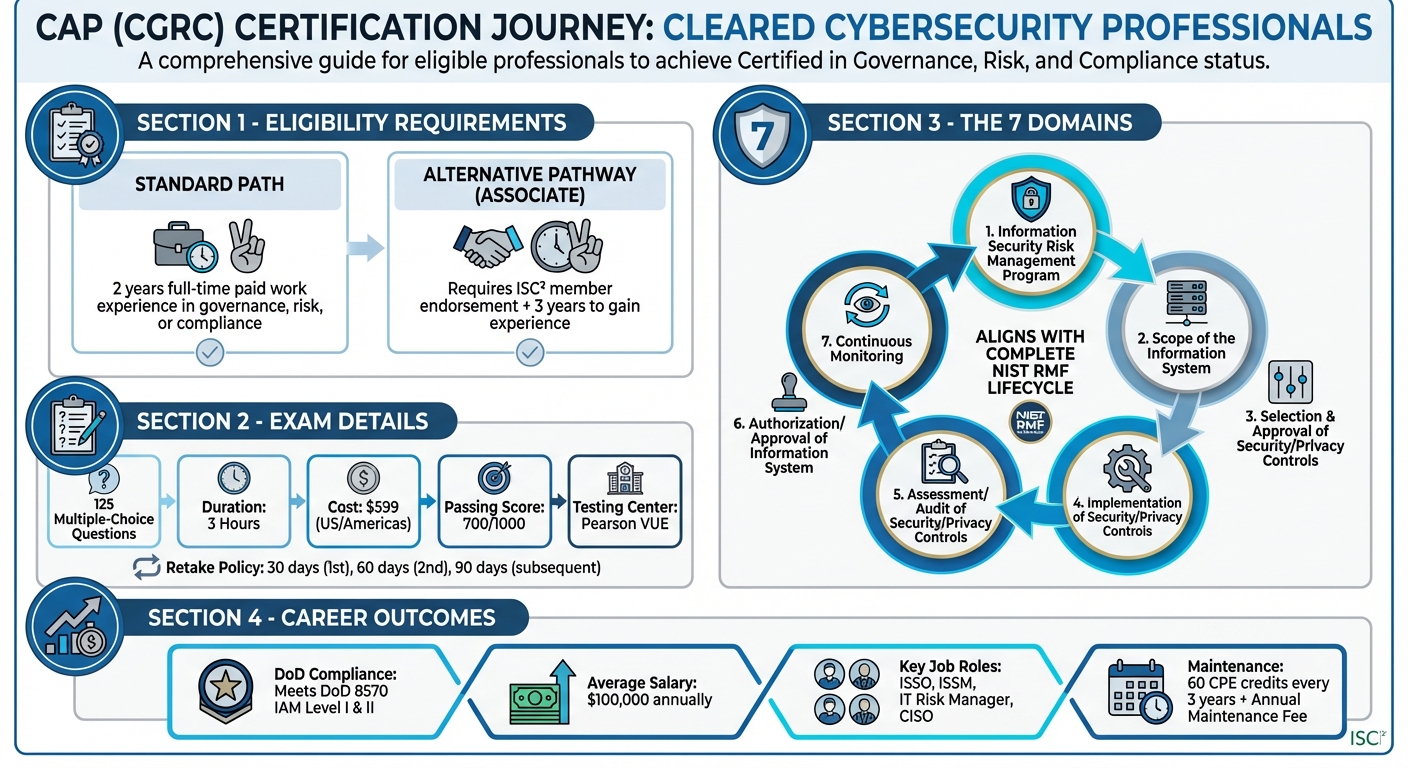
CAP Certification Path: Requirements, Exam Details, and Career Outcomes

CAP Certification Path: Requirements, Exam Details, and Career Outcomes

CAP Certification Exam Overview

Eligibility Requirements

To qualify for the CAP certification exam, candidates must have two years of full-time, paid work experience in at least one of the CAP domains. If you don’t meet this requirement, you can still take the exam through the Associate pathway. This pathway requires an endorsement from an (ISC)² member and allows you three years to gain the necessary work experience while holding the associate title. Work experience must be verifiable and relevant to governance, risk, or compliance. Once eligibility is confirmed, it’s time to focus on the exam format for effective preparation.

Exam Format and Content

The CAP exam, now referred to as the Certified in Governance, Risk and Compliance (CGRC) exam, includes 125 multiple-choice questions to be completed within three hours [5]. It is administered at Pearson VUE testing centers [5].

After completing the exam, you’ll get unofficial results immediately at the testing center. However, official results take six to eight weeks due to psychometric and forensic analysis [5]. If you don’t pass, there are specific waiting periods before retaking the exam: 30 days after the first attempt, 60 days after the second, and 90 days for subsequent attempts [5]. Successfully tackling these requirements is a key milestone for cybersecurity professionals working in cleared environments.

Cost and Registration Process

The CAP exam fee is set at $599 for candidates in the United States and the Americas [5]. Registration is straightforward – sign up for the CGRC exam through Pearson VUE, where you can schedule your test date and location [5].

Once you pass, keep an eye on your email for endorsement instructions. Completing this step is necessary to finalize your certification [5]. To keep your certification active, you’ll need to earn 60 Continuing Professional Education (CPE) credits every three years and pay an Annual Maintenance Fee [2].

sbb-itb-bf7aa6b

The 7 CAP Certification Domains

Domain Overview

The CAP exam is structured around seven domains, each representing a critical phase of the NIST Risk Management Framework (RMF). These domains guide candidates through the full lifecycle of managing and authorizing information systems, from setting up a risk management program to ensuring ongoing monitoring. The CAP/CGRC certification stands out as the only security credential under the DoD 8570 Mandate that aligns with every step of the NIST RMF [3]. Mastering these domains is essential for anyone preparing for the exam and aiming to excel in this field.

What You Need to Know for Each Domain

Each domain highlights key skills and knowledge areas for professionals working in secure and regulated environments.

  • Domain 1: Information Security Risk Management Program
    This domain establishes the groundwork for system authorization. It focuses on governance, organizational risk tolerance, aligning security with mission goals, and compliance with FISMA and OMB Circular A-130.
  • Domain 2: Scope of the Information System
    Here, the emphasis is on system categorization using FIPS 199 and NIST SP 800-60. It involves determining impact levels (low, moderate, or high) based on potential losses in confidentiality, integrity, and availability. Additionally, it defines system boundaries and components that require authorization.
  • Domain 3: Selection and Approval of Security and Privacy Controls
    This domain addresses selecting baseline controls from NIST SP 800-53 and tailoring them to specific environments. It also covers control overlays for DoD systems and documenting decisions in the System Security Plan.
  • Domain 4: Implementation of Security and Privacy Controls
    Focuses on applying chosen controls during the system development lifecycle (SDLC). It includes integrating security engineering principles and documenting the implementation in the System Security Plan.
  • Domain 5: Assessment/Audit of Security and Privacy Controls
    Covers testing methodologies from NIST SP 800-53A. Professionals learn to create assessment plans, perform control testing, and document results in a Security Assessment Report for independent validation.
  • Domain 6: Authorization/Approval of Information System
    This domain involves final risk determination and emphasizes the role of the Authorizing Official. It includes creating a Plan of Action and Milestones (POA&M) to secure an Authority to Operate (ATO).
  • Domain 7: Continuous Monitoring
    Focuses on maintaining continuous security monitoring as outlined in NIST SP 800-137. This includes managing configurations, vulnerabilities, and adapting to evolving threats to ensure ongoing compliance and maintain the ATO.

Study Tips for Each Domain

To prepare effectively, align your study efforts with the core elements of each domain using these strategies:

  • Dive into key NIST Special Publications, particularly SP 800-37 (RMF), SP 800-53 (Security Controls), SP 800-53A (Assessment), and SP 800-137 (Continuous Monitoring). These documents are central to the exam.
  • Approach the material with a managerial perspective. The exam focuses on governance and compliance decision-making rather than just technical details.
  • For professionals with security clearances, connect each domain to DoD-specific policies, such as the 8500 series and CNSS instructions. Relating your real-world experience to these domains can help pinpoint areas where you may need to deepen your understanding.

How to Prepare for the CAP Exam

Recommended Study Materials

The Official (ISC)² Guide to the CAP CBK, Second Edition by Patrick Howard is a key resource for exam preparation. It’s priced at about $52.92 for a new copy, with used versions available for as low as $6.65. While it has a solid 4.4/5-star rating on Amazon from 178 global reviews, keep in mind that it was published in 2012. This means it doesn’t include some of the newer RMF elements, like the "Preparation" step or roles such as SCA-R and SCA-V. Use it as a baseline resource, but supplement it with updated materials.

Another critical document is NIST SP 800-37 Rev 2, which outlines the RMF 2.0 process featured heavily on the exam. Pay close attention to Appendices D, E, F, and G for detailed insights. Before spending on additional materials, download ISC2’s free resources like the "Ultimate Guide to the CAP" and "Advance Your Risk Management Career Strategy" eBook. These can provide a solid starting point. Additionally, the Official ISC2 CAP Flash Cards are free and can help you test your knowledge on the go.

For practice questions, consider purchasing the book Certified Authorization Professional (CAP): Exam Questions and Annotated Answers for around $20.00. ISC2 also offers an Official CBK Training Seminar, which includes 180-day access to course content and a printable Student Guide. To connect with others preparing for the exam, join online communities like the ISC2 Community "CAP Certification Study Group" and the TechExams Community forum.

Creating Your Study Plan

Start by conducting a gap analysis across the seven CAP domains to identify where you’re strong and where you need improvement. Plan your study time based on the weight of each domain – spend more time on areas that account for a larger percentage of the exam. Scheduling your exam 6–10 weeks in advance (with a $599 fee) can help you stay focused and motivated by setting a clear deadline.

Two weeks before the test, take a full-length, three-hour mock exam with 125 questions to simulate the actual experience. This will help you build stamina and refine your pacing. Remember, your overall score determines whether you pass, so you don’t need to excel in every single domain – just aim for a strong total performance. If you don’t pass on your first try, plan for a 30-day review period before retaking the exam. Adjust your study plan accordingly to address any gaps.

Common Mistakes to Avoid

As you prepare, steer clear of these common errors: Focusing too much on technical controls while neglecting administrative, procedural, and legal aspects of the authorization process. The CAP exam evaluates your understanding of the entire risk management process, not just specific tools or programming knowledge. Always prioritize studying primary source material like NIST documentation rather than relying solely on third-party summaries.

Don’t overlook the full RMF lifecycle. While "Categorization" and "Selection" often get the most attention, areas like "Continuous Monitoring" and "Authorization" are equally important. Be sure you understand the responsibilities of key roles, such as the System Authorization Authority, the Assessor, and the System Owner, as these are central to the exam. Keep a managerial perspective that balances technical knowledge with governance and compliance, as this aligns with the holistic approach required for success on the CAP exam.

Career Benefits of CAP Certification

CAP and DoD 8570 Compliance
DoD 8570

The CAP certification, now referred to as CGRC by (ISC)², is a DoD Approved 8570 Baseline Certification that satisfies training requirements under both the DoD 8570 and the updated DoD 8140 standards. This certification is a critical requirement for many cleared professionals working in Information Assurance roles within federal agencies and defense contracting.

What sets CAP apart is its alignment with every phase of the NIST Risk Management Framework (RMF). This makes it indispensable for professionals tasked with managing risk assessment and creating security documentation throughout a system’s lifecycle. With the Department of Defense requiring all components to transition to the DoD Cyber Workforce Framework (DCWF) by fiscal year 2026, CAP certification ensures compliance with both current and legacy standards [7].

For cleared positions, certifications like CAP are often non-negotiable. Defense contracts frequently require baseline certifications, and candidates lacking these credentials can be automatically disqualified, regardless of their experience. This makes CAP not just a certification but a gateway to expanded career opportunities in the cleared community.

Job Roles for CAP-Certified Professionals

CAP-certified individuals often land roles that are both in-demand and well-compensated, with average annual salaries around $100,000 [4]. The certification qualifies professionals for Information Assurance Management (IAM) Level I and II roles, which focus on authorizing and approving RMF-related policies and procedures.

Job Category Specific Job Titles
Management & Oversight Chief Information Security Officer (CISO), GRC Director, Information Assurance Manager, IT Risk Manager
Technical & Engineering Information Systems Security Officer (ISSO), Information Systems Security Manager (ISSM), Cybersecurity Engineer, Authorization Specialist
Compliance & Audit Cybersecurity Auditor, Cybersecurity Compliance Officer, Information Systems Auditor, Third-Party Risk Manager

"IAM personnel are responsible for authorizing or approving RMF policy and procedure documents, so it is important they know and understand the RMF. That is why [CAP] is a valued certification." – Tyra Appleby, Systems Security Engineer [6]

Given the federal government and DoD’s reliance on RMF, CAP-certified professionals are especially sought after in regions like Washington, D.C., and Virginia [4]. During interviews, it’s beneficial to connect your professional experience to the seven domains of the CAP Common Body of Knowledge to highlight your expertise with RMF.

Finding CAP Jobs on Cleared Cyber Security Jobs
Cleared Cyber Security Jobs

Once certified, finding roles that value CAP becomes much easier. Cleared Cyber Security Jobs is a specialized job board designed for security-cleared professionals in the cybersecurity industry. The platform offers tools like targeted job filters, resume uploads, and alerts for positions requiring CAP certification, all tailored to the cleared workforce.

As a job seeker, you can search for roles such as ISSO, ISSM, and IAM-level positions that specifically require CAP certification. The platform connects you directly with employers looking for cleared professionals, bypassing staffing firms. It also offers job fairs, giving you the chance to meet hiring managers face-to-face.

For employers, the platform provides access to a resume database and job posting packages, making it easier to find professionals with CAP credentials. Since all job seekers must have U.S. citizenship and an active security clearance, the talent pool is highly qualified, simplifying the hiring process and increasing your chances of standing out as a candidate.

CGRC Certification Explained: Exam Details, Study Tips & Career Benefits

Conclusion

The CAP certification – now known as CGRC under (ISC)² – continues to be a key credential for professionals in authorization and compliance roles, especially those with security clearances. Its alignment with the NIST Risk Management Framework and its recognition for DoD 8570 IAM Level I and Level II positions make it a critical qualification for federal and defense contracting jobs. Without it, your access to many cleared opportunities could be restricted.

More than just meeting baseline requirements, the CAP certification paves the way for higher-level roles like CISO, IT Risk Manager, and Information Systems Auditor. Professionals holding this credential typically earn around $100,000 annually [4]. Its vendor-neutral nature ensures your skills are applicable across both public and private sectors, providing flexibility in career paths.

The certification also connects you to a global network of over 160,000 cybersecurity professionals through (ISC)² [1], offering opportunities for ongoing learning and professional development. This is particularly valuable in regions with high demand for cybersecurity expertise, such as Washington, D.C., and Virginia.

To maximize the benefits of your certification, showcase it prominently on your resume and highlight how your experience aligns with the seven CAP domains during interviews. This not only emphasizes your understanding of the Risk Management Framework but also demonstrates your ability to apply it practically. Remember to maintain your certification by earning 60 CPE credits every three years and paying the Annual Maintenance Fee [2].

Whether you’re starting out in authorization or aiming for leadership roles, the CAP certification establishes you as a trusted expert in governance, risk, and compliance – qualities that are in high demand among cleared employers.

FAQs

Is CAP the same as CGRC?

The CAP certification has been updated and is now called Certified in Governance, Risk and Compliance (CGRC). Despite the name change, it remains the same credential, with the new title emphasizing its focus on governance, risk, and compliance practices.

Can I take the CAP/CGRC exam without 2 years of experience?

To be eligible for the exam, you must have at least 2 years of paid work experience in one or more of the seven domains outlined in the CAP Common Body of Knowledge (CBK). This requirement is in place to ensure that candidates possess the hands-on experience needed to excel.

What CAP/CGRC study resources should I prioritize first?

To kick off your preparation, dive into the Official (ISC)2® Guide to the CAP® CBK®. This resource provides a detailed breakdown of the core knowledge areas covered in the exam. Pair this with the ISC2 CGRC/CAP exam outline, which gives a clear overview of the exam domains, helping you focus on the right topics.

Once you’ve reviewed these foundational materials, consider leveraging ISC2’s official prep tools and training courses. These resources are designed to deepen your understanding and ensure your study efforts align closely with the exam’s structure and content.
Related Blog Posts

  • CCSP Certification Career Guide for Cleared Cloud Security
  • CCSK Certification Career Guide for Cleared Cloud Knowledge
  • CRISC Certification Career Guide for Cleared Risk Professionals
  • CGRC Certification Career Guide for Cleared GRC Analysts

Related Guides

  • CGRC Certification Career Guide for Cleared GRC Analysts
  • CRISC Certification Career Guide for Cleared Risk Professionals
  • CASP Plus Certification Career Guide for Cleared Security Architects
  • Cybersecurity Salary Guide 2026
  • TS/SCI Salary Premium: Real 2026 Numbers

CGRC Certification Career Guide for Cleared GRC Analysts

CyberSecJobs Editorial · February 16, 2026 ·

The Certified in Governance, Risk, and Compliance (CGRC) certification is a must-have for cleared cybersecurity professionals. It validates expertise in frameworks like NIST RMF SP 800-37, FedRAMP, and ISO 27001 – essential for roles in federal and Department of Defense (DoD) environments. Recognized under DoDM 8140.03 and DoD 8570.01, this certification is highly sought after for IAM Level I and II positions.

Here’s what you need to know:

  • Eligibility: 2 years of relevant full-time experience in GRC domains or take the exam as an "Associate of ISC²" to gain experience later.
  • Exam Details: 125 multiple-choice questions, 3 hours, $599 fee, passing score: 700/1000.
  • Preparation: Focus on NIST RMF SP 800-37 Rev. 2, ISC² official resources, and practice tests. Study timelines range from 3–6 months.
  • Career Impact: Average U.S. salary for CGRC holders is $118,980–$135,430, with high demand in cleared roles like Information Systems Security Officer and Cybersecurity Risk Analyst.

If you’re in a cleared environment, the CGRC certification not only boosts your qualifications but also aligns with DoD requirements, opening doors to higher-paying, specialized roles.

Prerequisites and Eligibility for CGRC Certification

Eligibility Criteria

To earn the CGRC certification, you need 2 years of full-time paid experience in at least one of the seven domains outlined in the CGRC Common Body of Knowledge. Full-time work is defined as a minimum of 35 hours per week in roles related to information systems security, system authorization, or security risk management practices [8][10].

Professionals in cleared environments often meet these requirements through tasks such as conducting Authorization and Accreditation (A&A) activities, preparing authorization packages, or managing continuous monitoring programs. Roles like Information Assurance Manager, Cybersecurity Compliance Officer, or System Security Officer typically align with these criteria [8][9].

If you’ve worked part-time (20–34 hours per week), your experience can also count. For every 1,040 hours worked, you earn the equivalent of six months of full-time experience [8]. Don’t meet the experience requirement yet? You can still take the exam and earn the Associate of ISC2 designation, which gives you three years to gain the required experience [8][2]. The exam fee is $599, and there’s an annual maintenance fee of $135 [2].

This hands-on experience not only prepares you for the certification but also allows you to leverage your existing security clearance for further alignment with CGRC requirements.

How Security Clearance Complements CGRC

Your current security clearance can significantly enhance your CGRC application by demonstrating the skills and experience required for the certification. Cleared environments often operate under the NIST Risk Management Framework (RMF) SP 800-37, which forms the backbone of the CGRC exam [3][10]. If your work involves categorizing systems, selecting controls, or maintaining authorization packages, you’re already gaining the expertise needed for the certification.

The CGRC certification is recognized under DoD Directive 8140.03 and 8570.01 for Information Assurance Management (IAM) Level I and Level II positions [9][2]. This means that your cleared role not only qualifies you for the certification but also aligns with Department of Defense (DoD) requirements. Additionally, cleared workplaces often have a high number of ISC2-certified professionals, such as CISSPs, making it easier to find an endorser once you pass the exam [3].

As Dwayne Natwick, an ISC2 Authorized Trainer, explains: "The CGRC exam is based primarily on the NIST Risk Management Framework (RMF) 800-37… which the United States Federal Government utilizes to maintain compliance and reduce risks" [3].

sbb-itb-bf7aa6b

CGRC Certification Explained: Exam Details, Study Tips & Career Benefits

How to Earn the CGRC Certification

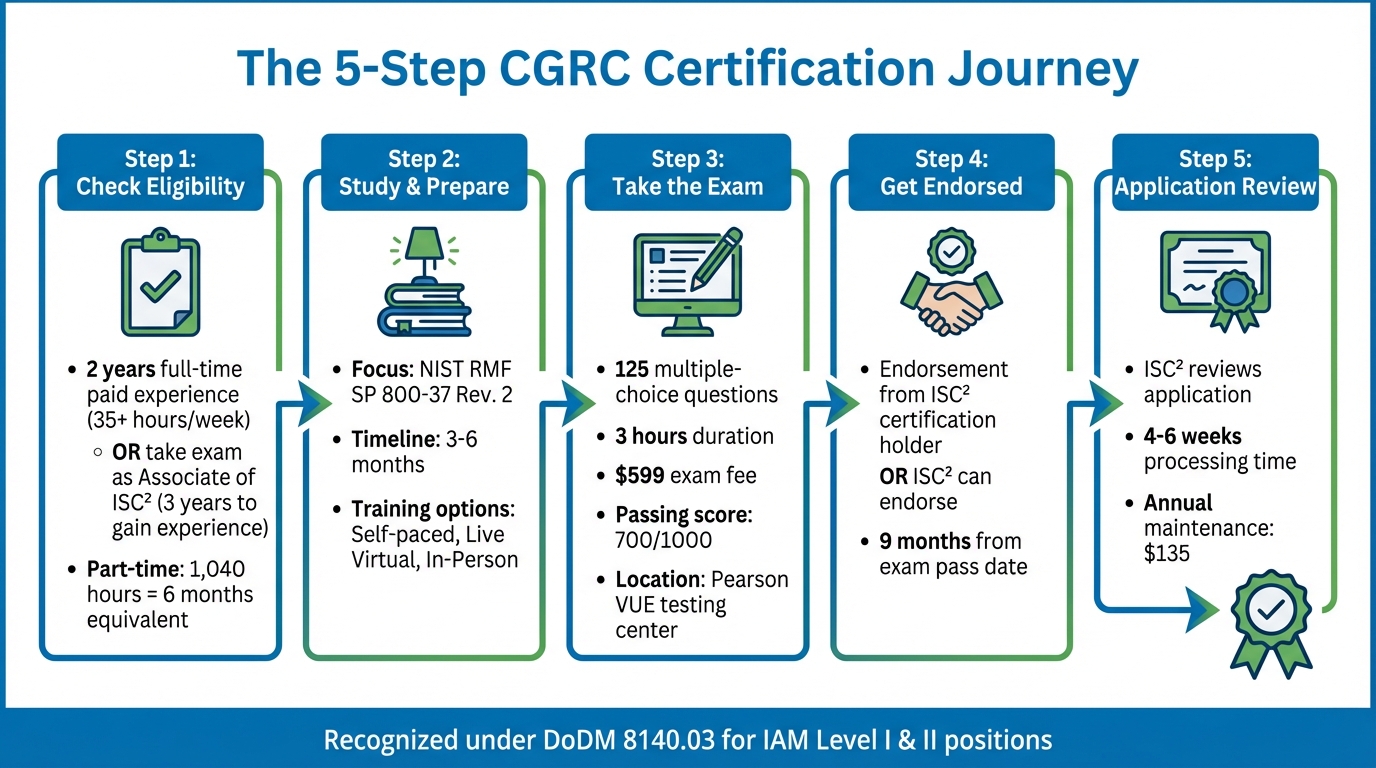
CGRC Certification Process: 5 Steps from Eligibility to Certification

CGRC Certification Process: 5 Steps from Eligibility to Certification

Steps to Certification

Earning the CGRC certification involves a clear, step-by-step process. First, ensure you meet the eligibility criteria: two years of relevant, full-time work experience. If you don’t yet have the required experience, you can still take the exam as an Associate of ISC² and gain up to three years to complete the necessary work experience [8][1].

Once you’ve confirmed your eligibility, your next priority should be studying the NIST Risk Management Framework (RMF) SP 800-37 Rev. 2, which forms the backbone of the exam content.

As Dwayne Natwick, an ISC² Authorized Trainer, explains: "The relationship between steps, tasks, and roles are necessary to pass the exam. The CGRC exam requires an expert level of understanding for the RMF and supporting tasks" [3].

To prepare, you can choose from ISC²’s official training options, which include self-paced courses, live virtual sessions, or in-person classroom training [5][11][13].

When you’re ready, schedule your exam through a Pearson VUE testing center. After passing, you’ll need an endorsement from a current ISC² certification holder who can verify your work experience. If you don’t know anyone with an ISC² credential, ISC² itself can act as your endorser [3]. Keep in mind, you have nine months from the date you pass the exam to complete this endorsement process [3].

The final step is ISC²’s review of your application, which usually takes 4–6 weeks [3]. This structured process is designed to help professionals manage their certification journey alongside their demanding professional responsibilities. With the steps laid out, it’s time to build a study plan that fits your schedule.

Preparation Timeline

For professionals juggling full-time work, a realistic study timeline is 3–6 months. Your familiarity with the NIST RMF will influence how much time you need. The exam covers seven domains, each with a specific weight, so it’s essential to allocate your study time strategically. For example, Domain 4 (Implementation of Security and Privacy Controls) has the highest weight at 17%, while Domain 1 (Governance, Risk Management, and Compliance Program) and Domain 5 (Assessment/Audit of Security and Privacy Controls) each account for 16% [10].

Here’s a suggested approach for a 3–6 month study plan:

  • Start with an overview of Domain 1 and NIST SP 800-37.
  • Move on to Domains 2 and 3, focusing on system scope and control selection.
  • Dedicate significant time to Domain 4, which emphasizes implementation.
  • Study Domain 5’s assessment procedures in detail.
  • Wrap up with Domains 6 and 7, and use the final weeks for practice tests, flashcards, and mapping RMF tasks to roles – a critical skill for passing the exam [3].

Consistency is key. ISC² even offers an Education Guarantee, allowing you to retake their official training course for free if you don’t pass the exam on your first try [11].

Study Resources for CGRC Certification

Official ISC² Resources

ISC² provides a range of official study tools to help you prepare for the 125-question, 3-hour CGRC exam. Start with the CGRC Exam Outline, which breaks down the seven domains, their weights, and the tasks you’ll be tested on. This document is essential for organizing your study plan effectively [10][12].

For training, ISC² offers three main options: Online Self-Paced (using adaptive learning technology to match your pace), Live Virtual (instructor-led online sessions), and In-Person classroom training [5][12]. The self-paced format is especially helpful if you’re juggling exam prep with a demanding cleared position [12][13].

Additional resources include the Official CGRC Flash Cards for quick reviews, Official Practice Tests to simulate the exam environment and improve timing, and the "Ultimate Guide to the CGRC." ISC² also offers specialized courses like the Risk Management Practitioner Certificate, which dives into practical risk analysis and standards relevant to the exam [12][3][14]. If you’re an ISC² Candidate, you can take advantage of discounts – 20% off official online training and up to 50% off textbooks [14]. These tools provide a solid foundation for your study efforts, particularly when tailored to cleared environments.

Cleared-Specific Study Materials

For cleared professionals, additional resources are available to address the unique requirements of their operational environments.

Since the CGRC exam is rooted in the NIST Risk Management Framework (RMF) SP 800-37 Rev. 2, studying NIST’s RMF SP 800-37 is a must. It’s a free resource available directly from NIST, and understanding the relationships between RMF steps, tasks, and roles is key to success [3].

Other essential documents include NIST SP 800-53 (security and privacy controls), FIPS 199/200 (system categorization), FedRAMP, FISMA, and CMMC. These frameworks are integral to the exam and are particularly relevant for professionals working in DoD or federal contracting environments [10][3]. ISC² also provides GRC Skill Builders, such as "Supply Chain Risk Management through Governance, Risk and Compliance", free for ISC² Members [3][14]. Lastly, joining the ISC² Community Study Groups allows you to connect with other candidates and exchange insights tailored to cleared roles [12][3].

Career Benefits of CGRC Certification for Cleared Professionals

The CGRC certification isn’t just a credential – it’s a career accelerator for cleared cybersecurity professionals. With its alignment to U.S. DoDM 8140.03 and DoD 8570.01, this certification opens doors to high-demand roles in government and contractor positions.

Cleared Roles That Benefit from CGRC

Earning the CGRC certification qualifies professionals for critical cleared roles, particularly in Information Assurance Management (IAM) Level I and Level II positions. These roles are pivotal for managing privileged access and ensuring compliance within the Department of Defense (DoD) [7][2]. By January 2026, over 5,000 professionals worldwide will hold this certification, underscoring its growing importance in the cleared cybersecurity field [7].

Here’s a snapshot of the roles where CGRC certification makes a tangible difference:

Role Average Salary (USD) Required Clearance Level CGRC Benefits
Information Systems Security Officer $110,000 – $140,000 Secret/Top Secret Validates RMF and authorization skills
Cybersecurity Risk Analyst $100,000 – $130,000 Secret/Top Secret Enhances risk assessment expertise
GRC Manager / Director $120,000 – $158,000 Secret/Top Secret Confirms leadership in compliance

GRC skills are in high demand, ranking as the second most sought-after skill (35%) for professionals aiming for promotions or new roles [6]. CGRC holders in North America enjoy an average salary of $134,522, while the global average stands at $110,006 [15]. These figures highlight the certification’s value in boosting earning potential and career progression.

Using CGRC for Promotions

The CGRC credential doesn’t just qualify you for specialized roles – it also positions you for leadership opportunities. By covering critical areas like Authorization/Approval and Governance, the certification helps professionals transition from technical roles to managerial positions.

"The CGRC credential recognizes that those who earn it have the knowledge, skills and ability in how to integrate governance, performance management, risk management and regulatory compliance within organizations."

  • ISC² [6]

For those with less than two years of experience, passing the exam to become an Associate of ISC² is a smart move. This designation signals to cleared recruiters that you’re on a fast track to leadership in GRC. It allows you to gain the necessary experience over three years while showcasing your technical expertise [1][2].

As organizations shift from threat-based to risk-based security models, the demand for professionals who can align IT objectives with risk tolerance is growing [4]. Additionally, with new regulations emerging around AI and other technologies, CGRC-certified professionals are well-prepared to tackle these challenges and lead the way [6].

Tips for Applying CGRC in Your Cleared Job Search

Your CGRC certification can be a game-changer when pursuing cleared GRC roles. To stand out in a competitive job market – where 89% of hiring managers prioritize cybersecurity credentials [16] – you’ll need to present your certification strategically.

Optimizing Your Resume

Craft your resume with precision, using terminology that aligns with the seven CGRC domains. Avoid vague phrases like "oversaw compliance initiatives." Instead, incorporate specific keywords such as "System Authorization", "POA&M", "Risk Register," and "Continuous Monitoring." These terms demonstrate your familiarity with the Authorization to Operate process and your ability to assist Authorizing Officials effectively.

Make sure "Certified in Governance, Risk and Compliance (CGRC)" is prominently displayed in your resume header and certifications section. Highlight your compliance with DoD 8570.01 and DoDM 8140.03 to ensure your resume clears automated filters for IAM Level I and Level II roles. If you’re still gaining experience, list your status as "Associate of ISC²" to show you’re actively working toward full certification.

When describing your experience, structure it around CGRC domains. Mention specific frameworks like NIST RMF, FISMA, FedRAMP, CMMC, and ISO/IEC 27001. Use targeted phrases such as "control tailoring", "vulnerability scanning," and "evidence validation," and note your involvement in processes like Change Control Boards. This approach highlights your hands-on expertise in control implementation, assessment preparation, and lifecycle management.

Searching for Cleared Jobs with CGRC

Platforms like Cleared Cyber Security Jobs provide specialized filters for security-cleared professionals seeking GRC roles. Use a variety of keywords when searching, including CGRC, RMF, NIST SP 800-37, System Authorization, A&A, Continuous Monitoring, and CAP (the certification’s former name). This ensures your search captures the full range of relevant opportunities.

Focus on positions that explicitly reference IAM Level I or IAM Level II, especially if you’re targeting Department of Defense contractor roles. These designations align with CGRC approval under DoDM 8140.03, making them a perfect fit for your certification.

Set up job alerts for sought-after titles like Information Assurance Manager, Cybersecurity Auditor, GRC Analyst, or Cybersecurity Risk & Compliance Project Manager. These roles not only leverage your CGRC certification but also position you for long-term growth within the cleared community.

Conclusion

The CGRC certification stands out as a strong career booster in the field of cleared cybersecurity. Recognized under DoDM 8140.03 for IAM Level I and Level II roles, it meets Department of Defense standards and confirms expertise in essential security frameworks. By early 2026, only 5,000 professionals worldwide are expected to hold this credential, placing you among a select group of specialists[5].

The pathway to certification is clear: confirm your eligibility or pursue the Associate of ISC² option, undergo focused training centered on NIST SP 800-37 Rev. 2, and follow the required steps to secure your endorsement. ISC² Authorized Trainer Dwayne Natwick highlights that grasping the connections between RMF steps, tasks, and roles is key to passing the exam[3].

Earning the CGRC certification can lead to roles like GRC Architect, Information Assurance Manager, or Cybersecurity Auditor – positions that come with competitive salaries and reflect the growing importance of managing cybersecurity as a business risk rather than just a technical issue[6].

To make the most of your certification, specialized job platforms can help you find roles tailored to your skills. Sites like Cleared Cyber Security Jobs offer tools like advanced filters and job alerts for security-cleared professionals. Searching with terms such as RMF, System Authorization, A&A, and Continuous Monitoring can help you uncover the full range of opportunities that align with your CGRC expertise.

FAQs

Is CGRC worth it if I already work in RMF?

Earning the CGRC certification is worth considering, even if you’re already working with RMF. It broadens your understanding of governance, risk, and compliance frameworks across various industries. Plus, it can open up new career opportunities. This certification highlights your expertise, helping you stand out in the competitive field of cleared cybersecurity.

How can I use CGRC to qualify for IAM Level I/II roles?

The CGRC certification highlights your skills in governance, risk management, and compliance – essential for IAM Level I/II positions. To be eligible, you’ll need at least two years of full-time experience in areas such as security and privacy governance. Together, this certification and experience demonstrate your capability to handle access controls and implement security frameworks with confidence.

What should I study first for the CGRC exam?

To prepare for the CGRC exam, begin by thoroughly reviewing the official exam outline. This document highlights the key areas you’ll need to master, such as security governance, risk management, and controls implementation. It’s your roadmap to understanding the exam’s structure and the topics you’ll encounter.

Once you’re familiar with the outline, use official study tools like flashcards and practice quizzes to test your knowledge. These tools can help pinpoint the areas where you need more work, allowing you to focus your efforts on the most challenging topics.

By prioritizing the exam outline and leveraging these resources, you’ll create a more targeted and efficient study plan.

Related Blog Posts

  • GSEC Certification Career Guide for Cleared Security Essentials
  • GCWN Certification Career Guide for Cleared Windows Security
  • GRID Certification Career Guide for Cleared Incident Response
  • CRISC Certification Career Guide for Cleared Risk Professionals

Related Guides

  • CAP Certification Career Guide for Cleared Authorization Pros
  • CRISC Certification Career Guide for Cleared Risk Professionals
  • CASP Plus Certification Career Guide for Cleared Security Architects
  • Cybersecurity Salary Guide 2026
  • TS/SCI Salary Premium: Real 2026 Numbers

CRISC Certification Career Guide for Cleared Risk Professionals

CyberSecJobs Editorial · February 16, 2026 ·

If you’re in cybersecurity with a security clearance, the CRISC certification (Certified in Risk and Information Systems Control) is a powerful way to transition into IT risk management roles. Offered by ISACA, this certification focuses on enterprise IT risk management and is highly valued in cleared environments. Here’s what you need to know:

  • What it Covers: CRISC prepares you to identify, analyze, and manage IT risks while aligning them with business goals. It includes four domains: Governance, Risk Assessment, Risk Response and Reporting, and Technology and Security.
  • Earnings Potential: CRISC-certified professionals earn an average of $151,000 annually, with salaries reaching $165,000+ in senior roles.
  • Exam Details: The exam includes 150 multiple-choice questions, requires a passing score of 450/800, and covers the four domains. You need at least three years of work experience in two of the domains to qualify.
  • Updates: As of November 2025, the exam includes material on AI, machine learning, and data governance.

Whether you’re aiming to boost your salary, enhance your career, or improve your risk management skills in classified settings, CRISC certification is a strong choice for cleared professionals. Keep reading for exam preparation tips, career paths, and how to apply CRISC skills in secure environments.

How to Prepare for the New CRISC Exam 2025: Strategy & Tips

sbb-itb-bf7aa6b

What is CRISC Certification?

The Certified in Risk and Information Systems Control (CRISC) credential, offered by ISACA, highlights expertise in identifying, analyzing, and managing IT risks [6]. This certification has become a benchmark for mid-career professionals in cybersecurity and risk management. Accredited by the American National Standards Institute (ANSI), it’s recognized worldwide by government agencies for adhering to industry-standard risk management practices [5]. It’s designed to equip professionals with the tools needed to tackle practical, real-world risk management challenges.

For professionals in cleared environments, CRISC bridges the gap between technical risk and actionable business insights, ensuring alignment with organizational goals [7].

"Being able to communicate in a language the business understands and connecting the dots with the organization’s goals and objectives is crucial to being successful in getting the resources you need to do the job properly",
explains Matthew Henshaw, Coordinator of Information Technology at Annapolis Valley Regional Centre for Education [7].

The exam itself consists of 150 multiple-choice questions, completed in 4 hours. A passing score of 450 on a scale of 200–800 is required, along with at least three years of relevant experience in two of the CRISC domains [4][6]. Candidates have five years from the exam date to apply for the official certification [4][5].

The 4 CRISC Domains

The CRISC exam is divided into four key domains, each critical for professionals working in government and cleared cybersecurity roles:

  • Domain 1: Governance (26%) focuses on organizational strategy, risk appetite, and frameworks like the Risk Management Framework (RMF). In government settings, this involves aligning security practices with mandates such as FISMA and NIST RMF [7].
  • Domain 2: Risk Assessment (22%) addresses threat modeling, vulnerability analysis, and risk scenarios. This is especially vital for safeguarding classified systems and understanding their impact on national security [2][10].
  • Domain 3: Risk Response and Reporting (32%) emphasizes the design and implementation of controls, as well as monitoring their effectiveness. Cleared professionals often apply this by managing NIST SP 800-53 controls and reporting system status to Authorizing Officials (AOs) [7].
  • Domain 4: Technology and Security (20%) covers security principles, data privacy, and disaster recovery. This domain ensures the protection of Controlled Unclassified Information (CUI) and the resilience of critical functions [3].
CRISC Domain Weight Application in Government Roles
Domain 1: Governance 26% Aligning with NIST RMF and adhering to FISMA requirements.
Domain 2: Risk Assessment 22% Threat modeling for classified systems and impact analysis.
Domain 3: Risk Response & Reporting 32% Managing NIST SP 800-53 controls and audit preparations.
Domain 4: Technology & Security 20% Ensuring data privacy and disaster recovery for sensitive systems.

These domains collectively provide professionals with the skills to address both strategic and operational risks in classified environments.

Why CRISC Matters for Cleared Cybersecurity Professionals

CRISC certification is particularly relevant for professionals working within government frameworks, as it ties directly to the Risk Management Framework (RMF) and NIST guidelines. These frameworks are essential for maintaining the Authority to Operate (ATO) in cleared environments, where adherence to governance and compliance standards is mandatory [2][7]. CRISC helps bridge the gap between technical cybersecurity measures and strategic decision-making, enabling professionals to communicate risks effectively to non-technical stakeholders and senior leadership [6][7].

Starting November 3, 2025, the CRISC exam will include updated material on risks associated with Artificial Intelligence (AI) and Machine Learning (ML). This ensures that certified professionals are prepared to adapt governance strategies for emerging technologies [3].

"The updated CRISC exam… provides comprehensive coverage of the current aspects of ML and AI, giving security professionals the knowledge they need to adapt frameworks, risk registers and compliance layers to meet modern demands",
notes Steven Lawrence, a security professional [3].

With this expanded focus, CRISC-certified professionals are well-positioned to build frameworks that address new threats, ensuring compliance with evolving regulations [3].

Eligibility and Exam Requirements

CRISC Prerequisites

To earn the CRISC certification, you need at least three years of professional experience in IT risk management and information systems control. This experience must be within the 10 years prior to your application or within five years after passing the exam [11][12]. Importantly, your work must cover at least two of the four CRISC domains. No degree or certification can replace this hands-on requirement [11].

For professionals with security clearances, this experience often aligns naturally with their roles. For instance, if you’ve worked as an Information System Security Officer (ISSO) or an Information System Security Manager (ISSM), your familiarity with the Risk Management Framework (RMF) likely overlaps with CRISC domains. Tasks like Security Assessment and Authorization (A&A) align with Domain 2 (Risk Assessment), while implementing controls ties to Domain 4 (Technology and Security) [2].

However, verifying experience in classified environments can be tricky. ISACA requires an independent verifier – such as a supervisor, manager, colleague, or client – who can confirm your work. Human Resources staff and family members are not eligible to serve as verifiers [11]. While classified details don’t need to be disclosed, the verifier must attest to the nature of your tasks and how they align with specific CRISC domains.

You can take the CRISC exam even if you haven’t yet met the full experience requirement. ISACA allows a five-year window after passing the exam to gain and submit the necessary verified experience [4][12]. Once your experience is verified, you’ll be on track to earn the certification.

Exam Format and Structure

The CRISC exam evaluates your expertise across its four domains, with a clear structure and specific time and fee requirements. Scores range from 200 to 800, and you’ll need at least 450 to pass. Results are typically sent within 10 business days [6].

The exam is weighted across the domains as follows:

  • Governance: 26%
  • Risk Assessment: 22%
  • Risk Response and Reporting: 32%
  • Technology and Security: 20% [2]

To manage your time effectively, aim to spend about 1.5 minutes on each question [12].

You can take the exam at authorized PSI testing centers or opt for remote online proctoring, making it accessible even for professionals in secure or remote locations [1]. The registration fee is $575 for ISACA members and $760 for non-members, with a $50 application fee required upon certification. Maintaining your certification involves an annual fee of $45 for members or $85 for non-members [4][1]. If needed, candidates can attempt the exam up to four times in a 12-month period [6].

"The CRISC is designed for IT risk, control and compliance practitioners, business analysts, project managers and other IT and business professionals who have three years of risk management and information system control experience within the past ten years", explains Lisa Cook, GRC Professional Practices Principal at ISACA [12].

This structure ensures that professionals, even those in high-security roles, can efficiently demonstrate their skills and knowledge.

Benefits of CRISC Certification for Cleared Professionals

CRISC certification isn’t just about boosting your paycheck – it’s about sharpening the skills needed to manage risk effectively in classified environments. Below, we’ll explore how this credential impacts financial outcomes, risk management expertise, and career advancement for cleared professionals.

Salary and Career Advancement

CRISC-certified professionals enjoy impressive salaries, with an average base of $148,000 per year as of December 2025 [13]. At top defense contractors like Booz Allen Hamilton, salaries for these professionals range from $147,900 to $165,000 [13][9].

On average, CRISC-certified individuals earn 10% to 15% more than their non-certified counterparts [15]. In high-cost regions or executive roles, salaries can even surpass $204,000 [15]. With only about 46,000 certified professionals worldwide [15][9], this scarcity makes CRISC holders highly sought-after for senior risk positions.

The certification also accelerates career progression. Over half (52%) of CRISC holders report noticeable performance improvements on the job after earning the credential [18]. It’s a recognized differentiator in Governance, Risk, and Compliance (GRC) leadership roles, often paving the way for a seat at the executive table.

"If your career trajectory involves translating technical risk into business decisions, CRISC belongs on your certification roadmap",

  • Ken Sahs, Training Camp [15].

While the financial perks are appealing, the real value lies in the enhanced ability to manage risk strategically.

Improved Risk Management Skills for Cleared Work

CRISC certification emphasizes translating technical vulnerabilities into clear, actionable business terms. This is especially critical in cleared environments, where communicating risks to non-technical stakeholders is a daily challenge. The certification equips professionals to assess and explain risks in terms of likelihood, impact, and residual exposure [9].

For cleared professionals, these skills are essential when managing third-party security and compliance in government or classified settings. CRISC training also includes building Key Risk Indicator (KRI) dashboards that align with board-level expectations, shifting focus from reactive troubleshooting to proactive resilience planning [9].

"Organizations prefer candidates with a CRISC certification as it signifies a commitment to quality work methods and skills that help improve business performance",

  • John Davies, Cyber Security Governance & Assurance Specialist [17].

Additionally, the certification prepares professionals for emerging challenges, such as AI risk assessment, data governance, and ethical considerations – key areas for tackling evolving threats in classified systems [1].

Comparison: CRISC-Certified vs. Non-Certified Professionals

The advantages of CRISC certification become even clearer when comparing certified and non-certified professionals:

Feature CRISC-Certified Professional Non-Certified Professional
Average Salary $147,000 – $165,000 [15][9] 10-15% lower [15]
Advancement Rate Faster path to leadership/management [15][16] Standard technical career growth [9]
Risk Expertise Enterprise-level governance & business impact [9] Often limited to technical severity [9]
Employer Demand High in GRC, Banking, and Government [15][9] General IT/Security demand [9]

The Bureau of Labor Statistics projects 29% job growth for Information Security Analysts – roles often filled by CRISC-certified professionals – through 2034, with a median salary of $124,910 [6]. Additionally, tech occupations are expected to grow at twice the national average over the next decade, with median salaries about 130% higher than those in other fields [14].

How to Prepare for CRISC Certification

Study Materials and Resources

To start, the ISACA Review Manual is a must-have. It covers all four domains of the CRISC exam and is available in both digital and print formats. If you like the convenience of quick searches and instant access, the digital version is for you. Prefer flipping through physical pages? The print version has you covered.

Another helpful resource is the CRISC Questions, Answers & Explanations (QAE) Database. This tool includes between 833 and 983 practice questions, each with detailed explanations. A 12-month subscription costs around $399 and is a great way to pinpoint areas where you might need extra practice.

For a more interactive experience, ISACA’s self-paced Online Review Course offers video lessons, case studies, and downloadable aids. These resources are perfect for professionals juggling busy schedules, as they let you study in your own time.

Need advice or have questions? The ISACA Engage Community is an online forum where members can connect with experts from around the world. Plus, ISACA provides a free 10-question quiz to help you assess your starting point before diving into more in-depth materials.

Study Timeline and Schedule

Once you have your materials, a solid study plan is key. Most people spend between 120 and 150 hours preparing for the CRISC exam, typically over three to six months. Setting daily goals can help you avoid cramming and burnout.

One popular strategy is the 100-day study plan. Here’s how it works: dedicate 90 minutes a day to cover four pages of the review manual and answer 20 practice questions. Since the exam content is weighted, you’ll want to focus your time accordingly:

  • Risk Response and Reporting: 32%
  • Governance: 26%
  • IT Risk Assessment: 22%
  • Information Technology and Security: 20%

"CRISC is an exam that appears to test you on ‘which is the better decision’ rather than ‘which is the best technology’."

  • Louis Cremen, Cyber Security Trainer [19]

Before your test date, take at least one full-length mock exam under timed conditions. This helps you get comfortable with the exam format and builds the stamina you’ll need on test day. During the final week, focus on reviewing ISACA’s governance-focused methodology and completing full-length practice tests.

If you’re balancing a packed schedule, ISACA offers a remotely proctored exam option. You can take the test from home under strict monitoring. Alternatively, exams are available at PSI testing centers, and you can schedule them as soon as 48 hours after payment.

This structured approach not only prepares you for the exam but also ensures you’re ready to apply CRISC knowledge in high-security roles.

Using Cleared Cyber Security Jobs for Certification Support

Cleared Cyber Security Jobs

As you prepare for the exam, don’t overlook career resources that can help you land CRISC-related roles. Cleared Cyber Security Jobs is a platform tailored for professionals with active security clearances. You can set up job alerts for CRISC-specific positions within government agencies or defense contractors, saving you time by filtering out irrelevant listings.

The platform also hosts job fairs, giving you the chance to meet hiring managers face-to-face. These events are a great way to discuss how your CRISC certification can address their risk management needs.

Career Paths for CRISC-Certified Cleared Professionals

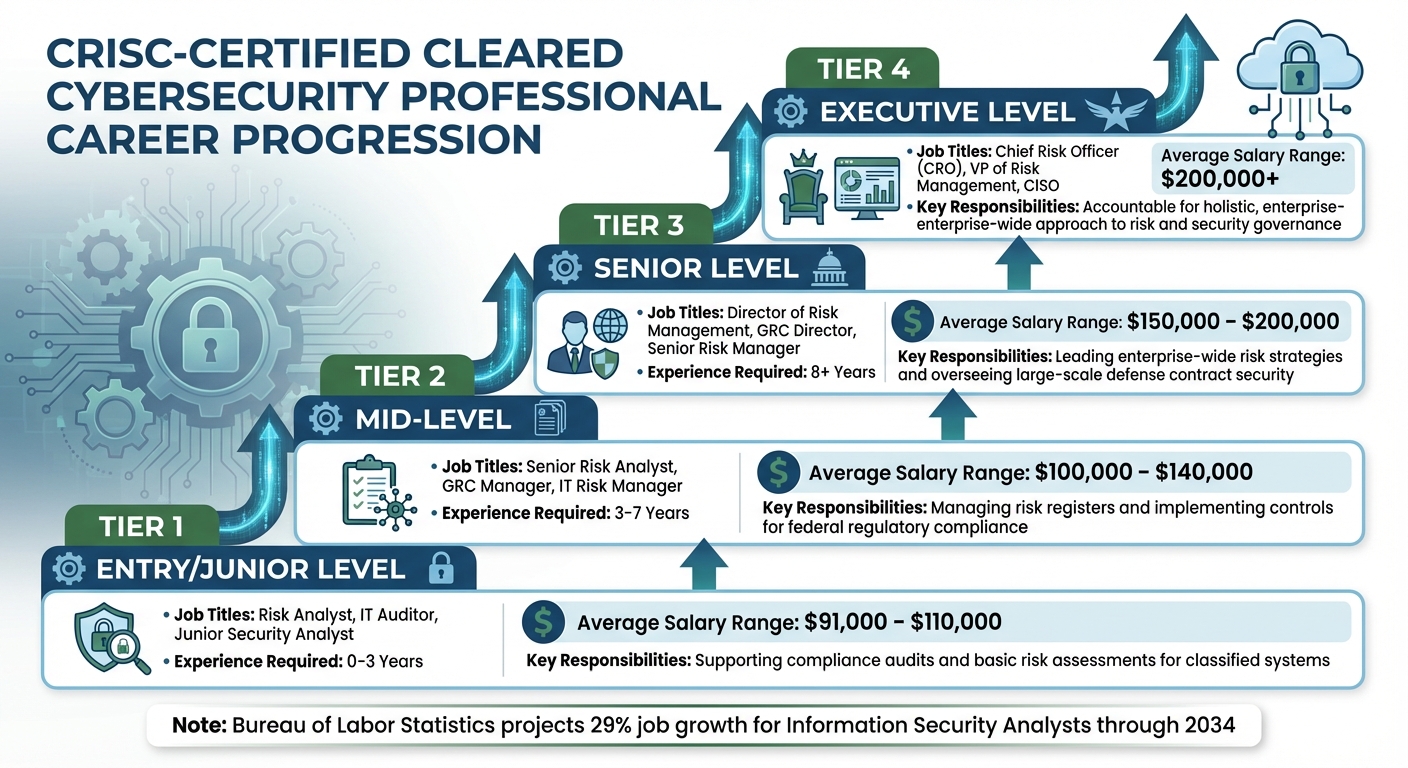
CRISC Career Progression Path for Cleared Cybersecurity Professionals

CRISC Career Progression Path for Cleared Cybersecurity Professionals

Common Job Roles for CRISC Professionals

Earning a CRISC certification opens doors to a variety of roles for cleared professionals, including IT Risk Manager, GRC Analyst/Manager, Information Security Manager, IT Auditor, Data Protection Officer, Compliance Auditor, Security Engineer, Cybersecurity Risk Analyst, Third-Party Risk Manager, and Cloud Security Risk Specialist. These positions focus on safeguarding classified systems and ensuring the security of mission-critical operations[6][8].

For instance, an IT Risk Manager working with defense contractors doesn’t just evaluate general IT risks – they also assess threats to classified information. Their work ensures that security measures align with both organizational objectives and federal compliance standards. These roles provide various entry points, allowing professionals to expand their responsibilities and expertise over time in the field of risk management.

Career Progression with CRISC

The career path for CRISC-certified professionals often starts with entry-level positions like Risk Analyst or IT Auditor, where the focus is on supporting compliance efforts and conducting initial risk assessments for classified systems[8]. As they gain experience, professionals move into mid-level roles such as Senior Risk Analyst, GRC Manager, or IT Risk Manager, where responsibilities include managing risk registers and implementing controls to meet federal compliance standards[8].

At the senior level, roles like Director of Risk Management or GRC Director involve leading enterprise-wide risk strategies, particularly for large-scale defense contracts[8]. For those with over a decade of experience, executive roles such as Chief Risk Officer (CRO), VP of Risk Management, or CISO become attainable. These positions demand a comprehensive, enterprise-wide focus on risk and security governance, especially in classified and mission-critical environments[8].

"CRISC certification positions you to bridge this gap between technical implementation and business risk assessment." – Rob Witcher, CEO, Destination Certification[8]

The demand for professionals in this field is growing rapidly. The Bureau of Labor Statistics anticipates a 29% growth rate for Information Security Analysts between 2024 and 2034[6]. Globally, there are over 30,000 CRISC-certified professionals[6], with an average annual salary exceeding $151,000[6]. This highlights the strong financial and career growth opportunities available to cleared professionals with this certification.

CRISC Career Progression Table

Career Stage Typical Job Titles Experience Required Average Salary Range Relevance to Cleared Environments
Entry/Junior Risk Analyst, IT Auditor, Junior Security Analyst 0-3 Years $91,000 – $110,000 Supporting compliance audits and basic risk assessments for classified systems.
Mid-Level Senior Risk Analyst, GRC Manager, IT Risk Manager 3-7 Years $100,000 – $140,000 Managing risk registers and implementing controls for federal regulatory compliance.
Senior Director of Risk Management, GRC Director, Senior Risk Manager 8+ Years $150,000 – $200,000 Leading enterprise-wide risk strategies and overseeing large-scale defense contract security.
Executive Chief Risk Officer (CRO), VP of Risk Management, CISO 10+ Years $200,000+ Accountable for a holistic, enterprise-wide approach to risk and security governance.

Applying CRISC Skills in Cleared Environments

Managing Risk in Classified Systems

CRISC-certified professionals rely on structured frameworks to address risks that could compromise national security. At the core of their work is the NIST Risk Management Framework (RMF), particularly in how CRISC Domain 2 (Risk Assessment) aligns with the RMF’s "Categorize" and "Select" steps. These steps involve determining the potential impact of classified data loss. To evaluate threats, professionals turn to STRIDE threat modeling – a method that identifies risks like Spoofing, Tampering, Repudiation, Information Disclosure, Denial of Service, and Elevation of Privilege. This helps them understand how adversaries might exploit vulnerabilities in secure networks.

Adversary profiling is another key tool. It examines threat actors based on their capability, intent, stealth, and persistence. For example, countermeasures for a nation-state actor targeting defense systems differ significantly from those for an insider threat. By analyzing these factors, professionals can design tailored defense strategies. When assessing classified systems, they carefully distinguish between technical vulnerabilities, procedural gaps, and organizational weaknesses.

To make risk management actionable, professionals develop "what-if" scenarios that connect specific threats to classified assets. These scenarios translate technical vulnerabilities into insights that authorizing officials can use to make informed decisions[8]. This approach highlights how CRISC-certified individuals turn technical assessments into strategic actions, particularly in high-security environments.

Implementing Compliance Controls

Beyond risk assessments, CRISC-certified professionals are skilled at establishing strong compliance measures within cleared environments. CRISC Domain 1 plays a key role in the "Prepare" and "Categorize" phases, while Domain 3 is critical for the "Implement", "Authorize", and "Monitor" stages. These efforts ensure alignment with NIST SP 800-53 controls, which were updated on August 27, 2025[20]. Staying current with these updates, including those driven by Executive Order 14306, is essential.

To maintain compliance, professionals engage in continuous monitoring, which helps sustain an Authority to Operate (ATO) for classified systems. They use Key Risk Indicators (KRIs) and Key Control Indicators (KCIs) to manage risks in near real-time – a priority for federal agencies. Risk registers are another crucial tool, tracking "inherent" risks versus "residual" risks for systems handling Controlled Unclassified Information (CUI) or higher classifications. Meanwhile, the Three Lines of Defense model ensures clear accountability across operational management, risk/compliance functions, and internal audits.

When third-party vendors require access to sensitive data, CRISC professionals evaluate whether those vendors’ security practices align with the organization’s risk tolerance. They also create Security, Privacy, and Cybersecurity Supply Chain Risk Management Plans in line with NIST SP 800-18r2 guidance. This ensures that compliance controls not only protect classified assets but also meet federal regulatory standards effectively.

Conclusion

The CRISC certification brings three key advantages: access to leadership opportunities, higher earning potential, and improved risk management expertise. On average, CRISC-certified professionals earn between $150,000 and $165,000 annually, with senior roles often surpassing $180,000 [9]. Beyond salary, CRISC equips professionals with the ability to communicate technical risks in business terms, bridging the gap between IT vulnerabilities and their broader business impact [9]. This skill can significantly accelerate career growth into senior risk management roles.

"CRISC’s greatest real-world strength lies in bridging the gap between security operations and executive strategy. It often becomes the credential that earns professionals a seat at decision-making tables." – Expert Takeaway, Programs.com [9]

These benefits are particularly valuable in cleared environments, where enterprise IT risk management is critical to meeting strict regulatory requirements. With the demand for Information Security Analysts expected to grow by 29% from 2024 to 2034 [6], CRISC-certified professionals are well-prepared to address this rising need.

Cleared Cyber Security Jobs offers a dedicated platform for showcasing your CRISC certification. It connects you with employers who prioritize security clearance and risk management expertise. You can upload your resume, set up job alerts, and access career resources tailored to the cleared community – all completely free.

FAQs

Does CRISC meet DoD 8570/8140 requirements?

Yes, the CRISC certification aligns with the DoD 8570/8140 requirements. It is officially recognized within the Department of Defense’s cyber workforce framework and qualifies for over 85% of the approved work roles listed in the DoD 8140 Cyber Workforce Qualification Provider Marketplace. This recognition makes CRISC an important credential for professionals seeking cleared positions that adhere to these standards.

How do I verify CRISC experience without sharing classified details?

To validate your CRISC experience, you’ll need to fill out a comprehensive work experience form. Make sure to clearly describe your roles and responsibilities within the relevant domains. Be careful not to include any sensitive or classified information – this ensures that verifiers can evaluate your qualifications without exposing restricted details.

Which CRISC domain matters most for RMF/ATO work?

The Governance domain, which makes up 26% of the CRISC exam, is the most relevant for RMF/ATO work. This area emphasizes organizational strategy, policies, standards, and the impact of IT risk on business objectives. Its focus aligns directly with the demands of RMF/ATO processes, making it a key area of expertise for professionals in these roles.

Related Blog Posts

  • CISM Certification Career Guide for Cleared Security Managers
  • CISA Certification Career Guide for Cleared IT Auditors
  • GSEC Certification Career Guide for Cleared Security Essentials
  • CySA Plus Certification Career Guide for Cleared SOC Analysts

Related Guides

  • CAP Certification Career Guide for Cleared Authorization Pros
  • CGRC Certification Career Guide for Cleared GRC Analysts
  • CASP Plus Certification Career Guide for Cleared Security Architects
  • Cybersecurity Salary Guide 2026
  • TS/SCI Salary Premium: Real 2026 Numbers

GCP Security Certification for Cleared Cloud Architects

CyberSecJobs Editorial · February 15, 2026 ·

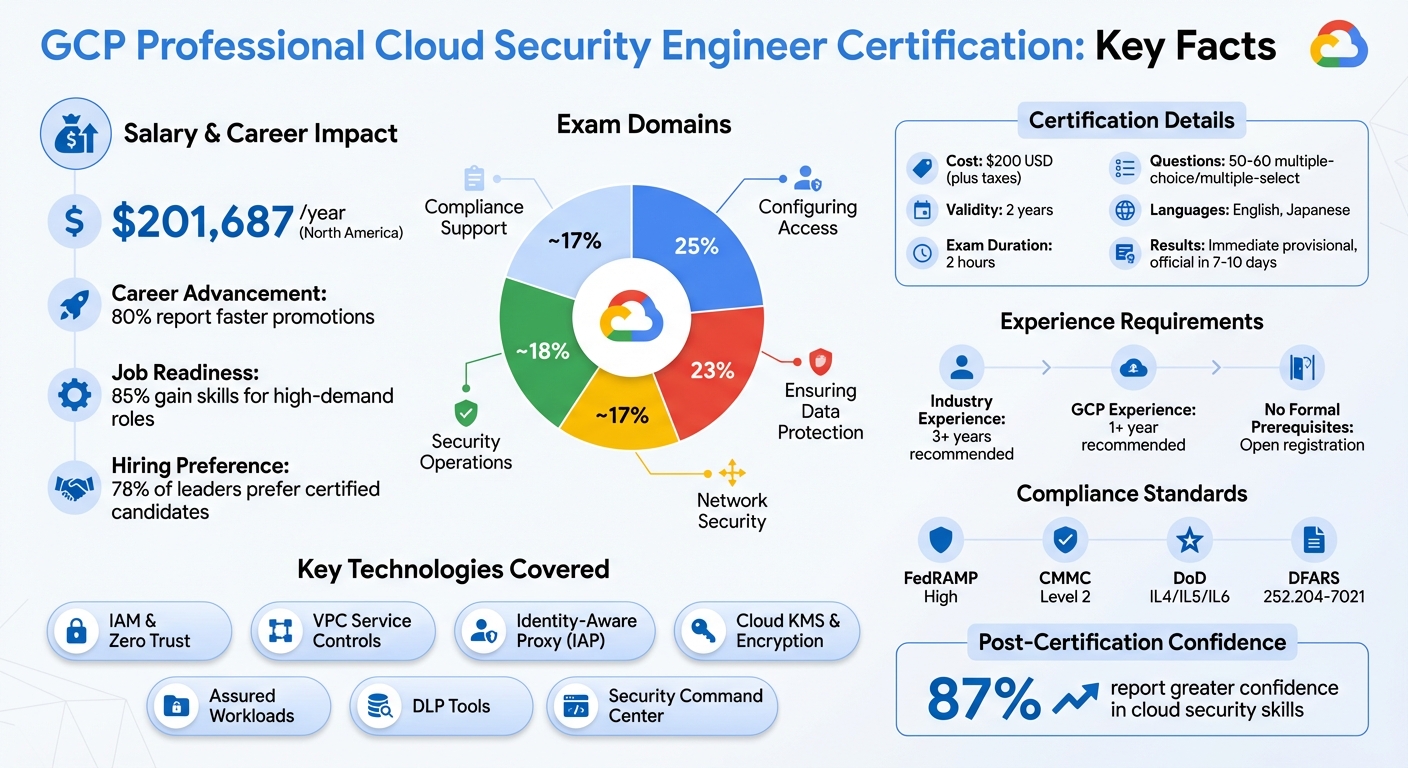
The Google Cloud Professional Cloud Security Engineer Certification is a key credential for cloud architects managing classified data in government and defense sectors. It validates expertise in securing workloads on Google Cloud using tools like Zero Trust, Identity-Aware Proxy (IAP), and VPC Service Controls. With an average salary of $201,687/year in North America, this certification offers significant career growth opportunities, especially for professionals with security clearances.

Key Details:

  • Focus Areas: Access configuration, data protection, network security, compliance, and operations management.
  • Cost: $200 USD (plus taxes), valid for two years.
  • Recommended Experience: 3+ years in the industry, with 1+ year on Google Cloud.
  • Skills Tested: IAM, encryption, VPC Service Controls, Assured Workloads, and more.

This certification is highly relevant for cleared professionals working on Top Secret and Secret missions, aligning with compliance standards like FedRAMP and CMMC Level 2. It ensures readiness for high-stakes roles in securing sensitive government systems.

GCP Professional Cloud Security Engineer Certification Overview: Costs, Salary, and Key Stats

GCP Professional Cloud Security Engineer Certification Overview: Costs, Salary, and Key Stats

How I passed the GCP Professional Cloud Security Certification

sbb-itb-bf7aa6b

What Is the Google Cloud Professional Cloud Security Engineer Certification?

Google Cloud

This certification confirms your ability to secure Google Cloud workloads while adhering to industry standards and best practices [1][8]. It highlights your expertise in designing secure solutions using Google’s security technologies and enforcing regulatory controls essential for high-security environments. Google describes the role as:

"A Cloud Security Engineer allows organizations to design and implement secure workloads and infrastructure on Google Cloud. Through an understanding of security best practices and industry requirements, this individual designs, develops, and manages a secure solution by using Google security technologies." [1]

The certification has adapted to address modern security priorities, such as securing AI workloads, protecting the software supply chain, and automating security processes. These areas are becoming increasingly relevant for government and defense sectors [1]. It focuses on key security domains essential for safeguarding sensitive and classified data.

What the Certification Covers

The certification is built around five core domains that align with the needs of cleared environments. These include:

  • Configuring Cloud Identity, IAM, and access controls
  • Securing network communications with VPC security and firewalls
  • Protecting data using encryption and Data Loss Prevention (DLP) tools
  • Managing security operations through logging and incident response
  • Supporting compliance with regulatory frameworks [1][8]

For cleared cloud architects managing classified data, the exam tests your knowledge of tools like Assured Workloads for compliant deployments, VPC Service Controls for establishing security perimeters, and Sensitive Data Protection tools for discovering and redacting sensitive information [12]. You’ll also need to demonstrate proficiency with Cloud HSM, Cloud External Key Manager, and Confidential Computing to safeguard data at rest, in transit, and in use [12].

The certification also validates your understanding of digital sovereignty and data residency requirements. Using Sovereign Controls by Partners and configuring data residency services, you’ll address the strict location requirements of federal workloads. These skills are critical for meeting standards like FedRAMP and DoD Impact Levels, which govern cleared cloud environments [12].

Core Skills Tested by the Certification

The exam emphasizes practical applications of security across Google Cloud’s technology stack. In identity and access management, you’ll configure service accounts, implement role-based access control (RBAC), and manage resource hierarchies in line with the principle of least privilege [11][1]. For network security, you’ll design isolated perimeters using VPC peering, Shared VPC, firewall rules, and Identity-Aware Proxy (IAP) – essential for securing government applications [11][10].

When it comes to data protection, you’ll work with tools like Customer-Managed Encryption Keys (CMEK), Customer-Supplied Encryption Keys (CSEK), and envelope encryption through Cloud KMS [11][1]. You’ll also use the DLP API to safeguard personally identifiable information (PII) and comply with government data security mandates. In security operations, the focus is on configuring log sinks, audit logs, and automated security scanning in CI/CD pipelines to enable real-time monitoring and rapid threat response [11][8].

The certification also covers the shared responsibility model and aligning cloud infrastructure with federal defense standards [11][1]. According to Google Cloud, 87% of certified professionals report greater confidence in their cloud security skills after earning this credential [10].

Senior Cloud Architect Natalie Godec shares: "I would definitely recommend the Google Cloud certifications to others, specifically because of the learning paths that come with the preparation for them. There is a treasure trove of knowledge in those preparatory courses, videos, labs that you will take" [9].

Prerequisites and Required Experience

Google doesn’t impose any formal prerequisites for registering for the Professional Cloud Security Engineer exam [1][3]. You can sign up and take the test without needing to verify prior experience or hold any other certifications. That said, thorough preparation is key. The exam fee is $200 USD (plus applicable taxes), and the content assumes you already have a solid understanding of cloud security fundamentals [1][3].

Who Should Pursue This Certification

This certification is designed for professionals with substantial hands-on experience in cloud environments, ideally at least one year of experience specifically in designing and managing solutions on Google Cloud [1][10]. It’s particularly suited for cloud architects who want to deepen their security expertise, especially those looking to go beyond general infrastructure design into areas like architecting zero-trust networks with Identity-Aware Proxy (IAP) and VPC Service Controls [3].

Security analysts and engineers transitioning from traditional on-premises environments will also benefit, as the certification helps bridge the gap between conventional security models and cloud-native frameworks [3]. Additionally, cloud engineers and administrators managing infrastructure will find it valuable, as the exam validates skills like configuring access controls, setting up resource hierarchies, and enforcing compliance requirements [1]. For compliance and audit professionals, the certification is particularly relevant, as it focuses on mapping Google Cloud Platform (GCP) controls to standards such as PCI-DSS, HIPAA, and GDPR [3].

According to Google Cloud data, 78% of leaders from organizations using Google Cloud prefer hiring professionals with cloud certifications, and 80% of learners say earning a certification has accelerated their career progression [9][2]. For cloud architects aiming for high-security roles in government or defense sectors, these stats highlight the competitive edge certifications can provide.

With the target audience in mind, the next step is to focus on building the necessary skills and a solid preparation plan.

Required Knowledge and How to Prepare

If you already have foundational experience, focus on strengthening your expertise through hands-on practice and official training resources. To succeed in the exam, you’ll need a strong grasp of identity and access management (IAM), resource hierarchy design, network security configuration, and threat monitoring [1]. Foundational skills like basic command-line usage, familiarity with Linux, and the ability to read Python or JavaScript code are also crucial [10]. Experience in deploying and managing applications will further bolster your readiness [10].

Beyond the basics, you’ll need to be comfortable with advanced topics such as securing AI workloads, protecting software supply chains, and managing containerized environments like Kubernetes [1][10]. To get started, explore Google’s official "Professional Cloud Security Engineer" learning path on Google Cloud Skills Boost [1][2]. If you’re new to Google Cloud, foundational courses like "Google Cloud Fundamentals: Core Infrastructure" and "Security in Google Cloud" are excellent starting points before diving into specialized security topics [8].

For hands-on practice, work on configuring IAM roles, setting up VPC peering, and securing Kubernetes clusters within GCP [10]. Use the official exam guide to pinpoint areas where you may need additional study, such as VPC Service Controls, Cloud KMS, and Cloud Data Loss Prevention (DLP) [1][3]. This focused preparation ensures you’re equipped to meet the demands of high-security environments, particularly in sectors like government and defense. Keep in mind, the certification is valid for two years, after which you’ll need to recertify by passing the exam again [3][8].

Exam Format and How to Prepare

This section dives into the exam logistics and offers key strategies to help you confidently prepare for certification.

Exam Structure and Format

The exam costs $200 USD and includes 50–60 multiple-choice and multiple-select questions to be completed in 2 hours. You can take it either online or onsite, with language options in English and Japanese.

Once you finish, you’ll receive immediate provisional results, and official confirmation follows within 7–10 days. If you don’t pass, a detailed section-by-section score report will be available in your Candidate Portal to help identify areas for improvement. The certification remains valid for two years, after which you’ll need to recertify by retaking the exam. This structured format ensures candidates are well-prepared to handle the complexities of securing critical government and defense systems.

Study Resources and Training Materials

Start your preparation with the "Professional Cloud Security Engineer" learning path on Google Cloud Skills Boost. It offers on-demand courses and hands-on labs tailored to the exam. For a more in-depth approach, explore the 14-course "Security Engineer Professional Certificate" on Coursera, which covers all exam domains comprehensively. Additionally, Qwiklabs provides practical exercises for tasks like configuring VPC Service Controls, setting up IAM roles, and using Cloud Data Loss Prevention tools.

The official exam guide serves as a roadmap, helping you pinpoint gaps in areas like Packet Mirroring or VPC Service Controls. Supplement this with Google Cloud documentation and case studies to see real-world applications of security practices. Joining the Google Cloud Community or a local Google Developer Group can also be valuable. These groups often host study sessions and provide opportunities to connect with others preparing for the exam.

Exam Preparation Tips

Set your exam date early to establish a disciplined study routine. While practicing, focus not just on the correct answers but also on understanding why the incorrect options are wrong. This approach builds a stronger grasp of the concepts, which is crucial during the actual exam. Pay special attention to high-weight domains like "Configuring Access" (25%) and "Ensuring Data Protection" (23%), as they make up nearly half of the exam.

Practical experience is just as important as theoretical knowledge. Use sandbox environments to practice setting up custom VPCs, configuring DLP jobs, and working with the Security Command Center. A helpful technique is summarizing each Google Cloud product’s purpose in four words or less – this can make it easier to recall key features quickly during the exam.

Career Benefits for Cleared Cloud Architects

Growing Need for Cloud Security in Cleared Positions

The DFARS 252.204-7021 clause now requires specific cybersecurity certifications for contract eligibility [7][6]. This has created an immediate need for cloud architects skilled in handling workloads under CMMC Level 2 and FedRAMP High standards. In May 2024, Google Public Sector expanded its FedRAMP High offerings by authorizing over 100 additional cloud services [13]. This move has significantly broadened the landscape of secure environments, increasing demand for architects with expertise in cloud security.

Government agencies are also embracing software-defined community clouds like Assured Workloads, which rely on logical segmentation and software-based guardrails. For example, in April 2024, the U.S. Air Force began using Vertex AI to modernize aircraft maintenance processes, integrating AI into classified missions. This shift highlights the growing need for professionals adept at managing Top Secret and Secret cloud authorizations [5]. These developments emphasize the importance of certifications that validate advanced cloud security skills, especially in high-stakes environments.

How the Certification Sets You Apart

Given these evolving requirements, earning the certification not only aligns with regulatory demands but also enhances your marketability in the competitive cleared job market. The rigorous preparation for the certification strengthens your technical expertise, translating into tangible career advantages. For instance, the Professional Cloud Security Engineer certification boasts the highest average annual salary in North America at $201,687, with senior positions often exceeding $200,000 [4][3]. Beyond financial benefits, 85% of Google Cloud learners report gaining the skills needed for high-demand roles through certifications, and 80% say certifications accelerate promotions [2].

This certification proves your ability to implement zero-trust architectures using tools like BeyondCorp, Identity-Aware Proxy, and VPC Service Controls – key technologies for securing high-stakes government environments. It also demonstrates your capability to manage Google Distributed Cloud Hosted environments, essential for Top Secret and Secret missions within the U.S. Intelligence Community and the Department of Defense. In November 2025, Google Public Sector achieved CMMC Level 2 certification, verified by a third-party assessment organization. This milestone further positions certified professionals as trusted partners for DoD systems handling Controlled Unclassified Information [6].

As AI continues to play a role in sensitive public sector projects – ranging from cancer detection to predictive maintenance – this certification ensures you have the skills to secure the data pipelines powering these models. By combining compliance expertise, hands-on security knowledge, and readiness for emerging technologies, this credential sets you apart in a field where cleared professionals with cloud security skills are in high demand.

Using GCP Security Skills in Government and Defense Work

Protecting Classified and Sensitive Data

If you’re working in government or defense, your expertise in Google Cloud Platform (GCP) security plays a direct role in safeguarding critical information. For example, handling Controlled Unclassified Information (CUI) often involves configuring Assured Workloads to ensure data stays within U.S. borders, meeting the strict requirements of FedRAMP High and DoD IL4/IL5 [15][14]. This setup includes implementing guardrails to control where data is stored and processed, ensuring compliance with regulatory standards.

For higher-security missions, such as those involving Top Secret and Secret data under DoD IL6, you’ll work with Google Distributed Cloud (GDC) Hosted. This isolated environment operates without public internet access, requiring advanced configurations like FIPS 140-2 or 140-3 validated encryption to secure data both at rest and in transit. Access is restricted to federally vetted U.S. personnel, reflecting the stringent security demands [14][18]. Notably, Google became the first hyperscaler to achieve a DoD IL5 Provisional Authorization for a software-defined community cloud, making professionals with GCP certifications key players in these high-security operations [14].

Your certification also prepares you for specialized tasks, such as ensuring U-NNPI compliance (Unclassified Naval Nuclear Propulsion Information). This requires implementing 17 additional security controls beyond the standard DoD IL5 framework [14]. For example, using Cloud Logging to retain audit logs for at least 90 days helps meet DFARS 252.204-7012 obligations, though extending this to six months is recommended for heightened security [16]. Additionally, Google’s commitment to notifying customers of data incidents within 72 hours for properly configured Assured Workloads underscores its proactive approach to security [16]. These measures are crucial not only for protecting sensitive data but also for supporting mission-critical applications.

Securing Mission-Critical Applications

Your GCP security skills extend beyond data protection to ensure that mission-critical applications remain secure and reliable. Defense and intelligence operations often demand systems that can withstand the most rigorous security requirements. By leveraging tools like VPC Service Controls, you’ll establish security perimeters that manage data flow independently of Identity and Access Management, adding an extra layer of security [19]. For workloads under FedRAMP High and DoD IL4/IL5, configuring regional load balancers and Cloud Armor policies ensures traffic remains within jurisdictional boundaries [15].

A real-world example of GCP’s impact is the U.S. Air Force Rapid Sustainment Office’s use of Google Cloud in April 2024. By automating manual processes, they improved aircraft maintenance efficiency, showcasing how GCP security expertise supports operational readiness [5]. Similarly, the Defense Innovation Unit has adopted Google Cloud for developing AI models, such as augmented reality microscopes, to deliver precise and secure diagnostics [5]. Even in humanitarian efforts, Google Distributed Cloud Hosted facilitates language translation in over 200 languages using Vertex AI, all within secure environments [5].

"GDC Hosted is an air-gapped cloud solution built specifically for stringent security requirements, allowing U.S. intelligence and DoD agencies to host, control, and manage their infrastructure and services in a highly secure environment." – Leigh Palmer, VP, Google Public Sector [5]

Another critical skill is configuring Confidential Computing, which processes data in hardware-isolated Trusted Execution Environments (TEE). This ensures data remains secure even during processing, a vital capability for AI/ML workloads analyzing sensitive information in air-gapped or highly regulated settings [17]. As agencies increasingly modernize with advanced analytics, these configurations are becoming indispensable. By mastering them, you’ll not only protect vital operations but also position yourself as a strong candidate for high-demand roles requiring security clearances.

Using Your Certification on Cleared Cyber Security Jobs

Cleared Cyber Security Jobs

How to Highlight Your Certification

Your GCP Professional Cloud Security Engineer certification deserves a prominent spot on your resume, especially considering that 98% of open cleared jobs at major federal contractors like GovCIO are IT-related [21]. Include it in your professional summary or technical skills section to ensure it stands out. On Cleared Cyber Security Jobs, manually add "Google Cloud Platform" and "Professional Cloud Security Engineer" to your Skills Cloud for better visibility. Uploading your resume also activates IntelliSearch™, which pairs your credentials with relevant cleared positions when your certification is listed.

To strengthen your application, attach your official certificate directly to your resume. Additionally, opt into the Google Cloud Skills Directory via your Credly account settings, making your verified credential searchable by employers looking for specific certifications. When describing your GCP security experience, focus on measurable achievements. For instance, instead of general statements, use examples like: "Reduced system vulnerabilities by 35% through proactive threat monitoring." Metrics like these demonstrate real value to potential employers.

Finding Jobs That Match Your Skills

Once your certification is highlighted, the next step is to target roles that align with your expertise. Use the search filters on Cleared Cyber Security Jobs to find positions requiring Google Cloud Platform security skills. Job titles like Cloud Security Analyst – focused on cyber defense and threat monitoring in cloud environments – or Cloud Security Subject Matter Expert (SME) – which involves high-level expertise for Federal Strategic Cyber Programs – are great starting points [23]. Salary ranges for GCP-related cloud engineering roles typically fall between $80,000 and $128,000 [22].

To improve your chances of being discovered by employers, use keywords such as "GCP Security", "Cloud Security Engineer", and "Google Cloud Platform" in your job search. Since 44% of employees at major federal IT contractors hold public trust or higher clearances [21], combining your GCP certification with your clearance makes you a highly attractive candidate. You can also set up job alerts to stay updated on new opportunities that match your specific skill set.

Connecting with Hiring Managers

After identifying roles that fit, focus on building connections with hiring managers to elevate your chances. Attend events like the Cleared Careers Virtual Hiring Event, where you can engage directly with recruiters from defense and intelligence sectors [20]. These events provide a direct line to decision-makers actively looking for candidates with your qualifications. If you’re transitioning from military service, plan to attend job fairs and engage with hiring managers at least a year before your End of Active Service (EAS) [21].

"Jobs like network engineers, systems engineers, administrators, help desk, cyber, AWS, cloud security. Those are some newer trending positions at GovCIO that we’re seeing a lot of." – Tammy Muncy, Recruitment Director, National Security Services Sector, GovCIO [21]

Make your profile searchable on Cleared Cyber Security Jobs so pre-screened employers can easily find you. With 85% of Google Cloud learners reporting that cloud certifications equip them with the skills needed for in-demand roles [2], your certification signals readiness to tackle critical projects. Taking these proactive steps ensures hiring managers see you as a candidate who can contribute immediately to their mission-critical objectives in government and defense.

Conclusion

The Google Cloud Professional Cloud Security Engineer certification is an excellent step forward for cloud architects working in government and defense sectors. With 80% of participants reporting faster promotions and 85% confirming it equips them with skills for high-demand roles [2], this certification offers measurable career benefits. It demonstrates your ability to safeguard Controlled Unclassified Information (CUI) and meet CMMC compliance standards – essential for Department of Defense (DoD) contracts starting November 10, 2025, when DFARS 252.204-7021 takes effect [6][7].

Proficiency in areas like Identity and Access Management (IAM), VPC Service Controls, and Assured Workloads directly contributes to critical defense operations. Google Public Sector’s CMMC Level 2 certification in November 2025, verified by a third-party assessment, underscores its readiness to support DoD initiatives [6]. Ron Bushar, Managing Director & Chief Security Officer at Google Public Sector, highlighted this milestone:

"This CMMC Level 2 certification is a key enabler for our partnership with the DoD. It ensures our teams can operate and collaborate within the defense ecosystem fully supporting the new DoD requirements" [6].

This certification not only enhances operational readiness but also provides direct career advantages. At a cost of $200 (plus taxes), it’s a worthwhile investment considering the returns. Certified Cloud Security Engineers in North America earn an average salary of $201,687, making it one of the most lucrative certifications in the field [3][4]. Combined with an active clearance, it positions you as a standout professional in a highly competitive industry.

FAQs

Is this certification worth it if I already have a security clearance?

Yes, holding this certification alongside a security clearance adds significant value. It enhances your understanding of Google Cloud security technologies, making you a stronger candidate for sought-after roles in the cleared cybersecurity field. Combining cloud security expertise with a clearance can open doors to career opportunities in government and defense sectors.

What hands-on GCP skills should I practice most before the exam?

To excel in Google Cloud Platform (GCP) security, focus on key tasks like creating and managing custom security roles. This allows for fine-tuned access control, ensuring users have just the right permissions they need. Dive into configuring service accounts and binding roles to efficiently handle identities and permissions across your projects.

Additionally, get hands-on with Kubernetes Engine by setting up private clusters and deploying applications securely. This will help you understand critical aspects of identity management, network security, and container security, all of which are essential for mastering GCP and acing the exam.

How does this certification help with FedRAMP, CMMC, and DoD Impact Levels?

The GCP Security Certification highlights a professional’s skill in setting up cloud environments that comply with federal security standards like FedRAMP, CMMC, and DoD Impact Levels. This certification proves expertise in aligning cloud architectures with stringent requirements such as FedRAMP High, DoD IL2-IL6, and the DoD Cloud SRG, demonstrating the ability to build secure and compliant cloud solutions tailored for government and defense needs.

Related Blog Posts

  • Classified Cloud Security Jobs – AWS GovCloud and Azure Government Specialization
  • GSEC Certification Career Guide for Cleared Security Essentials
  • CCSP Certification Career Guide for Cleared Cloud Security
  • CCSK Certification Career Guide for Cleared Cloud Knowledge

Related Guides

  • Azure Security Engineer Certification for Cleared Professionals
  • AWS Security Specialty Certification for Cleared Cloud Engineers
  • CCSK Certification Career Guide for Cleared Cloud Knowledge
  • Cybersecurity Salary Guide 2026
  • TS/SCI Salary Premium: Real 2026 Numbers

Azure Security Engineer Certification for Cleared Professionals

CyberSecJobs Editorial · February 15, 2026 ·

The Microsoft Certified: Azure Security Engineer Associate (AZ-500) certification is a must-have for professionals in security-cleared roles. It validates expertise in securing cloud and hybrid environments, meeting strict compliance like DoD 8570 requirements, and protecting sensitive government data. With 56% of organizations using Azure and 95% of Fortune 500 companies relying on it, this certification is highly relevant.

Key Highlights:

  • Exam Cost: $165
  • Passing Score: 700/1000
  • Renewal: Free online every 12 months

Skills Covered:

  • Identity and Access Management: Multi-Factor Authentication, Conditional Access, Privileged Identity Management.
  • Network Security: Azure Firewall, VPNs, Network Security Groups.
  • Threat Detection: Microsoft Defender for Cloud, Sentinel.
  • Data Protection: Key Vault, Transparent Data Encryption.

The AZ-500 is ideal for cleared professionals aiming to secure critical infrastructures and advance their careers in roles like Cloud Security Engineer or Security Operations Analyst.

AZ-500 Full Course | Microsoft Azure Security Technologies Complete Course

Microsoft Azure

sbb-itb-bf7aa6b

What is the Azure Security Engineer Certification (AZ-500)?

AZ-500 Azure Security Engineer Certification Exam Domains and Weightings

AZ-500 Azure Security Engineer Certification Exam Domains and Weightings

The Microsoft Certified: Azure Security Engineer Associate certification is earned by passing the AZ-500 exam. This credential demonstrates your ability to implement, manage, and monitor security controls across Azure, multi-cloud, and hybrid environments, ensuring a strong security framework [1].

Within Microsoft’s certification hierarchy, the AZ-500 bridges the gap between entry-level certifications like the AZ-900 and advanced credentials such as the SC-100 [5]. It’s tailored for professionals tasked with meeting rigorous security and compliance requirements. For those in cleared cyber security jobs, this certification validates expertise in safeguarding sensitive government data and critical infrastructure.

"As the Azure security engineer, you implement, manage, and monitor security for resources in Azure, multi-cloud, and hybrid environments as part of an end-to-end infrastructure." – Microsoft [1]

The 100-minute exam includes 40–60 questions in formats like multiple-choice, drag-and-drop, and case studies, testing your practical skills. According to Wayne Hoggett, Senior Azure Training Architect at Pluralsight, "While technically an associate level exam, AZ-500 is one of the more difficult associate-level Microsoft certification exams" [5].

Main Topics Covered in AZ-500

The exam focuses on four key skill areas, each weighted based on its real-world relevance. Starting January 2026, the most significant focus will be on security operations using Microsoft Defender for Cloud and Microsoft Sentinel, which make up 30–35% of the test [2].

Skill Domain Weighting Key Focus Areas
Secure identity and access 15–20% Tools like Microsoft Entra ID, Multi-Factor Authentication (MFA), Conditional Access, and Privileged Identity Management (PIM)
Secure networking 20–25% Includes Network Security Groups (NSGs), Azure Firewall, VPNs, ExpressRoute, Private Links, and Web Application Firewall (WAF)
Secure compute, storage, and databases 20–25% Covers container security (Azure Kubernetes Service), disk encryption, SQL auditing, and Key Vault
Secure Azure using Defender for Cloud and Sentinel 30–35% Focuses on security posture management, threat protection, automation, and logging

A major emphasis of the AZ-500 is the Zero Trust Security approach, which assumes no user, device, or network is inherently trustworthy. Anthony Bartolo from Microsoft states, "The Zero Trust Security approach, which assumes that all users, devices, and networks are untrusted and require constant verification, is one of the most critical security methodologies in the industry today" [4]. This strategy is essential for securing modern, high-stakes environments.

The exam also tests your ability to manage security across multi-cloud platforms like AWS and Google Cloud Platform (GCP) using Microsoft Defender for Cloud. Additionally, you’ll need to demonstrate how to align infrastructure with the Microsoft Cloud Security Benchmark (MCSB) and other regulatory frameworks, which are often critical in cleared cybersecurity roles.

Prerequisites and Required Experience

While there are no formal prerequisites for the AZ-500, Microsoft recommends at least one year of hands-on experience with Azure administration and a solid understanding of compute, networking, and storage services [1]. Familiarity with foundational certifications like AZ-900 and practical experience with AZ-104 is also advised [3][5]. Without this background, the exam’s technical depth can be challenging.

Key action verbs like "Implement", "Manage", "Configure", and "Monitor" frequently appear in the exam and highlight the importance of practical experience [5]. You should be adept at tasks such as configuring Microsoft Entra ID, managing network security groups, working with Key Vault, and responding to incidents using Microsoft Sentinel. For cleared professionals, experience in hybrid environments is especially critical, as many government agencies are transitioning from on-premises to cloud-based solutions. This expertise not only prepares you for the exam but also strengthens your ability to protect sensitive government data effectively.

Skills Validated by AZ-500 for Cleared Cybersecurity Jobs

The AZ-500 certification confirms technical skills that are directly aligned with the security needs of cleared government roles. These are hands-on abilities designed to safeguard sensitive federal data and critical infrastructure.

Identity and Access Management (IAM) is a cornerstone of cleared security work. The certification evaluates your ability to implement the principle of least privilege through tools like Azure Role-Based Access Control (RBAC) and Microsoft Entra Privileged Identity Management (PIM) [2]. It also covers configuring Just-In-Time (JIT) access and Conditional Access policies to enforce strict "need-to-know" standards [2][8]. As Jeff Porch, VP of Educational Services at Training Camp, puts it:

"I don’t teach from a textbook. I teach what happens in the SOC when the alert fires" [7].

This real-world focus is essential for roles requiring swift, accurate responses to security incidents. These identity controls work hand-in-hand with network defenses to secure sensitive systems.

Network security skills are equally critical. The exam ensures you can secure hybrid and cloud-only networks using tools like Network Security Groups (NSGs), Azure Firewall, and Web Application Firewalls (WAF) [2]. It also tests your ability to implement encryption for ExpressRoute and VPN connections [2]. These skills are crucial in cleared roles to prevent misconfigurations that could lead to data breaches. Beyond network security, the certification also evaluates your ability to manage cloud posture and protect data effectively.

Proficiency in Cloud Security Posture Management (CSPM) is validated using Microsoft Defender for Cloud, while data protection is assessed through Transparent Data Encryption (TDE) and Azure Key Vault. The certification also emphasizes threat detection and response using Microsoft Sentinel [2][8][9]. These tools are essential for Security Operations Center (SOC) roles, where constant monitoring and quick incident response are non-negotiable. Additionally, the AZ-500 meets DoD 8570 requirements, making it a recognized credential for cleared cybersecurity professionals [7].

Rounding out the skill set is container and compute security. The exam tests your ability to secure Azure Kubernetes Service (AKS) through network isolation, authentication, and activity monitoring [2][9]. This expertise is becoming increasingly important as government agencies adopt containerized and hybrid infrastructures.

How to Earn the AZ-500 Certification

Preparing for the AZ-500 certification involves focusing on four key domains, with a strong emphasis on securing Azure environments using tools like Microsoft Defender for Cloud and Sentinel. The exam consists of 40 to 60 questions, with a passing score of 700 out of 1,000 points. You’ll have 100 minutes to complete it, making time management crucial. For professionals working in sensitive sectors, this certification directly supports the protection of critical data and infrastructure.

Study Materials and Preparation Methods

Microsoft provides a free learning path titled "Secure cloud resources with Microsoft security technologies", which serves as the official resource for covering all exam domains. This self-paced program is an excellent starting point for your preparation [1]. However, hands-on experience is equally important. The official GitHub repository, AZ500-AzureSecurityTechnologies, includes 11 lab modules that cover practical exercises on topics like Role-Based Access Control (RBAC), Azure Firewall, ACR/AKS security, Key Vault, and Microsoft Sentinel [10].

When preparing, pay close attention to action verbs in the exam objectives, such as "Secure", "Implement", "Manage," and "Configure," as these indicate the practical skills you’ll be tested on [5]. For objectives involving "Plan" or "Enable", focus on understanding prerequisites and setup requirements. If the objective uses "Recommend", make sure you can evaluate the pros and cons of various Azure services [5].

To evaluate your readiness, Microsoft offers free practice assessments that highlight areas needing improvement [1]. Familiarize yourself with the exam interface using the Exam Sandbox, which provides a preview of interactive question types like drag-and-drop, hot area, and case studies [1]. Additionally, platforms like Pluralsight (use the code LEARNTECH50 for a 50% discount) and Coursera offer structured video courses and additional lab exercises to reinforce your knowledge [5].

Registering and Taking the Exam

Once prepared, you can register for the exam through the Microsoft Learn certification page. Select "Schedule exam" and choose Pearson VUE as the delivery provider [12]. Use a personal Microsoft Account (MSA) for registration instead of a work account. This ensures your certification records remain accessible even if you change employers [1].

The exam costs $165 USD and can be scheduled up to 90 days in advance. You also have the option to schedule two Microsoft certification exams at once [1]. Make sure your Microsoft Learn profile name matches the government-issued ID you’ll present on test day [12]. Exams can be taken at a local test center or online with remote proctoring. If you choose the online format, complete the Pearson VUE system check in advance to ensure compatibility with your device and network [12].

If you don’t pass on your first attempt, you can retake the exam after 24 hours. However, after a second failure, you’ll need to wait 14 days before trying again [1]. Since incorrect answers don’t incur penalties, it’s best to answer every question, even if you’re unsure [5]. If you need disability accommodations or extra time, submit your request to Microsoft before scheduling the exam to ensure everything is set up properly [12].

The certification is valid for 12 months, but you can renew it for free by passing an online assessment on Microsoft Learn. This eliminates the need to retake the full proctored exam [1].

Using AZ-500 to Advance Your Cleared Cybersecurity Career

The AZ-500 certification is a powerful way to build on your technical skills and take your cleared cybersecurity career to the next level. This certification opens doors to sought-after roles like Cloud Security Engineer, Systems and Network Administrator, and Technical Lead. With around 52,172 job openings for Cyber Security Engineers, the specialized knowledge you gain through AZ-500 directly applies to managing cloud infrastructure in cleared environments[6].

Adding AZ-500 to Your Cleared Cybersecurity Jobs Profile

One simple but impactful step after earning your AZ-500 certification is updating your Cleared Cyber Security Jobs profile. Make sure hiring managers can see your expertise by sharing your official digital badge from the Microsoft Certification Dashboard on platforms like LinkedIn. This provides a verifiable showcase of your skills[3]. As Sandra Marin from Microsoft puts it:

"It often takes less than a minute to update your LinkedIn profile and share your achievements, highlight your skills, and help boost your career potential"[3].

In the "Skills and Endorsements" section of your profile, include relevant keywords from the AZ-500 skills outline. Terms like "Microsoft Entra ID", "Azure Sentinel", "Network Security Groups", "Azure Firewall", and "Privileged Identity Management" can make your profile stand out to recruiters. Also, take advantage of the free renewal assessment on Microsoft Learn, which becomes available six months before your certification expires. This not only keeps your certification current but also shows your commitment to staying updated with cloud technologies[3]. Together, these steps ensure your profile aligns with the expectations of cleared cybersecurity roles.

Matching Certification Skills to Job Requirements

The skills covered in the AZ-500 exam align closely with what employers look for in cleared cybersecurity roles. Tailor your resume to reflect the exam’s key domains: "Secure identity and access", "Secure networking", "Secure compute, storage, and databases", and "Secure Azure using Microsoft Defender for Cloud and Microsoft Sentinel." Use action-oriented verbs like "Implement", "Manage", and "Monitor" to help your resume pass automated applicant tracking systems[2].

Emphasize your experience with tools and concepts like MFA, RBAC, Azure Firewall, NSGs, and SQL database auditing, as these are central to many cleared job descriptions. Highlight your proficiency with Microsoft security tools, including Microsoft Entra ID, Microsoft Defender for Cloud, and Microsoft Sentinel, since these are frequently requested in job postings[1]. As organizations adopt Zero Trust strategies and face challenges from advancements in AI, your skills in threat protection and vulnerability management are increasingly in demand[11].

Wrapping Up

The AZ-500 certification proves you have the skills to implement security controls, manage identity and access, and safeguard cloud infrastructure – key abilities for cybersecurity roles requiring security clearances. With this credential, you’re well-prepared for sought-after positions like Cloud Security Engineer or Security Operations Analyst.

What’s Next?

  • Explore the Microsoft Learn curriculum, which covers all four exam domains.
  • Practice using the Exam Sandbox and Practice Assessment to get comfortable with the question format.
  • Schedule your exam when ready.

Once you pass, make sure to update your professional profiles with skills highlighted in the exam outline, such as Microsoft Entra ID, Azure Sentinel, and Microsoft Defender for Cloud. These keywords can help align your profile with job requirements and boost your visibility to recruiters. Keep in mind that the certification is valid for 12 months, but you can renew it for free through an online assessment on Microsoft Learn.

Earning the AZ-500 is a smart move that can open doors to advanced roles and long-term career growth in secure environments.

FAQs

Is AZ-500 enough to qualify for DoD 8570 roles?

No, the AZ-500 certification by itself does not fulfill the requirements for Department of Defense (DoD) 8570 roles. These roles generally demand specific baseline certifications, such as Security+ CE, CISSP, or other approved credentials listed by the DoD. To ensure you meet the qualifications for your position, it’s essential to review the official DoD certification requirements.

How hard is the AZ-500 if I only have AZ-900-level knowledge?

The AZ-500 certification sits at an intermediate level, meaning jumping in with just AZ-900 knowledge might feel like a steep climb. To tackle it successfully, you’ll need to deepen your understanding of security-focused topics and get plenty of hands-on practice. Set aside dedicated time for studying and real-world application to close the knowledge gap and gear up for the challenge.

What hands-on labs should I do before taking AZ-500?

To get ready for the AZ-500 exam, dive into hands-on labs that focus on essential Azure security topics. Spend time practicing tasks like managing identity and access using Role-Based Access Control (RBAC), setting up network security groups, configuring the Azure Firewall, securing Azure SQL databases, and handling security policies.

Resources like Microsoft Learn and official study guides provide practical exercises that can help strengthen your skills in areas such as security controls, identity management, network security, and operations. These tools are a great way to build confidence and expertise before tackling the exam.

Related Blog Posts

  • Classified Cloud Security Jobs – AWS GovCloud and Azure Government Specialization
  • Security Plus Certification Career Guide for Cleared Entry Level
  • CCSP Certification Career Guide for Cleared Cloud Security
  • AWS Security Specialty Certification for Cleared Cloud Engineers

Related Guides

  • GCP Security Certification for Cleared Cloud Architects
  • AWS Security Specialty Certification for Cleared Cloud Engineers
  • CCSK Certification Career Guide for Cleared Cloud Knowledge
  • Cybersecurity Salary Guide 2026
  • TS/SCI Salary Premium: Real 2026 Numbers
  • « Go to Previous Page
  • Go to page 1
  • Interim pages omitted …
  • Go to page 6
  • Go to page 7
  • Go to page 8
  • Go to page 9
  • Go to page 10
  • Interim pages omitted …
  • Go to page 14
  • Go to Next Page »
  • Facebook
  • Instagram
  • LinkedIn
  • Twitter
  • YouTube

Cleared Cyber Security Jobs | CyberSecJobs.com

  • Contact
  • About
  • Privacy Policy