

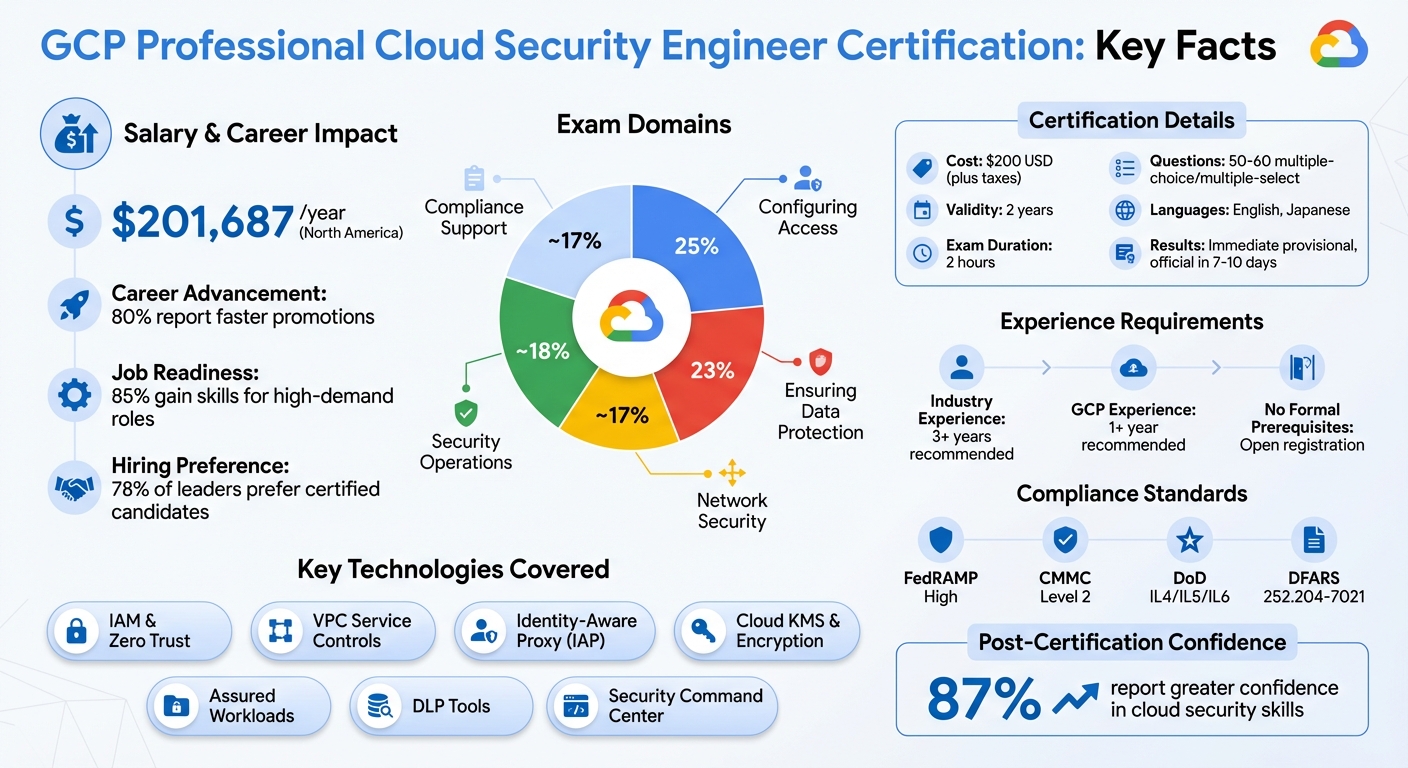
The Google Cloud Professional Cloud Security Engineer Certification is a key credential for cloud architects managing classified data in government and defense sectors. It validates expertise in securing workloads on Google Cloud using tools like Zero Trust, Identity-Aware Proxy (IAP), and VPC Service Controls. With an average salary of $201,687/year in North America, this certification offers significant career growth opportunities, especially for professionals with security clearances.
Key Details:
- Focus Areas: Access configuration, data protection, network security, compliance, and operations management.
- Cost: $200 USD (plus taxes), valid for two years.
- Recommended Experience: 3+ years in the industry, with 1+ year on Google Cloud.
- Skills Tested: IAM, encryption, VPC Service Controls, Assured Workloads, and more.
This certification is highly relevant for cleared professionals working on Top Secret and Secret missions, aligning with compliance standards like FedRAMP and CMMC Level 2. It ensures readiness for high-stakes roles in securing sensitive government systems.
GCP Professional Cloud Security Engineer Certification Overview: Costs, Salary, and Key Stats
How I passed the GCP Professional Cloud Security Certification
sbb-itb-bf7aa6b
What Is the Google Cloud Professional Cloud Security Engineer Certification?
This certification confirms your ability to secure Google Cloud workloads while adhering to industry standards and best practices [1][8]. It highlights your expertise in designing secure solutions using Google’s security technologies and enforcing regulatory controls essential for high-security environments. Google describes the role as:
"A Cloud Security Engineer allows organizations to design and implement secure workloads and infrastructure on Google Cloud. Through an understanding of security best practices and industry requirements, this individual designs, develops, and manages a secure solution by using Google security technologies." [1]
The certification has adapted to address modern security priorities, such as securing AI workloads, protecting the software supply chain, and automating security processes. These areas are becoming increasingly relevant for government and defense sectors [1]. It focuses on key security domains essential for safeguarding sensitive and classified data.
What the Certification Covers
The certification is built around five core domains that align with the needs of cleared environments. These include:
- Configuring Cloud Identity, IAM, and access controls
- Securing network communications with VPC security and firewalls
- Protecting data using encryption and Data Loss Prevention (DLP) tools
- Managing security operations through logging and incident response
- Supporting compliance with regulatory frameworks [1][8]
For cleared cloud architects managing classified data, the exam tests your knowledge of tools like Assured Workloads for compliant deployments, VPC Service Controls for establishing security perimeters, and Sensitive Data Protection tools for discovering and redacting sensitive information [12]. You’ll also need to demonstrate proficiency with Cloud HSM, Cloud External Key Manager, and Confidential Computing to safeguard data at rest, in transit, and in use [12].
The certification also validates your understanding of digital sovereignty and data residency requirements. Using Sovereign Controls by Partners and configuring data residency services, you’ll address the strict location requirements of federal workloads. These skills are critical for meeting standards like FedRAMP and DoD Impact Levels, which govern cleared cloud environments [12].
Core Skills Tested by the Certification
The exam emphasizes practical applications of security across Google Cloud’s technology stack. In identity and access management, you’ll configure service accounts, implement role-based access control (RBAC), and manage resource hierarchies in line with the principle of least privilege [11][1]. For network security, you’ll design isolated perimeters using VPC peering, Shared VPC, firewall rules, and Identity-Aware Proxy (IAP) – essential for securing government applications [11][10].
When it comes to data protection, you’ll work with tools like Customer-Managed Encryption Keys (CMEK), Customer-Supplied Encryption Keys (CSEK), and envelope encryption through Cloud KMS [11][1]. You’ll also use the DLP API to safeguard personally identifiable information (PII) and comply with government data security mandates. In security operations, the focus is on configuring log sinks, audit logs, and automated security scanning in CI/CD pipelines to enable real-time monitoring and rapid threat response [11][8].
The certification also covers the shared responsibility model and aligning cloud infrastructure with federal defense standards [11][1]. According to Google Cloud, 87% of certified professionals report greater confidence in their cloud security skills after earning this credential [10].
Senior Cloud Architect Natalie Godec shares: "I would definitely recommend the Google Cloud certifications to others, specifically because of the learning paths that come with the preparation for them. There is a treasure trove of knowledge in those preparatory courses, videos, labs that you will take" [9].
Prerequisites and Required Experience
Google doesn’t impose any formal prerequisites for registering for the Professional Cloud Security Engineer exam [1][3]. You can sign up and take the test without needing to verify prior experience or hold any other certifications. That said, thorough preparation is key. The exam fee is $200 USD (plus applicable taxes), and the content assumes you already have a solid understanding of cloud security fundamentals [1][3].
Who Should Pursue This Certification
This certification is designed for professionals with substantial hands-on experience in cloud environments, ideally at least one year of experience specifically in designing and managing solutions on Google Cloud [1][10]. It’s particularly suited for cloud architects who want to deepen their security expertise, especially those looking to go beyond general infrastructure design into areas like architecting zero-trust networks with Identity-Aware Proxy (IAP) and VPC Service Controls [3].
Security analysts and engineers transitioning from traditional on-premises environments will also benefit, as the certification helps bridge the gap between conventional security models and cloud-native frameworks [3]. Additionally, cloud engineers and administrators managing infrastructure will find it valuable, as the exam validates skills like configuring access controls, setting up resource hierarchies, and enforcing compliance requirements [1]. For compliance and audit professionals, the certification is particularly relevant, as it focuses on mapping Google Cloud Platform (GCP) controls to standards such as PCI-DSS, HIPAA, and GDPR [3].
According to Google Cloud data, 78% of leaders from organizations using Google Cloud prefer hiring professionals with cloud certifications, and 80% of learners say earning a certification has accelerated their career progression [9][2]. For cloud architects aiming for high-security roles in government or defense sectors, these stats highlight the competitive edge certifications can provide.
With the target audience in mind, the next step is to focus on building the necessary skills and a solid preparation plan.
Required Knowledge and How to Prepare
If you already have foundational experience, focus on strengthening your expertise through hands-on practice and official training resources. To succeed in the exam, you’ll need a strong grasp of identity and access management (IAM), resource hierarchy design, network security configuration, and threat monitoring [1]. Foundational skills like basic command-line usage, familiarity with Linux, and the ability to read Python or JavaScript code are also crucial [10]. Experience in deploying and managing applications will further bolster your readiness [10].
Beyond the basics, you’ll need to be comfortable with advanced topics such as securing AI workloads, protecting software supply chains, and managing containerized environments like Kubernetes [1][10]. To get started, explore Google’s official "Professional Cloud Security Engineer" learning path on Google Cloud Skills Boost [1][2]. If you’re new to Google Cloud, foundational courses like "Google Cloud Fundamentals: Core Infrastructure" and "Security in Google Cloud" are excellent starting points before diving into specialized security topics [8].
For hands-on practice, work on configuring IAM roles, setting up VPC peering, and securing Kubernetes clusters within GCP [10]. Use the official exam guide to pinpoint areas where you may need additional study, such as VPC Service Controls, Cloud KMS, and Cloud Data Loss Prevention (DLP) [1][3]. This focused preparation ensures you’re equipped to meet the demands of high-security environments, particularly in sectors like government and defense. Keep in mind, the certification is valid for two years, after which you’ll need to recertify by passing the exam again [3][8].
Exam Format and How to Prepare
This section dives into the exam logistics and offers key strategies to help you confidently prepare for certification.
Exam Structure and Format
The exam costs $200 USD and includes 50–60 multiple-choice and multiple-select questions to be completed in 2 hours. You can take it either online or onsite, with language options in English and Japanese.
Once you finish, you’ll receive immediate provisional results, and official confirmation follows within 7–10 days. If you don’t pass, a detailed section-by-section score report will be available in your Candidate Portal to help identify areas for improvement. The certification remains valid for two years, after which you’ll need to recertify by retaking the exam. This structured format ensures candidates are well-prepared to handle the complexities of securing critical government and defense systems.
Study Resources and Training Materials
Start your preparation with the "Professional Cloud Security Engineer" learning path on Google Cloud Skills Boost. It offers on-demand courses and hands-on labs tailored to the exam. For a more in-depth approach, explore the 14-course "Security Engineer Professional Certificate" on Coursera, which covers all exam domains comprehensively. Additionally, Qwiklabs provides practical exercises for tasks like configuring VPC Service Controls, setting up IAM roles, and using Cloud Data Loss Prevention tools.
The official exam guide serves as a roadmap, helping you pinpoint gaps in areas like Packet Mirroring or VPC Service Controls. Supplement this with Google Cloud documentation and case studies to see real-world applications of security practices. Joining the Google Cloud Community or a local Google Developer Group can also be valuable. These groups often host study sessions and provide opportunities to connect with others preparing for the exam.
Exam Preparation Tips
Set your exam date early to establish a disciplined study routine. While practicing, focus not just on the correct answers but also on understanding why the incorrect options are wrong. This approach builds a stronger grasp of the concepts, which is crucial during the actual exam. Pay special attention to high-weight domains like "Configuring Access" (25%) and "Ensuring Data Protection" (23%), as they make up nearly half of the exam.
Practical experience is just as important as theoretical knowledge. Use sandbox environments to practice setting up custom VPCs, configuring DLP jobs, and working with the Security Command Center. A helpful technique is summarizing each Google Cloud product’s purpose in four words or less – this can make it easier to recall key features quickly during the exam.
Career Benefits for Cleared Cloud Architects
Growing Need for Cloud Security in Cleared Positions
The DFARS 252.204-7021 clause now requires specific cybersecurity certifications for contract eligibility [7][6]. This has created an immediate need for cloud architects skilled in handling workloads under CMMC Level 2 and FedRAMP High standards. In May 2024, Google Public Sector expanded its FedRAMP High offerings by authorizing over 100 additional cloud services [13]. This move has significantly broadened the landscape of secure environments, increasing demand for architects with expertise in cloud security.
Government agencies are also embracing software-defined community clouds like Assured Workloads, which rely on logical segmentation and software-based guardrails. For example, in April 2024, the U.S. Air Force began using Vertex AI to modernize aircraft maintenance processes, integrating AI into classified missions. This shift highlights the growing need for professionals adept at managing Top Secret and Secret cloud authorizations [5]. These developments emphasize the importance of certifications that validate advanced cloud security skills, especially in high-stakes environments.
How the Certification Sets You Apart
Given these evolving requirements, earning the certification not only aligns with regulatory demands but also enhances your marketability in the competitive cleared job market. The rigorous preparation for the certification strengthens your technical expertise, translating into tangible career advantages. For instance, the Professional Cloud Security Engineer certification boasts the highest average annual salary in North America at $201,687, with senior positions often exceeding $200,000 [4][3]. Beyond financial benefits, 85% of Google Cloud learners report gaining the skills needed for high-demand roles through certifications, and 80% say certifications accelerate promotions [2].
This certification proves your ability to implement zero-trust architectures using tools like BeyondCorp, Identity-Aware Proxy, and VPC Service Controls – key technologies for securing high-stakes government environments. It also demonstrates your capability to manage Google Distributed Cloud Hosted environments, essential for Top Secret and Secret missions within the U.S. Intelligence Community and the Department of Defense. In November 2025, Google Public Sector achieved CMMC Level 2 certification, verified by a third-party assessment organization. This milestone further positions certified professionals as trusted partners for DoD systems handling Controlled Unclassified Information [6].
As AI continues to play a role in sensitive public sector projects – ranging from cancer detection to predictive maintenance – this certification ensures you have the skills to secure the data pipelines powering these models. By combining compliance expertise, hands-on security knowledge, and readiness for emerging technologies, this credential sets you apart in a field where cleared professionals with cloud security skills are in high demand.
Using GCP Security Skills in Government and Defense Work
Protecting Classified and Sensitive Data
If you’re working in government or defense, your expertise in Google Cloud Platform (GCP) security plays a direct role in safeguarding critical information. For example, handling Controlled Unclassified Information (CUI) often involves configuring Assured Workloads to ensure data stays within U.S. borders, meeting the strict requirements of FedRAMP High and DoD IL4/IL5 [15][14]. This setup includes implementing guardrails to control where data is stored and processed, ensuring compliance with regulatory standards.
For higher-security missions, such as those involving Top Secret and Secret data under DoD IL6, you’ll work with Google Distributed Cloud (GDC) Hosted. This isolated environment operates without public internet access, requiring advanced configurations like FIPS 140-2 or 140-3 validated encryption to secure data both at rest and in transit. Access is restricted to federally vetted U.S. personnel, reflecting the stringent security demands [14][18]. Notably, Google became the first hyperscaler to achieve a DoD IL5 Provisional Authorization for a software-defined community cloud, making professionals with GCP certifications key players in these high-security operations [14].
Your certification also prepares you for specialized tasks, such as ensuring U-NNPI compliance (Unclassified Naval Nuclear Propulsion Information). This requires implementing 17 additional security controls beyond the standard DoD IL5 framework [14]. For example, using Cloud Logging to retain audit logs for at least 90 days helps meet DFARS 252.204-7012 obligations, though extending this to six months is recommended for heightened security [16]. Additionally, Google’s commitment to notifying customers of data incidents within 72 hours for properly configured Assured Workloads underscores its proactive approach to security [16]. These measures are crucial not only for protecting sensitive data but also for supporting mission-critical applications.
Securing Mission-Critical Applications
Your GCP security skills extend beyond data protection to ensure that mission-critical applications remain secure and reliable. Defense and intelligence operations often demand systems that can withstand the most rigorous security requirements. By leveraging tools like VPC Service Controls, you’ll establish security perimeters that manage data flow independently of Identity and Access Management, adding an extra layer of security [19]. For workloads under FedRAMP High and DoD IL4/IL5, configuring regional load balancers and Cloud Armor policies ensures traffic remains within jurisdictional boundaries [15].
A real-world example of GCP’s impact is the U.S. Air Force Rapid Sustainment Office’s use of Google Cloud in April 2024. By automating manual processes, they improved aircraft maintenance efficiency, showcasing how GCP security expertise supports operational readiness [5]. Similarly, the Defense Innovation Unit has adopted Google Cloud for developing AI models, such as augmented reality microscopes, to deliver precise and secure diagnostics [5]. Even in humanitarian efforts, Google Distributed Cloud Hosted facilitates language translation in over 200 languages using Vertex AI, all within secure environments [5].
"GDC Hosted is an air-gapped cloud solution built specifically for stringent security requirements, allowing U.S. intelligence and DoD agencies to host, control, and manage their infrastructure and services in a highly secure environment." – Leigh Palmer, VP, Google Public Sector [5]
Another critical skill is configuring Confidential Computing, which processes data in hardware-isolated Trusted Execution Environments (TEE). This ensures data remains secure even during processing, a vital capability for AI/ML workloads analyzing sensitive information in air-gapped or highly regulated settings [17]. As agencies increasingly modernize with advanced analytics, these configurations are becoming indispensable. By mastering them, you’ll not only protect vital operations but also position yourself as a strong candidate for high-demand roles requiring security clearances.
Using Your Certification on Cleared Cyber Security Jobs

How to Highlight Your Certification
Your GCP Professional Cloud Security Engineer certification deserves a prominent spot on your resume, especially considering that 98% of open cleared jobs at major federal contractors like GovCIO are IT-related [21]. Include it in your professional summary or technical skills section to ensure it stands out. On Cleared Cyber Security Jobs, manually add "Google Cloud Platform" and "Professional Cloud Security Engineer" to your Skills Cloud for better visibility. Uploading your resume also activates IntelliSearch™, which pairs your credentials with relevant cleared positions when your certification is listed.
To strengthen your application, attach your official certificate directly to your resume. Additionally, opt into the Google Cloud Skills Directory via your Credly account settings, making your verified credential searchable by employers looking for specific certifications. When describing your GCP security experience, focus on measurable achievements. For instance, instead of general statements, use examples like: "Reduced system vulnerabilities by 35% through proactive threat monitoring." Metrics like these demonstrate real value to potential employers.
Finding Jobs That Match Your Skills
Once your certification is highlighted, the next step is to target roles that align with your expertise. Use the search filters on Cleared Cyber Security Jobs to find positions requiring Google Cloud Platform security skills. Job titles like Cloud Security Analyst – focused on cyber defense and threat monitoring in cloud environments – or Cloud Security Subject Matter Expert (SME) – which involves high-level expertise for Federal Strategic Cyber Programs – are great starting points [23]. Salary ranges for GCP-related cloud engineering roles typically fall between $80,000 and $128,000 [22].
To improve your chances of being discovered by employers, use keywords such as "GCP Security", "Cloud Security Engineer", and "Google Cloud Platform" in your job search. Since 44% of employees at major federal IT contractors hold public trust or higher clearances [21], combining your GCP certification with your clearance makes you a highly attractive candidate. You can also set up job alerts to stay updated on new opportunities that match your specific skill set.
Connecting with Hiring Managers
After identifying roles that fit, focus on building connections with hiring managers to elevate your chances. Attend events like the Cleared Careers Virtual Hiring Event, where you can engage directly with recruiters from defense and intelligence sectors [20]. These events provide a direct line to decision-makers actively looking for candidates with your qualifications. If you’re transitioning from military service, plan to attend job fairs and engage with hiring managers at least a year before your End of Active Service (EAS) [21].
"Jobs like network engineers, systems engineers, administrators, help desk, cyber, AWS, cloud security. Those are some newer trending positions at GovCIO that we’re seeing a lot of." – Tammy Muncy, Recruitment Director, National Security Services Sector, GovCIO [21]
Make your profile searchable on Cleared Cyber Security Jobs so pre-screened employers can easily find you. With 85% of Google Cloud learners reporting that cloud certifications equip them with the skills needed for in-demand roles [2], your certification signals readiness to tackle critical projects. Taking these proactive steps ensures hiring managers see you as a candidate who can contribute immediately to their mission-critical objectives in government and defense.
Conclusion
The Google Cloud Professional Cloud Security Engineer certification is an excellent step forward for cloud architects working in government and defense sectors. With 80% of participants reporting faster promotions and 85% confirming it equips them with skills for high-demand roles [2], this certification offers measurable career benefits. It demonstrates your ability to safeguard Controlled Unclassified Information (CUI) and meet CMMC compliance standards – essential for Department of Defense (DoD) contracts starting November 10, 2025, when DFARS 252.204-7021 takes effect [6][7].
Proficiency in areas like Identity and Access Management (IAM), VPC Service Controls, and Assured Workloads directly contributes to critical defense operations. Google Public Sector’s CMMC Level 2 certification in November 2025, verified by a third-party assessment, underscores its readiness to support DoD initiatives [6]. Ron Bushar, Managing Director & Chief Security Officer at Google Public Sector, highlighted this milestone:
"This CMMC Level 2 certification is a key enabler for our partnership with the DoD. It ensures our teams can operate and collaborate within the defense ecosystem fully supporting the new DoD requirements" [6].
This certification not only enhances operational readiness but also provides direct career advantages. At a cost of $200 (plus taxes), it’s a worthwhile investment considering the returns. Certified Cloud Security Engineers in North America earn an average salary of $201,687, making it one of the most lucrative certifications in the field [3][4]. Combined with an active clearance, it positions you as a standout professional in a highly competitive industry.
FAQs
Is this certification worth it if I already have a security clearance?
Yes, holding this certification alongside a security clearance adds significant value. It enhances your understanding of Google Cloud security technologies, making you a stronger candidate for sought-after roles in the cleared cybersecurity field. Combining cloud security expertise with a clearance can open doors to career opportunities in government and defense sectors.
What hands-on GCP skills should I practice most before the exam?
To excel in Google Cloud Platform (GCP) security, focus on key tasks like creating and managing custom security roles. This allows for fine-tuned access control, ensuring users have just the right permissions they need. Dive into configuring service accounts and binding roles to efficiently handle identities and permissions across your projects.
Additionally, get hands-on with Kubernetes Engine by setting up private clusters and deploying applications securely. This will help you understand critical aspects of identity management, network security, and container security, all of which are essential for mastering GCP and acing the exam.
How does this certification help with FedRAMP, CMMC, and DoD Impact Levels?
The GCP Security Certification highlights a professional’s skill in setting up cloud environments that comply with federal security standards like FedRAMP, CMMC, and DoD Impact Levels. This certification proves expertise in aligning cloud architectures with stringent requirements such as FedRAMP High, DoD IL2-IL6, and the DoD Cloud SRG, demonstrating the ability to build secure and compliant cloud solutions tailored for government and defense needs.