

The GIAC Security Essentials (GSEC) certification is a globally recognized credential that validates your ability to handle hands-on cybersecurity tasks. It’s especially valuable for professionals with U.S. government security clearances, as it aligns with DoD 8140/8570 IAT Level II requirements. The exam costs $949 (or $579 with a SANS training bundle) and includes 106 questions with a passing score of 73%. Its standout feature is the CyberLive testing component, which tests your practical skills in a lab environment using tools like Wireshark and PowerShell.
Key Details:
- Who Should Take It: Ideal for roles like forensic analysts, network administrators, and penetration testers.
- Core Topics: Access control, cryptography, cloud security (AWS, Azure, GCP), Linux hardening, Windows security, and incident response.
- Preparation Tips: Use the SANS SEC401 course, practice exams, and hands-on labs. Build a home lab with tools like Kali Linux and virtual machines.
- Career Impact: GSEC-certified professionals earn between $84,000 and $153,000 annually, with increased job opportunities in high-security environments.
This certification not only boosts your technical skills but also enhances your career prospects in cybersecurity roles requiring high levels of trust and expertise.
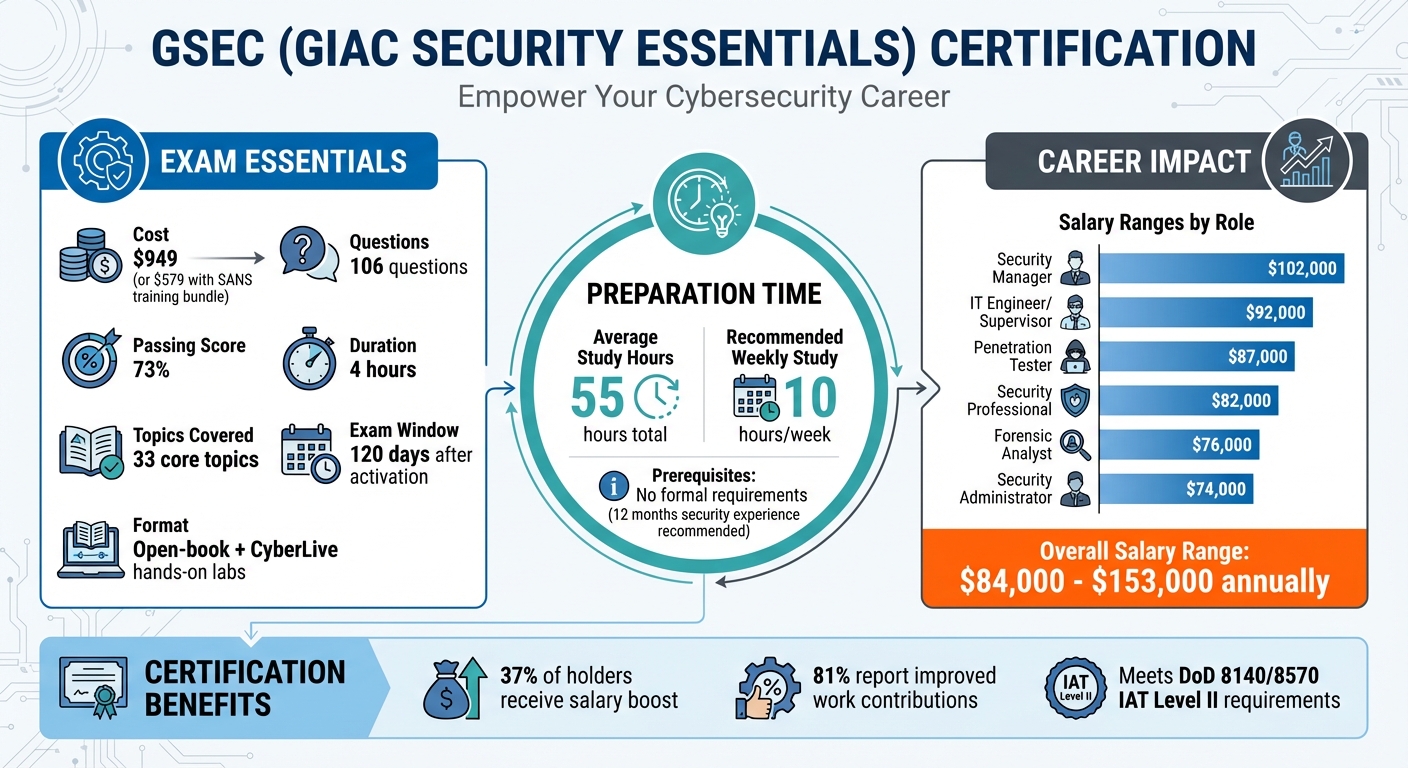
GSEC Certification Quick Reference Guide: Exam Details, Costs, and Career Salaries
GSEC Exam Structure and Prerequisites
Exam Objectives and Core Topics
The GSEC exam spans 33 topics, includes 106 questions, and gives you 4 hours to complete it. To pass, you’ll need a score of 73% or higher [1][2][5][6]. It’s an open-book exam, which means you can bring hard-copy materials. But don’t think that makes it easy – it’s all about how quickly and effectively you can find and apply the right information, not just memorizing facts.
The exam dives into essential areas like access control theory, password management, and cryptography applications (covering tools like VPNs, GPG, and PKI). It also tests your knowledge of Linux hardening and auditing, Windows security infrastructure (like Active Directory and Group Policy), network architecture and protocols, incident handling processes, cloud security across AWS, Azure, and GCP, and vulnerability scanning and penetration testing. These topics align with the DoD 8140/8570 requirements for Information Assurance Technical (IAT) Level II roles [5][7], making them especially relevant for high-security environments.
The CyberLive component adds a hands-on layer to the exam. You’ll use tools like tcpdump, Wireshark, and PowerShell within virtual machines to solve practical challenges [5][6]. This section emphasizes applying your skills in real-world scenarios. As Garrett Brown, a GCIH holder, puts it:
Excellent examination of skills. GIAC does a good job of leveraging knowledge and skill ability with IT intuition – an important pairing in a real cybersecurity position [3].
Prerequisites and Recommendations
While there are no formal prerequisites for the GSEC exam – anyone can register and take it [8] – GIAC strongly suggests having at least 12 months of security experience or a background in information systems and networking [8]. This advice stems from the practical nature of the CyberLive labs, which require you to perform real tasks, not just recall textbook knowledge [1].
If you’re already working in a security-focused role, especially one involving tools, protocols, and system hardening, you’re likely in good shape. For those just starting out, gaining some entry-level experience in security before tackling the exam is a smart move. After all, the exam costs $949, so it’s worth being well-prepared [8]. Once you activate your exam, you’ll have 120 days to complete it [1][2]. You can take the test remotely through ProctorU or in person at PearsonVUE testing centers.
sbb-itb-bf7aa6b
How to Prepare for the GSEC Exam
Study Materials and Tools
A key resource for preparing for the GSEC exam is the SANS SEC401: Security Essentials – Network, Endpoint, and Cloud course. Many successful candidates recommend it. This course is offered in various formats – Live, Live Online, or OnDemand – so you can choose what works best with your schedule. It includes detailed materials, such as textbooks and workbooks, covering everything from access control and cryptography to cloud security and incident handling [5].
The CyberLive hands-on labs are another vital component. These labs provide a virtual machine environment where you can work with real tools and code, helping you tackle practical security challenges. Skipping hands-on practice can hurt your performance on the exam, so make sure to take full advantage of these labs [12].
If you’re a cleared professional, setting up a home lab can be a game-changer. Aim for a setup with at least 16GB of RAM and a 4-core processor, which allows you to run multiple virtual machines. Platforms like VMware Workstation, Oracle VirtualBox, or Microsoft Hyper-V are excellent choices. For your lab, consider using Kali Linux or ParrotOS as your main security workstation. Add tools like Metasploitable for vulnerability testing, along with Windows 11 and Ubuntu instances for configuration and hardening exercises. This setup will help you practice critical skills, including network scanning, packet analysis, password cracking, and exploitation techniques [13].
Don’t underestimate the importance of GIAC practice exams. These are crucial for assessing your readiness and getting familiar with the CyberLive interface. Most successful candidates complete at least one practice test, using the results to target weak areas before the real exam [9].
Since the exam allows open-book resources, creating a custom index early in your preparation can make a huge difference. A good index – typically 4–6 pages, single-sided – helps you quickly find key information during the test. Include charts, definitions, and other essential details to make it as efficient as possible [11].
Study Strategies for Cleared Professionals
Balancing work and exam prep requires a solid plan. Most candidates spend around 55 hours preparing for GIAC exams. With a 120-day window from activation to completion, aim for about 10 hours of study time per week. This schedule works even if you have a busy routine [9][6].
The OnDemand training format is especially helpful for those with tight schedules. You can study during breaks, commutes, or downtime. Some candidates also listen to course audio recordings to reinforce key concepts [10].
Start with a 10-hour weekly study schedule, and build your custom index early. Taking a practice test early in your 120-day window will help you pinpoint areas that need more focus, allowing you to adjust your study plan effectively [10].
For cleared professionals, focus your hands-on practice on areas that are critical for your role. These include Linux hardening and auditing, Windows security infrastructure (like Active Directory and Group Policy), network architecture, and incident handling. These skills align with DoD 8140/8570 IAT Level II requirements and are often part of your daily responsibilities [5][7]. If you’re already working with tools like SIEM platforms, vulnerability scanners, or endpoint security solutions, try applying what you learn from the SEC401 course to real-world scenarios. This approach reinforces your knowledge while preparing you for the exam [10].
Start reviewing your materials as soon as your training is complete to keep the information fresh. Being well-prepared not only boosts your chances of passing but also ensures you get the most out of your investment – especially with the $949 exam registration fee [5].
Using GSEC for Career Advancement in Cleared Roles
Career Benefits of GSEC Certification
Earning a GSEC certification can open doors to roles with salaries ranging from $84,000 to $153,000, depending on your position and experience level [7][14]. Its approval under DoD 8140/8570 IAT Level II makes it a sought-after qualification for government and contractor jobs, meeting essential Department of Defense requirements and simplifying the hiring process [5][7].
One of the standout features of GSEC is its CyberLive testing format, which assesses practical, hands-on skills. This ensures hiring managers can trust your abilities from day one. Nate Gonzalez, a professional holding both GSEC and GCIH certifications, shared his experience:
Before I was GIAC certified, when I would interview for a role, I would get grilled over so many foundational topics as they tried to see how to stump me. I feel now that I am certified that the whole ‘Trust Me, I’m Certified’ actually does exist and I was able to land my dream role thanks to the skills and knowledge I’ve learned. [4]
The GSEC certification doesn’t just validate your current skills – it also sets you up for advanced certifications like the GIAC Security Expert (GSE), one of the toughest credentials in the industry [4]. With this foundation, you can specialize in areas such as Offensive Operations, Cloud Security, or Industrial Control Systems [3]. According to research, 37% of certification holders receive a salary boost, and 81% report improved contributions and value in their work after earning their credentials [15].
Here’s a quick look at average salaries for some roles that GSEC certification can help you qualify for:
| Job Role | Average Annual Salary |
|---|---|
| Security Manager | $102,000 |
| IT Engineer/Supervisor | $92,000 |
| Penetration Tester | $87,000 |
| Security Professional | $82,000 |
| Forensic Analyst | $76,000 |
| Security Administrator | $74,000 |
With these career benefits in mind, the next step is finding roles that align with your GSEC qualifications.
Finding GSEC-Aligned Jobs with Cleared Cyber Security Jobs
Cleared Cyber Security Jobs is a platform designed to connect security-cleared professionals with employers actively seeking candidates with high-demand certifications like the GSEC. Using the platform’s job search filters, you can zero in on positions that require or prefer DoD 8140/8570 IAT Level II certifications. Additionally, setting up job alerts ensures you’re notified about openings in competitive markets as soon as they’re posted.
The site’s resume upload feature allows you to showcase your GSEC certification directly to employers who prefer to hire without going through staffing firms. This streamlines the hiring process, making it easier for certified professionals to connect with employers looking for their skills.
Beyond job listings, Cleared Cyber Security Jobs offers resources to support your career growth. The platform hosts job fairs where you can network face-to-face with employers who value proven expertise. It also provides tools to help you leverage your GSEC certification during interviews and salary negotiations. Best of all, these services are free for job seekers – though eligibility is restricted to U.S. citizens with active security clearances.
Mastering the GSEC: Complete Guide to Passing the GIAC Security Essentials Certification
Conclusion: Starting Your GSEC Journey
The GSEC certification offers a clear path for security-cleared professionals to boost their earning potential, expand career opportunities, and gain recognition as skilled cybersecurity practitioners. With its hands-on CyberLive testing format, this credential demonstrates the practical expertise that government agencies and defense contractors prioritize.
Embarking on your GSEC journey requires focused preparation. Completing the SANS SEC401 training course is essential, along with dedicating significant time to studying and organizing your course materials. Planning exam logistics in advance ensures you’re fully prepared when test day arrives.
The benefits of certification are evident. Validated skills and industry recognition open doors to career advancement and higher salaries. Many professionals have successfully used their GSEC credentials to secure roles in high-security environments, where expertise is both valued and rewarded.
Once certified, you’re equipped to take your career to the next level. Platforms like Cleared Cyber Security Jobs can help you maximize your opportunities. Use their tools to search for positions requiring IAT Level II certifications, set up job alerts, and connect directly with employers eager to hire professionals with your qualifications. For U.S. citizens with active clearances, these services are free, making it easier to find roles where your GSEC certification and clearance give you a competitive advantage. With rigorous preparation and a sought-after credential, you’re ready to step into secure and rewarding cybersecurity roles. Start your journey today and connect with employers who value your expertise.
FAQs
What hands-on skills are assessed in the GSEC certification’s CyberLive section?
The CyberLive portion of the GSEC certification focuses on testing your ability to tackle practical cybersecurity challenges through hands-on exercises. It emphasizes skills such as network analysis, incident response, vulnerability assessment, and security configuration, all within scenarios that closely mirror tasks you’d encounter in a professional setting.
These exercises take place in a virtual environment, where you’re expected to identify, troubleshoot, and resolve security issues. This hands-on approach ensures you’re ready to translate your knowledge into action, making the certification especially valuable for professionals in operational cybersecurity roles.
What’s the best way to prepare for the GSEC exam while working full-time?
Balancing a full-time job while preparing for the GSEC exam can feel like a juggling act, but it’s entirely doable with the right strategy. One smart move is to explore flexible study options like on-demand or live online training from reputable providers. These formats let you fit learning into your schedule, whether it’s early mornings, lunch breaks, or late evenings.
To make your study time count, focus on active learning techniques. Take detailed notes, ask questions to clarify concepts, and connect what you’re learning to practical, real-world scenarios. This approach not only helps with retention but also makes the material feel more relevant. Additionally, practice exams and study guides are your best friends – they’ll help you measure progress and pinpoint areas that need extra attention.
Carve out a consistent study routine, even if it’s just a few hours each week, and prioritize the key topics that will appear on the exam. By staying organized and disciplined, you can prepare effectively for the GSEC without letting it take over your life.
What career paths are available for GSEC-certified professionals with security clearances?
GSEC-certified professionals with security clearances can explore a variety of career paths in the cybersecurity field, especially in roles that involve managing classified or sensitive information. Typical positions include cybersecurity engineers, security analysts, incident response specialists, security architects, and compliance or risk analysts. These jobs are commonly available in sectors like government, defense, and critical infrastructure, where holding a security clearance is a must.
Pairing a GSEC certification with a security clearance can also lead to advanced roles such as Information Systems Security Manager (ISSM), cyber threat analyst, penetration tester, or security engineer. Professionals in these roles often tackle tasks like safeguarding classified networks, performing vulnerability assessments, responding to security incidents, and creating effective security frameworks. Salaries for these positions typically range from $73,000 to over $130,000 annually, highlighting their critical role within the cybersecurity landscape that requires clearances.