

The Certified Information Systems Auditor (CISA) certification is a top credential for IT auditors, especially those working in government, defense, or classified environments. Approved under the DoD Manual 8140.03 since May 2024, it qualifies professionals for critical cyberspace roles. With over 52,000 job openings for cleared IT auditors in the U.S. and only 35,812 certified professionals, demand is high. CISA-certified individuals earn an average of $149,000 annually, often with a 10–15% salary premium.
Key Takeaways:
- Who It’s For: IT auditors in classified roles, including defense and government.
- Earning Potential: Average salary of $149,000.
- Certification Steps: Pass the exam, verify 5 years of experience, and adhere to ISACA’s ethics.
- Exam Details: 150 questions, 4 hours, $575–$760 registration fee.
- DoD Recognition: Approved for meeting DoD cyberspace workforce standards.
CISA certification validates expertise in IT auditing, compliance, and risk management, making it a valuable asset for cleared professionals aiming to advance their careers.
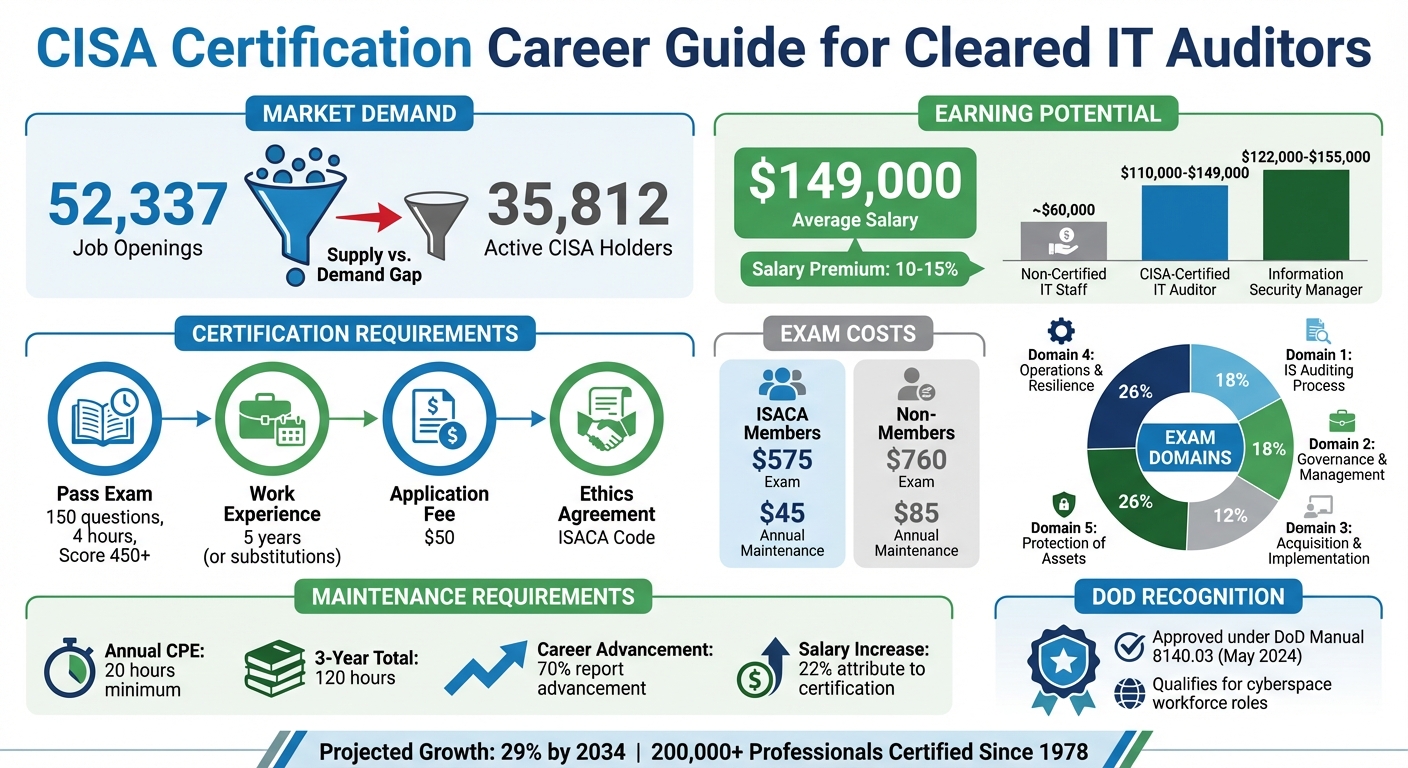
CISA Certification Career Guide: Key Statistics and Requirements
What is CISA Certification?
CISA Definition and Scope
The Certified Information Systems Auditor (CISA) is a professional credential offered by ISACA, designed to validate expertise in auditing, monitoring, and assessing information systems [4][3]. Since its inception in 1978, more than 200,000 professionals have earned the certification, solidifying its reputation as one of the most respected qualifications in the IT audit industry [6].
For professionals working in classified environments, CISA holds special significance. Recognized under the Department of Defense (DoD) Manual 8140.03, it meets the qualification standards for individuals in cyberspace roles, including service members, DoD employees, and government contractors [2]. This recognition often makes CISA a requirement – or at least a strong preference – for those auditing classified systems or managing cybersecurity risks in secure government settings.
CISA emphasizes a risk-based audit methodology, which is crucial for evaluating sensitive data and classified infrastructure [4]. The certification covers five key domains:
- Information System Auditing Process
- Governance and Management of IT
- Information Systems Acquisition, Development, and Implementation
- Information Systems Operations and Business Resilience
- Protection of Information Assets
These domains address various aspects of IT auditing, ensuring that professionals are well-prepared to handle the rigorous demands of secure environments.
Benefits of CISA for Cleared IT Auditors
For cleared IT professionals, CISA certification offers tangible career advantages. Its DoD recognition under Manual 8140 makes it a gateway to roles within the DoD cyberspace workforce, enabling contractors and federal employees to meet qualification standards for authorized positions [2]. Additionally, it enhances credibility when working with federal agencies that require expertise in regulatory compliance and federal security protocols.
CISA also supports long-term career growth. To maintain the certification, professionals must complete 120 Continuing Professional Education (CPE) hours over three years, with a minimum of 20 hours annually [3][5]. This ongoing requirement ensures that CISA holders stay up-to-date with the latest audit practices and cybersecurity standards, equipping them to adapt to the evolving demands of secure IT environments.
CISA Certification Requirements and Eligibility
Basic Requirements
To earn the CISA certification, you’ll need to complete four key steps: pass the exam, gain relevant work experience, submit an application with a $50 fee, and agree to ISACA’s Code of Professional Ethics and Information Systems Auditing Standards [5][1]. The exam itself includes 150 multiple-choice questions across five job practice domains. You’ll have four hours to finish, and a passing score is 450 on a scale of 200 to 800 [1][3]. Registration is open year-round, and you can schedule the exam through PSI testing centers for added flexibility [4][10].
For work experience, you must accumulate five years in IT auditing, control, assurance, or security. At least two of these years must directly relate to the CISA job practice domains [5][7][9]. All experience must be completed within the 10 years prior to your application date [5][8]. Additionally, your experience needs to be independently verified by a supervisor, manager, colleague, or client – HR personnel or family members are not allowed as verifiers [8][9].
Exam fees vary based on membership status: $575 for ISACA members and $760 for non-members [4][1][3]. After passing the exam, you must submit your certification application within five years [5][4].
If you don’t meet the full five-year work experience requirement, ISACA provides substitution options.
Work Experience Substitutions
ISACA permits up to three years of substitutions based on education or professional certifications [8][9]. Here’s how these substitutions work:
- A Bachelor’s degree or higher in any field waives two years of experience.
- A specialized Master’s degree in Information Systems, Computer Science, Information Assurance, or an MBA with an Information Systems focus waives the maximum of three years [9][8].
- An Associate degree or certifications like IT Audit Fundamentals or CCAK (Certificate of Cloud Auditing Knowledge) each waive one year [9][8].
Professional certifications can also reduce the requirement. For instance, full CIMA (Chartered Institute of Management Accountants) certification or ACCA membership counts for two years [9][8]. Additionally, one year of general information systems experience or financial audit work can be applied toward the requirement [9][8]. However, even with substitutions, you must complete at least two years of direct experience in the CISA job practice domains [9][8]. Be prepared to upload official transcripts or certificates as verification when applying [9].
| Substitution Type | Waiver Limit | Criteria |
|---|---|---|
| General IS or audit experience | 1 year | One year of general information systems or financial audit experience [9][8] |
| Associate degree or IT certificates | 1 year | Associate degree in any field, IT Audit Fundamentals, or CCAK [9][8] |
| Bachelor’s, Master’s, or PhD | 2 years | Degree in any field of study [9][8] |
| Specialized Master’s degree | 3 years | Master’s in Information Systems, Computer Science, Information Assurance, or MBA with IS focus [9][8] |
| Professional certifications | 2 years | Full CIMA certification or ACCA member status [9][8] |
CISA Exam Domains and Study Strategies
The 5 CISA Exam Domains
The CISA exam consists of 150 multiple-choice questions to be completed within 4 hours, with a passing score set at 450 [3]. These questions are divided into five domains, each reflecting key areas of expertise essential for auditing in real-world scenarios.
Domain 1: Information System Auditing Process (18%) focuses on planning and executing audits in line with professional standards [6]. For auditors working in secured environments, this involves conducting risk-based audits and adhering to specific agency guidelines when gathering evidence or documenting findings.
Domain 2: Governance & Management of IT (18%) examines IT strategy, organizational structures, and risk management frameworks like COBIT [6]. Cleared auditors must ensure compliance with federal regulations, such as FISMA and NIST standards, while evaluating data governance across systems with varying classification levels, from Unclassified to Top Secret.
Domain 3: Information Systems Acquisition, Development & Implementation (12%) tests knowledge of the system development life cycle (SDLC), project management, and post-implementation reviews [6]. In classified settings, auditors apply this expertise to assess secure hardware procurement and review DevSecOps practices within restricted networks.
Domain 4: IS Operations and Business Resilience (26%) emphasizes IT asset management, disaster recovery planning (DRP), and business continuity planning (BCP) [6]. For critical government systems, auditors evaluate how agencies maintain functionality during disruptions.
Domain 5: Protection of Information Assets (26%) centers on physical and logical security, identity and access management (IAM), encryption, and incident response [6]. This is especially relevant for cleared professionals, who may audit SCIF (Sensitive Compartmented Information Facility) security, verify PKI (Public Key Infrastructure) for CAC and PIV cards, and assess encryption standards for classified data.
Together, Domains 4 and 5 make up about 76 of the 150 exam questions [11]. A solid grasp of these areas, coupled with effective study tools, is critical for success.
| CISA Exam Domain | Weighting | Key Focus for Cleared Auditors |
|---|---|---|
| Domain 1: IS Auditing Process | 18% | Risk-based audits; secure evidence collection |
| Domain 2: Governance & Management of IT | 18% | Compliance with FISMA/NIST; data classification |
| Domain 3: IS Acquisition & Implementation | 12% | Secure procurement; auditing DevSecOps |
| Domain 4: IS Operations & Business Resilience | 26% | Disaster recovery; continuity for critical systems |
| Domain 5: Protection of Information Assets | 26% | SCIF security; encryption; IAM for classified networks |
Study Resources and Preparation Tips
Now that the domain breakdown is clear, using the right resources and strategies can help you excel. The CISA Review Manual, 28th Edition is the go-to study guide, available in both print and digital formats [4]. If you’re studying in a SCIF, opt for the print version. Pair this with the CISA Questions, Answers & Explanations (QAE) Database, which offers over 1,070 practice questions and a 12-month subscription [4].
For those with relevant IT experience, plan to dedicate 2 to 3 hours of study daily over 3 to 5 weeks. If you’re newer to the field, extend your study period to about 2 months [11][12]. Since Domains 4 and 5 make up nearly half the exam, prioritize them during your preparation.
Adopt the "ISACA Mindset" when answering questions – think like an auditor. Look for terms like "recommend", "evaluate", or "verify" rather than focusing on technical fixes. Pay close attention to words like "FIRST", "BEST", "PRIMARY", and "MOST" in exam questions, as they often point to the best answer among multiple correct options.
Practice full-length exams in a distraction-free setting to build the stamina needed for the 4-hour test. Additionally, join the ISACA Engage online forums to connect with other candidates and exchange study tips.
If you’re taking the exam remotely, ensure you have a private, non-secure room with a clear desk and stable internet. Cleared auditors working in SCIFs should schedule their exams at authorized PSI or Pearson VUE testing centers [10][4].
How to Obtain and Maintain CISA Certification
Certification Steps
Earning your CISA certification requires completing four essential steps:
- Pass the Exam
The exam consists of 150 questions, lasts four hours, and requires a minimum score of 450 on a 200–800 scale. You must register at least 48 hours in advance and pay the registration fee: $575 for ISACA members and $760 for non-members [1][4]. - Pay the Application Fee
After passing the exam, you’ll need to pay a one-time $50 application processing fee [5]. - Submit Verified Work Experience
Provide documentation of five years of professional experience in IT auditing, control, assurance, or security. This experience must be completed within the 10 years prior to your application and independently verified by a supervisor, manager, or colleague (family members and HR departments cannot verify). Waivers for certain qualifications, like advanced degrees, may reduce the required experience – check the Work Experience Substitutions section for details [8]. - Agree to ISACA’s Ethics and Standards
You must adhere to ISACA’s Code of Professional Ethics and Information Systems Auditing Standards. The entire certification process must be completed within five years of passing the exam. Note that CPE hours can often apply to multiple ISACA certifications [5][13].
Maintaining Your CISA Certification
Once certified, maintaining your CISA status is essential for staying current and advancing your career. Here’s what you need to do:
- Earn Continuing Professional Education (CPE) Hours
You need at least 20 CPE hours annually and a total of 120 hours over three years [13]. - Pay Annual Maintenance Fees
Fees are due by January 1 each year: $45 for ISACA members and $85 for non-members. If you hold three or more ISACA certifications, the fee drops to $25 for members and $50 for non-members [13].
"The goal of the CPE policy is to ensure that all certification holders maintain an adequate level of current knowledge and proficiency." – ISACA [13]
There are several ways to earn CPE credits. ISACA members can earn up to 36 free hours annually through webinars, plus 1 hour per ISACA Journal quiz. Additional credits can come from corporate training, security briefings, and professional meetings related to IT audit or security. You can also earn up to 20 hours annually by serving on ISACA boards or committees and up to 10 hours by mentoring others preparing for the CISA exam [13].
Be sure to keep documentation of your CPE activities, such as certificates or attendance records, for at least 12 months after each cycle [13]. Missing the annual CPE requirements leads to immediate certification revocation. Reinstatement involves a written appeal, a $50 fee, and proof of the missing hours – or you’ll need to retake the exam [13]. Staying compliant with these requirements ensures your certification remains valid and demonstrates your commitment to professional growth.
| Requirement | Detail |
|---|---|
| Annual CPE Minimum | 20 hours |
| 3-Year CPE Total | 120 hours |
| Annual Fee (Members) | $45 |
| Annual Fee (Non-Members) | $85 |
| Reporting Deadline | December 31 (CPE records) |
| Payment Deadline | January 1 (maintenance fee) |
sbb-itb-bf7aa6b
Career Opportunities for CISA-Certified Cleared IT Auditors
Top Roles for CISA-Certified Cleared Professionals
Earning a CISA certification can significantly boost your career, especially in secure and sensitive sectors like defense, intelligence, and government contracting. This credential demonstrates your expertise in auditing processes and business resilience, making you a prime candidate for roles that involve handling sensitive data[16].
Key positions for CISA-certified professionals include:
- Information Security Manager: Oversee security programs, lead teams of specialists, and ensure systems meet federal compliance standards[15].
- Compliance Analyst: Help organizations navigate regulations like HIPAA and SOX to maintain proper legal data management practices[15].
- IT Risk Manager: Identify threats to critical assets and develop strategies to mitigate them effectively[15].
Salary potential is another major advantage. While general IT roles in cleared environments often start around $60,000, CISA-certified auditors typically earn between $110,000 and $149,000[14][15].
"CISA has consistently ranked among the top-paying IT certifications, and it’s particularly valued by government agencies when hiring auditors." – Hannah George, Tech Blogger[15]
Here’s a breakdown of roles, responsibilities, and salaries in cleared environments:
| Role Type | Typical Responsibilities | Average Salary | Clearance Requirement |
|---|---|---|---|
| Non-Certified IT Staff | General system maintenance, technical support, and basic network operations | ~$60,000 | May require Public Trust |
| CISA-Certified IT Auditor | Risk assessment, compliance validation, and security control evaluation | $110,000–$149,000 | Secret/Top Secret often required |
| Information Security Manager | Oversight of security programs, team leadership, and policy implementation | $122,000–$155,000 | Secret/Top Secret typically required |
Using Cleared Cyber Security Jobs to Find CISA Positions
Once certified, finding the right position becomes essential. Platforms like Cleared Cyber Security Jobs specialize in connecting CISA-certified professionals with government agencies and defense contractors seeking cleared auditors. These platforms streamline your search by offering filters for certifications, clearance levels, and audit specialties, making it easier to find roles tailored to your expertise.
Uploading your resume allows employers to contact you directly, and setting up alerts ensures you’re notified of new openings. The site also provides resources specifically for the cleared community, including advice on maintaining certifications and navigating clearance requirements. Since only direct-hire employers can post jobs, you’ll connect directly with hiring managers, cutting out unnecessary intermediaries.
40-Hour Free CISA Exam Preparation Tutorial | ISACA CISA 2025 Full Course
Conclusion
This guide has highlighted how CISA certification plays a crucial role in navigating the competitive, cleared cybersecurity job market. With around 52,337 job openings for cleared IT audit professionals compared to just 35,812 active CISA holders in the U.S., the demand is clear. This gap translates into average salaries of $149,000 for certified professionals, making CISA a standout credential in the field [1].
Beyond the financial benefits, CISA certification fosters ongoing professional growth. The requirement to complete 20 hours of Continuing Professional Education (CPE) annually ensures that professionals stay updated on emerging technologies like AI and blockchain, both of which are becoming vital in government and defense auditing [1][19]. It’s worth noting that 70% of CISA holders report career advancements after certification, while 22% attribute direct salary increases to earning the credential [18].
Another key advantage is the certification’s approval under DoD Manual 8140.03, making it a must-have for Service members, DoD employees, and contractors in cyberspace roles. This opens doors to senior positions such as IT Audit Manager, Internal Audit Director, and even Chief Information Security Officer [2][17][15].
When it comes to costs, the investment is relatively modest. Exam fees range from $575 for ISACA members to $760 for non-members, with an annual maintenance fee of just $45 for members [1][3]. Considering the 29% projected growth in information security roles by 2034 [15], CISA certification provides a pathway to both immediate career advancement and long-term relevance in a rapidly evolving field.
FAQs
What are the key benefits of earning a CISA certification for cleared IT auditors?
Earning the CISA (Certified Information Systems Auditor) certification offers IT auditors with security clearances a range of important benefits. It showcases expertise in auditing, monitoring, and evaluating IT systems, boosting professional credibility and trust – especially in environments requiring high levels of security. This certification is particularly valuable for professionals in sensitive roles, as it highlights their ability to tackle intricate compliance and security challenges.
On top of that, the CISA credential can lead to better career opportunities and higher salaries. Many who earn this certification report improved job prospects and pay increases. It also aligns with the growing demand for experts in risk-based IT auditing, making it highly desirable in both government and private sectors. In short, the CISA certification enhances your qualifications, supports career progression, and helps you stay up to date with changing technology and compliance requirements.
Can professionals with different educational backgrounds pursue the CISA certification?
The CISA certification is designed to accommodate professionals from a range of educational and professional backgrounds. While it typically requires at least five years of experience in areas like information systems auditing, control, or security, certain educational qualifications or related certifications can sometimes reduce this requirement. This approach allows individuals from diverse career paths to pursue the certification.
The exam itself is computer-based and can be taken either at authorized testing centers or remotely, providing flexibility in scheduling. Beyond the exam, the certification focuses on practical experience and ongoing learning. For instance, maintaining the certification requires earning Continuing Professional Education (CPE) hours, ensuring that both academic knowledge and hands-on expertise remain central to achieving and holding the CISA credential.
What job roles and salary ranges can cleared IT auditors with a CISA certification expect?
Cleared IT auditors holding a CISA certification have a variety of career paths to choose from, including roles like IT auditor, compliance analyst, risk analyst, security engineer, and cybersecurity analyst. These positions are in high demand within the cleared community, thanks to the certification’s emphasis on auditing and governance of information systems.
In the U.S., CISA-certified cleared professionals typically earn between $122,000 and $149,000 annually. Salaries can vary based on factors such as experience, geographic location, and the specific job title. Beyond increasing earning potential, this certification provides access to advanced roles in industries where security-cleared expertise is a priority.