

The CISM certification is a must-have for security managers focusing on leadership and aligning information security with business goals. Offered by ISACA, it emphasizes governance, risk management, program development, and incident management – key areas for cleared professionals in government and defense roles. With job demand far outpacing the number of CISM-certified professionals, this credential can significantly enhance your earning potential and career prospects.
Key Takeaways:
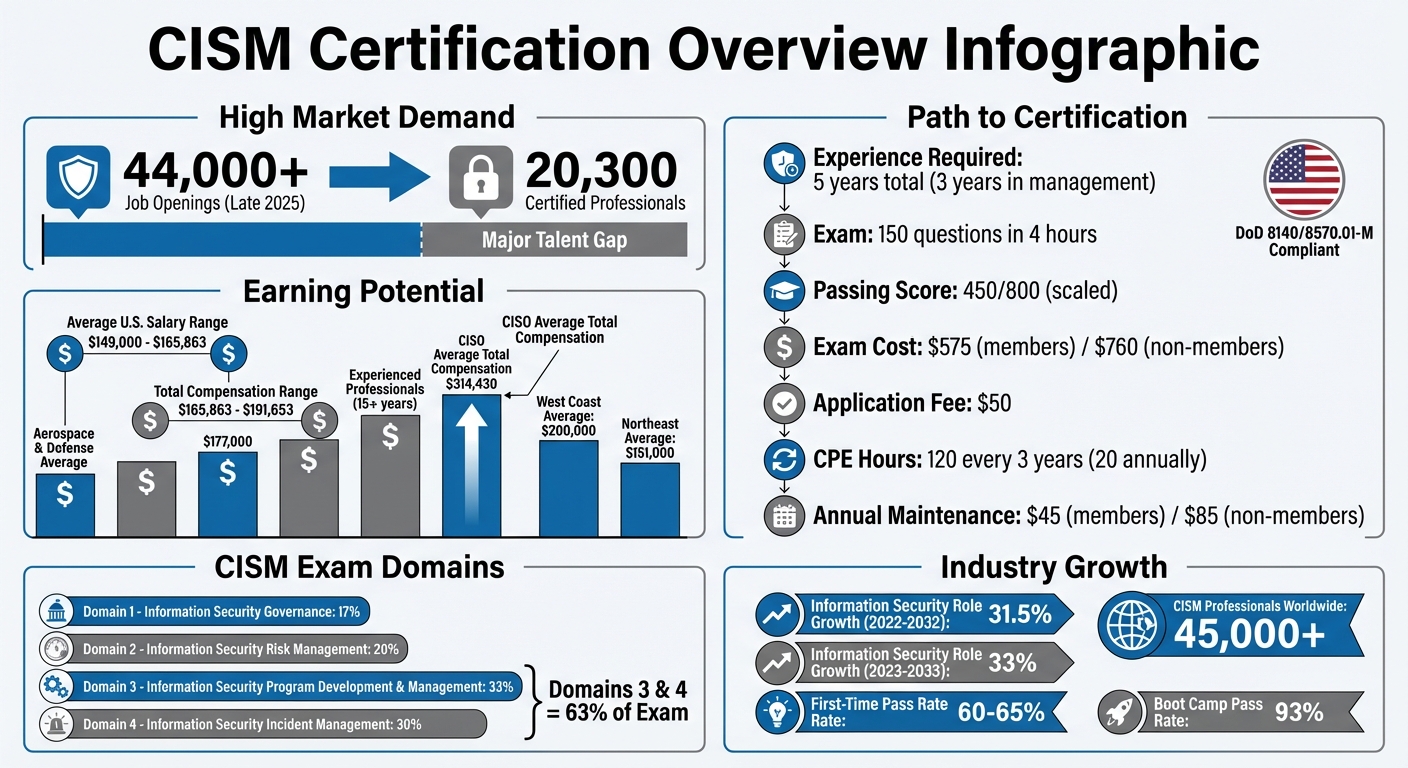
- High Demand: By late 2025, over 44,000 job openings required CISM, but only 20,300 professionals held the certification.
- Earnings: Average salaries for CISM holders in the U.S. range from $149,000 to $165,863, with leadership roles earning even more.
- DoD Alignment: Meets DoD 8140/8570.01-M standards, making it crucial for federal and defense roles.
- Certification Requirements: 5 years of experience (3 in management), passing a 150-question exam, and ongoing education (120 CPE hours every 3 years).
- Exam Focus: Domains 3 (Program Development) and 4 (Incident Management) cover 63% of the exam.
CISM is ideal for transitioning into senior roles like CISO, Security Director, or Risk Manager while commanding higher salaries and greater job opportunities in the cybersecurity field.
CISM Certification Requirements, Salary Data, and Career Statistics
Introduction Video | 40-Hour Free CISM Exam Preparation Tutorial | ISACA CISM 2025 Full Course
The Four CISM Domains for Cleared Security Managers
The CISM exam is built around four domains that reflect the core responsibilities of security managers. Each domain is weighted differently, with Domains 3 and 4 making up over 60% of the exam content [4][8]. Understanding these domains and how they relate to classified systems and federal compliance is key – not just for passing the exam but also for improving your leadership in security management. Below is an overview of each domain and its relevance to your role.
| CISM Domain | Exam Weight | Key Focus Areas for Cleared Managers |
|---|---|---|
| 1. Information Security Governance | 17% | Strategy alignment, NIST/Federal compliance, organizational structure. |
| 2. Information Security Risk Management | 20% | Threat landscape, classified data risk assessment, risk response options. |
| 3. Information Security Program Development & Management | 33% | Resource management, control implementation, security architecture. |
| 4. Information Security Incident Management | 30% | Incident response plans, business continuity (BCP), disaster recovery (DRP). |
Here’s a deeper dive into each domain and how it applies to your career.
1. Information Security Governance
This domain focuses on aligning security initiatives with organizational goals and federal regulations. It’s about setting up frameworks that comply with NIST standards and ensuring security is recognized as a strategic asset at the executive level.
You’ll gain skills to build business cases for security investments, define accountability structures, and create policies that guide your operations. As Destination Certification highlights:
Strong governance is foundational – it ensures security has visibility at the executive level and is positioned as a business enabler, not just a cost center.
For cleared managers, this is especially important when justifying complex security requirements to senior government or contracting leadership.
2. Information Security Risk Management
Making up 20% of the exam [4], this domain is all about identifying and addressing risks to information assets. It emphasizes assessing threats to classified data, conducting vulnerability analyses, and choosing risk responses – whether mitigating, transferring, avoiding, or accepting risks.
This domain equips you to evaluate threats in high-stakes environments like government or defense sectors. You’ll learn to perform detailed risk assessments and develop strategies that balance operational needs with security mandates. These skills are critical for managing the unique risks associated with classified systems.
3. Information Security Program Development and Management
Covering 33% of the exam [4], this domain is the largest and focuses on executing security strategies. It includes designing security architectures, managing personnel with security clearances, budgeting for specialized tools, and implementing controls to protect classified resources.
You’ll also learn to oversee the full lifecycle of security controls, from design to testing and evaluation. This includes tasks like asset classification, creating tailored training programs, and integrating security into contracts. Additionally, defining and tracking metrics to show program effectiveness is a key component. These responsibilities are essential for leading security programs that meet operational and compliance requirements in classified environments.
4. Information Security Incident Management
Making up 30% of the exam [4], this domain concentrates on incident readiness and response. It emphasizes creating response plans, conducting Business Impact Analyses (BIA), and managing recovery efforts to maintain continuity during incidents.
You’ll develop skills to establish detection and response systems, lead incident response teams, and implement disaster recovery processes tailored to classified environments. As Destination Certification notes:
Your incident management skills will often be the difference between a minor event and a costly breach.
In high-security settings, where incidents can have national security implications, a structured and proactive approach is essential. These skills not only prepare you for the exam but also enhance your ability to safeguard critical systems and data effectively.
CISM Certification Requirements
Earning your CISM certification is more than just passing an exam. ISACA sets specific criteria, including professional experience, ethical standards, and ongoing education, to ensure credential holders maintain their expertise. Here’s a breakdown of what’s required.
Work Experience Requirements
To qualify, you need five years of professional experience in information security, with at least three years in information security management across three or more CISM domains [9][10]. This experience must be completed within the 10 years before applying or within five years after passing the exam [9][12].
Interestingly, "management" doesn’t necessarily mean holding a formal managerial title. It refers to responsibilities like developing security strategies, overseeing program implementation, making risk-related decisions, or advising senior leadership [10]. Roles such as senior security analyst, security architect, or network security engineer may qualify if they involve strategic decision-making or program oversight [10].
Your experience must be verified by a supervisor, manager, colleague, or client [11]. Rob Witcher, CEO of Destination Certification, highlights:
The key is documenting how your technical work extended into strategic decision-making or program oversight – not just implementation.
Experience waivers can reduce the five-year requirement, though the three-year management minimum is non-negotiable. For example, holding a CISA or CISSP certification, or earning a Master’s degree in information security, grants a two-year waiver. A Bachelor’s degree in the field or certifications like Security+ reduce the requirement by one year [11][13].
Once your experience is clear, it’s time to tackle the exam.
Exam Format and Passing Score
The CISM exam includes 150 multiple-choice questions to be completed in four hours [10][12]. These scenario-based questions focus on management decision-making rather than technical details [8][12]. To pass, you’ll need a scaled score of 450 out of 800 [10][12].
The exam emphasizes program development and incident management, with Domain 3 (Information Security Program) at 33% and Domain 4 (Incident Management) at 30% making up the bulk of the content. Domain 2 (Risk Management) accounts for 20%, and Domain 1 (Governance) covers 17% [7][8].
Registration costs $575 for ISACA members and $760 for non-members [3][8]. You can take the exam at PSI testing centers or via remote proctoring [3]. After passing, you’ll have five years to meet the experience requirements and apply for certification [3][9][11].
Application Process and Continuing Education
Once you pass the exam and verify your work experience, you’ll need to complete the application process. This involves paying a one-time $50 fee and submitting your application within five years of passing the exam [9][3]. Ensure your MyISACA account profile matches your government ID to avoid delays [3].
CISM holders must follow ISACA’s Code of Professional Ethics, which outlines seven principles, including maintaining confidentiality, acting objectively, and supporting stakeholder education [9][13][12].
To keep your certification active, you’ll need to earn 120 Continuing Professional Education (CPE) hours every three years, with at least 20 hours completed annually [9][12]. Logging these hours monthly can simplify the annual audit process [12]. Annual maintenance fees are $45 for ISACA members and $85 for non-members [8][12]. Neglecting CPE requirements or failing to pay these fees could result in losing your certification [12].
Steps to Get Your CISM Certification
Earning your CISM certification involves three clear phases. Most professionals in the field complete this journey within three to six months [4].
1. Study for the Exam
Prepare to dedicate 150–200 focused study hours [4]. With first-time pass rates hovering around 60–65%, a structured study plan significantly improves your chances [4]. For example, Infosec‘s 5-day CISM Boot Camp boasts a pass rate of over 93% [14].
Start with ISACA’s Questions, Answers & Explanations (QAE) Database, which features over 1,000 practice questions [14][3]. This resource is invaluable because it helps you understand ISACA’s approach to security management decisions. Before investing in paid study materials, try the free 10-question practice quiz on ISACA’s website to gauge your starting point [14][3].
Interestingly, the challenge of the CISM exam isn’t rooted in technical difficulty. As Destination Certification notes:
The CISM exam is moderately difficult… What makes it challenging isn’t complicated technical concepts but the need to think like a security leader who balances security requirements with business objectives. [4]
Strategic focus is key. Concentrate on Domain 3 (Information Security Program) and Domain 4 (Incident Management), which together account for 63% of the exam [4]. When practicing questions, prioritize risk management and aligning security measures with business goals over purely technical fixes [4]. For government and defense professionals, CISM training aligns with ISO 17024 and DoD 8140/8570.01-M standards, making it highly relevant for such roles [2].
Once you feel confident in your preparation, move on to registering and scheduling your exam.
2. Register and Take the Exam
Joining ISACA can save you money. Membership costs $135 per year but lowers the exam fee by $185, reducing it from $760 to $575 [8][3]. Be sure your ISACA account name matches your government-issued ID to avoid any issues on exam day [3].
Registration is open year-round, giving you flexibility. Once you pay, you’ll have 12 months to schedule and take the exam [3]. Plan ahead by booking your appointment at least four to six weeks in advance through PSI, choosing between an in-person testing center or remote proctoring [3]. Be mindful of peak times, such as fiscal quarter ends or December, when slots can fill up quickly.
The exam itself includes 150 multiple-choice questions to be completed in four hours [15][8]. Preliminary results – pass or fail – are provided immediately after you finish. To pass, you’ll need a scaled score of 450 out of 800 [4]. If you don’t pass, you must wait 30 days for a second attempt and 90 days for a third or fourth attempt [4].
After passing, you’ll need to document your work experience to finalize your certification.
3. Submit Your Work Experience
The final step is to document your professional experience and submit your certification application. Your experience must cover at least three of the four CISM domains and must have occurred within the 10 years prior to your application [9][11].
Your application requires a full employment history and a completed Experience Verification Form. A supervisor, manager, colleague, or client can serve as your verifier, but family members or HR departments are not acceptable [11]. Submit your application online, via email, or through postal mail using ISACA’s submission portal [16].
There is a $50 application processing fee to complete this step [9][3].
sbb-itb-bf7aa6b
Career Benefits of CISM for Cleared Security Managers
Earning a CISM certification doesn’t just enhance your technical skills – it opens doors to career advancement and financial rewards. This certification translates your expertise into real-world opportunities, helping you achieve significant professional milestones.
1. Higher Salary Potential
One of the most immediate benefits of a CISM certification is its impact on earning potential. In the United States, CISM-certified security managers earn an average base salary of roughly $141,000. When factoring in bonuses and profit-sharing, total compensation typically falls between $165,863 and $191,653 [5][6][17][18].
For many professionals, the certification leads to a salary bump of $15,000 to $30,000 within the first year [6]. Those in the Aerospace and Defense sector see even higher averages, with total compensation reaching $177,000. Companies like SAIC and BAE Systems offer competitive packages, averaging $169,143 and $145,000, respectively [17][18].
Seasoned professionals with 15 or more years of experience can command salaries ranging from $200,000 to $250,000 [6]. Geographic location also plays a role – West Coast cybersecurity managers average $200,000 annually, compared to $151,000 in the Northeast [6]. Specialized skills, such as expertise in AI governance, can further boost salaries by $20,000 to $40,000 [6].
CISM-certified professionals consistently out-earn their non-certified peers.
Strategic career decisions, like switching employers every three to four years, can lead to even greater financial gains. Pairing a CISM certification with cloud security skills (e.g., AWS or Azure) can add up to $40,000 to your base salary [6].
2. Leadership Opportunities
CISM certification is a stepping stone to leadership. It demonstrates your ability to translate technical risks into business terms and align security strategies with organizational goals – key skills for senior roles.
With CISM, executive positions like Chief Information Security Officer (CISO), Chief Information Officer (CIO), and Director of Security become attainable [5][19]. CISOs with this certification earn an average total compensation of $314,430, with some top-tier roles exceeding $400,000 [5]. Other management opportunities, such as Information Security Manager (averaging $186,697 in total compensation), Security Director, Risk Manager, and IT Director, are also within reach [5][18].
In the cleared sector, federal agencies like the DoD, DHS, FBI, and NSA, as well as major defense contractors, highly value CISM-certified leaders [5].
Organizations prioritize leaders who can minimize risks while advancing business objectives – precisely the focus of CISM.
The numbers back this up: 70% of CISM-certified professionals report improved job performance, and their teams are 90% more effective [1][20]. Nearly half (48%) receive performance appraisals within a year of certification, and 42% earn pay raises directly linked to their CISM credential [20].
3. More Job Opportunities
The demand for cybersecurity managers is booming. From 2022 to 2032, information security roles are expected to grow by 31.5% [5]. For CISM-certified professionals, especially those with active security clearances, this growth means a wealth of opportunities.
Platforms like Cleared Cyber Security Jobs connect CISM holders with employers looking for cleared cybersecurity managers. These tools allow you to filter job searches, upload resumes, and set up alerts tailored to your expertise.
The rise of regulations like GDPR, HIPAA, and CMMC has further increased demand for professionals who can bridge technical security with governance [5][6]. As companies shift their focus from technical implementers to strategic advisors capable of managing large budgets and presenting to executive boards [5], CISM certification becomes even more valuable.
This growing demand positions CISM-certified professionals for success in a rapidly evolving field.
Using CISM to Find Cleared Security Jobs
Your CISM certification is more than just a credential – it’s a key to unlocking high-level cleared roles in the cybersecurity market. With fewer than 23,000 CISM professionals worldwide compared to over 100,000 CISA holders, this certification sets you apart in a competitive field [21]. Here’s how to make the most of it.
1. Add CISM to Your Resume
Make your CISM certification stand out on your resume. Place "CISM" right after your name at the top and include a dedicated certifications section prominently near the beginning [5]. This ensures recruiters notice your qualification immediately.
Organize your experience around the four core CISM domains: Information Security Governance, Information Risk Management, Information Security Program Development and Management, and Information Security Incident Management [4][5]. This structure highlights your strategic leadership skills, demonstrating that you’re more than just a technical expert.
Replace vague job descriptions with measurable achievements. For example, instead of saying "managed security incidents", use something like "reduced security incidents by 40% while supporting cloud transformation" [5]. Emphasize at least three years of security management experience to solidify your expertise.
Once your resume reflects your CISM qualifications, expand your job search using specialized platforms.
2. Search Job Boards for Cleared Professionals
Platforms like Cleared Cyber Security Jobs connect CISM-certified professionals with employers who need cleared cybersecurity experts. These job boards let you filter openings by clearance level – Secret, Top Secret, or TS/SCI – and offer tools like resume uploads and personalized job alerts tailored to your skills and clearance status.
To stand out, fully complete your online profile. Many recruiters review digital profiles before requesting a full resume [22]. Use targeted filters to find roles where your CISM certification delivers the most impact. The platform’s veteran-focused approach is especially helpful for those transitioning from military service or between cleared roles.
3. Network and Attend Job Fairs
Don’t rely solely on resumes and online applications – networking is a powerful tool in the cleared cybersecurity space. Industry events provide direct access to hiring managers and recruiters. Upcoming events include the CI or FS Poly Cleared Job Fair on February 5, 2026 (Hanover, MD), the Cleared Careers Virtual Huntsville Hiring Event on February 19, 2026, and additional events in Herndon, VA (March 5, 2026), Colorado Springs, CO (April 2, 2026), and Falls Church, VA (April 16, 2026) [23][24].
"For veterans especially, attending Cleared Job Fairs can be critical to a successful career transition." – G.B., Technical Project Manager, CACI [22]
Joining your local ISACA chapter is another way to build connections. These groups often offer exclusive networking opportunities with hiring managers and insights into which employers are actively seeking CISM-certified professionals [3][5]. Many roles are filled through personal connections before they’re even advertised. Prepare a clear elevator pitch that explains how your CISM certification helps translate technical risks into business solutions – exactly the kind of expertise sought by companies like Booz Allen Hamilton, Lockheed Martin, and Raytheon [22][5].
Conclusion
Earning a CISM certification is a smart move for cleared security managers looking to stand out in the cybersecurity field. With information security roles expected to grow by 33% between 2023 and 2033 [25] and over 45,000 professionals already holding this credential worldwide [4], the certification highlights your ability to bridge technical security operations with high-level decision-making. It positions you as a leader capable of driving strategic initiatives rather than just managing technical tasks.
For cleared professionals in areas like Washington, D.C., Virginia, and Maryland, the financial benefits are clear – CISM-certified managers consistently earn higher salaries than their non-certified counterparts. The certification’s four core domains provide a strong framework for managing enterprise-wide security programs, aligning security efforts with organizational goals, and effectively communicating risks to top executives [4].
To maximize the value of this certification, focus on mastering the core domains, passing the exam, and documenting your relevant experience. Networking through specialized platforms and events can also connect you with employers actively seeking professionals with your expertise. While the $575 investment for ISACA members may seem significant, it can lead to meaningful returns in salary growth, leadership roles, and career progression.
Combining your security clearance with a CISM certification gives you a distinct advantage in the cybersecurity job market. Use this powerful combination to take on strategic leadership roles and thrive in an ever-evolving industry.
FAQs
What are the main benefits of earning a CISM certification for security-cleared managers?
Earning a CISM certification can be a game-changer for security-cleared managers aiming to level up their careers. It showcases your ability to manage security programs, align cybersecurity strategies with business objectives, and handle risk mitigation with confidence.
Some standout perks include access to higher-paying positions (with average salaries climbing to $150,040), sharpened leadership abilities, and stronger industry credibility. This certification also paves the way for senior-level roles, establishing you as a respected leader in the security-cleared space.
How does the CISM certification meet DoD 8140/8570.01-M requirements?
The CISM certification is acknowledged under the DoD 8140/8570.01-M standards as a valid credential for Information Assurance Management (IAM) Levels II and III. This recognition underscores its importance in showcasing skills in information security management and governance.
Achieving the CISM allows cleared professionals to fulfill critical requirements for advancing within the DoD cyber workforce. It opens doors to leadership roles and broader career prospects in cybersecurity management.
How can I increase my earning potential after earning a CISM certification?
To maximize your earning potential with a CISM certification, focus on building practical experience in security management while emphasizing your leadership abilities. Roles like security director or chief information security officer (CISO) often demand a track record of aligning security initiatives with business objectives, so showcasing this skill set is crucial.
Keep growing through ongoing professional development. Deepening your expertise in areas such as risk management, governance, or incident response can help you stand out in a competitive job market. Adding certifications or gaining specialized skills can further increase your value to employers.
Use your CISM certification as leverage when negotiating promotions or salary adjustments. Connect with others in the cybersecurity community to expand your network, and aim for positions in industries where demand is high. Staying informed about the latest industry trends and consistently demonstrating strategic thinking can position you for top-tier compensation in the field.
Related Blog Posts
- CIO-SP3 Cybersecurity Positions vs DISA Encore III – Which Vehicle Drives Your Career?
- CISSP Cleared Cybersecurity vs CASP+ – The Certification ROI Debate for TS/SCI Holders
- Cleared Cybersecurity Career Assessment – Your Success Scorecard and Action Plan
- CISSP Certification Career Guide for Cleared Cyber Professionals
Leave a Reply