

If you’re in cybersecurity with a security clearance, the CRISC certification (Certified in Risk and Information Systems Control) is a powerful way to transition into IT risk management roles. Offered by ISACA, this certification focuses on enterprise IT risk management and is highly valued in cleared environments. Here’s what you need to know:
- What it Covers: CRISC prepares you to identify, analyze, and manage IT risks while aligning them with business goals. It includes four domains: Governance, Risk Assessment, Risk Response and Reporting, and Technology and Security.
- Earnings Potential: CRISC-certified professionals earn an average of $151,000 annually, with salaries reaching $165,000+ in senior roles.
- Exam Details: The exam includes 150 multiple-choice questions, requires a passing score of 450/800, and covers the four domains. You need at least three years of work experience in two of the domains to qualify.
- Updates: As of November 2025, the exam includes material on AI, machine learning, and data governance.
Whether you’re aiming to boost your salary, enhance your career, or improve your risk management skills in classified settings, CRISC certification is a strong choice for cleared professionals. Keep reading for exam preparation tips, career paths, and how to apply CRISC skills in secure environments.
How to Prepare for the New CRISC Exam 2025: Strategy & Tips
sbb-itb-bf7aa6b
What is CRISC Certification?
The Certified in Risk and Information Systems Control (CRISC) credential, offered by ISACA, highlights expertise in identifying, analyzing, and managing IT risks [6]. This certification has become a benchmark for mid-career professionals in cybersecurity and risk management. Accredited by the American National Standards Institute (ANSI), it’s recognized worldwide by government agencies for adhering to industry-standard risk management practices [5]. It’s designed to equip professionals with the tools needed to tackle practical, real-world risk management challenges.
For professionals in cleared environments, CRISC bridges the gap between technical risk and actionable business insights, ensuring alignment with organizational goals [7].
"Being able to communicate in a language the business understands and connecting the dots with the organization’s goals and objectives is crucial to being successful in getting the resources you need to do the job properly",
explains Matthew Henshaw, Coordinator of Information Technology at Annapolis Valley Regional Centre for Education [7].
The exam itself consists of 150 multiple-choice questions, completed in 4 hours. A passing score of 450 on a scale of 200–800 is required, along with at least three years of relevant experience in two of the CRISC domains [4][6]. Candidates have five years from the exam date to apply for the official certification [4][5].
The 4 CRISC Domains
The CRISC exam is divided into four key domains, each critical for professionals working in government and cleared cybersecurity roles:
- Domain 1: Governance (26%) focuses on organizational strategy, risk appetite, and frameworks like the Risk Management Framework (RMF). In government settings, this involves aligning security practices with mandates such as FISMA and NIST RMF [7].
- Domain 2: Risk Assessment (22%) addresses threat modeling, vulnerability analysis, and risk scenarios. This is especially vital for safeguarding classified systems and understanding their impact on national security [2][10].
- Domain 3: Risk Response and Reporting (32%) emphasizes the design and implementation of controls, as well as monitoring their effectiveness. Cleared professionals often apply this by managing NIST SP 800-53 controls and reporting system status to Authorizing Officials (AOs) [7].
- Domain 4: Technology and Security (20%) covers security principles, data privacy, and disaster recovery. This domain ensures the protection of Controlled Unclassified Information (CUI) and the resilience of critical functions [3].
| CRISC Domain | Weight | Application in Government Roles |
|---|---|---|
| Domain 1: Governance | 26% | Aligning with NIST RMF and adhering to FISMA requirements. |
| Domain 2: Risk Assessment | 22% | Threat modeling for classified systems and impact analysis. |
| Domain 3: Risk Response & Reporting | 32% | Managing NIST SP 800-53 controls and audit preparations. |
| Domain 4: Technology & Security | 20% | Ensuring data privacy and disaster recovery for sensitive systems. |
These domains collectively provide professionals with the skills to address both strategic and operational risks in classified environments.
Why CRISC Matters for Cleared Cybersecurity Professionals
CRISC certification is particularly relevant for professionals working within government frameworks, as it ties directly to the Risk Management Framework (RMF) and NIST guidelines. These frameworks are essential for maintaining the Authority to Operate (ATO) in cleared environments, where adherence to governance and compliance standards is mandatory [2][7]. CRISC helps bridge the gap between technical cybersecurity measures and strategic decision-making, enabling professionals to communicate risks effectively to non-technical stakeholders and senior leadership [6][7].
Starting November 3, 2025, the CRISC exam will include updated material on risks associated with Artificial Intelligence (AI) and Machine Learning (ML). This ensures that certified professionals are prepared to adapt governance strategies for emerging technologies [3].
"The updated CRISC exam… provides comprehensive coverage of the current aspects of ML and AI, giving security professionals the knowledge they need to adapt frameworks, risk registers and compliance layers to meet modern demands",
notes Steven Lawrence, a security professional [3].
With this expanded focus, CRISC-certified professionals are well-positioned to build frameworks that address new threats, ensuring compliance with evolving regulations [3].
Eligibility and Exam Requirements
CRISC Prerequisites
To earn the CRISC certification, you need at least three years of professional experience in IT risk management and information systems control. This experience must be within the 10 years prior to your application or within five years after passing the exam [11][12]. Importantly, your work must cover at least two of the four CRISC domains. No degree or certification can replace this hands-on requirement [11].
For professionals with security clearances, this experience often aligns naturally with their roles. For instance, if you’ve worked as an Information System Security Officer (ISSO) or an Information System Security Manager (ISSM), your familiarity with the Risk Management Framework (RMF) likely overlaps with CRISC domains. Tasks like Security Assessment and Authorization (A&A) align with Domain 2 (Risk Assessment), while implementing controls ties to Domain 4 (Technology and Security) [2].
However, verifying experience in classified environments can be tricky. ISACA requires an independent verifier – such as a supervisor, manager, colleague, or client – who can confirm your work. Human Resources staff and family members are not eligible to serve as verifiers [11]. While classified details don’t need to be disclosed, the verifier must attest to the nature of your tasks and how they align with specific CRISC domains.
You can take the CRISC exam even if you haven’t yet met the full experience requirement. ISACA allows a five-year window after passing the exam to gain and submit the necessary verified experience [4][12]. Once your experience is verified, you’ll be on track to earn the certification.
Exam Format and Structure
The CRISC exam evaluates your expertise across its four domains, with a clear structure and specific time and fee requirements. Scores range from 200 to 800, and you’ll need at least 450 to pass. Results are typically sent within 10 business days [6].
The exam is weighted across the domains as follows:
- Governance: 26%
- Risk Assessment: 22%
- Risk Response and Reporting: 32%
- Technology and Security: 20% [2]
To manage your time effectively, aim to spend about 1.5 minutes on each question [12].
You can take the exam at authorized PSI testing centers or opt for remote online proctoring, making it accessible even for professionals in secure or remote locations [1]. The registration fee is $575 for ISACA members and $760 for non-members, with a $50 application fee required upon certification. Maintaining your certification involves an annual fee of $45 for members or $85 for non-members [4][1]. If needed, candidates can attempt the exam up to four times in a 12-month period [6].
"The CRISC is designed for IT risk, control and compliance practitioners, business analysts, project managers and other IT and business professionals who have three years of risk management and information system control experience within the past ten years", explains Lisa Cook, GRC Professional Practices Principal at ISACA [12].
This structure ensures that professionals, even those in high-security roles, can efficiently demonstrate their skills and knowledge.
Benefits of CRISC Certification for Cleared Professionals
CRISC certification isn’t just about boosting your paycheck – it’s about sharpening the skills needed to manage risk effectively in classified environments. Below, we’ll explore how this credential impacts financial outcomes, risk management expertise, and career advancement for cleared professionals.
Salary and Career Advancement
CRISC-certified professionals enjoy impressive salaries, with an average base of $148,000 per year as of December 2025 [13]. At top defense contractors like Booz Allen Hamilton, salaries for these professionals range from $147,900 to $165,000 [13][9].
On average, CRISC-certified individuals earn 10% to 15% more than their non-certified counterparts [15]. In high-cost regions or executive roles, salaries can even surpass $204,000 [15]. With only about 46,000 certified professionals worldwide [15][9], this scarcity makes CRISC holders highly sought-after for senior risk positions.
The certification also accelerates career progression. Over half (52%) of CRISC holders report noticeable performance improvements on the job after earning the credential [18]. It’s a recognized differentiator in Governance, Risk, and Compliance (GRC) leadership roles, often paving the way for a seat at the executive table.
"If your career trajectory involves translating technical risk into business decisions, CRISC belongs on your certification roadmap",
- Ken Sahs, Training Camp [15].
While the financial perks are appealing, the real value lies in the enhanced ability to manage risk strategically.
Improved Risk Management Skills for Cleared Work
CRISC certification emphasizes translating technical vulnerabilities into clear, actionable business terms. This is especially critical in cleared environments, where communicating risks to non-technical stakeholders is a daily challenge. The certification equips professionals to assess and explain risks in terms of likelihood, impact, and residual exposure [9].
For cleared professionals, these skills are essential when managing third-party security and compliance in government or classified settings. CRISC training also includes building Key Risk Indicator (KRI) dashboards that align with board-level expectations, shifting focus from reactive troubleshooting to proactive resilience planning [9].
"Organizations prefer candidates with a CRISC certification as it signifies a commitment to quality work methods and skills that help improve business performance",
- John Davies, Cyber Security Governance & Assurance Specialist [17].
Additionally, the certification prepares professionals for emerging challenges, such as AI risk assessment, data governance, and ethical considerations – key areas for tackling evolving threats in classified systems [1].
Comparison: CRISC-Certified vs. Non-Certified Professionals
The advantages of CRISC certification become even clearer when comparing certified and non-certified professionals:
| Feature | CRISC-Certified Professional | Non-Certified Professional |
|---|---|---|
| Average Salary | $147,000 – $165,000 [15][9] | 10-15% lower [15] |
| Advancement Rate | Faster path to leadership/management [15][16] | Standard technical career growth [9] |
| Risk Expertise | Enterprise-level governance & business impact [9] | Often limited to technical severity [9] |
| Employer Demand | High in GRC, Banking, and Government [15][9] | General IT/Security demand [9] |
The Bureau of Labor Statistics projects 29% job growth for Information Security Analysts – roles often filled by CRISC-certified professionals – through 2034, with a median salary of $124,910 [6]. Additionally, tech occupations are expected to grow at twice the national average over the next decade, with median salaries about 130% higher than those in other fields [14].
How to Prepare for CRISC Certification
Study Materials and Resources
To start, the ISACA Review Manual is a must-have. It covers all four domains of the CRISC exam and is available in both digital and print formats. If you like the convenience of quick searches and instant access, the digital version is for you. Prefer flipping through physical pages? The print version has you covered.
Another helpful resource is the CRISC Questions, Answers & Explanations (QAE) Database. This tool includes between 833 and 983 practice questions, each with detailed explanations. A 12-month subscription costs around $399 and is a great way to pinpoint areas where you might need extra practice.
For a more interactive experience, ISACA’s self-paced Online Review Course offers video lessons, case studies, and downloadable aids. These resources are perfect for professionals juggling busy schedules, as they let you study in your own time.
Need advice or have questions? The ISACA Engage Community is an online forum where members can connect with experts from around the world. Plus, ISACA provides a free 10-question quiz to help you assess your starting point before diving into more in-depth materials.
Study Timeline and Schedule
Once you have your materials, a solid study plan is key. Most people spend between 120 and 150 hours preparing for the CRISC exam, typically over three to six months. Setting daily goals can help you avoid cramming and burnout.
One popular strategy is the 100-day study plan. Here’s how it works: dedicate 90 minutes a day to cover four pages of the review manual and answer 20 practice questions. Since the exam content is weighted, you’ll want to focus your time accordingly:
- Risk Response and Reporting: 32%
- Governance: 26%
- IT Risk Assessment: 22%
- Information Technology and Security: 20%
"CRISC is an exam that appears to test you on ‘which is the better decision’ rather than ‘which is the best technology’."
- Louis Cremen, Cyber Security Trainer [19]
Before your test date, take at least one full-length mock exam under timed conditions. This helps you get comfortable with the exam format and builds the stamina you’ll need on test day. During the final week, focus on reviewing ISACA’s governance-focused methodology and completing full-length practice tests.
If you’re balancing a packed schedule, ISACA offers a remotely proctored exam option. You can take the test from home under strict monitoring. Alternatively, exams are available at PSI testing centers, and you can schedule them as soon as 48 hours after payment.
This structured approach not only prepares you for the exam but also ensures you’re ready to apply CRISC knowledge in high-security roles.
Using Cleared Cyber Security Jobs for Certification Support

As you prepare for the exam, don’t overlook career resources that can help you land CRISC-related roles. Cleared Cyber Security Jobs is a platform tailored for professionals with active security clearances. You can set up job alerts for CRISC-specific positions within government agencies or defense contractors, saving you time by filtering out irrelevant listings.
The platform also hosts job fairs, giving you the chance to meet hiring managers face-to-face. These events are a great way to discuss how your CRISC certification can address their risk management needs.
Career Paths for CRISC-Certified Cleared Professionals
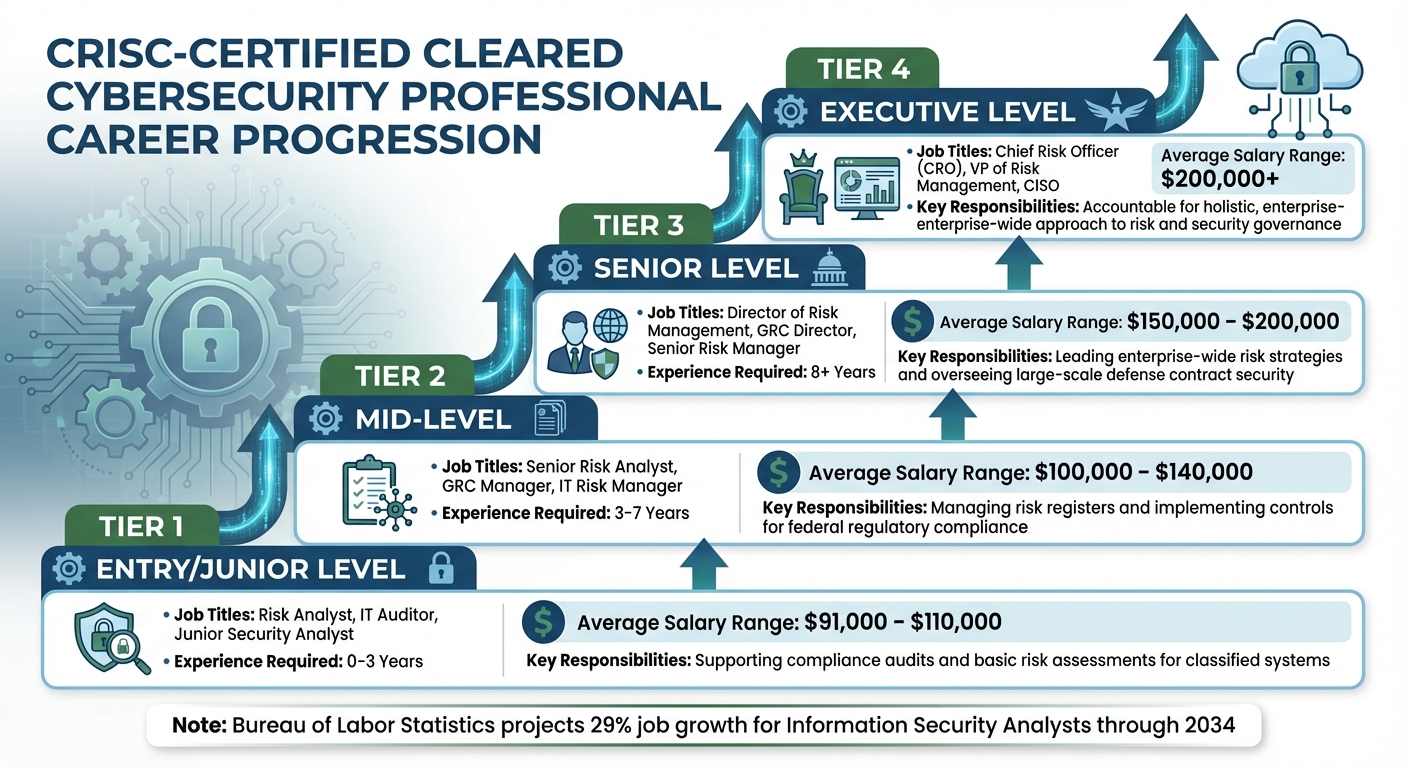
CRISC Career Progression Path for Cleared Cybersecurity Professionals
Common Job Roles for CRISC Professionals
Earning a CRISC certification opens doors to a variety of roles for cleared professionals, including IT Risk Manager, GRC Analyst/Manager, Information Security Manager, IT Auditor, Data Protection Officer, Compliance Auditor, Security Engineer, Cybersecurity Risk Analyst, Third-Party Risk Manager, and Cloud Security Risk Specialist. These positions focus on safeguarding classified systems and ensuring the security of mission-critical operations[6][8].
For instance, an IT Risk Manager working with defense contractors doesn’t just evaluate general IT risks – they also assess threats to classified information. Their work ensures that security measures align with both organizational objectives and federal compliance standards. These roles provide various entry points, allowing professionals to expand their responsibilities and expertise over time in the field of risk management.
Career Progression with CRISC
The career path for CRISC-certified professionals often starts with entry-level positions like Risk Analyst or IT Auditor, where the focus is on supporting compliance efforts and conducting initial risk assessments for classified systems[8]. As they gain experience, professionals move into mid-level roles such as Senior Risk Analyst, GRC Manager, or IT Risk Manager, where responsibilities include managing risk registers and implementing controls to meet federal compliance standards[8].
At the senior level, roles like Director of Risk Management or GRC Director involve leading enterprise-wide risk strategies, particularly for large-scale defense contracts[8]. For those with over a decade of experience, executive roles such as Chief Risk Officer (CRO), VP of Risk Management, or CISO become attainable. These positions demand a comprehensive, enterprise-wide focus on risk and security governance, especially in classified and mission-critical environments[8].
"CRISC certification positions you to bridge this gap between technical implementation and business risk assessment." – Rob Witcher, CEO, Destination Certification[8]
The demand for professionals in this field is growing rapidly. The Bureau of Labor Statistics anticipates a 29% growth rate for Information Security Analysts between 2024 and 2034[6]. Globally, there are over 30,000 CRISC-certified professionals[6], with an average annual salary exceeding $151,000[6]. This highlights the strong financial and career growth opportunities available to cleared professionals with this certification.
CRISC Career Progression Table
| Career Stage | Typical Job Titles | Experience Required | Average Salary Range | Relevance to Cleared Environments |
|---|---|---|---|---|
| Entry/Junior | Risk Analyst, IT Auditor, Junior Security Analyst | 0-3 Years | $91,000 – $110,000 | Supporting compliance audits and basic risk assessments for classified systems. |
| Mid-Level | Senior Risk Analyst, GRC Manager, IT Risk Manager | 3-7 Years | $100,000 – $140,000 | Managing risk registers and implementing controls for federal regulatory compliance. |
| Senior | Director of Risk Management, GRC Director, Senior Risk Manager | 8+ Years | $150,000 – $200,000 | Leading enterprise-wide risk strategies and overseeing large-scale defense contract security. |
| Executive | Chief Risk Officer (CRO), VP of Risk Management, CISO | 10+ Years | $200,000+ | Accountable for a holistic, enterprise-wide approach to risk and security governance. |
Applying CRISC Skills in Cleared Environments
Managing Risk in Classified Systems
CRISC-certified professionals rely on structured frameworks to address risks that could compromise national security. At the core of their work is the NIST Risk Management Framework (RMF), particularly in how CRISC Domain 2 (Risk Assessment) aligns with the RMF’s "Categorize" and "Select" steps. These steps involve determining the potential impact of classified data loss. To evaluate threats, professionals turn to STRIDE threat modeling – a method that identifies risks like Spoofing, Tampering, Repudiation, Information Disclosure, Denial of Service, and Elevation of Privilege. This helps them understand how adversaries might exploit vulnerabilities in secure networks.
Adversary profiling is another key tool. It examines threat actors based on their capability, intent, stealth, and persistence. For example, countermeasures for a nation-state actor targeting defense systems differ significantly from those for an insider threat. By analyzing these factors, professionals can design tailored defense strategies. When assessing classified systems, they carefully distinguish between technical vulnerabilities, procedural gaps, and organizational weaknesses.
To make risk management actionable, professionals develop "what-if" scenarios that connect specific threats to classified assets. These scenarios translate technical vulnerabilities into insights that authorizing officials can use to make informed decisions[8]. This approach highlights how CRISC-certified individuals turn technical assessments into strategic actions, particularly in high-security environments.
Implementing Compliance Controls
Beyond risk assessments, CRISC-certified professionals are skilled at establishing strong compliance measures within cleared environments. CRISC Domain 1 plays a key role in the "Prepare" and "Categorize" phases, while Domain 3 is critical for the "Implement", "Authorize", and "Monitor" stages. These efforts ensure alignment with NIST SP 800-53 controls, which were updated on August 27, 2025[20]. Staying current with these updates, including those driven by Executive Order 14306, is essential.
To maintain compliance, professionals engage in continuous monitoring, which helps sustain an Authority to Operate (ATO) for classified systems. They use Key Risk Indicators (KRIs) and Key Control Indicators (KCIs) to manage risks in near real-time – a priority for federal agencies. Risk registers are another crucial tool, tracking "inherent" risks versus "residual" risks for systems handling Controlled Unclassified Information (CUI) or higher classifications. Meanwhile, the Three Lines of Defense model ensures clear accountability across operational management, risk/compliance functions, and internal audits.
When third-party vendors require access to sensitive data, CRISC professionals evaluate whether those vendors’ security practices align with the organization’s risk tolerance. They also create Security, Privacy, and Cybersecurity Supply Chain Risk Management Plans in line with NIST SP 800-18r2 guidance. This ensures that compliance controls not only protect classified assets but also meet federal regulatory standards effectively.
Conclusion
The CRISC certification brings three key advantages: access to leadership opportunities, higher earning potential, and improved risk management expertise. On average, CRISC-certified professionals earn between $150,000 and $165,000 annually, with senior roles often surpassing $180,000 [9]. Beyond salary, CRISC equips professionals with the ability to communicate technical risks in business terms, bridging the gap between IT vulnerabilities and their broader business impact [9]. This skill can significantly accelerate career growth into senior risk management roles.
"CRISC’s greatest real-world strength lies in bridging the gap between security operations and executive strategy. It often becomes the credential that earns professionals a seat at decision-making tables." – Expert Takeaway, Programs.com [9]
These benefits are particularly valuable in cleared environments, where enterprise IT risk management is critical to meeting strict regulatory requirements. With the demand for Information Security Analysts expected to grow by 29% from 2024 to 2034 [6], CRISC-certified professionals are well-prepared to address this rising need.
Cleared Cyber Security Jobs offers a dedicated platform for showcasing your CRISC certification. It connects you with employers who prioritize security clearance and risk management expertise. You can upload your resume, set up job alerts, and access career resources tailored to the cleared community – all completely free.
FAQs
Does CRISC meet DoD 8570/8140 requirements?
Yes, the CRISC certification aligns with the DoD 8570/8140 requirements. It is officially recognized within the Department of Defense’s cyber workforce framework and qualifies for over 85% of the approved work roles listed in the DoD 8140 Cyber Workforce Qualification Provider Marketplace. This recognition makes CRISC an important credential for professionals seeking cleared positions that adhere to these standards.
How do I verify CRISC experience without sharing classified details?
To validate your CRISC experience, you’ll need to fill out a comprehensive work experience form. Make sure to clearly describe your roles and responsibilities within the relevant domains. Be careful not to include any sensitive or classified information – this ensures that verifiers can evaluate your qualifications without exposing restricted details.
Which CRISC domain matters most for RMF/ATO work?
The Governance domain, which makes up 26% of the CRISC exam, is the most relevant for RMF/ATO work. This area emphasizes organizational strategy, policies, standards, and the impact of IT risk on business objectives. Its focus aligns directly with the demands of RMF/ATO processes, making it a key area of expertise for professionals in these roles.