• Skip to primary navigation
  • Skip to main content
Cleared Cyber Security Jobs | CyberSecJobs.com

Cleared Cyber Security Jobs | CyberSecJobs.com

Cleared Cyber Security Jobs

  • Home
  • Search Cleared Cyber Jobs
  • Job Fairs
  • Career Resources

Certifications

Best Cybersecurity Certifications 2026: Complete Guide for Cleared Professionals

CyberSecJobs Editorial · March 19, 2026 ·

Best Cybersecurity Certifications 2026:
The Definitive Guide for Cleared Professionals

From a $404 Security+ to the $8,000 SANS pipeline — which certifications actually move the needle on your salary and career. With DoD 8140 compliance mapping and ROI analysis.

20 min read
13 certifications ranked
ROI analyzed
DoD 8140 mapped

The cybersecurity certification market has never been more crowded — or more consequential. In the cleared workforce, your certifications aren’t just career credentials: they’re DoD 8140 compliance requirements, contract award factors, and the single fastest way to add $10K–$35K to your annual salary.

This guide cuts through the noise. We ranked every major certification by ROI, DoD compliance value, salary impact, and career trajectory — so you know exactly which certifications to pursue first, and which ones to skip unless your employer is paying.

What’s Inside

  1. Quick Comparison Matrix
  2. Best Entry-Level Certifications
  3. Best Mid-Career Certifications
  4. Best Senior & Leadership Certifications
  5. Certification Roadmaps by Career Path
  6. DoD 8140 Requirements
  7. Cost vs. ROI Analysis
  8. Certification Stacking Strategies
  9. Cloud Security Certifications
  10. Frequently Asked Questions
47x
Peak first-year ROI on CISSP investment at $749 exam cost. +$25K–$35K average salary premium for CISSP holders in cleared environments — the highest absolute return of any cybersecurity certification.

Quick Comparison Matrix

All 13 major cybersecurity certifications ranked by level, cost, salary impact, and DoD 8140 compliance category. Use this as your master reference — then dive into each section for detailed analysis.

Certification Level Exam Cost Avg Salary Impact DoD 8140 Best For
CompTIA Security+ ⭐ Entry $404 +$10–15K IAT II / Baseline Everyone
CISSP Senior $749 +$25–35K IAM III Mgmt / Architecture
CISM Senior $760 +$20–30K IAM II Security Management
CEH Mid $1,199 +$12–18K CDA Pen Testing / Red Team
OSCP Mid–Sr $1,749 +$15–25K CDA Offensive Security
CySA+ Mid $404 +$8–12K CSSP SOC / Blue Team
CASP+ Senior $509 +$12–20K IAM III Architecture (CISSP alt)
PenTest+ Mid $404 +$8–12K CDA Pen Testing (budget)
CCSP Senior $599 +$15–25K — Cloud Security
GSEC Entry–Mid $2,499 +$15–20K — Premium Entry
CISA Mid–Sr $760 +$15–22K IAT III IT Audit / GRC
CRISC Senior $760 +$18–25K — Risk Management
AWS Security Specialty Mid–Sr $300 +$12–20K — AWS Cloud
Security+ is the only certification that’s genuinely non-negotiable in cleared cyber. Every other cert should be chosen based on your target career path and whether your employer will fund it.

Best Entry-Level Certifications

Start here. These three certifications form the foundation of every cleared cybersecurity career. The right choice depends on whether you’re headed toward blue team or red team — but Security+ is mandatory regardless.

CompTIA Security+

+$10–$15K

$404 exam · 2–3 mo study · IAT Level II · DoD 8140 Baseline
Most requested cert in DoD contracting — Non-negotiable

CompTIA CySA+

+$8–$12K

$404 exam · 3–4 mo study · CSSP Requirements
Blue team specialist — Required for many SOC analyst DoD roles

CompTIA PenTest+

+$8–$12K

$404 exam · 2–3 mo study · DoD 8140 CDA
Red team entry path — Budget-friendly OSCP precursor

#1 Must-Have: CompTIA Security+ — The Non-Negotiable

Verdict: Non-negotiable. Get this first, no exceptions.

Security+ is the DoD 8140 baseline for every cleared technical position. Without it, you simply won’t get hired for most cleared cyber roles. It appears in more cleared cybersecurity job postings than any other certification by a wide margin — the #1 most-requested cert in DoD contracting environments — and satisfies the IAT Level II baseline for system administrators, network engineers, and security analysts.

$404
Total exam cost for Security+. At 2–3 months of self-study, it’s the most efficient cert investment in cybersecurity — delivering 25–37x ROI in year one. CompTIA offers federal discounts for active duty, veterans, and government contractors.

→ Full Security+ Career Guide for Cleared Professionals

Blue Team Upgrade: CompTIA CySA+ — The Blue Team Specialist

Best for: SOC analysts, blue team, incident responders.

CySA+ bridges the gap between Security+ and more advanced analyst roles. It satisfies the CSSP (Cyber Security Service Provider) baseline, making it a requirement for many SOC analyst positions on DoD contracts. At $404 — same price as Security+ — with significantly higher specialization value for blue team roles, this is your immediate next step if you’re targeting a SOC or defense role.

The exam requires Security+ or equivalent experience as a prerequisite, covering threat detection, behavioral analytics, and incident response — skills that translate directly to day-one work in a cleared SOC environment.

Red Team Entry: PenTest+ or eJPT — The Offensive Starting Point

Best for: Aspiring penetration testers, red teamers.

PenTest+ is CompTIA’s entry-level penetration testing cert and satisfies the CDA (Cyber Defense Analyst) work role baseline at $404. It’s theory-heavy but recognized across DoD contracting environments — a solid choice if you need DoD 8140 CDA compliance on a budget before pursuing OSCP.

The eJPT (eLearnSecurity Junior Penetration Tester) at $249 is increasingly respected as a practical alternative. While not DoD-baseline, it demonstrates real hands-on skill and pairs well with PenTest+ for building your red team portfolio early in your career.

Best Mid-Career Certifications

You have Security+ and 2–4 years of experience. Now the question is specialization. Mid-career certifications sort you into the highest-paying tracks in cleared cyber — and the salary jumps are substantial.

OSCP

+$15–$25K

$1,749 all-in · 3–6 mo prep · DoD 8140 CDA
Gold standard in practical pen testing — $130–180K w/ TS/SCI

CEH

+$12–$18K

$1,199 exam · 2–4 mo study · DoD 8140 CDA
DoD contracting favorite — Best when employer-sponsored

GIAC Certifications (SANS)

+$15–$25K

$2,499+ exam ($5–8K w/ course) · Multiple work roles
Industry gold — Only pursue with employer funding

Gold Standard: OSCP — The Offensive Security Credential

“OSCP changed how I approach every engagement. It’s not just a cert — it’s a mindset shift. After passing, I was getting $15–20K more per role because employers knew I could actually break into things.” — Senior Penetration Tester, TS/SCI cleared, DoD contractor

The Offensive Security Certified Professional is the gold standard in practical penetration testing. The infamous 24-hour practical exam requires you to compromise multiple systems in a controlled lab environment — no multiple choice, no memorization shortcuts.

OSCP holders command premium rates in cleared environments. With a TS/SCI clearance, $130–180K is realistic at mid-career. Employers treat it as a strong signal that you can actually do the work, not just pass tests.

→ Full OSCP Career Guide for Cleared Offensive Security Professionals

DoD Favorite: CEH — The Contracting Workhorse

Certified Ethical Hacker is theory-heavy compared to OSCP, but it’s deeply embedded in DoD contracting requirements. Many contracting vehicles explicitly list CEH as preferred or required for red team and vulnerability assessment roles.

If your employer is sponsoring the cert, take it — the $1,199 price tag hurts less and the CDA compliance value is real. Without sponsorship, OSCP gives you better practical skills for the same DoD category at a higher cost.

GIAC Suite: The SANS Portfolio

GIAC certifications from SANS Institute are the most respected technical credentials in the industry. They’re expensive — often $5,000–8,000 with the associated SANS course — but carry enormous weight with cleared employers. Key certs include:

  • GCIH — Incident Handler
  • GPEN — Penetration Tester
  • GCFA — Forensic Analyst
  • GCIA — Intrusion Analyst
  • GREM — Reverse Engineer
Get your employer to fund SANS training. Many cleared contractors maintain SANS work role agreements or can access government training budgets. Never pay $5,000+ for GIAC out of pocket if you can avoid it.

Best Senior & Leadership Certifications

Senior certifications are career multipliers. They don’t just add salary — they open entire new job categories: ISSO, ISSM, CISO, Cloud Architect, Security Director. If you have 5+ years of experience, this is where the real money is.

+$25K
Average salary premium for CISSP holders in cleared environments. At the senior end, CISSP + TS/SCI consistently unlocks $160–200K+ salary bands for ISSO, ISSM, and principal architect roles.

CISSP — The Career Multiplier

The Certified Information Systems Security Professional is the single highest-impact certification you can earn in cleared cyber. It satisfies IAM Level III under DoD 8140, making it required for ISSO, ISSM, and senior security architect positions across virtually every DoD program.

The $749 exam fee is deceptive — the real investment is the 5 years of qualifying experience and 3–6 months of intensive study. The 6-hour adaptive exam tests breadth across all 8 domains of the CISSP Common Body of Knowledge.

Don’t have 5 years yet? CASP+ satisfies the same IAM III DoD requirement without the experience threshold. Use CASP+ as your bridge cert at $509, then upgrade to CISSP when you hit the experience bar.

→ Full CISSP Career Guide for Cleared Cyber Professionals

CISM — The Management Track

CISM (Certified Information Security Manager) from ISACA is the premier credential for security management roles. If you’re on a path toward CISO or security program manager, CISM is often preferred over CISSP by organizations focused on governance rather than technical implementation. At $760 with a +$20–30K salary impact, it delivers 26–39x ROI for management-track professionals.

CASP+ — The Experience-Free CISSP Alternative

CompTIA Advanced Security Practitioner satisfies IAM Level III under DoD 8140 — the same requirement as CISSP — without the 5-year experience prerequisite. At $509, it’s the fastest path to senior DoD compliance requirements for professionals still building their experience base.

CISSP

+$25–$35K

$749 exam · 5yr exp required · IAM Level III
Highest absolute ROI in cleared cyber — 33–47x year-one return

CISM

+$20–$30K

$760 exam · 3–5 mo study · IAM Level II
Premier management credential — 26–39x ROI

CASP+

+$12–$20K

$509 exam · No exp threshold · IAM Level III
CISSP bridge cert — Same DoD category, no experience gate

CRISC

+$18–$25K

$760 exam · Risk management track
ISACA’s premier risk credential — GRC / compliance leader

CISA

+$15–$22K

$760 exam · IAT Level III · IT Audit / GRC
Essential for IG offices, auditors, ISSO compliance roles

CCSP

+$15–$25K

$599 exam · ISC² Cloud Security Professional
DoD cloud recognized — Pairs perfectly with CISSP

Certification Roadmaps by Career Path

Don’t collect random certifications. Build a deliberate stack aligned to your target career path. These six roadmaps map the typical cleared cyber career trajectories from entry-level to principal or leadership roles.

🔴 Offensive Security (Red Team)

Penetration testing, red team operations, adversary simulation — $80K → $200K+

Entry
Security+ $80K
Foundation
PenTest+ / eJPT $100K
Mid-Career
CEH $120K
Advanced
OSCP $145K
Expert
OSCE / CRTO $165K
Principal
CRTL / Lead Operator $200K+

🔵 Defensive Security (Blue Team)

SOC analysis, incident response, threat hunting — $70K → $170K+

Entry
Security+ $70K
Foundation
CySA+ $90K
Mid-Career
GCIH (SANS) $110K
Advanced
BTL1 $125K
Senior
CISSP $145K
Lead
BTL2 / Security Director $170K+

📋 GRC & Security Management

Risk, compliance, ISSO/ISSM, CISO track — $65K → $200K+

Entry
Security+ $65K
Foundation
CAP / RMF $85K
Mid-Career
CISA $105K
Advanced
CRISC $130K
Senior
CISM $155K
CISO Track
CISSP / CISO $200K+

☕ Cloud Security

DoD cloud, JWCC, C2E environments — $80K → $200K+

Entry
Security+ $80K
Foundation
CCSK $105K
Mid-Career
AWS Security Specialty $135K
Senior
CCSP $160K
Architect
CISSP + Cloud Arch $200K+

🔬 Digital Forensics & Threat Intel

DFIR, malware analysis, CTI — $70K → $180K+

Entry
Security+ $70K
Foundation
CHFI $95K
Mid-Career
GCFA (SANS) $120K
Advanced
GNFA / GREM $150K
Principal
CTIA / Lead Analyst $180K+

🌐 Network Security Engineering

Infrastructure, perimeter defense, zero trust — $75K → $185K+

Entry
CCNA + Security+ $75K
Mid-Career
CCNP Security $95K
Advanced
CCNP Security $120K
Specialist
PCNSE / Fortinet NSE $145K
Expert
CCIE Security $185K+

DoD 8140 Requirements

DoD 8140 (formerly 8570) defines the certification requirements for cyberspace workforce positions across all DoD agencies and contracts. If you work on DoD programs, your specific work role determines which certifications you must hold.

✓ DoD 8140.01 Manual DoD 8140 replaced 8570 in 2023, introducing the DCWF (DoD Cyberspace Workforce Framework) which expands beyond the original IAT/IAM structure. However, many contracts still reference 8570 certification categories. Both frameworks are currently in force.

Work Role Category Example Positions Required / Baseline Certifications
IAT — Technical System admin, network admin, help desk (security-focused) Security+, CySA+, CASP+, CISSP
IAM — Management ISSO, ISSM, senior security analyst, CISO Security+, CISM, CISSP, CAP
CSSP — Service Provider SOC analyst, incident responder, security engineer CySA+, GCIH, CEH, CISSP
CDA — Defense Analysis Penetration tester, vulnerability analyst, red team operator CEH, PenTest+, OSCP, GPEN
Security+ gets you in the door for every DoD 8140 category at baseline level. After that, specialize based on your target work role — don’t collect certifications across multiple categories randomly. Note: DoD 8140 specifies minimum requirements. Individual program offices may require higher-level certifications. Always check the specific PWRR (Position Work Role Requirements) for your target role.

Cost vs. ROI Analysis

Not all certifications are equal investments. Here’s a frank dollar-for-dollar analysis of which certifications deliver the highest return on your time and money — and which ones require employer sponsorship to make financial sense.

“If your employer pays, take every cert you can. If you’re paying out of pocket, prioritize CompTIA and ISC² certs for the best dollar-for-dollar return.” — CybersecJobs.com Analysis, March 2026

Best ROI — 5 Stars (Self-Fund These)

CompTIA Security+

25–37x ROI

$404 exam · 2–3 months study
+$10–15K salary impact year 1. At $404 all-in, the most efficient cert investment in cybersecurity. Non-negotiable for cleared roles. CompTIA 2025

CISSP

33–47x ROI

$749 exam · 3–6 months study · 5yr exp required
+$25–35K salary impact. The highest absolute dollar return of any cybersecurity cert. Requires experience but delivers career-defining results. ISC² 2025

AWS Security Specialty

40–67x ROI

$300 exam · 2–3 months study
+$12–20K on top of existing cloud skills. Highest ROI-per-dollar cert for cloud-experienced professionals in the cleared market. AWS 2025

Good ROI — 4 Stars (Self-Fund or Employer)

CompTIA CySA+

20–30x ROI

$404 exam · 3–4 months study
+$8–12K salary impact. Excellent value for blue team specialization. DoD CSSP compliance makes it essentially required for SOC analyst roles. CompTIA 2025

CISM

26–39x ROI

$760 exam · 3–5 months study
+$20–30K for management track professionals. Outstanding ROI if targeting ISSO, ISSM, or security director positions. ISACA 2025

OSCP

9–14x ROI

$1,749 all-in · 3–6 months prep
+$15–25K salary impact. Higher cost, but practical credibility is unmatched. ROI improves dramatically with cleared-environment salary premiums. Offensive Security 2025

Moderate ROI — 3 Stars (Employer Sponsorship Recommended)

CEH (self-funded)

10–15x ROI

$1,199 exam · 2–4 months study
+$12–18K, but the $1,199 exam fee stings without sponsorship. Theory-heavy approach means skills don’t match the cost. Get employer to fund this one. EC-Council 2025

GSEC (self-funded)

3–4x ROI

$2,499 exam + $5,000+ SANS course
+$15–20K salary impact doesn’t justify $7,500+ out-of-pocket. GSEC is excellent — but only when employer-funded. Never pay for SANS training yourself if you can help it. SANS/GIAC 2025

Certification Stacking Strategies

The highest-earning cleared professionals don’t hold one great certification — they hold two or three that form a coherent, specialized stack. Stacking signals depth, not breadth. Here are the proven stacks by career track.

Career Track Stack Target Salary (TS/SCI) DoD Compliance
Red Team / Pen Test Security+ + CEH + OSCP $130–$180K IAT II + CDA
Blue Team / SOC Lead Security+ + CySA+ + GCIH $115–$155K IAT II + CSSP
ISSO / ISSM Security+ + CAP + CISSP $140–$195K IAT II + IAM III
Cloud Security Architect Security+ + AWS Security + CCSP $160–$210K IAT II
GRC / Compliance Lead Security+ + CISA + CISM $130–$175K IAT II + IAM II
Security Director / CISO CISSP + CISM + CRISC $180–$300K+ IAM III
The sweet spot for most cleared professionals is 2–4 strategically chosen certifications aligned to a single career path. A focused stack of Security+ + OSCP + CEH signals deeper red team expertise than 8 certs scattered across GRC, cloud, and offensive tracks. Employers see through credential inflation — depth beats breadth every time.

Cloud Security Certifications

Cloud security has become one of the highest-paying specializations in cleared cyber, driven by massive DoD cloud adoption (C2E, JWCC, OC2). Senior cloud security engineers with TS/SCI clearances are commanding $180–220K+ in the current market.

$220K+
Senior cloud security engineers with CISSP + AWS/Azure certs + TS/SCI are consistently hitting $180–220K+ in the current cleared contractor market. DoD cloud spend is projected to reach $10B+ through 2028.

AWS Security Specialty

+$12–$20K

$300 exam · Most in-demand cloud cert for DoD work
Highest ROI in the cloud track — 40–67x return

CCSP

+$15–$25K

$599 exam · ISC² Cloud Security Professional
DoD-recognized — Pairs perfectly with CISSP

Azure AZ-500

+$10–$18K

$165 exam · Critical for DISA, Army, Air Force
Essential in Microsoft Azure Government environments

GCP Professional Security

+$10–$16K

$200 exam · Niche but high-value
Increasingly valuable for Google Cloud DoD contracts

CCSK

+$8–$12K

$395 exam · Cloud Security Alliance
Inexpensive entry point to cloud security specialization

CRISC

+$18–$25K

$760 exam · ISACA risk management premier
Especially valuable combined with cloud architecture roles

CISSP + cloud specialty is the highest-earning combination in cleared cyber right now. Senior cloud security engineers with CISSP and AWS/Azure certs and TS/SCI clearances are consistently hitting $180–220K+ in the current contractor market.

Frequently Asked Questions

What is the best cybersecurity certification for beginners?

CompTIA Security+ is the best starting certification for beginners, with no exceptions. At $404 and 2–3 months of self-study, it’s the most accessible path to a cleared entry-level position. It satisfies DoD 8140 IAT Level II baseline — which means almost every cleared cyber job posting lists it as a requirement or preference. After Security+, choose your next cert based on your career direction: CySA+ for blue team/SOC, or PenTest+ for red team/offensive. Don’t skip Security+ to start with a specialty cert — it rarely works out.

Is CISSP worth it in 2026?

Yes — CISSP is absolutely worth it if you have 5 years of qualifying experience. In cleared environments, CISSP delivers the highest absolute salary premium of any certification: +$25–35K on average, with ROI of 33–47x on the $749 exam investment in year one alone. CISSP satisfies IAM Level III under DoD 8140, which is the baseline for ISSO, ISSM, and senior security architect positions. If you’re targeting those roles — which typically pay $160–200K+ with TS/SCI — CISSP is non-negotiable. Don’t have 5 years yet? Consider CASP+ as a bridge cert — it satisfies the same DoD category without the experience requirement.

Which certifications does the DoD require?

DoD 8140 certification requirements depend entirely on your specific work role category. There’s no single universal requirement — the DoD has organized positions into work role categories (IAT, IAM, CSSP, CDA) and each category has specific baseline certifications at different levels. That said, Security+ is the most commonly referenced baseline across all categories. It satisfies IAT Level II, which covers the broadest range of cleared technical positions. System/Network Admins (IAT): Security+, CySA+, CASP+. ISSO/ISSM (IAM): Security+, CISM, CISSP, CAP. SOC Analysts (CSSP): CySA+, GCIH, CEH, CISSP. Pen Testers (CDA): CEH, PenTest+, OSCP, GPEN.

How many cybersecurity certifications do I need?

Most cleared professionals perform best with 2–4 strategically chosen certifications aligned to a specific career path. More isn’t always better — a focused certification stack (e.g., Security+ + OSCP + CEH for red team) signals deeper expertise than a random collection of 8 certs across different domains. Entry (0–2 yr): 1–2 certs — Security+ plus one specialty baseline. Mid-career (3–7 yr): 2–3 certs — add a practical/advanced specialty. Senior (8+ yr): 3–4 certs — leadership cert (CISSP/CISM) plus specializations.

Cybersecurity certifications or a degree — which is better for cleared jobs?

For cleared cyber specifically, certifications beat a degree on pure ROI — especially in the short term. Security clearances are the primary hiring filter in this market, not academic credentials. A cleared candidate with Security+ and CySA+ will outcompete a non-cleared candidate with a master’s degree for most entry-to-mid positions. For immediate cleared employment: Certifications. Start with Security+ and get placed within 3–6 months. For long-term SES/leadership roles: A degree becomes increasingly important for GS-15, Senior Executive Service, or program director positions. Best of both worlds: Many cleared contractors offer tuition assistance. Get hired with certs, then pursue your degree on the employer’s dime.

Ready to Choose Your Certification Path?

Use our free tools to find the right certifications for your career stage, target salary, and DoD compliance requirements. Then search cleared cyber roles that match your certification stack.

Browse All 55 Cert Guides →
Cybersecurity Salary Guide

CyberSecJobs.com is the cybersecurity career resource of ClearedJobs.Net, a veteran-owned company serving the security-cleared community since 2001.
Cisco CCIE Security Career Guide for Cleared Expert Engineers

CyberSecJobs Editorial · March 7, 2026 ·

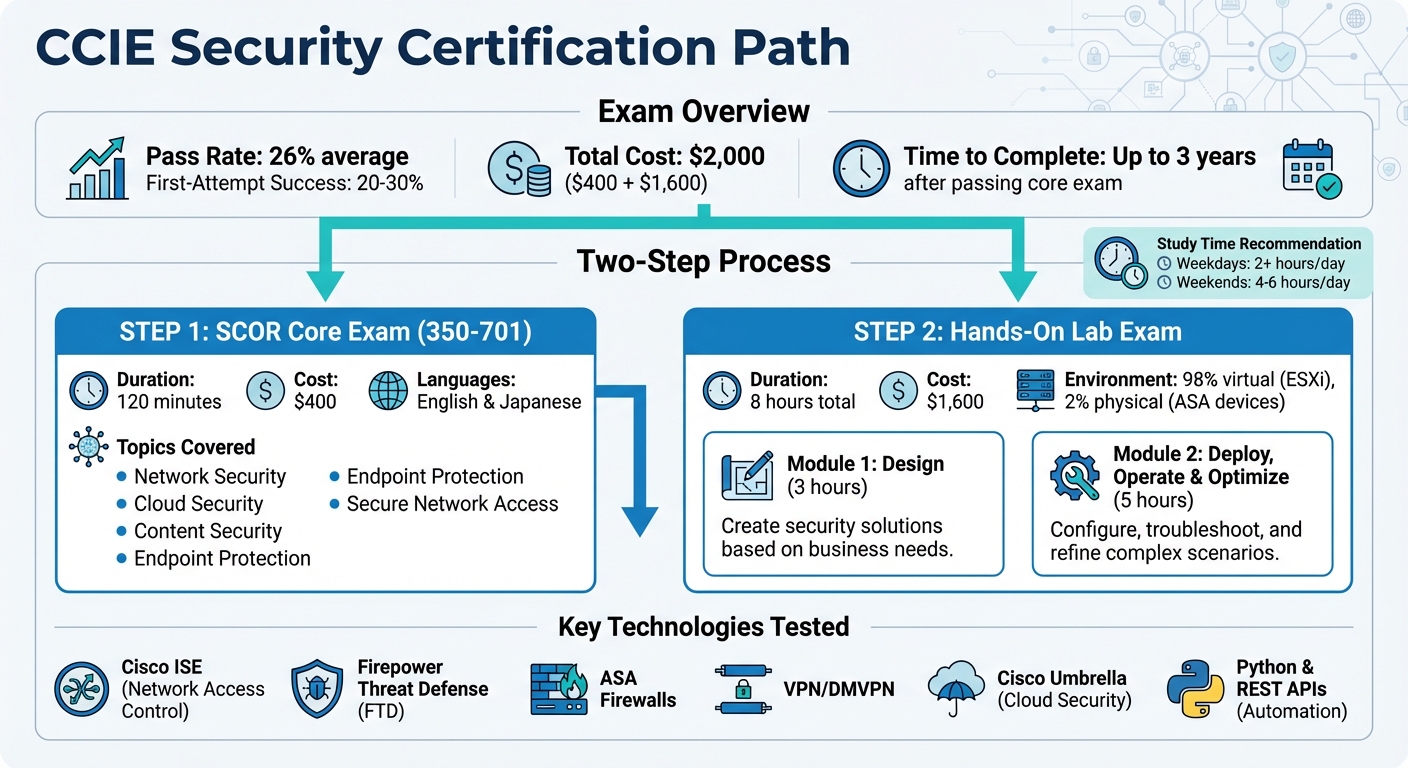
The Cisco CCIE Security certification is a top-tier credential for network security professionals, especially those with active security clearance. It validates expertise in designing, deploying, and managing advanced security systems, making it highly valuable for federal cybersecurity roles. With only a 26% average pass rate, the certification is challenging but opens doors to six-figure salaries and leadership positions like Security Architect and CISO.

Key Takeaways:

  • Certification Requirements: Pass a 120-minute SCOR core exam ($400) and an 8-hour lab exam ($1,600).
  • Skills Covered: Network security (firewalls, VPNs, ISE), cloud security, automation with Python/APIs.
  • Career Impact: High demand for cleared CCIE-certified professionals in federal cybersecurity, with roles in architecture, engineering, and leadership.
  • Preparation Tips: Focus on Cisco’s exam blueprint, practice in virtual labs, and build automation skills.

Cleared professionals with CCIE Security can secure top positions with government contractors like CACI, Peraton, and Lockheed Martin. This certification is a stepping stone to advancing in the federal cybersecurity sector.

How To Pass The CCIE Security Exam (Tips & Advice)

Exam Requirements and Preparation for CCIE Security

CCIE Security Certification Path and Exam Requirements

CCIE Security Certification Path and Exam Requirements

CCIE Security Exam Structure

Earning the CCIE Security certification requires passing two challenging exams: a 120-minute SCOR core exam and an 8-hour hands-on lab exam. The 350-701 SCOR core exam focuses on topics like network security, cloud security, content security, endpoint protection, and secure network access. Each attempt costs $400, and the exam is available in English and Japanese [2]. After passing the core exam, candidates have three years to complete the lab exam. The lab exam costs $1,600 and is split into two distinct modules [2].

  • Module 1: Design (3 hours) tests your ability to create security solutions based on specific business needs.
  • Module 2: Deploy, Operate, and Optimize (5 hours) evaluates your skills in configuring, troubleshooting, and refining complex security scenarios using both virtual and physical equipment [3].

The lab environment is predominantly virtual, with about 98% of tasks running on virtual machines in an ESXi setup. The remaining 2% involves physical ASA devices, which are used for clustering and failover scenarios [3]. Key technologies covered include Cisco Identity Services Engine (ISE) for network access control, Firepower Threat Defense (FTD) and ASA firewalls for perimeter security, VPN technologies like DMVPN, Cisco Umbrella for cloud security, and automation tools such as Python and REST APIs via Postman [1].

The CCIE Security exam is notoriously difficult, with an average pass rate of just 26%. First-attempt success rates hover between 20–30%, underscoring the need for thorough and strategic preparation [5].

Study Strategies for Cleared Engineers

For professionals in cleared roles aiming to excel in high-level federal cybersecurity positions, mastering the CCIE Security exam requires a disciplined and efficient approach. The demands of balancing a full-time job with limited study time make targeted strategies essential. Start by reviewing Cisco’s official exam blueprint to identify areas where you lack expertise. As Zia Hussain, Program Manager for the CCIE Security exam, advises:

"The exam blueprint should be the starting point of your journey. Identify the tasks from the blueprint that you are not an expert at. Then, build the lab modules for those tasks." [3]

Time management is key. Aim for at least two hours of study during weekdays and dedicate four to six hours on weekends [8]. Leverage virtual lab solutions like Cisco Modeling Labs (CML), EVE-NG, or GNS3 to simulate complex network setups without the need for costly physical hardware [7]. Cisco also provides CCIE Practice Labs for $50 per four-hour session, offering an environment similar to the actual exam setup [6].

To build the speed and decision-making skills required for the exam, practice full lab modules under timed conditions. Additionally, focus on developing Python scripting and Postman API skills, as these are integral to automation tasks. A crucial tip: save your configurations frequently during practice to prevent data loss during the exam [5].

These strategies can help cleared professionals effectively prepare for one of the most demanding certifications in the cybersecurity field.

Job Opportunities for CCIE Security Holders with Clearance

Top Jobs for Cleared CCIE Security Engineers

Earning a CCIE Security certification and holding clearance can open the door to high-level roles in network architecture and security engineering. These professionals are in demand for positions that involve designing and securing critical systems. For those focused on architecture, roles like Senior Network Architect, Enterprise Architect, and C2C Architect involve creating secure frameworks to support defense and intelligence operations. On the security engineering side, positions such as Senior Network Security Engineer and Senior Firewall Engineer focus on protecting network perimeters.

There are also specialized technical roles, like Cisco ISE Engineer, which center on managing network access and identity control. If you’re more interested in pre-sales, CCIE Security Certified Pre-Sales Engineers work on designing and presenting secure solutions tailored to government clients [9]. For those aiming for senior leadership, expert roles such as Principal Network Engineer and IT Network SME provide opportunities to lead critical projects. These roles span a variety of career paths, offering flexibility and growth potential in cleared environments.

Employers Hiring Cleared CCIE Security Professionals

A wide range of government contractors and specialized firms actively recruit CCIE Security professionals with clearance. For security engineering roles, companies like CACI, Crimson Phoenix, and TEKsystems frequently hire qualified candidates. If your focus is on network architecture, firms such as Zachary Piper Solutions, NTG, and Peraton value expertise in designing strategic security solutions.

For more senior positions, organizations including GuROO LLC, TENICA, and Mission Services LLC are on the lookout for Principal Network Engineers and IT Network SMEs. Those interested in operations can explore roles like Tier III Operations & Maintenance Network Engineer and Senior Network Administrator with contractors such as Dexian Signature Federal and Agensys. Meanwhile, specialized positions like Network Automation Engineer and Cisco ISE Engineer are in demand at employers like Zachary Piper Solutions and OMW Consulting. These employers offer a mix of opportunities, ensuring there’s something for every cleared CCIE Security professional.

sbb-itb-bf7aa6b

Career Growth Strategies with CCIE Security

Applying CCIE Skills to Emerging Technologies

Earning a CCIE Security certification positions you to tackle critical cybersecurity challenges by applying advanced skills to cutting-edge technologies that align with federal agencies’ priorities [4]. As Norman St. Laurent, Federal Product Marketing Manager at Cisco, puts it:

"To be successful in cybersecurity, it is crucial to remain committed to continuous learning and stay aware of industry developments." [10]

One area transforming Security Operations Centers (SOCs) is machine learning-based threat detection, which enables proactive threat hunting [10]. To stay ahead, focus on mastering cloud security across IaaS, PaaS, and SaaS platforms, and gain a solid understanding of API protocols to protect interconnected federal systems [10][11].

Regular recertification every two years keeps you updated on the latest advancements. Platforms like Cisco U. provide valuable resources, such as the course "Performing CyberOps Using Cisco Security Technologies", which dives into threat hunting, incident response, and malware forensics [10]. For hands-on experience, Cisco dCloud offers virtual labs designed to refine your technical expertise [10].

Acquiring expertise in emerging technologies not only sharpens your technical skillset but also increases your value to top employers in the cleared sector. These capabilities can open doors to new career opportunities and advancement.

Using Cleared Cyber Security Jobs for Career Advancement

With your growing technical expertise, you can use specialized platforms like Cleared Cyber Security Jobs to take your career to the next level. This platform caters specifically to security-cleared professionals, offering tools like job search filters that help you find roles based on clearance level, location, and CCIE-related qualifications. Upload your resume to attract employers actively seeking CCIE Security experts.

Set up job alerts for leadership roles such as Principal Network Engineer, Senior Network Architect, or CISO – positions that align with the advanced skills your CCIE Security certification provides [4]. The platform also offers career resources tailored to your needs, including advice on showcasing your CCIE credentials to appeal to government contractors. Additionally, their job fairs connect you directly with hiring managers from top companies like CACI, Peraton, and Lockheed Martin [11].

Since Cleared Cyber Security Jobs exclusively partners with direct-hire employers and requires U.S. citizenship with active clearance, you can trust that the opportunities are legitimate. This streamlined approach connects you with roles that can significantly advance your career in the cleared sector.

Conclusion

Earning the CCIE Security certification alongside a security clearance can significantly propel your career in the cleared cybersecurity sector. This combination addresses the federal sector’s growing need for secure, high-performing network solutions, opening doors to roles like Network Security Architect, Security Consultant, or even Chief Information Security Officer – positions that require both technical expertise and trusted access to sensitive government systems.

Zia Hussain, Cisco’s Program Manager for the CCIE Security exam, shares his perspective on the certification’s impact, reflecting on his 22-year journey from a TAC support engineer to senior leadership:

"Being CCIE certified hugely contributed towards my professional achievements and is key to career advancement."

This sentiment highlights the certification’s role in shaping successful careers.

The CCIE Security certification proves your ability to design, implement, and troubleshoot advanced security systems – skills essential for safeguarding defense and intelligence networks. Staying at the top of your field means committing to continuous learning and keeping up with new technologies [4].

To connect with opportunities in cleared cybersecurity, consider using Cleared Cyber Security Jobs. This platform is tailored for U.S. citizens with active security clearance, offering features like job alerts, resume uploads, and targeted job fairs to help you connect with government contractors looking for experts like you.

The cleared cybersecurity sector relies on professionals who can protect critical national security infrastructure. With your combined credentials, you are well-positioned to meet this demand and advance your career by connecting with leading employers in the industry.

FAQs

How long should I plan to prepare for CCIE Security?

You should allocate six to twelve months for dedicated preparation when working toward the CCIE Security certification. This period gives you enough time to dive deep into the material and develop the expertise required to excel in the exam.

What clearance levels get the most value from CCIE Security?

The CCIE Security certification holds exceptional value for professionals aiming for roles requiring higher clearance levels, such as TS/SCI. These positions often come with premium responsibilities and significantly higher salaries. Even at the Secret clearance level, this certification can open doors to numerous opportunities, along with notable salary enhancements. Its alignment with the skills and expertise sought in cleared cybersecurity roles makes it a powerful tool for advancing within the cleared job market.

Which CCIE Security topics matter most for federal roles?

For federal positions, expertise in CCIE Security revolves around protecting complex enterprise and government networks, especially within high-security settings. Key focus areas include secure network architecture, VPNs, firewalls, intrusion prevention systems, and threat mitigation techniques.

A thorough understanding of federal regulations – like FISMA, NIST guidelines, and DoD standards – is essential. Additionally, being adept at troubleshooting and optimizing security infrastructure is crucial for safeguarding national infrastructure and classified data.

Related Blog Posts

  • GSEC Certification Career Guide for Cleared Security Essentials
  • Security Plus Certification Career Guide for Cleared Entry Level
  • Cisco CCNA Security Career Guide for Cleared Network Professionals
  • Cisco CCNP Security Career Guide for Cleared Network Engineers

Related Guides

  • Cisco CCNP Security Career Guide for Cleared Network Engineers
  • Cisco CCNA Security Career Guide for Cleared Network Professionals
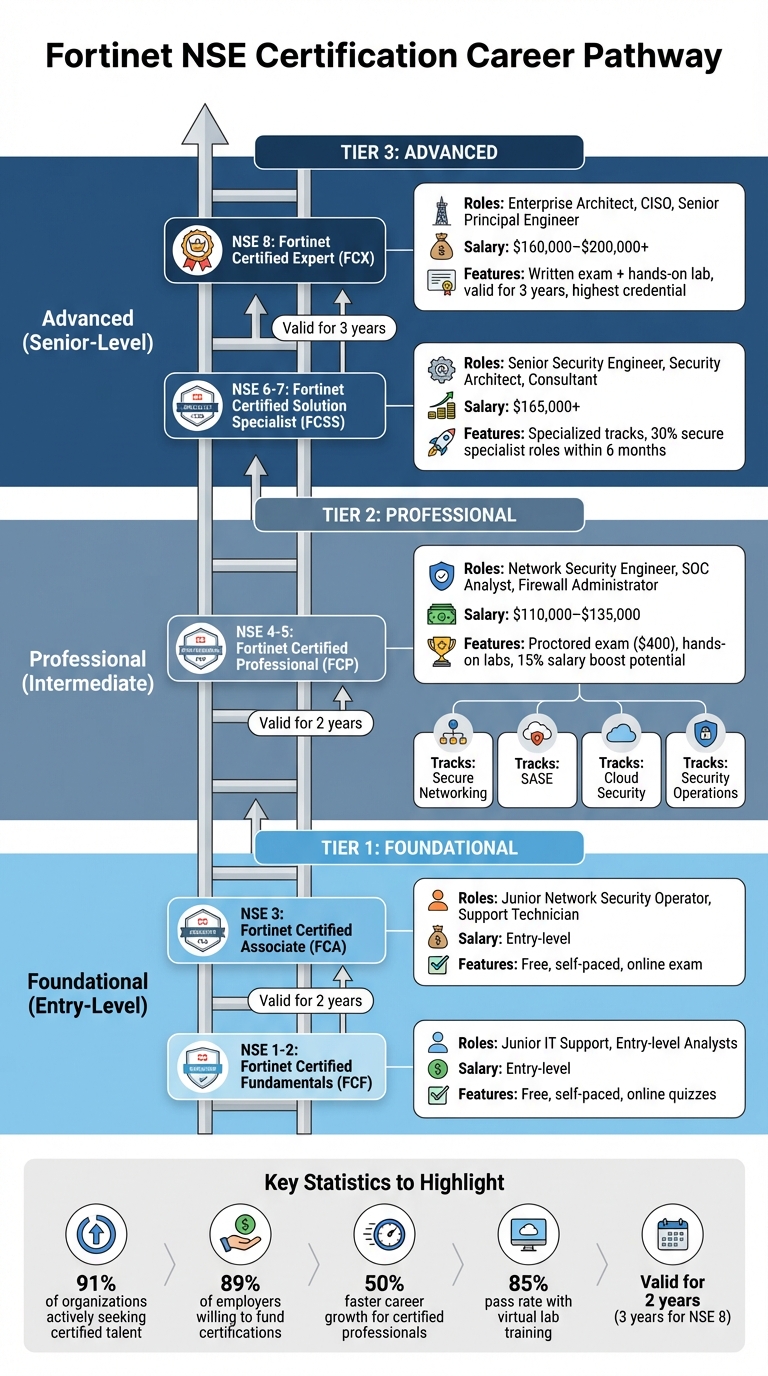
  • Fortinet NSE Certification Career Guide for Cleared Network Security
  • Cybersecurity Salary Guide 2026
  • TS/SCI Salary Premium: Real 2026 Numbers

Cisco CCNP Security Career Guide for Cleared Network Engineers

CyberSecJobs Editorial · March 5, 2026 ·

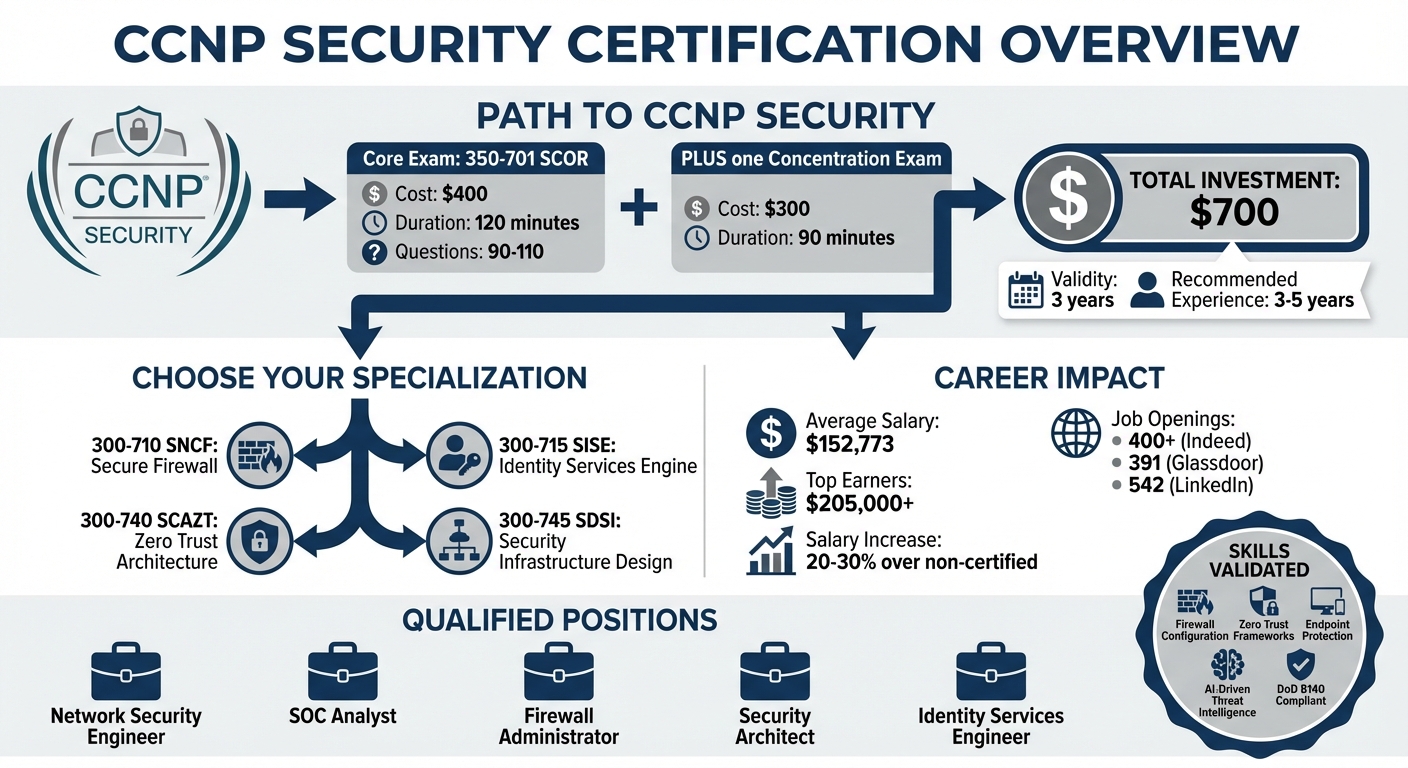
Looking to advance your career in government or defense cybersecurity? The Cisco CCNP Security certification is a top choice for security-cleared network engineers. It validates your expertise in securing Cisco infrastructures, aligns with DoD 8140 requirements, and opens doors to roles with salaries averaging $152,773 – with top earners exceeding $205,000.

Key Takeaways:

  • Certification Structure: Pass the 350-701 SCOR core exam ($400) and one concentration exam ($300). Total cost: $700.
  • Skills Gained: Firewall configuration, Zero Trust frameworks, endpoint protection, and AI-driven threat intelligence.
  • Updated Content: Includes quantum-safe security and NIST SP 800-37 frameworks (as of February 2026).
  • Career Opportunities: Qualifies you for jobs like Network Security Engineer, SOC Analyst, and Security Architect, often requiring Secret or Top Secret clearances.
  • Recertification: Valid for 3 years; renew via exams or 80 Continuing Education credits.

This certification not only boosts your technical skills but also positions you for high-demand roles in cybersecurity. Whether you’re starting your certification journey or aiming for senior positions, CCNP Security is a great investment for cleared professionals.

CCNP Security Certification Path: Exams, Costs, and Career Outcomes

CCNP Security Certification Path: Exams, Costs, and Career Outcomes

CCNP Security Certification: Structure and Skills

Required Core Exam and Optional Concentration Exams

To earn the CCNP Security certification, you’ll need to pass two exams: a mandatory core exam (350-701 SCOR) and one concentration exam of your choice. The core exam costs $400, while each concentration exam is priced at $300, bringing the total investment to around $700. While there are no official prerequisites, Cisco suggests having three to five years of hands-on experience with security solutions to prepare for these professional-level exams.

The 350-701 SCOR core exam is a 120-minute test with 90–110 questions. It focuses on a wide range of security technologies, including network security, cloud security, content security, endpoint protection, secure network access, and visibility enforcement. Successfully passing this exam not only earns you the CCNP Security core credential but also qualifies you to attempt the CCIE Security lab exam, which is ideal for those pursuing expert-level certification.

For the concentration exams, you can choose from several 90-minute options tailored to specific career paths:

  • 300-710 SNCF: Focuses on Cisco Secure Firewall, covering policy configurations, AI-driven threat intelligence, and cloud integration.
  • 300-715 SISE: Centers on Cisco Identity Services Engine (ISE), including BYOD policies, endpoint compliance, and network access control.
  • 300-740 SCAZT: Highlights Zero Trust architectures and Security Service Edge (SSE) for cloud environments.
  • 300-745 SDSI: Emphasizes designing complex security infrastructures and adopting emerging practices.

Important Note: Three older concentration exams – 300-720 SESA (Email Security), 300-725 SWSA (Web Security), and 300-730 SVPN (VPN Solutions) – will be retired on August 26, 2026. If you’re interested in these topics, you’ll need to complete the exams before this deadline. Additionally, the 300-735 SAUTO automation exam was retired on February 2, 2026.

With the exam structure outlined, let’s explore the specific skills this certification validates.

Skills Covered by CCNP Security

The CCNP Security certification equips you with the expertise needed to protect critical networks, including those in government and defense sectors. It validates your ability to tackle network security fundamentals, such as designing and managing firewalls, deploying intrusion prevention systems, and configuring secure remote access via VPNs. You’ll also gain skills in cloud security, including managing secure applications and implementing Zero Trust frameworks aligned with federal standards.

A major focus of the certification is endpoint protection and detection. You’ll learn how to secure devices, monitor for threats, and respond to incidents in distributed environments. Additionally, the certification covers identity services management through Cisco ISE, enabling you to control network access and enforce compliance policies for both employees and contractors. You’ll also gain proficiency in using visibility and enforcement tools to monitor network traffic, detect anomalies, and automate responses to security events.

Recent updates to the certification emphasize architectural design over just technical implementation. For instance, the 300-745 SDSI exam teaches you to design scalable security systems and integrate DevSecOps practices and SOAR (Security Orchestration, Automation, and Response) platforms into your architecture. These advanced skills prepare you for roles like Security Architect or Principal Engineer, where you’ll design entire security infrastructures rather than focusing on individual components.

Passing any concentration exam also earns you a Cisco Certified Specialist certification in that specific area, providing an additional credential to demonstrate your expertise. The CCNP Security certification remains valid for three years and can be renewed by completing any professional-level exam or earning 80 Continuing Education credits.

Getting Started with Cisco CCNP – Security

Cisco

Cleared Cybersecurity Jobs That Match CCNP Security Skills

This section highlights key cleared cybersecurity roles that align with the technical expertise validated by your CCNP Security certification. These roles are designed to meet strict federal standards and often require security clearances.

Top Cleared Roles for CCNP Security Professionals

Earning a CCNP Security certification qualifies you for several high-demand positions in the cleared cybersecurity space.

  • Network Security Engineers: These professionals design and implement secure architectures for government networks, configure VPN tunnels to enable secure communication between classified environments, and manage intrusion prevention systems. These roles typically require a Secret or Top Secret clearance.
  • Security Operations Center (SOC) Analysts: SOC analysts monitor network traffic, investigate potential security incidents, and respond to threats in real time. Defense contractors and intelligence agencies seek analysts skilled in Cisco network visibility tools.
  • Firewall Administrators: These roles involve managing access control policies, creating prefilter rules for classified networks, and ensuring compliance with federal security guidelines.

Other specialized positions include Identity Services Engineers, who deploy Cisco Identity Services Engine (ISE) for network access control, and Security Architects, who design infrastructures with integrated Zero Trust frameworks. These senior roles often require TS/SCI clearances and can offer salaries exceeding $150,000.

The following section breaks down how your CCNP Security skills align with these job responsibilities.

How CCNP Security Skills Match Job Requirements

The technical skills you developed through CCNP Security certification directly align with the responsibilities of these cleared roles. For example, if a job posting mentions expertise with next-generation firewalls, it refers to configuring access control policies and integrating threat intelligence – skills you’ve already mastered. Similarly, requirements for network visibility tools and secure remote access map directly to your experience with Cisco technologies like DMVPN and FlexVPN.

CCNP Security Skill Job Responsibility Relevant Technology
Firepower NGFW & IPS Configuring access control policies and prefilter rules for classified environments Cisco Firepower, FMC
Cisco Stealthwatch & Umbrella Providing network visibility and DNS-layer ransomware protection Stealthwatch, Umbrella
Identity Services (ISE) Managing secure access for end-user devices and enforcing compliance Cisco ISE, 802.1X
Email/Web Security Managing email policies and HTTPS decryption for government agencies ESA, WSA
Endpoint Protection Monitoring devices and responding to threats in distributed environments AMP for Endpoints, AnyConnect

As federal agencies shift toward Firepower Threat Defense, traditional ASA firewall roles are evolving, creating demand for professionals with next-generation firewall (NGFW) expertise – precisely what CCNP Security certification prepares you for. Additionally, the increasing emphasis on Zero Trust architectures aligns with the advanced training you’ve completed, especially in the related concentration exams.

sbb-itb-bf7aa6b

How to Prepare for and Earn CCNP Security Certification

To earn your CCNP Security certification, you need to pass the 350-701 SCOR core exam and one concentration exam. While there are no formal prerequisites, Cisco recommends having three to five years of hands-on experience with security solutions before attempting these professional-level exams. Keep in mind that recertification is required every three years.

Preparing for the Core Exam (350-701 SCOR)

The 350-701 SCOR exam is a 120-minute test with 90–110 questions covering six key areas: Security Concepts, Network Security, Securing the Cloud, Content Security, Endpoint Protection and Detection, and Secure Network Access/Visibility. This exam is not only essential for CCNP Security but also for CCIE Security, making it a smart choice for anyone planning long-term growth in the field.

To prepare effectively, combine structured study with practical lab work. Cisco U. offers learning paths with assessments to help you identify and address knowledge gaps. For hands-on practice, set up a virtual lab using tools like Cisco Modeling Labs (CML), GNS3, or Cisco Packet Tracer. Focus on tasks like configuring FlexVPN tunnels, creating Firepower policies, and deploying ISE solutions. Additionally, familiarize yourself with interpreting Python scripts for Cisco Security appliance APIs to tackle automation-related questions.

Plan for a 12–16 week study schedule, dedicating each week to a specific domain. Tools like Anki flashcards can help with memorizing cryptography and protocol details. Aim to consistently score 85% or higher on practice tests before scheduling your exam. During the test, manage your time wisely – spend no more than 60–75 seconds per multiple-choice question to leave time for simulation-based tasks. Results are typically available online within 48 hours, and passing the exam earns you the "Cisco Certified Specialist – Security Core" certification.

Mastering these study techniques not only prepares you for the exam but also builds the technical skills needed for critical security roles. Once you’ve completed the core exam, the next step is to select a concentration exam that aligns with your career goals.

Selecting Your Concentration Exam

Choosing the right concentration exam is crucial for aligning your certification with your career path. For example:

  • If you’re a Network Security Engineer focusing on threat detection and Cisco Secure Firewalls, the 300-710 SNCF exam is a great fit. This test now includes AI-driven threat intelligence and Cloud Control management as of the 2026 update.
  • For those managing Identity Services Engine (ISE), BYOD lifecycles, and network access policies, the 300-715 SISE exam is ideal.
  • Cloud Security Engineers working on Zero Trust and Secure Cloud Access should go for the 300-740 SCAZT exam.
  • If you’re aiming for a Senior Architect role, the 300-745 SDSI exam will prepare you with content on architectural design, AI threats, and quantum-safe concepts.

Keep in mind that some older exams have been retired, so always verify the latest exam offerings to ensure you’re focusing on relevant, in-demand skills.

Maintaining Your Certification

Once certified, keeping your CCNP Security credential active is essential to staying on top of evolving security technologies. The certification is valid for three years, and maintaining it ensures you’re prepared for new challenges and opportunities.

You have three options for recertification:

  • Pass any professional-level concentration exam.
  • Retake the 350-701 SCOR core exam.
  • Earn 80 Continuing Education (CE) credits. Activities like attending Cisco Live sessions, completing training courses, or publishing technical content can help you accumulate these credits.

The CE credit option is particularly helpful for busy professionals who may not have time for full exam preparation. Be sure to track your credits in your Cisco certification account to avoid lapses in your credential.

Staying certified not only keeps your skills sharp but also reinforces your value in the ever-changing world of security solutions.

Using CCNP Security to Advance Your Cleared Career

Earning a CCNP Security certification can significantly boost your career, especially in specialized cleared roles. On average, CCNP-certified professionals earn 20% to 30% more than their non-certified counterparts [4], with CCNP Security professionals bringing in an impressive annual salary of $152,773 [1]. But the benefits extend far beyond just financial gains – this certification opens doors to a range of exciting opportunities in the cybersecurity field.

Job Search Methods for Cleared Professionals

Landing the right cleared role requires a focused and strategic approach. Start by targeting job boards like Cleared Cyber Security Jobs, where you can search for positions requiring both your CCNP Security certification and your specific clearance level, such as TS/SCI. Setting up job alerts with keywords like "CCNP Security" and your clearance type ensures you’re among the first to respond to new opportunities. Unlike generic job boards, cleared roles come with strict requirements, so this tailored strategy saves time and effort.

In addition to job boards, aim for major federal contractors such as Booz Allen Hamilton, Leidos, and Lockheed Martin. Many of these companies offer referral bonuses, making networking with their employees a smart move. Attend hiring events and industry conferences geared toward cleared professionals – like INSA, NDIA, GEOINT, and AUSA – to connect directly with recruiters and program managers. Also, optimize your LinkedIn profile by including terms like "Security-Cleared Professional | TS Clearance | CCNP Security" in your headline, but avoid sharing sensitive details on unsecured platforms.

Location matters, too. Cleared roles are concentrated in areas like Northern Virginia, Maryland’s Fort Meade region, Colorado Springs, and Tampa/Orlando. Since many national security jobs require on-site work in secure facilities (SCIFs), you may need to consider relocating if you’re not already in one of these hubs.

Once you’ve secured a role leveraging your CCNP Security certification, you’ll find even more opportunities for growth and advancement.

Career Advancement Paths with CCNP Security

Your CCNP Security certification isn’t just a credential – it’s a launchpad for specialized and leadership positions. This certification qualifies you for roles like Network Security Engineer, Security Consultant, SOC Specialist, Information Security Analyst, Senior Network Architect, and IT Security Manager, among others [4]. It also serves as a stepping stone to the expert-level CCIE Security certification, as passing the 350-701 SCOR core exam fulfills the written exam requirement for CCIE [1][5].

"CCNP Security is not just another certification. It’s a globally recognized standard that proves an IT professional has the ability to secure networks, manage advanced security solutions, and protect data in today’s hostile cyber environment." – Troytec Exams [4]

To broaden your expertise, consider adding complementary certifications. For example, management-focused credentials like CISSP can prepare you for governance and strategy roles, while offensive security certifications such as CEH provide valuable insights into cyberattacks [2]. You can also expand your Cisco knowledge by pursuing concentration exams in areas like automation (300-735 SAUTO) or cloud security (300-740 SCAZT), aligning with the growing demand for automated security solutions and cloud-native technologies.

Career Examples from Cleared Network Engineers

The demand for CCNP Security professionals in the cleared job market is strong. As of early 2026, searches for "CCNP Security" on job platforms yielded over 400 results on Indeed, 391 on Glassdoor, and 542 on LinkedIn [1]. Some job postings even allow advanced certifications like CCNP Security to substitute for required work experience, giving you an edge early in your career [1].

The global cybersecurity talent shortage – estimated at over 3.4 million professionals as of 2024 – further amplifies your value [4]. With your CCNP Security certification and active clearance, you belong to an elite group of candidates that government contractors are eager to hire. This combination not only strengthens your job prospects but also enhances your ability to negotiate better salaries, benefits, and career opportunities.

Conclusion: CCNP Security for Cleared Cybersecurity Careers

CCNP Security can be a game-changer for cleared network engineers, offering an average salary of $152,773 [1] and paving the way to roles like Security Architect, Cloud Security Engineer, and SOC Analyst [3].

This certification aligns with DoD 8140 requirements and qualifies you for the CCIE Security lab exam [1], making it a key credential for cleared professionals aiming to advance their careers.

Industry voices highlight its value:

"The CCNP Security certification is still absolutely worth it if you are looking to advance in your cybersecurity career. The exam updates have made the certification even more future-proof by including AI threats and cloud-centered security concepts." – Graeme Messina, Author, CBT Nuggets [3]

With over 3.4 million cybersecurity jobs currently unfilled worldwide [4], the updated CCNP Security curriculum – featuring AI-driven threats, Zero Trust frameworks, and quantum-safe security [3] – keeps you ahead of the curve. When paired with an active security clearance, this certification sets you apart in a market where government contractors are actively searching for skilled professionals.

At just $700 for the core and concentration exams [1], this certification is a smart investment. Whether you’re transitioning from networking to security or aiming for leadership roles, CCNP Security equips you with the expertise needed to thrive in the ever-evolving cybersecurity landscape.

FAQs

Which CCNP Security concentration exam should I choose for my cleared role?

If you’re aiming for a CCNP Security certification, the best concentration exam depends on your specific role and expertise in cybersecurity. Begin with the 350-701 SCOR core exam, which lays the foundation by covering essential topics like network and cloud security.

From there, pick a concentration exam that matches your professional focus. For example:

  • 350-702 SECURE: Ideal for those concentrating on threat detection and protection.
  • 350-704 CLCON: A great choice if your work revolves around secure access solutions.

Choose the path that aligns best with your career aspirations and current skill set.

How do I build a CCNP Security lab at home without using classified systems?

To set up a CCNP Security lab at home without relying on classified systems, you can use physical devices like Cisco 3550 switches or 2600 routers. Alternatively, virtualization tools such as GNS3, Cisco VIRL, or EVE-NG are excellent options. These tools allow you to design and configure network topologies that include routers, switches, firewalls, and VPNs, providing hands-on experience with security policies and troubleshooting.

Make sure that all the equipment and software you use comply with legal standards and are non-classified. At the same time, ensure your setup aligns with the requirements of the CCNP Security exam to get the most relevant practice.

Does CCNP Security help me meet DoD 8140 requirements for cleared jobs?

The CCNP Security certification aligns with the DoD 8140 requirements and is officially recognized as a DoD-approved credential. This certification helps professionals meet qualification standards for roles requiring security clearance, making it an important asset for those looking to enter or advance in the cleared job market.

Related Blog Posts

  • Security Plus Certification Career Guide for Cleared Entry Level
  • CCSP Certification Career Guide for Cleared Cloud Security
  • Palo Alto PCNSE Career Guide for Cleared Firewall Engineers
  • Cisco CCNA Security Career Guide for Cleared Network Professionals

Related Guides

  • Cisco CCIE Security Career Guide for Cleared Expert Engineers
  • Cisco CCNA Security Career Guide for Cleared Network Professionals
  • Fortinet NSE Certification Career Guide for Cleared Network Security
  • Cybersecurity Salary Guide 2026
  • TS/SCI Salary Premium: Real 2026 Numbers

Cisco CCNA Security Career Guide for Cleared Network Professionals

CyberSecJobs Editorial · March 5, 2026 ·

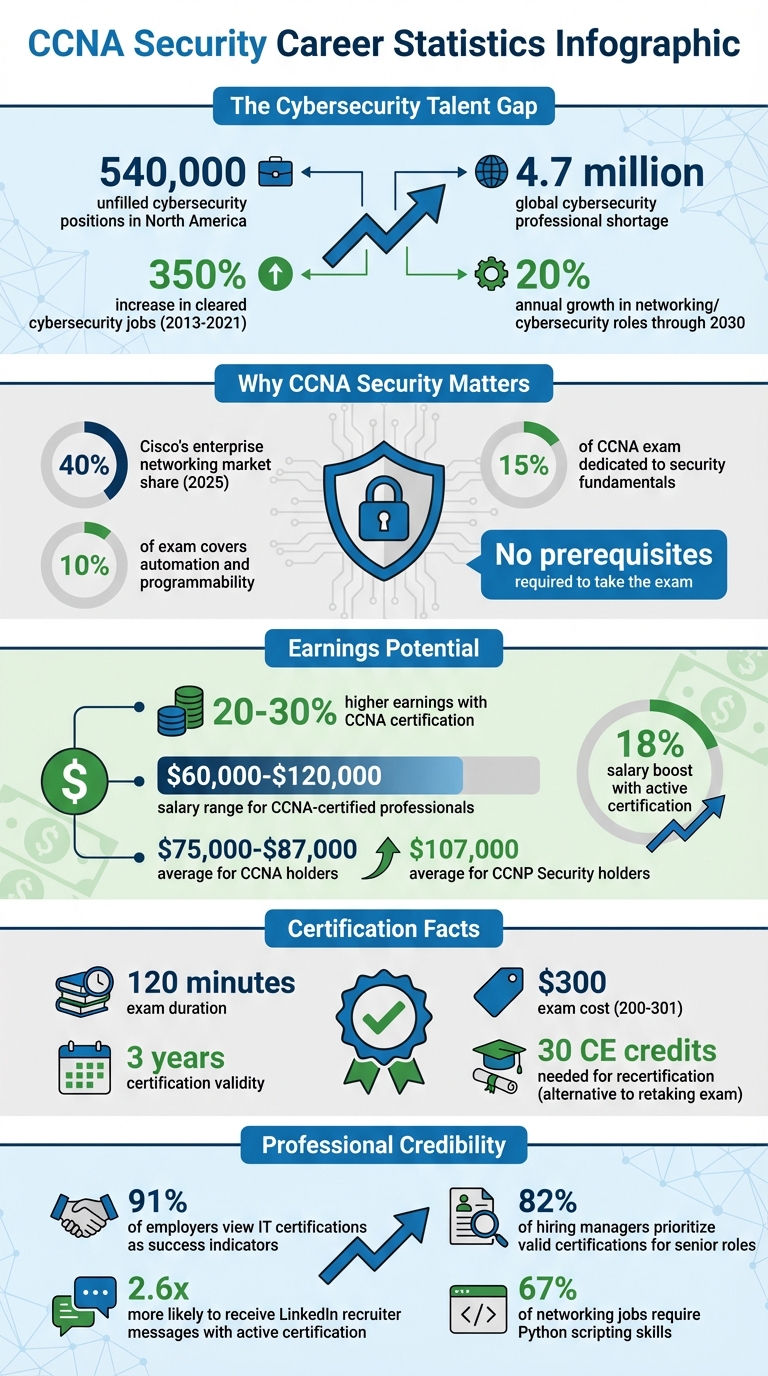
Want to boost your career in cybersecurity? The Cisco CCNA Security certification is a powerful tool for cleared professionals aiming to secure high-demand roles in defense and federal sectors. With over 540,000 unfilled cybersecurity positions in North America and a global shortage of 4.7 million professionals, this certification can set you apart. Here’s what you need to know:

  • Why It Matters: Proves your ability to secure networks and manage vulnerabilities. Recognized by the Department of Defense and aligns with the latest technologies, including AI and machine learning.
  • Earnings Potential: CCNA-certified professionals earn 20–30% more, with salaries ranging from $60,000 to $120,000.
  • Accessibility: No prerequisites required. Military personnel can use programs like "COOL Bucks" or GI Bill reimbursement to cover the $300 exam fee.
  • Career Growth: Opens doors to roles like ISSO and Cyber Threat Intelligence Analyst, with paths to advanced certifications like CCNP Security.

Whether you’re transitioning into cybersecurity or aiming for leadership roles, this certification is a smart step forward.

CCNA Security Certification Career Benefits and Statistics for Cleared Professionals

CCNA Security Certification Career Benefits and Statistics for Cleared Professionals

Cisco Security Workbook and Lab Guide – Free [CCNA Security]

What Is the Cisco CCNA Security Certification?

The Cisco CCNA Security certification showcases your ability to secure network infrastructures and handle cybersecurity threats effectively. In 2020, Cisco merged its associate-level tracks into the CCNA (200-301), integrating key security principles with essential networking topics [4]. Although the standalone CCNA Security track is no longer available, security concepts remain crucial for professionals tasked with protecting government networks. This certification demonstrates skills like configuring firewalls, implementing VPNs, and managing secure access controls – key capabilities for safeguarding classified systems [3]. These foundational skills pave the way for diving into the exam’s specifics and requirements.

Certification Scope and Core Topics

The current CCNA dedicates 15% of its curriculum to security fundamentals, covering areas like VPN technologies, Access Control Lists (ACLs), wireless security, and secure access management [4]. For professionals aiming for specialized security roles, these topics are a stepping stone toward advanced certifications such as CCNP Security or CyberOps [4] [9]. Key technical competencies include configuring Cisco ASA firewalls, setting up site-to-site and remote access VPNs, and managing Authentication, Authorization, and Accounting (AAA) systems. These skills align with Department of Defense (DOD) requirements for protecting government infrastructure, focusing on threat mitigation and secure access [3].

The CCNA also addresses automation and programmability (10% of the exam), reflecting the growing importance of software-defined networking in secure environments [4]. This includes using tools like APIs, Python, and Ansible to automate security configurations – skills highly sought after in cleared cybersecurity roles [6] [9]. With Cisco commanding nearly 40% of the enterprise networking market share as of 2025, these vendor-specific skills remain indispensable for federal agencies and defense contractors [4].

Prerequisites and Requirements

The CCNA (200-301) has no formal prerequisites, making it accessible to those transitioning into network security roles [4]. Previously, candidates for the CCNA Security track needed certifications like CCENT, CCNA Routing and Switching, or CCIE [3] [8]. To earn the certification, you must pass the 200-301 exam and agree to Cisco’s Career Certifications Confidentiality Agreement and Candidate Conduct Policy [3]. Cleared professionals should also confirm that their certification satisfies the DOD 8140/8570 framework for their specific job roles [3].

Service members can take the exam at Pearson VUE centers on military bases and use "COOL Bucks" (Credentialing Opportunities On-Line) to cover exam fees [3]. Allocate around 10–12 hours per week for 3–4 months to prepare, and use tools like Cisco Packet Tracer, GNS3, or EVE-NG to practice real-world network configurations [4]. Kevin Brown, a Cybersecurity Analyst, highlights the importance of certifications:

"Certifications give you instant credibility. People always want to know who they’re talking to. They want to know if you’re qualified." [7]

Exam Cost and Format

The CCNA (200-301) exam costs approximately $300, and military personnel can often use programs like "COOL Bucks" to cover the fee [3] [4]. The exam lasts 120 minutes and features multiple-choice questions, drag-and-drop exercises, and hands-on lab simulations designed to test your ability to configure secure networks in practical scenarios [4]. Security-related topics make up 15% of the exam [4].

The certification is valid for three years, after which you can recertify by passing a new associate-level exam, a professional-level exam like CCNP Security (350-701 SCOR, $400), or by earning Continuing Education (CE) credits [3] [7] [9]. Keeping your certification up to date ensures you stay ahead of technological advancements and remain competitive for advanced cybersecurity roles. Cleared professionals should consult their Education Service Officer to confirm eligibility for voucher reimbursements or promotion points [3].

Cleared Jobs That Require CCNA Security

Common Cleared Job Roles

CCNA Security credentials play a key role in meeting the growing demands of today’s cleared cybersecurity positions. Professionals holding these certifications are essential for maintaining cybersecurity standards in government and defense sectors. For instance, a March 2026 posting for a Network Engineer in Orlando, FL, required candidates to have an active security clearance, a CCNA certification, and expertise in applying STIGs while supporting RMF/DIACAP processes [11].

Cleared positions are increasingly looking for candidates who can combine networking expertise with cybersecurity skills. Employers often prioritize familiarity with tools such as the Assured Compliance Assessment Solution (ACAS), Nessus, and the Host Based Security System (HBSS). Many of these roles also require knowledge of RMF processes, NIST regulations, and NIST SP 800-53 standards. Gaining experience in these areas can open doors to a variety of opportunities and help professionals advance their cleared careers.

Industries Hiring CCNA-Certified Cleared Professionals

Several industries actively seek professionals with CCNA Security credentials and security clearances. These include the U.S. Department of Defense, Intelligence Community, federal agencies, and defense contractors. The skills outlined earlier directly align with the needs of these sectors. For example, organizations like the Air Force, Navy, and the Defense Information Systems Agency (DISA) regularly hire for roles in network administration and security. These positions often require Secret or Top Secret clearances and focus on safeguarding the network infrastructures that support critical military operations.

In the Intelligence Community, cleared roles – often requiring TS/SCI clearance with a polygraph – demand network security expertise to protect highly sensitive information. Federal civilian agencies, such as the Department of Commerce, and defense contractors working on government programs also seek cleared network engineers. Highlighting your experience with compliance standards when applying for these roles can significantly strengthen your application.

How to Use CCNA Security in Your Cleared Job Search

Adding CCNA Security to Your Resume and Profile

Your CCNA Security certification can be a powerful asset in landing a cleared job. To make the most of it, ensure it’s prominently displayed in your resume header. Pair it with your clearance level for maximum impact – for instance, "John Doe, CCNA Security, Active Secret Clearance." This way, recruiters can immediately spot your qualifications.

"Your security-cleared resume is not a biography or a mere list of qualifications. It’s an ad designed to help you land that coveted cleared job interview." – Ashley Jones, Editor, ClearedJobs.Net [12]

At the top of your resume, include a professional summary that highlights both your certification and experience. For example: "Network Security Specialist with CCNA Security and 5+ years of experience securing DoD communications infrastructure." This summary sets the tone for your expertise. When detailing your work history, use the STAR method to quantify your accomplishments. For example: "Reduced network vulnerabilities by 35% through proactive Cisco ASA firewall monitoring" [12][13].

If you’re still working toward your CCNA Security certification, list it as "CCNA Security (In-Progress)" along with your expected completion date. According to CyberSecJobs.com, including certifications in progress can make a big difference, especially if they’re a hard requirement for the role [13]. Tailor your resume for each job by incorporating specific technical terms from the posting, such as "Cisco ASA", "VPN", "network security", or "NIST-compliant." This not only aligns your skills with the job but also helps you get through Applicant Tracking Systems (ATS) [13][14].

Once your resume is polished, the next step is to refine your job search strategy.

Finding CCNA Security Jobs on Cleared Cyber Security Jobs

When searching for jobs, use phrase searches on Cleared Cyber Security Jobs. For precise results, place "CCNA Security" in quotation marks. To broaden your search, try Boolean operators like "CCNA Security" OR "Network Security Engineer." You can then narrow the results using "AND" to filter by clearance level or location. This focused approach can help you navigate the competitive hiring landscape for cleared professionals [15].

After crafting an effective search query – such as "CCNA Security" AND "Secret" – save it as a Job Agent. This feature will send you email alerts whenever a matching position is posted. For location-based searches, use a Zip Code with a mileage radius instead of city names. This ensures you capture jobs at nearby military installations that might be listed under different suburbs [15]. Additionally, logging in weekly keeps your profile active and visible to recruiters, as employers often prioritize candidates with recent activity [15].

sbb-itb-bf7aa6b

Career Growth with CCNA Security in Cleared Cybersecurity

Moving to Advanced Cisco Certifications

Earning your CCNA Security is just the beginning – it sets you up for a clear path to advanced Cisco certifications. The next step? The CCNP Security, which costs $700 in total. This includes $400 for the core 350-701 SCOR exam and $300 for one concentration exam [18]. With this professional-level certification, you can specialize in high-demand areas like Cisco Firepower (SNCF), Identity Services Engine (SISE), or VPN technologies (SVPN) [6]. These specializations align perfectly with the requirements of many cleared contracts, making you a strong candidate for senior engineering roles.

On average, CCNP Security holders earn $107,000 annually, up from the $75,000–$87,000 range typical for CCNA-certified professionals [18]. This certification also shifts your role toward solving more strategic and complex problems. For those with even greater ambitions, the CCIE Security represents the pinnacle of technical certifications in the industry. Achieving it involves passing a $400 written exam and an intense eight-hour hands-on lab exam, which costs between $1,600 and $1,900 [18].

"Certifications give you instant credibility." – Kevin Brown, Cybersecurity Analyst [18]

Before advancing to professional or expert certifications, it’s crucial to have strong networking fundamentals [18]. Passing a CCNP exam not only renews your CCNA certification but also moves you closer to expert-level credentials [17]. Beyond the technical benefits, these certifications can also pave the way to leadership opportunities.

Advancing to Leadership Positions

As you climb the career ladder, your CCNA Security remains a key building block for success in cleared cybersecurity. While it validates your technical expertise, it also opens doors to leadership roles by demonstrating your ability to enforce security policies and oversee monitoring efforts [6]. Becoming the "go-to person" for security-related challenges in your organization enhances your visibility, which can lead to management opportunities [18]. Notably, 91% of employers consider IT certifications a reliable indicator of employee success [18].

With a CCNA Security as your foundation, you could advance into roles like Cybersecurity Architect (earning $96,383–$124,947), Information Security Manager ($139,577–$167,911), or even Chief Information Security Officer ($219,741–$276,993) [16]. To reach these high-level positions, you might want to pair your CCNA with management-focused certifications like CISM or CISSP, which costs about $749 [16]. This combination of technical expertise and strategic skills positions you to lead Security Operations Center (SOC) teams and shape enterprise-wide security strategies [16].

The cleared cybersecurity sector has seen explosive growth, with a 350% increase in jobs between 2013 and 2021 [18]. Despite this growth, 53% of organizations report a 10% gap in staffing, highlighting the demand for certified professionals. Your CCNA Security could be the springboard that transforms you from a technical expert into a strategic leader [18].

Keeping Your CCNA Security Certification Current

Recertification Requirements and Timeline

Your CCNA certification stays valid for three years, with no extensions allowed [19][20]. To renew it, you have a few options: retake the CCNA (200-301) exam for $300, pass a professional concentration exam ($300), complete a technology core exam like CCNP Security Core 350-701 ($400), or earn 30 Continuing Education (CE) credits within the three-year period [10][20]. Attending Cisco Live events can earn you 10–15 credits per event while also exposing you to trending technologies like automation and SD-WAN [19]. Combining exam prep with continuing education can even speed up career promotions by 40% [19].

To stay on top of your recertification, set quarterly reminders to check the Cisco Certification Tracking System for updates and credit opportunities [19]. While Cisco does send email reminders at key intervals – two years, one year, 90, 60, and 30 days before expiration – it’s smart to plan at least six months ahead to avoid a last-minute scramble [19]. Letting your certification expire means you’ll need to start over and retake the full exam process [20].

Keeping your certification active isn’t just about convenience – it’s about value. An active certification can boost your salary by 18%, while an expired one might reduce its relevance by 12%. Additionally, professionals with active certifications are 2.6 times more likely to receive recruiter messages on LinkedIn, especially during periods of technological change [19]. Staying updated with cybersecurity trends ensures your recertification efforts directly support your career growth.

Staying Updated with Cybersecurity Changes

Recertification is important, but keeping up with industry trends is equally essential to stay competitive. For instance, automation concepts now make up 20% of the current CCNA exam, and 67% of networking job postings highlight Python scripting as a key skill [19]. With automation and AI-driven networks becoming more prominent, credits related to automation topics are now 35% more in demand compared to traditional routing subjects [19].

To avoid burnout, aim to dedicate just 30 minutes a week to training modules or study groups to steadily earn your credits [19]. Cisco also offers training badges in specialized areas like zero-trust architecture, which can quickly demonstrate your expertise in emerging technologies [19]. These micro-credentials can help you stand out, especially since 82% of hiring managers prioritize candidates with valid certifications for senior-level roles [19].

"Your expertise is like a smartphone – regular updates keep it running smoothly in our fast-paced digital world." – Editorial Team, CCNA-Classes [19]

Engaging with professional communities like the Cisco Learning Network forums is another great way to stay informed about exam updates and troubleshoot complex challenges [19]. For professionals working in roles tied to DoD 8570/8140 standards, maintaining an active certification isn’t just helpful – it’s often a job requirement [21]. An active certification proves your skills are up-to-date, while letting it lapse could mean starting over from scratch [21].

Conclusion and Next Steps

Key Points to Remember

Earning this certification is a game-changer for security-cleared professionals aiming to advance in government and defense sectors. The CCNA certification confirms your expertise in securing Cisco networks, building robust security systems, and countering threats effectively [1][3]. It’s highly regarded by prominent agencies like the National Security Agency (NSA) and the Committee on National Security Systems (CNSS) [22], making it a valuable credential for federal roles in fields like Computer Engineering and Information Technology Management [3]. Given Cisco’s stronghold in the market [4], this certification opens doors to lucrative opportunities with competitive salaries.

But it doesn’t stop there. The CCNA is also a stepping stone to pursuing advanced certifications [4][5][6]. The current CCNA (200-301) exam, updated as of August 2024, now covers topics like AI, machine learning, and cloud management – skills that are increasingly critical. With networking roles tied to cybersecurity expected to grow by 20% annually through 2030 [4][2], and a global shortage of 4.7 million cybersecurity professionals [2], your certification places you in a prime position for success.

With these advantages in mind, you’re well-equipped to take the next step in your cybersecurity career.

What to Do Next

Here’s how to turn your certification into actionable career growth:

  • Search for Cleared Roles: Visit Cleared Cyber Security Jobs to explore positions tailored for security-cleared professionals. Upload your resume, set up job alerts, and use filters to find roles that specifically require or prefer CCNA certification. Highlight your credential prominently in your profile to stand out.
  • Schedule Your Exam: If you haven’t taken the CCNA (200-301) exam yet, book it through Pearson VUE for $300 [4]. Use practical simulation tools to prepare for the hands-on components [4][5].
  • Plan for Recertification: If you’re already certified, mark your calendar six months before your certification’s three-year expiration date. Decide whether to retake the exam or pursue a more advanced certification to maintain your edge.
  • Stay Current: Dedicate 30 minutes a day to learning about automation and AI-driven networking trends. This will ensure your skills remain relevant in a fast-changing industry.

FAQs

Is CCNA still worth it if CCNA Security was retired?

Yes, the CCNA certification is still highly relevant, even with the retirement of CCNA Security. The updated CCNA now includes a wider scope of networking fundamentals, which also integrates security concepts. This makes it an excellent choice for professionals aiming for roles like network engineers or cybersecurity specialists. Globally recognized, it confirms critical skills and ensures that individuals are equipped to handle modern networking and security challenges, especially within Cisco-based environments.

Which cleared roles does CCNA help me qualify for?

The CCNA certification opens doors to roles such as Network Security Specialist, Security Administrator, and Network Security Support Engineer. These positions are centered around creating secure network infrastructures, detecting potential threats, and resolving vulnerabilities effectively.

How do I make CCNA stand out on a cleared resume?

To help your CCNA certification shine on a cybersecurity resume, focus on emphasizing your technical skills, certifications, and accomplishments in a clear and organized way. Start by placing your certifications prominently near the top of your resume, ensuring they grab attention immediately. Include a brief, impactful summary of your professional experience, and customize your resume to match the specific job description by incorporating relevant keywords.

Make sure to highlight your expertise in network security, your proficiency with Cisco technologies, and how your CCNA aligns with your security clearance. This combination can effectively underscore your qualifications for roles requiring clearance and technical expertise.

Related Blog Posts

  • GSEC Certification Career Guide for Cleared Security Essentials
  • Security Plus Certification Career Guide for Cleared Entry Level
  • CySA Plus Certification Career Guide for Cleared SOC Analysts
  • CCSP Certification Career Guide for Cleared Cloud Security

Related Guides

  • Cisco CCIE Security Career Guide for Cleared Expert Engineers
  • Cisco CCNP Security Career Guide for Cleared Network Engineers
  • Fortinet NSE Certification Career Guide for Cleared Network Security
  • Cybersecurity Salary Guide 2026
  • TS/SCI Salary Premium: Real 2026 Numbers

Fortinet NSE Certification Career Guide for Cleared Network Security

CyberSecJobs Editorial · March 4, 2026 ·

Fortinet NSE certifications are a structured way to validate cybersecurity skills for cleared professionals. The program offers eight levels, from basic awareness (NSE 1–2) to expert-level credentials (NSE 8), and aligns with federal standards like NICE. Updated in October 2025, the program now focuses on job-specific roles rather than just product knowledge. Here’s what you need to know:

  • Levels Overview:
    • NSE 1–3: Entry-level certifications covering cybersecurity basics and Fortinet products.
    • NSE 4–5: Mid-level certifications for configuring and managing Fortinet tools, with salaries of $110,000–$135,000.
    • NSE 6–7: Advanced certifications for designing and troubleshooting security systems.
    • NSE 8: The highest level, for experts managing complex infrastructures, with salaries exceeding $160,000.
  • Why It Matters:
    • Aligns with federal job requirements and industry frameworks.
    • Certifications like NSE 4–8 can lead to salary increases (15% or more).
    • Accepted for earning CPE credits for certifications like CISSP or CompTIA Security+.
  • Exam Details:
    • Foundational levels (NSE 1–3) are free and self-paced.
    • Advanced levels require proctored exams and hands-on labs via Pearson VUE.
  • Career Impact:
    • Certified professionals are in demand, with 91% of organizations seeking certified talent.
    • NSE certifications improve job prospects, faster career growth, and higher salaries.

Start with the free NSE 1–3 courses, then progress to higher levels for advanced roles in network security. Certification tracks include Secure Networking, SASE, Cloud Security, and Security Operations, catering to various career paths in cleared cybersecurity.

Fortinet NSE Certification Levels: Career Paths and Salary Ranges

Fortinet NSE Certification Levels: Career Paths and Salary Ranges

Fortinet Training & NSE Certification Updates – Deep Dive

sbb-itb-bf7aa6b

NSE Certification Levels and Career Applications

This section explains how the various NSE certification levels align with specific roles in cleared cybersecurity environments. The NSE program is divided into three career tiers, each tailored to different positions within the cybersecurity field. Knowing how each level fits into the broader career framework can help you select the right certification for your current role and future aspirations.

NSE 1–3: Foundational Knowledge for Entry-Level Roles

For those starting their journey in cleared cybersecurity, the first tier lays the groundwork. NSE 1–2 (Fortinet Certified Fundamentals) introduces basic cybersecurity concepts and raises awareness about network security. These certifications are particularly suited for junior IT support staff, entry-level analysts, and non-technical personnel transitioning into cleared cybersecurity roles [1][6].

NSE 3 (Fortinet Certified Associate) builds on this by validating operational skills with FortiGate devices. It’s designed for junior network security operators and support technicians handling daily tasks in smaller cleared environments [6]. Training for NSE 1–3 is offered online, self-paced, and includes quiz-based assessments [2].

Once this foundation is established, the next tier focuses on more advanced technical skills.

NSE 4–5: Technical Expertise for Intermediate Roles

This tier is ideal for cleared professionals managing classified network infrastructure. NSE 4 certification covers the configuration, installation, and management of FortiGate devices [1][7]. The exam costs $400 USD and requires practical technical knowledge [10].

NSE 5 certifications validate expertise in tools like FortiManager and FortiAnalyzer [6][10]. Clearing NSE 4 and one NSE 5 exam earns the Fortinet Certified Professional (FCP) designation, which can lead to an estimated 15% salary boost [4]. Certified professionals in this tier typically earn between $110,000 and $135,000 annually as of 2025 [10]. Specialization tracks such as Secure Networking, SASE, Cloud Security, and Security Operations prepare candidates to address specific challenges in cleared environments [6].

For those aiming to move into senior roles, the advanced certifications in the next tier provide the necessary credentials.

NSE 6–8: Advanced Credentials for Senior-Level Roles

This tier is tailored for professionals managing complex infrastructures and designing advanced security solutions. NSE 6 focuses on specialized areas like FortiMail, FortiWeb, Secure SD-WAN, and OT security, making it ideal for senior engineers [6][7].

NSE 7 targets security architects and senior engineers, emphasizing the design, deployment, and troubleshooting of large-scale security systems [1][6]. Completing NSE 6 and NSE 7 within the same track earns the Fortinet Certified Solution Specialist (FCSS) designation. Notably, 30% of FCSS-certified professionals secure specialist roles within six months [4].

At the top of the program is NSE 8 (Fortinet Certified Expert), which requires a written exam and a hands-on practical assessment. This certification demonstrates mastery in designing and troubleshooting complex network security systems [1][6]. NSE 8-certified professionals earn between $160,000 and $200,000+ annually [10]. Unlike lower-level certifications, NSE 8 is valid for three years [6]. It’s particularly suited for roles like Principal Architect, CISO, or senior consulting positions, where advanced technical expertise is essential for enterprise-level defense strategies.

NSE Level Certification Title Typical Cleared Job Roles Average Salary Range
1–2 Fortinet Certified Fundamentals (FCF) Junior IT Support, Entry-level Analysts Entry-level
3 Fortinet Certified Associate (FCA) Junior Network Security Operator, Support Technician Entry-level
4–5 Fortinet Certified Professional (FCP) Network Security Engineer, SOC Analyst, Firewall Administrator $110,000–$135,000 [10]
6–7 Fortinet Certified Solution Specialist (FCSS) Senior Security Engineer, Security Architect, Consultant
8 Fortinet Certified Expert (FCX) Enterprise Architect, CISO, Senior Principal Engineer $160,000–$200,000+ [10]

Skills Gained Through NSE Certifications

Core Technical Skills

NSE certifications are designed to build precise technical skills for managing network security. At the NSE 4 level, professionals develop expertise in FortiGate configuration and management, covering areas like firewall policies, NAT, IPsec/SSL VPNs, routing, High Availability (HA), and security profiles such as Antivirus, Web Filter, DNS, and Application Control [1][10].

For those pursuing NSE 5 certifications, the focus shifts to centralized management and analytics. This includes mastering tools like FortiManager for synchronizing configurations across multiple devices and FortiAnalyzer for monitoring, reporting, and incident correlation through FortiSIEM. These tools are essential for maintaining visibility across large-scale infrastructures [1][10].

The skill set deepens significantly at the NSE 6–8 levels. NSE 6 focuses on advanced areas such as Secure SD-WAN, Zero Trust Network Access (ZTNA), Public Cloud security (AWS, Azure, GCP), OT security, and automation using REST APIs [1][10]. Moving to NSE 7 and 8, professionals gain the ability to design, configure, and troubleshoot complex, multi-product security systems. These advanced skills are often required for roles like enterprise architects or CISOs, where strategic oversight and comprehensive security designs are critical [1][2]. Notably, professionals with NSE 7 or higher certifications have been shown to respond to breaches twice as quickly [4].

These technical capabilities align seamlessly with the evolving needs of cybersecurity professionals in high-security environments.

Job Role Alignment

Each NSE certification level is tailored to specific cybersecurity roles. For example, Network Security Engineers often hold NSE 4 certifications, enabling them to manage FortiGate deployments and enforce security policies within classified networks [1][7]. SOC Analysts, on the other hand, benefit from NSE 5 certifications, which equip them to use FortiAnalyzer and FortiSIEM for real-time monitoring and event correlation [1][11].

For more advanced roles, Security Architects and senior consultants typically pursue NSE 7 certifications, which validate their ability to design large-scale firewall configurations, secure hybrid cloud infrastructures, and troubleshoot advanced systems [1][7]. At the highest level, NSE 8-certified professionals take on roles like Enterprise Architect or CISO, where they oversee the design of intricate security frameworks and lead strategic defense efforts for National Security Systems [1][2].

NSE Level Core Technical Skills Aligned Cleared Roles
NSE 4 (Professional) FortiGate configuration, VPNs, Firewall policies Network Security Engineer, Firewall Administrator
NSE 5 (Professional) Centralized management, SIEM, EDR, Analytics SOC Analyst, Security Analyst, Systems Administrator
NSE 6 (Specialist) SD-WAN, FortiMail, FortiWeb, OT Security Email Security Specialist, Web App Firewall Expert
NSE 7 (Specialist) Advanced troubleshooting, Cloud Security, Architecture Security Architect, Cloud Security Engineer, Consultant
NSE 8 (Expert) Complex design, multi-product integration Enterprise Architect, CISO, Senior Security Lead

Using NSE Certifications to Advance Your Cleared Cyber Career

Finding Career Opportunities on Cleared Cyber Security Jobs

Cleared Cyber Security Jobs provides a direct link between NSE-certified professionals and employers who actively seek these qualifications. By uploading your resume and setting up job alerts based on your NSE level, clearance, and technical expertise, you can streamline your job search. Make sure to feature your NSE certifications prominently – using Credly digital badges can give employers instant, verified proof of your skills [12][2].

The platform’s search tools allow you to refine opportunities by clearance level, location, and specific technical skills, such as FortiGate administration or FortiAnalyzer knowledge. Since only direct-hire employers post jobs here – no staffing agencies – you’ll connect directly with hiring managers at defense contractors, federal agencies, and other cleared organizations. This is a significant advantage, especially considering that 89% of employers are willing to fund cybersecurity certifications for their employees [13]. Many roles even include certification sponsorship as part of professional development packages.

When applying, go beyond listing your certifications. Detail how your NSE training translates into real-world accomplishments, like configuring firewalls, deploying VPNs, or implementing security policies. If you’re a veteran, take advantage of the Fortinet Veterans Program "Battlecard" to adapt your military experience into industry-standard cybersecurity terms [14].

With this direct employer access, your NSE certifications become even more impactful, especially given the growing demand for certified professionals in the cleared cybersecurity field.

Industry Demand for NSE-Certified Talent

The cleared cybersecurity sector is experiencing a sharp demand for NSE-certified professionals, creating strong career opportunities. The shortage of certified talent is significant, with 91% of organizations actively looking to fill IT security roles with certified individuals [12]. Security leaders emphasize the importance of certifications, with 60% stating they enhance skills and knowledge, and 55% noting that certified practitioners perform tasks more effectively than their non-certified counterparts [13].

Certified professionals also enjoy faster career growth – nearly 50% faster than their non-certified peers – and higher salaries. For example, Network Security Engineers holding NSE 4-5 certifications earn an average of $120,000-$125,000 annually, while Security Architects with FCSS credentials can command $165,000 or more [10].

"Security leaders generally view certifications as strong indicators of cybersecurity expertise. In fact, 91% of respondents prefer to hire candidates with certifications." – Rob Rashotte, Vice President of Global Training & Technical Field Enablement, Fortinet [13]

The urgency for skilled professionals is underscored by the fact that nearly 90% of enterprises experienced a cyber breach in 2024, with 63% taking over a month to recover [13]. This has created a critical need for experts capable of designing, deploying, and managing complex security frameworks – precisely the expertise validated by NSE certifications. Moreover, NSE training aligns with the National Initiative for Cybersecurity Education (NICE) Workforce Framework, a standard often used for hiring in federal and cleared roles [13].

To maximize your career prospects, consider stacking multiple NSE certifications. For instance, combining NSE 4 and NSE 5 demonstrates both hands-on configuration skills and centralized analytics expertise, which are frequently required for leadership roles [12][9]. Keep in mind that most Fortinet certifications are valid for two years (three years for FCX), so staying current with recertifications is essential to meet government compliance and maintain your competitive edge in this fast-paced industry [6][12].

Certification Roadmap and Preparation Tips

Step-by-Step Certification Pathway

To navigate the NSE certification journey, follow this structured approach, which progresses from basic cybersecurity knowledge to expert-level expertise. Each level corresponds to role-based certifications such as FCF, FCA, FCP, FCSS, and FCX [6].

Start with Fundamentals (NSE 1–2) by completing the "Introduction to the Threat Landscape" course, then choose between "Getting Started in Cybersecurity" or "Technical Introduction to Cybersecurity" [2]. These courses are self-paced, include online quizzes, and do not require a proctored exam. Once completed, move on to the Associate level (NSE 3) by taking the "FortiGate Operator" course and passing the NSE 3 online exam [2].

For the Professional level (NSE 4–5), you’ll need to pass the NSE 4 (FortiOS Administrator) exam and one elective NSE 5 exam within your selected track – options include Secure Networking, SASE, Cloud Security, or Security Operations [2]. The Solution Specialist level (NSE 6–7) involves passing one NSE 6 exam and one NSE 7 exam within the same technical track [2]. Finally, the Expert level (NSE 8) requires a written exam and a hands-on lab assessment, testing your comprehensive knowledge of networking and security [2].

Most certifications are valid for two years, except for the FCX (NSE 8), which lasts three years [2]. Be careful to stick to a single track for electives, as mixing tracks can invalidate your designation [2]. This step-by-step pathway ensures clarity and builds the expertise needed for advanced cybersecurity roles.

Next, let’s dive into the tools and strategies that can help you prepare effectively.

Preparation Resources and Strategies

Fortinet offers all self-paced theoretical NSE courses free of charge through the Fortinet Training Institute at training.fortinet.com [2]. This includes foundational NSE 1–3 courses and theoretical materials for NSE 4–8. For hands-on experience, you can purchase on-demand lab access, which has been shown to boost exam success rates – virtual labs are linked to an 85% pass rate and are a strong predictor of success for NSE 6 exams [4].

Allocate 20–40 hours of study time per certification level [4]. Start by reviewing the official exam blueprint for each NSE level to familiarize yourself with the domains and topics that carry the most weight [15]. If you hold other certifications, Fortinet training can also earn you ISC² CPE credits (one credit per hour) or count toward renewal requirements for certifications like CompTIA Security⁺, PenTest⁺, and CySA⁺ [2].

Additional resources include CBT Nuggets, which offers Fortinet training for $59.00 USD monthly or $49.91 USD monthly with an annual subscription. Their courses include practice exams and quizzes to reinforce learning [1]. Veterans can take advantage of the Fortinet Veterans Program, which provides tailored support for transitioning into cybersecurity roles [5]. With 89% of organizations preferring certified candidates, consider seeking employer reimbursement for proctored exam fees (NSE 4–8) and lab costs [2].

Keep in mind that the NSE 8 exam will be updated in April 2026. If you plan to test after February 16, 2026, you’ll need to prepare for the revised version [3]. Once certified, upload your credentials to Credly to share digital badges that employers can verify instantly [12].

Conclusion

This guide has shown how Fortinet NSE certifications align with career progression in cleared cybersecurity roles. Now it’s time to chart your path forward.

Fortinet NSE certifications validate your technical skills and help fast-track your career in cybersecurity. With a modular structure – ranging from foundational courses like NSE 1–2 to the expert-level FCX (NSE 8) – you can tailor your certification journey to match specific career goals, such as Security Operations, Cloud Security, or Secure Networking.

Start with the free, self-paced NSE 1–3 courses offered by the Fortinet Training Institute to build a strong foundation. From there, aim for NSE 4 (FortiOS Administrator) as your first proctored exam. This certification qualifies you for mid-level roles with competitive salaries [10][8]. Advancing to NSE 6–8 will equip you with the high-level skills needed for senior roles, focusing on tasks like architecture design and troubleshooting [10].

Once certified, make the most of your achievements by uploading your Credly digital badges, earning ISC² CPE credits (one credit per training hour), and staying ahead with proactive recertifications. Since most NSE certifications are valid for two years, planning your recertification timeline early is crucial to maintaining active status [12][2]. These steps will position you to capitalize on new opportunities as they arise.

FAQs

Which NSE level should I start with for my cleared role?

To get started, consider beginning with NSE 1 or NSE 2. These levels focus on the fundamentals of network security, making them a great starting point for anyone looking to build a strong base. They’re especially useful for developing the core skills required in roles that demand security clearance.

How do I choose the right NSE track (Secure Networking, SASE, Cloud, SecOps)?

Choosing the right NSE track depends on your role, career aspirations, and the skills you aim to develop. Here’s a quick breakdown:

  • Secure Networking: Ideal for those involved in network security design and implementation.
  • Cloud: Focuses on securing cloud-based environments and solutions.
  • SASE: Tailored for secure access and edge security needs.
  • SecOps: Centers on incident response and security operations.

Each track aligns with specific roles and expertise, making it easier to build the skills that can propel your career forward.

How long does it take to progress from NSE 4 to NSE 7 or NSE 8?

Advancing from NSE 4 to NSE 7 or NSE 8 depends heavily on your experience level and how much time you dedicate to preparation. For most, the process can take anywhere from several months to over a year. This timeline includes building the required skills, gaining practical experience, and successfully passing the necessary exams. The pace of progression ultimately varies based on individual effort and commitment to studying and hands-on practice.

Related Blog Posts

  • GNFA Certification Career Guide for Cleared Network Forensics
  • GSEC Certification Career Guide for Cleared Security Essentials
  • Security Plus Certification Career Guide for Cleared Entry Level
  • Palo Alto PCNSE Career Guide for Cleared Firewall Engineers

Related Guides

  • Cisco CCIE Security Career Guide for Cleared Expert Engineers
  • Cisco CCNP Security Career Guide for Cleared Network Engineers
  • Cisco CCNA Security Career Guide for Cleared Network Professionals
  • Cybersecurity Salary Guide 2026
  • TS/SCI Salary Premium: Real 2026 Numbers
  • Go to page 1
  • Go to page 2
  • Go to page 3
  • Interim pages omitted …
  • Go to page 12
  • Go to Next Page »
  • Facebook
  • Instagram
  • LinkedIn
  • Twitter
  • YouTube

Cleared Cyber Security Jobs | CyberSecJobs.com

  • Contact
  • About
  • Privacy Policy