

The Microsoft Certified: Azure Security Engineer Associate (AZ-500) certification is a must-have for professionals in security-cleared roles. It validates expertise in securing cloud and hybrid environments, meeting strict compliance like DoD 8570 requirements, and protecting sensitive government data. With 56% of organizations using Azure and 95% of Fortune 500 companies relying on it, this certification is highly relevant.
Key Highlights:
- Exam Cost: $165
- Passing Score: 700/1000
- Renewal: Free online every 12 months
Skills Covered:
- Identity and Access Management: Multi-Factor Authentication, Conditional Access, Privileged Identity Management.
- Network Security: Azure Firewall, VPNs, Network Security Groups.
- Threat Detection: Microsoft Defender for Cloud, Sentinel.
- Data Protection: Key Vault, Transparent Data Encryption.
The AZ-500 is ideal for cleared professionals aiming to secure critical infrastructures and advance their careers in roles like Cloud Security Engineer or Security Operations Analyst.
AZ-500 Full Course | Microsoft Azure Security Technologies Complete Course
sbb-itb-bf7aa6b
What is the Azure Security Engineer Certification (AZ-500)?
AZ-500 Azure Security Engineer Certification Exam Domains and Weightings
The Microsoft Certified: Azure Security Engineer Associate certification is earned by passing the AZ-500 exam. This credential demonstrates your ability to implement, manage, and monitor security controls across Azure, multi-cloud, and hybrid environments, ensuring a strong security framework [1].
Within Microsoft’s certification hierarchy, the AZ-500 bridges the gap between entry-level certifications like the AZ-900 and advanced credentials such as the SC-100 [5]. It’s tailored for professionals tasked with meeting rigorous security and compliance requirements. For those in cleared cyber security jobs, this certification validates expertise in safeguarding sensitive government data and critical infrastructure.
"As the Azure security engineer, you implement, manage, and monitor security for resources in Azure, multi-cloud, and hybrid environments as part of an end-to-end infrastructure." – Microsoft [1]
The 100-minute exam includes 40–60 questions in formats like multiple-choice, drag-and-drop, and case studies, testing your practical skills. According to Wayne Hoggett, Senior Azure Training Architect at Pluralsight, "While technically an associate level exam, AZ-500 is one of the more difficult associate-level Microsoft certification exams" [5].
Main Topics Covered in AZ-500
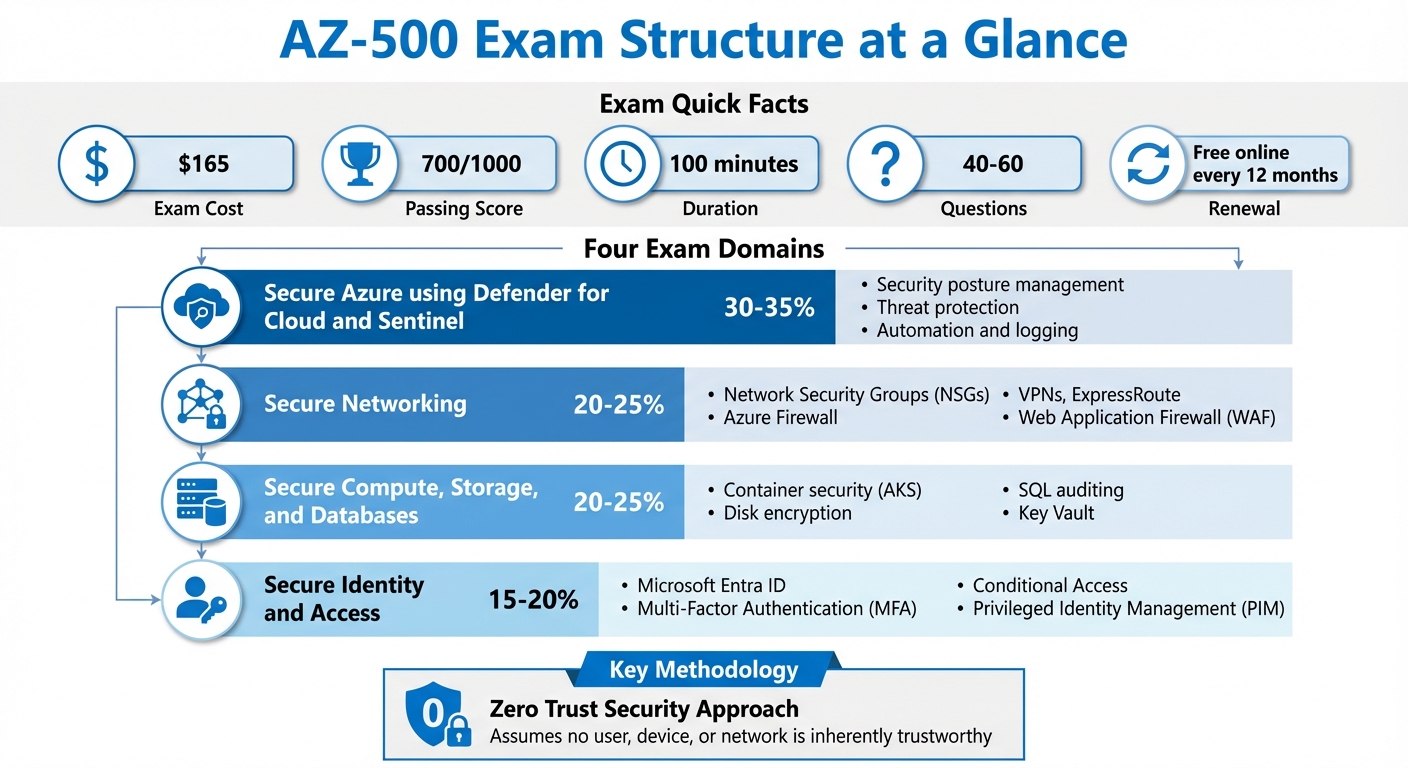
The exam focuses on four key skill areas, each weighted based on its real-world relevance. Starting January 2026, the most significant focus will be on security operations using Microsoft Defender for Cloud and Microsoft Sentinel, which make up 30–35% of the test [2].
| Skill Domain | Weighting | Key Focus Areas |
|---|---|---|
| Secure identity and access | 15–20% | Tools like Microsoft Entra ID, Multi-Factor Authentication (MFA), Conditional Access, and Privileged Identity Management (PIM) |
| Secure networking | 20–25% | Includes Network Security Groups (NSGs), Azure Firewall, VPNs, ExpressRoute, Private Links, and Web Application Firewall (WAF) |
| Secure compute, storage, and databases | 20–25% | Covers container security (Azure Kubernetes Service), disk encryption, SQL auditing, and Key Vault |
| Secure Azure using Defender for Cloud and Sentinel | 30–35% | Focuses on security posture management, threat protection, automation, and logging |
A major emphasis of the AZ-500 is the Zero Trust Security approach, which assumes no user, device, or network is inherently trustworthy. Anthony Bartolo from Microsoft states, "The Zero Trust Security approach, which assumes that all users, devices, and networks are untrusted and require constant verification, is one of the most critical security methodologies in the industry today" [4]. This strategy is essential for securing modern, high-stakes environments.
The exam also tests your ability to manage security across multi-cloud platforms like AWS and Google Cloud Platform (GCP) using Microsoft Defender for Cloud. Additionally, you’ll need to demonstrate how to align infrastructure with the Microsoft Cloud Security Benchmark (MCSB) and other regulatory frameworks, which are often critical in cleared cybersecurity roles.
Prerequisites and Required Experience
While there are no formal prerequisites for the AZ-500, Microsoft recommends at least one year of hands-on experience with Azure administration and a solid understanding of compute, networking, and storage services [1]. Familiarity with foundational certifications like AZ-900 and practical experience with AZ-104 is also advised [3][5]. Without this background, the exam’s technical depth can be challenging.
Key action verbs like "Implement", "Manage", "Configure", and "Monitor" frequently appear in the exam and highlight the importance of practical experience [5]. You should be adept at tasks such as configuring Microsoft Entra ID, managing network security groups, working with Key Vault, and responding to incidents using Microsoft Sentinel. For cleared professionals, experience in hybrid environments is especially critical, as many government agencies are transitioning from on-premises to cloud-based solutions. This expertise not only prepares you for the exam but also strengthens your ability to protect sensitive government data effectively.
Skills Validated by AZ-500 for Cleared Cybersecurity Jobs
The AZ-500 certification confirms technical skills that are directly aligned with the security needs of cleared government roles. These are hands-on abilities designed to safeguard sensitive federal data and critical infrastructure.
Identity and Access Management (IAM) is a cornerstone of cleared security work. The certification evaluates your ability to implement the principle of least privilege through tools like Azure Role-Based Access Control (RBAC) and Microsoft Entra Privileged Identity Management (PIM) [2]. It also covers configuring Just-In-Time (JIT) access and Conditional Access policies to enforce strict "need-to-know" standards [2][8]. As Jeff Porch, VP of Educational Services at Training Camp, puts it:
"I don’t teach from a textbook. I teach what happens in the SOC when the alert fires" [7].
This real-world focus is essential for roles requiring swift, accurate responses to security incidents. These identity controls work hand-in-hand with network defenses to secure sensitive systems.
Network security skills are equally critical. The exam ensures you can secure hybrid and cloud-only networks using tools like Network Security Groups (NSGs), Azure Firewall, and Web Application Firewalls (WAF) [2]. It also tests your ability to implement encryption for ExpressRoute and VPN connections [2]. These skills are crucial in cleared roles to prevent misconfigurations that could lead to data breaches. Beyond network security, the certification also evaluates your ability to manage cloud posture and protect data effectively.
Proficiency in Cloud Security Posture Management (CSPM) is validated using Microsoft Defender for Cloud, while data protection is assessed through Transparent Data Encryption (TDE) and Azure Key Vault. The certification also emphasizes threat detection and response using Microsoft Sentinel [2][8][9]. These tools are essential for Security Operations Center (SOC) roles, where constant monitoring and quick incident response are non-negotiable. Additionally, the AZ-500 meets DoD 8570 requirements, making it a recognized credential for cleared cybersecurity professionals [7].
Rounding out the skill set is container and compute security. The exam tests your ability to secure Azure Kubernetes Service (AKS) through network isolation, authentication, and activity monitoring [2][9]. This expertise is becoming increasingly important as government agencies adopt containerized and hybrid infrastructures.
How to Earn the AZ-500 Certification
Preparing for the AZ-500 certification involves focusing on four key domains, with a strong emphasis on securing Azure environments using tools like Microsoft Defender for Cloud and Sentinel. The exam consists of 40 to 60 questions, with a passing score of 700 out of 1,000 points. You’ll have 100 minutes to complete it, making time management crucial. For professionals working in sensitive sectors, this certification directly supports the protection of critical data and infrastructure.
Study Materials and Preparation Methods
Microsoft provides a free learning path titled "Secure cloud resources with Microsoft security technologies", which serves as the official resource for covering all exam domains. This self-paced program is an excellent starting point for your preparation [1]. However, hands-on experience is equally important. The official GitHub repository, AZ500-AzureSecurityTechnologies, includes 11 lab modules that cover practical exercises on topics like Role-Based Access Control (RBAC), Azure Firewall, ACR/AKS security, Key Vault, and Microsoft Sentinel [10].
When preparing, pay close attention to action verbs in the exam objectives, such as "Secure", "Implement", "Manage," and "Configure," as these indicate the practical skills you’ll be tested on [5]. For objectives involving "Plan" or "Enable", focus on understanding prerequisites and setup requirements. If the objective uses "Recommend", make sure you can evaluate the pros and cons of various Azure services [5].
To evaluate your readiness, Microsoft offers free practice assessments that highlight areas needing improvement [1]. Familiarize yourself with the exam interface using the Exam Sandbox, which provides a preview of interactive question types like drag-and-drop, hot area, and case studies [1]. Additionally, platforms like Pluralsight (use the code LEARNTECH50 for a 50% discount) and Coursera offer structured video courses and additional lab exercises to reinforce your knowledge [5].
Registering and Taking the Exam
Once prepared, you can register for the exam through the Microsoft Learn certification page. Select "Schedule exam" and choose Pearson VUE as the delivery provider [12]. Use a personal Microsoft Account (MSA) for registration instead of a work account. This ensures your certification records remain accessible even if you change employers [1].
The exam costs $165 USD and can be scheduled up to 90 days in advance. You also have the option to schedule two Microsoft certification exams at once [1]. Make sure your Microsoft Learn profile name matches the government-issued ID you’ll present on test day [12]. Exams can be taken at a local test center or online with remote proctoring. If you choose the online format, complete the Pearson VUE system check in advance to ensure compatibility with your device and network [12].
If you don’t pass on your first attempt, you can retake the exam after 24 hours. However, after a second failure, you’ll need to wait 14 days before trying again [1]. Since incorrect answers don’t incur penalties, it’s best to answer every question, even if you’re unsure [5]. If you need disability accommodations or extra time, submit your request to Microsoft before scheduling the exam to ensure everything is set up properly [12].
The certification is valid for 12 months, but you can renew it for free by passing an online assessment on Microsoft Learn. This eliminates the need to retake the full proctored exam [1].
Using AZ-500 to Advance Your Cleared Cybersecurity Career
The AZ-500 certification is a powerful way to build on your technical skills and take your cleared cybersecurity career to the next level. This certification opens doors to sought-after roles like Cloud Security Engineer, Systems and Network Administrator, and Technical Lead. With around 52,172 job openings for Cyber Security Engineers, the specialized knowledge you gain through AZ-500 directly applies to managing cloud infrastructure in cleared environments[6].
Adding AZ-500 to Your Cleared Cybersecurity Jobs Profile
One simple but impactful step after earning your AZ-500 certification is updating your Cleared Cyber Security Jobs profile. Make sure hiring managers can see your expertise by sharing your official digital badge from the Microsoft Certification Dashboard on platforms like LinkedIn. This provides a verifiable showcase of your skills[3]. As Sandra Marin from Microsoft puts it:
"It often takes less than a minute to update your LinkedIn profile and share your achievements, highlight your skills, and help boost your career potential"[3].
In the "Skills and Endorsements" section of your profile, include relevant keywords from the AZ-500 skills outline. Terms like "Microsoft Entra ID", "Azure Sentinel", "Network Security Groups", "Azure Firewall", and "Privileged Identity Management" can make your profile stand out to recruiters. Also, take advantage of the free renewal assessment on Microsoft Learn, which becomes available six months before your certification expires. This not only keeps your certification current but also shows your commitment to staying updated with cloud technologies[3]. Together, these steps ensure your profile aligns with the expectations of cleared cybersecurity roles.
Matching Certification Skills to Job Requirements
The skills covered in the AZ-500 exam align closely with what employers look for in cleared cybersecurity roles. Tailor your resume to reflect the exam’s key domains: "Secure identity and access", "Secure networking", "Secure compute, storage, and databases", and "Secure Azure using Microsoft Defender for Cloud and Microsoft Sentinel." Use action-oriented verbs like "Implement", "Manage", and "Monitor" to help your resume pass automated applicant tracking systems[2].
Emphasize your experience with tools and concepts like MFA, RBAC, Azure Firewall, NSGs, and SQL database auditing, as these are central to many cleared job descriptions. Highlight your proficiency with Microsoft security tools, including Microsoft Entra ID, Microsoft Defender for Cloud, and Microsoft Sentinel, since these are frequently requested in job postings[1]. As organizations adopt Zero Trust strategies and face challenges from advancements in AI, your skills in threat protection and vulnerability management are increasingly in demand[11].
Wrapping Up
The AZ-500 certification proves you have the skills to implement security controls, manage identity and access, and safeguard cloud infrastructure – key abilities for cybersecurity roles requiring security clearances. With this credential, you’re well-prepared for sought-after positions like Cloud Security Engineer or Security Operations Analyst.
What’s Next?
- Explore the Microsoft Learn curriculum, which covers all four exam domains.
- Practice using the Exam Sandbox and Practice Assessment to get comfortable with the question format.
- Schedule your exam when ready.
Once you pass, make sure to update your professional profiles with skills highlighted in the exam outline, such as Microsoft Entra ID, Azure Sentinel, and Microsoft Defender for Cloud. These keywords can help align your profile with job requirements and boost your visibility to recruiters. Keep in mind that the certification is valid for 12 months, but you can renew it for free through an online assessment on Microsoft Learn.
Earning the AZ-500 is a smart move that can open doors to advanced roles and long-term career growth in secure environments.
FAQs
Is AZ-500 enough to qualify for DoD 8570 roles?
No, the AZ-500 certification by itself does not fulfill the requirements for Department of Defense (DoD) 8570 roles. These roles generally demand specific baseline certifications, such as Security+ CE, CISSP, or other approved credentials listed by the DoD. To ensure you meet the qualifications for your position, it’s essential to review the official DoD certification requirements.
How hard is the AZ-500 if I only have AZ-900-level knowledge?
The AZ-500 certification sits at an intermediate level, meaning jumping in with just AZ-900 knowledge might feel like a steep climb. To tackle it successfully, you’ll need to deepen your understanding of security-focused topics and get plenty of hands-on practice. Set aside dedicated time for studying and real-world application to close the knowledge gap and gear up for the challenge.
What hands-on labs should I do before taking AZ-500?
To get ready for the AZ-500 exam, dive into hands-on labs that focus on essential Azure security topics. Spend time practicing tasks like managing identity and access using Role-Based Access Control (RBAC), setting up network security groups, configuring the Azure Firewall, securing Azure SQL databases, and handling security policies.
Resources like Microsoft Learn and official study guides provide practical exercises that can help strengthen your skills in areas such as security controls, identity management, network security, and operations. These tools are a great way to build confidence and expertise before tackling the exam.