

The Certified Cloud Security Professional (CCSP) certification, offered by ISC2, is a globally recognized credential for cloud security experts. It’s especially relevant for professionals with security clearances, as it’s officially approved under the U.S. Department of Defense Manual (DoDM) 8140.03 for roles like IAT Level III and IASAE III. With the rise of multi-cloud and hybrid infrastructures in government and defense sectors, the demand for CCSP-certified professionals continues to grow.
Key Highlights:
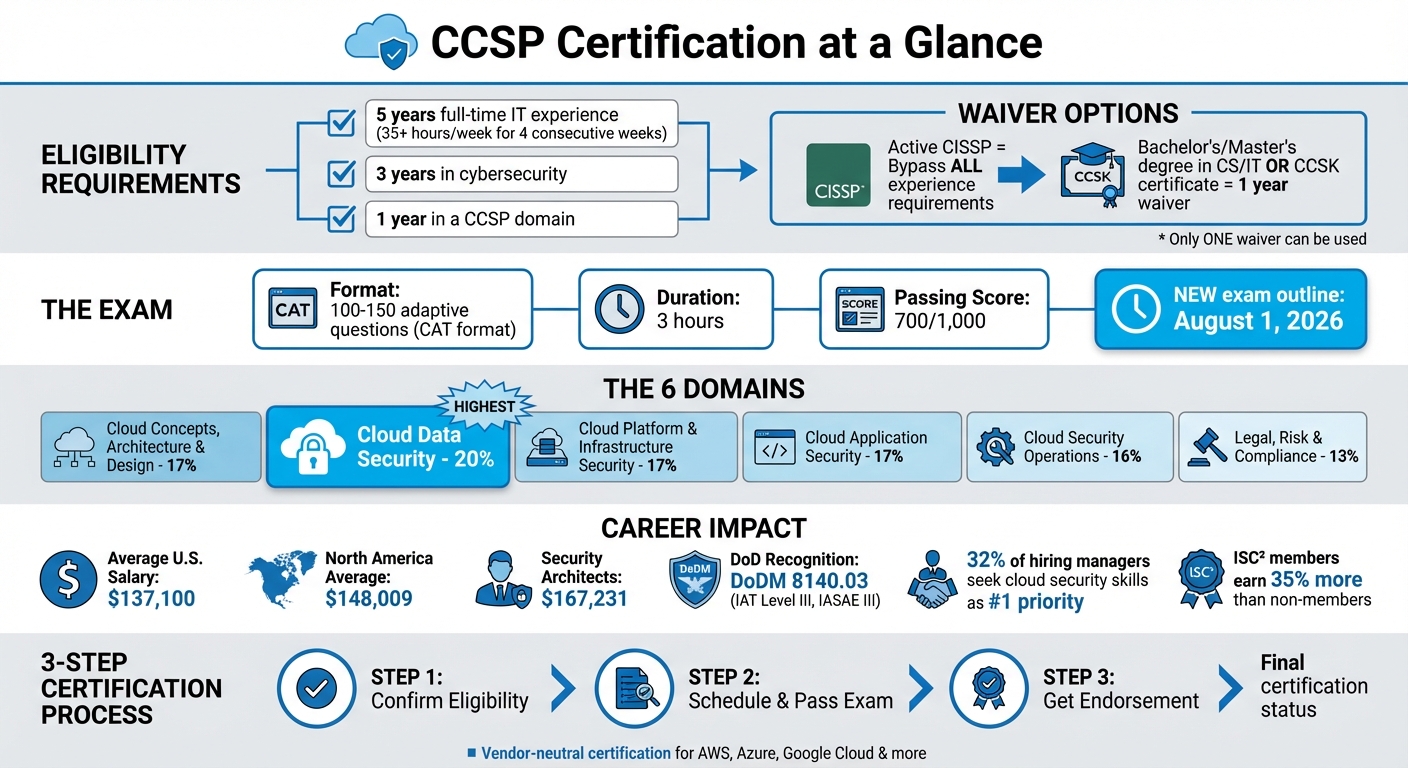
- Eligibility: Requires five years of IT experience (three in cybersecurity and one in a CCSP domain). CISSP holders can bypass the experience requirement.
- Exam: 100–150 adaptive questions, three hours, 700/1,000 passing score. A new exam outline takes effect on August 1, 2026.
- Domains: Six domains, with Cloud Data Security (20%) being the most weighted.
- Salary: Average U.S. salary of $137,100, with higher earning potential for specific roles like Cloud Architect or Security Engineer.
- Job Market: High demand in cleared roles such as Cloud Security Analyst and Cloud Engineer, with employers like Lockheed Martin and the U.S. Air Force actively hiring.
The CCSP certification validates expertise across cloud platforms like AWS, Azure, and Google Cloud, focusing on vendor-neutral security practices. It is a critical credential for professionals aiming to secure sensitive government data while advancing their careers in cloud security.
CCSP Certification Requirements and Path to Certification
What You Need to Know About CCSP Certification
CCSP Certification Overview
The Certified Cloud Security Professional (CCSP) is a globally recognized certification from ISC2. It validates your expertise in designing, managing, and securing cloud environments, including data, applications, and infrastructure. Unlike certifications tied to specific platforms, CCSP applies broadly across all cloud providers, making it especially useful for professionals in sensitive, security-cleared roles.
This certification is accredited by the American National Standards Institute (ANSI) and meets ISO/IEC Standard 17024, ensuring it adheres to international professional standards. It builds on the foundational knowledge from certifications like CISSP (Certified Information Systems Security Professional) and CCSK (Certificate of Cloud Security Knowledge), making it a logical next step for seasoned cybersecurity professionals.
To qualify for the CCSP, you need at least five years of full-time IT experience, including three years in cybersecurity and one year in one of the six CCSP domains. However, if you already hold an active CISSP credential, it waives the entire experience requirement. Additionally, a bachelor’s or master’s degree in computer science or IT, or a CCSK certificate, can substitute for one year of required experience.
The exam includes 100–150 multiple-choice questions administered through Computerized Adaptive Testing (CAT), which adjusts the question difficulty based on your answers. You’ll have three hours to complete the test, and a score of 700 out of 1,000 points is required to pass. Keep in mind that a new exam outline takes effect on August 1, 2026, so plan your preparation accordingly if you’re testing after this date.
The 6 CCSP Knowledge Domains
The CCSP exam is structured around six domains, each focusing on a critical aspect of cloud security. These domains are weighted differently, so understanding their importance will help you allocate your study time effectively.
| Domain | Weight | Focus Area |
|---|---|---|
| 1. Cloud Concepts, Architecture and Design | 17% | Cloud roles, reference architectures, security design principles like cryptography and zero trust |
| 2. Cloud Data Security | 20% | Data lifecycle, encryption, classification, and Information Rights Management (IRM) |
| 3. Cloud Platform & Infrastructure Security | 17% | Physical/logical infrastructure, secure data center design, and BC/DR strategies |
| 4. Cloud Application Security | 17% | Secure Software Development Life Cycle (SDLC), Identity and Access Management (IAM), and software assurance |
| 5. Cloud Security Operations | 16% | Operating and maintaining cloud infrastructure, digital forensics, and security operations |
| 6. Legal, Risk and Compliance | 13% | Privacy laws, audit processes, and enterprise risk management |
Cloud Data Security (Domain 2) carries the most weight at 20%, emphasizing the importance of protecting sensitive information in the cloud. This domain is particularly relevant for professionals handling classified government data, as it covers encryption standards and data classification.
Legal, Risk and Compliance (Domain 6) focuses on navigating privacy laws, international regulations, and compliance standards like Common Criteria (CC) and FIPS 140-2. These are essential for managing data across borders or within government and defense systems.
These domains highlight the specific skills CCSP-certified professionals need to secure cloud environments, especially in multi-cloud setups often used in government and defense roles.
How CCSP Applies to Cleared Positions
The CCSP certification is especially valuable for professionals in government and defense sectors. It’s officially recognized under U.S. Department of Defense Manual (DoDM) 8140.03, qualifying it for various roles like Cloud Architect, Cloud Engineer, Cloud Security Analyst, and Cloud Computing Auditor. This approval ensures it meets the mandatory certification requirements for information workforce positions.
One of CCSP’s key advantages is its vendor-neutral approach. Whether your agency uses AWS, Azure, Google Cloud, or a combination of platforms, you can apply the same security principles and policies across all environments. This adaptability is one reason why CCSP is the fastest-growing ISC2 certification and a top credential professionals aim to earn in 2024.
In multi-cloud environments, which are increasingly common in government agencies, the CCSP’s focus on tenant partitioning and logical design (Domain 3) ensures secure separation of classified and unclassified data. Meanwhile, Domain 5 addresses the operational skills needed for monitoring cloud infrastructure, performing digital forensics, and responding to security incidents – tasks that are critical in cleared roles.
If you pass the exam but don’t yet meet the experience requirements, you can earn the title of Associate of ISC2. This status gives you six years to gain the necessary experience while still showcasing your expertise in cloud security – a valuable distinction even before full certification.
sbb-itb-bf7aa6b
CCSP Eligibility Requirements and Qualification Paths
Experience and Education Requirements
To qualify for the CCSP certification, you’ll need five years of full-time IT experience. Within those five years, three must be in cybersecurity, and at least one year must involve one of the six CCSP domains. To count a month of experience, you must work at least 35 hours a week for four consecutive weeks [8][10].
If you already hold an active CISSP certification, you can bypass the experience requirement entirely and proceed directly to the exam [8][10]. This is the quickest route for professionals who have already earned their CISSP. Additionally, a bachelor’s or master’s degree in computer science, IT, or a related field – or the Cloud Security Alliance‘s CCSK certificate – can replace one year of the required experience [8][10]. However, you can only use one waiver; combining the degree and CCSK substitution is not allowed.
If you pass the exam but lack the full experience, you’ll earn an Associate status, which gives you up to six years to meet the remaining requirements [8][4].
The next step is to ensure you meet the security and ethical standards tied to this certification.
Security Clearance and Ethics Requirements
While security clearance isn’t mandatory for CCSP eligibility, the ISC2 background qualification process aligns with many of the standards required for cleared professionals. You’ll need to disclose any prior disciplinary actions from government agencies or professional organizations, as well as any involvement in criminal or computer-related offenses [11]. The background check also reviews military court-martials and government disciplinary records, which cleared professionals are typically already familiar with [11].
All candidates must agree to follow the ISC2 Code of Ethics to qualify for certification [8]. If you have any concerns about your eligibility – such as past disciplinary issues – reach out to legal@isc2.org before scheduling your exam. Keep in mind that exam fees are non-refundable if you’re later deemed ineligible [11].
For those with non-traditional work arrangements, part-time roles and internships can also help you meet the experience requirements.
How Part-Time Work and Internships Count
If you’ve worked part-time or completed internships, these experiences can also count toward your CCSP eligibility. Part-time work is eligible if you’ve worked between 20 and 34 hours per week. ISC2 calculates 1,040 hours as equivalent to six months of full-time experience, and 2,080 hours as equivalent to a year [8][10]. This is particularly useful for professionals who may have started with part-time roles in government or contractor positions.
Both paid and unpaid internships qualify, provided you can verify them. For internships, you’ll need documentation on official letterhead (or registrar’s stationery for school-based internships) during the endorsement process. If your career began with internships through government agencies or defense contractors, gathering this documentation early can streamline your certification process [8][10].
Introduction | 40-Hour Free CCSP Exam Preparation Tutorial | ISC2 CCSP 2025 Full Course
How to Earn Your CCSP Certification
Earning the CCSP certification involves a straightforward process with specific steps to help professionals navigate the requirements effectively.
Step 1: Confirm Your Eligibility
Before diving in, make sure you meet the necessary experience criteria. You’ll need five years of full-time IT experience (at least 35 hours per week for four consecutive weeks), including three years in cybersecurity and one year in a CCSP domain. If you already hold an active CISSP, a qualifying degree, or a CCSK certificate, you can waive one year of this requirement. If you don’t yet meet the full experience requirements, you can still earn Associate status, giving you up to six years to fulfill the remaining criteria [4][8].
Step 2: Schedule and Take the Exam
Once you’ve confirmed your eligibility, the next step is scheduling your exam. Log in to your ISC2 account, select the CCSP exam, pay the fees, and book your test appointment through Pearson VUE [12]. Double-check that your registration details match your government-issued ID exactly – any discrepancies could cause issues on test day, and exam fees are non-refundable [12].
The exam uses Computerized Adaptive Testing (CAT) and includes 100 to 150 multiple-choice and advanced questions. You’ll have three hours to complete it, and you’ll need a score of at least 700 out of 1,000 points to pass [4][9]. Testing centers enforce strict security measures, such as infrared and metal detection wands, to ensure exam integrity [12]. Keep in mind that a new exam outline will take effect on August 1, 2026 [4][1].
Step 3: Get Your Endorsement
After passing the exam, the final step is securing an endorsement. This involves having an ISC2-certified professional verify your qualifications and work experience [4][8]. The endorsement confirms that you meet the required IT experience, including cybersecurity and domain-specific expertise.
If you already hold an active CISSP, this process becomes simpler. For professionals with security clearance, it’s a good idea to identify an ISC2-certified colleague or supervisor beforehand to streamline this step. While security clearance doesn’t replace the endorsement, the CCSP’s recognition under U.S. DoDM 8140.03 makes it a highly respected credential for government and defense positions [1][5].
Cleared Jobs That Require or Prefer CCSP Certification
Common Cleared Cloud Security Positions
The CCSP certification opens doors to a variety of cleared cloud security roles. For instance, Cloud Security Analysts focus on identifying vulnerabilities and ensuring smooth cloud operations, often requiring active security clearance. Meanwhile, Cloud Architects and Cloud Engineers are responsible for designing and implementing secure cloud infrastructures, which frequently support intricate government systems.
Other roles, such as Enterprise Architects and Security Engineers, also often list the CCSP as a preferred or required credential. In January 2026, companies like Akumen Inc. and Resource Management Concepts Inc. advertised onsite Cloud Security Engineer positions in Washington, D.C., and Crane, Indiana, respectively [13]. These postings highlight how CCSP-certified professionals influence salary trends and the broader job market, which are explored next.
Salary Expectations and Job Market Outlook
In North America, CCSP-certified professionals command impressive salaries. On average, they earn $148,009 per year. Specific roles demonstrate even higher earning potential: Security Architects average $167,231 annually, Information Security Managers make around $129,063, and Information Security Analysts start at approximately $89,502 [14][15].
Demand for cloud security expertise in the cleared market remains strong. A notable 32% of cybersecurity hiring managers rank cloud computing security as the most sought-after skill in potential hires [6]. Additionally, ISC² members report earning salaries that are 35% higher than their non-member counterparts [13]. Prominent employers like Lockheed Martin Aeronautics Company, Microsoft Corp, and the U.S. Air Force actively recruit CCSP-certified professionals [15]. This consistent demand highlights the certification’s importance in government and defense sectors.
CCSP Value in Government and Defense Work
The CCSP certification holds particular significance in government and defense roles. It is officially recognized under U.S. DoDM 8140.03 [5][7], making it a key qualification for military and government contractors. Its vendor-neutral design allows professionals to work seamlessly across various cloud platforms, a critical advantage for agencies managing multi-cloud or diverse environments.
The certification’s emphasis on Legal, Risk, and Compliance aligns with stringent defense regulatory standards. As government agencies increasingly migrate critical assets to the cloud, many now require CCSP certification as a hiring prerequisite. Additionally, the certification’s rigorous approval process and adherence to the ISC² Code of Ethics ensure that CCSP holders are well-equipped to handle sensitive government data [13]. This makes the CCSP an essential credential for professionals working in the cleared cybersecurity space.
Study Resources and Exam Preparation Tips
ISC2 Official Study Materials
Once you’ve met the certification requirements and scheduled your exam, it’s time to focus on preparing effectively. The ISC2 Official Study Guide (3rd Edition) is an excellent starting point, as it covers all the exam objectives and includes practice tests. Pair it with the Official (ISC)2 CCSP CBK Reference (3rd Edition) for a deeper dive into the six domains, offering vendor-neutral insights that complement your study sessions.
Practicing exam questions is a must. The ISC2 official practice tests feature over 1,000 questions, helping you build stamina and pinpoint areas needing improvement [17][20]. For on-the-go learning, the Pocket Prep app is a handy tool, offering quick quizzes and earning a stellar 4.8/5 rating on the App Store [18]. If you’re an auditory learner, consider video training from ITPro.tv with Adam Gordon – it’s perfect for listening during your commute [17].
Support Networks for Cleared Professionals
Don’t underestimate the value of community support when preparing for the CCSP exam. Platforms like Reddit’s r/CCSP and various Discord channels provide access to real-time advice, pinned study notes, and shared experiences from others on the same journey [17]. These communities are especially useful for professionals who need to maintain operational security while seeking guidance.
Another helpful resource is the Cloud Security Alliance (CSA) Guidance v4.0, which includes the Cloud Controls Matrix (CCM). This reference is particularly useful for understanding concepts that frequently appear on the exam [17][19]. While not an official ISC2 resource, it’s highly relevant for those working with government cloud implementations, as it aligns closely with federal compliance standards.
Balancing Study Time with Work Demands
Selecting the right resources is just one part of the equation – managing your study time effectively is just as important. Most candidates dedicate 3 to 6 months to focused preparation, spending 10 to 20 hours per week studying [16][17]. With fewer than 10,000 CCSP holders worldwide compared to over 150,000 CISSP holders [17], it’s clear this certification requires a strategic approach.
"The CCSP tests more than just your technical knowledge – it evaluates your understanding of cloud security from a vendor-neutral perspective, your grasp of risk management principles, and your ability to think strategically." – John Berti, Co-founder, Destination Certification [16]
Start by taking a baseline practice test to identify your strengths and weaknesses. Then, apply the 60/30/10 rule: devote 60% of your study time to weaker areas, 30% to moderate ones, and 10% to reviewing what you’re already confident in [16]. Use tools like the Pocket Prep app to make the most of idle moments [17][18]. Aim to consistently score around 80% on practice tests before scheduling your exam. This ensures you’re ready and helps avoid "study drift" [17]. For professionals working in environments like AWS GovCloud or Azure Government, it’s crucial to shift focus from platform-specific knowledge to broader, vendor-neutral security principles [16].
Advancing Your Career with CCSP Certification
Finding CCSP Jobs on Cleared Cyber Security Jobs

Once you’ve earned your CCSP, it’s time to connect with employers who recognize the value of your expertise. Cleared Cyber Security Jobs is a specialized platform designed to link security-cleared professionals with government agencies and defense contractors actively hiring for cloud security roles. By using the platform’s search filters, you can zero in on positions like Cloud Security Engineer, Cloud Architect, or Cloud Security Analyst – roles where a CCSP certification is often highly regarded.
To stand out, upload your resume with your CCSP credential and security clearance details. This can help you meet requirements such as DoD 8140.03 IAT Level III and IASAE III. Setting up job alerts with keywords like “CCSP” or “Cloud Security” can also help you stay ahead in a competitive market. Considering that 64% of organizations have identified cloud security as a top priority for 2025 [2], this proactive approach can give you a significant edge. But remember, landing the job is just the beginning – maintaining your certification is just as important.
Keeping Your CCSP Certification Current
Getting your CCSP is just the first step; keeping it current is essential. To maintain your certification, you’ll need to recertify every three years by earning Continuing Professional Education (CPE) credits and paying an Annual Maintenance Fee of $125. Staying up to date not only fulfills certification requirements but also ensures you’re prepared to address new challenges in cloud security. This is especially critical as threats like Ransomware-as-a-Service and shifting cloud architectures continue to evolve.
For busy professionals, ISC² Express Courses and Certificates offer a convenient way to earn CPE credits while managing a demanding schedule. Additionally, keep in mind that the CCSP exam outline will be updated on August 1, 2026 [5]. Staying informed about these changes will help you maintain your edge in the industry.
Career Success Stories from CCSP-Certified Professionals
Maintaining your CCSP certification can open doors to impressive career opportunities and financial rewards. On average, CCSP-certified professionals in North America earn $148,009 annually [2]. But it’s not just about the paycheck – this certification also paves the way for leadership roles. With a CCSP, cleared professionals are well-positioned for advanced roles like Cloud Architect, Auditor of Cloud Computing Services, or Security Consultant. These roles often involve working with high-profile organizations, from government agencies and defense contractors to major enterprises like JPMorganChase and Swiss Re.
One of the standout features of CCSP certification is its vendor-neutral approach. This equips you with the skills to secure multicloud environments across platforms like AWS, Azure, and Google Cloud [3]. Whether you’re protecting a single cloud or managing complex multicloud systems, the CCSP ensures you’re ready to tackle the challenges ahead.
Conclusion
The CCSP certification is a smart career choice for professionals with security clearances looking to specialize in cloud security. With its recognition by the Department of Defense under DoDM 8140.03, its vendor-neutral approach to multicloud environments, and its focus on six critical knowledge areas, the CCSP can open doors to roles like Cloud Architect, Cloud Security Analyst, and Cloud Consultant. In the U.S., professionals holding this certification earn an average salary of $137,100, placing it among the top 15 highest-paying credentials [3].
As the demand for cloud security experts grows and the cybersecurity skills gap persists, having a CCSP certification gives you a distinct edge in the hiring process [21]. Whether you’re tasked with securing government systems, protecting defense contractor networks, or managing complex multicloud setups, the CCSP demonstrates your expertise in designing, managing, and safeguarding critical assets using globally recognized best practices [1].
These credentials can directly translate into career growth. Platforms like Cleared Cyber Security Jobs connect security-cleared professionals with government agencies and defense contractors seeking cloud security specialists. By uploading your resume with your CCSP certification and clearance details, and setting up targeted job alerts, you can position yourself for opportunities tailored to your unique qualifications.
Take the step to earn your CCSP, stay current with professional development, and connect with employers who value your security clearance and cloud security skills. With the CCSP exam outline set to update on August 1, 2026, this is the perfect time to advance your certification journey [5].
FAQs
Is CCSP worth it if I already have a security clearance?
Earning the CCSP certification holds strong value, even if you already have a security clearance. It showcases advanced knowledge in cloud security, which is increasingly critical as more organizations shift to cloud environments. This certification not only opens doors to better career opportunities but also aligns with the rising demand for professionals with both cloud security expertise and clearance. It’s a great way to distinguish yourself in the cybersecurity field and prove your dedication to staying current with technical skills.
What cleared roles does CCSP help me qualify for under DoD 8140.03?
The CCSP certification prepares professionals for a variety of roles within cloud security, aligning with the DoD 8140 framework. These roles include responsibilities in cloud security architecture, design, operations, and service orchestration. Certified individuals may work on managing and securing cloud environments, overseeing cloud operations, or handling procurement and cloud service management tasks.
Should I take the CCSP exam before or after the August 1, 2026 update?
It’s a good idea to take the CCSP exam before August 1, 2026, since a new exam outline will be implemented after that date. Preparing for the current version could be easier, as new outlines typically bring changes to the content and areas of emphasis.