

The GRID certification is a must-have for cleared professionals safeguarding critical infrastructure like power grids and water treatment facilities. It equips you with specialized skills to secure Industrial Control Systems (ICS) against cyber threats while ensuring operational continuity. Here’s what you need to know:
- What is GRID? A certification focused on defending ICS/OT environments, covering protocols like Modbus and DNP3, incident response, network monitoring, and digital forensics.
- Why it matters: Cyberattacks on ICS are increasing, and GRID proves you can handle threats in high-stakes environments without disrupting operations.
- Exam details: 75 questions, 2 hours, passing score of 74%, $999 fee.
- Career impact: Opens doors to roles like ICS Security Engineer, Incident Responder, OT SOC Analyst, and Threat Hunter in critical industries.
Preparing for GRID: Use the SANS ICS515 course, practice exams, and tools like Wireshark and Splunk to master exam topics. Focus on hands-on practice and real-world scenarios to build confidence.
Next steps: Update your job profile to highlight GRID certification, leverage cleared job platforms, and attend networking events to connect with employers in the ICS/OT sector. This certification positions you for impactful roles where your expertise protects essential operations.
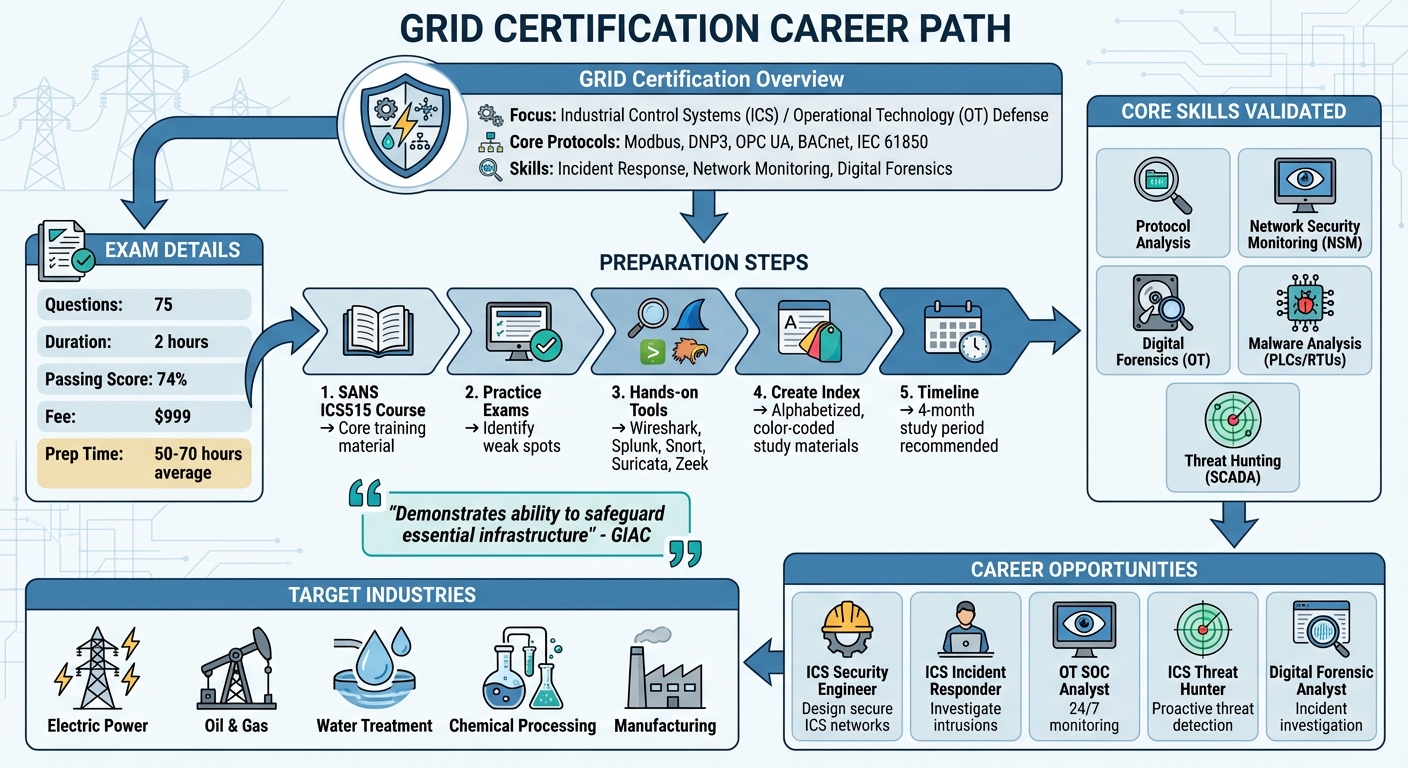
GRID Certification Path: From Preparation to Career Success
Skills and Competencies Validated by GRID
Core Skills for ICS Security
The GRID certification confirms a range of technical skills tailored to securing industrial control system (ICS) networks. It goes beyond passive monitoring, focusing on mitigation and threat detection informed by real-world attack strategies [1]. This certification ensures you understand adversary tactics and how to strengthen ICS defenses accordingly.
A key area of expertise is protocol analysis, which is essential for understanding and protecting industrial networks. GRID-certified professionals are skilled in analyzing protocols like Modbus, DNP3, OPC UA, BACnet, and IEC 61850. These protocols are the backbone of systems ranging from power grids to manufacturing operations but often lack built-in security features like authentication. With GRID, you demonstrate the ability to identify normal protocol behavior and detect malicious deviations. Additionally, you gain proficiency in network security monitoring (NSM) – capturing and interpreting ICS network traffic, maintaining visibility across operational technology (OT) environments, and spotting early signs of threats.
Digital forensics in OT environments presents unique challenges, as critical systems can’t simply be taken offline for investigation. GRID certification validates your ability to analyze system memory, logs, and artifacts to investigate breaches without disrupting operations. You’ll also develop skills in malware analysis for industrial components, such as programmable logic controllers (PLCs) and remote terminal units (RTUs). On top of that, you’ll be equipped for threat hunting, proactively identifying anomalies and hidden dangers in SCADA networks.
"Earning this credential demonstrates that you’re not only well-versed in threat detection and incident response, but also capable of applying these skills in real-time, high-risk environments where mistakes can have serious consequences."
– André Hammer, Readynez [5]
Mastering these techniques involves hands-on experience with specialized tools. GRID certification ensures you’re proficient with tools like Wireshark for packet analysis, Snort for intrusion detection, Splunk for log analysis, TCPdump, and Security Onion. You’ll learn to interpret outputs to detect malformed packets or unusual command sequences in industrial traffic. GRID also emphasizes integrating threat intelligence, enabling you to anticipate adversary tactics and protect critical infrastructure effectively. These skills are essential for incident response teams operating in high-stakes environments.
How GRID Applies to Cleared Incident Response Teams
The skills validated by GRID are indispensable for incident response teams working in classified and high-risk ICS operations. For professionals safeguarding classified ICS infrastructure, this certification translates directly into operational readiness. It ensures you can detect, contain, and resolve attacks while maintaining operational continuity – where even a minor error can have serious repercussions. GRID-certified experts are equipped to handle advanced persistent threats (APTs) in critical OT environments and manage incidents in sectors like energy.
In cleared environments, asset visibility is a top priority. Many of these systems are legacy setups with undocumented networks, making it challenging to maintain oversight. GRID certification demonstrates your ability to conduct asset discovery and maintain network visibility across complex ICS setups. These skills are vital for securing infrastructure that may have been designed decades ago without modern cybersecurity considerations. With GRID, you’ll be capable of mapping attack surfaces, identifying vulnerable components, and maintaining situational awareness during active incidents. The certification also confirms your ability to apply threat intelligence, helping you anticipate how state-sponsored actors and other sophisticated adversaries might target critical systems.
sbb-itb-bf7aa6b
How to Prepare for the GRID Certification Exam
Study Resources and Training Options
The cornerstone of preparing for the GRID certification is the SANS ICS515: ICS Visibility, Detection, and Response course[2]. This course delivers essential material, hands-on labs, and exercises designed to help you succeed in the exam. To accommodate busy professionals, SANS provides flexible delivery options, making it easier to fit studying into a packed schedule.
Beyond the official course, GIAC practice exams are a must-have tool. These practice tests mimic the actual exam, giving you a feel for the question style and helping you pinpoint areas that need more attention. On average, candidates spend 50 to 70 hours preparing, but this can vary depending on your prior experience with ICS/OT systems[2].
Practical skills are just as important as theoretical knowledge. Spend time working with tools like Wireshark, Splunk, and intrusion detection systems such as Snort, Suricata, and Zeek. Familiarize yourself with the MITRE ATT&CK for ICS framework and study incident analyses like Triton, Industroyer, and Stuxnet. These resources will deepen your understanding of real-world scenarios and align with the GRID certification’s focus.
Preparation Tips for Cleared Professionals
For cleared professionals juggling operational duties, having a focused strategy is critical. Start by creating a personalized, alphabetized, color-coded index of your printed study materials. Highlight key terms, protocol behaviors (e.g., "Modbus = no authentication"), and reference specific pages in the SANS courseware. A well-organized index is invaluable since you’ll have about 90 seconds per question to locate information during the exam.
Schedule your practice tests strategically. Take one midway through your study period to identify weak spots and another 3–5 days before the exam to simulate test conditions and improve your indexing speed. Use active study methods – complete labs on your own first, then review the solutions and note key takeaways.
GIAC recommends starting your preparation immediately after the training, aiming for a four-month study timeline. For professionals with limited time, prioritize hands-on practice over passive reading. Capture and analyze ICS protocol traffic – such as Modbus, DNP3, and BACnet – using tools like Wireshark. This approach reinforces your practical skills and ensures you’re ready for the GRID exam.
Career Opportunities with GRID Certification
Cleared Job Roles That Require GRID
Earning a GRID certification can open doors to specialized roles in industries like electric power, oil & gas, water treatment, chemical processing, and manufacturing. These sectors rely on professionals with the skills to secure and defend Industrial Control Systems (ICS) networks – precisely what the GRID certification validates.
ICS Security Engineers are responsible for designing and implementing secure ICS network systems in cleared environments. They collaborate with control system experts and operational teams to manage firewall logs, intrusion detection systems, and endpoint security tools. Their work also ensures compliance with regulations like NERC CIP. Meanwhile, ICS Incident Responders focus on investigating intrusions in industrial environments, providing remediation, and maintaining constant vigilance to ensure operational safety and uptime.
OT SOC Analysts monitor ICS protocols around the clock, using security intelligence and anomaly detection to identify malicious activity in industrial networks. ICS Threat Hunters apply their expertise in ICS-specific threat analysis to actively track adversaries within critical infrastructure. Additionally, Digital Forensic Analysts investigate incidents and analyze data from Windows and Linux systems in industrial settings, applying digital forensics and incident response (DFIR) techniques tailored to ICS environments.
These roles highlight why GRID certification is a powerful asset for advancing careers in cleared, high-security environments.
How GRID Advances Your Career
The GRID certification signals to employers that you have over two years of relevant experience and a specialized skill set. It’s particularly valuable because it bridges the gap between traditional IT security and Operational Technology (OT) – a combination crucial for protecting national infrastructure.
"Earning an ICS certification confirms your ability to safeguard essential infrastructure and demonstrates your value in the workplace." – GIAC Certifications [3]
This certification validates a wide range of skills, including ICS-focused digital forensics, incident response, network security monitoring, and threat hunting. For cleared professionals, it paves the way to higher-paying roles and career growth in industries where safeguarding sensitive assets is critical. With a $999 investment [4], GRID positions you for senior roles that demand proven expertise in ICS defense. Beyond enhancing your technical skills, it sharpens your focus for pursuing job opportunities in high-stakes environments where your contributions truly matter.
Using Cleared Cyber Security Jobs for GRID-Certified Job Searches
How to Optimize Your Job Search
Cleared Cyber Security Jobs allows you to leverage your security clearance and GRID certification to stand out in the specialized field of ICS incident response. Start by building a complete profile that clearly displays your clearance level – whether it’s Secret, TS/SCI, or TS/SCI with CI Poly – and highlights essential skills like GRID, ICS Security, Active Defense, and Network Security Monitoring. The platform uses AI-driven matching, combining Boolean and semantic search methods, to pair you with roles that align with both your security clearance and ICS/OT expertise.
To refine your search, set up alerts using keywords like ICS Incident Response, OT Security, and Active Defense so you’re notified as soon as relevant positions are posted. You can also use Boolean search strings (e.g., "GRID" OR "ICS Security") to narrow down results effectively. Be sure to select all applicable clearance levels and include a Zip Code with a specific mileage radius to broaden your reach.
Your profile is often the first thing recruiters see, even before your resume, so make sure it emphasizes your GRID certification and ICS-related skills. Keeping your profile updated ensures you’re visible to recruiters and ready for new opportunities. These adjustments also lay the groundwork for successful networking, which we’ll explore next.
Networking and Job Fairs
In addition to optimizing your online profile, attending networking events and job fairs is a key step in advancing your career. Cleared Cyber Security Jobs organizes both virtual and in-person hiring events, giving you direct access to recruiters from defense and intelligence contractors. Upcoming events include:
- Cleared Careers Virtual Huntsville Hiring Event – February 19, 2026
- Cleared Careers Hiring Event at UCCS in Colorado Springs – April 2, 2026
- Cleared Careers Nationwide Virtual Hiring Event – May 12, 2026
These events are a great chance to showcase the unique value of your GRID certification and demonstrate how your expertise in ICS incident response and active defense contributes to protecting critical infrastructure.
When you upload your resume to the platform, it’s tagged for specific job fairs, making it easier for employers to find professionals with specialized certifications like GRID. Subscribing to the Cleared+ newsletter can also keep you informed about GovCon companies, providing insights into contract activity, hiring trends, and mission priorities – valuable information for targeting employers actively hiring for ICS/OT roles.
As you network, be ready to discuss real-world incident response scenarios and explain how GRID equips you with a practical, effective approach to safeguarding operational technology environments.
"Intrusion detection, incident response and digital forensics are my everyday working areas. My GIAC certs provided a practical framework that is comprehensive and effective. Clients trust my work when they know I’m certified." – Juan Manzano, GSE [6]
Conclusion and Next Steps
Key Takeaways
The GRID certification stands out as a vital credential for professionals focused on defending industrial control systems (ICS). It equips cleared incident response experts with the skills needed to tackle the unique challenges of operational technology (OT). Unlike general IT certifications, GRID zeroes in on defending critical infrastructure where uptime, safety, and resilience are non-negotiable. From asset discovery and network monitoring to digital forensics and incident response, this certification validates your ability to safeguard systems like power grids and water treatment facilities against advanced cyber threats.
Earning the GRID certification requires thorough preparation. Understanding the exam’s format, duration, passing criteria, fees, and renewal process is essential for success. These details not only prepare you for the exam but also guide your next steps as you plan your career in ICS defense.
Next Steps for GRID-Certified Professionals
Now that you’ve earned your GRID certification, it’s time to put it to work. Start by updating your Cleared Cyber Security Jobs profile to highlight your clearance and GRID expertise, ensuring you’re visible to employers looking for professionals with your skills.
Stay informed about the latest ICS threats by making daily reading a habit. Cybersecurity recruiter Josh Fullmer from Dragos advises, "Pick one or two relevant resources and read something every day" [7]. Hands-on experience is just as important – continue honing your skills with tools like Wireshark, Splunk, and Snort.
Expand your professional network by joining organizations such as ISSA or (ISC)² and attending industry events like RSA, Black Hat, or AFCEA conferences. These opportunities not only keep you ahead of emerging threats but also connect you with potential employers in the critical infrastructure sector. Your GRID certification positions you to take on roles where you’ll play a key part in protecting systems that millions depend on daily.
ICS515: ICS Visibility, Detection, and Response | GRID
FAQs
Is GRID worth it if I’m new to ICS/OT?
Yes, the GRID certification is worth pursuing, even for beginners in ICS/OT. It lays a solid groundwork in areas like active defense, ICS-specific threats, and incident response strategies. These skills are crucial for safeguarding industrial control systems, making this certification a meaningful step toward developing expertise in this specialized domain.
What hands-on skills should I practice most for the GRID exam?
To prepare effectively for the GRID exam, concentrate on mastering active defense concepts, detection and analysis techniques, and ICS-focused digital forensics. It’s equally important to gain practical experience in areas like incident response, malware analysis, threat analysis, and threat intelligence fundamentals. These skills not only align with the exam’s core objectives but are also critical for success in the field.
How do I translate GRID into cleared incident response job interviews?
When it comes to protecting industrial control systems (ICS), active defense strategies are essential. These systems, which often manage critical infrastructure like power grids, water treatment facilities, and transportation networks, face unique threats that require specialized approaches. Active defense involves not just reacting to threats but proactively identifying and mitigating risks before they escalate. This includes monitoring network traffic for anomalies, deploying intrusion detection systems tailored to ICS protocols, and implementing segmentation to limit lateral movement within the network.
ICS-Specific Digital Forensics
Digital forensics in ICS environments is a highly specialized field. Unlike traditional IT systems, ICS devices often use proprietary protocols and hardware, making forensic investigations more complex. Expertise in ICS-specific digital forensics means understanding how to extract, analyze, and preserve data from these systems without disrupting operations. This skill is critical for identifying the root cause of incidents and ensuring that evidence is admissible for legal or regulatory purposes.
Threat Analysis and Incident Response Techniques
Threat analysis in ICS environments requires a deep understanding of the unique attack vectors and vulnerabilities these systems face. From supply chain risks to insider threats, the ability to analyze and prioritize risks is crucial. Incident response techniques for ICS must be tailored to minimize downtime and avoid further damage. This includes creating detailed response plans, coordinating with operational technology (OT) teams, and ensuring compliance with industry regulations.
Protecting Critical Infrastructure and Addressing ICS-Specific Threats
The stakes are incredibly high when it comes to ICS. A single breach can have far-reaching consequences, from economic disruption to public safety risks. By combining active defense, specialized forensics, and targeted incident response, it’s possible to address ICS-specific threats effectively. These skills not only protect critical infrastructure but also demonstrate the ability to navigate the unique challenges of cleared incident response roles, where precision and expertise are non-negotiable.