

Classified cloud security jobs combine technical expertise with active security clearances to secure sensitive government data in cloud environments like AWS GovCloud and Azure Government. These roles are critical as federal agencies adopt cloud-first strategies, creating a high demand for professionals who can manage compliance, implement security measures, and protect classified information.
Key Points:
- Platforms: AWS GovCloud and Azure Government cater to federal needs, offering secure, compliant solutions for classified workloads.
- Demand: Growing need for cleared professionals in defense, intelligence, and civilian sectors.
- Certifications: AWS Security Specialty, Azure Security Engineer Associate, CISSP, and others are crucial for these roles.
- Clearances: Secret, Top Secret, and TS/SCI levels are often required.
- Skills Needed: Cloud architecture, IAM, compliance automation, IaC, and container security.
Quick Comparison:
| Feature/Requirement | AWS GovCloud | Azure Government |
|---|---|---|
| FedRAMP High P-ATO | ✅ | ✅ |
| DoD Impact Level 6 | ❌ | ✅ (Secret) |
| ITAR Compliance | ✅ | ❌ |
| JSIG/ICD 503 (Top Secret) | ❌ | ✅ |
Professionals in this field can expect long-term career growth by combining cloud expertise, active clearances, and certifications. With the federal government allocating billions to secure cloud solutions, this niche offers lucrative and stable opportunities.
AWS re: Invent SEC 202: Federal Government Compliance Best Practices
AWS GovCloud and Azure Government Platform Overview
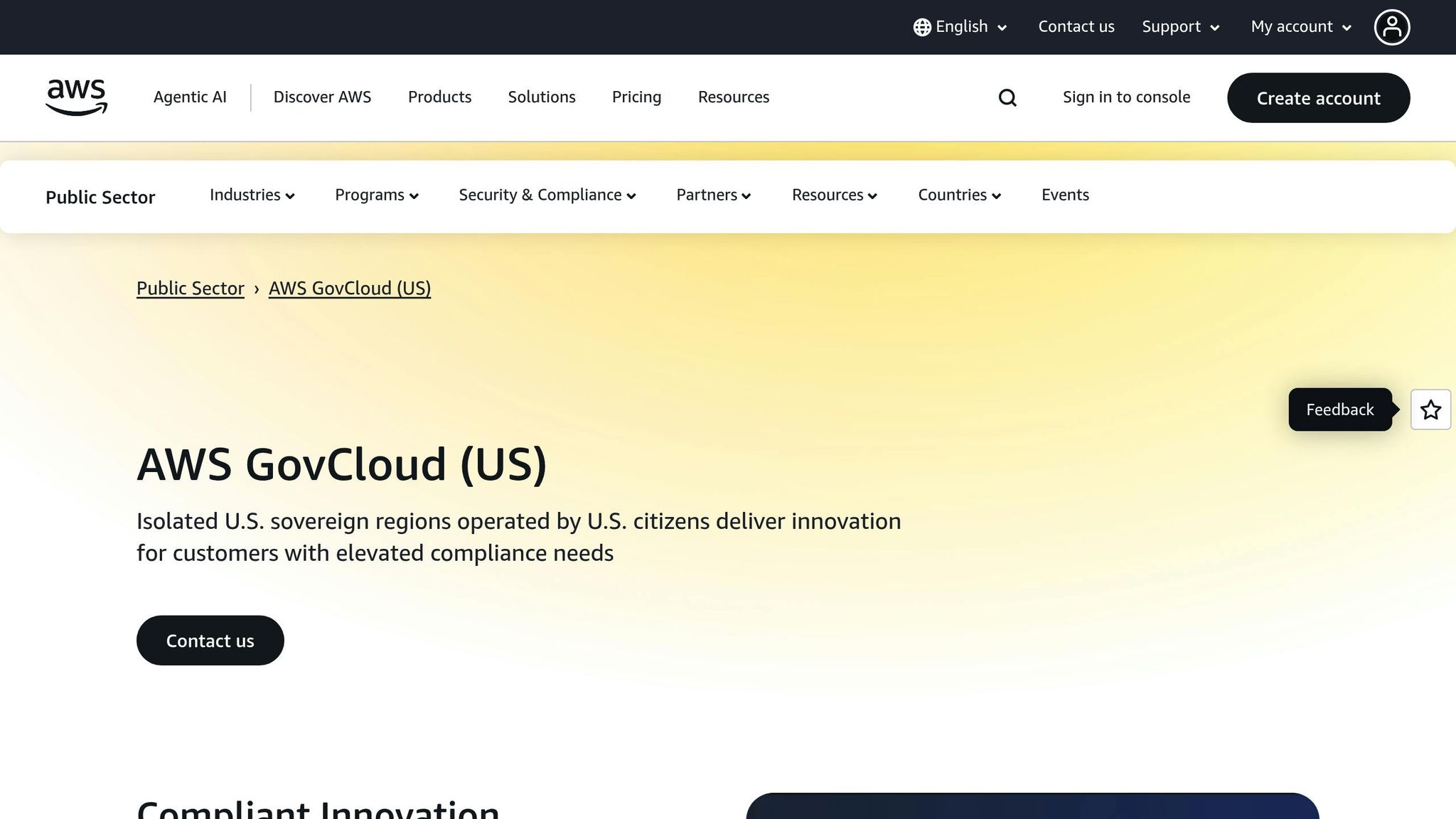
Understanding the architecture and compliance frameworks of AWS GovCloud and Azure Government is essential for anyone working with classified cloud environments. These platforms are specifically designed to meet federal regulatory standards, offering solutions for handling sensitive government workloads.
Core Features and Compliance Requirements
Both AWS GovCloud and Azure Government operate from isolated U.S.-based data centers, ensuring data sovereignty and compliance with federal regulations. AWS GovCloud enforces strict access controls, limiting use to vetted U.S. entities and requiring all root account owners and IAM users to be U.S. persons. Having been available longer, AWS GovCloud offers a broader range of cloud services tailored specifically for government needs.
Azure Government, on the other hand, is a distinct segment of Microsoft Azure, designed to integrate seamlessly with Microsoft’s ecosystem while maintaining robust security. It supports over 100 services, including AI, analytics, and IoT, and guarantees a 99.95% SLA. Both platforms ensure redundancy across multiple U.S. regions to maintain business continuity.
Required Certifications and Authorizations
Certifications for government cloud platforms are critical, as they define the compliance and security standards that each platform can support. These certifications directly influence the types of workloads each platform is authorized to host.
| Compliance Standard/Authorization | AWS GovCloud (US) | Azure Government |
|---|---|---|
| FedRAMP High P-ATO (JAB) | ✅ | ✅ |
| DoD Cloud Computing SRG Impact Level 2 | ✅ | ✅ |
| DoD Cloud Computing SRG Impact Level 4 | ✅ | ✅ |
| DoD Cloud Computing SRG Impact Level 5 | ✅ | ✅ |
| DoD Cloud Computing SRG Impact Level 6 | ❌ | ✅ (Azure Government Secret) |
| Criminal Justice Information Systems (CJIS) | ✅ | ✅ |
| U.S. International Traffic in Arms Regulations (ITAR) | ✅ | ❌ |
| Export Administration Regulations (EAR) | ✅ | ❌ |
| FIPS 140-2 | ✅ | ❌ |
| IRS Publication 1075 | ✅ | ✅ |
| Joint Special Access Program (JSIG) | ❌ | ✅ (Azure Government Secret & Top Secret) |
| ICD 503 ATO with facilities at ICD 705 | ❌ | ✅ (Azure Government Top Secret) |
Both platforms meet the FedRAMP High baseline, ensuring compliance with federal security standards. The DoD Cloud Computing Security Requirements Guide (SRG) defines the impact levels for processing defense information. While both platforms support Impact Levels 2, 4, and 5, Azure Government stands out for its support of Impact Level 6 in its Secret environment, making it a strong choice for highly classified defense workloads.
For defense contractors, AWS GovCloud’s ITAR compliance is critical for managing controlled technical data. Meanwhile, Azure Government’s JSIG and ICD 503 authorizations enable it to handle intelligence community workloads that require special access protections.
AWS GovCloud vs Azure Government Comparison
When comparing AWS GovCloud and Azure Government, their differences in service maturity and security classifications often guide the decision-making process. The choice largely depends on an agency’s specific requirements, existing technology investments, and the classification levels of its workloads.
AWS GovCloud has been serving government customers longer, offering a wider range of services designed for federal use. In contrast, Azure Government benefits from its integration with Microsoft’s ecosystem, making it an appealing choice for agencies looking for unified cloud solutions.
Security classification is where Azure Government has an edge. Its ability to support Secret and Top Secret environments, backed by JSIG and ICD 503 authorizations, allows it to handle workloads at the highest classification levels – capabilities AWS GovCloud does not offer.
On the other hand, AWS GovCloud’s ITAR and EAR authorizations make it indispensable for defense contractors, while Azure Government’s broader DoD SRG coverage appeals to military organizations. From an operational perspective, AWS GovCloud mirrors the commercial AWS environment, simplifying skill transfer for cloud professionals. In contrast, Azure Government’s isolated framework reinforces its security boundaries, shaping operational practices and responsibilities in classified cloud security roles.
Required Skills, Certifications, and Clearances
Working in classified cloud security requires a mix of active security clearances, technical expertise, and industry-recognized certifications. These roles demand professionals who can navigate both the stringent requirements of government security protocols and the fast-evolving world of cloud technologies.
Security Clearance Requirements
To work in classified cloud security, specific levels of clearance are non-negotiable. For many roles, a Secret clearance is the minimum requirement. This level of clearance allows access to sensitive national security information and is commonly required for contractors managing controlled unclassified information (CUI) or basic classified data in environments like AWS GovCloud.
For roles involving more sensitive information, a Top Secret clearance is essential. This clearance level is often required for positions that deal with systems or projects where a breach could result in exceptionally serious consequences. Many Azure Government roles supporting intelligence-related workloads demand this level of clearance.
At the highest level, Top Secret/Sensitive Compartmented Information (TS/SCI) clearance is necessary. This clearance allows professionals to handle intelligence data that requires special handling procedures. TS/SCI clearance holders are crucial for projects involving highly sensitive intelligence information.
The process of obtaining a clearance can be lengthy, but it’s worth noting that some employers are willing to sponsor upgrades for qualified candidates. Having an active clearance, however, can significantly speed up the hiring process and provide an edge during negotiations.
Technical Skills and Knowledge Areas
To succeed in classified cloud security roles, professionals must possess a range of technical skills tailored to secure and compliant government cloud environments.
- Cloud Architecture Expertise: Designing secure solutions requires a strong grasp of network segmentation, data classification, and workload compliance with strict security standards.
- Identity and Access Management (IAM): AWS GovCloud specialists need a deep understanding of IAM policies, roles, and least privilege principles. For Azure Government, expertise in Azure Active Directory, conditional access policies, and privileged identity management is essential. With the rise of zero-trust architectures, these skills are more critical than ever.
- Compliance Automation: Tools like AWS Config, Azure Policy, and AWS Security Hub enable professionals to continuously monitor compliance and automate remediation for violations, ensuring ongoing adherence to government standards.
- Infrastructure as Code (IaC): Proficiency with tools like Terraform, AWS CloudFormation, or Azure Resource Manager templates ensures consistent and secure deployments. These tools allow for auditable, repeatable processes that integrate security controls from the outset.
- Container Security: As government agencies increasingly adopt containerized workloads, expertise in platforms like Amazon EKS and Azure Kubernetes Service, along with knowledge of container security tools, has become indispensable.
Key Certifications for Classified Cloud Work
Certifications validate expertise and demonstrate a professional’s ability to meet the demands of classified cloud environments. Here are some key credentials:
- AWS Certified Security – Specialty: This certification confirms advanced knowledge of AWS security services, covering areas like incident response, monitoring, and infrastructure security, all relevant to GovCloud environments.
- Microsoft Certified: Azure Security Engineer Associate: This certification focuses on implementing security controls, managing identity and access, and protecting Azure platforms and operations.
- CISSP (Certified Information Systems Security Professional): Widely recognized, the CISSP demonstrates expertise across multiple security domains and is often a requirement for advanced roles.
- CompTIA Security+: Frequently required for Department of Defense (DoD) contractor roles under DoD 8570 standards, this certification serves as a foundational step in a security career.
- GIAC Certifications: Specialized credentials like GIAC Certified Incident Handler (GCIH) and GIAC Certified Forensic Analyst (GCFA) validate hands-on skills in incident response and digital forensics, both critical in cloud security.
- Architectural Certifications: Certifications like AWS Certified Solutions Architect – Professional and Microsoft Certified: Azure Solutions Architect Expert complement security-focused credentials, offering deeper insights into designing secure and scalable cloud architectures.
These certifications not only validate your technical abilities but also solidify your standing as a qualified candidate in classified cloud roles. By combining the right clearances, skills, and certifications, professionals can position themselves for success in this highly specialized field.
sbb-itb-bf7aa6b
Job Roles and Daily Responsibilities
Classified cloud roles require a mix of technical skills and security expertise, translating complex requirements into practical, secure operations. These positions merge cybersecurity knowledge with specialized cloud skills, creating distinct career paths for cleared professionals who take on unique responsibilities tied to their clearance levels.
Common Job Titles in Classified Cloud Security
Here’s a look at some of the key roles in classified cloud security:
- Cloud Security Engineer: These professionals focus on securing environments like AWS GovCloud and Azure Government. Their tasks include designing security architectures, configuring access controls, and ensuring compliance with regulations. The level of clearance needed depends on the client and mission scope.
- Cloud Compliance Analyst: This role revolves around maintaining compliance with government regulations and security frameworks. Analysts assess compliance, document controls, and assist in audits. They must be well-versed in frameworks like NIST 800-53, FedRAMP, and ATO processes.
- Cloud Solutions Architect: Architects design secure, scalable cloud infrastructures tailored to government needs. They balance operational requirements with security demands, crafting plans for cloud migrations and system deployments. Senior architects often work on defense or intelligence missions.
- DevSecOps Engineer: These engineers embed security into development and deployment pipelines. Their responsibilities include automating security testing, implementing infrastructure as code with built-in security measures, and securing CI/CD processes.
- Cloud Security Consultant: Consultants advise government agencies on cloud security strategies. They evaluate current security measures, recommend enhancements, and guide cloud adoption efforts. These roles often require broad access to sensitive information across multiple projects.
Each role plays a crucial part in the daily operations of classified cloud environments, ensuring security and compliance at every level.
Daily Tasks of Classified Cloud Professionals
Professionals in classified cloud environments handle a variety of responsibilities to maintain security and compliance:
- Security Architecture Design and Review: This involves analyzing system architectures to spot vulnerabilities and recommend controls that align with government standards. Professionals scrutinize network diagrams, access control matrices, and data flows to ensure security measures are robust.
- Continuous Monitoring and Incident Response: They configure and manage tools like AWS CloudTrail, Azure Security Center, and SIEM solutions to monitor for potential threats. Responding to security alerts, analyzing log data, and distinguishing between false positives and actual risks are part of their daily routine.
- Compliance Documentation and Reporting: Extensive documentation is a cornerstone of classified environments. Professionals draft and update System Security Plans (SSPs), Plan of Action and Milestones (POA&Ms), and monitoring reports. They also prepare for audits and assessments by government agencies.
- Automation Development: With the growing need to streamline processes, professionals create scripts and set up tools to automate tasks like compliance checks, security implementations, and incident responses. They also use Infrastructure as Code tools to embed security controls into deployment processes.
- Communication and Training: Clear communication is vital. Professionals provide security briefings to government clients, simplify technical concepts for non-technical stakeholders, and conduct security training for development teams and end users.
Role and Responsibility Matrix
Below is a summary of key responsibilities, compliance duties, and clearance levels for each role:
| Job Title | Primary Security Focus | Compliance Responsibilities | Implementation | Typical Clearance Level |
|---|---|---|---|---|
| Cloud Security Engineer | Infrastructure security, access controls | Control implementation, testing | Configuration, automation | Secret to Top Secret |
| Cloud Compliance Analyst | Regulatory adherence, audit support | Documentation, assessment coordination | Reporting tools | Secret |
| Cloud Solutions Architect | Secure design, risk assessment | Architecture documentation, control selection | Design oversight, proof of concepts | Top Secret |
| DevSecOps Engineer | Pipeline security, code analysis | Automated compliance checking | CI/CD integration, scripting | Secret to Top Secret |
| Cloud Security Consultant | Strategic guidance, risk management | Framework alignment, process improvement | Advisory role | Top Secret to TS/SCI |
Responsibilities often vary depending on the government client, contract specifics, and team size. In smaller teams supporting specialized missions, professionals may juggle multiple roles, requiring flexibility and adaptability.
Career advancement in this field typically involves transitioning from hands-on technical roles to strategic positions with broader responsibilities. Gaining experience across different roles can enhance a professional’s value and open doors to senior-level opportunities in classified cloud security.
Building Your Career in Classified Cloud Security
The field of classified cloud security offers exciting career opportunities for professionals with security clearance. It’s a space that demands both technical expertise and a knack for navigating the intricacies of government contracting. Building a successful career here requires not just technical skills but also strategic planning and the ability to connect with key players in the industry. This journey often leads to leadership roles, where you can shape large-scale security strategies.
Career Path Progression
Careers in classified cloud security, particularly within environments like AWS GovCloud and Azure Government, follow a structured path. Professionals typically start in technical roles and gradually move into positions with greater leadership responsibilities.
- Entry-Level Roles: Most careers begin with positions like Cloud Security Engineer or Junior DevSecOps Engineer. These roles focus on tasks such as configuring security controls, ensuring compliance, and supporting senior team members. A Secret clearance is usually required, along with foundational certifications like AWS Solutions Architect Associate or Azure Fundamentals.
- Mid-Level Positions: As you gain experience, you can move into roles like Senior Cloud Security Engineer or Cloud Compliance Analyst. These positions involve leading smaller teams, working closely with government clients, and taking on more responsibility. At this stage, higher clearance levels and certifications like AWS Security Specialty or Azure Security Engineer Expert are often necessary.
- Senior-Level Roles: Advanced positions, such as Cloud Solutions Architect or Principal Cloud Security Consultant, require extensive experience and advanced clearance. Professionals in these roles design enterprise-level security architectures, advise on strategic projects, and manage larger teams. Employers typically expect multiple expert-level certifications and in-depth knowledge of government compliance frameworks.
- Executive Leadership: The top of the ladder includes roles like Director of Cloud Security or Chief Technology Officer in government-focused organizations. These positions demand significant experience, a strong cleared background, and a history of managing large government programs effectively.
Using Your Cleared Experience and Credentials
Your security clearance and prior government experience are powerful tools in advancing your career in classified cloud security. These credentials not only demonstrate your expertise but also make you an attractive candidate by reducing onboarding delays for employers.
To stand out, translate your experience from government roles into cloud-specific skills. Highlight how your operational security and risk management expertise applies to cloud environments. Pairing your clearance with relevant cloud certifications further validates your capabilities, making you a strong contender for competitive roles.
Networking is another critical strategy. Leverage connections with former colleagues, military contacts, and organizations like the Armed Forces Communications and Electronics Association (AFCEA). Attending industry events can also help you stay informed about the latest cloud technologies and best practices, while opening doors to exclusive opportunities.
Finding Jobs Through Cleared Cyber Security Jobs
To streamline your job search, platforms like Cleared Cyber Security Jobs are designed specifically for security-cleared professionals. This resource connects you with employers seeking candidates with your background and expertise.
The site allows you to filter jobs by clearance level, cloud platform specialization, and government client type. It also offers tools to optimize your resume, helping you present your military or government experience in a way that resonates with hiring managers in cloud security. Additional resources, such as salary benchmarks, certification guides, and interview preparation tools, are available to support your transition into these roles.
You can also set up job alerts and explore networking opportunities to stay informed about openings for AWS GovCloud and Azure Government specialists. By leveraging these tailored resources, you’ll be better positioned to advance your career and move toward senior leadership roles in this growing field.
Success in classified cloud security hinges on technical skill, strategic planning, and continuous growth. With your cleared background as a strong foundation, you can build a dynamic and rewarding career in this high-demand industry.
Conclusion
Classified cloud security is opening up unique career paths for professionals with active clearances, especially in environments like AWS GovCloud and Azure Government. These platforms are growing rapidly, fueled by the U.S. government’s projected $12 billion cloud spending for FY2025, much of which is directed toward secure, compliant solutions for sensitive workloads.
As federal agencies increasingly rely on cloud technology, the need for cleared professionals with expertise in classified environments is skyrocketing. Combining an active clearance with in-depth knowledge of AWS GovCloud or Azure Government gives you a competitive edge, unlocking opportunities that are out of reach for most of the workforce.
Specializing in these platforms and mastering cloud compliance and automation not only boosts your earning potential but also paves the way to leadership roles. Employers highly value professionals who can handle the technical intricacies of cloud architecture while navigating the regulatory demands of government contracting. This dual skill set positions you for rapid career advancement, from technical roles to senior architect or executive positions.
Staying ahead in this field requires a commitment to continuous learning. As AWS and Azure evolve to meet shifting government standards, keeping up with new certifications, compliance updates, and emerging technologies ensures your skills remain relevant. Earning security credentials for these platforms is a smart investment that pays off over the long haul.
For those looking to connect with employers in this niche, Cleared Cyber Security Jobs offers a focused platform tailored to the cleared community. By targeting a specialized job market, this resource helps you stand out and capitalize on your unique qualifications. When you combine your cleared status, technical expertise, and these resources, you’re well-equipped to thrive in one of the most dynamic and fast-growing areas of cybersecurity.
FAQs
What distinguishes AWS GovCloud and Azure Government in managing classified information?
AWS GovCloud (US) is designed to manage sensitive and regulated workloads by maintaining strict physical and logical separation from other AWS regions. This approach ensures strong data residency and security measures, making it well-suited for classified environments.
Azure Government, meanwhile, delivers the same robust security features as the global Azure platform but stands out with its focus on integration and advanced data replication. Its private connectivity options make it a reliable choice for secure and streamlined data management.
AWS GovCloud leans heavily on isolation to enhance security, while Azure Government centers on integration and replication to meet the demands of classified data.
How can security clearances help professionals advance in classified cloud security careers?
Security clearances hold significant value for professionals working in classified cloud security roles. They open doors to high-stakes government and defense projects that demand strict credentials. These projects often come with attractive pay and the chance to step into leadership positions.
Having a clearance also eases the shift from military or government jobs to private-sector roles in secure cloud platforms like AWS GovCloud or Azure Government. A clearance signals both reliability and technical skill, which are essential for climbing the ladder into senior roles or expanding responsibilities in these specialized areas.
What certifications are most valuable for specializing in classified cloud security with AWS GovCloud or Azure Government?
To stand out in classified cloud security roles centered on AWS GovCloud or Azure Government, earning the right certifications is key to proving your expertise. Here are some top certifications that can set you apart:
- AWS Certified Security – Specialty: This certification confirms your ability to safeguard AWS environments while following industry best practices.
- Certified Cloud Security Professional (CCSP): A globally respected credential that highlights advanced knowledge in cloud security principles and practices.
- Microsoft Certified: Azure Security Engineer Associate: Perfect for those focusing on securing Azure platforms, managing identity, access, and ensuring compliance.
These certifications not only strengthen your technical skillset but also showcase your dedication to excelling in secure and tightly regulated cloud environments, making you a competitive candidate for specialized roles.
Leave a Reply