

Looking to break into cybersecurity with a clearance? The CompTIA Security+ certification is a must-have for entry-level roles in government and defense. It’s recognized under the DoD 8140.03 framework, qualifying you for 31 cybersecurity roles like Security Analyst, SOC Analyst, and Network Security Administrator. With over 82,000 job openings requiring this credential, it’s your gateway to high-demand positions and salaries starting at $45,000 to $70,000 annually.
Here’s what you need to know:
- Exam Details: 90 questions, 90 minutes, $425 fee, passing score of 750/900.
- Study Tips: Use video courses (e.g., Professor Messer), hands-on labs, and practice exams to prepare.
- Clearance Advantage: Security+ certified professionals with clearance earn 25-40% more.
This guide covers everything: preparing for the exam, finding cleared jobs, optimizing your resume, and advancing your career with certifications like CySA+ or CISSP. Whether you’re a veteran or new to IT, Security+ can set you up for success in a growing field.
How to PASS Your Security+ in ONE MONTH | CompTIA Security+ Study Guide For a Complete Beginner
sbb-itb-bf7aa6b
Entry-Level Cybersecurity Roles That Require Security+
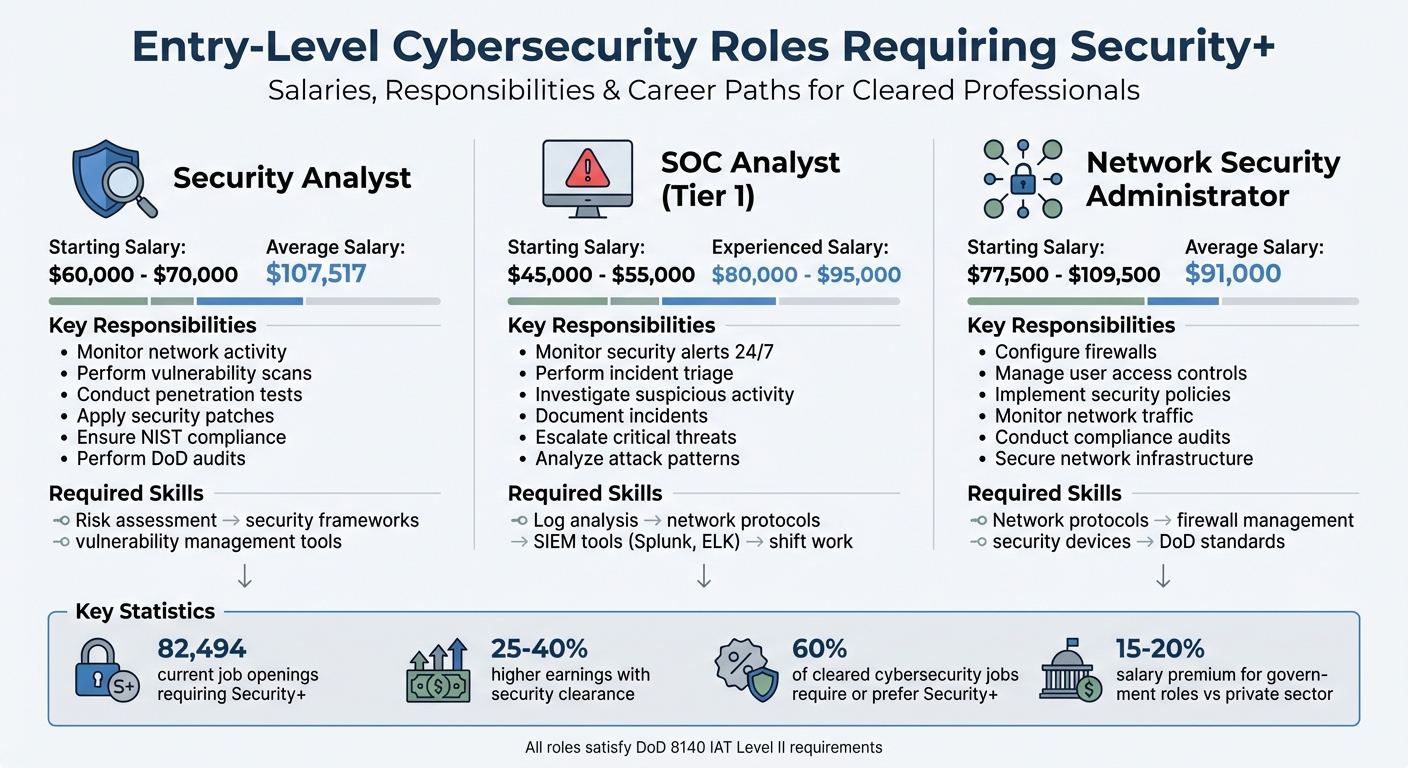
Entry-Level Cybersecurity Roles Requiring Security+ Certification: Salaries and Responsibilities
The Security+ certification is a powerful credential for cleared professionals aiming to make an immediate impact in cybersecurity. It’s required or preferred in over 60% of cleared cybersecurity job listings, with 82,494 current openings, making it the second most sought-after certification after CISSP [3][5][9]. Below are three key entry-level roles where Security+ plays a critical role.
Security Analyst
As a Security Analyst, you’ll be on the frontlines, monitoring network activity, performing vulnerability scans, conducting penetration tests, and applying critical security patches [4][5]. This role involves analyzing reports from security tools to detect unusual behavior and recommending measures to strengthen defenses [4][6]. In cleared environments, you’ll also ensure compliance with NIST frameworks and perform regular audits to meet Department of Defense (DoD) standards.
The average salary for a Security Analyst is about $107,517, with entry-level positions starting between $60,000 and $70,000 annually [4][3]. To excel, you’ll need skills in risk assessment, security frameworks, and tools for vulnerability management.
SOC Analyst
SOC (Security Operations Center) Analysts are the first line of defense in identifying and responding to threats in real time [6]. Working within a SOC, you’ll monitor alerts from tools like Splunk or ELK, perform initial incident triage, investigate suspicious activity, document incidents, and escalate critical threats to senior analysts [4][6]. This role requires constant vigilance to analyze attack patterns and prevent breaches before they escalate.
"Nearly every government job requires Sec+ for InfoSec/IT work. As most of those jobs are general IT work, if you know anything about computers and have Sec+, you can get a federal service job." – Cody Jackson, InfoSec Manager [7]
Starting salaries for Tier 1 SOC Analysts range from $45,000 to $55,000, with experienced analysts earning between $80,000 and $95,000 annually [3][6]. Key skills include log analysis, knowledge of network protocols, and the ability to work rotating shifts to ensure 24/7 security coverage.
Network Security Administrator
Network Security Administrators are responsible for managing and securing network infrastructure in cleared environments [5][8]. This includes configuring and maintaining firewalls, managing user access controls, implementing security policies, and monitoring network traffic for anomalies [4][6]. Hands-on experience with network protocols and security devices is essential for this role.
Network Security Administrators earn an average salary of $91,000, with junior roles in cleared environments offering between $77,500 and $109,500 [5][8][11]. This position is an excellent starting point for advancing into specialized roles like security architecture and involves conducting regular audits to ensure compliance with DoD security standards.
| Role | Average Starting Salary | Key Responsibilities |
|---|---|---|
| Security Analyst | $60,000 – $70,000 | Vulnerability scanning, patching, compliance |
| SOC Analyst (Tier 1) | $45,000 – $55,000 | Alert monitoring, incident triage, documentation |
| Network Security Admin | $77,500 – $109,500 | Firewall setup, access management, policy enforcement |
These roles not only offer attractive salaries but also serve as critical stepping stones in the cybersecurity field. Cleared professionals with Security+ certification tend to earn 25% to 40% more than their non-cleared counterparts. Additionally, government roles typically offer a 15% to 20% salary premium over private sector positions [10]. For veterans with security clearances, pairing their clearable status with Security+ certification can give them a significant edge in securing federal contracting jobs [2].
How to Get Your Security+ Certification
Earning your Security+ certification might be simpler than you think. There are no formal prerequisites – no degree or prior certifications are required to register for the exam. That said, CompTIA suggests having a Network+ certification and roughly two years of IT administration experience with a focus on security before attempting Security+ [16][17][20]. If you’re transitioning from the military or switching careers, don’t let this hold you back. Many professionals pass the exam with dedicated study and practical experience. Proper preparation not only helps you pass but also ensures you’re ready for cybersecurity roles requiring clearance. Now, let’s dive into the exam structure, study tools, and the registration process.
Exam Domains and Topics
The current Security+ exam (SY0-701) includes up to 90 questions – both multiple-choice and performance-based – and you’ll have 90 minutes to complete it. A passing score is 750 out of 900 [1][12]. The exam is divided into five key domains:
- Security Operations (28%): Covers areas like incident response, asset management, and vulnerability management.
- Threats, Vulnerabilities, and Mitigations (22%): Focuses on threat actors, attack techniques, malware, and social engineering.
- Security Program Management and Oversight (20%): Includes governance, risk management, and compliance with frameworks like HIPAA and GDPR.
- Security Architecture (18%): Addresses cloud models, IoT security, data protection, and system resilience.
- General Security Concepts (12%): Covers the CIA triad, Zero Trust principles, and cryptography basics [1][13].
Performance-based questions (PBQs) are especially critical. These simulate tasks like configuring firewalls or setting up access controls, which mirror real-world scenarios in cybersecurity roles.
Study Resources and Materials
A solid "study stack" is key to passing on your first attempt. Start with video courses – Professor Messer offers free resources on YouTube, while Jason Dion’s Udemy courses are great for quick learning [14][12]. Pair these with books like Mike Meyers’ All-in-One guide or Darril Gibson’s Get Certified Get Ahead for in-depth technical insights [13][12].
"Without labs, most students forget half of what they read when preparing. If you configure a firewall rule yourself, you’ll remember it ten times longer." – Professor, Programs.com [12]
Hands-on labs are a must. CompTIA CertMaster Labs provides structured exercises, or you can create your own virtual lab using VirtualBox or VMware. Practice tasks like configuring firewalls, setting up access control lists, and running vulnerability scans [15][12]. Finally, test your readiness with practice exams from CertMaster Practice, Boson ExSim-Max, or Professor Messer. Aim to score consistently between 80% and 90% on practice tests before scheduling your exam [13].
Flashcards can also help with memorizing port numbers and acronyms. During practice exams, flag challenging questions and revisit them later – this strategy works well on the actual test since there’s no penalty for incorrect answers [13].
Prerequisites and Exam Registration
When you’re ready, log in to your CompTIA account and click "Schedule and Manage Exams" to register through Pearson VUE [18]. Choose the SY0-701 exam and decide whether to test online via OnVUE or at a Pearson VUE testing center [16][18][20]. Select your preferred date, time, and language, then complete payment or apply a voucher code at checkout [18].
The exam voucher costs $425, or $474 with a retake option. Overall, costs can range from $600–$800 for self-study materials to as much as $3,500 for bootcamps [12][13]. Active-duty military personnel might qualify for up to $2,000 in certification training funds through Army COOL or AF COOL programs [19].
Pro Tip: Ensure the name on your CompTIA account matches your government-issued ID exactly, or you could be turned away at the testing center [18]. If testing online, run a system compatibility check ahead of time to avoid technical issues with the OnVUE software [16]. You can reschedule your exam up to 24 hours before your appointment without penalty [13].
The Security+ certification is valid for three years. To renew, you can earn 50 Continuing Education Units (CEUs) or pass a higher-level exam like CySA+ or CASP+ [16][19]. For those in cleared roles, Security+ satisfies DoD 8140/8570 compliance requirements for IAT Level II positions, making it a critical credential for government and contractor jobs [19][13].
Using Security+ to Find Cleared Jobs
If you’ve earned your Security+ certification, you’re already on the right path to landing a cleared job. But certification alone isn’t enough – you need to know how to search effectively, present your credentials, and stay visible to employers. Platforms like Cleared Cyber Security Jobs are tailored for this purpose, connecting security-cleared professionals with direct-hire employers in defense and intelligence. Unlike general job boards, every position here requires U.S. citizenship and an active security clearance, ensuring you see only relevant opportunities. Below, we’ll cover how to refine your job search, craft an optimized resume, and take advantage of job alerts and events.
How to Filter Jobs on Cleared Cyber Security Jobs
Start by using search filters to zero in on roles that fit your qualifications. Enter "Security+" or "CompTIA Security+" as keywords to find positions where this certification is explicitly required or preferred. Then, narrow your results by clearance level – whether it’s Secret, Top Secret, or TS/SCI. You can also filter by location, job type (full-time, part-time, contract), and experience level to target entry-level positions like Security Analyst, SOC Analyst, or Network Security Administrator.
Pay close attention to job descriptions mentioning IAT Level II or IAM Level I compliance. These categories align with Security+ certification and are essential for meeting federal requirements. Matching your qualifications to these standards is key to positioning yourself as a strong candidate.
How to Write Your Resume for Cleared Roles
Your resume should make two things immediately clear: you’re Security+ certified, and you hold a security clearance. Highlight these in your header or professional summary. For example: "Security+ certified professional with an active Secret clearance and two years of IT support experience." This ensures recruiters and Applicant Tracking Systems (ATS) can quickly identify your qualifications.
Include a dedicated "Certifications" or "Technical Skills" section to list CompTIA Security+ and other relevant credentials. Clearly state your clearance status, such as "Active Secret" or "Active TS/SCI." If your clearance is inactive but still within the 24-month reinstatement window, note it as "Inactive, Eligible for Reinstatement." Avoid mentioning sensitive details like classified project names, clearance ID numbers, or investigation dates.
When detailing your work experience, focus on measurable achievements. Instead of saying, "Supported cybersecurity operations", use specifics like: "Reduced system vulnerabilities by 35% through proactive monitoring and patch management." Use action verbs and numbers to demonstrate your impact, and align your language with the technical skills and DoD 8140 requirements listed in job postings.
"I currently hold an active Secret clearance, which enables me to support secure, mission-critical projects from day one." – MyPerfectResume [22]
Setting Up Job Alerts and Attending Job Fairs
Streamline your job search by setting up automated alerts. Save your search criteria – such as "Security+" and your clearance level – to receive email updates when new positions are posted. Completing your candidate profile with details about your clearance, certification, and skills can also make you more visible to recruiters.
Don’t overlook the value of cleared job fairs. These events connect you directly with defense and intelligence employers. For example, upcoming 2026 events include:
- CI or FS Poly Cleared Job Fair: March 5, 2026, at the Hyatt Regency in Herndon, VA (2:00 PM – 5:30 PM)
- All Clearances Cleared Job Fair: April 16, 2026, at the Westin in Falls Church, VA (2:00 PM – 5:00 PM)
- Additional events: May 14, 2026, in Hanover, MD, and June 3, 2026, in Herndon, VA [21].
When attending, bring multiple copies of your resume, dress professionally, and be ready to explain how your certification and clearance align with employer needs. For veterans, these fairs can be especially helpful in transitioning to civilian roles.
"I recently transitioned out of the military and started attending Cleared Job Fairs… I was offered a position shortly after. I accepted and moved directly from the military into my current position, without a lapse in employment." – G.B., Technical Project Manager, CACI [23]
Career Growth After Security+ Certification
Earning your Security+ certification is just the beginning. It lays the groundwork for a career in cybersecurity, and after 3–5 years in cleared roles, you can transition into mid-level positions with more responsibility and higher pay. With cybersecurity roles expected to grow by 32% through 2033 [10], knowing which paths to take and how to enhance your qualifications is critical. Here’s how you can build on your entry-level experience and move forward.
Moving to Mid-Level Positions
Once you’ve gained experience in roles like Security Analyst or SOC Analyst, you can step into mid-level positions such as Incident Response Specialist, Vulnerability Analyst, or Forensics Specialist. These roles focus on tasks like risk assessment, advanced threat hunting, and creating security policies. For cleared professionals, many of these positions align with DoD 8140 requirements, where Security+ is the baseline certification for IAT Level II roles [10][24].
In the defense contracting world, mid-level roles for Security+ certified professionals often offer salaries ranging from $85,000 to $110,000 [10]. For instance, Information Security Analysts typically earn between $65,000 and $80,000 [9], with job growth in this field projected at 33% from 2023 to 2033 [11]. Security Engineers, who focus on designing and safeguarding network architecture, can earn around $150,000 [11][24]. To stand out for these roles, it’s essential to develop skills in scripting languages like Python or PowerShell and gain expertise with SIEM platforms such as Splunk or Sentinel.
Adding More Certifications
Expanding your certification portfolio is a smart way to accelerate your career. Within a year or two of earning Security+, consider pursuing certifications like CompTIA CySA+ if you’re interested in threat detection and behavioral analytics, or CompTIA PenTest+ for a focus on offensive security and vulnerability assessment [10][11].
After reaching five years of experience, aim for the CISSP (Certified Information Systems Security Professional), which is widely regarded as the top credential for senior-level roles. CISSP-certified professionals earn an average salary of $126,000 [24]. If you don’t yet meet the experience requirement, passing the exam to become an Associate of (ISC)² can still boost your profile with cleared recruiters. For those who prefer technical roles over management, CompTIA SecurityX (formerly CASP+) validates advanced skills in security architecture and engineering [10][11].
Cloud certifications are becoming increasingly important, with 94% of organizations now relying on cloud services [10]. Certifications like AWS Certified Security – Specialty (around $300) and Microsoft Azure Security Engineer (AZ-500) (around $165) are particularly valuable for cleared professionals working in government-related cloud security roles [25][26].
Specializations and Growing Fields
Specializing in areas like cloud security, threat intelligence, and incident response can open doors to some of the fastest-growing roles in cybersecurity. For example, threat hunting is expected to grow by 105%, while threat intelligence roles are projected to increase by 53% over the next five years [27]. While Security+ offers a strong foundation by covering hybrid environments such as cloud, IoT, and operational technology (OT), advancing in these fields requires platform-specific expertise.
To specialize in cloud security, focus on mastering tools like AWS IAM, VPC security, and GuardDuty, or Azure Sentinel and Azure AD. For roles in threat intelligence and incident response, certifications like CySA+ are invaluable. Additionally, building a home lab using virtual environments like VMware or VirtualBox – along with tools like Splunk, Microsoft Sentinel, and Nessus – can provide hands-on experience that employers value [10].
Cleared professionals should also consider structured government roles, such as GS-11/12 or GS-13/14 Information Security Specialist positions. These roles offer salaries ranging from approximately $55,000 to over $125,000, depending on location [10]. To stay competitive, plan to invest $3,000 to $8,000 annually in advanced certifications and industry conferences like Black Hat or RSA [10].
Conclusion
The Security+ certification is a gateway to cybersecurity roles that require security clearance. It meets the DoD Directive 8140 requirements for IAT Level II positions, which are common for entry-level jobs in defense contracting and federal agencies. With over 82,494 job listings specifically calling for Security+ certification[9], this credential opens doors to competitive salaries in a field that’s growing rapidly.
If you already have a security clearance, Security+ may be the last piece you need to qualify for these roles. Security-cleared professionals with this certification earn 25–40% more than those without clearance, and many contractors offer clearance bonuses ranging from $5,000 to $15,000 on top of base pay[10]. The exam itself costs $392[9], and you can prepare effectively using tools like CertMaster Learn and hands-on practice labs.
Once certified, update your resume to emphasize both your Security+ credential and your clearance level. Platforms like Cleared Cyber Security Jobs allow you to filter for roles requiring Security+ and set up alerts for positions like SOC Analyst, Security Administrator, or Junior InfoSec Specialist.
Keep in mind, the Security+ certification is valid for three years and requires 50 Continuing Education Units (CEUs) for renewal. Consider planning your next steps early – whether that’s CySA+ for defensive roles, PenTest+ for offensive positions, or CISSP for senior-level opportunities. With cybersecurity jobs expected to grow by 32% through 2033[10], certified professionals with security clearance will remain in high demand.
Start preparing today to secure your spot in this fast-growing and essential field. Taking this step ensures you’re ready to meet the challenges of a dynamic cybersecurity landscape.
FAQs
What clearance level is typically required for Security+ jobs?
Security+ roles frequently demand a Secret or Top Secret security clearance, especially when working with government contractors or in positions connected to national security. These clearances are crucial for handling classified information and fulfilling the responsibilities required in such high-security environments.
How long should I study for Security+ if I’m new to IT?
If you’re just starting out in IT, aim to dedicate 12 to 16 weeks – or around 200 to 300 hours – to your studies. The exact time will depend on your learning speed and prior knowledge. The key is to create a steady, consistent study routine that helps you absorb the material effectively and build a solid base for the exam.
How do I list my clearance on a resume safely?
When including your security clearance on a resume, it’s important to do so carefully and professionally. Mention the clearance level (e.g., Confidential, Secret, or Top Secret), the issuing agency (like the Department of Defense), and the date of issuance or investigation. This information is best placed near the top of your resume, either after your contact details or in your professional summary. Be mindful not to disclose any sensitive or classified details – this ensures you maintain confidentiality while effectively highlighting your qualifications.
Related Blog Posts
- CIO-SP3 Cybersecurity Positions vs DISA Encore III – Which Vehicle Drives Your Career?
- Cleared Resume OPSEC Guidelines – What NSA Says You Can and Can’t Say
- Cleared Cybersecurity Career Assessment – Your Success Scorecard and Action Plan
- GSEC Certification Career Guide for Cleared Security Essentials