

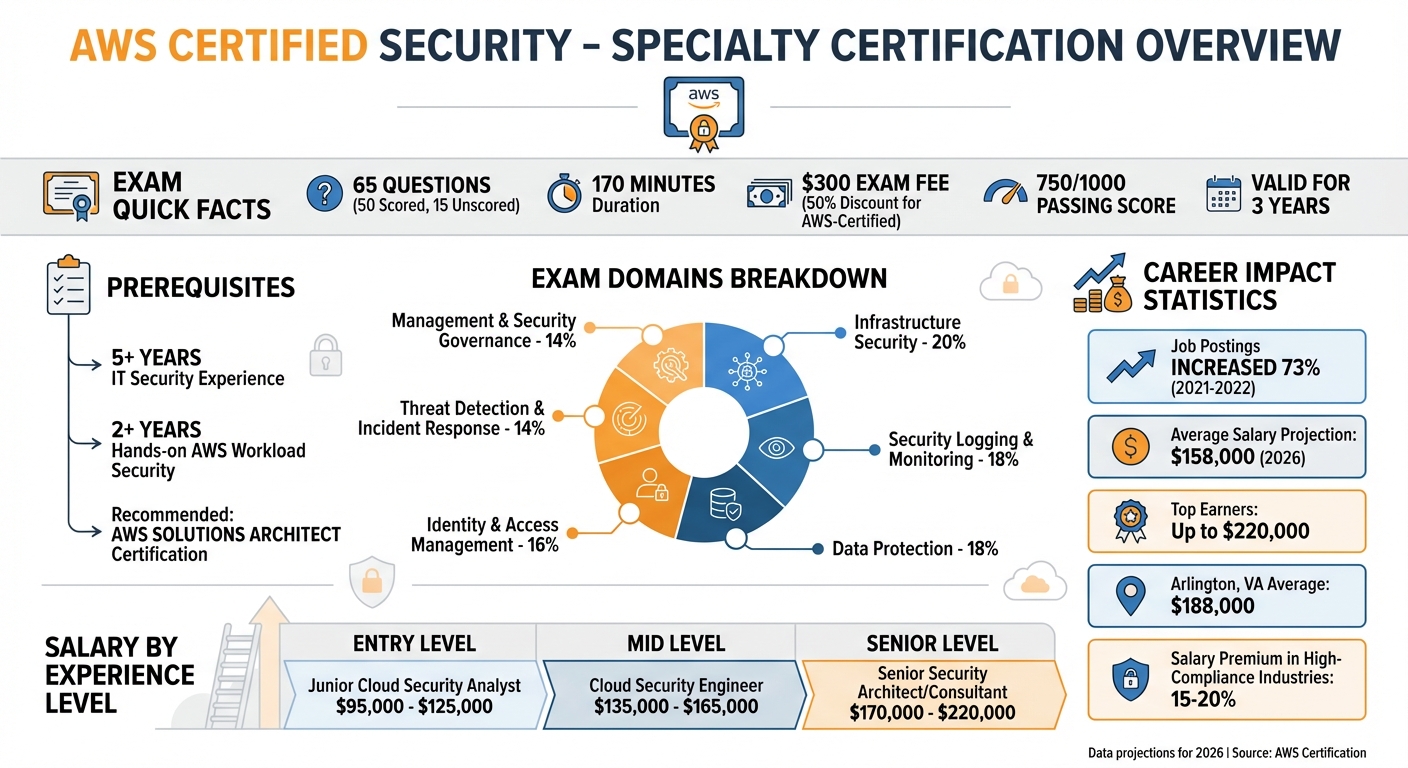
The AWS Certified Security – Specialty certification is a must-have for cloud engineers working with classified or sensitive data. It validates expertise in AWS security, compliance, and incident response – skills in high demand for government and defense projects. With job postings requiring this certification increasing by 73% between 2021 and 2022, and average salaries projected to hit $158,000 annually by 2026, it’s a career booster for cleared professionals.
Key highlights:
- Exam Overview: 65 questions, 170 minutes, $300 fee (50% discount for current AWS-certified professionals).
- Core Domains: Infrastructure Security, Data Protection, IAM, Threat Detection, Logging & Monitoring, Governance.
- Prerequisites: 5+ years of IT security experience, 2+ years securing AWS workloads.
- Job Impact: Positions like Cloud Security Engineer and Senior Security Architect offer salaries up to $220,000.
This certification equips you to secure classified workloads, enforce compliance, and handle advanced AWS tools like GuardDuty, KMS, and Security Hub. It’s a practical investment for cleared engineers aiming to excel in high-stakes environments.
AWS Security Specialty Certification: Exam Details, Salary Projections, and Career Impact 2026
AWS Certified Security Specialty Exam (SCS-C02) Training Course
sbb-itb-bf7aa6b
What Is the AWS Certified Security – Specialty Certification?
The AWS Certified Security – Specialty certification validates your expertise in designing and implementing security solutions within the AWS Cloud. It focuses on advanced security practices, including encryption methods and compliance frameworks tailored for sensitive environments like government operations [1][2].
The SCS-C02 exam includes 65 questions (50 of which are scored), has a time limit of 170 minutes, and requires a minimum score of 750 out of 1,000 to pass. The exam fee is $300, but active AWS certification holders receive a 50% discount [1][5]. Candidates are expected to have five years of IT security experience and two years of hands-on experience securing AWS workloads [1][2]. Once achieved, the certification is valid for three years, after which recertification is required by passing the latest version of the exam [1][5]. These rigorous requirements highlight its importance, especially for professionals handling sensitive workloads.
Why Cleared Cloud Engineers Need This Certification
Cleared professionals often work in environments where security is paramount, and any lapse could have serious consequences. This certification equips them with the expertise to safeguard classified or sensitive workloads, aligning with the strict compliance and security standards required in government and defense projects [3][5].
The exam emphasizes compliance and governance using tools like AWS Config and Security Hub, which help enforce frameworks like CIS AWS Foundations and PCI DSS [3]. For projects that demand FIPS 140-2 Level 3 compliance, the certification covers AWS CloudHSM, a service that provides dedicated hardware security modules [3].
Additionally, it prepares candidates to respond to security incidents effectively. For example, you’ll learn to maintain data immutability with S3 Object Lock and Glacier Vault Lock, ensuring WORM (Write Once, Read Many) compliance for sensitive data [3]. By combining technical skills with compliance expertise, this certification empowers cleared engineers to handle the unique demands of government and defense projects.
Core Skills Covered
The certification’s exam domains mirror real-world security priorities, ensuring that the skills you gain are directly applicable to securing sensitive workloads. The exam is divided into six key domains:
| Domain | Weight | Key Services and Topics |
|---|---|---|
| Infrastructure Security | 20% | AWS WAF, Shield, VPC, Security Groups, NACLs |
| Security Logging & Monitoring | 18% | CloudTrail, CloudWatch, VPC Flow Logs, Inspector |
| Data Protection | 18% | KMS, CloudHSM, S3 Encryption, Secrets Manager |
| Identity & Access Management | 16% | IAM Policies, Roles, Federation, Cognito |
| Threat Detection & Incident Response | 14% | GuardDuty, Security Hub, Detective |
| Management & Security Governance | 14% | AWS Organizations, SCPs, Config |
Incident Response training includes tools like Amazon GuardDuty, Security Hub, and Detective to detect and address compromised resources [3]. You’ll also explore automation techniques, such as using Amazon EventBridge to trigger AWS Lambda functions for security remediation [3].
Logging and Monitoring focuses on setting up CloudTrail for auditing, CloudWatch for real-time alerts, and VPC Flow Logs for analyzing network traffic [3][7]. In Infrastructure Security, you’ll learn to design robust edge security with AWS WAF and Shield, as well as implement network segmentation using Security Groups and NACLs [3].
Identity Management covers complex authorization tasks, including creating IAM policies, managing roles, and enabling secure access to AWS resources through federation and SAML 2.0 integration with on-premises Active Directory [3][4][7].
Finally, Data Protection emphasizes mastering AWS KMS for encryption key management, CloudHSM for hardware-based security, and S3 Object Lock for preserving data integrity. For instance, you’ll learn to use S3 Object Lock in "Compliance" mode to ensure critical data remains untouchable, even by root users [3].
Certification Requirements and Exam Details
Prerequisites and Experience Requirements
You don’t need any prior AWS certifications to sign up for this exam [5]. That said, AWS strongly recommends candidates bring a wealth of practical experience to the table: five or more years of IT security experience focused on designing and implementing security solutions, alongside at least two years of hands-on experience securing AWS workloads [1][2][5].
To succeed, you’ll need a solid grasp of the AWS shared responsibility model, data encryption techniques, data classifications, and secure internet protocols [1][5]. Additionally, hands-on familiarity with key AWS services like IAM, CloudTrail, KMS, CloudWatch, GuardDuty, Security Hub, Macie, AWS Config, and WAF is essential [5]. While not mandatory, many candidates choose to first earn the AWS Certified Solutions Architect – Associate or Professional certifications to strengthen their cloud knowledge base [1][5]. This foundational expertise is especially valuable for tackling the complex demands of securing classified cloud environments.
Exam Format and Scoring
Preparation doesn’t stop at experience – it’s also about knowing the exam’s format inside and out. Referred to as SCS-C02, the exam includes 65 questions presented in multiple choice and multiple response formats [1][5]. However, only 50 questions count toward your final score, as 15 are unscored trial questions. Since these trial questions aren’t identified, every question deserves your full attention.
To pass, you’ll need a scaled score of 750 [5]. AWS uses a compensatory scoring method, meaning your overall performance across all domains determines your result [5]. This approach makes understanding the exam structure key for professionals working in high-security environments.
The test is available at Pearson VUE centers or through online proctoring, and it’s offered in several languages, including English, Japanese, Korean, Portuguese, Simplified Chinese, and Spanish [1][8]. After completing the exam, you’ll receive a detailed breakdown of your performance by domain, helping you identify areas to focus on if you need to retake it [5].
Benefits for Cleared Cloud Engineers
Cleared cloud engineers who master essential security domains unlock a range of career and technical advantages.
Job Demand and Salary Impact
Achieving the AWS Certified Security – Specialty certification can lead to some of the most lucrative positions in the cleared cybersecurity field. By 2026, professionals holding this certification are projected to earn an average base salary of $158,000 annually in the United States, with top earners in major tech hubs surpassing $200,000 per year [9]. In key defense and government contracting areas like Arlington, VA, average salaries can climb to $188,000 [9].
In high-compliance industries such as defense, fintech, and healthcare, cleared professionals often enjoy a 15% to 20% salary premium. This is because employers in these sectors value both expertise and the assurance that comes with it – mistakes in these fields can have enormous costs [9]. Additionally, this certification demonstrates the ability to implement advanced security measures, such as Service Control Policies across multiple accounts. This expertise can result in a 20% to 30% salary boost over those with only basic cloud knowledge [9].
| Experience Level | Job Role | Estimated Salary Range (2026) |
|---|---|---|
| Entry Level | Junior Cloud Security Analyst | $95,000 – $125,000 |
| Mid Level | Cloud Security Engineer | $135,000 – $165,000 |
| Senior Level | Senior Security Architect/Consultant | $170,000 – $220,000 |
In addition to competitive pay, the certification hones technical skills critical for working in classified environments.
Technical Skills for Classified Work
This certification develops the expertise needed to secure classified and sensitive workloads effectively. For example, it provides advanced knowledge of data protection tools like AWS KMS and CloudHSM, ensuring compliance with FIPS 140-2 Level 3 and safeguarding data both at rest and in transit.
It also emphasizes continuous monitoring and auditing capabilities. You’ll learn to maintain detailed audit trails and detect threats in real time. Using tools like AWS Lambda and Amazon EventBridge, you can build automated workflows to immediately isolate compromised resources – an essential skill in environments where delays in response are unacceptable.
The training further covers designing secure network architectures. By leveraging VPCs, Network Access Control Lists, and private endpoints, you’ll be able to isolate sensitive workloads from public internet access while meeting stringent regulatory requirements. These skills are indispensable for maintaining security in high-stakes, classified settings.
How to Prepare for the Exam
Preparing for the AWS Certified Security – Specialty exam takes a mix of structured study, hands-on practice, and disciplined time management. Here’s how you can set yourself up for success.
Study Materials and Resources
Begin with the AWS Certified Security – Specialty Exam Guide and the Official Practice Question Set available on AWS Skill Builder [1]. These resources detail the exam’s scope and familiarize you with the types of questions you’ll encounter. AWS Skill Builder also offers an "Exam Prep Plan" featuring digital courses, AWS Builder Labs, AWS Cloud Quest, and AWS Jam for hands-on practice [1].
For additional preparation, platforms like A Cloud Guru (now part of Pluralsight) provide certification courses, quizzes, and an Exam Simulator that replicates the test environment [4]. This simulator is especially useful for practicing time management – try to answer 10 questions every 20 minutes [6].
Key AWS whitepapers to review include the "AWS Security Incident Response Guide", "KMS Best Practices", and "DDoS Best Practices" [4]. You can also access free sessions on AWS Training Live on Twitch, led by AWS experts [1]. If you’ve previously passed an AWS certification, take advantage of the 50% discount voucher for your next exam, bringing the cost down to $150 USD [1].
| Exam Domain | Weighting | Services to Review for Exam Prep |
|---|---|---|
| Infrastructure Security | 20% | VPC, Security Groups, NACLs, WAF, Shield |
| Data Protection | 18% | KMS, CloudHSM, S3 Encryption, Secrets Manager |
| Logging and Monitoring | 18% | CloudWatch, CloudTrail, Config, Inspector |
| Identity and Access Management | 16% | IAM, Cognito, Organizations, Directory Service |
| Threat Detection and Incident Response | 14% | GuardDuty, Security Hub, Detective |
| Management and Security Governance | 14% | Organizations, SCPs, Trusted Advisor |
Armed with these resources, it’s time to dive into practical application.
Hands-On Practice with AWS
"There’s no replacement for [hands-on experience]. We’re humans, and we learn by doing."
– Faye Ellis, Principal Training Architect, A Cloud Guru [4]
Relying solely on theory won’t cut it for this exam. Use the AWS Free Tier to practice with core security services like IAM, KMS, CloudTrail, and GuardDuty [3][4]. For services beyond the Free Tier, budget around $10.00 per month for practice exercises [10].
Set up at least three AWS accounts and use AWS Organizations to create a master account. This setup lets you practice cross-account IAM roles and resource sharing – skills essential for managing multi-account environments [10]. For encryption exercises, invest in a Customer Managed Key (CMK) in KMS, which costs about $1.00 per month [10].
You can also launch EC2 instances to practice enabling VPC Flow Logs, sending logs to CloudWatch, and setting alarms for rejected traffic on specific ports like port 22 [10]. Test S3 bucket policies and VPC endpoints by restricting bucket access to a specific VPC endpoint, then simulate failure scenarios using the CLI [10][11]. Additionally, experiment with Permission Boundaries and Attribute-Based Access Control (ABAC) by tagging users and designing policies that align access permissions with resource tags [10].
Once you’ve built your practical skills, it’s time to organize your study plan.
Creating a Study Schedule
Balancing work and exam prep can be challenging, especially for professionals. A three-month study plan works well for those with prior AWS experience.
- Month 1: Focus on Identity and Infrastructure. Learn IAM policy evaluation, VPC security, and edge security tools like WAF, Shield, and CloudFront.
- Month 2: Dive into Data Protection and Monitoring. Concentrate on KMS key policies, S3 security configurations, and services like CloudTrail and CloudWatch Logs.
- Month 3: Cover Incident Response and Governance. Study services like GuardDuty, Security Hub, and AWS Organizations [6].
Use the final two weeks for practice exams from Whizlabs or AWS Skill Builder to fine-tune your timing and readiness [6]. Follow AWS’s 4-Step Plan: review the exam guide, fill knowledge gaps with courses, practice with flashcards and questions, and take the official pretest to gauge your preparedness [1]. When answering questions, prioritize the most secure solution unless the question explicitly asks for the "simplest" or "most economical" option [6].
To retain what you learn, review new material at intervals: after 10 minutes, 24 hours, one week, and one month. This approach can help you retain up to 90% of the information [4].
Using the Certification in Classified Environments
This section explores how to apply your certification skills to tackle the challenges of classified environments. With your AWS Certified Security – Specialty knowledge, you’ll be equipped to protect the nation’s most sensitive data. This certification confirms your expertise in managing specialized data classifications and AWS protection tools, which are critical for handling workloads across Unclassified, Sensitive, Secret, and Top Secret levels.
Securing Classified Workloads on AWS
For over a decade, AWS has been the go-to cloud service provider for U.S. government workloads, supporting the full spectrum of data classifications [12]. Your training enables you to enforce compliance with standards like DNI ICD 503 and NIST SP 800-53.
In classified environments, AWS handles the physical infrastructure’s security while you focus on applying OS and application STIGs. Using pre-approved CloudFormation templates, you can secure security groups, network ACLs, and deploy STIG-hardened machine images.
| AWS Environment | DoD Impact Level | Classification Level |
|---|---|---|
| US East / West Regions | IL 2 | Unclassified / Public |
| AWS GovCloud (US) | IL 2, 4, 5 | CUI / Sensitive |
| AWS Secret Region | IL 6 | Secret |
| AWS Top Secret Cloud | N/A (ICD 503) | Top Secret |
The AWS Top Secret Cloud is supported 24/7 by cleared U.S. citizens [12]. In October 2025, AWS expanded its Secret-level capacity by launching the Secret-West Region [16]. For example, the Naval Information Warfare Center (NIWC) Pacific used AWS in 2024 to create a compliant DevSecOps environment, accelerating classified research and development [16].
"By removing the undifferentiated heavy lifting of the underlying IT infrastructure, national security customers are able to focus on keeping the United States secure."
- AWS Top Secret Cloud Documentation [12]
You can also streamline your compliance efforts by leveraging AWS FedRAMP and DoD provisional authorizations to reduce the burden of System Security Plans (SSP). Concentrate on shared and customer-specific controls, and automate compliance by enforcing programmatic policies. AWS Service Catalog templates allow you to lock down security settings, ensuring application owners cannot modify critical configurations like network ACLs.
Next, we’ll look at connecting AWS services with on-premises classified networks to complete your security strategy.
Connecting AWS with Classified Networks
Integrating AWS with on-premises classified infrastructure requires precise connectivity solutions. Your certification expertise in secure protocols and AWS networking is essential when using AWS Direct Connect. This dedicated, high-bandwidth connection bypasses the public internet, meeting strict requirements for Secret and Top Secret data transmission.
For workloads at Impact Levels 4 (IL4) and 5 (IL5), deploy the Landing Zone Accelerator (LZA) on AWS to align with DISA SCCA requirements [14]. While physical isolation was once the standard, the DoD Security Requirements Guide now allows logical separation for IL5 workloads if you demonstrate robust virtual separation controls and dedicated tenancy [15].
To enforce data handling standards, use resource tags (e.g., Classification: Secret) along with AWS Organizations tag policies. AWS Config can continuously monitor resources and flag any deviations from your security baseline. Always ensure cryptographic protection for sensitive government data by using FIPS 140-3 validated endpoints [13].
For ITAR-regulated or highly sensitive data, restrict access to "US Persons" as defined by federal regulations. Maintain a centralized data catalog that maps data locations, sensitivity levels, and applied controls – such as encryption, retention, and access restrictions. This ensures compliance while managing multi-tenant systems effectively. Alternate solutions may also be approved during the Provisional Authorization (PA) process [15].
Finding Jobs with Your Certification on Cleared Cyber Security Jobs
Put your technical skills to work by targeting high-demand roles in cleared cybersecurity. With an AWS Certified Security – Specialty credential, you’re positioned for some of the most sought-after positions in the field. The key is making sure the right employers see it. Cleared Cyber Security Jobs connects you with a resume database that defense and intelligence contractors actively use to search through over 1.6 million qualified candidates.
Highlighting Your Certification on Resumes
Make your AWS Certified Security – Specialty credential stand out – especially alongside your clearance level. Recruiters often skim the first few lines of a resume for critical qualifications, so include this information in your professional summary or contact section. For instance, instead of burying it later in your resume, lead with something like: "TS/SCI cleared Cloud Security Engineer with AWS Certified Security – Specialty and 7 years securing classified workloads." [17][18]
Consider adding a Technical Skills section to your resume where "AWS Certified Security – Specialty" is prominently listed. Use the STAR method (Situation, Task, Action, Result) to quantify your achievements. For example, instead of writing "Managed AWS security", try: "Reduced system vulnerabilities by 35% through proactive threat monitoring using AWS Security Hub." This approach not only appeals to human recruiters but also improves your visibility in Applicant Tracking Systems (ATS) [17][18].
"Your security-cleared resume is not a biography or a mere list of qualifications. It’s an ad designed to help you land that coveted cleared job interview." – Ashley Jones, Editor, ClearedJobs.Net [18]
Keep your resume concise – limit it to one or two pages by removing outdated roles (older than 10 years) and focusing on your most relevant certifications [18][19]. Stick to simple formatting without graphics or unusual fonts to avoid issues with electronic scanning systems. Lastly, ensure your certification is active, as it’s valid for three years, so you remain competitive in the cleared job market.
Using Job Search Tools and Filters
Once your resume is polished, take advantage of job search tools to zero in on the right cleared cybersecurity positions. Cleared Cyber Security Jobs offers advanced filters to help you narrow results by clearance level (e.g., Secret, Top Secret, TS/SCI), polygraph requirements (CI or Full Scope), and work environment (on-site, remote, or hybrid). Use Boolean search operators to refine your search further – try something like "AWS" AND "GuardDuty" to find positions requiring specific tools. You can also set up automated alerts with keywords like "AWS Security Engineer" or "Cloud Architect" to receive regular updates on relevant openings.
The platform’s IntelliSearch™ feature matches the details of your security-focused resume to suitable positions, while the polygraph filter quickly highlights high-level roles that often come with premium pay for AWS expertise. By saving search filters, you can monitor multiple criteria at once, ensuring you don’t miss opportunities that align with your certification and clearance level. As of October 2024, the AWS Certified Security – Specialty is among the top-paying technical certifications in the U.S. [1], making these targeted tools especially valuable for boosting your earning potential.
Conclusion
The AWS Certified Security – Specialty is a key credential for cloud engineers working on classified projects. It confirms your ability to secure sensitive workloads, implement advanced encryption techniques, and navigate the critical tradeoffs required in high-stakes government settings. With demand increasing for experts who combine cloud skills with national security expertise, this certification holds significant value.
It also positions you as a trusted professional in managing complex data classifications across air-gapped systems and multi-level security setups, such as the Amazon Dedicated Cloud (ADC) [20]. As of October 2024, this certification ranks among the highest-paying technical credentials in the United States [1], underlining the essential role you play in safeguarding classified data and supporting intelligence missions. Beyond validating your technical skills, it sets you apart for top-tier cleared roles.
"This certification can build your credibility and position you as a trusted advisor to your stakeholders and customers." – AWS [1]
To connect with opportunities that align with your expertise, Cleared Cyber Security Jobs offers a focused platform. It features advanced filters for clearance levels, polygraph requirements, and work environments, helping you target roles like Cloud Security Engineer or DevSecOps within defense and intelligence sectors.
Whether you’re securing classified systems, designing incident response strategies, or architecting multi-level security frameworks, the AWS Certified Security – Specialty credential opens doors to some of the most challenging and rewarding careers in cleared cybersecurity.
FAQs
Is this certification worth it if I already have a clearance?
Earning the AWS Security Specialty certification is absolutely worth it, even if you already have a security clearance. This certification highlights your advanced skills in AWS security, adds credibility to your expertise, and opens doors to more opportunities in cloud security roles. It’s especially valuable when working with sensitive or classified cloud environments, helping you stand out in a competitive field.
Which AWS services should I practice most for SCS-C02?
When diving into AWS security, there are a few critical areas to master, especially if you’re preparing for the SCS-C02 exam or aiming to implement AWS security best practices.
Start with Identity and Access Management (IAM). This service is at the heart of controlling who can access your AWS resources and what actions they can take. Understanding how to configure IAM policies, roles, and permissions is essential for maintaining a secure environment.
Next, focus on data encryption. AWS offers multiple options for encrypting data at rest and in transit, such as using AWS Key Management Service (KMS) or enabling encryption for services like S3, RDS, and EBS. Knowing when and how to apply encryption ensures your sensitive data stays protected.
Don’t overlook security controls tailored for AWS environments. These include setting up security groups, network ACLs, and leveraging AWS Web Application Firewall (WAF) to guard against common threats.
Equally important are logging and monitoring strategies. Tools like Amazon CloudWatch and AWS CloudTrail help you track activity and detect anomalies. Combined with services like AWS Config, you can maintain compliance and quickly identify misconfigurations.
Finally, sharpen your skills in vulnerability management and incident detection tools. AWS Inspector, GuardDuty, and Security Hub are powerful resources for identifying vulnerabilities and responding to potential incidents.
By focusing on these areas, you’ll not only prepare for the exam but also gain a deeper understanding of how to secure AWS environments effectively.
How do I get hands-on experience without risking high AWS costs?
To get hands-on practice with AWS security while keeping costs low, take advantage of the AWS Free Tier. This allows you to experiment with services like EC2, S3, and CloudTrail without incurring charges. Just remember to shut down any resources when you’re done to prevent unexpected fees.
Another great option is to explore free AWS hands-on labs offered by various learning platforms. These labs don’t require a credit card and provide practical exercises in a controlled, risk-free environment. They’re a great way to build your skills and prepare for the AWS Security Specialty certification.