

Looking to advance your career as a cleared security architect? The CASP+ certification, now rebranded as CompTIA SecurityX, is a hands-on, performance-based credential tailored for high-level cybersecurity professionals. Officially launched on December 17, 2024, SecurityX aligns with DoD Directive 8140/8570.01-M, making it a key qualification for roles like Security Architect, Systems Requirements Planner, and Security Control Assessor.
Key Highlights:
- Focus Areas: Security architecture, engineering, operations, and compliance.
- Exam Details: 90 questions, 165 minutes, pass/fail grading.
- Relevance: Approved by the U.S. Department of Defense for critical cybersecurity roles.
- Experience Needed: 10 years of IT work (5+ in security).
- Career Impact: Opens doors to cleared roles with employers like the U.S. Army, Booz Allen Hamilton, and Verizon.
With cloud-based threats surging by 110% annually, SecurityX equips you to tackle challenges in automation, Zero Trust, and advanced cryptography. Whether you’re aiming to design secure systems or enhance your technical expertise, this certification positions you for success in high-demand, cleared cybersecurity roles.
CompTIA SecurityX is here (CASP+ is no more): What you need to know
sbb-itb-bf7aa6b
CASP+ Certification and Exam Overview
CASP+ SecurityX Exam Domains and Content Breakdown
Exam Format and Content Domains
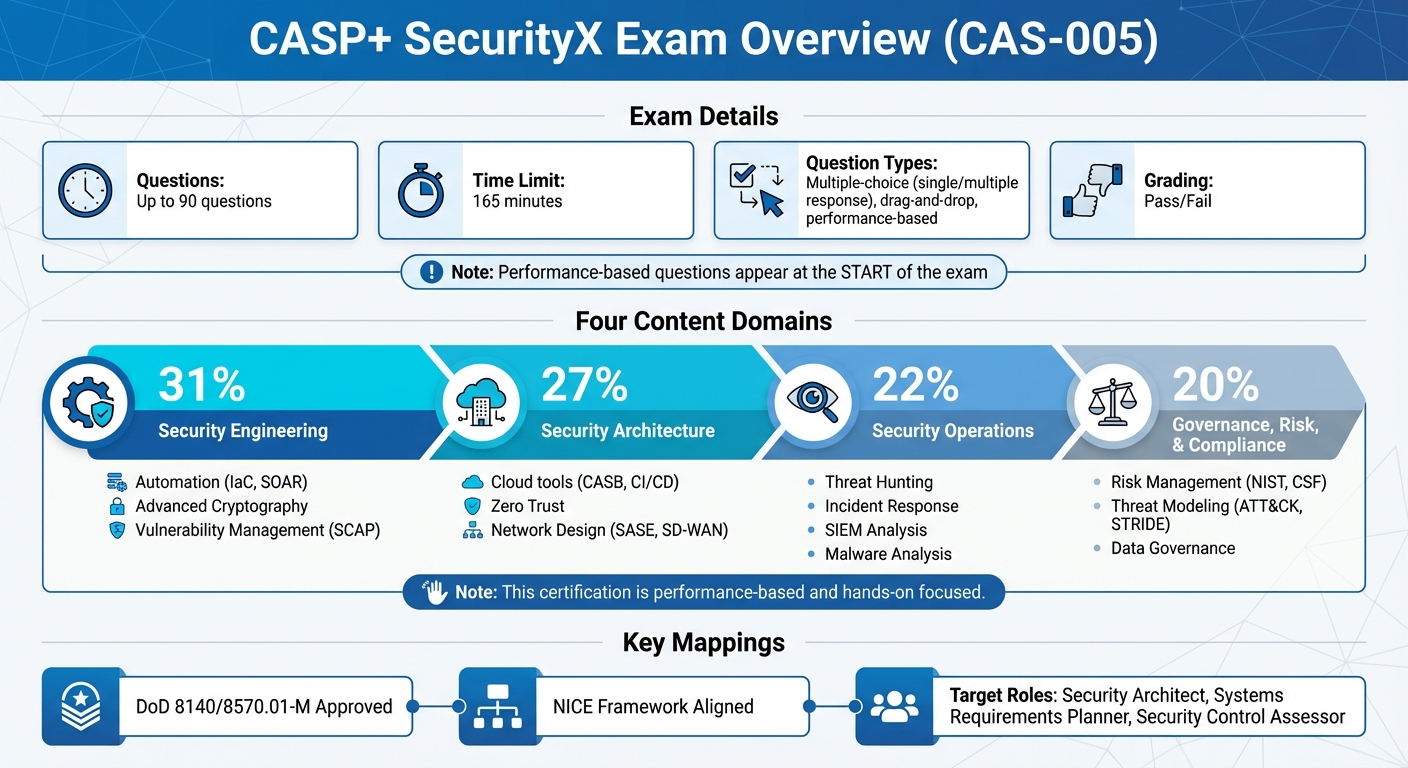
The SecurityX exam (CAS-005) includes up to 90 questions, which candidates must complete within a 165-minute time limit [1]. The question types are varied, featuring multiple-choice (both single and multiple response), drag-and-drop, and performance-based items. Unlike many other CompTIA exams, this one is graded on a pass/fail basis rather than a scaled score.
Performance-based questions, which simulate real-world technical problem-solving, appear at the start of the exam. During these tasks, the on-screen clock is hidden, so managing your time effectively is crucial. Additionally, an optional exit survey follows the exam, consisting of about 12 multiple-choice questions aimed at gathering feedback on your study experience.
The exam content is divided into four main domains, each weighted to reflect the expertise required for security architects:
| Domain | Weight | Key Focus Areas |
|---|---|---|
| Security Engineering | 31% | Automation (IaC, SOAR), Advanced Cryptography, Vulnerability Management (SCAP) |
| Security Architecture | 27% | Cloud tools (CASB, CI/CD), Zero Trust, Network Design (SASE, SD-WAN) |
| Security Operations | 22% | Threat Hunting, Incident Response, SIEM Analysis, Malware Analysis |
| Governance, Risk, & Compliance | 20% | Risk Management (NIST, CSF), Threat Modeling (ATT&CK, STRIDE), Data Governance |
These domains collectively assess the technical skills and strategic knowledge expected of advanced security architects.
Relevant Areas for Security Architects
Looking closer at the domain breakdown, several areas stand out as particularly relevant to security architects.
In the Security Engineering domain, which carries the highest weight at 31%, there’s a strong focus on automation and scripting. Proficiency in languages like PowerShell, Bash, or Python is essential, as well as a deep understanding of Infrastructure as Code (IaC) principles.
The Security Architecture domain, weighted at 27%, directly aligns with the responsibilities of a security architect. This section emphasizes designing secure systems for cloud, on-premises, and hybrid environments. Expect questions about Secure Access Service Edge (SASE), microsegmentation, and Zero Trust models. Familiarity with cloud-specific tools, such as Cloud Access Security Brokers (CASB) and shadow IT detection, is also critical.
The remaining domains – Security Operations (22%) and Governance, Risk, & Compliance (20%) – cover areas like threat hunting, incident response, and risk management. These sections incorporate frameworks such as NIST and CSF, ensuring that candidates are prepared for roles requiring advanced risk assessment and compliance strategies.
This certification is mapped to NICE and DoD 8140 work roles, including Security Architect, Systems Requirements Planner, and Security Control Assessor, reinforcing its importance for professionals in high-level security positions.
Prerequisites and Who Should Pursue CASP+
Experience Requirements for Cleared Professionals
CompTIA suggests 10 years of IT experience, with at least five years in security, before attempting CASP+ (now SecurityX) [8]. While there are no strict prerequisites, this certification is not geared toward recent graduates or those just starting their careers.
The exam assumes a strong understanding of topics covered in certifications like CompTIA Network+, Security+, CySA+, Cloud+, and PenTest+ [8]. To succeed, you should already be familiar with areas like identity and access management (IAM), cryptographic tools like SSL/TLS and PKI, networking basics such as TCP/IP, and key security technologies like firewalls and VPNs. If you’re still building these skills, a good path is to begin with Security+ (roughly two years of experience), followed by CySA+ or PenTest+ (three to four years) before tackling CASP+ [10].
Unlike certifications aimed at management roles, CASP+ is tailored for advanced practitioners who prefer staying hands-on with technology rather than shifting into purely leadership positions. Meeting these criteria ensures you’re well-prepared to use CASP+ as a way to propel your career forward.
How CASP+ Fits Your Career Path
CASP+ is the next logical step for senior security engineers and cleared security architects tasked with designing, building, and implementing secure systems in complex environments [2]. It’s also recognized by the U.S. Department of Defense as meeting Directive 8140/8570.01-M requirements, aligning with key roles like Security Architect, Systems Requirements Planner, and Security Control Assessor [8].
According to CompTIA, around 32% of certification holders report earning raises, promotions, or other benefits after completing their certification [8]. For professionals in federal contracting or government roles, CASP+ showcases your ability to combine high-level security strategy with hands-on technical execution – a skill set that’s becoming increasingly critical in positions requiring both architectural vision and practical implementation.
Why CASP+ Matters for Cleared Security Architects
DoD 8570 Compliance and Approval
CASP+ (recently rebranded as CompTIA SecurityX as of December 17, 2024) holds approval from the U.S. Department of Defense (DoD) under Directive 8140/8570.01-M. This makes it a required baseline certification for many roles involving privileged access in the cleared sector [4][5]. Specifically, the certification aligns with the Information Assurance System Architecture and Engineering (IASAE) specialty levels within the DoD 8570 framework – key for professionals in security architecture [11].
According to DoDM 8140.03, SecurityX is recognized for 31 critical roles, including Security Architect and Systems Security Analyst. Starting February 2025, all DoD civilian employees and military service members in Defense Cyber Workforce Framework roles must meet these updated qualifications.
What makes SecurityX stand out is its combined focus on security architecture and engineering concepts. This dual approach prepares professionals to both design and implement secure systems – an essential skill set in high-security environments. Cleared employers highly value this certification for roles that demand technical expertise and compliance with DoD standards. Beyond meeting these stringent requirements, SecurityX also positions individuals for career progression in the cybersecurity field.
Career Growth in Cleared Positions
Beyond its DoD compliance, SecurityX plays a pivotal role in career advancement for cleared professionals. It paves the way for senior roles that demand a blend of technical expertise and strategic vision. Unlike certifications aimed at managerial skills, SecurityX focuses on preparing practitioners for roles like Security Architect or Senior Security Engineer. CompTIA emphasizes this distinction:
"SecurityX is the only hands-on, performance-based certification for practitioners – not managers – at an advanced skill level of cybersecurity" [6].
Additionally, 90% of employers rely on certifications to identify top talent [4]. The updated SecurityX V5 exam reflects current trends, such as AI, automation with PowerShell/Python/Bash, and Zero Trust architecture [7]. These skills are vital, especially as cloud-related cyber threats have surged by 110% year-over-year [5]. With these capabilities, SecurityX-certified professionals are well-equipped to maintain a technical edge in an ever-evolving threat landscape, ensuring their expertise remains indispensable in cleared roles.
How to Prepare for the CASP+ Exam
Study Materials for Cleared Professionals
To get ready for the CASP+ exam, start with the CompTIA Official Study Guide and CertMaster Learn. These resources are designed to match the latest exam objectives, ensuring you cover everything you need to know [13][14]. Since the exam includes performance-based scenarios, focus especially on the hands-on skills required. Pay close attention to the four major domains, with Security Engineering and Security Architecture making up a hefty 58% of the test [7][12].
For practical experience, platforms like Qwiklabs and TryHackMe are excellent for tackling real-world security scenarios [13]. You can also use tools like VirtualBox or VMware to set up sandbox environments. These are perfect for practicing tasks like configuring firewalls, managing incidents, and working with encryption [13]. This hands-on approach mirrors the challenges you’ll face in cleared cybersecurity roles.
If you’re looking for additional resources, check out the "CompTIA CASP+ Study Guide" by Mike Meyers or the "CASP+ CompTIA Advanced Security Practitioner Study Guide" by Wm. Arthur Conklin [13]. These guides not only dive into exam content but also help you prepare for the practical tasks discussed in the next section.
Study Planning and Time Management
Once you’ve gathered your materials, creating a structured study plan is key to success. Break your study sessions into 45 to 60-minute blocks, followed by 10 to 15-minute breaks. This method, often called the Pomodoro Technique, can help you stay focused and retain more information [13]. Since performance-based questions are time-consuming and appear at the start of the exam, practice solving them in simulated environments to build both speed and confidence [9]. Full-length practice exams – taken under timed conditions and without notes – are another great way to simulate the test day experience [13].
Use the official exam objectives to evaluate your current knowledge. Spend extra time on areas you find challenging, such as advanced cryptography or cloud control strategies [12][13]. To make your study time even more effective, relate your daily work tasks to the exam content. For example, apply concepts like risk assessment, cloud configuration, or log analysis to your current projects [15]. Finally, consider joining CASP+ study groups on platforms like Reddit or LinkedIn. These communities are great for exchanging tips and discussing complex topics with others preparing for the exam [13].
Finding Cleared Jobs with CASP+ Certification
Using Cleared Cyber Security Jobs
Once you’ve earned your CASP+ certification, the next step is putting it to work to land the right cleared position. Platforms like Cleared Cyber Security Jobs can help you showcase your clearance level and technical expertise to recruiters. This tool highlights your CASP+/SecurityX credential, clearance status, and key skills, using an AI-powered engine that combines Boolean and semantic criteria for better job matching. You can refine your job search by clearance level (Secret, TS/SCI, or TS/SCI with polygraph), location, and technical skills. The platform also features virtual and in-person hiring events, giving you opportunities to expand your professional network.
Common Cleared Roles for CASP+ Holders
The CASP+ certification opens doors to a variety of cleared roles that align with DoD 8140/8570.01-M standards, including positions at IAT Level III and IASAE levels [3][18]. Your validated expertise makes you a strong candidate for these critical roles. For example, Security Architect positions are in demand, where you’ll design secure IT infrastructures and develop enterprise-wide strategies [16][17]. Other roles include Technical Lead Analyst, where you’ll guide teams in assessing security risks and implementing solutions, and Application Security Engineer, focusing on securing CI/CD pipelines and containerized environments.
Employers such as the U.S. Army, U.S. Navy, Booz Allen Hamilton, Leidos, and Northrop Grumman frequently seek professionals with CASP+ certification. Holding a TS/SCI clearance can significantly boost your earning potential, with salaries averaging 40.6% higher and reaching up to $148,314 for those with a Full Scope Polygraph [18].
"SecurityX is the industry standard for advanced-level competency for technical professionals who wish to remain immersed in technology as opposed to strictly managing." – CompTIA [4]
Renewing Your CASP+ Certification
Keeping your SecurityX certification (formerly CASP+) up to date is just as important as earning it in the first place. This ensures you remain compliant and skilled for cleared roles. The certification is valid for three years [20]. To maintain your status and meet DoD 8140/8570 compliance, you’ll need to earn 75 Continuing Education Units (CEUs) within that three-year period [20]. This is the highest CEU requirement among CompTIA certifications, reflecting the advanced level of this credential [22].
There are two ways to renew your certification. The first is the single activity route: you can either pass the latest SecurityX exam (currently priced at $509 [23]) or earn an approved non-CompTIA certification, such as CISSP or CISM [20]. The second option is the multiple activities route, which involves accumulating 75 CEUs through various professional activities. These can include attending webinars, completing training courses, publishing articles, or documenting relevant work experience [19]. At least half of these activities must align with the current exam objectives [22].
CompTIA emphasizes the importance of renewal as part of professional growth:
"Renewing your certification gives you a great opportunity to document your knowledge in technology areas that matter to employers and are important to your IT career." – CompTIA [20]
To make the process easier, use CompTIA’s CEU assessment tool to confirm your activities meet the requirements before committing time to them [22]. Be sure to upload documentation to your certification record while the training courses are still on the pre-approved list. If a course is removed before you upload your proof, those CEUs won’t count [21]. Additionally, you can leverage your day-to-day work in security architecture under the "Work Experience" category to earn CEUs without extra costs [19].
If you fail to renew your certification before it expires, your only option to regain active status is to retake the current exam [20]. Unlike other CompTIA certifications, you can’t renew SecurityX by earning a "higher-level" certification. Your choices are limited to earning CEUs, obtaining a qualifying non-CompTIA certification, or retaking the exam [20][23]. This renewal process helps ensure your skills stay sharp and relevant for advancing your career in cleared security roles.
Conclusion
SecurityX, previously known as CASP+, combines security architecture and engineering expertise in a way that sets it apart [5]. For cleared security architects, it demonstrates your ability to design and implement secure solutions in complex environments while meeting DoD 8140/8570 compliance standards. Unlike management-focused certifications, SecurityX highlights your advanced technical and hands-on skills.
This certification offers real career advantages. Around 32% of certified professionals report pay raises or promotions [8], and the Bureau of Labor Statistics forecasts a 33% growth rate for Information Security Analysts between 2023 and 2033 [8]. Employers like the U.S. Army, U.S. Navy, Booz Allen Hamilton, and General Dynamics actively seek SecurityX-certified individuals for cleared positions [3].
The upcoming rebrand to SecurityX on December 17, 2024, reflects its adaptation to emerging threats. With cloud-focused cyber threats surging by 110% annually and cloud intrusions up 75% [5], the updated exam emphasizes automation, artificial intelligence, and Zero Trust architectures to ensure your skills stay relevant. This shift aligns with the rapidly changing threat landscape and employer demands. Certified professionals should update their records to reflect the new name [5].
Staying certified requires ongoing effort. To maintain your credential, you’ll need 75 CEUs every three years [8]. Regular training, practical work experience, and professional development are crucial to staying competitive and meeting compliance requirements, helping you retain your cleared status and advance your career.
FAQs
Is CASP+ the same as CompTIA SecurityX?
The CASP+ certification has been renamed SecurityX. Tailored for security architects and senior security engineers, this advanced certification focuses on practical expertise in designing and implementing secure solutions. The updated SecurityX version now features more hands-on components and real-world scenarios, ensuring it aligns closely with the demands of advanced cybersecurity roles.
What cleared roles does SecurityX satisfy under DoD 8140/8570?
SecurityX plays key roles such as security architect and security engineer under the DoD 8140/8570 directives. It is officially approved by the Department of Defense (DoD) to meet the requirements outlined in 8140/8570.01-M. The program is acknowledged for its expertise in areas like risk management, enterprise security, and security architecture. These qualifications align perfectly with the directive’s expectations for cybersecurity professionals in advanced, cleared positions.
How should I practice for the performance-based questions?
To get ready for performance-based questions on the CASP+ exam, dedicate time to hands-on practice that mirrors real-world cybersecurity challenges. Work in labs, simulations, or virtual setups to strengthen your skills in areas like enterprise security operations, architecture, and risk management. Focus on scenario-driven resources that highlight practical applications, helping you confidently tackle complex security solutions during the exam.