• Skip to primary navigation
  • Skip to main content
Cleared Cyber Security Jobs | CyberSecJobs.com

Cleared Cyber Security Jobs | CyberSecJobs.com

Cleared Cyber Security Jobs

  • Home
  • Search Cleared Cyber Jobs
  • Job Fairs
  • Career Resources

Uncategorized

Cleared Cryptographer Jobs Complete Career Guide

CyberSecJobs Editorial · April 7, 2026 ·

Cryptographers with security clearances play a key role in protecting sensitive government data. These professionals design and analyze encryption systems, ensuring secure communication and data protection. Here’s what you need to know about pursuing this career:

  • Security Clearance: Essential for most roles, with levels like Secret, Top Secret, and TS/SCI. Higher clearances mean better pay, with TS/SCI holders earning 15–25% more.
  • Education: A bachelor’s degree in Computer Science, Mathematics, or Cybersecurity is the minimum requirement. Advanced degrees (Master’s or PhD) are often needed for research or specialized roles.
  • Technical Skills: Proficiency in programming (Python, C++, Java), cryptographic algorithms, and security protocols is critical. Experience with post-quantum cryptography and zero-knowledge proofs is increasingly important.
  • Certifications: Credentials like CISSP, CEH, and ECES boost career prospects and salaries by $15,000–$25,000 annually.
  • Salary: Cleared cryptographers earn 20–40% more than their commercial counterparts, with median pay reaching $170,000 as of 2025.

This guide covers the education, skills, certifications, and clearances needed for a successful career in cleared cryptography, along with tips for job applications and industry trends.

How to Get $100,000+/yr Government Security Clearance for Free (Full Guide Without the Military)

Education and Qualifications

If you’re aiming for a career in cleared cryptography, both strong academic credentials and advanced technical skills are essential.

Degrees and Fields of Study

At a minimum, most cryptographers hold a bachelor’s degree, with about 50% meeting this baseline [1]. Popular undergraduate programs for this field include Computer Science, Mathematics, Electrical Engineering, Cybersecurity, and Applied Mathematics. These programs provide a solid foundation in advanced mathematics and programming.

Key coursework to focus on includes number theory, linear algebra, combinatorics, abstract algebra, probability, and computational complexity. As Coursera Staff explains:

A cryptographer needs familiarity with code systems, programming, and system architecture. Most undergraduate computer science and applied mathematics majors take these courses [1].

For cleared cryptography roles, U.S. citizenship is necessary since it’s part of the security clearance process. If you’re interested in encryption theory research or advanced security applications, a Master’s degree or PhD is often required. The specialized nature of this work is reflected in the median total pay for cryptography engineers, which reached $170,000 as of July 2025 [1].

When choosing a school, consider institutions recognized as Centers of Academic Excellence in Cybersecurity (CAE-C) by the NSA and DHS. Among these, 23 schools hold the CAE-Cyber Operations (CAE-CO) designation, offering deeply technical programs rooted in computer science, computer engineering, or electrical engineering [3]. Many of these programs also include 12-week summer internships, where students collaborate with NSA employees on real-world challenges.

Strong academic foundations are important, but technical skills are the next critical step.

Technical Skills Required

Proficiency in programming is non-negotiable. You’ll need to be skilled in:

  • Python: For scripting and modeling.
  • C/C++: For performance-critical implementations.
  • Java: For broader application development.

Beyond programming, a deep understanding of cryptographic primitives is essential. This includes symmetric encryption (e.g., AES, DES), asymmetric encryption (e.g., RSA, ECC), hash functions, and digital signatures.

You’ll also need to master security protocols and architecture, such as TLS, SSL, SSH, Public Key Infrastructure (PKI), and Hardware Security Modules (HSMs). Expertise in advanced topics like cryptanalysis, side-channel attacks, and emerging technologies like quantum-resistant algorithms or zero-knowledge proofs will give you an edge.

To develop these skills, consider pursuing specialized degrees, participating in internships focused on information security, or contributing to open-source cryptographic libraries like OpenSSL or Libsodium. It’s important to stick to industry-standard libraries – creating custom cryptography is not recommended. Additionally, participating in cryptographic contests or hackathons can sharpen your abilities.

Keep in mind, cryptography roles are rarely entry-level. Typically, you’ll need about five years of professional experience in information security before stepping into this field [1].

Certifications for Cryptographers

Certifications are often a must for federal positions. Under DoD 8570/8140, specific credentials are required for anyone handling information assurance tasks for the Department of Defense [4]. Beyond compliance, these certifications also translate into higher salaries. For example, CISSP holders typically earn $25,000 more than their non-certified counterparts, CEH adds about $18,000, and CompTIA Security+ boosts earnings by approximately $15,000 [4]. With a global cybersecurity workforce gap of 3.5 million positions and job growth in the field expected to hit 32% by 2032 [4], certified cryptographers hold a strong advantage when negotiating salaries and roles.

Here’s a breakdown of the top certifications valued in cryptography roles tied to government or defense work.

CISSP Certification
CISSP

The Certified Information Systems Security Professional (CISSP) is widely regarded as the gold standard for senior-level security professionals. It covers eight critical domains, including Cryptography and Security Architecture, making it particularly relevant for cryptographers [4]. To earn this certification, you need five years of paid, full-time experience in at least two of the (ISC)² domains. A four-year degree can substitute for one year of experience [4].

The CISSP exam costs $749, lasts three hours, and requires a score of 700 out of 1,000 to pass [4]. Candidates must adhere to the (ISC)² Code of Ethics and get an endorsement from a certified professional to verify their experience. Maintaining the certification involves an annual $125 fee and earning 120 Continuing Professional Education (CPE) credits every three years [5]. Nearly 25% of cybersecurity job postings in 2020 listed CISSP as a requirement [5], making it a key credential for cryptographers aiming for senior roles or higher clearance levels.

CEH Certification

The Certified Ethical Hacker (CEH) focuses on offensive security and penetration testing, which are essential for understanding how cryptographic systems can be attacked or bypassed [4]. This insight is invaluable for designing secure encryption systems. To qualify, candidates need either two years of information security experience or completion of official EC-Council training.

The CEH exam costs $1,199, takes four hours, and requires a 70% passing score [4]. This certification is particularly relevant for roles that involve testing the security of cryptographic implementations, helping cryptographers enhance the resilience of encryption systems.

CompTIA Security+ Certification

CompTIA Security+ is often the first step for those entering cybersecurity, especially in government or defense contractor roles. It’s a requirement under DoD 8570 for many federal positions [4]. The exam costs $370, lasts 90 minutes, and requires a score of 750 out of 900 to pass [4]. Covering foundational security concepts, this certification is ideal for those with little to no professional experience (0–1 year) and ensures compliance for working on federal systems [4].

EC-Council Certified Encryption Specialist (ECES)

The EC-Council Certified Encryption Specialist (ECES) is designed specifically for cryptography professionals. This certification focuses on encryption techniques rather than general security topics. It covers critical areas like symmetric and asymmetric encryption, hash functions, digital signatures, and key management. These skills are the backbone of secure communications in classified environments.

For cryptographers working in intelligence or defense, ECES provides targeted validation directly tied to their daily responsibilities. It demonstrates expertise in implementing encryption protocols that protect sensitive data in high-security settings.

Security Clearance Levels
Security Clearance Levels Comparison for Cryptographers

Security Clearance Levels Comparison for Cryptographers

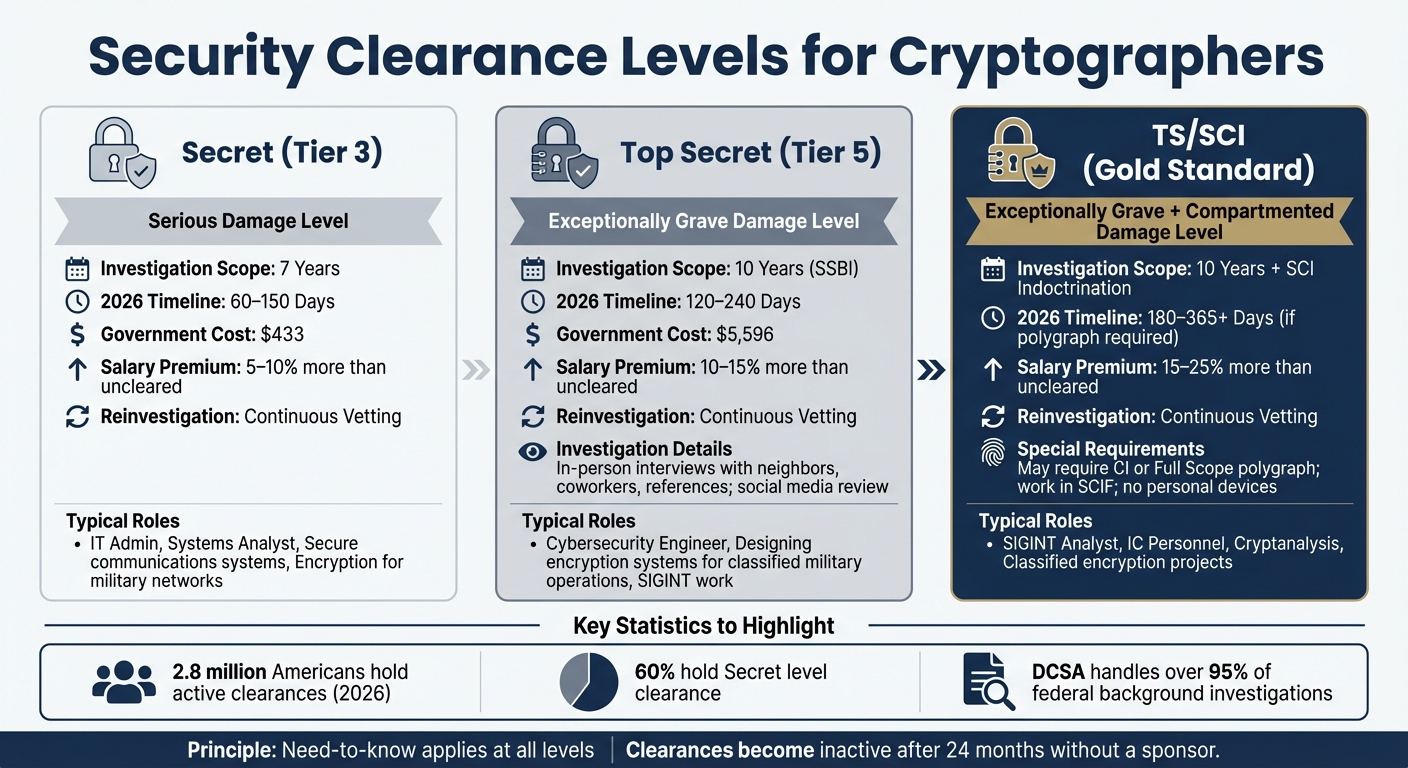
Security clearances are essential for federal cryptography roles, influencing program eligibility, job location, and even salary. As of 2026, 2.8 million Americans hold active clearances, with 60% at the Secret level [6].

Recent updates to the process, under Trusted Workforce 2.0, have introduced "eApp" in place of e-QIP and implemented Continuous Vetting. This system performs real-time checks on criminal, credit, and travel records [9]. The Defense Counterintelligence and Security Agency (DCSA) handles over 95% of all federal background investigations [6][9].

One key principle applies to all clearance levels: need-to-know. Simply holding a clearance doesn’t grant unrestricted access to classified information. Access is only granted when it directly relates to a specific mission [8]. Below, we’ll break down the requirements and benefits of each clearance level.

Clearances, much like professional certifications, validate an individual’s trustworthiness to handle sensitive information.

Secret Clearance

Secret clearance (Tier 3) is the starting point for most cryptographers entering the cleared workforce. It pertains to information that, if disclosed, could cause "serious damage" to national security [6]. Investigations cover the past 7 to 10 years of your life [6][9], with processing times averaging between 60 and 150 days as of 2026 [9]. The cost to the government for this investigation is $433 [8].

Roles requiring Secret clearance often involve secure communications systems, encryption for military networks, and defensive cybersecurity tasks. Those with this clearance typically earn 5–10% more than their peers without clearance [6]. If you’re just beginning a cleared career, this is likely where you’ll start. Many employers are willing to sponsor upgrades to higher clearance levels once you’ve gained experience.

Top Secret Clearance

Top Secret clearance (Tier 5) is reserved for work involving information that could cause "exceptionally grave damage" to national security if leaked [6]. The investigation process is more rigorous, covering 10 years of personal history through a Single Scope Background Investigation (SSBI) [6][8]. This includes in-person interviews with neighbors, coworkers, and references, as well as a review of social media and digital activity [9].

In 2026, the average processing time for Top Secret clearance ranges from 120 to 240 days [9], with the government spending $5,596 per investigation [8]. Top Secret holders generally earn 10–15% more than their uncleared counterparts [6]. This clearance is common for roles like designing encryption systems for classified military operations, working on signals intelligence (SIGINT), or developing secure key management infrastructure. For technical positions, adjudicators may even examine your GitHub activity, forum contributions, and use of encryption tools or VPNs [9].

TS/SCI Clearance

TS/SCI clearance combines Top Secret clearance with access to Sensitive Compartmented Information (SCI) [7]. Often referred to as "the gold standard", this level is essential for Intelligence Community (IC) careers [7]. After obtaining a Top Secret clearance, a Special Security Officer (SSO) reviews your investigation to grant access to specific programs. You’ll then be "read in" and required to sign non-disclosure agreements for each compartment [7].

"TS/SCI is the gold standard of U.S. security clearances – the credential that unlocks intelligence community careers, the highest-paying cleared positions, and access to the most sensitive government programs." – ClearedJobs.Net [7]

Some TS/SCI roles require a Counterintelligence (CI) polygraph or a Full Scope (Lifestyle) polygraph, which cover areas like espionage, terrorism, personal conduct, and drug use [7]. If a polygraph is needed, processing can take over a year due to scheduling delays [9]. TS/SCI holders enjoy salary premiums of 15–25%, with some cryptography specialists earning even higher premiums [6][7].

These roles often require working in a SCIF (Sensitive Compartmented Information Facility), where personal devices are prohibited, and daily commutes are mandatory [7]. For those in signals intelligence, cryptanalysis, or classified encryption projects, this clearance is a standard requirement.

Feature Secret (Tier 3) Top Secret (Tier 5) TS/SCI
Damage Level Serious [6] Exceptionally Grave [6] Exceptionally Grave + Compartmented [7]
Investigation Scope 7 Years [6] 10 Years [6] 10 Years + SCI Indoctrination [7]
2026 Timeline 60–150 Days [9] 120–240 Days [9] 180–365+ Days (if Poly required) [9]
Reinvestigation Continuous Vetting [9] Continuous Vetting [9] Continuous Vetting [9]
Typical Roles IT Admin, Systems Analyst [6] Cybersecurity Engineer [6] SIGINT Analyst, IC Personnel [6]

Under Continuous Vetting, it’s crucial to self-report events like arrests, major debt, or foreign travel. Keeping a detailed record of your last 10 years of residence, employment, and contacts can help streamline the process [9]. Adjudicators are also increasingly examining online activities to assess judgment and potential vulnerabilities [9].

The Trusted Workforce 2.0 initiative aims to simplify clearance reciprocity across federal departments and agencies with the principle of "clear once, trusted everywhere" [9]. This means your clearance can remain active as you switch employers, provided there’s no significant employment gap and no disqualifying incidents [6][7]. However, a clearance typically becomes inactive 24 months after leaving a cleared role unless a new sponsor picks it up [9].

sbb-itb-bf7aa6b

Skills and Responsibilities

Cleared cryptographers play a critical role in safeguarding the nation’s most sensitive data. From designing encryption protocols for classified communications to identifying vulnerabilities before they can be exploited, their work is vital. While specific tasks vary based on an individual’s clearance level and employer, the overarching goal remains the same: protecting information that could cause serious harm to the United States if exposed.

Job Responsibilities

On a technical level, much of your time will be spent developing cryptographic code, implementing algorithms, and optimizing their performance. This involves transforming plain data into encrypted formats that ensure confidentiality, integrity, authenticity, and nonrepudiation. You’ll also test cryptographic theories and analyze systems to uncover potential weaknesses.

In secure environments, responsibilities often go beyond theoretical work. Cryptological Technicians, for instance, handle the installation, troubleshooting, and repair of cryptographic equipment. They adhere to MILSPEC standards and two-person integrity rules, ensuring TEMPEST and RF shielding remain intact to prevent electromagnetic leaks that could jeopardize classified operations [10].

Collaboration is another key aspect of the job. You’ll work closely with security analysts, architects, and hardware engineers to integrate strong security measures. Given the high-stakes nature of this field, these technical demands require equally strong interpersonal and analytical skills.

Interpersonal and Analytical Skills

In addition to technical expertise, clear communication and sharp analytical abilities are essential for safeguarding classified systems. Explaining complex cryptographic risks to non-technical stakeholders, such as program managers or compliance officers, is a common challenge. As Coursera Staff points out:

Clear language can help identify security problems and get solutions in use because it reduces errors when setting up security systems [1].

Attention to detail is non-negotiable – a single error in a cryptographic protocol could compromise an entire system. Whether you’re conducting cryptanalysis, evaluating side-channel attacks, or designing secure communication protocols like TLS or SSH, a methodical approach is crucial. You’ll also need to be adaptable and self-directed, as classified projects often involve rapidly changing threats and limited external guidance.

Ethical judgment is another cornerstone of this role. Handling classified information daily requires trust and integrity that go beyond technical skills. While around 50% of cryptographers hold a bachelor’s degree [1], your success in the cleared community will also hinge on critical thinking, effective communication, and the ability to perform under pressure.

Job Search Strategies

Securing the perfect cleared cryptographer role means showcasing your clearance effectively while staying mindful of operational security.

Resume Optimization

Start by listing your clearance level right alongside your contact information [12]. Follow this with a brief, 2-3 line summary that emphasizes your cryptography experience – be specific about how long you’ve worked in the field [12].

Include a dedicated section for technical skills, highlighting your expertise in areas like cryptography, network security, and incident response [13]. When describing your achievements, use the STAR method (Situation, Task, Action, Result) to present measurable outcomes. Avoid vague statements like "Handled encryption protocols." Instead, go for specifics, like, "Redesigned encryption protocols to reduce vulnerability exposure by 30%." As Ashley Jones, Editor at ClearedJobs.Net, points out:

Your security-cleared resume is not a biography or a mere list of qualifications. It’s an ad designed to help you land that coveted cleared job interview [12].

Operational security is key. Never include classified project names, colleagues’ identities, office sizes, or budget details on your resume [12]. If you’re working toward certifications like CISSP or CEH, mention them along with the anticipated completion date to highlight your dedication [13]. Stick to simple formatting – use standard fonts and avoid graphics or shading that could confuse Applicant Tracking Systems [12]. Also, avoid mentioning your clearance level on LinkedIn, as this can pose a security risk [12].

Once your resume is polished, leverage specialized platforms to increase your job visibility.

Using Cleared Cyber Security Jobs
Cleared Cyber Security Jobs

The success of this platform hinges on how well you set up your profile. Employers rely on profile details rather than uploaded resumes, so fully completing sections like "Key Skills" and "Work Location" is crucial for visibility [14]. Regularly updating your profile keeps you appearing as a "fresh" candidate in searches [14].

Set up job alerts using terms like "Cryptographer" or "Encryption Specialist" to catch a broader range of opportunities [14]. When filtering by clearance level, select all levels you’re eligible for – if you have a Top Secret clearance, also include "Secret" to expand your options [14]. Use ZIP Code and mileage filters to refine your search results [14]. The platform even allows you to block specific employers or switch to "Anonymous" mode, which keeps your skills visible while hiding your name [14].

After building a strong online presence, focus on preparing for interviews to effectively showcase your qualifications.

Interview Preparation

These strategies complement the technical expertise and clearance advantages discussed earlier. Use the STAR method during interviews to detail how you’ve improved security – share specific examples of how you mitigated risks or reduced vulnerabilities [13].

Be ready for direct questions during clearance verification interviews. The 13 adjudication guidelines cover areas like financial history and past misconduct, so make sure you’re prepared [11]. Bring government-issued ID and any necessary documents, such as financial forms or court records [11]. Understanding clearance reciprocity between federal agencies can also be helpful if you’re considering transitioning between government roles [11].

Industry Trends and Tools

Current Trends in Cryptography

Post-quantum cryptography (PQC) has moved from being a theoretical concept to an operational necessity. The National Security Agency’s CNSA 2.0 guidelines mandate that all National Security Systems transition to quantum-resistant algorithms. Starting January 2027, new system acquisitions must use PQC, with full migration required by 2035 [19]. NIST has already finalized its first three PQC standards as of August 2024: ML-KEM (FIPS 203) for key exchange, ML-DSA (FIPS 204) for digital signatures, and SLH-DSA (FIPS 205) as a hash-based backup [17]. Experts estimate there’s a greater than 50% chance that quantum computers will be capable of breaking RSA-2048 by 2034 [19].

The growing threat of "Harvest Now, Decrypt Later" has heightened urgency. Adversaries are intercepting and storing encrypted data with the hope of decrypting it once quantum technology matures [19]. As the Leidos Editorial Team puts it:

Post-quantum readiness is less about predicting ‘Q-Day’ and more about building durable cryptographic agility into enterprise architecture [15].

This concept of cryptographic agility – the ability to switch algorithms through configuration rather than overhauling infrastructure – has become a must-have [15]. Security-cleared professionals should start by auditing existing cryptographic systems to uncover hidden encryption in legacy setups and third-party tools. They should then focus on safeguarding data that needs to remain secure for a decade or more, such as genomic data or classified intelligence, with PQC measures [19].

Beyond quantum concerns, Zero Trust Architecture has become a federal requirement. This approach shifts away from perimeter-based security to a "never trust, always verify" model [18]. Additionally, homomorphic encryption is gaining traction for enabling computations on encrypted data, particularly in healthcare and financial sectors. Meanwhile, Zero-Knowledge Proofs (ZKPs) are proving useful for blockchain privacy and secure authentication [2]. Cryptographers must stay ahead of these developments to protect the nation’s most sensitive systems.

Keeping pace with these trends requires access to advanced tools and techniques.

Cryptography Tools

To meet these evolving challenges, professionals need a robust set of tools. OpenSSL remains essential for TLS/SSL protocols and certificate management in secure environments, while liboqs (Open Quantum Safe) supports quantum-resistant algorithms approved by NIST, complete with Python wrappers for testing [17]. Tools like SandboxAQ’s AQtive Guard, Keyfactor Command, and IBM Quantum Safe Explorer are invaluable for cataloging certificates and keys across enterprise systems [19].

For digital forensics and cryptanalysis, EnCase and FTK (Forensic Toolkit) are critical. In cloud environments, AWS KMS (GovCloud) and Microsoft Azure Government offer centralized, hardware-backed key management solutions [16]. Developers working with cryptographic primitives often rely on PyCryptodome, a Python library ideal for prototyping and security testing.

The choice of programming language also matters. C++ is preferred for high-speed encryption tasks where memory control is critical, while Python is better suited for rapid prototyping and scripting. Rust is gaining popularity for its memory-safe features, which help prevent side-channel attacks [2]. Building a GitHub portfolio showcasing hands-on cipher implementations – like AES in C++ or contributions to OpenSSL – can often make a stronger impression on employers than an advanced degree [2].

Transitioning to PQC comes with practical hurdles. For instance, ML-KEM and ML-DSA require significantly larger key and signature sizes (ranging from 800 to over 4,500 bytes compared to RSA/ECC’s 64–256 bytes). This makes automation tools like Certificate Lifecycle Management essential [19]. A hybrid approach – running both classical and quantum-safe encryption simultaneously, such as X25519Kyber768Draft – helps maintain compatibility while preparing for future threats. Tools like OpenSSL 3.x, with its provider-based architecture, allow for seamless algorithm swapping without rewriting code [19].

Conclusion

Pursuing a career in cryptography requires a mix of formal education, hands-on experience, and specialized credentials. While a bachelor’s degree in fields like computer science, mathematics, or cybersecurity lays the groundwork, it’s the roughly five years of professional experience in information security that truly sets you up for cryptographer roles [1]. To stand out, focus on mastering technical skills such as linear algebra, number theory, and programming languages like Python and C++.

Security clearance plays a massive role in this field. Holding a TS/SCI clearance can boost your salary by $30,000–$45,000 annually, while positions requiring a Full Scope Polygraph often come with premiums of $45,000–$65,000 over non-cleared roles [18]. By the time you’ve gained five years of experience, your clearance and mission-specific expertise become invaluable. As of July 2025, the median total pay for cryptography engineers reached $170,000, with certain specialized roles offering even higher compensation [1].

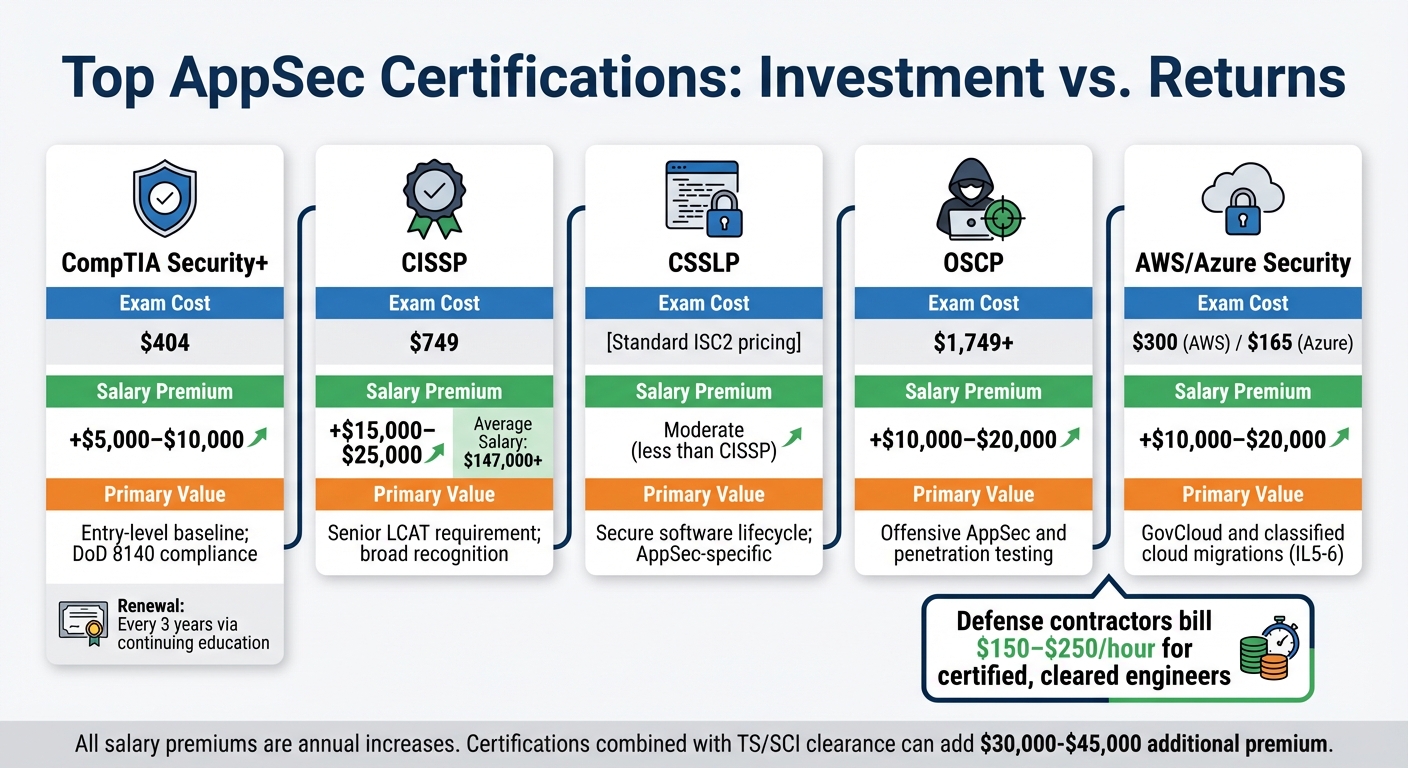
Staying current with industry trends and earning certifications can further enhance your career. Certifications offer immediate benefits; for instance, CISSP certification typically increases salaries by $15,000–$25,000 and qualifies you for senior-level roles [18]. Begin with the CompTIA Security+ certification ($404) to meet DoD 8140 compliance requirements, and then work toward CISSP ($749) as you advance in your career [18]. If you’re looking to specialize, the EC-Council Certified Encryption Specialist (ECES) can validate your expertise in cryptography and help you stand out [1].

The field is changing quickly, and professionals skilled in advanced techniques, such as post-quantum cryptography, will be highly sought after [2]. Akane T.H., from FindWeb3, encapsulated the essence of the profession:

A career in cryptography is less about finding a job and more about cultivating ongoing problem-solving expertise. You are tasked with staying one step ahead of adversaries.

To sharpen your skills, build a GitHub portfolio showcasing real-world implementations, participate in Capture the Flag competitions to hone adversarial thinking, and stay flexible as encryption technologies evolve.

For those with active clearances, platforms like Cleared Cyber Security Jobs can connect you directly with employers, cutting down the lengthy clearance processing time. Upload your resume, set up job alerts, and take advantage of resources tailored to the cleared community. By combining technical skills, strategic certifications, and an active clearance, you’ll be well-positioned to safeguard the nation’s most critical systems and data. Use Cleared Cyber Security Jobs to simplify your journey and take the next step in your cryptography career.

FAQs

How do I get a clearance if I don’t already have one?

To get a security clearance, you need sponsorship from either an employer or a government agency. The process involves filling out an application, such as the SF-86 form, and going through a background investigation. In some cases, a polygraph test might also be part of the process. The investigation looks into various aspects of your life, including personal details, financial records, criminal history, and employment background. The time it takes to process a clearance depends on the level – Secret clearances might take a few months, while Top Secret clearances can take over a year.

What should I include in a GitHub portfolio without violating OPSEC?

To create a GitHub portfolio that respects OPSEC (Operational Security), focus on projects that steer clear of sensitive or classified information. Highlight your cybersecurity or cryptography skills by working on open-source projects, simulations, or educational tools that rely solely on public data. It’s crucial to avoid including real-world systems, client data, or operational details in your work. This approach allows you to demonstrate your expertise while staying within operational security boundaries.

How can I prepare now for post-quantum cryptography requirements?

Getting ready for post-quantum cryptography requires staying up-to-date with key developments, such as the standards being finalized by NIST in 2024. These standards will serve as a guide for implementing quantum-resistant solutions.

One crucial step is to prioritize crypto-agility – this means building systems that can quickly adapt to new algorithms as they emerge. Another effective approach is using hybrid strategies, which combine traditional encryption methods with quantum-resistant techniques to provide an extra layer of security during the transition.

It’s also important to revisit and update your security protocols. Assess risks like the "harvest now, decrypt later" threat, where attackers collect encrypted data today with plans to break it using quantum computers in the future. Collaborating with cryptography experts and industry professionals will help you implement PQC solutions effectively and ensure your systems are ready for the challenges ahead.

Staying proactive is key – quantum threats are advancing quickly, and preparation now can save significant trouble later.
Related Blog Posts

  • Threat Intelligence Analyst Career Path for Cleared Professionals
  • Cryptographer Career Path for Cleared Professionals
  • Cryptanalyst Career Path for Cleared Intelligence Professionals
  • Cyber Warfare Specialist Career Path for Cleared Military

Cleared IAM Specialist Jobs Complete Career Guide

CyberSecJobs Editorial · April 6, 2026 ·

Cleared Identity and Access Management (IAM) specialists are in high demand, combining cybersecurity skills with government security clearance to protect sensitive data. Here’s why this career path stands out and how you can get started:

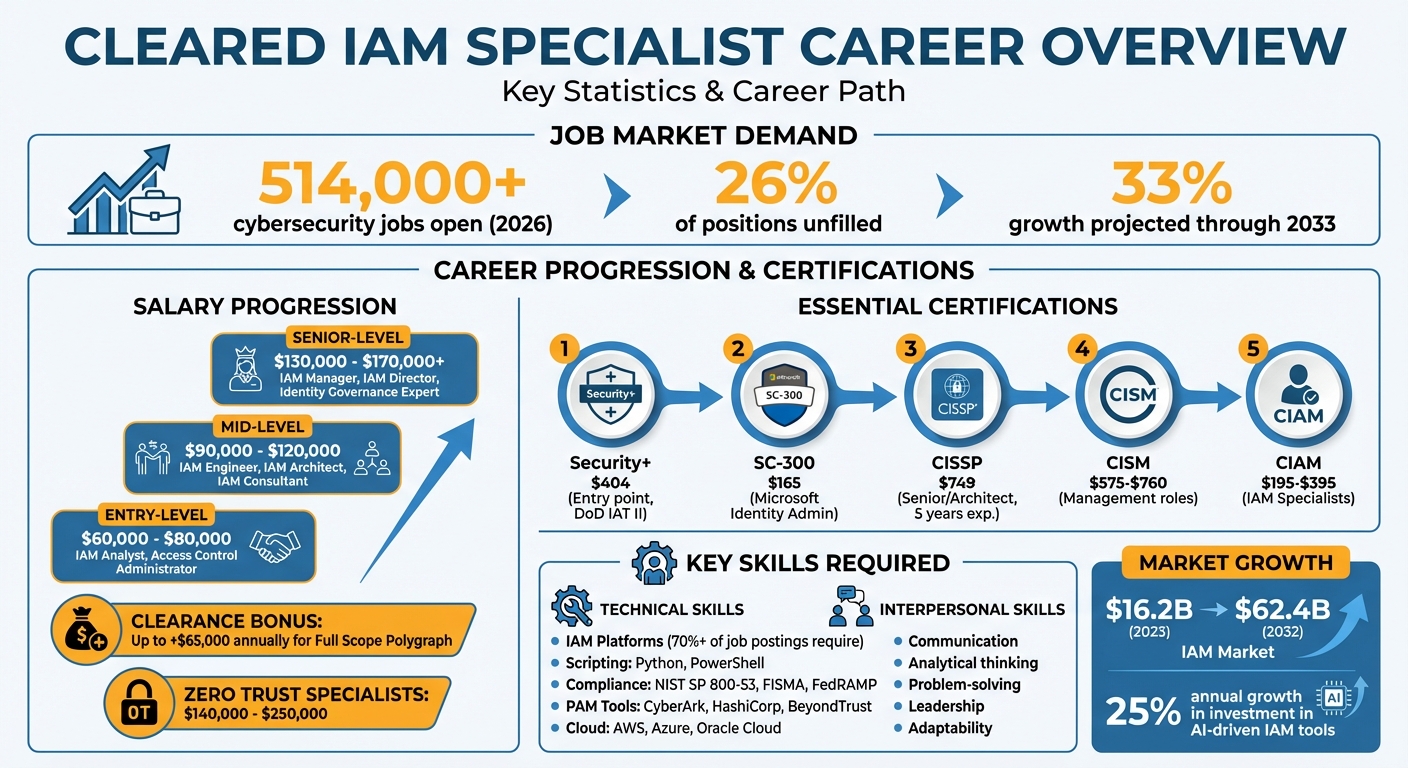
  • High Demand: Over 514,000 cybersecurity jobs are open as of 2026, with 26% unfilled. Cleared IAM roles are particularly sought after, offering job stability and multiple opportunities.
  • Competitive Pay: Average salaries start at $74,295, with clearance levels adding significant bonuses – up to $65,000 more annually for Full Scope Polygraph clearance.
  • Key Skills: Expertise in IAM platforms (e.g., Okta, SailPoint), scripting (Python, PowerShell), and compliance with frameworks like NIST SP 800-53 is essential.
  • Certifications Matter: Start with Security+ ($404) and progress to CISSP or CISM for leadership roles.
  • Career Growth: Entry-level roles pay $60,000–$80,000, while senior positions can exceed $170,000 annually. Specializing in areas like Zero Trust or cloud IAM further boosts prospects.

This guide breaks down the responsibilities, skills, certifications, and steps needed to thrive as a cleared IAM specialist. Whether you’re starting out or advancing your career, cleared IAM roles offer unmatched opportunities in cybersecurity.

Cleared IAM Specialist Career Path: Salaries, Certifications, and Job Market Statistics

Cleared IAM Specialist Career Path: Salaries, Certifications, and Job Market Statistics

Key Responsibilities of Cleared IAM Specialists

Core Job Functions

Cleared IAM specialists oversee the entire identity lifecycle – from onboarding new employees to securely offboarding departing ones. They ensure access provisioning across enterprise platforms and cloud services is automated, while promptly removing access for departing employees to eliminate orphaned accounts.

A critical aspect of their role is enforcing the principle of least privilege. This means designing access models that grant users only the permissions they need for their specific role. For high-risk accounts, like those of network administrators or root users, they implement Privileged Access Management (PAM) controls. These include session monitoring, secure credential storage, and automated password rotation for added security.

They also create Role-Based Access Control (RBAC) models, configure group structures, and implement multi-factor authentication (MFA) to strengthen system defenses. Regular access reviews are another key responsibility, ensuring that least-privilege principles are consistently applied. These reviews, along with periodic audits, are crucial in preventing breaches – especially in light of the 2,741 publicly disclosed attacks reported in 2024 [1].

"Effective IAM allows an organization to maintain the confidentiality, integrity and availability of its systems and data."

  • One Identity

These foundational tasks enable cleared IAM specialists to work effectively with other teams across the organization.

Working with Other Teams

Beyond their technical duties, cleared IAM specialists play a vital role in cross-team collaboration. Their ability to communicate clearly and work with various stakeholders is essential for translating complex security measures into actionable steps.

These specialists act as a liaison between technical teams and executive leadership. They collaborate with application owners, infrastructure teams, and business stakeholders to define access needs for both new and existing systems. In the event of security incidents, they work with cybersecurity and risk teams to investigate and resolve access-related issues.

Using tools like PowerShell and Python, they integrate IAM workflows with HR systems and support Security Operations Center (SOC) activities to monitor for suspicious behavior. Clear and concise communication is key, especially when explaining technical concepts to non-technical stakeholders. This skill is particularly important when working with compliance teams to provide audit logs and maintain adherence to regulatory standards.

Compliance and Regulatory Requirements

Cleared IAM specialists must operate within strict federal regulatory frameworks. They adhere to standards like NIST SP 800-53 Rev. 5, focusing on AC (Access Control), IA (Identification and Authentication), and PS (Personnel Security) control families. They also implement FISMA requirements, ensuring that systems meet High, Moderate, or Low baselines, and aim for complete MFA coverage for enterprise users as outlined in OMB Memorandum M-22-09 under Zero Trust initiatives.

For cloud environments, IAM controls must comply with FedRAMP standards before federal agencies can authorize system use. Daily responsibilities include identity proofing in line with NIST SP 800-63B and conducting periodic access reviews to meet PCI DSS v4.0 requirements, which typically call for reviews every six months. For instance, a FISMA Moderate-baseline system requires the full implementation and documentation of nine specific IA controls [7]. Specialists also use controls like AC-2 and AC-6 from NIST SP 800-53 to manage privileged access, ensuring adherence to least-privilege principles.

Framework Primary IAM Focus Key Requirement
NIST SP 800-53 Federal Security Controls AC, IA, and PS control families
FISMA Federal Agency Compliance Implementation of FIPS 199/200 and NIST controls
OMB M-22-09 Zero Trust Strategy 100% MFA coverage for enterprise users
FedRAMP Cloud Security Standardized IAM controls for cloud service providers
PCI DSS v4.0 Payment Data Semi-annual access reviews and enforcement of least-privilege
sbb-itb-bf7aa6b

Required Skills for Cleared IAM Roles

Technical Skills

Cleared IAM roles demand a deep understanding of identity management platforms. In fact, over 70% of IAM specialist job postings highlight the need for expertise in platforms like Okta, SailPoint, Azure Active Directory, or CyberArk [8]. These systems are the backbone of identity governance, making hands-on experience with them a must.

Beyond platform knowledge, you’ll need a solid grasp of authentication, access control, and identity federation protocols. This includes implementing multi-factor authentication (MFA), designing Role-Based Access Control (RBAC) systems, and managing identity federation with protocols like SAML and OAuth. Cleared roles also emphasize proficiency with Privileged Access Management (PAM) tools such as HashiCorp and BeyondTrust, which are vital for safeguarding high-risk accounts in sensitive environments [2].

Working in cleared environments often involves navigating diverse technology ecosystems. You’ll need to manage access across legacy systems like Mainframe and Unix file systems while also handling modern hybrid cloud platforms such as AWS, Azure, and Oracle Cloud [2]. Scripting skills in languages like PowerShell and Python are crucial for automating provisioning workflows and integrating IAM solutions with HR systems and existing infrastructure.

Compliance expertise is another key requirement. Cleared IAM professionals must implement controls from frameworks like NIST SP 800-53, ISO/IEC 27001, and the MITRE ATT&CK framework to meet federal security standards. This regulatory knowledge helps maintain the "security-first" mindset necessary for protecting classified information [1][2].

While these technical abilities are crucial, success in cleared IAM roles also hinges on strong interpersonal skills.

Interpersonal Skills for Success

Technical know-how is only part of the equation for cleared IAM positions. Communication and problem-solving skills are equally vital. Strong communication skills are essential, as you’ll often need to explain complex security concepts to a wide range of audiences, including technical teams, compliance authorities, and non-technical executives. As the Identity Management Institute points out, "IAM professionals must be confident leaders, clear communicators of challenging concepts, and team players working across multiple divisions" [6].

Analytical thinking and problem-solving abilities are what set exceptional IAM specialists apart. You’ll need to anticipate vulnerabilities and address them before they escalate, especially given the high stakes of potential security breaches. This involves analyzing security logs, spotting anomalies, and managing identity-related incidents under tight deadlines.

Collaboration is another critical element. You’ll work closely with IT, HR, and Legal departments to align security measures with organizational goals, often relying on conflict resolution skills to balance operational needs with security requirements. Senior roles demand leadership capabilities, such as mentoring junior team members, influencing key decisions, and navigating complex organizational dynamics [6].

Finally, adaptability is a must. Cybersecurity threats and regulatory demands evolve quickly, and with AI-driven IAM tools projected to see a 25% annual growth in investment [8], staying current with emerging technologies is non-negotiable. This might involve leading user training sessions or offering ongoing support – tasks that require patience and a genuine commitment to user satisfaction.

Top Certifications for Cleared IAM Professionals

Recommended Certifications

For cleared IAM specialists, certifications are a must-have. They’re not just helpful – they’re often required. If you’re working on a Department of Defense (DoD) contract, for instance, failing to secure the necessary baseline certification within 30–60 days could lead to losing your position or even contract termination [10]. In some cases, no certification means no job access and no clearance [11].

One of the most flexible starting points is CompTIA Security+ ($404). This certification meets DoD IAT Level II requirements and counts as one year toward the five-year experience requirement for the CISSP [9].

For those eyeing senior or architect-level roles, the CISSP (Certified Information Systems Security Professional) is the gold standard. Priced at $749, it requires a minimum score of 700 out of 1,000 to pass and at least five years of relevant experience. A one-year waiver is available if you hold a four-year degree or an approved credential like Security+ [9].

If you’re heading into management roles, CISM (Certified Information Security Manager) is key. It focuses on governance and risk management, costing $575 for ISACA members or $760 for non-members. For IAM program design and management, the Certified Identity and Access Manager (CIAM) credential from the Identity Management Institute is a strong option, with fees ranging from $195 to $395 [11,12].

As more agencies move to the cloud, platform-specific certifications are becoming increasingly valuable. Options like Microsoft’s SC-300 (Identity and Access Administrator Associate) ($165), AWS Certified Security – Specialty, and certifications from Okta ($250 per exam) or Ping Identity ($395–$495) show expertise in specific tools and platforms [9].

Certification Cost Best For DoD Category Experience Required
CompTIA Security+ $404 Entry/Mid-level IAT II None
CISSP $749 Senior/Architect IAM II/III, IASAE 5 years (or 4 with waiver)
CISM $575–$760 Management IAM II/III 5 years
CIAM $195–$395 IAM Specialists Specialized Varies
SC-300 $165 Microsoft Identity Admin N/A None

These certifications do more than validate your skills – they also improve your professional reputation and open doors to new opportunities.

How Certifications Improve Job Prospects

Beyond meeting baseline requirements, certifications can significantly elevate your career potential in the IAM field. In cleared environments, they’re essential for complying with federal mandates and standing out in a crowded job market.

Certifications prove your expertise in areas like authentication protocols, privileged access management, and identity lifecycle management. They also align with federal DoD 8140 directives, ensuring you meet the necessary standards [12].

Advanced certifications such as CISSP or CISM not only boost your credibility but also expand your professional network through organizations like (ISC)² [7,11].

"A rigorous identity and access management program diminishes the likelihood of a successful cyberattack."
– Paul Kirvan, Independent Consultant [9]

The IAM field is growing fast. The global market is expected to jump from $16.2 billion in 2023 to $62.4 billion by 2032 [9]. Salaries reflect this demand: entry-level IAM roles typically range from $60,000 to $80,000, while senior positions can command $130,000 to $170,000 [6].

To stay competitive, balance vendor-neutral certifications like CISSP and CISM with platform-specific ones like Okta or SailPoint. These specialized credentials are especially useful for roles involving technical implementation. Keep in mind that most certifications need to be renewed every three years through continuing education, ensuring your skills stay up-to-date [9].

Finding and Securing Cleared IAM Jobs

Using Cleared Cyber Security Jobs for Your Job Search

Cleared Cyber Security Jobs

Landing a cleared IAM job can be challenging, but using the right platform can make a big difference. Cleared Cyber Security Jobs offers tools tailored specifically for professionals with security clearances.

Start by completing your candidate profile. Employers will see your "Key Skills" and "Ideal Work Locations" before they even open your resume [13][14]. First impressions count – list your IAM skills clearly, such as privileged access, lifecycle management, and authentication protocols. Be precise about your location preferences by using zip codes instead of city names.

Stay active on the platform. Logging in weekly keeps your profile visible to employers. Use focused keywords like "IAM Specialist" to refine your job search. When filtering by clearance, select all levels you’re eligible for – if you hold a Top Secret clearance, include Secret-level roles too. Save these searches as Job Agents to receive alerts when matching positions are posted.

Privacy controls on the platform are another valuable feature. You can block specific employers or set your profile to "Anonymous", allowing recruiters to view your skills without revealing your identity. Also, make the most of Cleared Job Fairs – both in-person and virtual events connect you directly with recruiters from top defense contractors.

The demand for cybersecurity professionals is growing. In 2026, there were over 514,000 cybersecurity job postings – a 12% increase from the previous year – but nearly 26% of these roles remained unfilled [5]. Optimizing your profile and actively engaging with the cleared community can help you stand out.

Networking in the Cleared Community

Networking in the cleared job market is unique. The community is smaller, built on trust, and often relies on shared experiences. Attending industry-specific events like government cybersecurity conferences, DoD contracting expos, and federal IT gatherings can help you connect with others, exchange ideas, and even gain referrals.

If you’re a veteran, tap into military networks. Many cleared IAM professionals transition from military cyber roles, and veteran-focused groups often provide mentorship and insider advice. Online forums and professional groups for cleared cybersecurity professionals can also offer insights into clearance processes and workplace cultures.

Building relationships with recruiters specializing in cleared roles is another smart move. These recruiters understand the complexities of clearance requirements and can sometimes provide access to opportunities before they’re widely advertised. Just remember to maintain discretion in your online profiles.

Writing Resumes for Cleared Roles

Pair your job search with a resume customized for cleared positions. A well-targeted resume should emphasize your clearance level, certifications, and IAM expertise.

Start by listing your clearance level prominently at the top. Include a concise summary of your IAM skills and certifications, and use the STAR method (Situation, Task, Action, Result) to describe your achievements. For instance, instead of saying, "Managed user access", you could write, "Reduced unauthorized access incidents by 40% through automated provisioning workflows."

Operational security is critical. Avoid mentioning classified project names, colleague identities, office sizes, or specific budgets. As Bill Branstetter from 9th Way Insignia recommends:

"Keep subjective self-descriptions out of your summary section. I’m looking at you, Results-Oriented Team Players." [15]

Keep your resume concise – no more than two pages. Make sure it’s ATS-friendly by using simple fonts and avoiding overly complex formatting. Incorporate relevant keywords from the job description, and skip roles older than 10 years unless they directly relate to your current goals. Avoid age-related details, like graduation years, that might unintentionally signal inflexibility. If you’re relocating, clearly state your target location and availability.

Finally, proofread thoroughly. Reading your resume aloud can help you catch errors that automated tools might miss. A polished, targeted resume can make all the difference in securing your next cleared IAM role.

Career Growth in Cleared IAM

Entry-Level to Senior-Level Advancement

Careers in cleared IAM often start with roles like IAM Analyst or Access Control Administrator, where responsibilities include onboarding, troubleshooting, and deploying IAM solutions. These entry-level positions provide a solid foundation, with annual salaries typically ranging from $60,000 to $80,000 [6].

As professionals gain experience, they can transition into mid-level roles such as IAM Engineer, IAM Architect, or IAM Consultant. These positions focus on designing, implementing, and managing large-scale IAM systems for organizations. Salaries in these roles generally fall between $90,000 and $120,000 per year [6]. Companies like Northrop Grumman, RTX (formerly Raytheon), and Booz Allen Hamilton are prominent employers in this space [3].

For those aiming higher, senior-level positions such as IAM Manager, IAM Director, or Identity Governance Expert offer salaries between $130,000 and $170,000, with potential for even greater earnings depending on the size and scope of the organization [6]. These roles involve shaping organizational IAM strategies, managing teams, and ensuring compliance with federal regulations. According to the Identity Management Institute, these positions require:

"strong negotiation skills, a strategic vision to guide teams and impact decision-making, and a capacity to manage high-stress circumstances" [6].

Specializing in areas like Privileged Access Management (PAM), Cloud IAM, or Zero Trust architecture can further set candidates apart. As the Identity Management Institute highlights:

"having Zero Trust skills positions IAM professionals as strategic leaders" [6].

Emerging technologies like AI-driven identity verification and blockchain-based decentralized identity are also creating new opportunities for professionals who stay ahead of the curve. Continuous skill development is essential for climbing the career ladder in this field.

Continuing Education and Skill Development

Success in cleared IAM requires staying on top of evolving security threats, compliance regulations, and technological advancements. The information security analyst sector, which includes IAM specialists, is expected to grow by 33% through 2033 [1]. This growth underscores the importance of keeping skills up to date.

Earning certifications like CIAM or CISM can help professionals advance into leadership roles, while technical specialists may benefit from certifications such as the Certified Identity Management Professional (CIMP) or Certified Identity Governance Expert (CIGE) [6]. Mastery of emerging technologies like passwordless authentication and post-quantum cryptography is also crucial.

Technical skills in automation scripting languages like Python, Java, or PowerShell can streamline IAM workflows and increase efficiency [4]. Familiarity with standards such as FIDO2, biometric systems, and post-quantum cryptography can further enhance expertise and job stability [4].

Networking is another key to career growth. Joining LinkedIn groups focused on identity management or participating in CISO communities can provide valuable insights into industry best practices [6]. Attending conferences and webinars is a great way to learn about unadvertised job opportunities and stay informed about regulatory updates like GDPR, HIPAA, and PCI-DSS [6]. As Rhys, an IAM Engineer, shares:

"The industry values continuous learning, and that encouragement has empowered me to expand my skill set and make significant contributions to my organization" [4].

Conclusion and Key Takeaways

Final Thoughts

Pursuing a career in Identity and Access Management (IAM) with security clearance offers excellent pay and job stability. Holding a Full Scope Polygraph clearance can significantly enhance your earning potential over the course of your career [5]. With projections indicating over 514,000 cybersecurity job openings by 2026 and about 26% of these positions likely remaining unfilled, the demand for skilled IAM professionals is undeniable [5].

The cleared cybersecurity sector remains resilient, even during economic downturns, because of ongoing talent shortages and the critical role it plays in national security [5]. Specializing in sought-after areas like Zero Trust Architecture can place you among the top earners in the field, with salaries ranging from $140,000 to $250,000 [5]. Certifications such as Security+ and CISSP are not just important for meeting DoD requirements – they also serve as powerful tools for boosting your earning potential [5].

To thrive in this field, you need a blend of technical skills and strategic insight. Focus on gaining practical experience, earning relevant certifications, and actively pursuing job opportunities. Avoid the trap of collecting credentials without applying them. By following these principles, you can set yourself up for long-term success in IAM.

Next Steps for Aspiring Cleared IAM Specialists

Begin by earning your Security+ certification, as it fulfills key DoD requirements. Set up a home lab to showcase your hands-on skills in identity and access management [5]. Pay attention to key job markets such as Washington, DC/Northern Virginia, San Antonio, and Huntsville, where opportunities for cleared professionals are concentrated.

Leverage resources like Cleared Cyber Security Jobs to find positions that align with your clearance level and career goals. Build your network by joining LinkedIn groups focused on identity management and attending cybersecurity meetups in defense-related areas [5]. If you don’t yet have clearance, consider applying to defense contractors that sponsor clearances for technical roles [5]. Take the first step today to advance your career in this high-demand field.

Why IAM Is the Best Cybersecurity Career in 2026 | Skills, Salary, Certification & Roadmap Explained

FAQs

What clearance level is required for IAM jobs?

The clearance level needed for IAM roles varies depending on the specific position. Common clearance levels include SECRET, Top Secret (TS), TS/SCI, and TS/SCI Poly. Always review individual job postings for precise requirements, as these can differ by role and employer.

How can I get hands-on IAM experience without a cleared role?

To build experience in Identity and Access Management (IAM), consider pursuing certifications or enrolling in training programs that focus on practical skills. Online courses and cybersecurity labs dedicated to IAM systems are excellent resources to deepen your expertise. Additionally, internships or volunteer opportunities in roles involving IAM tasks – even if they don’t require a security clearance – can help you gain hands-on experience. These steps create a strong knowledge base, which can later be applied to cleared roles as you advance in your career.

What should I include on a cleared IAM resume without breaking OPSEC?

To ensure Operational Security (OPSEC), start your document by clearly listing your security clearance level (e.g., Confidential, Secret, Top Secret) prominently at the top. Include essential personal details such as your name, city/state, email, and phone number. Avoid sharing sensitive information like clearance investigation dates, clearance numbers, or any classified details.

Focus on showcasing your clearance level, relevant experience, and skills in a way that maintains strict adherence to OPSEC guidelines.

Related Blog Posts

  • Classified Cloud Security Jobs – AWS GovCloud and Azure Government Specialization
  • Cloud Security Engineer Career Path for Cleared Professionals
  • Identity and Access Management Specialist Career Path Cleared
  • Cleared Cloud Security Jobs Complete Career Guide

Cleared DevSecOps Jobs Complete Career Guide

CyberSecJobs Editorial · April 6, 2026 ·

Cleared DevSecOps jobs combine software development expertise with security clearance requirements, creating high-demand roles in classified environments like defense and intelligence. These positions offer competitive salaries – ranging from $115,000 to $240,000 annually – with additional premiums of $20,000 to $65,000 based on clearance level. With 26% of cybersecurity positions unfilled in 2026, cleared DevSecOps professionals are highly sought after by companies like Lockheed Martin and SpaceX.

Key takeaways:

  • High Demand: Cleared DevSecOps roles face a talent shortage, leading to higher salaries and job security.
  • Earnings Potential: Clearance premiums significantly boost pay, especially for TS/SCI with Full Scope Polygraph.
  • Required Skills: Proficiency in CI/CD pipelines, containerization (e.g., Docker), Infrastructure as Code (e.g., Terraform), and compliance knowledge is essential.
  • Certifications: Start with Security+ and progress to advanced credentials like CISSP or AWS Security Specialty.
  • Job Search Tips: Use cleared cyber security job boards, highlight your clearance on resumes, and network within the cleared community.

This guide covers everything from required skills to navigating clearance protocols, helping you succeed in this lucrative and specialized career path.

How to Go from Help Desk to DevSecOps Engineer (Step-by-Step Path)

sbb-itb-bf7aa6b

Required Skills and Tools for Cleared DevSecOps Professionals

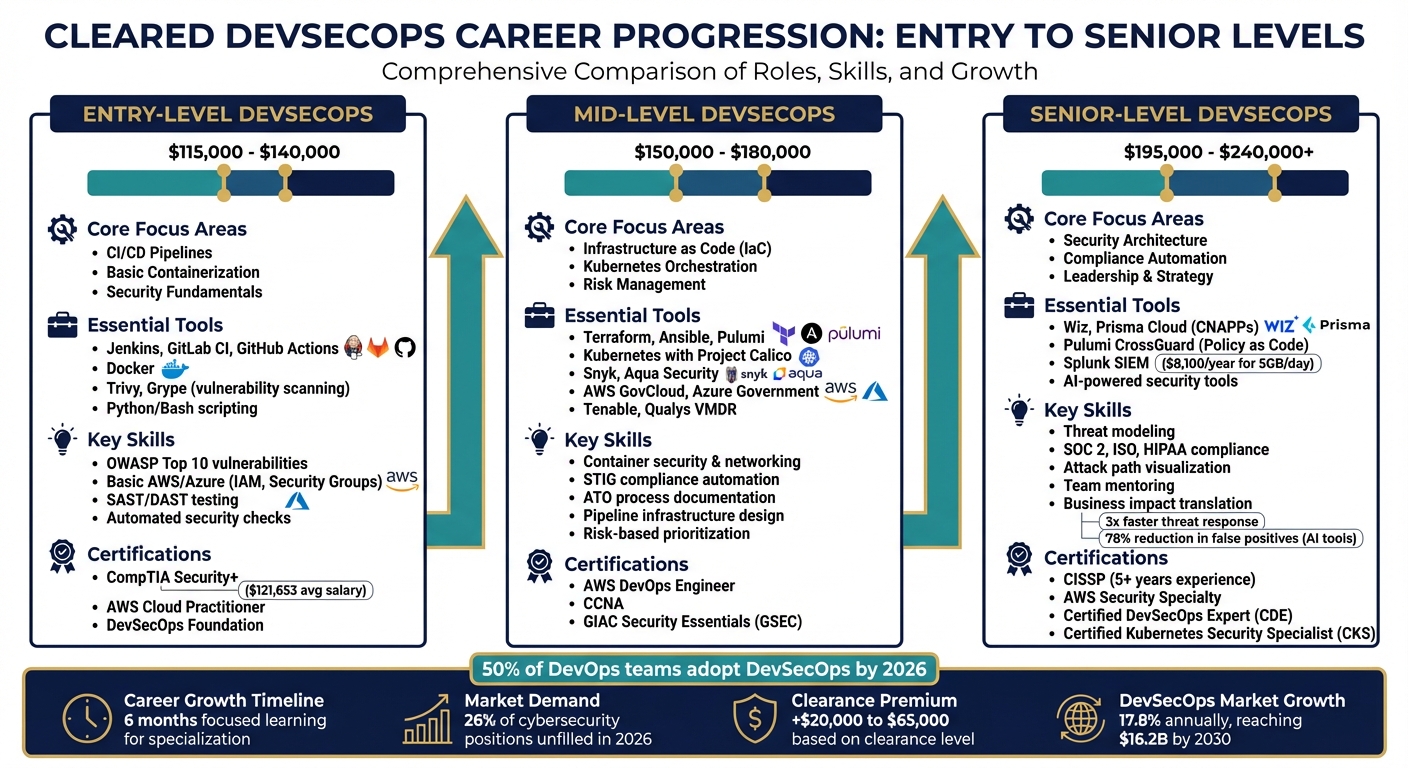
Cleared DevSecOps Career Progression: Skills, Tools, and Salary by Level

Cleared DevSecOps Career Progression: Skills, Tools, and Salary by Level

Cleared DevSecOps roles require a solid mix of technical skills and a deep understanding of government compliance. Unlike traditional tech roles, breaking into this field involves mastering security principles alongside development and operations, all while navigating strict regulatory frameworks. The expectation isn’t that you’ll know every tool from day one. Most hiring managers prioritize a strong security mindset over expertise in advanced tools.

"If someone comes in knowing Docker, basic AWS, and can explain how they’d secure a CI/CD pipeline without googling, they’re already ahead of most candidates. The advanced stuff we can teach." – Senior Engineering Manager, Fintech Company [5]

Career progression in this field is structured, moving from entry-level tasks like basic automation to senior responsibilities like designing security frameworks. Understanding where you are in this trajectory helps you focus on the skills that align with your current and future career goals.

Entry-Level Skills and Tools

Starting in cleared DevSecOps means building a foundation in CI/CD pipelines and containerization. Tools like Jenkins, GitLab CI, and GitHub Actions are essential for automating security checks during development, which is critical for environments handling classified information. GitLab, for example, offers a free tier with 400 compute minutes per month – perfect for honing your skills [4].

Docker proficiency is key. You’ll need to create containerized environments and scan images for vulnerabilities using tools like Trivy or Grype, both of which are free and widely used in government projects [4]. Automating routine security checks using Python or Bash is another way to showcase your abilities. For instance, writing a Python script to scan code repositories for hardcoded credentials demonstrates practical security awareness.

At this stage, understanding the OWASP Top 10 vulnerabilities is more critical than diving into complex orchestration. Employers want to see that you can identify issues like SQL injections or hardcoded API keys and apply a security-first mindset to development tasks [5]. Basic knowledge of AWS or Azure – particularly Identity and Access Management (IAM) and Security Groups – rounds out the foundational skills needed for most cleared roles.

"We’ve hired people who never touched Kubernetes before. What we can’t teach is security thinking. If you can look at our codebase and spot potential vulnerabilities, you’re hired." – DevSecOps Lead, Unicorn Startup [5]

To stand out, create a portfolio showcasing your ability to integrate security tools into CI/CD pipelines. For example, document how you used Checkov to scan Infrastructure as Code (IaC) for misconfigurations or implemented SAST/DAST testing. This kind of hands-on demonstration often carries more weight than certifications alone when applying for cleared positions [5].

Mid-Level Skills and Tools

As you progress, mid-level roles demand a focus on Infrastructure as Code (IaC) and advanced risk management. Tools like Terraform, Ansible, or Pulumi are essential for automating infrastructure builds and enforcing consistent security controls. Terraform Cloud, for instance, offers a free tier for up to 500 managed resources, making it an accessible option for practice [3].

Kubernetes orchestration becomes a core skill at this level. You’ll need to manage container networking and security using tools like Project Calico, Snyk, or Aqua Security. Understanding how to secure pod-to-pod communication and implement network policies in restricted environments is especially important. Expertise in regulated cloud platforms like AWS GovCloud or Azure Government can also lead to higher compensation.

Vulnerability management evolves from basic scanning to risk-based prioritization. Tools like Tenable or Qualys VMDR help identify and address critical risks. In cleared environments, you’ll often automate Security Technical Implementation Guide (STIG) compliance and produce technical documentation for Authority to Operate (ATO) processes – tasks unique to government systems [9].

Mid-level professionals move beyond running existing jobs to designing new pipeline infrastructure. For example, you might build container image pipelines that handle building, scanning, signing, and deploying, all while maintaining audit trails for classified systems. With DevSecOps practices becoming increasingly standard – adopted by 50% of DevOps teams by 2026 – these skills are in high demand [7].

Senior-Level Skills and Tools

At the senior level, the focus shifts to designing security architecture using tools like Wiz or Prisma Cloud. These Cloud-Native Application Protection Platforms (CNAPPs) identify "toxic combinations" of risks across your infrastructure, from code to cloud. Wiz, for instance, starts at $24,000/year for 100 workloads and is praised for its agentless deployment and attack path visualization, scoring 4.7/5 on G2 [3].

Threat modeling and compliance automation are critical. You’ll predict potential threats to cloud infrastructure before deployment and automate audits for SOC 2, ISO, and HIPAA compliance, mapping findings to CIS benchmarks [3][6].

With Policy as Code, you enforce security at deployment rather than relying on manual reviews. Tools like Pulumi CrossGuard or OIDC allow for scoped, short-lived credentials. Advanced SIEM tools like Splunk (starting at $8,100/year for 5GB/day) enable faster threat response – up to three times quicker, according to some organizations [3].

Leadership becomes just as important as technical expertise. Senior professionals translate vulnerabilities into real-world impacts, such as potential regulatory fines or risks to national security. For example, understanding how a misconfigured IAM role could compromise classified information ties your technical skills directly to mission-critical objectives [1]. Additionally, you’ll mentor junior engineers, conduct pipeline audits, and promote the use of AI-powered security tools, which can reduce false positives by up to 78% [8].

"AI hasn’t replaced security experts – it’s democratized security expertise, putting it directly into developers’ hands when and where they need it most." – StarAgile | Tech Bytes [8]

Security Clearance Requirements for DevSecOps

Landing a cleared DevSecOps role means navigating clearance protocols and meeting rigorous standards essential for working with secure defense systems. These roles aren’t like typical tech jobs – they require government authorization to access classified information. That authorization comes with strict eligibility rules and responsibilities, which directly influence the positions you can apply for and your earning potential.

Types of Security Clearances

The federal government issues four main clearance levels: Confidential, Secret, Top Secret (TS), and Top Secret/Sensitive Compartmented Information (TS/SCI). Each level grants access to more sensitive information and involves increasingly detailed background checks [10].

Most DoD contractor and federal civilian DevSecOps roles require a Secret clearance, which involves a Tier 3 investigation. These make up about 60% of active clearances. On the other hand, Top Secret clearances – needed for senior-level and advanced technical roles – require a Tier 5 investigation (formerly called Single Scope Background Investigation) [10].

"TS/SCI is not a separate clearance level – it’s a Top Secret clearance combined with access to Sensitive Compartmented Information (SCI) programs." – ClearedJobs.Net [10]

If you’re aiming for positions in the Intelligence Community (e.g., CIA, NSA, DIA), you’ll likely need a TS/SCI clearance, which includes additional program-specific indoctrinations. Some roles also require polygraph tests, either Counterintelligence (CI) or Full Scope (lifestyle), further narrowing the candidate pool. For those holding TS/SCI clearances with polygraphs, salaries can see a 15–25% bump compared to similar roles in the commercial sector [10].

If you currently hold a Secret clearance, look for "upgradeable" roles where employers sponsor the move to Top Secret or TS/SCI. While the government aims to process Secret clearances in about 40 days and Top Secret in 75, actual timelines can vary. As of January 2026, the Defense Counterintelligence and Security Agency (DCSA) reported a significant reduction in its investigation backlog, marking a 65% drop compared to early 2025 [11].

Understanding these clearance levels is essential for navigating the compliance-heavy environment of cleared DevSecOps work.

Compliance and Regulatory Requirements

Cleared DevSecOps roles operate under strict regulations that dictate how classified information is handled. The Espionage Act (18 U.S.C. 793 through 798) outlines the legal framework, and mishandling sensitive data like SCI or SAP can lead to criminal consequences [11].

Key compliance practices include:

  • Using only government-approved communication channels.
  • Avoiding unsecured networks.
  • Refraining from using personal devices for classified work.
  • Following strict storage and discussion protocols to prevent security breaches.

The federal government has shifted to Trusted Workforce 2.0, replacing periodic reinvestigations with Continuous Vetting (CV). This system actively monitors personnel in near real-time, flagging potential issues as they arise. By early 2026, over 3.8 million cleared personnel were enrolled in CV, which automates checks against criminal, financial, and public records databases [11].

"Continuous vetting uses automated checks against criminal, financial, terrorism, and public records databases on an ongoing basis rather than waiting years between reviews." – USFCR [11]

Under this system, you’re expected to promptly self-report events like foreign travel, interactions with foreign nationals, major financial changes, or legal troubles. Waiting for a scheduled reinvestigation is no longer an option.

How to Maintain Your Security Clearance

Keeping your clearance active requires constant vigilance and open communication with your Facility Security Officer (FSO). Continuous Vetting tracks changes in your life, such as criminal arrests or credit issues, and often alerts security offices within days [12].

To maintain your clearance:

  • Report significant life events – like arrests, financial troubles, or new foreign contacts – to your FSO immediately.
  • Perform annual reviews of your financial and personnel records.
  • Address financial issues proactively, as they are the most common reason for clearance revocation (Guideline F), followed by Foreign Influence (Guideline B), Drug Involvement (Guideline H), and Personal Conduct (Guideline E). Note that marijuana use remains federally prohibited and can disqualify you, even in states where it’s legal [12].

If your clearance becomes inactive, it typically expires after 24 months without sponsorship. However, the 2026 NDAA extends this window to five years for departing DoD personnel [11]. When changing jobs, use the Defense Information System for Security (DISS) to transfer your clearance without restarting the investigation process [10].

Take proactive steps like reviewing your credit report annually and requesting your official security file through a DCSA Privacy Act request to correct any inaccuracies. It’s also smart to maintain a personal security file with mitigation documents, reporting emails, and correspondence about adjudicative issues. Be mindful of your online presence, as adjudicators increasingly examine public-facing activities like GitHub contributions and social media. Regularly audit your privacy settings to ensure you’re presenting a professional image [12].

"View your Security Officer as a partner in retention. Self-report significant life events immediately." – Kevin James, Writer, Cybersecurity For Me [12]

Certifications and Training for DevSecOps Professionals

Certifications can validate your expertise and open the door to higher-paying cleared roles. Many government contracts even require specific certifications, so it’s essential to choose those that align with your career goals and job requirements.

The certifications and training programs listed here build on the foundational skills mentioned earlier, ensuring you meet both technical and clearance-related expectations.

Entry-Level Certifications

If you’re just starting in DevSecOps, these certifications can help you establish a solid foundation. CompTIA Security+ is widely regarded as the baseline for most cleared DevSecOps positions. It’s accredited by the American National Standards Institute (ANSI) and meets DoD 8570 requirements. On average, professionals with this certification earn $121,653 per year [13]. Pairing it with CompTIA Network+ can further strengthen your networking skills.

For cloud-focused environments, the AWS Cloud Practitioner certification offers a great introduction to cloud basics without requiring advanced technical knowledge. Additionally, the DevSecOps Foundation from the DevOps Institute provides a strong understanding of core practices and principles, equipping you with the terminology and concepts necessary to collaborate effectively in cross-functional teams.

Advanced Certifications

Advanced certifications are ideal for professionals aiming to validate their expertise while meeting regulatory requirements in cleared environments. For AWS-centric roles, the AWS Certified DevOps Engineer and AWS Security Specialty certifications demonstrate proficiency in managing complex cloud architectures and securing deployment pipelines.

If networking is your focus, the CCNA is a strong choice. Cisco recommends candidates have at least one year of hands-on experience before attempting this certification, which highlights enterprise-level networking skills [13].

The GIAC Security Essentials (GSEC) certification emphasizes practical, hands-on security knowledge. For those with five or more years of experience and aspirations for leadership roles, the CISSP is a highly respected credential that covers advanced security management and governance. For top-tier expertise, the Certified DevSecOps Expert (CDE) showcases mastery in implementing enterprise-scale security architectures.

Continuing Education and Training

Success in DevSecOps requires more than just earning certifications – it’s about staying ahead in a constantly evolving field. Regularly assess your CI/CD pipelines for vulnerabilities and seek targeted training to address gaps. Familiarize yourself with the OWASP Top 10 to understand common attack patterns, and gain hands-on experience with tools like SonarQube for code scanning, OWASP ZAP for dynamic testing, and Trivy for container vulnerability scanning [14].

Joining professional communities can help you stay informed about emerging threats and trends. Transitioning into a specialized DevSecOps role typically takes about six months of focused learning and practical application [1][14]. Lastly, developing strong communication skills – especially in translating technical risks into business terms – is essential for roles that demand advanced expertise.

How to Find Cleared DevSecOps Jobs

If you’re a certified professional with clearance, the key to landing a cleared DevSecOps position lies in strategy. The job market for cleared DevSecOps roles in 2026 is competitive, with 26% of positions remaining unfilled and salaries ranging from $115,000 to $195,000 – often 20–40% higher than commercial rates [2]. The real challenge isn’t finding opportunities; it’s standing out and securing them quickly.

Using Cleared Job Boards

Specialized job boards tailored to the cleared community are one of the best ways to find DevSecOps roles. Platforms like Cleared Cyber Security Jobs allow you to filter opportunities by clearance level, such as Secret, TS/SCI, or Full Scope Polygraph. Many of these sites also use AI-powered tools to match your profile with relevant positions, streamlining the process.

Set up daily job alerts with specific search terms like "DevSecOps" and your clearance level (e.g., "TS/SCI") to ensure you’re among the first to apply for new openings. Refresh your profile weekly to update your "last active" status, as recruiters prioritize candidates who appear active [16]. Additionally, make sure to select all clearance levels you’re qualified for to broaden your visibility.

Once you’ve identified roles, your next step is crafting application materials that effectively highlight your qualifications.

Writing Effective Application Materials

Your resume needs to grab attention quickly, especially in the cleared job market. Place your security clearance level at the top – either in a "Certifications" or "Clearances" section – so recruiters can immediately see your eligibility. Use clear and specific phrasing like "Active Top Secret Clearance with SCI eligibility" instead of vague descriptions.

Focus on measurable achievements by using the STAR method (Situation, Task, Action, Result) to describe your accomplishments rather than listing responsibilities. Incorporate keywords from the job description to ensure your resume passes through Applicant Tracking Systems (ATS). Stick to clean, simple designs with standard fonts, and avoid graphics or placing key information in headers and footers. Highlight your technical expertise by specifying how many years you’ve worked with DevSecOps tools, and keep your resume concise – one to two pages max. Avoid including clearance badges, investigation dates, or any classified details.

"Stop collecting certifications. Start applying. I see too many people with 6 certs and no job applications. You need ONE good cert and 100 job applications, not six certs and 10 applications." – Cybersecurity Hiring Manager [2]

Beyond a polished resume, networking plays a crucial role in accessing hidden opportunities.

Networking in the Cleared Community

Networking is a powerful way to discover unadvertised positions and build direct connections with hiring managers at companies like Northrop Grumman, Booz Allen Hamilton, and CACI. Attend cleared job fairs and industry events such as BSides or RSA to meet recruiters face-to-face.

On LinkedIn, highlight your DevSecOps expertise and clearance status, but avoid sharing detailed clearance information publicly to avoid potential issues. Contributing to open-source security projects on GitHub is another great way to showcase your skills, while participating in forums like Reddit’s r/netsec can help you engage with industry professionals [15]. Conduct informational interviews with people in roles you admire, and always follow up with a thank-you email to maintain those connections [15]. Building strong relationships is highly valued by major employers in the cleared community, often giving you an edge in the hiring process [2].

How to Succeed in Cleared DevSecOps Roles

Landing a cleared DevSecOps role is just the start. To truly excel, you’ll need to embrace collaboration, commit to ongoing learning, and think strategically – far beyond just running scans or blocking deployments.

Working Across Security, Development, and Operations Teams

Success in DevSecOps hinges on fostering shared responsibility between developers, security teams, and operations. Developers act as the first line of defense, while security teams set policies and guide best practices.

One effective way to bridge these groups is by creating a Security Champions program. In this setup, developers volunteer to advocate for secure coding practices within their teams. Nick Liffen, Director at GitHub, emphasizes this point:

"The more developers are involved in creating a security process and making policy decisions, the smoother the collaboration will be between engineering and security teams."

To thrive in this environment, cultivate "T-shaped skills." This means having deep expertise in one area while broadening your knowledge across related fields. For instance, instead of merely reporting a high-severity vulnerability, explain its potential business impact – like how it could lead to a $1.2 million regulatory fine [1].

It’s also crucial to adopt a blameless culture during postmortems. Viewing mistakes as opportunities for systemic improvement fosters innovation and strengthens team dynamics.

Beyond collaboration, staying ahead of evolving tools and practices is key to long-term success.

Staying Current in Cleared Environments

Keeping up with the fast pace of technological change is non-negotiable in DevSecOps. The field is growing rapidly – at an annual rate of 17.8% – and is expected to hit $16.2 billion by 2030 [17]. Shifting from a "speed first" to a "secure speed" mindset is essential, where security becomes an enabler rather than a bottleneck.

To stay on top of your game:

  • Incorporate security tools into CI/CD pipelines: Use SAST, DAST, and SCA tools to catch vulnerabilities early in the development process.
  • Secure Infrastructure as Code templates: This helps prevent overprivileged access in expanding cloud environments.
  • Conduct regular pipeline audits: These can identify hardcoded secrets, unpatched dependencies, and configuration issues before they become major problems.

Engage with DevSecOps communities like Reddit’s r/devsecops to stay informed about emerging threats and trends. Additionally, keep an eye on AI-driven remediation tools, which are transforming the field by enabling real-time prioritization and resolution of vulnerabilities.

Mastering these evolving practices will not only help you succeed but also position you for career growth.

Growing Your DevSecOps Career

Building technical expertise and fostering collaboration are just the foundation. To advance your career, focus on leadership and specialized skills.

  • Highlight the financial impact of vulnerabilities: For example, demonstrate how a misconfiguration could lead to a $1.2 million loss [1].
  • Take on leadership roles: Becoming a Security Champion or mentoring junior team members can raise your visibility and showcase your expertise.
  • Leverage certifications: Credentials like the Certified Kubernetes Security Specialist (CKS) or AWS Security Specialty are valuable for specialization. At higher levels, earning a CISSP (which typically requires five or more years of experience) validates your ability to lead on strategic security initiatives.

Finally, keep in mind that DevSecOps roles often come with higher earning potential – salaries can be 15–25% above those of traditional DevOps positions [1]. Combining technical skill, leadership, and ongoing learning will ensure you thrive in this dynamic field.

Conclusion

Cleared DevSecOps stands out as one of the most rewarding and in-demand career paths in cybersecurity today. With the market’s growing need for professionals who combine technical expertise with a strong security focus, the opportunities in this field are unmatched.

The financial benefits are impressive. Salaries for cleared DevSecOps professionals are typically 15–25% higher than those in standard DevOps roles and 20–40% above commercial rates. On top of that, holding a Full Scope Polygraph clearance can boost earnings by an additional $45,000 to $65,000 annually. Over a 20-year career, this adds up to an extra $900,000 to $1.3 million. As ClearanceJobs notes:

"A Full Scope Polygraph clearance can add $45-65K annually to your cybersecurity salary. That’s $900K to $1.3M over a 20-year career. The math is simple: get cleared, get paid." [2]

However, thriving in this field isn’t just about technical knowledge. Success requires the ability to connect development, security, and operations teams, while effectively communicating technical risks in ways that resonate with business stakeholders. The ultimate goal is to ensure secure, efficient deployment – not just speed for its own sake [1].

If you’re ready to pursue this path, now is the time to act. Start by earning a foundational certification like Security+ (currently priced at $404), gain hands-on experience through home labs or Capture The Flag competitions, and begin applying for cleared DevSecOps roles [2]. By following the steps outlined in this guide – certifications, practical skill-building, and networking – you’ll be well-positioned to succeed in this specialized and lucrative career field. The cleared DevSecOps market rewards those who take action.

FAQs

Can I get a cleared DevSecOps job without Kubernetes?

Yes, landing a cleared DevSecOps job without Kubernetes experience is achievable. Most job descriptions emphasize a strong grasp of CI/CD principles and DevOps fundamentals rather than expertise in specific tools. Concentrate on mastering these core areas to meet the expectations of potential employers.

How do employers sponsor a clearance upgrade?

Employers initiate a clearance upgrade by officially requesting a higher security clearance level for an employee. This process involves an in-depth background investigation that examines areas such as criminal history, financial responsibility, and allegiance to the United States. Once the investigation is complete, the relevant agency reviews the results to determine whether to approve or deny the upgrade. The entire process can take several months, during which employers ensure all required documentation and procedures meet national security guidelines.

What should I put on my resume about my clearance?

If you hold a security clearance, make sure to clearly display it near the top of your resume, such as in your professional summary. For example, you can simply state "Active Secret Clearance" or "TS/SCI Clearance." This immediately signals your eligibility for roles requiring access to classified information and underscores your reliability.

However, do not include sensitive details, like investigation dates or clearance numbers, as this could compromise security protocols. Keep the focus on the clearance level itself, ensuring your resume remains professional and secure.

Related Blog Posts

  • Cloud Security Engineer Career Path for Cleared Professionals
  • DevSecOps Engineer Career Path for Cleared Professionals
  • Cleared Cloud Security Jobs Complete Career Guide
  • Cleared AppSec Engineer Jobs Complete Career Guide

Cleared AppSec Engineer Jobs Complete Career Guide

CyberSecJobs Editorial · April 2, 2026 ·

Cleared Application Security (AppSec) engineers are cybersecurity experts who protect classified government systems and data. These professionals require both technical certifications and active security clearances, making their roles distinct from commercial AppSec jobs. Here’s what you need to know:

  • Key Responsibilities: Implement security tools, configure systems to meet government standards (e.g., DISA STIGs), integrate security into CI/CD pipelines, and ensure compliance with frameworks like NIST SP 800-53 and RMF.
  • Security Clearance: U.S. citizenship is mandatory. Most roles require Secret or Top Secret clearance, with some needing TS/SCI. The clearance process involves extensive background checks and continuous vetting.
  • Certifications: Common certifications include CompTIA Security+, CISSP, CSSLP, and OSCP. These validate technical skills and compliance with DoD 8140 standards.
  • Salary and Demand: Cleared roles often pay 10%-40% more than non-cleared positions, with salaries ranging from $65,000 for entry-level to $300,000+ for senior roles. Demand is high, with over 514,000 cybersecurity job postings expected by 2026.
  • Challenges: Limited remote work opportunities, strict compliance requirements, and the need for ongoing professional development.

This field offers lucrative opportunities for professionals with the right mix of technical expertise, certifications, and clearance credentials.

FASTEST way to become Application Security Engineer and ACTUALLY get a job – UPDATED (2026)

sbb-itb-bf7aa6b

Required Qualifications and Certifications

Top AppSec Certifications: Costs, Salary Impact, and Career Value Comparison

Top AppSec Certifications: Costs, Salary Impact, and Career Value Comparison

Cleared AppSec engineering roles demand a mix of technical expertise, a solid educational background, specific certifications, and an active security clearance [5]. These qualifications are non-negotiable for many government contract positions [5].

Security Clearance Requirements

Security clearance is a cornerstone of any cleared AppSec role [6]. To qualify, U.S. citizenship is a must, as only federal agencies or authorized defense contractors can sponsor your clearance for a designated position [6]. Most cleared AppSec roles require either a Secret (Tier 3) or Top Secret (Tier 5) clearance, with some specialized positions needing Top Secret/Sensitive Compartmented Information (TS/SCI) eligibility [6].

The clearance process varies by level. A Secret clearance typically takes 60 to 150 days, involving checks on employment history, education, and criminal records. For a Top Secret clearance, the timeline extends to 120 to 240 days and includes a Single Scope Background Investigation (SSBI), which digs deeper into finances, foreign contacts, and involves in-person interviews. TS/SCI roles with polygraph requirements can take 180 to 365+ days [6].

Since 2026, the Trusted Workforce 2.0 (TW 2.0) framework has replaced periodic reinvestigations with Continuous Vetting (CV). This system provides automated, real-time monitoring of criminal records, financial activity, and foreign travel throughout your career [6]. To maintain your clearance, you must promptly report any adverse events, such as arrests, significant debt, or new foreign contacts, to your Security Officer [6].

"A U.S. security clearance is a formal, renewable determination made by a federal agency that an individual is eligible for access to classified national security information."
– Kevin James, Cybersecurity Writer [6]

To expedite the clearance process, prepare a detailed 10-year history of your residences, employment, education, and foreign contacts before receiving your eApp link [6].

Top Certifications for AppSec Engineers

Certifications are essential for proving your technical skills and meeting DoD compliance requirements [5]. While a clearance demonstrates trustworthiness, certifications validate your expertise.

  • CompTIA Security+: This entry-level certification is a baseline requirement, especially for DoD positions, and can boost your salary by $5,000 to $10,000. The exam costs $404 and requires renewal every three years through continuing education credits [5][7].
  • CISSP (Certified Information Systems Security Professional): Ideal for mid-to-senior roles, this certification is highly sought after and can add $15,000 to $25,000 to your salary. The $749 exam focuses on designing and managing comprehensive cybersecurity programs [5].
  • CSSLP (Certified Secure Software Lifecycle Professional): Tailored for embedding security into the software development lifecycle, this certification aligns closely with AppSec responsibilities, though it doesn’t offer the same salary boost as CISSP [4].
  • OSCP (Offensive Security Certified Professional): This certification is valued for offensive security roles, including penetration testing, with salary premiums ranging from $10,000 to $20,000. The cost starts at $1,749 and includes both coursework and a practical exam [5].
  • AWS Security Specialty and Azure AZ-500: As cloud adoption grows, these certifications are becoming increasingly relevant in the cleared sector. They are priced at $300 and $165, respectively, and can add $10,000 to $20,000 to your salary for roles involving GovCloud and IL5-6 environments [5].
Certification Exam Cost Salary Premium Primary Value
CompTIA Security+ $404 +$5,000–$10,000 Entry-level baseline; DoD 8140 compliance [5]
CISSP $749 +$15,000–$25,000 Senior LCAT requirement; broad recognition [5]
OSCP $1,749+ +$10,000–$20,000 Offensive AppSec and penetration testing [5]
AWS/Azure Security $300/$165 +$10,000–$20,000 GovCloud and classified cloud migrations [5]

When discussing compensation, it helps to know that defense contractors often bill the government $150 to $250 per hour for certified, cleared engineers. Use this information to negotiate effectively [5].

"The AppSec space has gotten rather crowded with a number of certifications… However, we feel the 2 most commonly recognised and relevant certifications are CSSLP – Certified Secure Software Lifecycle Professional, or CISSP – Certified Information Systems Security Professional."
– Aneesh Bhargav, Head of Content Strategy, AppSecEngineer [4]

In addition to certifications, most roles require a bachelor’s degree in computer science, information technology, or a related field [2]. Advanced degrees or specialized training in cybersecurity and software development can further enhance your qualifications, especially for senior positions. Proficiency in programming languages like Java, C++, Python, and Ruby is also essential for conducting thorough code reviews and navigating development environments [2][4].

Technical Skills and Tools for Cleared AppSec Engineers

Core Technical Skills

Proficiency in programming languages like Python, Java, JavaScript, C++, Ruby, Go, .NET, and C# is essential for AppSec engineers. While mastering every language isn’t necessary, being able to read code and pinpoint vulnerabilities is a critical skill.

Secure coding practices are equally important. Techniques such as input validation, output encoding, error handling, and input sanitization should align with the OWASP Top 10:2025. This updated list prioritizes systemic issues like architectural weaknesses and operational gaps – areas such as Broken Access Control, Security Misconfiguration, and Supply Chain Failures take center stage [8].

Effective vulnerability management goes beyond coding. Engineers must excel in threat modeling, perform both manual and automated security code reviews (using tools like SAST), and conduct thorough post-deployment testing. Familiarity with MVC architecture, microservices, and API security is also key. Moreover, integrating security tools into CI/CD pipelines through DevSecOps practices – using Infrastructure as Code and automation scripts (e.g., Bash, Python) – has become a standard expectation. These practices directly influence the selection and application of specialized security tools.

Tools and Platforms

These technical skills are supported by a range of specialized tools. SAST (Static Application Security Testing) and DAST (Dynamic Application Security Testing) form the foundation of any security toolkit. SAST examines source code for vulnerabilities before deployment, while DAST identifies real-time issues in running applications. For instance, Checkmarx One combines SAST, DAST, Software Composition Analysis (SCA), and Application Security Posture Management (ASPM), reportedly scanning over 800 billion lines of code each month [9].

In high-security environments, tool selection becomes even more critical. Checkmarx supports a variety of deployment models – cloud, on-premises, and hybrid – while SaaS-only solutions like StackHawk may not be suitable for air-gapped or highly secure roles. Engineers should also be familiar with container security tools such as Docker and Kubernetes, along with cloud platforms like AWS GovCloud and Azure Government. Modern DAST tools increasingly emphasize API-first scanning, covering protocols like REST (OpenAPI), GraphQL, SOAP, and gRPC.

"Bringing ASPM context directly into the IDE reflects a forward-looking approach to prioritizing security efforts based on risk earlier in the development process." – Gartner [9]

DevSecOps automation extends beyond traditional scanning. Tools like gitleaks and truffleHog help identify secrets within CI/CD hooks, while platforms like WebGoat and DVWA (Damn Vulnerable Web Application) provide hands-on vulnerability training. Additionally, the rise of AI-assisted development has introduced new challenges, requiring fresh approaches to code review and testing.

Cleared-Specific Technical Requirements

For cleared roles, compliance with federal frameworks is non-negotiable. Adhering to DISA STIG guidelines is mandatory for all DoD-related applications. The Application Security and Development STIG (Version 6, Release 3) outlines 286 findings, categorized into 34 High (Category I), 230 Medium (Category II), and 22 Low (Category III) requirements [10]. Tools like Coverity and HCL AppScan simplify this process by mapping vulnerabilities to DISA STIG requirements, aiding in RMF accreditation.

Engineers must also understand the NIST Secure Software Development Framework (SSDF SP 800-218), which aligns closely with SDLC automation. Key practices include enforcing signed commits, implementing branch protection, and generating Software Bills of Materials (SBOMs) in formats like CycloneDX or SPDX. For container hardening, engineers follow DISA requirements by configuring non-privileged execution in Dockerfiles (via the USER directive), using DoD-approved base images (e.g., Iron Bank), and setting up Kubernetes readiness/liveness probes.

Compliance doesn’t stop there. FedRAMP and FISMA mandate continuous monitoring, requiring pipelines to produce machine-readable evidence in OSCAL format. Additionally, CMMC Level 2 certification involves 110 security practices, with SDLC-relevant controls carrying significant weight. Under DISA standards, critical vulnerabilities must be resolved within 21 days. However, 74% of organizations still face security debt, with unresolved flaws lingering for over a year [11] [12].

"Of all federal compliance frameworks, the SSDF maps most directly to SDLC automation. Its practices read like a specification for what a pipeline enforcement system should do." – Earthly Blog [11]

Career Progression and Opportunities

Navigating career growth in cleared Application Security (AppSec) roles is essential for maximizing both your impact and earning potential in the government cybersecurity space. Cleared AppSec careers typically evolve from hands-on technical work to high-level strategic leadership, with greater responsibilities and compensation at each stage.

Career Levels in AppSec Engineering

At the Associate or Junior level (0–3 years), AppSec engineers focus on foundational technical tasks under supervision. This includes running basic static application security testing (SAST) scans, triaging lower-severity vulnerabilities, and assisting with code reviews. Salaries for these entry-level roles generally fall between $65,000 and $100,000[5].

Progressing to the Mid-Level and Senior stages (3–7 years), engineers begin to lead projects independently and gain deeper technical knowledge. Responsibilities expand to include complex threat modeling, driving DevSecOps automation, and mentoring junior team members. Salaries at this level range from $90,000 to $140,000 for mid-level roles and $120,000 to $185,000 for senior positions[5]. Around the five-year mark, professionals with mission-specific expertise see a notable increase in market value.

At the Principal Engineer or Security Architect level (7+ years), the focus shifts to strategic responsibilities like designing secure systems, conducting audits, and advising on organizational best practices. Advanced roles, such as Lead Engineer or Subject Matter Expert (10–15 years), offer compensation between $150,000 and $220,000, while senior leadership positions (15+ years) can exceed $300,000 annually. Notably, the cleared cybersecurity market often pays nearly double the salaries of entry-level commercial roles, with a TS/SCI clearance adding a premium of $30,000 to $45,000 per year[5].

As professionals advance, technical expertise must be paired with leadership skills to unlock higher-level opportunities.

Moving into Leadership Roles

Climbing into leadership positions requires more than just technical know-how. It demands strong communication skills and the ability to align security strategies with broader organizational goals. Leaders must be able to explain risks clearly to non-technical stakeholders while maintaining a strategic focus on enabling secure software development.

"When I look at an Application Security team, it comes down to enabling the engineering of software in a secure manner. This will require the ability to understand development environments, how code is written so you can perform code reviews, how software is built and tested, and how applications are run in a production environment." – Derek Fisher, Vice President of Application Security at Envestnet[4]

Earning a Master’s degree in cybersecurity can fast-track advancement to management or senior architectural roles, where median salaries often surpass $110,000. Certifications like CISSP and CISM also demonstrate readiness for enterprise-level strategy, with CISSP holders reporting average salaries above $147,000. The job outlook remains strong, with Information Security Analysts projected to grow by 29% between 2024 and 2034[1].

While the career path is promising, cleared AppSec professionals encounter unique challenges that can affect their progression.

Career Progression Challenges

Cleared professionals face obstacles that are less common in commercial AppSec roles. For instance, the reliance on Sensitive Compartmented Information Facilities (SCIFs) limits work flexibility, as fully remote cleared roles are rare. Most positions require at least partial physical presence in a SCIF. Additionally, under Continuous Vetting, professionals must promptly report adverse events – such as arrests, significant debt, or foreign contacts – to avoid clearance revocation. Adjudicators are increasingly scrutinizing candidates’ GitHub activity, professional profiles, and even online gaming communities for signs of sound judgment and operational security[6].

Another challenge is over-reliance on automated tools without understanding how to remediate vulnerabilities. This can stall career growth.

"I can tell you with no uncertainty that we can teach the security requirements and tooling far more easily than we can teach coding." – Bruce Parr, AppSec DevSecOps Manager at Paylocity[13]

Finally, compliance with DoD Directive 8140 is critical, as certain certifications are mandatory for specific roles. Failure to meet these certification requirements could result in losing a position[3].

Cleared AppSec professionals must navigate these challenges while continuing to develop both technical and leadership skills to thrive in this demanding yet rewarding field.

Job Search Strategies for Cleared AppSec Engineers

Finding roles in the cleared AppSec field often requires navigating specialized platforms and approaches. Knowing where to look and how to present yourself can make the process smoother and more efficient.

Using Cleared Cyber Security Jobs

Cleared Cyber Security Jobs

Cleared Cyber Security Jobs is a platform tailored for professionals with active security clearances. It’s exclusive to U.S. citizens and connects candidates directly with employers, cutting out staffing agencies. To improve your visibility, keep your profile updated, highlight your skills, and specify preferred locations.

Set up job alerts to stay on top of new postings that match your criteria. When searching, include all clearance levels you qualify for – such as both Top Secret and Secret – to cast a wider net. Use Boolean search terms like "Application Security" OR "AppSec" and search by Zip Code with a mileage radius, as many listings may be tied to military base names rather than cities. Focus on regions with a high concentration of cleared jobs, such as Washington, DC/Northern Virginia, Colorado Springs, San Antonio, and Huntsville. With cybersecurity job postings projected to exceed 514,000 by 2026 – a 12% annual growth rate – and 26% of roles remaining unfilled, there’s significant demand for skilled individuals [14]. Attending both in-person and virtual job fairs can also provide direct access to recruiters.

Once you’ve identified potential opportunities, the next step is crafting a resume tailored to cleared positions.

How to Write a Resume for Cleared Roles

Start by listing your clearance level prominently alongside your contact details – this is a crucial screening factor for employers.

"Your security-cleared resume is not a biography or a mere list of qualifications. It’s an ad designed to help you land that coveted cleared job interview." – Ashley Jones, Blog Editor and Cleared Job Search Expert [15]

Dedicate a section to your AppSec skills and certifications. If a certification is in progress, include the expected completion date. Tailor your resume by incorporating specific keywords from job descriptions, such as "penetration testing", "threat modeling", or "secure coding", to ensure it aligns with Applicant Tracking Systems. Use the STAR method (Situation, Task, Action, Result) to showcase your achievements, and back them up with measurable results.

Keep your resume concise – one to two pages is ideal – and format it simply for easy electronic scanning. Include a brief summary highlighting your technical expertise and years of experience, avoiding subjective language. Never disclose classified project details, colleague names, or sensitive personal information like your Social Security Number. While listing your clearance level is essential for cleared job boards, it’s best to leave it off public platforms like LinkedIn.

Beyond a polished resume, networking is a key component of success in this field.

Networking and Professional Development

Attending cybersecurity events such as BSides, Black Hat, DEF CON, and RSA can help you establish meaningful connections. Often, the most impactful conversations happen casually in hallways or between sessions. Contributing to open-source security projects on GitHub or participating in forums like Reddit’s r/netsec or Stack Overflow can also enhance your visibility and credibility in the community.

Seek out informational interviews with experienced professionals who can offer guidance on navigating the cleared job market. Networking within this niche not only opens doors but also provides insights into government-specific requirements.

Participating in Capture The Flag (CTF) challenges and building home labs can demonstrate your hands-on skills. Volunteering at cybersecurity events or with non-profits can further expand your network and experience. Following major industry players and defense contractors on social media is another way to stay informed about trends and job openings.

Continuous learning is critical in this field. Cleared professionals often earn 20% to 40% more than their peers in commercial roles [14]. For instance, obtaining a CISSP certification can increase your salary by $15,000 to $25,000 annually, while a Full Scope Polygraph clearance might add $45,000 to $65,000 – potentially boosting lifetime earnings by as much as $1.3 million over a 20-year career [14]. After networking events, sending thank-you emails can help maintain those valuable connections.

Conclusion

Breaking into the cleared AppSec field requires a combination of strong software development and cybersecurity expertise to bridge the gap between creating and securing applications. Focus on mastering at least one widely-used programming language, like Python or Java, and gain a solid understanding of the OWASP Top 10 vulnerabilities. Additionally, earning foundational certifications such as CompTIA Security+ will help you meet DoD 8140 standards [14].

The financial incentives for cleared cybersecurity roles are hard to ignore. Professionals with security clearances earn 20%–40% more than their commercial counterparts. Adding a Full Scope Polygraph clearance can boost annual earnings by $45,000–$65,000, potentially translating into $900,000 to $1.3 million over a 20-year career [14]. With over 514,000 job postings expected by 2026 and approximately 26% of positions unfilled, the demand for skilled professionals continues to rise [14].

Your clearance can be a game-changer. Focus on regions like Washington, DC/Northern Virginia, San Antonio, and Huntsville, where high-clearance roles are abundant [14]. Keep in mind that most of these positions require on-site work due to SCIF requirements, though GRC roles might allow for more flexibility.

"Stop collecting certifications. Start applying. I see too many people with 6 certs and no job applications. You need ONE good cert and 100 job applications, not six certs and 10 applications." – Cybersecurity Hiring Manager [14]

Rather than collecting certifications, emphasize developing practical skills. Build home labs, participate in Capture The Flag competitions, and contribute to open-source projects to showcase your hands-on abilities. Stay competitive by maintaining your clearance, aiming for high-clearance roles, and keeping up with advancements in areas like cloud security, zero trust, and AI/ML [14][16].

FAQs

Can I get a clearance without a job offer?

No, you can’t get a security clearance without a job offer. The process requires an employer or organization to sponsor you, as they are responsible for starting and supporting the vetting process.

What should I do while waiting for my clearance to process?

While waiting for your security clearance to process, it might be worth exploring a non-cleared job. Many contracting companies offer such roles because the adjudication process can take quite a while. This period is also an excellent opportunity to build up your skills or earn certifications that are relevant to your field. For instance, diving into areas like secure coding or vulnerability assessment can help you align your expertise with the demands of AppSec engineering and make you stand out for future opportunities.

How do I prove AppSec skills without sharing classified work?

To present your AppSec skills without revealing classified work, emphasize your knowledge of secure coding practices, vulnerability assessments, and certifications such as CISSP or CEH. Tailor your resume to showcase technical strengths and project achievements, but avoid sharing sensitive information. You can also contribute to open-source projects, complete professional training, and earn industry-recognized certifications to prove your expertise while respecting confidentiality.

Related Blog Posts

  • Cloud Security Engineer Career Path for Cleared Professionals
  • Application Security Engineer Career Path for Cleared Professionals
  • DevSecOps Engineer Career Path for Cleared Professionals
  • Cleared Cloud Security Jobs Complete Career Guide

Cleared Cloud Security Jobs Complete Career Guide

CyberSecJobs Editorial · April 2, 2026 ·

Cloud security is one of the fastest-growing fields in cybersecurity, driven by the increasing adoption of cloud platforms and the rising demand for professionals with security clearances. Here’s what you need to know:

  • Job Market Growth: U.S. cloud security roles are increasing by 29%, with median salaries around $164,000/year.
  • Security Clearance Advantage: Holding clearances like Secret or TS/SCI makes you highly sought after by federal contractors like Lockheed Martin and Booz Allen Hamilton.
  • Certifications Matter: Certifications like AWS Certified Security Specialty ($300) and CCSP ($599) are key to landing top roles and boosting earning potential.
  • Key Roles:
    • Staff Cloud Security Engineer: Focuses on secure cloud architecture and compliance (Median Salary: $122,500).
    • ISSE AWS Cloud Security: Specializes in securing cloud systems for government agencies.
    • Cloud DevOps Engineer: Integrates security into development pipelines.
    • Google Cloud Engineer: Secures workloads within GCP, often for data analytics and machine learning.
  • Skills in Demand:
    • AWS security tools like IAM, GuardDuty, and KMS.
    • Compliance frameworks like NIST SP 800-53.
    • Scripting (Python, PowerShell) and DevSecOps practices.

To excel, combine certifications, hands-on skills, and an active security clearance. Use job search filters, attend Cleared Job Fairs, and stay updated on industry trends. With cloud security spending projected to grow to $148.3 billion by 2032, this is the perfect time to advance your career.

Cleared Cloud Security Jobs: Salaries, Growth & Certifications Overview

Cleared Cloud Security Jobs: Salaries, Growth & Certifications Overview

FASTEST way to become Cloud Security Engineer and ACTUALLY get a job – UPDATED (2024)

sbb-itb-bf7aa6b

Top Cloud Security Jobs for Cleared Professionals

The cleared cloud security job market offers a variety of specialized roles that combine technical expertise with strict government compliance requirements. These positions generally require at least an active Secret clearance, with many high-sensitivity federal projects preferring TS/SCI credentials. Understanding the nuances of these roles can help you align your career goals with the opportunities that best match your skills and experience. Below, we break down some of the most sought-after positions in the field.

Staff Cloud Security Engineer

Staff Cloud Security Engineers play a pivotal role in securing sensitive projects while leveraging their active security clearance. They take the lead on designing and implementing secure cloud architectures across platforms like AWS, Azure, and GCP, often using zero-trust principles. Unlike junior engineers who focus on routine tasks, staff-level professionals handle the implementation and validation of compliance frameworks such as NIST SP 800-53, the DoD Cloud Computing Security Requirements Guide (CC SRG), and DISA STIGs to maintain Authorization to Operate (ATO).

These roles typically require 6 to 8 years of experience and offer competitive salaries, with a median annual pay of $122,500 and top earners making over $160,000[4]. Responsibilities include incident response, forensic analysis, advising leadership, and mentoring junior team members. Proficiency in automation using scripting languages like Python and Bash is critical to minimizing human error in repetitive tasks.

Information System Security Engineer (ISSE) AWS Cloud Security

AWS

ISSE roles are heavily focused on government compliance frameworks, requiring professionals to secure cloud-based systems for agencies like the Department of Defense. For example, in March 2026, LMI advertised a remote ISSE position with a salary range of $90,270 to $155,037, requiring an active Secret clearance (TS/SCI preferred)[3]. Mid-level ISSE positions generally require 3 to 5 years of experience in information security, with at least 3 years dedicated to AWS cloud security[3][4].

Key responsibilities include using tools like AWS GuardDuty, Security Hub, Inspector, and AWS Config for threat detection and compliance. Expertise in AWS Identity and Access Management (IAM) and Key Management Service (KMS) for encryption is essential. Additionally, certifications such as CISSP, CASP+, or CISM are often required to meet DoD 8570/8140 standards[3].

Cloud DevOps and Platform Engineer

Cloud DevOps and Platform Engineers integrate security into development workflows, automating cloud infrastructure and embedding security controls within CI/CD pipelines. These professionals focus on DevSecOps practices, using tools like Terraform or CloudFormation to enforce policies across environments. They also manage hybrid connectivity solutions, such as Direct Connect and VPNs, particularly in environments like AWS GovCloud designed for high-sensitivity workloads.

A shift-left approach – bringing security into the earliest phases of development – has become standard in these roles, ensuring that security is a priority throughout the lifecycle of a project.

Cloud Computing Engineer with Security Clearance

Cloud Computing Engineers with security clearances manage and secure cloud-based environments for cleared projects. These roles blend traditional infrastructure management with modern cloud-native security techniques. Responsibilities include securing VPCs using tools like AWS Network Firewall and WAF, as well as managing centralized logging platforms such as Splunk or Elastic for threat detection.

These positions typically require 3 to 5 years of experience and a solid understanding of Linux and Windows hardening techniques to secure diverse workloads. An active security clearance is essential, as these roles often involve government contracts.

Google Cloud Engineer (Cleared)

Google Cloud Engineers specializing in cleared projects focus on securing workloads within the Google Cloud Platform (GCP). They use tools like the Google Cloud Security Command Center for threat detection and compliance monitoring[4]. Although AWS is the dominant player in the federal cloud market, GCP is increasingly used for government applications requiring advanced data analytics and machine learning capabilities.

The Google Professional Cloud Security Engineer certification is highly regarded in this field, as it demonstrates expertise in GCP’s security architecture. Engineers in these roles are tasked with applying GCP’s security best practices to protect sensitive data and systems.

Required Certifications for Cleared Cloud Security Professionals

Certifications aren’t just a nice addition to your resume – they’re game-changers for cleared cloud security professionals. They validate your skills, meet government requirements, and can significantly boost your earning potential. In fact, 70% of cybersecurity employers require certifications, and professionals with these credentials often see an average salary bump of $18,000[7]. If you’re aiming for cloud security roles in the cleared sector, two certifications are must-haves.

The AWS Certified Security – Specialty is a mark of expertise in securing AWS environments. Priced at $300, this certification is ideal for those with at least five years of IT security experience, including two years of hands-on work with AWS security systems[6]. Between October 2021 and September 2022, demand for this certification surged by 73%[6], reflecting its importance in the field. It’s also one of the top-paying technical certifications in the U.S. The exam covers critical areas like incident response, encryption, data classification, and secure internet protocols – skills that align closely with federal cloud projects. Plus, after earning this certification, you’ll get a 50% discount on your next AWS exam[6].

The Certified Cloud Security Professional (CCSP) from ISC2 offers a broader, vendor-neutral perspective. At $599[8], this certification focuses on cloud architecture, data security, platform security, and legal compliance across various cloud environments. Approved by the U.S. Department of Defense under Directive 8140.03[5], it’s particularly valuable for military and contractor roles. CCSP-certified professionals earn an average of $150,400 annually, while those with the AWS Security Specialty average $149,190[8]. To qualify for the CCSP, you need five years of work experience, including three years in information security and one year in cloud security domains[8][9].

Combining these certifications can take your career to the next level. The AWS certification highlights your technical skills in the most widely used federal cloud platform, while the CCSP demonstrates strategic, multi-cloud expertise. If you’re targeting engineering roles focused on securing AWS environments, start with the AWS certification. However, if you’re eyeing architecture, consulting, or leadership positions, the CCSP may be the better first step. And don’t forget – 40% of cybersecurity professionals have their certification costs covered by employers[7], so check if that’s an option for you.

Both certifications require renewal every three years, ensuring your knowledge stays up-to-date as cloud security evolves. Note that the CCSP exam will follow a new outline starting August 1, 2026[5], so plan your preparation accordingly. Earning these credentials not only enhances your expertise but also positions you as a strong candidate for the cleared cloud security roles discussed earlier.

Skills and Experience You Need

To thrive in cleared cloud security roles, you’ll need more than just certifications. Employers are looking for a mix of technical expertise and a deep understanding of regulatory requirements. These roles often involve securing intricate cloud infrastructures while adhering to strict federal guidelines. And here’s a bonus: mastering these skills can potentially boost your salary by over $15,000 [12]. Pairing these abilities with your certifications creates a strong foundation for success in this field.

AWS Security Expertise

Understanding AWS security is critical. Start by focusing on Identity and Access Management (IAM) and Role-Based Access Control (RBAC) to manage permissions across multiple accounts while enforcing least-privilege access [12][13]. You’ll also need to implement Multi-Factor Authentication (MFA), configure security groups, and set up Network Access Control Lists (NACLs) to define traffic rules [14].

Cloud security expert Teri Radichel highlights the importance of securing every entry point, stating:

"Applications can be the gateway to your environment" [11].

This underscores the need to lock down all potential vulnerabilities.

Network and Encryption

What sets top-tier professionals apart in this field? Strong network security skills. You’ll need to understand network protocols, use tools like Wireshark for packet analysis, and dig into network logs to identify threats like command-and-control channels or DNS exfiltration [11][12].

Log analysis is another key area. You’ll need to review logs from tools like AWS GuardDuty, system logs, and DNS logs to spot indicators of compromise [11]. Setting up a home lab with tools like a pfSense firewall can help you practice traffic inspection [11].

DNS security is particularly important. Learn about Domain Generation Algorithms (DGAs) and DNS tunneling techniques to protect against advanced threats [11]. Additionally, gaining expertise in encryption through AWS Key Management Service (KMS) is essential for securely handling sensitive data. Familiarity with operating system baselines can also help you detect anomalies, such as process injection [11].

Compliance Frameworks

Technical skills alone won’t cut it – understanding compliance standards is just as important when working on federal cloud projects. You’ll need to be well-versed in frameworks like NIST SP 800-53 and CIS Benchmarks to ensure government operations remain secure [11][12].

Another critical area is managing the chain of custody for logs and data during security incidents. This ensures evidence integrity, which is crucial in legal or government investigations [11].

Proficiency in Linux and scripting languages like Python or PowerShell is also essential. These skills allow you to build security tools and automate repetitive tasks. Python, in particular, is widely used in cybersecurity for its simplicity and versatility [12].

Lastly, adopting DevSecOps principles – such as Infrastructure as Code (IaC) and immutable deployment strategies – ensures security is baked into the development process from the start [11][13]. Combine this with expertise in SIEM platforms and Security Data Lakes to effectively correlate events across multiple systems [11][12].

How to Find Cleared Cloud Security Jobs

Landing a cleared cloud security job takes a focused and proactive approach. The trick is knowing how to effectively use job search platforms while staying engaged with the cleared professional community.

Using Security Clearance Filters

When searching for jobs, select all clearance levels you’re eligible for – not just the one you currently hold. For instance, if you have a Top Secret clearance, also include Secret in your search to expand your options. Use Boolean operators to refine your search. For example, try searching for "Cloud Security" OR "Cloud Engineer" OR "AWS Security" to cover different job titles that align with your expertise.

Another tip is to filter by ZIP code and set a mileage radius. This helps capture job listings that may appear under different location names. A recent search for "cloud security" revealed 209 open positions with top defense and technology companies like Leidos, GDIT, CACI, and SAIC [15].

Once you’ve adjusted your filters, shift your attention to optimizing your online profile to attract recruiters.

Resume Upload and Job Alerts

Your online profile is often the first thing recruiters see, so ensure it’s up-to-date. Highlight your cloud security certifications and skills, and upload a polished resume. Setting up job alerts is another way to stay ahead, as it allows you to be notified of new openings immediately. Also, logging into your account weekly can improve your visibility in recruiter searches, as recent activity often boosts your profile.

For example, Booz Allen Hamilton’s "Cloud Software Engineer (Mid)" role in Lexington, MA was the third most applied-for cleared position in December 2025 [2]. Staying active and engaged online can help you stand out in a competitive market.

While an optimized online presence is important, face-to-face networking can also significantly enhance your job search.

Attending Cleared Job Fairs and Using Career Resources

Cleared Job Fairs are excellent opportunities to connect directly with hiring managers from top defense contractors. These events, available both in-person and virtually, allow you to explore the job market, understand which cloud security skills are in demand, and make personal connections that can fast-track your career.

G.B., a Technical Project Manager at CACI, shared their success story:

"I recently transitioned out of the military and started attending Cleared Job Fairs. I attended a Cleared Job Fair and was offered a position shortly after. I accepted and moved directly from the military into my current position, without a lapse in employment." [16]

Additionally, take advantage of career resources like podcasts, newsletters, and tip sheets tailored for cleared professionals. These tools provide valuable insights into the hiring process, tips for translating military experience into civilian roles, and guidance on navigating procedures like SF-86 forms and polygraph tests. Signing up for updates on job fair schedules and trends in cleared job searches can keep you informed and prepared.

Key Takeaways

If you’re stepping into cleared cloud security, earning DoD-approved certifications like the CCSP (priced at $599) or AWS Certified Security Specialty ($300) can help establish your credibility. Keep in mind, the CCSP exam will have updates starting August 1, 2026[5]. Tailor your certification choices to align with the cloud platform preferred by your target agency. For instance, many government agencies favor Microsoft Azure, while financial sectors with clearance requirements tend to prefer AWS[18].

A security clearance gives you a distinct edge, granting access to exclusive environments like AWS GovCloud and Microsoft Azure Government[19]. Thanks to the Trusted Workforce 2.0 initiative, clearance reciprocity is becoming more streamlined, making it easier to transition between federal agencies and contractors[19]. Maintaining good digital hygiene and promptly reporting major life changes to your Facility Security Officer are essential for keeping this advantage. This clearance not only expands your career opportunities but also positions you to build critical technical expertise.

Beyond certifications, prioritize skills in Identity and Access Management (IAM), network security, encryption, and compliance frameworks. In the U.S., cloud security professionals earn a median total pay of about $140,000 annually[18], and the demand for information security analysts is expected to grow by 29% between 2024 and 2034[1]. Building a technical portfolio to demonstrate hands-on experience can further strengthen your career prospects[20].

To complement your skills and credentials, refine your job search approach. Apply for roles across all clearance levels you’re eligible for, set up automated job alerts, and stay active on professional platforms. Attending Cleared Job Fairs, whether in-person or virtual, can help you connect directly with hiring managers and identify the most in-demand cloud security skills.

The cloud security industry is growing fast, with spending projected to exceed $2 trillion by the end of the decade and global cybersecurity investments expected to surpass $520 billion annually by 2026[10][20]. To stay ahead, renew your certifications regularly and consider specializing in sought-after areas like Zero Trust or DevSecOps[10][17].

FAQs

Do I need an active Secret or TS/SCI clearance to apply?

Yes, having an active Secret or TS/SCI clearance is a must for applying to security clearance jobs. These clearances confirm that you meet the necessary qualifications to work with sensitive or classified information.

Which certification should I get first: AWS Security Specialty or CCSP?

When deciding on the best certification to start with, it all comes down to your career goals. The AWS Certified Security Specialty is ideal if you’re looking to specialize in securing AWS environments, as it emphasizes hands-on skills tailored to AWS. On the other hand, the CCSP (Certified Cloud Security Professional) offers a vendor-neutral approach, covering broader cloud security principles across multiple platforms.

If you want a solid foundation that applies to various cloud environments, the CCSP is a great choice. But if your focus is on AWS-specific roles, the AWS Security Specialty certification is the better fit. Choose the one that best matches your immediate goals and the platform you aim to work with.

How can I prove hands-on cloud security experience for cleared roles?

When discussing your expertise, emphasize projects where you successfully safeguarded cloud environments, particularly those involving sensitive data. Highlight specific instances where you implemented security controls, managed Identity and Access Management (IAM), handled encryption protocols, or led incident response efforts on platforms like AWS or Azure.

Certifications such as AWS Certified Security Specialty or CCSP can further demonstrate your technical abilities and practical experience. Additionally, if you’ve participated in security assessments or applied frameworks like NIST to real-world scenarios, make sure to detail those contributions. These examples showcase not only your technical knowledge but also your ability to apply it effectively in professional settings.

Related Blog Posts

  • Classified Cloud Security Jobs – AWS GovCloud and Azure Government Specialization
  • CCSP Certification Career Guide for Cleared Cloud Security
  • GCP Security Certification for Cleared Cloud Architects
  • Cloud Security Engineer Career Path for Cleared Professionals

  • « Go to Previous Page
  • Go to page 1
  • Interim pages omitted …
  • Go to page 14
  • Go to page 15
  • Go to page 16
  • Go to page 17
  • Go to page 18
  • Interim pages omitted …
  • Go to page 21
  • Go to Next Page »
  • Facebook
  • Instagram
  • LinkedIn
  • Twitter
  • YouTube

Cleared Cyber Security Jobs | CyberSecJobs.com

  • Contact
  • About
  • Privacy Policy