

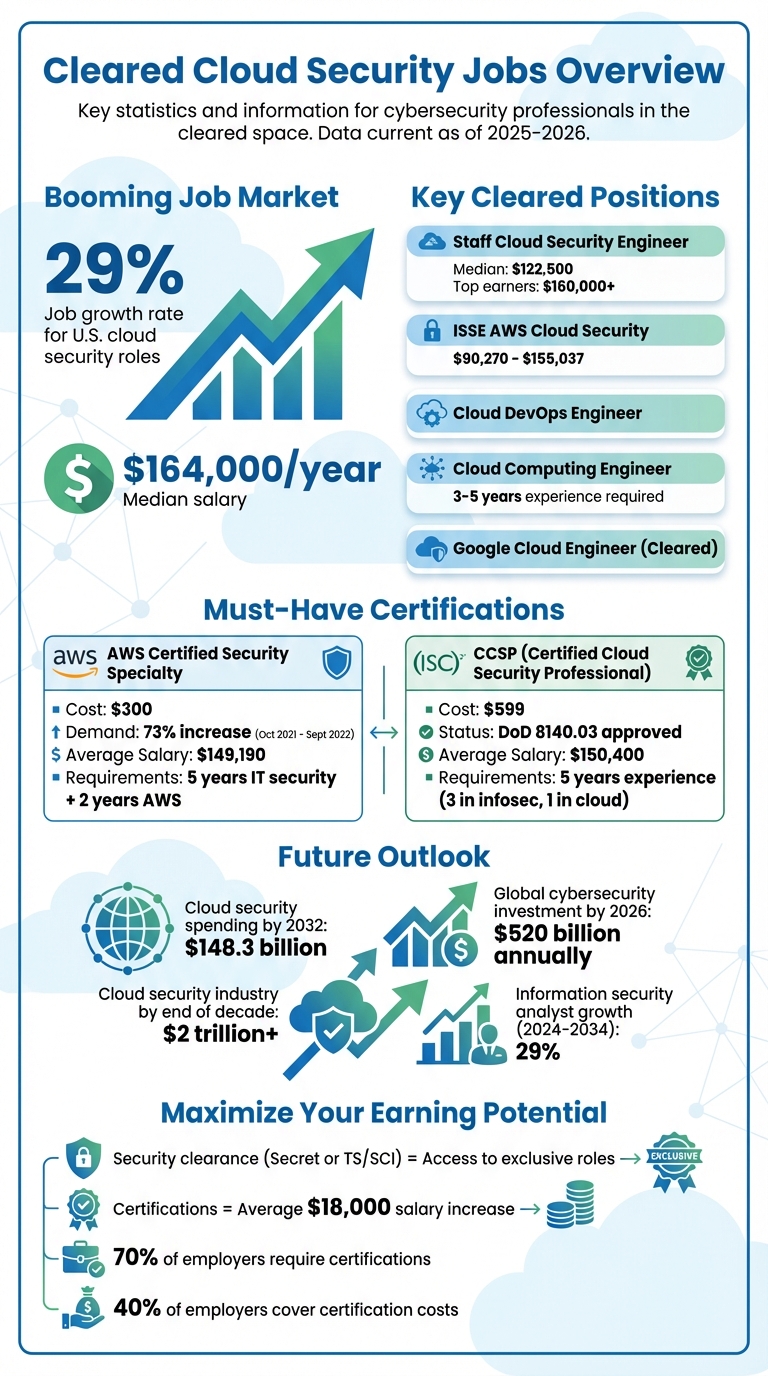
Cloud security is one of the fastest-growing fields in cybersecurity, driven by the increasing adoption of cloud platforms and the rising demand for professionals with security clearances. Here’s what you need to know:
- Job Market Growth: U.S. cloud security roles are increasing by 29%, with median salaries around $164,000/year.
- Security Clearance Advantage: Holding clearances like Secret or TS/SCI makes you highly sought after by federal contractors like Lockheed Martin and Booz Allen Hamilton.
- Certifications Matter: Certifications like AWS Certified Security Specialty ($300) and CCSP ($599) are key to landing top roles and boosting earning potential.
- Key Roles:
- Staff Cloud Security Engineer: Focuses on secure cloud architecture and compliance (Median Salary: $122,500).
- ISSE AWS Cloud Security: Specializes in securing cloud systems for government agencies.
- Cloud DevOps Engineer: Integrates security into development pipelines.
- Google Cloud Engineer: Secures workloads within GCP, often for data analytics and machine learning.
- Skills in Demand:
- AWS security tools like IAM, GuardDuty, and KMS.
- Compliance frameworks like NIST SP 800-53.
- Scripting (Python, PowerShell) and DevSecOps practices.
To excel, combine certifications, hands-on skills, and an active security clearance. Use job search filters, attend Cleared Job Fairs, and stay updated on industry trends. With cloud security spending projected to grow to $148.3 billion by 2032, this is the perfect time to advance your career.
Cleared Cloud Security Jobs: Salaries, Growth & Certifications Overview
FASTEST way to become Cloud Security Engineer and ACTUALLY get a job – UPDATED (2024)
sbb-itb-bf7aa6b
Top Cloud Security Jobs for Cleared Professionals
The cleared cloud security job market offers a variety of specialized roles that combine technical expertise with strict government compliance requirements. These positions generally require at least an active Secret clearance, with many high-sensitivity federal projects preferring TS/SCI credentials. Understanding the nuances of these roles can help you align your career goals with the opportunities that best match your skills and experience. Below, we break down some of the most sought-after positions in the field.
Staff Cloud Security Engineer
Staff Cloud Security Engineers play a pivotal role in securing sensitive projects while leveraging their active security clearance. They take the lead on designing and implementing secure cloud architectures across platforms like AWS, Azure, and GCP, often using zero-trust principles. Unlike junior engineers who focus on routine tasks, staff-level professionals handle the implementation and validation of compliance frameworks such as NIST SP 800-53, the DoD Cloud Computing Security Requirements Guide (CC SRG), and DISA STIGs to maintain Authorization to Operate (ATO).
These roles typically require 6 to 8 years of experience and offer competitive salaries, with a median annual pay of $122,500 and top earners making over $160,000[4]. Responsibilities include incident response, forensic analysis, advising leadership, and mentoring junior team members. Proficiency in automation using scripting languages like Python and Bash is critical to minimizing human error in repetitive tasks.
Information System Security Engineer (ISSE) AWS Cloud Security
ISSE roles are heavily focused on government compliance frameworks, requiring professionals to secure cloud-based systems for agencies like the Department of Defense. For example, in March 2026, LMI advertised a remote ISSE position with a salary range of $90,270 to $155,037, requiring an active Secret clearance (TS/SCI preferred)[3]. Mid-level ISSE positions generally require 3 to 5 years of experience in information security, with at least 3 years dedicated to AWS cloud security[3][4].
Key responsibilities include using tools like AWS GuardDuty, Security Hub, Inspector, and AWS Config for threat detection and compliance. Expertise in AWS Identity and Access Management (IAM) and Key Management Service (KMS) for encryption is essential. Additionally, certifications such as CISSP, CASP+, or CISM are often required to meet DoD 8570/8140 standards[3].
Cloud DevOps and Platform Engineer
Cloud DevOps and Platform Engineers integrate security into development workflows, automating cloud infrastructure and embedding security controls within CI/CD pipelines. These professionals focus on DevSecOps practices, using tools like Terraform or CloudFormation to enforce policies across environments. They also manage hybrid connectivity solutions, such as Direct Connect and VPNs, particularly in environments like AWS GovCloud designed for high-sensitivity workloads.
A shift-left approach – bringing security into the earliest phases of development – has become standard in these roles, ensuring that security is a priority throughout the lifecycle of a project.
Cloud Computing Engineer with Security Clearance
Cloud Computing Engineers with security clearances manage and secure cloud-based environments for cleared projects. These roles blend traditional infrastructure management with modern cloud-native security techniques. Responsibilities include securing VPCs using tools like AWS Network Firewall and WAF, as well as managing centralized logging platforms such as Splunk or Elastic for threat detection.
These positions typically require 3 to 5 years of experience and a solid understanding of Linux and Windows hardening techniques to secure diverse workloads. An active security clearance is essential, as these roles often involve government contracts.
Google Cloud Engineer (Cleared)
Google Cloud Engineers specializing in cleared projects focus on securing workloads within the Google Cloud Platform (GCP). They use tools like the Google Cloud Security Command Center for threat detection and compliance monitoring[4]. Although AWS is the dominant player in the federal cloud market, GCP is increasingly used for government applications requiring advanced data analytics and machine learning capabilities.
The Google Professional Cloud Security Engineer certification is highly regarded in this field, as it demonstrates expertise in GCP’s security architecture. Engineers in these roles are tasked with applying GCP’s security best practices to protect sensitive data and systems.
Required Certifications for Cleared Cloud Security Professionals
Certifications aren’t just a nice addition to your resume – they’re game-changers for cleared cloud security professionals. They validate your skills, meet government requirements, and can significantly boost your earning potential. In fact, 70% of cybersecurity employers require certifications, and professionals with these credentials often see an average salary bump of $18,000[7]. If you’re aiming for cloud security roles in the cleared sector, two certifications are must-haves.
The AWS Certified Security – Specialty is a mark of expertise in securing AWS environments. Priced at $300, this certification is ideal for those with at least five years of IT security experience, including two years of hands-on work with AWS security systems[6]. Between October 2021 and September 2022, demand for this certification surged by 73%[6], reflecting its importance in the field. It’s also one of the top-paying technical certifications in the U.S. The exam covers critical areas like incident response, encryption, data classification, and secure internet protocols – skills that align closely with federal cloud projects. Plus, after earning this certification, you’ll get a 50% discount on your next AWS exam[6].
The Certified Cloud Security Professional (CCSP) from ISC2 offers a broader, vendor-neutral perspective. At $599[8], this certification focuses on cloud architecture, data security, platform security, and legal compliance across various cloud environments. Approved by the U.S. Department of Defense under Directive 8140.03[5], it’s particularly valuable for military and contractor roles. CCSP-certified professionals earn an average of $150,400 annually, while those with the AWS Security Specialty average $149,190[8]. To qualify for the CCSP, you need five years of work experience, including three years in information security and one year in cloud security domains[8][9].
Combining these certifications can take your career to the next level. The AWS certification highlights your technical skills in the most widely used federal cloud platform, while the CCSP demonstrates strategic, multi-cloud expertise. If you’re targeting engineering roles focused on securing AWS environments, start with the AWS certification. However, if you’re eyeing architecture, consulting, or leadership positions, the CCSP may be the better first step. And don’t forget – 40% of cybersecurity professionals have their certification costs covered by employers[7], so check if that’s an option for you.
Both certifications require renewal every three years, ensuring your knowledge stays up-to-date as cloud security evolves. Note that the CCSP exam will follow a new outline starting August 1, 2026[5], so plan your preparation accordingly. Earning these credentials not only enhances your expertise but also positions you as a strong candidate for the cleared cloud security roles discussed earlier.
Skills and Experience You Need
To thrive in cleared cloud security roles, you’ll need more than just certifications. Employers are looking for a mix of technical expertise and a deep understanding of regulatory requirements. These roles often involve securing intricate cloud infrastructures while adhering to strict federal guidelines. And here’s a bonus: mastering these skills can potentially boost your salary by over $15,000 [12]. Pairing these abilities with your certifications creates a strong foundation for success in this field.
AWS Security Expertise
Understanding AWS security is critical. Start by focusing on Identity and Access Management (IAM) and Role-Based Access Control (RBAC) to manage permissions across multiple accounts while enforcing least-privilege access [12][13]. You’ll also need to implement Multi-Factor Authentication (MFA), configure security groups, and set up Network Access Control Lists (NACLs) to define traffic rules [14].
Cloud security expert Teri Radichel highlights the importance of securing every entry point, stating:
"Applications can be the gateway to your environment" [11].
This underscores the need to lock down all potential vulnerabilities.
Network and Encryption
What sets top-tier professionals apart in this field? Strong network security skills. You’ll need to understand network protocols, use tools like Wireshark for packet analysis, and dig into network logs to identify threats like command-and-control channels or DNS exfiltration [11][12].
Log analysis is another key area. You’ll need to review logs from tools like AWS GuardDuty, system logs, and DNS logs to spot indicators of compromise [11]. Setting up a home lab with tools like a pfSense firewall can help you practice traffic inspection [11].
DNS security is particularly important. Learn about Domain Generation Algorithms (DGAs) and DNS tunneling techniques to protect against advanced threats [11]. Additionally, gaining expertise in encryption through AWS Key Management Service (KMS) is essential for securely handling sensitive data. Familiarity with operating system baselines can also help you detect anomalies, such as process injection [11].
Compliance Frameworks
Technical skills alone won’t cut it – understanding compliance standards is just as important when working on federal cloud projects. You’ll need to be well-versed in frameworks like NIST SP 800-53 and CIS Benchmarks to ensure government operations remain secure [11][12].
Another critical area is managing the chain of custody for logs and data during security incidents. This ensures evidence integrity, which is crucial in legal or government investigations [11].
Proficiency in Linux and scripting languages like Python or PowerShell is also essential. These skills allow you to build security tools and automate repetitive tasks. Python, in particular, is widely used in cybersecurity for its simplicity and versatility [12].
Lastly, adopting DevSecOps principles – such as Infrastructure as Code (IaC) and immutable deployment strategies – ensures security is baked into the development process from the start [11][13]. Combine this with expertise in SIEM platforms and Security Data Lakes to effectively correlate events across multiple systems [11][12].
How to Find Cleared Cloud Security Jobs
Landing a cleared cloud security job takes a focused and proactive approach. The trick is knowing how to effectively use job search platforms while staying engaged with the cleared professional community.
Using Security Clearance Filters
When searching for jobs, select all clearance levels you’re eligible for – not just the one you currently hold. For instance, if you have a Top Secret clearance, also include Secret in your search to expand your options. Use Boolean operators to refine your search. For example, try searching for "Cloud Security" OR "Cloud Engineer" OR "AWS Security" to cover different job titles that align with your expertise.
Another tip is to filter by ZIP code and set a mileage radius. This helps capture job listings that may appear under different location names. A recent search for "cloud security" revealed 209 open positions with top defense and technology companies like Leidos, GDIT, CACI, and SAIC [15].
Once you’ve adjusted your filters, shift your attention to optimizing your online profile to attract recruiters.
Resume Upload and Job Alerts
Your online profile is often the first thing recruiters see, so ensure it’s up-to-date. Highlight your cloud security certifications and skills, and upload a polished resume. Setting up job alerts is another way to stay ahead, as it allows you to be notified of new openings immediately. Also, logging into your account weekly can improve your visibility in recruiter searches, as recent activity often boosts your profile.
For example, Booz Allen Hamilton’s "Cloud Software Engineer (Mid)" role in Lexington, MA was the third most applied-for cleared position in December 2025 [2]. Staying active and engaged online can help you stand out in a competitive market.
While an optimized online presence is important, face-to-face networking can also significantly enhance your job search.
Attending Cleared Job Fairs and Using Career Resources
Cleared Job Fairs are excellent opportunities to connect directly with hiring managers from top defense contractors. These events, available both in-person and virtually, allow you to explore the job market, understand which cloud security skills are in demand, and make personal connections that can fast-track your career.
G.B., a Technical Project Manager at CACI, shared their success story:
"I recently transitioned out of the military and started attending Cleared Job Fairs. I attended a Cleared Job Fair and was offered a position shortly after. I accepted and moved directly from the military into my current position, without a lapse in employment." [16]
Additionally, take advantage of career resources like podcasts, newsletters, and tip sheets tailored for cleared professionals. These tools provide valuable insights into the hiring process, tips for translating military experience into civilian roles, and guidance on navigating procedures like SF-86 forms and polygraph tests. Signing up for updates on job fair schedules and trends in cleared job searches can keep you informed and prepared.
Key Takeaways
If you’re stepping into cleared cloud security, earning DoD-approved certifications like the CCSP (priced at $599) or AWS Certified Security Specialty ($300) can help establish your credibility. Keep in mind, the CCSP exam will have updates starting August 1, 2026[5]. Tailor your certification choices to align with the cloud platform preferred by your target agency. For instance, many government agencies favor Microsoft Azure, while financial sectors with clearance requirements tend to prefer AWS[18].
A security clearance gives you a distinct edge, granting access to exclusive environments like AWS GovCloud and Microsoft Azure Government[19]. Thanks to the Trusted Workforce 2.0 initiative, clearance reciprocity is becoming more streamlined, making it easier to transition between federal agencies and contractors[19]. Maintaining good digital hygiene and promptly reporting major life changes to your Facility Security Officer are essential for keeping this advantage. This clearance not only expands your career opportunities but also positions you to build critical technical expertise.
Beyond certifications, prioritize skills in Identity and Access Management (IAM), network security, encryption, and compliance frameworks. In the U.S., cloud security professionals earn a median total pay of about $140,000 annually[18], and the demand for information security analysts is expected to grow by 29% between 2024 and 2034[1]. Building a technical portfolio to demonstrate hands-on experience can further strengthen your career prospects[20].
To complement your skills and credentials, refine your job search approach. Apply for roles across all clearance levels you’re eligible for, set up automated job alerts, and stay active on professional platforms. Attending Cleared Job Fairs, whether in-person or virtual, can help you connect directly with hiring managers and identify the most in-demand cloud security skills.
The cloud security industry is growing fast, with spending projected to exceed $2 trillion by the end of the decade and global cybersecurity investments expected to surpass $520 billion annually by 2026[10][20]. To stay ahead, renew your certifications regularly and consider specializing in sought-after areas like Zero Trust or DevSecOps[10][17].
FAQs
Do I need an active Secret or TS/SCI clearance to apply?
Yes, having an active Secret or TS/SCI clearance is a must for applying to security clearance jobs. These clearances confirm that you meet the necessary qualifications to work with sensitive or classified information.
Which certification should I get first: AWS Security Specialty or CCSP?
When deciding on the best certification to start with, it all comes down to your career goals. The AWS Certified Security Specialty is ideal if you’re looking to specialize in securing AWS environments, as it emphasizes hands-on skills tailored to AWS. On the other hand, the CCSP (Certified Cloud Security Professional) offers a vendor-neutral approach, covering broader cloud security principles across multiple platforms.
If you want a solid foundation that applies to various cloud environments, the CCSP is a great choice. But if your focus is on AWS-specific roles, the AWS Security Specialty certification is the better fit. Choose the one that best matches your immediate goals and the platform you aim to work with.
How can I prove hands-on cloud security experience for cleared roles?
When discussing your expertise, emphasize projects where you successfully safeguarded cloud environments, particularly those involving sensitive data. Highlight specific instances where you implemented security controls, managed Identity and Access Management (IAM), handled encryption protocols, or led incident response efforts on platforms like AWS or Azure.
Certifications such as AWS Certified Security Specialty or CCSP can further demonstrate your technical abilities and practical experience. Additionally, if you’ve participated in security assessments or applied frameworks like NIST to real-world scenarios, make sure to detail those contributions. These examples showcase not only your technical knowledge but also your ability to apply it effectively in professional settings.