

Cleared DevSecOps jobs combine software development expertise with security clearance requirements, creating high-demand roles in classified environments like defense and intelligence. These positions offer competitive salaries – ranging from $115,000 to $240,000 annually – with additional premiums of $20,000 to $65,000 based on clearance level. With 26% of cybersecurity positions unfilled in 2026, cleared DevSecOps professionals are highly sought after by companies like Lockheed Martin and SpaceX.
Key takeaways:
- High Demand: Cleared DevSecOps roles face a talent shortage, leading to higher salaries and job security.
- Earnings Potential: Clearance premiums significantly boost pay, especially for TS/SCI with Full Scope Polygraph.
- Required Skills: Proficiency in CI/CD pipelines, containerization (e.g., Docker), Infrastructure as Code (e.g., Terraform), and compliance knowledge is essential.
- Certifications: Start with Security+ and progress to advanced credentials like CISSP or AWS Security Specialty.
- Job Search Tips: Use cleared cyber security job boards, highlight your clearance on resumes, and network within the cleared community.
This guide covers everything from required skills to navigating clearance protocols, helping you succeed in this lucrative and specialized career path.
How to Go from Help Desk to DevSecOps Engineer (Step-by-Step Path)
sbb-itb-bf7aa6b
Required Skills and Tools for Cleared DevSecOps Professionals
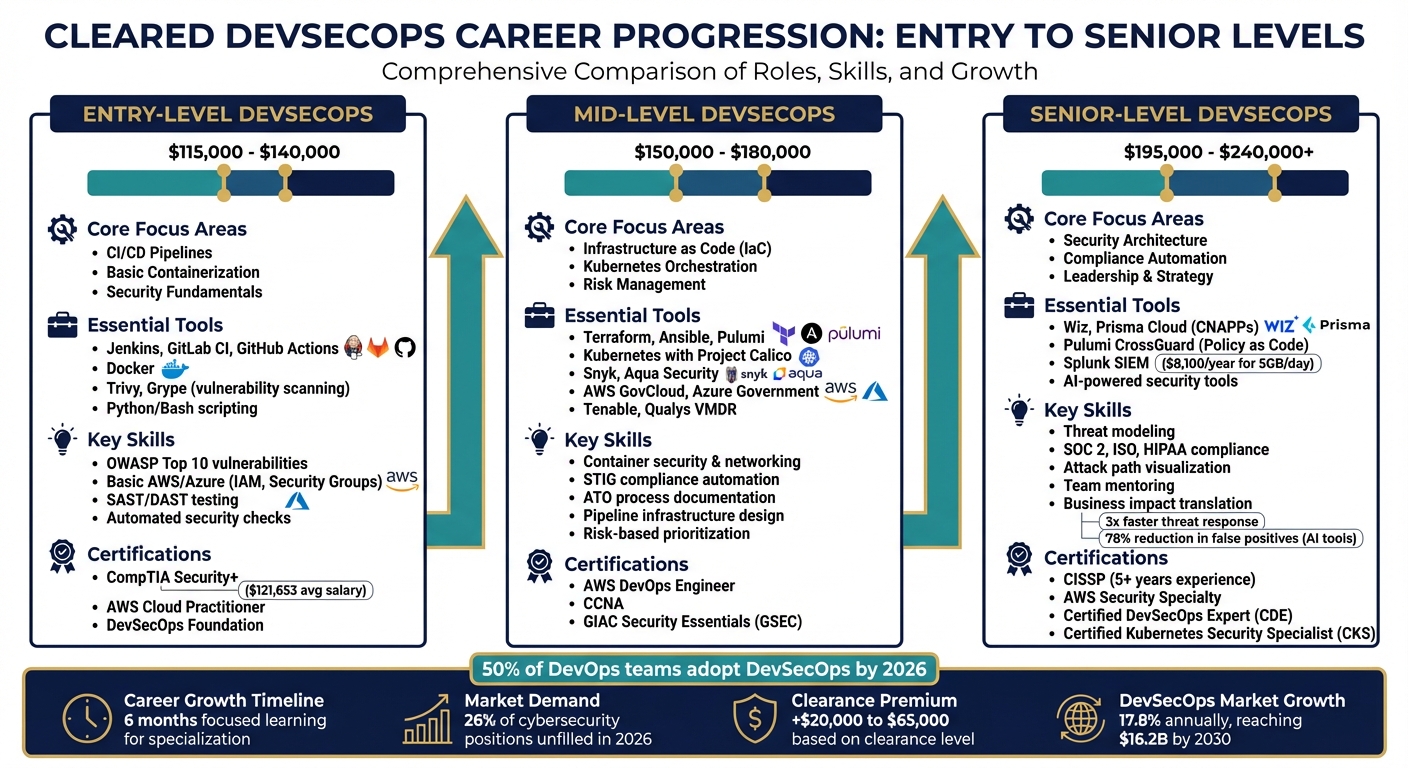
Cleared DevSecOps Career Progression: Skills, Tools, and Salary by Level
Cleared DevSecOps roles require a solid mix of technical skills and a deep understanding of government compliance. Unlike traditional tech roles, breaking into this field involves mastering security principles alongside development and operations, all while navigating strict regulatory frameworks. The expectation isn’t that you’ll know every tool from day one. Most hiring managers prioritize a strong security mindset over expertise in advanced tools.
"If someone comes in knowing Docker, basic AWS, and can explain how they’d secure a CI/CD pipeline without googling, they’re already ahead of most candidates. The advanced stuff we can teach." – Senior Engineering Manager, Fintech Company [5]
Career progression in this field is structured, moving from entry-level tasks like basic automation to senior responsibilities like designing security frameworks. Understanding where you are in this trajectory helps you focus on the skills that align with your current and future career goals.
Entry-Level Skills and Tools
Starting in cleared DevSecOps means building a foundation in CI/CD pipelines and containerization. Tools like Jenkins, GitLab CI, and GitHub Actions are essential for automating security checks during development, which is critical for environments handling classified information. GitLab, for example, offers a free tier with 400 compute minutes per month – perfect for honing your skills [4].
Docker proficiency is key. You’ll need to create containerized environments and scan images for vulnerabilities using tools like Trivy or Grype, both of which are free and widely used in government projects [4]. Automating routine security checks using Python or Bash is another way to showcase your abilities. For instance, writing a Python script to scan code repositories for hardcoded credentials demonstrates practical security awareness.
At this stage, understanding the OWASP Top 10 vulnerabilities is more critical than diving into complex orchestration. Employers want to see that you can identify issues like SQL injections or hardcoded API keys and apply a security-first mindset to development tasks [5]. Basic knowledge of AWS or Azure – particularly Identity and Access Management (IAM) and Security Groups – rounds out the foundational skills needed for most cleared roles.
"We’ve hired people who never touched Kubernetes before. What we can’t teach is security thinking. If you can look at our codebase and spot potential vulnerabilities, you’re hired." – DevSecOps Lead, Unicorn Startup [5]
To stand out, create a portfolio showcasing your ability to integrate security tools into CI/CD pipelines. For example, document how you used Checkov to scan Infrastructure as Code (IaC) for misconfigurations or implemented SAST/DAST testing. This kind of hands-on demonstration often carries more weight than certifications alone when applying for cleared positions [5].
Mid-Level Skills and Tools
As you progress, mid-level roles demand a focus on Infrastructure as Code (IaC) and advanced risk management. Tools like Terraform, Ansible, or Pulumi are essential for automating infrastructure builds and enforcing consistent security controls. Terraform Cloud, for instance, offers a free tier for up to 500 managed resources, making it an accessible option for practice [3].
Kubernetes orchestration becomes a core skill at this level. You’ll need to manage container networking and security using tools like Project Calico, Snyk, or Aqua Security. Understanding how to secure pod-to-pod communication and implement network policies in restricted environments is especially important. Expertise in regulated cloud platforms like AWS GovCloud or Azure Government can also lead to higher compensation.
Vulnerability management evolves from basic scanning to risk-based prioritization. Tools like Tenable or Qualys VMDR help identify and address critical risks. In cleared environments, you’ll often automate Security Technical Implementation Guide (STIG) compliance and produce technical documentation for Authority to Operate (ATO) processes – tasks unique to government systems [9].
Mid-level professionals move beyond running existing jobs to designing new pipeline infrastructure. For example, you might build container image pipelines that handle building, scanning, signing, and deploying, all while maintaining audit trails for classified systems. With DevSecOps practices becoming increasingly standard – adopted by 50% of DevOps teams by 2026 – these skills are in high demand [7].
Senior-Level Skills and Tools
At the senior level, the focus shifts to designing security architecture using tools like Wiz or Prisma Cloud. These Cloud-Native Application Protection Platforms (CNAPPs) identify "toxic combinations" of risks across your infrastructure, from code to cloud. Wiz, for instance, starts at $24,000/year for 100 workloads and is praised for its agentless deployment and attack path visualization, scoring 4.7/5 on G2 [3].
Threat modeling and compliance automation are critical. You’ll predict potential threats to cloud infrastructure before deployment and automate audits for SOC 2, ISO, and HIPAA compliance, mapping findings to CIS benchmarks [3][6].
With Policy as Code, you enforce security at deployment rather than relying on manual reviews. Tools like Pulumi CrossGuard or OIDC allow for scoped, short-lived credentials. Advanced SIEM tools like Splunk (starting at $8,100/year for 5GB/day) enable faster threat response – up to three times quicker, according to some organizations [3].
Leadership becomes just as important as technical expertise. Senior professionals translate vulnerabilities into real-world impacts, such as potential regulatory fines or risks to national security. For example, understanding how a misconfigured IAM role could compromise classified information ties your technical skills directly to mission-critical objectives [1]. Additionally, you’ll mentor junior engineers, conduct pipeline audits, and promote the use of AI-powered security tools, which can reduce false positives by up to 78% [8].
"AI hasn’t replaced security experts – it’s democratized security expertise, putting it directly into developers’ hands when and where they need it most." – StarAgile | Tech Bytes [8]
Security Clearance Requirements for DevSecOps
Landing a cleared DevSecOps role means navigating clearance protocols and meeting rigorous standards essential for working with secure defense systems. These roles aren’t like typical tech jobs – they require government authorization to access classified information. That authorization comes with strict eligibility rules and responsibilities, which directly influence the positions you can apply for and your earning potential.
Types of Security Clearances
The federal government issues four main clearance levels: Confidential, Secret, Top Secret (TS), and Top Secret/Sensitive Compartmented Information (TS/SCI). Each level grants access to more sensitive information and involves increasingly detailed background checks [10].
Most DoD contractor and federal civilian DevSecOps roles require a Secret clearance, which involves a Tier 3 investigation. These make up about 60% of active clearances. On the other hand, Top Secret clearances – needed for senior-level and advanced technical roles – require a Tier 5 investigation (formerly called Single Scope Background Investigation) [10].
"TS/SCI is not a separate clearance level – it’s a Top Secret clearance combined with access to Sensitive Compartmented Information (SCI) programs." – ClearedJobs.Net [10]
If you’re aiming for positions in the Intelligence Community (e.g., CIA, NSA, DIA), you’ll likely need a TS/SCI clearance, which includes additional program-specific indoctrinations. Some roles also require polygraph tests, either Counterintelligence (CI) or Full Scope (lifestyle), further narrowing the candidate pool. For those holding TS/SCI clearances with polygraphs, salaries can see a 15–25% bump compared to similar roles in the commercial sector [10].
If you currently hold a Secret clearance, look for "upgradeable" roles where employers sponsor the move to Top Secret or TS/SCI. While the government aims to process Secret clearances in about 40 days and Top Secret in 75, actual timelines can vary. As of January 2026, the Defense Counterintelligence and Security Agency (DCSA) reported a significant reduction in its investigation backlog, marking a 65% drop compared to early 2025 [11].
Understanding these clearance levels is essential for navigating the compliance-heavy environment of cleared DevSecOps work.
Compliance and Regulatory Requirements
Cleared DevSecOps roles operate under strict regulations that dictate how classified information is handled. The Espionage Act (18 U.S.C. 793 through 798) outlines the legal framework, and mishandling sensitive data like SCI or SAP can lead to criminal consequences [11].
Key compliance practices include:
- Using only government-approved communication channels.
- Avoiding unsecured networks.
- Refraining from using personal devices for classified work.
- Following strict storage and discussion protocols to prevent security breaches.
The federal government has shifted to Trusted Workforce 2.0, replacing periodic reinvestigations with Continuous Vetting (CV). This system actively monitors personnel in near real-time, flagging potential issues as they arise. By early 2026, over 3.8 million cleared personnel were enrolled in CV, which automates checks against criminal, financial, and public records databases [11].
"Continuous vetting uses automated checks against criminal, financial, terrorism, and public records databases on an ongoing basis rather than waiting years between reviews." – USFCR [11]
Under this system, you’re expected to promptly self-report events like foreign travel, interactions with foreign nationals, major financial changes, or legal troubles. Waiting for a scheduled reinvestigation is no longer an option.
How to Maintain Your Security Clearance
Keeping your clearance active requires constant vigilance and open communication with your Facility Security Officer (FSO). Continuous Vetting tracks changes in your life, such as criminal arrests or credit issues, and often alerts security offices within days [12].
To maintain your clearance:
- Report significant life events – like arrests, financial troubles, or new foreign contacts – to your FSO immediately.
- Perform annual reviews of your financial and personnel records.
- Address financial issues proactively, as they are the most common reason for clearance revocation (Guideline F), followed by Foreign Influence (Guideline B), Drug Involvement (Guideline H), and Personal Conduct (Guideline E). Note that marijuana use remains federally prohibited and can disqualify you, even in states where it’s legal [12].
If your clearance becomes inactive, it typically expires after 24 months without sponsorship. However, the 2026 NDAA extends this window to five years for departing DoD personnel [11]. When changing jobs, use the Defense Information System for Security (DISS) to transfer your clearance without restarting the investigation process [10].
Take proactive steps like reviewing your credit report annually and requesting your official security file through a DCSA Privacy Act request to correct any inaccuracies. It’s also smart to maintain a personal security file with mitigation documents, reporting emails, and correspondence about adjudicative issues. Be mindful of your online presence, as adjudicators increasingly examine public-facing activities like GitHub contributions and social media. Regularly audit your privacy settings to ensure you’re presenting a professional image [12].
"View your Security Officer as a partner in retention. Self-report significant life events immediately." – Kevin James, Writer, Cybersecurity For Me [12]
Certifications and Training for DevSecOps Professionals
Certifications can validate your expertise and open the door to higher-paying cleared roles. Many government contracts even require specific certifications, so it’s essential to choose those that align with your career goals and job requirements.
The certifications and training programs listed here build on the foundational skills mentioned earlier, ensuring you meet both technical and clearance-related expectations.
Entry-Level Certifications
If you’re just starting in DevSecOps, these certifications can help you establish a solid foundation. CompTIA Security+ is widely regarded as the baseline for most cleared DevSecOps positions. It’s accredited by the American National Standards Institute (ANSI) and meets DoD 8570 requirements. On average, professionals with this certification earn $121,653 per year [13]. Pairing it with CompTIA Network+ can further strengthen your networking skills.
For cloud-focused environments, the AWS Cloud Practitioner certification offers a great introduction to cloud basics without requiring advanced technical knowledge. Additionally, the DevSecOps Foundation from the DevOps Institute provides a strong understanding of core practices and principles, equipping you with the terminology and concepts necessary to collaborate effectively in cross-functional teams.
Advanced Certifications
Advanced certifications are ideal for professionals aiming to validate their expertise while meeting regulatory requirements in cleared environments. For AWS-centric roles, the AWS Certified DevOps Engineer and AWS Security Specialty certifications demonstrate proficiency in managing complex cloud architectures and securing deployment pipelines.
If networking is your focus, the CCNA is a strong choice. Cisco recommends candidates have at least one year of hands-on experience before attempting this certification, which highlights enterprise-level networking skills [13].
The GIAC Security Essentials (GSEC) certification emphasizes practical, hands-on security knowledge. For those with five or more years of experience and aspirations for leadership roles, the CISSP is a highly respected credential that covers advanced security management and governance. For top-tier expertise, the Certified DevSecOps Expert (CDE) showcases mastery in implementing enterprise-scale security architectures.
Continuing Education and Training
Success in DevSecOps requires more than just earning certifications – it’s about staying ahead in a constantly evolving field. Regularly assess your CI/CD pipelines for vulnerabilities and seek targeted training to address gaps. Familiarize yourself with the OWASP Top 10 to understand common attack patterns, and gain hands-on experience with tools like SonarQube for code scanning, OWASP ZAP for dynamic testing, and Trivy for container vulnerability scanning [14].
Joining professional communities can help you stay informed about emerging threats and trends. Transitioning into a specialized DevSecOps role typically takes about six months of focused learning and practical application [1][14]. Lastly, developing strong communication skills – especially in translating technical risks into business terms – is essential for roles that demand advanced expertise.
How to Find Cleared DevSecOps Jobs
If you’re a certified professional with clearance, the key to landing a cleared DevSecOps position lies in strategy. The job market for cleared DevSecOps roles in 2026 is competitive, with 26% of positions remaining unfilled and salaries ranging from $115,000 to $195,000 – often 20–40% higher than commercial rates [2]. The real challenge isn’t finding opportunities; it’s standing out and securing them quickly.
Using Cleared Job Boards
Specialized job boards tailored to the cleared community are one of the best ways to find DevSecOps roles. Platforms like Cleared Cyber Security Jobs allow you to filter opportunities by clearance level, such as Secret, TS/SCI, or Full Scope Polygraph. Many of these sites also use AI-powered tools to match your profile with relevant positions, streamlining the process.
Set up daily job alerts with specific search terms like "DevSecOps" and your clearance level (e.g., "TS/SCI") to ensure you’re among the first to apply for new openings. Refresh your profile weekly to update your "last active" status, as recruiters prioritize candidates who appear active [16]. Additionally, make sure to select all clearance levels you’re qualified for to broaden your visibility.
Once you’ve identified roles, your next step is crafting application materials that effectively highlight your qualifications.
Writing Effective Application Materials
Your resume needs to grab attention quickly, especially in the cleared job market. Place your security clearance level at the top – either in a "Certifications" or "Clearances" section – so recruiters can immediately see your eligibility. Use clear and specific phrasing like "Active Top Secret Clearance with SCI eligibility" instead of vague descriptions.
Focus on measurable achievements by using the STAR method (Situation, Task, Action, Result) to describe your accomplishments rather than listing responsibilities. Incorporate keywords from the job description to ensure your resume passes through Applicant Tracking Systems (ATS). Stick to clean, simple designs with standard fonts, and avoid graphics or placing key information in headers and footers. Highlight your technical expertise by specifying how many years you’ve worked with DevSecOps tools, and keep your resume concise – one to two pages max. Avoid including clearance badges, investigation dates, or any classified details.
"Stop collecting certifications. Start applying. I see too many people with 6 certs and no job applications. You need ONE good cert and 100 job applications, not six certs and 10 applications." – Cybersecurity Hiring Manager [2]
Beyond a polished resume, networking plays a crucial role in accessing hidden opportunities.
Networking in the Cleared Community
Networking is a powerful way to discover unadvertised positions and build direct connections with hiring managers at companies like Northrop Grumman, Booz Allen Hamilton, and CACI. Attend cleared job fairs and industry events such as BSides or RSA to meet recruiters face-to-face.
On LinkedIn, highlight your DevSecOps expertise and clearance status, but avoid sharing detailed clearance information publicly to avoid potential issues. Contributing to open-source security projects on GitHub is another great way to showcase your skills, while participating in forums like Reddit’s r/netsec can help you engage with industry professionals [15]. Conduct informational interviews with people in roles you admire, and always follow up with a thank-you email to maintain those connections [15]. Building strong relationships is highly valued by major employers in the cleared community, often giving you an edge in the hiring process [2].
How to Succeed in Cleared DevSecOps Roles
Landing a cleared DevSecOps role is just the start. To truly excel, you’ll need to embrace collaboration, commit to ongoing learning, and think strategically – far beyond just running scans or blocking deployments.
Working Across Security, Development, and Operations Teams
Success in DevSecOps hinges on fostering shared responsibility between developers, security teams, and operations. Developers act as the first line of defense, while security teams set policies and guide best practices.
One effective way to bridge these groups is by creating a Security Champions program. In this setup, developers volunteer to advocate for secure coding practices within their teams. Nick Liffen, Director at GitHub, emphasizes this point:
"The more developers are involved in creating a security process and making policy decisions, the smoother the collaboration will be between engineering and security teams."
To thrive in this environment, cultivate "T-shaped skills." This means having deep expertise in one area while broadening your knowledge across related fields. For instance, instead of merely reporting a high-severity vulnerability, explain its potential business impact – like how it could lead to a $1.2 million regulatory fine [1].
It’s also crucial to adopt a blameless culture during postmortems. Viewing mistakes as opportunities for systemic improvement fosters innovation and strengthens team dynamics.
Beyond collaboration, staying ahead of evolving tools and practices is key to long-term success.
Staying Current in Cleared Environments
Keeping up with the fast pace of technological change is non-negotiable in DevSecOps. The field is growing rapidly – at an annual rate of 17.8% – and is expected to hit $16.2 billion by 2030 [17]. Shifting from a "speed first" to a "secure speed" mindset is essential, where security becomes an enabler rather than a bottleneck.
To stay on top of your game:
- Incorporate security tools into CI/CD pipelines: Use SAST, DAST, and SCA tools to catch vulnerabilities early in the development process.
- Secure Infrastructure as Code templates: This helps prevent overprivileged access in expanding cloud environments.
- Conduct regular pipeline audits: These can identify hardcoded secrets, unpatched dependencies, and configuration issues before they become major problems.
Engage with DevSecOps communities like Reddit’s r/devsecops to stay informed about emerging threats and trends. Additionally, keep an eye on AI-driven remediation tools, which are transforming the field by enabling real-time prioritization and resolution of vulnerabilities.
Mastering these evolving practices will not only help you succeed but also position you for career growth.
Growing Your DevSecOps Career
Building technical expertise and fostering collaboration are just the foundation. To advance your career, focus on leadership and specialized skills.
- Highlight the financial impact of vulnerabilities: For example, demonstrate how a misconfiguration could lead to a $1.2 million loss [1].
- Take on leadership roles: Becoming a Security Champion or mentoring junior team members can raise your visibility and showcase your expertise.
- Leverage certifications: Credentials like the Certified Kubernetes Security Specialist (CKS) or AWS Security Specialty are valuable for specialization. At higher levels, earning a CISSP (which typically requires five or more years of experience) validates your ability to lead on strategic security initiatives.
Finally, keep in mind that DevSecOps roles often come with higher earning potential – salaries can be 15–25% above those of traditional DevOps positions [1]. Combining technical skill, leadership, and ongoing learning will ensure you thrive in this dynamic field.
Conclusion
Cleared DevSecOps stands out as one of the most rewarding and in-demand career paths in cybersecurity today. With the market’s growing need for professionals who combine technical expertise with a strong security focus, the opportunities in this field are unmatched.
The financial benefits are impressive. Salaries for cleared DevSecOps professionals are typically 15–25% higher than those in standard DevOps roles and 20–40% above commercial rates. On top of that, holding a Full Scope Polygraph clearance can boost earnings by an additional $45,000 to $65,000 annually. Over a 20-year career, this adds up to an extra $900,000 to $1.3 million. As ClearanceJobs notes:
"A Full Scope Polygraph clearance can add $45-65K annually to your cybersecurity salary. That’s $900K to $1.3M over a 20-year career. The math is simple: get cleared, get paid." [2]
However, thriving in this field isn’t just about technical knowledge. Success requires the ability to connect development, security, and operations teams, while effectively communicating technical risks in ways that resonate with business stakeholders. The ultimate goal is to ensure secure, efficient deployment – not just speed for its own sake [1].
If you’re ready to pursue this path, now is the time to act. Start by earning a foundational certification like Security+ (currently priced at $404), gain hands-on experience through home labs or Capture The Flag competitions, and begin applying for cleared DevSecOps roles [2]. By following the steps outlined in this guide – certifications, practical skill-building, and networking – you’ll be well-positioned to succeed in this specialized and lucrative career field. The cleared DevSecOps market rewards those who take action.
FAQs
Can I get a cleared DevSecOps job without Kubernetes?
Yes, landing a cleared DevSecOps job without Kubernetes experience is achievable. Most job descriptions emphasize a strong grasp of CI/CD principles and DevOps fundamentals rather than expertise in specific tools. Concentrate on mastering these core areas to meet the expectations of potential employers.
How do employers sponsor a clearance upgrade?
Employers initiate a clearance upgrade by officially requesting a higher security clearance level for an employee. This process involves an in-depth background investigation that examines areas such as criminal history, financial responsibility, and allegiance to the United States. Once the investigation is complete, the relevant agency reviews the results to determine whether to approve or deny the upgrade. The entire process can take several months, during which employers ensure all required documentation and procedures meet national security guidelines.
What should I put on my resume about my clearance?
If you hold a security clearance, make sure to clearly display it near the top of your resume, such as in your professional summary. For example, you can simply state "Active Secret Clearance" or "TS/SCI Clearance." This immediately signals your eligibility for roles requiring access to classified information and underscores your reliability.
However, do not include sensitive details, like investigation dates or clearance numbers, as this could compromise security protocols. Keep the focus on the clearance level itself, ensuring your resume remains professional and secure.