

Identity and Access Management (IAM) specialists are becoming increasingly critical as organizations shift to cloud systems and adopt zero-trust security models. These professionals ensure secure access to sensitive information, especially in government and defense environments. Here’s a quick breakdown:
- Job Growth: IAM-related roles are projected to grow by 33% from 2023 to 2033.
- Salaries: Annual pay ranges from $100,000 to $280,000+, depending on experience and role.
- Core Responsibilities: Tasks include managing user access, deploying Multi-Factor Authentication (MFA), and maintaining secure identity systems.
- Key Skills: Proficiency in tools like Okta and CyberArk, understanding of protocols (OAuth2, SAML), and certifications like CISSP or Security+ CE.
- Clearance Requirements: Many roles require Secret or Top Secret/SCI clearances, which involve background checks and adherence to strict government standards.
With the cybersecurity market expected to hit $271.91 billion by 2029, cleared IAM professionals are in high demand. This career path offers competitive pay, job security, and exposure to cutting-edge security technologies.
(2025) Zero to IAM Analyst | Step-By-Step Guide | #IAM #IAMANALYST
sbb-itb-bf7aa6b
Required Skills for Cleared IAM Specialists
Cleared IAM roles demand a mix of strong technical know-how and excellent interpersonal abilities. On the technical side, expertise in directory services like Active Directory and LDAP is crucial, as these systems form the backbone of identity management in government settings. Additionally, a solid grasp of authentication protocols such as SAML, OAuth 2.0, and OpenID Connect (OIDC) is necessary for implementing single sign-on and managing identity federation across intricate systems.
Technical Skills
To excel in this field, you need to master access control frameworks like RBAC, ABAC, and MAC while leveraging Privileged Access Management (PAM) tools such as CyberArk. Automating tasks with scripting languages like Python and PowerShell is equally important. Familiarity with cloud identity platforms, including Microsoft Entra ID, AWS IAM, and Google Cloud Identity, is a must. Moreover, understanding SSL/TLS, PKI, and newer standards like FIDO2 is critical. Since compromised credentials account for about 80% of data breaches, PAM skills are indispensable for safeguarding access to sensitive systems [4].
For cleared roles, aligning with DoD 8570.11 IAT Level II certification requirements is non-negotiable. Certifications like Security+ CE, CCNA-Security, or SSCP are often required [1]. You’ll also need to navigate regulatory frameworks such as NIST, FISMA, GDPR, HIPAA, and PCI DSS. The global IAM market is expected to surpass $43 billion by 2029 [4], underscoring the growing demand for professionals adept at handling these complex regulatory environments.
Soft Skills
Technical expertise alone isn’t enough – strong interpersonal abilities are vital for success. Clear communication and the ability to break down complex identity concepts for non-technical audiences are key.
"IAM professionals regularly work with non-technical stakeholders – HR, legal, business unit leaders. Your ability to explain identity concepts in plain language is a genuine differentiator."
– Deepak Gupta, Founder, guptadeepak.com [4]
Effective collaboration across departments is essential, whether it’s working with HR during onboarding or partnering with IT teams for system implementation. Problem-solving and analytical thinking are equally important for designing secure solutions that balance rigorous security needs with user accessibility. Precision in tasks like auditing logs, managing permissions, and ensuring compliance is non-negotiable.
With 81% of security managers identifying the protection of machine identities as critical for AI adoption [4], staying adaptable and committed to continuous learning is crucial in this fast-changing field.
IAM Tools for Cleared Cybersecurity Professionals
When it comes to securing classified environments, certain Identity and Access Management (IAM) tools are indispensable for cleared cybersecurity professionals. Two standout platforms are Okta for identity management and CyberArk for privileged access control. These tools not only help meet strict Department of Defense (DoD) requirements but also ensure smooth and efficient operations.
Okta: Identity as a Service

Okta for US Military, hosted on AWS GovCloud, is a robust platform with DISA IL4 and IL5 Provisional Authorizations, making it suitable for handling Controlled Unclassified Information (CUI) and high-impact workloads [5]. This platform already supports close to 3 million DoD personnel and mission partners [5].
One of Okta’s strengths lies in automating identity workflows, which traditionally relied on time-consuming manual processes. Okta Identity Governance (OIG) and Okta Workflows, both DISA-authorized, can automate the System Authorization Access Request (SAAR) process, replacing the outdated DD-2875 forms [7]. With the Department of War CIO mandating an automation-first approach to identity workflows by June 30, 2026 [7], these capabilities are becoming a necessity.
"Investing in commercial-grade technology while access decisions remain bottlenecked by paper-based workflows creates obstacles for the warfighter and the mission." – Amy Johanek, Vice President of Federal, Okta [7]
Okta also supports Common Access Card (CAC) and Personal Identity Verification (PIV) credentials, ensuring secure authentication for both CAC and non-CAC users [5][9]. Additionally, it helps agencies meet CMMC 2.0 requirements in Access Control (AC) and Identification and Authentication (IA) domains by enforcing multi-factor authentication and limiting failed login attempts [6]. With over 7,000 pre-built integrations available in the Okta Integration Network [9], agencies can seamlessly connect to nearly any application or infrastructure they use.
While Okta handles identity management, CyberArk steps in to secure privileged access.
CyberArk: Privileged Access Management
CyberArk specializes in safeguarding privileged accounts, which are often the primary targets for attackers. In classified environments, this means protecting administrative access to sensitive systems and infrastructure. Key features include credential vaulting, which secures shared accounts while maintaining accountability, and session recording for SSH/RDP access to ensure compliance and audit readiness [8].
One of CyberArk’s standout capabilities is its ability to eliminate permanent access. Instead of granting ongoing administrative rights, the platform provides just-in-time access to servers and service accounts, significantly reducing the potential attack surface [8]. This approach aligns with Zero Trust principles and the least privilege model required in government settings. Additionally, all privileged access is routed through a gateway for network proxying, ensuring servers are never directly exposed to the internet [8].
Both Okta and CyberArk address critical needs for cleared professionals, offering tools that align with the highest security standards while improving operational efficiency.
Certifications for Cleared IAM Specialists
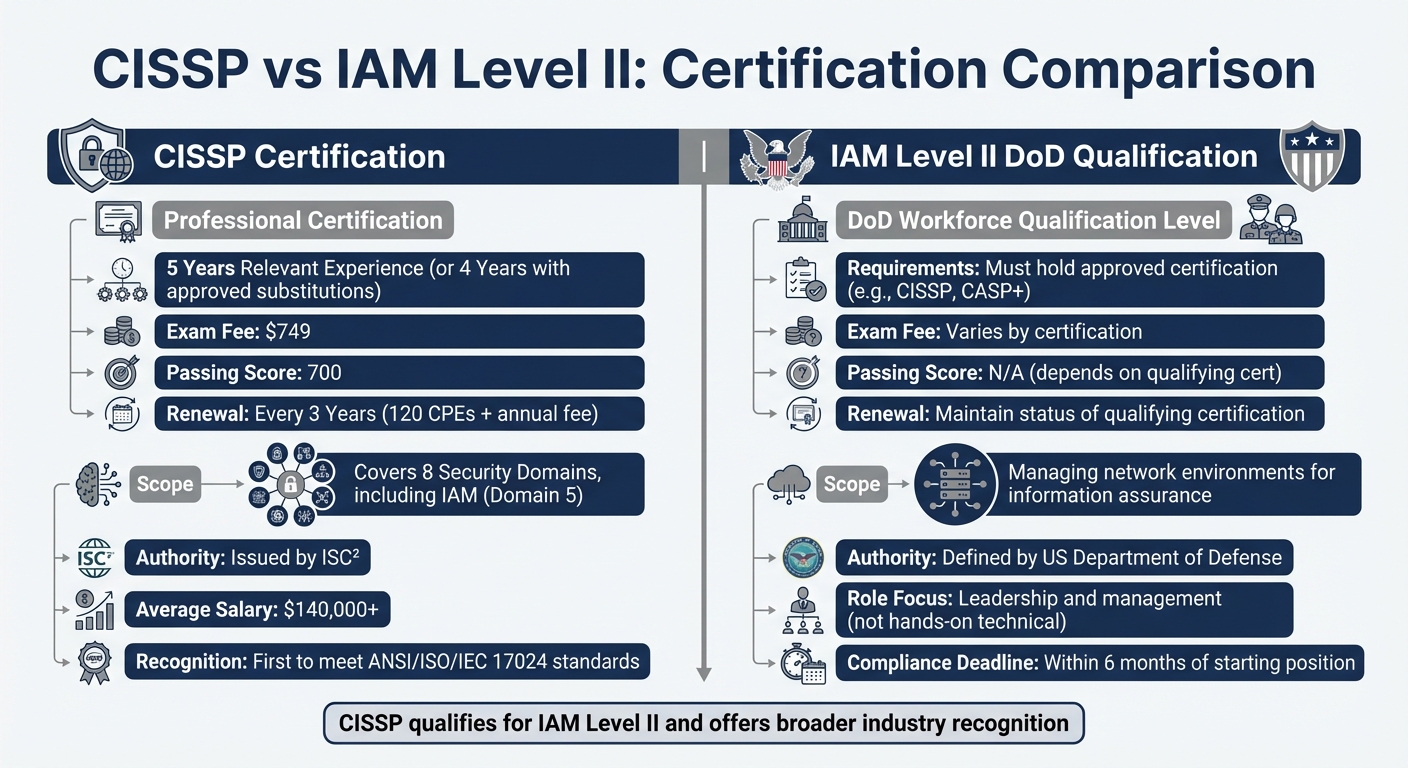
CISSP vs IAM Level II DoD Qualification Comparison for Cleared Cybersecurity Professionals
Certifications not only validate your expertise but can also open doors to higher-paying cleared roles. Two key credentials to know are CISSP and the IAM Level II DoD qualification. While CISSP is a professional certification offered by ISC², IAM Level II is a Department of Defense (DoD) workforce requirement that can be met by earning a recognized certification, such as CISSP. Here’s a closer look at these certifications and their relevance to cleared IAM roles.
CISSP Certification
The CISSP (Certified Information Systems Security Professional), provided by ISC², is a globally respected certification. It was the first to meet ANSI/ISO/IEC 17024 standards. To qualify, candidates need at least five years of full-time work experience in two or more of the eight CISSP domains. However, a four-year degree or certain other certifications can reduce this to four years.
The CISSP exam costs $749, and candidates need a score of 700 to pass. Those who hold a CISSP certification often earn an average annual salary exceeding $140,000 [13].
IAM Level II DoD Qualification
In cleared environments, IAM Level II qualifications demonstrate readiness for leadership roles in identity and access management. This qualification, outlined in DoD Directive 8570.01-M/8140, is required for professionals managing information assurance within networking environments. To meet the IAM Level II standard, individuals must earn one of the approved baseline certifications, such as CISSP, CISM, CASP+ (SecurityX), CCISO, or CAP (CGRC), within six months of starting a relevant position.
IAM Level II roles are typically more focused on leadership and management rather than technical, hands-on responsibilities. Since CISSP serves as one of the qualifying certifications for IAM Level II, it’s often a strategic choice for professionals who want flexibility across various DoD role categories.
"The IA level (I-III) corresponds to the respective system architecture, not to an individual’s grade, rank, or experience." – Greg Belding, Veteran IT Professional
Certification Comparison
Here’s a quick comparison of CISSP and IAM Level II qualifications to highlight their differences:
| Feature | CISSP Certification | IAM Level II DoD Qualification |
|---|---|---|
| Nature | A professional certification | A DoD workforce qualification level |
| Requirements | 5 years of relevant experience (or 4 years with approved substitutions) | Must hold an approved certification (e.g., CISSP, CASP+) |
| Exam Fee | $749 | Varies by certification |
| Renewal | Every 3 years (120 CPEs + annual fee) | Maintain the status of the qualifying certification |
| Scope | Covers 8 security domains, including IAM (Domain 5) | Focuses on managing network environments for information assurance |
| Authority | Issued by ISC² | Defined by the US Department of Defense |
While both certifications enhance a career in cleared IAM roles, the CISSP is widely recognized across the broader cybersecurity industry. For those working under tight contract deadlines (30–60 days), fast-track services can expedite compliance with DoD 8140/8570 requirements [11][12].
Security Clearance Requirements for IAM Roles
Security clearance is a must-have for IAM specialists working in secure environments. It qualifies you for sensitive roles and ensures you’re equipped to handle classified networks or secure cloud systems. For cleared IAM specialists, meeting these requirements is non-negotiable and directly tied to adhering to DoD standards.
Types of Security Clearances
Security clearances operate on a tiered system, with each level granting specific access privileges [14]. For IAM roles, the most common levels are Secret (Tier 3) and Top Secret/SCI (Tier 5), depending on the sensitivity of the systems you’ll manage [10].
- Secret clearance: This is the baseline for most IAM positions. The process to obtain it generally takes 60 to 150 days. Delays often stem from incomplete applications or undisclosed foreign contacts.
- Top Secret clearance: Required for roles involving highly sensitive information, such as Information Systems Security Officers (ISSO). This process can take 120 to 240 days, and if a polygraph is needed, it may extend to 180 to 365+ days due to scheduling backlogs [10].
Higher clearance levels often translate into higher salaries. For example, holding a clearance can increase your pay by 10% to 20% compared to non-cleared roles [15].
In 2026, a faster option called Interim Secret clearance will become available. It can be granted in as little as 10 to 30 days based on initial automated checks [10]. This development could significantly reduce waiting times for many applicants.
How to Obtain a Security Clearance
You can’t apply for a security clearance on your own – it requires sponsorship from an employer with a government contract that mandates cleared personnel. Once you’re sponsored, you’ll need to complete the SF-86 form via the eApp platform under Trusted Workforce 2.0 [10].
Preparation is key. Before starting your SF-86, gather and verify 10 years of residence, employment, and education history. Accuracy is critical because honesty is heavily scrutinized under the "Personal Conduct" guideline [10].
Financial issues are the most common reason for clearance denials, accounting for 40% of Department of Navy cases. Dishonesty on applications contributes to another 15% [16].
"The SF-86 application process creates more problems when candidates hide information than the actual issues they try to conceal." – JOBSwithDOD [16]
The Defense Counterintelligence and Security Agency (DCSA) handles 95% of federal background checks [14]. During the investigation, adjudicators evaluate your case using the "whole person concept", which balances positive and negative factors against 13 federal adjudicative guidelines [10]. This process includes reviewing your credit report, interviewing references, and even checking your public social media activity on platforms like Twitter, Facebook, and Instagram [10].
To improve your chances:
- Review your credit report and address any delinquencies with documented repayment plans.
- Be completely honest – omissions or inaccuracies can lead to denial [10][16].
Certain factors automatically disqualify applicants, including non-U.S. citizenship, illegal drug use, dishonorable military discharge, or being declared mentally incapacitated [15].
Once you’ve been granted clearance, it remains active as long as you’re in a cleared position. Under the Continuous Vetting system, periodic reinvestigations have been replaced by real-time monitoring of criminal, credit, and travel records [10]. You’re also required to self-report incidents like arrests, significant debts, or foreign travel within 72 hours to your Facility Security Officer (FSO) [16].
"A clearance is tied to the sponsoring position. If you leave the job that requires it, your clearance typically becomes inactive after 24 months unless picked up by a new sponsor." – Kevin James, Cybersecurity Writer [10]
If you leave a cleared role, your clearance stays "current" for 24 months. This gives you a window to find another sponsoring employer before it becomes inactive [10].
How to Get a Cleared IAM Job
If you’re aiming for a cleared IAM role, you’ll need a mix of hands-on experience, targeted job searches, and continuous skill-building. The cleared cybersecurity sector is booming – by March 2026, there are over 2,300 job openings requiring Secret clearance and more than 700 positions needing TS/SCI clearance, according to specialized job boards [17].
Build Experience and Skills
Start by gaining experience in entry-level roles like IAM Analyst or Access Control Administrator, which involve troubleshooting and supporting system deployments. If those positions aren’t available, consider IT roles such as Help Desk Technician to build foundational knowledge in security and access management [17].
If you already have IT experience in areas like network security, systems administration, or database management, you’re in a great position. These fields equip you with transferable skills in system configuration and user access management [3]. As you progress, you can target mid-level roles like IAM Engineer or IAM Architect, which typically offer salaries between $90,000 and $120,000 [3]. Senior positions, such as IAM Manager, can earn you between $130,000 and $170,000 annually [3].
Once you’ve built a solid foundation, it’s time to focus on finding the right job opportunities.
Use Cleared Cyber Security Jobs to Find Positions
To match your skills and clearance level with the right job, explore platforms like Cleared Cyber Security Jobs, which specialize in connecting cleared professionals with employers in cybersecurity. These job boards feature tools that let you filter roles by clearance level, location, and specific IAM titles like ICAM Manager, Identity and Access Management Engineer, or Privileged Access Management (PAM) Specialist [18][19]. You can also upload your resume, set up job alerts, and access career resources designed for the cleared community.
Top defense contractors like Northrop Grumman, RTX (Raytheon), Booz Allen Hamilton, and General Dynamics actively hire for cleared IAM roles [17]. These companies often hold government contracts that require cleared personnel, making them ideal for professionals seeking sponsorship.
Network and Continue Learning
Networking is a powerful tool for advancing your career. Join IAM-focused communities on LinkedIn and follow organizations like the Identity Management Institute (IMI) to discover opportunities that aren’t publicly advertised [3]. Attending job fairs is another great strategy – platforms like Cleared Cyber Security Jobs host events where you can meet hiring managers in person and learn about openings before they’re posted.
To stay competitive, keep your certifications up to date and engage with emerging trends in IAM. For example, familiarize yourself with DevSecOps practices, such as CI/CD pipelines and infrastructure-as-code tools like Terraform [1]. Make sure you meet DoD 8570.11 – IAT Level II certification requirements with credentials like Security+ CE, SSCP, or GSEC [1]. Additionally, understanding compliance regulations like GDPR, HIPAA, and PCI-DSS is crucial, as these frameworks dictate how access is managed in cleared environments [3].
Conclusion
Building a successful career in cleared Identity and Access Management (IAM) requires a mix of technical skills, industry certifications, and a valid security clearance. Experience with platforms like Okta and CyberArk lays the groundwork for implementing solutions like Zero Trust and Privileged Access Management in practical settings. This hands-on expertise is essential for tackling the technical challenges of IAM roles while also serving as a springboard for more advanced positions.
Certifications such as the CISSP add a layer of strategic understanding that separates technical practitioners from those who design and lead security initiatives. As Elias Ward, Deep Coding Specialist, puts it:
"Identity is foundational to security. CISSP ensures IAM specialists understand this foundation in context – designing identity solutions that address real security risks rather than just managing identity platforms in isolation." [2]
This broader perspective on security becomes increasingly important as professionals transition into leadership roles.
For those aiming to safeguard national security infrastructure, a U.S. government security clearance is indispensable. Kevin James, a Cybersecurity Writer, highlights its importance:
"For cybersecurity professionals aiming to protect national security infrastructure, a U.S. government security clearance is the golden key." [10]
Obtaining this clearance is not a quick process – it can take anywhere from 60 to 240 days [10]. However, it opens doors to classified networks and government cloud systems, making it a critical step for anyone pursuing a cleared IAM career.
By combining technical expertise, certifications, and clearance, you’ll be equipped to design and implement identity solutions that meet the stringent security standards required by government agencies [2] [10]. As Zero Trust architectures continue to shape federal security strategies, IAM specialists with this well-rounded skill set will remain highly sought after.
To get started, focus on gaining hands-on experience, pursuing certifications like Security+ CE (aligned with DoD 8570.11 IAT Level II requirements), and working toward clearance sponsorship. Platforms like Cleared Cyber Security Jobs can help you find opportunities tailored to your skill set. The path to a thriving cleared IAM career is clear – take that first step and commit to ongoing learning as the field evolves.
FAQs
What’s the fastest way to break into IAM if I’m coming from help desk or sysadmin work?
To transition from a help desk or sysadmin role to Identity and Access Management (IAM), focus on earning certifications like CISSP or IAM Level II DoD certifications. Pair this with practical experience using tools such as Okta, CyberArk, and Active Directory. Build your expertise by diving into training programs, hands-on projects, and networking within the cybersecurity community. This will help you master IAM policies, user management, and security protocols – key skills for cleared IAM positions.
Which IAM certifications should I prioritize first for DoD roles?
For Department of Defense (DoD) roles, it’s crucial to prioritize DoD 8570 IAM Level I certifications. Two key certifications to consider are the Certified Authorization Professional (CAP) and CompTIA Security+. These credentials not only meet baseline requirements but also serve as a solid foundation for pursuing cleared IAM positions.
Can I get a Secret or Top Secret clearance without an employer sponsor?
No, you can’t get a Secret or Top Secret clearance on your own. To even start the process, you need an employer or a government agency to sponsor you. This sponsorship is tied to a job that specifically requires the clearance, making it a crucial step in the process. Without it, the clearance can’t be initiated or completed.