

Cryptanalysts are modern codebreakers working in intelligence to analyze and break encryption systems, revealing crucial data for national security. With demand for information security roles projected to grow by 29% from 2024 to 2034 and median salaries reaching $124,910, this career path offers strong opportunities for cleared professionals. Essential qualifications include a degree in mathematics or computer science, programming expertise in Python, C++, and Java, and certifications like CISSP or CEH. Most roles require a Secret or Top Secret clearance, which involves thorough background checks. Platforms like Cybersecjobs.com can help you find these specialized roles. Start by building your skills, earning certifications, and leveraging your clearance to secure a rewarding career in cryptanalysis.
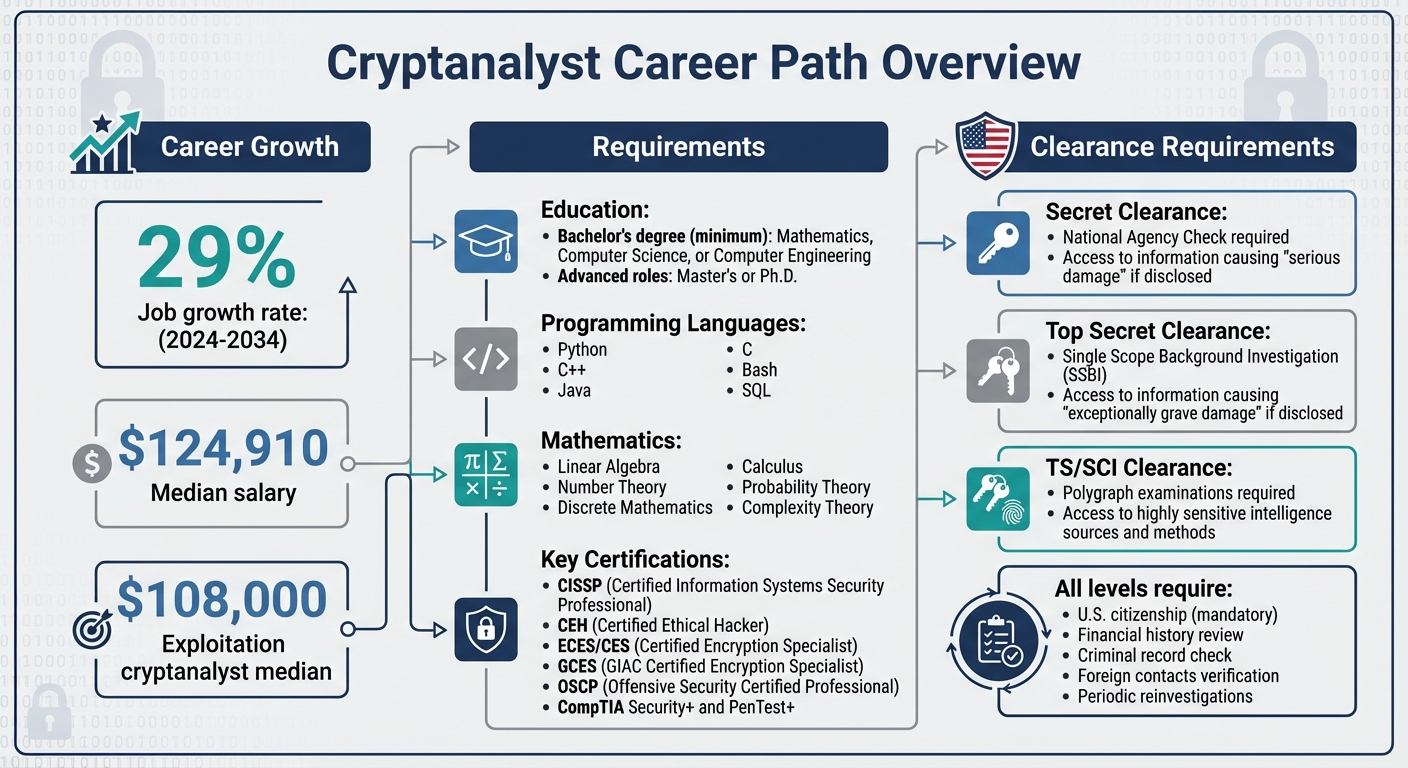
Cryptanalyst Career Requirements: Skills, Education, and Clearance Levels
What Are The Career Paths In Secure Cryptography? – Next LVL Programming
sbb-itb-bf7aa6b
What Cryptanalysts Do in Intelligence Roles
Cryptanalysts working in intelligence roles focus on decoding and analyzing encrypted communications from foreign governments, terrorist groups, and criminal organizations. Their mission is to uncover hidden information that informs high-stakes decisions for national security. These roles are designed specifically for security-clearance environments, where protecting sensitive information is a top priority.
Daily Cryptanalysis Tasks
On a typical day, cryptanalysts handle encrypted data collected through signals intelligence (SIGINT) operations. Their job involves analyzing these communications to identify weaknesses in encryption algorithms or errors in coding. Beyond cracking codes, they ensure data collection systems are running smoothly and evaluate the security of cryptographic systems to uncover vulnerabilities that could grant access to target networks. To do this, they often develop and test custom tools using programming languages like Python, C++, and Java.
For example, in January 2026, the NSA sought Exploitation Cryptanalysts at Fort Meade, MD. These professionals were tasked with diagnosing and exploiting encrypted material while debugging software to support national security. The role included participation in the Cryptanalysis Development Program (CADP), which required completing five tours of duty over three years. These assignments emphasized collaboration with analysts and engineers to tackle complex technical challenges.
| Role Component | Primary Tasks |
|---|---|
| Technical Analysis | Identifying weaknesses in algorithms; diagnosing software issues |
| Operational Support | Analyzing encrypted data; ensuring quality in data collection systems |
| Development | Creating and testing cryptanalysis tools; validating hypotheses with code |
| Collaboration | Sharing intelligence reports; working with joint operations teams |
Working with Intelligence Teams
Once technical findings are gathered, cryptanalysts collaborate with broader intelligence teams. They partner with intelligence analysts, cybersecurity experts, and operations staff to turn raw data into actionable insights. This involves applying mathematical and programming skills to sift through massive datasets, uncover adversarial networks, and identify potential vulnerabilities in target systems. These efforts directly support SIGINT missions, helping to track targets and exploit access points in critical infrastructure.
In law enforcement, cryptanalysts assist investigators by deciphering encrypted digital evidence and may even testify as expert witnesses in court. Some also bridge the gap between technical cryptanalysis and program management, ensuring that cryptanalytic capabilities align with project timelines and budgets. As Professor Neal Koblitz from the University of Washington explains:
Cryptography is part of the multidisciplinary field of computer security, where people who have studied computer science, engineering, or mathematics collaborate to solve multifaceted problems.
Required Skills and Tools for Cleared Cryptanalysts
Becoming a cleared cryptanalyst isn’t just about cracking codes – it’s a complex mix of mathematical expertise, programming skills, and the ability to adapt to emerging technologies. With advancements like quantum computing and new attack methods, staying ahead in this field requires constant learning and problem-solving.
Mathematics and Programming Skills
Cryptanalysts lean heavily on mathematics to expose vulnerabilities in encryption systems. Key areas include linear algebra, number theory, discrete mathematics, and calculus. Other essential topics include differential equations, matrix algebra, complexity theory, information theory, and probability theory. As QuickStart explains:
Cryptanalysts are expert mathematicians who can design, develop, and evaluate algorithms that can be used to decipher various number theory problems.
Programming skills are just as critical. Languages like Python, C, C++, and Java are used to write algorithms and debug encryption software. Scripting languages such as Bash and query tools like SQL help with automation and data handling. Cryptanalysts also need a deep understanding of computer architecture, data structures, network protocols (like TCP/IP), and operating systems such as Linux and Unix to uncover implementation flaws in cryptographic systems.
| Skill Category | Essential Technical Skills |
|---|---|
| Mathematics | Linear Algebra, Number Theory, Discrete Math, Calculus, Probability and Complexity Theory |
| Programming | Python, C, C++, Java, Bash, SQL |
| Technical Domains | Computer Architecture, Data Structures, Network Protocols, SIEM (e.g., Splunk) |
| Cryptanalysis | Algorithm Diagnosis, Side-Channel Analysis, Pattern Recognition, Debugging |
These skills form the backbone of a cryptanalyst’s toolkit, enabling them to tackle both theoretical and practical challenges.
Cryptanalysis Tools and Software
Cryptanalysts rely on specialized tools to perform their work effectively. For reverse engineering, Ghidra, developed by the NSA, is a go-to tool for analyzing compiled code and pinpointing cryptographic elements. Wireshark is widely used to intercept and analyze network traffic, helping cryptanalysts detect encrypted communication patterns.
To recover passwords or test brute-force attacks, tools like Hashcat and John the Ripper are indispensable. Aircrack-ng focuses specifically on breaking wireless encryption, such as WEP and WPA-PSK. For encoding, decoding, and lightweight cryptanalysis tasks, CyberChef, often dubbed the "Cyber Swiss Army Knife", is a versatile choice.
Other specialized tools include Cryptol, which evaluates how algorithms function within software, and CryptoBench, which performs cryptanalysis on messages encrypted with common algorithms. Volatility, a memory forensics tool, is used to extract encryption keys or plaintext data from RAM. The NSA Codebreaker Challenge offers hands-on experience with many of these tools, making it an excellent resource for those looking to sharpen their skills [3].
Analytical and Problem-Solving Abilities
While technical skills are essential, analytical thinking is what truly sets successful cryptanalysts apart. Pattern recognition enables them to identify hidden structures or coding systems in what might seem like random data. They must also be able to hypothesize about how encrypted data is structured, test these ideas through programming, and draw logical conclusions. As QuickStart puts it:
A cryptanalyst should have strong analytical skills, excellent problem-solving attitude, and creative mindset.
Creative thinking is especially important for tackling unconventional or unexpected problems. Cryptanalysts often have to reverse-engineer the encryption process by examining the encrypted message itself, piecing together the "internals" from external clues. Given the sensitive nature of their work, traits like ethical integrity and trustworthiness are non-negotiable. Intelligence agencies, including the NSA, actively seek out individuals with curiosity and a drive to learn – qualities that help cryptanalysts address national security challenges with precision and resourcefulness.
Education, Certifications, and Clearance Requirements
Entering the field of cryptanalysis within the intelligence community requires a strong educational background, relevant certifications, and proper security clearance. These elements are critical for success in roles that demand access to classified information. Here’s a closer look at these key qualifications.
Degree Requirements for Cryptanalysts
At a minimum, a bachelor’s degree in mathematics, computer science, or computer engineering is necessary for entry-level cryptanalyst positions. These fields equip you with the mathematical and programming expertise needed to break down complex encryption systems. For those aiming for senior or research-focused positions, advanced degrees such as a master’s or Ph.D. are often required. These qualifications pave the way for work in areas like algorithm development, quantum cryptanalysis, and academic research.
Proficiency in programming languages such as C, C++, Python, and Java is essential at every stage of education. This technical skill set is non-negotiable for tackling encryption challenges.
The demand for professionals in information security is on the rise. According to the U.S. Bureau of Labor Statistics, these roles are expected to grow by 28.5% through 2034. Median salaries for exploitation cryptanalysts were reported at $108,000 as of October 2025 [1][2]. A strong academic foundation not only prepares you for the technical aspects of the job but also boosts your competitiveness for roles requiring security clearance.
Certifications for Cleared Cryptanalysts
Certifications are another way to demonstrate your expertise and stand out in the field. Some of the most respected certifications for cryptanalysts include:
- EC-Council Certified Encryption Specialist (ECES/CES)
- Certified Information Systems Security Professional (CISSP)
- Certified Ethical Hacker (CEH)
- GIAC Certified Encryption Specialist (GCES)
- GIAC Penetration Tester (GPEN)
- GIAC Certified Intrusion Analyst (GCIA)
- CompTIA Security+ and PenTest+
- Offensive Security Certified Professional (OSCP)
Earning one or more of these certifications, in addition to your degree, can significantly boost your qualifications for intelligence roles that require clearance.
Security Clearance Requirements
Most cryptanalyst positions in intelligence demand a Secret, Top Secret, or Top Secret/Sensitive Compartmented Information (TS/SCI) clearance. These clearances grant access to classified information and are categorized based on the potential damage caused by unauthorized disclosure:
- Secret Clearance: Requires a National Agency Check and provides access to information that could cause serious damage if compromised.
- Top Secret Clearance: Involves a Single Scope Background Investigation (SSBI) and applies to information that could cause exceptionally grave damage.
- TS/SCI Clearance: Includes additional polygraph examinations and grants access to highly sensitive intelligence sources and methods.
Securing any of these clearances involves an extensive background check covering your financial history, criminal record, foreign contacts, and personal conduct. U.S. citizenship is mandatory, and maintaining clearance requires strict adherence to security protocols as well as periodic reinvestigations.
Because many employers look for candidates who already hold active clearances, obtaining one early in your career can give you a significant edge when pursuing roles in the intelligence sector. These clearances are not just a formality – they are a cornerstone of trust and reliability in sensitive operations.
Finding Cleared Cryptanalyst Jobs
The job market for cleared intelligence professionals operates differently than traditional career paths. Holding a clearance gives you access to specialized roles, but knowing where and how to search is key.
Using Cybersecjobs.com for Job Search

Cybersecjobs.com is a targeted platform designed for professionals with active clearances. Through the Quick Sign Up feature, you can upload your resume and make it accessible to employers actively seeking cleared candidates. This direct approach is especially effective in the intelligence field, where hiring managers prioritize applicants who already meet clearance requirements.
Take advantage of job alerts by using keywords like "cryptanalysis", "signals exploitation", or "cryptologic technician" to stay updated on relevant openings. You can also filter results by clearance level, location, and employer type. While many intelligence roles require on-site work in SCIFs (Sensitive Compartmented Information Facilities), some cyber intelligence analyst positions now offer remote or hybrid options, giving you more flexibility [5].
Cybersecjobs.com also organizes job fairs, connecting you directly with hiring managers from intelligence agencies and defense contractors. For example, nearly 45% of the 341 cyber intelligence analyst listings on the platform required TS/SCI with Polygraph clearance [5]. These events provide an excellent opportunity to showcase your qualifications and network with employers.
By leveraging these tools, you can secure a role that aligns with your skills and clearance, setting the foundation for future career growth.
Career Advancement Paths
As a cryptanalyst, your career typically progresses through several stages as you gain expertise. Entry-level roles focus on applying established decryption techniques and analyzing encrypted data under supervision. After three to five years, you can move into mid-level roles that demand more complex problem-solving and greater autonomy. For instance, Booz Allen Hamilton recently advertised a Cyber Intelligence Analyst, Mid position requiring four years of experience and a TS/SCI with Polygraph clearance, offering a salary range of $62,000 to $141,000 [5].
Senior cryptanalysts often transition into specialized research roles, tackling challenges like quantum-resistant encryption or developing new cryptanalytic techniques. Others move into leadership positions, managing analyst teams and coordinating projects across multiple agencies. As Booz Allen Hamilton highlights:
The problem facing the intelligence community (IC) is no longer how to get more data, it’s understanding how to turn the data they have into answers.
This shift underscores the growing demand for experienced cryptanalysts who can merge technical expertise with strategic thinking.
Military experience can also open doors. For example, the U.S. Navy’s Cryptologic Technician Interpretive (CTI) rating provides specialized training in foreign language communications and signals intelligence [4]. This blend of linguistic and technical skills complements civilian cryptanalyst credentials, offering an alternative pathway into intelligence roles.
As you build on your technical skills and leverage your clearance, you’ll not only advance in your career but also play a crucial role in shaping intelligence operations at a strategic level.
Conclusion
A career in cryptanalysis for cleared professionals combines technical expertise with strategic planning. To succeed, start with a solid background in mathematics or computer science and develop your programming skills in languages like Python, C++, and Java. Certifications such as the EC-Council Certified Encryption Specialist or CompTIA Security+ can help showcase your abilities.
Security clearance is a powerful asset in this field. With employment for information security professionals expected to grow by 29% through 2034 and median salaries reaching $124,910, the opportunities are plentiful [2]. Platforms like Cybersecjobs.com can help you connect with these opportunities – upload your resume, set up job alerts for cryptanalysis roles, and attend job fairs to engage directly with intelligence agencies and defense contractors. If you’re transitioning from a broader STEM background, programs like the NSA’s Cryptanalysis Development Program (CADP) offer structured training and rotational experiences to help you specialize.
Take action today by expanding your skills, earning relevant certifications, and leveraging your clearance. Explore advanced areas such as quantum cryptanalysis, blockchain security, or signals intelligence to position yourself for the next stage in your career.
FAQs
How do I get a security clearance for cryptanalyst roles?
To work as a cryptanalyst with a security clearance, there are some essential steps to follow. First, you must meet basic eligibility criteria: being a U.S. citizen, demonstrating loyalty to the country, and having a clean record – both criminal and financial. Additionally, a sponsoring employer, like a government agency or contractor, is necessary to start the clearance process.
The process begins with completing the SF-86 form, which collects detailed personal information. Afterward, you’ll go through an in-depth background investigation and an adjudication phase to determine your eligibility. Once granted, maintaining your clearance involves periodic reinvestigations and strict compliance with security protocols.
What should I study first if I’m new to cryptanalysis?
If you’re just stepping into the world of cryptanalysis, it’s important to begin with the fundamentals of cryptography and cryptanalysis. Dive into topics like encryption methods, different types of ciphers, and the techniques used to decode or analyze encrypted messages. A solid understanding of mathematics is crucial here – key areas include linear algebra, number theory, and calculus. Pursuing a bachelor’s degree in computer science or mathematics can help build the core skills you’ll need to excel in this field.
What’s the best way to find cleared cryptanalyst jobs?
The most effective way to discover cryptanalyst positions requiring clearance is by exploring job boards that specifically cater to security-cleared roles. Additionally, networking within the cybersecurity community that focuses on cleared professionals can reveal hidden opportunities. Use your security clearance as a key advantage when applying to positions with intelligence agencies or defense contractors. Make it a habit to frequently browse platforms dedicated to cleared jobs for the latest openings that match your skill set.