• Skip to primary navigation
  • Skip to main content
Cleared Cyber Security Jobs | CyberSecJobs.com

Cleared Cyber Security Jobs | CyberSecJobs.com

Cleared Cyber Security Jobs

  • Home
  • Search Cleared Cyber Jobs
  • Job Fairs
  • Career Resources

Uncategorized

Cleared Cyber Analyst Jobs at DIA Complete Guide

CyberSecJobs Editorial · April 9, 2026 ·

Looking to join the Defense Intelligence Agency (DIA) as a cyber analyst? Here’s what you need to know:

  • Role Overview: Cyber analysts protect classified networks, monitor for breaches, and mitigate vulnerabilities using tools like Splunk and CrowdStrike.
  • Pay and Demand: Median pay as of 2025 was $127,000, with demand for cybersecurity analysts projected to grow by 29% from 2024 to 2034.
  • Security Clearance: A TS/SCI clearance is mandatory, requiring a detailed background check, polygraph, and adjudication process (9–12 months on average).
  • Qualifications: A bachelor’s degree (e.g., Cybersecurity, Computer Science) and certifications like Security+ or CISSP are often required.
  • Application Process: Apply via USAJOBS with a tailored resume highlighting technical skills and measurable achievements.
  • Interview Prep: Expect technical assessments, scenario-based tasks, and behavioral questions. Familiarity with frameworks like MITRE ATT&CK is key.

This guide outlines everything from clearance requirements to interview tips to help you secure a DIA cyber analyst role. Ready to start your journey? Let’s dive into the details.
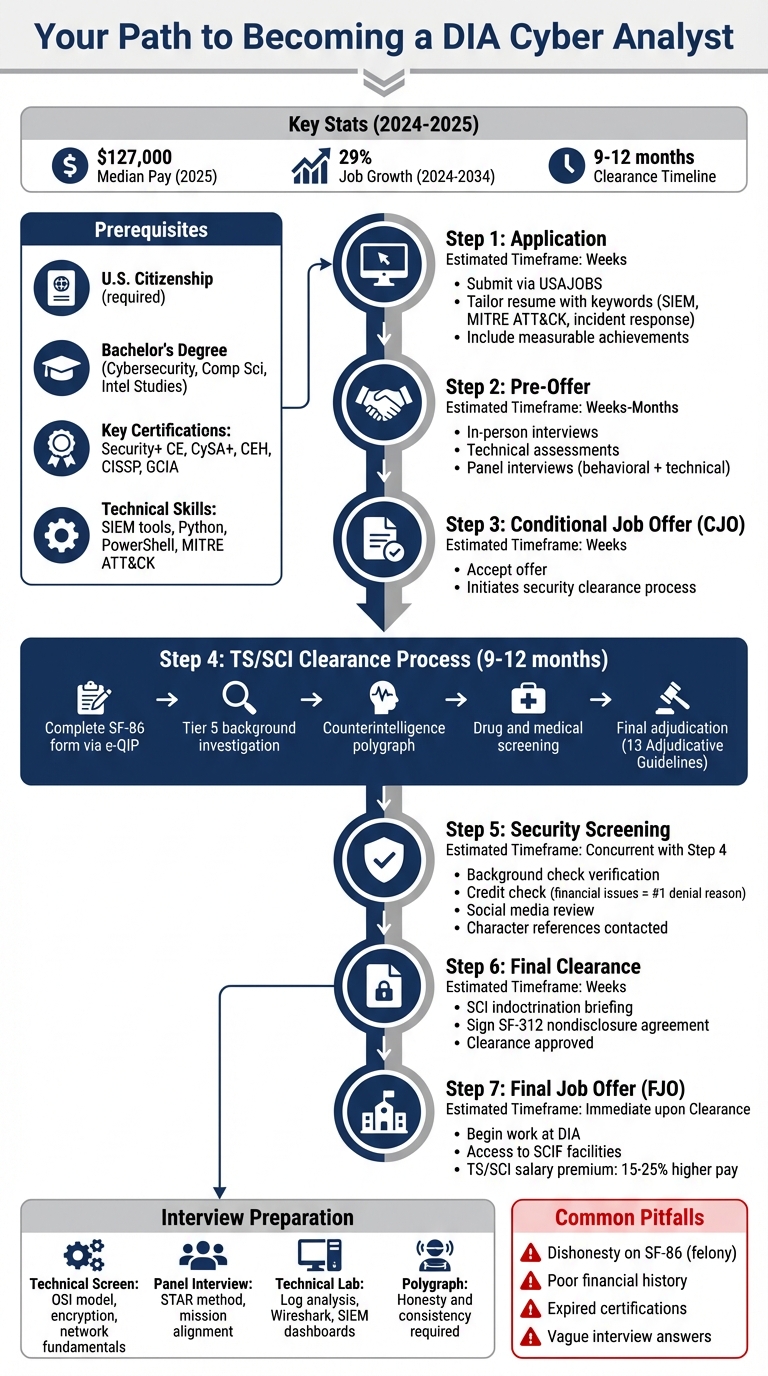
DIA Cyber Analyst Application Process Timeline and Requirements

DIA Cyber Analyst Application Process Timeline and Requirements

What Cyber Analysts Do at DIA

Main Job Duties

Cyber analysts at the Defense Intelligence Agency (DIA) play a critical role in protecting classified networks. They monitor network traffic using SIEM tools like Splunk, IBM QRadar, and Elastic SIEM to detect unusual activity. When anomalies arise, they investigate and prepare detailed incident response reports to document their findings and actions taken [1]. Their responsibilities also include installing and managing security tools such as firewalls and encryption software, addressing vulnerabilities before they can be exploited, and conducting regular risk assessments and penetration tests to uncover potential weaknesses in the system [1]. These efforts are vital to securing national intelligence data.

Another key aspect of their work involves transforming technical intelligence into reports that are useful for both technical teams and decision-makers [11]. To do this, they rely on threat intelligence platforms like Recorded Future, which processes billions of data points daily. Using frameworks like MITRE ATT&CK, CVE data, and the Diamond Model, analysts contextualize threats and recommend mitigation strategies [5][11]. Additionally, they develop and test disaster recovery plans to ensure the agency can bounce back after a cyberattack [10].

Work Environment at DIA

The work environment for cyber analysts at the DIA goes beyond technical tasks, emphasizing teamwork and ongoing learning. Analysts collaborate with intelligence professionals, subject matter experts, and external partners to ensure the accuracy and reliability of intelligence products [11]. They often work in blue teams, analyzing logs to distinguish between normal network activity and potential threats [10].

The DIA is also embracing advanced technology to strengthen its cybersecurity efforts. The agency is adopting an "AI-first" approach, using artificial intelligence tools to enhance threat analysis and ensure dependable cybersecurity outcomes [6]. Analysts have access to cutting-edge tools across different security domains and classification levels. These include endpoint detection and response platforms like CrowdStrike Falcon and SentinelOne, network traffic analysis tools like Wireshark and Zeek, and automation solutions such as Palo Alto Cortex XSOAR [7].

Next, we’ll explore the security clearance requirements needed for these roles.

sbb-itb-bf7aa6b

Security Clearance Requirements

What TS/SCI Clearance Means

TS/SCI, or Top Secret/Sensitive Compartmented Information, combines a Top Secret clearance with additional access authorization to highly compartmented intelligence, strictly restricted to those with a "need-to-know" basis [12][13][14]. This clearance is a must for cyber analyst roles at the Defense Intelligence Agency (DIA), as these roles involve working with intelligence that, if leaked, could cause "exceptionally grave damage" to national security [12][13]. Since the DIA is part of the 18-agency Intelligence Community, it handles classified sources, methods, and analysis processes that demand this level of security. Most of this work occurs in a Sensitive Compartmented Information Facility (SCIF), where electronic devices are strictly forbidden [12][14].

"SCI (Sensitive Compartmented Information) is not a clearance level – it is an access authorization applied on top of a Top Secret clearance." – ClearedJobs.Net [12]

U.S. citizenship is a non-negotiable requirement for TS/SCI roles at the DIA [14]. While the Department of Defense might occasionally allow non-citizens access to Secret-level information under rare circumstances, TS/SCI positions require full U.S. citizenship [14]. Additionally, individuals holding TS/SCI clearance often earn 15–25% more than their counterparts without clearance [12][13].

Understanding these requirements is crucial before diving into the clearance process.

How the Clearance Process Works

The clearance process kicks off once you accept a conditional job offer from the DIA. On average, the process takes between 9 to 12 months to complete [4][12][13].

The first step is completing the SF-86 form through the e-QIP system. This detailed questionnaire covers the past decade of your life, including addresses, employment, education, foreign contacts, and financial history [14][16]. Having all your documentation ready beforehand can help speed things along [14][16].

"Your character, conduct and discretion must be above reproach and you must have unquestioned loyalty to the United States." – Defense Intelligence Agency [2]

Next comes the Tier 5 background investigation. Investigators will verify your character and history by reaching out to friends, neighbors, former colleagues, and employers [13][14]. They may also review publicly available social media, following SEAD 5 guidelines [15]. Financial issues are the most common cause of clearance denials, so keeping your credit report clean and ensuring all taxes are filed and paid is critical [15][16].

A counterintelligence-scope polygraph examination is also required. This test focuses on topics like espionage, sabotage, terrorism, and unauthorized disclosures of classified information [14]. To perform well during the polygraph, stick to your normal routine. As Teresa Tennyson, a journalist and retired Army officer, advises, "The best way to pass any lie detector test is to not lie" [14].

After passing drug and medical screenings, your case goes to final adjudication. An adjudicator reviews all findings against the 13 Adjudicative Guidelines outlined in SEAD 4 to determine your eligibility [15]. Once approved, you’ll attend an indoctrination briefing for SCI access and sign a nondisclosure agreement (SF-312) [12]. It’s important to note that dishonesty or omission of information on the SF-86 is a felony and a common reason for clearance disqualification [14][15]. This thorough process ensures that only those who meet the highest standards of trustworthiness are granted access to the nation’s most sensitive intelligence.

Once your clearance is finalized, the next step is preparing your application and interview for a DIA cyber analyst position.

Required Qualifications, Skills, and Certifications

Education and Experience Requirements

For roles as a DIA cyber analyst, a bachelor’s degree in fields like Cybersecurity, Computer Science, Intelligence Studies, or Technology is typically required [8][9]. However, the agency also values non-traditional career paths and unique experiences [17]. Highlighting how your background – whether conventional or unconventional – equips you to tackle advanced threats can make your application stand out. According to the U.S. Bureau of Labor Statistics, the demand for cybersecurity professionals is anticipated to grow by 33% through 2030 [17].

Besides academic qualifications, technical expertise plays a critical role in distinguishing candidates.

Technical Skills You Need

While a degree is important, technical know-how is what truly sets candidates apart. DIA cyber analysts must excel in several key areas, including coding, intrusion detection and prevention systems, understanding attack methods, security operations, and incident response technologies [17]. Building hands-on experience with tools like Wireshark, Splunk, and scripting languages such as Python and PowerShell is highly recommended [19][21].

"Cyber threat intelligence analysts play an indispensable role in helping organizations understand their threat landscape and protect themselves from risk." – Flashpoint [17]

To succeed, you’ll need to master strategic, operational, and tactical skills to analyze threat actor tactics, techniques, and procedures (TTPs) [17]. Given the constantly shifting nature of cyber threats, continual skill development is a must.

Top Certifications for DIA Roles

DIA cyber analysts must comply with the Department of Defense Directive (DoDD) 8140, which outlines mandatory certifications for individuals with privileged access to DoD information systems [18][20]. These certifications are categorized by job functions, including Information Assurance Technical (IAT), Information Assurance Management (IAM), and Cybersecurity Service Provider (CSSP) [18][20].

Certification Issuing Body Focus Areas Experience Level DIA/DoD Relevance
Security+ CE CompTIA Foundational security, troubleshooting Entry/Mid Standard for IAT Level II roles
CySA+ CompTIA Threat hunting, incident response Mid Approved for CSSP Analyst & Incident Responder
CEH EC-Council Offensive tactics, vulnerability scanning Mid Core requirement for CSSP Analyst roles
CISSP ISC2 Security engineering, risk management Senior Required for IAM Level III (Management)
GCIA GIAC Intrusion analysis, network traffic Intermediate Specialized for CSSP Analyst roles

If you’re just starting, focus on earning the CompTIA Security+ certification, as it’s often required for IAT Level II roles [20]. For analyst-specific positions, certifications like CEH, CySA+, or GCIA – under the CSSP Analyst category – are highly relevant [18][20]. Keep in mind, certifications must remain active. Expired certifications can disqualify candidates from working on cleared federal projects. For instance, CompTIA certifications like Security+ need renewal every three years [20].

"Certifications aren’t just ‘nice to have’ – they’re often mandatory. Cyber threats are growing, and hiring someone without the right skills and credentials can delay projects or even put national security at risk." – CCS Global Tech [20]

How to Apply for DIA Cyber Analyst Jobs

Applying Through USAJOBS

USAJOBS

To land a DIA cyber analyst position, start with USAJOBS, the main platform for federal job applications. Create a detailed profile and craft a resume tailored to the job posting. Use specific keywords like "SIEM," "MITRE ATT&CK," and "incident response" to ensure your resume passes Applicant Tracking Systems (ATS) [23].

Focus on showcasing measurable accomplishments instead of listing generic responsibilities. For instance, replace "responsible for incident response" with specifics like "reduced incident response times by 20%" or "mitigated over 200 phishing attempts monthly" [23]. Highlight expertise in government frameworks such as NIST 800-53 and DISA STIGs. Use clean, professional formatting – fonts like Calibri or Arial – and save your resume as a PDF to ensure it looks polished [23].

Once your application is submitted, the hiring process follows several structured steps.

Security Screening and Hiring Steps

After receiving a Conditional Job Offer (CJO), you’ll undergo a multi-stage security screening process, including a background check, polygraph, drug testing, and medical exams. These steps are in place to ensure candidates meet strict qualifications for handling sensitive national security information.

Hiring Stage Key Components
Application Submit via USAJOBS, tailor your resume, and pass the initial screening.
Pre-Offer Participate in in-person interviews and technical assessments.
Conditional Offer Accept the CJO, which initiates the security clearance process.
Security Screening Undergo a background investigation, TS/SCI adjudication, and polygraph.
Medical & Suitability Complete drug testing, medical exams, and credit checks.
Final Decision Receive either a Final Job Offer (FJO) or a negative determination.

Be prepared for potential delays, especially during the adjudication phase. Some candidates report waiting five to six months after the initial investigation for SCI access [3]. As one applicant, Wombat_in_Combat, shared:

"The security office does not communicate where you are in the process with the hiring staff or managers, their current workload, or timelines" [3].

If you encounter delays, reach out to DIA Personnel Security (PERSEC) or the ODNI Scattered Castles hotline to check your clearance status [3].

Using Cleared Cyber Security Jobs to Find Opportunities

In addition to USAJOBS, consider using platforms like Cleared Cyber Security Jobs to simplify your search for DIA roles. This site offers filters tailored to clearance levels such as "TS/SCI + CI Poly," which are essential for DIA cyber analyst positions [22]. You can set up job alerts to receive notifications about relevant openings and upload your resume to make it easily accessible to recruiters [24]. Since the platform focuses solely on positions requiring security clearances, it eliminates irrelevant listings and connects you directly with employers hiring for these specialized roles.

Next, we’ll dive into how to prepare for the DIA interview process.

Preparing for DIA Interviews

What to Expect in Interviews

Once you’ve made it through the application process, it’s time to prepare for the DIA interviews. These interviews are designed to evaluate both your technical expertise and your ability to communicate effectively. You’ll face questions on network fundamentals – think firewall types, segmentation strategies, and practical applications of the OSI model. Be ready to clearly explain the steps of the incident response lifecycle, covering everything from preparation and detection to containment, eradication, recovery, and post-incident review.

You’ll also encounter questions on the MITRE ATT&CK framework and need to distinguish between tactical and strategic threat intelligence. Familiarity with tools like SIEM platforms (e.g., Splunk or Microsoft Sentinel), EDR solutions (like CrowdStrike or Carbon Black), and network analysis tools (such as Wireshark or Snort) is essential. Additionally, you should be able to explain encryption methods, hashing, and their appropriate use cases.

Real-world examples are key. Grace Abrams, a hiring manager, highlights the importance of layered defense strategies:

"A secure network architecture consists of several key components that work together… I like to think of it as a multi-layered approach that ensures a robust defense against potential threats."

Prepare specific examples of times you’ve identified vulnerabilities, reduced incident response times, or simplified technical issues for non-technical leadership. If you’re unsure of an answer during the interview, admit it honestly and explain how you’d research the solution instead of making guesses.

You may also face tabletop exercises where you’ll walk through hypothetical scenarios like a DDoS attack, phishing campaign, or zero-day exploit. These exercises test your ability to prioritize actions, contain threats without disrupting operations, and conduct root cause analysis. A solid understanding of the CIA triad – confidentiality, integrity, and availability – is crucial, as this framework underpins information security decisions across the intelligence community.

Interview Stages and Preparation Tips

DIA interviews are structured to assess different competencies at each stage. Here’s a breakdown of what to expect:

Interview Stage Focus Preparation Tip Common Pitfall
Technical Screen Core knowledge (OSI model, encryption, tools) Review basics like common port numbers and key definitions. Giving vague or overly "textbook" answers without context.
Panel Interview Behavioral fit and communication Use the STAR method (Situation, Task, Action, Result) to frame responses. Failing to show how your work aligns with the agency’s mission.
Technical Lab/Scenario Hands-on skills (log analysis, packet capture) Practice with tools like Wireshark and SIEM dashboards. Document your process clearly. Rushing through tasks without showing your thought process.
Polygraph Exam Integrity and security clearance Be honest and consistent throughout the exam. Trying to "outsmart" the exam or being evasive.

During the technical screen, you’ll need to explain foundational concepts like network protocols, the differences between IDS and IPS, and attack vectors such as Man-in-the-Middle, Cross-Site Scripting, and brute-force attacks. Focus on explaining these ideas clearly, not just reciting definitions.

The panel interview will dive into behavioral scenarios, emphasizing how your experience supports the DIA’s mission. Practice discussing situations where you communicated technical issues to leadership, resolved team conflicts, or handled sensitive information under pressure. The ability to translate technical jargon into plain language for non-technical stakeholders is highly valued. Tailor your responses to reflect the agency’s role in national security.

In the technical lab or scenario, you’ll be expected to analyze logs, investigate network traffic, or respond to a simulated incident. Take your time documenting your methodology as you work – interviewers want to see how you approach problems, not just whether you arrive at the correct answer.

Finally, the polygraph exam is all about integrity. Be truthful and consistent, as this stage is designed to confirm your suitability for handling classified information, not to trip you up.

Final Thoughts

Achieving a role as a cleared cyber analyst at the DIA requires careful planning and dedication. From meeting stringent clearance standards to honing technical skills, every step plays a crucial part in your preparation.

Obtaining a TS/SCI clearance is a critical component. This clearance mandates a spotless background, which includes maintaining clean credit records and demonstrating financial responsibility. The process itself is thorough, involving polygraph exams, drug tests, and in-depth background checks. Be ready for a lengthy and meticulous vetting process that can take several months to complete.

On the technical side, earning certifications like CompTIA Security+, GIAC GSEC, or CISSP can validate your expertise and help fill any gaps in experience. While 61% of cybersecurity analysts hold a bachelor’s degree [1], certifications ensure your skills remain sharp and up to date. Additionally, proficiency in programming languages such as Python, JavaScript, or C/C++ can set you apart in technical roles [1].

The application process and interviews are equally demanding. Expect multiple evaluation rounds designed to test your technical knowledge and communication skills. Clear, confident communication is just as important as technical expertise during these stages.

Platforms like Cleared Cyber Security Jobs simplify the job search for professionals with security clearances. Instead of combing through generic job boards, you can focus on positions specifically requiring clearances, such as those at the DIA. This platform offers free tools like job alerts, resume uploads, and career resources tailored to the cleared community. By using these resources, you can streamline your journey from obtaining certifications to landing your dream role at the DIA.

FAQs

Can I apply if I don’t already have TS/SCI?

To qualify for a cleared cyber analyst position at the DIA, you must already hold a TS/SCI clearance. This clearance is a fundamental requirement for these roles and is non-negotiable.

What issues most often delay or derail TS/SCI approval?

The delays in obtaining TS/SCI approval often arise from the intricate nature of the adjudication process. Common issues include cases with past drug use, financial complications, or incomplete and inconsistent submissions. Additionally, external events, such as public security incidents or high-profile cases, can lead to heightened scrutiny and create backlogs. When deeper investigations or additional clarifications are required, the process can extend to a year or even longer.

How can I build DIA-relevant experience without prior intel work?

To prepare for a role at the Defense Intelligence Agency (DIA), focus on building transferable cybersecurity skills and earning certifications that are highly regarded in the intelligence community. Key areas to prioritize include collection management, tradecraft, and fundamental cybersecurity principles like auditing and analysis.

By pursuing certifications and training relevant to the field, you not only demonstrate your commitment but also make up for any lack of direct intelligence experience. Developing expertise in defense-oriented skills is a critical step toward being ready for DIA opportunities.
Related Blog Posts

  • Threat Intelligence Analyst Career Path for Cleared Professionals
  • Cryptanalyst Career Path for Cleared Intelligence Professionals
  • Cleared SOC Analyst Jobs Complete Career Guide
  • Cleared Cyber Analyst Jobs at CIA Complete Guide

Cleared Cyber Analyst Jobs at FBI Complete Guide

CyberSecJobs Editorial · April 9, 2026 ·

Want to join the FBI as a Cyber Analyst? Here’s what you need to know:

  • Role Overview: FBI Cyber Analysts protect national security by analyzing threats like malware, cyberattacks, and espionage. These positions require strong technical and analytical skills.
  • Qualifications: A bachelor’s degree in computer science, IT, or related fields with a minimum 3.0 GPA is required. Certifications like CISSP, CEH, or CompTIA Security+ can strengthen your application.
  • Clearance: Applicants must obtain Top Secret clearance with SCI access, involving a thorough background check, polygraph, and continuous vetting.
  • Application Process: Jobs are listed on USAJobs. The hiring process includes multiple testing phases, interviews, and can take 6-18 months.
  • Career Growth: Opportunities include roles in specialized teams like the Cyber Action Team, or advancing to senior analyst or Special Agent positions.

Key Takeaway: The path to becoming an FBI Cyber Analyst is challenging but rewarding, with opportunities to make a real impact on national security.

Life on an FBI Cyber Squad: An Insider’s Look into Technical Career Paths at the FBI

FBI

sbb-itb-bf7aa6b

Security Clearance Requirements

FBI cyber analyst roles come with a critical requirement: Top Secret clearance with Sensitive Compartmented Information (SCI) access. Mishandling this level of classified information could severely jeopardize national security [4]. This clearance allows unescorted access to FBI facilities and highly sensitive intelligence. Interestingly, out of the approximately 4.3 million Americans holding security clearances, nearly 85% work under the Department of Defense [5][6].

Top Secret and SCI Clearance Levels

The FBI uses three main clearance levels, each tied to the potential damage caused by unauthorized disclosure:

  • Confidential: Protects information that could cause "damage" if disclosed. Requires reinvestigation every 15 years.
  • Secret: Covers information that could cause "serious damage" and is reinvestigated every 10 years.
  • Top Secret: Reserved for information that could cause "grave damage." This level requires a thorough background investigation spanning the last 10 years, with reinvestigation every five years [4].

SCI, while not a separate clearance, refers to intelligence-related methods and sources. It’s typically granted to those with Top Secret clearance after completing the rigorous Single Scope Background Investigation. As FBI.gov explains, "A Top Secret clearance may be granted to those persons who have a ‘need-to-know’ national security information, classified up to the Top Secret level, and who need unescorted access to FBI facilities" [4].

With the clearance levels outlined, the next step is understanding how to navigate the complex process of obtaining a Top Secret clearance.

How the Clearance Process Works

The clearance process kicks off only after you receive and accept a conditional job offer from the FBI – this isn’t something you can start on your own [7][9]. After accepting the offer, you’ll complete the SF-86 form through the "eApp" portal, detailing your personal history over the past decade. From there, the process includes digital fingerprinting, criminal background checks, and a Tier 5 (Single Scope) investigation. This investigation involves in-person interviews with people like your neighbors, coworkers, and personal references. Additionally, a counterintelligence-scope polygraph examines areas such as criminal activity, drug use, and espionage [7][8].

The FBI aims to process Top Secret clearances within 6 to 9 months. However, positions requiring polygraphs often face delays, extending the timeline to anywhere from 180 days to over a year due to appointment backlogs [4][7]. Your case file is reviewed against 13 Adjudicative Guidelines using a "whole-person concept", which evaluates your overall eligibility. Once granted, your clearance is maintained through Continuous Vetting, a system that monitors criminal records, financial activity, and travel in real time [7].

What Can Disqualify You from Getting Clearance

Even with a thorough clearance process, certain factors can result in denial.

One of the most common issues is financial irresponsibility. This includes significant credit problems, defaulted loans, unpaid taxes, or overdue child support [7][9]. Despite state-level legalization, marijuana use remains a federal disqualifier [7][9].

Errors or omissions on the SF-86 form are another major pitfall. As Kevin James puts it, "Falsification on the SF-86, even on a minor point, is often the most easily preventable yet fatal mistake. Candor is paramount" [7]. Even small inconsistencies can lead to denial under the "Personal Conduct" guideline. The U.S. Intelligence Community stresses, "Your character, conduct and discretion must be above reproach and you must have unquestioned loyalty to the United States" [8].

Additional disqualifiers include:

  • Felony convictions
  • Ties to organizations seeking to overthrow the U.S. government
  • Failure to register with the Selective Service System (for eligible males)
  • Close relationships with foreign nationals or foreign business dealings
  • Refusing a drug test or failing the polygraph exam [7][8][9]

For cybersecurity positions, adjudicators are increasingly scrutinizing digital footprints. This includes GitHub contributions, forum activity, and social media posts, looking for signs of poor judgment [7].

Meeting these stringent requirements is a pivotal step in becoming an FBI cyber analyst.

Required Qualifications and Skills

FBI cyber analyst roles demand specific education and technical expertise to meet the agency’s high standards.

Education and Experience Requirements

To qualify for these roles, candidates must hold a bachelor’s degree or higher from an accredited U.S. institution in fields like computer science, engineering, information systems, mathematics, operations research, statistics, or related areas [1][2]. Applicants must also maintain a 3.0 cumulative GPA throughout the application process [11]. As the FBI Jacksonville Field Office puts it:

"In today’s complex world, a degree in criminal justice doesn’t meet any of our hiring needs" [11].

Alternatively, candidates may qualify with 24 to 30 credit hours in the approved fields [1][2]. For Digital Forensic Examiner positions, at least 24 credit hours in computer science, engineering, digital forensics, or IT are required. Another pathway is having four years of full-time professional experience in digital forensics [14].

Role Minimum Education Preferred Degree Fields
Computer Scientist Bachelor’s Degree Computer Science, Engineering, Information Science [1]
IT Specialist Bachelor’s Degree Computer Science, Information Systems [2]
Digital Forensic Examiner Bachelor’s (24+ tech credits) Digital Forensics, IT, Engineering, Math [2]
Data Analyst Bachelor’s Degree Statistics, Data Science, Mathematics [1][12]

In addition to academic qualifications, certifications play a key role in demonstrating expertise.

Certifications the FBI Values

Industry-recognized certifications can significantly strengthen a candidate’s profile, especially for specialized roles like Digital Forensic Examiner [14]. Key certifications for cybersecurity positions include:

  • CompTIA Security+
  • Certified Ethical Hacker (CEH)
  • Certified Information Systems Security Professional (CISSP) [2][15]

Networking specialists benefit from certifications like Cisco Certified Network Associate (CCNA) or advanced credentials such as CCNP Security [13]. For those in forensic accounting, certifications like Certified Public Accountant (CPA), Certified Fraud Examiner (CFE), and Certified in Financial Forensics (CFF) are highly valued [14]. Newly hired forensic accountants also undergo a five-week Forensic Accountant Core Training Session at the FBI Academy in Quantico, Virginia [14].

Camila Rojas, a Forensic Examiner and Cryptanalyst at the FBI, highlighted the importance of FBI-provided training:

"My proudest achievement with the Bureau would be my first court testimony… It was a combination of hard work and also the great training that the FBI offered" [14].

These certifications and training opportunities ensure professionals are well-prepared for their roles.

Technical and Professional Skills

Beyond education and certifications, FBI cyber analysts must excel in both technical and professional skills. On the technical side, expertise in digital forensics, network security, system integration, and encryption is critical [1][2]. Analysts are tasked with combating malware, investigating computer intrusions, and tracking international cyber threats [1]. They also handle evidence from diverse sources, including mobile devices, drones, and security cameras [2].

Strong communication skills are equally important. Analysts write detailed technical reports and deliver presentations to law enforcement partners and private organizations [2][3]. As FBI Jobs explains:

"Our technology careers are the backbone of many key functions relating to security, system capabilities, and the investigative work at the FBI" [2].

Key professional skills include critical thinking, attention to detail, and the ability to simplify complex technical ideas for non-technical audiences [2].

Skill Category Essential Technical Skills Essential Professional Skills
Cyber Defense Malware analysis, encryption, network security Critical thinking, problem-solving
Forensics Digital evidence preservation, mobile/drone forensics Attention to detail, reporting
Data Analysis Data mining, vulnerability assessment, risk management Logical reasoning, trend identification
Operations System integration, architectural design, troubleshooting Collaboration, interpersonal ability

With cybersecurity jobs projected to grow by 33% through 2033, meeting these qualifications can give candidates a competitive edge in pursuing FBI roles [2].

How to Apply for FBI Cyber Analyst Jobs

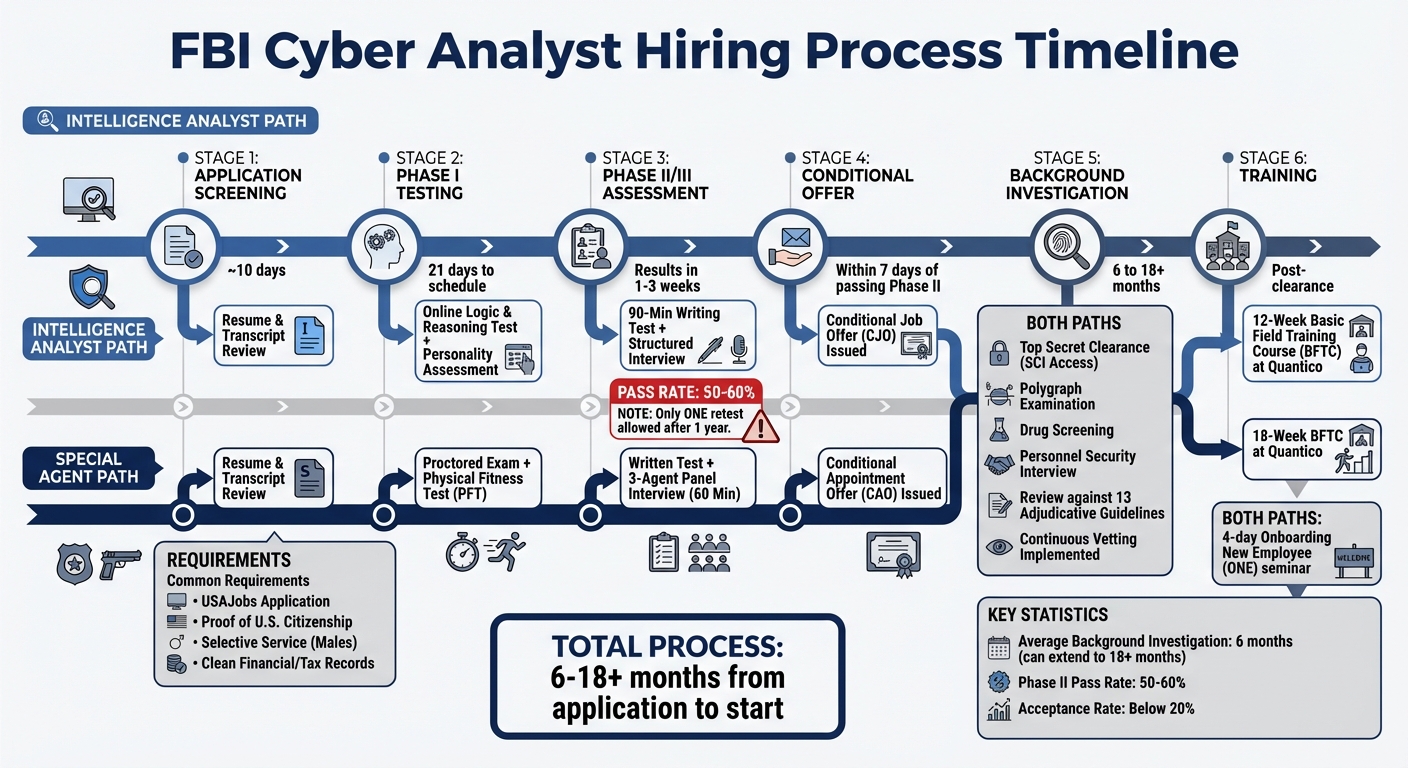
FBI Cyber Analyst Hiring Process Timeline and Requirements

FBI Cyber Analyst Hiring Process Timeline and Requirements

Getting through the FBI’s application process takes time and careful preparation, as the hiring process can stretch beyond a year [16]. Knowing the steps involved can help you stay on track and meet key deadlines.

Applying Through USAJobs

USAJobs

All FBI cyber analyst job openings are listed exclusively on USAJobs, the federal government’s official job site. Crafting a federal resume is different from creating a standard one – you’ll need to include detailed information about your education, work experience, and security clearance eligibility. Along with your application, you must provide proof of U.S. citizenship, Selective Service registration (for male applicants), and confirm your compliance with student loan obligations, federal and state taxes, and any court-ordered child support [10].

Once your application is submitted, the FBI typically takes about 10 days to determine if you meet the minimum qualifications [16]. If you pass this step, you’ll receive an invitation to Phase I testing, which you must schedule and complete within 21 days [16]. Before applying, it’s critical to ensure you meet the FBI’s suitability standards, which include adherence to the FBI drug policy and a clean record with no felony convictions – failing to meet these standards results in immediate disqualification [10]. From there, candidates move through a structured series of tests and interviews.

The FBI Hiring Process Timeline

After the application and initial testing, the hiring process continues in clearly defined stages. The FBI has separate hiring tracks for Intelligence Analysts and Special Agents with a cyber focus, and each track has its own set of tests and timelines.

For Intelligence Analysts, the process includes:

  • A Phase I online test that evaluates logic-based reasoning and personality traits.
  • A Phase II timed writing test, which simulates reviewing intelligence reports.
  • A Phase III structured interview to gauge communication abilities [3, 19].

Special Agent candidates follow a different path:

  • A proctored Phase I exam.
  • A Physical Fitness Test (PFT).
  • A Phase II written assessment and structured interview, conducted by a panel of three agents [16].

"The average background investigation takes approximately six months, but can take 18 months or more depending on where you have lived, worked, and traveled." – FBIJOBS [16]

If you successfully complete these steps, you’ll receive either a Conditional Job Offer (CJO) as an Intelligence Analyst or a Conditional Appointment Offer (CAO) as a Special Agent. These offers are typically issued within seven days of passing Phase II [3, 19]. However, the offer is contingent on passing a detailed background investigation, which includes a polygraph test, drug screening, and a personnel security interview. While this process usually takes about six months, it can extend to 18 months or longer in some cases [3, 19].

Here’s a quick breakdown of the key hiring stages for cyber analyst roles:

Hiring Stage Intelligence Analyst Path Special Agent Cyber Path Typical Timeline
Application Screening Resume and transcript review Resume and transcript review ~10 days [16]
Phase I Testing Online logic and reasoning Proctored exam + PFT 21 days to schedule [16]
Phase II/III Writing test + structured interview Written test + 3-agent interview Results in 1–3 weeks [16]
Conditional Offer CJO issued CAO issued Within 7 days [3, 19]
Background Check Polygraph, drug test, security interview Polygraph, drug test, medical review 6 to 18+ months [3, 19]
Training 12-week BFTC at Quantico 18-week BFTC at Quantico Post-clearance [3, 19]

Once cleared, Intelligence Analysts attend a 12-week Basic Field Training Course (BFTC) at the FBI Academy in Quantico, while Special Agents undergo an 18-week training program [3, 19]. Intelligence Analyst candidates must also agree to a mobility agreement, which allows the FBI to assign them to headquarters or any field office as needed [3]. Additionally, all new hires participate in a four-day Onboarding New Employee (ONE) seminar at Quantico during their first week to get acquainted with the FBI’s mission and culture [3].

How to Prepare for FBI Interviews

After navigating the rigorous qualification and clearance steps, preparing for the FBI interview is your final hurdle toward becoming a cyber analyst. The interview process is designed to test both your technical expertise and your behavioral readiness. With a reported pass rate of 50% to 60% for the Phase 2 assessment and only one retest opportunity allowed (a year after the original interview), thorough preparation is non-negotiable [17].

Preparing for Technical Tests

The 90-minute writing assessment challenges you to analyze a scenario and craft a concise, objective report that integrates multiple data points [17]. Your task is to identify relevant details while discarding irrelevant ones, all while maintaining a formal tone devoid of personal opinions or speculation [17]. Since there’s no spellcheck, practice writing reports manually to ensure your grammar, spelling, and punctuation are flawless [17].

"Your writing will be evaluated based on clarity, grammar, structure, coherence, and your ability to distinguish between relevant and irrelevant details – skills that are crucial in real-world FBI reports." – JobTestPrep [17]

For cyber-focused roles, hone your ability to tackle scenario-based problems like analyzing malware alerts, studying network traffic patterns, and setting up firewall rules [18]. Simulating a malware attack response can help you refine your triaging and threat mitigation skills [18]. If you’re aiming for a security engineering role, ensure you’re comfortable with Python and adept at conducting root cause analyses for incident investigations [18].

Once you’ve mastered technical reporting and problem-solving, the next step is preparing for the live panel interview to showcase your behavioral qualifications.

Showing You’re Ready for Clearance Work

Beyond technical know-how, you’ll need to demonstrate that you’re prepared to work in a high-security clearance environment. The 60-minute structured panel interview, a pivotal component of the FBI Phase 2 assessment, is conducted by three Special Agents who evaluate you on eight key competencies: Collaboration, Communication, Flexibility and Adaptability, Initiative, Interpersonal Ability, Leadership, Organization and Planning, and Problem Solving and Judgment [17]. Use the STAR method (Situation, Task, Action, Result) to prepare examples that highlight how you’ve handled ethical dilemmas, resolved conflicts, and performed under pressure [17].

Additionally, get ready for the Personnel Security Interview by organizing a detailed timeline of your employment history, foreign travel, and financial background [16]. Tailor your responses to emphasize your dedication to public service and alignment with the FBI’s mission, steering away from any focus on corporate interests [3].

"The FBI Phase 2 interview is known to be one of the most challenging parts of the hiring process. It’s a high-pressure, in-person panel interview conducted by three Special Agents trained to assess your behavioral competencies under stress." – JobTestPrep [17]

Career Advancement Opportunities

Becoming an FBI cyber analyst opens the door to a variety of career growth paths. Most cyber-related roles follow the General Schedule (GS) pay scale. Entry-level positions typically start at GS-7 or GS-9, mid-level roles are at GS-11 or GS-12, and senior positions can reach GS-13 [1]. For instance, Data Analysts progress from GS-7/9 to GS-13, with median salaries ranging from $107,000 to $113,000 [1][2]. These opportunities reward not only technical skills but also leadership and strategic abilities, paving the way for specialized team roles.

Moving Up to Senior Analyst Positions

Advancing in this field often requires focusing on specific areas of expertise. Intelligence Analysts, for example, can specialize in one of five key functions: Threat Analysis, Collection Management, Domain Analysis, Targeting Analysis, or Reports Management [3]. Each area demands unique skills, such as evaluating real-time threats or distributing raw intelligence to the right teams. To support career growth, the FBI’s Data Analytics Support Hub (DASH) provides mentorship and an annual training stipend for data analysts and scientists [1].

Some professionals may choose to transition into tactical roles, such as Staff Operations Specialist or Tactical Specialist, where they provide direct support during field investigations [3]. Alternatively, career paths can lead to becoming a Special Agent, where responsibilities include investigating cyber threats firsthand and testifying in court. However, applicants for Special Agent roles must meet the age requirement of 23 to 36 years old [2][3].

Working on FBI Cyber Action Teams

For those drawn to fast-paced environments, joining the Cyber Action Team (CAT) is a prestigious option. This elite group is deployed nationwide within hours of a significant cyber incident, offering both investigative and technical expertise on-site [19]. The FBI also maintains dedicated cyber squads in all 56 field offices, ensuring comprehensive coverage across the country [19].

Beyond CAT, opportunities exist with CyWatch, the FBI’s 24/7 operations center that monitors and coordinates responses to cyber incidents in real time [19]. Analysts interested in international collaboration can serve as Cyber Assistant Law Enforcement Attachés at U.S. embassies, working with global partners to address transnational threats [19]. Another option is joining the National Cyber Investigative Joint Task Force (NCIJTF), a collaborative effort involving over 30 co-located agencies from law enforcement and the intelligence community [19]. Participating in these specialized teams not only advances your career but also strengthens your role in the FBI’s cybersecurity mission.

"It allows you to touch on… multiple cases on your particular squad, so you’re not limited or relegated to a single case or two cases. At the same time, there’s really never a dull moment." – Jagdeep Singh Narula, Intelligence Analyst, FBI [3]

Conclusion

Becoming an FBI cyber analyst is no small feat – it requires dedication, preparation, and a commitment to excellence. To qualify, you’ll need to meet stringent eligibility criteria: U.S. citizenship, a spotless record, and adherence to the FBI’s drug policies [2]. Academically, a bachelor’s degree in a STEM field like computer science or information technology lays the groundwork, followed by a rigorous multi-phase selection process designed to test your analytical thinking, writing ability, and other key skills [3].

The path to joining the FBI is lengthy, often taking up to a year. With an acceptance rate below 20%, the process includes securing Top Secret clearance through an exhaustive background investigation after receiving a Conditional Offer [2][3]. Once cleared, you’ll undergo specialized training at the FBI Academy to prepare for the challenges ahead.

Inside the Bureau, the career possibilities are both diverse and impactful. From roles in Threat Analysis and Collection Management to joining elite groups like the Cyber Action Team or even transitioning into Special Agent positions, the opportunities are vast [3][19]. But beyond the variety, the work carries a profound sense of purpose. As FBI Intelligence Analyst Jagdeep Singh Narula explains:

"It’s about helping Americans stay safe. So that, you know, it gives me a lot of fulfillment knowing that my work actually matters" [3].

This sentiment underscores the meaningful nature of the role, where every effort contributes to protecting the nation.

FAQs

Can I apply if I don’t already have a Top Secret/SCI clearance?

Yes, you can apply for cyber analyst roles at the FBI even if you don’t already have a Top Secret/SCI clearance. If you’re offered the job, the FBI will start the security clearance process as part of your hiring procedure.

How strict is the FBI on past marijuana use, debt, or foreign contacts?

The FBI enforces strict guidelines when it comes to past marijuana use, financial responsibilities, and foreign associations. Applicants must not have used marijuana in any form within one year prior to applying. Financial concerns, such as defaulting on student loans or failing to pay child support, can lead to disqualification. Additionally, foreign connections, whether through family ties or financial interests, undergo thorough scrutiny. These factors can affect security clearance if they are not fully disclosed or adequately addressed during the background investigation.

What can I do now to improve my chances before applying?

If you’re aiming for a role as an FBI cyber analyst, it’s all about honing the right skills, earning relevant certifications, and deepening your knowledge. Start by familiarizing yourself with the FBI’s mission and its focus on combating cyber threats.

To stand out, consider earning cybersecurity certifications like CompTIA Security+ or Certified Information Systems Security Professional (CISSP). These can demonstrate your technical expertise. Sharpen your skills in threat analysis and ensure you stay current on the latest security practices and trends in the industry.

Finally, prepare thoroughly for FBI assessments and tailor your application to meet their specific requirements. The better aligned you are with their expectations, the stronger your chances will be.

Related Blog Posts

  • Threat Intelligence Analyst Career Path for Cleared Professionals
  • Cryptanalyst Career Path for Cleared Intelligence Professionals
  • Cleared Cyber Analyst Jobs at NSA Complete Guide
  • Cleared Cyber Analyst Jobs at CIA Complete Guide

Cleared Cyber Analyst Jobs at CIA Complete Guide

CyberSecJobs Editorial · April 8, 2026 ·

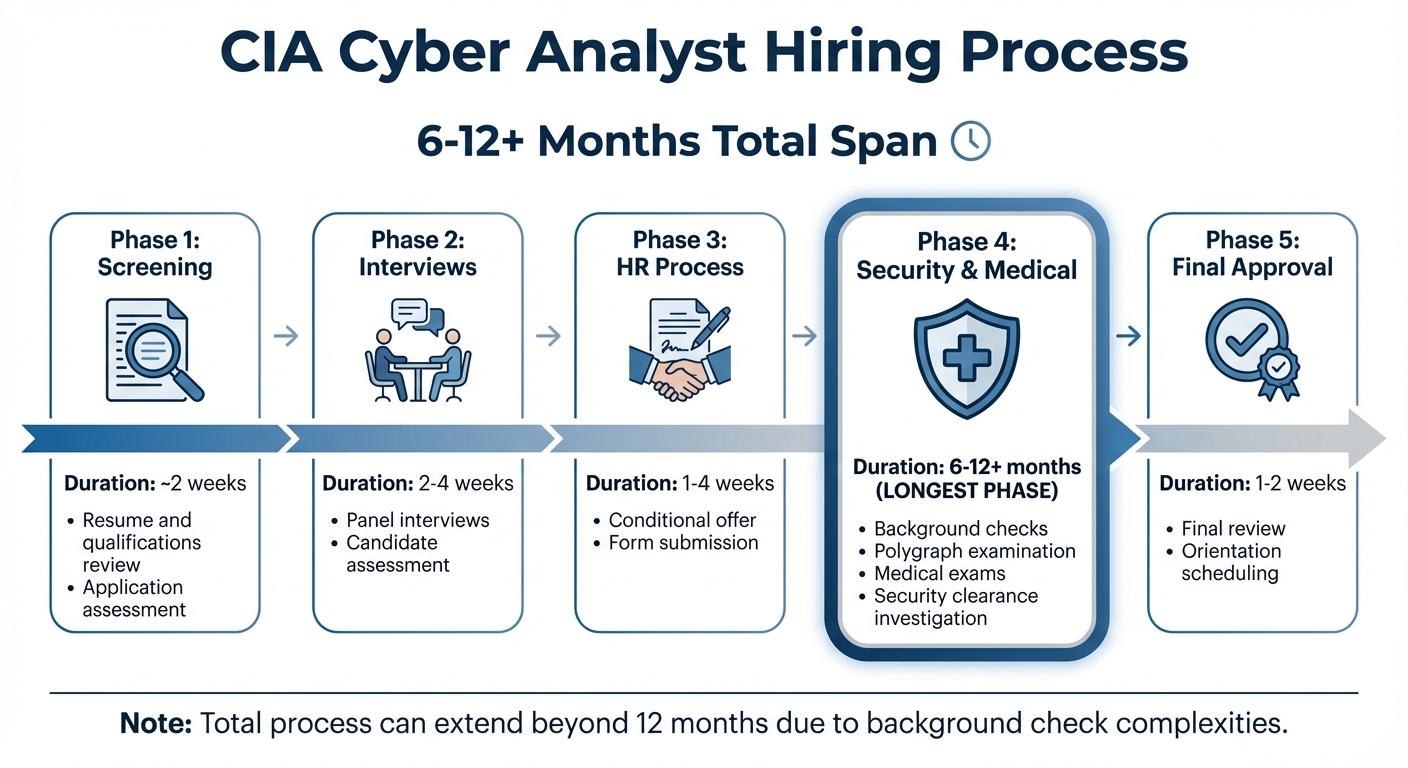
The CIA hires cyber analysts to protect classified information and gather intelligence on adversaries. These professionals work in roles like Cyber Operations Officers, Cyber Targeters, and Digital Forensics Engineers. Responsibilities include monitoring threats, analyzing adversary behavior, and briefing policymakers. Key skills include programming (Python, Bash), network analysis, and proficiency in languages like Russian or Chinese. Applicants need at least a bachelor’s degree, a minimum 3.0 GPA, and must pass a rigorous Top Secret/SCI clearance process, including background checks, polygraph tests, and drug screenings. The hiring process can take 6–12 months, requiring strict discretion throughout.

Phase Duration Activities
Screening ~2 weeks Resume and qualifications review
Interviews 2–4 weeks Panel interviews
HR Process 1–4 weeks Conditional offer, form submission
Security & Medical 6–12+ months Background checks, polygraph, medical exams
Final Approval 1–2 weeks Final review and orientation scheduling

To apply, submit your application through the CIA’s MyLINK portal while in the U.S., and prepare a detailed 10-year history of residences, employment, and education. Avoid discussing your application online, as discretion is critical. This guide provides a roadmap for navigating the process and starting a career in national security.

CIA Cyber Analyst Hiring Process Timeline: 6-12+ Month Journey

CIA Cyber Analyst Hiring Process Timeline: 6-12+ Month Journey

Inside CIA Targeting and OSINT: Intelligence Operations

CIA

sbb-itb-bf7aa6b

What CIA Cyber Analysts Do

CIA cyber analysts combine intelligence work with cybersecurity strategies. Their primary goal is to extract intelligence from adversary networks to identify and counter cyber threats [1]. This role demands a blend of offensive and defensive tactics – analyzing how foreign adversaries operate while also reinforcing national cybersecurity frameworks.

The responsibilities within this field can vary widely based on the specific role. For example, Cyber Operations Officers focus on using advanced tools to gather intelligence, while Cyber Targeters specialize in analyzing social networks. Digital Forensics Engineers use scripting languages like Python and Bash to recover critical data, and Data Analysis Officers rely on applied mathematics and SQL for interpreting massive datasets [1]. These varied roles emphasize the depth and breadth of expertise required in the CIA’s cyber domain.

Core Job Responsibilities

On a daily basis, cyber analysts work to monitor, assess, and mitigate cyber threats targeting U.S. interests. Their tasks include identifying patterns in adversary behavior, tracking foreign intelligence activities, and briefing policymakers on emerging risks. This proactive approach to threat management is essential for national security. Collaboration is key, as analysts work closely across different agency departments under the shared principle of "one team, supporting one mission" [3].

"The use of Artificial Intelligence (AI) technologies allows officers to analyze and interpret complex data needed to support CIA’s mission" [5].

Required Skills and Technical Tools

To fulfill their duties, CIA cyber analysts need a strong technical foundation across several domains. Their expertise includes network analysis, using TCP/IP protocols, and working with Linux-based systems. They also leverage Security Information and Event Management (SIEM) platforms like Splunk for monitoring and managing incidents [1]. Programming skills in Python and Bash are critical for automating tasks and creating custom tools for data recovery. Below is an overview of the required technical skills and tools:

Required Technical Skills Technical Tools
Reverse Engineering Forensic Software & Recovery Systems
Programming and Scripting Python, Bash, SQL
Network Monitoring TCP/IP protocols, Linux systems
Event Management Splunk (SIEM)

Additionally, proficiency in languages such as Arabic, Chinese, Dari, Korean, Persian, or Russian enhances an analyst’s ability to assess foreign threats more effectively [4].

Job Requirements and Qualifications

Education and Work Experience

To be considered for a role at the CIA, applicants must hold at least a bachelor’s degree, though having a master’s degree in a relevant field can significantly enhance your application. Degrees in Computer Science, Cybersecurity, Engineering, Digital Forensics, Telecommunications, or Information Assurance are particularly aligned with the agency’s needs. For roles like Cyber Operations Officer or Cyber Targeter, a degree in a STEM field is often a must.

That said, technical degrees aren’t the only pathway. Fields like International Relations, Foreign Affairs, or Security Studies can also strengthen your application, particularly for positions focused on intelligence analysis. The BYU Economics Department highlights this requirement:

A bachelor’s degree or a master’s degree in a subject related to one of the analyst fields… is required. Applicants need to have a minimum 3.0 GPA to apply [6].

Relevant professional experience – such as work in digital forensics, network security, data analytics, or military intelligence – can either complement or, in some cases, substitute for formal education. The key is a strong academic background combined with expertise in areas critical to the CIA’s mission.

Security Clearance Requirements

In addition to meeting educational and experience requirements, securing a Top Secret/SCI clearance is mandatory for all CIA cyber analyst roles. This clearance process is among the most thorough in the federal government, involving an extensive background check. Investigators will conduct interviews with your personal and professional references, and you’ll also need to complete a polygraph test, as well as physical and psychological evaluations [3].

Your background is reviewed against 13 Adjudicative Criteria, which assess factors like potential conflicts of interest, susceptibility to coercion, and your ability to protect sensitive information. The CIA enforces strict drug policies: applicants must not have used marijuana or THC products within 90 days of applying, and any other illegal drug use or prescription drug misuse must have occurred no less than one year before applying [3].

The agency is clear about the importance of honesty during the application process:

Lack of candor, or dishonesty, which includes omitting, underreporting, or inconsistently reporting information at any time during the hiring process is contrary to what we value… and is the top reason we withdraw an offer of employment [3].

Additionally, male applicants between the ages of 18 and 25 need to be registered with the Selective Service to be considered for employment [3].

How to Apply for CIA Cyber Analyst Jobs

Application and Initial Screening

Once you’ve confirmed you meet the job requirements, the next step is submitting your application through the CIA’s MyLINK portal. Here, you can upload your resume and indicate interest in up to four positions. Keep in mind, you must be physically in the United States when submitting your application, or it will be disqualified [3].

The initial screening process typically takes about two weeks, during which recruiters assess your qualifications against the agency’s needs [7]. If you’ve used AI tools to create your resume, be upfront about how they were used, as AI assistance is not permitted for writing samples or assessments [3]. From the outset, the CIA places a strong emphasis on honesty and transparency.

If your application passes this stage, you’ll move on to the next phase: an extensive background investigation and clearance process.

Background Investigation and Clearance Vetting

Once you receive a conditional job offer, you’ll have five days to accept it and about two weeks to complete the required forms [7]. This kicks off the detailed security and medical evaluations, which can take anywhere from 6 to 12 months – or even longer [7] [8].

The background check is thorough, involving interviews with people who know you, such as neighbors, colleagues, and supervisors, to assess your character and trustworthiness [3]. You’ll also have to complete a polygraph test, along with physical and psychological evaluations conducted by the agency’s security professionals [3]. Starting in 2026, the outdated e-QIP system has been replaced by eApp, a digital platform for submitting the SF-86 form [8]. However, the wait time for a polygraph appointment remains a significant bottleneck for Intelligence Community positions [8].

Financial reviews are another key component of this process. To avoid potential issues, consider reviewing your credit history and resolving any delinquencies before applying. Financial problems are a common reason for clearance denials, so it’s better to disclose any concerns upfront, along with evidence of how you’ve addressed them.

By understanding these steps, you’ll be better prepared to navigate this complex process and stay on track.

Expected Timeline and Application Tips

The hiring process for a CIA Cyber Analyst position – from the initial application to onboarding – can take anywhere from 6 to 12 months or more [7] [8]. Here’s a general timeline to help you plan:

Phase Estimated Duration Key Activities
Screening ~2 weeks HR review of your resume and qualifications [7]
Interviews 2–4 weeks Panel interviews to assess technical and professional skills [7]
HR Process 1–4 weeks Conditional offer extended; completion of agency forms and documentation [7]
Security & Medical 6–12+ months Background checks, polygraph, medical/psychological exams, and drug tests [7] [8]
Final Approval 1–2 weeks Final review by hiring authorities and scheduling for orientation [7]

To streamline your application process, avoid discussing your application online. This includes not following the CIA on social media, liking their posts, or sharing updates about your status [3]. Prepare a detailed 10-year history of your residences, employment, education, and foreign contacts before accessing the eApp system to ensure accuracy [8]. Promptly respond to any communications from the agency, as delays can negatively impact your application [3]. Lastly, if you’re a male applicant aged 18 to 25, make sure you’re registered with the Selective Service, as this is a mandatory requirement for employment consideration [3].

Interview and Onboarding Preparation

How to Prepare for CIA Interviews

CIA interviews are designed to evaluate not only your technical skills but also how well you align with the agency’s mission. You’ll encounter questions about global events that impact U.S. national security, so staying up-to-date on these topics is crucial [2]. The agency values candidates who can tie their technical expertise to addressing real-world threats.

To prepare, focus on key areas like network security (firewalls, IDS/IPS, VLANs), cryptography (PKI, SSL/TLS, symmetric/asymmetric encryption), and incident response using tools such as Nessus, Nmap, or Wireshark [10]. It’s also important to understand frameworks like the NIST Cybersecurity Framework (Identify, Protect, Detect, Respond, Recover) and ISO/IEC 27001 standards, as these are integral to federal cybersecurity practices [10].

While technical knowledge is essential, honesty is even more important. Use the STAR method (Situation, Task, Action, Result) to craft stories that showcase your teamwork, problem-solving, and decision-making during security incidents [10]. Highlight skills like Python or PowerShell scripting, experience with SIEM tools, and cloud security expertise – these can potentially increase your salary by more than $15,000 [9].

Once you pass the interview, your focus shifts to a detailed onboarding process.

Starting Your CIA Career Successfully

After clearing the interview and security process, you’ll begin an intensive training program that introduces you to CIA policies, procedures, and specialized training tailored to your cyber role [2]. This phase is crucial for understanding how your technical skills fit into the agency’s broader mission. Cyber professionals typically work within the Directorate of Digital Innovation (focused on cybersecurity and IT infrastructure) or the Directorate of Analysis (focused on threat assessments), though your work may support any of the five directorates [2].

Since all CIA positions are based in Washington, DC [3], you’ll need to plan for relocation. Discretion is critical – avoid following the CIA on social media, liking their posts, or sharing anything about your employment [3]. For those in certain roles, such as those requiring undercover work, this discretion extends to family members [2]. During your first months, it’s important to respond promptly to inquiries and attend all appointments, as the agency will closely monitor your reliability and professionalism during onboarding [3].

Conclusion

A career as a CIA cyber analyst demands a mix of technical expertise, integrity, and unwavering patience. The agency’s rigorous clearance process includes an in-depth background investigation, a polygraph interview, and physical and psychological assessments [3]. Above all, honesty is non-negotiable. As the CIA emphasizes:

Lack of candor, or dishonesty… is the top reason we withdraw an offer of employment [3].

Even minor inconsistencies in your application can immediately disqualify you.

It’s also crucial to maintain discretion. Avoid following the CIA on social media or discussing your application publicly [3]. The agency makes it clear:

refraining from mentioning the submission of a resume or receiving an invitation to apply for employment with the CIA on social media [1].

This not only safeguards your privacy but also protects the agency’s operations.

The hiring process can be lengthy due to the extensive security checks, so patience is key [3]. If you aren’t selected, remember that you’ll need to wait 12 months before reapplying [2]. Throughout the process, make sure to respond quickly to communications and attend all scheduled appointments – your reliability is being evaluated at every step [2].

Use these insights, paired with our tailored resources, to confidently navigate the challenges of the application process. For professionals with security clearances looking to advance their careers, Cleared Cyber Security Jobs offers specialized guidance to help you succeed in this demanding but rewarding journey.

FAQs

What can I do to speed up the CIA clearance timeline?

To speed up the CIA clearance process, make sure your background investigation is complete and accurate. Any omissions or dishonesty can slow things down. Stay within the U.S. during this time, respond quickly to document requests, and complete all required paperwork ahead of time. Be ready for polygraph tests, as well as medical and psychological evaluations. Keeping communication clear and paying close attention to details can help you avoid unnecessary delays.

Will past drug use or debt automatically disqualify me?

The CIA doesn’t automatically disqualify candidates for past drug use or debt, but these factors can influence your security clearance and overall eligibility. A comprehensive background investigation is conducted to evaluate your character, trustworthiness, and loyalty. How you handle the process – especially your honesty and accountability – plays a key role in the assessment.

Do I need a cyber degree, or can experience and certs qualify me?

A specialized degree in cybersecurity isn’t always a must-have for landing a CIA cyber analyst role. Instead, experience, certifications, and practical skills can carry just as much weight. Credentials like CISSP or CEH, combined with relevant work experience, can significantly boost your application. The CIA places a high value on strong analytical skills and hands-on expertise, meaning candidates with solid experience and professional certifications can still qualify, even without a focused academic background.

Related Blog Posts

  • Threat Intelligence Analyst Career Path for Cleared Professionals
  • Cryptanalyst Career Path for Cleared Intelligence Professionals
  • Data Security Analyst Career Path for Cleared Professionals
  • Cleared Cyber Analyst Jobs at NSA Complete Guide

Cleared Cyber Analyst Jobs at NSA Complete Guide

CyberSecJobs Editorial · April 8, 2026 ·

NSA cyber analyst jobs offer high salaries, job security, and unique opportunities to protect national intelligence. Here’s what you need to know:

  • Top Secret/Sensitive Compartmented Information (TS/SCI) clearance with a Full Scope Polygraph is mandatory.
  • Clearance can boost your salary by $45,000–$65,000 annually, totaling $900,000–$1.3 million over 20 years.
  • A bachelor’s degree in fields like Computer Science or Cyber Security is preferred, but military experience or certifications like CompTIA Security+ can qualify you.
  • Analysts work in Sensitive Compartmented Information Facilities (SCIFs) with no remote options.
  • The clearance process takes 6–18 months and includes a detailed background check and polygraph exam.
  • The cybersecurity job market is strong, with 514,000 postings and 26% unfilled positions projected by 2026.

Applying requires attention to detail, especially when completing the SF-86 form and tailoring your resume. Certifications like CISSP or CEH can give you an edge. Expect rigorous interviews and technical assessments. Long-term, NSA offers training, leadership opportunities, and advanced degree programs to help grow your career.

Bottom line: NSA cyber analyst roles demand preparation and patience but deliver unmatched career rewards.

Vet to Cybersecurity path by Ex-NSA Hacker

NSA

sbb-itb-bf7aa6b

Required Qualifications and Certifications

NSA cyber analyst positions require a bachelor’s degree in fields like Computer Science, Cyber Security, Information Technology, or closely related areas. However, candidates with an associate’s degree can qualify if they have two years of relevant experience. Military personnel with 18 semester hours of approved cyber coursework – such as the Joint Cyber Analysis Course (JCAC), Undergraduate Cyber Training (UCT), Network Warfare Bridge Course (NWBC), or Intermediate Network Warfare Training (INWT) – plus two years of experience also meet the entry requirements[1]. For intelligence-focused analyst roles, degrees in History, Government, Political Science, Intelligence, International Affairs, Library/Information Sciences, or National Security Studies are also considered[4]. Below, we’ll dive into the educational and certification expectations in more detail.

Education Requirements

Both academic qualifications and practical skills are highly valued. The NSA prioritizes candidates who can demonstrate hands-on experience through labs, projects, or military training. The demand for cybersecurity analysts is expected to grow 33% through 2033, with approximately 17,300 job openings every year[3]. This highlights the importance of building a solid educational foundation early in your career. Beyond academics, industry certifications play a key role in showcasing your expertise.

Industry Certifications

Certifications are a way to validate technical skills and meet DoD 8140 requirements. CompTIA Security+ is often seen as the baseline certification for many government contractor roles[2]. Once you’ve earned Security+, you can pursue more specialized certifications like Certified Ethical Hacker (CEH) for penetration testing or Certified Information Systems Security Professional (CISSP) for advanced security architecture[3][5]. The average salary for cybersecurity analysts is around $120,360, and obtaining a Full Scope Polygraph clearance can boost your earnings by an additional $45,000–$65,000 annually[2][3].

"Stop collecting certifications. Start applying. I see too many people with 6 certs and no job applications. You need ONE good cert and 100 job applications, not six certs and 10 applications." – Cybersecurity Hiring Manager[2]

Practical experience is just as important as certifications. Building home labs with virtual networks to simulate incident response scenarios can be more impactful than accumulating multiple certifications. For niche roles, specific credentials can make a difference. For instance, malware analysts might pursue GREM or OSCP, while cloud security architects could benefit from AWS or Azure Security Specialty certifications[2]. Additionally, the NSA values expertise in cryptology, information warfare, and foreign media analysis for intelligence-related positions[6].

Security Clearance Process

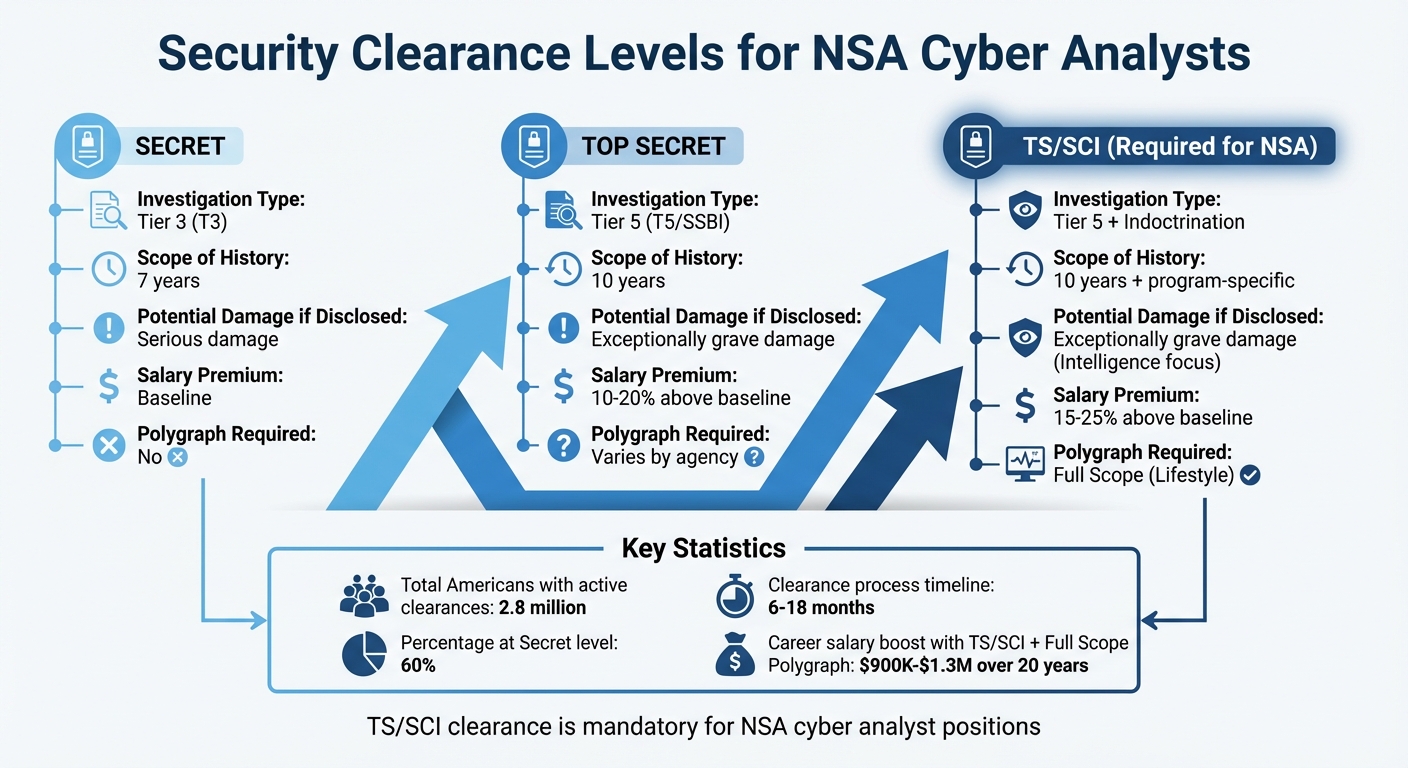
NSA Security Clearance Levels Comparison: Requirements and Investigation Scope

NSA Security Clearance Levels Comparison: Requirements and Investigation Scope

For NSA cyber analyst roles, obtaining a Top Secret (TS) clearance with Sensitive Compartmented Information (SCI) access and a Full Scope Polygraph is mandatory [7]. This combination – TS/SCI – grants access to highly classified intelligence programs, but only on a strict need-to-know basis [7]. The clearance process is lengthy, typically taking anywhere from 6 to 18 months after receiving a conditional job offer [7][8].

Beyond access to classified information, TS/SCI clearance comes with financial perks. Individuals holding this level of clearance often earn a 10–20% salary premium compared to those without it. Additionally, candidates with an active Full Scope Polygraph can command even higher premiums, ranging from 15–25% above standard market rates [7][8]. Considering that about 60% of active U.S. security clearances are at the Secret level, TS/SCI holders represent a smaller, more specialized group among the 2.8 million Americans with active clearances [8].

TS/SCI Clearance Requirements

The clearance process officially begins once you accept a conditional job offer from the NSA [10]. At this stage, you’ll be required to complete the SF-86 security form and undergo a Tier 5 background investigation (previously called SSBI). This investigation examines the last 10 years of your life, including residence, employment, education, foreign travel, and financial history [8]. Providing accurate and detailed information is crucial, especially regarding foreign contacts and finances, as inaccuracies could result in disqualification [10].

Level Investigation Type Scope of History Potential Damage if Disclosed
Secret Tier 3 (T3) 7 years Serious damage [8]
Top Secret Tier 5 (T5/SSBI) 10 years Exceptionally grave damage [8]
TS/SCI Tier 5 + Indoctrination 10 years + program-specific Exceptionally grave damage (Intelligence focus) [7][8]

Once the background investigation wraps up, adjudicators evaluate your loyalty, character, and discretion to decide your eligibility [10]. If approved, Special Security Officers (SSOs) grant access to specific SCI programs [7]. The final step involves being "read in", which includes signing a non-disclosure agreement and attending briefings on handling classified materials. Most NSA cyber analyst tasks must be conducted in a Sensitive Compartmented Information Facility (SCIF), making remote work for classified assignments nearly impossible [7].

Understanding this clearance process is essential for securing NSA roles and the associated financial advantages. The next step involves navigating the rigorous polygraph examination, which ensures your suitability for accessing sensitive programs.

Polygraph Examination

NSA applicants must pass a Full Scope (Lifestyle) Polygraph, which is more thorough than the Counterintelligence (CI) polygraph used by other government agencies [7]. This exam includes three types of questions: relevant, irrelevant, and control [11]. While CI polygraphs focus on espionage, terrorism, and unauthorized disclosures, the Full Scope polygraph expands its scope to cover personal conduct, such as drug use, criminal behavior, and financial misconduct [7].

Honesty is critical – providing false or misleading answers can jeopardize your clearance [11]. The Full Scope polygraph is often more stressful than the CI version because of its focus on personal lifestyle issues. Its findings are reviewed alongside the 13 Adjudicative Guidelines (SEAD 4), which evaluate factors like financial responsibility, drug use, and foreign influence [9].

Feature Counterintelligence (CI) Polygraph Full Scope (Lifestyle) Polygraph
Primary Focus Espionage, terrorism, and unauthorized disclosures [7] CI topics plus personal conduct and lifestyle [7]
Lifestyle Coverage Limited or none [7] Includes drug use, criminal history, and financial crimes [7]
Agency Usage Standard for DIA, NGA, and many DoD programs [7] Standard for NSA, CIA, and NRO [7]

Job Responsibilities of NSA Cyber Analysts

NSA cyber analysts play a critical role in turning classified information into actionable insights, uncovering the intentions of adversaries [4]. Their work focuses on identifying threats to U.S. critical infrastructure, the Defense Industrial Base, and National Security Systems. This requires a blend of technical skills and sharp analytical abilities, as they sift through data from various sources to close intelligence gaps and keep a watchful eye on global developments [4].

"As a cybersecurity professional, you will work with a team on the frontlines of defense against cyber adversaries… Help protect national security interests as part of the world’s most advanced team of cyber professionals." – NSA Career Fields [4]

These analysts collaborate with interdisciplinary teams to merge threat assessments into cohesive security strategies [4][6]. By doing so, they ensure their technical findings align with broader national security goals. Let’s take a closer look at the daily responsibilities and team dynamics that define NSA cyber operations.

Threat Detection and Analysis

On a day-to-day basis, analysts are tasked with monitoring networks and analyzing metadata to uncover emerging threats. They map global networks and investigate adversarial communications, employing tools like Ghidra, IDA Pro, Snort, and Suricata. Their work involves deep packet analysis and examining network protocols such as TCP/IP, VoIP, and wireless communications to detect suspicious activity or vulnerabilities in systems, including wired networks, 5G technology, and cloud platforms.

When vulnerabilities are identified, analysts respond by creating mitigations and designing defensive measures like perimeter defenses. Their technical expertise extends to programming in languages such as Python, C/C++, Assembly, and Java, which they use to automate threat detection, analyze malware, and reverse-engineer malicious software.

Working with Intelligence Teams

NSA cyber analysts don’t work in isolation – they’re part of diverse teams that include software engineers, data scientists, researchers, and programmers. Together, these teams develop sophisticated tools and systems [12]. Analysts integrate vulnerability assessments from multiple sources to create a comprehensive view of network risks, providing technical mission offices with critical situational awareness and actionable intelligence. Programs like the DNEA and Intrusion Analyst initiatives combine formal training with hands-on assignments over three years to foster team-based expertise [12].

"The increased complexity of supporting NSA’s mission requires world class researchers, programmers, and developers who operate in teams… in order to design and develop advanced tools, techniques, and systems." – National Security Agency [12]

This collaborative approach not only strengthens national security but also highlights the level of skill and teamwork required to excel in these roles, setting the stage for future discussions on application success.

How to Apply for NSA Cyber Analyst Positions

If you’re aiming to become a cyber analyst at the NSA, the application process is straightforward but rigorous. Start by visiting the NSA’s official website under the "Careers" section or head to IntelligenceCareers.gov. Completing the initial application takes about 30–60 minutes, and you can expect a response within 1 to 5 weeks.

After submitting your application, you’ll receive a link to eApp, the platform where you’ll fill out the Standard Form 86 (SF-86). This form requires a detailed record of your past 10 years, including documentation like residential leases, tax returns, and passport stamps. While eApp features automated error-checking and pre-filled fields, it’s still up to you to ensure everything is accurate [1].

The selection process includes a thorough background check, phone interviews, and mandatory drug screenings [13]. As part of the Trusted Workforce 2.0 framework, adjudicators are increasingly reviewing candidates’ digital footprints – this might include your GitHub projects, activity on professional forums, and social media presence during the Personal Conduct review [1]. Additionally, tailoring your resume to NSA standards is critical.

Application and Resume Submission

When submitting your resume, be precise. Include exact dates of employment and the number of hours worked per week for each role. Omitting these details will result in an incomplete application [14]. Avoid attaching classified information, photos, or anything inappropriate, as these can lead to immediate disqualification [14]. For those with military experience, list relevant courses like JCAC (Joint Cyber Analysis Course) or UCT (Undergraduate Cyber Training) – the NSA treats these 20- to 24-week courses as six months of relevant experience.

Make sure your resume highlights tools and programming languages mentioned in the job description, such as Ghidra, IDA Pro, Snort, Suricata, Python, C, and SQL. If you have received performance appraisals or incentive awards, include them to showcase your specialized experience [14]. Veterans should submit DD-214 (Copy 4) and Standard Form 15 right away to claim preference eligibility. To ensure you’re applying for the right role, use the Job Exploration Tool on the NSA website. Once your application is in, prepare for challenging technical assessments during the interview process.

Interview and Assessment Process

The interview phase is demanding and tailored to your area of expertise. Expect technical assessments that may involve solving logic problems, translating complex documents, or explaining technical concepts. Depending on the role, you might face questions about network security, reverse engineering, or incident response. In some cases, you’ll need to prepare and present a detailed technical topic to a panel of officials, defending your ideas under scrutiny [13].

Technical Assessment Area Specific Skills/Tools Evaluated
Network Security Protocol analysis, signature development (Snort/Suricata), packet analysis
Software Engineering Reverse engineering (Ghidra, IDA Pro), scripting (Python, C, Lua)
Systems Admin Windows and Unix/Linux administration
Forensics & Analysis Incident response, malware analysis, computer and network forensics

Honesty is crucial throughout the process. Disclose any minor offenses or issues during interviews and on security forms – the NSA’s background check will uncover hidden details anyway. Under Continuous Vetting, you are required to report significant life changes – like arrests, major debt, or foreign contacts – to a Security Officer immediately rather than waiting for a formal review [1]. Also, review your social media and networking site privacy settings to avoid raising any concerns.

Career Growth at the NSA

Promotion Paths and Leadership Roles

Starting your career as an NSA cyber analyst opens the door to a wide range of advancement opportunities. With time and experience, you can move into management or technical leadership roles like Analytic Methodologist, Counterintelligence Threat Analyst, or Cryptologic Cyber Planner. These roles offer not only professional growth but also competitive compensation. On average, national security analysts earn $107,334 annually, with most salaries falling between $91,500 and $130,000 [4][6].

To help employees grow, the NSA provides structured development programs and internal education options. For instance, after just one year of permanent employment, you can qualify for the Advanced Studies Program, which lets you take up to four semesters of advanced courses at accredited institutions. This program allows you to maintain your full salary while covering tuition costs [15]. Combined with comprehensive training programs, these opportunities make career advancement at the NSA both achievable and rewarding.

Training and Professional Development

The NSA places a strong emphasis on training and professional growth. Through initiatives like the National Cryptologic School (NCS), employees can receive specialized instruction in cryptology and leadership. For those seeking formal degrees, the National Intelligence University (NIU) offers accredited programs in secure, classified environments.

Additional programs include:

  • After-Hours College Program: Covers tuition for job-related courses.
  • Accelerated Degree Program: Provides college credit for National Cryptologic University coursework and military training at reduced tuition rates.

The NSA also collaborates with institutions like the Naval Postgraduate School, National Defense University, and National War College to offer tuition-free degrees in intelligence studies. For those aiming for advanced degrees, graduate fellowship programs cover full tuition and salary while studying at local universities [15].

These resources demonstrate the NSA’s commitment to equipping its workforce with the expertise and credentials needed for long-term success.

Using Cleared Cyber Security Jobs to Find NSA Positions

Cleared Cyber Security Jobs

Job Search Features and Resume Tools

Cleared Cyber Security Jobs makes it easier to find cyber analyst roles at the NSA by offering filters tailored specifically for the cleared community. You can refine your search by clearance levels like Secret, Top Secret, or TS/SCI, as well as polygraph requirements, such as Counterintelligence or Full Scope – both of which are crucial for most NSA roles. The platform uses an AI-powered matching engine that combines Boolean and semantic search methods to connect you with positions that match your clearance, technical expertise, and preferred location.

The site focuses on areas where the NSA has significant operations, including Fort Meade, MD, Augusta, GA, San Antonio, TX, and Colorado Springs, CO [2][4]. When creating your profile, it’s essential to highlight certifications that comply with DoD 8140/8570 standards, like Security+ or CISSP, as these are often required for cleared analyst positions [2]. Additionally, the platform offers a 2026 Cybersecurity Salary Guide with verified compensation data specifically for cleared professionals [2].

"A Full Scope Polygraph clearance can add $45-65K annually to your cybersecurity salary. That’s $900K to $1.3M over a 20-year career. The math is simple: get cleared, get paid." – ClearanceJobs [2]

These tools, paired with networking events, can significantly enhance your job search.

Job Fairs and Networking Opportunities

In addition to its search tools, Cleared Cyber Security Jobs organizes job fairs that provide direct access to NSA recruiters. These events allow you to bypass general applicant pools and connect with hiring managers who are actively looking for cleared talent. For instance, job fairs focused on polygraph requirements are scheduled for May 14, 2026, and September 10, 2026, in Hanover, MD, and August 5, 2026, at Fort Meade, MD [16].

These events are excellent opportunities to engage with recruiters who have immediate hiring needs. To make the most of these fairs, upload your resume beforehand, ensuring it clearly states your clearance level and polygraph status. With around 26% of cybersecurity positions still unfilled in 2026 and cleared professionals earning 20% to 40% more than their counterparts in the commercial sector [2], attending these events gives you a significant edge in securing high-paying NSA roles.

Conclusion

Landing a cyber analyst position at the NSA requires more than just technical expertise – it calls for careful planning and strategic preparation. Securing a TS/SCI clearance with a Full Scope Polygraph can significantly enhance your earning potential, adding an estimated $45,000–$65,000 annually and potentially boosting your income by $900,000–$1.3 million over a 20-year career [2]. The Trusted Workforce 2.0 framework has simplified the clearance process, leveraging tools like the eApp platform and Continuous Vetting to streamline applications [1].

Start by earning your Security+ certification to meet the DoD 8140 baseline requirements, and focus on obtaining additional relevant certifications to strengthen your qualifications. When filling out your SF-86 form, pay close attention to detail – small errors can lead to "Personal Conduct" flags that might jeopardize your clearance [1].

Take the time to review and clean up your online presence. Adjudicators now examine GitHub contributions, professional forums, and even gaming communities, looking for signs of sound judgment. Additionally, report any adverse events, such as arrests or significant financial issues, to your Security Officer immediately. Staying vigilant helps protect your clearance and keeps you competitive in a field with increasing demand.

With 26% of cybersecurity positions projected to remain unfilled by 2026 and cleared professionals earning 20% to 40% more than their counterparts in the private sector [2], opportunities in this area are vast. Platforms like Cleared Cyber Security Jobs offer tools such as clearance-specific job filters, access to recruiters, and job fairs in major hubs like Fort Meade, San Antonio, and Augusta, giving you an edge in this competitive market.

While the path to becoming an NSA cyber analyst is demanding, the rewards – both professionally and financially – are well worth the effort. By mastering the clearance process, refining your application strategy, and using the resources available, you can position yourself for a successful and impactful career in the cleared cybersecurity field.

FAQs

Can I apply without an active TS/SCI yet?

No, you can’t apply for NSA cyber analyst positions without holding an active TS/SCI clearance. This clearance level is a basic requirement for most roles, and candidates won’t be considered without it.

What commonly delays the TS/SCI and polygraph process?

Delays in obtaining TS/SCI clearance and completing the polygraph process can stem from several factors. These include a shortage of examiners, difficulties in scheduling appointments, and the time required to conduct detailed background investigations. Other potential causes are the need for follow-up interviews or additional time to process polygraph results. The overall timeline often depends on the complexity of the case and the resources available.

How can I prepare for NSA technical interviews?

To get ready for NSA technical interviews, concentrate on honing your cybersecurity knowledge and technical abilities. Make sure to review core topics like risk management, incident response, and scripting languages (such as PowerShell). Be prepared to discuss your background, certifications, and relevant experience in detail. Taking courses on cybersecurity basics or scripting can also help you feel more confident and showcase your skills effectively during the interview.

Related Blog Posts

  • Threat Intelligence Analyst Career Path for Cleared Professionals
  • Cryptanalyst Career Path for Cleared Intelligence Professionals
  • Data Security Analyst Career Path for Cleared Professionals
  • Cleared SOC Analyst Jobs Complete Career Guide

Cleared Network Security Jobs Complete Career Guide

CyberSecJobs Editorial · April 7, 2026 ·

Cleared network security jobs are in high demand, offering lucrative salaries and career growth for professionals with security clearances. Here’s what you need to know:

  • Job Demand: By 2026, 514,000 cybersecurity jobs are projected, with 26% remaining unfilled. Security clearances significantly boost employability.
  • Salary Boosts: Security clearances can increase pay by 20–40%. Average salaries for cleared positions start at $129,443, with additional earnings of $45,000–$65,000 annually for Full Scope Polygraph clearances.
  • Career Levels: Roles range from entry-level SOC Analysts ($65,000–$100,000) to senior-level CISOs ($200,000–$400,000+).
  • Certifications: Must-have certifications include CompTIA Security+ (entry-level), CISSP (mid-to-senior level), and CCNA for networking roles.
  • Clearance Levels: Secret, Top Secret, and TS/SCI clearances are essential. Higher clearances mean higher pay but require thorough background checks.
  • Skills in Demand: Expertise in cloud security, Zero Trust Architecture, AI/ML security, and programming languages like Python and SQL is highly valued.

Key takeaway: A career in cleared network security offers high salaries, job security, and growth potential. Focus on certifications, gaining experience, and leveraging your security clearance to maximize opportunities.

How to get a Security Clearance for I.T. Jobs 🇺🇸 GovTech 2024

sbb-itb-bf7aa6b

Cleared Network Security Job Types

Cleared Network Security Career Levels: Roles, Salaries, and Certifications Comparison

Cleared Network Security Career Levels: Roles, Salaries, and Certifications Comparison

Cleared network security careers are divided into three tiers, each with distinct technical requirements and salary expectations. As you move from entry-level roles to senior positions, your expertise – and the value of your security clearance – grows significantly.

Entry-Level Positions

Entry-level cleared roles focus on monitoring and escalating security incidents. A common starting point is the SOC Analyst Tier 1, where responsibilities include tracking security alerts, investigating straightforward issues, and escalating more complex threats to senior staff. Other entry-level roles include IT Support Specialist, Junior Network Specialist, and Information Systems Security Officer (ISSO), which involves applying Risk Management Framework (RMF) controls.

These positions typically require less than two years of experience and a Secret clearance. Many contractors are willing to sponsor promising candidates for their clearance. Salaries for cleared SOC Analysts range from $65,000 to $100,000 annually [1]. A CompTIA Security+ certification is the standard requirement, especially for Department of Defense (DoD) 8140 positions starting February 15, 2026.

Veterans with cyber-related military experience, such as MOS 35N or 1B4X1, often skip entry-level roles entirely. Thanks to their technical training and existing clearances, they can transition directly into mid-level positions [1].

As experience grows, professionals can take on roles that focus on proactive security measures.

Mid-Level Positions

Mid-level positions, requiring 2 to 5 years of experience, shift the focus from reactive monitoring to proactive security measures. For example, SOC Analyst Tier 2/3 roles involve threat hunting, investigating advanced incidents, and optimizing security tools. Security Engineers handle tasks like deploying security infrastructure, automating systems, and creating custom configurations. Meanwhile, Penetration Testers simulate attacks to uncover vulnerabilities before adversaries can exploit them.

Salaries for mid-level positions range from $95,000 to $200,000, with a Top Secret/SCI clearance adding an extra $30,000 to $45,000 annually [1]. Specializations like Zero Trust Architecture and Cloud Security often command even higher pay.

Role Level Position Example Salary Range (Cleared) Key Certifications
Entry-Level SOC Analyst Tier 1 $65,000 – $100,000 Security+, CySA+
Mid-Level SOC Analyst Tier 2/3 $95,000 – $155,000 GCIH, GCFA
Mid-Level Security Engineer $110,000 – $200,000 CISSP, AWS Security
Mid-Level Penetration Tester $102,000 – $190,000 OSCP, GPEN

As professionals advance, the focus shifts toward leadership and strategic oversight in senior roles.

Senior-Level Positions

Senior-level cleared roles require a blend of technical expertise, leadership skills, and strategic thinking. Network Security Architects design secure environments and draft enterprise-wide security policies. SOC Managers lead security teams, mentor junior staff, and communicate risks to executive leadership. At the top, Chief Information Security Officers (CISOs) oversee security strategies for entire agencies or major contractor programs.

These roles demand not only technical mastery but also business acumen and strong communication abilities. Cleared CISOs can earn between $200,000 and $400,000+, while Zero Trust Architects make $140,000 to $250,000 [1]. A Full Scope Polygraph clearance adds an additional $45,000 to $65,000 annually, which can amount to $900,000 to $1.3 million over a 20-year career [1].

While most senior positions require working within a SCIF (Sensitive Compartmented Information Facility), some governance and compliance roles offer hybrid work arrangements. The highest earners in this tier combine advanced clearances, expertise in emerging areas like AI/ML security, and the ability to communicate complex risks to business leaders [1].

Required Certifications for Cleared Network Security Professionals

As discussed earlier, meeting both clearance and technical qualifications is essential for professionals in this field. Certifications play a critical role in ensuring candidates meet these standards. In fact, specific certifications are mandatory under DoD directives 8570 and 8140 for certain Labor Category (LCAT) positions. Without the required certification, candidates simply aren’t eligible for these roles [2].

As one industry expert aptly puts it:

"No cert = you literally can’t sit in the seat, regardless of your skills." – CyberSecJobs Editorial [2]

Employers rely on certifications to align candidates with specific LCATs, which also influence the billing rates contractors can charge the government [2]. Having the right certification not only speeds up onboarding but also reduces training costs [5]. With around 26% of cybersecurity positions projected to remain unfilled by 2026, cleared candidates with certifications are in high demand and have a competitive edge [1].

CompTIA Security+

CompTIA Security+ is often considered the go-to certification for entry-level cleared positions. It’s a key requirement for meeting DoD 8140 standards [1][2]. The exam costs $404 and must be renewed every three years to remain valid for federal contracts [1][2][5]. Holding this certification can boost your annual salary by an estimated $5,000 to $10,000 [1][2]. For those new to cleared roles, Security+ is one of the most versatile certifications, meeting requirements for both IAT Level II and IAM Level I positions [4].

CISSP (Certified Information Systems Security Professional)

CISSP

CISSP is widely regarded as the certification with the highest return on investment for cleared professionals [2]. It’s designed for those with management-level expertise and is a must-have for senior LCAT positions across most major defense contracts [2]. This certification qualifies professionals for roles such as IAT Level III, IAM Level II/III, and IASAE – positions that often require Top Secret or TS/SCI clearances [5]. The exam costs $749, but the potential salary increase of $15,000 to $25,000 makes it a worthwhile investment [1][2]. CISSP is often a requirement for management and high-level architecture roles [4][5]. To earn this certification, candidates need five years of paid work experience across two or more CISSP domains, though a relevant degree can reduce this requirement to four years [2].

Cisco Certified Network Associate (CCNA)

The CCNA certification is ideal for professionals looking to build foundational networking skills, particularly for hands-on technical roles involving Cisco-based infrastructure [3]. It qualifies candidates for IAT Level I and II positions, such as helpdesk or systems support roles [5]. For cleared professionals who manage routers, switches, and network security appliances, CCNA is especially valuable. This certification also pairs well with Security+, offering a combination of security and networking expertise that many roles demand [3][5].

These certifications are essential stepping stones for professionals aiming to advance into specialized or leadership roles within cleared network security positions.

Skills Employers Look for in Cleared Network Security Professionals

Employers prioritize both technical expertise and effective communication when hiring professionals to safeguard sensitive networks and collaborate with teams.

On the technical side, a strong command of network security controls is essential. This includes managing firewalls, IDS/IPS systems, and VPNs to prevent unauthorized access. Another critical skill is threat analysis, which involves researching adversaries and examining indicators of compromise. With incident response roles increasing by 100.89% in 2023 [7], expertise in areas like forensics, crisis management, and containment has become indispensable.

As cyber threats grow more advanced, securing cloud infrastructures has taken center stage. Professionals need to be skilled in securing cloud environments, managing access controls, and implementing encryption across platforms like AWS GovCloud and Microsoft Azure. Additionally, designing and deploying Zero Trust architectures is now a high-priority requirement. Familiarity with programming languages such as Python, SQL, C, and C++ is also crucial for detecting malicious activities and automating responses.

Expertise in AI and machine learning (ML) is another sought-after skill, as these technologies reshape the cybersecurity landscape. Employers value individuals who can effectively use AI tools, validate their outputs, and protect AI/ML systems from potential threats. As one industry expert aptly notes:

"AI is not a job thief – it’s a job transformer." – Wallarm

However, technical abilities alone don’t guarantee success. The ability to communicate risks clearly, conduct security training, and document findings sets top candidates apart. Professionals who combine technical know-how with strong interpersonal skills gain a competitive edge. These combined skills not only play a critical role in safeguarding national security but also open doors to leadership opportunities in government and defense sectors.

Security Clearance Levels and Requirements

Security clearances are a cornerstone of network security, determining the roles you can access and the sensitive information you may handle. The U.S. government categorizes clearances into three primary levels based on the potential harm unauthorized disclosure could cause to national security: Secret, Top Secret, and Top Secret with SCI (Sensitive Compartmented Information). Secret clearances protect information that could cause "serious damage", Top Secret clearances cover data that could lead to "exceptionally grave damage", and TS/SCI clearances allow compartmentalized access to highly sensitive information [6].

Most professionals start at the Secret level, which accounts for about 60% of all active security clearances [6]. The investigation process varies by level. Secret clearances take 1–6 months, with a Tier 3 investigation reviewing the past 7–10 years of your history. Top Secret clearances require 4–12 months and involve a more thorough Tier 5 investigation covering the last decade [6][12]. As of early 2026, efforts to reduce the investigation backlog have cut it by 65%, bringing it down to around 100,000 cases and speeding up processing times [9].

Clearances also come with financial benefits. Secret clearance holders often earn 5–10% more than their peers, while Top Secret clearance holders see a 10–15% premium. TS/SCI professionals command even higher premiums, ranging from 15–25% [6]. However, access to classified information isn’t automatic. Each mission or program requires a specific "need-to-know" determination [8][14].

Here’s a closer look at each clearance level, from requirements to salary impacts.

Secret Clearance

Secret clearance is the entry point for many roles in defense contracting and government IT, including systems analysts, IT administrators, and network support technicians. It protects information that could cause serious harm if disclosed [6]. The Tier 3 investigation examines your past 7–10 years, including employment history, residences, and personal conduct. Current federal targets aim to process these clearances in about 40 days [9][12].

Applicants must fill out the SF‑86 form, a detailed questionnaire covering addresses, foreign contacts, financial history, and any criminal records. Financial issues are the most common reason for clearance denials, so reviewing your credit report and resolving any problems beforehand is key [8][10]. Importantly, you can’t apply for a clearance on your own – you need sponsorship from a federal agency or a cleared contractor after receiving a conditional job offer [12].

As of 2026, the Trusted Workforce 2.0 initiative has replaced periodic reinvestigations with Continuous Vetting (CV). This system uses automated checks to monitor clearance holders. Over 3.8 million individuals are now enrolled, and they must self-report significant events like arrests, large debts, or new foreign contacts [9][10].

For those advancing to higher levels, additional scrutiny applies.

Top Secret Clearance

Top Secret clearance is required for higher-level positions like cybersecurity engineers, Information Systems Security Managers (ISSM), and vulnerability researchers [6]. The Tier 5 investigation is more rigorous, involving in-person interviews with neighbors, coworkers, and references to verify trustworthiness and character over the past 10 years [6][12]. Processing times average around 75 days but can stretch to 4–12 months for complex cases [6][9].

The cost of a Top Secret investigation is approximately $5,596, compared to $433 for Secret clearances. These fees are covered by government funds, not the individual or employer [8]. Adjudicators evaluate applicants using 13 guidelines, including allegiance to the U.S., financial responsibility, and personal conduct [11][12].

"The dominant theme for security clearances process in 2026 is implementation amidst unpredictability."
– Kevin James from Cybersecurity For Me [10]

Cybersecurity professionals should be mindful of their online presence, as adjudicators increasingly review activities like GitHub contributions or gaming community participation for signs of judgment and security awareness. Under the 2026 National Defense Authorization Act, departing Department of Defense personnel retain classified access eligibility for up to five years, up from the previous 24-month limit, making transitions between cleared roles smoother [9].

For roles demanding the highest level of compartmentalized access, TS/SCI clearance is the next step.

Top Secret/SCI Clearance

Sensitive Compartmented Information (SCI) isn’t a separate clearance level but an additional authorization attached to a Top Secret clearance [6][13]. It’s essential for Intelligence Community roles and work conducted in Sensitive Compartmented Information Facilities (SCIFs). Positions like cyber threat intelligence analysts, SIGINT analysts, and SCIF operations specialists require this level of access [6].

Getting SCI access involves holding a Top Secret clearance, undergoing indoctrination for specific compartments, and often completing a counterintelligence or full-scope polygraph exam. Processing times for SCI access can range from 6–18 months for new applicants [6][12]. Access to one compartment, such as SIGINT or HUMINT, doesn’t automatically grant access to others – each requires a separate need-to-know determination [13].

Working in SCIFs comes with strict rules. Personal electronic devices are banned, and discussing compartmented information outside secure facilities is prohibited. When listing your clearance on a resume, it’s wise to include your clearance level and polygraph status but avoid mentioning specific SCI compartments for security reasons [13]. TS/SCI holders with polygraph clearance enjoy a salary premium of 15–25% above market rates [6].

How to Get Hired for Cleared Network Security Jobs

Landing a cleared network security job isn’t just about having technical expertise or stacking up certifications. It’s about presenting yourself effectively in a highly specialized job market with strict security requirements. From crafting a resume that gets past automated filters to acing interviews and navigating exclusive job platforms, here’s how you can position yourself for success.

Writing Resumes for Cleared Positions

Start by listing your clearance level prominently at the top of your resume, alongside your name and contact details. Be specific with phrases like “Active Top Secret Clearance with SCI eligibility” or “Previously held Secret clearance; reinvestigation eligible.” This keeps potential employers informed without revealing sensitive information.

Follow OPSEC (Operational Security) guidelines carefully – leave out classified project names, sensitive numbers, or investigation details. Instead, use the STAR method (Situation, Task, Action, Result) to frame your accomplishments in a measurable and impactful way. As Ashley Jones, Editor at ClearedJobs.Net, puts it:

"Your security-cleared resume is not a biography or a mere list of qualifications. It’s an ad designed to help you land that coveted cleared job interview and move to the next stage of the hiring process."

Create a section dedicated to your technical skills, listing tools like firewalls, SIEM solutions, intrusion detection systems, and vulnerability assessment platforms. Highlight certifications like CompTIA Security+ and CISSP, and mention any certifications you’re currently pursuing, along with expected completion dates. Keep your resume concise – one or two pages max – and focus on recent, relevant experience. Avoid flashy designs or elements like graphics and columns, as these can confuse Applicant Tracking Systems (ATS). Tailor your resume to match the language in job descriptions. For example, if a listing mentions "penetration testing", use that exact term. Lastly, avoid sharing specific clearance levels on public platforms like LinkedIn to maintain security.

Preparing for Network Security Interviews

Interviews for cleared roles often dive deeper than standard technical questions. Be ready to discuss hands-on experiences, such as lab work, Capture the Flag (CTF) competitions, or personal projects that showcase your practical skills. Highlight your knowledge of emerging areas like cloud security, zero trust architecture, and AI/ML security, as these are increasingly sought after.

Use the STAR method to explain how you’ve solved problems or mitigated risks in past roles. Behavioral questions will likely explore how you handle sensitive information or maintain security protocols under pressure. Always stick to OPSEC – when discussing past projects, focus on the technical challenges and skills involved without revealing classified details. With a strong resume and well-prepared interview responses, you’ll be ready to tackle this competitive job market.

Using Cleared Cyber Security Jobs to Find Opportunities

Cleared Cyber Security Jobs

Platforms like Cleared Cyber Security Jobs are tailored to the unique demands of this field. Start by completing your profile and using Boolean search logic to refine your job hunt. For example, enclose phrases like “network security” in quotes and use “OR” to broaden your search criteria. Set up automated Job Agents to save time and ensure you don’t miss new postings. If you hold a Top Secret clearance, include Secret-level positions in your search to expand your options. Searching by zip code and mileage radius can also reveal jobs listed under military base names instead of cities.

Take advantage of the platform’s cleared job fairs – whether in-person or virtual – to connect directly with employers. To protect your privacy, you can block specific companies from viewing your profile or choose to remain anonymous while showcasing your skills.

With over 514,000 cybersecurity job postings as of 2026 (a 12% increase from the previous year), and 26% of these roles still unfilled, the demand for cleared professionals is high. As one hiring manager advises:

"Stop collecting certifications. Start applying. I see too many people with 6 certs and no job applications. You need ONE good cert and 100 job applications, not six certs and 10 applications."

Network Security Career Path for Cleared Professionals

Starting a career in cleared network security often begins with foundational IT roles like help desk support, junior systems administration, or entry-level network engineering. These positions help you build the technical expertise needed to transition into specialized security roles. Typically, the career path progresses from Junior Network Security Engineer to Network Security Engineer, then Senior Engineer, followed by Network Security Manager, and eventually roles like Director of Network Security or CISO.

By the time you reach the five-year mark, your value in the field increases significantly. At this stage, you’re more than just another skilled engineer – you’ve gained institutional knowledge, program-specific "read-ins", and built relationships within the SCIF (Sensitive Compartmented Information Facility). These assets make you indispensable, as they’re nearly impossible for outside hires to replicate. This combination of clearance and expertise often leads to higher salaries and greater responsibilities.

Specializing in areas like Zero Trust Architecture, Cloud Security, or AI Security can further accelerate your career and boost your earning potential. For example, senior-level Zero Trust roles, driven by federal mandates, command salaries ranging from $185,000 to $250,000. Emerging AI Security roles add an additional $20,000 to $40,000 above standard positions. Additionally, holding a TS/SCI with a Full Scope Polygraph can increase your annual earnings by $45,000 to $65,000 compared to non-cleared roles.

Certifications aligned with DoD 8140 mandates are essential for career growth. Starting with CompTIA Security+ ensures entry-level compliance, while earning a CISSP around your fifth year maximizes your return on investment. If management is your goal, a CISM certification can add an extra $12,000 to $20,000 annually. Contract recompetes also offer opportunities for salary growth, as new prime contractors often pay 15–20% more to retain incumbent staff with active clearances rather than endure the lengthy clearance process for new hires.

Location can also influence your earnings. While Washington, DC offers the highest raw salaries (a TS/SCI averages $149,398 as of October 2025), cities like San Antonio and Huntsville provide better cost-adjusted salaries. For instance, a $118,000 salary in these areas can have the same purchasing power as over $170,000 in DC. Federal positions also offer competitive compensation – consider that a GS-14 salary of $163,104, when factoring in full benefits, can rival a $185,000 contractor salary due to pensions and matching contributions.

This structured career progression provides a solid foundation for the job search and interview strategies covered in the next section.

Conclusion

This guide has highlighted the essential skills, certifications, and strategies needed to thrive in the competitive world of cleared network security. The field offers career opportunities that go beyond what’s typically available in the commercial sector. With over 514,000 cybersecurity job postings projected for 2026 and around 26% of those positions expected to remain unfilled [1], the demand for security-cleared professionals is immense. Holding a security clearance can significantly boost your earnings, adding between $10,000 and $65,000 annually depending on the clearance level – translating to an increase of $900,000 to $1.3 million over a 20-year career.

These figures emphasize the importance of making smart career moves. Instead of chasing multiple certifications without direction, focus on obtaining one key certification that meets job requirements, like CompTIA Security+ (costing $404). As you gain experience, you can move on to advanced credentials such as CISSP, priced at $749. Specializing in areas like Zero Trust Architecture or AI/ML Security can also help maximize your earning potential.

To maintain your clearance, secure a new role within 24 months to avoid costly reinvestigation fees, which can range from $10,000 to $30,000. When negotiating job offers, aim for a 15–20% salary increase; employers often favor candidates who are ready to work without the delays of a clearance process.

Leverage platforms like Cleared Cyber Security Jobs to connect with employers actively looking for cleared professionals. These platforms also provide tools like salary data and career resources to streamline your job search. With federal cybersecurity spending projected to surpass $27 billion in 2026, now is the time to take advantage of these opportunities and build a rewarding career in cleared network security.

FAQs

Can I get a cleared network security job without already having a clearance?

Yes, it’s possible to apply for certain roles without a security clearance, but it depends on the job and the employer. Some companies, including government contractors, are willing to sponsor candidates for clearances, enabling you to apply even if you don’t have one. However, many positions require you to already hold a clearance due to the sensitive nature of the work involved. Another option is starting in roles that don’t require a clearance and pursuing one later to broaden your career opportunities.

Which certification should I get first for DoD 8140 cleared roles?

For roles covered under DoD 8140, the Security+ certification serves as an excellent entry point. As one of the approved baseline certifications under this directive, it’s widely respected within the industry. Earning this certification helps you meet initial qualifications while laying the groundwork for growth in cleared network security positions.

How do I list my clearance on a resume without breaking OPSEC?

When adding your security clearance to a resume, it’s important to balance showcasing your qualifications with protecting sensitive information. Clearly state your clearance level (e.g., Confidential, Secret, or Top Secret), but do not include sensitive details like clearance numbers or investigation dates.

A good practice is to position your clearance level prominently near the top of your resume, alongside your name and contact information. This makes it easy for recruiters to see your eligibility while ensuring operational security (OPSEC) is maintained.

Related Blog Posts

  • Cisco CCIE Security Career Guide for Cleared Expert Engineers
  • Threat Intelligence Analyst Career Path for Cleared Professionals
  • Cloud Security Engineer Career Path for Cleared Professionals
  • Cyber Warfare Specialist Career Path for Cleared Military

  • « Go to Previous Page
  • Go to page 1
  • Interim pages omitted …
  • Go to page 13
  • Go to page 14
  • Go to page 15
  • Go to page 16
  • Go to page 17
  • Interim pages omitted …
  • Go to page 21
  • Go to Next Page »
  • Facebook
  • Instagram
  • LinkedIn
  • Twitter
  • YouTube

Cleared Cyber Security Jobs | CyberSecJobs.com

  • Contact
  • About
  • Privacy Policy