

Cryptographers with security clearances play a key role in protecting sensitive government data. These professionals design and analyze encryption systems, ensuring secure communication and data protection. Here’s what you need to know about pursuing this career:
- Security Clearance: Essential for most roles, with levels like Secret, Top Secret, and TS/SCI. Higher clearances mean better pay, with TS/SCI holders earning 15–25% more.
- Education: A bachelor’s degree in Computer Science, Mathematics, or Cybersecurity is the minimum requirement. Advanced degrees (Master’s or PhD) are often needed for research or specialized roles.
- Technical Skills: Proficiency in programming (Python, C++, Java), cryptographic algorithms, and security protocols is critical. Experience with post-quantum cryptography and zero-knowledge proofs is increasingly important.
- Certifications: Credentials like CISSP, CEH, and ECES boost career prospects and salaries by $15,000–$25,000 annually.
- Salary: Cleared cryptographers earn 20–40% more than their commercial counterparts, with median pay reaching $170,000 as of 2025.
This guide covers the education, skills, certifications, and clearances needed for a successful career in cleared cryptography, along with tips for job applications and industry trends.
How to Get $100,000+/yr Government Security Clearance for Free (Full Guide Without the Military)
Education and Qualifications
If you’re aiming for a career in cleared cryptography, both strong academic credentials and advanced technical skills are essential.
Degrees and Fields of Study
At a minimum, most cryptographers hold a bachelor’s degree, with about 50% meeting this baseline [1]. Popular undergraduate programs for this field include Computer Science, Mathematics, Electrical Engineering, Cybersecurity, and Applied Mathematics. These programs provide a solid foundation in advanced mathematics and programming.
Key coursework to focus on includes number theory, linear algebra, combinatorics, abstract algebra, probability, and computational complexity. As Coursera Staff explains:
A cryptographer needs familiarity with code systems, programming, and system architecture. Most undergraduate computer science and applied mathematics majors take these courses [1].
For cleared cryptography roles, U.S. citizenship is necessary since it’s part of the security clearance process. If you’re interested in encryption theory research or advanced security applications, a Master’s degree or PhD is often required. The specialized nature of this work is reflected in the median total pay for cryptography engineers, which reached $170,000 as of July 2025 [1].
When choosing a school, consider institutions recognized as Centers of Academic Excellence in Cybersecurity (CAE-C) by the NSA and DHS. Among these, 23 schools hold the CAE-Cyber Operations (CAE-CO) designation, offering deeply technical programs rooted in computer science, computer engineering, or electrical engineering [3]. Many of these programs also include 12-week summer internships, where students collaborate with NSA employees on real-world challenges.
Strong academic foundations are important, but technical skills are the next critical step.
Technical Skills Required
Proficiency in programming is non-negotiable. You’ll need to be skilled in:
- Python: For scripting and modeling.
- C/C++: For performance-critical implementations.
- Java: For broader application development.
Beyond programming, a deep understanding of cryptographic primitives is essential. This includes symmetric encryption (e.g., AES, DES), asymmetric encryption (e.g., RSA, ECC), hash functions, and digital signatures.
You’ll also need to master security protocols and architecture, such as TLS, SSL, SSH, Public Key Infrastructure (PKI), and Hardware Security Modules (HSMs). Expertise in advanced topics like cryptanalysis, side-channel attacks, and emerging technologies like quantum-resistant algorithms or zero-knowledge proofs will give you an edge.
To develop these skills, consider pursuing specialized degrees, participating in internships focused on information security, or contributing to open-source cryptographic libraries like OpenSSL or Libsodium. It’s important to stick to industry-standard libraries – creating custom cryptography is not recommended. Additionally, participating in cryptographic contests or hackathons can sharpen your abilities.
Keep in mind, cryptography roles are rarely entry-level. Typically, you’ll need about five years of professional experience in information security before stepping into this field [1].
Certifications for Cryptographers
Certifications are often a must for federal positions. Under DoD 8570/8140, specific credentials are required for anyone handling information assurance tasks for the Department of Defense [4]. Beyond compliance, these certifications also translate into higher salaries. For example, CISSP holders typically earn $25,000 more than their non-certified counterparts, CEH adds about $18,000, and CompTIA Security+ boosts earnings by approximately $15,000 [4]. With a global cybersecurity workforce gap of 3.5 million positions and job growth in the field expected to hit 32% by 2032 [4], certified cryptographers hold a strong advantage when negotiating salaries and roles.
Here’s a breakdown of the top certifications valued in cryptography roles tied to government or defense work.
CISSP Certification
The Certified Information Systems Security Professional (CISSP) is widely regarded as the gold standard for senior-level security professionals. It covers eight critical domains, including Cryptography and Security Architecture, making it particularly relevant for cryptographers [4]. To earn this certification, you need five years of paid, full-time experience in at least two of the (ISC)² domains. A four-year degree can substitute for one year of experience [4].
The CISSP exam costs $749, lasts three hours, and requires a score of 700 out of 1,000 to pass [4]. Candidates must adhere to the (ISC)² Code of Ethics and get an endorsement from a certified professional to verify their experience. Maintaining the certification involves an annual $125 fee and earning 120 Continuing Professional Education (CPE) credits every three years [5]. Nearly 25% of cybersecurity job postings in 2020 listed CISSP as a requirement [5], making it a key credential for cryptographers aiming for senior roles or higher clearance levels.
CEH Certification
The Certified Ethical Hacker (CEH) focuses on offensive security and penetration testing, which are essential for understanding how cryptographic systems can be attacked or bypassed [4]. This insight is invaluable for designing secure encryption systems. To qualify, candidates need either two years of information security experience or completion of official EC-Council training.
The CEH exam costs $1,199, takes four hours, and requires a 70% passing score [4]. This certification is particularly relevant for roles that involve testing the security of cryptographic implementations, helping cryptographers enhance the resilience of encryption systems.
CompTIA Security+ Certification
CompTIA Security+ is often the first step for those entering cybersecurity, especially in government or defense contractor roles. It’s a requirement under DoD 8570 for many federal positions [4]. The exam costs $370, lasts 90 minutes, and requires a score of 750 out of 900 to pass [4]. Covering foundational security concepts, this certification is ideal for those with little to no professional experience (0–1 year) and ensures compliance for working on federal systems [4].
EC-Council Certified Encryption Specialist (ECES)
The EC-Council Certified Encryption Specialist (ECES) is designed specifically for cryptography professionals. This certification focuses on encryption techniques rather than general security topics. It covers critical areas like symmetric and asymmetric encryption, hash functions, digital signatures, and key management. These skills are the backbone of secure communications in classified environments.
For cryptographers working in intelligence or defense, ECES provides targeted validation directly tied to their daily responsibilities. It demonstrates expertise in implementing encryption protocols that protect sensitive data in high-security settings.
Security Clearance Levels
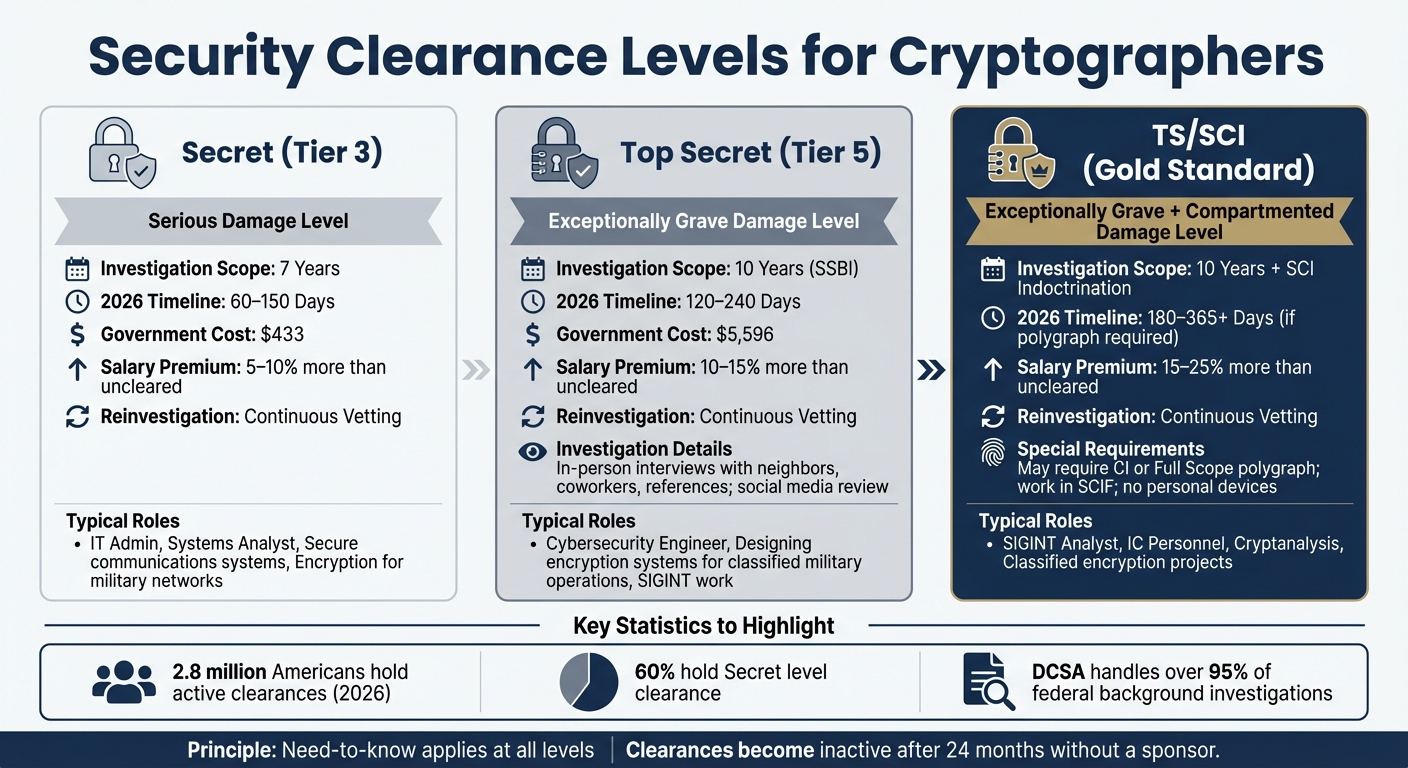
Security Clearance Levels Comparison for Cryptographers
Security clearances are essential for federal cryptography roles, influencing program eligibility, job location, and even salary. As of 2026, 2.8 million Americans hold active clearances, with 60% at the Secret level [6].
Recent updates to the process, under Trusted Workforce 2.0, have introduced "eApp" in place of e-QIP and implemented Continuous Vetting. This system performs real-time checks on criminal, credit, and travel records [9]. The Defense Counterintelligence and Security Agency (DCSA) handles over 95% of all federal background investigations [6][9].
One key principle applies to all clearance levels: need-to-know. Simply holding a clearance doesn’t grant unrestricted access to classified information. Access is only granted when it directly relates to a specific mission [8]. Below, we’ll break down the requirements and benefits of each clearance level.
Clearances, much like professional certifications, validate an individual’s trustworthiness to handle sensitive information.
Secret Clearance
Secret clearance (Tier 3) is the starting point for most cryptographers entering the cleared workforce. It pertains to information that, if disclosed, could cause "serious damage" to national security [6]. Investigations cover the past 7 to 10 years of your life [6][9], with processing times averaging between 60 and 150 days as of 2026 [9]. The cost to the government for this investigation is $433 [8].
Roles requiring Secret clearance often involve secure communications systems, encryption for military networks, and defensive cybersecurity tasks. Those with this clearance typically earn 5–10% more than their peers without clearance [6]. If you’re just beginning a cleared career, this is likely where you’ll start. Many employers are willing to sponsor upgrades to higher clearance levels once you’ve gained experience.
Top Secret Clearance
Top Secret clearance (Tier 5) is reserved for work involving information that could cause "exceptionally grave damage" to national security if leaked [6]. The investigation process is more rigorous, covering 10 years of personal history through a Single Scope Background Investigation (SSBI) [6][8]. This includes in-person interviews with neighbors, coworkers, and references, as well as a review of social media and digital activity [9].
In 2026, the average processing time for Top Secret clearance ranges from 120 to 240 days [9], with the government spending $5,596 per investigation [8]. Top Secret holders generally earn 10–15% more than their uncleared counterparts [6]. This clearance is common for roles like designing encryption systems for classified military operations, working on signals intelligence (SIGINT), or developing secure key management infrastructure. For technical positions, adjudicators may even examine your GitHub activity, forum contributions, and use of encryption tools or VPNs [9].
TS/SCI Clearance
TS/SCI clearance combines Top Secret clearance with access to Sensitive Compartmented Information (SCI) [7]. Often referred to as "the gold standard", this level is essential for Intelligence Community (IC) careers [7]. After obtaining a Top Secret clearance, a Special Security Officer (SSO) reviews your investigation to grant access to specific programs. You’ll then be "read in" and required to sign non-disclosure agreements for each compartment [7].
"TS/SCI is the gold standard of U.S. security clearances – the credential that unlocks intelligence community careers, the highest-paying cleared positions, and access to the most sensitive government programs." – ClearedJobs.Net [7]
Some TS/SCI roles require a Counterintelligence (CI) polygraph or a Full Scope (Lifestyle) polygraph, which cover areas like espionage, terrorism, personal conduct, and drug use [7]. If a polygraph is needed, processing can take over a year due to scheduling delays [9]. TS/SCI holders enjoy salary premiums of 15–25%, with some cryptography specialists earning even higher premiums [6][7].
These roles often require working in a SCIF (Sensitive Compartmented Information Facility), where personal devices are prohibited, and daily commutes are mandatory [7]. For those in signals intelligence, cryptanalysis, or classified encryption projects, this clearance is a standard requirement.
| Feature | Secret (Tier 3) | Top Secret (Tier 5) | TS/SCI |
|---|---|---|---|
| Damage Level | Serious [6] | Exceptionally Grave [6] | Exceptionally Grave + Compartmented [7] |
| Investigation Scope | 7 Years [6] | 10 Years [6] | 10 Years + SCI Indoctrination [7] |
| 2026 Timeline | 60–150 Days [9] | 120–240 Days [9] | 180–365+ Days (if Poly required) [9] |
| Reinvestigation | Continuous Vetting [9] | Continuous Vetting [9] | Continuous Vetting [9] |
| Typical Roles | IT Admin, Systems Analyst [6] | Cybersecurity Engineer [6] | SIGINT Analyst, IC Personnel [6] |
Under Continuous Vetting, it’s crucial to self-report events like arrests, major debt, or foreign travel. Keeping a detailed record of your last 10 years of residence, employment, and contacts can help streamline the process [9]. Adjudicators are also increasingly examining online activities to assess judgment and potential vulnerabilities [9].
The Trusted Workforce 2.0 initiative aims to simplify clearance reciprocity across federal departments and agencies with the principle of "clear once, trusted everywhere" [9]. This means your clearance can remain active as you switch employers, provided there’s no significant employment gap and no disqualifying incidents [6][7]. However, a clearance typically becomes inactive 24 months after leaving a cleared role unless a new sponsor picks it up [9].
sbb-itb-bf7aa6b
Skills and Responsibilities
Cleared cryptographers play a critical role in safeguarding the nation’s most sensitive data. From designing encryption protocols for classified communications to identifying vulnerabilities before they can be exploited, their work is vital. While specific tasks vary based on an individual’s clearance level and employer, the overarching goal remains the same: protecting information that could cause serious harm to the United States if exposed.
Job Responsibilities
On a technical level, much of your time will be spent developing cryptographic code, implementing algorithms, and optimizing their performance. This involves transforming plain data into encrypted formats that ensure confidentiality, integrity, authenticity, and nonrepudiation. You’ll also test cryptographic theories and analyze systems to uncover potential weaknesses.
In secure environments, responsibilities often go beyond theoretical work. Cryptological Technicians, for instance, handle the installation, troubleshooting, and repair of cryptographic equipment. They adhere to MILSPEC standards and two-person integrity rules, ensuring TEMPEST and RF shielding remain intact to prevent electromagnetic leaks that could jeopardize classified operations [10].
Collaboration is another key aspect of the job. You’ll work closely with security analysts, architects, and hardware engineers to integrate strong security measures. Given the high-stakes nature of this field, these technical demands require equally strong interpersonal and analytical skills.
Interpersonal and Analytical Skills
In addition to technical expertise, clear communication and sharp analytical abilities are essential for safeguarding classified systems. Explaining complex cryptographic risks to non-technical stakeholders, such as program managers or compliance officers, is a common challenge. As Coursera Staff points out:
Clear language can help identify security problems and get solutions in use because it reduces errors when setting up security systems [1].
Attention to detail is non-negotiable – a single error in a cryptographic protocol could compromise an entire system. Whether you’re conducting cryptanalysis, evaluating side-channel attacks, or designing secure communication protocols like TLS or SSH, a methodical approach is crucial. You’ll also need to be adaptable and self-directed, as classified projects often involve rapidly changing threats and limited external guidance.
Ethical judgment is another cornerstone of this role. Handling classified information daily requires trust and integrity that go beyond technical skills. While around 50% of cryptographers hold a bachelor’s degree [1], your success in the cleared community will also hinge on critical thinking, effective communication, and the ability to perform under pressure.
Job Search Strategies
Securing the perfect cleared cryptographer role means showcasing your clearance effectively while staying mindful of operational security.
Resume Optimization
Start by listing your clearance level right alongside your contact information [12]. Follow this with a brief, 2-3 line summary that emphasizes your cryptography experience – be specific about how long you’ve worked in the field [12].
Include a dedicated section for technical skills, highlighting your expertise in areas like cryptography, network security, and incident response [13]. When describing your achievements, use the STAR method (Situation, Task, Action, Result) to present measurable outcomes. Avoid vague statements like "Handled encryption protocols." Instead, go for specifics, like, "Redesigned encryption protocols to reduce vulnerability exposure by 30%." As Ashley Jones, Editor at ClearedJobs.Net, points out:
Your security-cleared resume is not a biography or a mere list of qualifications. It’s an ad designed to help you land that coveted cleared job interview [12].
Operational security is key. Never include classified project names, colleagues’ identities, office sizes, or budget details on your resume [12]. If you’re working toward certifications like CISSP or CEH, mention them along with the anticipated completion date to highlight your dedication [13]. Stick to simple formatting – use standard fonts and avoid graphics or shading that could confuse Applicant Tracking Systems [12]. Also, avoid mentioning your clearance level on LinkedIn, as this can pose a security risk [12].
Once your resume is polished, leverage specialized platforms to increase your job visibility.
Using Cleared Cyber Security Jobs
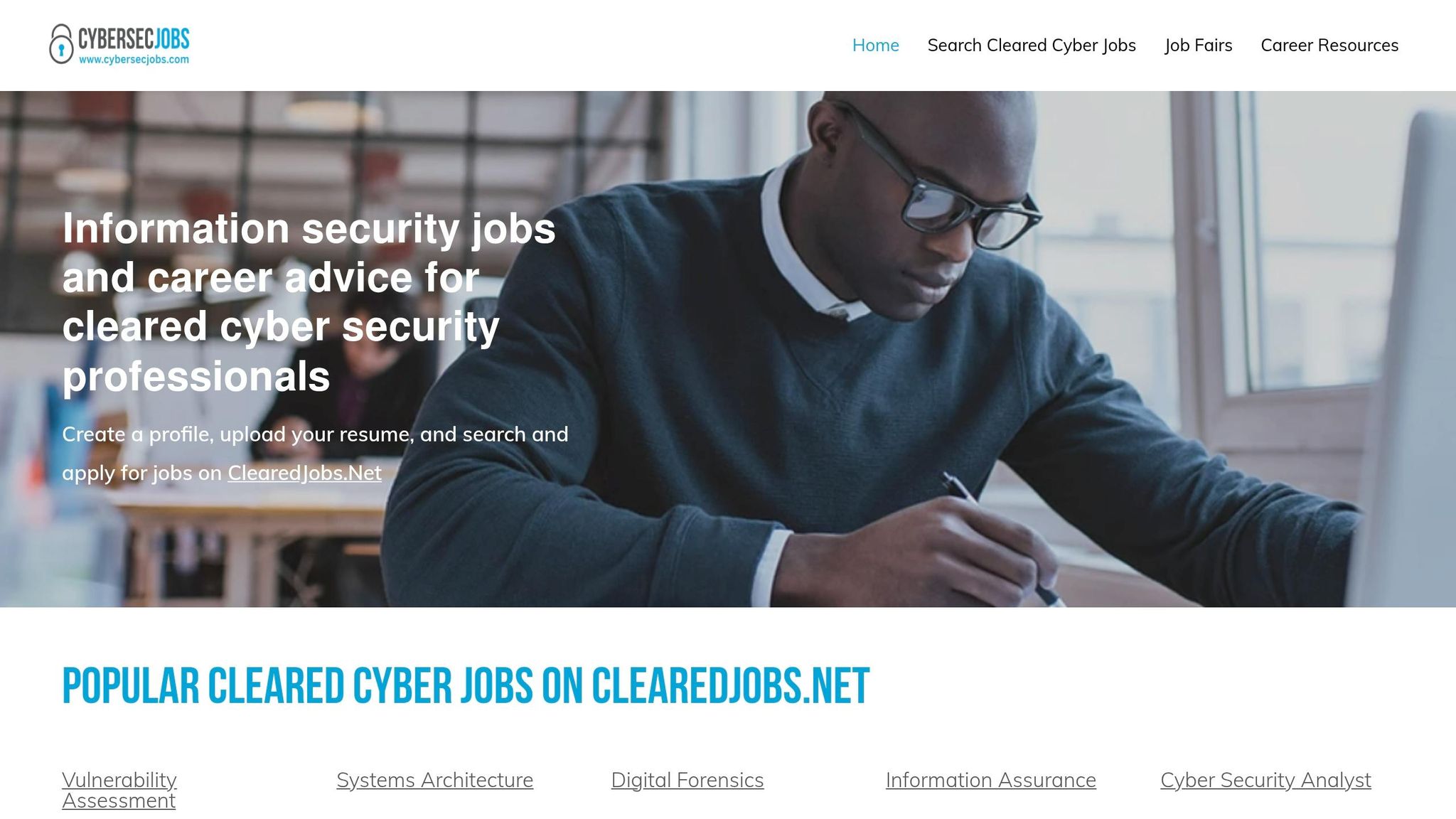
The success of this platform hinges on how well you set up your profile. Employers rely on profile details rather than uploaded resumes, so fully completing sections like "Key Skills" and "Work Location" is crucial for visibility [14]. Regularly updating your profile keeps you appearing as a "fresh" candidate in searches [14].
Set up job alerts using terms like "Cryptographer" or "Encryption Specialist" to catch a broader range of opportunities [14]. When filtering by clearance level, select all levels you’re eligible for – if you have a Top Secret clearance, also include "Secret" to expand your options [14]. Use ZIP Code and mileage filters to refine your search results [14]. The platform even allows you to block specific employers or switch to "Anonymous" mode, which keeps your skills visible while hiding your name [14].
After building a strong online presence, focus on preparing for interviews to effectively showcase your qualifications.
Interview Preparation
These strategies complement the technical expertise and clearance advantages discussed earlier. Use the STAR method during interviews to detail how you’ve improved security – share specific examples of how you mitigated risks or reduced vulnerabilities [13].
Be ready for direct questions during clearance verification interviews. The 13 adjudication guidelines cover areas like financial history and past misconduct, so make sure you’re prepared [11]. Bring government-issued ID and any necessary documents, such as financial forms or court records [11]. Understanding clearance reciprocity between federal agencies can also be helpful if you’re considering transitioning between government roles [11].
Industry Trends and Tools
Current Trends in Cryptography
Post-quantum cryptography (PQC) has moved from being a theoretical concept to an operational necessity. The National Security Agency’s CNSA 2.0 guidelines mandate that all National Security Systems transition to quantum-resistant algorithms. Starting January 2027, new system acquisitions must use PQC, with full migration required by 2035 [19]. NIST has already finalized its first three PQC standards as of August 2024: ML-KEM (FIPS 203) for key exchange, ML-DSA (FIPS 204) for digital signatures, and SLH-DSA (FIPS 205) as a hash-based backup [17]. Experts estimate there’s a greater than 50% chance that quantum computers will be capable of breaking RSA-2048 by 2034 [19].
The growing threat of "Harvest Now, Decrypt Later" has heightened urgency. Adversaries are intercepting and storing encrypted data with the hope of decrypting it once quantum technology matures [19]. As the Leidos Editorial Team puts it:
Post-quantum readiness is less about predicting ‘Q-Day’ and more about building durable cryptographic agility into enterprise architecture [15].
This concept of cryptographic agility – the ability to switch algorithms through configuration rather than overhauling infrastructure – has become a must-have [15]. Security-cleared professionals should start by auditing existing cryptographic systems to uncover hidden encryption in legacy setups and third-party tools. They should then focus on safeguarding data that needs to remain secure for a decade or more, such as genomic data or classified intelligence, with PQC measures [19].
Beyond quantum concerns, Zero Trust Architecture has become a federal requirement. This approach shifts away from perimeter-based security to a "never trust, always verify" model [18]. Additionally, homomorphic encryption is gaining traction for enabling computations on encrypted data, particularly in healthcare and financial sectors. Meanwhile, Zero-Knowledge Proofs (ZKPs) are proving useful for blockchain privacy and secure authentication [2]. Cryptographers must stay ahead of these developments to protect the nation’s most sensitive systems.
Keeping pace with these trends requires access to advanced tools and techniques.
Cryptography Tools
To meet these evolving challenges, professionals need a robust set of tools. OpenSSL remains essential for TLS/SSL protocols and certificate management in secure environments, while liboqs (Open Quantum Safe) supports quantum-resistant algorithms approved by NIST, complete with Python wrappers for testing [17]. Tools like SandboxAQ’s AQtive Guard, Keyfactor Command, and IBM Quantum Safe Explorer are invaluable for cataloging certificates and keys across enterprise systems [19].
For digital forensics and cryptanalysis, EnCase and FTK (Forensic Toolkit) are critical. In cloud environments, AWS KMS (GovCloud) and Microsoft Azure Government offer centralized, hardware-backed key management solutions [16]. Developers working with cryptographic primitives often rely on PyCryptodome, a Python library ideal for prototyping and security testing.
The choice of programming language also matters. C++ is preferred for high-speed encryption tasks where memory control is critical, while Python is better suited for rapid prototyping and scripting. Rust is gaining popularity for its memory-safe features, which help prevent side-channel attacks [2]. Building a GitHub portfolio showcasing hands-on cipher implementations – like AES in C++ or contributions to OpenSSL – can often make a stronger impression on employers than an advanced degree [2].
Transitioning to PQC comes with practical hurdles. For instance, ML-KEM and ML-DSA require significantly larger key and signature sizes (ranging from 800 to over 4,500 bytes compared to RSA/ECC’s 64–256 bytes). This makes automation tools like Certificate Lifecycle Management essential [19]. A hybrid approach – running both classical and quantum-safe encryption simultaneously, such as X25519Kyber768Draft – helps maintain compatibility while preparing for future threats. Tools like OpenSSL 3.x, with its provider-based architecture, allow for seamless algorithm swapping without rewriting code [19].
Conclusion
Pursuing a career in cryptography requires a mix of formal education, hands-on experience, and specialized credentials. While a bachelor’s degree in fields like computer science, mathematics, or cybersecurity lays the groundwork, it’s the roughly five years of professional experience in information security that truly sets you up for cryptographer roles [1]. To stand out, focus on mastering technical skills such as linear algebra, number theory, and programming languages like Python and C++.
Security clearance plays a massive role in this field. Holding a TS/SCI clearance can boost your salary by $30,000–$45,000 annually, while positions requiring a Full Scope Polygraph often come with premiums of $45,000–$65,000 over non-cleared roles [18]. By the time you’ve gained five years of experience, your clearance and mission-specific expertise become invaluable. As of July 2025, the median total pay for cryptography engineers reached $170,000, with certain specialized roles offering even higher compensation [1].
Staying current with industry trends and earning certifications can further enhance your career. Certifications offer immediate benefits; for instance, CISSP certification typically increases salaries by $15,000–$25,000 and qualifies you for senior-level roles [18]. Begin with the CompTIA Security+ certification ($404) to meet DoD 8140 compliance requirements, and then work toward CISSP ($749) as you advance in your career [18]. If you’re looking to specialize, the EC-Council Certified Encryption Specialist (ECES) can validate your expertise in cryptography and help you stand out [1].
The field is changing quickly, and professionals skilled in advanced techniques, such as post-quantum cryptography, will be highly sought after [2]. Akane T.H., from FindWeb3, encapsulated the essence of the profession:
A career in cryptography is less about finding a job and more about cultivating ongoing problem-solving expertise. You are tasked with staying one step ahead of adversaries.
To sharpen your skills, build a GitHub portfolio showcasing real-world implementations, participate in Capture the Flag competitions to hone adversarial thinking, and stay flexible as encryption technologies evolve.
For those with active clearances, platforms like Cleared Cyber Security Jobs can connect you directly with employers, cutting down the lengthy clearance processing time. Upload your resume, set up job alerts, and take advantage of resources tailored to the cleared community. By combining technical skills, strategic certifications, and an active clearance, you’ll be well-positioned to safeguard the nation’s most critical systems and data. Use Cleared Cyber Security Jobs to simplify your journey and take the next step in your cryptography career.
FAQs
How do I get a clearance if I don’t already have one?
To get a security clearance, you need sponsorship from either an employer or a government agency. The process involves filling out an application, such as the SF-86 form, and going through a background investigation. In some cases, a polygraph test might also be part of the process. The investigation looks into various aspects of your life, including personal details, financial records, criminal history, and employment background. The time it takes to process a clearance depends on the level – Secret clearances might take a few months, while Top Secret clearances can take over a year.
What should I include in a GitHub portfolio without violating OPSEC?
To create a GitHub portfolio that respects OPSEC (Operational Security), focus on projects that steer clear of sensitive or classified information. Highlight your cybersecurity or cryptography skills by working on open-source projects, simulations, or educational tools that rely solely on public data. It’s crucial to avoid including real-world systems, client data, or operational details in your work. This approach allows you to demonstrate your expertise while staying within operational security boundaries.
How can I prepare now for post-quantum cryptography requirements?
Getting ready for post-quantum cryptography requires staying up-to-date with key developments, such as the standards being finalized by NIST in 2024. These standards will serve as a guide for implementing quantum-resistant solutions.
One crucial step is to prioritize crypto-agility – this means building systems that can quickly adapt to new algorithms as they emerge. Another effective approach is using hybrid strategies, which combine traditional encryption methods with quantum-resistant techniques to provide an extra layer of security during the transition.
It’s also important to revisit and update your security protocols. Assess risks like the "harvest now, decrypt later" threat, where attackers collect encrypted data today with plans to break it using quantum computers in the future. Collaborating with cryptography experts and industry professionals will help you implement PQC solutions effectively and ensure your systems are ready for the challenges ahead.
Staying proactive is key – quantum threats are advancing quickly, and preparation now can save significant trouble later.