• Skip to primary navigation
  • Skip to main content
Cleared Cyber Security Jobs | CyberSecJobs.com

Cleared Cyber Security Jobs | CyberSecJobs.com

Cleared Cyber Security Jobs

  • Home
  • Search Cleared Cyber Jobs
  • Job Fairs
  • Career Resources

Uncategorized

Cleared Penetration Tester Jobs Complete Career Guide

CyberSecJobs Editorial · March 26, 2026 ·

Cleared penetration testers are in high demand, with job growth projected at 33% from 2023 to 2033. These professionals simulate cyberattacks to identify vulnerabilities in classified systems, requiring both technical skills and federal security clearances (e.g., Secret, Top Secret, TS/SCI). Here’s what you need to know:

  • Security Clearances: Mandatory for accessing classified systems. Clearances are sponsored by employers and maintained through Continuous Vetting.
  • Certifications: CEH, OSCP, GPEN, and PenTest+ are key for meeting DoD compliance and showcasing hands-on skills.
  • Career Path: Entry-level roles start at $85,000, with senior positions exceeding $200,000 annually.
  • Key Skills: Expertise in tools like Nmap, Metasploit, and Burp Suite, plus knowledge of Windows/Linux, networking protocols, and scripting languages.
  • Job Search Tips: Use niche platforms like Cleared Cyber Security Jobs and network at industry events to find roles requiring active clearances.

This guide covers everything from clearance requirements to salary expectations, helping you navigate this specialized and growing field.

How to Become a Penetration Tester (Ethical Hacker) in 2025

sbb-itb-bf7aa6b

Security Clearance Requirements
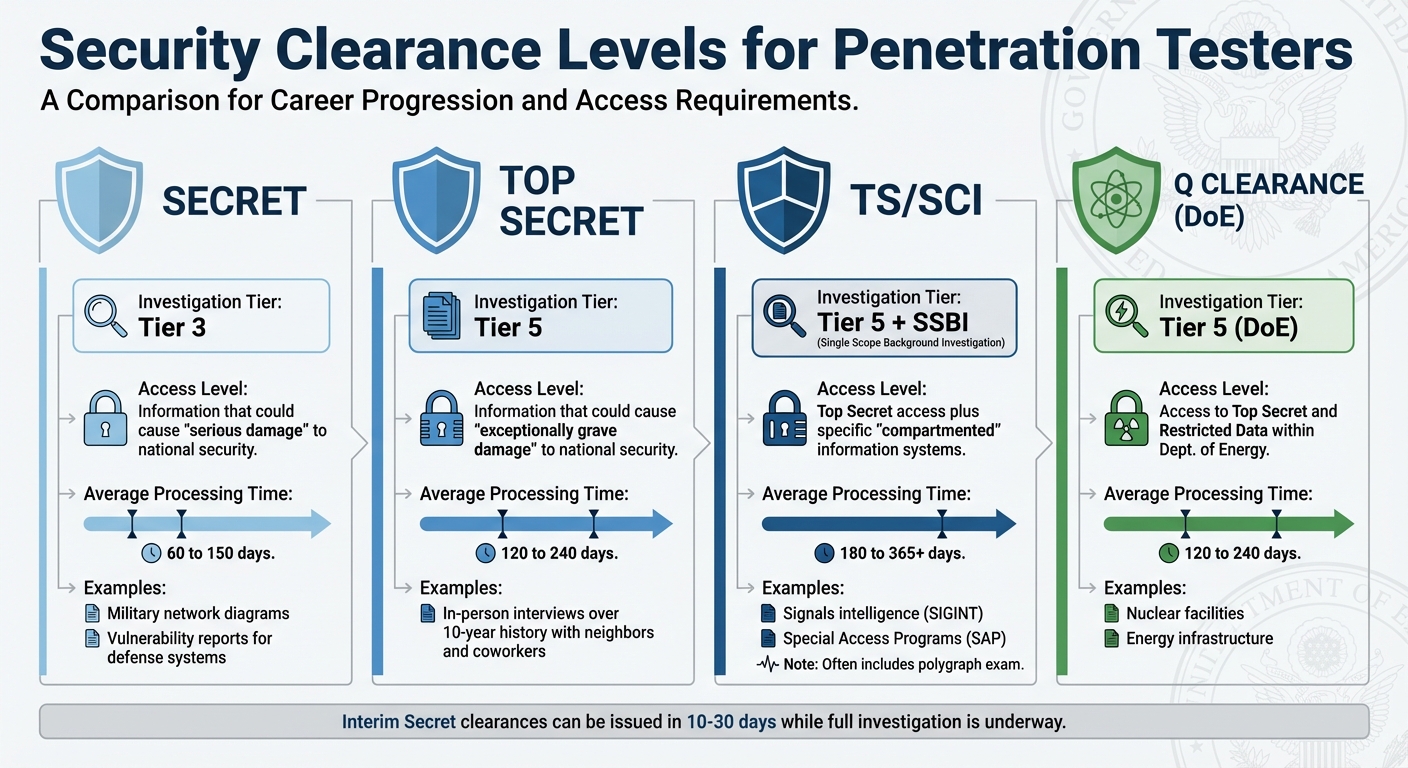
Security Clearance Levels Comparison for Penetration Testers

Security Clearance Levels Comparison for Penetration Testers

Security clearances are a must-have for penetration testers working in the cleared sector. Without one, you won’t be able to access classified networks like SIPRNet, analyze sensitive threat intelligence, or test vulnerabilities in critical systems like weapon platforms or infrastructure [4]. The Defense Counterintelligence and Security Agency (DCSA) handles the vast majority – over 95% – of federal background checks [4].

Here’s the catch: you can’t apply for a clearance on your own. A federal agency or an authorized defense contractor has to sponsor you, typically after offering you a conditional job [4]. For newcomers, this creates a frustrating cycle – many employers want candidates with active clearances, but you need an employer to sponsor you in the first place. Once granted, your clearance is tied to your job. If you leave a cleared position, the clearance usually becomes inactive after 24 months unless another sponsor steps in [4][5].

The Trusted Workforce 2.0 (TW 2.0) framework, now the standard as of 2026, aims to simplify things by enabling "clear once, trusted everywhere" reciprocity. This means your clearance should transfer more easily between federal agencies and contractors, cutting down on redundant investigations. Another major change is the shift from periodic reinvestigations every 5 or 10 years to Continuous Vetting (CV). This real-time system monitors criminal records, credit issues, and foreign travel [4].

"An incident on a Saturday could generate an alert to your security office by Monday. This makes immediate self-reporting of any adverse event… a critical component of sustaining trust." – Kevin James, Cybersecurity Writer [4]

Clearance processing times depend on the level of access required. For example:

  • Interim Secret clearances can be issued in 10 to 30 days, allowing you to begin some work while the full investigation is underway.
  • A full Secret (Tier 3) clearance usually takes 60 to 150 days.
  • Top Secret (Tier 5) clearances take longer, averaging 120 to 240 days.
  • For TS/SCI with a polygraph, expect a timeline of 180 to 365+ days, with polygraph scheduling often being the biggest delay [4].

Clearance Levels Explained

There are three main clearance levels, each tied to the potential damage unauthorized disclosures could cause to national security. Here’s a quick breakdown:

  • Confidential and Secret clearances both involve Tier 3 investigations, but Secret is far more common in penetration testing roles. Secret clearance grants access to information that could cause "serious damage" if leaked – think military network diagrams or vulnerability reports for defense systems [5].
  • Top Secret clearances, requiring Tier 5 investigations, protect information that could cause "exceptionally grave damage." These investigations are more thorough, including in-person interviews over a 10-year history with people like neighbors and coworkers [4].
  • TS/SCI (Top Secret/Sensitive Compartmented Information) isn’t a separate clearance but an added control for compartmented information. This often includes a polygraph exam and additional briefings. Penetration testers with TS/SCI clearances typically work on sensitive programs like signals intelligence (SIGINT) or special access programs (SAP) [5].

For roles involving nuclear facilities or energy infrastructure, the Department of Energy uses different terms:

  • L Clearance (similar to Secret)
  • Q Clearance (akin to Top Secret, with access to Restricted Data) [5]
Clearance Level Investigation Tier Access Level Average Processing Time
Secret Tier 3 Information that could cause "serious damage" to national security 60 to 150 days
Top Secret Tier 5 Information that could cause "exceptionally grave damage" to national security 120 to 240 days
TS/SCI Tier 5 + SSBI Top Secret access plus specific "compartmented" information systems 180 to 365+ days
Q Clearance Tier 5 (DoE) Access to Top Secret and Restricted Data within the Dept. of Energy 120 to 240 days

The next section dives into how to maintain and upgrade these clearances, with tips for staying eligible long-term.

Maintaining and Upgrading Your Clearance

Continuous Vetting has completely changed how clearances are maintained. Instead of waiting for periodic reinvestigations, the system now tracks criminal records, credit issues, and foreign travel in real time [4]. It’s crucial to report any adverse events – like arrests, major debt, or new foreign contacts – to your Facility Security Officer (FSO) immediately. Delays in self-reporting can jeopardize your clearance [4].

Financial issues remain the number one reason for clearance denials or revocations. If you’re about to start the eApp (the digital replacement for e-QIP), check your credit reports and resolve any delinquencies. The SF-86 form requires a detailed 10-year history of your residences, jobs, education, and foreign contacts, so gather those records in advance [4].

Upgrading from Secret to Top Secret involves sponsorship for a role that needs higher access. This triggers a new Tier 5 investigation, which digs deeper into your finances and foreign connections. If you’ve maintained good credit, avoided legal trouble, and kept clear documentation of your international collaborations, the process should go smoothly [4].

In 2026, adjudicators are paying closer attention to your digital footprint. They review public-facing activity like GitHub contributions, gaming forums, and social media for signs of poor judgment or vulnerability to blackmail. Before applying, take a moment to review your social media privacy settings and posts [4].

One key tip: don’t list your clearance level on public platforms like LinkedIn. Advertising an "Active TS/SCI" status makes you a target for foreign intelligence. Instead, create two resumes – one with clearance details for verified recruiters and a sanitized version for public job boards [6].

Looking ahead, proposed "Warm Bench" legislation could allow contractors to sponsor clearances for talent pools, even without immediate contract needs. If passed, this could help break the cycle of needing a clearance to get a job and vice versa. For now, focus on roles offering interim clearances or employers willing to sponsor new applicants.

Required Qualifications and Certifications

If you’re eyeing a penetration testing role in the cleared space, technical skills alone won’t cut it – you’ll also need the right certifications. The DoD 8140 framework (previously known as 8570.01-M) outlines the certifications required for federal contractors, linking them to specific roles like Exploitation Analysis and Vulnerability Assessment [7][8]. Without these credentials, even highly experienced candidates may find themselves ineligible.

Certifications for penetration testers fall into two main categories: knowledge-based exams (like CEH and PenTest+) and performance-based certifications (such as OSCP). Performance-based credentials hold more weight because they test hands-on skills rather than just theoretical understanding [8]. That said, knowledge-based certifications can still help you qualify for contracts quickly in the cleared marketplace.

Top Certifications for Penetration Testers

Certification Format Focus Career Impact
CEH Multiple-choice exam Foundational techniques and attack methods Meets DoD compliance; essential for federal contracts
OSCP 24-hour practical lab Hands-on exploitation and detailed reporting Demonstrates practical skill; favored for red teaming
GPEN Open-book proctored exam Network exploitation methodology Recognized in SANS-oriented environments; stackable with others
PenTest+ Knowledge & performance End-to-end penetration testing lifecycle Ideal for roles emphasizing assessment coordination

The Certified Ethical Hacker (CEH) is officially approved for the Computer Network Defense Service Provider (CND-SP) Analyst role under DoD 8140 [7]. It covers basic attack techniques and requires 120 continuing education credits every three years to stay valid.

"CEH satisfies explicit DoD 8140 role requirements… making CEH the default choice for compliance-driven DoD contract fulfillment." – Penetration Testing Authority [7]

The Offensive Security Certified Professional (OSCP) is often considered the gold standard for technical expertise. Candidates must compromise machines in a 24-hour lab and submit a detailed report within the following 24 hours [7]. This hands-on format bridges the gap between theory and real-world application. While not always required for entry-level roles, OSCP is increasingly seen as a baseline for independent engagements [9].

The GIAC Penetration Tester (GPEN) is a favorite in enterprise settings, particularly those aligned with SANS training. This open-book exam emphasizes network exploitation methods and requires 36 continuing professional experience credits every four years [7][8]. Many professionals pair GPEN with other GIAC certifications, like GWAPT or GXPN, to highlight specialized expertise.

CompTIA PenTest+ offers a broader view, covering the entire penetration testing lifecycle, from planning and scoping to reporting. Scoring at least 750 out of 900 is required to pass [8]. This certification is well-suited for roles that focus on managing or coordinating assessments rather than strictly technical execution.

For federal contractors, the CEH is often the go-to choice to meet DoD 8140 compliance [7]. If you’re aiming for more technical or red team roles, the OSCP is a better fit [7]. For niche areas like web application or cloud security, consider adding certifications like GWAPT or OSWE to your toolkit [8].

While certifications prove your foundational skills, practical experience is what truly prepares you for advanced roles. Next, let’s explore how experience levels align with career progression in this field.

Experience Requirements by Career Stage

Certifications are just the start – your career in penetration testing will grow with hands-on experience and deeper technical skills.

  • Entry-Level (0–2 years): Most beginners transition from roles like systems administration, network engineering, or SOC analysis, bringing 1–4 years of IT experience. At this stage, you’ll focus on learning tools like Nmap and Burp Suite while working under senior supervision. Entry-level salaries typically start around $85,000 [3].
  • Mid-Level (2–5 years): With a few years of experience, you’ll start leading engagements, managing scopes of work, and crafting technical reports for executives. Specialization in areas like cloud security or web applications often begins here, with salaries ranging from $110,000 to $140,000 [3].
  • Senior-Level (5–8 years): Senior roles involve defining methodologies, leading red teams, and conducting advanced research. Salaries for these positions can range from $145,000 to $200,000 or more [3].
  • Lead/Principal Roles (8+ years): At this stage, you’ll guide teams, manage large-scale programs, and contribute to broader security strategies.

For those transitioning into penetration testing, focus on skills like local privilege escalation and network-based attacks (e.g., SMB relay). Many professionals make the leap within 12–24 months [1][9]. Participating in bug bounty programs (via platforms like Bugcrowd or HackerOne) or using gamified labs like Hack The Box and PentesterLab can help you gain practical, verifiable experience outside traditional employment [2].

Technical Skills and Tools You Need

To stand out as a penetration tester, you need a deep understanding of technical systems. For cleared roles, this means expertise in both Windows and Linux environments, databases, and networking protocols like TCP/IP, UDP, ARP, DNS, DHCP, HTTP, and SSL/TLS [15]. Knowing scripting and programming languages such as Python, Bash, Perl, Ruby, or JavaScript is equally important, as these are key for tasks like automation, exploit development, and code review [12]. Add to that knowledge of cryptography, reverse engineering, and secure code reviews, and you’ve got the foundation for working in classified environments and meeting federal testing standards [12].

You’re also expected to be familiar with frameworks like OSSTMM, the OWASP Top 10, PTES, and NIST standards, which shape how you conduct tests and create reports [11]. In cleared environments, you’ll need to adapt security protocols to specialized systems like SIPRNet, AWS GovCloud, and Microsoft Azure Government [4].

AI is playing a growing role in penetration testing, helping automate tasks like reconnaissance, attack surface scanning, and report generation [10]. That said, human expertise is still crucial for validating results and understanding their impact. As Thoropass notes, “AI will not replace penetration testers, but it can make them more effective” [10].

Must-Know Penetration Testing Tools

To effectively apply your skills, you’ll need to master a range of tools:

  • Nmap: A go-to tool for active network scanning, identifying hosts and services [15].
  • Metasploit Framework: Essential for delivering exploits and managing payloads during the exploitation phase [15].
  • Burp Suite Professional and OWASP ZAP: Popular choices for web application testing, targeting vulnerabilities like SQL injection and cross-site scripting [16].
  • Wireshark: A packet analysis tool for capturing and examining network traffic in real time [12].
  • Nessus and OpenVAS: Vulnerability scanners that help identify known weaknesses for compliance purposes [15].
  • Cobalt Strike: A commercial platform used for advanced simulations, including lateral movement and command-and-control operations [15].
  • BloodHound: A tool for mapping attack paths within Active Directory or Azure environments [14].
  • CloudFox: Useful for uncovering exploitable paths in cloud infrastructures like AWS, Azure, and GCP [14].

If you’re aiming to pass ATS filters or technical interviews, proficiency in tools like Nmap, Metasploit, and Burp Suite is often considered essential [17]. These tools are referenced in federal standards like NIST SP 800-115 and form the backbone of most penetration testing engagements [15].

Testing Domains and Specializations

Beyond tools, diving into specific testing domains can sharpen your skills further. Specialization typically happens after 2–5 years of general experience [3]. Here’s a breakdown of key areas:

  • Network security: Focuses on infrastructure like routers and firewalls. You’ll tackle challenges such as SMB relay, ARP spoofing, and man-in-the-middle attacks [1].
  • Web application testing: Centers on OWASP Top 10 vulnerabilities, including SQL injection and broken authentication. Tools like Burp Suite and secure coding practices are essential here [3].
  • Cloud security: Involves working with AWS, Azure, and Google Cloud. Cleared roles often extend this to environments like AWS GovCloud and Microsoft Azure Government [4].
  • Mobile application testing: Requires expertise in iOS and Android security models [11].
  • Wireless security: Focuses on testing wireless protocols and securing networks [11].
  • Social engineering: Tests the human element of security through phishing campaigns and similar techniques [12].

Your background can guide your specialization. For instance, former developers often lean toward application security, while network engineers might specialize in network penetration testing [1]. Building a home lab with virtual machines or platforms like Proving Grounds is a great way to practice and refine your techniques in a controlled setting [12].

How to Find Cleared Penetration Tester Jobs

Once you’ve honed your technical skills and earned the right certifications, the next challenge is landing a position in the cleared environment. This requires a strategic job search. The U.S. Bureau of Labor Statistics anticipates a 33% growth in information security analyst roles, including penetration testers, between 2023 and 2033 [2]. But here’s the catch: these specialized roles often aren’t listed on mainstream job boards. You’ll need to focus on niche platforms and communities.

Using Cleared Cyber Security Jobs Job Board
Cleared Cyber Security Jobs

Cleared Cyber Security Jobs is a dedicated platform for U.S. citizens with active security clearances. Unlike traditional job boards, this site connects candidates directly with employers, bypassing third-party staffing firms. You can set up tailored job alerts based on criteria like job title, clearance level, and location, ensuring you stay updated on relevant positions.

Your profile on this platform matters just as much as your resume. Make sure every section is filled out completely, and highlight your clearance level prominently at the top of your resume to increase your chances of passing Applicant Tracking Systems (ATS).

The platform also organizes Cleared Job Fairs, both virtual and in-person, where you can meet hiring managers from defense contractors and government agencies. These events provide a direct path to employment. As G.B., a Technical Project Manager at CACI, shared:

"I attended a Cleared Job Fair and was offered a position shortly after. I accepted and moved directly from the military into my current position, without a lapse in employment." [18]

While job boards are helpful, personal connections can often lead to roles that aren’t publicly advertised.

Networking and Getting Referrals

After optimizing your online presence, shift your focus to networking – it’s often the key to uncovering hidden opportunities. Many cleared penetration testing roles never make it to job boards. As Cleared Cyber Security Jobs explains:

"In the security-cleared cyber security community, landing your dream job often requires more than just submitting your resume online… networking is key." [19]

Connecting with professionals in classified environments can provide valuable insights into agency requirements and unadvertised roles. Industry events like BSides, Black Hat, DEF CON, and RSA are excellent places to network. These conferences even have a nickname for casual networking: "HallwayCon." Volunteering at these events can grant you free access and direct interaction with organizers and speakers. Make sure to follow up within 24–48 hours and stay engaged by sharing relevant industry news or articles.

On LinkedIn, consider joining groups for cleared professionals rather than publicly displaying your clearance status. A search for "Active TS/SCI" on LinkedIn can yield over 33,000 profiles, potentially making you a target for exploitation [6]. Fr. Dewey Fisher, Administration Developer at Loyal Source, emphasizes the value of a clearance:

"If you hold a U.S. Secret Clearance, you have something many would consider more valuable than a college degree." [6]

For those working in sensitive locations like the Pentagon, it’s wise to list your employer as "Top Government Agency" on public profiles. This strikes a balance between protecting sensitive information and signaling your experience level.

Additionally, contributing to open-source security projects on GitHub or participating in forums like Reddit’s r/netsec can showcase your technical skills and help you connect with peers who might offer referrals. Platforms like Bugcrowd or HackerOne can also provide hands-on experience through bug bounty programs, which is appealing to cleared employers. Finally, reaching out to government staffing firms, such as Loyal Source, can put you on their radar for future opportunities [6].

Salary Expectations and Career Growth

In a cleared penetration testing career, your technical expertise and clearance qualifications not only make you more attractive to employers but also pave the way for higher salaries and leadership roles.

Salary Ranges by Clearance and Experience

Cleared penetration testers generally earn more than their non-cleared counterparts. The federal contracting market is divided into cleared and non-cleared sectors, and those without Department of Defense (DoD) clearances are excluded from many lucrative opportunities [20]. Cleared professionals typically earn a 10–20% pay premium due to the limited supply of candidates and the lengthy clearance process, which can take months or even years [20].

As of May 2023, the median annual wage for Information Security Analysts, a category that includes penetration testers, was $120,360 [20]. Those with active TS/SCI clearances tend to earn even more because the labor pool becomes even smaller [20].

Career Tier Experience Base Salary Range (Non-Cleared) Estimated Cleared Salary (10–20% Premium)
Junior / Associate 0–2 years $60,000 – $85,000 $66,000 – $102,000 [20]
Mid-Level 2–5 years $90,000 – $130,000 $99,000 – $156,000 [20]
Senior / Red Team Lead 5+ years $140,000 – $200,000+ $154,000 – $240,000+ [20]

Location also plays a big role. Salaries in cities like Washington, DC, and the San Jose–San Francisco area can be 20–30% higher than the national median [20]. Certifications matter too: OSCP holders often land in mid-level pay ranges ($90,000–$130,000), while advanced credentials like GXPN or OSED are linked to the highest salary tiers [20].

These salary structures provide a clear roadmap for career development, as outlined further below.

Career Advancement Opportunities

Cleared penetration testing careers typically follow a structured progression. Entry-level Junior/Associate roles involve supporting senior team members, while Mid-Level positions allow for independently managing engagements. At the Senior/Red Team Lead level, responsibilities include designing complex simulations and mentoring less experienced staff [20]. Senior Red Team Leads in sectors like federal defense or finance can earn $160,000–$200,000+ [20].

Career paths can also lead to specialized roles. For example:

  • Management-adjacent positions (often requiring a CISSP)
  • Security Architecture, with a median salary of $120,520 as of 2021 [13]
  • Boutique consulting, where hourly rates range from $150 to $350+ [20]
  • Security Software Development, with a median salary of $109,020 [13]
  • Executive roles like Chief Information Security Officer (CISO) [2][13]

In-house positions often provide stability and a defined scope of work, while consulting roles offer higher earning potential through billable hours and business development [20].

Advancing in this field requires balancing technical expertise with business skills. As your career develops, you’ll shift from hands-on testing to advising on security strategies, assessing risks, and training staff on cybersecurity best practices [13].

Wrapping It All Up

Cleared penetration testing requires a mix of technical expertise and thoughtful career planning. On the certification front, the OSCP is ideal for showcasing independent practitioner skills, while Security+ and CEH fulfill the DoD 8140 requirements. To excel, you’ll need a strong grasp of networking, operating system internals, and tools like Kali Linux and Metasploit, along with the ability to deliver professional-grade reports. These skills and credentials provide a solid foundation for a targeted job search.

Securing and maintaining a Secret or TS/SCI clearance through the DCSA opens doors to lucrative opportunities. Once you have the right credentials, leverage platforms like Cleared Cyber Security Jobs to connect with employers specifically seeking professionals with active clearances. Upload your resume, set up job alerts, and access resources tailored for the cleared community.

Focusing early on high-demand areas – like Active Directory exploitation or cloud-native architecture – can fast-track your progression from entry-level to senior roles. Highlight your expertise through CTF competitions, Hack The Box rankings, or GitHub projects to stand out.

The path is straightforward: earn DoD-recognized certifications, keep your clearance active, and use specialized platforms to land roles that align with your skills. Your next cleared opportunity is waiting – go after it!

FAQs

How can I get my first security clearance?

To get your first security clearance, you’ll need to meet specific eligibility criteria and complete a thorough vetting process. Usually, this starts with an employer sponsoring you for a role that requires clearance. From there, you’ll fill out the SF-86 form and undergo background checks that review your finances, criminal record, and personal behavior. The entire process can take anywhere from several months to a year. Staying honest and transparent throughout is key to increasing your likelihood of approval.

Which cert should I get first for DoD 8140 roles?

The CompTIA PenTest+ certification is an excellent entry point for individuals pursuing DoD 8140 roles. Approved by the Department of Defense, it qualifies you for positions such as cybersecurity service provider analyst, incident responder, and auditor. This certification not only aligns your skills with critical job responsibilities but is also widely acknowledged within the cleared community.

What gets a clearance denied or revoked?

Clearances may be denied or revoked if someone fails to meet specific adjudicative guidelines. Common reasons include inappropriate sexual behavior, misuse of IT systems, mishandling of protected information, foreign influence, alcohol or drug abuse, criminal conduct, personal misconduct, or financial problems. Each situation is assessed on a case-by-case basis, taking these factors into account.
Related Blog Posts

  • PenTest Plus Certification Career Guide for Cleared Pen Testers
  • eJPT Certification Career Guide for Cleared Junior Pen Testers
  • Red Team Operator Career Path for Cleared Professionals
  • Cyber Warfare Specialist Career Path for Cleared Military

Cleared Incident Responder Jobs Complete Career Guide

CyberSecJobs Editorial · March 26, 2026 ·

Cleared incident responders are cybersecurity professionals who protect classified government and defense systems from cyber threats. These roles require advanced technical skills, security clearances (Secret, Top Secret/SCI, or TS/SCI with Polygraph), and certifications like Security+, CEH, GCIH, or CISSP. Salaries average $132,962 annually, with some roles paying up to $186,500.

Key Points:

  • Work Environment: Operate in secure facilities (SCIFs) using tools like SIEMs (Splunk, QRadar) and forensic software (EnCase, FTK).
  • Growing Demand: Federal modernization, secure cloud adoption, and legislative changes (e.g., Trusted Workforce 2.0) drive job growth.
  • Skills Needed: Forensics, malware analysis, scripting (PowerShell, Bash), and communication.
  • Experience Path: Start as SOC analyst or system admin; progress to roles like Cyber Incident Handler or Cloud Forensic Analyst.
  • Security Clearance: Requires sponsorship, with processing times ranging from 60 to 365+ days depending on clearance level.

If you’re aiming to break into or advance in this field, focus on gaining certifications, building technical expertise, and preparing for the clearance process.

A beginner’s guide to modern incident response (step-by-step guide) | Learn with HTB (Episode #3)

sbb-itb-bf7aa6b

Required Skills and Qualifications

To thrive as a cleared incident responder, you need a mix of advanced technical know-how, recognized certifications, and essential interpersonal skills. These roles operate within government and defense contractor environments, where high standards are the norm.

Technical Skills You Need

Incident response depends on expertise in forensic collection, intrusion correlation, and log analysis. This includes analyzing data from hosts, network traffic, firewalls, and intrusion detection systems to piece together how an attack unfolded. Advanced roles go further, requiring knowledge of memory, registry, and USB forensics, as well as investigations tailored to platforms like Windows, Linux, Docker, and cloud environments.

Malware analysis and reverse engineering are key for uncovering the origins and extent of attacks. Skills in scripting with PowerShell and Bash are also vital, as they allow you to automate responses and quickly analyze logs. Familiarity with tools like Autopsy, Volatility, EnCase, FTK, and various SIEM platforms enhances your ability to gather evidence and connect the dots in complex attack scenarios.

Many professionals start in roles such as SOC analyst, network administrator, or system administrator before transitioning into incident response. If you’re in a general IT role, look for opportunities to work with IDS tools or contribute to community rules for systems like Snort.

Once you’ve built a solid technical foundation, certifications can help validate your expertise and prepare you for cleared roles.

Certifications for Cleared Roles

Certifications are a great way to demonstrate your qualifications and stand out in the field. For those just starting, Security+ provides a solid foundation. As you advance, certifications like GCIH (GIAC Certified Incident Handler) and ECIH (EC-Council Certified Incident Handler) focus on practical incident response techniques. The CEH (Certified Ethical Hacker) certification is also helpful for understanding how attackers operate, so you can better defend against them.

For those specializing in digital forensics, the GCFA (GIAC Certified Forensic Analyst) offers in-depth training. Senior-level roles often require certifications like CISSP or CISM, which emphasize leadership and managing enterprise-wide responses. A tiered approach to certifications can help you progressively build your qualifications.

Certification Level Primary Focus
Security+ Entry Basic security principles and foundational skills
CEH Intermediate Understanding attacker techniques and strategies
GCIH / ECIH Intermediate Tactical incident response and handling
GCFA Advanced In-depth digital forensics and data recovery
CISSP / CISM Senior Leadership and enterprise-level response management

While technical skills and certifications are important, success in this field also depends on your ability to communicate effectively and stay composed under pressure.

Soft Skills and Analytical Abilities

Technical knowledge alone isn’t enough. You’ll need to translate complex forensic findings into clear, actionable reports for managers, legal teams, and others who may not have a technical background.

During active breaches, stress management and quick decision-making are crucial. You’ll often face irregular hours and high-pressure situations, so staying calm and adaptable is essential. Collaboration is also key – incident responders work closely with teams across IT, HR, legal, DevOps, and executive leadership to address and resolve threats.

Attention to detail is critical for identifying real threats and avoiding false positives, especially when the situation doesn’t fit standard playbooks. The cyber threat landscape is constantly evolving, so staying current is a must. This means learning about new malware, phishing tactics, and emerging threats. Activities like cloud-based capture-the-flag competitions, SANS NetWars events, or running tabletop exercises with your team can sharpen your analytical skills and keep you prepared.

Combining these technical and soft skills ensures you can respond effectively to the challenges of cleared incident response roles.

Education and Experience Requirements

Educational Background

For most cleared incident responder roles, a bachelor’s degree in fields like Computer Science, Cybersecurity, Information Technology, or Information Security is typically required. Statistics show that about 54% of cybersecurity professionals hold a bachelor’s degree, often with specializations like Digital Forensics or Incident Response, which can give candidates a competitive edge. Meanwhile, 43% of professionals have an associate degree, which can be enough for entry-level positions [1]. Only 1% of professionals hold a master’s degree, but those who do often find opportunities in senior leadership roles [1].

Relevant coursework should include topics such as network protocols, operating systems like Linux and Windows, and cloud security basics [6]. That said, some organizations are willing to waive formal degree requirements if a candidate has extensive professional experience and proven technical expertise [3].

While academic qualifications set the foundation, practical experience plays a critical role in advancing within cleared incident response careers.

Experience Levels by Role and Clearance Type

"Incident response is rarely an entry-level role." – Cybersecurity Guide [1]

Most employers prefer candidates with 2–3 years of experience in related roles before transitioning into incident response [1]. Entry-level roles often require 1–3 years of experience in positions such as system administrator, network administrator, or SOC analyst [5]. For mid-level roles, employers typically look for 2–5 years of direct experience in areas like computer forensics, cybersecurity, or network administration [4]. Senior-level positions, such as Security Manager or Architect, usually demand 5–8+ years of experience in information security [4].

Role Level Typical Experience Required Common Previous Titles
Entry-Level (Tier 1) 1–3 Years System Admin, Network Admin, SOC Analyst
Mid-Level 2–5 Years Security Specialist, Forensic Analyst, Intrusion Analyst
Senior-Level 5–8+ Years Security Manager, Security Architect, CSIRT Manager

"Incident responders typically begin their careers as SOC analysts. After their analysis and investigation during their time as an analyst, they continue their career in the direction of becoming an incident responder." – Muhammet Donmez, LetsDefend [3]

Hands-On Training Opportunities

Hands-on training is crucial for developing the technical skills that employers demand. Platforms such as TryHackMe and LetsDefend offer structured learning paths that focus on key areas like Windows and Linux forensics, memory analysis, and investigating hacked web servers [8]. LetsDefend’s "Incident Responder Path" is specifically designed to prepare candidates for the technical challenges they’ll face in cleared roles [8].

Federal programs also provide direct entry points into cleared positions. For instance, the SMART Scholarship for Service covers tuition costs and guarantees a civilian job with the Department of Defense after graduation. Similarly, agencies like the Department of Homeland Security (DHS) and CISA offer paid internships and apprenticeships. These programs often extend beyond typical internship durations, providing hands-on experience in national security missions and frequently leading to full-time roles without additional clearance delays.

The Security Clearance Process

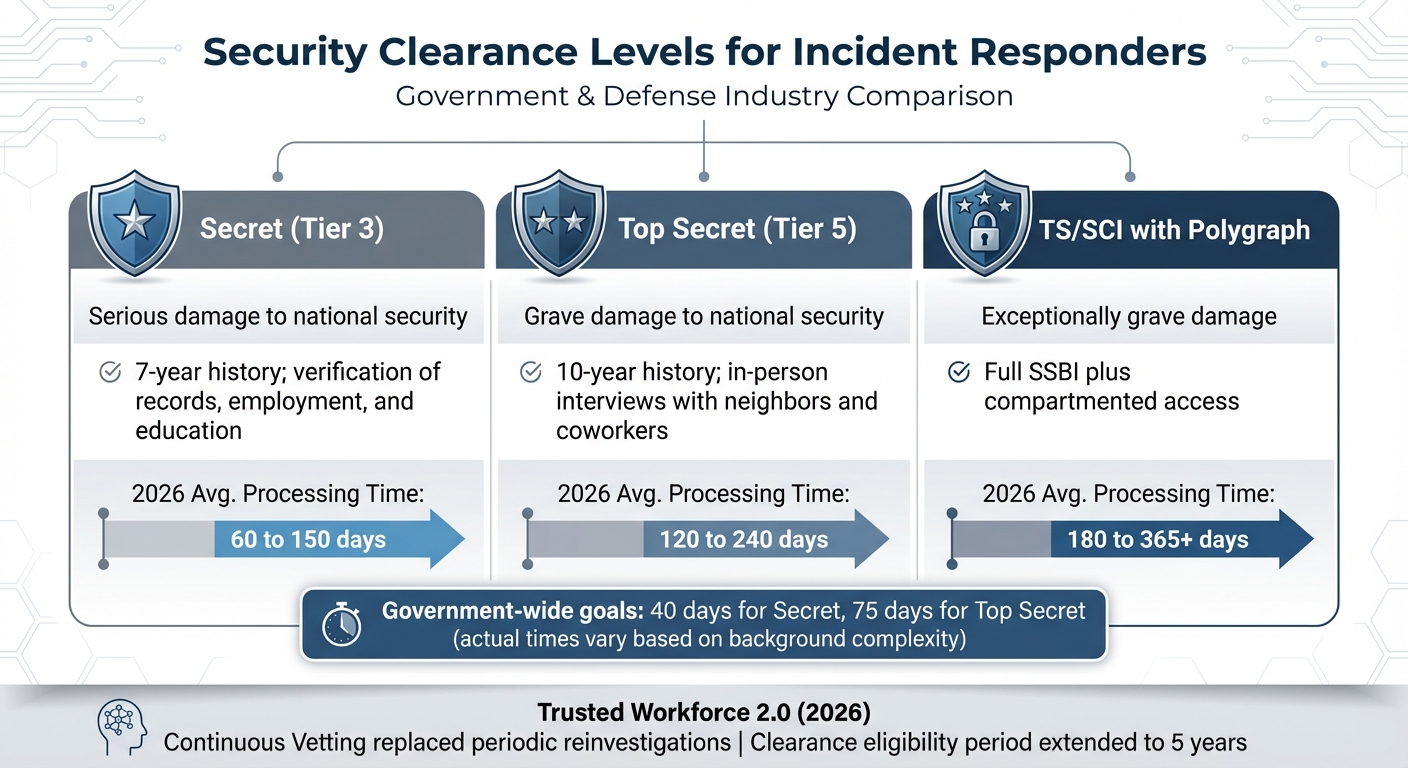
Security Clearance Levels for Incident Responders: Requirements and Processing Times

Security Clearance Levels for Incident Responders: Requirements and Processing Times

For incident responders, having the right security clearance is just as important as honing technical expertise.

Security Clearance Levels Explained

Obtaining a security clearance requires sponsorship by a federal agency or a cleared defense contractor, typically based on the need to handle classified information [2]. Since 2026, the clearance system has been governed by Trusted Workforce 2.0 (TW 2.0), which replaced periodic reinvestigations with Continuous Vetting (CV). This system uses automated, near real-time monitoring of records like criminal history, finances, and travel [4,14].

The clearance system is divided into three levels: Tier 1 (Public Trust), Tier 3 (Secret), and Tier 5 (Top Secret/SCI) [2]. For incident responders, the required clearance depends on the networks and systems being defended. For example, if your role involves analyzing classified threat indicators, investigating incidents on networks like SIPRNet, or conducting forensics on secure systems, you’ll need at least a Secret clearance [2].

Clearance Level Investigation Scope Impact of Disclosure 2026 Avg. Processing Time
Secret (Tier 3) 7-year history; verification of records, employment, and education [4,13] Serious damage to national security [13,14] 60 to 150 days [2]
Top Secret (Tier 5) 10-year history; in-person interviews with neighbors and coworkers [4,13] Grave damage to national security [13,14] 120 to 240 days [2]
TS/SCI with Polygraph Full SSBI plus compartmented access [4,13] Exceptionally grave damage [2] 180 to 365+ days [2]

These timelines highlight the importance of providing accurate and thorough information during the application process. While government-wide goals aim for 40 days for Secret and 75 days for Top Secret clearances [9], actual processing times often depend on the complexity of your background, including any foreign contacts [2].

Adjudicators evaluate applications using 13 guidelines, with the most common issues stemming from financial problems, foreign influence, and personal conduct [4,13]. Financial concerns, in particular, account for about 40% of clearance denials [10]. For incident responders, even your digital activities – such as GitHub contributions, forum posts, or interactions with international researchers – may come under scrutiny [2].

"The dominant theme for security clearances process in 2026 is implementation amidst unpredictability. While digital systems like eApp and Continuous Vetting are fully deployed, processing timelines remain variable." – Kevin James, Cybersecurity Writer [2]

Once your clearance is approved, knowing how to maintain it is just as important.

How to Maintain Your Security Clearance

Under the Continuous Vetting system, periodic reinvestigations are no longer required. By early 2026, over 3.8 million cleared personnel were enrolled in the CV program [9], which continuously monitors records for potential issues. If something adverse occurs – like an arrest, financial trouble, or foreign contact – you must immediately self-report it to your Security Officer. Automated systems will flag these events within 72 hours [2].

The 2026 National Defense Authorization Act (NDAA) extended the eligibility period for reactivating a clearance from 24 months to 5 years [9]. This change offers greater flexibility for career moves, as it allows you to transfer your clearance to a new sponsor within that window without restarting the investigation process.

Staying proactive can help you avoid clearance issues. Review your credit report annually and address any delinquencies with documented repayment plans, as financial stability is crucial – especially since financial problems are the leading cause of clearance denials [2]. Keep a personal security file with copies of mitigation documents, reporting emails, and other relevant correspondence throughout your career.

For incident responders who work within international cybersecurity circles, it’s essential to log all interactions with international researchers and document attendance at global conferences [2]. Additionally, always follow government-approved IT security protocols, avoid using personal devices for classified work, and ensure compliance with communication guidelines to protect your clearance.

Job Search Strategies for Cleared Roles

Landing a cleared incident responder position takes more than a standard job search approach. Generic job boards often miss opportunities that require security clearances, so focusing on platforms and strategies tailored to the cleared community is key.

Using Cleared Cyber Security Jobs Effectively

Cleared Cyber Security Jobs is a specialized platform that simplifies the search for incident responder roles. You can filter job listings by clearance level – whether you hold Secret, TS/SCI, or Polygraph – and refine results by location. As of March 2026, companies like Leidos, Peraton, CACI, Nightwing, and The Aerospace Corporation regularly post roles for cleared incident responders on this platform [12].

Take advantage of job alerts by setting up notifications for terms like "incident response" or "incident handler", so you’re immediately informed when new roles appear [12]. Upload your resume to the platform’s database to allow employers to find you directly. Additionally, participate in job fairs specifically designed for security-cleared professionals. These events connect you with defense and government contractors actively seeking talent [12]. Key locations for cleared incident responder positions include Arlington, VA; Alexandria, VA; Sterling, VA; and Colorado Springs, CO [12].

How to Tailor Your Resume for Cleared Roles

Your resume should clearly communicate that you’re a strong candidate for cleared incident responder roles. Start by listing your clearance level prominently at the top of your resume alongside your contact details. However, never mention your clearance on public platforms like LinkedIn, as some employers may view this as a disqualifier [13].

Use the STAR method (Situation, Task, Action, Result) to describe your accomplishments. Instead of generic statements like "conducted vulnerability assessments", include measurable outcomes, such as the number of vulnerabilities resolved or the percentage reduction in security risks achieved [11]. Add a technical skills section that highlights tools like SIEM solutions, firewalls, intrusion detection systems, and vulnerability assessment tools [11].

Incorporate keywords from job postings into your resume, such as "penetration testing" or "network security", to ensure it passes automated screening systems [11]. If you’re working toward certifications like CISSP or CEH, include them with an expected completion date. As CyberSecJobs.com points out, "Listing an in-progress certification could be the deciding factor in whether a recruiter contacts you, especially if it’s a job requirement" [11].

Keep your resume concise – one to two pages at most – and avoid sharing classified project details, colleague names, or budget specifics. ClearedJobs.Net advises, "Your cleared resume is an advertisement, not your biography" [13]. Additionally, most cleared roles don’t require more than 10 years of experience, so listing too much can sometimes lead to age bias [13].

Networking and Professional Development

To stay competitive in the cleared incident response field, focus on certifications and building professional relationships. Prioritize credentials like CompTIA Security+, CISSP, CEH, or CISM to demonstrate your expertise.

Attend job fairs geared toward security-cleared professionals to connect directly with hiring managers from defense and government contractors [12]. These events can provide face-to-face opportunities that bypass traditional application hurdles. When networking or applying, emphasize metrics like the number of vulnerabilities mitigated or the percentage reduction in security risks achieved – hiring managers value quantifiable results [11].

Sample Cleared Incident Responder Job Profiles

These profiles illustrate how careers in incident response evolve from entry-level positions to senior roles, tying in with the skills, clearance requirements, and strategies discussed earlier.

Tier 1 Security Analyst (Tysons, VA)

In entry-level roles, the focus is on monitoring and triaging alerts using tools like SIEM platforms and security consoles. Analysts work to filter out false positives and escalate genuine threats. Daily tasks include analyzing alerts, conducting initial threat assessments, and documenting incidents based on established protocols. A Secret clearance is required for these positions. Tysons, VA, is a hotspot for defense contractors, making it an excellent place to start a career in cleared incident response. Skills gained here lay the groundwork for advancing to more technically demanding roles.

Cyber Incident Handler (Fort Huachuca, AZ)

Intermediate roles require greater independence and technical expertise. At Fort Huachuca, Cyber Incident Handlers manage incidents within military-affiliated networks [14]. These roles often intersect with intelligence and electronic warfare systems, so knowledge of SIGINT (Signals Intelligence) is highly beneficial [14]. Responsibilities include analyzing network traffic, detecting malicious activity, and executing containment measures within a 24/7 operations center. Candidates typically need a Secret or Top Secret clearance. For those ready for more advanced challenges, senior positions offer opportunities to safeguard critical defense systems.

Cloud Forensic Analyst IV (Arlington, VA)

Senior-level roles demand advanced skills to protect sensitive defense programs. For example, in March 2026, Nightwing sought a Cloud Forensic Analyst IV in Arlington, VA, to handle complex incident response tasks requiring TS/SCI clearance [15][7]. Duties in this role include conducting in-depth digital forensics, proactive threat hunting, and responding to sophisticated cyber threats. Analysts also perform root cause analysis, cloud forensics, and implement cybersecurity automation to secure highly sensitive data. Arlington is a hub for senior-level cleared positions, with companies like Leidos and Nightwing frequently hiring for these specialized roles [15].

Role Level Location Typical Clearance Primary Focus Example Employer
Entry Tysons, VA Secret Alert Triage & Monitoring Multiple Contractors
Intermediate Fort Huachuca, AZ Secret/Top Secret Incident Containment Peraton [14]
Senior Arlington, VA TS/SCI Advanced Forensics & Threat Hunting Nightwing [15]

These examples highlight the range of opportunities available for cleared professionals, showcasing how you can strategically progress through a career in incident response.

Next Steps

You’ve now explored the ins and outs of cleared incident responder careers – from the required technical skills and certifications to the clearance process and job search strategies. The next step? Putting this knowledge into action.

Start by evaluating your qualifications. Pull your credit report and address any financial issues, as these are a common reason for clearance denial [2]. Prepare 10 years’ worth of documentation, including addresses, foreign contacts, and employment history, to make your eApp process smoother [2].

With your personal records in order, turn your focus to building your technical expertise. Certifications are key. Begin with credentials like GCIH or GCFA to develop core incident response skills. From there, aim for the CISSP, which can open doors to leadership roles [18][1]. These certifications align closely with what government agencies and contractors are seeking. Update your resume accordingly. Make sure to list your clearance status prominently at the top so recruiters and applicant tracking systems can spot it quickly. Keep two versions of your resume: one with clearance details for verified recruiters and another without for public platforms [17].

With your resume polished and certifications in hand, it’s time to dive into your job search. Platforms like Cleared Cyber Security Jobs are excellent for finding positions with titles such as Cybersecurity Incident Response Analyst, Intrusion Analyst, or CSIRT Engineer [1]. Use keywords like SIEM, Cyber Threat Intelligence, Linux, and Incident Management to optimize your profile and attract the right opportunities [1]. Setting up job alerts can help you stay on top of new openings that match your skills and clearance level.

Networking is another critical step. Join professional groups like the Incident Response Consortium or the Information Systems Security Association (ISSA) for mentorship and job leads [16]. On LinkedIn, connect with "cleared" networking groups while maintaining a low profile on public platforms to avoid unwanted attention from bad actors [17]. With cybersecurity roles projected to remain among the top 20 most in-demand IT positions over the next decade [1], the cleared incident responder field offers immense potential. Take the first step toward your next opportunity today.

FAQs

How can I get sponsored for a security clearance?

To begin the security clearance process, you need sponsorship – you can’t initiate it on your own. Sponsorship comes after receiving a conditional job offer from an employer or government agency that requires clearance. Once you have that offer, the sponsoring organization will walk you through the steps. This usually involves filling out the SF-86 form, undergoing detailed background checks, and successfully completing a comprehensive investigation.

What should I do now if I don’t have a clearance yet?

If you don’t currently hold a security clearance, the first step is understanding how the process works. Typically, obtaining one requires sponsorship from an employer or a government entity, along with passing a background check. To boost your chances, prioritize developing essential cybersecurity skills and earning certifications such as CompTIA Security+ or CISSP. Building experience in cybersecurity roles is another critical move – employers are more likely to sponsor candidates who showcase both expertise and reliability.

What home labs best prepare me for cleared incident response?

Creating a home lab that mimics real-world incident response scenarios is a must for roles requiring security clearances. Tools like VMware or VirtualBox allow you to set up multiple virtual machines running both Windows and Linux systems. Use this environment to practice with tools like intrusion detection systems (IDS), SIEM platforms, and simulated attack scenarios. By designing segmented networks and rehearsing incident response workflows, you can sharpen the skills needed for working in cleared environments.

Related Blog Posts

  • Incident Response Analyst Career Path for Cleared Professionals
  • Digital Forensics Examiner Career Path for Cleared Professionals
  • Threat Intelligence Analyst Career Path for Cleared Professionals
  • Cleared SOC Analyst Jobs Complete Career Guide

Cleared SOC Analyst Jobs Complete Career Guide

CyberSecJobs Editorial · March 26, 2026 ·

Looking to become a cleared SOC Analyst? Here’s what you need to know:

  1. What is a Cleared SOC Analyst?
    A professional responsible for protecting classified government networks like SIPRNet and JWICS from cyber threats. Requires a U.S. security clearance.
  2. Demand and Salary:
    • SOC Analysts are among the most sought-after cybersecurity roles.
    • Average salary: $90,215/year.
    • Security clearances can boost salaries by $10,000–$50,000.
  3. Clearance Requirements:
    • Levels: Secret, Top Secret, TS/SCI (with polygraph).
    • Processing times: 40–365+ days.
    • Eligibility: U.S. citizenship, clean financial and personal history.
  4. Skills and Tools:
    • Proficiency in SIEM platforms (e.g., Splunk, Microsoft Sentinel).
    • Knowledge of tools like ACAS, HBSS, Python, and PowerShell.
    • Familiarity with frameworks like MITRE ATT&CK.
  5. Certifications:
    • Entry-level: CompTIA Security+ (mandatory for DoD roles).
    • Advanced: GIAC certifications, CISSP for management roles.
  6. Career Path:
    • Tier 1: Alert triage (0–2 years).
    • Tier 2: Incident response (2–4 years).
    • Tier 3: Threat hunting (4–7+ years).
    • Salaries range from $90,000 to $170,000+ depending on role and experience.
  7. Job Search Tips:
    • Use platforms like Cleared Cyber Security Jobs.
    • Focus on hubs like Northern Virginia, Huntsville, and Washington, D.C.
    • Most roles require on-site work.

Key Takeaway: Cleared SOC Analyst roles offer high demand, competitive pay, and clear career growth opportunities. Start with a Security+ certification, gain hands-on experience, and target high-demand regions for the best prospects.

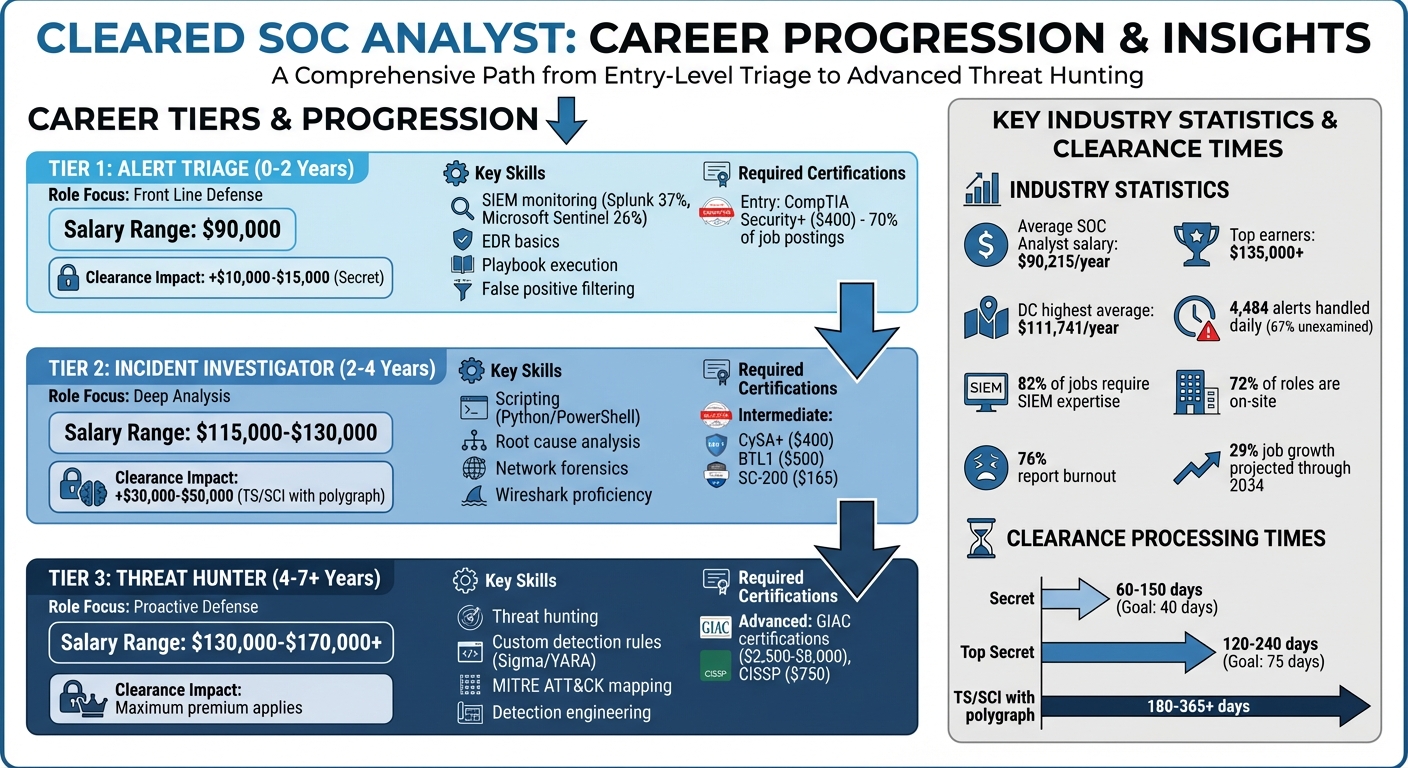
Cleared SOC Analyst Career Path: Tiers, Skills, and Salary Progression

Cleared SOC Analyst Career Path: Tiers, Skills, and Salary Progression

The SOC Analyst Career Guide | How to Become a SOC Analyst | SOC Analyst Career Roadmap:

sbb-itb-bf7aa6b

Security Clearance Requirements for SOC Analyst Jobs

SOC Analyst positions require a security clearance, typically sponsored by a federal agency or a contractor, after a conditional job offer is extended [6][7]. This sponsorship initiates the clearance process, which only begins once an employer decides you’re a good fit for a role involving classified information.

Types of Security Clearances

There are three main clearance levels relevant to SOC Analysts:

  • Secret Clearance (Tier 3): Grants access to information that, if leaked, could seriously harm national security. This clearance often adds $10,000–$15,000 to your base salary [2].
  • Top Secret Clearance (Tier 5): Allows access to information that could cause exceptionally grave damage if exposed.
  • TS/SCI Clearance: This includes a Top Secret clearance with Sensitive Compartmented Information access, often requiring a polygraph. It can increase earnings by $30,000–$50,000 [2][6].

The processing times vary: Secret clearances take 60–150 days, Top Secret clearances require 120–240 days, and TS/SCI clearances with polygraphs can take 180–365+ days [6].

Eligibility and Application Process

To qualify, you must be a U.S. citizen and demonstrate a "need-to-know", meaning access to classified information is necessary for your job duties [6]. The process begins with completing the Standard Form 86 (SF-86) through the eApp platform, which has replaced e-QIP. This form requires detailed information about your past ten years of residences, employment, education, and foreign contacts [6].

Financial problems are a leading cause of clearance denial, including issues like high debt, tax evasion, or unexplained wealth [6]. Additionally, close ties to foreign nationals or business dealings in sensitive regions can raise concerns. The Defense Counterintelligence and Security Agency (DCSA) handles over 95% of federal background checks, and as of early 2026, the backlog of investigations had been reduced to around 100,000 cases – a 65% improvement from early 2025 [5][6]. Current processing goals are 40 days for Secret clearances and 75 days for Top Secret clearances [5].

Once cleared, you’ll join the Continuous Vetting (CV) program, which replaces periodic reinvestigations with automated, near real-time monitoring of criminal, financial, and public records [5][6]. Over 3.8 million individuals are part of this program as of early 2026 [5]. Under CV, you’re required to self-report major life events – such as arrests, foreign travel, or significant debt – to your Facility Security Officer [6]. Before submitting your eApp, it’s wise to check your credit report and address any delinquencies, as financial issues are a common reason for denials. Reviewing your social media privacy settings is also recommended, as adjudicators may examine public-facing online activity for potential concerns [6].

"For cybersecurity professionals aiming to protect national security infrastructure, a U.S. government security clearance is the golden key." – Kevin James, Cybersecurity Writer [6]

Clearing these requirements is the first step toward a secure and rewarding career as a SOC Analyst. It lays the groundwork for tackling the technical responsibilities and challenges of this role.

Skills and Responsibilities of Cleared SOC Analysts

Cleared SOC Analysts play a critical role in safeguarding classified environments, combining technical skills with a focus on national security. Their primary mission is to defend sensitive networks like SIPRNet and JWICS, where a breach could directly impact national security. Unlike analysts in commercial settings who often deal with ransomware or cybercriminals, these professionals face nation-state adversaries. The pressure is immense – organizations handle an average of 4,484 alerts daily, with 67% going unexamined due to sheer volume [1][2].

Technical Skills Required

Cleared SOC Analysts must excel in a wide range of technical areas. SIEM platforms are a cornerstone, with 82% of job postings requiring expertise in tools like Splunk (37%) and Microsoft Sentinel (26%) [2]. Beyond commercial solutions, cleared environments demand familiarity with government-specific systems such as ACAS (Assured Compliance Assessment Solution), HBSS (Host Based Security System), and eMASS, which supports the Risk Management Framework [1].

Proficiency in endpoint and network defense tools is equally important. Analysts need experience with EDR platforms like CrowdStrike Falcon and Microsoft Defender for Endpoint, as well as packet analysis tools like Wireshark and tcpdump [8][2]. A solid understanding of networking protocols (TCP/IP, DNS, HTTP/S) and operating systems (Windows event logs and Linux command line) is essential for detecting anomalies that automated systems might miss [8][3].

Automation and scripting skills set advanced analysts apart. Knowledge of Python and PowerShell enables them to automate routine tasks, interact with threat intelligence APIs, and create custom detection scripts [9][2]. Tools like YARA and Sigma, combined with the MITRE ATT&CK framework, help map adversary behavior and craft detection rules [2].

Skill Level Focus Area Key Technical Skills
Tier 1 (Front Line) Alert Triage SIEM monitoring, EDR basics, playbook execution, false positive filtering
Tier 2 (Investigator) Deep Analysis Scripting (Python/PowerShell), root cause analysis, network forensics, Wireshark
Tier 3 (Hunter) Proactive Defense Threat hunting, custom detection rules (Sigma/YARA), MITRE ATT&CK mapping

These skills form the backbone of a cleared SOC Analyst’s technical capabilities.

Daily Job Responsibilities

Cleared SOC Analysts spend their shifts monitoring dashboards, triaging SIEM alerts, and identifying genuine threats. When a threat is confirmed, they dive into incident investigations, determining the scope of the breach, identifying compromised systems, and performing root cause analyses. Swift containment actions follow, such as blocking IPs, isolating affected devices, and collecting forensic evidence.

Additionally, analysts handle compliance and maintenance tasks, including conducting STIG (Security Technical Implementation Guide) checks and supporting RMF (Risk Management Framework) authorization packages [1]. During quieter periods, they work on developing Indicators of Compromise (IOCs), refining detection rules, and searching for threats that evade automated systems. Detailed documentation – such as incident reports, shift handovers, and post-mortem analyses – ensures that all security events are well-documented for team and leadership review.

Given the high-stakes nature of their work, most SOC roles require 24/7 coverage, with analysts often rotating through 8-, 10-, or 12-hour shifts [2][3]. This demanding schedule contributes to high burnout rates, with 76% of security professionals reporting such challenges by 2025 [2]. Meanwhile, the role is evolving with the rise of AI-assisted triage, enabling analysts to focus more on complex, ambiguous threats while validating AI-generated insights [2]. This shift highlights the growing importance of adaptability and interpretation skills alongside technical expertise.

Certifications and Qualifications for Cleared SOC Analysts

Cleared SOC Analyst roles adhere to strict Department of Defense (DoD) standards, making certifications a must-have. Under the DoD 8570/8140 Information Assurance framework, IAT Level II – commonly achieved with the CompTIA Security+ certification – is the baseline requirement for most cybersecurity and IT positions in this space [1]. In fact, Security+ shows up in about 70% of SOC analyst job postings, often serving as a critical HR filter [3]. Below, we’ll outline certifications that not only meet these standards but can also boost your career prospects.

Required and Preferred Certifications

For entry-level roles, CompTIA Security+ is the go-to certification. At around $400, it satisfies DoD compliance requirements and can lead to a salary bump of roughly 15% compared to peers without it [2][3].

For Tier 2 positions, which focus more on investigation and analysis, certifications like CompTIA CySA+ ($400) and Blue Team Level 1 (BTL1) ($500) are highly regarded. These certifications emphasize hands-on, practical skills rather than traditional multiple-choice tests. If you’re working in Azure-centric environments, the Microsoft SC-200 ($165) is also a strong choice, with nearly half of SIEM engineer job postings recognizing its relevance [2].

For Tier 3 or senior roles, advanced certifications are key. GIAC certifications (e.g., GCIH, GCFA, GCIA) are considered top-tier for technical expertise in government and high-assurance environments, with costs ranging from $2,500 to $8,000. These credentials can add $10,000–$20,000 to your salary [2]. For those pursuing management roles, the CISSP ($750) is indispensable, appearing in 47% of security management job postings and required for 80% of SOC Manager positions [2].

Certification Cost Career Level Primary Value
CompTIA Security+ ~$400 Entry / Tier 1 Meets DoD 8570/8140 compliance; essential HR filter
CompTIA CySA+ ~$400 Intermediate / Tier 2 Focuses on threat detection and behavioral analytics
BTL1 / OSDA ~$500 Intermediate / Tier 2 Validates hands-on investigation skills
Microsoft SC-200 ~$165 Intermediate High ROI for Azure/Sentinel environments
CEH ~$1,200 Intermediate Often used as an HR checkbox; less SOC-specific value
GIAC (GCIH/GCFA/GCIA) $2,500–$8,000 Advanced / Tier 3 Establishes technical credibility in government roles
CISSP ~$750 Senior / Management Essential for leadership roles; requires 5 years’ experience

These certifications are critical for demonstrating the expertise needed to handle the challenges of modern SOC environments.

Education and Experience Requirements

While certifications are crucial, education and experience also play a significant role in qualifying for cleared SOC Analyst positions. About 63.31% of these roles require a Bachelor’s degree, and 19% prefer a Master’s degree [1]. Common fields of study include cybersecurity, computer science, and information technology. However, many employers are shifting their focus toward hands-on skills and certifications over formal education [3]. Military veterans with experience in signals, communications, or intelligence often have a direct path into these roles [1].

Experience requirements vary by tier. Tier 1 roles typically require 0–2 years of experience and focus on tasks like alert triage and following playbooks. Tier 2 positions generally demand 2–4 years of experience, with an emphasis on advanced investigation techniques and scripting knowledge. Tier 3 roles, often requiring 4–7+ years of experience, focus on proactive threat hunting, detection engineering, and team leadership. Even "entry-level" roles often expect 6–12 months of prior IT experience, such as helpdesk support or system administration, to demonstrate foundational technical skills [2][3].

Compensation for cleared SOC Analysts varies based on experience and clearance level. On average, these professionals earn about $90,215 per year, with top earners making up to $135,000 [1].

How to Find Cleared SOC Analyst Jobs

Landing a cleared SOC Analyst position requires a tailored approach. The cleared job market operates differently from the broader cybersecurity hiring landscape, relying heavily on specialized platforms and specific geographic hubs. Recruiters often scour resume databases, so making yourself visible is key [1].

Using Cleared Cyber Security Jobs

Cleared Cyber Security Jobs is an excellent resource for finding positions with top defense contractors like Booz Allen Hamilton, Leidos, General Dynamics IT (GDIT), and Peraton [2][10]. Uploading your resume to this platform is crucial because recruiters actively search these databases. To stand out, ensure your profile includes expertise in tools like Splunk (featured in 37% of SOC Analyst job postings) and Microsoft Sentinel (appearing in 26% of postings) [2].

You can also set up automated job alerts based on your clearance level and preferred locations, allowing you to stay updated on new opportunities. The platform’s filters make it easy to search by work environment. Keep in mind that 72% of SOC Analyst roles are on-site due to the need for 24/7 shift coverage and access to classified networks like SIPRNet and JWICS. Fully remote positions are rare, making up only 6% of available roles [2].

Targeting High-Demand Locations

Focusing your search on key geographic areas can significantly increase your chances of finding a role. Cleared SOC positions are concentrated in defense and intelligence hubs. For example:

  • Arlington and Alexandria, Virginia: These areas are home to employers like the Pentagon, Leidos, and Booz Allen Hamilton, offering salaries between $89,000 and $162,000 [2][10].
  • Huntsville, Alabama: A growing hub for defense and aerospace SOC roles, centered around Redstone Arsenal [11][12].
  • Fayetteville, North Carolina: Located near Fort Liberty (formerly Fort Bragg), this area provides strong opportunities [10].
  • Chandler, Arizona: Supports Department of Homeland Security operations and offers a range of positions [10].

The District of Columbia stands out with the highest average salary for cleared SOC Analysts at $111,741 annually, reflecting the intense demand for talent in the nation’s capital [1]. Additionally, clearance levels can significantly impact earnings. A Secret clearance typically adds $10,000–$15,000 to base salaries, while a TS/SCI with polygraph can increase pay by $30,000–$50,000 [2].

When planning your job search, focus on locations that align with your clearance level and lifestyle needs. Since most roles require on-site presence, being flexible with location is often necessary. These strategies can help you take the next step in your cleared SOC Analyst career.

Career Growth for Cleared SOC Analysts

Career Progression Paths

Cleared SOC Analysts typically follow a structured career path, starting with Tier 1 roles (Alert Triage, 0–2 years). At this stage, analysts focus on sorting through alerts, eliminating false positives, and adhering to established playbooks. From there, they advance to Tier 2 (Incident Investigator, 2–4 years), where they dive into root cause analysis and refine incident response procedures. The final technical step is Tier 3 (Threat Hunter/Detection Engineer, 4–7 years), which involves proactive threat hunting and crafting custom detection rules [2][3].

After Tier 3, analysts can choose between deepening their technical expertise or stepping into leadership roles. Technical specializations include Detection Engineering (with salaries ranging from $130,000 to $170,000), cyber threat intelligence, digital forensics, or cloud security. Leadership paths might lead to positions like SOC Manager ($115,000–$145,000), Director of Security Operations, or even Chief Information Security Officer (CISO) [2][13][14]. In government roles, career progression often aligns with the General Schedule (GS) pay scale, advancing from GS-9 to GS-15, with senior technical roles like Security Architect earning over $200,000 annually [1][14].

Climbing the career ladder requires continuous learning. Moving from Tier 1 to Tier 2 often involves mastering tools like Python or PowerShell to automate tasks such as log parsing and alert enrichment [2]. Reaching Tier 3 demands a strong grasp of frameworks like MITRE ATT&CK and the ability to analyze adversary tactics. For those aiming for management, early demonstrations of leadership – such as coordinating team workflows and streamlining documentation – are key [13]. Progressing through these tiers not only benefits individual careers but also strengthens defenses against increasingly sophisticated cyber threats.

Next, let’s look at the unique challenges faced by SOC analysts in cleared environments.

Challenges in Cleared Environments

While cleared SOC roles offer clear advancement opportunities, they also come with unique challenges that can impact long-term career growth. One major factor is the requirement for on-site work to access classified networks [2]. This often involves rotating shifts, which contributes to burnout – a problem experienced by 71% of SOC analysts [2].

Cleared environments also present a more complex technical landscape. Analysts must navigate strict compliance requirements, such as the Risk Management Framework (RMF) and Security Technical Implementation Guides (STIGs), to ensure classified systems meet regulatory standards [1]. Additionally, these roles frequently involve monitoring for nation-state actors – such as those from Russia, China, North Korea, and Iran – who target Department of Defense and Intelligence Community networks. This requires a deeper understanding of adversary tactics compared to commercial SOC roles [1].

Another challenge is alert fatigue. SOCs handle an average of 4,484 alerts daily, with approximately 67% going uninvestigated due to sheer volume [2]. The ability to remain focused and identify critical threats amidst this noise is essential for career longevity.

Finally, maintaining a security clearance is crucial. Background checks for new clearances can take anywhere from 6 to 18 months, and any lapse in clearance status can stall career progress [1]. However, holding a clearance comes with financial perks. A Secret clearance can add $10,000–$15,000 to your salary, while a TS/SCI clearance (with polygraph) can boost earnings by $30,000–$50,000. These premiums become even more valuable as analysts transition into roles supporting national mission teams at organizations like CYBERCOM, NSA, or CISA [2][1].

Conclusion

Combining security clearances, technical skills, and relevant certifications not only opens doors to roles safeguarding critical systems like SIPRNet and JWICS but also significantly boosts earning potential[2].

To take full advantage of these opportunities, focus on building a solid technical foundation. Start with the CompTIA Security+ certification, which meets the DoD 8570/8140 requirements. From there, develop practical skills in Python and PowerShell, and demonstrate your expertise through hands-on platforms like TryHackMe or LetsDefend[2][3].

Cleared SOC Analysts often follow a clear career path, starting in alert triage and progressing to advanced roles in threat hunting or leadership. Salaries increase with experience, and the field’s robust growth ensures strong demand. With a projected 29% growth in information security analyst roles through 2034 and a global talent shortage of roughly 4.8 million professionals, the opportunities are vast[2]. Once your technical skills are solid, focus on high-demand markets for cleared positions.

Look to regions like Northern Virginia and Washington, D.C., where on-site roles with top defense contractors such as Booz Allen Hamilton, Leidos, Peraton, and GDIT are concentrated. Use tools like Cleared Cyber Security Jobs to filter openings by clearance level, location, and experience[1].

This guide has covered everything from navigating the clearance process to building technical expertise and strategically searching for jobs. With automation increasingly handling routine triage tasks, mastering AI and machine learning tools will be essential for career advancement – by 2026, 64% of cybersecurity job listings are expected to require skills in AI, machine learning, or automation[4]. By continuously improving your technical knowledge and adapting to new technologies, you’ll be well-prepared to move from frontline roles to leadership positions, ensuring the protection of the nation’s most critical systems.

FAQs

Can I get a clearance without a job offer?

Yes, it’s possible to get a security clearance without having a job offer. However, to keep the clearance active and make use of it, you’ll usually need an employer to sponsor you. While the background check and vetting process can start independently, having an employer sponsor your clearance ensures it stays valid and can be applied to roles requiring it.

What should I do while my clearance is processing?

While waiting for your clearance to process, take the opportunity to develop skills, earn certifications, and expand your knowledge base. Leverage free training platforms and hands-on labs to solidify your understanding of cybersecurity fundamentals. Dive into the responsibilities of SOC analysts and explore tools like SIEM platforms to familiarize yourself with industry practices. Look into certifications like CEH or CISSP to prepare for advanced roles. Being proactive now will set you apart when your clearance is complete.

How can I move from Tier 1 SOC to Tier 2 or Tier 3 faster?

To make progress faster, concentrate on building key skills like automation, writing detection rules, and becoming proficient with SIEM systems. Pursuing certifications such as Security+ or CySA+ can also boost your credentials. Spend time practicing how to identify patterns, focus on addressing critical alerts, and take every opportunity to learn from experienced analysts. By automating repetitive tasks and refining your ability to craft effective detection rules, you can stand out and move ahead in your career.

Related Blog Posts

  • CySA Plus Certification Career Guide for Cleared SOC Analysts
  • SOC Analyst Career Path for Cleared Professionals Tier 1 to Lead
  • Data Security Analyst Career Path for Cleared Professionals
  • Cyber Warfare Specialist Career Path for Cleared Military

CNO Operator Career Path for Cleared Cyber Professionals

CyberSecJobs Editorial · March 26, 2026 ·

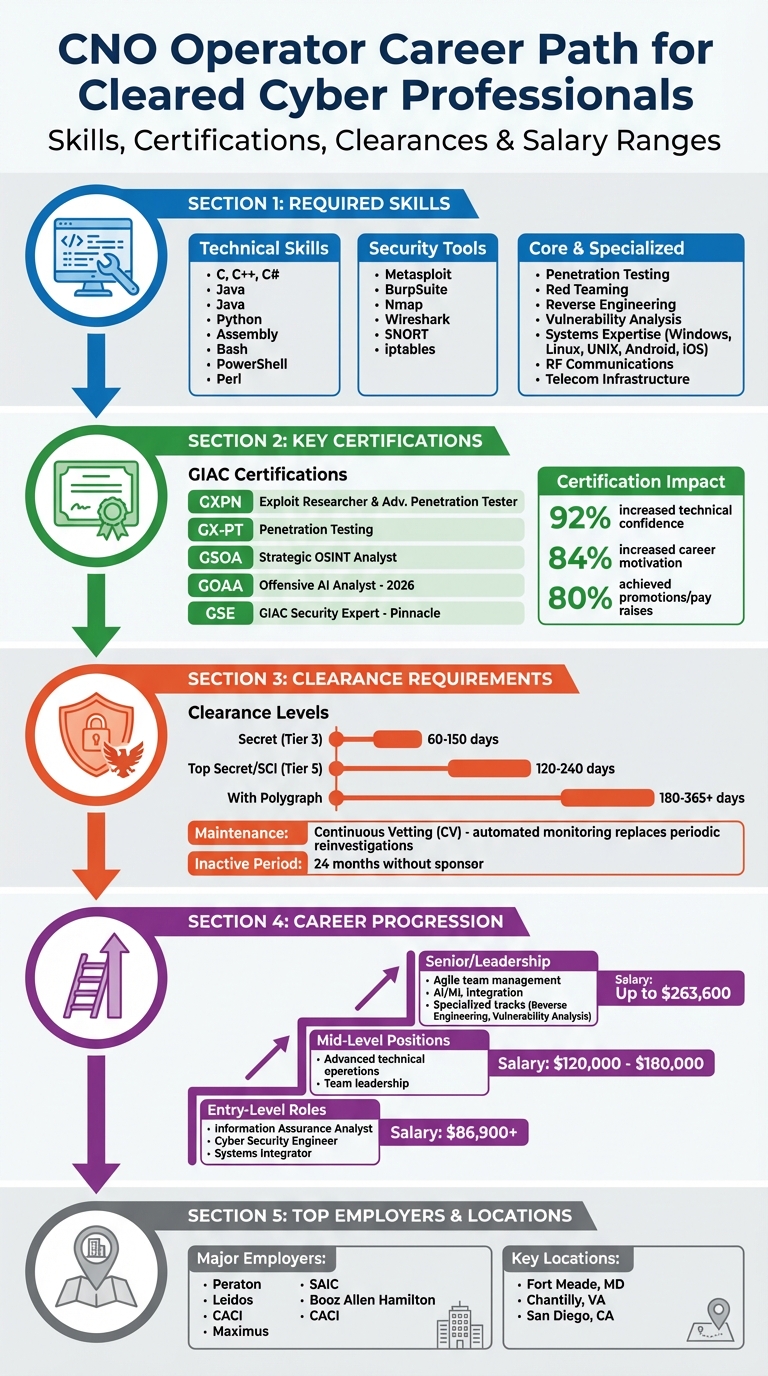
CNO (Computer Network Operations) Operators play a critical role in cybersecurity for national security and intelligence. These professionals focus on tasks like network attack, defense, and exploitation while working with sensitive data under strict security clearance protocols.

Key Highlights:

  • High Demand: Employers like Peraton, Leidos, and SAIC are hiring for key locations like Fort Meade, MD, and Chantilly, VA.
  • Clearance Requirements: Most roles require Top Secret/SCI clearance with a polygraph.
  • Skills Needed: Expertise in programming (Python, C++, etc.), security tools (Metasploit, Wireshark), and system internals (Windows, Linux).
  • Certifications: GIAC certifications such as GXPN and GSE boost career prospects.
  • Salary Range: $86,900–$263,600, depending on experience and employer.

This career path offers long-term job security and competitive pay but requires technical expertise, advanced clearances, and a commitment to staying updated on evolving cyber threats.

CNO Operator Career Path: Skills, Certifications, and Salary Progression

CNO Operator Career Path: Skills, Certifications, and Salary Progression

Required Skills and Qualifications

Breaking into CNO operations demands a mix of technical know-how, recognized certifications, and strict adherence to security clearance protocols. These elements are the backbone of the skills and qualifications needed to thrive in this field.

Technical Skills You Need

To excel, you’ll need to master both low- and high-level programming languages like C, C++, C#, Java, and Python. These are essential for creating advanced programs and understanding system internals [2]. Additionally, scripting languages such as Python, Bash, Perl, and PowerShell are indispensable for automating tasks and analyzing network traffic [3][4]. Python, in particular, stands out due to its flexibility in offensive tools and data processing.

You’ll also need hands-on experience with security tools like Metasploit, BurpSuite, Nmap, Wireshark, SNORT, and iptables. These tools are critical for core cyber operations, including penetration testing, red teaming, reverse engineering, and vulnerability analysis – key responsibilities in a CNO role [3]. Some specialized positions may require knowledge of RF communications, telecom infrastructure, and broadband architectures [3][4].

A strong grasp of computer network architectures and operating system internals is non-negotiable. This includes expertise across Windows, Linux, UNIX, Android, and iOS environments, as well as a deep understanding of network stacks and data flows in complex systems [3][4]. Compensation in this field reflects the demand for these skills, ranging from $86,900 to $198,000 at firms like Booz Allen Hamilton and up to $263,600 at companies like CACI [2][3].

Skill Category Essential Technical Skills & Tools
Languages C, C++, C#, Java, Python, Assembly, Bash, PowerShell, Perl
Security Tools Metasploit, BurpSuite, Nmap, Wireshark, SNORT, iptables
Operations Penetration Testing, Red Teaming, Reverse Engineering, Vulnerability Analysis
Systems Windows, Linux, UNIX, Android, iOS, OS Internals, Network Stacks
Specialized RF Communications, Telecom Infrastructure, Broadband Architectures

Certifications That Advance Your Career

Certifications are a cornerstone of career progression in CNO operations. GIAC certifications, in particular, are highly regarded, with their Offensive Operations focus aligning directly with the demands of the role [5]. GIAC divides its certifications into two tiers: Practitioner Certifications, which validate foundational skills, and Applied Knowledge Certifications, which emphasize hands-on expertise through virtual machine environments instead of traditional exams [5].

Looking ahead to 2026, the GIAC Offensive AI Analyst (GOAA) certification is set to validate skills in leveraging AI for adversary analysis and intrusion techniques [5]. Other advanced certifications, such as GX-PT (Penetration Testing), GXPN (Exploit Researcher and Advanced Penetration Tester), and GSOA (Strategic OSINT Analyst), are also highly valued. The GIAC Security Expert (GSE) remains the pinnacle of achievement, requiring a portfolio of lower-level certifications.

The impact of these certifications is clear: 92% of GIAC candidates report increased confidence in their technical skills, 84% feel more motivated to advance their careers, and 80% achieve goals like promotions or pay raises after certification [5]. As Ben Boyle, a holder of multiple GIAC certifications, explains:

I value the instant respect and credibility GIAC professionals receive. People know you’ve worked hard to obtain the certification and they recognize the critical skills and knowledge that come with it [5].

Security Clearance Requirements

Security clearances are just as critical as technical skills and certifications in CNO operations. Clearances are typically sponsored by federal agencies or contractors after a conditional job offer.

Under the Trusted Workforce 2.0 framework, investigations for clearances fall into two tiers: Tier 3 for Secret and Tier 5 for Top Secret/SCI [6]. As of early 2026, obtaining a Secret clearance takes 60 to 150 days, while a Top Secret clearance can take 120 to 240 days. For positions requiring a polygraph, the timeline may extend to 180 to 365+ days [6].

The Defense Counterintelligence and Security Agency (DCSA) handles more than 95% of federal background checks [6]. For cybersecurity roles, adjudicators often examine digital footprints – such as GitHub activity, participation in technical forums, and even gaming communities – to assess operational security practices. It’s also worth noting that marijuana use remains a disqualifier, as federal law still prohibits it despite state-level legalization.

Once granted, clearances are maintained through Continuous Vetting (CV), which has replaced periodic reinvestigations. This automated system monitors factors like criminal records, financial activity, and travel history. Professionals are expected to self-report any adverse events promptly [6]. If not transferred to a new employer, clearances typically become inactive 24 months after leaving a sponsoring position [6].

sbb-itb-bf7aa6b

Career Progression for CNO Operators

Getting Started in Entry-Level Roles

Starting a career in Computer Network Operations (CNO) often involves roles like Information Assurance Analyst, Cyber Security Engineer, or Systems Integrator. These positions help you build the essential skills needed for more advanced work. Companies such as Leidos, Peraton, Maximus, SAIC, and Booz Allen Hamilton are some of the major players hiring for these cleared positions, offering a gateway into the world of cleared cyber operations [1][7].

Location plays a big role in landing your first job. Areas like Fort Meade, Maryland, Chantilly, Virginia, and San Diego, California are hotspots for cleared cybersecurity roles [1][7]. Focusing your job search in these regions can significantly improve your chances. If you’re just starting out, roles like Engineering Technician can provide valuable hands-on experience in the defense sector while you work on developing the specialized skills required for CNO operations [1].

Once you’ve gained some experience, the next step is transitioning into more technical and strategic roles.

Moving to Mid-Level and Senior Positions

As you advance, the focus shifts from purely technical tasks to taking on leadership and project management responsibilities. Senior operators are expected to lead agile teams and oversee the entire lifecycle of capability development, from identifying possibilities to implementing solutions for complex systems [8]. Booz Allen Hamilton describes this shift as:

Using your network operations experience, you’ll determine what the art of the possible is and what can be done – and then you’ll bring it to life for your clients [8].

At this stage, technical expertise also becomes more specialized. While mid-level roles often require general proficiency in C/C++ for Unix, Linux, or Windows environments, senior positions demand in-depth knowledge of kernel and driver development, x86 binary reverse engineering, and advanced vulnerability analysis using tools like SQL [8]. Proficiency in scripting languages such as Python, Bash, and Windows batch is also critical for developing custom tools. These advanced roles come with higher salaries and require maintaining a TS/SCI clearance with a polygraph [8].

Leadership and Specialized Positions

For seasoned CNO operators, career progression often involves choosing between leadership roles or technical specialization.

Leadership positions focus on managing agile teams, overseeing complex projects like reverse engineering and vulnerability analysis, and incorporating AI and machine learning into CNO operations [8]. These roles require a deep understanding of multiple platforms, including Unix, Linux, and Windows (both Win32 and kernel/driver development), as well as advanced knowledge in areas like Information Assurance and cryptography [8].

On the other hand, those who prefer a technical track can specialize in areas like Reverse Engineering, Vulnerability Analysis, or embedded and application development. Specialists in these roles explore exploitation techniques for complex systems and develop custom tools using version control systems such as Subversion [8]. Both paths demand continuous learning, especially in OS internals, network protocol analysis, and leveraging AI/ML technologies to counter sophisticated threats [8].

Whether you choose to lead teams or dive deeper into technical expertise, these career paths demonstrate the growing opportunities and challenges in cleared cybersecurity operations.

Tools and Frameworks for CNO Operations

Core Tools for Network Operations

The Metasploit Framework stands as one of the most widely used tools for penetration testing. It’s a critical resource for identifying vulnerabilities and executing exploits effectively [9]. Another essential suite for operators is the Kali Linux toolset, which offers a variety of utilities tailored to different needs, including:

  • Nikto: A web scanner for identifying potential vulnerabilities in web servers.
  • Cewl: A tool for generating custom wordlists, often used in password cracking.
  • Enum4linux: Useful for Windows and Samba enumeration.
  • Nbtscan: Designed for scanning NetBIOS networks [12].

In addition to these, specialized tools like ELEM (Enterprise Linux Exploit Mapper) and FCTL (Fedora Cyber Test Lab) expand analytical capabilities. These tools help by correlating CVEs (Common Vulnerabilities and Exposures) with available exploits and performing dynamic analysis on disassembled binaries [12].

The industry has also embraced containerization through the Open Container Image Format. This approach allows cyber tools to operate seamlessly across various Linux distributions such as Fedora, CentOS, and RHEL. By adopting this method, operators gain the flexibility to deploy tools without worrying about compatibility issues, making operations smoother and more efficient [12].

Industry Frameworks and Methodologies

While tools provide the technical foundation, frameworks guide strategic planning and decision-making. The MITRE ATT&CK Framework is a cornerstone for understanding adversary tactics, techniques, and procedures (TTPs), all based on real-world scenarios [13][14]. With 14 tactics and over 200 techniques, it helps bridge the gap between raw data and actionable insights. The latest version, 17.1, released in April 2025, reflects the ever-evolving threat landscape [11].

A notable example of its application comes from the 2025 MITRE ATT&CK Evaluation. Here, the security company Cynet demonstrated a perfect 100% detection visibility rate. They identified all 90 malicious sub-steps across Windows, Linux, and AWS cloud environments while maintaining zero false positives during 17 benign activity tests. Additionally, Cynet achieved a flawless protection rate, blocking all five attack scenarios at the Entry Vector phase [10].

For a more linear perspective, the Lockheed Martin Cyber Kill Chain offers a model that outlines the seven stages of a cyberattack, from reconnaissance to final objectives [10][11]. While this framework excels in high-level planning and perimeter defense, MITRE ATT&CK dives deeper into post-compromise techniques and lateral movements [10][11].

To aid in visualization, CNO operators often use the ATT&CK Navigator tool. This tool creates heat maps to assess an organization’s detection capabilities, helping teams identify and prioritize gaps [13][10]. Modern operations increasingly focus on detecting behavioral patterns rather than relying solely on Indicators of Compromise (IOCs). This shift enables teams to spot unknown variants of existing threats and effectively identify post-compromise activities [11].

Challenges in Cleared Cybersecurity Careers

Managing Clearance Requirements and Career Growth

The introduction of Continuous Vetting (CV) under the Trusted Workforce 2.0 framework has reshaped how CNO operators maintain their security clearances. Instead of periodic reinvestigations, automated systems now monitor activities like criminal records, credit history, travel, and online behavior in real time [6]. Cybersecurity professional Kevin James highlights this shift:

An incident on a Saturday could generate an alert to your security office by Monday. This makes immediate self-reporting of any adverse event… a critical component of sustaining trust [6].

Financial problems are one of the most common reasons for clearance denial or revocation under Guideline F. To avoid issues, conduct annual self-audits of your finances and address any delinquencies with documented repayment plans. Your online presence also undergoes significant scrutiny – adjudicators may review GitHub contributions, posts in technical forums, participation in gaming communities, and professional networking activity for signs of poor judgment or vulnerability to blackmail.

Career mobility adds another layer of complexity. While the goal is to create a system where you’re "clear once, trusted everywhere", transferring a clearance between agencies can take 90 to 150 days. Additionally, clearances typically become inactive after 24 months if not transferred to a new sponsor, though proposed changes under the 2026 NDAA may extend this period to five years [6].

To stay ahead, keep a personal security file that includes mitigation documents, reporting emails, and other relevant correspondence. Document international collaborations and contributions to open-source projects carefully, as these could raise concerns under Guideline B (Foreign Influence). Also, be aware that any current or recent marijuana use remains a serious disqualifier due to federal law [6].

Beyond managing your clearance, staying on top of technical advancements is just as important.

Staying Current in a Changing Field

While clearance management is essential, CNO operators must also consistently update their technical skills. The job demands deep knowledge of areas like kernel internals, vulnerability analysis (including privilege escalation and sandbox escapes), and the creation of stealthy implants and loaders [15]. Proficiency with reverse engineering tools like IDA Pro, Ghidra, WinDbg, and x64dbg is crucial. Staying relevant requires adapting to new threats and technologies as they emerge [15].

The eApp platform has replaced the older e-QIP system, offering logic-based questioning and real-time error checking to reduce application mistakes [6]. Agencies are also starting to use AI and machine learning to streamline clearance cases and identify patterns in background data. Collaborating with your Facility Security Officer (FSO) and promptly self-reporting any significant events builds trust within the CV framework [6].

Take steps to protect your digital footprint by auditing your social media privacy settings and reviewing old posts for anything that might raise concerns. Request your official personnel security file annually through a DCSA Privacy Act request to check for and correct any errors. Since the Defense Counterintelligence and Security Agency (DCSA) handles over 95% of all federal background investigations, understanding their processes can give you an edge [6].

As Kevin James puts it:

Success is built on proactive preparation, uncompromising honesty, and an understanding that trust is now a continuous commitment, not a one-time award [6].

In today’s environment, combining technical expertise with a strong focus on security awareness is what shapes a successful career for CNO operators.

Conclusion: Your Path as a CNO Operator

Pursuing a career as a CNO Operator offers not only the chance to make a meaningful impact but also impressive financial rewards. For instance, having advanced security clearances can boost salaries by 10–20%. Entry-level professionals with these clearances typically earn around $10,000 more annually than those with only Secret clearances. Over time, this gap widens – after a decade, it can exceed $22,000, and seasoned professionals can earn up to $263,600 per year at top defense contractors like CACI International Inc. [3][16]. But excelling in this field requires constant growth, from understanding complex network architectures to using advanced tools in practical scenarios [3].

Integrity is non-negotiable in this line of work. Dishonesty during the clearance process – whether on the SF-86 form or in interviews – can result in denial. As Kathleen Mitchell, PhD, Collegiate Faculty at UMGC, puts it:

Honesty is a paramount character trait for all intelligence professionals [16].

This ethical foundation supports your technical growth. Maintaining clean digital habits is equally important, as investigators often review public social media activity to ensure compliance with agency standards [16].

Top employers also invest in their teams, offering specialized training to enhance skills. As CACI International Inc. highlights:

Creativity on top of a strong technical foundation and fundamental understanding of cyber engineering is paramount for success in this role [3].

A deep understanding of cyber tools across Linux, Windows, Android, and iOS platforms is key to thriving in this field [3].

Combining technical expertise with a commitment to continuous learning and ethical conduct positions you for long-term success. Keep in mind that security clearances are tied to specific roles and require sponsorship from a qualified agency or contractor [16]. With preparation, adaptability, and integrity, you’ll be ready to excel in one of the most vital areas of national cybersecurity.

FAQs

What’s the fastest way to break into CNO work without a TS/SCI yet?

To step into CNO roles without a TS/SCI clearance right away, focus on developing expertise in malware analysis, reverse engineering, and incident response. Begin by pursuing entry-level cybersecurity jobs or internships that don’t demand a TS/SCI clearance. Earning certifications such as CySA+, CEH, or CISSP can enhance your resume and demonstrate your skills. Additionally, connect with professionals in the field and seek out organizations that provide clearance sponsorship or specialized training programs to help you progress toward CNO positions.

Which GIAC cert should I get first for a CNO operator track?

If you’re aiming to begin a career in the CNO operator track, the GIAC Security Essentials (GSEC) certification is an excellent starting point. This certification covers essential cybersecurity concepts and skills applicable to both offensive and defensive cyber operations, providing a solid foundation for this field.

How can I protect my online footprint during continuous vetting?

To protect your online presence during continuous vetting, focus on keeping a polished and professional digital profile. Be cautious about posting sensitive or divisive content on social media, routinely check and adjust your privacy settings, and minimize the amount of personal information you share publicly. Taking control of your online behavior not only lowers potential risks to your clearance but also shows reliability and accountability during ongoing monitoring.

Related Blog Posts

  • Red Team Operator Career Path for Cleared Professionals
  • Cryptanalyst Career Path for Cleared Intelligence Professionals
  • Cyber Range Operator Career Path for Cleared Professionals
  • Cyber Warfare Specialist Career Path for Cleared Military

Cyber Warfare Specialist Career Path for Cleared Military

CyberSecJobs Editorial · March 25, 2026 ·

Cyber warfare offers a high-demand career path for military veterans, especially those with security clearances. With over 500,000 unfilled cybersecurity jobs in the U.S. by 2025 and a 0% unemployment rate in the field, transitioning military personnel are uniquely positioned to excel in this industry. Here’s why:

  • Military Skills Translate Directly: Threat detection, incident response, and secure communications are core military skills that align with cybersecurity roles.
  • Active Security Clearance Is a Major Asset: Veterans with clearances can bypass lengthy background checks, making them attractive to federal agencies and defense contractors.
  • High Salaries and Job Growth: Entry-level roles start around $80K, with mid-level and senior positions offering six-figure salaries. Cybersecurity jobs are projected to grow 29% from 2024 to 2034.
  • Certifications Open Doors: Earning certifications like CompTIA Security+, CISSP, or CEH can fast-track your entry into the field.
  • Veteran-Specific Resources: Programs like DoD SkillBridge, SANS VetSuccess Academy, and CyberVetsUSA provide training, mentorship, and job placement.

Whether you’re aiming for entry-level roles like SOC Analyst or advancing to senior positions, your military background and a strategic approach to certifications can set you up for success in cyber warfare. Start by tailoring your resume, leveraging veteran-focused resources, and connecting with employers through platforms like Cleared Cyber Security Jobs.

Cyber Warfare Career Statistics for Military Veterans

Cyber Warfare Career Statistics for Military Veterans

Cyber Warfare Operators: Fighting America’s Battles in Cyberspace | Chief’s Corner #23

sbb-itb-bf7aa6b

What Does a Cyber Warfare Specialist Do?

Cyber Warfare Specialists are the guardians of critical systems, tasked with defending against digital threats while also carrying out precision offensive operations in cyberspace.

Primary Job Duties

Your main responsibility is to safeguard classified networks like SIPRNet and secure government-only cloud environments such as AWS GovCloud [6]. This involves conducting penetration tests to identify system vulnerabilities and leading responses to breaches. In these situations, you’ll investigate incidents, gather evidence, and map out how the attack occurred [7].

"On the defensive side what we’re mostly looking for is either the presence of or recovering from the effects… any type of cyber threat whether it’s a computer virus or degradation of service. On the offensive side what we’ll be working on is, you know, trying to find and exploit vulnerabilities and systems to our advantage in the cyber space battle."
– Gunnery Sergeant Timothy Erickson, Cybersecurity Technician, U.S. Marine Corps [2]

Another key aspect of the job is threat analysis and intelligence. You’ll monitor adversary tactics, analyze malicious activities, and use open-source intelligence (OSINT) to predict and prevent future attacks. In a Security Operations Center (SOC), your role includes reviewing security alerts and investigating unusual activity through constant monitoring. The Pentagon’s current shortfall of over 20,000 cybersecurity professionals underscores the pressing need for skilled specialists in this field [7].

To meet these challenges, you’ll need a broad range of technical expertise.

Required Skills and Abilities

To succeed, you must excel in areas like network engineering, packet analysis, and operating systems. Knowing programming languages such as C and Python is crucial for tasks like malware analysis and reverse engineering. Equally important are skills in cloud security, firewall management, and cryptology.

In addition to technical skills, strong analytical abilities and quick decision-making under pressure are vital. You’ll often need to maintain situational awareness, solve intricate problems with limited information, and juggle multiple high-priority tasks in fast-paced environments. Communication is just as important – you’ll brief leaders, collaborate with team members, and document findings in a clear, concise manner. As cyber threats continue to evolve, staying adaptable, disciplined, and committed to ongoing learning will keep you ahead of potential adversaries.

Moving from Military Service to Cyber Warfare

Transitioning from military service to cyber warfare can give you a significant advantage in the job market. With around 200,000 service members leaving active duty annually and more than 500,000 unfilled cybersecurity positions across the country, the timing couldn’t be better to leverage your skills [3][5][8]. Here’s how to make the most of your military background and security clearance during this career shift.

How to Apply Your Military Background

Your military training has already equipped you with valuable skills like threat detection and incident response, which translate seamlessly into civilian cyber warfare roles. The situational awareness you honed in high-pressure environments can easily become expertise in handling incidents, while your ability to make quick decisions under stress is a key asset in mitigating threats.

Rob Hughes, CISO at RSA, highlights why employers value this experience: "Knowing that a prospective hire has had experience in mitigating risks and identifying threats, and knowing that they learned those skills in the highest-stakes environments, always makes those prospects stand out" [8].

To make your military experience resonate with civilian employers, adjust your resume to use terminology they’ll understand. For instance, instead of listing yourself as a Navy "Cryptologic Technician", frame your role in terms like "managing network monitoring systems" or "detecting and mitigating threats" [8]. Civilian employers highly regard military cyber operations experience [4].

Programs like DoD SkillBridge can help bridge the transition. This initiative allows you to gain practical experience with government agencies or defense contractors during your last months of service, giving you a head start in the civilian workforce [3]. You can also connect with organizations like VetSec, CyberVetsUSA, or Hiring Our Heroes, which offer mentorship and job placement services tailored to veterans [8].

Why Your Security Clearance Matters

An active security clearance is a major advantage in the cyber warfare field. It can fast-track your hiring process by eliminating the lengthy background investigation phase [3][9]. A clearance also serves as proof of your trustworthiness, which is critical when working with sensitive information. If your clearance has expired within the past two years, you might be able to have it reinstated quickly, keeping you competitive in the job market.

It’s important to maintain good financial standing, as issues like debt or delinquencies can jeopardize your clearance. Ultimately, having an active clearance opens the door to specialized roles that are off-limits to candidates without one.

Education, Certifications, and Training You’ll Need

You don’t need a four-year degree to step into cyber warfare roles. Certifications can quickly open doors to positions like SOC Analyst or entry-level Security Analyst, allowing you to start earning while continuing to learn. With the right credentials and a military background, you could land roles offering salaries between $80,000 and $135,000 per year. Your military experience not only strengthens your qualifications but also prepares you to tackle the demanding training programs in this field.

Top Certifications for Cyber Warfare

Certifications are key in this industry, and some are more sought-after than others. Here are a few that stand out:

  • CompTIA Security+ ($425) and Network+: These foundational certifications are often considered essential for entry-level roles, especially within the Department of Defense (DoD). Many branches of the military offer funding for these through the COOL program.
  • Certified Ethical Hacker (CEH) ($1,199): Focused on offensive tactics and penetration testing, this certification is ideal for those looking to specialize in hacking and security breaches.
  • Offensive Security Certified Professional (OSCP): Known for its hands-on, rigorous training, the OSCP is highly regarded in the industry.
  • CISSP ($749): Aimed at mid-to-senior level roles or management positions, this certification is highly respected but requires five years of professional experience. Military cybersecurity service often counts toward this requirement.
  • GIAC certifications through SANS ($999 per exam): These certifications are among the most respected in the industry, covering areas like incident response and penetration testing.

Tom Marsland, Board Chair of VetSec, emphasizes the importance of preparation: "You’ve got to do a lot of prior planning and owning your destiny" [5].

Once you’ve earned these certifications, additional training can help refine your skills even further.

Where to Get Training

Certifications are just the starting point – hands-on training is critical for building expertise. The military and specialized academies offer excellent opportunities:

  • U.S. Army Cyber Center of Excellence (Fort Eisenhower, GA): Provides training in signal, cyber, and electronic warfare.
  • U.S. Navy Center for Information Warfare Training: Operates across 19 locations and trains over 26,000 students annually in cryptology and cyber-related fields.
  • Air Force Cyberspace Technical Center of Excellence (Wright-Patterson AFB): Offers advanced degrees and immersive summer courses focused on cyber warfare.
  • DC3 Cyber Training Academy (Hanover, MD): Features over 30 courses covering digital forensics, network intrusion, and log analysis.

Your Post-9/11 GI Bill can reimburse up to $2,000 per certification exam without using a full month of benefits. Additionally, several programs cater specifically to veterans and transitioning service members:

  • SANS VetSuccess Academy: Provides free advanced training and certification vouchers, with many graduates moving on to federal cyber roles.
  • Onward to Opportunity (Syracuse University): Offers free courses for certifications like Security+, CASP+, and CISSP.
  • VetsinTech: Hosts free 5-day bootcamps for the CompTIA Security+ certification.
  • CISA Learning (formerly FedVTE): Gives access to hundreds of hours of free training and prep courses for certifications like CEH and CISSP.

These resources ensure you’re not only certified but also well-prepared for the challenges of cyber warfare roles.

How to Build Your Career and Find Jobs

Entry-Level Positions to Start Your Career

Starting your career in cyber warfare? A Security Operations Center (SOC) Analyst (Tier 1) is a great entry point for cleared veterans. Think of it as the "emergency room" of cybersecurity. You’ll handle tasks like triaging alerts, monitoring systems like SIEM and EDR, and investigating phishing attempts. Salaries for entry-level SOC Analysts range from $66K to $98K, with active clearance potentially adding up to $30K more [10].

Other entry-level options include roles like Junior Penetration Tester, IT Auditor, or Compliance Officer. These positions leverage the procedural and analytical skills you developed in the military [5]. Companies such as Booz Allen Hamilton, Leidos, Peraton, GDIT, and CACI are known for hiring junior professionals with active clearances [10]. Keep in mind, though, that most SOC analyst roles (72%) are on-site, with only 6% offering fully remote options [10].

These roles serve as stepping stones, setting you up for more advanced opportunities later in your career.

Finding Jobs on Cleared Cyber Security Jobs

Cleared Cyber Security Jobs is a job board tailored specifically for security-cleared professionals. The platform allows you to filter job searches by clearance level, location, and specific areas of cyber warfare. Upload your resume and set up job alerts to connect directly with hiring managers.

The platform also hosts job fairs where you can meet decision-makers from federal agencies and defense contractors. Since only direct-hire employers are allowed to post, you’ll avoid staffing firms and speak directly with those who can expedite the hiring process. Pro tip: Use civilian-friendly language on your resume. For instance, replace military ranks with terms like "Team Lead" or "Manager" to make your experience more relatable to civilian employers [5].

Moving Up to Senior Positions

Once you’ve gained some experience, certifications and leadership development become key to advancing into higher-level roles. For example, transitioning from a Tier 1 SOC Analyst to senior positions typically takes 4–7 years and requires continuous learning.

  • Tier 2 Analysts (2–4 years experience): Handle deeper investigations and root cause analysis, often using tools like Python or PowerShell. Salaries range from $86K to $144K [10].
  • Tier 3 Analysts (4–7 years experience): Focus on proactive threat hunting and creating custom detection rules, earning between $112K and $170K [10].

"The SOC is a launchpad, not a destination." – Cybersecurity Jobs List [10]

Senior positions like Cyber Operations Manager or Information Security Architect often demand advanced certifications such as CISSP. Some roles may also require a bachelor’s or master’s degree in cybersecurity [1]. Your military leadership experience can be a major asset when transitioning into management roles.

To ease this transition, consider joining veteran-focused communities like VetSec, which has over 3,300 members, for mentorship and guidance from veterans already in senior cyber positions [5]. Additionally, start building your LinkedIn network early. Connect with HR professionals and cybersecurity teams at your target companies well before your transition date [11].

Conclusion

Shifting from military service to a career as a cyber warfare specialist is a logical next step when approached strategically. Your military background already equips you with invaluable skills – like situational awareness, quick decision-making under pressure, and the ability to adapt – which are highly sought after by cybersecurity employers. These qualities, honed in high-stakes environments, make military candidates stand out in the hiring process.

With over 457,000 open cybersecurity roles waiting for qualified professionals, your military experience gives you a competitive edge [8]. Here’s how to make the most of it:

  • Tailor your resume to use civilian-friendly language, and highlight your active security clearance to showcase your readiness for sensitive roles.
  • Earn certifications such as CompTIA Security+, CISSP, or OSCP to validate your technical expertise.
  • Tap into veteran-focused resources like DoD SkillBridge, SANS VetSuccess Academy, and Navy COOL for training and financial support [8].
  • Engage with communities like VetSec to access mentorship and networking opportunities [8].

By following these steps, you can secure roles that value your unique background. When you’re ready to start job hunting, platforms like Cleared Cyber Security Jobs can help you find positions that specifically require and appreciate your active security clearance. These roles often connect directly to hiring managers at federal agencies and defense contractors, simplifying the job search process.

As the U.S. cybersecurity workforce surpasses 1.25 million professionals, demand continues to grow. With approximately 200,000 service members transitioning to civilian life each year, now is an ideal time to enter this field [8]. Begin your journey today – your military-honed skills could be the key to a successful career in cyber warfare.

FAQs

Which cyber roles best match my military MOS/AFSC/rate?

The cybersecurity roles that match your military MOS/AFSC/rate are closely tied to the skills and responsibilities you developed during your service. Positions in areas like communications, IT, spectrum management, and signals often align well. For instance, if you served as an Army MOS 25U (Signal Support Systems Specialist), 25N (Nodal Network Systems Operator-Maintainer), or 25B (Information Technology Specialist), you may find a natural transition into cybersecurity roles. To pinpoint opportunities, compare your specific MOS/AFSC/rate with related cyber job functions.

How do I keep or reinstate my security clearance when I separate?

To keep your security clearance active or to reinstate it after a break, it’s crucial to avoid gaps of more than 24 months between cleared positions. Start planning well in advance – ideally 18 to 20 months before your clearance is set to expire. Use this time to update your paperwork, expand your professional network, and actively seek roles that require a clearance.

If your clearance does lapse, you’ll likely need to update your background information and collaborate with adjudicators to get it reactivated. Staying ahead of the process with careful preparation can make the transition much smoother.

What certification should I earn first for a cleared SOC job?

To land a cleared SOC (Security Operations Center) role, the first step is building a solid foundation in cybersecurity. Starting with a certification like CompTIA Security+ is an excellent choice for beginners. It covers essential concepts and provides a strong entry point into the field.

As you gain experience, consider advancing to certifications like CISSP (Certified Information Systems Security Professional), which is highly regarded for senior-level positions. Alternatively, the CEH (Certified Ethical Hacker) certification is a great way to showcase your skills in ethical hacking and cybersecurity principles. Both certifications can significantly boost your credentials and open doors to more specialized roles.

Related Blog Posts

  • Job Search Checklist for Veterans in Cyber Security
  • Threat Intelligence Analyst Career Path for Cleared Professionals
  • Cryptanalyst Career Path for Cleared Intelligence Professionals
  • Cyber Range Operator Career Path for Cleared Professionals

  • « Go to Previous Page
  • Go to page 1
  • Interim pages omitted …
  • Go to page 17
  • Go to page 18
  • Go to page 19
  • Go to page 20
  • Go to page 21
  • Go to Next Page »
  • Facebook
  • Instagram
  • LinkedIn
  • Twitter
  • YouTube

Cleared Cyber Security Jobs | CyberSecJobs.com

  • Contact
  • About
  • Privacy Policy