

CNO (Computer Network Operations) Operators play a critical role in cybersecurity for national security and intelligence. These professionals focus on tasks like network attack, defense, and exploitation while working with sensitive data under strict security clearance protocols.
Key Highlights:
- High Demand: Employers like Peraton, Leidos, and SAIC are hiring for key locations like Fort Meade, MD, and Chantilly, VA.
- Clearance Requirements: Most roles require Top Secret/SCI clearance with a polygraph.
- Skills Needed: Expertise in programming (Python, C++, etc.), security tools (Metasploit, Wireshark), and system internals (Windows, Linux).
- Certifications: GIAC certifications such as GXPN and GSE boost career prospects.
- Salary Range: $86,900–$263,600, depending on experience and employer.
This career path offers long-term job security and competitive pay but requires technical expertise, advanced clearances, and a commitment to staying updated on evolving cyber threats.
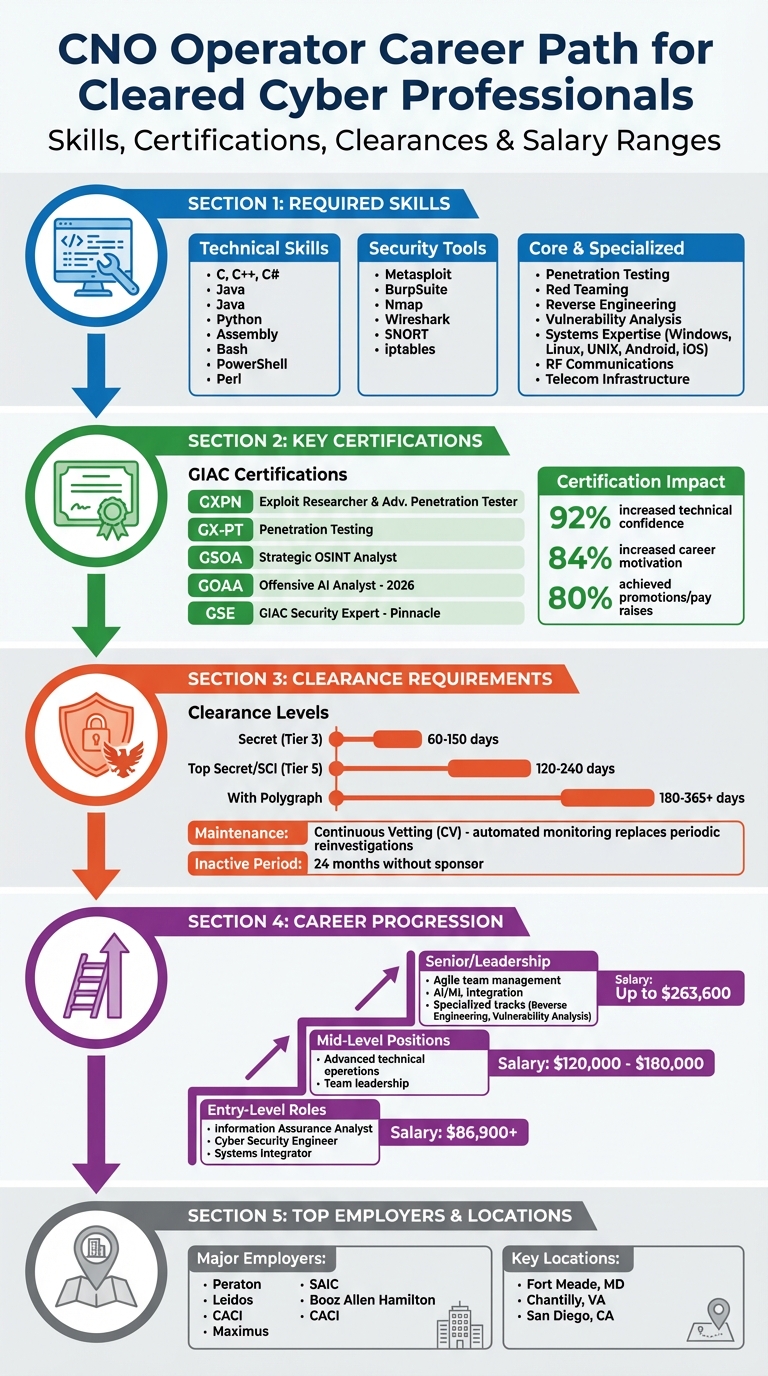
CNO Operator Career Path: Skills, Certifications, and Salary Progression
Required Skills and Qualifications
Breaking into CNO operations demands a mix of technical know-how, recognized certifications, and strict adherence to security clearance protocols. These elements are the backbone of the skills and qualifications needed to thrive in this field.
Technical Skills You Need
To excel, you’ll need to master both low- and high-level programming languages like C, C++, C#, Java, and Python. These are essential for creating advanced programs and understanding system internals [2]. Additionally, scripting languages such as Python, Bash, Perl, and PowerShell are indispensable for automating tasks and analyzing network traffic [3][4]. Python, in particular, stands out due to its flexibility in offensive tools and data processing.
You’ll also need hands-on experience with security tools like Metasploit, BurpSuite, Nmap, Wireshark, SNORT, and iptables. These tools are critical for core cyber operations, including penetration testing, red teaming, reverse engineering, and vulnerability analysis – key responsibilities in a CNO role [3]. Some specialized positions may require knowledge of RF communications, telecom infrastructure, and broadband architectures [3][4].
A strong grasp of computer network architectures and operating system internals is non-negotiable. This includes expertise across Windows, Linux, UNIX, Android, and iOS environments, as well as a deep understanding of network stacks and data flows in complex systems [3][4]. Compensation in this field reflects the demand for these skills, ranging from $86,900 to $198,000 at firms like Booz Allen Hamilton and up to $263,600 at companies like CACI [2][3].
| Skill Category | Essential Technical Skills & Tools |
|---|---|
| Languages | C, C++, C#, Java, Python, Assembly, Bash, PowerShell, Perl |
| Security Tools | Metasploit, BurpSuite, Nmap, Wireshark, SNORT, iptables |
| Operations | Penetration Testing, Red Teaming, Reverse Engineering, Vulnerability Analysis |
| Systems | Windows, Linux, UNIX, Android, iOS, OS Internals, Network Stacks |
| Specialized | RF Communications, Telecom Infrastructure, Broadband Architectures |
Certifications That Advance Your Career
Certifications are a cornerstone of career progression in CNO operations. GIAC certifications, in particular, are highly regarded, with their Offensive Operations focus aligning directly with the demands of the role [5]. GIAC divides its certifications into two tiers: Practitioner Certifications, which validate foundational skills, and Applied Knowledge Certifications, which emphasize hands-on expertise through virtual machine environments instead of traditional exams [5].
Looking ahead to 2026, the GIAC Offensive AI Analyst (GOAA) certification is set to validate skills in leveraging AI for adversary analysis and intrusion techniques [5]. Other advanced certifications, such as GX-PT (Penetration Testing), GXPN (Exploit Researcher and Advanced Penetration Tester), and GSOA (Strategic OSINT Analyst), are also highly valued. The GIAC Security Expert (GSE) remains the pinnacle of achievement, requiring a portfolio of lower-level certifications.
The impact of these certifications is clear: 92% of GIAC candidates report increased confidence in their technical skills, 84% feel more motivated to advance their careers, and 80% achieve goals like promotions or pay raises after certification [5]. As Ben Boyle, a holder of multiple GIAC certifications, explains:
I value the instant respect and credibility GIAC professionals receive. People know you’ve worked hard to obtain the certification and they recognize the critical skills and knowledge that come with it [5].
Security Clearance Requirements
Security clearances are just as critical as technical skills and certifications in CNO operations. Clearances are typically sponsored by federal agencies or contractors after a conditional job offer.
Under the Trusted Workforce 2.0 framework, investigations for clearances fall into two tiers: Tier 3 for Secret and Tier 5 for Top Secret/SCI [6]. As of early 2026, obtaining a Secret clearance takes 60 to 150 days, while a Top Secret clearance can take 120 to 240 days. For positions requiring a polygraph, the timeline may extend to 180 to 365+ days [6].
The Defense Counterintelligence and Security Agency (DCSA) handles more than 95% of federal background checks [6]. For cybersecurity roles, adjudicators often examine digital footprints – such as GitHub activity, participation in technical forums, and even gaming communities – to assess operational security practices. It’s also worth noting that marijuana use remains a disqualifier, as federal law still prohibits it despite state-level legalization.
Once granted, clearances are maintained through Continuous Vetting (CV), which has replaced periodic reinvestigations. This automated system monitors factors like criminal records, financial activity, and travel history. Professionals are expected to self-report any adverse events promptly [6]. If not transferred to a new employer, clearances typically become inactive 24 months after leaving a sponsoring position [6].
sbb-itb-bf7aa6b
Career Progression for CNO Operators
Getting Started in Entry-Level Roles
Starting a career in Computer Network Operations (CNO) often involves roles like Information Assurance Analyst, Cyber Security Engineer, or Systems Integrator. These positions help you build the essential skills needed for more advanced work. Companies such as Leidos, Peraton, Maximus, SAIC, and Booz Allen Hamilton are some of the major players hiring for these cleared positions, offering a gateway into the world of cleared cyber operations [1][7].
Location plays a big role in landing your first job. Areas like Fort Meade, Maryland, Chantilly, Virginia, and San Diego, California are hotspots for cleared cybersecurity roles [1][7]. Focusing your job search in these regions can significantly improve your chances. If you’re just starting out, roles like Engineering Technician can provide valuable hands-on experience in the defense sector while you work on developing the specialized skills required for CNO operations [1].
Once you’ve gained some experience, the next step is transitioning into more technical and strategic roles.
Moving to Mid-Level and Senior Positions
As you advance, the focus shifts from purely technical tasks to taking on leadership and project management responsibilities. Senior operators are expected to lead agile teams and oversee the entire lifecycle of capability development, from identifying possibilities to implementing solutions for complex systems [8]. Booz Allen Hamilton describes this shift as:
Using your network operations experience, you’ll determine what the art of the possible is and what can be done – and then you’ll bring it to life for your clients [8].
At this stage, technical expertise also becomes more specialized. While mid-level roles often require general proficiency in C/C++ for Unix, Linux, or Windows environments, senior positions demand in-depth knowledge of kernel and driver development, x86 binary reverse engineering, and advanced vulnerability analysis using tools like SQL [8]. Proficiency in scripting languages such as Python, Bash, and Windows batch is also critical for developing custom tools. These advanced roles come with higher salaries and require maintaining a TS/SCI clearance with a polygraph [8].
Leadership and Specialized Positions
For seasoned CNO operators, career progression often involves choosing between leadership roles or technical specialization.
Leadership positions focus on managing agile teams, overseeing complex projects like reverse engineering and vulnerability analysis, and incorporating AI and machine learning into CNO operations [8]. These roles require a deep understanding of multiple platforms, including Unix, Linux, and Windows (both Win32 and kernel/driver development), as well as advanced knowledge in areas like Information Assurance and cryptography [8].
On the other hand, those who prefer a technical track can specialize in areas like Reverse Engineering, Vulnerability Analysis, or embedded and application development. Specialists in these roles explore exploitation techniques for complex systems and develop custom tools using version control systems such as Subversion [8]. Both paths demand continuous learning, especially in OS internals, network protocol analysis, and leveraging AI/ML technologies to counter sophisticated threats [8].
Whether you choose to lead teams or dive deeper into technical expertise, these career paths demonstrate the growing opportunities and challenges in cleared cybersecurity operations.
Tools and Frameworks for CNO Operations
Core Tools for Network Operations
The Metasploit Framework stands as one of the most widely used tools for penetration testing. It’s a critical resource for identifying vulnerabilities and executing exploits effectively [9]. Another essential suite for operators is the Kali Linux toolset, which offers a variety of utilities tailored to different needs, including:
- Nikto: A web scanner for identifying potential vulnerabilities in web servers.
- Cewl: A tool for generating custom wordlists, often used in password cracking.
- Enum4linux: Useful for Windows and Samba enumeration.
- Nbtscan: Designed for scanning NetBIOS networks [12].
In addition to these, specialized tools like ELEM (Enterprise Linux Exploit Mapper) and FCTL (Fedora Cyber Test Lab) expand analytical capabilities. These tools help by correlating CVEs (Common Vulnerabilities and Exposures) with available exploits and performing dynamic analysis on disassembled binaries [12].
The industry has also embraced containerization through the Open Container Image Format. This approach allows cyber tools to operate seamlessly across various Linux distributions such as Fedora, CentOS, and RHEL. By adopting this method, operators gain the flexibility to deploy tools without worrying about compatibility issues, making operations smoother and more efficient [12].
Industry Frameworks and Methodologies
While tools provide the technical foundation, frameworks guide strategic planning and decision-making. The MITRE ATT&CK Framework is a cornerstone for understanding adversary tactics, techniques, and procedures (TTPs), all based on real-world scenarios [13][14]. With 14 tactics and over 200 techniques, it helps bridge the gap between raw data and actionable insights. The latest version, 17.1, released in April 2025, reflects the ever-evolving threat landscape [11].
A notable example of its application comes from the 2025 MITRE ATT&CK Evaluation. Here, the security company Cynet demonstrated a perfect 100% detection visibility rate. They identified all 90 malicious sub-steps across Windows, Linux, and AWS cloud environments while maintaining zero false positives during 17 benign activity tests. Additionally, Cynet achieved a flawless protection rate, blocking all five attack scenarios at the Entry Vector phase [10].
For a more linear perspective, the Lockheed Martin Cyber Kill Chain offers a model that outlines the seven stages of a cyberattack, from reconnaissance to final objectives [10][11]. While this framework excels in high-level planning and perimeter defense, MITRE ATT&CK dives deeper into post-compromise techniques and lateral movements [10][11].
To aid in visualization, CNO operators often use the ATT&CK Navigator tool. This tool creates heat maps to assess an organization’s detection capabilities, helping teams identify and prioritize gaps [13][10]. Modern operations increasingly focus on detecting behavioral patterns rather than relying solely on Indicators of Compromise (IOCs). This shift enables teams to spot unknown variants of existing threats and effectively identify post-compromise activities [11].
Challenges in Cleared Cybersecurity Careers
Managing Clearance Requirements and Career Growth
The introduction of Continuous Vetting (CV) under the Trusted Workforce 2.0 framework has reshaped how CNO operators maintain their security clearances. Instead of periodic reinvestigations, automated systems now monitor activities like criminal records, credit history, travel, and online behavior in real time [6]. Cybersecurity professional Kevin James highlights this shift:
An incident on a Saturday could generate an alert to your security office by Monday. This makes immediate self-reporting of any adverse event… a critical component of sustaining trust [6].
Financial problems are one of the most common reasons for clearance denial or revocation under Guideline F. To avoid issues, conduct annual self-audits of your finances and address any delinquencies with documented repayment plans. Your online presence also undergoes significant scrutiny – adjudicators may review GitHub contributions, posts in technical forums, participation in gaming communities, and professional networking activity for signs of poor judgment or vulnerability to blackmail.
Career mobility adds another layer of complexity. While the goal is to create a system where you’re "clear once, trusted everywhere", transferring a clearance between agencies can take 90 to 150 days. Additionally, clearances typically become inactive after 24 months if not transferred to a new sponsor, though proposed changes under the 2026 NDAA may extend this period to five years [6].
To stay ahead, keep a personal security file that includes mitigation documents, reporting emails, and other relevant correspondence. Document international collaborations and contributions to open-source projects carefully, as these could raise concerns under Guideline B (Foreign Influence). Also, be aware that any current or recent marijuana use remains a serious disqualifier due to federal law [6].
Beyond managing your clearance, staying on top of technical advancements is just as important.
Staying Current in a Changing Field
While clearance management is essential, CNO operators must also consistently update their technical skills. The job demands deep knowledge of areas like kernel internals, vulnerability analysis (including privilege escalation and sandbox escapes), and the creation of stealthy implants and loaders [15]. Proficiency with reverse engineering tools like IDA Pro, Ghidra, WinDbg, and x64dbg is crucial. Staying relevant requires adapting to new threats and technologies as they emerge [15].
The eApp platform has replaced the older e-QIP system, offering logic-based questioning and real-time error checking to reduce application mistakes [6]. Agencies are also starting to use AI and machine learning to streamline clearance cases and identify patterns in background data. Collaborating with your Facility Security Officer (FSO) and promptly self-reporting any significant events builds trust within the CV framework [6].
Take steps to protect your digital footprint by auditing your social media privacy settings and reviewing old posts for anything that might raise concerns. Request your official personnel security file annually through a DCSA Privacy Act request to check for and correct any errors. Since the Defense Counterintelligence and Security Agency (DCSA) handles over 95% of all federal background investigations, understanding their processes can give you an edge [6].
As Kevin James puts it:
Success is built on proactive preparation, uncompromising honesty, and an understanding that trust is now a continuous commitment, not a one-time award [6].
In today’s environment, combining technical expertise with a strong focus on security awareness is what shapes a successful career for CNO operators.
Conclusion: Your Path as a CNO Operator
Pursuing a career as a CNO Operator offers not only the chance to make a meaningful impact but also impressive financial rewards. For instance, having advanced security clearances can boost salaries by 10–20%. Entry-level professionals with these clearances typically earn around $10,000 more annually than those with only Secret clearances. Over time, this gap widens – after a decade, it can exceed $22,000, and seasoned professionals can earn up to $263,600 per year at top defense contractors like CACI International Inc. [3][16]. But excelling in this field requires constant growth, from understanding complex network architectures to using advanced tools in practical scenarios [3].
Integrity is non-negotiable in this line of work. Dishonesty during the clearance process – whether on the SF-86 form or in interviews – can result in denial. As Kathleen Mitchell, PhD, Collegiate Faculty at UMGC, puts it:
Honesty is a paramount character trait for all intelligence professionals [16].
This ethical foundation supports your technical growth. Maintaining clean digital habits is equally important, as investigators often review public social media activity to ensure compliance with agency standards [16].
Top employers also invest in their teams, offering specialized training to enhance skills. As CACI International Inc. highlights:
Creativity on top of a strong technical foundation and fundamental understanding of cyber engineering is paramount for success in this role [3].
A deep understanding of cyber tools across Linux, Windows, Android, and iOS platforms is key to thriving in this field [3].
Combining technical expertise with a commitment to continuous learning and ethical conduct positions you for long-term success. Keep in mind that security clearances are tied to specific roles and require sponsorship from a qualified agency or contractor [16]. With preparation, adaptability, and integrity, you’ll be ready to excel in one of the most vital areas of national cybersecurity.
FAQs
What’s the fastest way to break into CNO work without a TS/SCI yet?
To step into CNO roles without a TS/SCI clearance right away, focus on developing expertise in malware analysis, reverse engineering, and incident response. Begin by pursuing entry-level cybersecurity jobs or internships that don’t demand a TS/SCI clearance. Earning certifications such as CySA+, CEH, or CISSP can enhance your resume and demonstrate your skills. Additionally, connect with professionals in the field and seek out organizations that provide clearance sponsorship or specialized training programs to help you progress toward CNO positions.
Which GIAC cert should I get first for a CNO operator track?
If you’re aiming to begin a career in the CNO operator track, the GIAC Security Essentials (GSEC) certification is an excellent starting point. This certification covers essential cybersecurity concepts and skills applicable to both offensive and defensive cyber operations, providing a solid foundation for this field.
How can I protect my online footprint during continuous vetting?
To protect your online presence during continuous vetting, focus on keeping a polished and professional digital profile. Be cautious about posting sensitive or divisive content on social media, routinely check and adjust your privacy settings, and minimize the amount of personal information you share publicly. Taking control of your online behavior not only lowers potential risks to your clearance but also shows reliability and accountability during ongoing monitoring.