

Looking to become a cleared SOC Analyst? Here’s what you need to know:
- What is a Cleared SOC Analyst?
A professional responsible for protecting classified government networks like SIPRNet and JWICS from cyber threats. Requires a U.S. security clearance. - Demand and Salary:
- SOC Analysts are among the most sought-after cybersecurity roles.
- Average salary: $90,215/year.
- Security clearances can boost salaries by $10,000–$50,000.
- Clearance Requirements:
- Levels: Secret, Top Secret, TS/SCI (with polygraph).
- Processing times: 40–365+ days.
- Eligibility: U.S. citizenship, clean financial and personal history.
- Skills and Tools:
- Proficiency in SIEM platforms (e.g., Splunk, Microsoft Sentinel).
- Knowledge of tools like ACAS, HBSS, Python, and PowerShell.
- Familiarity with frameworks like MITRE ATT&CK.
- Certifications:
- Career Path:
- Tier 1: Alert triage (0–2 years).
- Tier 2: Incident response (2–4 years).
- Tier 3: Threat hunting (4–7+ years).
- Salaries range from $90,000 to $170,000+ depending on role and experience.
- Job Search Tips:
- Use platforms like Cleared Cyber Security Jobs.
- Focus on hubs like Northern Virginia, Huntsville, and Washington, D.C.
- Most roles require on-site work.
Key Takeaway: Cleared SOC Analyst roles offer high demand, competitive pay, and clear career growth opportunities. Start with a Security+ certification, gain hands-on experience, and target high-demand regions for the best prospects.
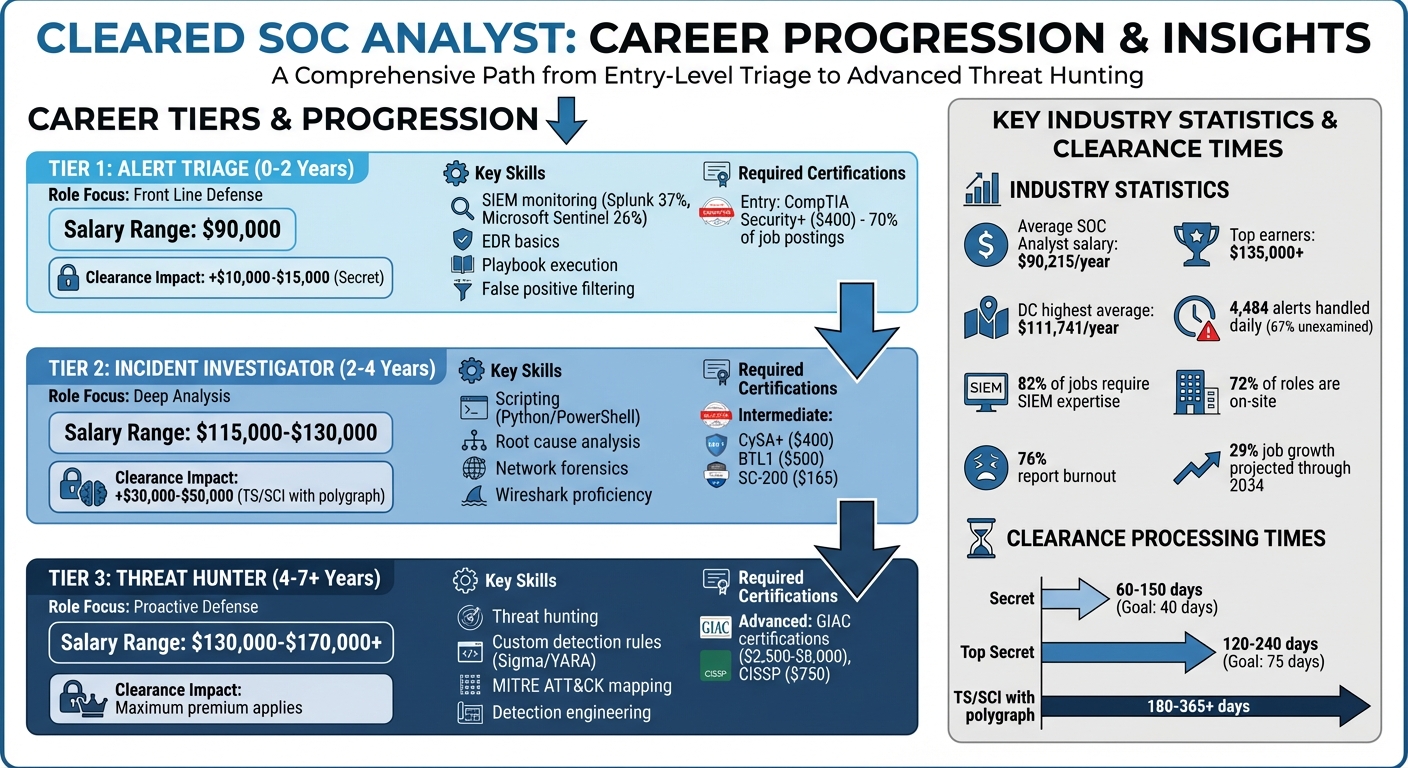
Cleared SOC Analyst Career Path: Tiers, Skills, and Salary Progression
The SOC Analyst Career Guide | How to Become a SOC Analyst | SOC Analyst Career Roadmap:
sbb-itb-bf7aa6b
Security Clearance Requirements for SOC Analyst Jobs
SOC Analyst positions require a security clearance, typically sponsored by a federal agency or a contractor, after a conditional job offer is extended [6][7]. This sponsorship initiates the clearance process, which only begins once an employer decides you’re a good fit for a role involving classified information.
Types of Security Clearances
There are three main clearance levels relevant to SOC Analysts:
- Secret Clearance (Tier 3): Grants access to information that, if leaked, could seriously harm national security. This clearance often adds $10,000–$15,000 to your base salary [2].
- Top Secret Clearance (Tier 5): Allows access to information that could cause exceptionally grave damage if exposed.
- TS/SCI Clearance: This includes a Top Secret clearance with Sensitive Compartmented Information access, often requiring a polygraph. It can increase earnings by $30,000–$50,000 [2][6].
The processing times vary: Secret clearances take 60–150 days, Top Secret clearances require 120–240 days, and TS/SCI clearances with polygraphs can take 180–365+ days [6].
Eligibility and Application Process
To qualify, you must be a U.S. citizen and demonstrate a "need-to-know", meaning access to classified information is necessary for your job duties [6]. The process begins with completing the Standard Form 86 (SF-86) through the eApp platform, which has replaced e-QIP. This form requires detailed information about your past ten years of residences, employment, education, and foreign contacts [6].
Financial problems are a leading cause of clearance denial, including issues like high debt, tax evasion, or unexplained wealth [6]. Additionally, close ties to foreign nationals or business dealings in sensitive regions can raise concerns. The Defense Counterintelligence and Security Agency (DCSA) handles over 95% of federal background checks, and as of early 2026, the backlog of investigations had been reduced to around 100,000 cases – a 65% improvement from early 2025 [5][6]. Current processing goals are 40 days for Secret clearances and 75 days for Top Secret clearances [5].
Once cleared, you’ll join the Continuous Vetting (CV) program, which replaces periodic reinvestigations with automated, near real-time monitoring of criminal, financial, and public records [5][6]. Over 3.8 million individuals are part of this program as of early 2026 [5]. Under CV, you’re required to self-report major life events – such as arrests, foreign travel, or significant debt – to your Facility Security Officer [6]. Before submitting your eApp, it’s wise to check your credit report and address any delinquencies, as financial issues are a common reason for denials. Reviewing your social media privacy settings is also recommended, as adjudicators may examine public-facing online activity for potential concerns [6].
"For cybersecurity professionals aiming to protect national security infrastructure, a U.S. government security clearance is the golden key." – Kevin James, Cybersecurity Writer [6]
Clearing these requirements is the first step toward a secure and rewarding career as a SOC Analyst. It lays the groundwork for tackling the technical responsibilities and challenges of this role.
Skills and Responsibilities of Cleared SOC Analysts
Cleared SOC Analysts play a critical role in safeguarding classified environments, combining technical skills with a focus on national security. Their primary mission is to defend sensitive networks like SIPRNet and JWICS, where a breach could directly impact national security. Unlike analysts in commercial settings who often deal with ransomware or cybercriminals, these professionals face nation-state adversaries. The pressure is immense – organizations handle an average of 4,484 alerts daily, with 67% going unexamined due to sheer volume [1][2].
Technical Skills Required
Cleared SOC Analysts must excel in a wide range of technical areas. SIEM platforms are a cornerstone, with 82% of job postings requiring expertise in tools like Splunk (37%) and Microsoft Sentinel (26%) [2]. Beyond commercial solutions, cleared environments demand familiarity with government-specific systems such as ACAS (Assured Compliance Assessment Solution), HBSS (Host Based Security System), and eMASS, which supports the Risk Management Framework [1].
Proficiency in endpoint and network defense tools is equally important. Analysts need experience with EDR platforms like CrowdStrike Falcon and Microsoft Defender for Endpoint, as well as packet analysis tools like Wireshark and tcpdump [8][2]. A solid understanding of networking protocols (TCP/IP, DNS, HTTP/S) and operating systems (Windows event logs and Linux command line) is essential for detecting anomalies that automated systems might miss [8][3].
Automation and scripting skills set advanced analysts apart. Knowledge of Python and PowerShell enables them to automate routine tasks, interact with threat intelligence APIs, and create custom detection scripts [9][2]. Tools like YARA and Sigma, combined with the MITRE ATT&CK framework, help map adversary behavior and craft detection rules [2].
| Skill Level | Focus Area | Key Technical Skills |
|---|---|---|
| Tier 1 (Front Line) | Alert Triage | SIEM monitoring, EDR basics, playbook execution, false positive filtering |
| Tier 2 (Investigator) | Deep Analysis | Scripting (Python/PowerShell), root cause analysis, network forensics, Wireshark |
| Tier 3 (Hunter) | Proactive Defense | Threat hunting, custom detection rules (Sigma/YARA), MITRE ATT&CK mapping |
These skills form the backbone of a cleared SOC Analyst’s technical capabilities.
Daily Job Responsibilities
Cleared SOC Analysts spend their shifts monitoring dashboards, triaging SIEM alerts, and identifying genuine threats. When a threat is confirmed, they dive into incident investigations, determining the scope of the breach, identifying compromised systems, and performing root cause analyses. Swift containment actions follow, such as blocking IPs, isolating affected devices, and collecting forensic evidence.
Additionally, analysts handle compliance and maintenance tasks, including conducting STIG (Security Technical Implementation Guide) checks and supporting RMF (Risk Management Framework) authorization packages [1]. During quieter periods, they work on developing Indicators of Compromise (IOCs), refining detection rules, and searching for threats that evade automated systems. Detailed documentation – such as incident reports, shift handovers, and post-mortem analyses – ensures that all security events are well-documented for team and leadership review.
Given the high-stakes nature of their work, most SOC roles require 24/7 coverage, with analysts often rotating through 8-, 10-, or 12-hour shifts [2][3]. This demanding schedule contributes to high burnout rates, with 76% of security professionals reporting such challenges by 2025 [2]. Meanwhile, the role is evolving with the rise of AI-assisted triage, enabling analysts to focus more on complex, ambiguous threats while validating AI-generated insights [2]. This shift highlights the growing importance of adaptability and interpretation skills alongside technical expertise.
Certifications and Qualifications for Cleared SOC Analysts
Cleared SOC Analyst roles adhere to strict Department of Defense (DoD) standards, making certifications a must-have. Under the DoD 8570/8140 Information Assurance framework, IAT Level II – commonly achieved with the CompTIA Security+ certification – is the baseline requirement for most cybersecurity and IT positions in this space [1]. In fact, Security+ shows up in about 70% of SOC analyst job postings, often serving as a critical HR filter [3]. Below, we’ll outline certifications that not only meet these standards but can also boost your career prospects.
Required and Preferred Certifications
For entry-level roles, CompTIA Security+ is the go-to certification. At around $400, it satisfies DoD compliance requirements and can lead to a salary bump of roughly 15% compared to peers without it [2][3].
For Tier 2 positions, which focus more on investigation and analysis, certifications like CompTIA CySA+ ($400) and Blue Team Level 1 (BTL1) ($500) are highly regarded. These certifications emphasize hands-on, practical skills rather than traditional multiple-choice tests. If you’re working in Azure-centric environments, the Microsoft SC-200 ($165) is also a strong choice, with nearly half of SIEM engineer job postings recognizing its relevance [2].
For Tier 3 or senior roles, advanced certifications are key. GIAC certifications (e.g., GCIH, GCFA, GCIA) are considered top-tier for technical expertise in government and high-assurance environments, with costs ranging from $2,500 to $8,000. These credentials can add $10,000–$20,000 to your salary [2]. For those pursuing management roles, the CISSP ($750) is indispensable, appearing in 47% of security management job postings and required for 80% of SOC Manager positions [2].
| Certification | Cost | Career Level | Primary Value |
|---|---|---|---|
| CompTIA Security+ | ~$400 | Entry / Tier 1 | Meets DoD 8570/8140 compliance; essential HR filter |
| CompTIA CySA+ | ~$400 | Intermediate / Tier 2 | Focuses on threat detection and behavioral analytics |
| BTL1 / OSDA | ~$500 | Intermediate / Tier 2 | Validates hands-on investigation skills |
| Microsoft SC-200 | ~$165 | Intermediate | High ROI for Azure/Sentinel environments |
| CEH | ~$1,200 | Intermediate | Often used as an HR checkbox; less SOC-specific value |
| GIAC (GCIH/GCFA/GCIA) | $2,500–$8,000 | Advanced / Tier 3 | Establishes technical credibility in government roles |
| CISSP | ~$750 | Senior / Management | Essential for leadership roles; requires 5 years’ experience |
These certifications are critical for demonstrating the expertise needed to handle the challenges of modern SOC environments.
Education and Experience Requirements
While certifications are crucial, education and experience also play a significant role in qualifying for cleared SOC Analyst positions. About 63.31% of these roles require a Bachelor’s degree, and 19% prefer a Master’s degree [1]. Common fields of study include cybersecurity, computer science, and information technology. However, many employers are shifting their focus toward hands-on skills and certifications over formal education [3]. Military veterans with experience in signals, communications, or intelligence often have a direct path into these roles [1].
Experience requirements vary by tier. Tier 1 roles typically require 0–2 years of experience and focus on tasks like alert triage and following playbooks. Tier 2 positions generally demand 2–4 years of experience, with an emphasis on advanced investigation techniques and scripting knowledge. Tier 3 roles, often requiring 4–7+ years of experience, focus on proactive threat hunting, detection engineering, and team leadership. Even "entry-level" roles often expect 6–12 months of prior IT experience, such as helpdesk support or system administration, to demonstrate foundational technical skills [2][3].
Compensation for cleared SOC Analysts varies based on experience and clearance level. On average, these professionals earn about $90,215 per year, with top earners making up to $135,000 [1].
How to Find Cleared SOC Analyst Jobs
Landing a cleared SOC Analyst position requires a tailored approach. The cleared job market operates differently from the broader cybersecurity hiring landscape, relying heavily on specialized platforms and specific geographic hubs. Recruiters often scour resume databases, so making yourself visible is key [1].
Using Cleared Cyber Security Jobs
Cleared Cyber Security Jobs is an excellent resource for finding positions with top defense contractors like Booz Allen Hamilton, Leidos, General Dynamics IT (GDIT), and Peraton [2][10]. Uploading your resume to this platform is crucial because recruiters actively search these databases. To stand out, ensure your profile includes expertise in tools like Splunk (featured in 37% of SOC Analyst job postings) and Microsoft Sentinel (appearing in 26% of postings) [2].
You can also set up automated job alerts based on your clearance level and preferred locations, allowing you to stay updated on new opportunities. The platform’s filters make it easy to search by work environment. Keep in mind that 72% of SOC Analyst roles are on-site due to the need for 24/7 shift coverage and access to classified networks like SIPRNet and JWICS. Fully remote positions are rare, making up only 6% of available roles [2].
Targeting High-Demand Locations
Focusing your search on key geographic areas can significantly increase your chances of finding a role. Cleared SOC positions are concentrated in defense and intelligence hubs. For example:
- Arlington and Alexandria, Virginia: These areas are home to employers like the Pentagon, Leidos, and Booz Allen Hamilton, offering salaries between $89,000 and $162,000 [2][10].
- Huntsville, Alabama: A growing hub for defense and aerospace SOC roles, centered around Redstone Arsenal [11][12].
- Fayetteville, North Carolina: Located near Fort Liberty (formerly Fort Bragg), this area provides strong opportunities [10].
- Chandler, Arizona: Supports Department of Homeland Security operations and offers a range of positions [10].
The District of Columbia stands out with the highest average salary for cleared SOC Analysts at $111,741 annually, reflecting the intense demand for talent in the nation’s capital [1]. Additionally, clearance levels can significantly impact earnings. A Secret clearance typically adds $10,000–$15,000 to base salaries, while a TS/SCI with polygraph can increase pay by $30,000–$50,000 [2].
When planning your job search, focus on locations that align with your clearance level and lifestyle needs. Since most roles require on-site presence, being flexible with location is often necessary. These strategies can help you take the next step in your cleared SOC Analyst career.
Career Growth for Cleared SOC Analysts
Career Progression Paths
Cleared SOC Analysts typically follow a structured career path, starting with Tier 1 roles (Alert Triage, 0–2 years). At this stage, analysts focus on sorting through alerts, eliminating false positives, and adhering to established playbooks. From there, they advance to Tier 2 (Incident Investigator, 2–4 years), where they dive into root cause analysis and refine incident response procedures. The final technical step is Tier 3 (Threat Hunter/Detection Engineer, 4–7 years), which involves proactive threat hunting and crafting custom detection rules [2][3].
After Tier 3, analysts can choose between deepening their technical expertise or stepping into leadership roles. Technical specializations include Detection Engineering (with salaries ranging from $130,000 to $170,000), cyber threat intelligence, digital forensics, or cloud security. Leadership paths might lead to positions like SOC Manager ($115,000–$145,000), Director of Security Operations, or even Chief Information Security Officer (CISO) [2][13][14]. In government roles, career progression often aligns with the General Schedule (GS) pay scale, advancing from GS-9 to GS-15, with senior technical roles like Security Architect earning over $200,000 annually [1][14].
Climbing the career ladder requires continuous learning. Moving from Tier 1 to Tier 2 often involves mastering tools like Python or PowerShell to automate tasks such as log parsing and alert enrichment [2]. Reaching Tier 3 demands a strong grasp of frameworks like MITRE ATT&CK and the ability to analyze adversary tactics. For those aiming for management, early demonstrations of leadership – such as coordinating team workflows and streamlining documentation – are key [13]. Progressing through these tiers not only benefits individual careers but also strengthens defenses against increasingly sophisticated cyber threats.
Next, let’s look at the unique challenges faced by SOC analysts in cleared environments.
Challenges in Cleared Environments
While cleared SOC roles offer clear advancement opportunities, they also come with unique challenges that can impact long-term career growth. One major factor is the requirement for on-site work to access classified networks [2]. This often involves rotating shifts, which contributes to burnout – a problem experienced by 71% of SOC analysts [2].
Cleared environments also present a more complex technical landscape. Analysts must navigate strict compliance requirements, such as the Risk Management Framework (RMF) and Security Technical Implementation Guides (STIGs), to ensure classified systems meet regulatory standards [1]. Additionally, these roles frequently involve monitoring for nation-state actors – such as those from Russia, China, North Korea, and Iran – who target Department of Defense and Intelligence Community networks. This requires a deeper understanding of adversary tactics compared to commercial SOC roles [1].
Another challenge is alert fatigue. SOCs handle an average of 4,484 alerts daily, with approximately 67% going uninvestigated due to sheer volume [2]. The ability to remain focused and identify critical threats amidst this noise is essential for career longevity.
Finally, maintaining a security clearance is crucial. Background checks for new clearances can take anywhere from 6 to 18 months, and any lapse in clearance status can stall career progress [1]. However, holding a clearance comes with financial perks. A Secret clearance can add $10,000–$15,000 to your salary, while a TS/SCI clearance (with polygraph) can boost earnings by $30,000–$50,000. These premiums become even more valuable as analysts transition into roles supporting national mission teams at organizations like CYBERCOM, NSA, or CISA [2][1].
Conclusion
Combining security clearances, technical skills, and relevant certifications not only opens doors to roles safeguarding critical systems like SIPRNet and JWICS but also significantly boosts earning potential[2].
To take full advantage of these opportunities, focus on building a solid technical foundation. Start with the CompTIA Security+ certification, which meets the DoD 8570/8140 requirements. From there, develop practical skills in Python and PowerShell, and demonstrate your expertise through hands-on platforms like TryHackMe or LetsDefend[2][3].
Cleared SOC Analysts often follow a clear career path, starting in alert triage and progressing to advanced roles in threat hunting or leadership. Salaries increase with experience, and the field’s robust growth ensures strong demand. With a projected 29% growth in information security analyst roles through 2034 and a global talent shortage of roughly 4.8 million professionals, the opportunities are vast[2]. Once your technical skills are solid, focus on high-demand markets for cleared positions.
Look to regions like Northern Virginia and Washington, D.C., where on-site roles with top defense contractors such as Booz Allen Hamilton, Leidos, Peraton, and GDIT are concentrated. Use tools like Cleared Cyber Security Jobs to filter openings by clearance level, location, and experience[1].
This guide has covered everything from navigating the clearance process to building technical expertise and strategically searching for jobs. With automation increasingly handling routine triage tasks, mastering AI and machine learning tools will be essential for career advancement – by 2026, 64% of cybersecurity job listings are expected to require skills in AI, machine learning, or automation[4]. By continuously improving your technical knowledge and adapting to new technologies, you’ll be well-prepared to move from frontline roles to leadership positions, ensuring the protection of the nation’s most critical systems.
FAQs
Can I get a clearance without a job offer?
Yes, it’s possible to get a security clearance without having a job offer. However, to keep the clearance active and make use of it, you’ll usually need an employer to sponsor you. While the background check and vetting process can start independently, having an employer sponsor your clearance ensures it stays valid and can be applied to roles requiring it.
What should I do while my clearance is processing?
While waiting for your clearance to process, take the opportunity to develop skills, earn certifications, and expand your knowledge base. Leverage free training platforms and hands-on labs to solidify your understanding of cybersecurity fundamentals. Dive into the responsibilities of SOC analysts and explore tools like SIEM platforms to familiarize yourself with industry practices. Look into certifications like CEH or CISSP to prepare for advanced roles. Being proactive now will set you apart when your clearance is complete.
How can I move from Tier 1 SOC to Tier 2 or Tier 3 faster?
To make progress faster, concentrate on building key skills like automation, writing detection rules, and becoming proficient with SIEM systems. Pursuing certifications such as Security+ or CySA+ can also boost your credentials. Spend time practicing how to identify patterns, focus on addressing critical alerts, and take every opportunity to learn from experienced analysts. By automating repetitive tasks and refining your ability to craft effective detection rules, you can stand out and move ahead in your career.