

Looking to build a career as a data security analyst in the cleared cybersecurity sector? Here’s what you need to know:
- High Demand: The job market for information security analysts is expected to grow by 29% through 2034. Over 500,000 cybersecurity roles remain unfilled in the U.S.
- Security Clearance Advantage: A Secret clearance can boost salaries by $10,000–$15,000 annually, while a TS/SCI with polygraph can add $30,000–$50,000.
- Key Skills: Master scripting (Python, PowerShell), network security, SIEM tools (e.g., Splunk), and government frameworks like NIST 800-53 and RMF.
- Certifications Matter: Start with CompTIA Security+ and work toward advanced credentials like CISSP or OSCP for higher-paying roles.
- Career Progression: Entry-level SOC analysts earn $66,000–$98,000, while senior roles can reach $170,000+. Leadership positions like SOC Manager or CISO offer even greater earning potential.
- Job Stability: Cleared roles provide job security and access to high-stakes positions protecting national security systems.
This field offers competitive pay, growth opportunities, and the chance to contribute to critical missions. Whether you’re starting out or advancing your career, the cleared cybersecurity sector has immense potential.
From Zero to Data Security Analyst (My Steps Worked!)
sbb-itb-bf7aa6b
Required Skills and Competencies
Cleared data security analysts need a mix of technical know-how, interpersonal abilities, and a deep understanding of government systems. While the fundamentals of cybersecurity are consistent across industries, working in classified environments introduces additional layers of complexity that demand specialized expertise.
Technical Skills
Start with scripting and automation – languages like Python, PowerShell, and Bash are essential for tasks like log analysis and building custom tools. A solid grasp of network security concepts, including TCP/IP, firewalls, VPNs, DNS, and subnetting, is crucial since much of the job revolves around monitoring network activity for potential intrusions. Analysts must also be adept at navigating various operating systems, particularly Windows, Linux, and macOS, as government systems often span multiple platforms.
Proficiency with security tools sets top-tier analysts apart. Mastering SIEM platforms (like Splunk or ArcSight), Endpoint Detection and Response (EDR) tools, and vulnerability scanners is non-negotiable. These tools are key for efficiently managing alerts and investigating threats. Cleared roles also require familiarity with government-specific tools such as ACAS (Assured Compliance Assessment Solution) and CND (Computer Network Defense) systems.
The regulatory requirements for cleared positions are distinct from those in commercial cybersecurity. While private-sector roles may focus on GDPR, HIPAA, or SOC 2 compliance, cleared professionals must navigate frameworks like NIST 800-53, the NIST Cybersecurity Framework, and FISMA. Additionally, understanding the Risk Management Framework (RMF) and Navy Qualified Validator (NQV) processes is often mandatory for defense-related roles.
Finally, it’s not just about technical expertise; the ability to clearly communicate risks is just as important.
Interpersonal Skills
In classified settings, technical skills alone won’t suffice. Analysts must be able to explain complex technical risks to non-technical government leaders. This involves translating technical jargon into actionable intelligence that decision-makers can use immediately.
Collaboration is another cornerstone of success. You’ll often work with cross-functional teams, including legal, IT, military units, and intelligence personnel. In a Security Operations Center (SOC), teamwork is essential for profiling threat actors and executing containment strategies. Quick, sound judgment is critical when deciding whether unusual activity – like unexpected file access – is a legitimate project change or a potential breach.
Transparency is also a must. Under the Trusted Workforce 2.0 framework, you’re required to self-report foreign contacts, financial changes, or major life events to your Security Officer. Kevin James, a cybersecurity expert, emphasizes this point:
"View your Security Officer as a partner in retention. Self-report significant life events immediately" [2].
Since 71% of SOC analysts report experiencing burnout [1], maintaining open communication with your team and leadership can help sustain morale and operational effectiveness.
These interpersonal skills are indispensable for thriving in classified environments.
Cleared Environment Knowledge
Beyond technical and interpersonal skills, working in classified environments demands a thorough understanding of specialized protocols. Handling sensitive national security data requires rigorous ethical standards and strict adherence to chain-of-custody procedures. This isn’t just about following rules – it’s about supporting critical military and intelligence operations.
Continuous Vetting is another key aspect of cleared roles. This system monitors criminal, financial, and travel records in real time, requiring analysts to report any significant changes promptly. Staying informed about emerging threats is equally important. Subscribing to daily briefings like SANS StormCast or CISA Alerts helps analysts keep up with the ever-evolving threat landscape.
Practical experience is highly valued. Building a home lab to practice tasks like log parsing, host hardening, and vulnerability testing demonstrates hands-on skills. Participating in Capture The Flag (CTF) competitions or hackathons can further showcase your problem-solving abilities to potential employers.
The specific knowledge required varies by clearance level and mission. For example, network defense roles at the Secret level may focus on tasks like SIEM analysis and ACAS scanning, while TS/SCI positions often involve advanced activities like threat hunting, adversarial emulation, and cyber fusion operations. Understanding these distinctions can help you tailor your skill development to align with your career goals in cleared cybersecurity roles.
Education, Certifications, and Clearance Requirements
When it comes to breaking into the cleared data security field, there are three essential pillars to focus on: education, certifications, and security clearance. Together, these elements form the foundation of a successful career in this competitive space.
Key Certifications
Certifications play a critical role in meeting industry standards and advancing your career. For many cleared professionals, CompTIA Security+ is the starting point. This certification satisfies U.S. Department of Defense 8570/8140 requirements for IAT Level II roles [8][9]. The exam costs between $392 and $425, and you’ll need a score of 750 out of 900 to pass.
Once you’ve gained some experience, you might consider the CompTIA CySA+, which focuses on behavioral analytics and threat detection. For those aiming for senior roles, the Certified Information Systems Security Professional (CISSP) is a highly regarded credential. It covers multiple security domains, including risk management and asset protection. The CISSP exam costs about $749 and requires five years of professional experience, though a four-year degree can waive one of those years.
As Holland Webb explains:
"A four-year degree only counts as one year of work experience for the CISSP credential, which requires a cumulative five years of paid work experience." [3]
Other certifications include the Systems Security Certified Practitioner (SSCP), which costs around $249 and requires one year of experience, and the GIAC Certified Incident Handler (GCIH), which validates incident detection and response skills. For those interested in offensive security, the Offensive Security Certified Professional (OSCP) is a hands-on certification priced between $1,499 and $1,749, including 90 days of lab access.
Certified professionals often earn 15% to 35% more than their non-certified counterparts. For example, entry-level certified analysts typically earn between $70,000 and $90,000 annually, compared to $55,000 to $70,000 for those without certifications [10]. A 2020 Fortinet survey found that 82% of organizations prefer candidates with at least one professional certification [3]. If you pass advanced exams like CISSP or SSCP but lack the required experience, you can achieve "Associate of (ISC)²" status while building your professional background. Keep in mind that most certifications require ongoing education credits and annual fees to maintain.
Educational Background
For most cleared positions, a bachelor’s degree in fields like cybersecurity, computer science, IT, engineering, or mathematics is often necessary [3][7]. In fact, 42.8% of information security analysts hold a bachelor’s degree, while 25.7% have a graduate degree. The demand for cybersecurity professionals is booming, with employment projected to grow by 31% by 2030 and approximately 600,000 unfilled cybersecurity jobs in the U.S. as of late 2022.
If you’re transitioning into cybersecurity from another field, bootcamps and professional certificate programs can provide a streamlined path to entry. Options like EC-Council certifications or Google’s Data Analytics programs are worth exploring [3][4][6]. For example, the Splunk Certified Cybersecurity Defense Analyst Exam costs $130 per attempt, while Coursera offers professional certificates through subscription plans [5][6]. Advanced positions, such as security engineers or Chief Information Security Officers (CISOs), often require a master’s degree in cybersecurity or an MBA. Many academic programs now incorporate industry certifications into their curricula, and 94% of certified professionals report that certification has improved their skills and knowledge [3].
Internships are invaluable for gaining hands-on experience and initiating the security clearance process. Opportunities with federal agencies like the NSA, CIA, FBI, and DHS, or with cleared contractors like Lockheed Martin, can help you build your network. For roles focused on data security, maintaining a portfolio of projects that showcase your ability to clean, normalize, and visualize data is also a smart move [4].
Security Clearance Process
Security clearance is the final piece of the puzzle for a career in cleared environments. You’ll need sponsorship from a federal agency or cleared contractor, typically after receiving a conditional job offer. The Department of Defense handles over 85% of federal background investigations [11]. As of 2026, the e‑QIP system has been replaced by eApp, a digital platform designed to streamline the process with logic-based questioning.
Clearances are divided into three tiers: Tier 1 (Public Trust), Tier 3 (Secret), and Tier 5 (Top Secret/SCI). Secret clearances usually take 60 to 150 days, while Top Secret clearances can take 120 to 240 days. Positions requiring a polygraph, such as TS/SCI roles, may take 180 to 365+ days. Interim clearances, however, can be granted within 10 to 30 days based on initial checks [2].
The adjudication process evaluates candidates across 13 guidelines, such as financial history and personal conduct, using a "whole-person" approach. Financial issues are the most common reason for clearance denials, accounting for about 40% of cases in the Department of the Navy, while criminal conduct accounts for 24% [12]. Kevin James, a cybersecurity expert, explains:
"A U.S. security clearance is a formal, renewable determination… predicated on two pillars: a verified ‘need-to-know’ and a favorable adjudication demonstrating loyalty, reliability, and sound judgment." [2]
To prepare, gather 10 years of residential, employment, and educational history. It’s also wise to audit your financial records, as adjudicators will review your credit history for unresolved issues. Clearance maintenance now involves an automated Continuous Vetting system, which monitors key records. Investigators may also review public social media activity, so consider updating your privacy settings and reviewing old posts. Keep in mind that any adverse events, such as arrests or significant new debt, must be reported to your Facility Security Officer (FSO) immediately. The Trusted Workforce 2.0 (TW 2.0) initiative now supports clearance reciprocity across federal agencies.
Salaries reflect the value of a security clearance: professionals with Secret clearances earn about $92,000 annually, while those with Top Secret clearances average around $119,000 [12].
Career Progression and Advancement
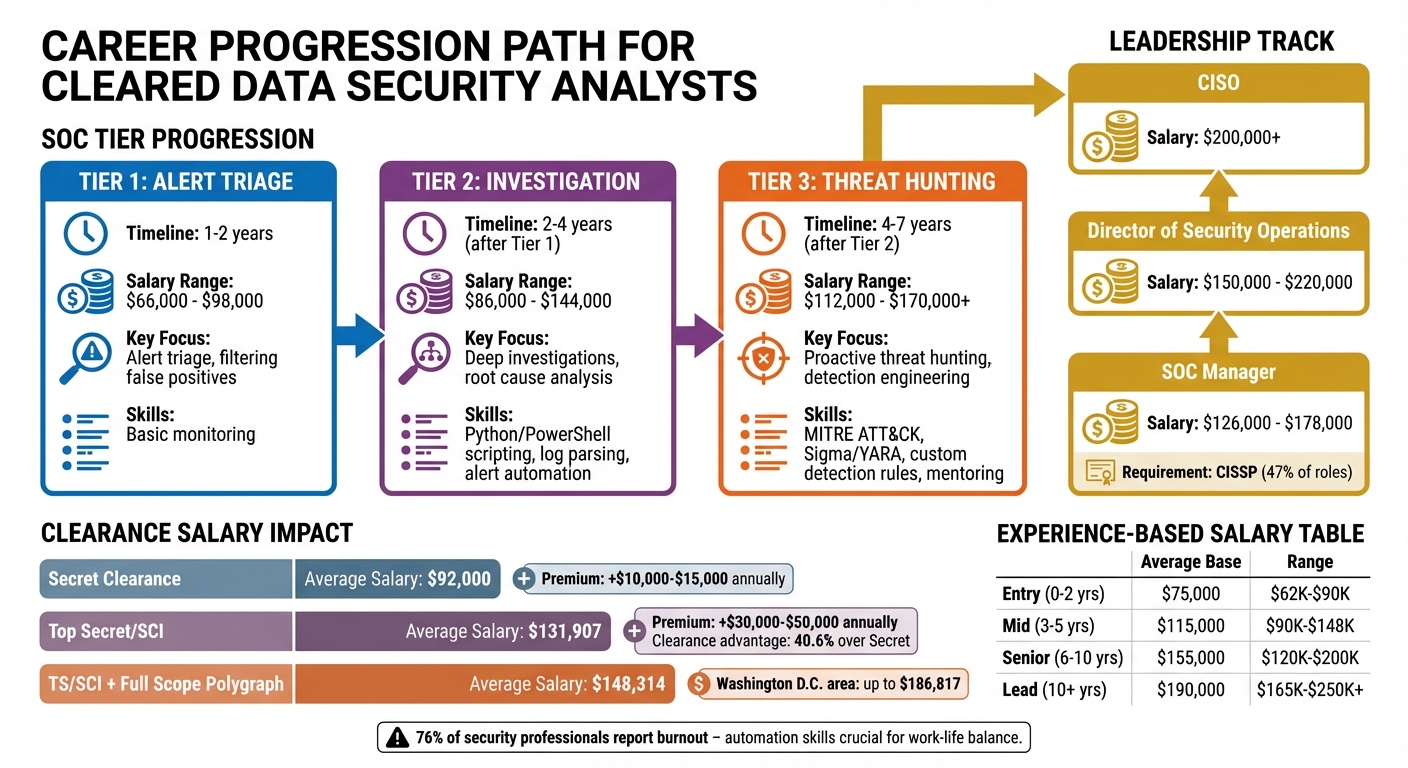
Data Security Analyst Career Progression: Tiers, Salaries, and Clearance Levels
Career Progression Paths
Cleared data security analysts often start their journey within a three-tier Security Operations Center (SOC) model. Tier 1, typically lasting one to two years, focuses on alert triage and filtering out false positives. Entry-level salaries for this stage range from $66,000 to $98,000. After gaining experience, analysts move to Tier 2, usually after two to four years. This role shifts toward deeper investigations and root cause analysis, requiring skills like scripting in Python or PowerShell to automate tasks such as log parsing and alert enrichment. Salaries at this level generally fall between $86,000 and $144,000.
Tier 3, reached after four to seven years, emphasizes proactive threat hunting and detection engineering. Analysts at this stage need expertise in frameworks like MITRE ATT&CK and tools like Sigma or YARA for creating custom detection rules. Salaries here range from $112,000 to $170,000+, and responsibilities often include mentoring less experienced team members.
Beyond the SOC, there are opportunities to specialize in areas like Incident Response, Threat Intelligence, Digital Forensics, Cloud Security, or Security Architecture. Leadership roles, such as SOC Manager (earning between $126,000 and $178,000), Director of Security Operations, or Chief Information Security Officer (CISO), provide additional paths for growth. Notably, about 47% of security management roles require the CISSP certification [1]. These structured tiers and specializations offer clear routes for career development.
Advancement Strategies
To climb the cybersecurity career ladder, adopting specific strategies can make a big difference. One key focus is on automation and documentation. Building a GitHub portfolio featuring automation scripts – like those for generating shift reports or integrating VirusTotal API lookups – can showcase your readiness for promotion. Additionally, developing expertise in a specific SIEM platform, such as Splunk or Microsoft Sentinel, can make you stand out and may lead to higher compensation compared to a generalist approach.
Another critical factor is maintaining your security clearance under the Trusted Workforce 2.0 framework. The government now uses Continuous Vetting (CV) to monitor criminal, financial, and foreign travel records in real time, replacing periodic reinvestigations [2]. Kevin James emphasizes the importance of promptly self-reporting significant life events, such as arrests, large debts, or major foreign contacts, to reinforce your reliability and trustworthiness.
Networking is equally crucial. Attending job fairs and professional events can help you connect with hiring managers and peers in the cleared community. With over 500,000 cybersecurity job openings in the U.S. and SOC analyst roles being the most in-demand according to ISC2’s 2025 Workforce Study [1], building relationships can open doors to new opportunities. Given that 76% of security professionals report burnout, improving automation skills is not just about advancing your career – it can also help achieve better work-life balance in this demanding field.
Tools and Technologies for Cleared Data Security
Standard Data Security Tools
Cleared analysts rely on cybersecurity platforms specifically designed for the unique demands of classified networks. Tools like Splunk, IBM QRadar, and LogRhythm serve as SIEM (Security Information and Event Management) solutions, aggregating data from various sources to provide real-time monitoring and detect anomalies in secure environments [13]. For identifying and addressing vulnerabilities in these isolated networks, tools such as Tenable Nessus, Qualys, and Rapid7 InsightVM are widely used and adhere to strict government authorization protocols [13]. When it comes to forensics and incident response, platforms like EnCase Forensic, The Sleuth Kit with Autopsy, and FireEye Helix are indispensable [13].
"Mastering these tools is about understanding the context in which they are used, the data they provide, and the way they can be leveraged to fortify an organization’s defenses" [13].
These tools provide the foundation for the more specialized technologies required in classified environments.
Classified Environment Technologies
In addition to standard tools, classified environments demand unique technologies to ensure secure operations. Analysts typically work on isolated networks like SIPRNet (Secret) and JWICS (Top Secret/SCI), which are completely disconnected from the public internet [2][15]. These environments often utilize air-gapped platforms specifically designed for SCIFs (Sensitive Compartmented Information Facilities), eliminating any reliance on external cloud services [15]. Encryption methods approved by the NSA are employed to safeguard classified data [14].
To move data securely between networks with varying security levels, Cross-Domain Solutions are used, providing controlled interfaces. Compliance tools are also critical, automating workflows like Plan of Action and Milestones (POA&M) to ensure adherence to STIGs (Security Technical Implementation Guides) and ICD 503 mandates [15][14]. Additional protective measures include TEMPEST, TSCM (Technical Surveillance Counter-Measures), and Protected Distribution Systems [14].
For situations where cloud services are required, analysts rely on government-specific platforms such as AWS GovCloud and Microsoft Azure Government. These cloud environments are physically and logically separated from public cloud regions, ensuring they meet stringent federal security standards [2].
Job Market and Salary Information
Understanding job market trends and salary benchmarks is crucial when planning your career in data security. Let’s dive into the current landscape.
Job Market Trends
The demand for cleared data security analysts continues to grow, fueled by increasingly sophisticated cyber threats and new regulatory requirements. Employment for information security analysts is expected to maintain steady growth through 2034[16][17]. Despite this, there’s a significant talent gap – of the 457,398 cybersecurity job openings reported nationwide, only about 74% are currently filled by qualified professionals[18][19].
Employers are now prioritizing skill verification over simply filling roles[20]. The highest demand is in sectors managing critical infrastructure and national security, such as government agencies, energy providers, and telecommunications firms[18][19]. The adoption of CMMC 2.0 into DFARS has further increased the need for cleared consultants skilled in implementing NIST 800-171 requirements[22].
Specialized skills command higher compensation. For example, roles focused on incident response saw a 100.89% growth in 2023, while cybersecurity and privacy attorney positions rose by 40.74% in 2024 due to new SEC breach reporting rules[19][20]. Professionals with expertise in AI security, cloud architecture, or Zero Trust frameworks can earn 15–25% more than generalists[21].
Salary Ranges
Cleared data security analysts enjoy competitive salaries, with security clearance levels serving as a major factor in earnings. A TS/SCI clearance, for instance, offers a 40.6% salary premium compared to a Secret clearance[22]. TS/SCI holders earn an average of $131,907 annually, while those with a Full Scope Polygraph see national average earnings rise to $148,314. In the Washington D.C. area, top earners with these credentials can make $186,817 or more[22].
| Experience Level | Average Base Salary | Typical Range |
|---|---|---|
| Entry-Level (0–2 years) | $75,000 | $62,000–$90,000 |
| Mid-Level (3–5 years) | $115,000 | $90,000–$148,000 |
| Senior (6–10 years) | $155,000 | $120,000–$200,000 |
| Lead / Principal (10+ years) | $190,000 | $165,000–$250,000+ |
Geographic location also plays a big role in earnings. Average annual salaries are highest in Washington at $150,592, followed by New York at $147,514, California at $145,000, and Maryland at $131,260[21]. Certifications add even more value: CISSP holders can see an additional $25,000–$35,000, OSCP certifications can boost salaries by $20,000–$30,000, and CISM credentials can add $20,000–$28,000[21]. Since the TS/SCI clearance process can take 6–18 months, employers often pay significant premiums for professionals with active clearances[21][22].
Conclusion
Excelling in cleared data security demands a mix of technical expertise, sharp analytical skills to interpret incomplete data, and the ability to communicate effectively with decision-makers. These qualities distinguish exceptional analysts in the cleared space from those who are merely competent[23].
For those ready to invest in the right credentials, this career path offers plenty of rewards. Certifications like CompTIA Security+ and CISSP are essential for career growth and deliver tangible benefits[1]. Additionally, holding an active security clearance can significantly enhance earning potential, especially for military veterans transitioning into civilian roles[1].
The timing couldn’t be better for entering this field. The job market is thriving, with an impressive 29% growth projected through 2034. Opportunities are abundant in government, defense, and critical infrastructure sectors[1]. With 43% of businesses reporting cyber breaches in the past year, the demand for skilled security professionals has never been higher[23]. Specialists with niche expertise not only earn higher salaries but also experience quicker career advancement.
Success here requires more than just technical know-how. It’s about understanding the unique demands of cleared environments and staying current with certifications. Whether you’re beginning your journey or aiming for senior leadership, a career in cleared data security offers stability, competitive pay, and the chance to contribute to national security while advancing your professional goals. It’s a field where dedication and specialization lead to both personal and professional fulfillment.
FAQs
Do I need an active clearance to get hired as a data security analyst?
Yes, the majority of jobs in the cleared cybersecurity field require an active security clearance. This clearance is crucial because it allows professionals to access classified information and contribute to sensitive projects tied to this line of work.
What should I learn first to move from SOC Tier 1 to Tier 2 faster?
To move from SOC Tier 1 to Tier 2, concentrate on mastering analyzing escalated alerts, conducting advanced log analysis, and handling incident response procedures. Gain practical experience with tools such as SIEM, EDR, and network monitoring systems. Focus on developing skills like writing detection rules, automating repetitive tasks, and aligning your work with the organization’s risk management priorities. Taking initiative and showing leadership during incident handling can also help speed up your advancement.
How can I build a portfolio if I can’t share classified work?
To create a portfolio while adhering to security restrictions, focus on presenting your skills, certifications, and measurable accomplishments. Provide detailed descriptions of your roles, emphasizing the tools and methodologies you’ve worked with, but avoid disclosing sensitive information. Highlight relevant projects, training, or certifications that showcase your expertise. Additionally, tailor your resume with job-specific keywords to align with applicant tracking systems. This approach helps you craft a strong professional profile while staying compliant.