

Cyber Range Operators play a critical role in cybersecurity, especially for professionals with security clearances. They manage simulated IT environments that mimic real-world networks for training, testing, and mission rehearsals. This career is in high demand across the Department of Defense (DoD) and Intelligence Community due to increasing investments in cybersecurity infrastructure, like Georgia’s $35 million facility and the National Cyber Range Complex.
Key Highlights:
- Role Overview: Set up and manage virtual environments for offensive and defensive cybersecurity exercises, mission rehearsals, and malware analysis.
- Skills Needed: Proficiency in tools like Terraform, Ansible, and VMware; expertise in penetration testing, incident response, and network management.
- Certifications: Start with CompTIA Security+, CISSP, and CEH. Advanced options include GIAC Red Team Professional (GRTP) and Offensive Security Certified Professional (OSCP).
- Salary: Entry-level roles range from $95,000 to $110,000, while senior positions can exceed $150,000 annually.
- Training: Military programs like Army MOS 17C or industry courses such as CYBER RANGES provide hands-on experience.
This career offers clear growth opportunities, from entry-level technical roles to leadership positions, with strong earning potential and a focus on national security.
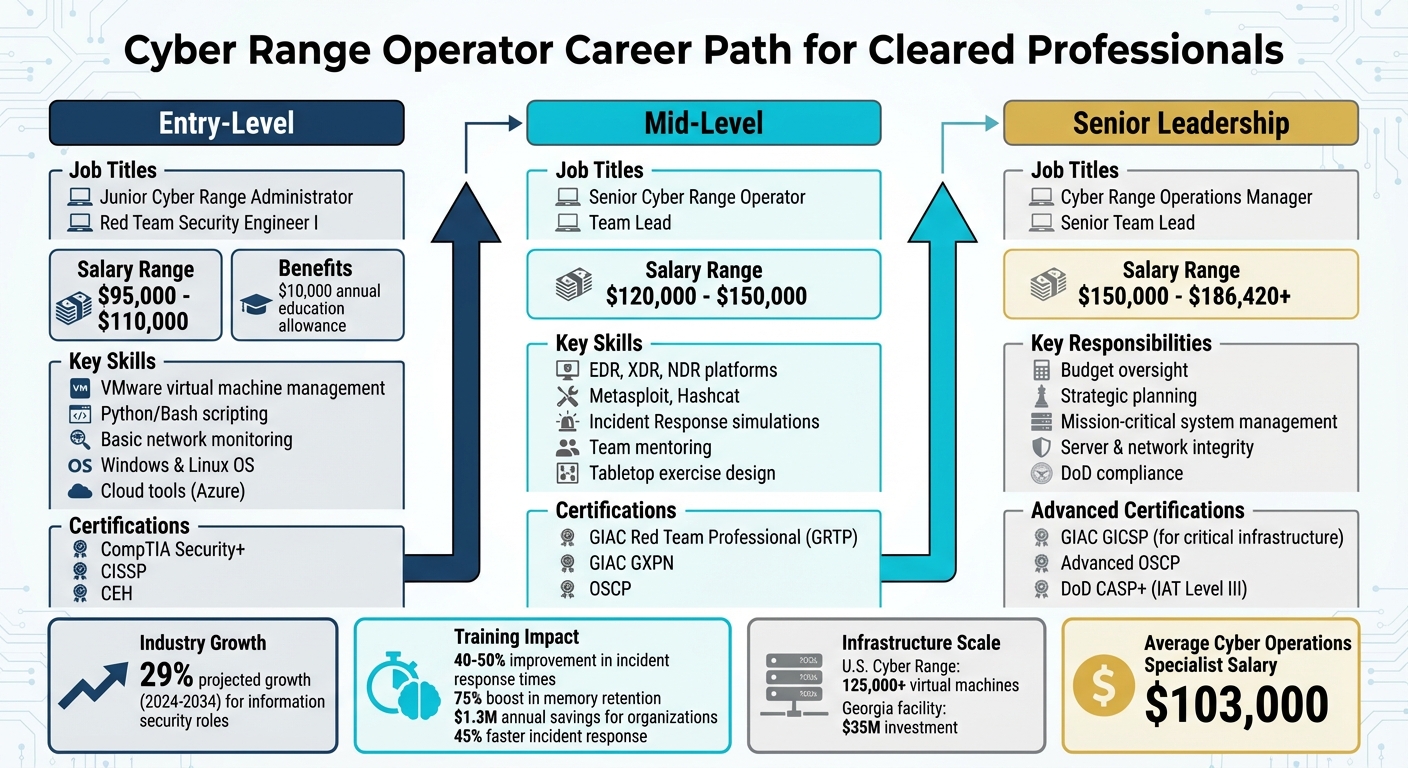
Cyber Range Operator Career Path: Roles, Salaries, and Certifications
The Life of an Air Force Defensive Cyber Warfare Operator – Chief’s Corner #28
sbb-itb-bf7aa6b
What is a Cyber Range Operator?
A Cyber Range Operator runs simulated IT environments designed to mimic actual networks and cyber threats. For cleared professionals, these simulations are vital for supporting national security missions. Here’s how industry leaders define it:
"A cyber range is a simulated IT environment that replicates your organization’s network infrastructure, applications, and security tools. Think of it as a digital sandbox where security teams can safely conduct training exercises." – SimSpace [4]
At the core of this role is environment orchestration – essentially managing the system that powers the cyber range. This involves configuring virtualization platforms, infrastructure components, and target systems. Operators set up virtual machines to mirror real-world network setups [5]. They also simulate authentic traffic patterns and attack methods to reflect how actual cybercriminals operate. For those working on classified missions, these tasks take on heightened importance.
Cleared professionals in this role often simulate classified network environments for mission rehearsals and live-fire exercises. This allows them to safely practice both offensive and defensive strategies. They also facilitate Red Team (attack simulation) versus Blue Team (defense) exercises and provide secure spaces for malware analysis, reverse engineering, and testing security measures before deployment.
The impact of this work is significant. Training in cyber ranges improves incident response times by 40%–50%, boosts memory retention by up to 75%, and helps reduce risks associated with the $4.88 million average cost of a data breach [4][6]. For government agencies tasked with safeguarding critical infrastructure, having a safe place to practice before facing real-world threats is essential.
Key Responsibilities and Skills for Cyber Range Operators
Core Responsibilities
Cyber Range Operators handle a mix of infrastructure management and critical operational tasks. They are responsible for hosting servers, managing databases, and setting up networks or individual systems to ensure the range runs smoothly and efficiently [7]. To protect these systems during simulated attacks, they deploy defensive measures like firewalls and security controls [7].
When systems face outages, failures, or simulated breaches, operators step in to troubleshoot and restore functionality [7]. They also conduct forensic analysis, gathering and handling digital evidence to trace and identify network intrusions [7][8]. In military environments, their duties expand to include supporting warfare operations and managing sensitive mission intelligence. This might involve safeguarding essential assets such as weapon systems, satellites, and aviation infrastructure [7].
On the offensive side, operators engage in penetration testing, experiment with antivirus and Endpoint Detection and Response (EDR) evasion techniques, and run social engineering campaigns to test and evaluate the range’s defenses [8]. This combination of offensive and defensive responsibilities sets Cyber Range Operators apart from traditional cybersecurity roles, requiring them to adapt to constantly shifting scenarios.
Required Technical and Soft Skills
To excel in this role, Cyber Range Operators need a diverse mix of technical expertise and interpersonal abilities, especially when working in high-stakes environments.
Technically, operators must be proficient in reconnaissance techniques like packet analysis and system mapping, offensive strategies such as ethical hacking and Distributed Denial-of-Service (DDoS) simulations, and defensive measures including incident detection and firewall management [7]. These skills form the backbone of their ability to navigate complex cybersecurity challenges.
In addition to technical know-how, operators must thrive under pressure, making quick decisions and juggling multiple tasks effectively [7]. The demand for professionals in this field is growing, with information security roles projected to increase by 29% between 2024 and 2034. Cyber Operations Specialists typically earn an average salary of $103,000 [7], while cleared Red Cyber Operators at top defense firms like GDIT can expect salaries ranging from $100,900 to $136,512 [8]. Achieving Department of Defense (DoD) compliance through certifications like CASP+ (required for IAT Level III roles) is also essential for advancing in this field [8].
Top Certifications for Cyber Range Operators
Core Certifications
If you’re stepping into the world of cyber range operations, CompTIA Security+, CISSP, and CEH are essential starting points. These certifications establish your foundation in areas like network security, risk management, and incident response – skills you’ll rely on every day in a cyber range environment [10].
The Certified Information Systems Security Professional (CISSP) stands out for cleared professionals. It’s recognized under the U.S. Department of Defense directive DoDM 8140.03, covering key areas such as Security Operations and Security Assessment and Testing. This DoD approval makes CISSP a direct pathway to meeting federal job requirements [9].
The Certified Ethical Hacker (CEH) bridges theoretical knowledge with practical skills, focusing on offensive techniques within simulated environments. While certifications like these teach the "what", cyber ranges provide the hands-on experience to master the "how" [10]. Once you’ve built a solid foundation, advanced certifications can help you tackle more specialized challenges in cyber range operations.
Advanced Certifications
After completing the basics, GIAC certifications offer specialized tracks tailored for advanced cyber range roles. These certifications align closely with the practical and security demands of cleared environments. For example, the GIAC Red Team Professional (GRTP) demonstrates expertise in conducting comprehensive Red Team operations, from creating adversary emulation plans to executing Active Directory attacks using tools like Cobalt Strike and Empire [15][11].
The GIAC Exploit Researcher and Advanced Penetration Tester (GXPN) focuses on advanced penetration testing and exploit development – key skills for high-level operators [11]. For those working in critical infrastructure, the Global Industrial Cyber Security Professional (GICSP) focuses on Operational Technology (OT) and Industrial Control Systems (ICS) security [14][12]. Another standout is the Offensive Security Certified Professional (OSCP), which is renowned for its hands-on approach to penetration testing [13][12].
Organizations leveraging cyber range training see tangible benefits, such as responding to incidents 45% faster and saving up to $1.3 million annually [14].
"With this course we provide students with a blueprint they can use to set up a realistic Red Team operation against a client environment. Students will be able to consume threat intelligence, formulate a plan of attack, execute it, and ultimately create a debrief package." – Jean-Francois Maes, Certified SANS Instructor [15]
For advanced roles, certifications with lab-based exams, like GIAC’s CyberLive or OSCP, are ideal since they simulate real-world tasks [15][11]. Training costs can vary widely, from a few hundred dollars to $10,000 for in-depth bootcamps [2].
Tools and Technologies Used in Cyber Ranges
Cyber Range Operators rely on a multi-layered technology stack that replicates real-world enterprise environments. At the core, virtualization platforms like VMware, AWS, Azure, and OpenStack create secure, isolated environments. These platforms enable activities like releasing live malware or simulating DDoS attacks without jeopardizing production systems [5]. For example, the U.S. Cyber Range, managed by Virginia Tech, supports over 125,000 virtual machines, providing training for students and professionals nationwide [12]. This foundation allows for the seamless orchestration of training scenarios.
The orchestration layer connects virtualization technologies with target infrastructures, enabling real-time deployment of custom training scenarios. Many modern platforms use Infrastructure as Code (IaC), where ranges are defined using YAML code. This approach significantly reduces setup time, allowing complex environments to be deployed in minutes rather than days [16].
"The orchestration layer serves as the brain of the cyber range, coordinating the various technological components and managing the dynamic creation and modification of training scenarios." – Matthew Dobbs, Cyberbit [5]
For offensive operations, tools like Metasploit, Burp Suite, Hashcat, Nmap, and DirBuster are commonly used [2]. On the defensive side, platforms such as SIEM systems, Security Onion, Wireshark, NetworkMiner, and VirusTotal are standard [2]. Endpoint security tools, including CrowdStrike Falcon, SentinelOne, Palo Alto Cortex XDR, and Cisco XDR, play a critical role in securing endpoints [2]. Additionally, network security tools like Palo Alto Next-Generation Firewalls, Cisco NGFW, and various intrusion detection and prevention systems enhance a cyber range’s defensive capabilities [2].
To simulate realistic scenarios, ranges incorporate traffic and attack generators. These tools inject network traffic, automated malware, phishing campaigns, and multi-stage attacks aligned with frameworks like MITRE ATT&CK [5]. Many ranges use commercial products like Microsoft Windows Server to mirror the actual systems operators will encounter [1]. An example of innovation in this field is IBM’s X-Force Command Cyber Tactical Operations Center (C-TOC), a mobile training unit equipped with 23 tons of cyber capabilities for on-site sessions [12].
The emergence of Cyber Range as a Service (CRaaS) has made these platforms more accessible. Organizations can now access cloud-based ranges within hours, eliminating the need for significant hardware investments [5]. Whether you’re using open-source tools or enterprise-grade solutions, mastering these technologies is essential for advancing as a Cyber Range Operator. These platforms are not just about training – they’re a cornerstone for national security preparation.
Career Path Progression for Cyber Range Operators
Cyber range operations offer a clear path for growth, transitioning from technical roles to strategic leadership. By understanding these stages, you can set realistic goals and focus on the skills required at each level.
Entry-Level Roles
Starting out, roles like Junior Cyber Range Administrator and Red Team Security Engineer I emphasize foundational technical skills. These include managing virtual machines in VMware environments, scripting with Python or Bash, and basic network monitoring. Familiarity with virtualization platforms, cloud-native tools like Azure, and both Windows and Linux operating systems is essential [17][3].
Salaries for cleared entry-level professionals typically range between $95,000 and $110,000, often accompanied by generous training benefits. For instance, some employers provide $10,000 annual education allowances to help employees stay updated on tools like Kubernetes, Docker, and Splunk [3]. While a Bachelor’s degree in Computer Science is common, relevant hands-on experience can often substitute for formal education [3].
Proficiency in Infrastructure as Code (IaC) tools such as Terraform and Ansible is becoming increasingly important. Entry-level operators use these tools to create realistic cyber range environments for critical training exercises. Collaboration with Hunt, Red, and Blue teams is also a key part of these roles, as they tailor infrastructure to specific simulation goals [3]. As technical expertise grows, opportunities for leadership and strategic roles become more accessible.
Mid-Level and Senior Roles
As professionals advance, mid-level and senior roles expand beyond technical tasks to include strategic responsibilities. Positions like Senior Cyber Range Operator, Team Lead, or Cyber Range Operations Manager involve designing and leading tabletop exercises, running Incident Response simulations, and mentoring junior team members [2][19][20]. These roles require expertise across multiple security tools, including EDR, XDR, and NDR platforms. Familiarity with red team tools like Metasploit and Hashcat is also valuable for anticipating adversary strategies [2].
For cleared professionals, managing sensitive mission-critical systems and adhering to strict operational protocols is a significant part of these roles. Salaries for mid-to-senior positions range from $120,000 to $150,000+, with top earners reaching up to $186,420. Additional responsibilities often include overseeing budgets, server systems, and network integrity [7]. Military professionals with experience in roles like the Army’s 17C (Cyber Operations Specialist) MOS often find these civilian positions a natural next step [7].
Training Programs and Resources for Cleared Professionals
For those building a career in cyber range operations, targeted training programs provide the practical experience necessary for excelling in government and defense roles. These programs are specifically designed to align with federal competency standards and offer hands-on exposure to classified systems.
Military and Veteran Training Pathways
One standout option is the Army MOS 17C (Cyber Operations Specialist) program. This intensive 45-week Advanced Individual Training is split between Florida (25 weeks) and Fort Gordon, Georgia (20 weeks). The curriculum addresses both offensive and defensive cyber operations and has earned a stellar 4.9 out of 5 rating from 94 reviews[23].
For transitioning service members, the DoD SkillBridge program is a great resource, particularly the CMS CyberVets rotation. This six-month program focuses on networking, reverse engineering, and threat management. To secure a spot, it’s recommended to apply at least eight months before your separation date. Additionally, the Department of Defense Cyber Crime Center (DC3) offers a Cyber Training Academy tailored for military and civilian personnel engaged in cyber-focused roles.
The Applied Technology Academy (ATA) collaborates with CYBER RANGES to deliver on-premise, bare-metal cyber range installations rated for Impact Level 4 (IL4). These installations meet stringent security requirements for federal agencies and Guard and Reserve forces[21]. For those outside the military, industry programs also provide specialized training to sharpen both tactical and technical skills.
Industry-Specific Training Courses
In addition to military pathways, industry-specific courses are available to further develop expertise in cyber range operations. The CSIAC Cyber Training Range (CTR) Course is one such program, offering free, virtual instructor-led training exclusively for federal employees and contractors with a .gov or .mil email address. This course dives into adversarial threats targeting DoD networks and weapons systems, incorporating hands-on training with unmanned aerial system simulators[24].
Another noteworthy program is CITADEL Red Team Training by CYBER RANGES. It provides a detailed lab environment featuring 13 integrated Windows systems and a medium-sized Active Directory domain. Participants work through the full adversary attack lifecycle, including phishing, password spraying, and persistence techniques like WMI and DLL-side loading.
"CITADEL’s scenarios mirrored our operational environment and exposed real gaps in our defenses. The Drill Masters’ feedback was invaluable." – Chief Information Security Officer, National Energy Grid[13]
This training aligns with NIST NICE work roles and MITRE ATT&CK techniques, ensuring participants meet federal standards.
For Maryland residents, the Hagerstown Community College SOC Operations Analyst I (SOCOA I) certification is available at no cost through the Cyber Workforce Accelerator program. This initiative trains 1,100 residents using the BCR Cyber Series 3000 Cyber Range for incident response scenarios[22]. Additionally, the Technology Advancement Center (TAC) offers specialized ranges that simulate Operational Technology (OT) and Platform Information Technology (PIT) environments crucial for safeguarding national infrastructure[14].
Job Search Strategies for Cleared Cyber Range Operators
Using Cleared Cyber Security Jobs Effectively

Cleared Cyber Security Jobs provides tailored tools specifically for professionals with security clearances who are pursuing cyber range operator roles. To make the most of this platform, use clearance-level filters to narrow down job listings to those that match your specific clearance level, whether it’s Secret, Top Secret, or TS/SCI with polygraph. Setting up job alerts for positions like "Cyber Range Operator" ensures you receive timely notifications, allowing you to apply within 24–48 hours – a critical window for staying competitive. Uploading your resume is another key step, as it attracts recruiters from top defense contractors like Leidos, General Dynamics IT, and Nightwing.
It’s also smart to focus on major defense hubs, such as Annapolis Junction, Fort Belvoir, and Huntsville. Veterans can further boost their profiles by including their Military Occupational Specialty (MOS), which highlights relevant training and experience to potential employers[7]. These targeted approaches not only streamline your job search but also help you connect with the right opportunities in the cleared community.
Networking and Industry Connections
While job search tools are a great starting point, building a strong professional network is equally important. Participate in specialized training programs and attend industry events to connect with others in the cleared community. For instance, government-sponsored courses like the CSIAC Cyber Training Range (CTR) program offer both skill-building opportunities and a chance to meet key players in the field. A notable example is the three-day virtual CTR course hosted in partnership with the Defense Acquisition University (DAU) in July 2025, which was limited to 30 federal employees and contractors. Events like this foster direct interaction with Department of Defense (DoD) and federal contractors[24].
Cleared-specific job fairs organized by Cleared Cyber Security Jobs are another valuable resource. These events cater exclusively to professionals with active or eligible clearances, ensuring that every conversation with recruiters is highly relevant. Networking at these fairs can be a stepping stone to moving from entry-level roles into senior positions. Additionally, consider joining initiatives like Michigan’s Cyber Civilian Corps (MiC3), which operates on a "volunteer fire department" model for responding to cyber emergencies. Volunteering with such groups not only provides hands-on experience but also broadens your network within the cleared community[18].
Conclusion
Cyber Range Operators are uniquely positioned in the fast-growing cybersecurity field, especially when holding security clearances. This opens doors to opportunities within the National Cyber Range Complex and other classified settings where mission-critical rehearsals are a priority.
Success in this role hinges on more than just theoretical knowledge. It’s about building real-world experience through consistent practice in simulated breach scenarios. As Zach Carnes, Technical Solutions Architect at WWT, explains:
"The key, as with all learning, is repetition. Being presented with a problem, working through it, over and over and over again" [2].
This repetition builds the "muscle memory" essential for responding effectively to actual security incidents.
To move forward in this career, focus on earning relevant certifications, maintaining ongoing training, and expanding your professional network. Whether you’re transitioning from military cyber operations or advancing from an entry-level role, mastering tools like EDR and SIEM, along with documenting your processes through After-Action Reviews, is essential. States like Georgia, Michigan, and Virginia are actively investing in cyber range programs, creating plenty of chances for cleared professionals to grow their skills.
From here, leverage your clearance and expertise by connecting with defense contractors through platforms like Cleared Cyber Security Jobs. Pursue certifications that align with Department of Defense requirements and participate in Capture the Flag exercises to sharpen your abilities. Combining your clearance, technical know-how, and hands-on experience puts you in a prime position to protect national security in today’s digital landscape.
FAQs
What clearance do I need to become a Cyber Range Operator?
To become a Cyber Range Operator, having a Top Secret clearance is usually a must, particularly if you’re working with military or government cyber ranges. This clearance is essential because the role often involves handling highly sensitive and classified information.
How can I get cyber range experience without prior range work?
You can build cyber range experience using simulation-based training platforms that offer hands-on practice in safe, controlled environments. Seek out programs featuring realistic scenarios, Capture the Flag (CTF) exercises, or scenario-driven training sessions. These tools let you practice defending against and responding to simulated cyber threats, giving you practical skills – even if you’ve never worked in a cyber range before.
Which certifications matter most for DoD cyber range roles?
If you’re aiming for a role within a DoD cyber range, certain certifications can boost your qualifications significantly. Two key ones to consider are:
- CISSP (Certified Information Systems Security Professional): Recognized under DoD 8140, this certification is essential for a variety of cybersecurity positions. It demonstrates advanced knowledge in securing systems and managing cybersecurity risks.
- CEH (Certified Ethical Hacker): Approved for roles like Cyber Defense Analyst and Vulnerability Assessment Analyst, this certification focuses on identifying and addressing vulnerabilities, a critical skill in cybersecurity operations.
Both of these certifications align with DoD requirements and validate the specialized skills needed for professionals in this field.