

Cleared incident responders are cybersecurity professionals who protect classified government and defense systems from cyber threats. These roles require advanced technical skills, security clearances (Secret, Top Secret/SCI, or TS/SCI with Polygraph), and certifications like Security+, CEH, GCIH, or CISSP. Salaries average $132,962 annually, with some roles paying up to $186,500.
Key Points:
- Work Environment: Operate in secure facilities (SCIFs) using tools like SIEMs (Splunk, QRadar) and forensic software (EnCase, FTK).
- Growing Demand: Federal modernization, secure cloud adoption, and legislative changes (e.g., Trusted Workforce 2.0) drive job growth.
- Skills Needed: Forensics, malware analysis, scripting (PowerShell, Bash), and communication.
- Experience Path: Start as SOC analyst or system admin; progress to roles like Cyber Incident Handler or Cloud Forensic Analyst.
- Security Clearance: Requires sponsorship, with processing times ranging from 60 to 365+ days depending on clearance level.
If you’re aiming to break into or advance in this field, focus on gaining certifications, building technical expertise, and preparing for the clearance process.
A beginner’s guide to modern incident response (step-by-step guide) | Learn with HTB (Episode #3)
sbb-itb-bf7aa6b
Required Skills and Qualifications
To thrive as a cleared incident responder, you need a mix of advanced technical know-how, recognized certifications, and essential interpersonal skills. These roles operate within government and defense contractor environments, where high standards are the norm.
Technical Skills You Need
Incident response depends on expertise in forensic collection, intrusion correlation, and log analysis. This includes analyzing data from hosts, network traffic, firewalls, and intrusion detection systems to piece together how an attack unfolded. Advanced roles go further, requiring knowledge of memory, registry, and USB forensics, as well as investigations tailored to platforms like Windows, Linux, Docker, and cloud environments.
Malware analysis and reverse engineering are key for uncovering the origins and extent of attacks. Skills in scripting with PowerShell and Bash are also vital, as they allow you to automate responses and quickly analyze logs. Familiarity with tools like Autopsy, Volatility, EnCase, FTK, and various SIEM platforms enhances your ability to gather evidence and connect the dots in complex attack scenarios.
Many professionals start in roles such as SOC analyst, network administrator, or system administrator before transitioning into incident response. If you’re in a general IT role, look for opportunities to work with IDS tools or contribute to community rules for systems like Snort.
Once you’ve built a solid technical foundation, certifications can help validate your expertise and prepare you for cleared roles.
Certifications for Cleared Roles
Certifications are a great way to demonstrate your qualifications and stand out in the field. For those just starting, Security+ provides a solid foundation. As you advance, certifications like GCIH (GIAC Certified Incident Handler) and ECIH (EC-Council Certified Incident Handler) focus on practical incident response techniques. The CEH (Certified Ethical Hacker) certification is also helpful for understanding how attackers operate, so you can better defend against them.
For those specializing in digital forensics, the GCFA (GIAC Certified Forensic Analyst) offers in-depth training. Senior-level roles often require certifications like CISSP or CISM, which emphasize leadership and managing enterprise-wide responses. A tiered approach to certifications can help you progressively build your qualifications.
| Certification | Level | Primary Focus |
|---|---|---|
| Security+ | Entry | Basic security principles and foundational skills |
| CEH | Intermediate | Understanding attacker techniques and strategies |
| GCIH / ECIH | Intermediate | Tactical incident response and handling |
| GCFA | Advanced | In-depth digital forensics and data recovery |
| CISSP / CISM | Senior | Leadership and enterprise-level response management |
While technical skills and certifications are important, success in this field also depends on your ability to communicate effectively and stay composed under pressure.
Soft Skills and Analytical Abilities
Technical knowledge alone isn’t enough. You’ll need to translate complex forensic findings into clear, actionable reports for managers, legal teams, and others who may not have a technical background.
During active breaches, stress management and quick decision-making are crucial. You’ll often face irregular hours and high-pressure situations, so staying calm and adaptable is essential. Collaboration is also key – incident responders work closely with teams across IT, HR, legal, DevOps, and executive leadership to address and resolve threats.
Attention to detail is critical for identifying real threats and avoiding false positives, especially when the situation doesn’t fit standard playbooks. The cyber threat landscape is constantly evolving, so staying current is a must. This means learning about new malware, phishing tactics, and emerging threats. Activities like cloud-based capture-the-flag competitions, SANS NetWars events, or running tabletop exercises with your team can sharpen your analytical skills and keep you prepared.
Combining these technical and soft skills ensures you can respond effectively to the challenges of cleared incident response roles.
Education and Experience Requirements
Educational Background
For most cleared incident responder roles, a bachelor’s degree in fields like Computer Science, Cybersecurity, Information Technology, or Information Security is typically required. Statistics show that about 54% of cybersecurity professionals hold a bachelor’s degree, often with specializations like Digital Forensics or Incident Response, which can give candidates a competitive edge. Meanwhile, 43% of professionals have an associate degree, which can be enough for entry-level positions [1]. Only 1% of professionals hold a master’s degree, but those who do often find opportunities in senior leadership roles [1].
Relevant coursework should include topics such as network protocols, operating systems like Linux and Windows, and cloud security basics [6]. That said, some organizations are willing to waive formal degree requirements if a candidate has extensive professional experience and proven technical expertise [3].
While academic qualifications set the foundation, practical experience plays a critical role in advancing within cleared incident response careers.
Experience Levels by Role and Clearance Type
"Incident response is rarely an entry-level role." – Cybersecurity Guide [1]
Most employers prefer candidates with 2–3 years of experience in related roles before transitioning into incident response [1]. Entry-level roles often require 1–3 years of experience in positions such as system administrator, network administrator, or SOC analyst [5]. For mid-level roles, employers typically look for 2–5 years of direct experience in areas like computer forensics, cybersecurity, or network administration [4]. Senior-level positions, such as Security Manager or Architect, usually demand 5–8+ years of experience in information security [4].
| Role Level | Typical Experience Required | Common Previous Titles |
|---|---|---|
| Entry-Level (Tier 1) | 1–3 Years | System Admin, Network Admin, SOC Analyst |
| Mid-Level | 2–5 Years | Security Specialist, Forensic Analyst, Intrusion Analyst |
| Senior-Level | 5–8+ Years | Security Manager, Security Architect, CSIRT Manager |
"Incident responders typically begin their careers as SOC analysts. After their analysis and investigation during their time as an analyst, they continue their career in the direction of becoming an incident responder." – Muhammet Donmez, LetsDefend [3]
Hands-On Training Opportunities
Hands-on training is crucial for developing the technical skills that employers demand. Platforms such as TryHackMe and LetsDefend offer structured learning paths that focus on key areas like Windows and Linux forensics, memory analysis, and investigating hacked web servers [8]. LetsDefend’s "Incident Responder Path" is specifically designed to prepare candidates for the technical challenges they’ll face in cleared roles [8].
Federal programs also provide direct entry points into cleared positions. For instance, the SMART Scholarship for Service covers tuition costs and guarantees a civilian job with the Department of Defense after graduation. Similarly, agencies like the Department of Homeland Security (DHS) and CISA offer paid internships and apprenticeships. These programs often extend beyond typical internship durations, providing hands-on experience in national security missions and frequently leading to full-time roles without additional clearance delays.
The Security Clearance Process
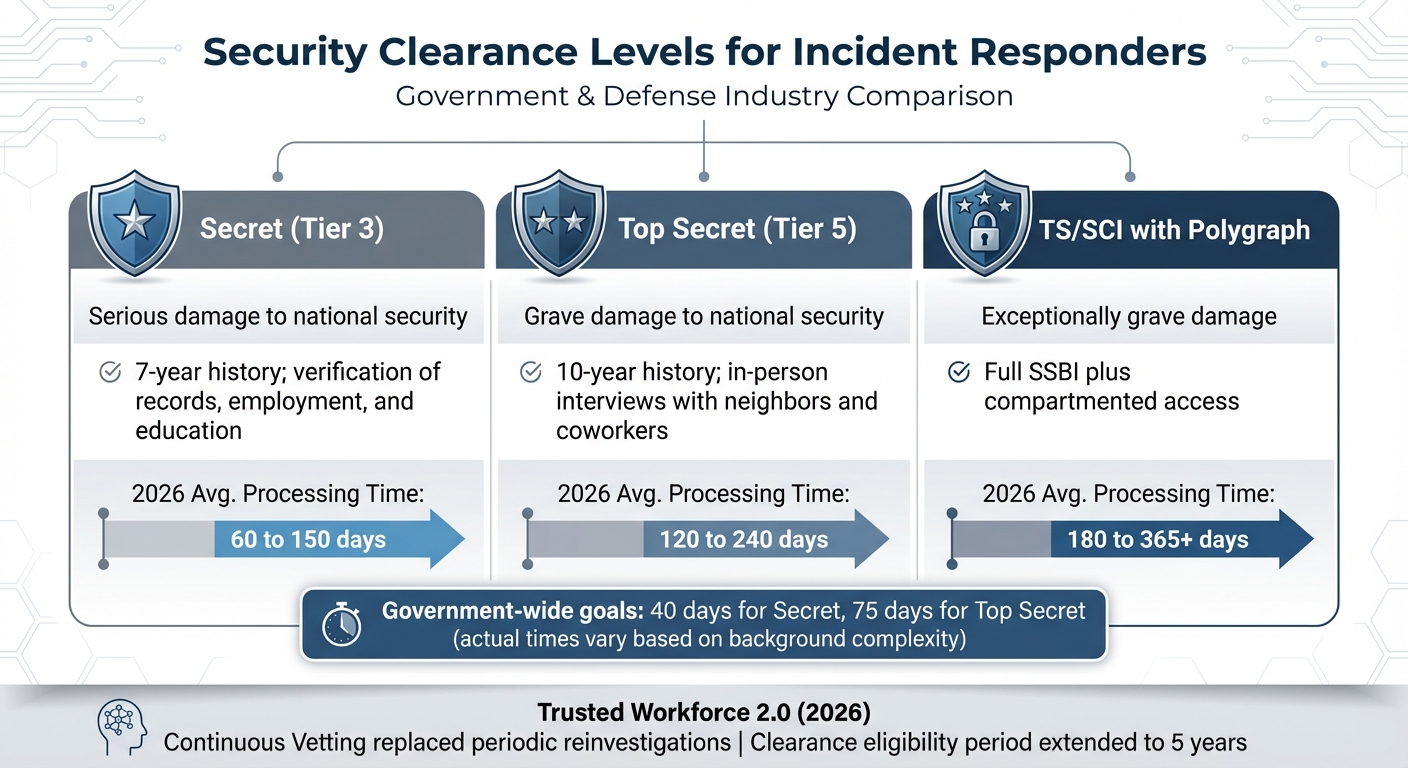
Security Clearance Levels for Incident Responders: Requirements and Processing Times
For incident responders, having the right security clearance is just as important as honing technical expertise.
Security Clearance Levels Explained
Obtaining a security clearance requires sponsorship by a federal agency or a cleared defense contractor, typically based on the need to handle classified information [2]. Since 2026, the clearance system has been governed by Trusted Workforce 2.0 (TW 2.0), which replaced periodic reinvestigations with Continuous Vetting (CV). This system uses automated, near real-time monitoring of records like criminal history, finances, and travel [4,14].
The clearance system is divided into three levels: Tier 1 (Public Trust), Tier 3 (Secret), and Tier 5 (Top Secret/SCI) [2]. For incident responders, the required clearance depends on the networks and systems being defended. For example, if your role involves analyzing classified threat indicators, investigating incidents on networks like SIPRNet, or conducting forensics on secure systems, you’ll need at least a Secret clearance [2].
| Clearance Level | Investigation Scope | Impact of Disclosure | 2026 Avg. Processing Time |
|---|---|---|---|
| Secret (Tier 3) | 7-year history; verification of records, employment, and education [4,13] | Serious damage to national security [13,14] | 60 to 150 days [2] |
| Top Secret (Tier 5) | 10-year history; in-person interviews with neighbors and coworkers [4,13] | Grave damage to national security [13,14] | 120 to 240 days [2] |
| TS/SCI with Polygraph | Full SSBI plus compartmented access [4,13] | Exceptionally grave damage [2] | 180 to 365+ days [2] |
These timelines highlight the importance of providing accurate and thorough information during the application process. While government-wide goals aim for 40 days for Secret and 75 days for Top Secret clearances [9], actual processing times often depend on the complexity of your background, including any foreign contacts [2].
Adjudicators evaluate applications using 13 guidelines, with the most common issues stemming from financial problems, foreign influence, and personal conduct [4,13]. Financial concerns, in particular, account for about 40% of clearance denials [10]. For incident responders, even your digital activities – such as GitHub contributions, forum posts, or interactions with international researchers – may come under scrutiny [2].
"The dominant theme for security clearances process in 2026 is implementation amidst unpredictability. While digital systems like eApp and Continuous Vetting are fully deployed, processing timelines remain variable." – Kevin James, Cybersecurity Writer [2]
Once your clearance is approved, knowing how to maintain it is just as important.
How to Maintain Your Security Clearance
Under the Continuous Vetting system, periodic reinvestigations are no longer required. By early 2026, over 3.8 million cleared personnel were enrolled in the CV program [9], which continuously monitors records for potential issues. If something adverse occurs – like an arrest, financial trouble, or foreign contact – you must immediately self-report it to your Security Officer. Automated systems will flag these events within 72 hours [2].
The 2026 National Defense Authorization Act (NDAA) extended the eligibility period for reactivating a clearance from 24 months to 5 years [9]. This change offers greater flexibility for career moves, as it allows you to transfer your clearance to a new sponsor within that window without restarting the investigation process.
Staying proactive can help you avoid clearance issues. Review your credit report annually and address any delinquencies with documented repayment plans, as financial stability is crucial – especially since financial problems are the leading cause of clearance denials [2]. Keep a personal security file with copies of mitigation documents, reporting emails, and other relevant correspondence throughout your career.
For incident responders who work within international cybersecurity circles, it’s essential to log all interactions with international researchers and document attendance at global conferences [2]. Additionally, always follow government-approved IT security protocols, avoid using personal devices for classified work, and ensure compliance with communication guidelines to protect your clearance.
Job Search Strategies for Cleared Roles
Landing a cleared incident responder position takes more than a standard job search approach. Generic job boards often miss opportunities that require security clearances, so focusing on platforms and strategies tailored to the cleared community is key.
Using Cleared Cyber Security Jobs Effectively
Cleared Cyber Security Jobs is a specialized platform that simplifies the search for incident responder roles. You can filter job listings by clearance level – whether you hold Secret, TS/SCI, or Polygraph – and refine results by location. As of March 2026, companies like Leidos, Peraton, CACI, Nightwing, and The Aerospace Corporation regularly post roles for cleared incident responders on this platform [12].
Take advantage of job alerts by setting up notifications for terms like "incident response" or "incident handler", so you’re immediately informed when new roles appear [12]. Upload your resume to the platform’s database to allow employers to find you directly. Additionally, participate in job fairs specifically designed for security-cleared professionals. These events connect you with defense and government contractors actively seeking talent [12]. Key locations for cleared incident responder positions include Arlington, VA; Alexandria, VA; Sterling, VA; and Colorado Springs, CO [12].
How to Tailor Your Resume for Cleared Roles
Your resume should clearly communicate that you’re a strong candidate for cleared incident responder roles. Start by listing your clearance level prominently at the top of your resume alongside your contact details. However, never mention your clearance on public platforms like LinkedIn, as some employers may view this as a disqualifier [13].
Use the STAR method (Situation, Task, Action, Result) to describe your accomplishments. Instead of generic statements like "conducted vulnerability assessments", include measurable outcomes, such as the number of vulnerabilities resolved or the percentage reduction in security risks achieved [11]. Add a technical skills section that highlights tools like SIEM solutions, firewalls, intrusion detection systems, and vulnerability assessment tools [11].
Incorporate keywords from job postings into your resume, such as "penetration testing" or "network security", to ensure it passes automated screening systems [11]. If you’re working toward certifications like CISSP or CEH, include them with an expected completion date. As CyberSecJobs.com points out, "Listing an in-progress certification could be the deciding factor in whether a recruiter contacts you, especially if it’s a job requirement" [11].
Keep your resume concise – one to two pages at most – and avoid sharing classified project details, colleague names, or budget specifics. ClearedJobs.Net advises, "Your cleared resume is an advertisement, not your biography" [13]. Additionally, most cleared roles don’t require more than 10 years of experience, so listing too much can sometimes lead to age bias [13].
Networking and Professional Development
To stay competitive in the cleared incident response field, focus on certifications and building professional relationships. Prioritize credentials like CompTIA Security+, CISSP, CEH, or CISM to demonstrate your expertise.
Attend job fairs geared toward security-cleared professionals to connect directly with hiring managers from defense and government contractors [12]. These events can provide face-to-face opportunities that bypass traditional application hurdles. When networking or applying, emphasize metrics like the number of vulnerabilities mitigated or the percentage reduction in security risks achieved – hiring managers value quantifiable results [11].
Sample Cleared Incident Responder Job Profiles
These profiles illustrate how careers in incident response evolve from entry-level positions to senior roles, tying in with the skills, clearance requirements, and strategies discussed earlier.
Tier 1 Security Analyst (Tysons, VA)
In entry-level roles, the focus is on monitoring and triaging alerts using tools like SIEM platforms and security consoles. Analysts work to filter out false positives and escalate genuine threats. Daily tasks include analyzing alerts, conducting initial threat assessments, and documenting incidents based on established protocols. A Secret clearance is required for these positions. Tysons, VA, is a hotspot for defense contractors, making it an excellent place to start a career in cleared incident response. Skills gained here lay the groundwork for advancing to more technically demanding roles.
Cyber Incident Handler (Fort Huachuca, AZ)
Intermediate roles require greater independence and technical expertise. At Fort Huachuca, Cyber Incident Handlers manage incidents within military-affiliated networks [14]. These roles often intersect with intelligence and electronic warfare systems, so knowledge of SIGINT (Signals Intelligence) is highly beneficial [14]. Responsibilities include analyzing network traffic, detecting malicious activity, and executing containment measures within a 24/7 operations center. Candidates typically need a Secret or Top Secret clearance. For those ready for more advanced challenges, senior positions offer opportunities to safeguard critical defense systems.
Cloud Forensic Analyst IV (Arlington, VA)
Senior-level roles demand advanced skills to protect sensitive defense programs. For example, in March 2026, Nightwing sought a Cloud Forensic Analyst IV in Arlington, VA, to handle complex incident response tasks requiring TS/SCI clearance [15][7]. Duties in this role include conducting in-depth digital forensics, proactive threat hunting, and responding to sophisticated cyber threats. Analysts also perform root cause analysis, cloud forensics, and implement cybersecurity automation to secure highly sensitive data. Arlington is a hub for senior-level cleared positions, with companies like Leidos and Nightwing frequently hiring for these specialized roles [15].
| Role Level | Location | Typical Clearance | Primary Focus | Example Employer |
|---|---|---|---|---|
| Entry | Tysons, VA | Secret | Alert Triage & Monitoring | Multiple Contractors |
| Intermediate | Fort Huachuca, AZ | Secret/Top Secret | Incident Containment | Peraton [14] |
| Senior | Arlington, VA | TS/SCI | Advanced Forensics & Threat Hunting | Nightwing [15] |
These examples highlight the range of opportunities available for cleared professionals, showcasing how you can strategically progress through a career in incident response.
Next Steps
You’ve now explored the ins and outs of cleared incident responder careers – from the required technical skills and certifications to the clearance process and job search strategies. The next step? Putting this knowledge into action.
Start by evaluating your qualifications. Pull your credit report and address any financial issues, as these are a common reason for clearance denial [2]. Prepare 10 years’ worth of documentation, including addresses, foreign contacts, and employment history, to make your eApp process smoother [2].
With your personal records in order, turn your focus to building your technical expertise. Certifications are key. Begin with credentials like GCIH or GCFA to develop core incident response skills. From there, aim for the CISSP, which can open doors to leadership roles [18][1]. These certifications align closely with what government agencies and contractors are seeking. Update your resume accordingly. Make sure to list your clearance status prominently at the top so recruiters and applicant tracking systems can spot it quickly. Keep two versions of your resume: one with clearance details for verified recruiters and another without for public platforms [17].
With your resume polished and certifications in hand, it’s time to dive into your job search. Platforms like Cleared Cyber Security Jobs are excellent for finding positions with titles such as Cybersecurity Incident Response Analyst, Intrusion Analyst, or CSIRT Engineer [1]. Use keywords like SIEM, Cyber Threat Intelligence, Linux, and Incident Management to optimize your profile and attract the right opportunities [1]. Setting up job alerts can help you stay on top of new openings that match your skills and clearance level.
Networking is another critical step. Join professional groups like the Incident Response Consortium or the Information Systems Security Association (ISSA) for mentorship and job leads [16]. On LinkedIn, connect with "cleared" networking groups while maintaining a low profile on public platforms to avoid unwanted attention from bad actors [17]. With cybersecurity roles projected to remain among the top 20 most in-demand IT positions over the next decade [1], the cleared incident responder field offers immense potential. Take the first step toward your next opportunity today.
FAQs
How can I get sponsored for a security clearance?
To begin the security clearance process, you need sponsorship – you can’t initiate it on your own. Sponsorship comes after receiving a conditional job offer from an employer or government agency that requires clearance. Once you have that offer, the sponsoring organization will walk you through the steps. This usually involves filling out the SF-86 form, undergoing detailed background checks, and successfully completing a comprehensive investigation.
What should I do now if I don’t have a clearance yet?
If you don’t currently hold a security clearance, the first step is understanding how the process works. Typically, obtaining one requires sponsorship from an employer or a government entity, along with passing a background check. To boost your chances, prioritize developing essential cybersecurity skills and earning certifications such as CompTIA Security+ or CISSP. Building experience in cybersecurity roles is another critical move – employers are more likely to sponsor candidates who showcase both expertise and reliability.
What home labs best prepare me for cleared incident response?
Creating a home lab that mimics real-world incident response scenarios is a must for roles requiring security clearances. Tools like VMware or VirtualBox allow you to set up multiple virtual machines running both Windows and Linux systems. Use this environment to practice with tools like intrusion detection systems (IDS), SIEM platforms, and simulated attack scenarios. By designing segmented networks and rehearsing incident response workflows, you can sharpen the skills needed for working in cleared environments.