

Transitioning from military service to cybersecurity? This guide simplifies the process, helping you leverage your skills, security clearance, and veteran-specific resources to land a role in this high-demand field. With over 542,000 open cybersecurity positions in North America and starting salaries averaging $85,000 for entry-level roles with certifications, now is the perfect time to make your move. Here’s how to get started:
- Translate Your Experience: Highlight transferable skills like risk management and network security. Use tools like the NICE Workforce Framework to align military tasks with civilian roles.
- Certifications Matter: Start with certifications like CompTIA Security+ or CEH and explore free or subsidized training programs such as CyberVetsUSA or VET TEC.
- Build Your Profile: Create a civilian-friendly resume and optimize your LinkedIn profile to showcase your expertise and clearance.
- Use Veteran Resources: Explore veteran-specific job boards, programs like DoD SkillBridge, and mentorship networks to connect with employers who value your background.
- Plan Your Finances: Use benefits like the Post-9/11 GI Bill or VET TEC to cover training costs and ensure financial stability during your transition.
This step-by-step approach will help you confidently transition into a cybersecurity career while maximizing the value of your military experience.
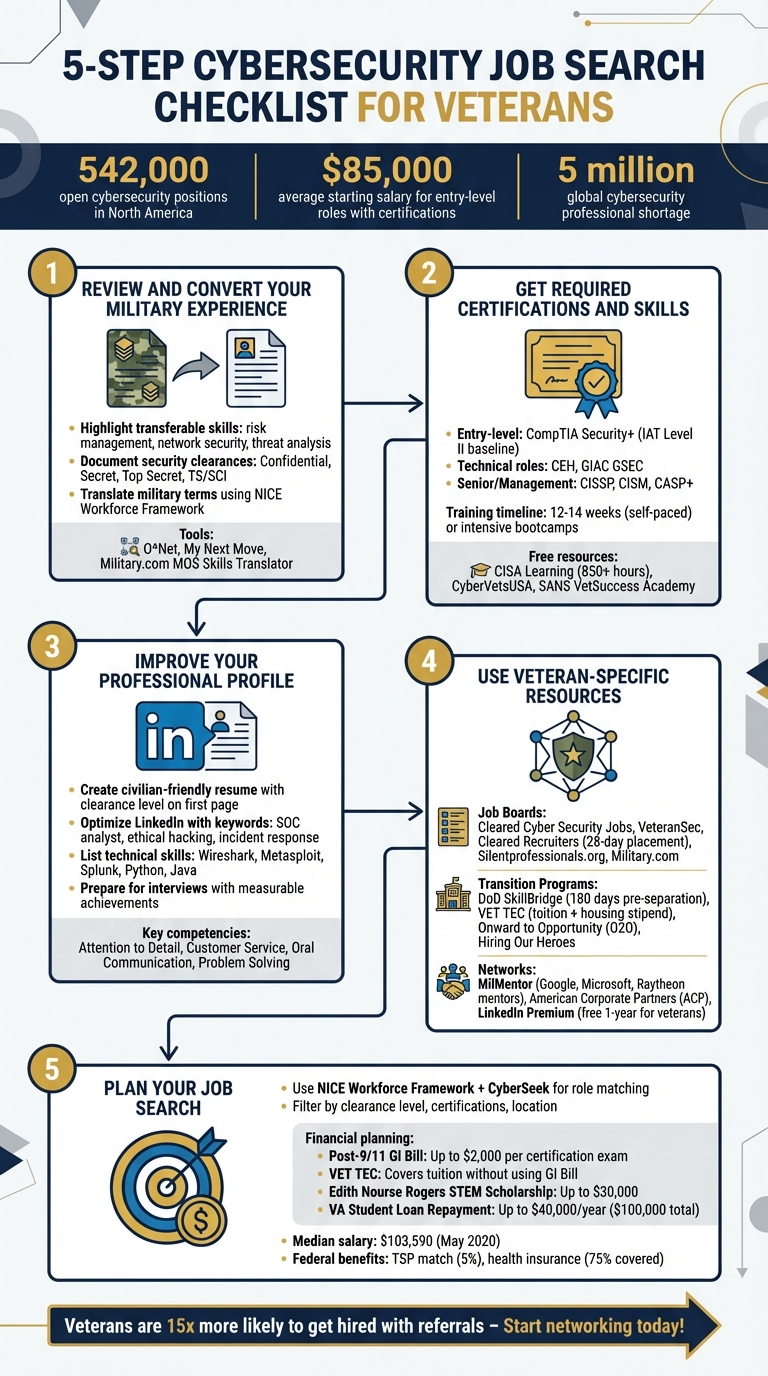
5-Step Cybersecurity Job Search Checklist for Veterans
A Veteran’s Guide to a Cybersecurity Career Transition with Tim Ramirez | The Cybrary Podcast Ep. 75
Step 1: Review and Convert Your Military Experience
Take a close look at your military background. Your service has likely equipped you with skills that are highly desirable in the cybersecurity field. Employers in this industry value qualities like situational awareness, the ability to make sound security decisions, and the capacity to adapt to fast-changing challenges under pressure. In particular, federal cybersecurity roles often prioritize skills such as attention to detail, customer service, oral communication, and problem-solving – areas where veterans naturally excel.
The next step is to identify your transferable skills, highlight any security clearances, and translate military-specific terms into language that civilian employers can easily understand.
Highlight Your Transferable Skills
Pinpoint the skills you acquired during your service that align with cybersecurity roles. These might include risk management, computer networking concepts, understanding cyber threats and vulnerabilities, and recognizing the operational impact of security breaches. If you have experience in Cyber Operations, Signals Intelligence, or IT support, those skills directly translate to civilian cybersecurity positions.
A helpful resource is the NICE Workforce Framework for Cybersecurity, which allows you to match your military tasks with specific civilian roles. Tools like the Cyber Career Pathways Tool can guide you in identifying which of the 52 roles within the NICE Framework best align with your experience. For instance, an Army 17C role often corresponds to Network Security and Defensive Cyber Operations, while Navy Cryptologic Technicians (CTN) are well-suited for Network Defense and Cryptography positions.
When documenting your skills, focus on measurable achievements. For example, instead of a generic description, write something like: "Managed network security for 500+ users across three locations, reducing incidents by 40% within 12 months."
Document Your Security Clearances
If you have an active or recently expired security clearance, it’s a huge advantage when applying for positions with defense or government contractors. Employers value active clearances since they can often be processed within 90 days [4].
Include your clearance level and status on your resume. Be specific about the type, such as Confidential, Secret, Top Secret, or TS/SCI, and note whether the clearance is active or when it expired. When describing work that required a clearance, use metrics to highlight your responsibilities without disclosing classified information. For instance, you could write: "Oversaw equipment valued at over $2 million" [3]. For federal job applications, it’s a good idea to have your DD-214 (Member Copy 4) and, if applicable, an SF-15 (Application for 10-Point Veteran Preference) ready.
Translate Military Terms for Civilian Audiences
To make your resume more accessible to civilian hiring managers, avoid military-specific acronyms and jargon. Terms like "NCOIC", "TDY", or MOS codes may not resonate with someone outside the military. Instead, use plain language to describe your functional roles, such as risk assessment, technical support, process improvement, or project management. For example, replace "NCOIC of logistics" with "Logistics Team Supervisor" [3][5].
You can use tools like O*Net, "My Next Move", or the Military.com MOS Skills Translator to convert military terminology into civilian-friendly language. When listing job titles, focus on functional descriptions rather than rank. For example, instead of using "Captain", write "Operations Manager", or replace "Sergeant" with "Technical Specialist." Similarly, refer to "soldiers" as "team members" or "staff", and describe "weapons/uniforms" as "equipment" or "supplies" [5]. These adjustments ensure your resume is clear and relatable to civilian hiring managers, helping them quickly understand your qualifications and potential.
Step 2: Get Required Certifications and Skills
If you’re a veteran aiming for a cleared cybersecurity role, certifications are non-negotiable. The Department of Defense (DoD) enforces Directive 8140 (formerly 8570), which requires anyone with privileged access to DoD information systems to hold specific certifications for their job classification [6]. Without these credentials, even your military experience won’t qualify you for many federal or contractor positions.
Your military background has already equipped you with the technical know-how and operational discipline needed for cybersecurity. Certifications, however, are what translate those skills into qualifications that civilian employers understand and meet the strict requirements for cleared roles. The next step is to secure the right certifications to bridge the gap between your military and civilian career.
Find the Right Certifications
The first step is identifying certifications that align with your military expertise and civilian career goals. A great starting point is CompTIA Security+, which serves as a baseline certification for many entry-level IAT Level II roles [6]. This credential opens doors to network security and defensive operations, providing a strong foundation for more advanced certifications down the line.
For technical roles, consider certifications like CEH (Certified Ethical Hacker) for analyst positions or CISSP (Certified Information Systems Security Professional) for senior technical or managerial roles. Another excellent option for Level II positions is the GIAC Security Essentials (GSEC) certification. If you’re eyeing management tracks, credentials like CISM (Certified Information Security Manager) or CASP+ (CompTIA Advanced Security Practitioner) are highly regarded for IAM Level II and III roles [6].
Create a Training Schedule
Planning your training is key, especially if you’re transitioning out of the military. If you’re within 180 days of separation, take advantage of the DoD SkillBridge program to gain hands-on experience in civilian cybersecurity roles while still earning your military pay [2]. Most self-paced online courses can be completed in 12 to 14 weeks, while intensive bootcamps offer quicker paths but require full-time dedication. Asynchronous online courses, which let you access materials 24/7, are ideal if you’re still on active duty.
Veterans can also tap into free training resources. For example, CISA Learning (formerly FedVTE) offers over 850 hours of training. Programs like CyberVetsUSA provide 12–14 weeks of training with job placement assistance. Additionally, the SANS VetSuccess Academy offers intensive scholarship-based training tailored to veterans [2].
If you’re within six months of separation, you may also qualify for up to six months of free access to training platforms like CBT Nuggets [2].
Use Military Education Benefits
Don’t forget to leverage your military education benefits. The Post-9/11 GI Bill reimburses up to $2,000 per certification exam. Before enrolling, use the VA’s GI Bill Comparison Tool to ensure your chosen training provider is VA-approved.
The VET TEC program (Veteran Employment Through Technology Education Courses) is another excellent option. It covers tuition and provides housing stipends for high-tech training with approved providers, all without dipping into your GI Bill entitlement [2]. This is especially helpful if you want to save your GI Bill benefits for a degree program later while earning certifications now.
Additionally, explore scholarships tailored for veterans. For instance, the Infosec Accelerate Scholarship offers up to $4,999 [7]. Many military-friendly institutions also grant college credit for your military training and experience, which can significantly reduce the time needed to earn a degree if you decide to pursue one alongside your certifications [1].
Step 3: Improve Your Professional Profile
Once you’ve earned your certifications, it’s time to make yourself visible to potential employers. While your military background is a strong asset, it needs to be translated into terms that resonate with civilian cybersecurity recruiters. This step is all about shaping your resume and online presence to align with what hiring managers are actively looking for.
Write a Civilian Resume
Your resume should clearly highlight your security clearance, technical skills, and measurable achievements. Make sure to list your clearance level (e.g., Secret, Top Secret, TS/SCI) prominently on the first page.
"Having an active security clearance tells employers: You’ve passed extensive background checks, you understand secure systems and data protection, and you can be trusted with classified or sensitive projects." – LaunchCode
Include a dedicated section for technical skills, listing tools like Wireshark, Metasploit, and Splunk, programming languages such as Python and Java, and frameworks like NIST and RMF. Certifications like CompTIA Security+, CISSP, CEH, and CISM should also stand out – they’re highly regarded in the cybersecurity field. Use quantifiable achievements to demonstrate the impact of your work.
When describing your military experience, keep it broad to avoid disclosing classified details. Use industry-relevant terms like "intrusion detection system", "vulnerability assessment", and "incident response" to ensure your resume is optimized for Applicant Tracking Systems. Depending on your background, you might choose a combination resume format to balance your military and technical experience or a chronological format to emphasize your work history.
Once your resume is polished, focus on enhancing your online presence.
Set Up Your LinkedIn Profile
Think of your LinkedIn profile as an extension of your resume. It’s a key tool for increasing your visibility to recruiters. As Andrew Golden, Lead Technical Recruiter at Trellix, notes:
"Everybody from zero years’ experience to 35 years’ experience struggles with this [profile optimization]. You are not alone!"
Optimize your profile with keywords like "SOC analyst", "ethical hacking", and "incident response." Your headline should clearly state your role and expertise, such as "Cybersecurity Analyst | SOC | SIEM | Network Security | Threat Intelligence." Use bullet points in your summary to highlight your technical skills and accomplishments. Make sure your LinkedIn profile aligns with the strengths emphasized in your resume.
Be mindful about sharing your clearance level on LinkedIn. Some contractors prefer candidates not disclose this information, and it could pose a security risk. To boost your visibility, engage with the cybersecurity community by liking, commenting on, and sharing posts from industry leaders. Follow major organizations to stay informed about trends and job openings. When connecting with recruiters, send personalized messages like, "I admire your work in security and would love to connect."
With your resume and online presence in place, the next step is to prepare for interviews with confidence.
Prepare for Interviews
Interview preparation is about combining your technical expertise with the ability to present your military experience in a civilian context. Familiarize yourself with common cybersecurity interview questions and practice explaining your background without revealing classified information. Use specific, measurable examples to showcase your impact – for instance, how you reduced vulnerabilities, handled incidents, or improved security protocols.
Mock interviews can help refine your responses and delivery. Watching tutorials from trusted sources like the National Initiative for Cybersecurity Education can also give you insight into what employers expect. Ensure your social media presence is professional, and avoid linking personal accounts on federal resumes.
For federal roles, such as those with CISA, be prepared to demonstrate key competencies like Attention to Detail, Customer Service, Oral Communication, and Problem Solving. Have important documents like your DD-214 and SF-15 (if applicable) ready. If you’re applying for high-level cleared positions, keep in mind that polygraph exams are often part of the hiring process and can be intentionally stressful – being mentally prepared for this is key.
sbb-itb-bf7aa6b
Step 4: Use Veteran-Specific Resources
Once you’ve polished your professional profile, it’s time to tap into resources designed specifically for veterans. These platforms, programs, and networks are tailored to streamline your cybersecurity job search and connect you with employers who understand and appreciate the unique skills that come with a military background.
Explore Veteran-Focused Job Boards
There are several job boards that cater to veterans entering cybersecurity:
- Cleared Cyber Security Jobs: This veteran-founded platform connects you with employers who value both your military experience and security clearance. You can upload your resume, set up job alerts, and access resources tailored for individuals with active clearances – all at no cost for U.S. citizens.
- VeteranSec: This community-driven platform not only offers a job board but also provides mentoring and training opportunities for veterans transitioning into cybersecurity careers [2].
- Cleared Recruiters: Known for its large database of cleared professionals, this service focuses on filling critical roles within the Intelligence Community and the Department of Defense, often completing placements within 28 days [8].
- Silentprofessionals.org: This site specializes in curating private security and cybersecurity positions for veterans [2].
- Military.com: Powered by Monster, this platform includes an MOS translator to help you match your military skills with relevant civilian job opportunities [2].
Leverage Transition Programs
If you’re still on active duty but nearing separation, programs like DoD SkillBridge can be a game-changer. It allows you to gain hands-on civilian work experience while continuing to receive your military pay. For those interested in cybersecurity, programs like CyberVetsUSA and the NPower SkillBridge Cybersecurity Program offer free certifications and intensive training [2].
Other programs worth exploring include:
- Hiring Our Heroes: This initiative connects veterans with corporate partners for fellowship opportunities, giving you practical experience in civilian roles [10].
- NS2 Serves: Focused on tech and cybersecurity, this program provides training for high-demand roles [10].
- VET TEC: If you have at least one day of GI Bill eligibility left, this program covers tuition and provides a housing stipend for high-tech training [11][2].
- Onward to Opportunity (O2O): This program offers free training and exam vouchers for certifications like CompTIA, PMP, and AWS, helping you break into cybersecurity without financial hurdles [11].
Build Connections Through Veteran Networks
Networking is a powerful tool in any job search, and for veterans, it can be even more impactful. Statistics show that referred candidates are 15 times more likely to get hired than those applying without a referral [10].
Here are some veteran-focused networks to consider:
- VeteranSec: Beyond job boards, this platform offers workshops and mentoring from veterans who’ve successfully transitioned into cybersecurity [2].
- FortiVet: This program provides networking opportunities, training, and mentorship specifically for cybersecurity careers [2].
- MilMentor: A free platform that connects veterans with mentors from companies like Google, Microsoft, and Raytheon, offering on-demand support without waitlists [9][11].
- American Corporate Partners (ACP): This initiative focuses on long-term mentorship, pairing transitioning service members with experienced professionals [9].
- LinkedIn Premium: Veterans can claim a free one-year subscription to LinkedIn Premium, giving you access to enhanced networking tools and job search capabilities [2].
- BSides Conferences: These events are excellent for networking within the cybersecurity community and meeting industry professionals [10].
Step 5: Plan Your Job Search
Organize your job search with a clear strategy that focuses on finding the right roles while ensuring financial stability during your transition.
Set Your Career Goals and Location
To translate your military experience into cybersecurity roles, use tools like the NICE Workforce Framework. This framework breaks the field into specific work roles, outlining tasks and required skills, making it easier to identify where your expertise fits. Additional resources, such as the Cyber Career Pathways Tool and Career Pathways Roadmap, can help match your military skills to civilian cybersecurity positions.
For insights into job demand and salary data, turn to CyberSeek, which provides heat maps showing cybersecurity job concentrations and typical pay ranges by state or city. This tool allows you to compare opportunities by location and role. Similarly, the NICCS Cybersecurity Career Map offers filters for federal positions based on city, state, and salary, helping you pinpoint roles that align with your goals.
If you have an active security clearance, leverage it to target federal jobs or private-sector roles requiring clearance. Existing clearances are usually processed within 90 days, while new ones can take up to 1.5 years [1][4]. Some applicants may qualify for interim clearance within weeks of submitting a complete application [4].
Apply Job Search Filters
Once you’ve defined your career goals, refine your search using specific filters. On platforms like Cleared Cyber Security Jobs, you can filter opportunities based on clearance level (e.g., Secret, Top Secret, TS/SCI), certifications (such as CISSP, Security+, or CEH), and location preferences, including remote work options. For federal positions, websites like Cybercareers.gov or USAJOBS allow you to select "Veterans" under the hiring path filter, giving you access to roles with veterans’ preference.
Use keywords that align with your expertise – terms like "Incident Response", "Cloud Security", "Penetration Testing", or "Risk Management" can help identify roles suited to your skills. If flexibility is a priority, search for positions labeled "Telework-eligible" or "Remote."
Prepare Your Finances
While searching for jobs, it’s essential to plan your finances to cover the transition period. The Post-9/11 GI Bill can help by covering full tuition at public schools and providing a monthly housing allowance (MHA) along with a relocation stipend to ease living expenses during training. For additional support, the Edith Nourse Rogers STEM Scholarship offers up to nine months or $30,000 in benefits for veterans completing a cybersecurity degree [13].
Another option is VET TEC, which covers tuition and housing without using your GI Bill benefits. To ensure financial stability, build a cash reserve to bridge the gap until you receive your first paycheck, especially if you’re waiting for clearance adjudication to finalize.
As of May 2020, the median annual salary for information security analysts was $103,590 [12]. Federal cybersecurity roles not only offer competitive pay but also include benefits like a TSP match of up to 5%, health insurance (with the government covering up to 75% of premiums), and student loan repayment programs. For instance, the VA provides up to $40,000 per year and a total of $100,000 toward student loans [14]. When evaluating job offers, consider these benefits alongside the base salary and inquire about recruitment, relocation, and retention bonuses [14].
Careful financial planning will help ensure a smooth transition from military service to a thriving cybersecurity career.
Conclusion
Shifting from military service to a career in cybersecurity is a logical next step that builds on your existing strengths. Your disciplined approach and security clearance give you a head start in a field that’s currently facing a shortage of nearly 5 million professionals, with over 542,000 vacancies in North America alone [1]. This makes your military expertise a highly valuable asset when paired with the right cybersecurity qualifications.
"Cybersecurity employers also see the same qualities in veterans that so many others do: discipline, dedication, and team orientation." – CybersecurityGuide.org [1]
To make the most of your transition, focus on translating your military experience into civilian terms. Be specific – highlight accomplishments like managing equipment worth over $2 million with zero losses. Concrete examples like this can set you apart.
Finally, invest in certifications that showcase your technical skills. Take advantage of veteran-focused training programs and networking opportunities to speed up your journey into this in-demand field.
FAQs
How can I turn my military experience into skills for a cybersecurity career?
To transfer your military experience into the cybersecurity field, start by pinpointing the tasks you performed that overlap with civilian cyber roles. For instance, positions like Signal Support Systems Specialist or Information Technology Specialist often involve responsibilities such as managing secure communications or maintaining networks. These skills align well with roles like network administrator or systems engineer. When drafting your résumé, swap out military-specific jargon for language that resonates in the civilian workforce. For example, instead of saying "maintained secure satellite communications", you could phrase it as "managed encrypted satellite links and monitored for potential security threats."
Your military training also equips you with key skills highly valued in cybersecurity. Abilities like quick decision-making, situational awareness, and staying calm under pressure are crucial in this field. If you held a security clearance, be sure to feature it prominently, as it’s a significant asset for roles in federal agencies or government contractors.
Here’s a straightforward process to highlight your qualifications:
- List the duties you performed during your service.
- Identify how those tasks align with common cybersecurity job titles.
- Rewrite your accomplishments using civilian terminology and include measurable results (e.g., "reduced network downtime by 15%").
- Add any relevant certifications and mention your security clearance.
This method allows you to present your military background as a solid stepping stone into a successful cybersecurity career.
What certifications should I focus on to boost my cybersecurity job opportunities as a veteran?
To excel in cleared cybersecurity roles, it’s essential to focus on certifications that match your experience and long-term career objectives. Tools like the NICCS Certification Guide and the NICE Framework can help you pinpoint the most respected credentials in the field. Employers often look for certifications such as CompTIA Security+, Certified Information Systems Security Professional (CISSP), and Certified Ethical Hacker (CEH) when hiring for these positions. Choose certifications that effectively bridge your military background with the cybersecurity skills needed in civilian roles.
What resources are available to help veterans transition into a cybersecurity career?
Veterans have access to a range of resources aimed at easing their transition into cybersecurity careers. For example, the National Initiative for Cybersecurity Careers and Studies (NICCS) provides tools to help translate military experience into civilian cybersecurity roles. This includes advice on using existing security clearances for federal positions and detailed career checklists to guide the process. Similarly, the Cybersecurity and Infrastructure Security Agency (CISA) offers free training programs, certification pathways, and scholarships specifically designed for veterans.
Additional support comes from mentorship networks, credentialing assistance, and employer connections through the National Institute of Standards and Technology (NIST). The U.S. Department of Veterans Affairs also plays a role by showcasing cybersecurity career options and offering specialized training programs tailored to veterans. These resources are crafted to help veterans build the necessary skills, gain certifications, and establish the connections required to thrive in cleared cybersecurity roles.
Leave a Reply