

Cleared penetration testers are in high demand, with job growth projected at 33% from 2023 to 2033. These professionals simulate cyberattacks to identify vulnerabilities in classified systems, requiring both technical skills and federal security clearances (e.g., Secret, Top Secret, TS/SCI). Here’s what you need to know:
- Security Clearances: Mandatory for accessing classified systems. Clearances are sponsored by employers and maintained through Continuous Vetting.
- Certifications: CEH, OSCP, GPEN, and PenTest+ are key for meeting DoD compliance and showcasing hands-on skills.
- Career Path: Entry-level roles start at $85,000, with senior positions exceeding $200,000 annually.
- Key Skills: Expertise in tools like Nmap, Metasploit, and Burp Suite, plus knowledge of Windows/Linux, networking protocols, and scripting languages.
- Job Search Tips: Use niche platforms like Cleared Cyber Security Jobs and network at industry events to find roles requiring active clearances.
This guide covers everything from clearance requirements to salary expectations, helping you navigate this specialized and growing field.
How to Become a Penetration Tester (Ethical Hacker) in 2025
sbb-itb-bf7aa6b
Security Clearance Requirements
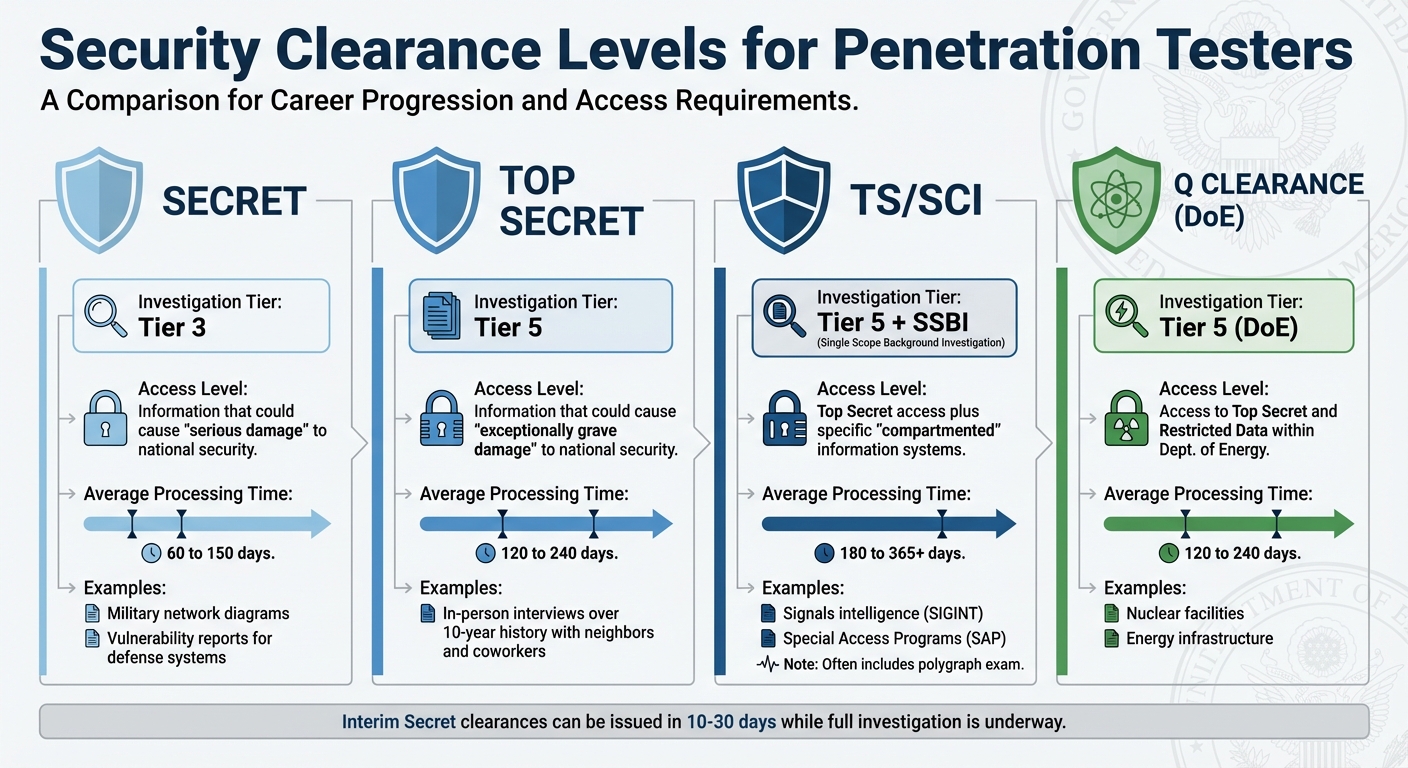
Security Clearance Levels Comparison for Penetration Testers
Security clearances are a must-have for penetration testers working in the cleared sector. Without one, you won’t be able to access classified networks like SIPRNet, analyze sensitive threat intelligence, or test vulnerabilities in critical systems like weapon platforms or infrastructure [4]. The Defense Counterintelligence and Security Agency (DCSA) handles the vast majority – over 95% – of federal background checks [4].
Here’s the catch: you can’t apply for a clearance on your own. A federal agency or an authorized defense contractor has to sponsor you, typically after offering you a conditional job [4]. For newcomers, this creates a frustrating cycle – many employers want candidates with active clearances, but you need an employer to sponsor you in the first place. Once granted, your clearance is tied to your job. If you leave a cleared position, the clearance usually becomes inactive after 24 months unless another sponsor steps in [4][5].
The Trusted Workforce 2.0 (TW 2.0) framework, now the standard as of 2026, aims to simplify things by enabling "clear once, trusted everywhere" reciprocity. This means your clearance should transfer more easily between federal agencies and contractors, cutting down on redundant investigations. Another major change is the shift from periodic reinvestigations every 5 or 10 years to Continuous Vetting (CV). This real-time system monitors criminal records, credit issues, and foreign travel [4].
"An incident on a Saturday could generate an alert to your security office by Monday. This makes immediate self-reporting of any adverse event… a critical component of sustaining trust." – Kevin James, Cybersecurity Writer [4]
Clearance processing times depend on the level of access required. For example:
- Interim Secret clearances can be issued in 10 to 30 days, allowing you to begin some work while the full investigation is underway.
- A full Secret (Tier 3) clearance usually takes 60 to 150 days.
- Top Secret (Tier 5) clearances take longer, averaging 120 to 240 days.
- For TS/SCI with a polygraph, expect a timeline of 180 to 365+ days, with polygraph scheduling often being the biggest delay [4].
Clearance Levels Explained
There are three main clearance levels, each tied to the potential damage unauthorized disclosures could cause to national security. Here’s a quick breakdown:
- Confidential and Secret clearances both involve Tier 3 investigations, but Secret is far more common in penetration testing roles. Secret clearance grants access to information that could cause "serious damage" if leaked – think military network diagrams or vulnerability reports for defense systems [5].
- Top Secret clearances, requiring Tier 5 investigations, protect information that could cause "exceptionally grave damage." These investigations are more thorough, including in-person interviews over a 10-year history with people like neighbors and coworkers [4].
- TS/SCI (Top Secret/Sensitive Compartmented Information) isn’t a separate clearance but an added control for compartmented information. This often includes a polygraph exam and additional briefings. Penetration testers with TS/SCI clearances typically work on sensitive programs like signals intelligence (SIGINT) or special access programs (SAP) [5].
For roles involving nuclear facilities or energy infrastructure, the Department of Energy uses different terms:
- L Clearance (similar to Secret)
- Q Clearance (akin to Top Secret, with access to Restricted Data) [5]
| Clearance Level | Investigation Tier | Access Level | Average Processing Time |
|---|---|---|---|
| Secret | Tier 3 | Information that could cause "serious damage" to national security | 60 to 150 days |
| Top Secret | Tier 5 | Information that could cause "exceptionally grave damage" to national security | 120 to 240 days |
| TS/SCI | Tier 5 + SSBI | Top Secret access plus specific "compartmented" information systems | 180 to 365+ days |
| Q Clearance | Tier 5 (DoE) | Access to Top Secret and Restricted Data within the Dept. of Energy | 120 to 240 days |
The next section dives into how to maintain and upgrade these clearances, with tips for staying eligible long-term.
Maintaining and Upgrading Your Clearance
Continuous Vetting has completely changed how clearances are maintained. Instead of waiting for periodic reinvestigations, the system now tracks criminal records, credit issues, and foreign travel in real time [4]. It’s crucial to report any adverse events – like arrests, major debt, or new foreign contacts – to your Facility Security Officer (FSO) immediately. Delays in self-reporting can jeopardize your clearance [4].
Financial issues remain the number one reason for clearance denials or revocations. If you’re about to start the eApp (the digital replacement for e-QIP), check your credit reports and resolve any delinquencies. The SF-86 form requires a detailed 10-year history of your residences, jobs, education, and foreign contacts, so gather those records in advance [4].
Upgrading from Secret to Top Secret involves sponsorship for a role that needs higher access. This triggers a new Tier 5 investigation, which digs deeper into your finances and foreign connections. If you’ve maintained good credit, avoided legal trouble, and kept clear documentation of your international collaborations, the process should go smoothly [4].
In 2026, adjudicators are paying closer attention to your digital footprint. They review public-facing activity like GitHub contributions, gaming forums, and social media for signs of poor judgment or vulnerability to blackmail. Before applying, take a moment to review your social media privacy settings and posts [4].
One key tip: don’t list your clearance level on public platforms like LinkedIn. Advertising an "Active TS/SCI" status makes you a target for foreign intelligence. Instead, create two resumes – one with clearance details for verified recruiters and a sanitized version for public job boards [6].
Looking ahead, proposed "Warm Bench" legislation could allow contractors to sponsor clearances for talent pools, even without immediate contract needs. If passed, this could help break the cycle of needing a clearance to get a job and vice versa. For now, focus on roles offering interim clearances or employers willing to sponsor new applicants.
Required Qualifications and Certifications
If you’re eyeing a penetration testing role in the cleared space, technical skills alone won’t cut it – you’ll also need the right certifications. The DoD 8140 framework (previously known as 8570.01-M) outlines the certifications required for federal contractors, linking them to specific roles like Exploitation Analysis and Vulnerability Assessment [7][8]. Without these credentials, even highly experienced candidates may find themselves ineligible.
Certifications for penetration testers fall into two main categories: knowledge-based exams (like CEH and PenTest+) and performance-based certifications (such as OSCP). Performance-based credentials hold more weight because they test hands-on skills rather than just theoretical understanding [8]. That said, knowledge-based certifications can still help you qualify for contracts quickly in the cleared marketplace.
Top Certifications for Penetration Testers
| Certification | Format | Focus | Career Impact |
|---|---|---|---|
| CEH | Multiple-choice exam | Foundational techniques and attack methods | Meets DoD compliance; essential for federal contracts |
| OSCP | 24-hour practical lab | Hands-on exploitation and detailed reporting | Demonstrates practical skill; favored for red teaming |
| GPEN | Open-book proctored exam | Network exploitation methodology | Recognized in SANS-oriented environments; stackable with others |
| PenTest+ | Knowledge & performance | End-to-end penetration testing lifecycle | Ideal for roles emphasizing assessment coordination |
The Certified Ethical Hacker (CEH) is officially approved for the Computer Network Defense Service Provider (CND-SP) Analyst role under DoD 8140 [7]. It covers basic attack techniques and requires 120 continuing education credits every three years to stay valid.
"CEH satisfies explicit DoD 8140 role requirements… making CEH the default choice for compliance-driven DoD contract fulfillment." – Penetration Testing Authority [7]
The Offensive Security Certified Professional (OSCP) is often considered the gold standard for technical expertise. Candidates must compromise machines in a 24-hour lab and submit a detailed report within the following 24 hours [7]. This hands-on format bridges the gap between theory and real-world application. While not always required for entry-level roles, OSCP is increasingly seen as a baseline for independent engagements [9].
The GIAC Penetration Tester (GPEN) is a favorite in enterprise settings, particularly those aligned with SANS training. This open-book exam emphasizes network exploitation methods and requires 36 continuing professional experience credits every four years [7][8]. Many professionals pair GPEN with other GIAC certifications, like GWAPT or GXPN, to highlight specialized expertise.
CompTIA PenTest+ offers a broader view, covering the entire penetration testing lifecycle, from planning and scoping to reporting. Scoring at least 750 out of 900 is required to pass [8]. This certification is well-suited for roles that focus on managing or coordinating assessments rather than strictly technical execution.
For federal contractors, the CEH is often the go-to choice to meet DoD 8140 compliance [7]. If you’re aiming for more technical or red team roles, the OSCP is a better fit [7]. For niche areas like web application or cloud security, consider adding certifications like GWAPT or OSWE to your toolkit [8].
While certifications prove your foundational skills, practical experience is what truly prepares you for advanced roles. Next, let’s explore how experience levels align with career progression in this field.
Experience Requirements by Career Stage
Certifications are just the start – your career in penetration testing will grow with hands-on experience and deeper technical skills.
- Entry-Level (0–2 years): Most beginners transition from roles like systems administration, network engineering, or SOC analysis, bringing 1–4 years of IT experience. At this stage, you’ll focus on learning tools like Nmap and Burp Suite while working under senior supervision. Entry-level salaries typically start around $85,000 [3].
- Mid-Level (2–5 years): With a few years of experience, you’ll start leading engagements, managing scopes of work, and crafting technical reports for executives. Specialization in areas like cloud security or web applications often begins here, with salaries ranging from $110,000 to $140,000 [3].
- Senior-Level (5–8 years): Senior roles involve defining methodologies, leading red teams, and conducting advanced research. Salaries for these positions can range from $145,000 to $200,000 or more [3].
- Lead/Principal Roles (8+ years): At this stage, you’ll guide teams, manage large-scale programs, and contribute to broader security strategies.
For those transitioning into penetration testing, focus on skills like local privilege escalation and network-based attacks (e.g., SMB relay). Many professionals make the leap within 12–24 months [1][9]. Participating in bug bounty programs (via platforms like Bugcrowd or HackerOne) or using gamified labs like Hack The Box and PentesterLab can help you gain practical, verifiable experience outside traditional employment [2].
Technical Skills and Tools You Need
To stand out as a penetration tester, you need a deep understanding of technical systems. For cleared roles, this means expertise in both Windows and Linux environments, databases, and networking protocols like TCP/IP, UDP, ARP, DNS, DHCP, HTTP, and SSL/TLS [15]. Knowing scripting and programming languages such as Python, Bash, Perl, Ruby, or JavaScript is equally important, as these are key for tasks like automation, exploit development, and code review [12]. Add to that knowledge of cryptography, reverse engineering, and secure code reviews, and you’ve got the foundation for working in classified environments and meeting federal testing standards [12].
You’re also expected to be familiar with frameworks like OSSTMM, the OWASP Top 10, PTES, and NIST standards, which shape how you conduct tests and create reports [11]. In cleared environments, you’ll need to adapt security protocols to specialized systems like SIPRNet, AWS GovCloud, and Microsoft Azure Government [4].
AI is playing a growing role in penetration testing, helping automate tasks like reconnaissance, attack surface scanning, and report generation [10]. That said, human expertise is still crucial for validating results and understanding their impact. As Thoropass notes, “AI will not replace penetration testers, but it can make them more effective” [10].
Must-Know Penetration Testing Tools
To effectively apply your skills, you’ll need to master a range of tools:
- Nmap: A go-to tool for active network scanning, identifying hosts and services [15].
- Metasploit Framework: Essential for delivering exploits and managing payloads during the exploitation phase [15].
- Burp Suite Professional and OWASP ZAP: Popular choices for web application testing, targeting vulnerabilities like SQL injection and cross-site scripting [16].
- Wireshark: A packet analysis tool for capturing and examining network traffic in real time [12].
- Nessus and OpenVAS: Vulnerability scanners that help identify known weaknesses for compliance purposes [15].
- Cobalt Strike: A commercial platform used for advanced simulations, including lateral movement and command-and-control operations [15].
- BloodHound: A tool for mapping attack paths within Active Directory or Azure environments [14].
- CloudFox: Useful for uncovering exploitable paths in cloud infrastructures like AWS, Azure, and GCP [14].
If you’re aiming to pass ATS filters or technical interviews, proficiency in tools like Nmap, Metasploit, and Burp Suite is often considered essential [17]. These tools are referenced in federal standards like NIST SP 800-115 and form the backbone of most penetration testing engagements [15].
Testing Domains and Specializations
Beyond tools, diving into specific testing domains can sharpen your skills further. Specialization typically happens after 2–5 years of general experience [3]. Here’s a breakdown of key areas:
- Network security: Focuses on infrastructure like routers and firewalls. You’ll tackle challenges such as SMB relay, ARP spoofing, and man-in-the-middle attacks [1].
- Web application testing: Centers on OWASP Top 10 vulnerabilities, including SQL injection and broken authentication. Tools like Burp Suite and secure coding practices are essential here [3].
- Cloud security: Involves working with AWS, Azure, and Google Cloud. Cleared roles often extend this to environments like AWS GovCloud and Microsoft Azure Government [4].
- Mobile application testing: Requires expertise in iOS and Android security models [11].
- Wireless security: Focuses on testing wireless protocols and securing networks [11].
- Social engineering: Tests the human element of security through phishing campaigns and similar techniques [12].
Your background can guide your specialization. For instance, former developers often lean toward application security, while network engineers might specialize in network penetration testing [1]. Building a home lab with virtual machines or platforms like Proving Grounds is a great way to practice and refine your techniques in a controlled setting [12].
How to Find Cleared Penetration Tester Jobs
Once you’ve honed your technical skills and earned the right certifications, the next challenge is landing a position in the cleared environment. This requires a strategic job search. The U.S. Bureau of Labor Statistics anticipates a 33% growth in information security analyst roles, including penetration testers, between 2023 and 2033 [2]. But here’s the catch: these specialized roles often aren’t listed on mainstream job boards. You’ll need to focus on niche platforms and communities.
Using Cleared Cyber Security Jobs Job Board
Cleared Cyber Security Jobs is a dedicated platform for U.S. citizens with active security clearances. Unlike traditional job boards, this site connects candidates directly with employers, bypassing third-party staffing firms. You can set up tailored job alerts based on criteria like job title, clearance level, and location, ensuring you stay updated on relevant positions.
Your profile on this platform matters just as much as your resume. Make sure every section is filled out completely, and highlight your clearance level prominently at the top of your resume to increase your chances of passing Applicant Tracking Systems (ATS).
The platform also organizes Cleared Job Fairs, both virtual and in-person, where you can meet hiring managers from defense contractors and government agencies. These events provide a direct path to employment. As G.B., a Technical Project Manager at CACI, shared:
"I attended a Cleared Job Fair and was offered a position shortly after. I accepted and moved directly from the military into my current position, without a lapse in employment." [18]
While job boards are helpful, personal connections can often lead to roles that aren’t publicly advertised.
Networking and Getting Referrals
After optimizing your online presence, shift your focus to networking – it’s often the key to uncovering hidden opportunities. Many cleared penetration testing roles never make it to job boards. As Cleared Cyber Security Jobs explains:
"In the security-cleared cyber security community, landing your dream job often requires more than just submitting your resume online… networking is key." [19]
Connecting with professionals in classified environments can provide valuable insights into agency requirements and unadvertised roles. Industry events like BSides, Black Hat, DEF CON, and RSA are excellent places to network. These conferences even have a nickname for casual networking: "HallwayCon." Volunteering at these events can grant you free access and direct interaction with organizers and speakers. Make sure to follow up within 24–48 hours and stay engaged by sharing relevant industry news or articles.
On LinkedIn, consider joining groups for cleared professionals rather than publicly displaying your clearance status. A search for "Active TS/SCI" on LinkedIn can yield over 33,000 profiles, potentially making you a target for exploitation [6]. Fr. Dewey Fisher, Administration Developer at Loyal Source, emphasizes the value of a clearance:
"If you hold a U.S. Secret Clearance, you have something many would consider more valuable than a college degree." [6]
For those working in sensitive locations like the Pentagon, it’s wise to list your employer as "Top Government Agency" on public profiles. This strikes a balance between protecting sensitive information and signaling your experience level.
Additionally, contributing to open-source security projects on GitHub or participating in forums like Reddit’s r/netsec can showcase your technical skills and help you connect with peers who might offer referrals. Platforms like Bugcrowd or HackerOne can also provide hands-on experience through bug bounty programs, which is appealing to cleared employers. Finally, reaching out to government staffing firms, such as Loyal Source, can put you on their radar for future opportunities [6].
Salary Expectations and Career Growth
In a cleared penetration testing career, your technical expertise and clearance qualifications not only make you more attractive to employers but also pave the way for higher salaries and leadership roles.
Salary Ranges by Clearance and Experience
Cleared penetration testers generally earn more than their non-cleared counterparts. The federal contracting market is divided into cleared and non-cleared sectors, and those without Department of Defense (DoD) clearances are excluded from many lucrative opportunities [20]. Cleared professionals typically earn a 10–20% pay premium due to the limited supply of candidates and the lengthy clearance process, which can take months or even years [20].
As of May 2023, the median annual wage for Information Security Analysts, a category that includes penetration testers, was $120,360 [20]. Those with active TS/SCI clearances tend to earn even more because the labor pool becomes even smaller [20].
| Career Tier | Experience | Base Salary Range (Non-Cleared) | Estimated Cleared Salary (10–20% Premium) |
|---|---|---|---|
| Junior / Associate | 0–2 years | $60,000 – $85,000 | $66,000 – $102,000 [20] |
| Mid-Level | 2–5 years | $90,000 – $130,000 | $99,000 – $156,000 [20] |
| Senior / Red Team Lead | 5+ years | $140,000 – $200,000+ | $154,000 – $240,000+ [20] |
Location also plays a big role. Salaries in cities like Washington, DC, and the San Jose–San Francisco area can be 20–30% higher than the national median [20]. Certifications matter too: OSCP holders often land in mid-level pay ranges ($90,000–$130,000), while advanced credentials like GXPN or OSED are linked to the highest salary tiers [20].
These salary structures provide a clear roadmap for career development, as outlined further below.
Career Advancement Opportunities
Cleared penetration testing careers typically follow a structured progression. Entry-level Junior/Associate roles involve supporting senior team members, while Mid-Level positions allow for independently managing engagements. At the Senior/Red Team Lead level, responsibilities include designing complex simulations and mentoring less experienced staff [20]. Senior Red Team Leads in sectors like federal defense or finance can earn $160,000–$200,000+ [20].
Career paths can also lead to specialized roles. For example:
- Management-adjacent positions (often requiring a CISSP)
- Security Architecture, with a median salary of $120,520 as of 2021 [13]
- Boutique consulting, where hourly rates range from $150 to $350+ [20]
- Security Software Development, with a median salary of $109,020 [13]
- Executive roles like Chief Information Security Officer (CISO) [2][13]
In-house positions often provide stability and a defined scope of work, while consulting roles offer higher earning potential through billable hours and business development [20].
Advancing in this field requires balancing technical expertise with business skills. As your career develops, you’ll shift from hands-on testing to advising on security strategies, assessing risks, and training staff on cybersecurity best practices [13].
Wrapping It All Up
Cleared penetration testing requires a mix of technical expertise and thoughtful career planning. On the certification front, the OSCP is ideal for showcasing independent practitioner skills, while Security+ and CEH fulfill the DoD 8140 requirements. To excel, you’ll need a strong grasp of networking, operating system internals, and tools like Kali Linux and Metasploit, along with the ability to deliver professional-grade reports. These skills and credentials provide a solid foundation for a targeted job search.
Securing and maintaining a Secret or TS/SCI clearance through the DCSA opens doors to lucrative opportunities. Once you have the right credentials, leverage platforms like Cleared Cyber Security Jobs to connect with employers specifically seeking professionals with active clearances. Upload your resume, set up job alerts, and access resources tailored for the cleared community.
Focusing early on high-demand areas – like Active Directory exploitation or cloud-native architecture – can fast-track your progression from entry-level to senior roles. Highlight your expertise through CTF competitions, Hack The Box rankings, or GitHub projects to stand out.
The path is straightforward: earn DoD-recognized certifications, keep your clearance active, and use specialized platforms to land roles that align with your skills. Your next cleared opportunity is waiting – go after it!
FAQs
How can I get my first security clearance?
To get your first security clearance, you’ll need to meet specific eligibility criteria and complete a thorough vetting process. Usually, this starts with an employer sponsoring you for a role that requires clearance. From there, you’ll fill out the SF-86 form and undergo background checks that review your finances, criminal record, and personal behavior. The entire process can take anywhere from several months to a year. Staying honest and transparent throughout is key to increasing your likelihood of approval.
Which cert should I get first for DoD 8140 roles?
The CompTIA PenTest+ certification is an excellent entry point for individuals pursuing DoD 8140 roles. Approved by the Department of Defense, it qualifies you for positions such as cybersecurity service provider analyst, incident responder, and auditor. This certification not only aligns your skills with critical job responsibilities but is also widely acknowledged within the cleared community.
What gets a clearance denied or revoked?
Clearances may be denied or revoked if someone fails to meet specific adjudicative guidelines. Common reasons include inappropriate sexual behavior, misuse of IT systems, mishandling of protected information, foreign influence, alcohol or drug abuse, criminal conduct, personal misconduct, or financial problems. Each situation is assessed on a case-by-case basis, taking these factors into account.