• Skip to primary navigation
  • Skip to main content
Cleared Cyber Security Jobs | CyberSecJobs.com

Cleared Cyber Security Jobs | CyberSecJobs.com

Cleared Cyber Security Jobs

  • Home
  • Search Cleared Cyber Jobs
  • Job Fairs
  • Career Resources

Uncategorized

1B4X1 Cyber Warfare Operations to Cleared Civilian Career Guide

CyberSecJobs Editorial · April 20, 2026 ·

If you’re transitioning from a 1B4X1 Cyber Warfare Operations role in the Air Force to the civilian workforce, you’re entering a job market that highly values your expertise. With over 514,000 cybersecurity roles available in 2026 and many requiring security clearances, your skills and TS/SCI clearance position you for mid-to-senior-level roles with salaries ranging from $90,000 to $200,000 annually.

Key Takeaways:

  • Security Clearance Advantage: Your TS/SCI clearance can add $30,000–$45,000 to your annual salary and saves employers significant time and costs.
  • High-Demand Skills: Threat hunting, incident response, vulnerability management, and offensive cyber operations make you a strong candidate for roles like SOC Analyst, Penetration Tester, and Security Engineer.
  • Certifications Matter: Start with Security+ and expand to advanced certifications like CISSP, OSCP, or CCSP to increase earning potential and align with DoD 8140 requirements.
  • Resume Tips: Highlight your clearance, translate military terms into civilian language, and quantify achievements (e.g., "secured a 500,000-endpoint network").
  • Act Quickly: Your clearance remains active for 24 months post-military, giving you a critical window to secure a civilian job without re-investigation.

This guide provides strategies to translate your military experience into civilian job titles, secure certifications, and leverage platforms like Cybersecjobs.com to land roles at top employers like SpaceX, Leidos, and Northrop Grumman. Start preparing now to make the most of your transition.

From Air Force IT Specialist to Civilian Cybersecurity Pro

sbb-itb-bf7aa6b

What 1B4X1 Cyber Warfare Operations Professionals Do

As a 1B4X1 specialist, your role involves conducting both Offensive Cyber Operations (OCO) and Defensive Cyber Operations (DCO). On the offensive side, you work to disrupt adversary networks by deploying malware, launching denial-of-service (DoS) attacks, and exploiting zero-day vulnerabilities. On the defensive side, you focus on safeguarding Department of Defense (DoD) networks by hunting threats, responding to security incidents, and performing forensic analyses to determine how breaches occurred [6].

Your daily tasks include configuring firewalls, managing intrusion detection systems, and utilizing tools like Splunk, Wireshark, and CrowdStrike [6]. Ensuring compliance with federal standards such as RMF and DISA STIGs is also a key responsibility [6]. The networks you defend range in size, often encompassing 15,000 to over 500,000 endpoints, and are frequently targeted by nation-state adversaries [2].

"Military cyber professionals have something that most civilian cybersecurity candidates don’t: real-world operational experience defending networks against actual threats, not just simulated ones." – Brad Tachi, CEO, Best Military Resume [2]

Primary Duties and Responsibilities

In offensive roles, your mission is to engage adversaries by deploying malware and exploiting vulnerabilities to gain tactical advantages. On the defensive side, you protect DoD’s digital infrastructure through activities like endpoint detection, threat hunting, and incident response [6]. You also manage encryption tools such as PGP and GPG, configure Virtual Private Networks (VPNs), and ensure adherence to frameworks like NIST standards and the MITRE ATT&CK framework [6].

Cyber operations are increasingly integrated with traditional military missions across air, land, and sea. For instance, you might disable enemy air defenses ahead of an airstrike, providing a significant advantage to your team [6]. This dual expertise is highly valued by civilian employers seeking cleared cybersecurity professionals.

Air Force Skill Levels and Training Path

Your operational skills are developed through a structured and demanding training program designed to prepare you for progressively advanced roles. You start as a 3-level (Apprentice) and work your way up to 7-level (Craftsman).

As a 3-level, you begin with 7.5 weeks of Basic Military Training at Lackland Air Force Base, followed by 66 classroom days of technical training at Keesler Air Force Base. This phase focuses on cybersecurity fundamentals, network security, and cyber law [6]. To qualify, you must achieve a minimum score of 70 in the Electronics (E) section of the ASVAB [6].

After technical school, you move into Initial Qualification Training (IQT), which can last anywhere from four months to over a year, depending on your assigned weapon system [6]. Offensive roles often require more intensive training. At the 5-level (Journeyman), you take on supervisory responsibilities and mentor junior airmen. By the time you reach the 7-level (Craftsman), you’re planning large-scale operations and creating new Tactics, Techniques, and Procedures (TTPs) [6]. This progression equips you with the expertise needed for mid-to-senior-level civilian roles after your military career.

Here’s a breakdown of the skill levels and their corresponding responsibilities:

Skill Level Title Primary Responsibilities
3-Level (1B431) Apprentice Entry-level operations; mastering core offensive and defensive tactics [6].
5-Level (1B451) Journeyman Supervising cyber operations; mentoring junior airmen [6].
7-Level (1B471) Craftsman Planning large-scale operations; developing new TTPs [6].

How 1B4X1 Skills Transfer to Civilian Cybersecurity Jobs
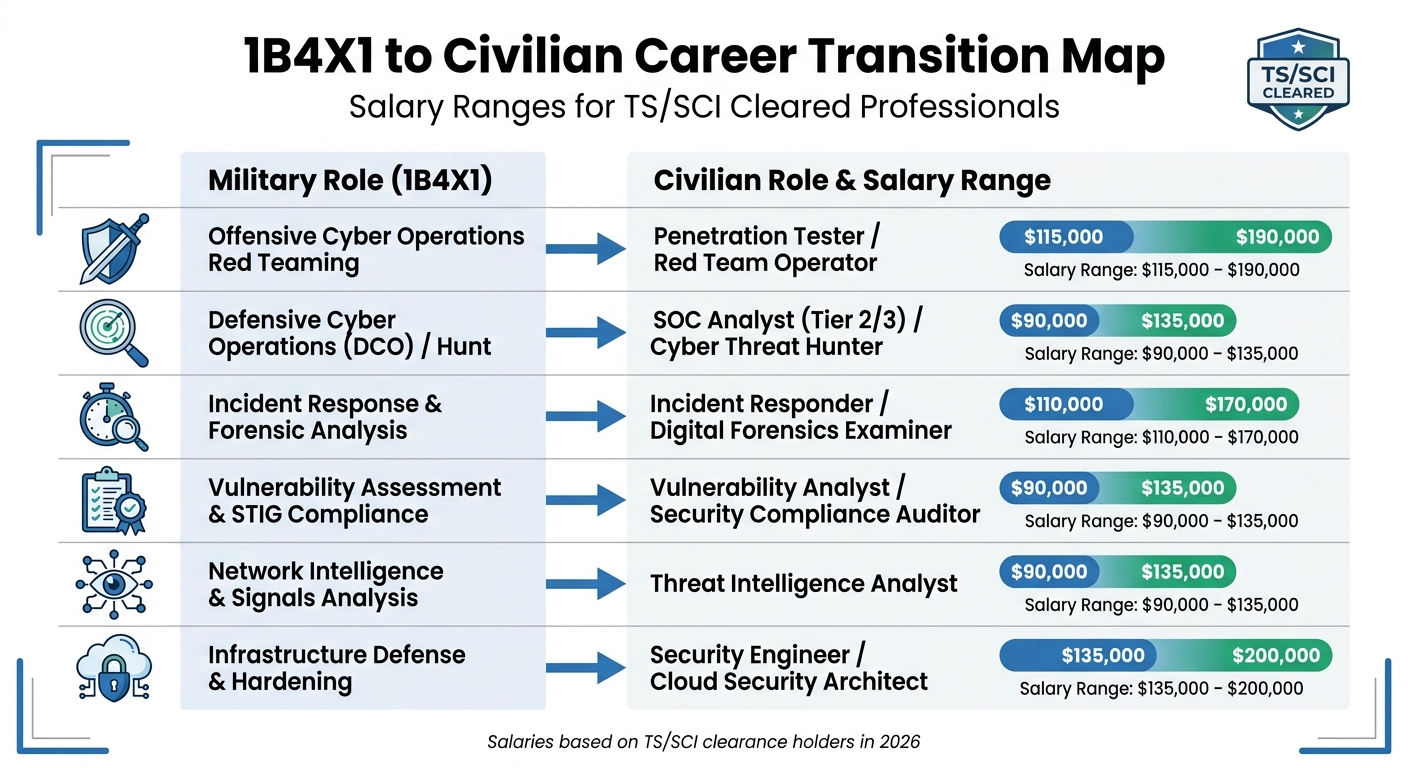
1B4X1 Military to Civilian Cybersecurity Career Transition Guide

1B4X1 Military to Civilian Cybersecurity Career Transition Guide

Your experience as a 1B4X1 specialist gives you a clear edge over many civilian candidates in the cybersecurity field. Unlike those who have only trained in controlled environments, you’ve been tackling actual network threats and executing offensive operations. This real-world expertise is exactly what employers in the cleared cybersecurity industry are looking for.

The demand for cybersecurity professionals is massive, with a global workforce gap of 3.5 million unfilled positions [5]. In the U.S. alone, information security analyst roles are expected to grow by 33% through 2033, adding about 17,300 new jobs annually [3]. Your military background and hands-on training make you uniquely qualified to step into these roles immediately.

Skills That Employers Want

Your skill set aligns perfectly with the needs of the cybersecurity industry:

  • Threat Hunting: Your ability to identify advanced persistent threats (APTs) and analyze network traffic anomalies is highly sought after for roles like SOC Analyst and Cyber Threat Hunter. Civilian professionals often take years to develop this level of expertise [2].
  • Incident Response: Rapid breach containment, forensic analysis, and detailed after-action reporting are essential for positions such as Incident Responder and Digital Forensics Examiner [2].
  • Vulnerability Management: Experience with tools like ACAS and Nessus, along with ensuring compliance with DISA STIGs, makes you an excellent candidate for roles like Vulnerability Analyst or Security Compliance Auditor [2].
  • Knowledge of Frameworks: Familiarity with NIST, MITRE ATT&CK, CIS controls, and the Risk Management Framework (RMF) adds significant value, as these frameworks are the backbone of civilian cybersecurity programs [2].
  • Offensive Cyber Operations: Skills in exploitation, scripting, and vulnerability research make you a strong contender for high-paying roles like Penetration Tester or Red Team Operator. Even classified operations highlight your depth of experience [2].

Military to Civilian Job Comparison

The table below maps your 1B4X1 responsibilities to equivalent civilian roles, along with their corresponding salary ranges for those holding TS/SCI clearances:

1B4X1 Responsibility Civilian Role Salary Range (With TS/SCI)
Offensive Cyber Operations / Red Teaming Penetration Tester / Red Team Operator $115,000 – $190,000
Defensive Cyber Operations (DCO) / Hunt SOC Analyst (Tier 2/3) / Cyber Threat Hunter $90,000 – $135,000
Incident Response & Forensic Analysis Incident Responder / Digital Forensics Examiner $110,000 – $170,000
Vulnerability Assessment & STIG Compliance Vulnerability Analyst / Security Compliance Auditor $90,000 – $135,000
Network Intelligence & Signals Analysis Threat Intelligence Analyst $90,000 – $135,000
Infrastructure Defense & Hardening Security Engineer / Cloud Security Architect $135,000 – $200,000

"If you’ve been doing cyber operations for 4+ years in the military, you should be targeting mid-level to senior roles with compensation to match."
– Brad Tachi, CEO, Best Military Resume [2]

When crafting your civilian resume, adjust military-specific terms to language that resonates with civilian employers. For example, replace "COMSEC" with "cryptographic security" or "encryption key management", and "ACAS" with "vulnerability scanning using Nessus/Tenable" [3]. Be specific about the scale of your work – for instance, instead of saying you "secured a network", detail that you "conducted defensive operations across a 500,000+ endpoint enterprise network" [2].

Certifications That Advance Your Civilian Career

Certifications play a key role in the cleared cybersecurity field. They not only validate your expertise in terms that civilian hiring managers recognize but also ensure compliance with DoD 8140 (formerly DoD 8570) for privileged access [7][8]. As the DoD Cyber Workforce Framework (DCWF) transition deadline approaches in fiscal year 2026, knowing which certifications align with your career goals is crucial [8].

If you’re a 1B4X1 professional, chances are you already hold the CompTIA Security+ certification from your Air Force training. This satisfies IAT Level II requirements [2]. While Security+ is a solid starting point, adding specialized credentials can open doors to higher-paying roles.

Before you separate, take advantage of funding resources like Air Force COOL (Credentialing Opportunities On-Line) to cover exam fees [9]. The VA’s VET TEC program can also fund cybersecurity bootcamps and training without using up your GI Bill benefits [4]. Another great option is Syracuse University’s Onward to Opportunity (O2O) program, which offers free certification training and exam vouchers for transitioning service members [4]. Once you’ve secured funding, focus on building a strong foundation with both entry-level and advanced certifications.

Entry-Level Certifications to Start With

If Security+ is your only certification, consider adding CompTIA CySA+ to showcase your skills in threat detection and behavioral analytics. This certification, which costs around $400, is a natural fit for 1B4X1 professionals with defensive cyber operations experience. It also qualifies you for CSSP Analyst roles under DoD 8140, directly connecting your military expertise to civilian job requirements [7][4].

"One of our Army Signal NCOs went from E-6 to a $115K SOC analyst role in eight months. Security+ got him in the door. CySA+ got him the offer over other candidates. The clearance sealed it."
– Brad Tachi, CEO, Best Military Resume [4]

For those with offensive cyber operations experience, the Certified Ethical Hacker (CEH) certification is a DoD-approved standard for penetration testing roles. At approximately $1,199, CEH meets CSSP Auditor and Incident Responder requirements under DoD 8140 [4]. While it focuses more on theoretical knowledge, it’s a stepping stone for roles in offensive operations. If you’re looking for a more hands-on credential, the OSCP (Offensive Security Certified Professional) is highly regarded in both government and private sectors. Starting at $1,599 for the course bundle, OSCP is ideal for penetration testers and red teamers [2][4].

Advanced Certifications for Senior Roles

With four or more years of 1B4X1 experience, you may already qualify for the CISSP (Certified Information Systems Security Professional). This certification requires five years of professional experience, and your military service counts toward this requirement [2][10]. At $749, CISSP is a gateway to roles in security architecture and management, often commanding salaries over $130,000 [9][4]. It’s also essential for positions requiring IAM Level III or IASAE designations under DoD 8140 [7].

If you’re eyeing opportunities in cloud security – a rapidly expanding field – the CCSP (Certified Cloud Security Professional) is an excellent complement to CISSP. Priced at $599, CCSP is increasingly sought after as organizations migrate to AWS, Azure, and GCP platforms [4]. Certifications like CCSP or AWS Certified Security Specialty can significantly boost your earning potential [2][3].

Certification Cost DoD 8140 Role Best For
CompTIA Security+ ~$400 IAT Level II Baseline requirement for cleared roles
CompTIA CySA+ ~$400 CSSP Analyst SOC analysts and threat hunters
CEH ~$1,199 CSSP Auditor/Incident Responder Offensive operations (knowledge-based)
OSCP ~$1,599 Technical Practitioner Penetration testers and red teamers
CISSP $749 IAM Level III / IASAE Security architects and managers
CCSP $599 Cloud Security Cloud security engineers and architects

Start preparing for certifications 12–18 months before you separate to maximize available funding [10][2]. Make sure to maintain your certifications with Continuing Education Units (CEUs) to avoid costly re-testing after separation [4]. Also, remember that your clearance remains active for 24 months post-separation, giving you a critical window to secure a cleared civilian role without requiring a full re-investigation [3]. Armed with the right certifications, you’ll be well-positioned to build a strong resume and land a role in the cleared job market.

How to Land Cleared Civilian Cybersecurity Jobs

If you’ve got the right certifications and an active clearance, you’re already ahead in the civilian job market. But landing a cleared cybersecurity role isn’t just about technical know-how. You’ll need a resume that not only passes Applicant Tracking Systems (ATS) but also effectively translates your military experience into terms civilian employers understand – all without compromising operational security. Your TS/SCI clearance is a huge asset, saving employers both time and money, which gives you a strong edge. Here’s how to make the most of it.

Writing a Resume That Gets Noticed

Your resume is your personal marketing tool, and it needs to highlight your certifications, experience, and most importantly, your clearance. Place your security clearance at the very top of your resume near your contact details. Why? Many recruiters filter resumes by searching for terms like "TS/SCI" before they even dive into the rest of your qualifications [11][12]. Don’t bury this critical information in a summary or generic paragraph.

Another key tip: translate military jargon into civilian job titles and terms. For example, swap out "1B4X1 Cyber Warfare Operations" for roles like SOC Lead, Red Team Operator, or Cloud Security Architect. Similarly, replace military-specific terminology with civilian equivalents – think "IA compliance" becoming "NIST 800-53 compliance" or "ACAS" being rephrased as "vulnerability scanning using Nessus/Tenable" [2][3][5].

When listing your accomplishments, use the STAR method (Situation, Task, Action, Result) to show measurable impact. For instance: "Led a team of five analysts to remediate 95% of critical vulnerabilities in 30 days across a 500,000-endpoint network" [2][11][12]. Highlight unclassified tools and frameworks you’ve worked with – like Splunk, Wireshark, CrowdStrike, Palo Alto firewalls, or the MITRE ATT&CK framework – and make sure to use the same keywords found in job postings. If a job description mentions "SIEM administration", include that exact phrase [2][3].

"Your security-cleared resume is not a biography or a mere list of qualifications. It’s an ad designed to help you land that coveted cleared job interview."
– Ashley Jones, Blog Editor, ClearedJobs.Net [11]

Be cautious about including any classified project names, targets, or budget details. Instead, describe your work environment in broader terms, like "multi-enclave network environment processing classified information" [2][11]. Keep your resume clean and concise – ideally one to two pages – so ATS software can easily scan it [11][12]. And skip personal details like your Social Security Number, marital status, or graduation years, which could lead to unintended bias [11].

"Keep subjective self-descriptions out of your summary section. I’m looking at you, Results-Oriented Team Players."
– Bill Branstetter, 9th Way Insignia [11]

Once your resume is polished, it’s time to prepare for the next step: interviews.

Preparing for Clearance and Job Interviews

Before heading into interviews, double-check your SF-86 for accuracy, as employers may verify its details [14]. Your clearance remains valid for 24 months after leaving the military, giving you a window to secure a civilian role without needing a full reinvestigation [13]. Be ready to explain this timeline to potential employers, as many will extend conditional offers while verifying your clearance through the Defense Information System for Security (DISS) [13].

When discussing your experience, avoid classified specifics. Instead, focus on the scale and complexity of your work. For example, say you "managed security for a 15,000-node enterprise network" rather than mentioning classified program details [2]. Avoid referencing SCI compartments or codewords, as this could raise security concerns [13]. Emphasize your experience with widely recognized tools and frameworks that civilian employers value.

For behavioral interview questions, use action verbs and quantify your results wherever possible [2][12]. Consider supplementing your operational experience with civilian-style technical labs like TryHackMe or HackTheBox to prepare for technical assessments [2].

Don’t sell yourself short. Four years of experience in 1B4X1 Cyber Warfare Operations often qualifies you for mid-level or senior roles, not entry-level SOC positions [2]. Highlight the unique value of your offensive cyber skills and the cost savings your clearance brings when negotiating compensation. With information security analyst roles expected to grow 33% through 2033, adding about 17,300 new positions annually, the opportunities are there [3].

"The cyber veterans I’ve seen transition most successfully are the ones who don’t settle for the first SOC analyst job offered to them. Your military experience puts you above entry-level."
– Brad Tachi, CEO, Best Military Resume [2]

Using Cleared Cyber Security Jobs to Find Your Next Role

With your polished resume and well-honed interview skills, it’s time to connect with employers who value your 1B4X1 expertise and active clearance. Cybersecjobs.com, a veteran-owned job board, focuses exclusively on roles requiring U.S. citizenship and active clearance. This ensures you only see opportunities you’re eligible for, streamlining your job search as you transition from military to civilian cybersecurity roles.

What makes this platform stand out is its direct-hire focus. Unlike other job boards filled with third-party recruiters, Cybersecjobs.com works exclusively with direct-hire employers like Booz Allen, Leidos, Northrop Grumman, and CACI.

"What makes us stand out in the recruitment industry is that we only allow direct-hire employers to source our career site and participate in job fairs."
– Cybersecjobs.com

With over 514,000 cybersecurity positions currently unfilled nationwide [1] and a $13 billion federal cybersecurity budget projected for 2026 [15], the cleared job market is thriving. Your active clearance is a key asset that significantly increases your value to employers. Let’s explore how Cybersecjobs.com’s tools can help you maximize your opportunities.

Getting the Most from Cybersecjobs.com Tools
Cybersecjobs.com

A strong resume is just the beginning. To fully leverage Cybersecjobs.com, start by creating a complete profile and uploading your resume to the database. Recruiters often review your profile first, focusing on your skills and preferred work locations before diving into your resume. Highlight your experience with unclassified tools and frameworks from your 1B4X1 background – such as Wireshark, Metasploit, Splunk, or the MITRE ATT&CK framework.

Use the platform’s advanced search filters to narrow your job hunt by location, job title, company, or clearance level. For example, if you’re targeting areas like San Antonio, TX (home to NSA Texas and the 16th Air Force) or the DC Metro area, the Zip Code and mileage radius filters can help you zero in on opportunities. When filtering by clearance, include all levels you qualify for – if you hold a TS/SCI, also select Secret-level roles to broaden your options.

Set up Job Alerts to stay on top of openings for roles like "Red Team Operator", "Penetration Tester", "SOC Lead", or "Cloud Security Architect." These alerts deliver new postings directly to your inbox based on your preferences. You can also refine searches using Boolean logic – for instance, searching "Project Manager" OR "Program Manager" in quotation marks will include both titles.

Here’s a pro tip: log in to your account weekly. Each visit updates your profile’s activity date, keeping you visible in recruiter searches.

Tool/Feature How It Helps 1B4X1 Professionals
Job Filters Narrow down roles by cleared hubs like San Antonio or Fort Meade
Resume Database Lets top defense contractors proactively find your profile
Job Alerts Sends relevant cleared roles straight to your inbox
Anonymous Mode Browse opportunities discreetly without alerting your employer

Attending Cleared Job Fairs

Online tools are powerful, but nothing beats the face-to-face connections you can make at Cleared Job Fairs. Hosted by Cybersecjobs.com, these events – both in-person and virtual – let you skip automated systems and speak directly with hiring managers. Since attendees must have an active clearance, you’ll be competing in a smaller, more qualified pool.

For 1B4X1 professionals, these fairs are invaluable. They provide a chance to showcase the depth of your operational experience – details that may not come through on a resume. Recruiters at these events understand the nuances of roles like SOC Analyst versus Cyber Warfare Operator, and they’re actively seeking candidates with your expertise. Be prepared with a polished resume, a clear idea of your target roles, and examples of your unclassified achievements.

"I recently transitioned out of the military and started attending Cleared Job Fairs to get comfortable speaking to potential employers, to network, and to learn about the market… For veterans especially, attending Cleared Job Fairs can be critical to a successful career transition."
– G.B., Technical Project Manager, CACI

Before attending, take advantage of Cybersecjobs.com’s Career Resources to research participating employers and prepare for interviews. You can also stay informed with their podcast, Security Cleared Jobs: Who’s Hiring & How, weekly newsletters, and webinars focused on transitioning from military to civilian careers. These resources keep you updated on trending companies and the specific skills in demand.

Conclusion

Transitioning from a 1B4X1 Cyber Warfare Operations role to a civilian career isn’t just achievable – it’s highly sought after. With over 514,000 cybersecurity job openings across the U.S. and around 26% of these roles expected to remain unfilled by 2026 [1], your expertise is exactly what employers are looking for. Plus, your active TS/SCI clearance gives you a major advantage by reducing employer processing time and costs for sponsorship [2][4].

To succeed, focus on translating your military experience into civilian terms, earning the right certifications, and targeting roles that align with your skillset. Your background in offensive cyber operations positions you for senior-level roles, which often come with top-tier salaries [2][5]. Start with certifications like Security+ to meet DoD 8140 requirements, and then aim for advanced credentials like OSCP or CISSP to unlock even greater earning potential.

"Your military experience puts you above entry-level – don’t let impostor syndrome push you into a role that’s two tiers below your actual capability." – Brad Tachi, CEO, Best Military Resume [2]

Your clearance remains active for just 24 months after separation [3], so it’s crucial to act quickly. Use platforms like Cybersecjobs.com to tap into tools like advanced job filters and cleared job fairs to connect with employers such as Booz Allen Hamilton, Leidos, and Northrop Grumman – companies that value your 1B4X1 expertise. Set up job alerts, keep your profile updated, and take advantage of programs like SkillBridge or VET TEC to fill any certification gaps before you leave the service [2][3][4]. These steps will help you confidently secure a role that reflects your experience and capabilities.

FAQs

What civilian job level should I target with 1B4X1 experience?

If you have experience in 1B4X1 Cyber Warfare Operations, you’re well-positioned to pursue mid-level cybersecurity roles like Cybersecurity Analyst, Security Engineer, or SOC Lead. Your military background in areas like network defense, threat analysis, and response coordination provides a strong foundation for these positions.

To boost your chances, consider obtaining certifications such as Security+, which are highly regarded in the industry. Start by targeting roles that typically require 3-5 years of experience, such as SOC Analyst. These positions are a great match for your skill set and can serve as stepping stones to advanced roles like Cybersecurity Engineer or Cyber Defense Manager.

How do I keep my TS/SCI active after separation?

To maintain your TS/SCI clearance after leaving the military, you typically have a 2-year window for reinstatement. During this period, it’s crucial to stay in touch with your previous employer or security officer. Be prepared to update your information or potentially undergo a reinvestigation. Taking action within this timeframe ensures you won’t have to start the clearance process all over again.

Which cert should I get next for my track (blue vs. red)?

Your next certification should align with your career ambitions and current expertise. If you’re aiming for offensive security roles (red team), certifications like OSCP or CEH can help you develop penetration testing skills. On the other hand, for defensive roles (blue team), Security+ or CISSP are well-regarded and can enhance your qualifications. For seasoned professionals, advanced certifications like CISSP or CCSP can open doors to senior-level positions. The key is to choose a certification that matches your goals and builds on your existing knowledge.
Related Blog Posts

  • Cyber Warfare Specialist Career Path for Cleared Military
  • Cleared Cyber Jobs at Army Cyber Command Complete Guide
  • Cleared Cyber Jobs at 16th Air Force Complete Guide
  • Cleared Cyber Jobs at Coast Guard Cyber Command Complete Guide

25D Cyber Network Defender to Cleared Civilian Career Guide

CyberSecJobs Editorial · April 19, 2026 ·

If you’re a 25D Cyber Network Defender transitioning to civilian life, you’re in a strong position to secure high-paying cybersecurity roles. Your Top Secret clearance, combined with hands-on experience defending networks, makes you a sought-after candidate in a market with over 514,000 job openings and salaries ranging from $95,000 to over $200,000 for cleared professionals.

Key Takeaways:

  • Your Clearance Is an Asset: A TS/SCI clearance can add $15,000 to $30,000 to your salary and save employers months of processing time.
  • In-Demand Skills: Experience with tools like Splunk, Nessus, and DISA STIGs aligns with roles like SOC Analyst, Vulnerability Analyst, and Cybersecurity Engineer.
  • Certifications Matter: Start with CompTIA Security+ and consider advanced options like CISSP or AWS certifications for higher-paying roles.
  • Target Mid-Level Roles: With your background, aim for positions requiring 3-5 years of experience, not entry-level jobs.

This guide breaks down how to translate your military experience into civilian terms, secure the right certifications, and connect with employers hiring cleared professionals.

How Military Cyber Experience Translates to Civilian Careers

sbb-itb-bf7aa6b

How 25D Skills Match Cleared Civilian Cybersecurity Jobs

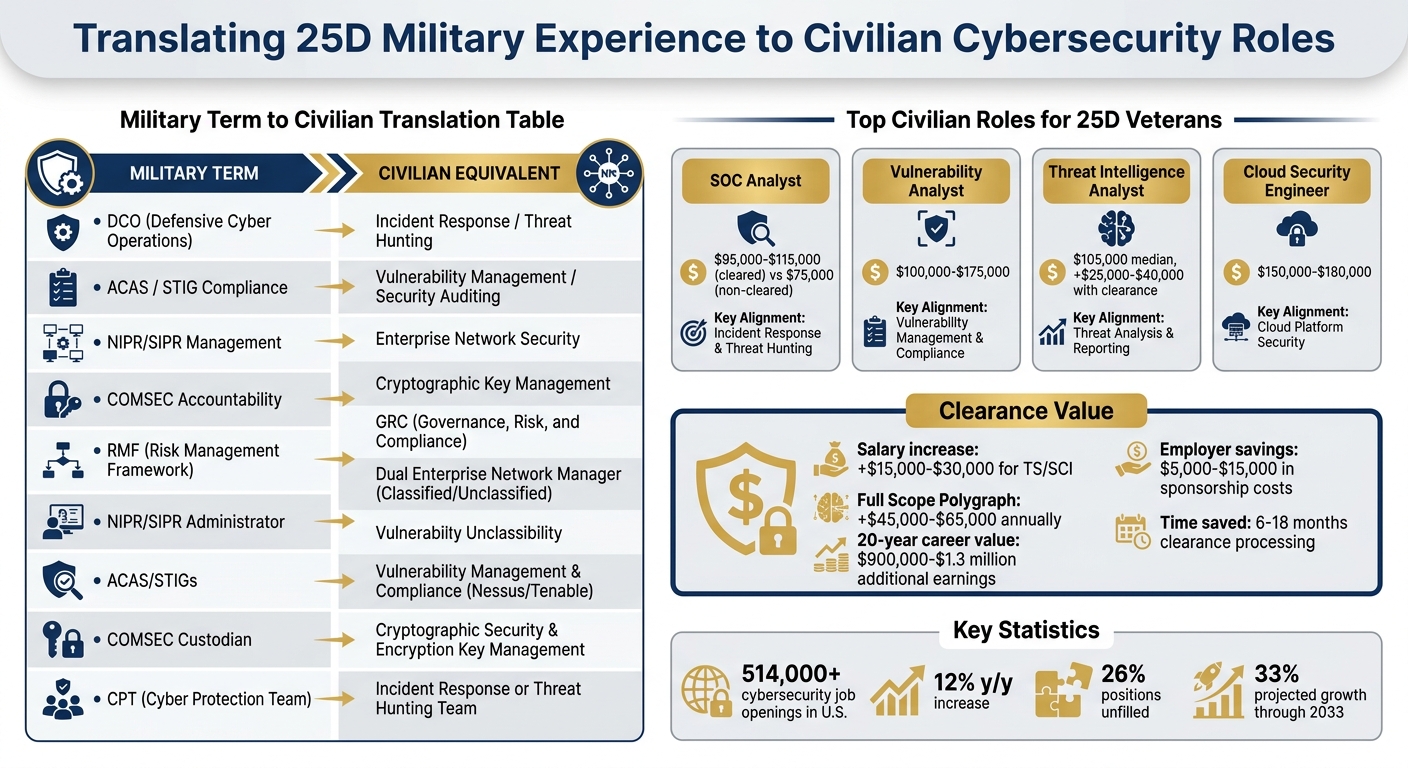
Military to Civilian Cybersecurity Translation Guide for 25D Veterans

Military to Civilian Cybersecurity Translation Guide for 25D Veterans

Your experience as a 25D translates seamlessly into a variety of cleared civilian cybersecurity roles. The expertise you gained in network monitoring, vulnerability assessments, and intrusion detection directly aligns with positions like SOC Analyst, Vulnerability Analyst, and Cybersecurity Engineer. These roles often start at salaries of $95,000 and can exceed $180,000 for professionals with security clearances.

As of 2026, the cleared cybersecurity job market is thriving, with more than 514,000 job postings in the U.S., reflecting a 12% year-over-year increase. About 26% of these positions remain unfilled, creating ample opportunities for candidates with your background. Your clearance and technical expertise make you a strong contender for these roles, as detailed below.

Best Civilian Jobs for 25D Veterans

  • Security Operations Center (SOC) Analyst: This role involves monitoring security alerts, investigating incidents, and coordinating responses – tasks you likely performed during your service. Cleared SOC Analysts earn between $95,000 and $115,000, compared to $75,000 for non-cleared positions.
  • Vulnerability Analyst: Your experience with ACAS and Nessus tools is highly relevant here. This role focuses on conducting security assessments, prioritizing remediation, and ensuring compliance with frameworks like NIST 800-53. Cleared Incident Responder roles, which overlap with this skill set, offer salaries ranging from $100,000 to $175,000.
  • Threat Intelligence Analyst: If you specialized in analyzing adversary tactics or tracking network anomalies, this role is a perfect fit. The median salary is $105,000, with cleared positions adding an extra $25,000 to $40,000.
  • Cloud Security Engineer: With companies migrating to platforms like AWS, Azure, and GCP, this is one of the fastest-growing sectors. Cleared professionals with defensive operations experience can expect salaries starting at $150,000 to $180,000.

Defense contractors such as Booz Allen Hamilton, Leidos, and Raytheon are excellent starting points, as they value your clearance and familiarity with DoD networks. Tech giants like Amazon AWS, Microsoft, and CrowdStrike are also hiring 25D veterans for roles in their government cloud divisions. Additionally, financial institutions like JPMorgan Chase and Goldman Sachs are seeking cleared professionals for sensitive security operations.

Converting Military Experience to Civilian Job Requirements

When transitioning to civilian roles, it’s crucial to translate military terminology into language that civilian recruiters understand. For example:

  • Replace "DCO" with "Defensive Cyber Operations."
  • Use "Vulnerability Management and Security Auditing" instead of "ACAS/STIG compliance."
  • Convert "NIPR/SIPR Management" to "Enterprise Network Security across multiple security domains."

A strong resume formula is [Action] + [Technical Detail] + [Business Impact]. For instance:

  • Instead of saying "secured a network", write: "Administered network security for 2,400 users across 3 installations, maintaining 99.7% uptime."
  • Replace "performed vulnerability scans" with: "Executed weekly vulnerability assessments using Nessus and ACAS across a 15,000-node enterprise network, reducing critical findings by 40% in six months."

Include unclassified tools you’ve used, such as Splunk, Wireshark, Nessus, ACAS, SolarWinds, Palo Alto firewalls, and CrowdStrike, as these are common keywords in recruiter searches. Quantify your accomplishments by citing metrics like endpoints, users, or alerts triaged. For example, describe your RMF experience as "Governance, Risk, and Compliance (GRC)" and COMSEC work as "Cryptographic Key Management."

Military Responsibility Civilian Job Requirement / Keyword
DCO (Defensive Cyber Operations) Incident Response / Threat Hunting
ACAS / STIG Compliance Vulnerability Management / Security Auditing
NIPR/SIPR Management Enterprise Network Security
COMSEC Accountability Cryptographic Key Management
RMF (Risk Management Framework) GRC (Governance, Risk, and Compliance)

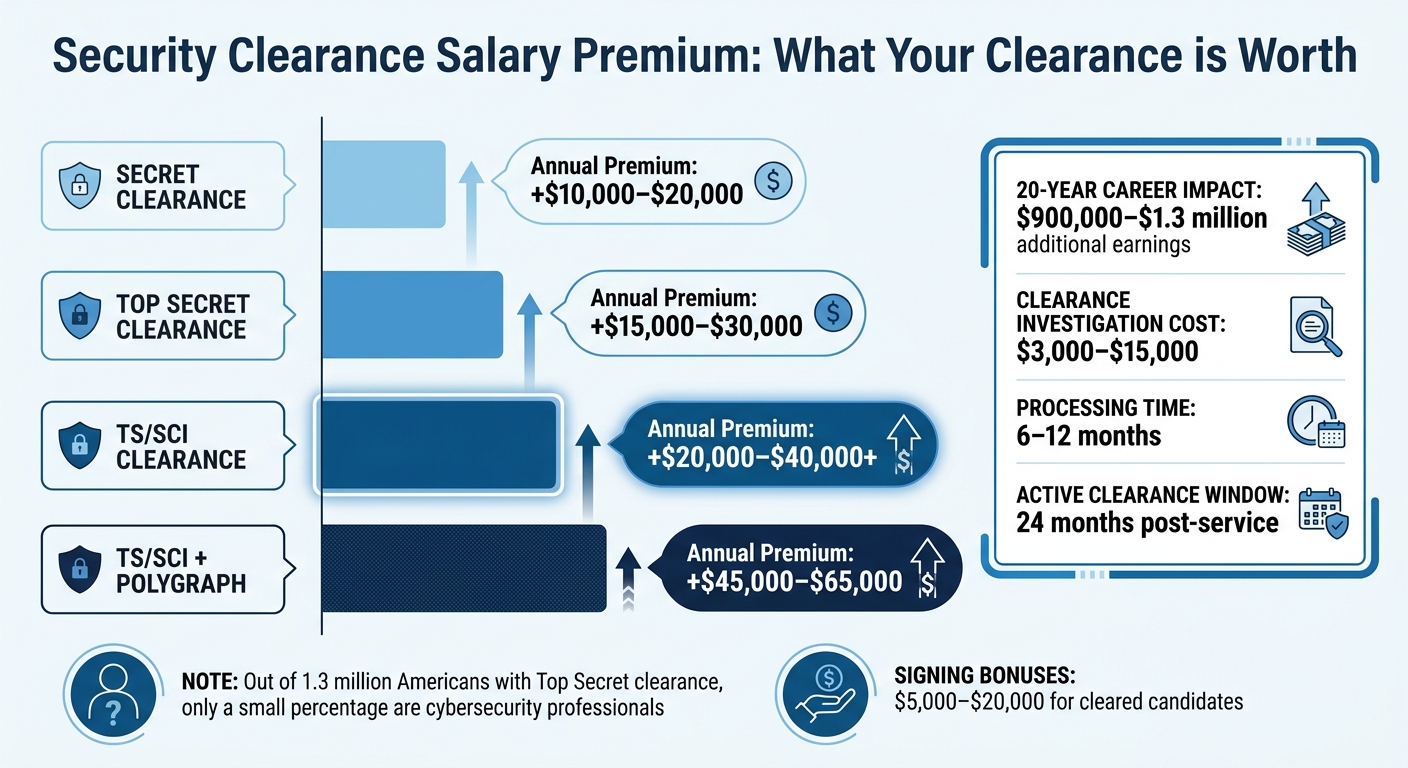
Your clearance is a major asset and should be prominently displayed at the top of your resume. For example, list it as "Active TS/SCI Clearance" or "Secret Clearance" directly under your contact information. A clearance can add $15,000 to $30,000 to your salary, and for roles requiring a Full Scope Polygraph, this figure increases by $45,000 to $65,000 annually – amounting to $900,000 to $1.3 million over a 20-year career.

Focus on mid-level positions rather than entry-level roles. With four or more years of experience as a 25D, you’re well-qualified for jobs requiring 3-5 years of cybersecurity experience. Don’t undervalue your operational expertise – it’s often more practical and impactful than the simulated lab experience many civilian candidates bring to the table.

Certifications You Need for Cleared Civilian Roles

Transitioning from military service into cleared civilian cybersecurity roles often requires certifications to translate your military expertise into credentials recognized by hiring managers and applicant tracking systems. If you’re coming from a 25D background, CompTIA Security+ is the essential starting point. This certification is the baseline requirement for DoD 8140/8570 IAT Level II positions, which encompass most defense sector cybersecurity jobs. The exam costs about $404, and with your military experience, you can prepare for it in just 4-8 weeks.

Building a stack of certifications can fast-track you to higher-paying roles. For instance, the CompTIA CySA+ (approximately $400) focuses on threat detection and incident response, making it ideal for SOC Tier 2 positions. The Certified Ethical Hacker (CEH), priced at $1,199, is highly sought for penetration testing and vulnerability assessment roles. For senior-level or management positions, the CISSP remains the top credential at $749. Your military service as a 25D often satisfies CISSP’s five-year professional experience requirement, giving you a strong advantage.

Top Certifications Employers Want

Defense contractors and federal agencies prioritize certifications that align with DoD 8140 work role requirements. CompTIA Security+ is almost universally required for entry-level cleared positions. If you’re aiming for leadership roles like security architect or CISO, the CISSP is a must-have. For offensive security and red team positions, CEH is the go-to certification.

With the growing use of cloud platforms by federal agencies, certifications like AWS Certified Security Specialty, Azure Security Engineer, and CCSP (Certified Cloud Security Professional, priced at $599) are becoming increasingly important. These are especially valuable for roles working with platforms like AWS GovCloud or Azure Government.

GIAC certifications such as GSEC and GCIH are also highly respected in government contracting. Cloud-specific certifications are among the fastest-growing in demand, with professionals holding the AWS Certified Solutions Architect credential earning an average of $149,000 annually. To align your certifications with your target role, consider the following:

  • Security+: Ideal for baseline cleared positions.
  • CySA+: Best for SOC analyst roles.
  • CEH: Suited for vulnerability analyst positions.
  • CISSP: Perfect for leadership tracks.

These certifications not only validate your skills but also build on the extensive training and experience you already bring from the military.

Using Military Training to Get Certified Faster

Your 25D training covers much of the material needed for certifications like Security+ and CySA+. Skills like Risk Management Framework (RMF), DISA STIGs, and Information Assurance give you an edge over civilian candidates – you’re simply formalizing knowledge you’ve already been using.

"One of our Army Signal NCOs went from E-6 to a $115K SOC analyst role in eight months. Security+ got him in the door. CySA+ got him the offer over other candidates. The clearance sealed it." – Brad Tachi, Navy Veteran & Founder, Best Military Resume [3]

To maximize your certification opportunities, start 12-18 months before separation. Programs like Army Credentialing Assistance (CA) and Tuition Assistance (TA) can help cover costs. During your final 180 days, leverage DoD SkillBridge to attend certification boot camps at no cost while still receiving your military pay. Other resources include:

  • VET TEC: Covers tuition for cybersecurity training and provides a housing stipend without using your GI Bill.
  • Onward to Opportunity (O2O): Offers free training and exam vouchers for certifications like CompTIA, Cisco, and AWS.
  • VA Reimbursement: The VA reimburses up to $2,000 per year for certification exam fees.

These programs ensure you’re equipped with the credentials needed to excel in the civilian cybersecurity workforce.

How to Build Your Resume for Cleared Cybersecurity Jobs

Your resume is your bridge from military service to civilian cybersecurity roles. Every detail matters. To make the most of your clearance and technical background, your resume needs to effectively translate your military experience into terms that civilian recruiters and Applicant Tracking Systems (ATS) can easily understand. Keep in mind that hiring managers spend just a few seconds on their initial review, so clarity and precision are key.

Here’s how to adapt your military experience and certifications into resume content that grabs attention.

Writing Military Experience in Civilian Language

Start by rephrasing your job title. For example, "25D Cyber Network Defender" can become Cybersecurity Analyst, SOC Analyst, Information Security Specialist, or Cybersecurity Engineer. Similarly, swap terms like "BDE S-6 shop" for something like "Enterprise IT Department" or "Security Operations Center" to make your experience relatable.

Use this formula for crafting bullet points: Action Verb + Technical Detail + Business Impact. The CAR method (Challenge, Action, Result) can help structure your achievements. For instance: "Reduced false-positive security alerts by 30% by implementing custom SIEM filters for a 15,000-node enterprise network." Including metrics like network size or the number of endpoints will make your accomplishments stand out.

Here’s a quick reference table to help translate military jargon into civilian-friendly terms:

Military Term Civilian Equivalent
25D Cyber Network Defender Cybersecurity Analyst / SOC Analyst
NCOIC Team Lead / Operations Manager
SIPR/NIPR Networks Classified and Unclassified Enterprise Networks
DISA STIGs Security Hardening Standards / Compliance Frameworks
ACAS / Nessus Scans Vulnerability Assessments
COMSEC Custodian Encryption Key Manager / Cryptographic Security Lead

Also, highlight your proficiency with tools like Splunk, Wireshark, Nessus, the NIST RMF, and MITRE ATT&CK. These are keywords recruiters actively search for when using ATS.

Highlighting Your Clearance and Accomplishments

Once you’ve translated your military terms, make sure to showcase your clearance and quantify your achievements.

Your clearance is a major asset, often increasing your salary by $15,000–$30,000 compared to non-cleared roles. Employers know that sponsoring a new TS/SCI clearance can cost $5,000–$15,000 and take 6 to 18 months, so having an active clearance makes you a highly valuable candidate.

"I’ve talked to defense contractor recruiters who told me they literally search their ATS for ‘TS/SCI’ as their first filter before looking at anything else. If your clearance isn’t in a searchable text field on your resume… you’re invisible to these recruiters." – Brad Tachi, CEO, Best Military Resume

Place your clearance (e.g., TS/SCI) directly under your contact information and in your Skills section. Use standard abbreviations for ATS compatibility and specify whether it’s "Active" or "Current." If applicable, include the type of polygraph (CI or Full-Scope), as this further increases your appeal.

Here’s how to format clearance details on your resume:

Clearance Level Recommended Resume Formatting
Active Secret "Active Secret Clearance – Current"
Active Top Secret "Active Top Secret (TS) Clearance – Current"
Active TS/SCI "Active TS/SCI Clearance – Current"
TS/SCI w/ Poly "Active TS/SCI with CI Polygraph – Current" or "Active TS/SCI with Full-Scope Polygraph"
Inactive "Previous Top Secret Clearance (inactive, eligible for reinstatement)"

Avoid including classified details or personal identifiers – stick to clearance type and status only.

Quantify your accomplishments wherever possible. Include metrics like the number of endpoints managed, network uptime (e.g., 99.9%), or vulnerabilities remediated. For example: "Maintained 99.9% network uptime for a 15,000-user classified environment by implementing automated patch management, reducing help desk tickets by 40%."

Making Your Resume Pass Applicant Tracking Systems

To ensure your resume gets noticed by both recruiters and ATS, optimize its format and content.

Defense contractors often use ATS platforms like Workday and iCIMS, while federal agencies rely on USA Staffing. These systems prioritize keyword matching for technical skills and clearance levels. If a job posting specifies "SIEM administration", use that exact phrase instead of a more general term like "security event monitoring" to improve your chances of being selected.

Stick to a clean, simple layout. Avoid complex tables, graphics, colors, and multi-column designs that can confuse ATS software. Use standard fonts and minimal formatting. For most roles, keep your resume to two pages or less – one page is ideal if you have fewer than 10 years of experience.

"Your military experience is valuable. But if a hiring manager can’t understand your resume, they can’t hire you." – Brad Tachi, CEO, Best Military Resume

When applying, mirror the language used in job descriptions. For instance, if a job mentions "Risk Management Framework (RMF)", include that exact term. Certifications like Security+, CySA+, CEH, and CISSP are also high-priority keywords for ATS, so list them prominently.

Lastly, if you’re applying through Cleared Cyber Security Jobs, make sure your clearance is included in a searchable text field. Many recruiters filter resumes by clearance level before reviewing other qualifications, so ensure your resume is optimized for both human and ATS review.

With these strategies, you’ll be well-prepared to pursue cleared cybersecurity roles with confidence.

Where and How to Search for Cleared Cybersecurity Jobs

Once you’ve polished your resume and secured the right certifications, it’s time to dive into the world of cleared cybersecurity job hunting. Unlike traditional job searches, finding cleared positions requires a more targeted approach. General job boards can be overwhelming, as cleared roles are often hidden among countless non-cleared listings. This makes it harder to connect with recruiters specifically seeking candidates with security clearances. Instead, specialized platforms streamline the process by verifying your clearance status upfront and linking you directly with employers who value your credentials and military experience.

In the cleared job market, recruiters often pay to access resume databases, actively searching for candidates with the exact clearance levels they need. To stand out, ensure your online profile is optimized with the right keywords. Most cleared jobs are concentrated in specific regions, including the Washington, D.C./Northern Virginia area, San Antonio (NSA Texas), Augusta (Army Cyber Command), Colorado Springs (Space Force), and Huntsville (Redstone Arsenal) [4][6].

Getting the Most from Cleared Cyber Security Jobs

Cleared Cyber Security Jobs

Cleared Cyber Security Jobs is a veteran-owned platform designed exclusively for U.S. citizens with active or current security clearances [5]. The site focuses on direct-hire employers, eliminating the middleman and making the recruitment process more straightforward.

To maximize your chances, create a detailed profile using civilian job titles like "SOC Analyst" or "Security Engineer." Be specific about your clearance level (e.g., Secret, TS, or TS/SCI) and include the date of your last investigation [7]. Upload your resume in a text-based format to make it easily searchable by applicant tracking systems (ATS). You can also set up daily job alerts based on location, clearance level, and job title to stay on top of new opportunities [5]. Additionally, the platform offers access to cleared job fairs, where you can meet recruiters face-to-face and bypass automated systems.

"Your clearance is a golden ticket, but only if you put it where employers can find it." – Brad Tachi, Founder, Best Military Resume [7]

Finding Jobs with Defense Contractors and Federal Agencies

Specialized job boards aren’t the only way to land a cleared cybersecurity role. Applying directly to defense contractors and federal agencies can increase your chances even further. These organizations are among the top employers for 25D veterans. Major defense contractors like Northrop Grumman, Booz Allen Hamilton, Leidos, SAIC, ManTech, Raytheon, and Peraton offer internal career portals with clearance filters and veteran hiring programs [1]. When applying, use their "Military" or "Veteran" portals to ensure your application is flagged for veteran recruiters.

For federal civilian roles, such as GS-level positions, USAJobs.gov is your go-to resource. Use the security clearance filter to narrow down your options. If you’re targeting agencies within the Intelligence Community – like the NSA, CIA, DIA, or NRO – check out IntelligenceCareers.gov [7]. Federal roles often come with stable GS-scale pay and comprehensive benefits, while defense contractors might offer quicker hiring processes and higher salaries.

Emerging defense tech companies like Palantir, Anduril, and SpaceX are also actively hiring cleared professionals, often offering competitive salaries [4]. Additionally, major tech firms with cleared divisions – such as Amazon (AWS), Microsoft, Google (including Mandiant), CrowdStrike, and Palo Alto Networks – have programs specifically for veterans [1].

To stay consistent in your search, check specialized job boards daily, use Boolean searches on LinkedIn (e.g., "TS/SCI" AND "Cyber"), and regularly visit USAJobs and contractor career pages [7]. If you’re still on active duty, consider the DoD SkillBridge program, which allows you to work with a company during your final 180 days of service. Applying 6 to 12 months before separation can help you secure a job offer before transitioning out of the military [2].

Building Your Network in the Cleared Cybersecurity Field

Networking plays a crucial role in the cleared cybersecurity world. Many roles in this field are filled through referrals long before they’re ever posted publicly [8]. While having a clearance opens doors, it’s your network that helps you step through them. Think of networking as a skill, much like translating military experience into civilian terms – it requires a deliberate and personalized approach. Start building connections 6–12 months before you transition out of service. By doing so, you establish trust and lay the groundwork for deeper strategies that can fuel your career growth [11].

The statistics are clear: over 87% of recruiters use LinkedIn to scout talent, and veterans often see results from networking within just 2–3 months of consistent effort [11]. The key is to focus on authentic connections where your background naturally resonates with others.

"Networking is not about asking strangers for jobs – it is about building relationships where people want to help you because they know you, respect your background, and understand what you bring to the table." – Brad Tachi, CEO and Founder, Best Military Resume [11]

Connecting Through Veteran Events and Groups

Veteran organizations are a goldmine for mentorship and direct access to recruiters [11]. American Corporate Partners (ACP), for instance, has supported over 25,000 veterans through one-on-one corporate mentorships. Programs like Hire Heroes USA and FourBlock are also excellent resources for connecting transitioning service members with business mentors [13].

For those in cybersecurity, there are tailored communities worth exploring. VetSec (VeteranSec), the Military Cyber Professionals Association (MCPA), and CyberVetsUSA are excellent options. CyberVetsUSA, backed by companies like Cisco and Amazon, offers pathways to jobs and networking opportunities specifically for veterans in states like Virginia, North Carolina, and Maryland [14].

Cleared hiring events are another valuable resource. These events, often hosted on military bases, allow job seekers to meet recruiters in person and skip the hassle of automated application systems [12]. Upcoming events include:

  • Peterson Space Force Base (April 2026)
  • Lackland Air Force Base (May 2026)
  • Fort Meade (June 2026)
  • Fort Gordon (August 2026)

If online networking is more your speed, start by optimizing your LinkedIn profile with civilian job titles like "Cybersecurity Engineer" or "SOC Analyst." Join veteran-focused groups like "Veterans in Tech", and use LinkedIn’s Alumni Tool to connect with others who share your military background [11]. Another effective strategy is conducting informational interviews – short, 15–20 minute calls to learn about industry trends and company culture without directly asking for a job [9][11].

"People will stop responding to you if you’re only in touch when you need something from them." – ClearedJobs.net [9]

Meeting Employers Who Hire Cleared Professionals

Once your network is in place, the next step is connecting directly with employers. Many cleared roles are never advertised, so networking is essential for uncovering these hidden opportunities. Large defense contractors often have Employee Resource Groups (ERGs) for veterans, such as Warriors@Amazon or MSVETS at Microsoft. These groups can provide internal referrals and advocates to help you stand out [11].

Attending cybersecurity conferences like Black Hat, DEF CON, or RSA is another excellent way to meet potential employers. Don’t overlook the informal networking that happens between sessions, often referred to as "HallwayCon" [8]. Volunteering at these events can also get you free access and direct contact with industry professionals [8].

For those who prefer online engagement, join niche communities like Reddit’s r/netsec or contribute to open-source projects on GitHub to showcase your technical skills [8]. Additionally, ClearedJobs.net hosts Military Monday webinars, offering monthly advice on resumes and career strategies tailored to the cleared community [10].

Platforms like Cleared Cyber Security Jobs are also worth exploring. They host cleared job fairs and provide tools like detailed profiles and daily job alerts. Be sure to highlight your clearance level and investigation date to make it easy for recruiters to find you. Since the platform is free for job seekers and focuses on direct-hire employers, it’s an efficient way to connect with companies that value your military experience [5].

Preparing for Cleared Cybersecurity Job Interviews

Once you’ve polished your resume and honed your job search, the next step is nailing the interview. This is your chance to showcase how your 25D experience translates into the civilian cybersecurity world. Cleared cybersecurity interviews are designed to assess both your technical skills and your ability to articulate your military accomplishments in terms that resonate with civilian employers. Start preparing your responses as early as six months before your separation date to ensure you’re ready to shine. This phase builds on the groundwork you’ve laid with your resume and networking efforts, emphasizing how your military background can deliver immediate results.

One standout advantage in these interviews is your clearance. A TS/SCI clearance, for example, can boost your base salary by $15,000 to $30,000 and save employers thousands in sponsorship costs – anywhere from $5,000 to $15,000. Plus, it eliminates the lengthy clearance process, which can take 6 to 18 months.

Answering Behavioral and Technical Questions

In technical interviews, expect questions about the tools and frameworks you used as a 25D. Be ready to discuss cybersecurity tools like Splunk, Nessus, ACAS, Wireshark, ArcSight, and McAfee ePO. You’ll also likely encounter questions about your experience with frameworks such as NIST, MITRE ATT&CK, CIS controls, the Risk Management Framework (RMF), and DISA STIGs.

For behavioral questions, employers want to evaluate your ability to stay alert, handle pressure, and follow structured protocols – traits often described as a "watch-standing mentality." When framing your military experience, use clear and measurable examples. For instance, instead of saying you "monitored networks", you could say, "Analyzed over 200 daily alerts, reducing incident response time by 40%." This Action + Technical Detail + Business Impact formula helps convey your achievements in a way that resonates with civilian employers.

When discussing classified work, focus on the scale and complexity rather than specific details. For example, describing how you managed a "15,000-node enterprise network" illustrates the scope of your role without breaching security protocols.

Here’s a quick guide to translating military terms into civilian equivalents:

Military Term Civilian Equivalent
NIPR/SIPR Administrator Dual Enterprise Network Manager (Classified/Unclassified)
ACAS/STIGs Vulnerability Management & Compliance (Nessus/Tenable)
COMSEC Custodian Cryptographic Security & Encryption Key Management
CPT (Cyber Protection Team) Incident Response or Threat Hunting Team
RMF (Risk Management Framework) Security Compliance & Authorization Framework

A common pitfall for veterans is underselling their experience. If you have four or more years as a 25D, aim for mid-level or senior roles instead of entry-level SOC analyst positions. Your operational background qualifies you for more advanced opportunities, and settling for less could mean leaving money – and career growth – on the table.

"The cyber veterans I’ve seen transition most successfully are the ones who don’t settle for the first SOC analyst job offered to them. Your military experience puts you above entry-level." – Brad Tachi, CEO, Best Military Resume

Discussing Your Clearance and Job Fit

Once you’ve tackled the technical and behavioral questions, it’s time to clearly communicate your clearance status and role alignment. When discussing your clearance, specify the level (e.g., Secret, TS, or TS/SCI) and include your investigation date. This allows employers to confirm your status through the Defense Information System for Security using just your name and date of birth. Avoid sharing sensitive details like SCI compartments or classification markings – a simple mention of "TS/SCI" is sufficient.

Be precise about your clearance status. For example:

  • Active: Currently sponsored.
  • Current: Within the 24-month reactivation window.
  • Inactive: Lapsed beyond 24 months.

Misrepresenting an interim clearance as a full clearance is a major red flag, so be honest about your status. If your clearance is within the reactivation window, highlight that it can be reinstated without a full reinvestigation.

When addressing job fit, explain how your military training and operational experience make you uniquely suited to protect corporate assets and reduce risks. Employers want to know you can handle the high-pressure demands of a 24/7 Security Operations Center or respond effectively to incidents with financial consequences. Use your 25D background to demonstrate your ability to manage critical responsibilities under intense conditions.

Finally, align your language with the job posting. For example, if the role mentions "SIEM administration", use that exact term instead of alternatives like "security event monitoring." This not only shows you understand the position but also helps ensure your resume and interview responses resonate with Applicant Tracking Systems.

"Any employer knows veterans are going to be trainable and have a high work ethic." – Tom Marsland, Board Chair, VetSec

Conclusion

Shifting from a 25D Cyber Network Defender role to a cleared civilian cybersecurity position means tapping into your hands-on operational experience and leveraging your active clearance to secure jobs that often pay between $95,000 and $148,000 – or even more. Your background equips you with real-world skills defending networks against actual threats, not just theoretical scenarios.

The challenge lies in translating your military expertise into terms that resonate with civilian employers and applicant tracking systems (ATS). For example, reframe terms like "ACAS" as "vulnerability scanning with Nessus" or "COMSEC Custodian" as "Cryptographic Security & Encryption Key Management." Certifications such as Security+ can help you qualify for DoD 8140 roles, while advanced credentials like CISSP or OSCP can position you for higher-level opportunities.

Your active TS/SCI clearance is a major asset, saving employers the cost and time of sponsorship while accelerating your hiring process. With over four years of experience as a 25D, you should target mid-level or senior roles to maximize your earning potential. As Brad Tachi, CEO of Best Military Resume, explains:

"A TS/SCI-cleared cyber professional with 4+ years of operational experience should not be accepting $80K SOC analyst positions when the market pays $110K+ for that profile" [2].

With more than 500,000 open cybersecurity jobs in the U.S. and a projected 33% growth in the field through 2033, the demand for skilled professionals like you is undeniable.

FAQs

How do I keep my TS/SCI active after leaving the Army?

To maintain your TS/SCI clearance in an "active" status, you need to show a continued need for access to classified information. Stay in regular contact with your Facility Security Officer (FSO) or security manager to ensure your information is up-to-date and your need for access is reaffirmed. If your clearance shifts to "current" but not "active", you’ll still have eligibility, but your access will be revoked. Consistent updates are crucial to prevent your clearance from expiring.

Which 25D skills should I highlight for mid-level civilian roles?

If you’re transitioning into mid-level civilian roles, there are specific 25D skills that can make your resume stand out. Focus on showcasing your ability to manage enterprise networks, handle cybersecurity operations, and enforce security protocols effectively.

Your experience defending classified networks, troubleshooting intricate systems, and performing hands-on operational cybersecurity tasks is highly relevant. Employers also value expertise in conducting risk assessments, maintaining robust security measures, and thriving under pressure in high-stakes situations. These skills are a strong match for positions like security analyst, threat intelligence analyst, and cybersecurity engineer.

What’s the fastest certification path to land a cleared cyber job?

The fastest way to land a cleared cybersecurity job is by earning the CompTIA Security+ certification. This entry-level credential is widely recognized and often enough to qualify for roles like cybersecurity analyst. With dedicated effort, you can complete it in just a few months. The process is straightforward: prepare for the exam, register, and pass. Security+ is particularly helpful for translating military experience into civilian cybersecurity credentials, making it a great choice for cleared positions.

Related Blog Posts

  • Job Search Checklist for Veterans in Cyber Security
  • Cyber Warfare Specialist Career Path for Cleared Military
  • Cleared Cyber Jobs at Army Cyber Command Complete Guide
  • Cleared Cyber Jobs at 16th Air Force Complete Guide

17A Cyber Operations Officer to Cleared Civilian Career Guide

CyberSecJobs Editorial · April 19, 2026 ·

If you’re a 17A Cyber Operations Officer transitioning to a civilian cybersecurity career, you’re in a strong position. Your military experience, technical skills, and active security clearance make you a top candidate for high-paying roles. Here’s why and how you can make the leap:

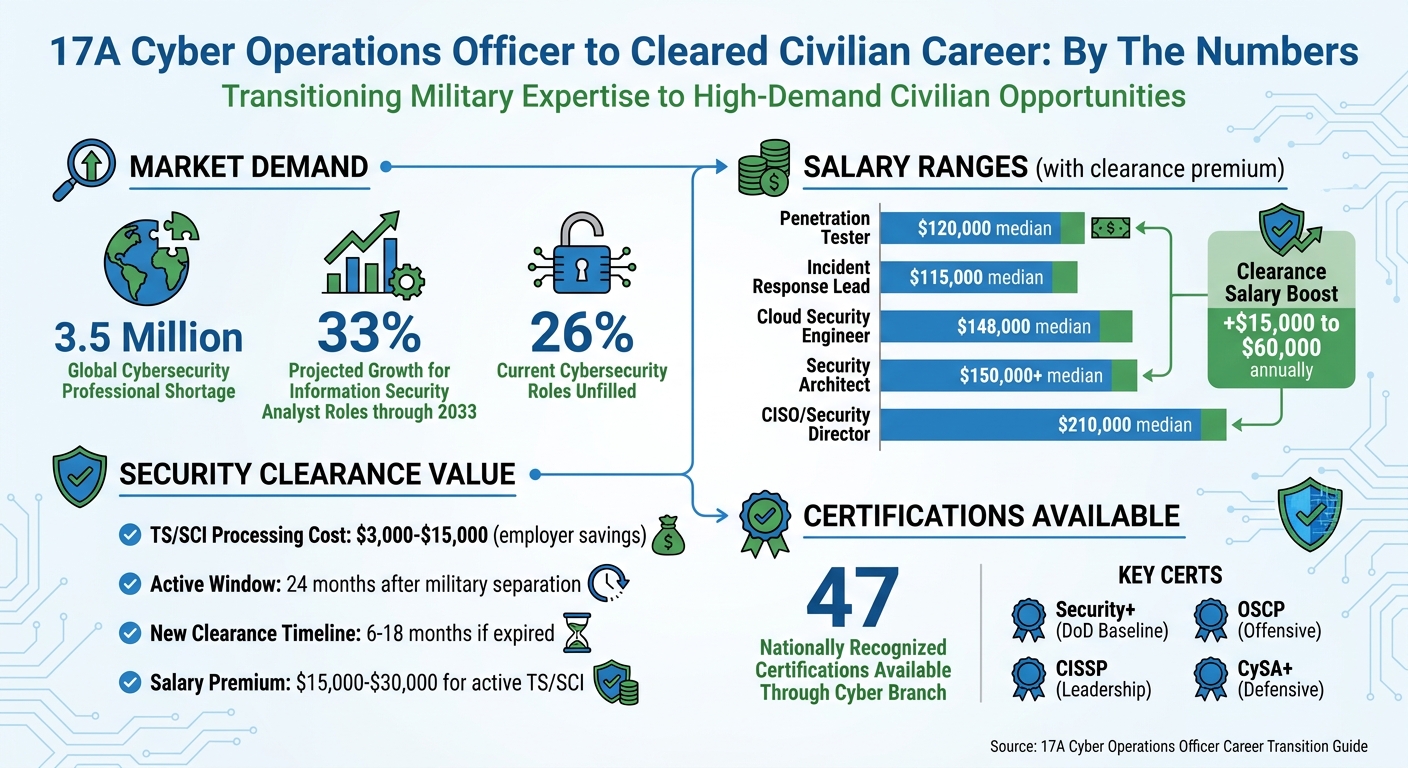
  • Demand is High: The cybersecurity field faces a global shortage of 3.5 million professionals, and roles like Information Security Analyst are set to grow by 33% through 2033.
  • Lucrative Salaries: Senior roles like CISO, Security Architect, and Cybersecurity Manager pay $130,000–$200,000+, with active clearances adding $15,000–$60,000 to your salary.
  • Security Clearance Advantage: Your TS/SCI clearance saves employers time and money, making you a priority hire.
  • Certifications Matter: Certifications like Security+, CISSP, or OSCP are essential and often funded by military programs.

To succeed, translate your military experience into civilian terms, focus on leadership roles, and highlight your clearance and certifications. Networking, cleared job boards, and tailored resumes will help you land positions that match your expertise.

17A Cyber Officer to Civilian Transition: Key Stats and Salary Ranges

17A Cyber Officer to Civilian Transition: Key Stats and Salary Ranges

How Military Cyber Experience Translates to Civilian Careers

sbb-itb-bf7aa6b

What Does a 17A Cyber Operations Officer Do?

As a 17A Cyber Operations Officer, you take charge of cyber mission forces, steering both offensive and defensive operations. Your role combines technical expertise with strategic leadership, requiring you to manage high-pressure situations while protecting and advancing critical cyber capabilities.

Main Responsibilities of a 17A Cyber Operations Officer

In Offensive Cyberspace Operations (OCO), your mission is to disrupt or exploit adversary systems. This involves identifying weaknesses in their networks to neutralize threats or manipulate their communications[6]. On the other hand, Defensive Cyberspace Operations (DCO) task you with safeguarding friendly networks. You’ll monitor systems, detect potential threats, and respond to attacks aimed at compromising data or infrastructure[6].

Your responsibilities extend beyond operations. You align cyberspace activities with broader military strategies to secure key advantages in the field[6]. Additionally, you oversee network security by inspecting IT systems, controlling access, and ensuring your team is prepared for combat scenarios. This includes managing equipment accounts valued between $1 million and $24 million, a critical aspect of maintaining operational readiness[6].

These duties highlight the importance of advanced training and the role of security clearance in carrying out your responsibilities effectively.

Training and Certification Requirements

To prepare for this role, you’ll complete the Cyber Basic Officer Leaders Course (CBOLC) at Fort Eisenhower, GA. This rigorous program covers networking, operating systems, scripting (such as Python), exploitation techniques, and defensive strategies[5][7]. The training meets NSA standards, equipping you for the high-stakes nature of cyber operations[7]. Additionally, you must hold a Bachelor of Science or higher degree in a STEM-related field, such as computer science, electrical engineering, or information assurance[5].

Certifications are another key component of your preparation. The cyber branch offers access to 47 nationally recognized certifications[4]. Most officers begin with the CompTIA Security+ certification, which is required for DoD IAT Level II roles. From there, you can pursue advanced credentials like OSCP for offensive operations or CISSP for management pathways[3][7]. The Army supports funding for these certifications – some costing thousands of dollars – through programs like the GI Bill or Army IgnitED[3][7].

This training and certification pipeline ensures you’re not only ready for military operations but also highly competitive in the civilian cybersecurity sector.

Why Security Clearance Matters

A Top Secret/Sensitive Compartmented Information (TS/SCI) clearance is non-negotiable for the 17A role. This clearance allows you to access classified networks and operate across multiple domains, all of which directly impact national security[4]. The government invests between $3,000 and $15,000 to process your TS clearance[8], making it a valuable asset for transitioning into civilian roles.

Your clearance remains active for 24 months after you leave the military[8]. During this time, you can reactivate it for a civilian position without undergoing a full reinvestigation. Missing this window, however, could mean waiting 6 to 18 months for a new clearance[3]. This makes pursuing cleared positions immediately after your military service a strategic move for a smooth transition into the civilian workforce.

How to Translate 17A Skills to Civilian Cybersecurity Jobs

Your specialized training and clearance as a 17A cyber professional can open doors to high-demand roles in the civilian cybersecurity world. The skills you’ve honed in military operations are invaluable in the private sector, particularly because of the real-world operational experience they bring. As Brad Tachi, CEO of Best Military Resume, explains:

"Military cyber professionals have something that most civilian cybersecurity candidates don’t: real-world operational experience defending networks against actual threats, not just simulated ones" [3].

This hands-on expertise gives you a distinct advantage over many civilian candidates.

Matching Military Skills to Civilian Roles

The transition from military to civilian roles is more straightforward than it might seem. Your Offensive Cyberspace Operations (OCO) experience is a natural fit for leadership roles in Red Team operations and penetration testing. Identifying vulnerabilities under combat conditions directly prepares you for civilian penetration testing roles.

On the defensive side, your experience with Defensive Cyberspace Operations (DCO) aligns seamlessly with Blue Team roles, incident response leadership, and threat hunting. The strategic planning you’ve done – coordinating cyber activities with broader operational goals – positions you for senior roles like Chief Information Security Officer (CISO) or Security Architect.

Your familiarity with frameworks like the Risk Management Framework (RMF) and DISA STIGs translates well to civilian compliance standards such as NIST 800-53, FISMA, and FedRAMP. When describing your experience, replace military-specific terms with civilian equivalents. For instance, instead of "COMSEC", use "cryptographic key management." Be specific about your achievements – rather than saying "led a team", say something like, "Led a 12-person Cyber Protection Team defending a 500,000-endpoint network."

Additionally, your hands-on experience with tools like Splunk, Wireshark, Nessus, and ArcSight is highly relevant. These tools are staples in civilian cybersecurity roles, making your expertise directly applicable to positions requiring technical proficiency.

Common Cleared Cybersecurity Job Titles

Your leadership and technical skills make you a strong candidate for mid-to-senior-level positions. Brad Tachi cautions against undervaluing your worth:

"A TS/SCI-cleared cyber professional with 4+ years of operational experience should not be accepting $80K SOC analyst positions when the market pays $110K+ for that profile" [3].

An active TS/SCI clearance can increase your salary by $15,000 to $30,000, as it eliminates the need for employers to sponsor your clearance.

With your dual expertise in offensive and defensive operations, you’re well-suited for high-responsibility roles like Penetration Tester (median salary $120,000), Security Architect (median salary $150,000+), Incident Response Lead (median salary $115,000+), Cloud Security Engineer (median salary $148,000), and CISO/Security Director (median salary $210,000) [1].

Given that information security analyst roles are projected to grow by 33% through 2033 [2], focusing on positions emphasizing NIST frameworks, MITRE ATT&CK, and CIS controls will help you tap into the premium market for cleared professionals. These roles not only leverage your experience but also position you for long-term success in the cybersecurity industry.

How to Build a Resume for Cleared Cybersecurity Jobs

Your resume is your ticket to landing an interview. With recruiters spending just 6 to 7 seconds on an initial scan of your resume [10][2][14], every word has to count. The goal? Translate your military background into civilian terms while ensuring your security clearance is front and center for both human recruiters and Applicant Tracking Systems (ATS).

How to Highlight Your Military Experience

Start by swapping out military-specific terms like your rank or MOS code for civilian-friendly job titles that hiring managers will recognize. For example, instead of "17A Cyber Operations Officer", use titles such as Cybersecurity Operations Manager, Lead Penetration Tester, or Incident Response Lead [11][2][3]. When listing accomplishments, use the STAR (Situation, Task, Action, Result) or CAR (Challenge, Action, Result) method to quantify your impact. For instance, instead of saying, "Managed network security", try: "Led a 12-person team defending a 500,000-endpoint network, maintaining 99.9% availability while triaging 200+ security alerts daily."

Translate military jargon into civilian equivalents. For example:

  • The Risk Management Framework (RMF) stays the same.
  • DISA STIGs become "security hardening standards."
  • COMSEC converts to "cryptographic key management" or "encryption key management" [3][2].

When describing your work environment, focus on quantifiable details like network size and user count, rather than mission specifics. For example: "3,000-user dual enterprise environment (classified/unclassified)" [3][9].

To make it past ATS filters, include unclassified tools and frameworks you’ve used, such as Splunk, Wireshark, Nessus, CrowdStrike, or Palo Alto firewalls. Also, mention frameworks like NIST RMF, MITRE ATT&CK, and CIS Controls [2][3]. These specifics show both technical expertise and hands-on experience.

Military Term Civilian Translation
17A Cyber Operations Officer Cybersecurity Operations Manager / Lead Penetration Tester
NIPR/SIPR Administrator Dual Enterprise Network Manager (Classified/Unclassified)
COMSEC Custodian Cryptographic Security / Encryption Key Manager
ACAS / STIG Compliance Vulnerability Management & Security Hardening
DCO (Defensive Cyber Operations) Incident Response & Network Defense

Keep your resume format simple for ATS compatibility. Avoid graphics, shading, or intricate layouts that could confuse automated systems [10][14]. Stick to standard fonts and clear section headers. As Bill Branstetter from 9th Way Insignia advises:

"Keep subjective self-descriptions out of your summary section. I’m looking at you, Results-Oriented Team Players" [14].

Stick to hard facts and measurable achievements.

How to List Certifications and Training

Your certifications are vital in cleared cybersecurity roles, so place them near the top of your resume. CompTIA Security+ is a must-have for meeting DoD 8570/8140 compliance and should be prominently displayed [3][2]. For management or architecture roles, highlight CISSP. If you’re aiming for offensive roles, showcase OSCP or GPEN. For defensive roles or incident response, certifications like CySA+ or GIAC are key [3][2].

If you’re working toward a certification, include it with an expected completion date to show initiative [12][9]. For example: "CISSP (Certified Information Systems Security Professional) – ISC², January 2025."

Cloud security certifications are becoming increasingly important as more organizations shift to cloud-based infrastructure. Highlight certifications like AWS Certified Security Specialty or Azure Security Engineer, especially if you gained cloud-related training during your military service [3][2].

How to List Your Security Clearance

Your security clearance is a major asset – potentially adding $15,000 to $30,000 to your salary [3][13][2].

"I’ve talked to defense contractor recruiters who told me they literally search their ATS for ‘TS/SCI’ as their first filter before looking at anything else. If your clearance isn’t in a searchable text field on your resume… you’re invisible to these recruiters" [13].

To make it easy for recruiters to find, list your clearance in two places: directly under your contact information in the header and again in the "Core Competencies" or "Skills" section [13][14]. Use standard abbreviations like "TS/SCI" and specify whether it’s "Active" or "Current." If you have a polygraph, include the type (e.g., CI or Full-Scope), as this significantly boosts your value [13]. For example: "Active TS/SCI Clearance – Current (Full-Scope Polygraph)."

Keep in mind the 24-month window after military separation – your clearance remains "current" during this period, allowing employers to reactivate it without a full reinvestigation [13][2]. This is crucial since sponsoring a new TS/SCI clearance can cost employers $5,000 to $15,000 and take 6 to 18 months [3][13]. Transitioning into a cleared role quickly ensures you maximize this advantage.

Finally, avoid sharing sensitive details about your clearance. A simple, professional description is all you need [13][14].

Once your resume is polished, you’ll be ready to focus on targeted job searches and networking.

Job Search and Networking Strategies for Cleared Cybersecurity Roles

Once your resume is polished and ready, the next step is to approach your job search strategically. The cleared cybersecurity job market has its own unique dynamics. Your active security clearance is a standout advantage, but it’s crucial to present it effectively to make the most of this edge.

How to Use Cleared Job Boards

Platforms like Cleared Cyber Security Jobs are designed to connect you with employers who specifically value your qualifications. This veteran-founded site offers tools like clearance-level filters, resume uploads, job alerts, and resources tailored to the cleared community.

Dedicate about 15 minutes each morning to check job postings and stay updated. Additionally, review the career pages of major defense contractors – such as Booz Allen Hamilton, Lockheed Martin, and Leidos – twice a week. Setting up job alerts on these sites ensures you don’t miss out on opportunities.

When creating profiles, use civilian-equivalent titles like Cybersecurity Engineer or Incident Response Lead instead of military-specific designations. This adjustment helps recruiters searching for civilian terms find you more easily. Also, make sure to include your clearance level, polygraph type (if applicable), and investigation date in searchable text fields, rather than hiding them in attachments.

Once your job alerts are active and profiles are optimized, shift your attention to networking within the industry.

How to Network at Cleared Job Fairs and Events

Cleared job fairs offer direct access to hiring managers who understand and value military experience. Platforms like Cleared Cyber Security Jobs host both in-person and virtual job fairs, allowing you to bypass automated screening processes and make a direct impression.

Attending major cybersecurity conferences such as Black Hat, DEF CON, RSA, and BSides can also be highly beneficial. These events are ideal for informal networking, often referred to as "HallwayCon", where impromptu conversations with industry professionals can lead to unadvertised opportunities. Volunteering at these events is another way to connect directly with industry leaders.

Prepare a concise 30-second introduction that translates your military experience into civilian terms. For example:
"I led defensive cyber operations for a 500,000-endpoint network, managing incident response and vulnerability assessments. I hold an active TS/SCI with Full-Scope Polygraph and am transitioning into civilian cybersecurity architecture roles."
This type of introduction highlights your skills and experience clearly, making an immediate impact on hiring managers.

After meeting someone, follow up with an email within 24 hours. Reference a specific detail from your conversation to reinforce the connection and express interest in maintaining contact.

Outside of events, building deeper connections within the cleared community can significantly aid your transition.

How to Build Connections in the Cleared Community

Reaching out to former military colleagues now working in defense contracting can be immensely helpful. These connections often lead to direct referrals, allowing you to bypass applicant tracking systems and ensuring your resume gets into the right hands. Reconnect with former unit members, training classmates, and peers from joint exercises who have already transitioned into the civilian sector. Your shared experiences provide a natural starting point for these conversations.

Informational interviews are another powerful tool. These casual, short conversations with professionals in your target roles can provide insights into their day-to-day responsibilities, advice for transitioning, and potential job leads within their organizations.

You can also engage with specialized online communities like Reddit’s r/netsec or contribute to open-source security projects on GitHub. Active participation in these spaces not only showcases your technical skills but also helps you stay informed about the latest tools and trends in the field.

"Your clearance is a golden ticket, but only if you put it where employers can find it. A clearance buried on page two of your resume or missing from your online profile is a clearance that is not working for you."
– Brad Tachi, CEO, Best Military Resume

How to Prepare for Cleared Cybersecurity Interviews

Once you’ve polished your resume and honed your networking tactics, the next step is acing the interview. This is where you demonstrate how your military cybersecurity expertise can directly benefit civilian employers. Cleared cybersecurity interviews typically include behavioral questions about leadership and technical assessments of your skills. The trick is framing your military experience in a way that resonates with civilian hiring managers.

How to Discuss Leadership and Technical Skills

As a 17A Cyber Operations Officer, you’re likely aiming for senior roles like CISO, Security Architect, or Senior Cybersecurity Manager – not entry-level positions. To showcase your leadership, use specific metrics. For instance:

"Led a 12-person Cyber Protection Team defending a 500,000-endpoint network, maintaining 99.9% availability while triaging 200+ security alerts daily" [2][3].

A good formula to follow is Action + Technical Detail + Business Impact [9]. This approach makes it clear what value you can bring to an organization.

When discussing your experience, avoid military jargon and translate terms into civilian equivalents. For example:

  • Instead of “COMSEC,” say “Encryption Key Management.”
  • Replace “ACAS/STIGs” with “Vulnerability Scanning (Nessus) and Security Hardening Standards.”

Also, name unclassified tools you’ve used, like Splunk, Wireshark, Nessus, CrowdStrike, and Palo Alto Networks. Highlight your ability to work under pressure and relate military frameworks – like RMF (Risk Management Framework) – to civilian standards. Explain how your experience with DISA STIGs aligns with widely recognized security hardening practices.

How to Address Your Security Clearance Status

Your TS/SCI clearance is a major asset, so mention it early in the conversation. Employers value this because it eliminates the need for costly sponsorship (which can range from $5,000 to $15,000) and bypasses the lengthy 6 to 18-month investigation process [2][3]. Be clear and concise:

"I hold an active TS/SCI with Full-Scope Polygraph, current as of my last investigation in [month/year]."

Your clearance remains valid for 24 months after leaving the military, and a Facility Security Officer (FSO) can reactivate it through the Defense Information System for Security (DISS). During interviews, never share sensitive details like your SSN or case numbers – your name and date of birth are sufficient for verification [13].

If you have a Counter-Intelligence (CI) or Full-Scope Polygraph, emphasize it, as these are highly sought after by intelligence community contractors [13]. Present your clearance as evidence of your trustworthiness and ability to handle sensitive information.

"If you have an active TS/SCI and operational cyber experience, you are in a seller’s market. Multiple employers will compete for you."
– Brad Tachi, CEO, Best Military Resume [3]

How to Answer Behavioral and Technical Questions

Be ready to discuss both your leadership and technical skills in detail. For behavioral questions, use metrics to back up your claims. Examples include:

  • "Investigated 150+ security incidents quarterly."
  • "Hardened 95% of systems to DISA STIG standards within 6 months." [2][3]

When discussing leadership, mention managing Cyber Protection Teams or overseeing security for large-scale, multi-enclave environments [3].

For technical assessments, stay sharp by practicing on platforms like TryHackMe or HackTheBox [2][3]. Some interviews may include live technical challenges, so be prepared to demonstrate your familiarity with civilian frameworks like NIST, MITRE ATT&CK, and CIS controls [3]. Employers want assurance that your skills can be applied immediately.

Military Term Civilian Equivalent for Interviews
COMSEC Cryptographic Security / Encryption Key Management
ACAS Vulnerability Scanning (Nessus/Tenable)
DCO / OCO Defensive / Offensive Cyber Operations
RMF Risk Management Framework (Compliance)
SIPR / NIPR Classified / Unclassified Enterprise Networks
CPT Lead Cybersecurity Team Lead / Manager

Avoid discussing specific SCI compartments, codewords, or classified programs during interviews. This could raise security concerns. Instead, focus on the complexity and scale of your work, showing that you can protect sensitive information while effectively communicating your expertise.

"Military cyber professionals have something that most civilian cybersecurity candidates don’t: real-world operational experience defending networks against actual threats, not just simulated ones."
– Brad Tachi, CEO, Best Military Resume [3]

Conclusion

Shifting from a 17A Cyber Operations Officer role to a cleared civilian cybersecurity career positions you as a standout candidate. Your hands-on experience in network defense and an active TS/SCI clearance set you apart from the competition. To make the most of this transition, focus on translating military jargon into civilian terms, highlight measurable achievements, and aim for mid-to-senior level roles like Security Architect, Senior Cybersecurity Manager, or even CISO – roles that align with your expertise rather than settling for entry-level positions.

Keep in mind, your clearance is a valuable but time-sensitive asset. It remains active for only 24 months after separation, and retaining an active TS/SCI clearance can boost your salary by $15,000 to $30,000. To maximize this opportunity, ensure your transition happens while your clearance is still valid [3]. Complement your experience with certifications such as Security+ for baseline DoD compliance and CISSP to highlight leadership capabilities. Make these certifications prominent on your resume to solidify your qualifications for high-paying cleared roles.

Strategize your job search by focusing on platforms like Cleared Cyber Security Jobs, which cater specifically to professionals with military backgrounds. These platforms connect you with employers seeking candidates like you and often feature roles that pay 20–40% more than commercial cybersecurity positions [15].

"The cyber veterans I’ve seen transition most successfully are the ones who don’t settle for the first SOC analyst job offered to them. Your military experience puts you above entry-level."
– Brad Tachi, CEO and Founder, Best Military Resume [3]

Start planning your transition 12 to 18 months in advance to ensure a smooth shift into a cleared role. Take advantage of programs like SkillBridge to gain corporate experience, and build connections within the cleared community through job fairs and networking events. With 26% of cybersecurity roles currently unfilled [15] and a projected 33% growth in information security analyst positions by 2033 [2], the demand for your expertise is at an all-time high.

FAQs

Which cleared cyber roles best match my 17A experience?

Roles that match your experience as a 17A Cyber Operations Officer include Threat Intelligence Analyst, Security Engineer, and Cybersecurity Manager. These positions leverage your expertise in operational cybersecurity, leadership abilities, and active security clearances. To transition smoothly into the cleared cybersecurity industry, target opportunities that appreciate your military background and technical skill set.

How do I keep my TS/SCI active during my transition?

To maintain your TS/SCI clearance, keep in mind that a Secret clearance generally remains valid for up to 2 years after you separate from the military. Within this window, you can reinstate it for civilian employment. To avoid losing your clearance, check its status regularly and complete any necessary steps for renewal or reinstatement. This might include updating your background investigation or working through your employer or contracting agency to ensure everything is up to date.

What certifications should I prioritize for the job I want?

For entry-level cybersecurity positions, certifications like Security+ can be a great starting point to demonstrate your foundational knowledge. If you’re aiming for senior roles, particularly if you bring military experience and hold security clearances, advanced certifications such as CISSP or CISA are worth pursuing. These credentials are highly regarded in the cleared cybersecurity sector and can help showcase your expertise while aligning your qualifications with industry demands.

Related Blog Posts

  • Cyber Warfare Specialist Career Path for Cleared Military
  • Cleared Cyber Jobs at Army Cyber Command Complete Guide
  • Cleared Cyber Jobs at 16th Air Force Complete Guide
  • Cleared Cyber Jobs at Coast Guard Cyber Command Complete Guide

17C Cyber Operations Specialist to Cleared Civilian Career Guide

CyberSecJobs Editorial · April 19, 2026 ·

If you’re a 17C Cyber Operations Specialist transitioning from the Army, your skills in cyber operations, combined with a TS/SCI clearance, make you a strong candidate for high-paying cybersecurity roles. The demand is massive: over 457,000 open cybersecurity jobs in the U.S. and a global shortfall of 3.5 million professionals. With starting salaries often exceeding $130,000, your military experience puts you ahead of many civilian candidates. However, understanding your market value, earning key certifications, and translating your experience into civilian terms are critical steps to secure the best opportunities.

Key Takeaways:

  • Clearance Value: A TS/SCI clearance adds $20,000–$40,000+ annually to your salary. Keeping it active (within 24 months post-service) is essential.
  • Certifications: Start with CompTIA Security+ ($400) and progress to CySA+, OSCP, or CISSP for advanced roles.
  • Job Market: Roles like SOC Analyst, Security Engineer, and Cloud Security Architect can pay $95,000–$250,000+.
  • Transition Timeline: Plan 12–18 months ahead, leveraging programs like SkillBridge, VET TEC, and O2O for training and internships.

This guide outlines how to maximize your transition, secure a six-figure career, and leverage your clearance and skills effectively.

What 17C Specialists Do and Skills That Transfer

What 17C Specialists Do

As a 17C, you undergo an intense six-month training program at Fort Eisenhower, focusing on NSA-level networking, operating systems, and exploitation [2]. This training lays a solid groundwork for transitioning into civilian roles, where practical, hands-on experience is highly sought after. Your work involves a mix of Defensive Cyberspace Operations (DCO) and Offensive Cyberspace Operations (OCO). On the defensive side, you handle tasks like vulnerability assessments, digital forensics, incident response, and threat hunting across vast enterprise networks. On the offensive side, you carry out network exploitation and study adversary tactics [2][4].

Your daily responsibilities might include analyzing unusual network traffic, creating custom detection signatures, and safeguarding systems from advanced cyber threats. You could also find yourself monitoring massive enterprise networks with over 500,000 endpoints, uncovering thousands of vulnerabilities using tools like ACAS and DISA STIGs, or leading Cyber Protection Teams through intricate incident responses [4]. Unlike many civilian candidates who rely on lab-based experience, your expertise comes from defending against real-world threats, giving you a distinct edge [4].

Skills Employers Want

The technical skills you bring to the table align perfectly with what employers are looking for. Your proficiency with tools like Splunk, Wireshark, Nessus, and SIEM systems makes you a top candidate. Additionally, your knowledge of frameworks like RMF, NIST, and DISA STIGs is highly valued [3][4]. Employers also prize your scripting skills in Python, your experience managing SIEM systems, and your ability to perform vulnerability scans.

But it’s not just about technical know-how – your soft skills are just as critical. You’ve led diverse teams under the intense pressure of national security operations, tackled complex problems with limited information, and adapted swiftly to ever-changing threats. Your "watch-standing mentality" – remaining vigilant and responding promptly – mirrors the demands of civilian Security Operations Centers [3][8]. Furthermore, your ability to write clear, technical reports that translate complex cyber activities into actionable insights is a standout quality [4][7].

"Military cyber professionals have something that most civilian cybersecurity candidates don’t: real-world operational experience defending networks against actual threats, not just simulated ones."

  • Brad Tachi, CEO and Founder, Best Military Resume [4]

These technical and interpersonal skills, sharpened in high-stakes environments, along with your TS/SCI clearance, make you an exceptional candidate for civilian cybersecurity roles.

sbb-itb-bf7aa6b

Breaking Into Cyber: Army 17C Cyber Operations Specialist Edition!

How Your Security Clearance Helps You Get Hired

Security Clearance Salary Premium Comparison for Cybersecurity Professionals

Security Clearance Salary Premium Comparison for Cybersecurity Professionals

What Your Clearance Is Worth

Your TS/SCI clearance is a powerful asset in the civilian job market. Out of 1.3 million Americans holding a Top Secret clearance or higher, only a small percentage are cybersecurity professionals [10]. This rarity creates a competitive edge, often leading to substantial salary bonuses.

On average, a TS/SCI clearance can increase your base salary by $20,000 to $40,000 compared to roles without a clearance [9][12]. If you also hold a Full Scope Polygraph, that premium can rise to $45,000–$65,000 annually [10]. Over a 20-year career, this can add up to an additional $900,000–$1.3 million in earnings [10].

Clearance Level Annual Salary Premium
Secret +$10,000–$20,000 [9]
Top Secret +$15,000–$30,000 [9]
TS/SCI +$20,000–$40,000+ [9]
TS/SCI + Polygraph +$45,000–$65,000 [10]

Employers highly value active clearances because they save time and money. A Top Secret clearance investigation typically costs between $3,000 and $15,000 and takes 6–12 months to complete [9]. By hiring someone with an active clearance, companies avoid these delays and expenses, making you an attractive candidate.

"When I transitioned out of the Navy, I did not fully appreciate what my clearance was worth. I spent time applying for jobs that did not require one – which meant I was competing with the entire civilian workforce instead of a much smaller pool of cleared candidates. That is a strategic mistake."

  • Brad Tachi, Founder, Best Military Resume [9]

Having an active clearance also gives you negotiation power. Cleared veterans are often hired faster, which can lead to higher starting salaries and signing bonuses ranging from $5,000 to $20,000 [10]. To make the most of this opportunity, it’s essential to maintain and showcase your clearance effectively.

Keeping and Highlighting Your Clearance

To maximize your clearance’s value, it’s important to keep it active and prominently display it. A clearance is a time-sensitive asset that loses value the longer it remains inactive [12]. After leaving the military, your clearance is considered "current" for about 24 months. During this period, it can be reactivated without requiring a full reinvestigation if you secure a cleared position [9][11]. Targeting a cleared role within this timeframe is critical to maintaining your marketability.

Make sure your clearance is easy to spot on your resume and LinkedIn profile. Include it in your resume header, right below your name and contact details. On LinkedIn, use phrases like "Active TS/SCI Clearance – Current" or "Active TS/SCI with CI Polygraph – Current" in your headline [11]. Recruiters often use ATS filters to search for terms like "TS/SCI", so this visibility is key.

However, be cautious about sharing sensitive details. Never include specific SCI compartments, codewords, or classified program names on your resume or public profiles, as this could raise security concerns [11][12].

Certifications You Need

If you have an active clearance and military experience, earning the right certifications can set you apart in the civilian job market. These credentials translate your 17C training into qualifications that civilian employers recognize. For most cleared defense contractor positions, CompTIA Security+ is where you should start. It meets DOD 8140 (formerly 8570) IAT Level II requirements and costs $400 to take the exam. Once you have Security+, you can focus on certifications tailored to defensive, offensive, or leadership roles.

Defensive Certifications

If you’re interested in roles like SOC analyst, incident response, or threat intelligence, CompTIA CySA+ is a logical step after Security+. It costs around $400 and focuses on behavioral analytics and incident response skills [5]. For more advanced expertise, GIAC certifications such as GSEC, GCIH, and GCIA are highly respected. If you earned these through unit funding during active duty, be sure to highlight them – they’re expensive to obtain independently [5][4].

Cloud security is another growing field. Certifications like AWS Certified Security Specialty and Azure Security Engineer are becoming essential as more organizations move to the cloud [4][3]. Pairing cloud credentials with your clearance gives you an advantage for federal contractor roles [13]. Another excellent option is the CCSP (Certified Cloud Security Professional), which costs $599 and is ideal for those aiming for cloud architect positions [5].

Offensive Certifications

For those pursuing penetration testing or red team positions, the OSCP (Offensive Security Certified Professional) is considered the gold standard. The course and exam bundle starts at $1,599, and its 24-hour hands-on practical exam is highly regarded by hiring managers [5]. If you’re just starting, the Certified Ethical Hacker (CEH) is a more accessible option at $1,199, though the OSCP holds greater prestige for offensive roles [5][4]. Another strong choice is GPEN, particularly for roles that require GIAC certifications [5][4].

"One of our Army Signal NCOs went from E-6 to a $115K SOC analyst role in eight months. Security+ got him in the door. CySA+ got him the offer over other candidates. The clearance sealed it."

  • Brad Tachi, Navy Veteran & Founder, Best Military Resume [5]

For senior-level technical or leadership roles, the CISSP stands out as the most sought-after credential. It costs $749 and often leads to salaries in the $120,000 to $130,000+ range [5][13][14]. To qualify, you need five years of experience in at least two CISSP domains, which most 17Cs with a full contract will meet.

When to Get Certified and How to Pay for It

Timing and funding are critical when planning your certifications. Start 12–18 months before separating from the military to take advantage of funding options. While on active duty, use programs like Army COOL, Navy COOL, or Air Force COOL, which cover exam fees without tapping into your GI Bill benefits [14]. These programs pay directly for exam costs and remain available until your separation date.

After leaving active duty, you have options like VET TEC, which covers high-tech training and provides a housing stipend without affecting your GI Bill [5][3]. Another resource is Onward to Opportunity (O2O) through Syracuse University, which offers free training and one free exam voucher for certifications like Security+ or CISSP [5][13]. If you’re in your final 180 days of service, consider SkillBridge, which allows you to train full-time for certifications while still receiving military pay [13][4]. For additional funding, the VA reimburses up to $2,000 per year in certification exam fees through the GI Bill [13].

Funding Source Best For Key Benefit
Military COOL Active Duty personnel Covers exam fees; doesn’t use GI Bill [14]
VET TEC Transitioning Veterans Pays for training + housing; doesn’t use GI Bill [5][3]
O2O (Syracuse) Veterans & Spouses Free training and exam vouchers [5][13]
GI Bill Post-Separation Reimburses up to $2,000/year in exam fees [13]

Career Options and What You’ll Earn

Your experience as a 17C opens up career opportunities that many civilian cybersecurity professionals spend years trying to achieve. With your certifications and clearance, you’re already positioned to excel in a field where demand far outstrips supply. The cleared market operates differently than the broader tech industry, offering a 20% to 40% pay premium over non-cleared positions [6]. With over 514,000 cybersecurity job postings projected by 2026 and 26% of those roles expected to remain unfilled, your skills are in high demand [6]. Let’s explore how your technical expertise and leadership background can take you from analyst roles to executive-level positions.

From Analyst to CISO: Career Progression

Many 17C veterans start their civilian careers as SOC Analysts (Tier 2 or 3), Incident Responders, or Penetration Testers, earning between $95,000 and $140,000, depending on location and clearance level [4]. These roles focus on monitoring security events, responding to breaches, and testing system defenses – tasks you’ve already mastered during your service.

From there, you could advance to positions like Security Engineer or Cloud Security Architect, with salaries ranging from $120,000 to $250,000 [4]. Security Engineers focus on designing and implementing security controls, while Cloud Security Architects create enterprise-wide security frameworks, often working on cloud migrations to platforms like AWS, Azure, or GCP.

If offensive operations are your strength, roles such as Red Team Operator or Malware Analyst are excellent fits, offering salaries between $120,000 and $210,000, especially if you hold certifications like OSCP or GPEN [4]. For those interested in leadership, paths include Security Manager, Information System Security Manager (ISSM), and even Chief Information Security Officer (CISO), with salaries ranging from $150,000 to $400,000+ [4]. These roles build on the real-world expertise you’ve gained and position you to command competitive offers.

Your clearance not only accelerates your career progression but also secures you a significant salary premium. Information Security Analyst roles, for instance, are projected to grow by 33% through 2034, further highlighting the demand for your skill set [15].

How Military Experience Affects Your Starting Level

Your military background gives you a distinct advantage, often qualifying you for mid-to-senior level positions right out of the gate. A full 17C contract means you’ve accumulated over four years of operational experience defending networks against real-world threats. This depth of expertise makes entry-level roles unnecessary for you. Instead, focus on Tier 2 or Tier 3 roles that start at $95,000 to $125,000 or more [4].

"Your military experience puts you above entry-level – don’t let impostor syndrome push you into a role that’s two tiers below your actual capability."

  • Brad Tachi, CEO, Best Military Resume [4]

Your training meets NSA-level standards, giving you a skill set that surpasses what most civilian programs offer [2]. Employers value your ability to manage high-pressure projects, troubleshoot complex systems, and lead teams in critical situations. These attributes make you a sought-after candidate for companies like Booz Allen Hamilton, Leidos, Raytheon, Amazon, Microsoft, and CrowdStrike, all of which actively recruit 17C veterans [4].

"The $150K civilian salary number is real, which is why the Army’s biggest 17C problem is keeping you past your first contract."

  • HonestMOS [2]

Don’t settle for roles that undervalue your experience. The cleared cybersecurity market is in your favor, giving you the leverage to negotiate for higher salaries and better positions. Secure multiple offers, use your clearance as a key bargaining tool, and aim for roles that reflect your true capabilities.

Defense Contracting Jobs

Defense contracting provides a seamless pathway for transitioning from 17C military service to civilian roles. Employers in this field highly value the combination of an active security clearance and hands-on cyber expertise – skills that are not easily found. Obtaining a new Top Secret clearance can cost anywhere from $15,000 to $50,000 and take 9 to 15 months to process [16]. If you already have an active TS/SCI clearance, you’re not only eliminating this delay but also potentially adding $15,000 to $30,000 to your base salary [4].

The work environment in defense contracting mirrors the structure of military operations. You’ll encounter familiar terminology, work within government frameworks like RMF and DISA STIGs, and tackle mission-driven objectives similar to those you handled in uniform. Additionally, defense firms often prioritize certifications and proven technical skills over a traditional four-year degree [16].

"Defense contractors are the easiest cultural transition for most veterans – they already understand military terminology, clearance requirements, and the value of military experience."

  • Brad Tachi, CEO, Best Military Resume [17]

To maximize the value of your clearance, start your job search 6 to 9 months before your separation date. Employers prefer hiring candidates while their clearances are fully active [16]. Once you’re ready, focus on the top defense contractors that actively recruit veterans with clearances.

Major Defense Contractors That Hire Veterans

The "Big 5" prime contractors – Lockheed Martin, Raytheon (RTX), Northrop Grumman, Boeing, and General Dynamics – are always on the lookout for 17C talent for positions such as Security Architect, Technical Lead, and Program Manager [16][18]. Meanwhile, mid-tier contractors like Booz Allen Hamilton, SAIC, Leidos, Peraton, CACI, and ManTech focus on operational roles like SOC Analyst, Penetration Tester, Incident Responder, and Vulnerability Analyst [16][18].

Booz Allen Hamilton stands out for its veteran-friendly culture.
Laura Schmiegel, Head of Military and Veteran Affairs, highlights:

"So much of our work needs the mission expertise and leadership capabilities of our cleared veterans. Mission and purpose are imbued in everything we do" [18].

Tracy Freedman, Program Manager of Military and Veteran Affairs, adds:

"Military talent brings unique experiences to the civilian workforce. Booz Allen is a place where they can support the same missions they did in the military – only out of uniform" [18].

Tech companies like CrowdStrike, Palo Alto Networks, Amazon (AWS), Microsoft, and Google also seek 17C veterans for roles such as Cloud Security Engineer, Threat Hunter, Red Team Operator, and Consultant [16].

SkillBridge Internships

SkillBridge programs offer another excellent avenue for transitioning to a civilian role. These programs allow you to work for a civilian contractor during your final 180 days of active duty while still receiving full military pay and benefits [19]. Think of it as a 6-month job interview for a specific, budgeted position [19][20]. Defense contractors report conversion rates between 85% and 95%, with Lockheed Martin achieving over 90% in its cybersecurity divisions [20].

"SkillBridge is a 6-month job interview where you still collect military pay. There is no better deal in the transition process. But you have to treat it like a job interview – not a vacation from the military."

  • Brad Tachi, Navy Veteran & BMR Founder [19]

To secure a spot, start researching SkillBridge programs 12 months before separation and apply at least 9 months in advance. Competitive positions at companies like Raytheon, Lockheed Martin, Amazon, Microsoft, and Booz Allen Hamilton fill up quickly [19]. When evaluating opportunities, ask about the program’s direct-hire rate – the percentage of interns who transition to full-time roles – rather than relying on vague placement statistics [20]. Look for programs that offer a specific mentor and defined job titles, such as "SOC Analyst Intern" or "Penetration Tester Intern", rather than generic or rotational roles [20].

Make sure the contractor’s Facility Security Officer initiates your clearance crossover as soon as you start to keep your clearance active [20]. Remote SkillBridge programs for technical roles like 17C now have conversion rates comparable to in-person opportunities, giving you more flexibility in choosing a location [20].

Government Jobs vs. Private Sector Jobs

Deciding between federal and private sector jobs is a big step for 17C specialists transitioning into civilian life. Both options have their perks, but they differ significantly in terms of work style, pay, and career growth.

Federal roles tend to revolve around policy-making, program management, and long-term oversight, while contractors often deal with more hands-on technical tasks and cutting-edge tools [22][21]. If you like strategic planning and managing programs over the long haul, federal service might be your thing. On the other hand, if you’re drawn to staying on the frontlines of technology, private contracting might suit you better [21].

Comparing Pay and Benefits

When it comes to salaries, defense contractors usually outpace federal jobs, offering 15–30% higher base pay. For example, a GS-13 Step 5 position in Washington, D.C. pays around $138,024, while equivalent contractor roles offer $140,000 to $175,000 [10][22]. However, federal jobs come with perks like a FERS pension (roughly 20% of your high-three average salary after 20 years), a 5% TSP match, and comprehensive health insurance. For instance, total compensation for a GS-14 Step 5 in D.C. is about $221,000, compared to $212,000 for a similar contractor position [10].

Federal jobs also provide unmatched job security, as layoffs are rare. Contractor roles, however, depend on 1- to 5-year contracts, which carry the risk of non-renewal [22]. As Leo Taddeo, CISO at Cyxtera, puts it:

"Cybersecurity professionals most likely to have high job satisfaction in the private sector are those who want a dynamic role that involves working with cutting-edge technology and can tolerate the risk of a job loss in exchange for higher pay" [21].

Government Agency Positions

For 17C specialists, federal agencies like the NSA, DHS, CISA, FBI, and various DoD divisions offer a range of opportunities. These agencies hire through the GS-2210 series, with roles spanning GS-7 to GS-15 [3]. Veterans with four or more years of experience should aim for GS-12 or GS-13 positions to align with their skills [4].

The GS pay scale is predictable, with step increases within grades and promotions requiring competition. For example, a GS-12 Step 5 in D.C. earns about $116,071, while a GS-15 Step 5 can make up to $191,850 [10]. Federal roles often emphasize compliance, documentation, and long-term planning rather than rapid innovation. Veterans also benefit from being able to "buy back" military service time, which counts toward federal retirement [22]. Additionally, federal employees receive 26 days of annual leave and 13 sick days after three years – more generous than the 15–20 days of PTO typically found in contractor roles [10].

Clearance requirements vary, but most federal positions demand at least a Top Secret clearance. Agencies like the NSA or certain DoD units may require TS/SCI with Full Scope Polygraph. Having an active military clearance gives you a strong advantage for these roles [6].

Private Company Positions

Private sector jobs offer a different set of opportunities. Cybersecurity roles in this space fall into two main categories: defense contracting and positions at global tech companies like CrowdStrike, AWS, and Google [16]. These companies actively recruit 17C veterans for positions such as Incident Responder, Penetration Tester, and Security Engineer. Salaries for mid-to-senior professionals with a TS/SCI clearance often range from $140,000 to $230,000 or more [10].

Career growth in the private sector often hinges on mobility. Switching companies every two to three years can yield salary increases of 15–25% [22]. The "20% Rule" is especially relevant for contractors, as employers are willing to pay a premium to avoid delays in clearance sponsorship [10]. Brad Tachi explains:

"Contractor positions typically pay 15–30% more in base salary. Federal positions offer better benefits, retirement, and job security. Your best choice depends on your timeline, risk tolerance, and where you are in your career" [22].

Your clearance can significantly boost your value in the private sector. For example, a SOC analyst earning $75,000 in a non-cleared role might earn $95,000 to $115,000 with a TS/SCI clearance. Adding a Full Scope Polygraph can increase annual pay by $45,000 to $65,000, translating to $900,000 to $1.3 million over a 20-year career [6][10].

However, private sector jobs come with trade-offs. Instead of a FERS pension, you’ll typically get a 401(k) match, often between 2–6%. Job security is also less stable, particularly during contract transitions. While some tech roles offer remote work, many cleared positions require regular access to a SCIF, limiting flexibility.

Lastly, expertise in AI/ML security is in high demand. Professionals with these skills are commanding premiums of $20,000 to $40,000 above standard roles due to a limited talent pool [10].

Next, we’ll explore how to translate your military experience into a strong civilian resume and build strategic connections in the cleared community.

Your 12-18 Month Transition Plan

Transitioning from the military to a civilian cybersecurity role takes careful planning and preparation. With your certifications and clearance as strong assets, this timeline will help you leverage your 17C experience effectively. A structured approach ensures you build the right credentials, gain industry exposure, and position yourself as a top candidate before your separation date.

12-18 Months Out

Start by identifying any certification gaps. While your hands-on experience is invaluable, employers often expect certifications like CompTIA Security+, especially for DoD 8140 compliance. Take advantage of resources like ArmyIgnitED or COOL to cover exam costs while you’re still on active duty. If you already have a military IT background, preparing for the Security+ exam typically takes about 4–8 weeks [5].

Update your LinkedIn profile to use civilian-friendly language. For instance, replace terms like "COMSEC" with "cryptographic key management" and "ACAS" with "vulnerability scanning." This makes your experience more relatable to civilian recruiters. Join professional groups such as VetSec, ISSA, or local ISC2 chapters to connect with others in the industry. These groups can provide helpful insights into salaries and job opportunities [4]. Once your LinkedIn is polished, shift your focus to gaining hands-on civilian experience and expanding your network as you move into the 6–12 month phase.

6-12 Months Out

Apply for SkillBridge internships with leading defense contractors or tech companies. Start this process 9–12 months before your separation to secure a spot. SkillBridge offers a unique opportunity to gain civilian work experience while still receiving your military pay – it’s essentially a six-month, paid audition for a long-term role.

Make time to attend cybersecurity conferences if you can. Many events offer free or discounted passes for active-duty military, giving you the chance to meet hiring managers, explore emerging roles, and practice articulating your experience in terms that resonate with civilian employers. Additionally, consider applying for VET TEC. This program provides access to high-tech training, including tuition support and a housing allowance, without affecting your GI Bill benefits [3]. As you approach the final 3–6 months of your transition, ramp up your job applications and fine-tune your interview skills.

3-6 Months Out

Focus on tailoring your resume to translate military jargon into civilian terminology. For example, use terms like "network defense", "threat hunting", or "incident response" while avoiding any references to classified work. Refresh your technical skills through hands-on platforms like TryHackMe or HackTheBox to stay sharp. Prepare for interviews by practicing the STAR method (Situation, Task, Action, Result), highlighting your specific contributions and achievements.

Finally, aim to secure a cleared role within the 24-month window of your active security clearance [3]. This ensures you maximize the value of your clearance while demonstrating your readiness for civilian cybersecurity positions.

How to Write Your Resume and Build Your Network

Your resume is your chance to translate military experience into terms that resonate with civilian employers. For those with a 17C background, this is especially important to stand out in the competitive world of cleared roles. Keep in mind that hiring managers spend an average of just 6 seconds reviewing a resume during the initial screening stage [3], so clarity and precision are key.

Converting Military Experience to Civilian Language

Start by rephrasing your military job title. For example, instead of "17C Cyber Operations Specialist", use civilian-friendly titles like Cybersecurity Analyst, Penetration Tester, Incident Responder, or Information Security Specialist [4]. If you held leadership roles, such as being an E-5 or E-6, describe yourself as a Team Lead or Cybersecurity Supervisor rather than listing your rank [23].

Translate technical jargon into terms civilian employers understand. For instance:

  • Replace "COMSEC" with encryption key management.
  • Swap "ACAS" for vulnerability scanning using Nessus/Tenable [3].

Avoid mentioning classified details, but provide a clear picture of your responsibilities. For example, you might say you "secured a 15,000-node enterprise network" instead of referencing specific mission details [4]. Highlight tools and frameworks you’ve used, such as Splunk, Wireshark, Nessus, Metasploit, NIST frameworks, or MITRE ATT&CK.

Quantify your achievements using the CAR (Challenge, Action, Result) method. For example:
"Triaged 200+ security alerts daily, identified 45 critical vulnerabilities, and reduced organizational risk by implementing DISA STIGs across 300+ systems" [4].

Place your active TS/SCI clearance prominently at the top of your resume – this is a significant asset that employers value immediately.

"The question isn’t whether you can land a six-figure cybersecurity job after the military. It’s which six-figure cybersecurity job you want to pursue and how to position your resume to get it."

  • Brad Tachi, CEO, Best Military Resume [4]

Prepare two versions of your resume: a detailed one for federal applications and a concise 1–2 page version for corporate roles [3]. Also, include your desired relocation area and availability date at the top [24].

Once your resume is polished, the next step is to tap into the cleared community to expand your opportunities.

Networking in the Cleared Community

With a strong resume in hand, shift your focus to building connections within the cleared cybersecurity field. Joining professional organizations is a great place to start. Groups like the Information Systems Security Association (ISSA), ISC2 chapter groups, or VetSec – a veteran cybersecurity community – offer mentorship, networking opportunities, and insights into job openings and salary expectations [4].

Leverage job boards tailored to cleared professionals. Platforms like Cleared Cyber Security Jobs are frequented by employers who value military backgrounds and understand the premium associated with security clearances. When posting your resume, make sure your clearance level is visible to recruiters. However, be cautious about listing your clearance on public platforms like LinkedIn, as some contractors view this as a potential security risk [24].

Attend cybersecurity job fairs and industry events specifically designed for cleared professionals. Many of these events offer free or discounted passes for active-duty military members and veterans transitioning to civilian roles. These in-person interactions are a chance to showcase your technical skills and operational experience in ways that go beyond what a resume can convey.

Conclusion

Making the leap from a 17C Cyber Operations Specialist to a cleared civilian cybersecurity career is a direct route to a lucrative six-figure salary. You bring something unique to the table: hands-on operational experience, a top-tier security clearance, and technical expertise that most civilian candidates simply don’t have.

Your TS/SCI clearance alone can add $15,000–$30,000 to your pay [4]. Combine that with certifications like Security+, CySA+, or OSCP, and you’re looking at starting salaries of $130,000+, especially with four years of 17C experience [2]. The demand for cybersecurity professionals is staggering, with 3.5 million jobs currently unfilled worldwide and information security analyst roles expected to grow 33% by 2033 [1][3]. This isn’t just a job market – it’s a race for talent, and you’re ahead of the pack.

"The 17C is arguably the best-kept secret in the Army for post-military career potential. The TS/SCI clearance plus genuine offensive/defensive cyber experience puts you in a job market where six-figure salaries are the floor, not the ceiling."

  • HonestMOS [2]

To maximize your potential, start your transition 12–18 months before leaving the military. Focus on earning critical certifications, tailoring your resume, and building a professional network. Take full advantage of SkillBridge during your final 180 days to secure internships with leading firms like Booz Allen Hamilton or Leidos. By following this roadmap, you’ll align your skills with roles that reflect your experience and value.

Your military background has equipped you with abilities that civilian employers are willing to pay a premium for. Now is the time to translate that expertise into a career that rewards you both financially and professionally.

FAQs

How do I keep my TS/SCI clearance active after I separate?

To maintain your TS/SCI clearance, it needs to be sponsored by an employer within 24 months after you separate. While your clearance becomes inactive once you leave, it doesn’t immediately expire. However, if no employer steps in to sponsor it within that 24-month window, you’ll have to go through a new investigation, which can take anywhere from 6 to 18 months. Staying in touch with potential employers during this time is key to keeping your clearance intact.

Which 17C skills should I highlight to get hired faster?

To make a smooth transition, focus on showcasing these essential 17C skills: protecting networks from cyber threats, carrying out both offensive and defensive cyber operations, and incorporating electromagnetic warfare into strategic planning. Emphasize your hands-on operational experience, expertise in tactics, techniques, and procedures (TTPs), and your capability to handle complex cyber missions. These abilities highlight your preparedness for in-demand civilian cybersecurity positions and can help set you apart from other candidates.

Do I need a degree to land a $130,000+ cleared cyber job?

A college degree isn’t always a must-have for landing a $130,000+ cleared cyber job. Thanks to the ongoing shortage of skilled professionals in the cybersecurity field, many veterans with military cyber experience and security clearances are being hired without one. Employers often prioritize hands-on skills, real-world experience, and clearances over formal education.

Related Blog Posts

  • Job Search Checklist for Veterans in Cyber Security
  • Cyber Warfare Specialist Career Path for Cleared Military
  • Cleared Cyber Jobs at Army Cyber Command Complete Guide
  • Cleared Cyber Jobs at 16th Air Force Complete Guide

Cleared Cyber Jobs at NSA TAO Complete Guide

CyberSecJobs Editorial · April 17, 2026 ·

The National Security Agency’s Tailored Access Operations (TAO) division is a top-tier cyber intelligence team specializing in advanced offensive and defensive operations. TAO focuses on penetrating high-value, secure systems and extracting critical intelligence to support national security. Key highlights from the guide include:

  • Core Mission: TAO’s primary role is Computer Network Exploitation (CNE), targeting systems resistant to standard surveillance, including air-gapped networks.
  • Roles: TAO employs over 1,000 personnel in roles such as hackers, engineers, intelligence analysts, and targeting specialists.
  • Security Clearance: All positions require a Top Secret (TS) clearance with Sensitive Compartmented Information (SCI) access and a Full Scope Polygraph.
  • Application Process: Candidates apply via the NSA career portal, undergo technical and behavioral interviews, and must pass a rigorous clearance process.
  • Qualifications: Certifications like CISSP, GIAC, and OSCP, alongside technical expertise in programming, reverse engineering, and network analysis, are essential.
  • Networking: Building connections through industry events and platforms like CyberSecJobs.com is critical for accessing these competitive roles.

TAO offers opportunities for individuals with technical expertise and a strong commitment to national security. Success requires preparation, security clearance, and strategic networking.

NSA TAO Application Process Timeline and Requirements

NSA TAO Application Process Timeline and Requirements

What Is THE HARDEST Cybersecurity Job in the World?

sbb-itb-bf7aa6b

Cyber Job Types at NSA TAO

TAO, the Tailored Access Operations unit of the NSA, employs over 1,000 military and civilian professionals across various career paths [1]. Each role is designed to support the division’s core mission: Computer Network Exploitation (CNE). Whether you’re breaking into systems, defending networks, or creating the tools that make it all possible, every position plays a critical part. For those with security clearances and a desire to make an impact, understanding these roles is essential.

TAO’s workforce is structured into specialized branches, each focused on unique operational goals. For instance, the Remote Operations Center (ROC) at Fort Meade employs around 600 individuals dedicated to global intelligence gathering from computer systems [1]. Below is a breakdown of the key job categories to help you determine where your skills align.

Offensive Cyber Operations Jobs

Offensive cyber roles at TAO revolve around penetrating foreign computer systems to collect intelligence [1]. This includes hacking hardware such as routers, firewalls, and switches from various vendors [1]. Professionals in these roles develop and deploy tools like spyware, implants (e.g., OLYMPUSFIRE), and other custom attack software. They also conduct "man-on-the-side" attacks using the QUANTUM suite to redirect traffic to exploit servers like FOXACID [1]. Some positions involve "off-net operations", which require physically placing surveillance devices on foreign computers and telecom systems [1].

To put this into perspective, TAO spearheaded 231 offensive cyber operations in 2011 alone [1]. Offensive teams engage in "adversary engagement" by identifying exploitable systems through tools like XKeyscore [1]. They also execute zero-day attacks, exploiting software vulnerabilities before they become publicly known [1].

Branch / Unit Designation Primary Offensive Responsibility
Remote Operations Center (ROC) S321 Gathering intelligence from global computer systems [1]
Data Network Technologies (DNT) S323 Creating automated spyware and software implants [1]
Telecommunications Network Technologies (TNT) TNT Enhancing hacking techniques for networks and computers [1]
Access Technologies Operations (ATO) S328 Conducting "off-net operations" and planting physical devices [1]
Mission Infrastructure Technologies – Managing software and infrastructure for cyber attacks [1]

Defensive Cyber Operations Jobs

While TAO is renowned for its offensive capabilities, its defensive roles are equally critical. These positions focus on protecting National Security Systems and the Defense Industrial Base. Computer Network Defense Analysts (CNDAs) are tasked with identifying vulnerabilities, monitoring systems, and responding to incidents to safeguard vital infrastructure.

Intrusion Analysts, trained through the IASDP program, specialize in detecting unauthorized activity. This rigorous three-year program equips analysts to counter state-sponsored cyber threats and ransomware attacks [5]. Digital Network Exploitation Analysts (DNEAs) contribute by mapping global networks and analyzing technologies to identify threats. Experienced DNEAs can earn between $102,477 and $149,026 annually [5]. By 2015, TAO’s San Antonio workforce was expected to grow to 270 personnel to address increasing cyber defense demands [2].

Technical Specialist Positions

Technical specialists are the backbone of TAO’s operations, designing the tools and infrastructure that enable both offensive and defensive missions. These roles include computer hardware and software designers who create custom hacking tools, spyware, and persistent access mechanisms [1]. Electrical engineers develop exploitation tools like radio-frequency implants and hardware Trojans [1]. Meanwhile, targeting specialists and intelligence analysts focus on identifying key foreign targets and analyzing collected data to shape national security strategies [1].

As of 2013, TAO had approximately 85,000 active implants worldwide [2]. The NSA ANT catalog, a resource for TAO specialists, features over 100 specialized products. Some of these tools, such as hardware kits, can cost up to $250,000 [2]. Der Spiegel described the catalog as:

"The list reads like a mail-order catalog, one from which other NSA employees can order technologies from the ANT division for tapping their targets’ data" [1].

The Advanced Network Technology (ANT) Division supplies these tools, sometimes intercepting international hardware shipments – like routers – to install backdoor implants before delivery [2]. These technical roles are essential for supporting TAO’s cutting-edge operations.

Security Clearance Requirements

NSA TAO positions demand both exceptional technical expertise and a high level of trust. Every role requires a Top Secret (TS) clearance with Sensitive Compartmented Information (SCI) access as a baseline [6]. Simply put, if you don’t have TS/SCI clearance, you won’t qualify for these positions.

Clearance Process

The journey to obtaining clearance starts with a Tier 5 background investigation (previously known as SSBI). This process delves into your credit history, criminal record, foreign travel, and personal connections. The investigation alone can take anywhere from 4 to 12 months, with the entire clearance process lasting 6 to 18 months [6][7].

It’s important to note that you can’t apply for clearance on your own. You need to be sponsored by the NSA or an approved government contractor following a job offer [6]. Once your clearance is approved, the agency’s Special Security Officer (SSO) will determine your access to specific SCI programs based on a "need-to-know" basis. At this stage, you’ll be formally "read in" to compartmented programs and required to sign a nondisclosure agreement [6].

As ClearedJobs.Net explains:

"TS/SCI is the gold standard of U.S. security clearances – the credential that unlocks intelligence community careers, the highest-paying cleared positions, and access to the most sensitive government programs" [6].

Clearance isn’t a one-and-done deal. To maintain eligibility, you’ll undergo a reinvestigation every five years and be subject to continuous monitoring, including random drug testing [6][7]. The Laboratory for Telecommunication Sciences, an NSA partner, emphasizes the importance of transparency during the process:

"Our best word of advice is to be completely candid during the security process. Your cooperation in this regard will help ensure that the process goes more smoothly and quickly" [7].

Required Clearance Levels

The NSA adheres to a TS/SCI standard for nearly all positions, including those in TAO [6]. Here’s how the two components differ:

  • Top Secret: This clearance level allows access to information that, if disclosed, could cause "exceptionally grave damage" to national security [6].
  • Sensitive Compartmented Information (SCI): This is an additional authorization layered on top of a TS clearance. While you can hold a TS clearance without SCI access, SCI cannot be granted without an underlying TS clearance [6].
Feature Top Secret (TS) Sensitive Compartmented Information (SCI)
Nature Clearance Level Access Authorization
Investigation Tier 5 (formerly SSBI) Program-specific review by SSO
Requirement Base eligibility Must have TS first; based on "need-to-know"
Disclosure Risk Exceptionally grave damage Program-specific sensitive intelligence

Given the classified nature of TAO operations, all work is conducted within secure facilities known as SCIFs (Sensitive Compartmented Information Facilities). These areas enforce strict protocols, such as prohibiting personal electronics [6].

The financial benefits of holding a TS/SCI clearance are considerable. Cleared professionals often earn a 10–20% salary premium compared to their uncleared peers, with some cybersecurity specialists seeing premiums above 25% [6]. Candidates with an active TS/SCI and a Full Scope Polygraph are especially attractive to employers because they eliminate months of processing time [6].

Polygraph Requirements

For TAO positions, the NSA mandates a Full Scope (Lifestyle) Polygraph, which is more thorough than the Counterintelligence (CI) polygraph used by many other agencies [6]. This type of polygraph covers not only counterintelligence topics but also delves into personal areas like drug use, criminal behavior, and financial history [6].

Polygraph Type Focus Areas Agency Usage
Counterintelligence (CI) Espionage, terrorism, unauthorized disclosures, foreign contact DIA, NGA, and many DoD programs
Full Scope (Lifestyle) All CI topics plus drug use, criminal behavior, and finances NSA, CIA, and NRO

Honesty is critical during the polygraph process. A lack of candor is the leading cause of clearance denials or revocations [7]. If you have past issues – like drug experimentation, financial troubles, or foreign connections – disclose them upfront. Investigators prioritize honesty over a flawless record. Even complex issues, such as dual citizenship or foreign ties, can often be resolved if you’re transparent [7].

Discretion is equally important in your personal life. Avoid discussing your application or job details on social media [7]. If friends or family ask about your work, a simple explanation like "I work in a government position with the DoD" will suffice [7]. While the polygraph process may feel invasive, it’s designed to ensure you can be trusted with some of the nation’s most sensitive intelligence operations.

Required Qualifications and Certifications

TAO positions require a blend of advanced education, certifications, and practical expertise. The NSA seeks candidates who excel in offensive cyber operations, reverse engineering, and signals analysis, backed by both technical skills and formal qualifications.

Technical Certifications

Certifications are a critical first step toward qualifying for a TAO role. For positions in reverse engineering and intrusion analysis, some of the most respected certifications include CISSP (Certified Information Systems Security Professional), GIAC GREM (GIAC Reverse Engineering Malware), and CREA (Certified Reverse Engineering Analyst). These validate expertise in analyzing malware, uncovering vulnerabilities, and addressing sophisticated cyber threats.

For offensive roles, GIAC GREM and CREA are particularly relevant, as they directly align with reverse engineering responsibilities. Protocol Analysts and Signals Analysts should focus on certifications that emphasize signals analysis, while Vulnerability Analysts benefit from certifications like GIAC, CEH (Certified Ethical Hacker), or OSCP (Offensive Security Certified Professional). Selecting certifications that align with the technical needs of your targeted role is key.

Education and Technical Skills

While degrees in fields like Computer Science or Engineering are often required, experience carries significant weight. For example, a Level 2 Reverse Engineer might qualify with a Master’s degree and 3 years of experience, a Bachelor’s degree and 5 years, or even an Associate’s degree and 7 years. This flexible qualification system means hands-on experience can offset a lower degree level.

Candidates must also showcase a range of technical skills. Coding expertise in languages such as C++ and Python is crucial, as TAO engineers develop custom tools designed to infiltrate routers, switches, and firewalls [1]. Network analysis skills – covering protocol analysis, bitstream analysis, and waveform analysis – are essential for roles like Protocol Analysts. Additionally, proficiency in malware reverse engineering, penetration testing, computer forensics, and threat intelligence is highly valued. Specialized roles, like Target Digital Network Analyst (TDNA), require strong abilities in analyzing collection data and open-source intelligence to maintain operational leads and target continuity.

Experience with hardware and firmware can set you apart. TAO often works at the hardware level, utilizing techniques like BIOS and kernel-level implants. Skills in firmware modification and reverse engineering commercial hardware from companies like Cisco or Juniper are particularly advantageous [2]. These qualifications not only improve your chances of securing a TAO position but also ensure you’re well-prepared for the challenges of the role. Mastering the right certifications and technical skills is essential for standing out in this competitive field.

How to Apply for NSA TAO Jobs

Applying Through NSA’s Career Portal

To apply for a TAO position at the NSA, start by visiting their career portal. You’ll need to create a profile that includes your contact details and background information. Upload a detailed resume that outlines your education and work history, ensuring that start and end dates are formatted in MM/DD/YYYY. This level of accuracy is essential since these dates help determine salary offers based on your verified experience.

Make sure to have all necessary documents ready, including transcripts and DD-214 forms if applicable. Missing paperwork can lead to delays or even disqualification. During the application process, you’ll answer questions about your technical skills and qualifications tailored to the specific TAO role you’re pursuing. Double-check all your entries for accuracy before submitting your application. Once submitted, you’ll receive a confirmation email.

Next, prepare for virtual or phone interviews, often conducted via the HireVue platform. If you successfully navigate this stage, you’ll be offered a Conditional Job Offer (CJO). At this point, the suitability process begins, including both security and psychological evaluations. Only after clearing this phase will you receive a Final Job Offer (FJO) with a confirmed start date.

For those in the military, there are additional programs designed to streamline the transition into these roles.

Military Transition Programs

Military personnel have access to specialized transition programs that build on the standard application process. Those with experience in cryptologic roles are often well-suited for TAO positions and may find direct pathways into these roles.

Highlight your military experience, particularly if it involves cryptanalysis or technical expertise, as these align closely with TAO’s objectives. If you’ve worked within the Central Security Service (CSS), be sure to emphasize that experience. Skills like firmware development, reverse engineering, and low-level programming are highly relevant. Additionally, showcase any hands-on experience with network infrastructure, such as routers or servers, as these are critical to TAO’s tailored access missions [8].

How to Write Your Resume for TAO Jobs

When applying for TAO positions, your resume must showcase both your clearance level and technical expertise in a way that stands out to automated tracking systems (ATS) and human recruiters. Start by listing your clearance prominently beneath your contact information with precise language, such as "Active TS/SCI with Full Scope Polygraph". This ensures your clearance status is immediately visible. Use specific terms to describe your status: "Active" indicates you’re currently in a cleared role, "Current" means you’re within the 24-month reactivation period under Trusted Workforce 2.0, and "Inactive" means you’re beyond that window [9]. This clarity is essential for both ATS and recruiters.

When detailing your work experience, describe classified projects in unclassified, functional terms. Avoid naming specific TAO programs like QUANTUM or FOXACID. Instead, use phrases like "executed targeted network intrusions" or "developed custom exploitation tools" [2][9]. Highlight skills that align with TAO’s mission, such as Computer Network Exploitation (CNE), reverse engineering, vulnerability research, and familiarity with network infrastructure from vendors like Cisco, Juniper, and Huawei [1][2]. Incorporate keywords such as "SIGINT", "man-on-the-side attacks", "firmware exploitation", and "persistent access mechanisms" to align with job descriptions.

Make sure to use a personal email address when applying – avoid using .mil or .gov email accounts [9]. Leave out details like SCI caveats, specific program names, polygraph results, or classified metrics from your resume [9]. Before posting your resume publicly, have it reviewed by a Facility Security Officer (FSO) [9]. If you hold a clearance from a different agency, note that a DOE "Q" clearance is typically equivalent to a DOD Top Secret clearance for reciprocity purposes [9].

Focus on showcasing experiences that highlight your technical abilities, particularly in handling "hard targets." Mention achievements like bypassing air-gapped systems, overcoming encryption, or working with hardened network configurations. Include specialized skills such as BIOS/firmware exploitation, GSM/mobile network infiltration, and RF-based data exfiltration [2]. Adding the year of your most recent investigation (e.g., "last investigated 2024") helps recruiters evaluate the currency of your clearance [9]. A well-crafted resume like this will set you up for success as you move on to the interview stage.

Preparing for TAO Interviews

TAO interviews are designed to evaluate how well candidates can strategize for offensive operations. The process combines technical assessments that test your operational approach with behavioral questions that gauge your ethical decision-making within the boundaries of Executive Order 12333 [8][2]. The goal? To find professionals who can gather strategic intelligence while adhering to strict legal and ethical standards.

Technical Tests and Challenges

The technical portion revolves around TAO’s six-step operational methodology: reconnaissance, initial exploitation, persistence, tool installation, lateral movement, and data exfiltration [3]. You’ll need to demonstrate your understanding of each phase, from mapping a target network to maintaining access using the appropriate tools.

Rob Joyce, Chief of NSA’s TAO, highlights the mindset interviewers are looking for:

"Our key to success is knowing that network better than the people who set it up. We need that first crack and we’ll look to find it." [3]

Expect scenarios where you’ll analyze network vulnerabilities, particularly in infrastructure components like routers, switches, and firewalls from vendors such as Cisco, Juniper, and Huawei. Since TAO focuses on network infrastructure rather than individual devices, identifying overlooked weak points will be crucial [1][3].

Interestingly, zero-day exploits aren’t the main focus here. Joyce explains:

"Persistence and focus will get you in, will achieve that exploitation without the zero days. There are so many more vectors that are easier, less risky, and quite often more productive." [3]

This means interviewers want to see an advanced persistent threat (APT) mindset. For example, you might be asked how you would pivot through a network when the initial entry doesn’t immediately yield the target data. Once the technical portion is complete, the focus shifts to your judgment and ethical decision-making.

Behavioral and Clearance Questions

Behavioral questions aim to assess how you handle ethical dilemmas while balancing TAO’s dual mission: conducting offensive operations against foreign adversaries while safeguarding U.S. communications networks [8][2]. A clear understanding of the distinction between foreign intelligence collection and prohibited domestic activities is critical. Be ready to discuss how you would stay within legal boundaries while targeting peer competitors like China, Russia, and Iran.

When discussing past challenges, highlight your adherence to established protocols and rules of engagement rather than relying on independent judgment [10]. The security clearance process is equally rigorous. It involves an in-depth review of your character, background, and prior conduct – including how you’ve handled classified information and maintained operational security [10]. You may also be asked to describe situations where mission objectives conflicted with other considerations, emphasizing how you navigated these challenges within the legal framework that governs NSA operations.

Networking for Cleared Professionals

If you’re aiming for TAO opportunities, networking is a game-changer. In fact, over 80% of cybersecurity professionals land their first roles or make major career moves through networking rather than simply applying online [12]. This is even more relevant for TAO positions, where many roles are never openly advertised. Instead, they’re often filled through personal connections and internal referrals [12]. Building a strong network isn’t just helpful – it’s essential for advancing in this highly selective field.

Here’s an eye-opener: professionals with Intelligence Agency clearances make an average of $162,000 annually, and having a polygraph – often required for TAO roles – can add an extra $30,000 to that figure [14]. With around 3.5 million unfilled cybersecurity jobs worldwide [12], companies don’t always wait for resumes to roll in. Instead, they actively scout talent at conferences and job fairs.

The Washington, D.C. metro area is a hotspot for cleared professionals. It’s home to key federal agencies like the NSA, CISA, and DoD, along with defense contractors such as Palantir, Anduril, and SpaceX [13]. Major industry events like Black Hat, DEF CON, and RSA are prime venues for making connections. Even informal gatherings at these conferences – nicknamed "HallwayCon" – can lead to valuable opportunities [11].

Using Cleared Cyber Security Jobs for Career Growth

Cleared Cyber Security Jobs (CyberSecJobs.com) is a go-to resource for security-cleared professionals. This platform connects candidates with employers looking for specific clearance levels. With over 514,000 cybersecurity job postings – 26% of which are currently unfilled – it’s a treasure trove of opportunities [13]. Features like tailored search filters, resume uploads, and job alerts keep you in the loop for TAO-relevant roles.

The platform also hosts virtual and in-person job fairs, giving you direct access to recruiters from federal agencies and defense contractors. To stand out, make sure your profile clearly mentions your clearance level, polygraph status, and certifications like CISSP or OSCP [11]. Beyond just applying for jobs, use this platform to build meaningful professional relationships that could lead to future opportunities.

Making Connections at Job Fairs and Events

Job fairs and industry events are goldmines for meeting decision-makers. Focus on attending events where TAO recruiters are known to be active, and don’t underestimate the value of casual networking between sessions [11].

After meeting someone, send a follow-up email within 24–48 hours. A short thank-you note with a quick update can leave a lasting impression. Volunteering at cybersecurity conferences is another smart move – it often grants free access to sessions and lets you network directly with organizers and speakers [11]. Informational interviews with professionals already in TAO roles can also provide insights into the mission, technical skills, and team dynamics that aren’t always obvious from job descriptions.

Conclusion

Your path to joining NSA’s TAO roles hinges on deliberate preparation and strategic connections. To stand out, focus on technical fields such as Computer Science, Cybersecurity, and Engineering, and build expertise in areas like networking, programming, data science, and information assurance. These skills align with the demands of TAO positions, which include hackers, intelligence analysts, targeting specialists, and hardware/software designers [1][2][10].

Geography matters too. Targeting recruitment hubs like Fort Meade, Maryland; Hawaii; Georgia; Texas; and Colorado can significantly increase your visibility to recruiters [1][2].

The application process is no walk in the park. Submissions are made through the NSA career portal or intelligencecareers.gov/nsa [10], and applicants undergo extensive security clearances. Given TAO’s focus on handling classified intelligence and offensive cyber operations [4][2], the vetting process is thorough. If you’re transitioning from a military background, take advantage of resources designed to translate your experience into civilian qualifications [15]. Combine this diligence with proactive networking to boost your chances of breaking into TAO’s elite ranks.

Platforms like Cleared Cyber Security Jobs (CyberSecJobs.com) offer tailored tools to help you find TAO-relevant opportunities. Features like clearance-specific searches, resume uploads, and direct recruiter access at job fairs streamline your job hunt. Networking remains invaluable – attend industry events, follow up with contacts, and seek informational interviews with current TAO professionals. These steps not only provide insights but also strengthen your candidacy. With the right preparation, security clearances, and connections, you’ll be well-positioned to join TAO.

FAQs

Can I get TS/SCI without already having a cleared job?

Yes, it’s possible to get a TS/SCI clearance even if you don’t currently have a cleared job. The process involves undergoing a Tier 5 background investigation and completing a polygraph exam. However, having prior experience in a cleared position isn’t a requirement.

What does a Full Scope polygraph ask about?

A Full Scope polygraph delves into every aspect of a person’s background. This includes their personal life, professional experiences, and financial history. The goal is to uncover any potential vulnerabilities or concerns that might affect their reliability or their ability to qualify for a security clearance.

How do I describe classified cyber work on my resume?

When detailing classified cyber work on your resume, it’s crucial to avoid disclosing sensitive or classified information. Instead, you can include your security clearance level (such as TS/SCI), the date of your last investigation, and your polygraph status – but steer clear of specifics.

Use general terms to describe your role and expertise. For example, you might say “cybersecurity analysis” or “network defense” to outline your responsibilities and skills without revealing classified details.

Before finalizing your resume, always check with your Facility Security Officer (FSO) to ensure everything complies with security protocols. This step is essential to avoid potential violations.

Related Blog Posts

  • Cleared Cyber Analyst Jobs at NSA Complete Guide
  • Cleared Cyber Analyst Jobs at NGA Complete Guide
  • Cleared Cyber Jobs at Army Cyber Command Complete Guide
  • Cleared Cyber Jobs at Fleet Cyber Command Navy Complete Guide

  • « Go to Previous Page
  • Go to page 1
  • Interim pages omitted …
  • Go to page 9
  • Go to page 10
  • Go to page 11
  • Go to page 12
  • Go to page 13
  • Interim pages omitted …
  • Go to page 21
  • Go to Next Page »
  • Facebook
  • Instagram
  • LinkedIn
  • Twitter
  • YouTube

Cleared Cyber Security Jobs | CyberSecJobs.com

  • Contact
  • About
  • Privacy Policy