• Skip to primary navigation
  • Skip to main content
Cleared Cyber Security Jobs | CyberSecJobs.com

Cleared Cyber Security Jobs | CyberSecJobs.com

Cleared Cyber Security Jobs

  • Home
  • Search Cleared Cyber Jobs
  • Job Fairs
  • Career Resources

Uncategorized

CTR Cryptologic Technician Collection to Cleared Cyber Career Guide

CyberSecJobs Editorial · April 21, 2026 ·

CTR Cryptologic Technician Collection to Cleared Cyber Career Guide

For veterans and separating sailors with a CTR background, the civilian market is not simply “cyber” in the generic sense. It is a narrower, better-paid, and often more durable segment where signals intelligence, mission support, and cleared network defense overlap. The practical question is not whether CTR experience translates. It is where it translates best, how much employers will pay for it, and what extra credentials make hiring managers move faster.

Supporting guide for Issue #8 • Audience: transitioning military, cleared candidates, and employers assessing SIGINT-adjacent cyber talent

What exactly does CTR experience signal to civilian employers?

CTR, or Cryptologic Technician Collection, sits in a category that many recruiters struggle to describe but many program managers immediately value. The role usually signals exposure to signals intelligence workflows, collection systems, disciplined reporting, handling of classified information, and work inside a tightly controlled operational environment. In a commercial job post this may not appear under a clean one-to-one title match. Instead, the CTR signal shows up in requisitions asking for SIGINT analysts, cyber threat intelligence analysts, collection managers, mission support specialists, electronic intelligence support, or defensive cyber personnel who can interpret adversary behavior beyond basic log review.

That matters because the cleared labor market tends to reward context, not just tooling. A candidate who has touched packet analysis, communications collection, target development, reporting chains, and classified mission tempo is often more attractive than a candidate with only entry-level enterprise IT support. Employers know they can teach a specific dashboard. It is harder to teach operational discipline, reporting rigor, and an understanding of how intelligence requirements map to technical collection.

In practical terms, CTR veterans usually bring four assets into the market. First, they understand structured analytic output, which helps in cyber threat intelligence, watch floor work, and mission reporting. Second, they are generally comfortable with sensitive networks, access controls, and compartmented environments. Third, many have experience with radio frequency, communications, network indicators, or traffic pattern interpretation that can transfer into defensive operations. Fourth, they often hold or recently held a clearance that dramatically shortens hiring timelines. For a broad overview of where foundational cyber roles start, see /entry-level-cybersecurity-jobs/. CTR candidates, however, often enter above the true entry rung because of mission history and clearability.

Which civilian cleared roles fit a CTR best after separation?

The best civilian landing spots are usually roles where intelligence and cyber operations blur rather than sit in separate departments. Three categories stand out. The first is cleared SOC and network defense. Government SOCs and contractor-run watch centers increasingly want analysts who can triage alerts while also understanding adversary tradecraft, collection gaps, and reporting standards. That makes the transition into roles discussed in /cleared-soc-analyst-jobs-complete-career-guide/ relatively natural, especially for CTRs who worked around network indicators, communications analysis, or operational reporting.

The second category is threat intelligence and mission analysis. Here the title may read cyber threat intelligence analyst, all-source analyst with cyber focus, collection analyst, indications and warnings analyst, or SIGINT support specialist. The common thread is synthesizing technical and operational data into decision-useful output. CTR veterans with briefing experience, target packages, and time in secure reporting chains often outperform candidates whose experience is limited to commercial security tools.

The third category is contractor support to agencies and combatant commands. These jobs can sit near NSA missions, military service cryptologic elements, joint task forces, or federal cyber centers. The work may involve collections support, mission integration, analytic production, tool sustainment, hunt support, language-enabled analysis, or customer-facing mission liaison duties. For many veterans, this is the most logical first stop: same broad ecosystem, better compensation, and enough continuity to avoid the shock of switching directly into an unclassified corporate environment.

Less obvious but still viable paths include insider threat analysis, fraud and trust-and-safety intelligence, electronic warfare support, digital forensics in national security contexts, and technical program management for classified portfolios. Candidates who want a wider view of federal pathways may also compare /federal-cybersecurity-jobs-vs-contractor-roles/ and /security-clearance-jobs-in-cybersecurity/.

Strong CTR-to-civilian title matches often include:

  • Cleared SOC Analyst
  • Cyber Threat Intelligence Analyst
  • SIGINT Analyst / Mission Analyst
  • Collection Analyst or Collection Manager
  • Target Digital Network Analyst support roles
  • Incident Response Analyst in a classified environment
  • Watch Officer / Operations Center Analyst
  • Intelligence Support Engineer or Mission Integrator

How much does an active or recently active clearance change the hiring math?

It changes almost everything. In the ordinary cyber market, employers complain about “talent shortages” while taking months to screen candidates. In the cleared market, an active TS/SCI can function almost like a marketable asset on its own, especially around Fort Meade, northern Virginia, San Antonio, Augusta, Tampa, Hawaii, and selected contractor hubs. A program with a funded billet and a near-term start date may accept a candidate who is slightly light on a commercial certification if the candidate can walk into the facility, pass customer suitability, and begin contributing with limited delay.

That is why timing matters for separating CTR sailors. The closer one stays to the period of active clearance eligibility, the stronger the negotiating position. A current TS/SCI, recent polygraph, and current mission relevance can lift a candidate into a smaller and better-compensated labor pool. By contrast, a lapsed clearance can still be useful, but it no longer compresses hiring timelines in the same way. Employers may still want the candidate, yet some will prioritize applicants who can start immediately on classified systems.

Clearance status also affects role design. A candidate with an active TS/SCI and direct SIGINT mission experience may be slotted into analyst, operator, or mission support work rather than generic help desk or junior security monitoring. This is where many CTR veterans gain an earnings advantage over peers entering cyber from scratch. If you are planning around geography and billet type, /top-cities-for-cleared-cybersecurity-jobs/ is a useful companion guide.

There is another nuance. Cleared employers typically distinguish among Secret, TS, TS/SCI, and TS/SCI with polygraph. Each step tends to narrow supply and raise urgency. Not every job pays dramatically more at each level, but the premium often appears through signing bonuses, retention incentives, and a larger set of competing offers. For mission-heavy contractors, the difference between “clearable” and “read-in ready” is operational, not cosmetic.

Which employers hire CTR veterans into cyber and intelligence-adjacent jobs?

The headline names are familiar because they hold large intelligence and defense contracts: Booz Allen Hamilton, SAIC, Leidos, CACI, Peraton, ManTech, General Dynamics Information Technology, Parsons, and smaller specialist firms clustered around Meade and northern Virginia. NSA-adjacent contracting ecosystems are especially relevant because they value SIGINT literacy and clearance continuity. Some openings are directly cyber-labeled; many are posted as intelligence, mission support, operations, or collection roles that include cyber content once one reads the tasking closely.

Booz Allen often appears where analytic support, cyber operations, mission engineering, and client-facing consulting meet. SAIC and Leidos are common on large government integration programs and sustainment-heavy environments. Peraton and CACI frequently surface in intelligence support portfolios where classified mission experience matters as much as formal product certifications. Boutique firms can be equally attractive, sometimes offering better access to interesting work and less bureaucratic overhead, though benefits and internal mobility may be thinner.

Federal agencies themselves are another avenue, but they generally move slower and may pay less initially than top contractor offers. The trade-off is stability, mission ownership, and occasionally stronger long-term pension or civil-service benefits. Veterans trying to choose between the two should look at job architecture rather than brand prestige. Contractor roles often provide faster entry, salary upside, and location flexibility across customer sites; government roles can provide stronger institutional continuity and direct mission authority.

Not all employers will understand the CTR pipeline immediately. Some corporate recruiters outside the national security market may misread the background as too specialized or too intelligence-heavy. That is why resumes and interviews must translate mission work into civilian-readable competencies: analytic writing, collection management, network awareness, communications analysis, security operations, incident reporting, and cross-functional coordination. Candidates who want to frame their profile for recruiters can borrow structure from /how-to-write-a-cleared-cybersecurity-resume/ and /cybersecurity-jobs-for-veterans-with-security-clearances/.

What salary lift can a CTR expect versus non-cleared cyber entrants?

The salary advantage is real, though uneven by location, clearance level, and technical depth. In many metropolitan markets, a candidate starting from zero in commercial cyber may enter around the high five figures to low six figures, often after paying dues in IT support or generalist security operations. A CTR with an active clearance, relevant military experience, and even modest civilian credentialing can frequently skip part of that ladder.

As a rough market frame, cleared SOC or junior threat-intel support roles in major defense hubs often land somewhere around $85,000 to $120,000, with stronger offers in higher-cost regions or for TS/SCI candidates with recent mission alignment. Candidates with polygraphs, specialized reporting backgrounds, or directly applicable signals and target analysis may move into the $110,000 to $150,000 range faster than peers coming from unclassified enterprise environments. More senior or niche billets can go higher, particularly if the work requires unusual access, shift coverage, language ability, or scarce technical overlap.

That does not mean every veteran should expect an automatic premium. Salary inflation occurs when three conditions align: the clearance is current, the location has active demand, and the candidate can explain operational relevance to the billet. A CTR whose resume reads only as generalized military service will leave money on the table. A CTR who quantifies mission output, classified reporting volume, shift responsibility, tools, and target domains will usually fare better.

There is also a subtler economic benefit: reduced time to employment. A cleared candidate who receives offers within weeks rather than months effectively improves annualized earnings, avoids prolonged transition gaps, and can negotiate from momentum. In a labor market that often rewards speed more than elegance, that matters. For a broader compensation comparison, see /cleared-cybersecurity-salary-guide/.

Which certifications actually help bridge CTR experience into civilian cyber hiring?

The answer is less glamorous than certification marketing suggests. The most useful bridge certifications are usually the ones that make hiring managers comfortable fitting military experience into compliance boxes. Security+ remains the simplest example. It is not intellectually transformative, but many DoD and contractor roles still treat it as the minimum common denominator for cyber workforce alignment. For a separating CTR who lacks recognizable civilian badges, Security+ is often worth the relatively small effort.

After that, the right credential depends on the target lane. For SOC and blue-team work, CySA+, Splunk-related training, Microsoft security fundamentals, or vendor-specific SIEM exposure can help. For threat intelligence and analysis, GIAC certifications can carry weight, though they are expensive; practical writing samples and mission-relevant resumes often matter more. For cloud-adjacent defense roles, an AWS or Azure security credential may help if the program environment is evolving beyond purely traditional enclaves. Network+ or CCNA can also be useful for candidates whose experience touched traffic analysis or communications but needs a familiar civilian label.

What usually matters most is not stacking many certifications, but choosing one or two that bridge the translation gap. A hiring manager looking at a CTR resume may already believe the candidate can work in a classified environment. The unresolved question is whether the candidate can map that discipline into the employer’s current toolchain and compliance framework. One or two targeted certs can answer that question efficiently.

There is a risk in overcorrecting. Veterans sometimes spend months collecting credentials while their clearance ages and market timing worsens. The better sequence is often: preserve clearance relevance, rewrite the resume, apply aggressively to aligned roles, and add certifications that support active opportunities rather than abstract future plans. Candidates comparing roadmaps can reference /best-cybersecurity-certifications-for-cleared-jobs/ and /from-help-desk-to-soc-analyst-in-a-cleared-environment/.

How should a CTR translate military work into a resume and interview story?

This is where many otherwise strong candidates underperform. Military titles and acronyms are legible to some hiring managers but not to all recruiters, and the first screen is often handled by the latter. The task is to preserve credibility without producing a resume that reads like an internal eval. Replace opaque unit jargon with function: signals collection, analytic reporting, communications intelligence support, watch floor operations, security incident triage, cross-team coordination, briefing support, or technical mission analysis.

Quantification helps. Instead of saying one “supported national security missions,” say one produced time-sensitive reporting for a 24/7 operations center, analyzed communications and network indicators, or supported X-number shift cycles with zero security violations. If one worked with classified systems, describe the environment in a way that signals responsibility without oversharing. If one briefed leadership or downstream customers, say so. If one coordinated with linguists, engineers, operators, or cyber defenders, make the collaboration concrete.

Interviews should do similar translation work. A strong story has three parts. First: what mission one supported and what type of data or analysis one handled. Second: what disciplined skills that built, such as triage, pattern recognition, reporting, briefing, escalation, or technical interpretation. Third: how those skills fit the civilian billet. Candidates do poorly when they assume the interviewer will connect the dots automatically. They do better when they explain, crisply, how a CTR watch floor rhythm resembles a SOC, how reporting tradecraft supports threat intelligence, or how collection awareness improves incident response.

Veterans should also be ready for the cultural question: why move from pure intelligence into cyber? The best answer is usually that the distinction is narrower in practice than on org charts. Modern cyber operations depend on collection, intelligence context, and analytic rigor. CTR backgrounds fit that intersection unusually well.

What is the smartest transition plan in the final 6 to 12 months before separation?

The optimal plan is not complicated, but it does require sequencing. Start with records and timing: confirm clearance status, document recent mission experience in unclassified language, gather training history, and identify likely separation geography. Then build a resume oriented around two or three target roles rather than a vague appeal to “cybersecurity.” A CTR who applies simultaneously to cleared SOC, threat intelligence, and mission analyst positions can cover much of the market without looking unfocused.

Next, collect one bridge credential if needed, usually Security+ unless a more specific requisition dominates the target area. Then begin informational calls and applications earlier than feels necessary. Cleared hiring is fast when the stars align and slow when they do not; candidates benefit from optionality. Use veteran pipelines, former shipmates, and defense recruiting channels, but do not rely on warm introductions alone. The market is large enough to reward disciplined direct application.

Location strategy matters. Fort Meade and northern Virginia remain the densest ecosystems for SIGINT-adjacent cyber work. San Antonio offers a strong military and intelligence presence. Augusta and Tampa can be attractive depending on mission set. Hawaii is smaller but strategically relevant. Candidates who remain geographically flexible usually see materially better offer volume. Those who need remote work should be realistic: fully remote cleared roles exist, but many high-value positions still require facility presence.

Finally, avoid the common mistake of underselling the background. CTR is not generic service experience. In the right labor market, it is a premium signal that one can work with ambiguity, classified information, technical indicators, and mission accountability. The goal is not to pretend the military role was identical to a civilian cyber title. It is to show that the underlying habits of mind, environment, and access make the transition shorter and less risky for the employer than they first assumed.

The broader lesson is straightforward: CTR veterans do not need to start over. They need to translate, target, and time the market correctly.
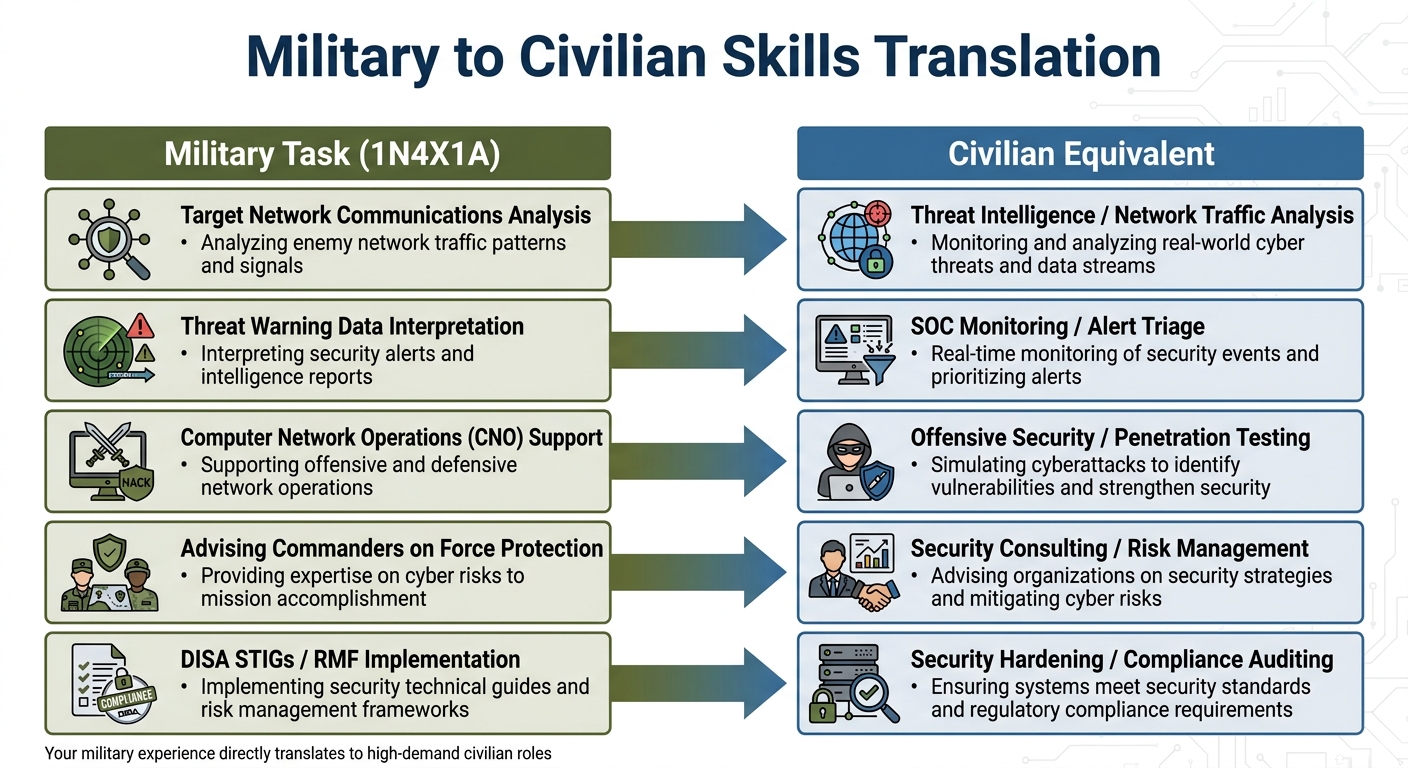
CTN Cryptologic Technician Networks to Cleared Cyber Career Guide

CyberSecJobs Editorial · April 21, 2026 ·

Career Paths • Cleared Cyber

CTN Cryptologic Technician Networks to Cleared Cyber Career Guide

Former Navy Cryptologic Technician Networks sailors enter the civilian market with something scarce: mission-grade experience in packet analysis, network defense, signals reporting, and operations conducted under real security controls. That combination travels well. The question is not whether CTN experience maps to cleared cyber. It does. The question is which employers pay for it, which credentials matter, and how much of a premium survives the jump from uniformed service to the civilian side.

For 2026, the salary math is favorable. Entry-level cleared cyber roles broadly land in the $65,000 to $100,000 band, cleared SOC analysts often sit at $65,000 to $95,000 on the junior end, senior cleared SOC analysts can reach $100,000 to $155,000, and TS/SCI cyber analyst roles in the Washington market cluster around $130,000 to $170,000 with a verified average of $149,398 [1][2]. For a rate built around classified networks and reporting discipline, that is not an abstract opportunity. It is a fairly direct labor-market translation.

What does a Navy CTN actually do, and why does that background translate so well to cleared cyber careers?

CTNs sat at the intersection of network operations, intelligence support, and defensive analysis. In practice, that meant traffic analysis, anomaly identification, tool-driven collection, reporting on adversary activity, and work performed in tightly controlled environments where process mattered as much as speed. Civilian recruiters often flatten all military cyber into one category. Hiring managers do not. They know the difference between someone who merely held a clearance and someone who spent years inside classified mission systems handling real incidents, real telemetry, and real reporting chains.

That is why CTNs tend to map cleanly into roles that value disciplined analytical work over generic IT administration. The experience profile lines up with cleared SOC analyst jobs, cyber threat intelligence support, network defense, hunt operations, and certain mission-support roles for agencies and primes. It also fits the broader market described in CyberSecJobs.com’s cybersecurity jobs guide, where the best-paid cleared roles sit closest to government mission systems, not generic commercial help desk pipelines.

The rate’s institutional context matters too. CTNs traditionally supported the Navy’s information warfare enterprise, with operational links to Fleet Cyber Command, the numbered fleet structure, national cryptologic elements, and NSA-driven tasking. Many tours were shore-heavy compared with legacy sea-centric communities, but the work was not “office IT.” Shore assignments could mean national mission support, watchfloor operations, network exploitation support, or intelligence production; operational billets could place sailors closer to fleet collection requirements, direct support, or deployed mission teams. That mix is exactly what civilian employers mean when they ask for experience in mission operations rather than only enterprise support.

For employers, the attraction is simple. CTNs are already accustomed to classification rules, chain-of-custody discipline, ticketing and reporting rigor, and environments where a missed indicator matters. Those habits reduce training risk. In cleared hiring, reduced risk usually gets priced into the offer.

Which cleared civilian cyber roles are the best fit for former CTNs?

The strongest post-service landing spots are roles that preserve three CTN advantages: comfort inside classified networks, fluency with traffic and telemetry, and the ability to write useful analytic output. Former CTNs usually compete well for Tier 1 and Tier 2 SOC positions, cyber analyst roles supporting NSA or service cyber components, network defense analyst jobs, threat-hunting teams, and some security engineering jobs where packet work and operational understanding matter more than pure software development.

Civilian role Why CTNs fit Typical cleared pay band
SOC Analyst I / II Monitoring, alert triage, incident documentation, escalation discipline, packet familiarity $65,000-$95,000 junior; $100,000-$155,000 senior [1]
Cybersecurity Analyst, TS/SCI Mission reporting, classified tooling, intelligence-informed analysis $130,000-$170,000 in DC; verified average $149,398 [2]
Threat Hunter / Detection Analyst Behavioral analysis, indicator development, network-centric tradecraft Usually tracks upper SOC or analyst bands, often with TS premium
Security Engineer Operational understanding of detection stacks, sensors, boundary defense, and mission systems $110,000-$200,000 cleared [1]
Penetration Tester / mission operator support Useful when CTN experience includes adversary emulation, exploitation support, or advanced tooling $85,000-$190,000 cleared [1]

Not every CTN should target the same path. Sailors with watchfloor and incident rhythm usually move fastest into SOC, hunt, and cyber analyst seats. Those with stronger systems exposure, scripting, or tool engineering can stretch toward security engineering. Those with more intelligence production and reporting depth may fit agency support, targeting support, or mission analysis jobs better than corporate blue-team work. If you are calibrating expectations, the entry-level cybersecurity jobs guide is useful for understanding the floor, but many CTNs should not market themselves as true entry level. They are often junior in corporate title, not junior in operational maturity.

Practical rule: if your Navy work involved packet analysis, indicators, or classified network reporting, pitch yourself above generic entry-level IT. Former CTNs often land closer to early-career cleared cyber analyst or SOC II profiles than to help desk or desktop support.

What security clearances do CTNs typically hold, and how do TS/SCI and polygraph requirements affect hiring?

Many CTNs exit the Navy with clearance histories that materially improve hiring odds: Secret at the low end, Top Secret for many mission-aligned billets, and TS/SCI for those who spent time in the most sensitive environments. That matters because the cleared cyber labor market is segmented less by job title than by access. A candidate who can start on a TS/SCI requirement is competing in a smaller, better-paid pool than someone who needs to be sponsored from scratch.

The verified pay file used for this article shows the premium clearly. Relative to non-cleared baselines, Secret usually adds $10,000 to $20,000, Top Secret adds $20,000 to $35,000, TS/SCI adds $30,000 to $45,000, and TS/SCI with polygraph can push the premium to $40,000 to $60,000 [1]. Public data on clearance-specific pay is imperfect, but directionally the market is consistent: access compresses hiring time and raises compensation.

For former CTNs, the wrinkle is adjudicative freshness. Recruiters care about active status, recent use, SCI eligibility, and whether a polygraph will be required for the target billet. If your background aligns with national mission customers, study the requirements in the NSA cleared cyber analyst guide and the NSA TAO guide. Those paths pay well because the supply of technically credible candidates who can also clear the access gate is still limited.

None of this means CTNs should chase the highest clearance requirement blindly. A Secret-cleared or recently read-out sailor may still do very well with a defense prime, MSSP serving federal customers, or a contractor on a program with lower barriers to entry. But when two candidates look similar on paper, the one with cleaner access usually gets the faster callback.

Which NSA contractors and cleared employers value CTN experience the most?

The short answer is the employers doing work closest to intelligence collection, network defense, and cyber mission support. That includes NSA-adjacent contractors, large defense primes supporting Cyber Command and service cyber components, and specialized shops that staff analytic, engineering, and hunt functions on classified programs. The exact logo matters less than the customer set. If the contract serves NSA, Fleet Cyber Command, U.S. Cyber Command, or a service cryptologic organization, CTN experience is usually legible immediately.

That is why former CTNs often get traction with primes and large integrators supporting Meade, Fort Gordon/Eisenhower, San Antonio, Hawaii, and Norfolk-area missions. Employers in those corridors understand the rate’s vocabulary. They know what it means if you worked around Fleet Cyber tasking, supported national customers, rotated between shore-based intelligence environments and operational fleet support, or produced reporting under NSA-derived mission standards. You will spend less time explaining the value of your background and more time discussing whether your tooling and mission set match the opening.

There is also a geographic story. The highest civilian salaries remain concentrated where national security demand is densest. Washington-Baltimore remains the richest target for TS/SCI analysts, while San Antonio, Colorado Springs, Augusta, and parts of Virginia offer strong combinations of demand and relative affordability. If your search is wide, using the security clearance job finder alongside vertical guides on NSA and SOC roles is a more efficient move than applying randomly across commercial boards.

How much salary lift can CTNs expect when moving into cleared civilian cyber compared with non-cleared roles?

The gap is wide enough to matter. Public salary chatter often understates it because it averages together commercial companies, uncleared regional employers, and federal markets with very different economics. The better comparison for CTNs is between civilian roles that value their mission background and civilian roles that merely tolerate it.

Benchmark 2026 verified compensation What it means for CTNs
Entry-level cyber, broad market $55,000-$80,000 commercial; $65,000-$100,000 cleared [1] Clearance alone can move the floor materially higher
SOC analyst $55,000-$78,000 commercial Tier 1; $65,000-$95,000 cleared Tier 1 [1] CTNs usually price above raw newcomers because of operations experience
Senior SOC analyst $85,000-$120,000 commercial; $100,000-$155,000 cleared [1] The premium becomes more visible once mission context is proven
TS/SCI cyber analyst in DC $130,000-$170,000 range; $149,398 verified average [2] This is the band many experienced CTNs target
Cleared security engineer $110,000-$200,000 [1] Higher ceiling for CTNs with engineering depth or scripting skill

Set against federal pay, the private-side premium is also visible. 2026 GS-12 Step 5 in DC is $116,071, GS-13 Step 5 is $138,024, and GS-14 Step 5 is $163,104 [1]. Strong contractors can beat those levels, especially for TS/SCI work where time-to-fill is painful for employers. Not every sailor will jump straight into the top quartile, but a CTN with current access, coherent mission experience, and a decent civilian resume is entering a better market than most veterans imagine.

The trap is assuming all civilian offers are automatically superior. Some employers will try to benchmark you as “entry-level cyber” because you lack a civilian title history. Push back with specifics: mission systems supported, incident volume, reporting outputs, watchfloor tempo, toolsets, and clearance level. Salary compression usually starts when the candidate lets the employer define the experience too loosely.

Which certifications help CTNs bridge military experience into civilian cyber credibility fastest?

CTNs often have enough operational substance already. The certification question is therefore not “how do I become credible?” but “which credential reduces hiring friction fastest?” For many employers, Security+ remains the compliance checkbox for junior and mid-level roles, especially on DoD-oriented contracts. The site’s Security+ guide for cleared entry-level roles is still relevant even for experienced veterans because the credential solves procurement language and 8140 mapping problems quickly.

After that, the best next move depends on target role. For SOC, detection, and defensive analysis, CySA+ is often the cleanest bridge because it signals practical blue-team fluency rather than generic theory. For CTNs moving toward leadership, architecture, or broader credibility across employers, CISSP still has labor-market weight. For exploitative, offensive, or highly technical engineering tracks, role-specific training and demonstrable scripting may matter more than collecting a long row of logos.

  • Security+: best for contract eligibility language, 8140 alignment, and broad employer recognition.
  • CySA+: strong bridge for SOC, hunt, and incident-response oriented CTNs.
  • CISSP: useful when you want to be priced for broader senior analyst, engineer, or lead roles.
  • Platform-specific proof: Splunk, Elastic, Sentinel, or scripting projects can matter more than another generalist badge.

The mistake is over-certifying before translating experience. A CTN with sharp resume language and one well-chosen certification is usually more marketable than a CTN with four certifications and a vague description of what they actually did.

How should CTNs position their Navy experience on a resume, LinkedIn profile, and interviews to win cleared cyber offers?

Translate mission, not jargon. Civilian recruiters do not need every internal acronym; they need a clear picture of systems touched, decisions made, and outcomes delivered. “Supported SIGINT operations” is weaker than “analyzed network activity in classified environments, identified anomalous traffic patterns, and produced reporting used by senior mission stakeholders.” The latter gives a recruiter something to map to a requisition.

Start with a headline that does real work: TS/SCI-cleared cyber analyst with Navy CTN background in network analysis, incident reporting, and classified mission support. Then add bullets that show scale and specificity without crossing security lines. Mention watchfloor operations, network telemetry, incident triage, reporting cadence, sensor or SIEM familiarity, scripting if relevant, and whether you supported fleet operations, national customers, or shore-based cryptologic missions. If you need a structured civilianization checklist, the veteran cyber job-search checklist is the better model than generic military-transition advice.

On LinkedIn, do not hide the clearance. Put it near the top. Recruiters search for it. In interviews, be ready for a short explanation of Fleet Cyber Command, NSA-linked tasking, and the rate’s shore-versus-operational balance. The goal is to make your background sound specialized, not obscure. A useful framing sentence is that CTN work combined classified network operations, analytical reporting, and mission support for fleet and national security customers. Most cleared employers understand the rest.

Finally, do not undersell the transition. Former CTNs are not learning security from scratch. They are translating a classified operating model into a commercial hiring language. That is a very different problem, and a much easier one to solve.

FAQ

Can a former CTN skip entry-level cyber jobs?

Often, yes. Many CTNs are better positioned for junior-to-mid cleared analyst, SOC II, or mission support roles rather than generic help desk or low-end IT support, especially if they leave service with current TS or TS/SCI access.

How much more is TS/SCI worth than Secret in cleared cyber hiring?

The verified 2026 salary file used here shows Secret commonly adding $10,000 to $20,000 over uncleared baselines, while TS/SCI more often adds $30,000 to $45,000, with a larger premium when a polygraph is required [1].

Which certification should a CTN get first?

If you do not already have it, Security+ remains the quickest broadly useful credential for DoD-oriented hiring. For analyst and SOC paths, CySA+ is often the next best signal because it maps closely to defensive operations work.

Sources
[1] cybersecjobs.com, verified-salaries-2026.json, pulled 2026-04-16 from OPM 2026 GS tables, ZipRecruiter, PayScale, Glassdoor, Salary.com, Programs.com, EpicDetect.io, and CyberSecJobs internal salary verification notes.
[2] ZipRecruiter and CyberSecJobs verified data, TS/SCI cyber analyst, Washington, DC average $149,398, referenced in verified-salaries-2026.json.


3D0X3 Cyber Surety to Cleared Civilian Career Guide

CyberSecJobs Editorial · April 21, 2026 ·

If you’re transitioning from a 3D0X3 Cyber Surety role in the Air Force to a civilian cybersecurity career, you’re in high demand. With 3.5 million unfilled cybersecurity positions worldwide and 33% job growth projected through 2033, your experience managing secure networks and holding an active security clearance makes you a standout candidate. Here’s what you need to know:

  • Top Certifications: Start with CompTIA Security+ ($404), which meets DoD 8140 requirements. Add certifications like CySA+, CISSP, or CEH to expand your opportunities.
  • Salary Potential: Cleared professionals earn 20%–40% more, with salaries ranging from $70,000 to $145,000. A TS/SCI clearance can add $15,000 to $30,000 to your pay.
  • Translating Skills: Frame military experience in civilian terms. For example, replace "ACAS" with "Tenable Nessus" and "STIGs" with "security configuration hardening."
  • Key Employers: Companies like Booz Allen Hamilton, Leidos, and Northrop Grumman actively seek veterans with cybersecurity expertise.

Act quickly – your security clearance remains active for 24 months post-separation. This guide outlines certifications, resume tips, and job search strategies to help you secure a civilian cybersecurity role.

Military Cybersecurity to Civilian Cybersecurity my transition

sbb-itb-bf7aa6b

What Does a 3D0X3 Cyber Surety Specialist Do?

As a 3D0X3 Cyber Surety specialist, you play a crucial role in safeguarding the Air Force’s Information Assurance (IA) program. This program spans Communications Security (COMSEC), Emissions Security (EMSEC), and Computer Security (COMPUSEC) [7]. Your job involves managing the Certification and Accreditation (C&A) process, ensuring all IT systems are secure before they’re deployed [7]. You also conduct evaluations to pinpoint security gaps and suggest solutions, serving as the Air Force’s frontline defense for protecting sensitive information systems.

Main Duties of 3D0X3 Cyber Surety

Your primary responsibilities revolve around administering the IA program, which includes protecting telecommunications systems under national and DoD guidelines [7]. Key tasks include:

  • Conducting cybersecurity audits and risk assessments using tools like ACAS (Tenable Nessus).
  • Enforcing DISA STIGs to ensure secure system configurations [7][6].
  • Deploying and managing real-time intrusion detection systems and firewalls.
  • Investigating security breaches through IT forensics, identifying causes, and preventing future incidents [1][7].

These responsibilities prepare you for civilian jobs in areas like compliance auditing, vulnerability management, and security operations center (SOC) analysis – fields in high demand within the defense and private sectors.

Your role also involves proactive and reactive defense measures, such as monitoring networks for threats and responding to incidents in real-time [7]. This hands-on experience, often at an enterprise scale supporting 500,000+ users, sets you apart from civilian counterparts who may lack practical exposure to live threats [6]. It’s this combination of technical expertise and real-world application that makes you a standout candidate for cybersecurity roles outside the military.

Training and Certifications for 3D0X3 Personnel

Becoming a 3D0X3 specialist requires meeting rigorous entry standards. You’ll need to achieve at least a 60 on the Cyber test, 57 on the EDPT, and 55 on the Electrical portion of the ASVAB – or alternatively, a 64 General score combined with a 57 EDPT [1]. After Basic Military Training, you’ll undergo around 14 weeks of technical training at Keesler Air Force Base in Biloxi, Mississippi [1]. This training covers everything from Air Force information systems and network protocols to solving technical problems and addressing security breaches [1].

To meet DoD 8570 IAT Level II requirements, you’ll typically earn a CompTIA Security+ certification, which costs about $400 but is funded by the Air Force Credentialing Opportunities On-Line (COOL) program [5][6]. This funding saves you significant out-of-pocket expenses and positions you for civilian IT roles. Depending on your duties, additional certifications like CCNA Security may also be required [5].

Why Security Clearance Matters

A Top Secret (SSBI) security clearance is essential for the 3D0X3 role and becomes a valuable asset during your transition to civilian life [1][7]. However, this clearance remains active for only 24 months after separation unless you secure a position requiring it. If it lapses, reactivating it involves a costly and time-consuming re-investigation [3][4].

"An active or recent security clearance is worth tens of thousands of dollars and months of time to an employer. They don’t have to sponsor you for one." – Brad Tachi, CEO, Best Military Resume [5]

The cleared cybersecurity market offers salaries 20% to 40% higher than commercial rates, with a TS/SCI clearance adding an extra $15,000 to $30,000 to your starting pay [8][4]. Cleared professionals also enjoy greater job security, as layoffs are less common in the defense sector [8]. While many roles require work in a Sensitive Compartmented Information Facility (SCIF) – limiting remote options – the higher compensation often offsets this restriction [8]. This clearance makes you an attractive candidate for defense contractors and federal agencies looking for pre-cleared talent.

How 3D0X3 Skills Transfer to Civilian Jobs

3D0X3 Military Skills to Civilian Cybersecurity Jobs Translation Guide

3D0X3 Military Skills to Civilian Cybersecurity Jobs Translation Guide

Your 3D0X3 background equips you with the expertise that civilian cybersecurity roles demand. The defensive security practices you’ve mastered – like vulnerability assessments, compliance checks, and incident response – are highly sought after by employers. The key is framing these skills in terms that resonate with civilian hiring managers.

Skills That Transfer to Civilian Work

The technical skills you’ve developed align closely with civilian cybersecurity needs. For example, your experience with the Risk Management Framework (RMF) is particularly valuable, as government contractors often use the same process for system authorizations. Similarly, managing COMSEC operations in the military translates into handling cryptographic key management and encryption security, which are essential in industries like defense and finance. Your IT forensics and incident response expertise also set you up well for roles such as SOC analyst or incident responder, where tasks like monitoring alerts and analyzing threats are critical.

What sets you apart is not just your technical knowledge but also your ability to work under pressure and your experience with large-scale enterprise networks. These qualities make you a strong candidate for roles such as SOC analyst or Information System Security Officer (ISSO), where real-world problem-solving is valued over theoretical knowledge.

Civilian Job Titles That Match 3D0X3 Experience

Your military experience directly aligns with several civilian job roles, such as:

  • Cybersecurity Analyst: Monitors security alerts and performs risk assessments.
  • Information System Security Officer (ISSO): Oversees system authorizations and RMF processes.
  • GRC Analyst: Handles risk assessments, compliance audits, and detailed documentation.
  • Vulnerability Analyst: Conducts scans and prioritizes remediation, much like the ACAS scanning you’ve done.
  • IT Compliance Specialist: Ensures systems meet security standards, reflecting your experience with STIG enforcement.

Top defense contractors like Booz Allen Hamilton, SAIC, Leidos, Peraton, and BAE Systems actively seek veterans with security clearances for these positions.

The earning potential is also promising. Entry-level cybersecurity analysts with a Security+ certification can earn between $55,000 and $75,000 within six months of leaving the military [2]. Cleared positions often pay 20–40% more. In 2022, the median salary for Information Security Analysts reached $112,000, with job growth projected at 33% through 2033 [1].

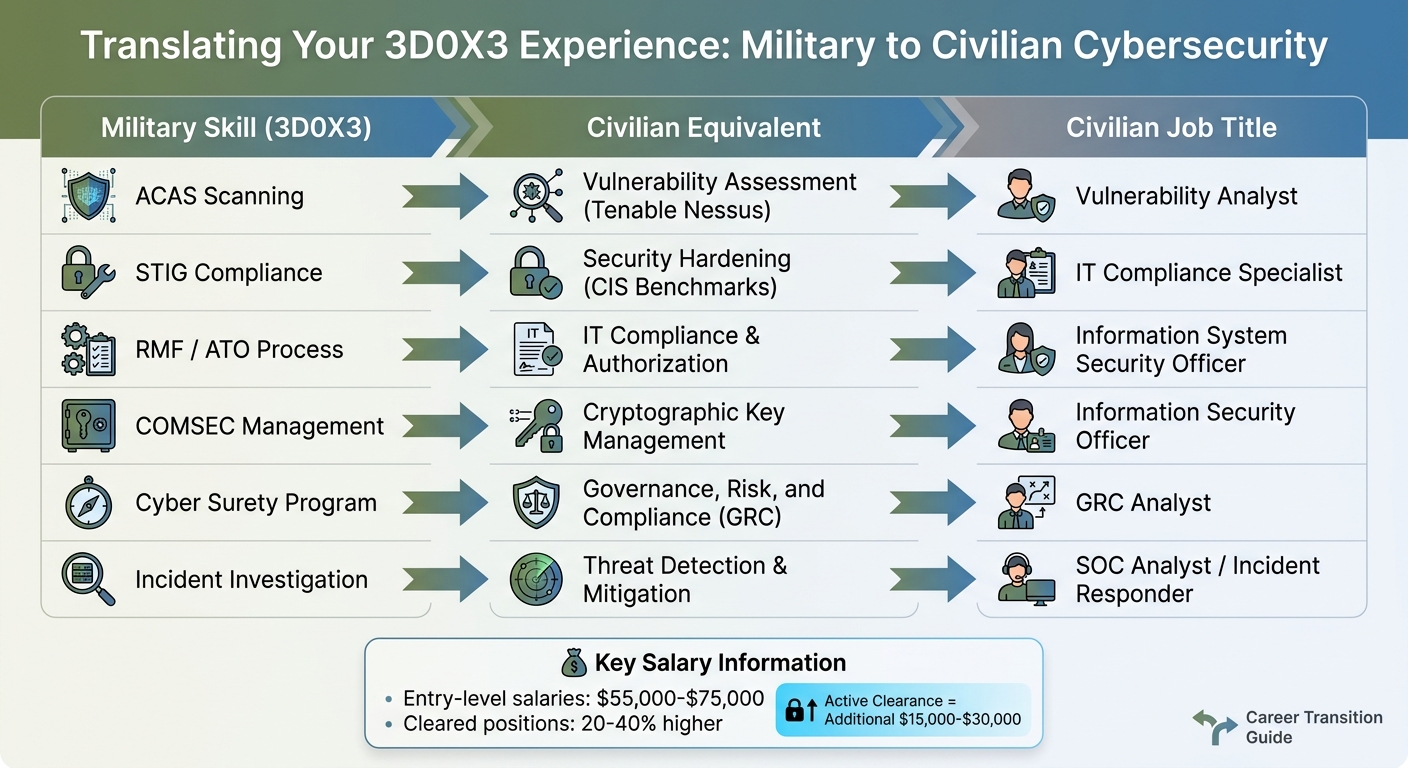
To succeed in civilian job applications, it’s essential to translate military terminology into civilian language. The table below provides a clear comparison between your military skills and their civilian equivalents.

Military Skills to Civilian Job Requirements Comparison

Military Skill (3D0X3) Civilian Equivalent Civilian Job Title
ACAS Scanning Vulnerability Assessment (Tenable Nessus) Vulnerability Analyst
STIG Compliance Security Hardening (CIS Benchmarks) IT Compliance Specialist
RMF / ATO Process IT Compliance & Authorization Information System Security Officer
COMSEC Management Cryptographic Key Management Information Security Officer
Cyber Surety Program Governance, Risk, and Compliance (GRC) GRC Analyst
Incident Investigation Threat Detection & Mitigation SOC Analyst / Incident Responder

When describing your experience, focus on measurable achievements. For example, instead of saying you "secured a network", you could highlight that you "managed network security for 2,400 users across three installations, maintaining 99.7% uptime." Replace military-specific terms with civilian equivalents – e.g., "AFNet" becomes "enterprise-wide network supporting 500,000+ users." These adjustments not only make your resume more relatable but also improve its chances of passing Applicant Tracking Systems (ATS) and catching the attention of hiring managers.

Certifications That Improve Your Job Prospects

Certifications are often a must-have for cleared cybersecurity positions. Under the DoD 8140 framework (previously known as 8570), specific certifications are tied to different job levels, essentially making them your ticket to accessing the cleared job market. While your military background as a 3D0X3 Cyber Surety specialist already demonstrates your expertise, certifications help translate that experience into qualifications that civilian employers recognize. Below, we break down key certifications, their timelines, and costs to help you make a smooth transition.

Top Certifications for Cleared Cybersecurity Jobs

If you’re aiming for a DoD 8140 IAT Level II role, CompTIA Security+ is the go-to certification. At a cost of about $404, most 3D0X3 specialists can prepare for this in just 4–8 weeks, thanks to their existing knowledge base.

For those looking to specialize in defensive security roles like SOC analyst or incident responder, CompTIA CySA+ is a great next step. This certification, also priced around $404, builds on your defensive security skills. On the other hand, CISSP is highly sought after for management and architecture roles. Though it requires five years of relevant experience (military service counts), it’s considered a career-defining credential. The exam costs $749, and CISSP-certified professionals often earn salaries exceeding $130,000.

"One of our Army Signal NCOs went from E-6 to a $115K SOC analyst role in eight months. Security+ got him in the door. CySA+ got him the offer over other candidates. The clearance sealed it."
– Brad Tachi, Navy Veteran & BMR Founder

For roles in offensive security, CEH (Certified Ethical Hacker) is a recognized option that meets DoD compliance standards, though it comes with a heftier price tag of $1,199. For those aiming to stand out in penetration testing, OSCP (Offensive Security Certified Professional) is highly regarded by technical hiring managers. Starting at $1,599, it’s an investment but pays off in advanced technical roles.

Cloud security is another booming area. Certifications like AWS Certified Security Specialty and CCSP (Certified Cloud Security Professional) are increasingly valuable as federal agencies continue to adopt cloud technologies. CCSP, for instance, costs around $599 and is ideal for cloud security-focused roles.

How Long Certifications Take and What They Cost

Planning your study time and budget is crucial. Here’s a quick breakdown of some of the most popular certifications:

  • Security+: 4–8 weeks of preparation, exam cost of $404
  • CySA+: 6–10 weeks of study, priced between $392 and $404
  • CISSP: 8–16 weeks of preparation, with an exam fee of $749
  • CEH: 6–10 weeks of study, costing $1,199
  • OSCP: 3–6 months of preparation, starting at $1,599

If you’re still on active duty, funding programs can help offset these costs. After leaving the military, programs like VET TEC not only cover high-tech training but may also provide a housing allowance, saving you thousands of dollars and speeding up your transition.

Certification Exam Cost Study Time Target Role
CompTIA Security+ $404 4–8 weeks Entry-level Security/Admin
CompTIA CySA+ $404 6–10 weeks SOC Analyst / Incident Responder
CISSP $749 8–16 weeks Security Manager / Architect
CEH $1,199 6–10 weeks Penetration Tester
OSCP $1,599+ 3–6 months Advanced Penetration Tester
CCSP $599 8–12 weeks Cloud Security Engineer

When paired with your military background and active clearance, these certifications can significantly boost your earning potential and reduce the time it takes to land your next role in the civilian cybersecurity sector.

How to Use Cleared Cyber Security Jobs for Your Job Search

With your certifications and polished credentials, you can connect directly with employers who need your expertise. If you have an active clearance, this platform is designed specifically for professionals like you – especially veterans seeking cybersecurity roles in government or contracting. Cleared Cyber Security Jobs eliminates middlemen, giving you direct access to federal agencies and government contractors.

By leveraging your certifications and an updated resume, you can tap into federal and contractor opportunities through this specialized platform.

Job Search Tools and How to Use Them

Start by building a complete profile. Keep in mind that employers will often review your profile before your resume, so ensure sections like "Key Skills" and "Ideal Work Locations" are filled out with precise terms hiring managers are likely to search for. Mention specific roles like ISSO or ISSM, and include certifications such as Security+ or CySA+.

Use filters to refine your search by location, clearance level, and job title. If you hold a Top Secret clearance, don’t forget to include Secret-level positions in your search – this can reveal additional opportunities. When filtering by location, it’s better to use a Zip Code and a mileage radius rather than just a city name. This way, you won’t miss jobs listed near military bases or in surrounding suburbs.

Set up daily Job Alerts to stay updated on new postings. To broaden your search, use Boolean logic. For example, enclose phrases like "Information Assurance" in quotation marks to find exact matches, and use OR to link related terms, such as "ISSO" OR "ISSM."

Take advantage of privacy settings to control how your profile is seen. You can mark it as "Active", stay "Anonymous", or even block specific employers. Regularly updating your profile can help you stay visible and prioritized by recruiters.

These tools make your job search more efficient while increasing your visibility to top hiring managers.

What Job Seekers Get from the Platform

Cleared Cyber Security Jobs isn’t just about job postings – it also offers exclusive Cleared Job Fairs. These events, held both in-person and virtually, allow you to interact directly with recruiters who understand the value of your clearance.

The platform also provides career resources tailored for veterans transitioning to civilian roles. These include salary guides, resume tips, and newsletters focused on relevant skills. Additionally, you can use the platform as a research tool to analyze job market trends – like which employers are hiring in your area or which certifications are in demand.

Job Seeker vs. Employer Features Comparison

Feature Job Seeker Benefits Employer Benefits
Job Postings Access cleared-only roles and apply directly Post jobs to reach pre-screened talent
Resume/Profile Upload your resume and create a searchable profile Search a database of highly qualified cleared professionals
Job Fairs Meet recruiters face-to-face or online Connect directly with top-tier candidates
Search Tools Use filters, Boolean searches, and alerts Simplify sourcing with streamlined tools
Privacy Stay anonymous or block specific employers Only direct-hire employers are allowed on the platform
Resources Get career advice, salary insights, and newsletters Receive hands-on, proactive customer support

Cleared professionals can access the platform for free, as long as they are U.S. citizens with an active or current security clearance. By connecting directly with decision-makers, you can simplify your job search, speed up the hiring process, and find roles that align with your skills and goals.

How to Write Your Resume and Prepare for Interviews

Your resume is the key to translating your military service into a format that civilian hiring managers can quickly understand. With recruiters spending just six seconds on initial resume reviews [3], every detail matters.

Converting Military Experience to Civilian Resume Language

Start by swapping military-specific language for civilian job titles and terms. For instance, instead of "Staff Sergeant, 3D0X3 Cyber Surety", use titles like Cybersecurity Analyst, Compliance Manager, or Information Security Specialist [6][9]. This makes your experience instantly relatable to recruiters.

A helpful approach is the "Function-First" formula: describe what you did and the scale of your responsibility. For example, "Cyber Surety Specialist" could become "Information Security Analyst managing compliance for a 5,000-user enterprise network" [9].

Translate military tools and processes into their civilian equivalents. For example:

  • ACAS → "Tenable Nessus Vulnerability Assessment"
  • DISA STIGs → "Security Hardening Standards (CIS Benchmarks)"
  • COMSEC Accountability → "Cryptographic Asset Management" [6][3]

If you performed ISSO or IAM duties, present them as roles like "Information Security Officer" or "Compliance Manager" [3].

Quantify your achievements using the CAR method (Challenge, Action, Result). Avoid vague descriptions like "Conducted vulnerability scans." Instead, say something like, "Identified 3,400+ vulnerabilities using Nessus and achieved 95% compliance within 90 days" [4][9]. Include measurable results – such as compliance rates, systems secured, or the value of assets managed.

For classified work, focus on the complexity and scope without revealing sensitive details. For instance, describe a "15,000-node multi-enclave network" or "security management for a distributed enterprise environment" [4].

Don’t forget to highlight your security clearance at the top of your resume. A TS/SCI clearance can increase your salary by $15,000 to $30,000 [4][3] and saves employers between $5,000 and $15,000 in clearance sponsorship costs, along with 6 to 18 months of processing time [4][3].

"Your military experience puts you above entry-level – don’t let impostor syndrome push you into a role that’s two tiers below your actual capability." – Brad Tachi, CEO, Best Military Resume [4]

Adopt a two-resume strategy:

  • Use a detailed, multi-page resume for federal jobs through USAJOBS. These resumes require specifics like hours worked per week and supervisor contact information.
  • Create a concise, 1-2 page resume for corporate and contractor roles, focusing on achievements and results [9][3].

Finally, list unclassified tools and frameworks you’ve used, such as Splunk, Wireshark, Nessus, and NIST standards. These keywords help your resume pass Applicant Tracking Systems (ATS) [4][3].

Preparing for Cleared Cybersecurity Interviews

Building on your resume, your interview strategy will demonstrate your readiness for civilian cybersecurity roles. Cleared cybersecurity interviews often emphasize technical expertise and your ability to operate within classified environments.

Expect questions about specific tools and frameworks you’ve worked with, such as Splunk, Nessus, ACAS, Wireshark, and NIST/RMF frameworks [4][6][3]. Be prepared to explain how you used these tools to address security challenges.

When discussing classified work, avoid sharing sensitive details. Instead, focus on the scope and impact of your responsibilities. For example, say "managed security for a 15,000-node enterprise network" or "conducted threat hunting across multi-enclave environments" [4][3].

Interviewers will likely ask about incident response and problem-solving under pressure [4][3]. Frame your answers to highlight both your technical skills and the broader impact of your actions. For instance, instead of saying "ran scans", explain how you "reduced organizational risk by identifying critical vulnerabilities before exploitation" [4][6].

Use civilian terms to describe your experience. Replace "NCOIC" with "Manager" or "Supervisor", and "COMSEC" with "Cryptographic Security" [10][3]. Similarly, swap "SIPR/NIPR" for "Classified/Unclassified enterprise networks" and "Deployment" for "Project Implementation" or "System Integration" [10][3].

Make sure to mention your clearance status early in the conversation. This can save employers significant time and money [4][3]. With cybersecurity roles projected to grow 33% by 2033, creating around 17,300 new positions annually [3], your skills and clearance make you highly competitive.

"If you have an active TS/SCI and operational cyber experience, you are in a seller’s market. Multiple employers will compete for you." – Brad Tachi, CEO, Best Military Resume [4]

Many cleared roles require hands-on technical assessments. Platforms like TryHackMe or HackTheBox can help you sharpen your practical skills [4]. Be ready to discuss how your experience with compliance frameworks, like DISA STIGs, aligns with civilian standards such as CIS Benchmarks [6][3].

Step-by-Step Job Application Process

Once your resume and interview prep are solid, follow these steps to land your next role:

  • Start 12 to 18 months before separation [4]. Use this time to earn certifications like Security+, CISSP, or CySA+, potentially through programs like Air Force COOL [6].
  • Tailor your resume for each job posting by mirroring keywords from the job description. For example, if the job mentions "SIEM administration", use that exact phrase instead of "security event monitoring" [3][10]. This boosts your chances of passing ATS and catching recruiters’ attention.
  • Upload your resume to platforms like Cleared Cyber Security Jobs. Fill out your profile completely, including sections like "Key Skills" and "Ideal Work Locations." Use precise terms that hiring managers search for, such as ISSO, ISSM, or certifications like Security+ or CySA+.
  • Apply to positions that match your clearance level and experience. If you hold a Top Secret clearance, don’t hesitate to include Secret-level roles to expand your opportunities. Use Boolean search features to find exact matches for terms like "Information Assurance" or "ISSO" OR "ISSM."
  • Take advantage of career resources offered by Cleared Cyber Security Jobs, including salary guides and veteran-focused resume tips. Attend both virtual and in-person cleared job fairs to connect directly with recruiters who understand the value of your military experience and clearance.
  • Aim to secure a cleared role within 24 months of separation to keep your clearance active in the system [3].

Key Points for a Successful Transition

If you have a 3D0X3 Cyber Surety background, you’re already well-prepared for roles in Governance, Risk, and Compliance (GRC), such as an Information System Security Officer (ISSO) or GRC Analyst. These positions focus on applying the Risk Management Framework (RMF) and ensuring security controls are maintained. Employers in these fields highly value practical experience with DISA STIG compliance, ACAS vulnerability scanning, and working within established compliance frameworks[8][3].

CompTIA Security+ is a must-have certification, as it satisfies DoD 8140 requirements and is often fully funded through Air Force COOL. Another critical asset is maintaining an active security clearance. It’s a major advantage because it saves employers both time and money. Keep in mind that clearances expire after 24 months of inactivity, so securing a cleared position as soon as possible is essential.

To streamline your transition, platforms like Cleared Cyber Security Jobs provide valuable tools. You can upload your resume, set job alerts, and use search filters to find positions that align with your clearance level and experience. The platform also offers resources like the Cybersecurity Salary Guide and Career Path Finder, which help you gauge your earning potential. On average, cleared professionals earn 20–40% more than their commercial counterparts, and holding a TS/SCI clearance could add an extra $15,000 to $30,000 to your base salary[8][4]. Additionally, attending job fairs hosted by the platform allows you to connect directly with employers who value your military expertise.

To set yourself up for success, start planning your transition 12 to 18 months before separation. Securing at least the Security+ certification and targeting cleared roles will put you in a strong position. With 26% of cybersecurity roles expected to remain unfilled by 2026 and the field projected to grow 33% by 2033, your 3D0X3 experience and active clearance make you a standout candidate[8][3].

FAQs

Which cleared cyber jobs fit 3D0X3 best?

The 3D0X3 Cyber Surety role translates well to civilian careers such as Cybersecurity Analyst, Security Engineer, and Threat Intelligence Analyst. These positions require expertise in managing security systems, analyzing potential threats, and implementing robust security measures. Veterans with certifications like CISSP or Security+ and hands-on experience with NIST standards or SIEM tools are highly competitive candidates. With an active security clearance, salaries in these roles often range from $75,000 to $130,000 annually.

What should I do to keep my clearance active after separating?

A Secret clearance can be reinstated for up to 2 years after leaving a position. To ensure you remain eligible, it’s important to stay in touch with security agencies and keep your personal information current. When seeking new employment, confirm your clearance status with potential employers and complete any necessary steps for transfer or renewal within that 2-year period. If this window passes, you may need to undergo a new background investigation to regain your clearance.

What’s the fastest certification path to a cleared role?

The fastest path to landing a cleared cybersecurity role – especially for veterans – is earning entry-level certifications like CompTIA Security+ or Cisco CCNA. These certifications align closely with military experience, require a relatively short amount of study time, and showcase essential skills to potential employers. With a strong demand for cleared professionals and numerous open positions, these certifications provide an effective way to transition into the civilian cybersecurity workforce.

Related Blog Posts

  • Cyber Warfare Specialist Career Path for Cleared Military
  • Cleared Cyber Jobs at Army Cyber Command Complete Guide
  • 1B4X1 Cyber Warfare Operations to Cleared Civilian Career Guide
  • 3D0X2 Cyber Systems Operations to Cleared Civilian Career Guide

3D0X2 Cyber Systems Operations to Cleared Civilian Career Guide

CyberSecJobs Editorial · April 21, 2026 ·

If you’re transitioning from a 3D0X2 Cyber Systems Operations role in the Air Force to a civilian cybersecurity career, you’re in a strong position. Your technical expertise with systems like Windows Server, Active Directory, Linux, and Cisco networking is highly valued in the private sector. Civilian roles such as Systems Administrator, Cybersecurity Analyst, and Network Administrator align well with your experience. Here’s what you need to know:

  • Salary Potential: Cleared roles can pay $70,000–$145,000 annually, with TS/SCI clearances adding $15,000–$30,000 to your income.
  • Certifications: Start with Security+ (a baseline requirement) and consider advanced options like CySA+, CEH, or CISSP to boost earning potential.
  • Resume Tips: Translate military jargon into civilian terms, focus on measurable achievements, and highlight your security clearance prominently.
  • Job Market: The cybersecurity industry faces a talent shortage, with 3.5 million unfilled positions globally. Cleared roles often pay 20%–40% more than non-cleared ones.

Your hands-on experience managing enterprise-scale networks and securing classified systems makes you a sought-after candidate. With the right certifications and resume adjustments, you’ll be well-prepared to excel in the civilian cybersecurity field.

3D0X2 to Civilian Cybersecurity Career Transition Guide: Salaries, Certifications, and Job Roles

3D0X2 to Civilian Cybersecurity Career Transition Guide: Salaries, Certifications, and Job Roles

From Air Force IT Specialist to Civilian Cybersecurity Pro

sbb-itb-bf7aa6b

What 3D0X2 Cyber Systems Operations Involves

As a 3D0X2 Cyber Systems Operations specialist, you’re tasked with building, securing, and maintaining essential networks that support critical missions [9]. This role spans server administration, managing network infrastructure, and enforcing security measures across both classified and unclassified systems.

Your technical responsibilities include working with tools and systems like Windows Server (2016/2019), RHEL, Active Directory, and Cisco IOS devices. You also conduct vulnerability scans using ACAS, ensure compliance with DISA STIG standards, and manage services like DNS, DHCP, SAN, and PKI. Troubleshooting network outages is part of the job, as is developing scripts in PowerShell, Bash, or Python to automate tasks like compliance reporting and server provisioning – all while working rotating shifts.

But it’s not just about technical know-how. You’ll also engage in strategic planning, such as forecasting budgets for hardware and software, managing system capacity, and creating contingency plans for system restoration. On top of that, you’ll research system threats and design tactics, techniques, and procedures for both defensive and offensive cyber operations. While much of the work happens in climate-controlled environments, deployments to challenging locations are possible, where maintaining network uptime can directly affect combat missions.

This role combines hands-on technical expertise, security oversight, and operational problem-solving, giving you a skill set that’s highly sought after in the civilian cybersecurity field. The familiarity with these technologies ensures that your military experience translates effectively into cleared cybersecurity roles in the civilian world.

How 3D0X2 Skills Apply to Cleared Civilian Jobs

Your 3D0X2 background is a strong foundation for civilian cleared roles, but translating military terminology into civilian job language is key. By aligning your technical expertise with job posting keywords, you can effectively showcase your qualifications. For instance, if a job mentions "enterprise network administration", highlight your experience managing networks for over 500,000 users. Similarly, terms like "vulnerability assessment" connect directly to your ACAS scanning work, and "security configuration hardening" ties to your STIG compliance experience [2][6].

This approach helps target roles such as Systems Administrator, Cybersecurity Analyst, and Network Administrator. Understanding these connections will help you stand out in the job market.

Systems Administrator Positions

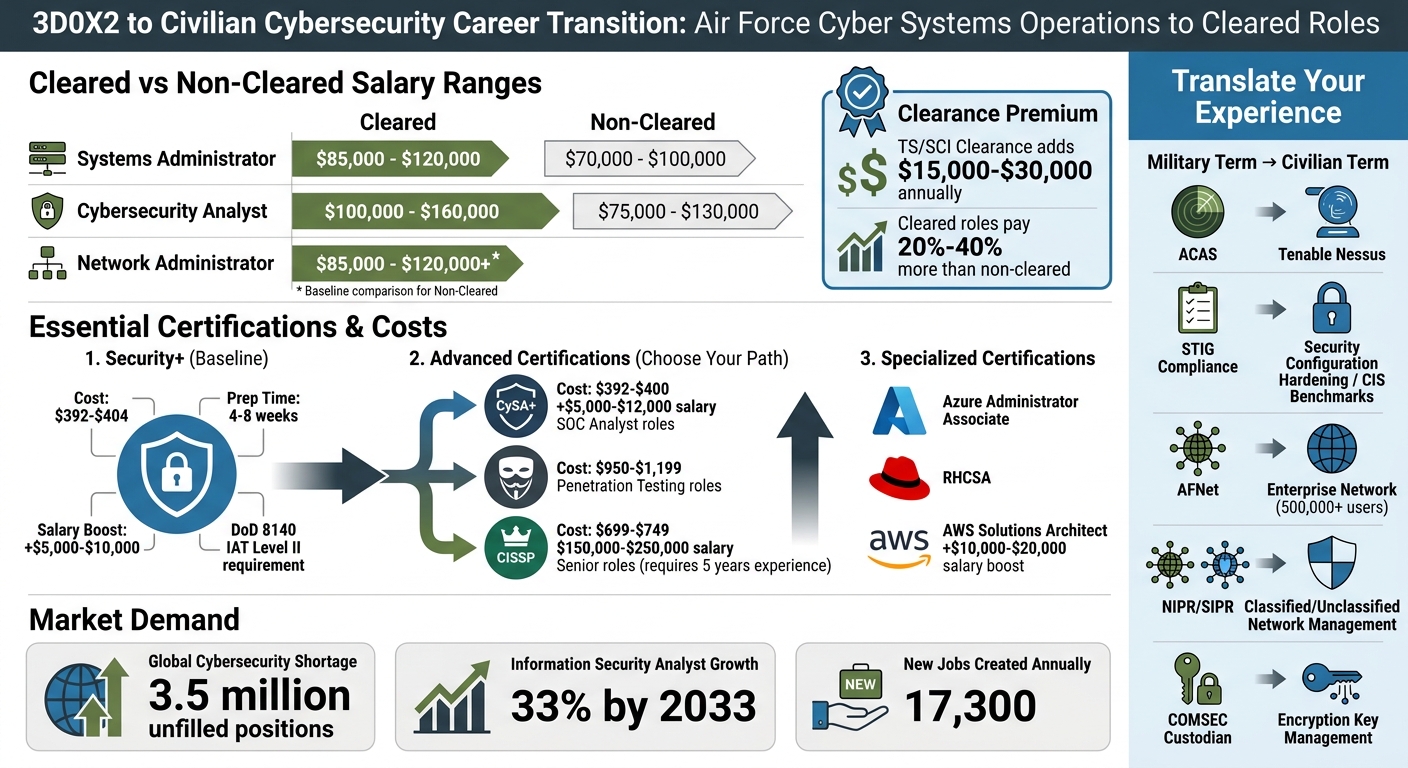
Your expertise in Windows Server, RHEL, Active Directory, Group Policy Objects, and server provisioning aligns naturally with Systems Administrator roles. Cleared positions in this field generally pay between $85,000 and $120,000 annually, compared to $70,000 to $100,000 for non-cleared roles.

When updating your resume, be specific. Instead of saying "managed AFNet infrastructure", you could write, "Administered 50+ servers supporting 4,500 users with 99.9% uptime" [2][4]. Including software versions like Windows Server 2016/2019 or RHEL 8 makes your experience more relevant to applicant tracking systems. Additionally, mentioning your work with virtualization tools like VMware and Hyper-V could open doors to Cloud Engineering or DevOps roles. If you’ve automated tasks using PowerShell or Bash, quantify the results – for example, "Reduced server provisioning time from 4 hours to 30 minutes through automation." Civilian employers value measurable outcomes.

Next, let’s look at how your skills apply to Cybersecurity Analyst positions.

Cybersecurity Analyst Positions

Your experience with ACAS vulnerability scanning directly translates to tools like Tenable Nessus, a common requirement for cybersecurity roles. Similarly, STIG compliance can be reframed as "security configuration baseline hardening" or "CIS Benchmark implementation" [2][6]. Cleared Cybersecurity Analyst positions typically offer salaries ranging from $100,000 to $160,000 annually, compared to $75,000 to $130,000 for non-cleared roles.

Your hands-on experience in incident response, patch management (IAVA/TCNO), and PKI management aligns with the core responsibilities of these roles. The need for information security analysts is growing rapidly, with a projected 33% increase by 2033, creating approximately 17,300 new jobs annually [5]. To make your resume stand out, use metrics like, "Performed weekly vulnerability assessments across 2,400 endpoints, achieving a 97% remediation rate within a 30-day compliance window" [5].

Your network-related skills also make you a strong candidate for Network Administrator roles.

Network Administrator Positions

Your expertise in configuring switches, managing VLANs, and troubleshooting WAN/LAN connectivity is a perfect match for civilian Network Administrator roles. Skills like network security monitoring and firewall management are especially valuable in cleared environments, where maintaining secure and reliable operations is critical. Salaries for cleared Network Administrator roles typically fall between $85,000 and $120,000+.

To effectively translate your experience, describe dual-enclave network operations (NIPR/SIPR) as "enterprise-wide classified and unclassified network management." Similarly, reframe COMSEC custodian responsibilities as "encryption key management" or "cryptographic security operations" [4][5].

Emphasize your experience in managing mission-critical infrastructure. Civilian candidates often lack exposure to environments where downtime has immediate consequences. Your ability to maintain operational discipline and perform under pressure is highly valued by defense contractors hiring for cleared positions.

Required Certifications for Cleared Cybersecurity Jobs

Certifications help translate military experience into credentials that civilian hiring managers and applicant tracking systems can easily recognize. If you hold an active TS/SCI clearance, you could see a salary boost of $15,000 to $30,000 annually[7][5]. Choosing certifications that align with your target role – whether as a systems administrator, cybersecurity analyst, or senior-level professional – is key to standing out.

Security+: The Baseline Requirement

CompTIA Security+ is often the first step for cleared cybersecurity roles. It meets DoD 8140 (formerly 8570) IAT Level II requirements, making it a common prerequisite for federal agencies and defense contractors[2][8]. The exam costs between $392 and $404, and most candidates prepare for it over four to eight weeks[10][3]. This certification effectively translates military operational experience into terms that resonate with civilian employers.

If you’re still in the military, consider using Air Force COOL funding to cover the exam cost, potentially saving $300 to $700[2]. For those already separated, the VA’s VET TEC program can cover certification training costs and even provide a housing allowance – without impacting your GI Bill benefits[8][5]. Earning Security+ certification could increase your salary by $5,000 to $10,000 compared to uncertified candidates[11].

"A certification cuts through that translation problem. When your resume says CompTIA Security+ or CISSP, a hiring manager immediately understands your knowledge base."
– Mike McNelis, Training Camp[10]

Once you’ve earned Security+, pursuing advanced certifications can further boost your expertise and earning potential.

Advanced Certifications: CySA+, CEH, and CISSP

CISSP

CompTIA CySA+ is ideal for those aiming for Security Operations Center (SOC) analyst roles. It emphasizes skills like threat detection, behavioral analytics, and incident response, making it a logical next step after Security+[8][11]. The exam costs around $392 to $400, and earning this certification can add $5,000 to $12,000 to your annual salary. This credential aligns well with job postings for SOC analysts and threat hunters.

Certified Ethical Hacker (CEH) is tailored for offensive security roles, such as vulnerability assessment and penetration testing. The exam costs between $950 and $1,199 and showcases your ability to think like an attacker[8][3].

For senior-level roles in security architecture and management, CISSP is the gold standard. It requires five years of professional experience, which your military service likely satisfies, and costs between $699 and $749[8][3]. CISSP-certified professionals in cleared roles often earn salaries ranging from $150,000 to $250,000 annually[7][3].

"One of our Army Signal NCOs went from E-6 to a $115K SOC analyst role in eight months. Security+ got him in the door. CySA+ got him the offer over other candidates. The clearance sealed it."
– Brad Tachi, Navy Veteran & BMR Founder[8]

For more specialized roles, targeted certifications can help validate your expertise.

Specialized Certifications: Azure Administrator and RHCSA

If your experience includes managing Windows Server, Active Directory, or RHEL, certifications can confirm your skills for civilian employers. The Azure Administrator Associate certifies your ability to manage Microsoft cloud infrastructures[2][10]. Similarly, the Red Hat Certified System Administrator (RHCSA) demonstrates your Linux expertise in a format that hiring managers immediately understand[2].

As companies move toward cloud-based systems, certifications like AWS Solutions Architect Associate or Azure Security Engineer have become increasingly important. These credentials can boost your salary by $10,000 to $20,000 and open doors to cloud engineering roles with salaries ranging from $120,000 to $170,000[7][11]. Starting your certification journey 12 to 18 months before leaving the military ensures you’re fully prepared to enter the civilian workforce with a strong credential stack[10].

How to Write a Resume for Cleared Jobs

When crafting a resume for cleared jobs, it’s critical to present your military experience in terms that civilian employers can understand. Recruiters typically spend just six seconds scanning a resume before deciding whether to read further [12][5]. This means clarity takes precedence over creativity. Start by listing your security clearance (e.g., TS/SCI or Secret) directly under your name, and repeat it in the skills section. Many defense contractors rely on applicant tracking systems to search for terms like "TS/SCI" as an initial screening step [14]. This straightforward approach ensures your qualifications are easy to spot and helps bridge the gap between military achievements and civilian job requirements.

Translate Military Jargon into Civilian Terms

Avoid military-specific terms and replace them with civilian equivalents. For instance, instead of "ACAS vulnerability scanning", use "Tenable Nessus vulnerability assessment." Similarly, swap "STIG compliance" for "security configuration hardening" or "CIS Benchmarks" [2]. If you’re describing AFNet, highlight its scale by calling it an "enterprise-wide network supporting 500,000+ users globally" [2]. Including specific versions of tools and systems, such as "Windows Server 2019" or "RHEL 8", also helps improve your resume’s match rate in applicant tracking systems [2]. These changes make your experience more relatable to civilian employers.

Focus on Quantifiable Achievements

Numbers speak louder than vague descriptions. Instead of saying you "managed network infrastructure", specify your impact: "maintained 99.9% uptime for 2,500 users" or "reduced ticket resolution time by 40% using PowerShell automation" [2][4]. Metrics like these clearly show the value you brought to your role in a way that resonates with civilian employers. For defense contractor positions, retain some military context, such as SCIF or OCONUS references. However, for corporate IT roles, strip out all military jargon and emphasize business-oriented outcomes [4]. These adjustments highlight your technical expertise while making your resume more accessible to civilian hiring managers.

"Keep subjective self-descriptions out of your summary section. I’m looking at you, Results-Oriented Team Players."
– Bill Branstetter, 9th Way Insignia [12]

Keep It Simple and Avoid Sensitive Details

Leave out classified project names, specific office sizes, or sensitive budget information [12]. Instead, describe the network environment in general terms, like "15,000-node network." Use a clean, single-column format without graphics, tables, or unusual fonts, as these can interfere with applicant tracking systems [15][16]. Organize your technical skills into clear categories such as "Operating Systems & Administration", "Network Infrastructure", and "Security Tools" [4]. Finally, have your resume reviewed by someone with a civilian perspective to ensure it hits the right notes [12][13].

Using Cleared Cyber Security Jobs to Find Positions

Cleared Cyber Security Jobs

On Cleared Cyber Security Jobs, employers check out your profile details before even glancing at your resume. To stand out, make sure your "Key Skills" and "Ideal Work Locations" sections are fully filled out. These details can significantly improve your visibility to potential employers [18].

Logging in regularly is another smart move. Each login updates your profile’s timestamp, which keeps your information appearing fresh in search results. As Ashley Jones, Blog Editor and Cleared Job Search Expert at ClearedJobs.Net, puts it:

"When you create a profile, a date is associated with your account. Each time you log in, that date is updated. That’s important because employers’ searches present what’s new or fresh at the top of their results" [18].

If you’re transitioning from a role like 3D0X2, reframe your experience using civilian job titles such as "Systems Administrator", "Cybersecurity Analyst", "Network Security Engineer", or "Cloud Engineer" [2]. To broaden your job search, use Boolean search operators like "Systems Administrator" OR "Cybersecurity Analyst" OR "Network Security Engineer." For location-based searches, enter a ZIP code with a mileage radius to find jobs near bases [18]. When filtering by clearance level, select all levels you’re eligible for. For example, if you hold a Top Secret clearance, include Secret-level filters too, as many roles accept either [18].

Set up Job Agents to get daily email alerts for new positions that match your preferences [17]. You can also fine-tune keywords through manual searches and save these as alerts. This way, you’ll be among the first to know when new opportunities pop up.

Additionally, the platform offers both in-person and virtual Cleared Job Fairs, where you can connect directly with recruiters from hiring companies [17]. These events are excellent for networking. If you’re concerned about privacy while job hunting, you can set your profile to "Anonymous", which highlights your skills but keeps your name hidden. There’s also a "Block Employers" feature to ensure your current employer doesn’t see your profile [18].

Using these search strategies and optimizing your profile can greatly enhance your chances of landing the right cleared cybersecurity role.

Preparing for Cleared Cybersecurity Interviews

With your resume polished, it’s time to shift focus to preparing for interviews tailored to cleared cybersecurity roles. While landing the interview is a big step, excelling in it requires a clear understanding of how these roles differ from others. One key point to remember: your security clearance is a major selling point, saving employers anywhere from $3,000 to $15,000 in sponsorship costs [14]. Be sure to highlight this as a key asset.

When discussing your clearance, keep it straightforward. Use terms like "Active Top Secret/SCI" or "Current Secret clearance." If you’ve completed a polygraph, specify whether it was Counter-Intelligence or Full-Scope, as this can significantly boost your market value [14]. However, never disclose sensitive details such as SCI compartments, codewords, classified program names, or investigation case numbers. Brad Tachi, CEO and Founder of Best Military Resume, advises:

"Your clearance can be verified through DISS (Defense Information System for Security) by a prospective employer’s security office without any information beyond your name and date of birth" [14].

If your clearance has expired, be transparent. You can describe it as "Previous [Level] clearance; reinvestigation eligible."

Crafting Success Stories

Prepare 5–7 success stories from your 3D0X2 experience that showcase your accomplishments without revealing classified information. Use a structured approach: describe the situation, the goal, the actions you took, and the measurable results. For instance, instead of saying "managed classified networks", you could say, "Administered a 50+ server environment supporting 4,500 users with 99.9% uptime across multiple security enclaves." Make an effort to translate military jargon into civilian terms – swap "ACAS" for "Tenable Nessus" or "STIGs" for "security baselines." This aligns with the focus on measurable outcomes that your resume should already reflect.

Anticipating Technical Questions

Be ready for technical questions covering cybersecurity fundamentals. Expect topics like the CIA triad (Confidentiality, Integrity, Availability), the OSI model, and the distinctions between IDS and IPS systems [19][20]. You should also practice explaining how you’ve secured systems, managed incidents, or automated tasks using tools such as PowerShell or Python. If you encounter a question you can’t answer, admit it honestly, research the topic afterward, and follow up with the hiring manager [19].

Researching Your Interviewers

Before the interview, ask the recruiter for the names of your interviewers and review their professional backgrounds. Understanding their roles and the contracts or agencies they support will help you tailor your responses and demonstrate genuine interest.

Post-Interview Etiquette

Just like your resume, your follow-up matters. Send a thank-you email to each interviewer within 24 hours. Use the opportunity to express gratitude, reaffirm your enthusiasm for the role, and leave a lasting positive impression. This small step reinforces your professionalism and keeps you fresh in their minds.

Conclusion

Transitioning from 3D0X2 Cyber Systems Operations to a civilian cybersecurity career is all about translating your military tech expertise into terms that resonate with civilian recruiters. Your hands-on experience with tools like Windows Server, Active Directory, and Linux directly aligns with roles such as Systems Administrator, Cybersecurity Analyst, and Cloud Engineer [2]. The key is to reframe your military experience in a way that civilian employers can easily understand and appreciate.

Once you’ve aligned your skills to civilian job descriptions, focus on certifications to validate your expertise. Certifications are non-negotiable in the cybersecurity field. Begin with Security+ to meet DoD 8570/8140 compliance requirements. From there, consider advancing to CySA+, CISSP, or cloud-specific certifications to further strengthen your resume [2]. Many military funding programs can help cover the costs of these certifications, so be sure to take advantage of those resources.

Your active security clearance is another critical asset. It can save potential employers between $5,000 and $15,000, while also boosting your earning potential by $10,000 to $30,000 annually [1][5]. To maximize this advantage, aim to secure a cleared position within 24 months of separating from the military, as maintaining an active clearance adds significant value to your profile. As Brad Tachi, CEO of Best Military Resume, advises:

"The cyber veterans I’ve seen transition most successfully are the ones who don’t settle for the first SOC analyst job offered to them. Your military experience puts you above entry-level" [7].

Finally, refine your job search strategy. Cleared Cyber Security Jobs is an excellent platform to connect directly with defense contractors like Booz Allen Hamilton, Leidos, and SAIC – companies that actively seek candidates with military backgrounds and active clearances [7]. Instead of relying on commercial job boards, which often filter resumes through automated systems, focus on the cleared job market. This niche not only values your unique experience but also offers salaries 20% to 40% higher than commercial positions [11].

FAQs

How do I explain 3D0X2 work in civilian terms?

In a nutshell, working in a 3D0X2 role means handling enterprise IT infrastructure, networks, and cybersecurity systems. Your responsibilities could include maintaining servers, setting up security protocols, managing network devices, and supporting essential IT operations.

For instance, you might describe your work like this: "Managed enterprise IT networks by configuring and maintaining servers, network devices, and security systems to ensure the high availability and security of critical infrastructure."

This type of experience directly aligns with positions such as systems administrator or cybersecurity analyst, making it a solid foundation for careers in IT and cybersecurity.

Which certs should I get after Security+?

After achieving Security+, you might want to explore certifications that align with your career goals. For advanced roles, the CISSP (Certified Information Systems Security Professional) is a strong choice. If penetration testing sparks your interest, consider the CEH (Certified Ethical Hacker).

For those aiming for higher-level positions, certifications like CISA (Certified Information Systems Auditor) or CISM (Certified Information Security Manager) stand out. These not only align with the DoD 8140 framework but also help demonstrate your expertise to civilian employers.

How can I keep my clearance active after separating?

To maintain your security clearance after separating, you’ll need an employer to sponsor it within 24 months. During this time, a Secret clearance remains inactive but can still be reinstated. However, if no sponsorship occurs within that window, your clearance will lapse, and you’ll need to undergo a new investigation. To avoid this, actively search for cleared job opportunities and connect with employers or contractors who can sponsor your clearance. This approach lets you bypass the hassle of restarting the process entirely.

Related Blog Posts

  • Cyber Warfare Specialist Career Path for Cleared Military
  • Cleared Cyber Jobs at 16th Air Force Complete Guide
  • 1B4X1 Cyber Warfare Operations to Cleared Civilian Career Guide
  • 1N4X1A Cyber Intel Fusion Analyst to Cleared Civilian Career Guide

1N4X1A Cyber Intel Fusion Analyst to Cleared Civilian Career Guide

CyberSecJobs Editorial · April 20, 2026 ·

Transitioning from a 1N4X1A Cyber Intel Fusion Analyst role in the military to a civilian cybersecurity career can be seamless if you plan ahead. With specialized skills and a TS/SCI clearance, you’re entering a high-demand job market where cybersecurity roles are projected to grow by 33% through 2033. Here’s what you need to know:

  • Key Advantage: Your clearance and hands-on expertise make you highly desirable. An active TS/SCI clearance alone can add $15,000–$40,000 to your salary.
  • Timing Matters: Your clearance must be reactivated within 24 months of leaving the military to avoid costly delays.
  • Certifications: Start with Security+ ($400), then pursue certifications like CySA+, CISSP, or OSCP based on your career goals.
  • Resume Tips: Translate military terms into civilian language, highlight tools like Splunk and Wireshark, and quantify achievements.
  • Networking: Use LinkedIn, join VetSec, and explore the DoD SkillBridge program for internships with top employers.
  • Top Employers: Defense contractors (e.g., Booz Allen Hamilton, Raytheon) and tech companies (e.g., AWS, Microsoft) actively hire veterans.

Act now: Begin preparing 12–18 months before separation to secure a cleared role and leverage your military experience for mid-level positions. With the right strategy, you can command salaries starting at $110,000 or more.

Veterans Panel: From Military to Cybersecurity Careers

sbb-itb-bf7aa6b

What 1N4X1A Cyber Intel Fusion Analysts Do

Military to Civilian Cybersecurity Skills Translation for 1N4X1A Analysts

Military to Civilian Cybersecurity Skills Translation for 1N4X1A Analysts

Primary Duties and Skills

As a 1N4X1A Cyber Intel Fusion Analyst, your role revolves around secretly gathering and analyzing intelligence from target network communications to uncover adversaries’ actions and future plans [5][6]. You identify key threat indicators, support Computer Network Operations (CNO), and extract critical intelligence to aid decision-makers [5].

Your technical expertise spans several critical areas. This includes analyzing network traffic anomalies to detect advanced persistent threats, conducting vulnerability assessments with tools like Nessus, and ensuring systems meet DISA STIGs – security standards mandated by the Department of Defense. You also handle the triaging of security alerts and coordinate appropriate responses to mitigate threats. Additionally, you manage Priority Intelligence Requirements (PIRs) and collaborate with collection assets to address intelligence gaps [2][3].

The foundation for this role is built during 135 days of intensive technical training at Goodfellow Air Force Base, TX, or Corry Station, FL [5]. Training covers structured analytic techniques, recognizing analytic biases, and all-source fusion, which combines signals intelligence (SIGINT), human intelligence (HUMINT), and geospatial intelligence (GEOINT) to form a comprehensive understanding of adversarial activities [7][3]. You also gain hands-on experience with tools like Splunk, ArcSight, Wireshark, Nessus, Palantir, DCGS-A, Analyst Notebook, ArcGIS, and the MITRE ATT&CK framework [2][3].

This position requires a Top Secret clearance, granted after a Single Scope Background Investigation (SSBI) and a polygraph test [5]. Holding such a clearance makes you highly attractive to civilian employers, as you’ve already cleared one of the toughest hurdles for high-paying, security-cleared positions.

These technical skills and experiences directly prepare you for various civilian cybersecurity roles.

How Military Experience Matches Civilian Job Requirements

The skills you develop as a 1N4X1A align perfectly with many in-demand civilian cybersecurity roles. Your military background translates seamlessly into roles such as Threat Intelligence Analyst, SOC Analyst, Incident Responder, and Security Engineer [2]. While the terminology may differ, the tasks are fundamentally the same.

Military Task (1N4X1A) Civilian Equivalent Skill/Role
Target Network Communications Analysis Threat Intelligence / Network Traffic Analysis
Threat Warning Data Interpretation SOC Monitoring / Alert Triage
Computer Network Operations (CNO) Support Offensive Security / Penetration Testing
Advising Commanders on Force Protection Security Consulting / Risk Management
DISA STIGs / RMF Implementation Security Hardening / Compliance Auditing

Your expertise with the Risk Management Framework (RMF) is especially valuable in government contracting, where similar authorization processes are required [2]. Likewise, your experience with DISA STIGs aligns with the security hardening standards used by civilian organizations to protect their networks.

The high-pressure environment you’ve thrived in – defending against real-world national security threats – translates exceptionally well to civilian Security Operations Centers (SOCs). Working in these demanding, fast-paced conditions has honed your ability to make rapid, effective decisions, a quality highly sought after in SOCs [4]. As Brad Tachi puts it, you’re entering "a seller’s market", where multiple employers will compete for your skills [2].

Getting Ready for Civilian Cybersecurity Work

Certifications That Matter for Cleared Jobs

If you’re transitioning into civilian cybersecurity, CompTIA Security+ should be your starting point. At $400, it’s the baseline certification for most federal and defense contractor roles under the DOD 8140 framework. You’ll see it listed as a core requirement for nearly every cleared cybersecurity job, especially for IAT Level II positions.

Once you’ve secured Security+, your next steps depend on your career goals. For aspiring SOC analysts, the CompTIA CySA+ (Cybersecurity Analyst) certification is a logical next step, also priced at $400. If you’re staying in intelligence-focused roles, the GIAC Cyber Threat Intelligence (GCTI) certification will validate your analytical skills. On the other hand, if penetration testing piques your interest, consider the Offensive Security Certified Professional (OSCP). This challenging 24-hour hands-on exam costs $1,599+ and proves your ability to handle real-world scenarios.

For those aiming for senior roles, the CISSP remains the industry standard. At $699, it opens doors to positions in security architecture and management. Planning ahead is key – start preparing for certifications 12–18 months before leaving the military. Programs like the VA’s VET TEC can cover certification prep costs without affecting your GI Bill benefits. You can also access free training through the Federal Virtual Training Environment (FedVTE) or take advantage of the Onward to Opportunity (O2O) program, which offers free courses and exam vouchers for certifications like CompTIA, Cisco, and AWS.

Target Civilian Role Recommended Certifications
Threat Intelligence Analyst Security+, GCTI, CEH
SOC Analyst Security+, CySA+
Penetration Tester OSCP, CEH, GPEN
Security Manager/Director CISSP, CISM
Cloud Security Engineer CCSP, AWS Certified Security Specialty, Azure Security Engineer

Once you’ve tackled certifications, the next step is adapting your military experience for civilian resumes.

Converting Military Experience to Civilian Resume Language

Your TS/SCI clearance is a valuable asset – place it prominently at the top of your resume in searchable text to ensure recruiters can find it.

When describing your experience, replace military ranks with civilian-friendly titles. For instance, instead of "Staff Sergeant", use "Operations Supervisor" and include specifics about your role, like "managed an 8-person team." Translate technical terms into language that resonates with civilian employers. For example, use "threat intelligence" instead of "signals analysis" or "vulnerability assessment" instead of "network characterization." Avoid acronyms like NCOIC, OCONUS, or FRAGO, as they might confuse hiring managers.

Structure your achievements using the CAR method (Challenge, Action, Result). For example, instead of simply stating, "Performed network analysis", say, "Triaged 200+ security alerts daily across a 15,000-node enterprise network, reducing mean time to detection by 40%." Quantify your results wherever possible – metrics like the number of users supported or downtime reductions can make your accomplishments stand out.

List tools and frameworks you’ve used that are relevant to civilian roles, such as Splunk, Wireshark, Nessus, MITRE ATT&CK, and NIST. Use the exact phrasing from job postings to ensure your resume passes applicant tracking systems. For instance, if a job requires "SIEM administration", use that term instead of alternatives like "security event monitoring."

"Military translation isn’t about making your qualifications legible to the people who decide whether you get an interview."

  • Brad Tachi, CEO, Best Military Resume

With a polished resume, it’s time to focus on networking within the cleared community.

Connecting with the Cleared Community

Start building your LinkedIn profile 12–18 months before transitioning out of the military. Include keywords like "TS/SCI", "cleared", and "polygraph" in your headline and skills section since recruiters in the defense sector actively search for these terms. Use the "Open to Work" feature set to "Recruiters Only" to signal your availability discreetly.

Join VetSec, an online community for military veterans in cybersecurity. It offers private networking, mentorship, and salary insights from others who’ve successfully made the transition. Other organizations like the Information Systems Security Association (ISSA), local ISC² chapters, and the Military Cyber Professionals Association (MCPA) host networking events and provide job leads.

Take advantage of the DoD SkillBridge program in your final 180 days of service. This program allows you to gain experience with companies like Booz Allen Hamilton, Microsoft, or Lockheed Martin while still receiving military pay and benefits. Many SkillBridge participants secure job offers as a result of this experience. When actively job hunting, platforms like Cleared Cyber Security Jobs are invaluable for tailored job alerts, resume databases, and career resources specifically for cleared professionals.

Finding and Landing Cleared Cybersecurity Jobs

With your military background and targeted certifications, you’re in a strong position to secure and negotiate roles in cleared cybersecurity. Here’s how to make it happen.

Managing Your Security Clearance During Transition

When you separate from the military, your security clearance becomes inactive, but you have a 24-month window to have it reinstated by a new employer without needing a full investigation [9][10]. To reactivate it, you’ll need a sponsoring employer, such as a defense contractor or federal agency [9][11]. Within the two-year period, reinstatement typically takes a few weeks. Beyond that, a new investigation can take anywhere from 6 to 18 months [9][10].

"The 24-month window is your biggest advantage as a separating veteran. A cleared position that would take a new applicant 6-18 months to fill… can be filled by you in a matter of weeks." – Brad Tachi, CEO, Best Military Resume [9]

Joining a reserve unit that requires clearance can also help keep it active [9]. Employers use the Defense Information System for Security (DISS) to check your clearance status, and Facility Security Officers (FSOs) verify investigation dates and levels [8][10]. If you were enrolled in Continuous Evaluation before leaving the military, ask the FSO at your prospective employer if this can speed up reinstatement.

When crafting your resume, clearly state your clearance status. For example, use phrases like "Active TS/SCI Clearance – Current" or "Current TS/SCI, eligible for reinstatement." Avoid including sensitive details such as SCI compartments, codewords, or classified program names.

Once your clearance is in order, focus on identifying employers who value your expertise.

Identifying Employers Who Hire Cleared Professionals

Defense contractors are often the go-to employers for 1N4X1A analysts, offering some of the best entry-level pay. Companies like Booz Allen Hamilton, Leidos, SAIC, Peraton, ManTech, Raytheon, and Northrop Grumman actively recruit military intelligence professionals for roles in threat intelligence, SOC operations, and security analysis [12].

Large tech companies also seek veterans for their cybersecurity teams. Employers such as Amazon (AWS), Microsoft, Google, CrowdStrike, and Palo Alto Networks hire for roles in cloud security, incident response, and threat hunting. Many also offer SkillBridge internships tailored to transitioning service members [1][2]. Financial institutions like JPMorgan Chase, Bank of America, and Goldman Sachs often hire cleared professionals to address complex cybersecurity challenges and adhere to strict regulatory standards, often at premium salaries [2]. Federal agencies such as NSA, CISA, FBI Cyber Division, DIA, and USCYBERCOM also offer positions ranging from GS-12 to GS-15, where veterans’ preference can give you a competitive edge [2].

For job alerts and access to a specialized resume database, platforms like Cleared Cyber Security Jobs connect you directly to employers who understand the value of your military background. Networking with fellow veterans working in defense contracting can help you bypass applicant tracking systems. Additionally, building relationships with FSOs at your target companies is essential for ensuring a smooth clearance reinstatement process [10][12].

"The cyber veterans I’ve seen transition most successfully are the ones who don’t settle for the first SOC analyst job offered to them. Your military experience puts you above entry-level – don’t let impostor syndrome push you into a role that’s two tiers below your actual capability." – Brad Tachi, CEO and Founder, Best Military Resume [2]

Once you’ve identified potential employers, understanding the salary landscape will help you make informed decisions about your career path.

What Cleared Cybersecurity Professionals Earn

The demand for cleared cybersecurity professionals far exceeds the supply, which means a TS/SCI clearance can add $30,000 to $45,000 to your annual salary compared to non-cleared roles [13]. If you hold a Full Scope Polygraph, that premium can rise to $45,000 to $65,000 [13]. As of October 2025, the average salary for a TS/SCI-cleared professional in the DC metro area was $149,398 [13].

For 1N4X1A analysts with more than four years of operational experience, aim for mid-level or senior roles starting at $110,000 or higher, rather than settling for entry-level SOC positions [2]. Here’s a breakdown of typical salaries:

  • Threat Intelligence Analysts: $105,000 to $140,000 for 3–7 years of experience; $140,000 to $180,000 for senior roles (8+ years)
  • SOC Analysts: $95,000 to $125,000 mid-career (Tier 2/3); $125,000 to $155,000 for senior-level positions
  • Security Engineers: $110,000 to $150,000 mid-level; $150,000 to $200,000 for senior roles [13]

Location also impacts pay. While the DC metro area offers the highest nominal salaries, cities like San Antonio and Huntsville often provide better overall value due to lower living costs [13]. If you’re switching contractors, consider the "20% Rule" – request 15% to 20% more than your current salary to account for clearance transfer costs and delays [13]. Signing bonuses for TS/SCI hires typically range from $5,000 to $20,000, with higher bonuses for Full Scope Polygraph roles [13].

Federal positions, such as a GS-14 Step 5 role in DC, offer a base salary of $163,104. Combined with an estimated FERS pension of roughly $24,000 annually, total compensation can rival or even surpass contractor salaries at around $221,000 [13]. Certifications can further boost your earnings: a CISSP might add $15,000 to $25,000 to your salary, while a CompTIA Security+ could provide an additional $5,000 to $10,000 as a baseline DoD 8140 requirement [13][1].

"Your security clearance is one of the most valuable lines on your resume. Put it at the top, format it correctly, and leverage it in salary negotiations. A TS/SCI clearance adds $15,000-$30,000 to most technical positions." – Brad Tachi, CEO, Best Military Resume [8]

Next Steps for Your Career Transition

Now that you’ve laid the groundwork with preparation and certification strategies, it’s time to focus on actionable steps to land a civilian cybersecurity role.

The timing couldn’t be better. The demand for information security analysts is expected to grow by 33% through 2033, with roughly 17,300 new positions opening each year [4]. Your TS/SCI clearance and 1N4X1A experience make you a strong candidate in this thriving field.

Start Early: Ideally, begin your transition 12 to 18 months before separation. Use this time to earn key certifications like CompTIA Security+ (costing around $392) [1]. Also, build a LinkedIn profile that translates your military experience into language that resonates with civilian employers.

6 to 12 Months Out: Apply for SkillBridge internships with defense contractors or tech companies. These internships offer hands-on experience and networking opportunities with cybersecurity professionals, especially those with active clearances [2].

3 to 6 Months Before Separation: Focus on crafting a resume that highlights your skills and achievements. Quantify your analytical contributions, list technical systems you’ve worked with (such as Palantir, Splunk, or Wireshark) [3], and prominently display your clearance level in your resume header. Additionally, explore the VA’s VET TEC program, which provides funding for cybersecurity training without impacting your GI Bill benefits [4].

Understand Clearance Timelines: Your clearance is a valuable asset, but it has a limited shelf life. Employers can reinstate your clearance within 24 months of separation without a full investigation. After that, reinstatement requires a new investigation, which can take 6 to 18 months and cost between $5,000 and $15,000 [2]. Acting quickly can save you and potential employers a lot of time and expense.

Aim Higher: If you have substantial operational experience, don’t settle for entry-level roles. Your military background positions you for mid-level roles in areas like threat intelligence or as a security analyst. Platforms like Cleared Cyber Security Jobs can help you find opportunities tailored to candidates with military experience and active clearances.

FAQs

Which civilian cyber roles fit 1N4X1A experience best?

Civilian careers that align with the experience of a 1N4X1A Fusion Analyst include roles such as Threat Intelligence Analyst, Cybersecurity Analyst, SOC Analyst, and Cyber Operations Specialist. These positions draw on critical skills like analyzing adversary behavior, creating actionable intelligence, and handling classified information. Familiarity with frameworks like MITRE ATT&CK and the ability to synthesize intelligence for strategic decision-making are directly applicable to cybersecurity operations and network defense in the civilian sector.

How do I keep my TS/SCI from expiring after separation?

Your TS/SCI clearance stays active and eligible for reinstatement for up to 2 years after you leave the military. To keep it from expiring, you’ll need to either secure a job with a sponsoring employer or take steps to reinstate it within this period. If it lapses, you’ll have to go through a completely new investigation to regain clearance. Be proactive – connect with potential employers or sponsors well before the 24-month window closes.

What’s the fastest certification path for cleared jobs?

Getting into cybersecurity quickly often means earning certifications that showcase your technical expertise and security clearance. For those starting out, CompTIA Security+ is a great option for entry-level positions and is often attainable in a short time – especially for veterans. If you’re aiming for higher-level roles, certifications like CISSP (Certified Information Systems Security Professional) or GCTI (GIAC Cyber Threat Intelligence) carry significant weight and can open doors to lucrative opportunities. These credentials help bridge your military background with the civilian cybersecurity world, making the transition smoother and more rewarding.

Related Blog Posts

  • Cyber Warfare Specialist Career Path for Cleared Military
  • Cleared Cyber Jobs at Army Cyber Command Complete Guide
  • Cleared Cyber Jobs at 16th Air Force Complete Guide
  • 1B4X1 Cyber Warfare Operations to Cleared Civilian Career Guide

  • « Go to Previous Page
  • Go to page 1
  • Interim pages omitted …
  • Go to page 8
  • Go to page 9
  • Go to page 10
  • Go to page 11
  • Go to page 12
  • Interim pages omitted …
  • Go to page 21
  • Go to Next Page »
  • Facebook
  • Instagram
  • LinkedIn
  • Twitter
  • YouTube

Cleared Cyber Security Jobs | CyberSecJobs.com

  • Contact
  • About
  • Privacy Policy