

If you’re a 17C Cyber Operations Specialist transitioning from the Army, your skills in cyber operations, combined with a TS/SCI clearance, make you a strong candidate for high-paying cybersecurity roles. The demand is massive: over 457,000 open cybersecurity jobs in the U.S. and a global shortfall of 3.5 million professionals. With starting salaries often exceeding $130,000, your military experience puts you ahead of many civilian candidates. However, understanding your market value, earning key certifications, and translating your experience into civilian terms are critical steps to secure the best opportunities.
Key Takeaways:
- Clearance Value: A TS/SCI clearance adds $20,000–$40,000+ annually to your salary. Keeping it active (within 24 months post-service) is essential.
- Certifications: Start with CompTIA Security+ ($400) and progress to CySA+, OSCP, or CISSP for advanced roles.
- Job Market: Roles like SOC Analyst, Security Engineer, and Cloud Security Architect can pay $95,000–$250,000+.
- Transition Timeline: Plan 12–18 months ahead, leveraging programs like SkillBridge, VET TEC, and O2O for training and internships.
This guide outlines how to maximize your transition, secure a six-figure career, and leverage your clearance and skills effectively.
What 17C Specialists Do and Skills That Transfer
What 17C Specialists Do
As a 17C, you undergo an intense six-month training program at Fort Eisenhower, focusing on NSA-level networking, operating systems, and exploitation [2]. This training lays a solid groundwork for transitioning into civilian roles, where practical, hands-on experience is highly sought after. Your work involves a mix of Defensive Cyberspace Operations (DCO) and Offensive Cyberspace Operations (OCO). On the defensive side, you handle tasks like vulnerability assessments, digital forensics, incident response, and threat hunting across vast enterprise networks. On the offensive side, you carry out network exploitation and study adversary tactics [2][4].
Your daily responsibilities might include analyzing unusual network traffic, creating custom detection signatures, and safeguarding systems from advanced cyber threats. You could also find yourself monitoring massive enterprise networks with over 500,000 endpoints, uncovering thousands of vulnerabilities using tools like ACAS and DISA STIGs, or leading Cyber Protection Teams through intricate incident responses [4]. Unlike many civilian candidates who rely on lab-based experience, your expertise comes from defending against real-world threats, giving you a distinct edge [4].
Skills Employers Want
The technical skills you bring to the table align perfectly with what employers are looking for. Your proficiency with tools like Splunk, Wireshark, Nessus, and SIEM systems makes you a top candidate. Additionally, your knowledge of frameworks like RMF, NIST, and DISA STIGs is highly valued [3][4]. Employers also prize your scripting skills in Python, your experience managing SIEM systems, and your ability to perform vulnerability scans.
But it’s not just about technical know-how – your soft skills are just as critical. You’ve led diverse teams under the intense pressure of national security operations, tackled complex problems with limited information, and adapted swiftly to ever-changing threats. Your "watch-standing mentality" – remaining vigilant and responding promptly – mirrors the demands of civilian Security Operations Centers [3][8]. Furthermore, your ability to write clear, technical reports that translate complex cyber activities into actionable insights is a standout quality [4][7].
"Military cyber professionals have something that most civilian cybersecurity candidates don’t: real-world operational experience defending networks against actual threats, not just simulated ones."
- Brad Tachi, CEO and Founder, Best Military Resume [4]
These technical and interpersonal skills, sharpened in high-stakes environments, along with your TS/SCI clearance, make you an exceptional candidate for civilian cybersecurity roles.
sbb-itb-bf7aa6b
Breaking Into Cyber: Army 17C Cyber Operations Specialist Edition!
How Your Security Clearance Helps You Get Hired
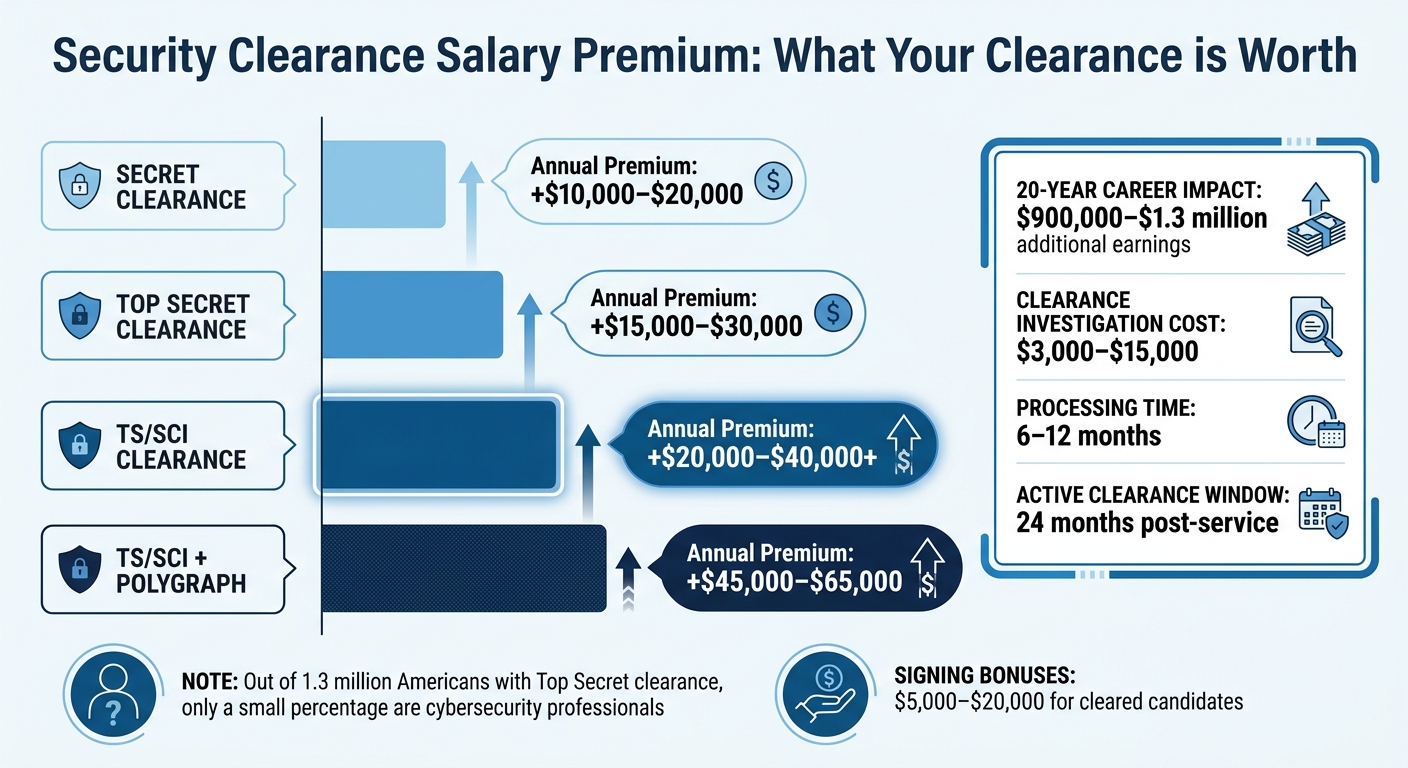
Security Clearance Salary Premium Comparison for Cybersecurity Professionals
What Your Clearance Is Worth
Your TS/SCI clearance is a powerful asset in the civilian job market. Out of 1.3 million Americans holding a Top Secret clearance or higher, only a small percentage are cybersecurity professionals [10]. This rarity creates a competitive edge, often leading to substantial salary bonuses.
On average, a TS/SCI clearance can increase your base salary by $20,000 to $40,000 compared to roles without a clearance [9][12]. If you also hold a Full Scope Polygraph, that premium can rise to $45,000–$65,000 annually [10]. Over a 20-year career, this can add up to an additional $900,000–$1.3 million in earnings [10].
| Clearance Level | Annual Salary Premium |
|---|---|
| Secret | +$10,000–$20,000 [9] |
| Top Secret | +$15,000–$30,000 [9] |
| TS/SCI | +$20,000–$40,000+ [9] |
| TS/SCI + Polygraph | +$45,000–$65,000 [10] |
Employers highly value active clearances because they save time and money. A Top Secret clearance investigation typically costs between $3,000 and $15,000 and takes 6–12 months to complete [9]. By hiring someone with an active clearance, companies avoid these delays and expenses, making you an attractive candidate.
"When I transitioned out of the Navy, I did not fully appreciate what my clearance was worth. I spent time applying for jobs that did not require one – which meant I was competing with the entire civilian workforce instead of a much smaller pool of cleared candidates. That is a strategic mistake."
- Brad Tachi, Founder, Best Military Resume [9]
Having an active clearance also gives you negotiation power. Cleared veterans are often hired faster, which can lead to higher starting salaries and signing bonuses ranging from $5,000 to $20,000 [10]. To make the most of this opportunity, it’s essential to maintain and showcase your clearance effectively.
Keeping and Highlighting Your Clearance
To maximize your clearance’s value, it’s important to keep it active and prominently display it. A clearance is a time-sensitive asset that loses value the longer it remains inactive [12]. After leaving the military, your clearance is considered "current" for about 24 months. During this period, it can be reactivated without requiring a full reinvestigation if you secure a cleared position [9][11]. Targeting a cleared role within this timeframe is critical to maintaining your marketability.
Make sure your clearance is easy to spot on your resume and LinkedIn profile. Include it in your resume header, right below your name and contact details. On LinkedIn, use phrases like "Active TS/SCI Clearance – Current" or "Active TS/SCI with CI Polygraph – Current" in your headline [11]. Recruiters often use ATS filters to search for terms like "TS/SCI", so this visibility is key.
However, be cautious about sharing sensitive details. Never include specific SCI compartments, codewords, or classified program names on your resume or public profiles, as this could raise security concerns [11][12].
Certifications You Need
If you have an active clearance and military experience, earning the right certifications can set you apart in the civilian job market. These credentials translate your 17C training into qualifications that civilian employers recognize. For most cleared defense contractor positions, CompTIA Security+ is where you should start. It meets DOD 8140 (formerly 8570) IAT Level II requirements and costs $400 to take the exam. Once you have Security+, you can focus on certifications tailored to defensive, offensive, or leadership roles.
Defensive Certifications
If you’re interested in roles like SOC analyst, incident response, or threat intelligence, CompTIA CySA+ is a logical step after Security+. It costs around $400 and focuses on behavioral analytics and incident response skills [5]. For more advanced expertise, GIAC certifications such as GSEC, GCIH, and GCIA are highly respected. If you earned these through unit funding during active duty, be sure to highlight them – they’re expensive to obtain independently [5][4].
Cloud security is another growing field. Certifications like AWS Certified Security Specialty and Azure Security Engineer are becoming essential as more organizations move to the cloud [4][3]. Pairing cloud credentials with your clearance gives you an advantage for federal contractor roles [13]. Another excellent option is the CCSP (Certified Cloud Security Professional), which costs $599 and is ideal for those aiming for cloud architect positions [5].
Offensive Certifications
For those pursuing penetration testing or red team positions, the OSCP (Offensive Security Certified Professional) is considered the gold standard. The course and exam bundle starts at $1,599, and its 24-hour hands-on practical exam is highly regarded by hiring managers [5]. If you’re just starting, the Certified Ethical Hacker (CEH) is a more accessible option at $1,199, though the OSCP holds greater prestige for offensive roles [5][4]. Another strong choice is GPEN, particularly for roles that require GIAC certifications [5][4].
"One of our Army Signal NCOs went from E-6 to a $115K SOC analyst role in eight months. Security+ got him in the door. CySA+ got him the offer over other candidates. The clearance sealed it."
- Brad Tachi, Navy Veteran & Founder, Best Military Resume [5]
For senior-level technical or leadership roles, the CISSP stands out as the most sought-after credential. It costs $749 and often leads to salaries in the $120,000 to $130,000+ range [5][13][14]. To qualify, you need five years of experience in at least two CISSP domains, which most 17Cs with a full contract will meet.
When to Get Certified and How to Pay for It
Timing and funding are critical when planning your certifications. Start 12–18 months before separating from the military to take advantage of funding options. While on active duty, use programs like Army COOL, Navy COOL, or Air Force COOL, which cover exam fees without tapping into your GI Bill benefits [14]. These programs pay directly for exam costs and remain available until your separation date.
After leaving active duty, you have options like VET TEC, which covers high-tech training and provides a housing stipend without affecting your GI Bill [5][3]. Another resource is Onward to Opportunity (O2O) through Syracuse University, which offers free training and one free exam voucher for certifications like Security+ or CISSP [5][13]. If you’re in your final 180 days of service, consider SkillBridge, which allows you to train full-time for certifications while still receiving military pay [13][4]. For additional funding, the VA reimburses up to $2,000 per year in certification exam fees through the GI Bill [13].
| Funding Source | Best For | Key Benefit |
|---|---|---|
| Military COOL | Active Duty personnel | Covers exam fees; doesn’t use GI Bill [14] |
| VET TEC | Transitioning Veterans | Pays for training + housing; doesn’t use GI Bill [5][3] |
| O2O (Syracuse) | Veterans & Spouses | Free training and exam vouchers [5][13] |
| GI Bill | Post-Separation | Reimburses up to $2,000/year in exam fees [13] |
Career Options and What You’ll Earn
Your experience as a 17C opens up career opportunities that many civilian cybersecurity professionals spend years trying to achieve. With your certifications and clearance, you’re already positioned to excel in a field where demand far outstrips supply. The cleared market operates differently than the broader tech industry, offering a 20% to 40% pay premium over non-cleared positions [6]. With over 514,000 cybersecurity job postings projected by 2026 and 26% of those roles expected to remain unfilled, your skills are in high demand [6]. Let’s explore how your technical expertise and leadership background can take you from analyst roles to executive-level positions.
From Analyst to CISO: Career Progression
Many 17C veterans start their civilian careers as SOC Analysts (Tier 2 or 3), Incident Responders, or Penetration Testers, earning between $95,000 and $140,000, depending on location and clearance level [4]. These roles focus on monitoring security events, responding to breaches, and testing system defenses – tasks you’ve already mastered during your service.
From there, you could advance to positions like Security Engineer or Cloud Security Architect, with salaries ranging from $120,000 to $250,000 [4]. Security Engineers focus on designing and implementing security controls, while Cloud Security Architects create enterprise-wide security frameworks, often working on cloud migrations to platforms like AWS, Azure, or GCP.
If offensive operations are your strength, roles such as Red Team Operator or Malware Analyst are excellent fits, offering salaries between $120,000 and $210,000, especially if you hold certifications like OSCP or GPEN [4]. For those interested in leadership, paths include Security Manager, Information System Security Manager (ISSM), and even Chief Information Security Officer (CISO), with salaries ranging from $150,000 to $400,000+ [4]. These roles build on the real-world expertise you’ve gained and position you to command competitive offers.
Your clearance not only accelerates your career progression but also secures you a significant salary premium. Information Security Analyst roles, for instance, are projected to grow by 33% through 2034, further highlighting the demand for your skill set [15].
How Military Experience Affects Your Starting Level
Your military background gives you a distinct advantage, often qualifying you for mid-to-senior level positions right out of the gate. A full 17C contract means you’ve accumulated over four years of operational experience defending networks against real-world threats. This depth of expertise makes entry-level roles unnecessary for you. Instead, focus on Tier 2 or Tier 3 roles that start at $95,000 to $125,000 or more [4].
"Your military experience puts you above entry-level – don’t let impostor syndrome push you into a role that’s two tiers below your actual capability."
- Brad Tachi, CEO, Best Military Resume [4]
Your training meets NSA-level standards, giving you a skill set that surpasses what most civilian programs offer [2]. Employers value your ability to manage high-pressure projects, troubleshoot complex systems, and lead teams in critical situations. These attributes make you a sought-after candidate for companies like Booz Allen Hamilton, Leidos, Raytheon, Amazon, Microsoft, and CrowdStrike, all of which actively recruit 17C veterans [4].
"The $150K civilian salary number is real, which is why the Army’s biggest 17C problem is keeping you past your first contract."
- HonestMOS [2]
Don’t settle for roles that undervalue your experience. The cleared cybersecurity market is in your favor, giving you the leverage to negotiate for higher salaries and better positions. Secure multiple offers, use your clearance as a key bargaining tool, and aim for roles that reflect your true capabilities.
Defense Contracting Jobs
Defense contracting provides a seamless pathway for transitioning from 17C military service to civilian roles. Employers in this field highly value the combination of an active security clearance and hands-on cyber expertise – skills that are not easily found. Obtaining a new Top Secret clearance can cost anywhere from $15,000 to $50,000 and take 9 to 15 months to process [16]. If you already have an active TS/SCI clearance, you’re not only eliminating this delay but also potentially adding $15,000 to $30,000 to your base salary [4].
The work environment in defense contracting mirrors the structure of military operations. You’ll encounter familiar terminology, work within government frameworks like RMF and DISA STIGs, and tackle mission-driven objectives similar to those you handled in uniform. Additionally, defense firms often prioritize certifications and proven technical skills over a traditional four-year degree [16].
"Defense contractors are the easiest cultural transition for most veterans – they already understand military terminology, clearance requirements, and the value of military experience."
- Brad Tachi, CEO, Best Military Resume [17]
To maximize the value of your clearance, start your job search 6 to 9 months before your separation date. Employers prefer hiring candidates while their clearances are fully active [16]. Once you’re ready, focus on the top defense contractors that actively recruit veterans with clearances.
Major Defense Contractors That Hire Veterans
The "Big 5" prime contractors – Lockheed Martin, Raytheon (RTX), Northrop Grumman, Boeing, and General Dynamics – are always on the lookout for 17C talent for positions such as Security Architect, Technical Lead, and Program Manager [16][18]. Meanwhile, mid-tier contractors like Booz Allen Hamilton, SAIC, Leidos, Peraton, CACI, and ManTech focus on operational roles like SOC Analyst, Penetration Tester, Incident Responder, and Vulnerability Analyst [16][18].
Booz Allen Hamilton stands out for its veteran-friendly culture.
Laura Schmiegel, Head of Military and Veteran Affairs, highlights:
"So much of our work needs the mission expertise and leadership capabilities of our cleared veterans. Mission and purpose are imbued in everything we do" [18].
Tracy Freedman, Program Manager of Military and Veteran Affairs, adds:
"Military talent brings unique experiences to the civilian workforce. Booz Allen is a place where they can support the same missions they did in the military – only out of uniform" [18].
Tech companies like CrowdStrike, Palo Alto Networks, Amazon (AWS), Microsoft, and Google also seek 17C veterans for roles such as Cloud Security Engineer, Threat Hunter, Red Team Operator, and Consultant [16].
SkillBridge Internships
SkillBridge programs offer another excellent avenue for transitioning to a civilian role. These programs allow you to work for a civilian contractor during your final 180 days of active duty while still receiving full military pay and benefits [19]. Think of it as a 6-month job interview for a specific, budgeted position [19][20]. Defense contractors report conversion rates between 85% and 95%, with Lockheed Martin achieving over 90% in its cybersecurity divisions [20].
"SkillBridge is a 6-month job interview where you still collect military pay. There is no better deal in the transition process. But you have to treat it like a job interview – not a vacation from the military."
- Brad Tachi, Navy Veteran & BMR Founder [19]
To secure a spot, start researching SkillBridge programs 12 months before separation and apply at least 9 months in advance. Competitive positions at companies like Raytheon, Lockheed Martin, Amazon, Microsoft, and Booz Allen Hamilton fill up quickly [19]. When evaluating opportunities, ask about the program’s direct-hire rate – the percentage of interns who transition to full-time roles – rather than relying on vague placement statistics [20]. Look for programs that offer a specific mentor and defined job titles, such as "SOC Analyst Intern" or "Penetration Tester Intern", rather than generic or rotational roles [20].
Make sure the contractor’s Facility Security Officer initiates your clearance crossover as soon as you start to keep your clearance active [20]. Remote SkillBridge programs for technical roles like 17C now have conversion rates comparable to in-person opportunities, giving you more flexibility in choosing a location [20].
Government Jobs vs. Private Sector Jobs
Deciding between federal and private sector jobs is a big step for 17C specialists transitioning into civilian life. Both options have their perks, but they differ significantly in terms of work style, pay, and career growth.
Federal roles tend to revolve around policy-making, program management, and long-term oversight, while contractors often deal with more hands-on technical tasks and cutting-edge tools [22][21]. If you like strategic planning and managing programs over the long haul, federal service might be your thing. On the other hand, if you’re drawn to staying on the frontlines of technology, private contracting might suit you better [21].
Comparing Pay and Benefits
When it comes to salaries, defense contractors usually outpace federal jobs, offering 15–30% higher base pay. For example, a GS-13 Step 5 position in Washington, D.C. pays around $138,024, while equivalent contractor roles offer $140,000 to $175,000 [10][22]. However, federal jobs come with perks like a FERS pension (roughly 20% of your high-three average salary after 20 years), a 5% TSP match, and comprehensive health insurance. For instance, total compensation for a GS-14 Step 5 in D.C. is about $221,000, compared to $212,000 for a similar contractor position [10].
Federal jobs also provide unmatched job security, as layoffs are rare. Contractor roles, however, depend on 1- to 5-year contracts, which carry the risk of non-renewal [22]. As Leo Taddeo, CISO at Cyxtera, puts it:
"Cybersecurity professionals most likely to have high job satisfaction in the private sector are those who want a dynamic role that involves working with cutting-edge technology and can tolerate the risk of a job loss in exchange for higher pay" [21].
Government Agency Positions
For 17C specialists, federal agencies like the NSA, DHS, CISA, FBI, and various DoD divisions offer a range of opportunities. These agencies hire through the GS-2210 series, with roles spanning GS-7 to GS-15 [3]. Veterans with four or more years of experience should aim for GS-12 or GS-13 positions to align with their skills [4].
The GS pay scale is predictable, with step increases within grades and promotions requiring competition. For example, a GS-12 Step 5 in D.C. earns about $116,071, while a GS-15 Step 5 can make up to $191,850 [10]. Federal roles often emphasize compliance, documentation, and long-term planning rather than rapid innovation. Veterans also benefit from being able to "buy back" military service time, which counts toward federal retirement [22]. Additionally, federal employees receive 26 days of annual leave and 13 sick days after three years – more generous than the 15–20 days of PTO typically found in contractor roles [10].
Clearance requirements vary, but most federal positions demand at least a Top Secret clearance. Agencies like the NSA or certain DoD units may require TS/SCI with Full Scope Polygraph. Having an active military clearance gives you a strong advantage for these roles [6].
Private Company Positions
Private sector jobs offer a different set of opportunities. Cybersecurity roles in this space fall into two main categories: defense contracting and positions at global tech companies like CrowdStrike, AWS, and Google [16]. These companies actively recruit 17C veterans for positions such as Incident Responder, Penetration Tester, and Security Engineer. Salaries for mid-to-senior professionals with a TS/SCI clearance often range from $140,000 to $230,000 or more [10].
Career growth in the private sector often hinges on mobility. Switching companies every two to three years can yield salary increases of 15–25% [22]. The "20% Rule" is especially relevant for contractors, as employers are willing to pay a premium to avoid delays in clearance sponsorship [10]. Brad Tachi explains:
"Contractor positions typically pay 15–30% more in base salary. Federal positions offer better benefits, retirement, and job security. Your best choice depends on your timeline, risk tolerance, and where you are in your career" [22].
Your clearance can significantly boost your value in the private sector. For example, a SOC analyst earning $75,000 in a non-cleared role might earn $95,000 to $115,000 with a TS/SCI clearance. Adding a Full Scope Polygraph can increase annual pay by $45,000 to $65,000, translating to $900,000 to $1.3 million over a 20-year career [6][10].
However, private sector jobs come with trade-offs. Instead of a FERS pension, you’ll typically get a 401(k) match, often between 2–6%. Job security is also less stable, particularly during contract transitions. While some tech roles offer remote work, many cleared positions require regular access to a SCIF, limiting flexibility.
Lastly, expertise in AI/ML security is in high demand. Professionals with these skills are commanding premiums of $20,000 to $40,000 above standard roles due to a limited talent pool [10].
Next, we’ll explore how to translate your military experience into a strong civilian resume and build strategic connections in the cleared community.
Your 12-18 Month Transition Plan
Transitioning from the military to a civilian cybersecurity role takes careful planning and preparation. With your certifications and clearance as strong assets, this timeline will help you leverage your 17C experience effectively. A structured approach ensures you build the right credentials, gain industry exposure, and position yourself as a top candidate before your separation date.
12-18 Months Out
Start by identifying any certification gaps. While your hands-on experience is invaluable, employers often expect certifications like CompTIA Security+, especially for DoD 8140 compliance. Take advantage of resources like ArmyIgnitED or COOL to cover exam costs while you’re still on active duty. If you already have a military IT background, preparing for the Security+ exam typically takes about 4–8 weeks [5].
Update your LinkedIn profile to use civilian-friendly language. For instance, replace terms like "COMSEC" with "cryptographic key management" and "ACAS" with "vulnerability scanning." This makes your experience more relatable to civilian recruiters. Join professional groups such as VetSec, ISSA, or local ISC2 chapters to connect with others in the industry. These groups can provide helpful insights into salaries and job opportunities [4]. Once your LinkedIn is polished, shift your focus to gaining hands-on civilian experience and expanding your network as you move into the 6–12 month phase.
6-12 Months Out
Apply for SkillBridge internships with leading defense contractors or tech companies. Start this process 9–12 months before your separation to secure a spot. SkillBridge offers a unique opportunity to gain civilian work experience while still receiving your military pay – it’s essentially a six-month, paid audition for a long-term role.
Make time to attend cybersecurity conferences if you can. Many events offer free or discounted passes for active-duty military, giving you the chance to meet hiring managers, explore emerging roles, and practice articulating your experience in terms that resonate with civilian employers. Additionally, consider applying for VET TEC. This program provides access to high-tech training, including tuition support and a housing allowance, without affecting your GI Bill benefits [3]. As you approach the final 3–6 months of your transition, ramp up your job applications and fine-tune your interview skills.
3-6 Months Out
Focus on tailoring your resume to translate military jargon into civilian terminology. For example, use terms like "network defense", "threat hunting", or "incident response" while avoiding any references to classified work. Refresh your technical skills through hands-on platforms like TryHackMe or HackTheBox to stay sharp. Prepare for interviews by practicing the STAR method (Situation, Task, Action, Result), highlighting your specific contributions and achievements.
Finally, aim to secure a cleared role within the 24-month window of your active security clearance [3]. This ensures you maximize the value of your clearance while demonstrating your readiness for civilian cybersecurity positions.
How to Write Your Resume and Build Your Network
Your resume is your chance to translate military experience into terms that resonate with civilian employers. For those with a 17C background, this is especially important to stand out in the competitive world of cleared roles. Keep in mind that hiring managers spend an average of just 6 seconds reviewing a resume during the initial screening stage [3], so clarity and precision are key.
Converting Military Experience to Civilian Language
Start by rephrasing your military job title. For example, instead of "17C Cyber Operations Specialist", use civilian-friendly titles like Cybersecurity Analyst, Penetration Tester, Incident Responder, or Information Security Specialist [4]. If you held leadership roles, such as being an E-5 or E-6, describe yourself as a Team Lead or Cybersecurity Supervisor rather than listing your rank [23].
Translate technical jargon into terms civilian employers understand. For instance:
- Replace "COMSEC" with encryption key management.
- Swap "ACAS" for vulnerability scanning using Nessus/Tenable [3].
Avoid mentioning classified details, but provide a clear picture of your responsibilities. For example, you might say you "secured a 15,000-node enterprise network" instead of referencing specific mission details [4]. Highlight tools and frameworks you’ve used, such as Splunk, Wireshark, Nessus, Metasploit, NIST frameworks, or MITRE ATT&CK.
Quantify your achievements using the CAR (Challenge, Action, Result) method. For example:
"Triaged 200+ security alerts daily, identified 45 critical vulnerabilities, and reduced organizational risk by implementing DISA STIGs across 300+ systems" [4].
Place your active TS/SCI clearance prominently at the top of your resume – this is a significant asset that employers value immediately.
"The question isn’t whether you can land a six-figure cybersecurity job after the military. It’s which six-figure cybersecurity job you want to pursue and how to position your resume to get it."
- Brad Tachi, CEO, Best Military Resume [4]
Prepare two versions of your resume: a detailed one for federal applications and a concise 1–2 page version for corporate roles [3]. Also, include your desired relocation area and availability date at the top [24].
Once your resume is polished, the next step is to tap into the cleared community to expand your opportunities.
Networking in the Cleared Community
With a strong resume in hand, shift your focus to building connections within the cleared cybersecurity field. Joining professional organizations is a great place to start. Groups like the Information Systems Security Association (ISSA), ISC2 chapter groups, or VetSec – a veteran cybersecurity community – offer mentorship, networking opportunities, and insights into job openings and salary expectations [4].
Leverage job boards tailored to cleared professionals. Platforms like Cleared Cyber Security Jobs are frequented by employers who value military backgrounds and understand the premium associated with security clearances. When posting your resume, make sure your clearance level is visible to recruiters. However, be cautious about listing your clearance on public platforms like LinkedIn, as some contractors view this as a potential security risk [24].
Attend cybersecurity job fairs and industry events specifically designed for cleared professionals. Many of these events offer free or discounted passes for active-duty military members and veterans transitioning to civilian roles. These in-person interactions are a chance to showcase your technical skills and operational experience in ways that go beyond what a resume can convey.
Conclusion
Making the leap from a 17C Cyber Operations Specialist to a cleared civilian cybersecurity career is a direct route to a lucrative six-figure salary. You bring something unique to the table: hands-on operational experience, a top-tier security clearance, and technical expertise that most civilian candidates simply don’t have.
Your TS/SCI clearance alone can add $15,000–$30,000 to your pay [4]. Combine that with certifications like Security+, CySA+, or OSCP, and you’re looking at starting salaries of $130,000+, especially with four years of 17C experience [2]. The demand for cybersecurity professionals is staggering, with 3.5 million jobs currently unfilled worldwide and information security analyst roles expected to grow 33% by 2033 [1][3]. This isn’t just a job market – it’s a race for talent, and you’re ahead of the pack.
"The 17C is arguably the best-kept secret in the Army for post-military career potential. The TS/SCI clearance plus genuine offensive/defensive cyber experience puts you in a job market where six-figure salaries are the floor, not the ceiling."
- HonestMOS [2]
To maximize your potential, start your transition 12–18 months before leaving the military. Focus on earning critical certifications, tailoring your resume, and building a professional network. Take full advantage of SkillBridge during your final 180 days to secure internships with leading firms like Booz Allen Hamilton or Leidos. By following this roadmap, you’ll align your skills with roles that reflect your experience and value.
Your military background has equipped you with abilities that civilian employers are willing to pay a premium for. Now is the time to translate that expertise into a career that rewards you both financially and professionally.
FAQs
How do I keep my TS/SCI clearance active after I separate?
To maintain your TS/SCI clearance, it needs to be sponsored by an employer within 24 months after you separate. While your clearance becomes inactive once you leave, it doesn’t immediately expire. However, if no employer steps in to sponsor it within that 24-month window, you’ll have to go through a new investigation, which can take anywhere from 6 to 18 months. Staying in touch with potential employers during this time is key to keeping your clearance intact.
Which 17C skills should I highlight to get hired faster?
To make a smooth transition, focus on showcasing these essential 17C skills: protecting networks from cyber threats, carrying out both offensive and defensive cyber operations, and incorporating electromagnetic warfare into strategic planning. Emphasize your hands-on operational experience, expertise in tactics, techniques, and procedures (TTPs), and your capability to handle complex cyber missions. These abilities highlight your preparedness for in-demand civilian cybersecurity positions and can help set you apart from other candidates.
Do I need a degree to land a $130,000+ cleared cyber job?
A college degree isn’t always a must-have for landing a $130,000+ cleared cyber job. Thanks to the ongoing shortage of skilled professionals in the cybersecurity field, many veterans with military cyber experience and security clearances are being hired without one. Employers often prioritize hands-on skills, real-world experience, and clearances over formal education.