

The National Security Agency’s Tailored Access Operations (TAO) division is a top-tier cyber intelligence team specializing in advanced offensive and defensive operations. TAO focuses on penetrating high-value, secure systems and extracting critical intelligence to support national security. Key highlights from the guide include:
- Core Mission: TAO’s primary role is Computer Network Exploitation (CNE), targeting systems resistant to standard surveillance, including air-gapped networks.
- Roles: TAO employs over 1,000 personnel in roles such as hackers, engineers, intelligence analysts, and targeting specialists.
- Security Clearance: All positions require a Top Secret (TS) clearance with Sensitive Compartmented Information (SCI) access and a Full Scope Polygraph.
- Application Process: Candidates apply via the NSA career portal, undergo technical and behavioral interviews, and must pass a rigorous clearance process.
- Qualifications: Certifications like CISSP, GIAC, and OSCP, alongside technical expertise in programming, reverse engineering, and network analysis, are essential.
- Networking: Building connections through industry events and platforms like CyberSecJobs.com is critical for accessing these competitive roles.
TAO offers opportunities for individuals with technical expertise and a strong commitment to national security. Success requires preparation, security clearance, and strategic networking.
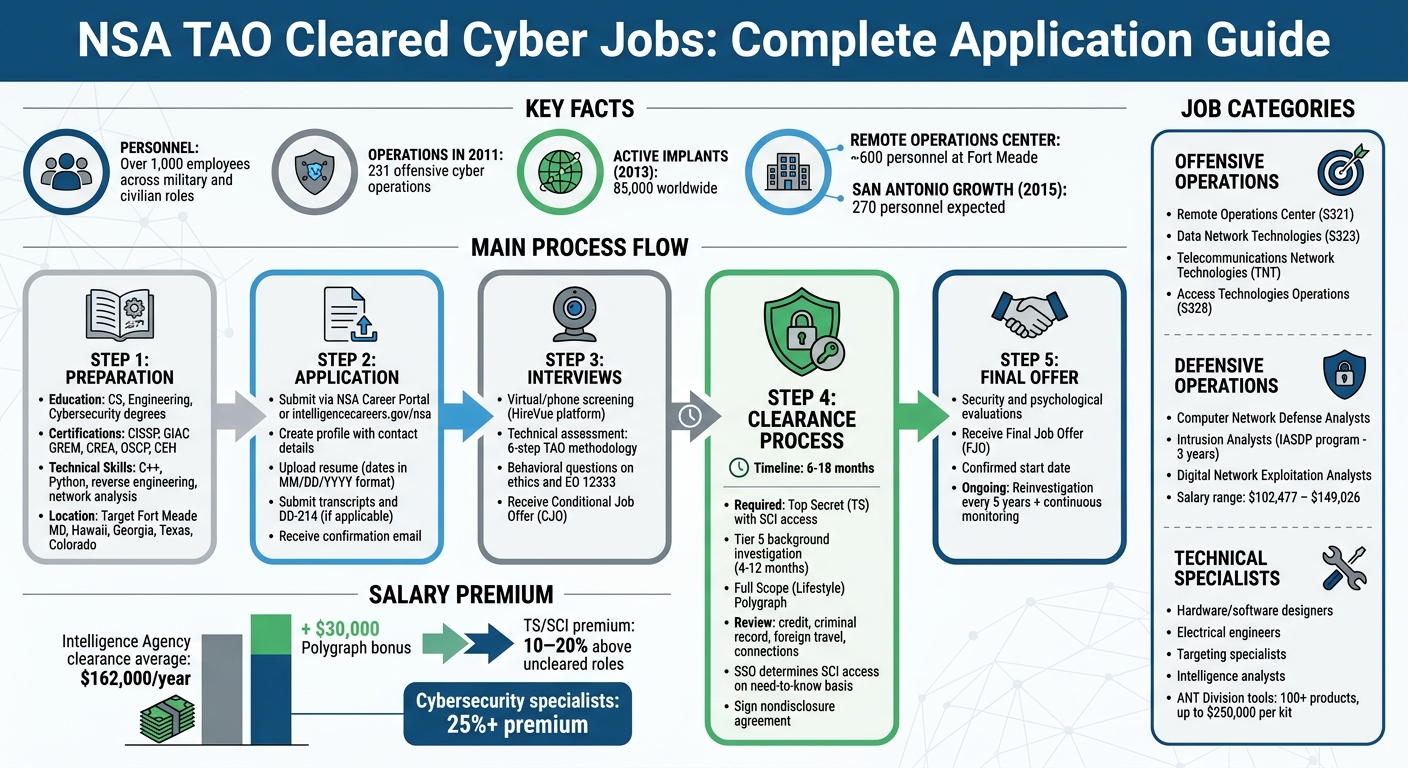
NSA TAO Application Process Timeline and Requirements
What Is THE HARDEST Cybersecurity Job in the World?
sbb-itb-bf7aa6b
Cyber Job Types at NSA TAO
TAO, the Tailored Access Operations unit of the NSA, employs over 1,000 military and civilian professionals across various career paths [1]. Each role is designed to support the division’s core mission: Computer Network Exploitation (CNE). Whether you’re breaking into systems, defending networks, or creating the tools that make it all possible, every position plays a critical part. For those with security clearances and a desire to make an impact, understanding these roles is essential.
TAO’s workforce is structured into specialized branches, each focused on unique operational goals. For instance, the Remote Operations Center (ROC) at Fort Meade employs around 600 individuals dedicated to global intelligence gathering from computer systems [1]. Below is a breakdown of the key job categories to help you determine where your skills align.
Offensive Cyber Operations Jobs
Offensive cyber roles at TAO revolve around penetrating foreign computer systems to collect intelligence [1]. This includes hacking hardware such as routers, firewalls, and switches from various vendors [1]. Professionals in these roles develop and deploy tools like spyware, implants (e.g., OLYMPUSFIRE), and other custom attack software. They also conduct "man-on-the-side" attacks using the QUANTUM suite to redirect traffic to exploit servers like FOXACID [1]. Some positions involve "off-net operations", which require physically placing surveillance devices on foreign computers and telecom systems [1].
To put this into perspective, TAO spearheaded 231 offensive cyber operations in 2011 alone [1]. Offensive teams engage in "adversary engagement" by identifying exploitable systems through tools like XKeyscore [1]. They also execute zero-day attacks, exploiting software vulnerabilities before they become publicly known [1].
| Branch / Unit | Designation | Primary Offensive Responsibility |
|---|---|---|
| Remote Operations Center (ROC) | S321 | Gathering intelligence from global computer systems [1] |
| Data Network Technologies (DNT) | S323 | Creating automated spyware and software implants [1] |
| Telecommunications Network Technologies (TNT) | TNT | Enhancing hacking techniques for networks and computers [1] |
| Access Technologies Operations (ATO) | S328 | Conducting "off-net operations" and planting physical devices [1] |
| Mission Infrastructure Technologies | – | Managing software and infrastructure for cyber attacks [1] |
Defensive Cyber Operations Jobs
While TAO is renowned for its offensive capabilities, its defensive roles are equally critical. These positions focus on protecting National Security Systems and the Defense Industrial Base. Computer Network Defense Analysts (CNDAs) are tasked with identifying vulnerabilities, monitoring systems, and responding to incidents to safeguard vital infrastructure.
Intrusion Analysts, trained through the IASDP program, specialize in detecting unauthorized activity. This rigorous three-year program equips analysts to counter state-sponsored cyber threats and ransomware attacks [5]. Digital Network Exploitation Analysts (DNEAs) contribute by mapping global networks and analyzing technologies to identify threats. Experienced DNEAs can earn between $102,477 and $149,026 annually [5]. By 2015, TAO’s San Antonio workforce was expected to grow to 270 personnel to address increasing cyber defense demands [2].
Technical Specialist Positions
Technical specialists are the backbone of TAO’s operations, designing the tools and infrastructure that enable both offensive and defensive missions. These roles include computer hardware and software designers who create custom hacking tools, spyware, and persistent access mechanisms [1]. Electrical engineers develop exploitation tools like radio-frequency implants and hardware Trojans [1]. Meanwhile, targeting specialists and intelligence analysts focus on identifying key foreign targets and analyzing collected data to shape national security strategies [1].
As of 2013, TAO had approximately 85,000 active implants worldwide [2]. The NSA ANT catalog, a resource for TAO specialists, features over 100 specialized products. Some of these tools, such as hardware kits, can cost up to $250,000 [2]. Der Spiegel described the catalog as:
"The list reads like a mail-order catalog, one from which other NSA employees can order technologies from the ANT division for tapping their targets’ data" [1].
The Advanced Network Technology (ANT) Division supplies these tools, sometimes intercepting international hardware shipments – like routers – to install backdoor implants before delivery [2]. These technical roles are essential for supporting TAO’s cutting-edge operations.
Security Clearance Requirements
NSA TAO positions demand both exceptional technical expertise and a high level of trust. Every role requires a Top Secret (TS) clearance with Sensitive Compartmented Information (SCI) access as a baseline [6]. Simply put, if you don’t have TS/SCI clearance, you won’t qualify for these positions.
Clearance Process
The journey to obtaining clearance starts with a Tier 5 background investigation (previously known as SSBI). This process delves into your credit history, criminal record, foreign travel, and personal connections. The investigation alone can take anywhere from 4 to 12 months, with the entire clearance process lasting 6 to 18 months [6][7].
It’s important to note that you can’t apply for clearance on your own. You need to be sponsored by the NSA or an approved government contractor following a job offer [6]. Once your clearance is approved, the agency’s Special Security Officer (SSO) will determine your access to specific SCI programs based on a "need-to-know" basis. At this stage, you’ll be formally "read in" to compartmented programs and required to sign a nondisclosure agreement [6].
As ClearedJobs.Net explains:
"TS/SCI is the gold standard of U.S. security clearances – the credential that unlocks intelligence community careers, the highest-paying cleared positions, and access to the most sensitive government programs" [6].
Clearance isn’t a one-and-done deal. To maintain eligibility, you’ll undergo a reinvestigation every five years and be subject to continuous monitoring, including random drug testing [6][7]. The Laboratory for Telecommunication Sciences, an NSA partner, emphasizes the importance of transparency during the process:
"Our best word of advice is to be completely candid during the security process. Your cooperation in this regard will help ensure that the process goes more smoothly and quickly" [7].
Required Clearance Levels
The NSA adheres to a TS/SCI standard for nearly all positions, including those in TAO [6]. Here’s how the two components differ:
- Top Secret: This clearance level allows access to information that, if disclosed, could cause "exceptionally grave damage" to national security [6].
- Sensitive Compartmented Information (SCI): This is an additional authorization layered on top of a TS clearance. While you can hold a TS clearance without SCI access, SCI cannot be granted without an underlying TS clearance [6].
| Feature | Top Secret (TS) | Sensitive Compartmented Information (SCI) |
|---|---|---|
| Nature | Clearance Level | Access Authorization |
| Investigation | Tier 5 (formerly SSBI) | Program-specific review by SSO |
| Requirement | Base eligibility | Must have TS first; based on "need-to-know" |
| Disclosure Risk | Exceptionally grave damage | Program-specific sensitive intelligence |
Given the classified nature of TAO operations, all work is conducted within secure facilities known as SCIFs (Sensitive Compartmented Information Facilities). These areas enforce strict protocols, such as prohibiting personal electronics [6].
The financial benefits of holding a TS/SCI clearance are considerable. Cleared professionals often earn a 10–20% salary premium compared to their uncleared peers, with some cybersecurity specialists seeing premiums above 25% [6]. Candidates with an active TS/SCI and a Full Scope Polygraph are especially attractive to employers because they eliminate months of processing time [6].
Polygraph Requirements
For TAO positions, the NSA mandates a Full Scope (Lifestyle) Polygraph, which is more thorough than the Counterintelligence (CI) polygraph used by many other agencies [6]. This type of polygraph covers not only counterintelligence topics but also delves into personal areas like drug use, criminal behavior, and financial history [6].
| Polygraph Type | Focus Areas | Agency Usage |
|---|---|---|
| Counterintelligence (CI) | Espionage, terrorism, unauthorized disclosures, foreign contact | DIA, NGA, and many DoD programs |
| Full Scope (Lifestyle) | All CI topics plus drug use, criminal behavior, and finances | NSA, CIA, and NRO |
Honesty is critical during the polygraph process. A lack of candor is the leading cause of clearance denials or revocations [7]. If you have past issues – like drug experimentation, financial troubles, or foreign connections – disclose them upfront. Investigators prioritize honesty over a flawless record. Even complex issues, such as dual citizenship or foreign ties, can often be resolved if you’re transparent [7].
Discretion is equally important in your personal life. Avoid discussing your application or job details on social media [7]. If friends or family ask about your work, a simple explanation like "I work in a government position with the DoD" will suffice [7]. While the polygraph process may feel invasive, it’s designed to ensure you can be trusted with some of the nation’s most sensitive intelligence operations.
Required Qualifications and Certifications
TAO positions require a blend of advanced education, certifications, and practical expertise. The NSA seeks candidates who excel in offensive cyber operations, reverse engineering, and signals analysis, backed by both technical skills and formal qualifications.
Technical Certifications
Certifications are a critical first step toward qualifying for a TAO role. For positions in reverse engineering and intrusion analysis, some of the most respected certifications include CISSP (Certified Information Systems Security Professional), GIAC GREM (GIAC Reverse Engineering Malware), and CREA (Certified Reverse Engineering Analyst). These validate expertise in analyzing malware, uncovering vulnerabilities, and addressing sophisticated cyber threats.
For offensive roles, GIAC GREM and CREA are particularly relevant, as they directly align with reverse engineering responsibilities. Protocol Analysts and Signals Analysts should focus on certifications that emphasize signals analysis, while Vulnerability Analysts benefit from certifications like GIAC, CEH (Certified Ethical Hacker), or OSCP (Offensive Security Certified Professional). Selecting certifications that align with the technical needs of your targeted role is key.
Education and Technical Skills
While degrees in fields like Computer Science or Engineering are often required, experience carries significant weight. For example, a Level 2 Reverse Engineer might qualify with a Master’s degree and 3 years of experience, a Bachelor’s degree and 5 years, or even an Associate’s degree and 7 years. This flexible qualification system means hands-on experience can offset a lower degree level.
Candidates must also showcase a range of technical skills. Coding expertise in languages such as C++ and Python is crucial, as TAO engineers develop custom tools designed to infiltrate routers, switches, and firewalls [1]. Network analysis skills – covering protocol analysis, bitstream analysis, and waveform analysis – are essential for roles like Protocol Analysts. Additionally, proficiency in malware reverse engineering, penetration testing, computer forensics, and threat intelligence is highly valued. Specialized roles, like Target Digital Network Analyst (TDNA), require strong abilities in analyzing collection data and open-source intelligence to maintain operational leads and target continuity.
Experience with hardware and firmware can set you apart. TAO often works at the hardware level, utilizing techniques like BIOS and kernel-level implants. Skills in firmware modification and reverse engineering commercial hardware from companies like Cisco or Juniper are particularly advantageous [2]. These qualifications not only improve your chances of securing a TAO position but also ensure you’re well-prepared for the challenges of the role. Mastering the right certifications and technical skills is essential for standing out in this competitive field.
How to Apply for NSA TAO Jobs
Applying Through NSA’s Career Portal
To apply for a TAO position at the NSA, start by visiting their career portal. You’ll need to create a profile that includes your contact details and background information. Upload a detailed resume that outlines your education and work history, ensuring that start and end dates are formatted in MM/DD/YYYY. This level of accuracy is essential since these dates help determine salary offers based on your verified experience.
Make sure to have all necessary documents ready, including transcripts and DD-214 forms if applicable. Missing paperwork can lead to delays or even disqualification. During the application process, you’ll answer questions about your technical skills and qualifications tailored to the specific TAO role you’re pursuing. Double-check all your entries for accuracy before submitting your application. Once submitted, you’ll receive a confirmation email.
Next, prepare for virtual or phone interviews, often conducted via the HireVue platform. If you successfully navigate this stage, you’ll be offered a Conditional Job Offer (CJO). At this point, the suitability process begins, including both security and psychological evaluations. Only after clearing this phase will you receive a Final Job Offer (FJO) with a confirmed start date.
For those in the military, there are additional programs designed to streamline the transition into these roles.
Military Transition Programs
Military personnel have access to specialized transition programs that build on the standard application process. Those with experience in cryptologic roles are often well-suited for TAO positions and may find direct pathways into these roles.
Highlight your military experience, particularly if it involves cryptanalysis or technical expertise, as these align closely with TAO’s objectives. If you’ve worked within the Central Security Service (CSS), be sure to emphasize that experience. Skills like firmware development, reverse engineering, and low-level programming are highly relevant. Additionally, showcase any hands-on experience with network infrastructure, such as routers or servers, as these are critical to TAO’s tailored access missions [8].
How to Write Your Resume for TAO Jobs
When applying for TAO positions, your resume must showcase both your clearance level and technical expertise in a way that stands out to automated tracking systems (ATS) and human recruiters. Start by listing your clearance prominently beneath your contact information with precise language, such as "Active TS/SCI with Full Scope Polygraph". This ensures your clearance status is immediately visible. Use specific terms to describe your status: "Active" indicates you’re currently in a cleared role, "Current" means you’re within the 24-month reactivation period under Trusted Workforce 2.0, and "Inactive" means you’re beyond that window [9]. This clarity is essential for both ATS and recruiters.
When detailing your work experience, describe classified projects in unclassified, functional terms. Avoid naming specific TAO programs like QUANTUM or FOXACID. Instead, use phrases like "executed targeted network intrusions" or "developed custom exploitation tools" [2][9]. Highlight skills that align with TAO’s mission, such as Computer Network Exploitation (CNE), reverse engineering, vulnerability research, and familiarity with network infrastructure from vendors like Cisco, Juniper, and Huawei [1][2]. Incorporate keywords such as "SIGINT", "man-on-the-side attacks", "firmware exploitation", and "persistent access mechanisms" to align with job descriptions.
Make sure to use a personal email address when applying – avoid using .mil or .gov email accounts [9]. Leave out details like SCI caveats, specific program names, polygraph results, or classified metrics from your resume [9]. Before posting your resume publicly, have it reviewed by a Facility Security Officer (FSO) [9]. If you hold a clearance from a different agency, note that a DOE "Q" clearance is typically equivalent to a DOD Top Secret clearance for reciprocity purposes [9].
Focus on showcasing experiences that highlight your technical abilities, particularly in handling "hard targets." Mention achievements like bypassing air-gapped systems, overcoming encryption, or working with hardened network configurations. Include specialized skills such as BIOS/firmware exploitation, GSM/mobile network infiltration, and RF-based data exfiltration [2]. Adding the year of your most recent investigation (e.g., "last investigated 2024") helps recruiters evaluate the currency of your clearance [9]. A well-crafted resume like this will set you up for success as you move on to the interview stage.
Preparing for TAO Interviews
TAO interviews are designed to evaluate how well candidates can strategize for offensive operations. The process combines technical assessments that test your operational approach with behavioral questions that gauge your ethical decision-making within the boundaries of Executive Order 12333 [8][2]. The goal? To find professionals who can gather strategic intelligence while adhering to strict legal and ethical standards.
Technical Tests and Challenges
The technical portion revolves around TAO’s six-step operational methodology: reconnaissance, initial exploitation, persistence, tool installation, lateral movement, and data exfiltration [3]. You’ll need to demonstrate your understanding of each phase, from mapping a target network to maintaining access using the appropriate tools.
Rob Joyce, Chief of NSA’s TAO, highlights the mindset interviewers are looking for:
"Our key to success is knowing that network better than the people who set it up. We need that first crack and we’ll look to find it." [3]
Expect scenarios where you’ll analyze network vulnerabilities, particularly in infrastructure components like routers, switches, and firewalls from vendors such as Cisco, Juniper, and Huawei. Since TAO focuses on network infrastructure rather than individual devices, identifying overlooked weak points will be crucial [1][3].
Interestingly, zero-day exploits aren’t the main focus here. Joyce explains:
"Persistence and focus will get you in, will achieve that exploitation without the zero days. There are so many more vectors that are easier, less risky, and quite often more productive." [3]
This means interviewers want to see an advanced persistent threat (APT) mindset. For example, you might be asked how you would pivot through a network when the initial entry doesn’t immediately yield the target data. Once the technical portion is complete, the focus shifts to your judgment and ethical decision-making.
Behavioral and Clearance Questions
Behavioral questions aim to assess how you handle ethical dilemmas while balancing TAO’s dual mission: conducting offensive operations against foreign adversaries while safeguarding U.S. communications networks [8][2]. A clear understanding of the distinction between foreign intelligence collection and prohibited domestic activities is critical. Be ready to discuss how you would stay within legal boundaries while targeting peer competitors like China, Russia, and Iran.
When discussing past challenges, highlight your adherence to established protocols and rules of engagement rather than relying on independent judgment [10]. The security clearance process is equally rigorous. It involves an in-depth review of your character, background, and prior conduct – including how you’ve handled classified information and maintained operational security [10]. You may also be asked to describe situations where mission objectives conflicted with other considerations, emphasizing how you navigated these challenges within the legal framework that governs NSA operations.
Networking for Cleared Professionals
If you’re aiming for TAO opportunities, networking is a game-changer. In fact, over 80% of cybersecurity professionals land their first roles or make major career moves through networking rather than simply applying online [12]. This is even more relevant for TAO positions, where many roles are never openly advertised. Instead, they’re often filled through personal connections and internal referrals [12]. Building a strong network isn’t just helpful – it’s essential for advancing in this highly selective field.
Here’s an eye-opener: professionals with Intelligence Agency clearances make an average of $162,000 annually, and having a polygraph – often required for TAO roles – can add an extra $30,000 to that figure [14]. With around 3.5 million unfilled cybersecurity jobs worldwide [12], companies don’t always wait for resumes to roll in. Instead, they actively scout talent at conferences and job fairs.
The Washington, D.C. metro area is a hotspot for cleared professionals. It’s home to key federal agencies like the NSA, CISA, and DoD, along with defense contractors such as Palantir, Anduril, and SpaceX [13]. Major industry events like Black Hat, DEF CON, and RSA are prime venues for making connections. Even informal gatherings at these conferences – nicknamed "HallwayCon" – can lead to valuable opportunities [11].
Using Cleared Cyber Security Jobs for Career Growth
Cleared Cyber Security Jobs (CyberSecJobs.com) is a go-to resource for security-cleared professionals. This platform connects candidates with employers looking for specific clearance levels. With over 514,000 cybersecurity job postings – 26% of which are currently unfilled – it’s a treasure trove of opportunities [13]. Features like tailored search filters, resume uploads, and job alerts keep you in the loop for TAO-relevant roles.
The platform also hosts virtual and in-person job fairs, giving you direct access to recruiters from federal agencies and defense contractors. To stand out, make sure your profile clearly mentions your clearance level, polygraph status, and certifications like CISSP or OSCP [11]. Beyond just applying for jobs, use this platform to build meaningful professional relationships that could lead to future opportunities.
Making Connections at Job Fairs and Events
Job fairs and industry events are goldmines for meeting decision-makers. Focus on attending events where TAO recruiters are known to be active, and don’t underestimate the value of casual networking between sessions [11].
After meeting someone, send a follow-up email within 24–48 hours. A short thank-you note with a quick update can leave a lasting impression. Volunteering at cybersecurity conferences is another smart move – it often grants free access to sessions and lets you network directly with organizers and speakers [11]. Informational interviews with professionals already in TAO roles can also provide insights into the mission, technical skills, and team dynamics that aren’t always obvious from job descriptions.
Conclusion
Your path to joining NSA’s TAO roles hinges on deliberate preparation and strategic connections. To stand out, focus on technical fields such as Computer Science, Cybersecurity, and Engineering, and build expertise in areas like networking, programming, data science, and information assurance. These skills align with the demands of TAO positions, which include hackers, intelligence analysts, targeting specialists, and hardware/software designers [1][2][10].
Geography matters too. Targeting recruitment hubs like Fort Meade, Maryland; Hawaii; Georgia; Texas; and Colorado can significantly increase your visibility to recruiters [1][2].
The application process is no walk in the park. Submissions are made through the NSA career portal or intelligencecareers.gov/nsa [10], and applicants undergo extensive security clearances. Given TAO’s focus on handling classified intelligence and offensive cyber operations [4][2], the vetting process is thorough. If you’re transitioning from a military background, take advantage of resources designed to translate your experience into civilian qualifications [15]. Combine this diligence with proactive networking to boost your chances of breaking into TAO’s elite ranks.
Platforms like Cleared Cyber Security Jobs (CyberSecJobs.com) offer tailored tools to help you find TAO-relevant opportunities. Features like clearance-specific searches, resume uploads, and direct recruiter access at job fairs streamline your job hunt. Networking remains invaluable – attend industry events, follow up with contacts, and seek informational interviews with current TAO professionals. These steps not only provide insights but also strengthen your candidacy. With the right preparation, security clearances, and connections, you’ll be well-positioned to join TAO.
FAQs
Can I get TS/SCI without already having a cleared job?
Yes, it’s possible to get a TS/SCI clearance even if you don’t currently have a cleared job. The process involves undergoing a Tier 5 background investigation and completing a polygraph exam. However, having prior experience in a cleared position isn’t a requirement.
What does a Full Scope polygraph ask about?
A Full Scope polygraph delves into every aspect of a person’s background. This includes their personal life, professional experiences, and financial history. The goal is to uncover any potential vulnerabilities or concerns that might affect their reliability or their ability to qualify for a security clearance.
How do I describe classified cyber work on my resume?
When detailing classified cyber work on your resume, it’s crucial to avoid disclosing sensitive or classified information. Instead, you can include your security clearance level (such as TS/SCI), the date of your last investigation, and your polygraph status – but steer clear of specifics.
Use general terms to describe your role and expertise. For example, you might say “cybersecurity analysis” or “network defense” to outline your responsibilities and skills without revealing classified details.
Before finalizing your resume, always check with your Facility Security Officer (FSO) to ensure everything complies with security protocols. This step is essential to avoid potential violations.