

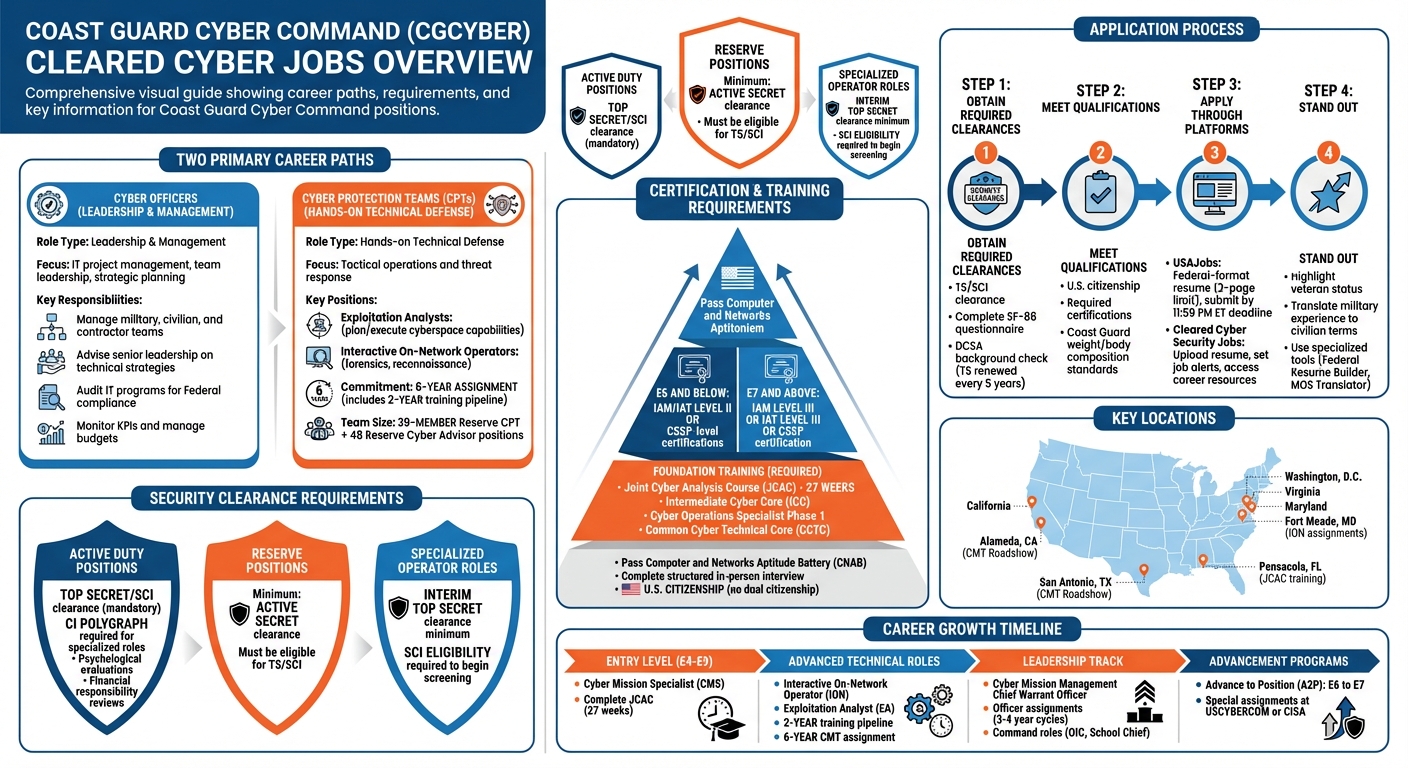
If you’re interested in cybersecurity roles that protect national infrastructure, the Coast Guard Cyber Command (CGCYBER) offers a range of opportunities. These jobs focus on safeguarding maritime networks and require candidates with high-level security clearances, such as Top Secret/SCI. Key roles include Cyber Officers, who lead and manage IT projects, and Cyber Protection Teams (CPTs), which handle hands-on threat detection and response. Applicants must meet strict requirements, including U.S. citizenship, specialized training, and certifications.
Key Highlights:
- Roles Available: Cyber Officers (leadership) and CPTs (technical defense).
- Clearance Requirements: Top Secret/SCI; some roles need a CI polygraph.
- Training: Programs like JCAC and certifications such as IAT/IAM Level III are critical.
- Locations: Washington, D.C., Virginia, Maryland, and California.
- Application Process: Use USAJobs or specialized platforms for security-cleared professionals.
These roles provide structured career growth, advanced training, and the chance to work on critical national defense missions. If you meet the qualifications, CGCYBER offers a unique path in cybersecurity.
Coast Guard Cyber Command Career Path and Requirements Guide
Coast Guard Cyber Mission
sbb-itb-bf7aa6b
Main Cleared Cyber Roles at Coast Guard Cyber Command
These roles are vital for carrying out CGCYBER’s mission to safeguard maritime networks and contribute to national defense. CGCYBER offers two primary career paths: leadership positions as Cyber Officers and operational roles within Cyber Protection Teams (CPTs). Here’s a closer look at what each path entails.
Cyber Officers
Cyber Officers take on leadership responsibilities, managing IT projects and guiding teams composed of military personnel, civilians, and contractors. They play a key role in advising senior leadership on technical strategies and overseeing system upgrades to address evolving organizational needs. Their responsibilities also include auditing IT programs for compliance with Federal regulations and serving as Service Managers for specific IT systems. This involves monitoring performance metrics like Key Performance Indicators (KPIs) and managing budgets, staffing, and contracts.
This role acts as a bridge between cyber operations and the Coast Guard’s traditional missions, such as maritime law enforcement and ship technology management. By ensuring IT systems are secure and operational, Cyber Officers lay the groundwork for both defensive and offensive cyber operations.
Cyber Protection Teams (CPTs)
Unlike the leadership-oriented role of Cyber Officers, CPTs focus on hands-on, tactical defense. These specialized units operate under CGCYBER’s Operations Department and collaborate with groups such as Cyber Mission Teams, Red Teams, Blue Teams, and the Cyber Security Operations Center. Their primary goal is to defend Coast Guard and maritime networks, respond to incidents, and counter cyber threats. Members of CPTs typically come from the Cyber Mission Specialist (CMS) enlisted rating and must meet USCYBERCOM qualification standards.
The Coast Guard has also developed a 39-member Reserve Cyber Protection Team and created 48 Reserve Cyber Advisor positions to support operational commands within the Marine Transportation System [4]. CPT personnel take on highly technical tasks, such as:
- Exploitation Analysts: These individuals plan and execute cyberspace capabilities aimed at external defense or force projection [5].
- Interactive On-Network Operators: They conduct forensic analysis, surveillance, reconnaissance, and network navigation to support offensive operations [5].
Assignments to Cyber Mission Teams are typically long-term, requiring a 6-year commitment, which includes a rigorous 2-year training program [5].
Security Clearance and Qualification Requirements
Securing a role within CGCYBER’s mission requires meeting stringent clearance and qualification standards. For most active-duty cyber positions, a Top Secret/Sensitive Compartmented Information (TS/SCI) clearance is mandatory. This includes roles such as Cyber Mission Specialist (CMS) [3] [8]. More specialized positions, like Interactive On-Network Operators or Exploitation Analysts, need at least an Interim Top Secret clearance with SCI eligibility to even begin the screening process [5]. For reservists, the minimum requirement is an active Secret clearance with eligibility for TS/SCI [4]. These strict clearance requirements pave the way for the advanced training described below.
Candidates must also undergo additional vetting, which includes a Counterintelligence (CI) polygraph, psychological evaluations, and financial responsibility reviews [5] [8]. According to official U.S. Coast Guard guidance:
"Applicants are required to be eligible for a government travel card, have no history of indebtedness for the previous three years, have no mark of unsatisfactory conduct in the EES for two years preceding application, and at a minimum members must hold an Interim Top Secret security clearance and be eligible for Secure Compartmented Information (SCI)" [5].
DoD 8140.03 Cyberspace Workforce Qualifications
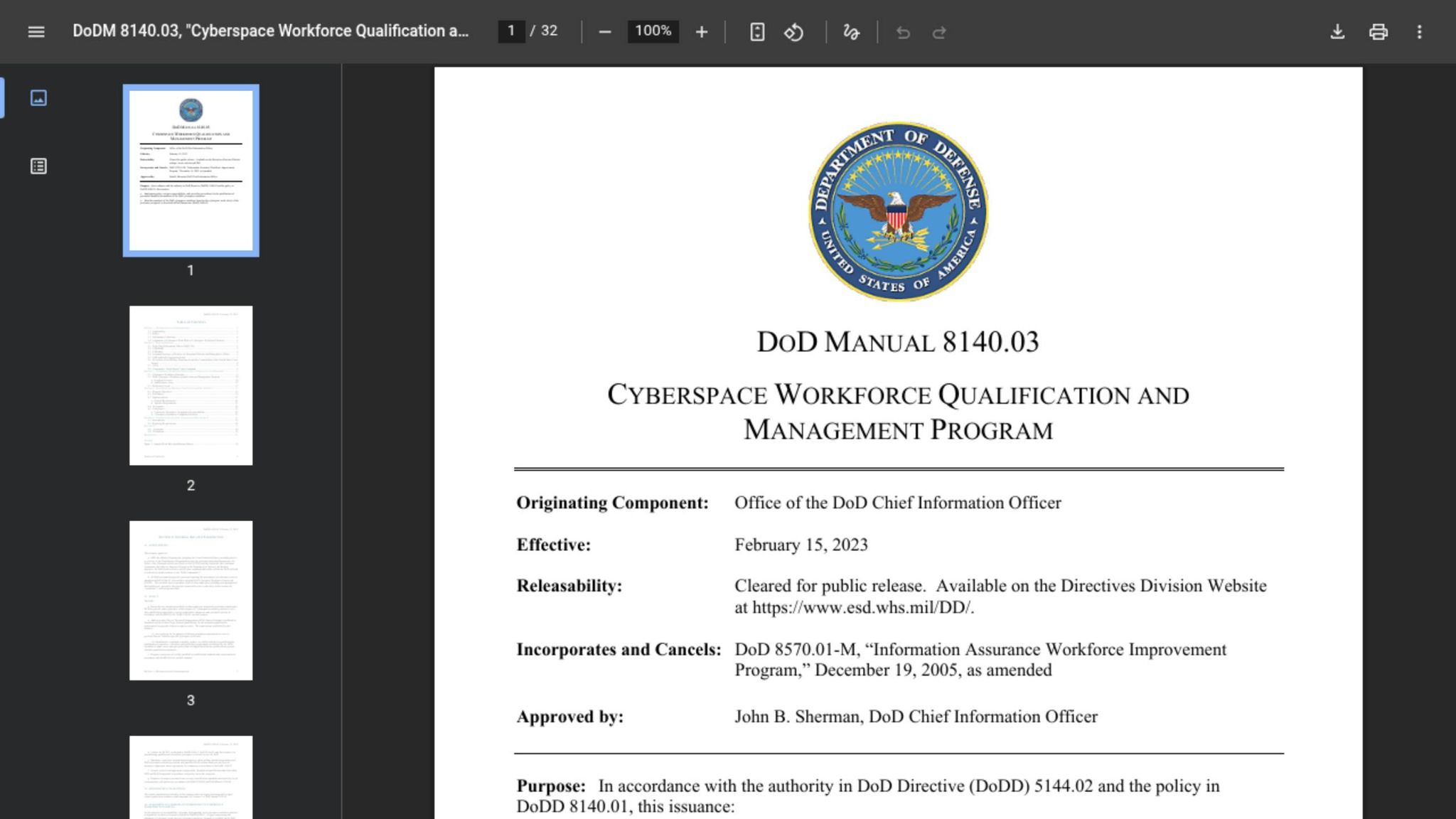
The DoD Cyber Workforce Framework establishes professional benchmarks for Coast Guard cyber roles. Foundational training is a must, including programs like the Joint Cyber Analysis Course (JCAC), Intermediate Cyber Core (ICC), Cyber Operations Specialist Phase 1, or Common Cyber Technical Core (CCTC). For personnel ranked E7 and above, these training requirements can be replaced by certifications such as Information Assurance Management (IAM) Level III, Information Assurance Technical (IAT) Level III, or Cyber Security Service Provider (CSSP). Those ranked E6 and below must hold IAM/IAT Level II or CSSP-level certifications.
Specialized operator roles require candidates to pass the Computer and Networks Aptitude Battery (CNAB) and complete a structured in-person interview. Keeping certifications updated in official records is crucial to avoid delays [4] [8]. If you have equivalent industry certifications not explicitly listed, you can request a waiver through the Office of Cyberspace Forces (CG-791) for consideration.
Security Clearance and Citizenship Requirements
Beyond clearance requirements, candidates must meet strict standards for citizenship and background checks. U.S. citizenship is mandatory, and most cyber roles do not allow dual citizenship [3] [4] [8]. Security clearance applications cannot be initiated independently; they require a conditional job offer for a position involving classified access. Once hired, the sponsoring agency facilitates the clearance process [7].
The Defense Counterintelligence and Security Agency (DCSA) handles approximately 95% of federal background checks. Top Secret clearances require reinvestigation every five years, while Secret clearances are reviewed every 10 years [7].
The process begins with completing the SF-86 security questionnaire, which involves an extensive review of your financial history, foreign contacts, and personal conduct [7]. If you have concerns – like financial issues or past substance use – be honest, as adjudicators evaluate the "whole person" and look for evidence of positive changes [7]. Common disqualifiers include criminal activity, financial dishonesty, substance abuse, or foreign allegiances [7]. Additionally, candidates must meet Coast Guard weight and body composition standards to qualify for lateral entry into cyber ratings [3] [8].
How to Apply for Cleared Cyber Jobs
Once you have your security clearances and qualifications in order, the next step is to focus on the application process. Applying for Coast Guard Cyber Command positions means navigating the federal hiring system carefully. Most job postings can be found on USAJobs, the official federal employment website, but there are also specialized platforms that can help you target roles requiring security clearance.
Applying Through USAJobs

First, set up a USAJobs account if you haven’t already. Be sure to format your resume according to federal guidelines. This includes keeping it within a two-page limit and using the correct date format for each job entry. Avoid including personal details like your Social Security Number, birth date, or a photo, as these can lead to automatic disqualification.
When you find a position with Coast Guard Cyber Command, click on "Apply Online" and complete the federal questionnaire with accurate information. Make sure to upload your federal-format resume along with any required documentation listed in the job announcement. Applications must be submitted by 11:59 PM Eastern Time on the job’s closing date.
Leveraging Cleared Cyber Security Jobs

Beyond USAJobs, the Cleared Cyber Security Jobs platform offers a more tailored approach for security-cleared professionals. This site allows you to search for Coast Guard cyber openings by clearance level, location, and area of expertise. You can also upload your resume to their database, where hiring managers and recruiters can find your profile when openings arise.
To stay ahead, set up job alerts for Coast Guard Cyber Command roles that match your skills and clearance. The platform also includes a career resources section with tools like certification guides and interview tips specifically designed for cleared cyber professionals. These resources can complement your efforts and help you stand out when applying for roles with CGCYBER.
How to Stand Out as a Cleared Candidate
Once you’ve streamlined your application, it’s time to focus on standing out. Competition for Coast Guard Cyber Command roles is fierce, and while a security clearance gets you in the door, additional qualifications like certifications, military experience, and strategic use of career resources can make all the difference.
Certifications and Professional Development
Meeting DoD 8570/8140 certification standards is essential for Coast Guard Cyber Command roles. For technical positions, aim for Information Assurance Technical (IAT) Level III certifications. If you’re targeting management roles like Cyber Mission Manager, you’ll need Information Assurance Management (IAM) Level III credentials such as CISSP or CISM. For many transitioning military personnel, CompTIA Security+ is an excellent starting point and often a baseline requirement for federal cyber roles.
If you’re looking to strengthen your foundation, completing the Joint Cyber Analysis Course (JCAC) is highly recommended. It’s considered a cornerstone of training for many advanced Coast Guard cyber roles. Transitioning from another branch of the military? Securing a spot in JCAC should be a priority. For offensive or defensive cyber roles, prepare for the Computer and Networks Aptitude Battery (CNAB), a critical pass/fail assessment for roles like Exploitation Analyst. Additionally, your military background can be a valuable asset when paired with these certifications.
Highlighting Veteran Status and Relevant Experience
Veterans bring unique strengths to Coast Guard Cyber Command. Your military service showcases discipline, the ability to operate under pressure, and experience with classified systems – qualities highly valued by the Command. According to Callie Guenther, Senior Manager for Cyber Threat Research, veterans bring essential, transferable skills to cybersecurity roles.
When crafting your federal resume, translate your military experience into civilian terms. For example, instead of using military-specific job titles like Coast Guard rating or Navy CTN specialty, describe your responsibilities more broadly. Phrases like "managed network monitoring systems for classified networks" or "responded to security incidents in operational environments" resonate more with hiring managers. Rob Hughes, CISO at RSA, notes:
"Knowing that a prospective hire has had experience in minimizing risks and detecting threats, and knowing that they learned those skills in the highest-stakes environments, always makes those prospects stand out" [9].
Also, don’t overlook the value of your security clearance. A current Top Secret/SCI clearance can boost your earning potential by $15,000 to $60,000 annually. Be sure to clearly state your clearance level and adjudication date in your application.
Using Cleared Cyber Security Jobs Resources
Take advantage of specialized tools and platforms designed for cleared cyber professionals. The Cleared Cyber Security Jobs platform offers resources tailored to help security-cleared candidates land federal cyber roles. Tools like the Federal Resume Builder ensure your application meets government standards, while the MOS Translator and DD-214 Decoder help convert military job titles, such as Coast Guard IT or Cyber Mission Specialist ratings, into civilian equivalents. The Certification Advisor tool can guide you through DoD 8140 requirements, helping you identify the most important certifications for your desired role.
Prepare for technical interviews and salary discussions using the platform’s Interview Simulator and Salary Roleplay tools. Additionally, the platform provides access to job fairs where you can connect directly with Coast Guard Cyber Command recruiters. Use the Networking Guide to build connections with other veterans, and attend virtual events to hear about job openings before they’re publicly announced. These tools complement your USAJobs applications and provide multiple ways to connect with decision-makers at CGCYBER.
Career Growth at Coast Guard Cyber Command
Moving from Cyber Protection Teams to Advanced Roles
At Coast Guard Cyber Command, professionals with the right clearances and dedication to training can follow clear paths to advancement. Enlisted CMS personnel (grades E4–E9) have opportunities to step into technical roles like Interactive On-Network Operator (ION) or Exploitation Analyst (EA). These roles demand a rigorous screening process, a 2-year training pipeline, and a commitment to a 6-year Cyber Mission Team assignment.
IONs handle on-network operations, focusing on tactical forensics and reconnaissance during offensive missions. Meanwhile, Exploitation Analysts design and carry out cyberspace capabilities to infiltrate targeted networks. To better understand these roles and prepare for the Computer and Networks Aptitude Battery (CNAB), consider attending a Cyber Mission Team (CMT) Roadshow in Alameda, CA, or San Antonio, TX [5].
For those aiming for leadership, the Cyber Mission Management (CMM) Chief Warrant Officer specialty offers a structured route to technical leadership [3]. Additionally, the Advance to Position (A2P) program enables qualified E6 personnel to advance to E7 by filling critical vacancies, such as Cyberspace Analyst roles at the Cybersecurity Operations Center. To qualify, ensure your Official Military Personnel File (OMPF) includes all relevant transcripts and certifications [10].
Professional Development Resources
Coast Guard Cyber Command prioritizes ongoing professional development to help personnel grow in their careers. Training is a cornerstone of this approach. After completing the 27-week Joint Cyber Analysis Course (JCAC) in Pensacola, FL, members can access specialized training in areas like risk and network traffic analysis, blue/red cell operations, and cloud security. The Coast Guard also supports higher education by funding Associate, Bachelor’s, and advanced degrees in cybersecurity-related fields, whether pursued full-time or part-time [1].
Special assignments provide additional opportunities for growth. Detachments at U.S. Cyber Command (USCYBERCOM) or the Cybersecurity and Infrastructure Security Agency (CISA) offer joint-agency experience, equipping personnel for senior roles such as Officer in Charge (OIC) or School Chief [2]. Officers advance through 2–4 year assignment cycles, moving from apprentice positions to command roles while gaining expertise in areas like Incident Management, Operations Research, Data Analytics, or Acquisition Program Management [6].
Conclusion
The Coast Guard Cyber Command offers security-cleared professionals a distinctive opportunity to protect maritime infrastructure while advancing their careers in cybersecurity. For instance, Cyber Mission Specialists undergo the intensive 27-week Joint Cyber Analysis Course in Pensacola, FL [1], while Interactive On-Network Operators take on 6-year assignments at Fort Meade, MD [5]. The Command supports career growth through structured training programs and Coast Guard-funded educational opportunities.
The selection process is demanding, ensuring only the most qualified candidates move forward. Specialized positions require passing the CNAB, obtaining Top Secret/SCI clearance with counterintelligence polygraphs, and completing a two-year training pipeline [5]. In return, candidates gain stable assignments, access to advanced training in areas like cloud security and red/blue cell operations, and a clear path from entry-level roles to leadership positions [1].
Once qualified, finding the right role becomes critical. Cleared Cyber Security Jobs simplifies this process by connecting job seekers with Coast Guard Cyber Command openings and other cleared positions in the defense sector. As a veteran-founded platform, it provides specialized job search tools, resources tailored to the cleared community, and direct access to employers – all free for job seekers.
Whether you’re stepping into your first Cyber Mission Specialist role or aiming for senior technical positions, leveraging Coast Guard professional development programs and Cleared Cyber Security Jobs’ targeted tools can give you an edge. This combination of rigorous training, defined career pathways, and strategic job placement resources equips security-cleared professionals to succeed in protecting critical national infrastructure.
FAQs
How long does it take to get TS/SCI for CGCYBER roles?
It usually takes about 6–8 months to secure a TS/SCI clearance for CGCYBER roles. However, the timeline can fluctuate depending on factors like the complexity of background checks and processing delays. Staying patient during this process is crucial, as the thorough vetting ensures candidates meet the strict requirements for these high-security positions.
Can I apply without a current clearance?
To apply for cleared cyber jobs at the Coast Guard Cyber Command, you must already hold the necessary security clearance (like TS/SCI) or be prepared to obtain one. These clearances are a critical requirement for these positions.
What’s the best path to move from CPT to ION or EA?
If you’re looking to move from a Cyber Mission Specialist (CPT) role to becoming an Interactive On-Network Operator (ION) or Exploitation Analyst (EA), the Coast Guard offers a clear path through its screening process.
An in-person screening event is set to take place at Coast Guard Headquarters from August 12–23, 2024. To prepare, make sure your military records are up-to-date and that you meet all eligibility requirements. Successfully passing this screening will pave the way for specialized training in these advanced roles.
For those who qualify, there are also lateral entry opportunities available, providing another route to join these specialized fields.