

NSA cyber analyst jobs offer high salaries, job security, and unique opportunities to protect national intelligence. Here’s what you need to know:
- Top Secret/Sensitive Compartmented Information (TS/SCI) clearance with a Full Scope Polygraph is mandatory.
- Clearance can boost your salary by $45,000–$65,000 annually, totaling $900,000–$1.3 million over 20 years.
- A bachelor’s degree in fields like Computer Science or Cyber Security is preferred, but military experience or certifications like CompTIA Security+ can qualify you.
- Analysts work in Sensitive Compartmented Information Facilities (SCIFs) with no remote options.
- The clearance process takes 6–18 months and includes a detailed background check and polygraph exam.
- The cybersecurity job market is strong, with 514,000 postings and 26% unfilled positions projected by 2026.
Applying requires attention to detail, especially when completing the SF-86 form and tailoring your resume. Certifications like CISSP or CEH can give you an edge. Expect rigorous interviews and technical assessments. Long-term, NSA offers training, leadership opportunities, and advanced degree programs to help grow your career.
Bottom line: NSA cyber analyst roles demand preparation and patience but deliver unmatched career rewards.
Vet to Cybersecurity path by Ex-NSA Hacker
sbb-itb-bf7aa6b
Required Qualifications and Certifications
NSA cyber analyst positions require a bachelor’s degree in fields like Computer Science, Cyber Security, Information Technology, or closely related areas. However, candidates with an associate’s degree can qualify if they have two years of relevant experience. Military personnel with 18 semester hours of approved cyber coursework – such as the Joint Cyber Analysis Course (JCAC), Undergraduate Cyber Training (UCT), Network Warfare Bridge Course (NWBC), or Intermediate Network Warfare Training (INWT) – plus two years of experience also meet the entry requirements[1]. For intelligence-focused analyst roles, degrees in History, Government, Political Science, Intelligence, International Affairs, Library/Information Sciences, or National Security Studies are also considered[4]. Below, we’ll dive into the educational and certification expectations in more detail.
Education Requirements
Both academic qualifications and practical skills are highly valued. The NSA prioritizes candidates who can demonstrate hands-on experience through labs, projects, or military training. The demand for cybersecurity analysts is expected to grow 33% through 2033, with approximately 17,300 job openings every year[3]. This highlights the importance of building a solid educational foundation early in your career. Beyond academics, industry certifications play a key role in showcasing your expertise.
Industry Certifications
Certifications are a way to validate technical skills and meet DoD 8140 requirements. CompTIA Security+ is often seen as the baseline certification for many government contractor roles[2]. Once you’ve earned Security+, you can pursue more specialized certifications like Certified Ethical Hacker (CEH) for penetration testing or Certified Information Systems Security Professional (CISSP) for advanced security architecture[3][5]. The average salary for cybersecurity analysts is around $120,360, and obtaining a Full Scope Polygraph clearance can boost your earnings by an additional $45,000–$65,000 annually[2][3].
"Stop collecting certifications. Start applying. I see too many people with 6 certs and no job applications. You need ONE good cert and 100 job applications, not six certs and 10 applications." – Cybersecurity Hiring Manager[2]
Practical experience is just as important as certifications. Building home labs with virtual networks to simulate incident response scenarios can be more impactful than accumulating multiple certifications. For niche roles, specific credentials can make a difference. For instance, malware analysts might pursue GREM or OSCP, while cloud security architects could benefit from AWS or Azure Security Specialty certifications[2]. Additionally, the NSA values expertise in cryptology, information warfare, and foreign media analysis for intelligence-related positions[6].
Security Clearance Process
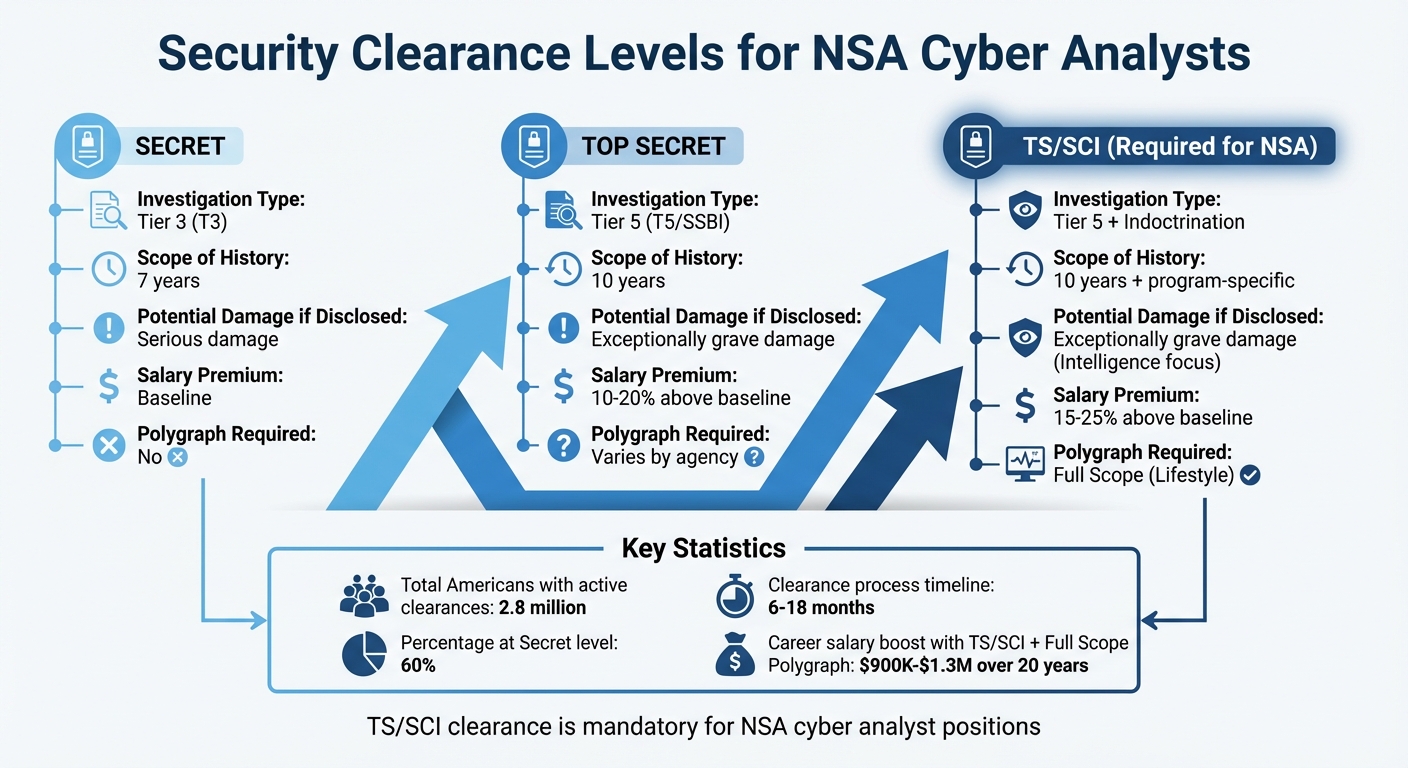
NSA Security Clearance Levels Comparison: Requirements and Investigation Scope
For NSA cyber analyst roles, obtaining a Top Secret (TS) clearance with Sensitive Compartmented Information (SCI) access and a Full Scope Polygraph is mandatory [7]. This combination – TS/SCI – grants access to highly classified intelligence programs, but only on a strict need-to-know basis [7]. The clearance process is lengthy, typically taking anywhere from 6 to 18 months after receiving a conditional job offer [7][8].
Beyond access to classified information, TS/SCI clearance comes with financial perks. Individuals holding this level of clearance often earn a 10–20% salary premium compared to those without it. Additionally, candidates with an active Full Scope Polygraph can command even higher premiums, ranging from 15–25% above standard market rates [7][8]. Considering that about 60% of active U.S. security clearances are at the Secret level, TS/SCI holders represent a smaller, more specialized group among the 2.8 million Americans with active clearances [8].
TS/SCI Clearance Requirements
The clearance process officially begins once you accept a conditional job offer from the NSA [10]. At this stage, you’ll be required to complete the SF-86 security form and undergo a Tier 5 background investigation (previously called SSBI). This investigation examines the last 10 years of your life, including residence, employment, education, foreign travel, and financial history [8]. Providing accurate and detailed information is crucial, especially regarding foreign contacts and finances, as inaccuracies could result in disqualification [10].
| Level | Investigation Type | Scope of History | Potential Damage if Disclosed |
|---|---|---|---|
| Secret | Tier 3 (T3) | 7 years | Serious damage [8] |
| Top Secret | Tier 5 (T5/SSBI) | 10 years | Exceptionally grave damage [8] |
| TS/SCI | Tier 5 + Indoctrination | 10 years + program-specific | Exceptionally grave damage (Intelligence focus) [7][8] |
Once the background investigation wraps up, adjudicators evaluate your loyalty, character, and discretion to decide your eligibility [10]. If approved, Special Security Officers (SSOs) grant access to specific SCI programs [7]. The final step involves being "read in", which includes signing a non-disclosure agreement and attending briefings on handling classified materials. Most NSA cyber analyst tasks must be conducted in a Sensitive Compartmented Information Facility (SCIF), making remote work for classified assignments nearly impossible [7].
Understanding this clearance process is essential for securing NSA roles and the associated financial advantages. The next step involves navigating the rigorous polygraph examination, which ensures your suitability for accessing sensitive programs.
Polygraph Examination
NSA applicants must pass a Full Scope (Lifestyle) Polygraph, which is more thorough than the Counterintelligence (CI) polygraph used by other government agencies [7]. This exam includes three types of questions: relevant, irrelevant, and control [11]. While CI polygraphs focus on espionage, terrorism, and unauthorized disclosures, the Full Scope polygraph expands its scope to cover personal conduct, such as drug use, criminal behavior, and financial misconduct [7].
Honesty is critical – providing false or misleading answers can jeopardize your clearance [11]. The Full Scope polygraph is often more stressful than the CI version because of its focus on personal lifestyle issues. Its findings are reviewed alongside the 13 Adjudicative Guidelines (SEAD 4), which evaluate factors like financial responsibility, drug use, and foreign influence [9].
| Feature | Counterintelligence (CI) Polygraph | Full Scope (Lifestyle) Polygraph |
|---|---|---|
| Primary Focus | Espionage, terrorism, and unauthorized disclosures [7] | CI topics plus personal conduct and lifestyle [7] |
| Lifestyle Coverage | Limited or none [7] | Includes drug use, criminal history, and financial crimes [7] |
| Agency Usage | Standard for DIA, NGA, and many DoD programs [7] | Standard for NSA, CIA, and NRO [7] |
Job Responsibilities of NSA Cyber Analysts
NSA cyber analysts play a critical role in turning classified information into actionable insights, uncovering the intentions of adversaries [4]. Their work focuses on identifying threats to U.S. critical infrastructure, the Defense Industrial Base, and National Security Systems. This requires a blend of technical skills and sharp analytical abilities, as they sift through data from various sources to close intelligence gaps and keep a watchful eye on global developments [4].
"As a cybersecurity professional, you will work with a team on the frontlines of defense against cyber adversaries… Help protect national security interests as part of the world’s most advanced team of cyber professionals." – NSA Career Fields [4]
These analysts collaborate with interdisciplinary teams to merge threat assessments into cohesive security strategies [4][6]. By doing so, they ensure their technical findings align with broader national security goals. Let’s take a closer look at the daily responsibilities and team dynamics that define NSA cyber operations.
Threat Detection and Analysis
On a day-to-day basis, analysts are tasked with monitoring networks and analyzing metadata to uncover emerging threats. They map global networks and investigate adversarial communications, employing tools like Ghidra, IDA Pro, Snort, and Suricata. Their work involves deep packet analysis and examining network protocols such as TCP/IP, VoIP, and wireless communications to detect suspicious activity or vulnerabilities in systems, including wired networks, 5G technology, and cloud platforms.
When vulnerabilities are identified, analysts respond by creating mitigations and designing defensive measures like perimeter defenses. Their technical expertise extends to programming in languages such as Python, C/C++, Assembly, and Java, which they use to automate threat detection, analyze malware, and reverse-engineer malicious software.
Working with Intelligence Teams
NSA cyber analysts don’t work in isolation – they’re part of diverse teams that include software engineers, data scientists, researchers, and programmers. Together, these teams develop sophisticated tools and systems [12]. Analysts integrate vulnerability assessments from multiple sources to create a comprehensive view of network risks, providing technical mission offices with critical situational awareness and actionable intelligence. Programs like the DNEA and Intrusion Analyst initiatives combine formal training with hands-on assignments over three years to foster team-based expertise [12].
"The increased complexity of supporting NSA’s mission requires world class researchers, programmers, and developers who operate in teams… in order to design and develop advanced tools, techniques, and systems." – National Security Agency [12]
This collaborative approach not only strengthens national security but also highlights the level of skill and teamwork required to excel in these roles, setting the stage for future discussions on application success.
How to Apply for NSA Cyber Analyst Positions
If you’re aiming to become a cyber analyst at the NSA, the application process is straightforward but rigorous. Start by visiting the NSA’s official website under the "Careers" section or head to IntelligenceCareers.gov. Completing the initial application takes about 30–60 minutes, and you can expect a response within 1 to 5 weeks.
After submitting your application, you’ll receive a link to eApp, the platform where you’ll fill out the Standard Form 86 (SF-86). This form requires a detailed record of your past 10 years, including documentation like residential leases, tax returns, and passport stamps. While eApp features automated error-checking and pre-filled fields, it’s still up to you to ensure everything is accurate [1].
The selection process includes a thorough background check, phone interviews, and mandatory drug screenings [13]. As part of the Trusted Workforce 2.0 framework, adjudicators are increasingly reviewing candidates’ digital footprints – this might include your GitHub projects, activity on professional forums, and social media presence during the Personal Conduct review [1]. Additionally, tailoring your resume to NSA standards is critical.
Application and Resume Submission
When submitting your resume, be precise. Include exact dates of employment and the number of hours worked per week for each role. Omitting these details will result in an incomplete application [14]. Avoid attaching classified information, photos, or anything inappropriate, as these can lead to immediate disqualification [14]. For those with military experience, list relevant courses like JCAC (Joint Cyber Analysis Course) or UCT (Undergraduate Cyber Training) – the NSA treats these 20- to 24-week courses as six months of relevant experience.
Make sure your resume highlights tools and programming languages mentioned in the job description, such as Ghidra, IDA Pro, Snort, Suricata, Python, C, and SQL. If you have received performance appraisals or incentive awards, include them to showcase your specialized experience [14]. Veterans should submit DD-214 (Copy 4) and Standard Form 15 right away to claim preference eligibility. To ensure you’re applying for the right role, use the Job Exploration Tool on the NSA website. Once your application is in, prepare for challenging technical assessments during the interview process.
Interview and Assessment Process
The interview phase is demanding and tailored to your area of expertise. Expect technical assessments that may involve solving logic problems, translating complex documents, or explaining technical concepts. Depending on the role, you might face questions about network security, reverse engineering, or incident response. In some cases, you’ll need to prepare and present a detailed technical topic to a panel of officials, defending your ideas under scrutiny [13].
| Technical Assessment Area | Specific Skills/Tools Evaluated |
|---|---|
| Network Security | Protocol analysis, signature development (Snort/Suricata), packet analysis |
| Software Engineering | Reverse engineering (Ghidra, IDA Pro), scripting (Python, C, Lua) |
| Systems Admin | Windows and Unix/Linux administration |
| Forensics & Analysis | Incident response, malware analysis, computer and network forensics |
Honesty is crucial throughout the process. Disclose any minor offenses or issues during interviews and on security forms – the NSA’s background check will uncover hidden details anyway. Under Continuous Vetting, you are required to report significant life changes – like arrests, major debt, or foreign contacts – to a Security Officer immediately rather than waiting for a formal review [1]. Also, review your social media and networking site privacy settings to avoid raising any concerns.
Career Growth at the NSA
Promotion Paths and Leadership Roles
Starting your career as an NSA cyber analyst opens the door to a wide range of advancement opportunities. With time and experience, you can move into management or technical leadership roles like Analytic Methodologist, Counterintelligence Threat Analyst, or Cryptologic Cyber Planner. These roles offer not only professional growth but also competitive compensation. On average, national security analysts earn $107,334 annually, with most salaries falling between $91,500 and $130,000 [4][6].
To help employees grow, the NSA provides structured development programs and internal education options. For instance, after just one year of permanent employment, you can qualify for the Advanced Studies Program, which lets you take up to four semesters of advanced courses at accredited institutions. This program allows you to maintain your full salary while covering tuition costs [15]. Combined with comprehensive training programs, these opportunities make career advancement at the NSA both achievable and rewarding.
Training and Professional Development
The NSA places a strong emphasis on training and professional growth. Through initiatives like the National Cryptologic School (NCS), employees can receive specialized instruction in cryptology and leadership. For those seeking formal degrees, the National Intelligence University (NIU) offers accredited programs in secure, classified environments.
Additional programs include:
- After-Hours College Program: Covers tuition for job-related courses.
- Accelerated Degree Program: Provides college credit for National Cryptologic University coursework and military training at reduced tuition rates.
The NSA also collaborates with institutions like the Naval Postgraduate School, National Defense University, and National War College to offer tuition-free degrees in intelligence studies. For those aiming for advanced degrees, graduate fellowship programs cover full tuition and salary while studying at local universities [15].
These resources demonstrate the NSA’s commitment to equipping its workforce with the expertise and credentials needed for long-term success.
Using Cleared Cyber Security Jobs to Find NSA Positions

Job Search Features and Resume Tools
Cleared Cyber Security Jobs makes it easier to find cyber analyst roles at the NSA by offering filters tailored specifically for the cleared community. You can refine your search by clearance levels like Secret, Top Secret, or TS/SCI, as well as polygraph requirements, such as Counterintelligence or Full Scope – both of which are crucial for most NSA roles. The platform uses an AI-powered matching engine that combines Boolean and semantic search methods to connect you with positions that match your clearance, technical expertise, and preferred location.
The site focuses on areas where the NSA has significant operations, including Fort Meade, MD, Augusta, GA, San Antonio, TX, and Colorado Springs, CO [2][4]. When creating your profile, it’s essential to highlight certifications that comply with DoD 8140/8570 standards, like Security+ or CISSP, as these are often required for cleared analyst positions [2]. Additionally, the platform offers a 2026 Cybersecurity Salary Guide with verified compensation data specifically for cleared professionals [2].
"A Full Scope Polygraph clearance can add $45-65K annually to your cybersecurity salary. That’s $900K to $1.3M over a 20-year career. The math is simple: get cleared, get paid." – ClearanceJobs [2]
These tools, paired with networking events, can significantly enhance your job search.
Job Fairs and Networking Opportunities
In addition to its search tools, Cleared Cyber Security Jobs organizes job fairs that provide direct access to NSA recruiters. These events allow you to bypass general applicant pools and connect with hiring managers who are actively looking for cleared talent. For instance, job fairs focused on polygraph requirements are scheduled for May 14, 2026, and September 10, 2026, in Hanover, MD, and August 5, 2026, at Fort Meade, MD [16].
These events are excellent opportunities to engage with recruiters who have immediate hiring needs. To make the most of these fairs, upload your resume beforehand, ensuring it clearly states your clearance level and polygraph status. With around 26% of cybersecurity positions still unfilled in 2026 and cleared professionals earning 20% to 40% more than their counterparts in the commercial sector [2], attending these events gives you a significant edge in securing high-paying NSA roles.
Conclusion
Landing a cyber analyst position at the NSA requires more than just technical expertise – it calls for careful planning and strategic preparation. Securing a TS/SCI clearance with a Full Scope Polygraph can significantly enhance your earning potential, adding an estimated $45,000–$65,000 annually and potentially boosting your income by $900,000–$1.3 million over a 20-year career [2]. The Trusted Workforce 2.0 framework has simplified the clearance process, leveraging tools like the eApp platform and Continuous Vetting to streamline applications [1].
Start by earning your Security+ certification to meet the DoD 8140 baseline requirements, and focus on obtaining additional relevant certifications to strengthen your qualifications. When filling out your SF-86 form, pay close attention to detail – small errors can lead to "Personal Conduct" flags that might jeopardize your clearance [1].
Take the time to review and clean up your online presence. Adjudicators now examine GitHub contributions, professional forums, and even gaming communities, looking for signs of sound judgment. Additionally, report any adverse events, such as arrests or significant financial issues, to your Security Officer immediately. Staying vigilant helps protect your clearance and keeps you competitive in a field with increasing demand.
With 26% of cybersecurity positions projected to remain unfilled by 2026 and cleared professionals earning 20% to 40% more than their counterparts in the private sector [2], opportunities in this area are vast. Platforms like Cleared Cyber Security Jobs offer tools such as clearance-specific job filters, access to recruiters, and job fairs in major hubs like Fort Meade, San Antonio, and Augusta, giving you an edge in this competitive market.
While the path to becoming an NSA cyber analyst is demanding, the rewards – both professionally and financially – are well worth the effort. By mastering the clearance process, refining your application strategy, and using the resources available, you can position yourself for a successful and impactful career in the cleared cybersecurity field.
FAQs
Can I apply without an active TS/SCI yet?
No, you can’t apply for NSA cyber analyst positions without holding an active TS/SCI clearance. This clearance level is a basic requirement for most roles, and candidates won’t be considered without it.
What commonly delays the TS/SCI and polygraph process?
Delays in obtaining TS/SCI clearance and completing the polygraph process can stem from several factors. These include a shortage of examiners, difficulties in scheduling appointments, and the time required to conduct detailed background investigations. Other potential causes are the need for follow-up interviews or additional time to process polygraph results. The overall timeline often depends on the complexity of the case and the resources available.
How can I prepare for NSA technical interviews?
To get ready for NSA technical interviews, concentrate on honing your cybersecurity knowledge and technical abilities. Make sure to review core topics like risk management, incident response, and scripting languages (such as PowerShell). Be prepared to discuss your background, certifications, and relevant experience in detail. Taking courses on cybersecurity basics or scripting can also help you feel more confident and showcase your skills effectively during the interview.