

Want to work in cybersecurity for the Army? Army Cyber Command (ARCYBER) offers high-level roles for military and civilian professionals to protect U.S. networks and conduct cyber operations. These jobs require security clearances, certifications, and specialized skills. Here’s what you need to know:
- Key Roles: Positions include Cyber Operations Specialist (17C), Cyber Warfare Officer (17A), and civilian IT Cybersecurity Specialists.
- Clearances: Most jobs need a Top Secret/Sensitive Compartmented Information (TS/SCI) clearance, sometimes with a Counterintelligence (CI) polygraph.
- Certifications: Certifications like Security+ or CISSP are mandatory under DoD Directive 8140.
- Salary: Military roles offer bonuses up to $40,000, while civilian salaries can exceed $190,000 annually.
- Application Process: Apply via USAJobs.gov or ARCYBER’s portal. Military personnel can transition through the Cyber Evaluation and Assessment Directorate (CEAD).
Pro Tip: Start early – clearances can take 6-18 months. Stay compliant with clearance requirements and focus on certifications to boost your career potential.
US Army 17C MOS | Cyber Operations Specialist
sbb-itb-bf7aa6b
What is Army Cyber Command
Army Cyber Command (ARCYBER) serves as the Army’s dedicated component to U.S. Cyber Command (USCYBERCOM). Its headquarters is located at Fort Gordon, Georgia. Formed on October 1, 2010, ARCYBER acts as the central hub for all cyberspace and information operations within the Army [3]. This streamlined structure ensures a unified and effective response to cyber threats.
Mission and National Defense Role
The mission of ARCYBER is rooted in achieving dominance in the information domain. It conducts proactive cyber operations to protect U.S. interests, maintain operational freedom, and counter threats. These efforts range from stopping phishing and ransomware attacks to dismantling hostile networks.
By September 2017, all 41 of the Active Army’s cyber mission force teams achieved Full Operational Capability (FOC). Additionally, the Army Reserve operates 21 Cyber Protection Teams [3]. These teams are responsible for critical tasks such as malware analysis, computer forensics, and offensive operations targeting nation-state adversaries. Given the sensitive nature of these operations, personnel are required to hold high-level security clearances, often at the Top Secret level.
How Army Cyber Command is Organized
ARCYBER is structured to maximize its effectiveness through specialized units, each playing a key role in its mission:
- Army Network Enterprise Technology Command (NETCOM): Oversees and protects the Army’s global enterprise network.
- 780th Military Intelligence Brigade: Conducts signals intelligence and cyberspace operations from its base at Fort Meade.
- Army Cyber Protection Brigade: Based at Fort Gordon, this unit focuses on defensive cyberspace operations, including its subordinate 60th Offensive Cyberspace Operations Signal Battalion.
ARCYBER also integrates multi-component forces, such as:
- 91st Cyber Brigade: The Army National Guard’s first cyber brigade.
- Joint Force Headquarters-Cyber (JFHQ-C): Manages the planning and execution of cyber operations for combatant commands.
Every member of these units – whether active duty, reserve, or civilian – must meet strict security clearance requirements to handle sensitive national security information. As of December 2025, Lieutenant General Christopher L. Eubank leads ARCYBER, having assumed command that same month [3].
This comprehensive organizational setup enables ARCYBER to safeguard critical operations effectively, laying the groundwork for the career opportunities discussed in later sections.
Types of Cleared Cybersecurity Jobs at Army Cyber Command
Main Positions and What They Do
Army Cyber Command (ARCYBER) offers a variety of cleared cybersecurity roles across both military and civilian tracks, each playing a key role in defending critical networks and conducting cyberspace operations.
Military positions are at the core of ARCYBER’s operational strength. For example, the Cyber Operations Specialist (17C) is an enlisted role focused on protecting Army networks and countering enemy cyber activities [1]. On the officer side, Cyber Warfare Officers (17A) lead synchronized defensive and offensive cyber operations [1]. If you’re drawn to operations involving the electromagnetic spectrum, the Electromagnetic Warfare Specialist (17E) handles planning and executing electronic warfare to control the spectrum and neutralize enemy systems [1]. Similarly, the Cyber Electromagnetic Warfare Officer (17B) oversees cyber protection strategies, coordinates attacks, and delivers electronic warfare support [1].
On the civilian side, ARCYBER offers advanced technical leadership opportunities. For instance, in January 2025, the Command advertised a Supervisory IT Cybersecurity Specialist role (GG-2210-14) at Fort Belvoir, Virginia, with a salary range of $139,335 to $190,510 [4]. This position involves leading teams under the Army User Activity Monitoring (UAM) Program, focusing on detecting insider threats and addressing emerging vulnerabilities in cyber defense [4].
These roles involve a range of technical tasks, including programming, malware analysis, forensics, and threat detection [1]. Compensation for military positions is competitive: a Cyber Officer at the O-2 level with three years of service earns about $5,100 per month, plus a $12,000 annual bonus. Enlistment and retention bonuses for critical specialties can go as high as $40,000 [2]. Additionally, professionals with STEM degrees can join the Cyber Corps as officers through direct commissioning, potentially starting at ranks as high as Colonel, depending on their experience [1].
These roles highlight the intricate balance of technical expertise and strict security protocols required to meet ARCYBER’s mission.
Why Security Clearance Matters for These Roles
The sensitive nature of ARCYBER’s mission makes security clearances a critical element of these positions. Security clearances enable access to Sensitive Compartmented Information (SCI) and are essential for carrying out advanced cyber operations. Personnel in these roles must conduct detailed research and analysis, often working with sensitive data sets that include indicators of potential cyber threats [4]. For instance, the Supervisory IT Cybersecurity Specialist position requires a Top Secret clearance with SCI eligibility to oversee the Army User Activity Monitoring Program and support the Army Counter-Insider Threat Program [4].
Clearance levels directly influence the scope of a role’s responsibilities. All Warrant Officers in the U.S. Army Cyber Corps are required to obtain and maintain a Top Secret clearance [1]. Maintaining this clearance involves periodic reviews, such as Counter-Intelligence Polygraph examinations, and adhering to ongoing requirements as a condition of employment [4]. These stringent clearance standards ensure that personnel are equipped to safeguard the nation’s critical networks and information systems.
Security Clearance Requirements
Clearance Levels and Eligibility
Most ARCYBER cybersecurity roles require a Top Secret/Sensitive Compartmented Information (TS/SCI) clearance, with many also needing a Counterintelligence (CI) polygraph. These strict requirements are in place because personnel deal with classified threat intelligence, making it essential to entrust these operations only to qualified individuals.
To be eligible, applicants must be U.S. citizens and participate in the Drug Free Federal Workplace Program. Many ARCYBER roles are classified as Testing Designated Positions (TDP), which means applicants must sign DA Form 5019, undergo regular urinalysis testing, and complete in-depth background checks to evaluate their suitability. Some positions also require annual OGE-450 financial disclosures, and male applicants born after December 31, 1959, must provide a Pre-Employment Certification Statement for Selective Service Registration.
Additionally, new hires may face a probationary period of up to three years. Importantly, applications must not include classified information, as doing so could lead to immediate disqualification. Many ARCYBER roles are deemed mission essential, meaning employees are required to report for duty during emergencies, severe weather, or even government furloughs [5].
How to Get a Clearance and How Long It Takes
The process for obtaining a clearance begins with completing Standard Form 86 (SF-86) on the "eApp" digital platform, which has replaced the older e-QIP system. Applicants must provide a detailed ten-year history of their residences, employment, education, and foreign contacts. Using the Trusted Workforce 2.0 framework, background checks are categorized into Tier 3 (Secret clearance) and Tier 5 (Top Secret/SCI clearance).
The time it takes to process a clearance depends on the level required:
- Interim Secret clearance: 10 to 30 days, based on preliminary checks like fingerprints and database reviews.
- Full Secret clearance: 60 to 150 days.
- Top Secret clearance: 120 to 240 days.
- TS/SCI with polygraph: 180 to 365 days or more, often due to delays in scheduling polygraph exams.
The Defense Counterintelligence and Security Agency (DCSA) oversees more than 95% of federal background investigations.
One of the most common reasons for clearance denial or revocation is financial issues. To avoid this, applicants should review their personal credit reports and resolve any problems before applying. It’s also important to note that marijuana use – even in states where it is legal – remains a federal disqualifier for ARCYBER positions. To streamline the process, gather a complete ten-year address history and contact information for former supervisors and neighbors.
Under the Continuous Vetting (CV) program, periodic reinvestigations have been replaced by real-time monitoring of factors like criminal arrests, credit irregularities, foreign travel, and public records. If any adverse events occur, such as an arrest, significant new debt, or foreign contacts, promptly report them to your Security Officer to prevent automated alerts from flagging your file [6].
Once your clearance is secured, you can focus on obtaining certifications and qualifications that will strengthen your application further.
Required Certifications and Qualifications
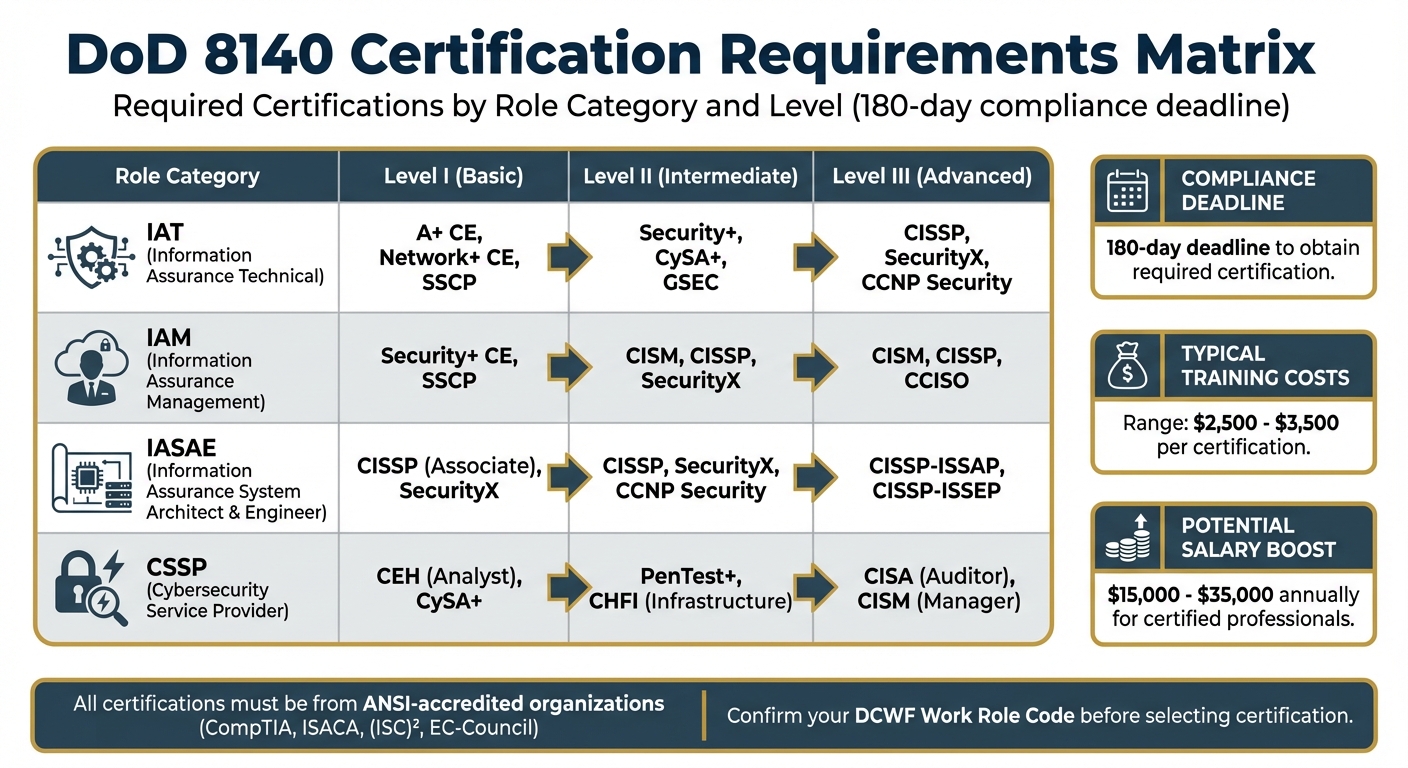
DoD 8140 Cybersecurity Certification Requirements by Role and Level
Certifications You Need
Under DoD Directive 8140 (which replaced the older 8570 standard), all ARCYBER personnel must earn specific certifications tailored to their assigned roles. You have 180 days to obtain the necessary certification.
The directive organizes roles into four main categories:
- IAT (Information Assurance Technical): Focused on hands-on defense tasks.
- IAM (Information Assurance Management): Concentrates on governance and policy.
- IASAE (Information Assurance System Architect and Engineer): Involves designing secure systems.
- CSSP (Cybersecurity Service Provider): Covers specialized roles like analysts and incident responders.
Each role category is further divided into three levels – Basic, Intermediate, and Advanced – each with its own certification requirements:
| Role Category | Level I (Basic) | Level II (Intermediate) | Level III (Advanced) |
|---|---|---|---|
| IAT (Technical) | A+ CE, Network+ CE, SSCP | Security+, CySA+, GSEC | CISSP, SecurityX, CCNP Security |
| IAM (Management) | Security+ CE, SSCP | CISM, CISSP, SecurityX | CISM, CISSP, CCISO |
| IASAE (Architect) | CISSP (Associate), SecurityX | CISSP, SecurityX, CCNP Security | CISSP-ISSAP, CISSP-ISSEP |
| CSSP (Specialist) | CEH (Analyst), CySA+ | PenTest+, CHFI (Infra) | CISA (Auditor), CISM (Manager) |
To ensure compliance, confirm your DCWF Work Role Code (e.g., 511 for Cyber Defense Analyst) before selecting a certification. All certifications must come from ANSI-accredited organizations such as CompTIA, ISACA, (ISC)², or EC-Council.
Training costs vary widely, with options like CompTIA Security+ priced at $2,495 and Cisco CCNA at $4,195, while most certifications fall between $2,500 and $3,500. On the bright side, certified DoD cybersecurity professionals typically earn $15,000 to $35,000 more annually compared to their non-certified peers [7][8].
Education and Training Requirements
In addition to certifications, ARCYBER positions come with specific educational and training prerequisites.
- Enlisted soldiers: Must have a high school diploma and be between 17 and 34 years old.
- Commissioned officers: Require a college degree and must be under 31. Those with STEM degrees in areas like computer programming or data analytics can apply for the Cyber Direct Commissioning program, which allows entry into the Army Cyber Corps at ranks ranging from Second Lieutenant to Colonel. Your starting rank depends on your civilian experience [1].
Warrant officers face additional steps, including passing the Cyber Capabilities Developer Assessment, completing Warrant Officer Candidate School, and finishing the Warrant Officer Basic Course. Regardless of rank, all Army Cyber personnel must complete Basic Training and meet standard military physical fitness requirements.
Once assigned, the Army provides specialized training in areas such as computer programming, software development, malware analysis, penetration testing, and computer forensics [1].
How to Apply for Cleared Cyber Jobs at Army Cyber Command
If you’ve got the necessary clearances and certifications, here’s how you can navigate the process to land a role at ARCYBER.
Applying Through USAJobs and ARCYBER Portals

Your first stop for civilian positions at ARCYBER is USAJobs.gov, the official employment hub for federal jobs. Start by creating a comprehensive profile that includes your resume, transcripts, and certifications. To find relevant openings, search using terms like "Army Cyber Command" or "ARCYBER", and include specific job titles that match your skills.
For more specialized roles, ARCYBER also has its own recruitment platform: armycyber.yellogov.com. This site focuses on positions like Supervisory IT Cybersecurity Specialists and simplifies the application process [9].
When submitting your application, keep all materials unclassified – even if you’re referencing work experience tied to your clearance.
Now, let’s explore how current Army personnel can transition into these roles.
Transferring Within the Army and the CEAD Program
If you’re already in the Army, transitioning into a cyber role follows a structured process. You’ll need to work with the Cyber Evaluation and Assessment Directorate (CEAD), which evaluates Enlisted, Officer, and Warrant Officer candidates for entry into the 17-series Cyber branch.
The CEAD Program takes a "whole person" approach. This means candidates are assessed through multiple steps, including the Cyber Aptitude Assessment (CAA), technical skills tests, and behavioral evaluations. These assessments ensure that you have not only the technical expertise but also the cognitive abilities necessary to thrive in ARCYBER’s challenging operational environment.
Using Cleared Cyber Security Jobs for Your Job Search

Another excellent resource is Cleared Cyber Security Jobs, a platform tailored for professionals with security clearances. This site offers tools to help you find ARCYBER opportunities by filtering jobs based on clearance levels, certifications, and location.
You can upload your resume, set up job alerts, and connect directly with ARCYBER hiring managers. The platform also provides career advice on certification paths, maintaining clearances, and preparing for interviews in federal cyber roles. Since it only works with direct-hire employers (no staffing agencies), you’ll engage directly with hiring managers at Army Cyber Command and other federal entities.
Conclusion
Army Cyber Command (ARCYBER) provides cleared cybersecurity professionals with a chance to protect mission-critical networks against serious threats. The roles available cover a wide range of areas, including technical positions, management, architecture, and service provider roles. Each role has specific requirements, such as DoD 8140/8570 certifications and security clearances that range from Secret to TS/SCI.
Your security clearance isn’t just a qualification – it’s a career asset. Having an active clearance can boost your annual salary by $15,000 to $30,000. As Brad Tachi, CEO of Best Military Resume, explains:
"Your clearance is a depreciating asset (it expires without a sponsoring organization), so maximize its value during your transition window when it’s most current" [10].
Timing is crucial, especially since the clearance process can take anywhere from 6 to 18 months [10].
To secure a position at ARCYBER, start by identifying the role you’re targeting – be it IAT, IAM, IASAE, or CSSP – and focus on obtaining the necessary baseline certifications, such as CompTIA Security+ or CISSP, within the typical 180-day timeframe. Certified DoD cybersecurity professionals often earn $15,000 to $35,000 more annually than their non-certified peers [7], making certification a smart investment.
Platforms like Cleared Cyber Security Jobs simplify the process. They connect you directly with ARCYBER hiring managers and federal agencies, letting you filter opportunities by clearance level, certifications, and location. Plus, you can upload your resume, set up job alerts, and access resources tailored specifically for cleared professionals – all without dealing with staffing agencies.
With resources like USAJobs, the CEAD Program, and similar platforms, your pathway to ARCYBER is clear. By combining the right certifications, an active clearance, and strategic use of these tools, you’ll be well-positioned for a rewarding career safeguarding the nation’s cyber infrastructure.
FAQs
Can I apply to ARCYBER jobs without an active TS/SCI?
No, you cannot apply to ARCYBER jobs without an active TS/SCI clearance. The majority of these positions require applicants to already hold and maintain a Top Secret clearance, which typically includes SCI (Sensitive Compartmented Information) access.
What should I do now to avoid clearance delays or denial?
To prevent delays or denials in the clearance process, make sure your application is thorough, accurate, and fulfills all eligibility requirements. Double-check every detail to avoid mistakes or missing information. Stay updated on the security clearance process, including any changes like Trusted Workforce 2.0 updates. Submit all required documents promptly and respond quickly to any additional information requests to keep things moving smoothly.
Which DoD 8140 certification path fits my cyber role goal?
The DoD 8140 certification path varies based on your job role and duties. For example, if you’re working as a cyber protection specialist or threat hunter within Army Cyber Command, you’ll need to secure a Joint Qualification Record (JQR). To enhance your skills in managing and safeguarding Army networks, consider certifications like CISSP (Certified Information Systems Security Professional) or CEH (Certified Ethical Hacker). Focus on certifications that align with your specific role and long-term career objectives.