

If you’re a 25D Cyber Network Defender transitioning to civilian life, you’re in a strong position to secure high-paying cybersecurity roles. Your Top Secret clearance, combined with hands-on experience defending networks, makes you a sought-after candidate in a market with over 514,000 job openings and salaries ranging from $95,000 to over $200,000 for cleared professionals.
Key Takeaways:
- Your Clearance Is an Asset: A TS/SCI clearance can add $15,000 to $30,000 to your salary and save employers months of processing time.
- In-Demand Skills: Experience with tools like Splunk, Nessus, and DISA STIGs aligns with roles like SOC Analyst, Vulnerability Analyst, and Cybersecurity Engineer.
- Certifications Matter: Start with CompTIA Security+ and consider advanced options like CISSP or AWS certifications for higher-paying roles.
- Target Mid-Level Roles: With your background, aim for positions requiring 3-5 years of experience, not entry-level jobs.
This guide breaks down how to translate your military experience into civilian terms, secure the right certifications, and connect with employers hiring cleared professionals.
How Military Cyber Experience Translates to Civilian Careers
sbb-itb-bf7aa6b
How 25D Skills Match Cleared Civilian Cybersecurity Jobs
Military to Civilian Cybersecurity Translation Guide for 25D Veterans
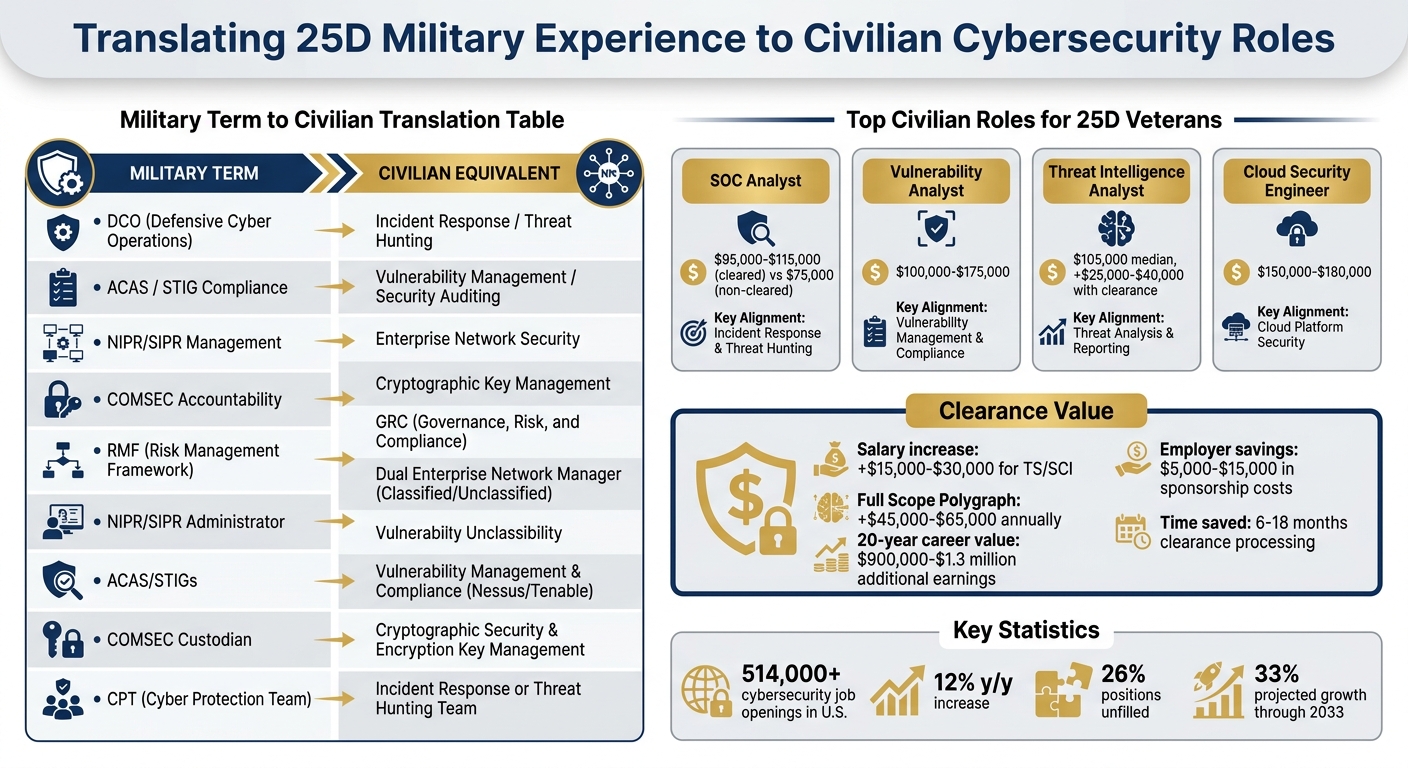
Your experience as a 25D translates seamlessly into a variety of cleared civilian cybersecurity roles. The expertise you gained in network monitoring, vulnerability assessments, and intrusion detection directly aligns with positions like SOC Analyst, Vulnerability Analyst, and Cybersecurity Engineer. These roles often start at salaries of $95,000 and can exceed $180,000 for professionals with security clearances.
As of 2026, the cleared cybersecurity job market is thriving, with more than 514,000 job postings in the U.S., reflecting a 12% year-over-year increase. About 26% of these positions remain unfilled, creating ample opportunities for candidates with your background. Your clearance and technical expertise make you a strong contender for these roles, as detailed below.
Best Civilian Jobs for 25D Veterans
- Security Operations Center (SOC) Analyst: This role involves monitoring security alerts, investigating incidents, and coordinating responses – tasks you likely performed during your service. Cleared SOC Analysts earn between $95,000 and $115,000, compared to $75,000 for non-cleared positions.
- Vulnerability Analyst: Your experience with ACAS and Nessus tools is highly relevant here. This role focuses on conducting security assessments, prioritizing remediation, and ensuring compliance with frameworks like NIST 800-53. Cleared Incident Responder roles, which overlap with this skill set, offer salaries ranging from $100,000 to $175,000.
- Threat Intelligence Analyst: If you specialized in analyzing adversary tactics or tracking network anomalies, this role is a perfect fit. The median salary is $105,000, with cleared positions adding an extra $25,000 to $40,000.
- Cloud Security Engineer: With companies migrating to platforms like AWS, Azure, and GCP, this is one of the fastest-growing sectors. Cleared professionals with defensive operations experience can expect salaries starting at $150,000 to $180,000.
Defense contractors such as Booz Allen Hamilton, Leidos, and Raytheon are excellent starting points, as they value your clearance and familiarity with DoD networks. Tech giants like Amazon AWS, Microsoft, and CrowdStrike are also hiring 25D veterans for roles in their government cloud divisions. Additionally, financial institutions like JPMorgan Chase and Goldman Sachs are seeking cleared professionals for sensitive security operations.
Converting Military Experience to Civilian Job Requirements
When transitioning to civilian roles, it’s crucial to translate military terminology into language that civilian recruiters understand. For example:
- Replace "DCO" with "Defensive Cyber Operations."
- Use "Vulnerability Management and Security Auditing" instead of "ACAS/STIG compliance."
- Convert "NIPR/SIPR Management" to "Enterprise Network Security across multiple security domains."
A strong resume formula is [Action] + [Technical Detail] + [Business Impact]. For instance:
- Instead of saying "secured a network", write: "Administered network security for 2,400 users across 3 installations, maintaining 99.7% uptime."
- Replace "performed vulnerability scans" with: "Executed weekly vulnerability assessments using Nessus and ACAS across a 15,000-node enterprise network, reducing critical findings by 40% in six months."
Include unclassified tools you’ve used, such as Splunk, Wireshark, Nessus, ACAS, SolarWinds, Palo Alto firewalls, and CrowdStrike, as these are common keywords in recruiter searches. Quantify your accomplishments by citing metrics like endpoints, users, or alerts triaged. For example, describe your RMF experience as "Governance, Risk, and Compliance (GRC)" and COMSEC work as "Cryptographic Key Management."
| Military Responsibility | Civilian Job Requirement / Keyword |
|---|---|
| DCO (Defensive Cyber Operations) | Incident Response / Threat Hunting |
| ACAS / STIG Compliance | Vulnerability Management / Security Auditing |
| NIPR/SIPR Management | Enterprise Network Security |
| COMSEC Accountability | Cryptographic Key Management |
| RMF (Risk Management Framework) | GRC (Governance, Risk, and Compliance) |
Your clearance is a major asset and should be prominently displayed at the top of your resume. For example, list it as "Active TS/SCI Clearance" or "Secret Clearance" directly under your contact information. A clearance can add $15,000 to $30,000 to your salary, and for roles requiring a Full Scope Polygraph, this figure increases by $45,000 to $65,000 annually – amounting to $900,000 to $1.3 million over a 20-year career.
Focus on mid-level positions rather than entry-level roles. With four or more years of experience as a 25D, you’re well-qualified for jobs requiring 3-5 years of cybersecurity experience. Don’t undervalue your operational expertise – it’s often more practical and impactful than the simulated lab experience many civilian candidates bring to the table.
Certifications You Need for Cleared Civilian Roles
Transitioning from military service into cleared civilian cybersecurity roles often requires certifications to translate your military expertise into credentials recognized by hiring managers and applicant tracking systems. If you’re coming from a 25D background, CompTIA Security+ is the essential starting point. This certification is the baseline requirement for DoD 8140/8570 IAT Level II positions, which encompass most defense sector cybersecurity jobs. The exam costs about $404, and with your military experience, you can prepare for it in just 4-8 weeks.
Building a stack of certifications can fast-track you to higher-paying roles. For instance, the CompTIA CySA+ (approximately $400) focuses on threat detection and incident response, making it ideal for SOC Tier 2 positions. The Certified Ethical Hacker (CEH), priced at $1,199, is highly sought for penetration testing and vulnerability assessment roles. For senior-level or management positions, the CISSP remains the top credential at $749. Your military service as a 25D often satisfies CISSP’s five-year professional experience requirement, giving you a strong advantage.
Top Certifications Employers Want
Defense contractors and federal agencies prioritize certifications that align with DoD 8140 work role requirements. CompTIA Security+ is almost universally required for entry-level cleared positions. If you’re aiming for leadership roles like security architect or CISO, the CISSP is a must-have. For offensive security and red team positions, CEH is the go-to certification.
With the growing use of cloud platforms by federal agencies, certifications like AWS Certified Security Specialty, Azure Security Engineer, and CCSP (Certified Cloud Security Professional, priced at $599) are becoming increasingly important. These are especially valuable for roles working with platforms like AWS GovCloud or Azure Government.
GIAC certifications such as GSEC and GCIH are also highly respected in government contracting. Cloud-specific certifications are among the fastest-growing in demand, with professionals holding the AWS Certified Solutions Architect credential earning an average of $149,000 annually. To align your certifications with your target role, consider the following:
- Security+: Ideal for baseline cleared positions.
- CySA+: Best for SOC analyst roles.
- CEH: Suited for vulnerability analyst positions.
- CISSP: Perfect for leadership tracks.
These certifications not only validate your skills but also build on the extensive training and experience you already bring from the military.
Using Military Training to Get Certified Faster
Your 25D training covers much of the material needed for certifications like Security+ and CySA+. Skills like Risk Management Framework (RMF), DISA STIGs, and Information Assurance give you an edge over civilian candidates – you’re simply formalizing knowledge you’ve already been using.
"One of our Army Signal NCOs went from E-6 to a $115K SOC analyst role in eight months. Security+ got him in the door. CySA+ got him the offer over other candidates. The clearance sealed it." – Brad Tachi, Navy Veteran & Founder, Best Military Resume [3]
To maximize your certification opportunities, start 12-18 months before separation. Programs like Army Credentialing Assistance (CA) and Tuition Assistance (TA) can help cover costs. During your final 180 days, leverage DoD SkillBridge to attend certification boot camps at no cost while still receiving your military pay. Other resources include:
- VET TEC: Covers tuition for cybersecurity training and provides a housing stipend without using your GI Bill.
- Onward to Opportunity (O2O): Offers free training and exam vouchers for certifications like CompTIA, Cisco, and AWS.
- VA Reimbursement: The VA reimburses up to $2,000 per year for certification exam fees.
These programs ensure you’re equipped with the credentials needed to excel in the civilian cybersecurity workforce.
How to Build Your Resume for Cleared Cybersecurity Jobs
Your resume is your bridge from military service to civilian cybersecurity roles. Every detail matters. To make the most of your clearance and technical background, your resume needs to effectively translate your military experience into terms that civilian recruiters and Applicant Tracking Systems (ATS) can easily understand. Keep in mind that hiring managers spend just a few seconds on their initial review, so clarity and precision are key.
Here’s how to adapt your military experience and certifications into resume content that grabs attention.
Writing Military Experience in Civilian Language
Start by rephrasing your job title. For example, "25D Cyber Network Defender" can become Cybersecurity Analyst, SOC Analyst, Information Security Specialist, or Cybersecurity Engineer. Similarly, swap terms like "BDE S-6 shop" for something like "Enterprise IT Department" or "Security Operations Center" to make your experience relatable.
Use this formula for crafting bullet points: Action Verb + Technical Detail + Business Impact. The CAR method (Challenge, Action, Result) can help structure your achievements. For instance: "Reduced false-positive security alerts by 30% by implementing custom SIEM filters for a 15,000-node enterprise network." Including metrics like network size or the number of endpoints will make your accomplishments stand out.
Here’s a quick reference table to help translate military jargon into civilian-friendly terms:
| Military Term | Civilian Equivalent |
|---|---|
| 25D Cyber Network Defender | Cybersecurity Analyst / SOC Analyst |
| NCOIC | Team Lead / Operations Manager |
| SIPR/NIPR Networks | Classified and Unclassified Enterprise Networks |
| DISA STIGs | Security Hardening Standards / Compliance Frameworks |
| ACAS / Nessus Scans | Vulnerability Assessments |
| COMSEC Custodian | Encryption Key Manager / Cryptographic Security Lead |
Also, highlight your proficiency with tools like Splunk, Wireshark, Nessus, the NIST RMF, and MITRE ATT&CK. These are keywords recruiters actively search for when using ATS.
Highlighting Your Clearance and Accomplishments
Once you’ve translated your military terms, make sure to showcase your clearance and quantify your achievements.
Your clearance is a major asset, often increasing your salary by $15,000–$30,000 compared to non-cleared roles. Employers know that sponsoring a new TS/SCI clearance can cost $5,000–$15,000 and take 6 to 18 months, so having an active clearance makes you a highly valuable candidate.
"I’ve talked to defense contractor recruiters who told me they literally search their ATS for ‘TS/SCI’ as their first filter before looking at anything else. If your clearance isn’t in a searchable text field on your resume… you’re invisible to these recruiters." – Brad Tachi, CEO, Best Military Resume
Place your clearance (e.g., TS/SCI) directly under your contact information and in your Skills section. Use standard abbreviations for ATS compatibility and specify whether it’s "Active" or "Current." If applicable, include the type of polygraph (CI or Full-Scope), as this further increases your appeal.
Here’s how to format clearance details on your resume:
| Clearance Level | Recommended Resume Formatting |
|---|---|
| Active Secret | "Active Secret Clearance – Current" |
| Active Top Secret | "Active Top Secret (TS) Clearance – Current" |
| Active TS/SCI | "Active TS/SCI Clearance – Current" |
| TS/SCI w/ Poly | "Active TS/SCI with CI Polygraph – Current" or "Active TS/SCI with Full-Scope Polygraph" |
| Inactive | "Previous Top Secret Clearance (inactive, eligible for reinstatement)" |
Avoid including classified details or personal identifiers – stick to clearance type and status only.
Quantify your accomplishments wherever possible. Include metrics like the number of endpoints managed, network uptime (e.g., 99.9%), or vulnerabilities remediated. For example: "Maintained 99.9% network uptime for a 15,000-user classified environment by implementing automated patch management, reducing help desk tickets by 40%."
Making Your Resume Pass Applicant Tracking Systems
To ensure your resume gets noticed by both recruiters and ATS, optimize its format and content.
Defense contractors often use ATS platforms like Workday and iCIMS, while federal agencies rely on USA Staffing. These systems prioritize keyword matching for technical skills and clearance levels. If a job posting specifies "SIEM administration", use that exact phrase instead of a more general term like "security event monitoring" to improve your chances of being selected.
Stick to a clean, simple layout. Avoid complex tables, graphics, colors, and multi-column designs that can confuse ATS software. Use standard fonts and minimal formatting. For most roles, keep your resume to two pages or less – one page is ideal if you have fewer than 10 years of experience.
"Your military experience is valuable. But if a hiring manager can’t understand your resume, they can’t hire you." – Brad Tachi, CEO, Best Military Resume
When applying, mirror the language used in job descriptions. For instance, if a job mentions "Risk Management Framework (RMF)", include that exact term. Certifications like Security+, CySA+, CEH, and CISSP are also high-priority keywords for ATS, so list them prominently.
Lastly, if you’re applying through Cleared Cyber Security Jobs, make sure your clearance is included in a searchable text field. Many recruiters filter resumes by clearance level before reviewing other qualifications, so ensure your resume is optimized for both human and ATS review.
With these strategies, you’ll be well-prepared to pursue cleared cybersecurity roles with confidence.
Where and How to Search for Cleared Cybersecurity Jobs
Once you’ve polished your resume and secured the right certifications, it’s time to dive into the world of cleared cybersecurity job hunting. Unlike traditional job searches, finding cleared positions requires a more targeted approach. General job boards can be overwhelming, as cleared roles are often hidden among countless non-cleared listings. This makes it harder to connect with recruiters specifically seeking candidates with security clearances. Instead, specialized platforms streamline the process by verifying your clearance status upfront and linking you directly with employers who value your credentials and military experience.
In the cleared job market, recruiters often pay to access resume databases, actively searching for candidates with the exact clearance levels they need. To stand out, ensure your online profile is optimized with the right keywords. Most cleared jobs are concentrated in specific regions, including the Washington, D.C./Northern Virginia area, San Antonio (NSA Texas), Augusta (Army Cyber Command), Colorado Springs (Space Force), and Huntsville (Redstone Arsenal) [4][6].
Getting the Most from Cleared Cyber Security Jobs
Cleared Cyber Security Jobs is a veteran-owned platform designed exclusively for U.S. citizens with active or current security clearances [5]. The site focuses on direct-hire employers, eliminating the middleman and making the recruitment process more straightforward.
To maximize your chances, create a detailed profile using civilian job titles like "SOC Analyst" or "Security Engineer." Be specific about your clearance level (e.g., Secret, TS, or TS/SCI) and include the date of your last investigation [7]. Upload your resume in a text-based format to make it easily searchable by applicant tracking systems (ATS). You can also set up daily job alerts based on location, clearance level, and job title to stay on top of new opportunities [5]. Additionally, the platform offers access to cleared job fairs, where you can meet recruiters face-to-face and bypass automated systems.
"Your clearance is a golden ticket, but only if you put it where employers can find it." – Brad Tachi, Founder, Best Military Resume [7]
Finding Jobs with Defense Contractors and Federal Agencies
Specialized job boards aren’t the only way to land a cleared cybersecurity role. Applying directly to defense contractors and federal agencies can increase your chances even further. These organizations are among the top employers for 25D veterans. Major defense contractors like Northrop Grumman, Booz Allen Hamilton, Leidos, SAIC, ManTech, Raytheon, and Peraton offer internal career portals with clearance filters and veteran hiring programs [1]. When applying, use their "Military" or "Veteran" portals to ensure your application is flagged for veteran recruiters.
For federal civilian roles, such as GS-level positions, USAJobs.gov is your go-to resource. Use the security clearance filter to narrow down your options. If you’re targeting agencies within the Intelligence Community – like the NSA, CIA, DIA, or NRO – check out IntelligenceCareers.gov [7]. Federal roles often come with stable GS-scale pay and comprehensive benefits, while defense contractors might offer quicker hiring processes and higher salaries.
Emerging defense tech companies like Palantir, Anduril, and SpaceX are also actively hiring cleared professionals, often offering competitive salaries [4]. Additionally, major tech firms with cleared divisions – such as Amazon (AWS), Microsoft, Google (including Mandiant), CrowdStrike, and Palo Alto Networks – have programs specifically for veterans [1].
To stay consistent in your search, check specialized job boards daily, use Boolean searches on LinkedIn (e.g., "TS/SCI" AND "Cyber"), and regularly visit USAJobs and contractor career pages [7]. If you’re still on active duty, consider the DoD SkillBridge program, which allows you to work with a company during your final 180 days of service. Applying 6 to 12 months before separation can help you secure a job offer before transitioning out of the military [2].
Building Your Network in the Cleared Cybersecurity Field
Networking plays a crucial role in the cleared cybersecurity world. Many roles in this field are filled through referrals long before they’re ever posted publicly [8]. While having a clearance opens doors, it’s your network that helps you step through them. Think of networking as a skill, much like translating military experience into civilian terms – it requires a deliberate and personalized approach. Start building connections 6–12 months before you transition out of service. By doing so, you establish trust and lay the groundwork for deeper strategies that can fuel your career growth [11].
The statistics are clear: over 87% of recruiters use LinkedIn to scout talent, and veterans often see results from networking within just 2–3 months of consistent effort [11]. The key is to focus on authentic connections where your background naturally resonates with others.
"Networking is not about asking strangers for jobs – it is about building relationships where people want to help you because they know you, respect your background, and understand what you bring to the table." – Brad Tachi, CEO and Founder, Best Military Resume [11]
Connecting Through Veteran Events and Groups
Veteran organizations are a goldmine for mentorship and direct access to recruiters [11]. American Corporate Partners (ACP), for instance, has supported over 25,000 veterans through one-on-one corporate mentorships. Programs like Hire Heroes USA and FourBlock are also excellent resources for connecting transitioning service members with business mentors [13].
For those in cybersecurity, there are tailored communities worth exploring. VetSec (VeteranSec), the Military Cyber Professionals Association (MCPA), and CyberVetsUSA are excellent options. CyberVetsUSA, backed by companies like Cisco and Amazon, offers pathways to jobs and networking opportunities specifically for veterans in states like Virginia, North Carolina, and Maryland [14].
Cleared hiring events are another valuable resource. These events, often hosted on military bases, allow job seekers to meet recruiters in person and skip the hassle of automated application systems [12]. Upcoming events include:
- Peterson Space Force Base (April 2026)
- Lackland Air Force Base (May 2026)
- Fort Meade (June 2026)
- Fort Gordon (August 2026)
If online networking is more your speed, start by optimizing your LinkedIn profile with civilian job titles like "Cybersecurity Engineer" or "SOC Analyst." Join veteran-focused groups like "Veterans in Tech", and use LinkedIn’s Alumni Tool to connect with others who share your military background [11]. Another effective strategy is conducting informational interviews – short, 15–20 minute calls to learn about industry trends and company culture without directly asking for a job [9][11].
"People will stop responding to you if you’re only in touch when you need something from them." – ClearedJobs.net [9]
Meeting Employers Who Hire Cleared Professionals
Once your network is in place, the next step is connecting directly with employers. Many cleared roles are never advertised, so networking is essential for uncovering these hidden opportunities. Large defense contractors often have Employee Resource Groups (ERGs) for veterans, such as Warriors@Amazon or MSVETS at Microsoft. These groups can provide internal referrals and advocates to help you stand out [11].
Attending cybersecurity conferences like Black Hat, DEF CON, or RSA is another excellent way to meet potential employers. Don’t overlook the informal networking that happens between sessions, often referred to as "HallwayCon" [8]. Volunteering at these events can also get you free access and direct contact with industry professionals [8].
For those who prefer online engagement, join niche communities like Reddit’s r/netsec or contribute to open-source projects on GitHub to showcase your technical skills [8]. Additionally, ClearedJobs.net hosts Military Monday webinars, offering monthly advice on resumes and career strategies tailored to the cleared community [10].
Platforms like Cleared Cyber Security Jobs are also worth exploring. They host cleared job fairs and provide tools like detailed profiles and daily job alerts. Be sure to highlight your clearance level and investigation date to make it easy for recruiters to find you. Since the platform is free for job seekers and focuses on direct-hire employers, it’s an efficient way to connect with companies that value your military experience [5].
Preparing for Cleared Cybersecurity Job Interviews
Once you’ve polished your resume and honed your job search, the next step is nailing the interview. This is your chance to showcase how your 25D experience translates into the civilian cybersecurity world. Cleared cybersecurity interviews are designed to assess both your technical skills and your ability to articulate your military accomplishments in terms that resonate with civilian employers. Start preparing your responses as early as six months before your separation date to ensure you’re ready to shine. This phase builds on the groundwork you’ve laid with your resume and networking efforts, emphasizing how your military background can deliver immediate results.
One standout advantage in these interviews is your clearance. A TS/SCI clearance, for example, can boost your base salary by $15,000 to $30,000 and save employers thousands in sponsorship costs – anywhere from $5,000 to $15,000. Plus, it eliminates the lengthy clearance process, which can take 6 to 18 months.
Answering Behavioral and Technical Questions
In technical interviews, expect questions about the tools and frameworks you used as a 25D. Be ready to discuss cybersecurity tools like Splunk, Nessus, ACAS, Wireshark, ArcSight, and McAfee ePO. You’ll also likely encounter questions about your experience with frameworks such as NIST, MITRE ATT&CK, CIS controls, the Risk Management Framework (RMF), and DISA STIGs.
For behavioral questions, employers want to evaluate your ability to stay alert, handle pressure, and follow structured protocols – traits often described as a "watch-standing mentality." When framing your military experience, use clear and measurable examples. For instance, instead of saying you "monitored networks", you could say, "Analyzed over 200 daily alerts, reducing incident response time by 40%." This Action + Technical Detail + Business Impact formula helps convey your achievements in a way that resonates with civilian employers.
When discussing classified work, focus on the scale and complexity rather than specific details. For example, describing how you managed a "15,000-node enterprise network" illustrates the scope of your role without breaching security protocols.
Here’s a quick guide to translating military terms into civilian equivalents:
| Military Term | Civilian Equivalent |
|---|---|
| NIPR/SIPR Administrator | Dual Enterprise Network Manager (Classified/Unclassified) |
| ACAS/STIGs | Vulnerability Management & Compliance (Nessus/Tenable) |
| COMSEC Custodian | Cryptographic Security & Encryption Key Management |
| CPT (Cyber Protection Team) | Incident Response or Threat Hunting Team |
| RMF (Risk Management Framework) | Security Compliance & Authorization Framework |
A common pitfall for veterans is underselling their experience. If you have four or more years as a 25D, aim for mid-level or senior roles instead of entry-level SOC analyst positions. Your operational background qualifies you for more advanced opportunities, and settling for less could mean leaving money – and career growth – on the table.
"The cyber veterans I’ve seen transition most successfully are the ones who don’t settle for the first SOC analyst job offered to them. Your military experience puts you above entry-level." – Brad Tachi, CEO, Best Military Resume
Discussing Your Clearance and Job Fit
Once you’ve tackled the technical and behavioral questions, it’s time to clearly communicate your clearance status and role alignment. When discussing your clearance, specify the level (e.g., Secret, TS, or TS/SCI) and include your investigation date. This allows employers to confirm your status through the Defense Information System for Security using just your name and date of birth. Avoid sharing sensitive details like SCI compartments or classification markings – a simple mention of "TS/SCI" is sufficient.
Be precise about your clearance status. For example:
- Active: Currently sponsored.
- Current: Within the 24-month reactivation window.
- Inactive: Lapsed beyond 24 months.
Misrepresenting an interim clearance as a full clearance is a major red flag, so be honest about your status. If your clearance is within the reactivation window, highlight that it can be reinstated without a full reinvestigation.
When addressing job fit, explain how your military training and operational experience make you uniquely suited to protect corporate assets and reduce risks. Employers want to know you can handle the high-pressure demands of a 24/7 Security Operations Center or respond effectively to incidents with financial consequences. Use your 25D background to demonstrate your ability to manage critical responsibilities under intense conditions.
Finally, align your language with the job posting. For example, if the role mentions "SIEM administration", use that exact term instead of alternatives like "security event monitoring." This not only shows you understand the position but also helps ensure your resume and interview responses resonate with Applicant Tracking Systems.
"Any employer knows veterans are going to be trainable and have a high work ethic." – Tom Marsland, Board Chair, VetSec
Conclusion
Shifting from a 25D Cyber Network Defender role to a cleared civilian cybersecurity position means tapping into your hands-on operational experience and leveraging your active clearance to secure jobs that often pay between $95,000 and $148,000 – or even more. Your background equips you with real-world skills defending networks against actual threats, not just theoretical scenarios.
The challenge lies in translating your military expertise into terms that resonate with civilian employers and applicant tracking systems (ATS). For example, reframe terms like "ACAS" as "vulnerability scanning with Nessus" or "COMSEC Custodian" as "Cryptographic Security & Encryption Key Management." Certifications such as Security+ can help you qualify for DoD 8140 roles, while advanced credentials like CISSP or OSCP can position you for higher-level opportunities.
Your active TS/SCI clearance is a major asset, saving employers the cost and time of sponsorship while accelerating your hiring process. With over four years of experience as a 25D, you should target mid-level or senior roles to maximize your earning potential. As Brad Tachi, CEO of Best Military Resume, explains:
"A TS/SCI-cleared cyber professional with 4+ years of operational experience should not be accepting $80K SOC analyst positions when the market pays $110K+ for that profile" [2].
With more than 500,000 open cybersecurity jobs in the U.S. and a projected 33% growth in the field through 2033, the demand for skilled professionals like you is undeniable.
FAQs
How do I keep my TS/SCI active after leaving the Army?
To maintain your TS/SCI clearance in an "active" status, you need to show a continued need for access to classified information. Stay in regular contact with your Facility Security Officer (FSO) or security manager to ensure your information is up-to-date and your need for access is reaffirmed. If your clearance shifts to "current" but not "active", you’ll still have eligibility, but your access will be revoked. Consistent updates are crucial to prevent your clearance from expiring.
Which 25D skills should I highlight for mid-level civilian roles?
If you’re transitioning into mid-level civilian roles, there are specific 25D skills that can make your resume stand out. Focus on showcasing your ability to manage enterprise networks, handle cybersecurity operations, and enforce security protocols effectively.
Your experience defending classified networks, troubleshooting intricate systems, and performing hands-on operational cybersecurity tasks is highly relevant. Employers also value expertise in conducting risk assessments, maintaining robust security measures, and thriving under pressure in high-stakes situations. These skills are a strong match for positions like security analyst, threat intelligence analyst, and cybersecurity engineer.
What’s the fastest certification path to land a cleared cyber job?
The fastest way to land a cleared cybersecurity job is by earning the CompTIA Security+ certification. This entry-level credential is widely recognized and often enough to qualify for roles like cybersecurity analyst. With dedicated effort, you can complete it in just a few months. The process is straightforward: prepare for the exam, register, and pass. Security+ is particularly helpful for translating military experience into civilian cybersecurity credentials, making it a great choice for cleared positions.