

The U.S. Fleet Cyber Command (FLTCYBER) is the Navy’s hub for cyberwarfare, managing operations in cyberspace, signals intelligence, and space. If you’re a cybersecurity expert with a security clearance, FLTCYBER offers lucrative roles with salaries reaching $185,234 and recruitment bonuses up to $140,000.
Key takeaways:
- Roles Available: Cybersecurity Analysts, Cyber Warfare Engineers, Information Security Officers, and more.
- Clearance Requirements: Most positions require TS/SCI clearance.
- Education: A STEM degree, preferably in Computer Science or Engineering, with a minimum 3.0 GPA.
- Certifications: Relevant certifications like RMF compliance and Zero Trust knowledge are highly valued.
- Application Process: Jobs are listed on USAJOBS or through public notices. Use a 2-page federal-style resume and include your clearance details.
These positions are open to civilians, veterans, and military personnel. Start your application through USAJOBS or contact a Navy recruiter for more details.
Types of Cleared Cyber Jobs Available
Job Titles and Responsibilities
Fleet Cyber Command offers a variety of roles that focus on technical, analytical, and leadership tasks. Each position plays a crucial role in supporting FLTCYBER’s mission to protect cyber operations and uphold national security. Some of the key roles include:
- Command Information Security Officers (CISO): At the GS-15 level, these professionals oversee security management and ensure policy compliance across naval installations.
- Computer Scientists: Spanning from entry-level GG-9 to senior GS-15 roles, these positions involve technical support, systems analysis, training, and development.
- Information Systems Security Officers (ISSO): Responsible for conducting threat and vulnerability assessments, reviewing system audit trails, and preparing briefings for command leadership.
- Cyber Warfare Engineers: Focused on both offensive and defensive cyber operations.
- Cybersecurity Analysts: Manage the Risk Management Framework (RMF) process and handle security package maintenance.
- Network Defense Specialists: Tasked with protecting the Navy’s information networks.
These roles are divided into civilian and military career tracks, each with distinct responsibilities and career paths.
Civilian vs. Military Positions
Civilian and military cyber roles at Fleet Cyber Command are structured differently, particularly in terms of career progression and responsibilities.
- Civilian Positions: These roles fall under the General Schedule (GS), GG, and ND pay scales, ranging from GS-9 for entry-level positions to GS-15 for senior leadership roles. Advancement is based on a "rating and ranking" system, where candidates are assessed through qualifications and specific evaluation questions. Civilian roles often emphasize long-term technical management and specialized expertise.
- Military Positions: These are rotational assignments managed through the Navy’s detailing system. Military roles typically involve broader operational responsibilities in cyber warfare and may require personnel to move through various assignments as part of their service commitments.
Required Skills and Technologies
To excel in these roles, candidates must demonstrate expertise in key technologies and frameworks. The Department of Defense has significantly reduced its hiring time for cyber roles – from 156 days to 79 days – by prioritizing skill-based hiring [2]. Some of the critical skills and technologies include:
- Risk Management Framework (RMF): Essential for ensuring compliance and managing security packages.
- Zero Trust Architecture: A focus on identity security and safeguarding data integrity is highly sought after.
- Threat and Vulnerability Assessments: Expertise in these areas is crucial for IT security planning and developing standard operating procedures.
- Cyber Workforce (CWF) Compliance: Adherence to DoDM 8140.03 standards is necessary for personnel management roles.
Mark Senell, President at Infoblox Federal, highlighted the growing importance of advanced technologies, stating:
"AI is transforming decision-making, data analytics, and cybersecurity, enabling the Navy to enhance command and control while mitigating cyber threats" [2].
To stay ahead of emerging challenges, the Department of Defense updates its cyber workforce requirements every 90 days [2].
sbb-itb-bf7aa6b
Qualifications and Certifications Required
Education Requirements
To qualify for Fleet Cyber Command positions, candidates typically need a bachelor’s degree in a STEM field. For officer roles like Cyber Warfare Engineer, degrees in Computer Science or Computer Engineering are strongly preferred. Other related fields, such as mathematics, physics, or software engineering, may also be accepted but are evaluated on a case-by-case basis.
A minimum cumulative GPA of 3.0 is required, though applicants with GPAs as low as 2.7 might still be considered if they have exceptional achievements. For those with lower undergraduate GPAs, an advanced degree with at least a 3.0 GPA can help offset earlier academic performance. Transcripts should highlight significant coursework in software development or programming, with a minimum GPA of 3.0 in those areas.
In some civilian roles, such as GG-13 Security Officer positions, strict educational requirements may be waived if the applicant has at least one year of specialized experience at the GS/GG-12 level. However, a solid academic background remains critical for obtaining the necessary certifications and clearances.
Professional Certifications
Certification requirements depend on the specific role but are highly valued across all positions. These certifications not only demonstrate technical skills but also show a commitment to staying updated in the rapidly changing cyber landscape. Meeting these standards is essential for fulfilling the demanding clearance and operational expectations of Fleet Cyber Command roles.
Experience and Clearance Levels
Beyond education and certifications, candidates must meet clearance and experience requirements. Most positions within Fleet Cyber Command demand Top Secret/Sensitive Compartmented Information (TS/SCI) clearance. Officer candidates must satisfy ICD 704 eligibility requirements and complete an initial suitability screening conducted by the Fleet Cyber Command Security Directorate. For Cyber Warfare Engineer roles, candidates also undergo a technical interview with the Commanding Officer of the Navy Cyber Warfare Development Group.
Officer candidates are required to achieve a minimum score of 45 on the Officer Aptitude Rating (OAR) exam, though scores of 50 or higher are preferred [3]. Those selected for officer roles must commit to a 5-year active-duty obligation starting from their appointment date [3]. For civilian positions, advancing through the rating and ranking system requires demonstrating specialized experience equivalent to the next lower grade level.
AFCEA West: Adapting Naval Cyber Command to Evolving Threats
How to Apply for Fleet Cyber Command Jobs
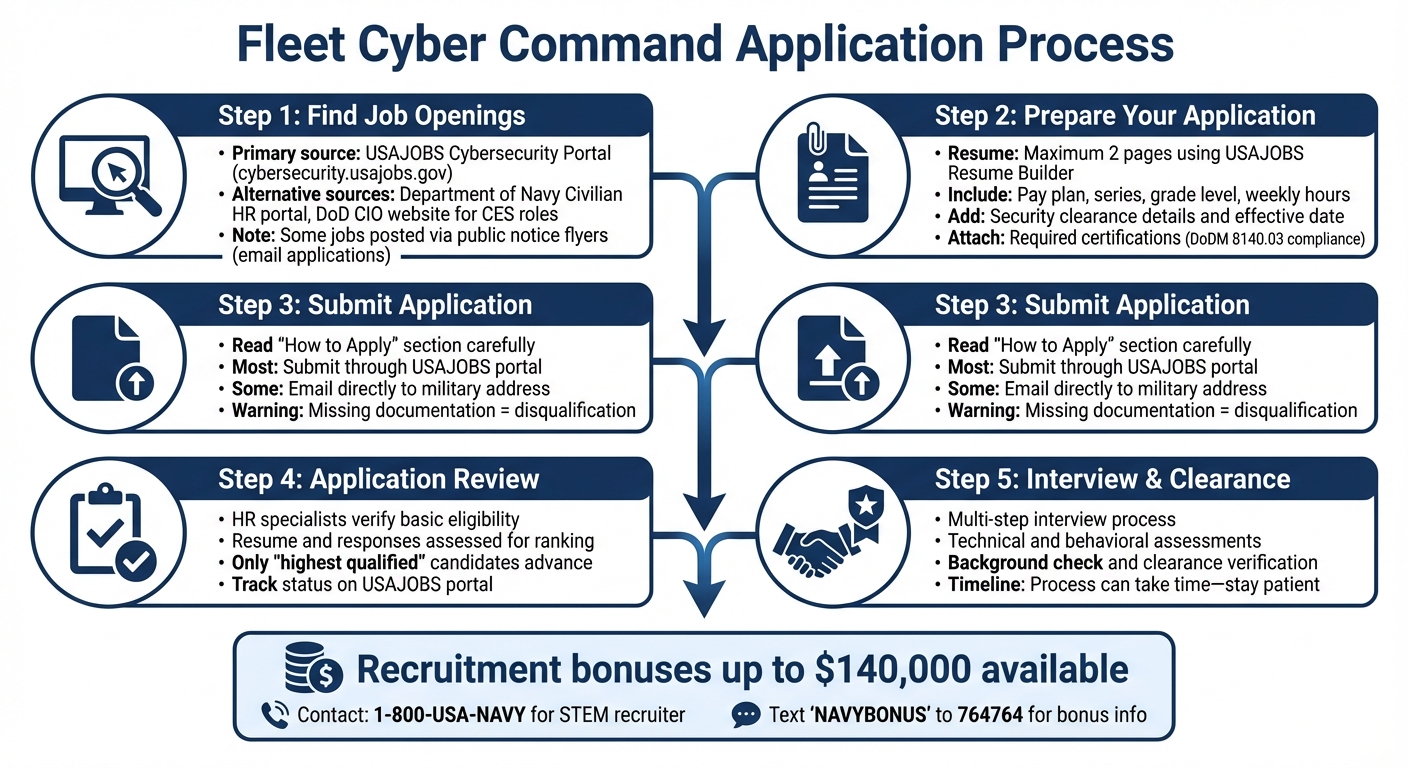
Fleet Cyber Command Application Process: 5 Steps to Landing a Cleared Cyber Job
Where to Find Job Openings
If you’re looking to join Fleet Cyber Command, your first stop should be the USAJOBS Cybersecurity Portal at cybersecurity.usajobs.gov. This is the go-to site for federal cybersecurity roles, including those within the Department of the Navy, and it outlines key requirements and deadlines for each position.
For more information about civilian careers in the Navy, check out the Department of the Navy Civilian Human Resources portal at secnav.navy.mil/donhr. This site provides details about Navy career policies, benefits, and advancement opportunities. If you’re interested in Cyber Excepted Service (CES) roles, visit the DoD CIO website at dodcio.defense.gov/Cyber-Workforce/CES.aspx. Here, you can find qualification standards as outlined in DoDM 8140.03.
Keep in mind that some Fleet Cyber Command jobs are advertised through public notice flyers instead of standard USAJOBS postings. These may require you to send your application directly to a designated HR contact via email. Always read the job announcement carefully to ensure you follow the correct application process.
Steps to Submit Your Application
When crafting your application, keep your resume concise – no more than 2 pages. Use the USAJOBS Resume Builder to ensure all necessary federal details are included, such as your pay plan, series, grade level, and weekly hours worked. These specifics are critical for HR specialists to evaluate your qualifications accurately.
Carefully review the "How to Apply" section of each job announcement. While most applications are submitted through the USAJOBS portal, some Navy cyber positions might require you to email your application package directly to a military email address. If the role demands specific certifications under DoDM 8140.03, be sure to include copies of those licenses or certificates. Missing documentation can lead to disqualification.
After submitting, you can track your application status on USAJOBS. HR specialists will first confirm your basic eligibility, then assess your resume and responses to determine your ranking. Only the candidates classified as "highest qualified" will typically move on to the next stage of consideration by the hiring manager.
What to Expect During Interviews
If your application makes it to the hiring manager, be ready for a multi-step interview process. Initially, HR specialists will screen your application for eligibility and qualifications. Then, if you’re selected, you’ll face technical and behavioral interviews designed to assess your expertise and how well you align with Fleet Cyber Command’s mission.
Expect interviews to delve into your past performance, overall suitability, and security clearance. Keep in mind, background checks and clearance verification can take time, so patience and prompt communication throughout the process will be essential.
Tips for Getting Hired at Fleet Cyber Command
How to Highlight Your Security Clearance
Your security clearance can set you apart when applying to Fleet Cyber Command. Make sure to include it – whether it’s Secret, Top Secret, or TS/SCI – in a dedicated "Clearances and Certifications" section on your resume. During interviews, be ready to explain how your clearance has allowed you to handle classified information or contribute to sensitive projects. Share examples of how this experience supported critical tasks like network defense or intelligence analysis. This approach not only strengthens your application but also prepares you for the networking strategies discussed next.
Building Connections in the Navy Cyber Sector
Having the right connections can be just as important as showcasing your qualifications. Start by calling 1-800-USA-NAVY to speak with a STEM-specialist recruiter who can provide insights into upcoming opportunities and current hiring needs. You can also use the Navy’s live chat feature during business hours to ask detailed questions about specific cyber roles and the application process.
Stay informed by subscribing to Navy email updates for exclusive information on cyber careers and benefits. Additionally, follow USCYBERCOM Emerging Tech Civilian Recruiting channels to keep up with announcements about high-tech civilian roles requiring specialized clearances. These channels often post job openings before they appear on standard job boards, giving you an edge over other applicants.
Matching Your Skills to Mission Requirements
To stand out, tailor your skills to align with Fleet Cyber Command’s mission. The command prioritizes candidates with expertise in intelligence, information systems, and cryptology. Highlight any experience that combines traditional engineering with cryptologic operations. Use the Navy’s "Compare Careers" tool on their recruitment site to see how your skills match different cyber roles and identify areas for improvement.
The Navy offers recruitment bonuses of up to $140,000 for certain high-demand roles [1]. To learn more about these financial incentives, text "NAVYBONUS" to 764764. When crafting your application, focus on demonstrating your technical expertise and commitment to long-term career growth. Fleet Cyber Command values personnel who stay in technical roles through multiple deployment cycles, so showcasing your dedication can make a strong impression.
Conclusion
This guide highlights how your security clearance and cyber expertise can open doors to a fulfilling career at Fleet Cyber Command.
Fleet Cyber Command provides security-cleared professionals with opportunities to engage in mission-critical work while enjoying competitive salaries. For example, roles like Supervisory Security Specialists can earn up to $185,234 annually, while IT Specialists in cybersecurity can reach $163,023. Employees also benefit from comprehensive federal perks, including health insurance, retirement plans, and paid leave. To top it off, recruitment bonuses can significantly boost your overall compensation.
The command emphasizes continuous professional growth, ensuring you stay ahead in a rapidly evolving tech landscape. Your role bridges military and civilian efforts, contributing directly to safeguarding national security. Additionally, the DoD Cyber Excepted Service (CES) offers career mobility through the Cyber Interagency Transfer Authority (CITA), allowing seamless transitions between service branches as new challenges and technologies emerge. This blend of technical expertise and career flexibility reflects the command’s dedication to protecting the nation.
Make sure your resume clearly states your security clearance and its effective date. Don’t forget to inquire about available recruitment bonuses. Your skills and clearance are essential to Fleet Cyber Command’s mission of defending national freedoms.
FAQs
Can I apply if I don’t already have TS/SCI?
No, an active TS/SCI clearance is usually required to apply for cyber jobs at Fleet Cyber Command. This clearance level serves as a baseline qualification for many of the roles.
What counts as “specialized experience” for GS/GG roles?
For GS/GG positions, "specialized experience" refers to skills and knowledge in fields such as computer science, data science, engineering, mathematics, and computer network exploitation. These qualifications are closely tied to the U.S. Cyber Command’s personnel management program and align with cybersecurity career descriptions. They’re designed to address the specific demands of cyber operations and ensure readiness for mission-critical tasks.
How do I prove my clearance on a federal resume?
When crafting a federal resume, it’s important to clearly indicate your security clearance level and its current status. For active clearances, specify the level (e.g., Top Secret or TS/SCI) and place it prominently – either in your summary or in a dedicated section near the top of your resume. This ensures hiring managers can quickly see your qualifications.
If your clearance has expired, you can still mention it by noting that you previously held the clearance. This demonstrates your reliability and ability to handle sensitive information.
One critical note: do not share clearance details publicly to avoid any potential security risks. Keep this information confined to official applications or communications.