

The National Geospatial-Intelligence Agency (NGA) offers cyber analyst roles that combine cybersecurity expertise with geospatial intelligence (GEOINT) to support national security. These positions require Top-Secret/SCI clearance, technical skills, and certifications like CISSP or Security+. Here’s a quick overview:
- What NGA Does: Provides geospatial intelligence for U.S. defense, intelligence, and policy decisions.
- Cyber Analyst Role: Tracks cyber threats, evaluates foreign cyber capabilities, and integrates geospatial data with cybersecurity.
- Qualifications: Bachelor’s degree in Cybersecurity or related fields, hands-on experience, and certifications.
- Clearance Requirements: TS/SCI clearance with periodic reinvestigations every five years.
- Application Process: Apply via intelligencecareers.gov/nga, complete assessments, and undergo security clearance checks.
This guide covers qualifications, skills, certifications, and how to prepare for NGA’s hiring process. Keep reading for detailed steps to start your career at NGA.
What I Wish I Knew Before I Started My Intelligence Career
sbb-itb-bf7aa6b
Security Clearance Requirements
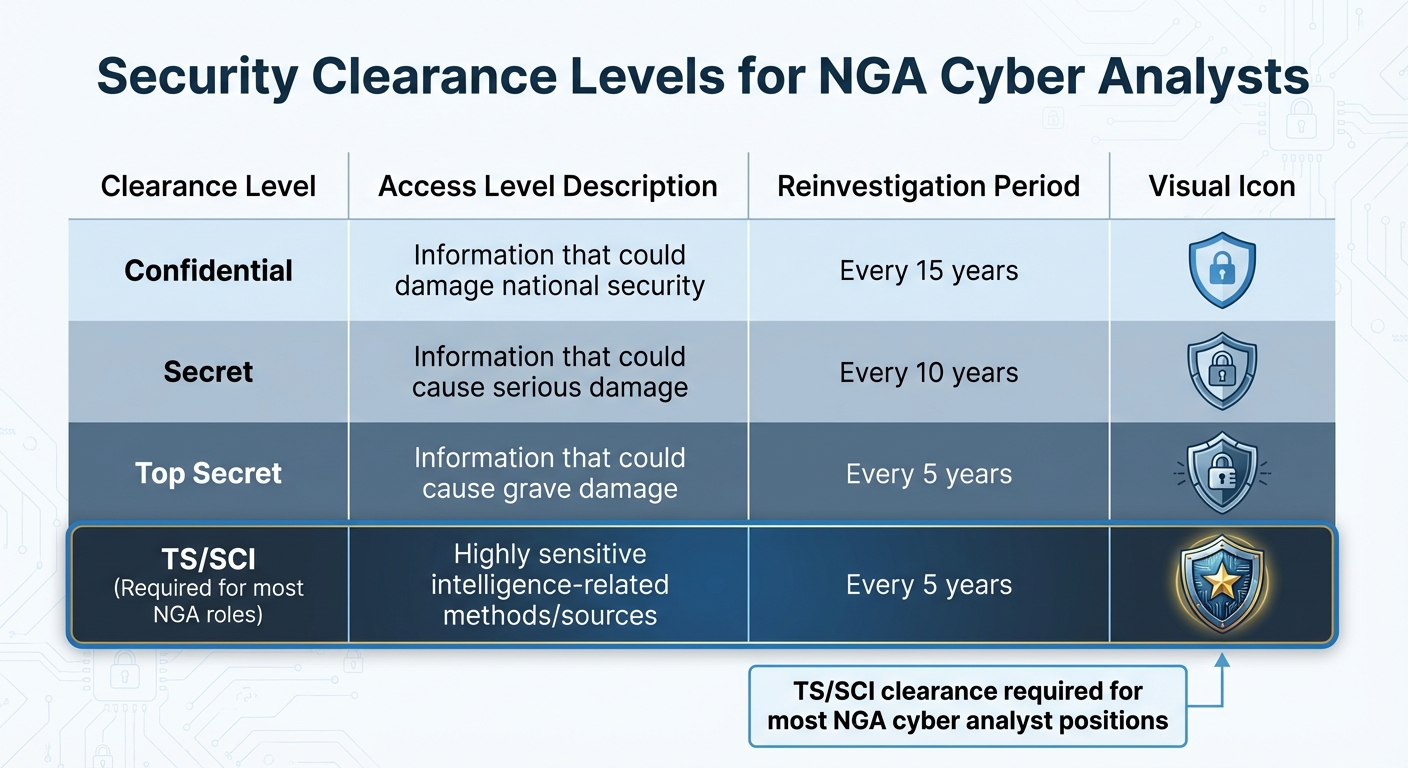
Security Clearance Levels and Requirements for NGA Cyber Analysts
Becoming a cyber analyst at the NGA involves navigating a demanding security clearance process. To qualify, applicants must secure a Top-Secret (TS) security clearance with access to Sensitive Compartmented Information (SCI) [6]. While this is the standard requirement, certain roles may also necessitate additional polygraph tests, such as counterintelligence-scope or full-scope polygraphs.
Clearance Levels Required
Some roles may require only Secret or Top-Secret clearances without SCI access, but these are less common. A Top-Secret clearance protects information that could cause grave harm to national security if leaked, while the SCI designation adds further restrictions for intelligence programs requiring compartmentalization.
| Clearance Level | Access Level | Reinvestigation Period |
|---|---|---|
| Confidential | Information that could damage national security | Every 15 years |
| Secret | Information that could cause serious damage | Every 10 years |
| Top Secret | Information that could cause grave damage | Every 5 years |
| TS/SCI | Highly sensitive intelligence-related methods/sources | Every 5 years |
How to Obtain or Upgrade Your Clearance
The clearance process begins only after accepting a conditional job offer from the NGA [7][8]. Even if you already hold a clearance, the process can take 9–12 months due to the agency’s rigorous checks.
The first step is completing Standard Form 86 (SF-86), a detailed questionnaire covering your personal history, including addresses, employment, education, foreign contacts, and financial records. Investigators then verify this information by contacting references. You’ll also need to undergo a counterintelligence polygraph and, in some cases, a psychological or medical evaluation.
Clearances are adjudicated under the 13 guidelines in Security Executive Agent Directive 4 (SEAD 4). These guidelines assess factors like allegiance to the U.S., foreign influence, financial stability, drug use, and criminal history. Poor financial management is the most common reason for clearance denial, so staying on top of bills and maintaining good credit is crucial. However, isolated concerns – such as past debt or drug use – don’t automatically disqualify you if you demonstrate transparency and positive changes.
"Any false claims or withheld information may impact whether you receive a final job offer." – U.S. Intelligence Community Careers [8]
Once approved, strict adherence to clearance standards is mandatory.
How to Maintain Your Clearance
After obtaining a TS/SCI clearance, you’ll need to undergo formal reinvestigations every five years to maintain eligibility [2][3][4]. Additionally, agencies now use continuous evaluation to monitor cleared individuals between these periodic reviews.
Maintaining your clearance requires strict compliance with behavioral and reporting standards. Avoid illegal drug use, as it is a major disqualifier, and promptly report life changes – such as marrying a foreign national, significant financial events, or extensive foreign travel – that could impact your status. SEAD 5 also allows investigators to review publicly available social media activity, so ensure your online presence reflects responsible behavior.
"The primary considerations in an investigation are the individual’s honesty, candor, and thoroughness in the completion of their security clearance forms." – Cybersecurity Guide [10]
Financial responsibility is critical throughout your career. Pay bills on time, manage debt wisely, and avoid situations that could make you vulnerable to coercion or blackmail. Any lapse in compliance can trigger a reinvestigation or even clearance revocation, potentially ending your career at the NGA.
Required Qualifications, Skills, and Certifications
Securing a cyber analyst role at the NGA requires a combination of focused education, hands-on experience, technical expertise, and industry-recognized certifications. Meeting these criteria is key to aligning your profile with the agency’s needs.
Education and Experience Requirements
To qualify for most cyber analyst positions at the NGA, you’ll need a bachelor’s degree in Cybersecurity, Computer Science, or a related field [11][12]. In fact, around 88% of cybersecurity job postings specify this educational requirement [12]. For leadership roles or positions involving specialized tasks like security architecture, a master’s degree is often preferred [11][12].
However, academic credentials alone aren’t enough. The Intelligence Community highly values practical, hands-on experience [13]. This includes internships, entry-level roles, or fieldwork where you’ve monitored network traffic or responded to real-time security incidents [11]. Enrolling in a program designated as a National Center of Academic Excellence in Cyber Defense Education ensures your degree meets the rigorous standards expected by government agencies [11][12].
When it comes to clearances, NGA and DIA tend to process them faster than other Intelligence Community agencies, with timelines averaging nine months for internships [13]. While base salaries align with the General Schedule (GS) pay scale, some STEM roles offer additional pay incentives, such as a 12% bonus, though these incentives typically don’t apply beyond the GS-12 level [13]. Together, these academic and experiential elements lay the groundwork for developing the technical skills needed for this role.
Technical Skills You’ll Need
Cyber analysts at NGA must be proficient in a variety of technical areas. Threat intelligence is central to the role, requiring an understanding of strategic, operational, and tactical intelligence to identify adversaries’ tactics, techniques, and procedures (TTPs) [15]. Analysts must also be skilled in working with Windows, Linux, and macOS systems, including their command-line interfaces and vulnerabilities [14].
Scripting expertise in Python or PowerShell is crucial for creating custom tools and automating tasks [14]. Familiarity with frameworks like NIST, ISO, and the MITRE ATT&CK framework is equally important to ensure security measures align with organizational objectives [14]. As government agencies increasingly adopt cloud technology, cloud security knowledge is becoming essential, often commanding salary premiums of over $15,000 [14].
"The most important skill an individual on a threat analyst team can have is the ability and inclination to continue learning and evolving their competencies." – Flashpoint [15]
Beyond technical know-how, strong communication skills are vital for translating complex technical findings into actionable insights for non-technical stakeholders, such as executives or legal teams [14][15]. Staying informed through resources like SANS StormCast, CISA Alerts, and the OWASP Top 10 showcases your dedication to staying ahead in the field [14]. To formally validate these skills, NGA requires specific certifications.
CISSP, Security+, and Other Certifications
Certifications are often a prerequisite for accessing government information systems, as outlined in DoD Directive 8570.01-M [18]. The CompTIA Security+ certification is a common starting point, with over 700,000 holders globally. It costs between $392 and $425 and meets DoD requirements by validating foundational security knowledge [17][18].
For more advanced roles, the ISC2 CISSP certification is highly regarded. It demonstrates your ability to manage cybersecurity programs across eight domains. The exam costs $749, and while it requires five years of experience, a four-year degree in computer science can waive one year of this requirement [17]. The EC-Council Certified Ethical Hacker (CEH) certification, which costs $950 to $1,199, is essential for roles focused on offensive security. Its latest version (v13) even includes AI-related content [16][18].
| Certification | Cost | Primary Focus | Experience Required |
|---|---|---|---|
| CompTIA Security+ | $392-$425 | Foundational Security | None |
| CEH | $950-$1,199 | Penetration Testing | None |
| CISSP | $749 | Security Management | 5 years (waivable to 4) |
| CISM | $575-$760 | Governance/Management | 5 years |
| GCIH | $999 | Incident Handling | Recommended |
Many government agencies and contractors cover the costs of training and certification exams [17]. Additionally, specialized certifications can boost your salary by 10-15% on average, making them a smart investment for advancing your career at NGA [16]. These qualifications equip you to effectively support the agency’s mission of securing and analyzing critical cyber and geospatial data.
How to Apply for NGA Cyber Analyst Jobs
This section walks you through finding cyber analyst positions at the National Geospatial-Intelligence Agency (NGA), understanding the hiring process, and crafting an application that stands out.
Where to Find and Apply for NGA Jobs
To locate cyber analyst roles at NGA, start with the Intelligence Community careers portal at intelligencecareers.gov/nga [9]. This is the primary platform for civilian job opportunities at NGA. Additionally, platforms like Cleared Cyber Security Jobs provide job alerts and allow you to upload your resume for broader visibility.
NGA has a presence at over 100 U.S. locations and 20 international sites, with key hubs in Springfield, Virginia, as well as St. Louis and Arnold, Missouri [1]. Pay close attention to job location requirements, as some positions may require you to work on-site. If you’re an active service member nearing the end of your military service (within 180 days), you might also explore the SkillBridge program. This initiative offers internships or apprenticeships at NGA, providing valuable civilian work experience [9].
Once you’ve identified a position, familiarize yourself with the hiring process to better prepare your application.
The NGA Hiring Process
The hiring process at NGA is designed to be thorough and can take anywhere from two months to over a year, depending on factors like your residential, work, and travel history. According to NGA: "As a member of the Intelligence Community, our hiring process may take as little as two months up to more than a year" [9].
The process typically involves several steps, including:
- Submitting a resume
- Completing technical assessments
- Participating in interviews
- Undergoing security clearance verification [6]
If you’re applying through a government contractor instead of directly with NGA, it’s wise to research the contractor’s track record to ensure the position is stable and secure [6].
Once you understand the process, the next step is to focus on creating a strong application that aligns with NGA’s core mission.
How to Write a Strong Application
Your application should clearly demonstrate how your skills as a cyber analyst contribute to NGA’s geospatial intelligence (GEOINT) mission. NGA serves as both an intelligence and combat support agency, so showcasing relevant expertise is key [1].
Highlight your experience in areas like:
- Network monitoring
- Threat intelligence
- Incident response
If you hold any security clearances, such as Public Trust, Secret, or TS/SCI, make sure to emphasize them. Certifications like CISSP or Security+ are also critical, as they validate your technical skills and meet Department of Defense requirements for accessing government systems.
Tailor your resume and cover letter to reflect NGA’s GEOINT focus and ensure your qualifications align with the agency’s mission [1]. A personalized, detail-oriented application will help set you apart.
How to Prepare for NGA Interviews
Getting an interview with the NGA means your application has already made an impression. Now, it’s time to gear up for a process that dives deep into your technical skills and how well you align with their mission. Expect a mix of technical and behavioral interviews, often conducted by a panel of hiring managers who will evaluate how your expertise supports geospatial intelligence operations.
Interview Questions to Expect
Technical questions will focus on network security basics, such as explaining the difference between firewalls and Intrusion Detection Systems (IDS), or describing how Virtual Local Area Networks (VLANs) help isolate sensitive data. You’ll also need to demonstrate knowledge of security frameworks like the NIST Cybersecurity Framework (Identify, Protect, Detect, Respond, Recover) and the CIA triad (Confidentiality, Integrity, Availability) [19][20].
Given NGA’s focus on geospatial intelligence, be ready for questions that connect cybersecurity with GEOINT. For example, you might be asked to explain the difference between raster and vector data in Geographic Information Systems (GIS) or discuss how geospatial analysis aids decision-making. Be prepared to walk through incident response scenarios, like handling a Distributed Denial-of-Service (DDoS) attack or mitigating a Man-in-the-Middle (MITM) threat. A solid understanding of cryptography concepts, including symmetric vs. asymmetric encryption and the role of Public Key Infrastructure (PKI), is also critical [20][22].
You’ll also want to highlight your experience with cybersecurity tools and geospatial platforms, focusing on your specific role in using them. If your work involved classified systems, follow the process-not-content rule: explain your methods, the scope of the data, and the tools used without revealing sensitive details.
"Describe what you did (the process and skills), not what you found or who you targeted (the content)"
- Brad Tachi, CEO of Best Military Resume [21].
Showcase moments where your cybersecurity expertise intersected with geospatial analysis, as this directly ties into NGA’s mission. These foundational questions will often lead into practical assessments.
Preparing for Technical Tests
NGA’s technical assessments are designed to test how well you can apply your knowledge in practical situations. These may include simulations, labs, and written exams. For GPC roles, expect a test with 100 to 150 multiple-choice questions covering geospatial data management, imagery analysis, and systems integration – all within a 3-hour time frame [28][29].
To prepare, practice using tools like Wireshark for packet analysis or Nmap for network discovery. Brush up on core cybersecurity frameworks, such as ISO/IEC 27001, and refine your PowerShell scripting skills for automation tasks [27][19]. If you’re focusing on GEOINT-specific areas, study technologies like Synthetic Aperture Radar (SAR), Remote Sensing, and GIS. Simulations can help you pinpoint weak spots and improve your time management for answering over 100 questions efficiently [29].
The key is to focus on application, not memorization. The assessments test your ability to critically analyze real-world scenarios, such as identifying vulnerabilities, outlining incident response steps, or explaining how network segmentation minimizes attack surfaces.
"The GPC exam challenges candidates to apply critical thinking and problem-solving skills across a range of GEOINT domains… including data collection, processing, analysis, and interpretation"
- Examzify [28].
Once you’ve fine-tuned your technical skills, shift your attention to effectively communicating your professional experiences.
Answering Behavioral Questions
Behavioral questions are best tackled using the STAR method (Situation, Task, Action, Result) or STARL (adding "Learning"). Allocate about 60% of your response time to the Action, with the Situation (20%), Task (10%), and Result (10%) rounding out the rest [23][24]. Including a Learning component shows you’re adaptable – an important trait in cybersecurity, where threats evolve constantly.
Prepare 5 to 7 professional stories that highlight leadership, problem-solving, and technical adaptability. Use metrics to quantify your accomplishments, such as "reduced phishing click rates by 75%" or "contained the incident within 2 hours" [24]. Focus on your individual contributions by using "I" statements instead of "we" [23].
Tailor your examples to reflect NGA’s mission and values. Research their goals, like their dedication to "showing the way" and protecting national security, to make your answers resonate [26].
"The cybersecurity field evolves rapidly… Hiring managers want to see that you’re technically competent and also capable of learning from experiences and adapting to new challenges"
- CyberPath Coaching [24].
Keep your examples recent and relevant to the cyber analyst role you’re pursuing [25].
Using Cleared Cyber Security Jobs to Find Opportunities

Once you’ve prepared for interviews, the next step is finding roles that match your clearance level. For agencies like the NGA, which have stringent clearance requirements, Cleared Cyber Security Jobs simplifies the process. Its precise filtering system helps you focus only on positions you qualify for, making it easier to connect with NGA opportunities.
Features of Cleared Cyber Security Jobs
This platform is tailored to help users search by clearance levels, such as Public Trust, Secret, Top Secret, TS/SCI, and Polygraph. Since NGA roles generally require TS/SCI clearance, this feature ensures your search stays relevant [6]. You can also upload your resume and set up personalized alerts for NGA-specific roles, like cyber analyst positions. Additionally, the platform includes a dedicated NGA company profile, offering insights into the agency’s mission and highlighting its key locations in Springfield, VA, St. Louis, and Arnold, MO [5][30].
Another advantage is access to contractor opportunities with NGA’s major partners, including Leidos, Booz Allen Hamilton, and Amentum. This broadens your options within the NGA ecosystem. With approximately 14,500 civilian, military, and contractor employees spread across more than 100 U.S. locations, having visibility into both direct-hire and contractor roles can significantly expand your career possibilities [5][31].
How to Find NGA Job Listings
To refine your search, use geographic filters for locations like Springfield, VA, or St. Louis/Arnold, MO, in combination with clearance filters like TS/SCI or Polygraph [5]. You can also search using specific keywords, such as "Cyber Analyst", since NGA is the leading federal agency for geospatial intelligence [5].
Setting up job alerts for terms like "NGA" or "Cyber Analyst" ensures you’re notified as soon as new positions are posted [30]. Given that NGA postings can be limited at times, these alerts help you stay ahead. If a listing closes, the platform’s "similar jobs" feature can point you toward contractor roles in the same area [31].
Attending Job Fairs for Cleared Professionals
Online searches are helpful, but attending job fairs can take your networking to the next level. Cleared Cyber Security Jobs hosts job fairs specifically for cleared professionals, connecting you directly with recruiters and hiring managers. These events are a great opportunity to meet employers looking for candidates with your clearance level.
For NGA roles – where the hiring process is as rigorous as the CIA or NSA – job fairs offer a chance to ask detailed questions about the agency’s mission, upcoming openings, and the day-to-day of GEOINT roles. It’s also a chance to build connections with professionals already working in the field, giving you an edge in your career search [6].
Conclusion
Key Points to Remember
The National Geospatial-Intelligence Agency (NGA) plays a crucial role in geospatial intelligence (GEOINT) and cyber analysis. As both an intelligence and combat support agency, NGA provides critical support for military operations, disaster response, and national policy-making. With over 100 locations across the U.S., its influence is far-reaching[5].
For cyber analysts, roles often require TS/SCI clearance and certifications like CISSP or Security+[6]. Success in NGA’s selection process demands careful preparation, from building a strong application to excelling in technical and behavioral assessments.
Use this information to strategically plan your steps toward a career with NGA.
Next Steps for Your Career
Start by verifying your clearance status and focusing on NGA’s key locations, such as Springfield, VA, and St. Louis, MO[5]. If you don’t currently hold TS/SCI clearance, look into roles that offer sponsorship opportunities[6].
Set up job alerts for NGA Cyber Analyst openings to stay informed about new opportunities. Additionally, consider contractor positions with major NGA partners like Leidos, Booz Allen Hamilton, or Peraton, as these can provide valuable entry points into the agency. Keep advancing your skills by maintaining certifications, attending cleared job fairs, and connecting with GEOINT professionals. While the journey to NGA may take time, the chance to contribute to critical national missions makes it a rewarding pursuit.
FAQs
Will NGA sponsor my TS/SCI clearance?
The National Geospatial-Intelligence Agency (NGA) does not provide sponsorship for TS/SCI clearances. Generally, individuals need to already possess this level of clearance or secure it through their employer. In many cases, NGA may require candidates to have an active TS/SCI clearance as a condition of employment.
How can I explain classified work on my resume?
Top Secret/SCI Clearance
I have extensive experience managing and safeguarding classified information, ensuring strict adherence to established security protocols. My work has involved handling sensitive materials and participating in projects that required the utmost discretion. I am well-versed in compliance with security regulations and have consistently demonstrated the ability to maintain confidentiality in high-pressure environments.
Additionally, I hold industry-recognized certifications, including CISSP (Certified Information Systems Security Professional) and Security+, which underscore my expertise in security practices and protocols. These qualifications reflect my commitment to upholding the highest standards in information security and risk management.
Which certifications matter most for NGA cyber analysts?
Certifications such as CISSP and Security+ carry significant weight for cyber analyst positions at NGA. The CISSP is widely regarded as a top-tier credential in information security, showcasing advanced knowledge and expertise that is highly respected across the industry.