

If you’re transitioning from a 1B4X1 Cyber Warfare Operations role in the Air Force to the civilian workforce, you’re entering a job market that highly values your expertise. With over 514,000 cybersecurity roles available in 2026 and many requiring security clearances, your skills and TS/SCI clearance position you for mid-to-senior-level roles with salaries ranging from $90,000 to $200,000 annually.
Key Takeaways:
- Security Clearance Advantage: Your TS/SCI clearance can add $30,000–$45,000 to your annual salary and saves employers significant time and costs.
- High-Demand Skills: Threat hunting, incident response, vulnerability management, and offensive cyber operations make you a strong candidate for roles like SOC Analyst, Penetration Tester, and Security Engineer.
- Certifications Matter: Start with Security+ and expand to advanced certifications like CISSP, OSCP, or CCSP to increase earning potential and align with DoD 8140 requirements.
- Resume Tips: Highlight your clearance, translate military terms into civilian language, and quantify achievements (e.g., "secured a 500,000-endpoint network").
- Act Quickly: Your clearance remains active for 24 months post-military, giving you a critical window to secure a civilian job without re-investigation.
This guide provides strategies to translate your military experience into civilian job titles, secure certifications, and leverage platforms like Cybersecjobs.com to land roles at top employers like SpaceX, Leidos, and Northrop Grumman. Start preparing now to make the most of your transition.
From Air Force IT Specialist to Civilian Cybersecurity Pro
sbb-itb-bf7aa6b
What 1B4X1 Cyber Warfare Operations Professionals Do
As a 1B4X1 specialist, your role involves conducting both Offensive Cyber Operations (OCO) and Defensive Cyber Operations (DCO). On the offensive side, you work to disrupt adversary networks by deploying malware, launching denial-of-service (DoS) attacks, and exploiting zero-day vulnerabilities. On the defensive side, you focus on safeguarding Department of Defense (DoD) networks by hunting threats, responding to security incidents, and performing forensic analyses to determine how breaches occurred [6].
Your daily tasks include configuring firewalls, managing intrusion detection systems, and utilizing tools like Splunk, Wireshark, and CrowdStrike [6]. Ensuring compliance with federal standards such as RMF and DISA STIGs is also a key responsibility [6]. The networks you defend range in size, often encompassing 15,000 to over 500,000 endpoints, and are frequently targeted by nation-state adversaries [2].
"Military cyber professionals have something that most civilian cybersecurity candidates don’t: real-world operational experience defending networks against actual threats, not just simulated ones." – Brad Tachi, CEO, Best Military Resume [2]
Primary Duties and Responsibilities
In offensive roles, your mission is to engage adversaries by deploying malware and exploiting vulnerabilities to gain tactical advantages. On the defensive side, you protect DoD’s digital infrastructure through activities like endpoint detection, threat hunting, and incident response [6]. You also manage encryption tools such as PGP and GPG, configure Virtual Private Networks (VPNs), and ensure adherence to frameworks like NIST standards and the MITRE ATT&CK framework [6].
Cyber operations are increasingly integrated with traditional military missions across air, land, and sea. For instance, you might disable enemy air defenses ahead of an airstrike, providing a significant advantage to your team [6]. This dual expertise is highly valued by civilian employers seeking cleared cybersecurity professionals.
Air Force Skill Levels and Training Path
Your operational skills are developed through a structured and demanding training program designed to prepare you for progressively advanced roles. You start as a 3-level (Apprentice) and work your way up to 7-level (Craftsman).
As a 3-level, you begin with 7.5 weeks of Basic Military Training at Lackland Air Force Base, followed by 66 classroom days of technical training at Keesler Air Force Base. This phase focuses on cybersecurity fundamentals, network security, and cyber law [6]. To qualify, you must achieve a minimum score of 70 in the Electronics (E) section of the ASVAB [6].
After technical school, you move into Initial Qualification Training (IQT), which can last anywhere from four months to over a year, depending on your assigned weapon system [6]. Offensive roles often require more intensive training. At the 5-level (Journeyman), you take on supervisory responsibilities and mentor junior airmen. By the time you reach the 7-level (Craftsman), you’re planning large-scale operations and creating new Tactics, Techniques, and Procedures (TTPs) [6]. This progression equips you with the expertise needed for mid-to-senior-level civilian roles after your military career.
Here’s a breakdown of the skill levels and their corresponding responsibilities:
| Skill Level | Title | Primary Responsibilities |
|---|---|---|
| 3-Level (1B431) | Apprentice | Entry-level operations; mastering core offensive and defensive tactics [6]. |
| 5-Level (1B451) | Journeyman | Supervising cyber operations; mentoring junior airmen [6]. |
| 7-Level (1B471) | Craftsman | Planning large-scale operations; developing new TTPs [6]. |
How 1B4X1 Skills Transfer to Civilian Cybersecurity Jobs
1B4X1 Military to Civilian Cybersecurity Career Transition Guide
Your experience as a 1B4X1 specialist gives you a clear edge over many civilian candidates in the cybersecurity field. Unlike those who have only trained in controlled environments, you’ve been tackling actual network threats and executing offensive operations. This real-world expertise is exactly what employers in the cleared cybersecurity industry are looking for.
The demand for cybersecurity professionals is massive, with a global workforce gap of 3.5 million unfilled positions [5]. In the U.S. alone, information security analyst roles are expected to grow by 33% through 2033, adding about 17,300 new jobs annually [3]. Your military background and hands-on training make you uniquely qualified to step into these roles immediately.
Skills That Employers Want
Your skill set aligns perfectly with the needs of the cybersecurity industry:
- Threat Hunting: Your ability to identify advanced persistent threats (APTs) and analyze network traffic anomalies is highly sought after for roles like SOC Analyst and Cyber Threat Hunter. Civilian professionals often take years to develop this level of expertise [2].
- Incident Response: Rapid breach containment, forensic analysis, and detailed after-action reporting are essential for positions such as Incident Responder and Digital Forensics Examiner [2].
- Vulnerability Management: Experience with tools like ACAS and Nessus, along with ensuring compliance with DISA STIGs, makes you an excellent candidate for roles like Vulnerability Analyst or Security Compliance Auditor [2].
- Knowledge of Frameworks: Familiarity with NIST, MITRE ATT&CK, CIS controls, and the Risk Management Framework (RMF) adds significant value, as these frameworks are the backbone of civilian cybersecurity programs [2].
- Offensive Cyber Operations: Skills in exploitation, scripting, and vulnerability research make you a strong contender for high-paying roles like Penetration Tester or Red Team Operator. Even classified operations highlight your depth of experience [2].
Military to Civilian Job Comparison
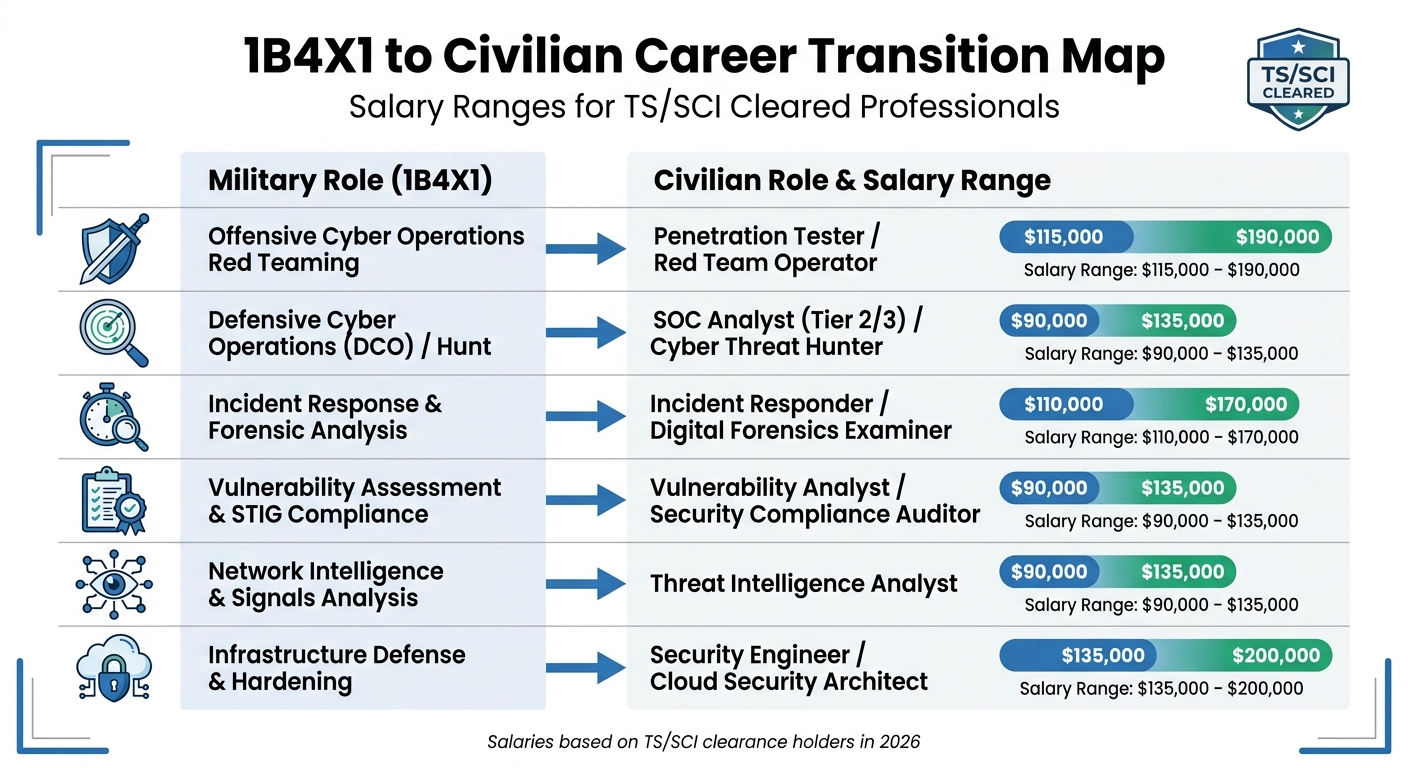
The table below maps your 1B4X1 responsibilities to equivalent civilian roles, along with their corresponding salary ranges for those holding TS/SCI clearances:
| 1B4X1 Responsibility | Civilian Role | Salary Range (With TS/SCI) |
|---|---|---|
| Offensive Cyber Operations / Red Teaming | Penetration Tester / Red Team Operator | $115,000 – $190,000 |
| Defensive Cyber Operations (DCO) / Hunt | SOC Analyst (Tier 2/3) / Cyber Threat Hunter | $90,000 – $135,000 |
| Incident Response & Forensic Analysis | Incident Responder / Digital Forensics Examiner | $110,000 – $170,000 |
| Vulnerability Assessment & STIG Compliance | Vulnerability Analyst / Security Compliance Auditor | $90,000 – $135,000 |
| Network Intelligence & Signals Analysis | Threat Intelligence Analyst | $90,000 – $135,000 |
| Infrastructure Defense & Hardening | Security Engineer / Cloud Security Architect | $135,000 – $200,000 |
"If you’ve been doing cyber operations for 4+ years in the military, you should be targeting mid-level to senior roles with compensation to match."
– Brad Tachi, CEO, Best Military Resume [2]
When crafting your civilian resume, adjust military-specific terms to language that resonates with civilian employers. For example, replace "COMSEC" with "cryptographic security" or "encryption key management", and "ACAS" with "vulnerability scanning using Nessus/Tenable" [3]. Be specific about the scale of your work – for instance, instead of saying you "secured a network", detail that you "conducted defensive operations across a 500,000+ endpoint enterprise network" [2].
Certifications That Advance Your Civilian Career
Certifications play a key role in the cleared cybersecurity field. They not only validate your expertise in terms that civilian hiring managers recognize but also ensure compliance with DoD 8140 (formerly DoD 8570) for privileged access [7][8]. As the DoD Cyber Workforce Framework (DCWF) transition deadline approaches in fiscal year 2026, knowing which certifications align with your career goals is crucial [8].
If you’re a 1B4X1 professional, chances are you already hold the CompTIA Security+ certification from your Air Force training. This satisfies IAT Level II requirements [2]. While Security+ is a solid starting point, adding specialized credentials can open doors to higher-paying roles.
Before you separate, take advantage of funding resources like Air Force COOL (Credentialing Opportunities On-Line) to cover exam fees [9]. The VA’s VET TEC program can also fund cybersecurity bootcamps and training without using up your GI Bill benefits [4]. Another great option is Syracuse University’s Onward to Opportunity (O2O) program, which offers free certification training and exam vouchers for transitioning service members [4]. Once you’ve secured funding, focus on building a strong foundation with both entry-level and advanced certifications.
Entry-Level Certifications to Start With
If Security+ is your only certification, consider adding CompTIA CySA+ to showcase your skills in threat detection and behavioral analytics. This certification, which costs around $400, is a natural fit for 1B4X1 professionals with defensive cyber operations experience. It also qualifies you for CSSP Analyst roles under DoD 8140, directly connecting your military expertise to civilian job requirements [7][4].
"One of our Army Signal NCOs went from E-6 to a $115K SOC analyst role in eight months. Security+ got him in the door. CySA+ got him the offer over other candidates. The clearance sealed it."
– Brad Tachi, CEO, Best Military Resume [4]
For those with offensive cyber operations experience, the Certified Ethical Hacker (CEH) certification is a DoD-approved standard for penetration testing roles. At approximately $1,199, CEH meets CSSP Auditor and Incident Responder requirements under DoD 8140 [4]. While it focuses more on theoretical knowledge, it’s a stepping stone for roles in offensive operations. If you’re looking for a more hands-on credential, the OSCP (Offensive Security Certified Professional) is highly regarded in both government and private sectors. Starting at $1,599 for the course bundle, OSCP is ideal for penetration testers and red teamers [2][4].
Advanced Certifications for Senior Roles
With four or more years of 1B4X1 experience, you may already qualify for the CISSP (Certified Information Systems Security Professional). This certification requires five years of professional experience, and your military service counts toward this requirement [2][10]. At $749, CISSP is a gateway to roles in security architecture and management, often commanding salaries over $130,000 [9][4]. It’s also essential for positions requiring IAM Level III or IASAE designations under DoD 8140 [7].
If you’re eyeing opportunities in cloud security – a rapidly expanding field – the CCSP (Certified Cloud Security Professional) is an excellent complement to CISSP. Priced at $599, CCSP is increasingly sought after as organizations migrate to AWS, Azure, and GCP platforms [4]. Certifications like CCSP or AWS Certified Security Specialty can significantly boost your earning potential [2][3].
| Certification | Cost | DoD 8140 Role | Best For |
|---|---|---|---|
| CompTIA Security+ | ~$400 | IAT Level II | Baseline requirement for cleared roles |
| CompTIA CySA+ | ~$400 | CSSP Analyst | SOC analysts and threat hunters |
| CEH | ~$1,199 | CSSP Auditor/Incident Responder | Offensive operations (knowledge-based) |
| OSCP | ~$1,599 | Technical Practitioner | Penetration testers and red teamers |
| CISSP | $749 | IAM Level III / IASAE | Security architects and managers |
| CCSP | $599 | Cloud Security | Cloud security engineers and architects |
Start preparing for certifications 12–18 months before you separate to maximize available funding [10][2]. Make sure to maintain your certifications with Continuing Education Units (CEUs) to avoid costly re-testing after separation [4]. Also, remember that your clearance remains active for 24 months post-separation, giving you a critical window to secure a cleared civilian role without requiring a full re-investigation [3]. Armed with the right certifications, you’ll be well-positioned to build a strong resume and land a role in the cleared job market.
How to Land Cleared Civilian Cybersecurity Jobs
If you’ve got the right certifications and an active clearance, you’re already ahead in the civilian job market. But landing a cleared cybersecurity role isn’t just about technical know-how. You’ll need a resume that not only passes Applicant Tracking Systems (ATS) but also effectively translates your military experience into terms civilian employers understand – all without compromising operational security. Your TS/SCI clearance is a huge asset, saving employers both time and money, which gives you a strong edge. Here’s how to make the most of it.
Writing a Resume That Gets Noticed
Your resume is your personal marketing tool, and it needs to highlight your certifications, experience, and most importantly, your clearance. Place your security clearance at the very top of your resume near your contact details. Why? Many recruiters filter resumes by searching for terms like "TS/SCI" before they even dive into the rest of your qualifications [11][12]. Don’t bury this critical information in a summary or generic paragraph.
Another key tip: translate military jargon into civilian job titles and terms. For example, swap out "1B4X1 Cyber Warfare Operations" for roles like SOC Lead, Red Team Operator, or Cloud Security Architect. Similarly, replace military-specific terminology with civilian equivalents – think "IA compliance" becoming "NIST 800-53 compliance" or "ACAS" being rephrased as "vulnerability scanning using Nessus/Tenable" [2][3][5].
When listing your accomplishments, use the STAR method (Situation, Task, Action, Result) to show measurable impact. For instance: "Led a team of five analysts to remediate 95% of critical vulnerabilities in 30 days across a 500,000-endpoint network" [2][11][12]. Highlight unclassified tools and frameworks you’ve worked with – like Splunk, Wireshark, CrowdStrike, Palo Alto firewalls, or the MITRE ATT&CK framework – and make sure to use the same keywords found in job postings. If a job description mentions "SIEM administration", include that exact phrase [2][3].
"Your security-cleared resume is not a biography or a mere list of qualifications. It’s an ad designed to help you land that coveted cleared job interview."
– Ashley Jones, Blog Editor, ClearedJobs.Net [11]
Be cautious about including any classified project names, targets, or budget details. Instead, describe your work environment in broader terms, like "multi-enclave network environment processing classified information" [2][11]. Keep your resume clean and concise – ideally one to two pages – so ATS software can easily scan it [11][12]. And skip personal details like your Social Security Number, marital status, or graduation years, which could lead to unintended bias [11].
"Keep subjective self-descriptions out of your summary section. I’m looking at you, Results-Oriented Team Players."
– Bill Branstetter, 9th Way Insignia [11]
Once your resume is polished, it’s time to prepare for the next step: interviews.
Preparing for Clearance and Job Interviews
Before heading into interviews, double-check your SF-86 for accuracy, as employers may verify its details [14]. Your clearance remains valid for 24 months after leaving the military, giving you a window to secure a civilian role without needing a full reinvestigation [13]. Be ready to explain this timeline to potential employers, as many will extend conditional offers while verifying your clearance through the Defense Information System for Security (DISS) [13].
When discussing your experience, avoid classified specifics. Instead, focus on the scale and complexity of your work. For example, say you "managed security for a 15,000-node enterprise network" rather than mentioning classified program details [2]. Avoid referencing SCI compartments or codewords, as this could raise security concerns [13]. Emphasize your experience with widely recognized tools and frameworks that civilian employers value.
For behavioral interview questions, use action verbs and quantify your results wherever possible [2][12]. Consider supplementing your operational experience with civilian-style technical labs like TryHackMe or HackTheBox to prepare for technical assessments [2].
Don’t sell yourself short. Four years of experience in 1B4X1 Cyber Warfare Operations often qualifies you for mid-level or senior roles, not entry-level SOC positions [2]. Highlight the unique value of your offensive cyber skills and the cost savings your clearance brings when negotiating compensation. With information security analyst roles expected to grow 33% through 2033, adding about 17,300 new positions annually, the opportunities are there [3].
"The cyber veterans I’ve seen transition most successfully are the ones who don’t settle for the first SOC analyst job offered to them. Your military experience puts you above entry-level."
– Brad Tachi, CEO, Best Military Resume [2]
Using Cleared Cyber Security Jobs to Find Your Next Role
With your polished resume and well-honed interview skills, it’s time to connect with employers who value your 1B4X1 expertise and active clearance. Cybersecjobs.com, a veteran-owned job board, focuses exclusively on roles requiring U.S. citizenship and active clearance. This ensures you only see opportunities you’re eligible for, streamlining your job search as you transition from military to civilian cybersecurity roles.
What makes this platform stand out is its direct-hire focus. Unlike other job boards filled with third-party recruiters, Cybersecjobs.com works exclusively with direct-hire employers like Booz Allen, Leidos, Northrop Grumman, and CACI.
"What makes us stand out in the recruitment industry is that we only allow direct-hire employers to source our career site and participate in job fairs."
– Cybersecjobs.com
With over 514,000 cybersecurity positions currently unfilled nationwide [1] and a $13 billion federal cybersecurity budget projected for 2026 [15], the cleared job market is thriving. Your active clearance is a key asset that significantly increases your value to employers. Let’s explore how Cybersecjobs.com’s tools can help you maximize your opportunities.
Getting the Most from Cybersecjobs.com Tools
A strong resume is just the beginning. To fully leverage Cybersecjobs.com, start by creating a complete profile and uploading your resume to the database. Recruiters often review your profile first, focusing on your skills and preferred work locations before diving into your resume. Highlight your experience with unclassified tools and frameworks from your 1B4X1 background – such as Wireshark, Metasploit, Splunk, or the MITRE ATT&CK framework.
Use the platform’s advanced search filters to narrow your job hunt by location, job title, company, or clearance level. For example, if you’re targeting areas like San Antonio, TX (home to NSA Texas and the 16th Air Force) or the DC Metro area, the Zip Code and mileage radius filters can help you zero in on opportunities. When filtering by clearance, include all levels you qualify for – if you hold a TS/SCI, also select Secret-level roles to broaden your options.
Set up Job Alerts to stay on top of openings for roles like "Red Team Operator", "Penetration Tester", "SOC Lead", or "Cloud Security Architect." These alerts deliver new postings directly to your inbox based on your preferences. You can also refine searches using Boolean logic – for instance, searching "Project Manager" OR "Program Manager" in quotation marks will include both titles.
Here’s a pro tip: log in to your account weekly. Each visit updates your profile’s activity date, keeping you visible in recruiter searches.
| Tool/Feature | How It Helps 1B4X1 Professionals |
|---|---|
| Job Filters | Narrow down roles by cleared hubs like San Antonio or Fort Meade |
| Resume Database | Lets top defense contractors proactively find your profile |
| Job Alerts | Sends relevant cleared roles straight to your inbox |
| Anonymous Mode | Browse opportunities discreetly without alerting your employer |
Attending Cleared Job Fairs
Online tools are powerful, but nothing beats the face-to-face connections you can make at Cleared Job Fairs. Hosted by Cybersecjobs.com, these events – both in-person and virtual – let you skip automated systems and speak directly with hiring managers. Since attendees must have an active clearance, you’ll be competing in a smaller, more qualified pool.
For 1B4X1 professionals, these fairs are invaluable. They provide a chance to showcase the depth of your operational experience – details that may not come through on a resume. Recruiters at these events understand the nuances of roles like SOC Analyst versus Cyber Warfare Operator, and they’re actively seeking candidates with your expertise. Be prepared with a polished resume, a clear idea of your target roles, and examples of your unclassified achievements.
"I recently transitioned out of the military and started attending Cleared Job Fairs to get comfortable speaking to potential employers, to network, and to learn about the market… For veterans especially, attending Cleared Job Fairs can be critical to a successful career transition."
– G.B., Technical Project Manager, CACI
Before attending, take advantage of Cybersecjobs.com’s Career Resources to research participating employers and prepare for interviews. You can also stay informed with their podcast, Security Cleared Jobs: Who’s Hiring & How, weekly newsletters, and webinars focused on transitioning from military to civilian careers. These resources keep you updated on trending companies and the specific skills in demand.
Conclusion
Transitioning from a 1B4X1 Cyber Warfare Operations role to a civilian career isn’t just achievable – it’s highly sought after. With over 514,000 cybersecurity job openings across the U.S. and around 26% of these roles expected to remain unfilled by 2026 [1], your expertise is exactly what employers are looking for. Plus, your active TS/SCI clearance gives you a major advantage by reducing employer processing time and costs for sponsorship [2][4].
To succeed, focus on translating your military experience into civilian terms, earning the right certifications, and targeting roles that align with your skillset. Your background in offensive cyber operations positions you for senior-level roles, which often come with top-tier salaries [2][5]. Start with certifications like Security+ to meet DoD 8140 requirements, and then aim for advanced credentials like OSCP or CISSP to unlock even greater earning potential.
"Your military experience puts you above entry-level – don’t let impostor syndrome push you into a role that’s two tiers below your actual capability." – Brad Tachi, CEO, Best Military Resume [2]
Your clearance remains active for just 24 months after separation [3], so it’s crucial to act quickly. Use platforms like Cybersecjobs.com to tap into tools like advanced job filters and cleared job fairs to connect with employers such as Booz Allen Hamilton, Leidos, and Northrop Grumman – companies that value your 1B4X1 expertise. Set up job alerts, keep your profile updated, and take advantage of programs like SkillBridge or VET TEC to fill any certification gaps before you leave the service [2][3][4]. These steps will help you confidently secure a role that reflects your experience and capabilities.
FAQs
What civilian job level should I target with 1B4X1 experience?
If you have experience in 1B4X1 Cyber Warfare Operations, you’re well-positioned to pursue mid-level cybersecurity roles like Cybersecurity Analyst, Security Engineer, or SOC Lead. Your military background in areas like network defense, threat analysis, and response coordination provides a strong foundation for these positions.
To boost your chances, consider obtaining certifications such as Security+, which are highly regarded in the industry. Start by targeting roles that typically require 3-5 years of experience, such as SOC Analyst. These positions are a great match for your skill set and can serve as stepping stones to advanced roles like Cybersecurity Engineer or Cyber Defense Manager.
How do I keep my TS/SCI active after separation?
To maintain your TS/SCI clearance after leaving the military, you typically have a 2-year window for reinstatement. During this period, it’s crucial to stay in touch with your previous employer or security officer. Be prepared to update your information or potentially undergo a reinvestigation. Taking action within this timeframe ensures you won’t have to start the clearance process all over again.
Which cert should I get next for my track (blue vs. red)?
Your next certification should align with your career ambitions and current expertise. If you’re aiming for offensive security roles (red team), certifications like OSCP or CEH can help you develop penetration testing skills. On the other hand, for defensive roles (blue team), Security+ or CISSP are well-regarded and can enhance your qualifications. For seasoned professionals, advanced certifications like CISSP or CCSP can open doors to senior-level positions. The key is to choose a certification that matches your goals and builds on your existing knowledge.