

If you’re transitioning from a 3D0X2 Cyber Systems Operations role in the Air Force to a civilian cybersecurity career, you’re in a strong position. Your technical expertise with systems like Windows Server, Active Directory, Linux, and Cisco networking is highly valued in the private sector. Civilian roles such as Systems Administrator, Cybersecurity Analyst, and Network Administrator align well with your experience. Here’s what you need to know:
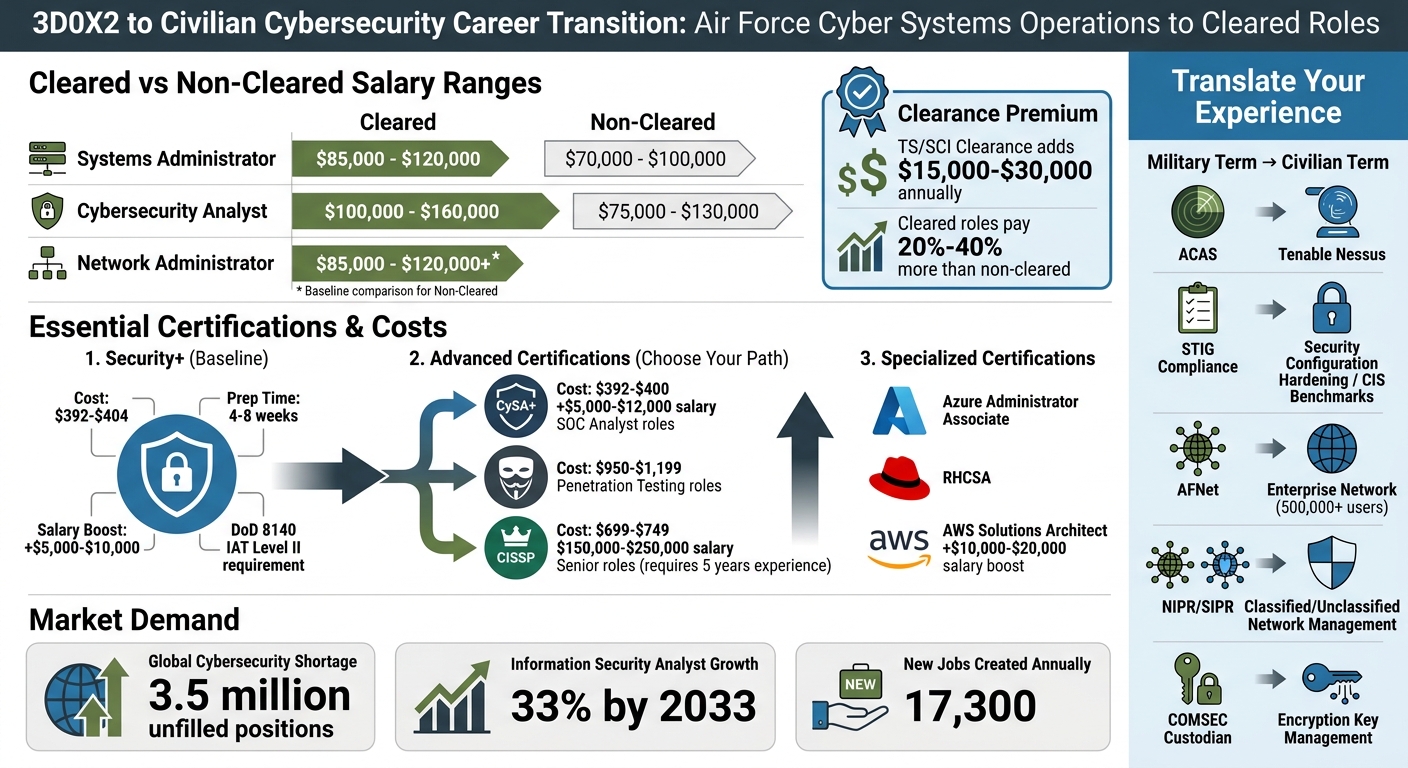
- Salary Potential: Cleared roles can pay $70,000–$145,000 annually, with TS/SCI clearances adding $15,000–$30,000 to your income.
- Certifications: Start with Security+ (a baseline requirement) and consider advanced options like CySA+, CEH, or CISSP to boost earning potential.
- Resume Tips: Translate military jargon into civilian terms, focus on measurable achievements, and highlight your security clearance prominently.
- Job Market: The cybersecurity industry faces a talent shortage, with 3.5 million unfilled positions globally. Cleared roles often pay 20%–40% more than non-cleared ones.
Your hands-on experience managing enterprise-scale networks and securing classified systems makes you a sought-after candidate. With the right certifications and resume adjustments, you’ll be well-prepared to excel in the civilian cybersecurity field.
3D0X2 to Civilian Cybersecurity Career Transition Guide: Salaries, Certifications, and Job Roles
From Air Force IT Specialist to Civilian Cybersecurity Pro
sbb-itb-bf7aa6b
What 3D0X2 Cyber Systems Operations Involves
As a 3D0X2 Cyber Systems Operations specialist, you’re tasked with building, securing, and maintaining essential networks that support critical missions [9]. This role spans server administration, managing network infrastructure, and enforcing security measures across both classified and unclassified systems.
Your technical responsibilities include working with tools and systems like Windows Server (2016/2019), RHEL, Active Directory, and Cisco IOS devices. You also conduct vulnerability scans using ACAS, ensure compliance with DISA STIG standards, and manage services like DNS, DHCP, SAN, and PKI. Troubleshooting network outages is part of the job, as is developing scripts in PowerShell, Bash, or Python to automate tasks like compliance reporting and server provisioning – all while working rotating shifts.
But it’s not just about technical know-how. You’ll also engage in strategic planning, such as forecasting budgets for hardware and software, managing system capacity, and creating contingency plans for system restoration. On top of that, you’ll research system threats and design tactics, techniques, and procedures for both defensive and offensive cyber operations. While much of the work happens in climate-controlled environments, deployments to challenging locations are possible, where maintaining network uptime can directly affect combat missions.
This role combines hands-on technical expertise, security oversight, and operational problem-solving, giving you a skill set that’s highly sought after in the civilian cybersecurity field. The familiarity with these technologies ensures that your military experience translates effectively into cleared cybersecurity roles in the civilian world.
How 3D0X2 Skills Apply to Cleared Civilian Jobs
Your 3D0X2 background is a strong foundation for civilian cleared roles, but translating military terminology into civilian job language is key. By aligning your technical expertise with job posting keywords, you can effectively showcase your qualifications. For instance, if a job mentions "enterprise network administration", highlight your experience managing networks for over 500,000 users. Similarly, terms like "vulnerability assessment" connect directly to your ACAS scanning work, and "security configuration hardening" ties to your STIG compliance experience [2][6].
This approach helps target roles such as Systems Administrator, Cybersecurity Analyst, and Network Administrator. Understanding these connections will help you stand out in the job market.
Systems Administrator Positions
Your expertise in Windows Server, RHEL, Active Directory, Group Policy Objects, and server provisioning aligns naturally with Systems Administrator roles. Cleared positions in this field generally pay between $85,000 and $120,000 annually, compared to $70,000 to $100,000 for non-cleared roles.
When updating your resume, be specific. Instead of saying "managed AFNet infrastructure", you could write, "Administered 50+ servers supporting 4,500 users with 99.9% uptime" [2][4]. Including software versions like Windows Server 2016/2019 or RHEL 8 makes your experience more relevant to applicant tracking systems. Additionally, mentioning your work with virtualization tools like VMware and Hyper-V could open doors to Cloud Engineering or DevOps roles. If you’ve automated tasks using PowerShell or Bash, quantify the results – for example, "Reduced server provisioning time from 4 hours to 30 minutes through automation." Civilian employers value measurable outcomes.
Next, let’s look at how your skills apply to Cybersecurity Analyst positions.
Cybersecurity Analyst Positions
Your experience with ACAS vulnerability scanning directly translates to tools like Tenable Nessus, a common requirement for cybersecurity roles. Similarly, STIG compliance can be reframed as "security configuration baseline hardening" or "CIS Benchmark implementation" [2][6]. Cleared Cybersecurity Analyst positions typically offer salaries ranging from $100,000 to $160,000 annually, compared to $75,000 to $130,000 for non-cleared roles.
Your hands-on experience in incident response, patch management (IAVA/TCNO), and PKI management aligns with the core responsibilities of these roles. The need for information security analysts is growing rapidly, with a projected 33% increase by 2033, creating approximately 17,300 new jobs annually [5]. To make your resume stand out, use metrics like, "Performed weekly vulnerability assessments across 2,400 endpoints, achieving a 97% remediation rate within a 30-day compliance window" [5].
Your network-related skills also make you a strong candidate for Network Administrator roles.
Network Administrator Positions
Your expertise in configuring switches, managing VLANs, and troubleshooting WAN/LAN connectivity is a perfect match for civilian Network Administrator roles. Skills like network security monitoring and firewall management are especially valuable in cleared environments, where maintaining secure and reliable operations is critical. Salaries for cleared Network Administrator roles typically fall between $85,000 and $120,000+.
To effectively translate your experience, describe dual-enclave network operations (NIPR/SIPR) as "enterprise-wide classified and unclassified network management." Similarly, reframe COMSEC custodian responsibilities as "encryption key management" or "cryptographic security operations" [4][5].
Emphasize your experience in managing mission-critical infrastructure. Civilian candidates often lack exposure to environments where downtime has immediate consequences. Your ability to maintain operational discipline and perform under pressure is highly valued by defense contractors hiring for cleared positions.
Required Certifications for Cleared Cybersecurity Jobs
Certifications help translate military experience into credentials that civilian hiring managers and applicant tracking systems can easily recognize. If you hold an active TS/SCI clearance, you could see a salary boost of $15,000 to $30,000 annually[7][5]. Choosing certifications that align with your target role – whether as a systems administrator, cybersecurity analyst, or senior-level professional – is key to standing out.
Security+: The Baseline Requirement
CompTIA Security+ is often the first step for cleared cybersecurity roles. It meets DoD 8140 (formerly 8570) IAT Level II requirements, making it a common prerequisite for federal agencies and defense contractors[2][8]. The exam costs between $392 and $404, and most candidates prepare for it over four to eight weeks[10][3]. This certification effectively translates military operational experience into terms that resonate with civilian employers.
If you’re still in the military, consider using Air Force COOL funding to cover the exam cost, potentially saving $300 to $700[2]. For those already separated, the VA’s VET TEC program can cover certification training costs and even provide a housing allowance – without impacting your GI Bill benefits[8][5]. Earning Security+ certification could increase your salary by $5,000 to $10,000 compared to uncertified candidates[11].
"A certification cuts through that translation problem. When your resume says CompTIA Security+ or CISSP, a hiring manager immediately understands your knowledge base."
– Mike McNelis, Training Camp[10]
Once you’ve earned Security+, pursuing advanced certifications can further boost your expertise and earning potential.
Advanced Certifications: CySA+, CEH, and CISSP
CompTIA CySA+ is ideal for those aiming for Security Operations Center (SOC) analyst roles. It emphasizes skills like threat detection, behavioral analytics, and incident response, making it a logical next step after Security+[8][11]. The exam costs around $392 to $400, and earning this certification can add $5,000 to $12,000 to your annual salary. This credential aligns well with job postings for SOC analysts and threat hunters.
Certified Ethical Hacker (CEH) is tailored for offensive security roles, such as vulnerability assessment and penetration testing. The exam costs between $950 and $1,199 and showcases your ability to think like an attacker[8][3].
For senior-level roles in security architecture and management, CISSP is the gold standard. It requires five years of professional experience, which your military service likely satisfies, and costs between $699 and $749[8][3]. CISSP-certified professionals in cleared roles often earn salaries ranging from $150,000 to $250,000 annually[7][3].
"One of our Army Signal NCOs went from E-6 to a $115K SOC analyst role in eight months. Security+ got him in the door. CySA+ got him the offer over other candidates. The clearance sealed it."
– Brad Tachi, Navy Veteran & BMR Founder[8]
For more specialized roles, targeted certifications can help validate your expertise.
Specialized Certifications: Azure Administrator and RHCSA
If your experience includes managing Windows Server, Active Directory, or RHEL, certifications can confirm your skills for civilian employers. The Azure Administrator Associate certifies your ability to manage Microsoft cloud infrastructures[2][10]. Similarly, the Red Hat Certified System Administrator (RHCSA) demonstrates your Linux expertise in a format that hiring managers immediately understand[2].
As companies move toward cloud-based systems, certifications like AWS Solutions Architect Associate or Azure Security Engineer have become increasingly important. These credentials can boost your salary by $10,000 to $20,000 and open doors to cloud engineering roles with salaries ranging from $120,000 to $170,000[7][11]. Starting your certification journey 12 to 18 months before leaving the military ensures you’re fully prepared to enter the civilian workforce with a strong credential stack[10].
How to Write a Resume for Cleared Jobs
When crafting a resume for cleared jobs, it’s critical to present your military experience in terms that civilian employers can understand. Recruiters typically spend just six seconds scanning a resume before deciding whether to read further [12][5]. This means clarity takes precedence over creativity. Start by listing your security clearance (e.g., TS/SCI or Secret) directly under your name, and repeat it in the skills section. Many defense contractors rely on applicant tracking systems to search for terms like "TS/SCI" as an initial screening step [14]. This straightforward approach ensures your qualifications are easy to spot and helps bridge the gap between military achievements and civilian job requirements.
Translate Military Jargon into Civilian Terms
Avoid military-specific terms and replace them with civilian equivalents. For instance, instead of "ACAS vulnerability scanning", use "Tenable Nessus vulnerability assessment." Similarly, swap "STIG compliance" for "security configuration hardening" or "CIS Benchmarks" [2]. If you’re describing AFNet, highlight its scale by calling it an "enterprise-wide network supporting 500,000+ users globally" [2]. Including specific versions of tools and systems, such as "Windows Server 2019" or "RHEL 8", also helps improve your resume’s match rate in applicant tracking systems [2]. These changes make your experience more relatable to civilian employers.
Focus on Quantifiable Achievements
Numbers speak louder than vague descriptions. Instead of saying you "managed network infrastructure", specify your impact: "maintained 99.9% uptime for 2,500 users" or "reduced ticket resolution time by 40% using PowerShell automation" [2][4]. Metrics like these clearly show the value you brought to your role in a way that resonates with civilian employers. For defense contractor positions, retain some military context, such as SCIF or OCONUS references. However, for corporate IT roles, strip out all military jargon and emphasize business-oriented outcomes [4]. These adjustments highlight your technical expertise while making your resume more accessible to civilian hiring managers.
"Keep subjective self-descriptions out of your summary section. I’m looking at you, Results-Oriented Team Players."
– Bill Branstetter, 9th Way Insignia [12]
Keep It Simple and Avoid Sensitive Details
Leave out classified project names, specific office sizes, or sensitive budget information [12]. Instead, describe the network environment in general terms, like "15,000-node network." Use a clean, single-column format without graphics, tables, or unusual fonts, as these can interfere with applicant tracking systems [15][16]. Organize your technical skills into clear categories such as "Operating Systems & Administration", "Network Infrastructure", and "Security Tools" [4]. Finally, have your resume reviewed by someone with a civilian perspective to ensure it hits the right notes [12][13].
Using Cleared Cyber Security Jobs to Find Positions
On Cleared Cyber Security Jobs, employers check out your profile details before even glancing at your resume. To stand out, make sure your "Key Skills" and "Ideal Work Locations" sections are fully filled out. These details can significantly improve your visibility to potential employers [18].
Logging in regularly is another smart move. Each login updates your profile’s timestamp, which keeps your information appearing fresh in search results. As Ashley Jones, Blog Editor and Cleared Job Search Expert at ClearedJobs.Net, puts it:
"When you create a profile, a date is associated with your account. Each time you log in, that date is updated. That’s important because employers’ searches present what’s new or fresh at the top of their results" [18].
If you’re transitioning from a role like 3D0X2, reframe your experience using civilian job titles such as "Systems Administrator", "Cybersecurity Analyst", "Network Security Engineer", or "Cloud Engineer" [2]. To broaden your job search, use Boolean search operators like "Systems Administrator" OR "Cybersecurity Analyst" OR "Network Security Engineer." For location-based searches, enter a ZIP code with a mileage radius to find jobs near bases [18]. When filtering by clearance level, select all levels you’re eligible for. For example, if you hold a Top Secret clearance, include Secret-level filters too, as many roles accept either [18].
Set up Job Agents to get daily email alerts for new positions that match your preferences [17]. You can also fine-tune keywords through manual searches and save these as alerts. This way, you’ll be among the first to know when new opportunities pop up.
Additionally, the platform offers both in-person and virtual Cleared Job Fairs, where you can connect directly with recruiters from hiring companies [17]. These events are excellent for networking. If you’re concerned about privacy while job hunting, you can set your profile to "Anonymous", which highlights your skills but keeps your name hidden. There’s also a "Block Employers" feature to ensure your current employer doesn’t see your profile [18].
Using these search strategies and optimizing your profile can greatly enhance your chances of landing the right cleared cybersecurity role.
Preparing for Cleared Cybersecurity Interviews
With your resume polished, it’s time to shift focus to preparing for interviews tailored to cleared cybersecurity roles. While landing the interview is a big step, excelling in it requires a clear understanding of how these roles differ from others. One key point to remember: your security clearance is a major selling point, saving employers anywhere from $3,000 to $15,000 in sponsorship costs [14]. Be sure to highlight this as a key asset.
When discussing your clearance, keep it straightforward. Use terms like "Active Top Secret/SCI" or "Current Secret clearance." If you’ve completed a polygraph, specify whether it was Counter-Intelligence or Full-Scope, as this can significantly boost your market value [14]. However, never disclose sensitive details such as SCI compartments, codewords, classified program names, or investigation case numbers. Brad Tachi, CEO and Founder of Best Military Resume, advises:
"Your clearance can be verified through DISS (Defense Information System for Security) by a prospective employer’s security office without any information beyond your name and date of birth" [14].
If your clearance has expired, be transparent. You can describe it as "Previous [Level] clearance; reinvestigation eligible."
Crafting Success Stories
Prepare 5–7 success stories from your 3D0X2 experience that showcase your accomplishments without revealing classified information. Use a structured approach: describe the situation, the goal, the actions you took, and the measurable results. For instance, instead of saying "managed classified networks", you could say, "Administered a 50+ server environment supporting 4,500 users with 99.9% uptime across multiple security enclaves." Make an effort to translate military jargon into civilian terms – swap "ACAS" for "Tenable Nessus" or "STIGs" for "security baselines." This aligns with the focus on measurable outcomes that your resume should already reflect.
Anticipating Technical Questions
Be ready for technical questions covering cybersecurity fundamentals. Expect topics like the CIA triad (Confidentiality, Integrity, Availability), the OSI model, and the distinctions between IDS and IPS systems [19][20]. You should also practice explaining how you’ve secured systems, managed incidents, or automated tasks using tools such as PowerShell or Python. If you encounter a question you can’t answer, admit it honestly, research the topic afterward, and follow up with the hiring manager [19].
Researching Your Interviewers
Before the interview, ask the recruiter for the names of your interviewers and review their professional backgrounds. Understanding their roles and the contracts or agencies they support will help you tailor your responses and demonstrate genuine interest.
Post-Interview Etiquette
Just like your resume, your follow-up matters. Send a thank-you email to each interviewer within 24 hours. Use the opportunity to express gratitude, reaffirm your enthusiasm for the role, and leave a lasting positive impression. This small step reinforces your professionalism and keeps you fresh in their minds.
Conclusion
Transitioning from 3D0X2 Cyber Systems Operations to a civilian cybersecurity career is all about translating your military tech expertise into terms that resonate with civilian recruiters. Your hands-on experience with tools like Windows Server, Active Directory, and Linux directly aligns with roles such as Systems Administrator, Cybersecurity Analyst, and Cloud Engineer [2]. The key is to reframe your military experience in a way that civilian employers can easily understand and appreciate.
Once you’ve aligned your skills to civilian job descriptions, focus on certifications to validate your expertise. Certifications are non-negotiable in the cybersecurity field. Begin with Security+ to meet DoD 8570/8140 compliance requirements. From there, consider advancing to CySA+, CISSP, or cloud-specific certifications to further strengthen your resume [2]. Many military funding programs can help cover the costs of these certifications, so be sure to take advantage of those resources.
Your active security clearance is another critical asset. It can save potential employers between $5,000 and $15,000, while also boosting your earning potential by $10,000 to $30,000 annually [1][5]. To maximize this advantage, aim to secure a cleared position within 24 months of separating from the military, as maintaining an active clearance adds significant value to your profile. As Brad Tachi, CEO of Best Military Resume, advises:
"The cyber veterans I’ve seen transition most successfully are the ones who don’t settle for the first SOC analyst job offered to them. Your military experience puts you above entry-level" [7].
Finally, refine your job search strategy. Cleared Cyber Security Jobs is an excellent platform to connect directly with defense contractors like Booz Allen Hamilton, Leidos, and SAIC – companies that actively seek candidates with military backgrounds and active clearances [7]. Instead of relying on commercial job boards, which often filter resumes through automated systems, focus on the cleared job market. This niche not only values your unique experience but also offers salaries 20% to 40% higher than commercial positions [11].
FAQs
How do I explain 3D0X2 work in civilian terms?
In a nutshell, working in a 3D0X2 role means handling enterprise IT infrastructure, networks, and cybersecurity systems. Your responsibilities could include maintaining servers, setting up security protocols, managing network devices, and supporting essential IT operations.
For instance, you might describe your work like this: "Managed enterprise IT networks by configuring and maintaining servers, network devices, and security systems to ensure the high availability and security of critical infrastructure."
This type of experience directly aligns with positions such as systems administrator or cybersecurity analyst, making it a solid foundation for careers in IT and cybersecurity.
Which certs should I get after Security+?
After achieving Security+, you might want to explore certifications that align with your career goals. For advanced roles, the CISSP (Certified Information Systems Security Professional) is a strong choice. If penetration testing sparks your interest, consider the CEH (Certified Ethical Hacker).
For those aiming for higher-level positions, certifications like CISA (Certified Information Systems Auditor) or CISM (Certified Information Security Manager) stand out. These not only align with the DoD 8140 framework but also help demonstrate your expertise to civilian employers.
How can I keep my clearance active after separating?
To maintain your security clearance after separating, you’ll need an employer to sponsor it within 24 months. During this time, a Secret clearance remains inactive but can still be reinstated. However, if no sponsorship occurs within that window, your clearance will lapse, and you’ll need to undergo a new investigation. To avoid this, actively search for cleared job opportunities and connect with employers or contractors who can sponsor your clearance. This approach lets you bypass the hassle of restarting the process entirely.