

If you’re transitioning from a 3D0X3 Cyber Surety role in the Air Force to a civilian cybersecurity career, you’re in high demand. With 3.5 million unfilled cybersecurity positions worldwide and 33% job growth projected through 2033, your experience managing secure networks and holding an active security clearance makes you a standout candidate. Here’s what you need to know:
- Top Certifications: Start with CompTIA Security+ ($404), which meets DoD 8140 requirements. Add certifications like CySA+, CISSP, or CEH to expand your opportunities.
- Salary Potential: Cleared professionals earn 20%–40% more, with salaries ranging from $70,000 to $145,000. A TS/SCI clearance can add $15,000 to $30,000 to your pay.
- Translating Skills: Frame military experience in civilian terms. For example, replace "ACAS" with "Tenable Nessus" and "STIGs" with "security configuration hardening."
- Key Employers: Companies like Booz Allen Hamilton, Leidos, and Northrop Grumman actively seek veterans with cybersecurity expertise.
Act quickly – your security clearance remains active for 24 months post-separation. This guide outlines certifications, resume tips, and job search strategies to help you secure a civilian cybersecurity role.
Military Cybersecurity to Civilian Cybersecurity my transition
sbb-itb-bf7aa6b
What Does a 3D0X3 Cyber Surety Specialist Do?
As a 3D0X3 Cyber Surety specialist, you play a crucial role in safeguarding the Air Force’s Information Assurance (IA) program. This program spans Communications Security (COMSEC), Emissions Security (EMSEC), and Computer Security (COMPUSEC) [7]. Your job involves managing the Certification and Accreditation (C&A) process, ensuring all IT systems are secure before they’re deployed [7]. You also conduct evaluations to pinpoint security gaps and suggest solutions, serving as the Air Force’s frontline defense for protecting sensitive information systems.
Main Duties of 3D0X3 Cyber Surety
Your primary responsibilities revolve around administering the IA program, which includes protecting telecommunications systems under national and DoD guidelines [7]. Key tasks include:
- Conducting cybersecurity audits and risk assessments using tools like ACAS (Tenable Nessus).
- Enforcing DISA STIGs to ensure secure system configurations [7][6].
- Deploying and managing real-time intrusion detection systems and firewalls.
- Investigating security breaches through IT forensics, identifying causes, and preventing future incidents [1][7].
These responsibilities prepare you for civilian jobs in areas like compliance auditing, vulnerability management, and security operations center (SOC) analysis – fields in high demand within the defense and private sectors.
Your role also involves proactive and reactive defense measures, such as monitoring networks for threats and responding to incidents in real-time [7]. This hands-on experience, often at an enterprise scale supporting 500,000+ users, sets you apart from civilian counterparts who may lack practical exposure to live threats [6]. It’s this combination of technical expertise and real-world application that makes you a standout candidate for cybersecurity roles outside the military.
Training and Certifications for 3D0X3 Personnel
Becoming a 3D0X3 specialist requires meeting rigorous entry standards. You’ll need to achieve at least a 60 on the Cyber test, 57 on the EDPT, and 55 on the Electrical portion of the ASVAB – or alternatively, a 64 General score combined with a 57 EDPT [1]. After Basic Military Training, you’ll undergo around 14 weeks of technical training at Keesler Air Force Base in Biloxi, Mississippi [1]. This training covers everything from Air Force information systems and network protocols to solving technical problems and addressing security breaches [1].
To meet DoD 8570 IAT Level II requirements, you’ll typically earn a CompTIA Security+ certification, which costs about $400 but is funded by the Air Force Credentialing Opportunities On-Line (COOL) program [5][6]. This funding saves you significant out-of-pocket expenses and positions you for civilian IT roles. Depending on your duties, additional certifications like CCNA Security may also be required [5].
Why Security Clearance Matters
A Top Secret (SSBI) security clearance is essential for the 3D0X3 role and becomes a valuable asset during your transition to civilian life [1][7]. However, this clearance remains active for only 24 months after separation unless you secure a position requiring it. If it lapses, reactivating it involves a costly and time-consuming re-investigation [3][4].
"An active or recent security clearance is worth tens of thousands of dollars and months of time to an employer. They don’t have to sponsor you for one." – Brad Tachi, CEO, Best Military Resume [5]
The cleared cybersecurity market offers salaries 20% to 40% higher than commercial rates, with a TS/SCI clearance adding an extra $15,000 to $30,000 to your starting pay [8][4]. Cleared professionals also enjoy greater job security, as layoffs are less common in the defense sector [8]. While many roles require work in a Sensitive Compartmented Information Facility (SCIF) – limiting remote options – the higher compensation often offsets this restriction [8]. This clearance makes you an attractive candidate for defense contractors and federal agencies looking for pre-cleared talent.
How 3D0X3 Skills Transfer to Civilian Jobs
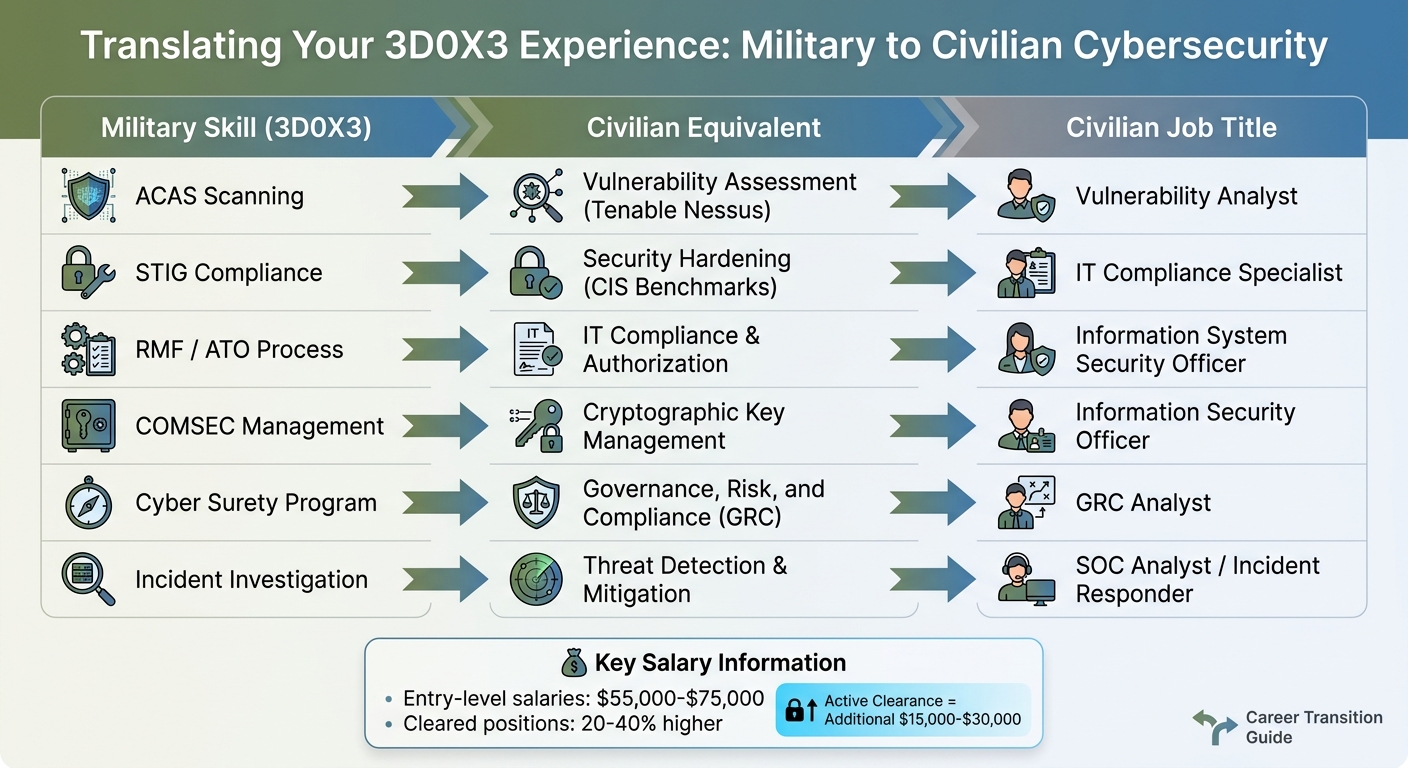
3D0X3 Military Skills to Civilian Cybersecurity Jobs Translation Guide
Your 3D0X3 background equips you with the expertise that civilian cybersecurity roles demand. The defensive security practices you’ve mastered – like vulnerability assessments, compliance checks, and incident response – are highly sought after by employers. The key is framing these skills in terms that resonate with civilian hiring managers.
Skills That Transfer to Civilian Work
The technical skills you’ve developed align closely with civilian cybersecurity needs. For example, your experience with the Risk Management Framework (RMF) is particularly valuable, as government contractors often use the same process for system authorizations. Similarly, managing COMSEC operations in the military translates into handling cryptographic key management and encryption security, which are essential in industries like defense and finance. Your IT forensics and incident response expertise also set you up well for roles such as SOC analyst or incident responder, where tasks like monitoring alerts and analyzing threats are critical.
What sets you apart is not just your technical knowledge but also your ability to work under pressure and your experience with large-scale enterprise networks. These qualities make you a strong candidate for roles such as SOC analyst or Information System Security Officer (ISSO), where real-world problem-solving is valued over theoretical knowledge.
Civilian Job Titles That Match 3D0X3 Experience
Your military experience directly aligns with several civilian job roles, such as:
- Cybersecurity Analyst: Monitors security alerts and performs risk assessments.
- Information System Security Officer (ISSO): Oversees system authorizations and RMF processes.
- GRC Analyst: Handles risk assessments, compliance audits, and detailed documentation.
- Vulnerability Analyst: Conducts scans and prioritizes remediation, much like the ACAS scanning you’ve done.
- IT Compliance Specialist: Ensures systems meet security standards, reflecting your experience with STIG enforcement.
Top defense contractors like Booz Allen Hamilton, SAIC, Leidos, Peraton, and BAE Systems actively seek veterans with security clearances for these positions.
The earning potential is also promising. Entry-level cybersecurity analysts with a Security+ certification can earn between $55,000 and $75,000 within six months of leaving the military [2]. Cleared positions often pay 20–40% more. In 2022, the median salary for Information Security Analysts reached $112,000, with job growth projected at 33% through 2033 [1].
To succeed in civilian job applications, it’s essential to translate military terminology into civilian language. The table below provides a clear comparison between your military skills and their civilian equivalents.
Military Skills to Civilian Job Requirements Comparison
| Military Skill (3D0X3) | Civilian Equivalent | Civilian Job Title |
|---|---|---|
| ACAS Scanning | Vulnerability Assessment (Tenable Nessus) | Vulnerability Analyst |
| STIG Compliance | Security Hardening (CIS Benchmarks) | IT Compliance Specialist |
| RMF / ATO Process | IT Compliance & Authorization | Information System Security Officer |
| COMSEC Management | Cryptographic Key Management | Information Security Officer |
| Cyber Surety Program | Governance, Risk, and Compliance (GRC) | GRC Analyst |
| Incident Investigation | Threat Detection & Mitigation | SOC Analyst / Incident Responder |
When describing your experience, focus on measurable achievements. For example, instead of saying you "secured a network", you could highlight that you "managed network security for 2,400 users across three installations, maintaining 99.7% uptime." Replace military-specific terms with civilian equivalents – e.g., "AFNet" becomes "enterprise-wide network supporting 500,000+ users." These adjustments not only make your resume more relatable but also improve its chances of passing Applicant Tracking Systems (ATS) and catching the attention of hiring managers.
Certifications That Improve Your Job Prospects
Certifications are often a must-have for cleared cybersecurity positions. Under the DoD 8140 framework (previously known as 8570), specific certifications are tied to different job levels, essentially making them your ticket to accessing the cleared job market. While your military background as a 3D0X3 Cyber Surety specialist already demonstrates your expertise, certifications help translate that experience into qualifications that civilian employers recognize. Below, we break down key certifications, their timelines, and costs to help you make a smooth transition.
Top Certifications for Cleared Cybersecurity Jobs
If you’re aiming for a DoD 8140 IAT Level II role, CompTIA Security+ is the go-to certification. At a cost of about $404, most 3D0X3 specialists can prepare for this in just 4–8 weeks, thanks to their existing knowledge base.
For those looking to specialize in defensive security roles like SOC analyst or incident responder, CompTIA CySA+ is a great next step. This certification, also priced around $404, builds on your defensive security skills. On the other hand, CISSP is highly sought after for management and architecture roles. Though it requires five years of relevant experience (military service counts), it’s considered a career-defining credential. The exam costs $749, and CISSP-certified professionals often earn salaries exceeding $130,000.
"One of our Army Signal NCOs went from E-6 to a $115K SOC analyst role in eight months. Security+ got him in the door. CySA+ got him the offer over other candidates. The clearance sealed it."
– Brad Tachi, Navy Veteran & BMR Founder
For roles in offensive security, CEH (Certified Ethical Hacker) is a recognized option that meets DoD compliance standards, though it comes with a heftier price tag of $1,199. For those aiming to stand out in penetration testing, OSCP (Offensive Security Certified Professional) is highly regarded by technical hiring managers. Starting at $1,599, it’s an investment but pays off in advanced technical roles.
Cloud security is another booming area. Certifications like AWS Certified Security Specialty and CCSP (Certified Cloud Security Professional) are increasingly valuable as federal agencies continue to adopt cloud technologies. CCSP, for instance, costs around $599 and is ideal for cloud security-focused roles.
How Long Certifications Take and What They Cost
Planning your study time and budget is crucial. Here’s a quick breakdown of some of the most popular certifications:
- Security+: 4–8 weeks of preparation, exam cost of $404
- CySA+: 6–10 weeks of study, priced between $392 and $404
- CISSP: 8–16 weeks of preparation, with an exam fee of $749
- CEH: 6–10 weeks of study, costing $1,199
- OSCP: 3–6 months of preparation, starting at $1,599
If you’re still on active duty, funding programs can help offset these costs. After leaving the military, programs like VET TEC not only cover high-tech training but may also provide a housing allowance, saving you thousands of dollars and speeding up your transition.
| Certification | Exam Cost | Study Time | Target Role |
|---|---|---|---|
| CompTIA Security+ | $404 | 4–8 weeks | Entry-level Security/Admin |
| CompTIA CySA+ | $404 | 6–10 weeks | SOC Analyst / Incident Responder |
| CISSP | $749 | 8–16 weeks | Security Manager / Architect |
| CEH | $1,199 | 6–10 weeks | Penetration Tester |
| OSCP | $1,599+ | 3–6 months | Advanced Penetration Tester |
| CCSP | $599 | 8–12 weeks | Cloud Security Engineer |
When paired with your military background and active clearance, these certifications can significantly boost your earning potential and reduce the time it takes to land your next role in the civilian cybersecurity sector.
How to Use Cleared Cyber Security Jobs for Your Job Search
With your certifications and polished credentials, you can connect directly with employers who need your expertise. If you have an active clearance, this platform is designed specifically for professionals like you – especially veterans seeking cybersecurity roles in government or contracting. Cleared Cyber Security Jobs eliminates middlemen, giving you direct access to federal agencies and government contractors.
By leveraging your certifications and an updated resume, you can tap into federal and contractor opportunities through this specialized platform.
Job Search Tools and How to Use Them
Start by building a complete profile. Keep in mind that employers will often review your profile before your resume, so ensure sections like "Key Skills" and "Ideal Work Locations" are filled out with precise terms hiring managers are likely to search for. Mention specific roles like ISSO or ISSM, and include certifications such as Security+ or CySA+.
Use filters to refine your search by location, clearance level, and job title. If you hold a Top Secret clearance, don’t forget to include Secret-level positions in your search – this can reveal additional opportunities. When filtering by location, it’s better to use a Zip Code and a mileage radius rather than just a city name. This way, you won’t miss jobs listed near military bases or in surrounding suburbs.
Set up daily Job Alerts to stay updated on new postings. To broaden your search, use Boolean logic. For example, enclose phrases like "Information Assurance" in quotation marks to find exact matches, and use OR to link related terms, such as "ISSO" OR "ISSM."
Take advantage of privacy settings to control how your profile is seen. You can mark it as "Active", stay "Anonymous", or even block specific employers. Regularly updating your profile can help you stay visible and prioritized by recruiters.
These tools make your job search more efficient while increasing your visibility to top hiring managers.
What Job Seekers Get from the Platform
Cleared Cyber Security Jobs isn’t just about job postings – it also offers exclusive Cleared Job Fairs. These events, held both in-person and virtually, allow you to interact directly with recruiters who understand the value of your clearance.
The platform also provides career resources tailored for veterans transitioning to civilian roles. These include salary guides, resume tips, and newsletters focused on relevant skills. Additionally, you can use the platform as a research tool to analyze job market trends – like which employers are hiring in your area or which certifications are in demand.
Job Seeker vs. Employer Features Comparison
| Feature | Job Seeker Benefits | Employer Benefits |
|---|---|---|
| Job Postings | Access cleared-only roles and apply directly | Post jobs to reach pre-screened talent |
| Resume/Profile | Upload your resume and create a searchable profile | Search a database of highly qualified cleared professionals |
| Job Fairs | Meet recruiters face-to-face or online | Connect directly with top-tier candidates |
| Search Tools | Use filters, Boolean searches, and alerts | Simplify sourcing with streamlined tools |
| Privacy | Stay anonymous or block specific employers | Only direct-hire employers are allowed on the platform |
| Resources | Get career advice, salary insights, and newsletters | Receive hands-on, proactive customer support |
Cleared professionals can access the platform for free, as long as they are U.S. citizens with an active or current security clearance. By connecting directly with decision-makers, you can simplify your job search, speed up the hiring process, and find roles that align with your skills and goals.
How to Write Your Resume and Prepare for Interviews
Your resume is the key to translating your military service into a format that civilian hiring managers can quickly understand. With recruiters spending just six seconds on initial resume reviews [3], every detail matters.
Converting Military Experience to Civilian Resume Language
Start by swapping military-specific language for civilian job titles and terms. For instance, instead of "Staff Sergeant, 3D0X3 Cyber Surety", use titles like Cybersecurity Analyst, Compliance Manager, or Information Security Specialist [6][9]. This makes your experience instantly relatable to recruiters.
A helpful approach is the "Function-First" formula: describe what you did and the scale of your responsibility. For example, "Cyber Surety Specialist" could become "Information Security Analyst managing compliance for a 5,000-user enterprise network" [9].
Translate military tools and processes into their civilian equivalents. For example:
- ACAS → "Tenable Nessus Vulnerability Assessment"
- DISA STIGs → "Security Hardening Standards (CIS Benchmarks)"
- COMSEC Accountability → "Cryptographic Asset Management" [6][3]
If you performed ISSO or IAM duties, present them as roles like "Information Security Officer" or "Compliance Manager" [3].
Quantify your achievements using the CAR method (Challenge, Action, Result). Avoid vague descriptions like "Conducted vulnerability scans." Instead, say something like, "Identified 3,400+ vulnerabilities using Nessus and achieved 95% compliance within 90 days" [4][9]. Include measurable results – such as compliance rates, systems secured, or the value of assets managed.
For classified work, focus on the complexity and scope without revealing sensitive details. For instance, describe a "15,000-node multi-enclave network" or "security management for a distributed enterprise environment" [4].
Don’t forget to highlight your security clearance at the top of your resume. A TS/SCI clearance can increase your salary by $15,000 to $30,000 [4][3] and saves employers between $5,000 and $15,000 in clearance sponsorship costs, along with 6 to 18 months of processing time [4][3].
"Your military experience puts you above entry-level – don’t let impostor syndrome push you into a role that’s two tiers below your actual capability." – Brad Tachi, CEO, Best Military Resume [4]
Adopt a two-resume strategy:
- Use a detailed, multi-page resume for federal jobs through USAJOBS. These resumes require specifics like hours worked per week and supervisor contact information.
- Create a concise, 1-2 page resume for corporate and contractor roles, focusing on achievements and results [9][3].
Finally, list unclassified tools and frameworks you’ve used, such as Splunk, Wireshark, Nessus, and NIST standards. These keywords help your resume pass Applicant Tracking Systems (ATS) [4][3].
Preparing for Cleared Cybersecurity Interviews
Building on your resume, your interview strategy will demonstrate your readiness for civilian cybersecurity roles. Cleared cybersecurity interviews often emphasize technical expertise and your ability to operate within classified environments.
Expect questions about specific tools and frameworks you’ve worked with, such as Splunk, Nessus, ACAS, Wireshark, and NIST/RMF frameworks [4][6][3]. Be prepared to explain how you used these tools to address security challenges.
When discussing classified work, avoid sharing sensitive details. Instead, focus on the scope and impact of your responsibilities. For example, say "managed security for a 15,000-node enterprise network" or "conducted threat hunting across multi-enclave environments" [4][3].
Interviewers will likely ask about incident response and problem-solving under pressure [4][3]. Frame your answers to highlight both your technical skills and the broader impact of your actions. For instance, instead of saying "ran scans", explain how you "reduced organizational risk by identifying critical vulnerabilities before exploitation" [4][6].
Use civilian terms to describe your experience. Replace "NCOIC" with "Manager" or "Supervisor", and "COMSEC" with "Cryptographic Security" [10][3]. Similarly, swap "SIPR/NIPR" for "Classified/Unclassified enterprise networks" and "Deployment" for "Project Implementation" or "System Integration" [10][3].
Make sure to mention your clearance status early in the conversation. This can save employers significant time and money [4][3]. With cybersecurity roles projected to grow 33% by 2033, creating around 17,300 new positions annually [3], your skills and clearance make you highly competitive.
"If you have an active TS/SCI and operational cyber experience, you are in a seller’s market. Multiple employers will compete for you." – Brad Tachi, CEO, Best Military Resume [4]
Many cleared roles require hands-on technical assessments. Platforms like TryHackMe or HackTheBox can help you sharpen your practical skills [4]. Be ready to discuss how your experience with compliance frameworks, like DISA STIGs, aligns with civilian standards such as CIS Benchmarks [6][3].
Step-by-Step Job Application Process
Once your resume and interview prep are solid, follow these steps to land your next role:
- Start 12 to 18 months before separation [4]. Use this time to earn certifications like Security+, CISSP, or CySA+, potentially through programs like Air Force COOL [6].
- Tailor your resume for each job posting by mirroring keywords from the job description. For example, if the job mentions "SIEM administration", use that exact phrase instead of "security event monitoring" [3][10]. This boosts your chances of passing ATS and catching recruiters’ attention.
- Upload your resume to platforms like Cleared Cyber Security Jobs. Fill out your profile completely, including sections like "Key Skills" and "Ideal Work Locations." Use precise terms that hiring managers search for, such as ISSO, ISSM, or certifications like Security+ or CySA+.
- Apply to positions that match your clearance level and experience. If you hold a Top Secret clearance, don’t hesitate to include Secret-level roles to expand your opportunities. Use Boolean search features to find exact matches for terms like "Information Assurance" or "ISSO" OR "ISSM."
- Take advantage of career resources offered by Cleared Cyber Security Jobs, including salary guides and veteran-focused resume tips. Attend both virtual and in-person cleared job fairs to connect directly with recruiters who understand the value of your military experience and clearance.
- Aim to secure a cleared role within 24 months of separation to keep your clearance active in the system [3].
Key Points for a Successful Transition
If you have a 3D0X3 Cyber Surety background, you’re already well-prepared for roles in Governance, Risk, and Compliance (GRC), such as an Information System Security Officer (ISSO) or GRC Analyst. These positions focus on applying the Risk Management Framework (RMF) and ensuring security controls are maintained. Employers in these fields highly value practical experience with DISA STIG compliance, ACAS vulnerability scanning, and working within established compliance frameworks[8][3].
CompTIA Security+ is a must-have certification, as it satisfies DoD 8140 requirements and is often fully funded through Air Force COOL. Another critical asset is maintaining an active security clearance. It’s a major advantage because it saves employers both time and money. Keep in mind that clearances expire after 24 months of inactivity, so securing a cleared position as soon as possible is essential.
To streamline your transition, platforms like Cleared Cyber Security Jobs provide valuable tools. You can upload your resume, set job alerts, and use search filters to find positions that align with your clearance level and experience. The platform also offers resources like the Cybersecurity Salary Guide and Career Path Finder, which help you gauge your earning potential. On average, cleared professionals earn 20–40% more than their commercial counterparts, and holding a TS/SCI clearance could add an extra $15,000 to $30,000 to your base salary[8][4]. Additionally, attending job fairs hosted by the platform allows you to connect directly with employers who value your military expertise.
To set yourself up for success, start planning your transition 12 to 18 months before separation. Securing at least the Security+ certification and targeting cleared roles will put you in a strong position. With 26% of cybersecurity roles expected to remain unfilled by 2026 and the field projected to grow 33% by 2033, your 3D0X3 experience and active clearance make you a standout candidate[8][3].
FAQs
Which cleared cyber jobs fit 3D0X3 best?
The 3D0X3 Cyber Surety role translates well to civilian careers such as Cybersecurity Analyst, Security Engineer, and Threat Intelligence Analyst. These positions require expertise in managing security systems, analyzing potential threats, and implementing robust security measures. Veterans with certifications like CISSP or Security+ and hands-on experience with NIST standards or SIEM tools are highly competitive candidates. With an active security clearance, salaries in these roles often range from $75,000 to $130,000 annually.
What should I do to keep my clearance active after separating?
A Secret clearance can be reinstated for up to 2 years after leaving a position. To ensure you remain eligible, it’s important to stay in touch with security agencies and keep your personal information current. When seeking new employment, confirm your clearance status with potential employers and complete any necessary steps for transfer or renewal within that 2-year period. If this window passes, you may need to undergo a new background investigation to regain your clearance.
What’s the fastest certification path to a cleared role?
The fastest path to landing a cleared cybersecurity role – especially for veterans – is earning entry-level certifications like CompTIA Security+ or Cisco CCNA. These certifications align closely with military experience, require a relatively short amount of study time, and showcase essential skills to potential employers. With a strong demand for cleared professionals and numerous open positions, these certifications provide an effective way to transition into the civilian cybersecurity workforce.