

Transitioning from a 1N4X1A Cyber Intel Fusion Analyst role in the military to a civilian cybersecurity career can be seamless if you plan ahead. With specialized skills and a TS/SCI clearance, you’re entering a high-demand job market where cybersecurity roles are projected to grow by 33% through 2033. Here’s what you need to know:
- Key Advantage: Your clearance and hands-on expertise make you highly desirable. An active TS/SCI clearance alone can add $15,000–$40,000 to your salary.
- Timing Matters: Your clearance must be reactivated within 24 months of leaving the military to avoid costly delays.
- Certifications: Start with Security+ ($400), then pursue certifications like CySA+, CISSP, or OSCP based on your career goals.
- Resume Tips: Translate military terms into civilian language, highlight tools like Splunk and Wireshark, and quantify achievements.
- Networking: Use LinkedIn, join VetSec, and explore the DoD SkillBridge program for internships with top employers.
- Top Employers: Defense contractors (e.g., Booz Allen Hamilton, Raytheon) and tech companies (e.g., AWS, Microsoft) actively hire veterans.
Act now: Begin preparing 12–18 months before separation to secure a cleared role and leverage your military experience for mid-level positions. With the right strategy, you can command salaries starting at $110,000 or more.
Veterans Panel: From Military to Cybersecurity Careers
sbb-itb-bf7aa6b
What 1N4X1A Cyber Intel Fusion Analysts Do
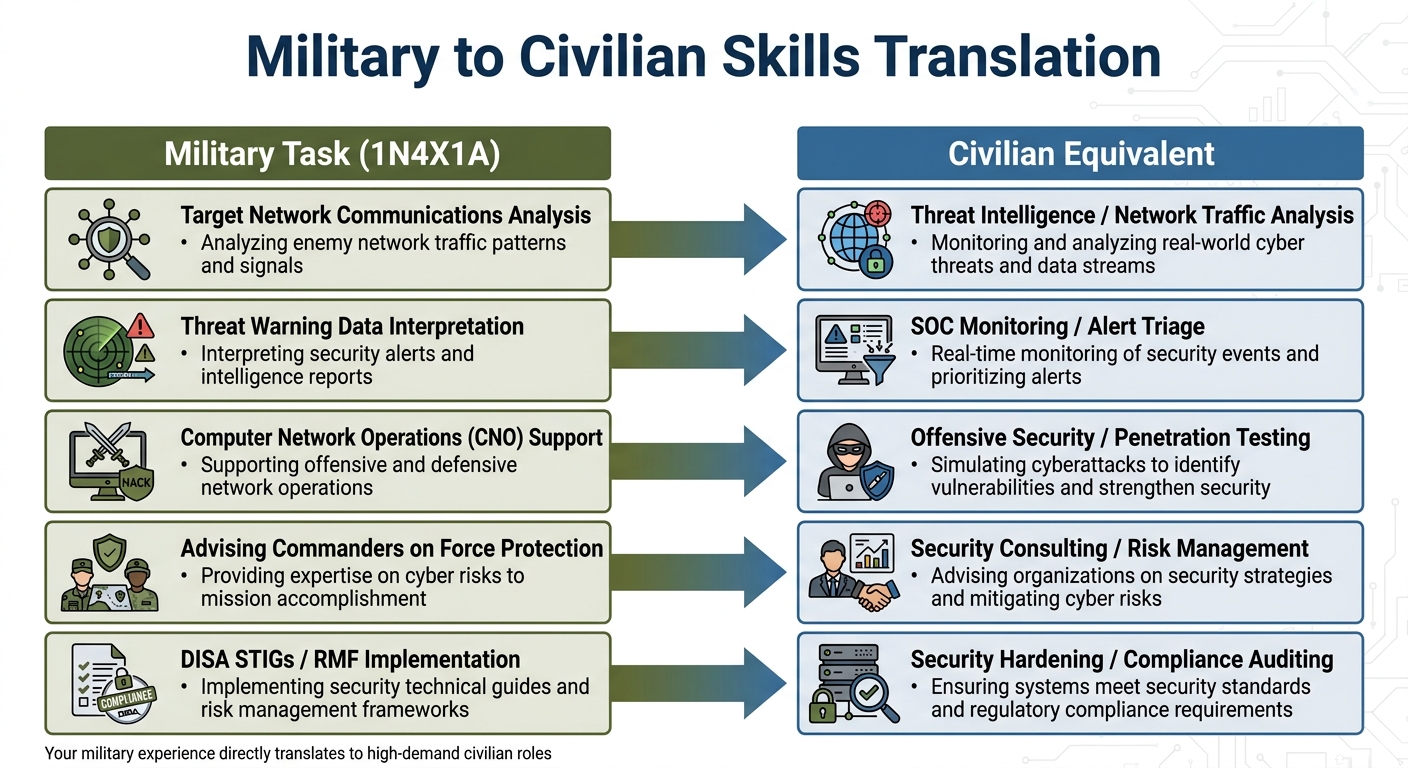
Military to Civilian Cybersecurity Skills Translation for 1N4X1A Analysts
Primary Duties and Skills
As a 1N4X1A Cyber Intel Fusion Analyst, your role revolves around secretly gathering and analyzing intelligence from target network communications to uncover adversaries’ actions and future plans [5][6]. You identify key threat indicators, support Computer Network Operations (CNO), and extract critical intelligence to aid decision-makers [5].
Your technical expertise spans several critical areas. This includes analyzing network traffic anomalies to detect advanced persistent threats, conducting vulnerability assessments with tools like Nessus, and ensuring systems meet DISA STIGs – security standards mandated by the Department of Defense. You also handle the triaging of security alerts and coordinate appropriate responses to mitigate threats. Additionally, you manage Priority Intelligence Requirements (PIRs) and collaborate with collection assets to address intelligence gaps [2][3].
The foundation for this role is built during 135 days of intensive technical training at Goodfellow Air Force Base, TX, or Corry Station, FL [5]. Training covers structured analytic techniques, recognizing analytic biases, and all-source fusion, which combines signals intelligence (SIGINT), human intelligence (HUMINT), and geospatial intelligence (GEOINT) to form a comprehensive understanding of adversarial activities [7][3]. You also gain hands-on experience with tools like Splunk, ArcSight, Wireshark, Nessus, Palantir, DCGS-A, Analyst Notebook, ArcGIS, and the MITRE ATT&CK framework [2][3].
This position requires a Top Secret clearance, granted after a Single Scope Background Investigation (SSBI) and a polygraph test [5]. Holding such a clearance makes you highly attractive to civilian employers, as you’ve already cleared one of the toughest hurdles for high-paying, security-cleared positions.
These technical skills and experiences directly prepare you for various civilian cybersecurity roles.
How Military Experience Matches Civilian Job Requirements
The skills you develop as a 1N4X1A align perfectly with many in-demand civilian cybersecurity roles. Your military background translates seamlessly into roles such as Threat Intelligence Analyst, SOC Analyst, Incident Responder, and Security Engineer [2]. While the terminology may differ, the tasks are fundamentally the same.
| Military Task (1N4X1A) | Civilian Equivalent Skill/Role |
|---|---|
| Target Network Communications Analysis | Threat Intelligence / Network Traffic Analysis |
| Threat Warning Data Interpretation | SOC Monitoring / Alert Triage |
| Computer Network Operations (CNO) Support | Offensive Security / Penetration Testing |
| Advising Commanders on Force Protection | Security Consulting / Risk Management |
| DISA STIGs / RMF Implementation | Security Hardening / Compliance Auditing |
Your expertise with the Risk Management Framework (RMF) is especially valuable in government contracting, where similar authorization processes are required [2]. Likewise, your experience with DISA STIGs aligns with the security hardening standards used by civilian organizations to protect their networks.
The high-pressure environment you’ve thrived in – defending against real-world national security threats – translates exceptionally well to civilian Security Operations Centers (SOCs). Working in these demanding, fast-paced conditions has honed your ability to make rapid, effective decisions, a quality highly sought after in SOCs [4]. As Brad Tachi puts it, you’re entering "a seller’s market", where multiple employers will compete for your skills [2].
Getting Ready for Civilian Cybersecurity Work
Certifications That Matter for Cleared Jobs
If you’re transitioning into civilian cybersecurity, CompTIA Security+ should be your starting point. At $400, it’s the baseline certification for most federal and defense contractor roles under the DOD 8140 framework. You’ll see it listed as a core requirement for nearly every cleared cybersecurity job, especially for IAT Level II positions.
Once you’ve secured Security+, your next steps depend on your career goals. For aspiring SOC analysts, the CompTIA CySA+ (Cybersecurity Analyst) certification is a logical next step, also priced at $400. If you’re staying in intelligence-focused roles, the GIAC Cyber Threat Intelligence (GCTI) certification will validate your analytical skills. On the other hand, if penetration testing piques your interest, consider the Offensive Security Certified Professional (OSCP). This challenging 24-hour hands-on exam costs $1,599+ and proves your ability to handle real-world scenarios.
For those aiming for senior roles, the CISSP remains the industry standard. At $699, it opens doors to positions in security architecture and management. Planning ahead is key – start preparing for certifications 12–18 months before leaving the military. Programs like the VA’s VET TEC can cover certification prep costs without affecting your GI Bill benefits. You can also access free training through the Federal Virtual Training Environment (FedVTE) or take advantage of the Onward to Opportunity (O2O) program, which offers free courses and exam vouchers for certifications like CompTIA, Cisco, and AWS.
| Target Civilian Role | Recommended Certifications |
|---|---|
| Threat Intelligence Analyst | Security+, GCTI, CEH |
| SOC Analyst | Security+, CySA+ |
| Penetration Tester | OSCP, CEH, GPEN |
| Security Manager/Director | CISSP, CISM |
| Cloud Security Engineer | CCSP, AWS Certified Security Specialty, Azure Security Engineer |
Once you’ve tackled certifications, the next step is adapting your military experience for civilian resumes.
Converting Military Experience to Civilian Resume Language
Your TS/SCI clearance is a valuable asset – place it prominently at the top of your resume in searchable text to ensure recruiters can find it.
When describing your experience, replace military ranks with civilian-friendly titles. For instance, instead of "Staff Sergeant", use "Operations Supervisor" and include specifics about your role, like "managed an 8-person team." Translate technical terms into language that resonates with civilian employers. For example, use "threat intelligence" instead of "signals analysis" or "vulnerability assessment" instead of "network characterization." Avoid acronyms like NCOIC, OCONUS, or FRAGO, as they might confuse hiring managers.
Structure your achievements using the CAR method (Challenge, Action, Result). For example, instead of simply stating, "Performed network analysis", say, "Triaged 200+ security alerts daily across a 15,000-node enterprise network, reducing mean time to detection by 40%." Quantify your results wherever possible – metrics like the number of users supported or downtime reductions can make your accomplishments stand out.
List tools and frameworks you’ve used that are relevant to civilian roles, such as Splunk, Wireshark, Nessus, MITRE ATT&CK, and NIST. Use the exact phrasing from job postings to ensure your resume passes applicant tracking systems. For instance, if a job requires "SIEM administration", use that term instead of alternatives like "security event monitoring."
"Military translation isn’t about making your qualifications legible to the people who decide whether you get an interview."
- Brad Tachi, CEO, Best Military Resume
With a polished resume, it’s time to focus on networking within the cleared community.
Connecting with the Cleared Community
Start building your LinkedIn profile 12–18 months before transitioning out of the military. Include keywords like "TS/SCI", "cleared", and "polygraph" in your headline and skills section since recruiters in the defense sector actively search for these terms. Use the "Open to Work" feature set to "Recruiters Only" to signal your availability discreetly.
Join VetSec, an online community for military veterans in cybersecurity. It offers private networking, mentorship, and salary insights from others who’ve successfully made the transition. Other organizations like the Information Systems Security Association (ISSA), local ISC² chapters, and the Military Cyber Professionals Association (MCPA) host networking events and provide job leads.
Take advantage of the DoD SkillBridge program in your final 180 days of service. This program allows you to gain experience with companies like Booz Allen Hamilton, Microsoft, or Lockheed Martin while still receiving military pay and benefits. Many SkillBridge participants secure job offers as a result of this experience. When actively job hunting, platforms like Cleared Cyber Security Jobs are invaluable for tailored job alerts, resume databases, and career resources specifically for cleared professionals.
Finding and Landing Cleared Cybersecurity Jobs
With your military background and targeted certifications, you’re in a strong position to secure and negotiate roles in cleared cybersecurity. Here’s how to make it happen.
Managing Your Security Clearance During Transition
When you separate from the military, your security clearance becomes inactive, but you have a 24-month window to have it reinstated by a new employer without needing a full investigation [9][10]. To reactivate it, you’ll need a sponsoring employer, such as a defense contractor or federal agency [9][11]. Within the two-year period, reinstatement typically takes a few weeks. Beyond that, a new investigation can take anywhere from 6 to 18 months [9][10].
"The 24-month window is your biggest advantage as a separating veteran. A cleared position that would take a new applicant 6-18 months to fill… can be filled by you in a matter of weeks." – Brad Tachi, CEO, Best Military Resume [9]
Joining a reserve unit that requires clearance can also help keep it active [9]. Employers use the Defense Information System for Security (DISS) to check your clearance status, and Facility Security Officers (FSOs) verify investigation dates and levels [8][10]. If you were enrolled in Continuous Evaluation before leaving the military, ask the FSO at your prospective employer if this can speed up reinstatement.
When crafting your resume, clearly state your clearance status. For example, use phrases like "Active TS/SCI Clearance – Current" or "Current TS/SCI, eligible for reinstatement." Avoid including sensitive details such as SCI compartments, codewords, or classified program names.
Once your clearance is in order, focus on identifying employers who value your expertise.
Identifying Employers Who Hire Cleared Professionals
Defense contractors are often the go-to employers for 1N4X1A analysts, offering some of the best entry-level pay. Companies like Booz Allen Hamilton, Leidos, SAIC, Peraton, ManTech, Raytheon, and Northrop Grumman actively recruit military intelligence professionals for roles in threat intelligence, SOC operations, and security analysis [12].
Large tech companies also seek veterans for their cybersecurity teams. Employers such as Amazon (AWS), Microsoft, Google, CrowdStrike, and Palo Alto Networks hire for roles in cloud security, incident response, and threat hunting. Many also offer SkillBridge internships tailored to transitioning service members [1][2]. Financial institutions like JPMorgan Chase, Bank of America, and Goldman Sachs often hire cleared professionals to address complex cybersecurity challenges and adhere to strict regulatory standards, often at premium salaries [2]. Federal agencies such as NSA, CISA, FBI Cyber Division, DIA, and USCYBERCOM also offer positions ranging from GS-12 to GS-15, where veterans’ preference can give you a competitive edge [2].
For job alerts and access to a specialized resume database, platforms like Cleared Cyber Security Jobs connect you directly to employers who understand the value of your military background. Networking with fellow veterans working in defense contracting can help you bypass applicant tracking systems. Additionally, building relationships with FSOs at your target companies is essential for ensuring a smooth clearance reinstatement process [10][12].
"The cyber veterans I’ve seen transition most successfully are the ones who don’t settle for the first SOC analyst job offered to them. Your military experience puts you above entry-level – don’t let impostor syndrome push you into a role that’s two tiers below your actual capability." – Brad Tachi, CEO and Founder, Best Military Resume [2]
Once you’ve identified potential employers, understanding the salary landscape will help you make informed decisions about your career path.
What Cleared Cybersecurity Professionals Earn
The demand for cleared cybersecurity professionals far exceeds the supply, which means a TS/SCI clearance can add $30,000 to $45,000 to your annual salary compared to non-cleared roles [13]. If you hold a Full Scope Polygraph, that premium can rise to $45,000 to $65,000 [13]. As of October 2025, the average salary for a TS/SCI-cleared professional in the DC metro area was $149,398 [13].
For 1N4X1A analysts with more than four years of operational experience, aim for mid-level or senior roles starting at $110,000 or higher, rather than settling for entry-level SOC positions [2]. Here’s a breakdown of typical salaries:
- Threat Intelligence Analysts: $105,000 to $140,000 for 3–7 years of experience; $140,000 to $180,000 for senior roles (8+ years)
- SOC Analysts: $95,000 to $125,000 mid-career (Tier 2/3); $125,000 to $155,000 for senior-level positions
- Security Engineers: $110,000 to $150,000 mid-level; $150,000 to $200,000 for senior roles [13]
Location also impacts pay. While the DC metro area offers the highest nominal salaries, cities like San Antonio and Huntsville often provide better overall value due to lower living costs [13]. If you’re switching contractors, consider the "20% Rule" – request 15% to 20% more than your current salary to account for clearance transfer costs and delays [13]. Signing bonuses for TS/SCI hires typically range from $5,000 to $20,000, with higher bonuses for Full Scope Polygraph roles [13].
Federal positions, such as a GS-14 Step 5 role in DC, offer a base salary of $163,104. Combined with an estimated FERS pension of roughly $24,000 annually, total compensation can rival or even surpass contractor salaries at around $221,000 [13]. Certifications can further boost your earnings: a CISSP might add $15,000 to $25,000 to your salary, while a CompTIA Security+ could provide an additional $5,000 to $10,000 as a baseline DoD 8140 requirement [13][1].
"Your security clearance is one of the most valuable lines on your resume. Put it at the top, format it correctly, and leverage it in salary negotiations. A TS/SCI clearance adds $15,000-$30,000 to most technical positions." – Brad Tachi, CEO, Best Military Resume [8]
Next Steps for Your Career Transition
Now that you’ve laid the groundwork with preparation and certification strategies, it’s time to focus on actionable steps to land a civilian cybersecurity role.
The timing couldn’t be better. The demand for information security analysts is expected to grow by 33% through 2033, with roughly 17,300 new positions opening each year [4]. Your TS/SCI clearance and 1N4X1A experience make you a strong candidate in this thriving field.
Start Early: Ideally, begin your transition 12 to 18 months before separation. Use this time to earn key certifications like CompTIA Security+ (costing around $392) [1]. Also, build a LinkedIn profile that translates your military experience into language that resonates with civilian employers.
6 to 12 Months Out: Apply for SkillBridge internships with defense contractors or tech companies. These internships offer hands-on experience and networking opportunities with cybersecurity professionals, especially those with active clearances [2].
3 to 6 Months Before Separation: Focus on crafting a resume that highlights your skills and achievements. Quantify your analytical contributions, list technical systems you’ve worked with (such as Palantir, Splunk, or Wireshark) [3], and prominently display your clearance level in your resume header. Additionally, explore the VA’s VET TEC program, which provides funding for cybersecurity training without impacting your GI Bill benefits [4].
Understand Clearance Timelines: Your clearance is a valuable asset, but it has a limited shelf life. Employers can reinstate your clearance within 24 months of separation without a full investigation. After that, reinstatement requires a new investigation, which can take 6 to 18 months and cost between $5,000 and $15,000 [2]. Acting quickly can save you and potential employers a lot of time and expense.
Aim Higher: If you have substantial operational experience, don’t settle for entry-level roles. Your military background positions you for mid-level roles in areas like threat intelligence or as a security analyst. Platforms like Cleared Cyber Security Jobs can help you find opportunities tailored to candidates with military experience and active clearances.
FAQs
Which civilian cyber roles fit 1N4X1A experience best?
Civilian careers that align with the experience of a 1N4X1A Fusion Analyst include roles such as Threat Intelligence Analyst, Cybersecurity Analyst, SOC Analyst, and Cyber Operations Specialist. These positions draw on critical skills like analyzing adversary behavior, creating actionable intelligence, and handling classified information. Familiarity with frameworks like MITRE ATT&CK and the ability to synthesize intelligence for strategic decision-making are directly applicable to cybersecurity operations and network defense in the civilian sector.
How do I keep my TS/SCI from expiring after separation?
Your TS/SCI clearance stays active and eligible for reinstatement for up to 2 years after you leave the military. To keep it from expiring, you’ll need to either secure a job with a sponsoring employer or take steps to reinstate it within this period. If it lapses, you’ll have to go through a completely new investigation to regain clearance. Be proactive – connect with potential employers or sponsors well before the 24-month window closes.
What’s the fastest certification path for cleared jobs?
Getting into cybersecurity quickly often means earning certifications that showcase your technical expertise and security clearance. For those starting out, CompTIA Security+ is a great option for entry-level positions and is often attainable in a short time – especially for veterans. If you’re aiming for higher-level roles, certifications like CISSP (Certified Information Systems Security Professional) or GCTI (GIAC Cyber Threat Intelligence) carry significant weight and can open doors to lucrative opportunities. These credentials help bridge your military background with the civilian cybersecurity world, making the transition smoother and more rewarding.