• Skip to primary navigation
  • Skip to main content
Cleared Cyber Security Jobs | CyberSecJobs.com

Cleared Cyber Security Jobs | CyberSecJobs.com

Cleared Cyber Security Jobs

  • Home
  • Search Cleared Cyber Jobs
  • Job Fairs
  • Career Resources

Career Paths

CISO Career Path for Cleared Chief Information Security Officers

CyberSecJobs Editorial · March 15, 2026 ·

The journey to becoming a cleared Chief Information Security Officer (CISO) blends technical expertise, leadership skills, and security clearance. This role is critical for safeguarding classified systems in government and defense sectors. Here’s what you need to know:

  • Demand and Growth: Cybersecurity roles are expected to grow by 29% from 2024 to 2034, with a significant shortage of professionals, especially at the executive level.
  • What Cleared CISOs Do: They secure classified information, comply with federal standards like NIST and DoD directives, and lead cybersecurity strategies for sensitive government operations.
  • Security Clearance: A must-have for accessing classified data, with new real-time vetting systems introduced under Trusted Workforce 2.0.
  • Education and Experience: A bachelor’s in Cybersecurity or related fields is essential, with advanced degrees (e.g., MS, MBA) being highly valued. The path typically spans 10–15 years, starting from entry-level roles like SOC Analyst or System Administrator.
  • Certifications: Key certifications include CISSP, CISM, and CCISO, which are often mandatory under DoD Directive 8140.
  • Skills: Mastery of frameworks like NIST 800-171 and Zero Trust principles is crucial, alongside strong communication for translating technical risks into business terms.

This career path offers salaries ranging from $180,000 to $280,000, with top roles exceeding $350,000 annually. Success hinges on a mix of technical knowledge, executive leadership, and continuous learning.
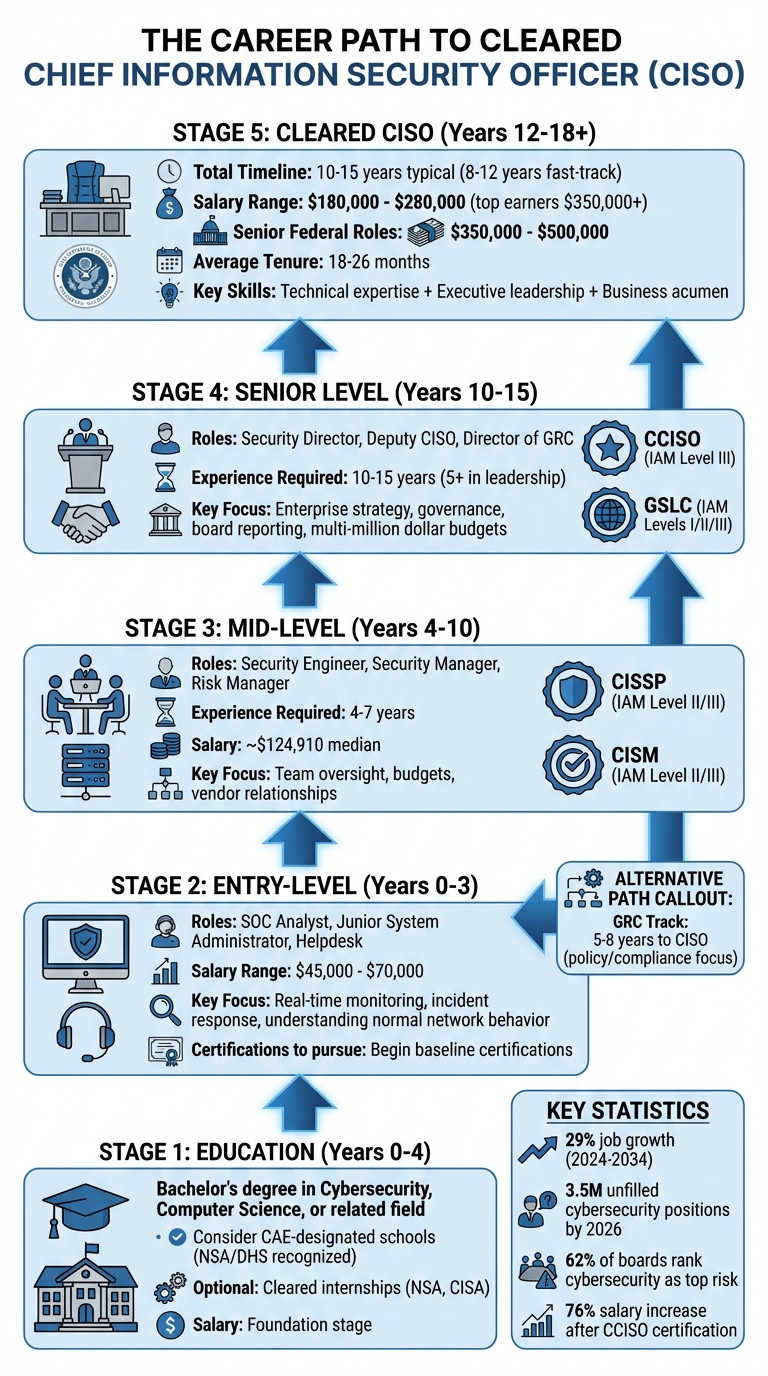
Career Path Timeline to Cleared CISO Position

Career Path Timeline to Cleared CISO Position

Education and Early Career Requirements

Degrees and Educational Paths

For most Chief Information Security Officer (CISO) roles, a bachelor’s degree in Cybersecurity, Computer Science, or a related field is the starting point [2][5]. Ideal undergraduate majors include Cybersecurity, IT, Information Assurance, Computer Engineering, or Computer Forensics. If you’re aiming for cleared roles, earning your degree from a school recognized as a Center of Academic Excellence (CAE) in Cyber Defense by the NSA and DHS can give you an edge [5].

Advanced degrees such as an MS in Cybersecurity or an MBA with a focus on Information Security can reduce the amount of experience required and show you’re ready for executive responsibilities [2][4]. With the increasing need for CISOs to bridge the gap between security and business, many boards favor candidates who possess not just technical expertise but also business acumen. This has led to a rise in professionals with MBAs or Business Administration degrees [1][4]. Modern programs now include topics like AI governance, predictive risk modeling, and automated auditing, ensuring leaders are equipped to handle evolving threats [1].

"No amount of formal education could ever replace real-world experience, hard work, and living a life. Education is obviously important, but it is not what separates the good from the great." – Steve Tcherchian, CISO, XYPRO [2]

For those aiming for cleared CISO positions, participating in cleared internship programs at organizations like the NSA or CISA is a smart move. These internships provide hands-on experience while also initiating the clearance process [2]. A solid educational background paired with practical experience is key to launching a cybersecurity career.

Entry-Level Cybersecurity Roles

Once you’ve got the academic credentials, entry-level roles are where you’ll gain the hands-on experience needed to climb the cybersecurity ladder. Typically, it takes about 12 to 18 years to go from an entry-level analyst to a CISO, although it’s possible to achieve this in 8 to 12 years on a fast track [3]. Salaries for entry-level security analyst positions generally range from $45,000 to $70,000 [3].

Some foundational roles to consider include:

  • SOC Analyst: Focuses on real-time monitoring, incident response, and threat intelligence.
  • Helpdesk or Service Desk Administrator: Builds troubleshooting skills that can transition into system administration.
  • Junior System Administrator: Manages infrastructure, account creation, and system configurations.
  • Technical Writer: Creates documentation while gaining exposure to security concepts [6][7][8].

These roles are critical because they help you understand what "normal" network behavior looks like. This knowledge is essential for spotting anomalies that could signal potential threats later in your career [8].

If you’re a veteran with an existing clearance, government contracting roles are a natural fit, as obtaining a clearance as a civilian can be expensive [7]. For those without a clearance, starting in Public Trust positions can pave the way toward full clearance [7]. These early roles not only provide operational knowledge but also lay the groundwork for the strategic thinking required to protect assets and eventually lead at the executive level.

sbb-itb-bf7aa6b

Required Certifications for Cleared CISOs

Top Certifications for Cleared Professionals

If you’re pursuing a cleared Chief Information Security Officer (CISO) role, certifications aren’t just helpful – they’re mandatory. Under DoD Directive 8140, you can’t legally perform cybersecurity or information assurance work on Department of Defense (DoD) contracts without the appropriate certifications [9].

The CISSP (Certified Information Systems Security Professional) is widely regarded as the gold standard for senior-level technical and management roles. It checks the box for IAM Level II/III and IASAE requirements under DoD 8140. Beyond DoD compliance, it aligns with federal standards like FISMA and the NIST Risk Management Framework, making it a top choice for cleared professionals [10]. For those focusing on policy, compliance, and team oversight, the CISM (Certified Information Security Manager) is an excellent fit, particularly for Information Assurance Management roles [14].

At the executive level, the CCISO (Certified Chief Information Security Officer) is designed to prepare professionals for governance, financial oversight, and boardroom communication. The latest CCISO curriculum (v4) even addresses modern challenges like AI-driven governance and predictive budgeting. Training programs for CCISO certification can enhance executive skill sets, and achieving this certification has been shown to increase salaries by an average of 76% [1].

Other certifications worth considering include:

  • GSLC (GIAC Security Leadership Certification): Approved for all three IAM levels under DoD 8570/8140, this certification is ideal for leadership roles.
  • CISA (Certified Information Systems Auditor): A strong option for professionals focusing on audit and compliance tracks [14].
  • CASP+ (now rebranded as SecurityX): Required for architecture and engineering roles within the IASAE category [9].

New hires in cleared positions typically have just 180 days to obtain the required baseline certification, or they risk losing their role [13].

Certification Primary Focus DoD 8140 Level Experience Required Renewal Period
CISSP Technical Security & Architecture IAM Level II/III, IAT Level III 5 years (in 2 of 8 domains) 3 years (120 CPEs)
CCISO Executive Leadership & Business Strategy IAM Level III, Program Manager 5 years (in 3 of 5 domains) Annual (US$100 fee)
CISM Information Security Management IAM Level II/III 5 years (in CISM domains) 3 years (120 CPEs)
GSLC Security Leadership IAM Levels I/II/III Varies 4 years (36 CPEs)

These certifications are stepping stones toward a cleared CISO role. Choosing the right one depends on your career goals and the path you want to take within the cybersecurity landscape.

How to Choose the Right Certification

The certification you pursue should align with both your current role and your long-term career ambitions. If you’re aiming for a cleared CISO position, focus on certifications that meet IAM Level III requirements, such as CISSP, CISM, GSLC, or CCISO. Use the DoD 8570/8140 framework to identify which certifications are required for your desired roles.

"Clearances and certifications serve different purposes: clearances verify trustworthiness to access classified information while certifications verify technical competence."
– Morgan Reyes, Cybersecurity Consultant [10]

If you’re in a technical role and looking to move into architecture, certifications like CISSP or CASP+ can help bridge that gap. For those already in management and preparing for C-suite responsibilities, the CCISO certification is a logical next step, with its focus on finance, strategic planning, and vendor management.

When preparing for demanding certification exams, aim for practice test scores in the 90th percentile before taking the official exam [12]. Keep in mind that some cleared employers may conduct their own technical evaluations, so practical skills are just as important as the certification itself. Additionally, staying on top of continuing education is crucial – both CISSP and CISM require 120 CPEs every three years for renewal [11].

With federal CISO roles, such as those at the GS-15 or SES levels, offering salaries from $150,000 to over $200,000, investing in the right certifications is a smart financial and professional decision [10].

Technical and Leadership Skills Development

Core Technical Skills

For cleared CISOs, mastering frameworks like NIST SP 800-171, NIST SP 800-172, CMMC 2.0 (Levels 1–3), FISMA, and DFARS 252.204-7012 is a must [22,24]. A deep understanding of how to identify and counter Advanced Persistent Threats (APTs) from nation-state actors – including those from China, Russia, Iran, and North Korea – is equally critical.

With the growing emphasis on Zero Trust Architecture, CISOs must focus on strict identity verification, least privilege principles, and micro-segmentation. Advanced Identity and Access Management (IAM) skills, such as implementing MFA, RBAC, and PAM, are essential. Additionally, they oversee 24/7 Security Operations Centers that leverage tools like SIEM, EDR/XDR, and AI-powered threat hunting. These capabilities ensure informed risk management while maintaining compliance and audit readiness.

A practical first step is conducting a gap analysis of the 110 NIST 800-171 controls to prepare for CMMC 2.0 certification. Using User and Entity Behavior Analytics (UEBA) can help detect unusual insider activity tied to APTs. Cleared CISOs are also responsible for managing DFARS’ 72-hour incident reporting requirement and ensuring subcontractors comply with CMMC 2.0. While technical expertise is the foundation, effective leadership ensures security initiatives align with the organization’s business goals.

Leadership and Communication Skills

To complement their technical expertise, cleared CISOs need strong leadership and communication skills to drive cybersecurity strategies at the executive level. The role has shifted from being purely technical to one that requires a strategic, business-focused approach.

"The CISO role has become a pivotal figure in the modern corporate landscape, tasked with providing a strategic vision for the organization’s cybersecurity enterprise" [15].

This shift means CISOs now spend about 35–40% of their time in meetings and managing stakeholders, with another 20–25% dedicated to strategy and planning [17]. The ability to translate technical risks into business language is crucial for success in these settings.

"CISOs act as trusted advisers, using data to help their organization become more agile in the marketplace and make wise business decisions without unnecessary risks" [16].

Frameworks like FAIR (Factor Analysis of Information Risk) help CISOs quantify vulnerabilities in terms of financial impact. With the average data breach costing approximately $4.45 million and global cybercrime expected to hit $10.5 trillion annually by 2025 [15], board members must grasp the monetary risks tied to cybersecurity.

Board simulations are a valuable tool for honing concise communication skills while fostering collaboration with teams like Legal, HR, Finance, and IT. It’s worth noting that 61% of CISOs focus on improving metrics and KPIs to better articulate risks to stakeholders [18]. Scheduling career-oriented one-on-one meetings and implementing mentorship programs can also help retain talent and institutional knowledge.

Additionally, building an executive presence through speaking at conferences like RSA or publishing thought leadership articles can boost a CISO’s visibility within the cybersecurity community. By combining technical expertise with leadership and communication skills, cleared CISOs can effectively bridge the gap between cybersecurity and business strategy – key steps toward a thriving career in this field.

Career Path to Cleared CISO

Mid-Level Roles

Becoming a cleared Chief Information Security Officer (CISO) is a long-term career journey, often taking 12–18 years, though some achieve it in as little as 8–12 years [3]. After starting out in foundational roles like security analyst, professionals gradually transition from technical tasks to overseeing teams, budgets, and vendor relationships.

Security Engineers focus on designing and implementing security measures, prioritizing threat mitigation and system hardening. This role usually requires 4 to 7 years of experience and involves mastering security tools while beginning to think strategically on an enterprise level [9, 12]. On the other hand, Security Managers and Risk Managers take on broader responsibilities, such as managing small teams and coordinating across departments. These roles, typically requiring 7 to 10 years of experience, represent a shift from being an individual contributor to stepping into leadership [9, 31].

Certifications like CISM (Certified Information Security Manager) can help professionals make this leap [19]. With information security analysts earning a median salary of roughly $124,910, these mid-level roles are both rewarding and crucial stepping stones [10, 31]. They prepare individuals for the more strategic and complex challenges of senior leadership.

Senior Roles and Transition to CISO

The final stages before reaching a CISO role often involve senior positions like Security Director or Deputy CISO. These roles typically require 10–15 years of experience, including at least 5 years in leadership, and focus on enterprise-wide strategy, governance, and reporting at the board level [9, 10]. At this stage, professionals are tasked with managing multi-million-dollar budgets, leading cross-departmental incident responses, and crafting long-term security plans [10, 27].

"A Chief Information Security Officer is not just a security expert; they are a business leader responsible for aligning cybersecurity strategy with organizational goals."

  • Safwan Azeem, Author, ACSMI [4]

In the U.S., CISOs earn between $180,000 and $280,000 annually, with some top earners surpassing $350,000 [4]. However, the role comes with its challenges, as the average tenure of a CISO is relatively short, ranging from 18 months to 4 years [27, 31].

For those with a background in strategy and compliance, an alternative pathway exists. The GRC (Governance, Risk, and Compliance) track allows professionals to prioritize policy and risk management over technical depth. Roles like Director of GRC or VP of Risk and Security can lead to a CISO position in just 5 to 8 years, provided the individual has strong business acumen [27, 31]. With an estimated 3.5 million unfilled cybersecurity positions projected globally by 2026, cleared professionals who bring together technical expertise, leadership, and business insight are increasingly sought after [12, 31].

The Essential Guide to Becoming a CISO

Using Cleared Job Platforms

These platforms can help transform your technical and leadership skills into real career opportunities.

Using Cleared Cyber Security Jobs Effectively
Cleared Cyber Security Jobs

Cleared Cyber Security Jobs provides tailored features for professionals aiming for roles like Chief Information Security Officer (CISO). Employers initially see key details such as your Key Skills and Ideal Work Locations before viewing your full resume. That makes it crucial to keep your profile complete and up-to-date. Regularly logging in and updating your "last activity" date ensures you remain visible to recruiters.

When searching for positions, select all clearance levels you hold (e.g., if you have TS, also select Secret) to broaden your options. Instead of searching by city names, use zip code radius searches to pinpoint opportunities near military bases or specific facilities. Setting up automated alerts with keywords like CISO or Chief Information Security Officer ensures you’re among the first to know about new listings. Additionally, privacy tools allow you to block specific employers or browse anonymously while still showcasing your skills [20].

"Use ClearedJobs.Net as a research tool to mine data from tens of thousands of jobs and hundreds of cleared facilities employers. Determine which skills are in demand, see what kind of jobs match your experience, and identify hiring trends."

  • Ashley Jones, Blog Editor and Cleared Job Search Expert, ClearedJobs.Net [20]

These strategies for using job platforms work hand-in-hand with networking techniques, which are just as important.

Networking and Professional Development

Cleared platforms also open doors to networking through career fairs and educational resources. Attending Cleared Job Fairs can help you secure referrals, which often play a key role in landing a job [23]. Combine these online tools with in-person events like RSA, Black Hat, and BSides. Even casual "HallwayCon" conversations at these events can lead to meaningful connections [21].

After meeting someone at a conference or fair, follow up with a short email to maintain the relationship. You might also consider requesting informational interviews to build rapport long before a position becomes available [21][22].

In addition, many cleared platforms offer career development resources like the Security Cleared Jobs: Who’s Hiring & How podcast, webinars, and guides on topics like salary negotiations and interview prep. These tools can help you stay informed about industry trends and better prepare for your path to a CISO role [23].

Conclusion

Climbing the ladder from technical roles to a strategic CISO position requires a mix of persistence, skill-building, and networking. Achieving a cleared CISO role typically takes 10 to 15 years of progressive experience, blending deep technical expertise with a strong grasp of executive-level strategy. The role has shifted dramatically, evolving from a purely technical focus to one of strategic business leadership. This transformation is underscored by the fact that 62% of boards now rank cybersecurity as their top risk [1]. To succeed, you must bridge the gap between technical vulnerabilities and their business implications – something only 12% of current CISOs have formally developed [1].

While technical skills lay the groundwork, successful CISOs also bolster their qualifications with certifications that demonstrate readiness for executive responsibilities. Start with foundational industry certifications and aim for leadership roles – such as Security Director or Manager – for at least five years before targeting a CISO position [24][4]. Advanced education, like an MBA or executive training, can also be invaluable, especially when learning to present cybersecurity risks in financial terms – a vital skill for boardroom discussions [17].

Given that many CISO roles are filled through executive searches, networking is just as critical as skill-building. Engage with recruiters and current CISOs early, and use platforms like Cleared Cyber Security Jobs to stay visible and informed about hiring trends in the cleared space [17].

The financial rewards reflect the weight of these responsibilities, with senior CISO salaries ranging between $350,000 and $500,000 [17]. Additionally, 76% of professionals report salary increases after earning the CCISO credential [1]. However, the role comes with challenges, including an average tenure of just 18 to 26 months [1]. To stay competitive, focus on continuous learning, whether through professional development, publishing thought leadership articles, or speaking at industry events.

Becoming a cleared CISO is a long-term commitment. By combining technical expertise, business acumen, and executive presence, you can prepare yourself for one of the most impactful roles in cybersecurity. Stay ahead of emerging challenges – like AI-driven threats – and remain intentional about every step of your career path.

FAQs

How do I get a security clearance to pursue a cleared CISO role?

To land a cleared CISO role, you’ll need to secure a security clearance, which can only happen through sponsorship by an employer or a government agency. This isn’t something you can apply for on your own – your sponsor takes the lead in initiating the process.

The clearance process involves a thorough background investigation. This includes a deep dive into your finances, criminal history, and personal conduct. Investigators will conduct interviews, verify the details you provide, and perform extensive background checks. Be prepared for this process to take time – anywhere from several months to a year.

Which certification should I earn first for DoD 8140 cleared jobs?

To kick off your journey, focus on earning a DoD 8140-compliant certification that aligns with your specific role. If you’re aiming for advanced leadership positions, the CISSP is often regarded as a top choice. Additionally, there are several other certifications recognized across the industry that can help you meet the qualifications for cleared DoD roles. The key is to select a certification that fits your career stage and aligns with the job requirements you’re targeting.

What’s the fastest path from technical roles to a cleared CISO?

To quickly step into a cleared CISO role, you’ll need a mix of broad technical expertise, strong leadership abilities, and industry-recognized certifications like CISSP or CISM. Start by working in foundational IT positions, such as a support engineer, to build a solid understanding of systems and networks. From there, transition into security-focused roles like a Security Analyst to gain hands-on experience in protecting systems and managing risks.

As you progress, shift your focus toward management roles. This is where leadership, strategic thinking, and effective communication become essential. Along the way, make it a priority to develop both your technical knowledge and business skills. This combination of expertise will prepare you to take on senior-level responsibilities and excel as a CISO.
Related Blog Posts

  • CIO-SP3 Cybersecurity Positions vs DISA Encore III – Which Vehicle Drives Your Career?
  • Cisco CCIE Security Career Guide for Cleared Expert Engineers
  • Threat Intelligence Analyst Career Path for Cleared Professionals
  • ISSM Career Path for Cleared Information Security Managers

Related Guides

  • Security Auditor Career Path for Cleared Professionals
  • Risk Analyst Career Path for Cleared Cyber Professionals
  • GRC Analyst Career Path for Cleared Compliance Professionals
  • TS/SCI Salary Premium: Real 2026 Numbers
  • Security Clearance Interview: What to Expect

ISSM Career Path for Cleared Information Security Managers

CyberSecJobs Editorial · March 15, 2026 ·

Information System Security Managers (ISSMs) are vital for safeguarding classified systems in government and defense sectors. They ensure compliance with strict cybersecurity standards, manage Authorization to Operate (ATO) processes, and act as liaisons between organizations and federal agencies like the Defense Counterintelligence and Security Agency (DCSA). Here’s what you need to know:

  • Role Overview: ISSMs oversee cybersecurity programs, maintain audit-ready systems, and resolve vulnerabilities using tools like Splunk, ACAS, and Nessus.
  • Qualifications: U.S. citizenship, an active Top Secret clearance, and certifications like CISSP, CISM, or GSLC are required. A bachelor’s degree and 5–12 years of experience are typical.
  • Career Progression: Start as an ISSO, gain RMF expertise, and advance to senior ISSM roles. Salaries range from $101,000 to $203,000 annually, depending on experience and location.
  • Challenges: Maintaining a security clearance requires financial responsibility and adherence to federal laws. Continuous Evaluation (CE) ensures real-time monitoring of clearance holders.
  • Future Outlook: With cybersecurity jobs projected to grow by 33% over the next decade, ISSMs are in high demand, offering lucrative and fulfilling career opportunities.

This guide breaks down the ISSM career path, including required skills, certifications, and strategies for long-term success.

ISSO vs ISSM and what to do after ISSO work

sbb-itb-bf7aa6b

Core Responsibilities of an ISSM in Cleared Environments

An ISSM’s role revolves around safeguarding classified systems through meticulous documentation, ongoing monitoring, and serving as a bridge between technical security teams and officials responsible for granting an Authorization to Operate (ATO). Their work ensures sensitive information remains secure. Here’s a closer look at some of their key responsibilities.

Implementing RMF and Managing ATO Processes

One of the ISSM’s primary tasks is applying the Risk Management Framework (RMF) outlined in NIST Special Publication 800-37. This structured six-step process – Categorize, Select, Implement, Assess, Authorize, and Monitor – guides how classified systems are secured [5].

During the Categorize phase, ISSMs work closely with system architects to define system boundaries and assign impact levels (Low, Moderate, or High) based on FIPS 199 and NIST 800-60. This ensures resources are allocated appropriately [5]. After categorizing, ISSMs customize security controls from the NIST 800-53 catalog to align with the system’s risk level. They coordinate with assessors to evaluate the effectiveness of these controls and brief the Authorizing Official on any remaining risks to secure an ATO. Additionally, they translate technical vulnerabilities into risk assessments, enabling senior leaders to make informed decisions [5]. By doing so, ISSMs maintain a robust security posture, ensuring risks are managed and controls remain effective.

Ensuring Compliance with DoD and NIST Standards

Compliance is a core part of an ISSM’s responsibilities. They manage essential RMF documentation, including the System Security Plan (SSP), Security Assessment Report (SAR), and Plans of Action and Milestones (POA&M). The POA&M is particularly important, as it tracks security weaknesses and outlines corrective actions until issues are resolved [5].

To maintain audit readiness, ISSMs compile evidence like configuration screenshots, access logs, and scan results, often using systems like eMASS [5]. They also conduct regular reviews of system configurations to ensure they align with NIST 800-53 controls and Department of Defense (DoD) guidelines. This continuous effort helps organizations adapt to evolving technologies and threats, reinforcing system security [5].

Managing Classified Systems Security

In addition to documentation, ISSMs actively monitor classified systems to address vulnerabilities before they become critical. This includes tracking patch deployments, reviewing logs, and coordinating incident response efforts. By staying vigilant, ISSMs ensure systems remain compliant between formal assessments, providing consistent protection for classified information.

Required Qualifications and Certifications for Cleared ISSMs

Stepping into the ISSM field requires meeting specific qualifications and certifications. Below, you’ll find the key requirements, certifications, and experience necessary to build a successful career as a cleared ISSM.

Basic Requirements for ISSMs

To qualify for cleared ISSM roles, U.S. citizenship is mandatory. Additionally, an active Top Secret or TS/SCI clearance is required. As of early 2026, the processing time for a Top Secret (Tier 5) clearance typically ranges from 120 to 240 days. However, an Interim Secret clearance may be granted in as little as 10 to 30 days, depending on initial fingerprint and background checks [6].

Most roles require a bachelor’s degree in fields like cybersecurity, computer science, or engineering. That said, some federal contracting environments allow for substitutions. For instance, holding a master’s degree can reduce the required work experience from 8 years to 5 years [1]. Before applying to a cleared position, it’s important to address any potential credit issues, as financial concerns are a common reason for clearance denial [6].

Required Certifications: CISSP, CISM, and GSLC

CISSP

Beyond meeting the basic criteria, obtaining key certifications is essential. ISSM roles require an IAM Level III certification, and the most recognized options include:

  • CISSP (Certified Information Systems Security Professional)
  • CISM (Certified Information Security Manager)
  • GSLC (GIAC Security Leadership Certification)

These certifications demonstrate expertise in implementing the Risk Management Framework, ensuring compliance with NIST 800-37/53, managing Authorization to Operate (ATO) processes, and advising leadership on cybersecurity risks. While some entry-level positions accept IAM Level II certifications, most competitive and higher-paying roles prioritize candidates with IAM Level III certification [1].

Experience and Skills Needed

Experience requirements vary from 5 to 12 years, depending on the level of the position. For mid-level ISSM roles, at least 5 years of experience in DoD/IC Cybersecurity is typically required, while senior-level roles may demand 8 to 12 years or more [1].

Practical expertise with key security tools is critical, including:

  • ACAS/Nessus for vulnerability scanning
  • SCAP for compliance checks
  • STIG Viewer for system hardening
  • SIEM platforms like Splunk for log analysis [1]

Core responsibilities often include conducting risk assessments, managing vulnerability scanning programs, and ensuring compliance with NIST 800-53 controls. A growing emphasis is placed on understanding modern security frameworks, such as Zero Trust architectures, Identity Access Management (IAM), and DevSecOps pipelines [1].

Leadership and communication skills are equally important. ISSMs not only guide ISSO teams but also act as the primary liaison with agencies like the Defense Counterintelligence and Security Agency (DCSA). These roles require the ability to mentor team members and effectively communicate complex cybersecurity concepts to senior leadership [1].

Salaries for cleared ISSM positions reflect this blend of technical expertise and leadership. Depending on experience and location, roles can range from $101,000 to $203,000 annually [1].

Career Progression Path for Cleared ISSMs

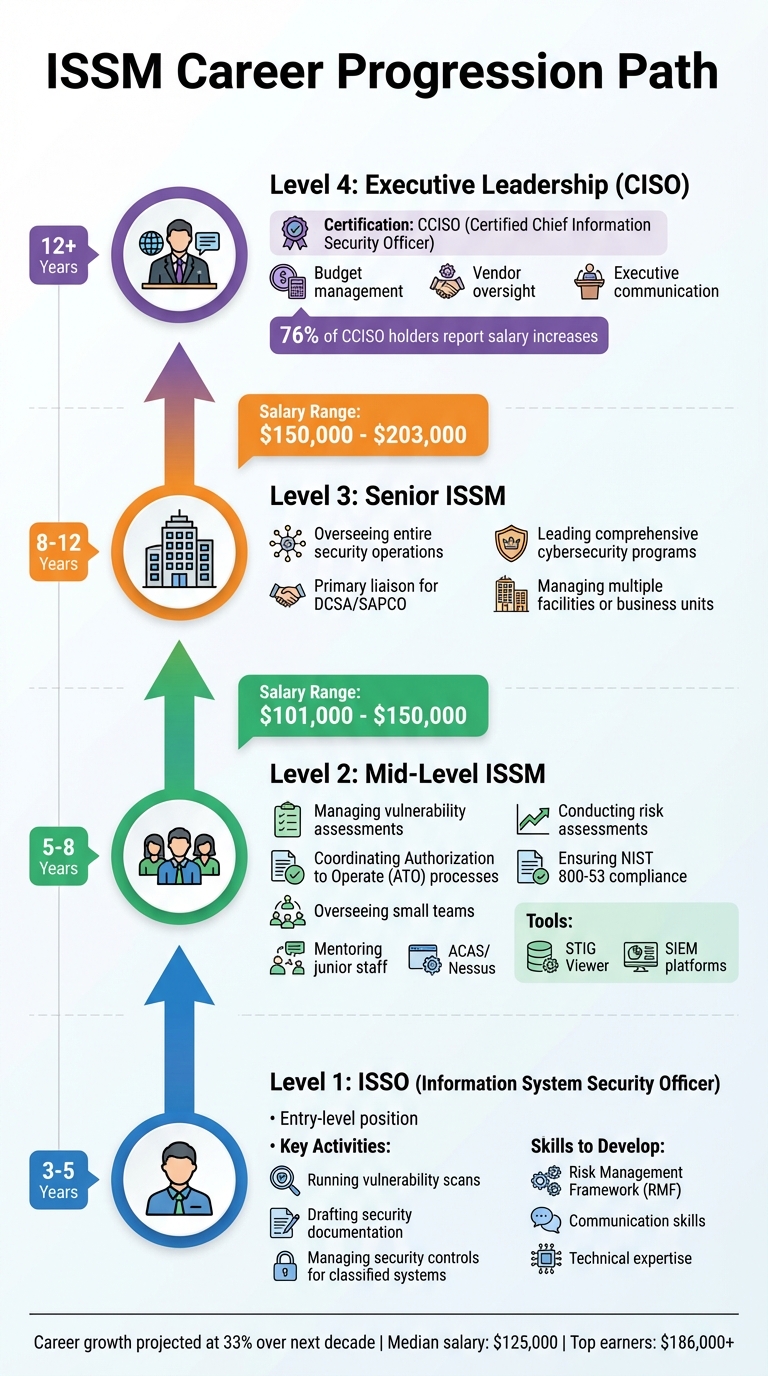
ISSM Career Progression Path: From ISSO to Senior Leadership

ISSM Career Progression Path: From ISSO to Senior Leadership

A cleared ISSM career typically follows a structured path, requiring both skill-building and strategic career moves. Most professionals start as Information System Security Officers (ISSOs), where they gain practical experience with security controls – an essential stepping stone toward leadership roles.

Moving from ISSO to ISSM

Making the leap from ISSO to ISSM generally takes about 3 to 5 years of experience managing security controls for classified systems. As an ISSO, you handle tasks like running vulnerability scans and drafting security documentation. This hands-on work not only builds technical expertise but also establishes the credibility needed to advance. To move into an ISSM role, you’ll need to demonstrate a solid understanding of the Risk Management Framework (RMF), earn relevant certifications, and hone your communication skills. These skills are vital because ISSMs often act as the main point of contact between technical teams and agencies like the Defense Counterintelligence and Security Agency (DCSA). Once this foundation is in place, transitioning into mid-level roles becomes more attainable.

Mid-Level ISSM Responsibilities

At the mid-level, ISSMs take on a mix of technical and leadership duties. This includes managing vulnerability assessments, coordinating the Authorization to Operate (ATO) process, and overseeing small teams. Tools like ACAS/Nessus for scanning, STIG Viewer for system hardening, and various Security Information and Event Management (SIEM) platforms for log analysis become part of your daily toolkit. Beyond technical tasks, you’ll be expected to mentor junior staff, conduct risk assessments, and prepare security documentation for audits, all while ensuring compliance with NIST 800-53 controls.

Typically, mid-level ISSMs have 5 to 8 years of experience and earn salaries ranging from $101,000 to $150,000 per year, depending on factors like location and clearance level. This role serves as a bridge to senior positions, offering a chance to refine your expertise and expand your influence.

Advancing to Senior ISSM and Leadership Roles

Senior ISSM roles shift the focus from managing individual systems to overseeing entire security operations across facilities or business units. Responsibilities often include leading comprehensive cybersecurity programs and serving as the primary liaison for agencies like DCSA or SAPCO. These positions usually require 8 to 12 years of experience and come with salaries between $150,000 and $203,000 annually.

To move beyond senior-level roles, pursuing executive-level credentials like the Certified Chief Information Security Officer (CCISO) can be a game-changer. This certification emphasizes skills like budget management, vendor oversight, and effective communication with executives. According to EC-Council, 76% of professionals reported a salary boost after earning the CCISO certification, highlighting that "technical excellence alone won’t earn a seat at the executive table" [7].

Challenges and Career Strategies for Cleared ISSMs

Navigating Security Clearance Processes

Maintaining a security clearance requires constant attention and a disciplined lifestyle. The introduction of Continuous Evaluation (CE) has transformed how clearance holders are monitored. Instead of periodic reinvestigations, such as the traditional five-year cycle for Top Secret clearances, CE ensures risk factors are assessed in real time. Dan Meyer, Esq., Partner at Tully Rinckey PLLC, explains:

"Continuous Evaluation (CE) shifts the focus to people presenting risk. If you do not present a risk, you will be reviewed less and less" [8].

Financial stability plays a key role in maintaining clearance. Meyer highlights this by stating:

"Financial instability is one of the leading causes of clearance revocation" [8].

This underscores the importance of staying financially responsible to avoid potential issues. Clearance holders must also self-report various activities, including foreign travel, foreign contacts, financial problems like bankruptcy or wage garnishments, criminal charges, and substance use. It’s important to note that THC use remains illegal under federal law and can jeopardize your clearance [8]. Working closely with your Facility Security Officer (FSO) and consulting a national security attorney can help you navigate these requirements effectively. Managing these challenges is a critical step toward building a stable and successful career.

Using Career Resources for Cleared Professionals

Once you’ve addressed clearance-related hurdles, tapping into specialized career resources can help you advance. Platforms tailored to the cleared community, such as Cleared Cyber Security Jobs, offer tools like personalized job alerts, resume builders, and career guidance specifically for security-cleared professionals [9]. These platforms also provide insights into hiring trends from major defense contractors, helping you identify the certifications and skills currently in demand [9][10][11].

Setting up automated job alerts for ISSM positions in key locations – like Arlington, VA; Fort Meade, MD; and El Segundo, CA – can help you stay informed about regional needs and specific agency requirements [9][10][11]. Additionally, reviewing recommendations for "similar jobs" can reveal emerging trends, such as advanced RMF (Risk Management Framework) implementations or expertise in cloud security, which are becoming increasingly sought after [10][11].

Continuing Education and Advanced Certifications

Staying competitive in the cleared cybersecurity field requires a commitment to continuous learning. The landscape evolves rapidly, and advanced education can set you apart. While foundational certifications like CISSP and CISM remain important, pursuing advanced credentials in areas like cloud security or specific compliance frameworks ensures your skills align with current threats and Department of Defense (DoD) requirements. Monitoring job postings from top contractors can help you identify which certifications are gaining popularity, allowing you to make informed decisions about your professional development [9][10][11].

Conclusion: Building a Successful Career as a Cleared ISSM

Key Points to Remember

To build a successful career as a cleared ISSM, you need a mix of technical expertise and leadership abilities. Starting as an ISSO is a smart move to gain hands-on experience with RMF and ATO processes. From there, earning DoD 8140-approved certifications like CISSP, CISM, or GSLC can set you on the path for career advancement [2][13].

For senior ISSM roles, executive-level skills become crucial. These include managing budgets, overseeing vendors, and effectively communicating the value of cybersecurity to leadership. With 62% of corporate boards identifying cybersecurity as their top organizational risk, understanding how to speak the language of executives is more important than ever [7]. If you’re aiming for higher leadership positions, the Certified Chief Information Security Officer (CCISO) certification can help bridge the gap between technical expertise and executive responsibilities. Notably, 76% of CCISO holders report salary increases [7].

To stay ahead, make use of specialized resources to track hiring trends and set up job alerts. Veterans should take advantage of preference points on USAJOBS, which can provide a significant edge – up to a 30-point lead – in federal hiring processes [3].

These steps create a solid foundation for long-term growth in an ISSM career.

Final Thoughts on ISSM Career Growth

The cleared cybersecurity field offers promising opportunities for those who commit to ongoing professional development. With employment expected to grow by 29% between 2024 and 2034, and median salaries around $125,000 (with top earners making up to $186,000), the potential rewards are substantial [4][12]. Joseph Stenaka, CISO at the Social Security Administration, shared how earning his CCISO certification was pivotal in achieving one of the most impactful roles in government cybersecurity:

"Being selected as the CISO for the Social Security Administration, one of the best cybersecurity jobs in the US government, was my most impactful achievement after earning CCISO" [7].

Staying ahead in this field means keeping up with emerging trends, such as AI-driven threat intelligence and cloud security. In fact, 69% of top-performing CISOs attribute their success to continuous learning and development [7]. Remember, your career growth depends on more than just technical skills – it hinges on your ability to adapt, lead with strategy, and maintain the ethical and financial standards required to hold a clearance.

FAQs

How can I move from ISSO to ISSM quickly?

To move swiftly from an ISSO role to an ISSM position, prioritize earning certifications such as CISSP or Security+. These credentials not only validate your technical knowledge but also signal your commitment to the field. Alongside certifications, focus on developing leadership skills by seeking roles that involve managing ISSOs or overseeing audits. Gaining hands-on experience with security policies, risk management, and compliance frameworks like RMF is equally important. A combination of these elements – certifications, leadership experience, and practical expertise – can significantly speed up your career advancement.

Do I need TS/SCI before applying for ISSM jobs?

Yes, many ISSM positions, especially those tied to classified or sensitive programs, mandate a TS/SCI clearance as a prerequisite. This requirement is standard for roles in security-cleared settings.

Which certification is best for ISSM: CISSP, CISM, or GSLC?

The best certification for an ISSM (Information System Security Manager) largely depends on the specific responsibilities of the role. CISSP (Certified Information Systems Security Professional) is highly regarded due to its extensive coverage of cybersecurity and risk management principles. On the other hand, CISM (Certified Information Security Manager) is tailored for those focusing on security management and policy creation, making it a great fit for managing security programs.

While the GSLC (GIAC Security Leadership Certification) emphasizes leadership and incident response, it’s less frequently associated with ISSM roles. Ultimately, CISSP and CISM stand out as the most sought-after certifications for professionals in this field.

Related Blog Posts

  • CIO-SP3 Cybersecurity Positions vs DISA Encore III – Which Vehicle Drives Your Career?
  • CISM Certification Career Guide for Cleared Security Managers
  • Threat Intelligence Analyst Career Path for Cleared Professionals
  • ISSO Career Path for Cleared Information Security Officers

Related Guides

  • Security Auditor Career Path for Cleared Professionals
  • Risk Analyst Career Path for Cleared Cyber Professionals
  • GRC Analyst Career Path for Cleared Compliance Professionals
  • TS/SCI Salary Premium: Real 2026 Numbers
  • Security Clearance Interview: What to Expect

ISSO Career Path for Cleared Information Security Officers

CyberSecJobs Editorial · March 14, 2026 ·

Looking to build a career as a cleared Information System Security Officer (ISSO)? Here’s what you need to know:

  • Role Overview: ISSOs safeguard information systems by managing risks, ensuring compliance with frameworks like NIST and FISMA, and maintaining system security in high-stakes environments like government and defense sectors.
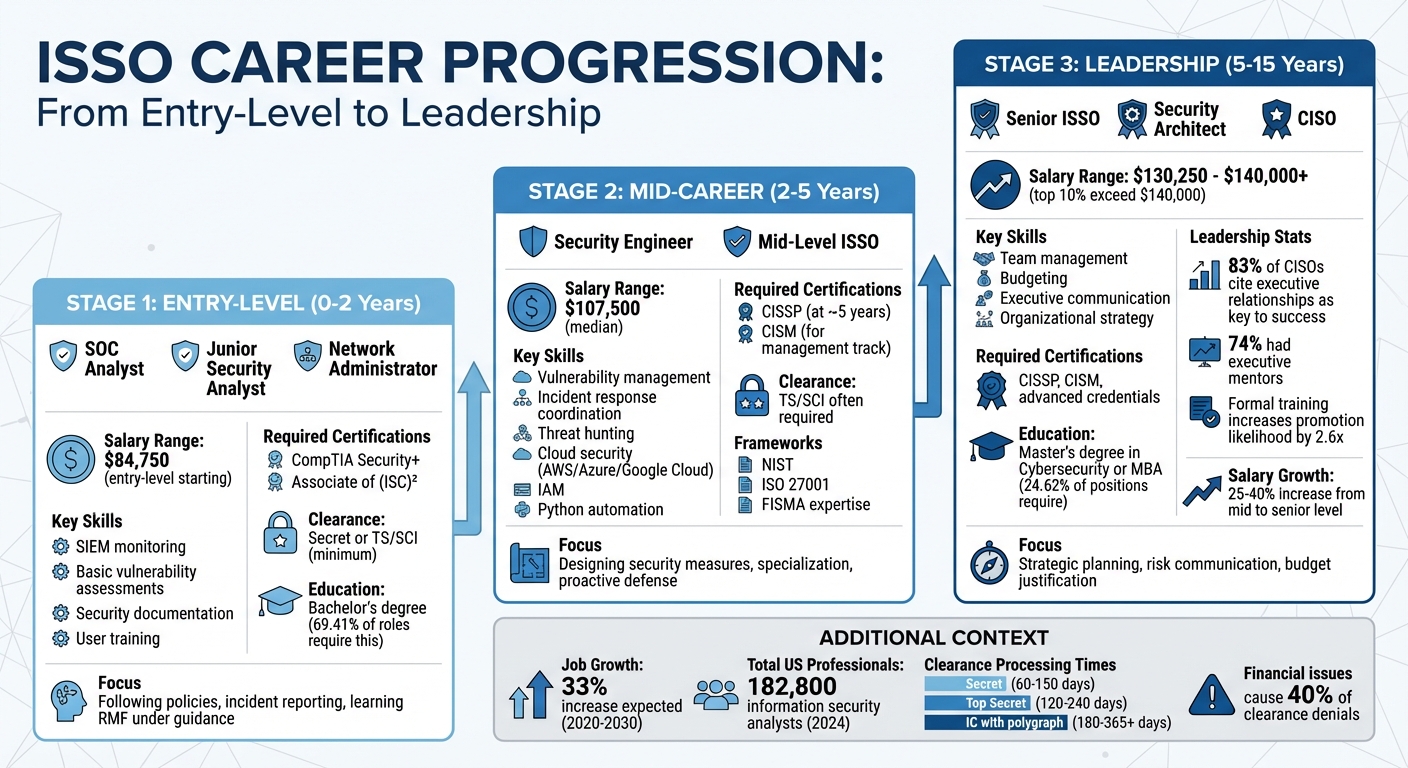
  • Salary Outlook: By 2026, median ISSO salaries are projected at $107,500. Entry-level roles start around $84,750, while senior positions can exceed $140,000.
  • Key Skills: Technical expertise (e.g., vulnerability scanning, SIEM tools), risk management, and communication are essential. Familiarity with frameworks like RMF and tools like eMASS is critical in cleared environments.
  • Education: A bachelor’s degree in fields like Cybersecurity or Information Systems is typically required. Advanced roles may benefit from a master’s degree in Cybersecurity or Information Assurance.
  • Certifications: Start with CompTIA Security+ for entry-level roles. As you advance, CISSP is a must-have for senior positions. Certifications align with DoD 8570/8140 standards.
  • Clearances: Most roles require at least a Secret clearance, with many demanding TS/SCI. Clearance processing times range from 60–365+ days, depending on the level and polygraph requirements.
  • Career Path: Progression typically moves from entry-level roles (SOC Analyst, Junior Security Analyst) to mid-level positions (Security Engineer, ISSO) and leadership roles (Senior ISSO, CISO). Experience, certifications, and specialization are key to advancement.

Takeaway: The ISSO career path combines technical skills, certifications, and clearance requirements to support national security. With strong demand and competitive salaries, it’s a rewarding field for those committed to cybersecurity.

How To Become Information System Security Officer With No Experience

sbb-itb-bf7aa6b

What ISSOs Do in Cleared Environments

In cleared environments, Information System Security Officers (ISSOs) operate under strict federal regulations such as FISMA, RMF, and NIST SP 800-37 [4]. These systems manage classified data tied to national security, so the stakes are high. One of their primary responsibilities is securing and maintaining an Authorization to Operate (ATO) – a formal approval that confirms any residual risk is within acceptable limits after a rigorous assessment process.

"The ISSO plays a pivotal role in bridging technical implementation with organizational risk management."

  • Babux, Information System Security Officer [4]

Cleared ISSOs often utilize specialized government tools like eMASS (Enterprise Mission Assurance Support Service) to manage security controls and documentation. Since they frequently work on classified networks like SIPR and JWICS, their roles often require on-site presence. These efforts all tie back to the critical mission of protecting national security.

This sets the foundation for understanding the specific, high-stakes tasks ISSOs handle in these environments.

Core Responsibilities of Cleared ISSOs

ISSOs guide information systems through the Risk Management Framework (RMF) lifecycle, as outlined in NIST SP 800-37 [4]. This process starts with categorizing systems based on boundaries and impact levels – Low, Moderate, or High – using FIPS 199 and NIST 800-60 guidelines. From there, ISSOs customize NIST 800-53 controls to align with the system’s risk level and mission objectives, often recommending alternative measures when needed.

One of their key deliverables is the RMF package, which includes:

  • System Security Plan (SSP): Outlines the system’s security requirements and controls.
  • Security Assessment Report (SAR): Provides a detailed evaluation of the system’s security posture.
  • Plan of Action and Milestones (POA&M): Tracks vulnerabilities, prioritizes fixes, and sets remediation timelines based on risk severity [4].

To minimize security incidents, ISSOs implement proactive measures like quarterly audits and phishing simulations, which have been shown to reduce errors and breaches significantly [5].

After a system is authorized, continuous monitoring becomes a priority. ISSOs oversee patch management, track security alerts, and analyze threat intelligence to ensure the ATO remains valid. Regular vulnerability scans play a big role here, enabling faster threat mitigation – up to 58% quicker when managed effectively [5].

To handle these responsibilities well, ISSOs need to balance technical expertise with strong communication skills.

Required Skills for ISSOs

Thriving as an ISSO in a cleared environment requires both technical know-how and the ability to communicate effectively. On the technical side, familiarity with tools like Nessus (vulnerability scanning), Splunk (SIEM systems), and RSA Archer (GRC platforms) is essential [5]. ISSOs must also interpret scan results, correlate security events, and configure monitoring tools to maintain system integrity.

Risk management is another cornerstone of the role. ISSOs translate technical findings into business-friendly language to brief Authorizing Officials about residual risks [4]. This skill directly impacts policy adoption rates, which can reach 74% when stakeholders are well-informed [5]. They also lead incident response efforts, determining how security events affect the system’s ATO and when to escalate issues to Authorizing Officials.

Familiarity with additional frameworks, like DoD’s CNSSI 1253, enhances an ISSO’s effectiveness in defense-focused roles [4]. With the rise of Zero Trust architecture and AI-driven security tools, modern ISSOs increasingly need experience in cloud security and emerging technologies like Microsoft Copilot to stay ahead in cyber defense [5].

Education Requirements for ISSOs

To become an Information Systems Security Officer (ISSO), a bachelor’s degree is typically required, whether you’re aiming for a role in the private sector or government. The most relevant fields of study include Computer Science, Cybersecurity, Information Systems, Information Technology, and Information Assurance. These programs provide the foundational knowledge needed to understand network protocols, system architecture, and security principles – skills that are crucial for navigating the complex regulations in cleared environments and advancing in an ISSO career.

"A bachelor’s degree in computer science, information technology, cybersecurity, or a related field is typically required to become an Information Systems Security Officer."

  • Jobicy [2]

For those pursuing advanced positions, a master’s degree in Cybersecurity or Information Assurance offers specialized training in areas like cryptography, cyber law, and risk management. This advanced knowledge becomes increasingly important as you move from junior-level roles (0–2 years of experience) to senior positions (5+ years) and eventually to leadership roles, such as Chief Information Security Officer, which typically require 8–15 years of experience.

Recommended Degrees for ISSO Roles

Different degree programs prepare ISSOs in unique ways:

  • Computer Science: Focuses on technical skills like programming, algorithms, and systems architecture.
  • Cybersecurity: Emphasizes security protocols, ethical hacking, risk assessment, and cryptography.
  • Information Systems: Combines technology and business processes, covering database management, IT governance, and network protocols.
  • Information Assurance: Concentrates on compliance and data protection with coursework in cyber law, security audits, and disaster recovery.

The demand for information security professionals, including ISSOs, is growing. The job outlook for information security analysts is expected to rise by 33% from 2020 to 2030 [6]. In 2024, about 182,800 information security analysts were employed in the U.S., with salaries ranging from $92,160 to $159,600 for the 25th to 75th percentiles [8].

If pursuing a traditional degree isn’t feasible, there are alternative routes to entering the field.

Alternative Paths and Certifications

A four-year degree isn’t the only way to start a career as an ISSO. Options like bootcamps and cyber range exercises provide hands-on, practical training in a shorter timeframe. These programs are especially effective when paired with professional certifications.

Certifications can either complement or, in some cases, substitute for a formal degree. For beginners, CompTIA Security+ is a great starting point to establish core security knowledge during or soon after academic studies. As you gain experience, certifications like the CISSP (Certified Information Systems Security Professional) become essential. Widely regarded as the gold standard for ISSOs, the CISSP certification costs around $599 [7]. If you’re just starting out and lack job experience, the Associate of (ISC)² certification is a good entry-level option.

"If hackers are the real life equivalent of super villains, Information Systems Security Officers serve as the super heroes who protect organizations day and night."

  • Abdul Mujeeb, Author [7]

Staying updated is crucial in this field. Continuous learning through online courses, seminars, and independent study is vital as new threats emerge. Topics like zero trust architectures, AI-driven threat detection, and cloud-native security are becoming increasingly relevant. By combining education, certifications, and ongoing learning, you’ll be well-prepared for a structured and rewarding career path in information security.

ISSO Career Progression Path

ISSO Career Progression Path from Entry-Level to Leadership

ISSO Career Progression Path from Entry-Level to Leadership

The journey from entry-level roles to senior leadership in the cleared cybersecurity field generally follows a structured path. While the timeline depends on factors like individual performance, certifications, and available opportunities, each step builds on a foundation of rigorous standards and the constant evolution of cybersecurity threats. Knowing the skills and qualifications needed at each stage – and the potential earnings – can help you map out your career effectively.

Entry-Level Positions and Skill Development

Most ISSOs begin their careers in roles like Security Operations Center (SOC) Analyst, Junior Security Analyst, or Network Administrator. These positions focus on tasks like real-time monitoring with SIEM tools, conducting basic vulnerability assessments, maintaining security documentation, and providing user training. During the first 0–2 years, you’ll develop skills in incident detection, user access management, and network protocols, while also learning to create and manage essential documentation.

A Bachelor’s degree in fields like Computer Science, Cybersecurity, or Information Systems is often a baseline requirement – about 69.41% of ISSO roles list this as mandatory [1]. Starting with certifications such as CompTIA Security+ is a great way to validate your core knowledge. If you’re still gaining experience, pursuing the Associate of (ISC)² credential can demonstrate your dedication to the field.

In the cleared market, even entry-level roles typically require at least a Secret clearance, with many positions demanding TS/SCI clearance. At this stage, you’ll focus on following established policies, reporting security incidents, and gaining hands-on experience with the Risk Management Framework (RMF) under the guidance of senior professionals. Once you’ve built a solid foundation, the focus shifts to proactive defense and specialization in your mid-career phase.

Mid-Career Growth and Specialization

With 2–5 years of experience, you’ll move into roles that emphasize designing and implementing security measures. Positions like Security Engineer or mid-level ISSO involve responsibilities such as managing vulnerabilities, coordinating incident responses, and proactively hunting for threats.

At this stage, specialization becomes key. You might focus on areas like cloud security (e.g., AWS, Azure, Google Cloud), Identity and Access Management (IAM), or automation. Learning to use programming languages like Python to automate security processes is increasingly valuable as AI-driven tools become more prevalent [9]. Additionally, gaining expertise in frameworks such as NIST, ISO 27001, and FISMA is critical for ensuring compliance in cleared environments.

Once you reach around five years of experience, pursuing the CISSP (Certified Information Systems Security Professional) certification can significantly enhance your credentials – it’s often considered the gold standard for senior ISSO roles. If you’re leaning toward a management track, certifications like CISM (Certified Information Security Manager) can help establish your leadership capabilities. As your expertise grows, transitioning to leadership roles becomes the logical next step.

Moving into Leadership Roles

After 5–15 years in the field, your focus will likely shift from technical execution to strategic leadership. Positions such as Senior ISSO, Security Architect, or CISO require a blend of technical knowledge and leadership skills. These roles involve responsibilities like team management, delegating tasks, and evaluating performance. Salaries at this level often exceed $130,250, with senior professionals typically seeing salary increases of 25% to 40% [5].

Leadership roles demand a different skill set than technical positions. You’ll need to understand budgeting and finance to justify funding for security initiatives, develop strong communication skills to convey complex risks in business terms, and navigate organizational dynamics to advance security goals. Research indicates that 83% of CISOs consider building relationships with other executives a key factor in their success [10].

"The ability to communicate complex security concepts to non-technical stakeholders is paramount."

  • (ISC)² [10]

To stand out for senior roles, consider pursuing a Master’s degree in Cybersecurity or an MBA – 24.62% of ISSO positions require a Master’s degree [1]. Formal leadership training can also make a difference; professionals with such training are 2.6 times more likely to be promoted to senior roles. Mentorship plays a crucial role as well – 74% of successful CISOs had an executive mentor during their career transition [10]. Seeking mentorship early can provide invaluable guidance as you navigate the shift from technical expert to strategic leader.

Certifications and Security Clearances

Required Certifications for ISSOs

The Department of Defense (DoD) defines the qualifications for Information System Security Officers (ISSOs) through its DoD 8570.01-M manual, which is transitioning into the DoD 8140 framework. These guidelines classify roles into Information Assurance Management (IAM) levels. ISSOs typically align with IAM Level I for entry-level tasks, Level II for network-focused responsibilities, and Level III for enterprise-scale management.

For entry-level ISSOs (IAM Level I), CompTIA Security+ is the foundational certification. It needs 50 Continuing Education Units (CEUs) every three years to stay current. For those advancing to IAM Levels II and III, the CISSP (Certified Information Systems Security Professional) becomes a requirement, covering 44% of approved work roles [13]. CISSP holders must earn 120 Continuing Professional Education (CPE) credits for renewal, reflecting its advanced standing.

Another important credential is the ISC2 CGRC (formerly CAP), which is particularly useful for ISSOs focusing on the Risk Management Framework (RMF) and NIST SP 800-53 controls. If you don’t already have the required certification when hired for a DoD position, you typically have up to six months to obtain it [11][12]. Higher-level certifications like CISSP are cumulative, meaning they qualify you for lower IAM levels as well [12].

"DoD 8570/8140 certifications are not ‘nice to have’. For many military, civilian and contractor positions they are mandatory – and they have a direct impact on your salary, job security and future career options."

  • CertWizard Editorial Team [16]

Security Clearance Levels and Requirements

In addition to certifications, security clearances are critical for ISSOs working in sensitive environments. While certifications confirm your technical expertise, clearances ensure you’re eligible to access classified national security systems. These clearances are essential for most ISSO roles and come in three main levels: Confidential (potential damage to national security), Secret (serious damage), and Top Secret (grave damage) [14][15]. Many ISSO positions demand Top Secret/Sensitive Compartmented Information (TS/SCI) clearance, especially in intelligence or advanced military technology sectors.

Clearance applications require sponsorship from a federal agency or a cleared contractor after receiving a conditional job offer [14][3]. Applicants use the eApp platform – set to replace e-QIP in 2026 – to complete the SF-86 questionnaire. You’ll need a detailed 10-year record of your residences, employment, and foreign contacts [3].

The timeline for clearance processing varies. As of 2026, Secret clearances take 60–150 days, while Top Secret clearances can take 120–240 days. For roles in the Intelligence Community that require a polygraph, the process may extend to 180–365+ days [3]. Financial issues, such as credit delinquencies or tax liens, account for about 40% of clearance denials, so addressing these issues beforehand is critical [14].

To maintain clearances, Trusted Workforce 2.0 now uses Continuous Vetting (CV). This automated system monitors your criminal, financial, and travel records in real time throughout the clearance period [3]. You’re required to report significant events – like arrests, major debts, or new foreign contacts – immediately, as CV systems flag these events within days [3]. Investigators also review public social media activity to assess judgment and operational security awareness, so it’s wise to regularly check your privacy settings and online activity [3].

Finding ISSO Jobs in the Cleared Market

Job Search Methods for Cleared ISSOs

If you’re looking for a cleared ISSO role, you’ll need more than just technical know-how. The cleared cybersecurity job market has its own unique dynamics, and understanding them can give you a real edge.

For starters, most ISSO positions require an active security clearance, making traditional job boards less effective. Instead, specialized platforms like Cleared Cyber Security Jobs connect candidates directly with employers who are hiring for these roles. When searching, focus on your clearance level and set up alerts with keywords like “ISSO,” “Information System Security Officer,” “RMF,” or “NIST 800-53” so you can act quickly when new openings appear.

Networking is another powerful tool. Many ISSO roles never make it to public job boards. With demand for ISSOs expected to grow by 12% – a rate much higher than the average job market [2] – building connections can help you access opportunities before they’re widely advertised. Industry events like the RSA Conference, Black Hat, or local ISSA chapter meetups are great places to meet hiring managers. You can also leverage internal networking within your current organization for promotions or referrals. And don’t underestimate the value of participating in cybersecurity forums. Engaging in discussions not only boosts your visibility but can also lead to early leads on job openings [2].

Once you’ve found a role that interests you, the next step is crafting a standout application.

How to Apply for Cleared ISSO Positions

Your application needs to do more than just list your skills – it should showcase your impact. Start with your resume. Highlight measurable achievements and certifications right at the top. Be specific. For instance, instead of saying you "improved security posture", you could write, “Reduced unauthorized access incidents by 70% through implementing multi-factor authentication.” Similarly, rather than stating you "managed incident response", say, “Restored critical services within two days following an incident.” These details make your contributions tangible [2].

Certifications are key for cleared ISSO roles. For senior positions, the CISSP is highly regarded, while CISM is often preferred for management-focused roles [2]. If you’re targeting DoD contractor positions, mention your IAT level qualifications, as many applicant tracking systems filter resumes using these keywords.

Another way to stand out is by assembling a portfolio of anonymized work samples. Include documents like security audit reports, risk assessments, incident response plans, or POA&M documentation. These examples provide real proof of your technical skills and problem-solving abilities, which can be especially helpful if you’re newer to the field.

Tailoring your cover letter is just as important. Highlight your experience with the frameworks mentioned in the job description. For example, if the employer emphasizes RMF (NIST 800-37), FISMA compliance, or Zero Trust architecture, share specific examples of your hands-on work with these frameworks. If cloud expertise is required, mention platforms you’ve worked with, like AWS, Azure, or Google Cloud.

Finally, emphasize your ability to make critical decisions, communicate technical risks clearly, and handle classified data with the highest ethical standards. These qualities, combined with a strategic approach to your application, can set you up for success in advancing your cleared ISSO career [2].

Conclusion

Start with a solid academic background – a bachelor’s degree in computer science, cybersecurity, or information technology. From there, aim for industry-recognized certifications like CompTIA Security+ for entry-level roles and CISSP or CISM for more advanced positions[2]. In the U.S., the median annual salary for an ISSO is $107,500, with senior roles climbing to $130,250 or higher. The top 10% of earners exceed $140,000 annually[2].

To stay ahead in the field, focus on mastering the Risk Management Framework (RMF), obtaining DoD 8570-approved certifications to meet IAT standards, and building expertise in areas like Zero Trust architecture, AI-driven security intelligence, and cloud-native environments[2]. Keeping your security clearance active through Continuous Vetting involves practicing strong digital hygiene and promptly reporting major life events to your Security Officer[3].

"The security clearance process in 2026 is defined by its dual nature: more digital and automated, yet still fundamentally human in its judgment of character." – Kevin James, Cybersecurity Professional and Writer[3]

FAQs

How do I get my first ISSO job if I don’t have RMF experience yet?

To break into your first ISSO role without direct RMF experience, start by strengthening your core cybersecurity skills. Earning certifications like Security+ or CISSP can showcase your knowledge, while obtaining a security clearance is often a key requirement for these positions. Familiarize yourself with NIST frameworks and commonly used security tools to build relevant expertise.

If you have experience in areas like vulnerability management or system administration, emphasize those transferable skills on your resume. These roles often overlap with ISSO responsibilities and can demonstrate your readiness to step into a security-focused position.

Finally, networking is a powerful tool. Connect with professionals in the field and explore junior roles supporting security teams – these can serve as stepping stones toward your ISSO career.

What should I do while waiting for my Secret or TS/SCI clearance to process?

While waiting for your Secret or TS/SCI clearance, use the time wisely to get ready for your role. Update your personal and professional documents to ensure everything is current. Connect with employers who have experience managing clearance transitions – they can offer valuable insights and opportunities. Stay updated on the latest industry requirements to remain competitive.

If you need to keep your skills sharp or maintain an income, look into bridge employment. Options like part-time or contract work can be a great way to stay active in your field while the clearance process is underway. Also, plan ahead – start preparing about 18–20 months before your clearance expires to avoid any last-minute hurdles.

How can I prove ISSO skills on my resume without sharing classified work?

To effectively highlight your ISSO expertise, focus on showcasing core technical skills such as risk management, security frameworks, and compliance. Emphasize your hands-on experience with critical security policies, procedures, and frameworks like NIST SP 800-137 and the Risk Management Framework (RMF). These demonstrate your ability to navigate complex security requirements and ensure system integrity.

Make sure to mention relevant certifications such as CISSP or Security+, as these credentials validate your professional knowledge and commitment to the field. Use specific keywords like vulnerability management, compliance audits, and risk assessment to align your qualifications with job descriptions. This approach not only highlights your technical proficiency but also underscores your ability to address organizational security challenges effectively – without delving into classified details.

Related Blog Posts

  • CIO-SP3 Cybersecurity Positions vs DISA Encore III – Which Vehicle Drives Your Career?
  • CISA Certification Career Guide for Cleared IT Auditors
  • CRISC Certification Career Guide for Cleared Risk Professionals
  • Threat Intelligence Analyst Career Path for Cleared Professionals

Related Guides

  • Security Auditor Career Path for Cleared Professionals
  • Risk Analyst Career Path for Cleared Cyber Professionals
  • GRC Analyst Career Path for Cleared Compliance Professionals
  • TS/SCI Salary Premium: Real 2026 Numbers
  • Security Clearance Interview: What to Expect

DevSecOps Engineer Career Path for Cleared Professionals

CyberSecJobs Editorial · March 14, 2026 ·

If you’re aiming for a career as a DevSecOps Engineer in the cleared sector, here’s the bottom line: this role is about integrating security into every stage of software development, especially within high-stakes environments like defense and government. With demand growing due to national security needs, cleared professionals with the right skills and certifications are in high demand. Here’s a quick breakdown:

  • Key Skills: Automating CI/CD pipelines, Infrastructure as Code (IaC), containerization (Docker/Kubernetes), and advanced security practices like SAST/DAST.
  • Certifications: CompTIA Security+ (entry-level), Certified Kubernetes Administrator (CKA), AWS DevOps Engineer, CISSP (senior-level).
  • Clearances: Secret, Top Secret (TS), or TS/SCI with polygraph, depending on role sensitivity.
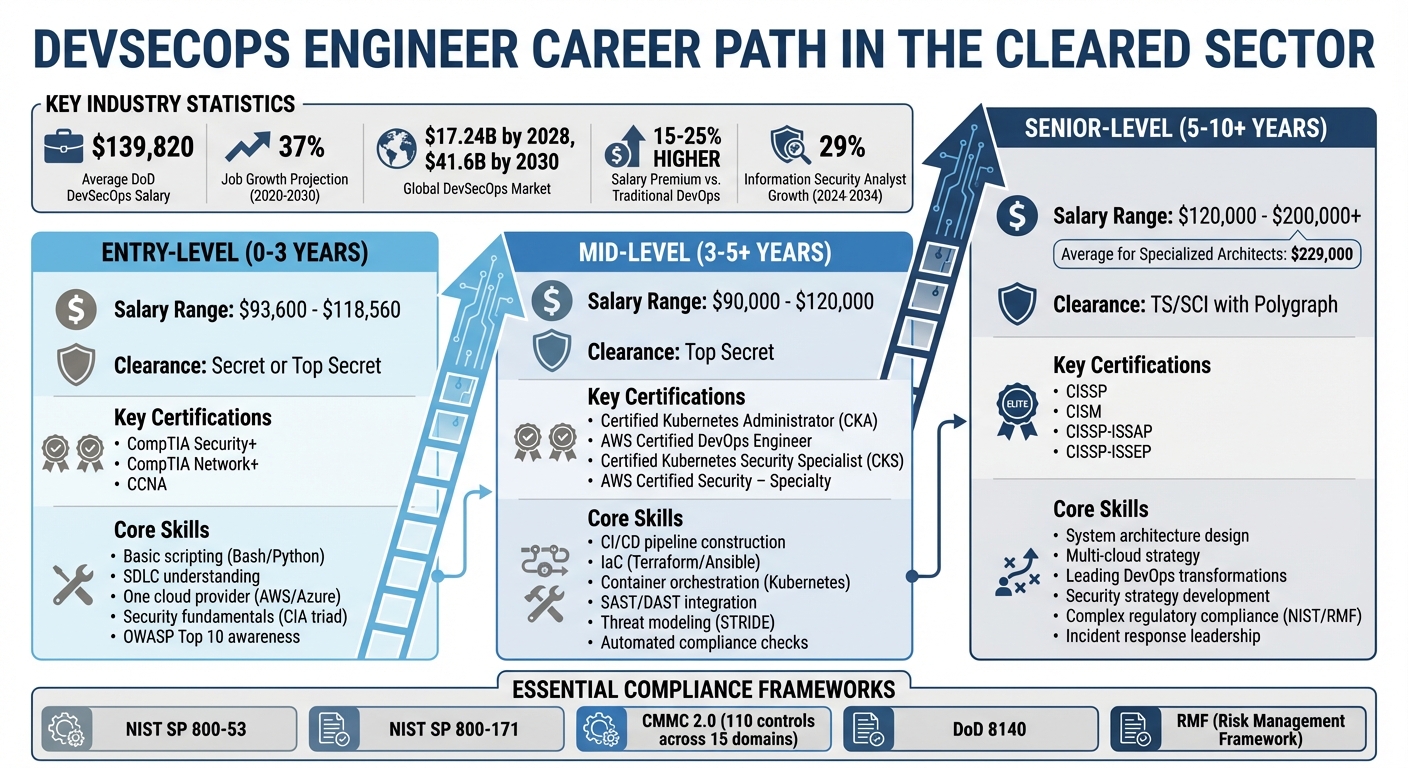
  • Salary: Average around $139,820, with senior roles exceeding $200,000.
  • Compliance: Mastery of frameworks like NIST SP 800-53, RMF, and CMMC 2.0 is essential.

The field is expanding, with the global DevSecOps market projected to hit $17.24 billion by 2028. To thrive, focus on security automation, continuous learning, and maintaining active clearances.


For more details, including career progression tips and how to stand out in the job market, read on. This guide covers everything from certifications to real-world applications in cleared environments.

DevSecOps Career Progression: Skills, Certifications, and Salaries by Level

DevSecOps Career Progression: Skills, Certifications, and Salaries by Level

DevSecOps in the Cleared Community

What DevSecOps Means in Cleared Roles

In cleared environments, DevSecOps goes beyond the standard "shift left" approach. The Department of Defense (DoD) defines it as the integration of security tools and practices directly into the development pipeline. This involves heavy automation and fostering a shared sense of responsibility among teams. For cleared professionals, this means operating within structured "Software Factories" designed for high-threat, classified missions [3].

A great example is the U.S. Air Force’s Kessel Run. Before 2017, their mission operations heavily relied on manual processes. But after teaming up with Pivotal Labs and embracing DevSecOps principles, they delivered their first product in just three months. By 2025, Kessel Run was deploying 4,000 capabilities annually [3].

Cleared DevSecOps engineers often work in environments that span TS/SCI, Secret, and Unclassified levels. These settings frequently include air-gapped systems and SCIFs, where commercial cloud tools aren’t an option. Instead, they rely exclusively on government-approved platforms like Platform One to ensure security is a constant, built-in process [2][3].

Another critical component of cleared roles is the shift from traditional one-time Authorizations to Operate (ATO) to the continuous model known as Continuous Authorization to Operate (cATO). This approach demands ongoing monitoring of Risk Management Framework (RMF) controls, active cyber defense, and compliance with approved DevSecOps reference designs. Since securing a traditional ATO is often the longest step in federal software development, moving to cATO is a game-changer [3].

These practices are the foundation of the rigorous compliance required in cleared environments.

Compliance and Governance Standards

Cleared DevSecOps roles also demand strict adherence to DoD and industry compliance frameworks. A key directive is DoD 8140, which replaced DoD 8570. This updated framework shifts from a certification-only model to a role-based competency system aligned with the DoD Cyber Workforce Framework (DCWF). The deadline for compliance with these qualifications is February 15, 2026 [4][5].

Another cornerstone is the Cybersecurity Maturity Model Certification (CMMC) 2.0, which governs how defense contractors protect Controlled Unclassified Information (CUI). Most cleared DevSecOps roles align with Level 2 of CMMC 2.0, requiring implementation of 110 specific security controls across 15 domains, such as Access Control and System and Communications Protection. Organizations typically need 12–24 months to prepare for this certification [3].

Daily operations also involve aligning technical activities with standards like NIST SP 800-53 (Security and Privacy Controls) and NIST SP 800-171 (Protecting CUI) [5][3]. Engineers manage Plans of Action and Milestones (POA&M) to track and address vulnerabilities identified during assessments. This level of documentation and continuous monitoring stands in stark contrast to the more flexible security practices often seen in the commercial sector.

CMMC 2.0 Level Focus Primary Requirement
Level 1 (Foundational) Basic safeguarding of FCI FAR Clause 52.204-21
Level 2 (Advanced) Protecting CUI NIST SP 800-171 Rev 2
Level 3 (Expert) High-priority programs NIST SP 800-172

"Digital transformation starts with processes and then moves to skills and technology."

  • Lt. Col. Max Reele, Kessel Run [3]

Compliance also extends to securing the software supply chain. Engineers must ensure that all software artifacts come from approved sources. Tools like Platform One’s Iron Bank provide a centralized repository of pre-vetted, hardened container images. This includes components such as Repo One for source code management, Big Bang for CI/CD pipelines, and Iron Bank for hardened containers. These resources help reduce risks associated with unvetted open-source software [2][3].

For cleared professionals, mastering these compliance and governance standards is essential for advancing in DevSecOps roles.

sbb-itb-bf7aa6b

How to Go from Help Desk to DevSecOps Engineer (Step-by-Step Path)

Required Skills and Technical Competencies

Cleared DevSecOps professionals operate in a space where compliance and governance are non-negotiable. To excel, they need a solid mix of technical expertise and security-specific skills.

Core Technical Skills

Cleared DevSecOps engineers must excel in automating CI/CD pipelines using tools like Jenkins, GitLab, or Bitbucket. These tools streamline integration processes while embedding security checks at every stage.

Infrastructure as Code (IaC) expertise is another must-have. Tools like Terraform, AWS CloudFormation, Ansible, Chef, and Puppet help ensure deployments align with strict security standards and provide the audit trails required for achieving an Authority to Operate (ATO).

Containerization (using Docker) and orchestration (via Kubernetes or Docker Swarm) are key skills. Engineers should also have a deep understanding of security services provided by cloud platforms like AWS, Azure, or Google Cloud.

"A DevOps engineer is an IT generalist who should have a wide-ranging knowledge of both development and operations, including coding, infrastructure management, system administration, and DevOps toolchains."

  • Tom Hall, DevOps Advocate & Practitioner, Atlassian

Proficiency in programming languages such as Python, Java, Bash, PowerShell, Go, or JavaScript is critical for automating security tasks and responding quickly to vulnerabilities. With the average cost of a data breach sitting at $4.45 million, these skills are more vital than ever [6].

Security-Specific Skills

Beyond general DevOps capabilities, cleared roles require advanced security knowledge. Engineers must codify DISA STIG and FedRAMP baselines into IaC templates, ensuring systems meet hardening requirements and accelerating the ATO process [8].

Policy-as-Code tools like Terraform, CloudFormation, or Packer are essential for maintaining consistent security configurations.

"Configuration automation using policy as code (PaC) can keep IT configurations in a desired state that complies with relevant DISA STIGs."

  • Puppet [8]

Security testing is another cornerstone. Engineers use tools for Static Application Security Testing (SAST), Dynamic Application Security Testing (DAST), and Software Composition Analysis (SCA). SAST identifies vulnerabilities like SQL injection early in the development cycle, while DAST uncovers runtime issues such as misconfigurations or cross-site scripting. With supply chain attacks expected to rise 742% by 2026, securing dependencies through SCA is now non-negotiable [7].

Threat modeling frameworks like STRIDE, DREAD, or PASTA allow engineers to proactively identify risks and implement effective controls. Continuous monitoring and drift detection help maintain compliance, even as systems evolve. For example, FedRAMP mandates ongoing monitoring to detect changes in security posture [8]. Automating STIG compliance, as seen in the DoD’s MITRE SAF project, not only speeds up the ATO process but also provides real-time audit evidence [8].

Skills by Career Level

The skills required for cleared DevSecOps roles evolve as professionals advance in their careers.

  • Entry-Level: These roles focus on foundational IT skills like basic Bash or Python scripting, understanding the software development lifecycle (SDLC), and familiarity with one cloud provider (e.g., AWS or Azure). Many entry-level engineers transition from system administration, junior development, or security analysis roles. Certifications like CompTIA Security+ help establish a security baseline [1].
  • Mid-Level: Engineers at this stage work on containerization (Docker, Kubernetes) and implement IaC tools like Terraform or Ansible. They integrate security testing tools (SAST, DAST, and SCA) into CI/CD pipelines and automate vulnerability scans. Certifications such as Certified Kubernetes Security Specialist (CKS) and AWS Certified Security – Specialty are highly valued. Salaries for mid-level roles typically range from $90,000 to $120,000 [1].
  • Senior-Level: Senior engineers focus on architectural design, organization-wide security controls, and policy-as-code implementation. They also translate technical risks into business terms and lead cross-functional teams. Advanced certifications like CISSP or CISM demonstrate expertise in governance, risk management, and security architecture. Salaries for these positions range from $120,000 to $140,000, with leadership roles exceeding $200,000 [1].
Career Level Typical Experience Core Technical Skills Security-Specific Skills
Entry-Level 0–3 Years Basic scripting (Bash/Python), SDLC understanding, familiarity with one cloud provider (AWS/Azure) Security fundamentals (CIA triad), basic vulnerability scanning, OWASP Top 10 awareness
Mid-Level 3–5+ Years CI/CD pipeline construction, IaC (Terraform/Ansible), container orchestration (Kubernetes) SAST/DAST integration, threat modeling (STRIDE), automated compliance checks
Senior-Level 5–10+ Years System architecture design, multi-cloud strategy, leading DevOps transformations Security strategy development, complex regulatory compliance (NIST/RMF), incident response leadership

The demand for these skills is reflected in the market. The global DevSecOps market is expected to soar to $41.6 billion by 2030, up from $3.7 billion in 2021. Job growth for DevSecOps engineers is projected at 37% from 2020 to 2030, with salaries for these roles running 15–25% higher than traditional DevOps positions [9] [10].

This dynamic skill set is the backbone of cleared DevSecOps careers, ensuring professionals meet the rigorous demands of their roles while advancing their careers.

Certifications and Clearance Requirements

For professionals in cleared roles, technical certifications and security clearances aren’t optional – they’re essential for career advancement. These credentials validate both your expertise and trustworthiness, making them critical for success in DevSecOps and related fields.

Required Certifications for Cleared Professionals

The Department of Defense (DoD) uses the DoD 8140 framework to align certifications with specific job functions across four key areas: Cybersecurity, Information Technology, Risk Management, and Systems Development [11]. Your certification needs will depend on your role and career stage.

For entry-level roles, CompTIA Security+ is widely recognized as a baseline certification and must be renewed every three years by earning 50 Continuing Education Units (CEUs) [11]. Many newcomers also pursue CompTIA Network+ or CCNA to build a strong IT foundation.

As you progress, mid-level professionals often add certifications tailored to cloud and DevSecOps. For instance:

  • Certified Kubernetes Administrator (CKA): Validates skills in managing containerized environments and costs $375 [12].
  • AWS Certified DevOps Engineer – Professional: Focuses on AWS expertise and is priced at $300 [12].
  • Microsoft Certified: Azure DevOps Engineer Expert: A more affordable option at $165 [12].
  • HashiCorp Certified: Terraform Associate: Ideal for infrastructure automation, costing $70.50 [12].

Senior-level roles typically require certifications in governance and risk management. Credentials like CISSP and CISM are considered top-tier and demand 120 Continuing Professional Education (CPE) credits every three years [11]. These certifications also open doors to lucrative federal roles, such as ISSO positions with salaries ranging from $87,000 to $140,000, and ISSM roles that can reach $180,000 [13].

Role Area Entry-Level Intermediate-Level Advanced-Level
Cybersecurity CompTIA Security+, CEH CISSP, CISM CISSP-ISSAP, CISSP-ISSEP
Information Tech CompTIA Network+, CCNA CASP+, GIAC Certs CISSP, CCIE Security
Risk Management CAP, CompTIA Security+ CRISC, CISM CISSP-ISSMP
Systems Development SSCP, CSSLP CISSP-ISSEP, Certified DevSecOps Engineer Advanced Systems Security Certifications

The DoD 8140 framework also ensures certification reciprocity across military branches, making it easier to transition between agencies like the Army, Navy, and Air Force [13].

Security Clearance Levels Explained

Security clearances are separate from certifications and confirm your eligibility to access classified information. These clearances involve thorough background checks conducted by the Defense Counterintelligence and Security Agency (DCSA), which handles the majority of federal investigations [14].

There are three primary clearance levels:

  • Secret Clearance: Requires a Tier 3 background check, typically used for entry-level engineering roles. Processing times range from 60 to 150 days [14].
  • Top Secret (TS) Clearance: Involves a more detailed Tier 5 investigation, necessary for sensitive national security systems. Processing takes 120 to 240 days [14].
  • TS/SCI Clearance: Grants access to highly sensitive intelligence and often includes a polygraph. Processing can take anywhere from 180 to over 365 days [14].
Clearance Level Investigation Tier 2026 Avg. Processing Time
Secret Tier 3 60 – 150 days
Top Secret Tier 5 120 – 240 days
TS/SCI (with Polygraph) Tier 5 180 – 365+ days

Under the Trusted Workforce 2.0 (TW 2.0) framework, the government has introduced a "clear once, trusted everywhere" model to streamline reciprocity between agencies [14]. Additionally, the outdated e-QIP system has been replaced by eApp, a modern platform for submitting SF‑86 forms with built-in error-checking [14].

Maintaining Certifications and Clearances

Keeping your certifications and clearances active requires ongoing effort. For certifications like CompTIA Security+ (50 CEUs) and CISSP/CISM (120 CPEs), renewal is required every three years [11]. Platforms such as Coursera, Udemy, and DoD-approved training repositories can help you earn these credits over time.

Clearance maintenance has shifted to Continuous Vetting (CV), which replaces the traditional 5- or 10-year periodic reinvestigation process. CV systems automatically monitor financial records, criminal databases, and other sources. Alerts are sent to your security office if any issues arise, often by the next business day [14].

Self-reporting is also mandatory. Events like arrests, significant debt, or notable foreign contacts must be reported immediately to your Facility Security Officer (FSO) [14]. Since financial problems are a leading cause of clearance denial, it’s smart to review your credit report annually and address any issues proactively [14].

If you leave a cleared position, your clearance becomes inactive after 24 months without a new sponsor [14]. Reactivation requires a new investigation, which can delay job opportunities. Additionally, adjudicators are now reviewing digital footprints, such as GitHub activity and professional profiles, for signs of sound judgment and operational security (OPSEC) awareness [14]. If you collaborate on open-source projects, document interactions with international researchers carefully to avoid concerns about "Foreign Influence" [14].

It’s also important to note that marijuana remains federally illegal, even in states where it’s been legalized. Any recent or ongoing use can disqualify you from maintaining a clearance in 2026 [14].

Staying on top of certifications and clearances not only helps you remain compliant but also safeguards your career opportunities in this competitive field.

Career Progression for Cleared DevSecOps Professionals

A career in cleared DevSecOps offers a clear path for growth, with salaries that increase as you gain experience and higher-level clearances. Understanding the typical progression stages can help you set practical goals and plan your journey effectively.

Entry-Level Roles and Advancement

Starting out, roles like Junior DevOps Engineer or Security Analyst I typically require at least two years of experience along with a Secret or Top Secret clearance. These positions focus on laying the groundwork with CI/CD pipelines and basic security tools. Salaries for entry-level positions with these clearances range from $93,600 to $118,560 per year.

During your first two to three years, the focus is on technical tasks such as automating deployment processes, implementing basic security measures, and gaining hands-on experience with tools like Kubernetes. Once you demonstrate proficiency with infrastructure-as-code tools like Terraform, moving into mid-level roles becomes a natural next step.

Mid-Level to Senior-Level Positions

As you build on your technical and security expertise, mid-level roles shift toward strategic responsibilities and leadership. Titles at this stage include DevSecOps Engineer, Cloud Security Engineer, or Security Automation Specialist. Salaries vary widely, ranging from $75,850 to $170,000, depending on your clearance level.

In these roles, you’ll take on tasks like designing security architectures, leading automation efforts, and mentoring junior colleagues. Senior roles, on the other hand, often require eight to eleven years of experience and TS/SCI clearances with a polygraph. Positions such as Senior DevSecOps Engineer, Cloud Security Architect, or Security Engineering Manager come with substantial pay increases – specialized architects earn median salaries around $229,000, while senior engineers average $217,000 [18].

At the senior level, responsibilities expand to include strategic planning, cross-department collaboration, and overseeing enterprise-wide security frameworks. With demand for information security analysts projected to grow by 29% between 2024 and 2034 [18], senior-level expertise in DevSecOps will remain highly sought-after.

Lateral Movement and Specializations

Cleared DevSecOps professionals also have the option to pivot laterally into specialized roles, allowing them to expand their skill set while staying relevant in a rapidly changing industry. Common transitions include roles like Site Reliability Engineer (SRE), Application Security (AppSec) Engineer, Compliance Engineer, or emerging fields such as Platform Engineering and AIOps.

Platform Engineering, often seen as the next step in DevOps evolution, involves building internal developer platforms to streamline workflows [17]. AIOps, on the other hand, uses artificial intelligence and machine learning to predict system failures and automate root cause analysis, reducing manual intervention.

"A security strategy that isn’t owned by the engineering teams won’t survive for long and will slowly degrade over time."
– Julien Vehent, Leader of Security Architecture, Mozilla [19]

Transitioning to areas like GitOps, Platform Engineering, or AIOps requires targeted upskilling. For software developers, this might mean gaining operational experience, while IT operations professionals may need to strengthen their coding and security knowledge [15][18]. Adopting a "shift-left" approach – integrating security early in the development process – can also make you invaluable in addressing the growing complexity of cyber threats. With global cyber attacks increasing by 30% in Q2 2024 [16], professionals who can bridge multiple domains will play a critical role in safeguarding systems.

Building a Competitive Profile

Once you’ve mapped out potential career paths, the next step is crafting a standout personal profile. The cleared DevSecOps job market is competitive, and success hinges on demonstrating technical expertise, presenting a polished resume, and effectively showcasing how your past experience aligns with DevSecOps principles. The best candidates combine hands-on skills with a strategic approach to self-presentation.

Hands-On Learning Strategies

Practical experience is key. Start by building a home lab using free tiers from AWS, Azure, or Google Cloud to replicate cleared environments. Work on projects like Cloud Security Posture Audits, IAM policy reviews, and CI/CD pipelines that integrate security tools like SonarQube or Snyk.

For compliance-focused tasks, try automating enforcement with Policy as Code using AWS Config or Azure Policy. Practice secrets management with tools like AWS Secrets Manager or Azure Key Vault to handle encryption and credential rotation. To sharpen your incident response skills, simulate scenarios such as credential compromise or unauthorized access and execute runbooks to address these events. AI chatbots can also serve as virtual mentors, offering step-by-step guidance for setting up environments, installing tools, and applying security controls.

Beyond solo projects, get involved in open-source initiatives, forums, and workshops. These activities not only refine your skills but also keep you updated on emerging industry practices.

Resume Optimization for Cleared Positions

When applying for cleared roles, your resume needs to make an immediate impact. Start by listing your active clearance prominently at the top. For 2026, recruiters are focusing on terms like "Shift Left," "Policy as Code," and "Zero Trust," along with tools like Snyk, Terraform, and Kubernetes. Clearly state your years of experience and use quantifiable achievements to stand out.

"Security is no longer an afterthought. It is the code itself." – ResumeAdapter [20]

Instead of generic phrases, use the PAR method (Problem, Action, Result) to showcase your accomplishments. For example, replace "improved security" with something like: "Configured SonarQube quality gates to automatically block builds with critical vulnerabilities, reducing MTTR by 25%" [20][22]. A technical skills matrix at the top of your resume can help recruiters and applicant tracking systems quickly identify your expertise in programming languages, platforms, and security tools.

While it’s essential to highlight your clearance, avoid sharing sensitive details such as classified project names or specific budgets. Stick to a clean, simple design with standard fonts to ensure your resume is easily processed by electronic systems. It’s worth noting that 55.6% of DevSecOps job ads come from the Finance & Banking sector, followed by Education (21.2%) and Healthcare (13.2%) [22].

"Keep subjective self-descriptions out of your summary section. I’m looking at you, Results-Oriented Team Players." – Bill Branstetter, 9th Way Insignia [21]

Leveraging Transferable Experience

Your background in system administration, networking, and virtualization can be a strong asset for protecting critical systems. Pair these skills with programming languages like Python, Java, C++, or Go, and enhance automation capabilities with shell scripting tools such as Bash, AWK, or sed.

Veterans should emphasize their existing clearances and experience in compliance-driven environments. If you’re transitioning from DevOps, focus on securing Terraform scripts with tools like Checkov or integrating security scanners into Jenkins or GitLab pipelines [20].

A well-rounded profile should also highlight proficiency in vulnerability management (SAST/DAST/SCA), Identity and Access Management (IAM), and compliance frameworks such as NIST 800-53, RMF, and STIGs. Expertise with containerization tools like Docker and Kubernetes, along with runtime security tools like Falco or image scanners such as Trivy, is increasingly sought after. Additionally, cloud security knowledge – using services like AWS GuardDuty or Azure Sentinel – can give you a competitive edge.

As of April 2025, the average salary for a DevSecOps Engineer at the Department of Defense is approximately $139,820, with typical ranges between $124,668 and $156,963 [2]. However, the hiring process can be lengthy. Over 700,000 applicants are currently waiting for federal background checks, and top-level security clearances can take more than 450 days to process. One defense contractor noted losing 20% to 30% of placements because candidates accepted other offers during this period [2].

"A sponsored TS/SCI clearance can be worth tens of thousands in future earning potential." – Alpha Bravo [2]

Navigating the Cleared DevSecOps Job Market

The cleared DevSecOps job market operates under unique conditions compared to the commercial tech sector. Success here depends on understanding what employers prioritize and addressing the challenges specific to these roles.

What Employers Expect

For cleared DevSecOps positions, active security clearances are non-negotiable. This requirement often creates hiring challenges; one defense contractor noted losing 20–30% of placements because candidates accepted other offers while waiting for their clearances to process. Beyond clearances, employers look for expertise in areas like cloud-native security, compliance automation, and adherence to frameworks such as NIST 800-53 and STIGs. They value engineers skilled in embedding security into development workflows while navigating complex regulatory landscapes.

"Successful DevSecOps implementation requires that government users continuously learn new skills." – Nicolas Chaillan, Former Chief Software Officer of the U.S. Air Force

These demands highlight the critical skills and qualifications needed to thrive in this field.

Key Sectors and Employers

The Capital Region, spanning from Baltimore to Richmond, is the epicenter of cleared DevSecOps opportunities. In 2018 alone, more than 115,000 job postings required security clearances. The Department of Defense leads the pack, driven by its shift to cloud-native tools and secure container repositories like the "Iron Bank." Other key employers include defense contractors, intelligence agencies, and organizations managing critical infrastructure.

While government roles may lack the stock options or bonuses common in Silicon Valley, they offer the chance to contribute to national security – a compelling draw for many professionals. These mission-driven roles often provide stability and the opportunity to work on impactful projects [2].

Job Search Strategies for Cleared Professionals

Finding cleared DevSecOps roles requires a targeted approach. Specialized platforms like Cleared Cyber Security Jobs connect candidates with employers who value both clearance and technical expertise. These platforms simplify the process by focusing on direct-hire opportunities.

For veterans, military transition programs can be a game-changer, often bypassing lengthy clearance adjudication processes. If you hold a TS/SCI clearance, treat it as a major asset – it can add tens of thousands of dollars to your earning potential. Highlight it prominently on your resume and LinkedIn profile to stand out.

Networking is equally important. Attend industry conferences, government-sponsored events, and veteran organizations to connect with others in the cleared community. These interactions can provide insights into company cultures and help speed up hiring timelines [2].

Conclusion

The cleared DevSecOps career path brings together technical expertise and the mission of safeguarding national security. It’s a field where demand is high, compensation is competitive, and the work has a direct impact on protecting critical government systems and operations. What was once considered an optional capability has now become essential.

Having an active clearance gives you a clear edge in this space. It not only sets you apart from other professionals but also makes you an in-demand candidate who can contribute immediately. This distinction opens doors and ensures long-term career opportunities.

To thrive in this field, staying ahead of the curve is essential. The technical landscape evolves quickly – think Kubernetes, Infrastructure as Code, Zero Trust Architecture, and automated compliance. Certifications, hands-on experience with top DevSecOps tools, and familiarity with frameworks like NIST 800-53 and STIGs are key to staying relevant. As government agencies shift from traditional waterfall methodologies to agile DevSecOps practices, the demand for professionals skilled in both technical and security aspects will continue to grow[2].

Take stock of your current skills and clearance status. Focus your job search on areas like the Washington, D.C., region, where opportunities are abundant, and use niche platforms to connect with employers who value your unique expertise and clearance[2]. By stepping into this career path now, you position yourself for a role that combines purpose with professional growth.

The work you do in this field matters. National security and the delivery of essential government services depend on secure, efficient software solutions. If you’re ready to take on the challenge of protecting critical systems while advancing your career, the cleared DevSecOps path offers a meaningful and rewarding journey.

FAQs

How do I get sponsored for a clearance?

To get sponsored for a security clearance, you usually need to secure a job with a government agency or a contractor involved in classified projects. Once you’re hired, your employer initiates the clearance process on your behalf. This process includes a thorough background investigation conducted by a government agency, such as the Department of Defense. They review various factors, including your criminal history, financial records, and overall background, to determine your eligibility.

What does DevSecOps look like in a SCIF or air-gapped network?

In a SCIF (Sensitive Compartmented Information Facility) or an air-gapped network, DevSecOps functions differently to accommodate the lack of internet access. The setup typically involves two zones: the Low Side, which manages dependencies, and the High Side, where production occurs. Secure data transfer between these zones is achieved using physical media and specialized hardware like data diodes. To keep workflows running smoothly in these isolated environments, teams rely on local mirrors, offline scanning tools, and stringent controls to ensure everything stays compliant and secure.

Which 2–3 certifications should I get first for cleared DevSecOps?

To build a strong base in security and cloud systems, start with well-regarded certifications. For security, consider CISSP (Certified Information Systems Security Professional), CISM (Certified Information Security Manager), or CEH (Certified Ethical Hacker). In cloud platforms, look into certifications for AWS, Azure, or Google Cloud. Your choice should align with your job requirements and the specific needs of your role within the cleared community.

Related Blog Posts

  • Cisco CCIE Security Career Guide for Cleared Expert Engineers
  • Red Team Operator Career Path for Cleared Professionals
  • Cloud Security Engineer Career Path for Cleared Professionals
  • Application Security Engineer Career Path for Cleared Professionals

Related Guides

  • Endpoint Security Engineer Career Path for Cleared Professionals
  • Application Security Engineer Career Path for Cleared Professionals
  • Cloud Security Engineer Career Path for Cleared Professionals
  • TS/SCI Salary Premium: Real 2026 Numbers
  • Security Clearance Interview: What to Expect

Application Security Engineer Career Path for Cleared Professionals

CyberSecJobs Editorial · March 13, 2026 ·

Looking to secure a high-paying role in cybersecurity? Application Security Engineers with security clearances are in demand, offering salaries ranging from $149,000 to $220,000 annually. These professionals ensure software is secure during development, aligning with frameworks like OWASP Top 10 and NIST standards.

Key takeaways:

  • What they do: Review code, conduct security tests (SAST/DAST), and identify vulnerabilities early.
  • Skills needed: Programming (Java, Python, etc.), threat modeling, DevSecOps integration, and cloud security.
  • Certifications: Start with Security+ or CEH, then advance to CISSP or CSSLP for leadership roles.
  • Clearance perks: Active clearances unlock exclusive jobs, higher pay, and faster hiring.

With cybersecurity roles expected to grow 29% by 2034, now is the time to combine technical expertise with clearance credentials for a thriving career.

How to Become an AppSec Engineer: Skills, Projects, and Reality (No Fluff)

sbb-itb-bf7aa6b

Required Skills and Tools

Becoming proficient in Application Security Engineering within cleared environments requires a mix of programming knowledge, security testing expertise, and a solid understanding of compliance standards. It’s not just about using automated tools – it’s about diving deep into code, architecture, data flow, and APIs to identify vulnerabilities that tools might miss [5]. Below, we’ll explore the technical skills and tools that are essential for this role.

Core Technical Skills

Programming skills are the backbone of this field. Languages like Java, Python, .NET, JavaScript, and C/C++ are commonly used in cleared environments. Mastering at least one or two of these languages is critical, as it sharpens your ability to review and write secure code. This is key for preventing vulnerabilities like SQL injection [3][6].

Understanding how to identify and prioritize threats – such as SQL injection, cross-site scripting (XSS), or buffer overflows – is just as important as filtering out false positives in security scans [3][6]. Threat modeling frameworks like STRIDE or PASTA help map out potential attack vectors early in the development process, making them invaluable tools [3][5].

Security engineers are also expected to integrate security into DevSecOps workflows. This means automating security checks within CI/CD pipelines using tools like Jenkins, Terraform, and GitHub Actions to ensure secure and efficient deployments [3][6]. Additionally, expertise in cloud and container security is essential, particularly for protecting Kubernetes workloads on platforms like AWS, Azure, and GCP [3][6].

In cleared environments, compliance is non-negotiable. Engineers must align applications with frameworks like the OWASP Top 10, NIST standards, SANS Top 25, and CWE Top 25 [1][3][6]. Beyond technical skills, strong communication abilities are critical for explaining risks and security measures to both technical teams and management [3].

Application Security Tools

For cleared professionals, knowing the right tools is just as important as having the right skills. A strong toolkit is essential for meeting stringent security requirements. The following tools are must-haves for Application Security Engineers:

  • Dynamic Application Security Testing (DAST) and Static Application Security Testing (SAST) tools: These are the cornerstone of application security. For example:
    • Burp Suite: A go-to for penetration testing, offering advanced features like its Intruder tool for automated attacks and extensions like AuthMatrix for role-based access control testing [7].
    • OWASP ZAP: A free, open-source alternative that integrates smoothly with CI/CD pipelines through its API and HUD overlay.

Lester Obbayi, Cyber Security Consultant, states: "The OWASP ZAP tool can be used during web application development by web developers or by experienced security experts during penetration tests to assess web applications for vulnerabilities." [8]

An Infosec Institute study from March 2018 highlighted OWASP ZAP’s effectiveness, showcasing its ability to detect critical vulnerabilities like XSS and OS Command Injection in real-world scenarios [8].

  • Source Code Analysis: Tools like Checkmarx and Fortify are essential for identifying security flaws before deployment, while SonarQube and Snyk specialize in Software Composition Analysis (SCA) to scan for vulnerabilities in dependencies.
  • Threat Modeling Platforms: Tools such as the Microsoft Threat Modeling Tool and IriusRisk simplify the process of mapping out potential threats during development.

For those looking to sharpen their skills, resources like the PortSwigger Web Security Academy offer practical training in identifying and exploiting vulnerabilities [5]. Entry-level professionals can start by focusing on scripting and pattern matching to reduce unnecessary noise in security scan results [3].

Certifications That Advance Your Career

Building technical and tool-based expertise is just the beginning. Industry certifications take it a step further, giving you the credentials to validate your skills, meet Department of Defense (DoD) requirements, and increase your earning potential in cleared Application Security roles. These certifications not only confirm your abilities to hiring managers but also fulfill federal mandates and often lead to higher salaries. As the job market in 2025 becomes increasingly competitive, having the right certifications will remain a key factor in career advancement and credibility [13].

The certifications you pursue should align with your career stage and goals. For beginners, entry-level credentials establish foundational knowledge and ensure compliance with federal standards. For seasoned professionals, advanced certifications demonstrate mastery and leadership in secure software development.

Entry-Level Certifications

CompTIA Security+ is widely regarded as the starting point for cleared professionals. It satisfies DoD 8570/8140 baseline requirements, making it essential for federal compliance. The exam costs between $370 and $392, and preparation typically requires 100 to 200 hours of study. Around 24% of the U.S. cybersecurity workforce holds this certification, reflecting its importance [14].

Certified Ethical Hacker (CEH) builds on foundational skills by introducing offensive security concepts and hacking techniques. Although the exam is more expensive – ranging from $1,100 to $1,300 – it is highly recognized by recruiters [13]. Professionals with CEH certifications often earn salaries of around $126,000 annually. However, some hiring managers note that CEH leans more toward theoretical knowledge compared to hands-on alternatives [13].

"In 2025’s tight job market, certifications remain key to credibility, hiring, and salary growth."

  • Mohammed Khalil, Cybersecurity Architect, DeepStrike [13]

Once you’ve established a solid foundation, advanced certifications can help you transition into leadership roles.

Senior-Level Certifications

CISSP (Certified Information Security Systems Professional) is the gold standard for senior-level positions in cleared environments. The exam costs $749 and requires five years of paid work experience in at least two of its eight security domains [11][12]. If you don’t yet meet the experience requirement, you can earn an Associate status while working toward full certification. In North America, CISSP holders earn an average of $148,000 annually, with the certification often adding about $25,000 to base salaries.

CSSLP (Certified Secure Software Lifecycle Professional) is tailored specifically for Application Security Engineers. At $599, it focuses on secure software development lifecycle (SDLC) practices, including secure coding, threat modeling, and vulnerability testing [12]. To qualify, you need four years of SDLC experience. This certification is ideal for professionals looking to maintain a hands-on, technical focus. CSSLP holders must also earn 90 Continuing Professional Education (CPE) credits every three years to keep their certification active.

Certification Cost Experience Required Average Salary Primary Value
Security+ $370–$392 0–1 year ~$125,000 Baseline compliance
CEH $1,100–$1,300 0–2 years ~$126,000 Offensive security fundamentals
CSSLP $599 4 years $150,000–$200,000 Secure SDLC expertise
CISSP $749 5 years ~$148,000 Senior leadership credential

These certifications not only validate your technical expertise but also position you as a strong candidate for government and cleared job opportunities.

"Application security engineering rewards deep technical skill. CISSP adds the breadth that elevates technical experts into strategic leaders in secure software development."

  • Elias Ward, Security Specialist [2]

For professionals aiming to work on government contracts, starting with Security+ is a practical move to meet immediate compliance requirements. From there, adding CEH or CSSLP can help you specialize in offensive security or secure development. If you’re looking to transition into senior leadership or security architecture roles, CISSP is the credential that opens doors to six-figure salaries and positions of strategic influence [13][15].

Career Path and Progression

Application Security Engineer Career Path: Stages, Salaries, and Certifications

Application Security Engineer Career Path: Stages, Salaries, and Certifications

For Application Security Engineers with active security clearances, career advancement can happen faster and with more opportunities. Understanding the typical career stages and how clearances impact your trajectory can help you make informed decisions about your professional growth.

Typical Career Stages

Entry Level (0–3 years):
Starting out, roles like Junior AppSec Engineer, Security Analyst, or DevSecOps Associate focus on tasks such as triaging automated scan results, verifying patches, and tracking remediation efforts. These positions typically offer salaries between $90,000 and $120,000 annually [3][9]. Early on, it’s essential to hone your skills by automating triage tasks and improving detection rules through investigating recurring scan flags.

Mid Level (2–5 years):
As you gain experience, you might step into roles like AppSec Engineer or DevSecOps Engineer. Here, responsibilities expand to include secure code reviews, threat modeling, and integrating security gates into CI/CD pipelines. Salaries at this stage range from $140,000 to $185,000 annually [3][9][16][10]. This phase involves moving beyond basic scripting to enforcing policies, such as identifying dependencies with known vulnerabilities.

Senior Level (5+ years):
In senior positions, such as Senior AppSec Engineer or Security Architect, your role shifts to leading design reviews, selecting security tools, and managing cross-team security projects. Compensation typically ranges between $180,000 and $200,000 annually [3][9]. At this stage, technical expertise often transitions into strategic responsibilities, paving the way for leadership roles.

Leadership and Executive Tracks:
Advanced positions include specialized roles like Mobile Security, API Security, or Cloud-Native Security (e.g., Kubernetes), as well as leadership roles such as AppSec Manager, Program Owner, Principal AppSec Engineer, or Chief Information Security Officer (CISO). These roles focus on strategy, budgeting, and risk management, with salaries starting at $200,000 and often exceeding $230,000 annually [3][9][10].

"AppSec engineers bridge the gap between development and security teams, ensuring applications are built securely from the ground up."

  • Wiz [9]
Career Stage Typical Job Titles Focus Areas Estimated Salary Range
Entry Junior AppSec Engineer, Security Analyst Triage, scanning, patch verification $90,000–$120,000 [3][9]
Mid AppSec Engineer, DevSecOps Engineer Threat modeling, code reviews, CI/CD $140,000–$185,000 [3][9][10]
Senior Senior AppSec Engineer, Security Architect Strategy, tool selection, mentoring $180,000–$200,000+ [3][9]
Leadership AppSec Manager, CISO, Principal Engineer Risk management, budgeting, policy $200,000–$230,000+ [3][9][10]

A security clearance not only enhances your skillset but also accelerates your career progression.

How Clearances Affect Your Career

An active security clearance can be a game-changer, significantly speeding up hiring processes and boosting earning potential. Employers value clearances because they eliminate delays and the costs of investigations, which can run up to $15,000 [4][17]. If you already hold an active clearance, you’re often hired more quickly and at higher salaries.

Clearances also bring financial benefits. For instance, holding a TS/SCI clearance with a polygraph can add $30,000–$50,000 annually compared to similar non-cleared roles [17].

"Every month a position sits empty because a clearance investigation is in progress costs the company money. A veteran who walks in the door with an active clearance fills that seat immediately. That urgency is your leverage."

  • Brad Tachi, CEO and Founder, Best Military Resume [17]

It’s important to remember that clearances are time-sensitive. If you leave a cleared role, your clearance typically becomes inactive after 24 months. To avoid this, secure a new sponsor within that period [4][17]. The Trusted Workforce 2.0 initiative aims to simplify transitions between federal agencies and contractors with the "clear once, trusted everywhere" approach. Additionally, the Continuous Vetting (CV) system now replaces periodic reinvestigations with real-time monitoring of criminal, financial, and foreign travel records [4].

"Letting a TS/SCI lapse because you took a non-cleared position is one of the most expensive mistakes a transitioning veteran can make."

  • Brad Tachi, CEO and Founder, Best Military Resume [17]

By 2026, adjudicators are increasingly assessing public-facing online activities, like GitHub contributions and professional forums, to gauge judgment and operational security awareness [4]. A strong digital presence is becoming just as important as technical expertise for maintaining clearance eligibility.

Balancing skill development with careful clearance management is key to long-term success in Application Security Engineering.

How to Find Cleared Application Security Jobs

Landing a cleared Application Security Engineer role takes more than just submitting resumes – it’s about knowing how to navigate the unique cleared job market. This specialized community operates differently, so leveraging the right platforms and networks is key to finding your next opportunity.

Using Cleared Cyber Security Jobs

Cleared Cyber Security Jobs

The platform Cleared Cyber Security Jobs is a valuable resource for professionals with security clearances seeking Application Security roles. To make the most of it, start by completing your profile thoroughly. Include details like your "Key Skills" and "Ideal Work Locations", as recruiters often review these sections before even looking at your resume [18][20].

Keep your profile active by logging in weekly – this helps boost your visibility in recruiter searches [18][20].

When searching for jobs, use zip codes and mileage ranges instead of city names. For example, searching "St. Louis" instead of "Saint Louis" ensures you don’t miss any listings [18][20]. Also, make sure to list all clearance levels you’re eligible for. If you hold a Top Secret clearance but are open to positions requiring only a Secret clearance, selecting both in your search filters can increase your chances [18][20].

Set up job alerts for terms like "Application Security" paired with your clearance level. This ensures you’re notified as soon as new positions are posted [18]. If you’re conducting a confidential search while employed, take advantage of the platform’s privacy settings to block your current employer from seeing your profile [18][20].

Cleared Cyber Security Jobs also hosts virtual and in-person job fairs, connecting you directly with hiring managers at companies like CACI, Amentum, and Booz Allen Hamilton. These events can be game-changers. G.B., a Technical Project Manager at CACI, highlights their importance:

"For veterans especially, attending Cleared Job Fairs can be critical to a successful career transition" [19].

While optimizing your online presence is important, building personal connections can be just as crucial.

Networking in the Cleared Community

Job boards are helpful, but many cleared positions – especially at senior levels – are filled through referrals. Building trust and a solid reputation within the cleared community can unlock opportunities that never make it to public job postings.

Attend industry events, conferences, and cleared job fairs to meet hiring managers in person. These settings allow you to showcase your expertise and experience in ways a resume can’t. Developing relationships with professionals already working in cleared Application Security roles can also provide insider tips about upcoming openings.

Stay informed with resources like the "Security Cleared Jobs: Who’s Hiring & How" podcast or YouTube channels that focus on cleared career paths. These platforms offer insights into hiring trends, interview strategies, and more [19][21]. Engaging in professional forums can also help you increase your visibility.

Networking is about more than finding a job – it’s about building a reputation that can open doors throughout your career.

Conclusion and Next Steps

Stepping into the world of a cleared Application Security Engineer means embracing a path of constant growth and deliberate career decisions. This role uniquely blends cybersecurity expertise with software development skills. With security-related engineering positions expected to grow by 29% through 2034, the demand is clear. Salaries reflect this need, ranging from $149,000 to $220,000 annually, with senior roles at top tech companies often exceeding $300,000[3][5].

Key Points to Remember

To excel, you must balance two critical mindsets: the "builder" and the "breaker." This means not only knowing how to develop software but also understanding how to identify and exploit vulnerabilities. As one expert from BSG explains:

"The role demands something rare – deep technical understanding of how software is built and how it breaks. Developers already have half of that equation solved." – BSG[5]

Your security clearance adds even more value to your profile, especially as organizations adopt DevSecOps practices and focus on embedding security throughout CI/CD pipelines. With trends like cloud-native security, AI-driven operations, and secure-by-design principles shaping the future, the opportunities in this field are only expanding[3].

What to Do Next

Start by revisiting your certification goals. Begin with foundational credentials like Security+ and work your way up to advanced certifications such as CSSLP or CISSP as you gain experience[3]. Keep your security clearance active to stay competitive.

Enhance your hands-on skills through platforms like PortSwigger Web Security Academy, Hack The Box, or TryHackMe[5]. Take on security code reviews at your workplace or participate in security champion programs to build real-world experience. Update your profile on Cleared Cyber Security Jobs, including your clearance level and preferred job locations, and set up alerts for relevant Application Security roles. Attending cleared job fairs is another excellent way to connect with hiring managers actively seeking talent in this area.

FAQs

Do I need a clearance before applying for AppSec roles?

Having a security clearance isn’t always necessary for Application Security (AppSec) roles, but it can give you an edge. Some positions – especially those in government or defense – specifically require it. If you already hold a clearance, it can strengthen your resume and unlock access to specialized roles within the cleared cybersecurity sector.

Which certification should I get first for cleared AppSec jobs?

The CISSP certification is a great starting point for professionals aiming for cleared Application Security (AppSec) roles. Known for its high regard in the cybersecurity industry, especially in security-cleared positions, it provides a solid base of knowledge and skills. This certification can open doors and set the stage for advancing in the cleared AppSec field.

How can I get hands-on AppSec experience without an AppSec title?

To build practical AppSec skills, dive into secure coding challenges, explore OWASP training programs, and take on self-directed projects. You can also contribute to open-source projects, participate in bug bounty programs, or work on personal security initiatives. Prioritize exercises that focus on OWASP vulnerabilities and tools like OWASP ZAP or Burp Suite. These activities not only sharpen your expertise but also help you create a portfolio that demonstrates your capabilities effectively.

Related Blog Posts

  • Threat Intelligence Analyst Career Path for Cleared Professionals
  • Red Team Operator Career Path for Cleared Professionals
  • Security Architect Career Path for Cleared Professionals
  • Cloud Security Engineer Career Path for Cleared Professionals

Related Guides

  • Endpoint Security Engineer Career Path for Cleared Professionals
  • Cloud Security Engineer Career Path for Cleared Professionals
  • Security Architect Career Path for Cleared Professionals
  • TS/SCI Salary Premium: Real 2026 Numbers
  • Security Clearance Interview: What to Expect
  • « Go to Previous Page
  • Go to page 1
  • Go to page 2
  • Go to page 3
  • Go to page 4
  • Go to page 5
  • Interim pages omitted …
  • Go to page 10
  • Go to Next Page »
  • Facebook
  • Instagram
  • LinkedIn
  • Twitter
  • YouTube

Cleared Cyber Security Jobs | CyberSecJobs.com

  • Contact
  • About
  • Privacy Policy