

The demand for Governance, Risk, and Compliance (GRC) roles is surging, especially for professionals with security clearances. Here’s what you need to know:
- Job Growth: GRC roles like analysts and virtual CISOs have seen a 1,000% increase in interest over five years, driven by stricter regulations and rising cybercrime costs.
- Salary Potential: Entry-level cleared GRC analysts earn $60,000–$88,954 annually, while senior roles can exceed $420,000.
- Core Responsibilities: GRC analysts focus on governance, risk management, and compliance by conducting risk assessments, managing audits, and aligning with frameworks like NIST and ISO 27001.
- Career Progression: Cleared professionals often advance to mid-level roles within 2–3 years, with salaries ranging from $95,000 to $105,000.
- Certifications: Key certifications include CISA, CRISC, CGRC, and Security+, which enhance career prospects and earning potential.
- Military Advantage: Veterans’ experience with SOPs, risk mitigation, and cross-functional communication aligns well with GRC roles.
With cybercrime projected to cost $12.2 trillion annually by 2031, cleared GRC professionals are in high demand. Start by gaining technical skills, earning certifications, and leveraging your security clearance to access lucrative opportunities.
GRC Roles and How to Get Started
Entry-Level GRC Positions for Cleared Candidates
Breaking into GRC roles doesn’t demand extensive specialized experience. Starting as a Junior GRC Analyst, you’ll focus on tasks like monitoring regulatory compliance, assisting with risk assessments, and supporting audits [8]. This role often involves gathering documentation and tracking compliance findings under the guidance of senior analysts. Salaries typically range from $60,000 to $80,000, with some high-demand sectors offering starting pay closer to $88,954 [8].
For those with a bit of IT experience, IT Compliance Analyst roles might be a great fit. These positions ensure that technology systems align with security and regulatory frameworks such as NIST or ISO 27001 [10]. About two years of IT systems administration experience – like managing patches, hosts, and cloud services – can make you a strong candidate [9]. Other entry-level options include Compliance Assistants, who handle documentation, draft compliance guidelines, and track regulatory updates [8], or Risk Associates, who focus on identifying operational and cybersecurity risks and assessing their potential impact [8].
For candidates with active security clearances, roles like Associate GRC Security Analyst provide direct involvement in federal compliance projects. These positions often require implementing NIST RMF steps and supporting ATO packages [9]. Having a Secret or Top Secret clearance is a significant advantage, as it eliminates the long wait for clearance investigations [9]. Cleared professionals can often advance to mid-level roles within 2–3 years, where median salaries range from $95,000 to $105,000 [8].
These positions are particularly well-suited for veterans, whose military experience often aligns seamlessly with the skills required for GRC work.
How Military Experience Applies to GRC Work
Veterans bring a wealth of skills that naturally transition into GRC roles. Familiarity with standard operating procedures (SOPs) translates directly to documenting internal controls and preparing for audits [12]. Many entry-level GRC responsibilities, such as compliance documentation and audit support, align with the operational discipline developed in the military. Additionally, experience in identifying threats and crafting mitigation strategies fits perfectly into the risk assessment duties common in GRC roles [10].
Another key strength military professionals offer is the ability to communicate complex requirements across diverse teams – a skill honed through cross-functional operations. This ability is essential when collaborating with IT, legal, and finance departments in GRC environments [10][8].
To stand out in federal GRC positions, transitioning military personnel should highlight their familiarity with frameworks like the NIST RMF and their experience with the ATO process on resumes [9]. If direct GRC roles aren’t immediately available, consider feeder positions such as IT Support, Network Administrator, or Security Administrator to build relevant technical expertise [11]. Entry-level GRC job descriptions show that 27% prioritize framework knowledge (SOC 2, ISO 27001, NIST), 21.6% require risk management skills, and 19% emphasize documentation and reporting [11] – all areas where veterans tend to excel.
Military experience can be a powerful asset in this field, offering a strong foundation for success in GRC roles.
sbb-itb-bf7aa6b
Required Skills and Tools for GRC Analysts
Technical Skills Every GRC Analyst Needs
To excel in a GRC role, especially in cleared environments, a strong grasp of technical frameworks and analytical skills is essential. At the core is framework expertise – familiarity with NIST (including the Risk Management Framework and 800-53), ISO 27001, SOC 2, and industry-specific regulations like HIPAA or PCI DSS is non-negotiable [1][13][4]. Risk assessment is a daily task, requiring you to identify threats, evaluate their potential impact, and decide which risks need immediate action. Increasingly, this involves assigning monetary values to risks instead of relying on instinct [1][7][3].
Another critical area is control implementation and testing. It’s not enough to document security controls – they must work as intended in real-world scenarios [1][13]. Additionally, you’ll need to master policy development and audit management. This includes drafting security policies that align with both regulations and company goals, as well as managing audits from start to finish – collecting evidence, conducting gap analyses, and ensuring compliance [1][13][6].
While you don’t need to be a coding expert, basic technical know-how is important. You should understand IT infrastructure, networking basics, and cloud platforms like AWS, Azure, or GCP [13][3][2]. Data analysis also plays a big role – working with spreadsheets and visualization tools to interpret risk metrics and compliance data is a regular part of the job [1][7][13]. These technical skills are often supported by specialized tools, which are discussed in the next section.
Common GRC Software and Platforms
GRC analysts rely on a variety of tools to streamline their work. Enterprise GRC platforms like Archer and ServiceNow GRC (IRM) are widely used for managing workflows, risk registers, and control evidence [1][7][3]. These platforms can map controls across multiple frameworks, such as linking NIST 800-53 requirements to ISO 27001 standards [3].
For automation, tools like Vanta, Drata, and CyberArrow simplify evidence collection and enable continuous monitoring, cutting down the manual effort involved in audit preparation [7][13][3]. Vulnerability management tools, including Tenable Nessus and Qualys, are essential for analyzing and prioritizing vulnerability data [3]. Privacy-focused roles might require platforms like OneTrust to handle GDPR and CCPA compliance [3].
To build practical experience, take advantage of free tools and developer instances. For example, the ServiceNow Developer Program offers free Personal Developer Instances, and Nessus Essentials is available at no cost. Open-source platforms like eramba allow you to practice risk mapping and policy management [3]. Using these tools to create mock risk registers or draft sample security policies is a great way to showcase your skills to potential employers.
Interpersonal Skills for GRC Professionals
Technical knowledge alone won’t take you far in GRC – strong interpersonal skills are just as important. These roles often require you to act as a bridge between technical teams and executive leadership, translating complex security issues into actionable insights for decision-makers [1][14][2]. This demands excellent communication skills and the ability to deliver tough messages about security gaps in a professional manner [14].
Stakeholder management is another key skill. GRC analysts frequently need to persuade teams across legal, finance, and IT to prioritize compliance efforts, often without having direct authority over them [1][13][2].
As Larry Trittschuh, CISO and CSO, puts it: "If there was one skill I’d go back and develop in cybersecurity, it would be empathy. When you walk in their [engineers’] shoes and see what’s driving them, it makes a huge difference" [2].
Attention to detail is non-negotiable. Whether you’re reviewing regulatory texts or auditing control evidence, small mistakes can lead to compliance issues [1][7][5]. Staying calm under pressure is equally important, especially during audits, security incidents, or regulatory reviews [6][5].
John Elliott, PCI Security Standards Advisor, highlights the value of intellectual humility: "People who can recognize what they don’t know, admit it, and seek to know the answers – curious, life-long learners – are the kind of people who thrive in cybersecurity" [2].
Certifications and Education for GRC Careers
Best Certifications for GRC Analysts
Earning the right certifications can significantly improve your career prospects and earning potential in GRC (Governance, Risk, and Compliance). One standout credential is CISA (Certified Information Systems Auditor), widely regarded as the benchmark for auditing and control evaluation. With over 170,000 professionals certified globally, it’s a highly respected qualification. The certification requires five years of experience and costs $575 for ISACA members or $760 for non-members [15].
For those focused on enterprise risk management, CRISC (Certified in Risk and Information Systems Control) is a valuable option. This certification equips you to translate technical risks into business terms, with holders earning between $147,000 and $151,000 annually [15].
If you’re working in federal or government roles, CGRC (Certified in Governance, Risk and Compliance) is particularly relevant. Formerly known as CAP, this certification emphasizes NIST RMF and FedRAMP standards, which are critical for government and defense contracting positions. While it’s less recognized in the private sector, it’s highly respected in federal circles. The exam costs $599 through ISC2 [17,19].
For those aiming to move into leadership roles, CISM (Certified Information Security Manager) is a strong choice. It focuses on managing and overseeing security programs rather than deep technical skills [15]. Entry-level professionals, on the other hand, should consider CompTIA Security+, which meets baseline requirements for government GRC roles (DoD 8570/8140) and provides the technical foundation needed to start in the field [14,17].
As Ken Sahs from Training Camp explains: "CISA proves you can evaluate whether controls are working. CRISC proves you can design the risk framework those controls support. Together, they cover both sides of the GRC coin" [15].
Emerging areas in GRC are also worth exploring. CDPSE (Certified Data Privacy Solutions Engineer) is becoming more relevant as data privacy regulations like GDPR and CCPA grow in importance. For those interested in AI-related risks, ISACA’s new certifications – AAISM (AI Security Management) and AAIA (AI Auditing) – address governance challenges in AI deployment [15].
How to Plan Your Certification Path
Your certification journey should align with your career stage. In the first three years, focus on foundational credentials like Security+ or ISC2’s Certified in Cybersecurity (CC), which is currently offered for free under the "One Million Certified in Cybersecurity" initiative [17,19]. If you’re in government roles, prioritize CGRC early to establish expertise in NIST RMF [15].
For professionals with three to seven years of experience, it’s time to specialize. Choose CISA if your focus is on auditing, CRISC for risk management, or CISM for managing security programs [15]. At senior levels (seven or more years), certifications like CISSP (Certified Information Systems Security Professional) add technical depth and are often required for leadership roles [15].
Christine Mills, a Project Manager, notes: "CISSP provides the technical foundation that makes GRC work substantive rather than superficial" [16].
To maximize your certification efforts, consider joining ISACA and applying the 70-20-10 rule: 70% hands-on experience (e.g., drafting policies), 20% networking and mentorship, and 10% formal study. Many CPE activities can count toward multiple ISACA certifications, helping you maintain multiple credentials affordably [17,3].
While certifications prove technical skills, academic degrees can provide a broader perspective and strategic foundation.
Degrees That Support GRC Careers
Degrees in fields like cybersecurity, information systems, business administration, or law can give you the technical and strategic knowledge needed for senior GRC roles [6,12,13,16]. Backgrounds in computer science and accounting are also highly valued [12,13]. However, practical experience combined with certifications like CISA can often offset the absence of a degree [13].
Professionals from non-technical backgrounds can also pivot into GRC roles by leveraging their existing skills. For instance:
- Legal professionals can transition into AI Governance or Privacy roles.
- Project managers can position themselves as Audit Readiness Leads.
- IT support staff can move into Incident Governance positions [3].
As Taimur Ijlal, author of The Cloud Security Guy, puts it: "GRC has quietly become one of the fastest-growing, most stable, and most accessible career paths in cybersecurity" [14].
With nearly 440,000 new cybersecurity jobs added between 2022 and 2023 and a 1,000% increase in search interest for GRC roles over the past five years, this field is expanding rapidly [3,12]. The demand creates opportunities for professionals with a "T-shaped" skill set – broad business knowledge paired with deep expertise in specific areas like cloud or AI risk [3].
The Best Way to Start a GRC Career in 2025 AND Get Hired
How to Advance Your GRC Career
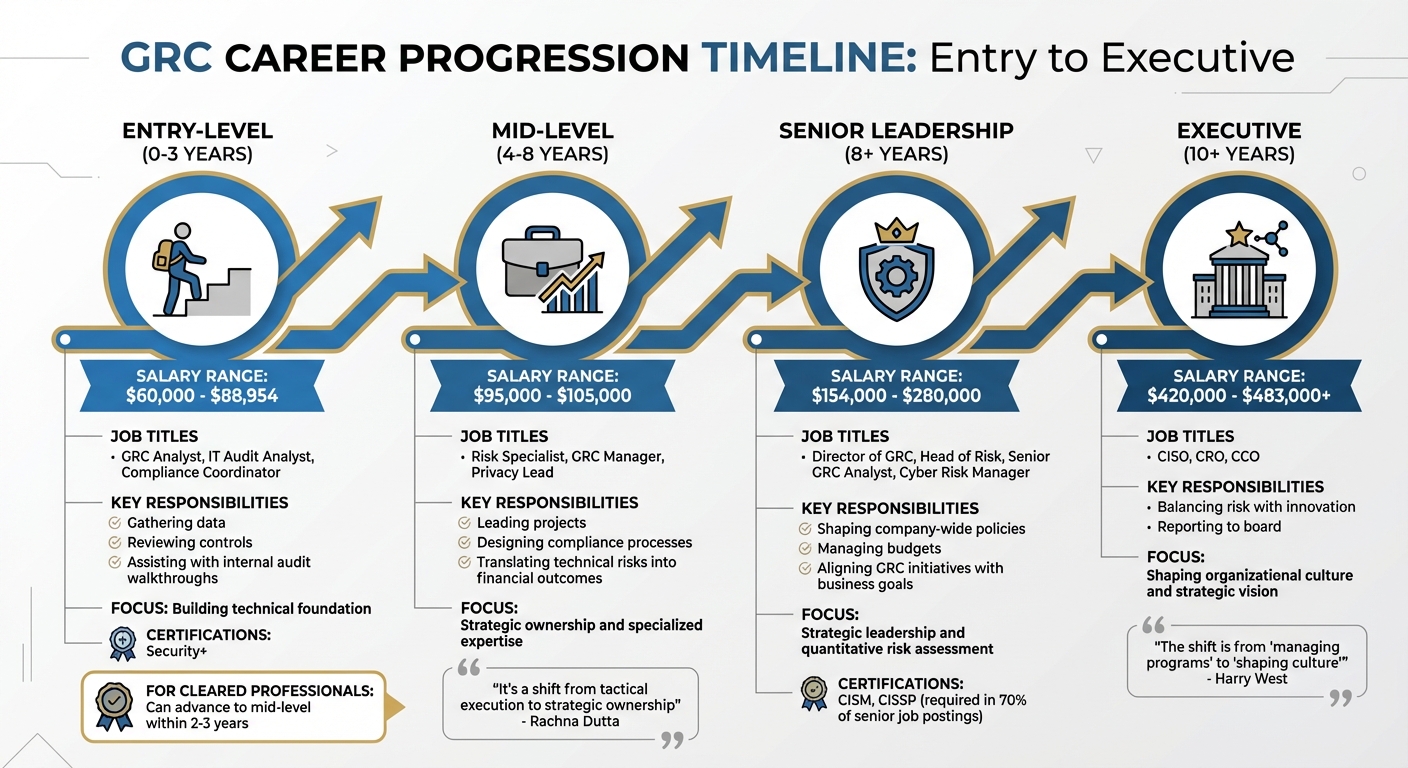
GRC Career Progression Timeline: From Entry-Level to Executive Roles
GRC Career Progression Timeline
A career in GRC typically unfolds in four stages, each with its own set of skills and responsibilities.
- Entry-Level Stage (0–3 years): At this stage, you’ll find roles like GRC Analyst, IT Audit Analyst, or Compliance Coordinator. Your focus will be on tasks like gathering data, reviewing controls, and assisting with internal audit walkthroughs. This is where you build your technical foundation and earn certifications like Security+ to kick-start your career.
- Mid-Level Stage (4–8 years): Here, the emphasis shifts to taking ownership and developing specialized expertise. Roles such as Risk Specialist, GRC Manager, or Privacy Lead involve leading projects, designing compliance processes, and translating technical risks into financial outcomes.
"It’s a shift from tactical execution to strategic ownership, where mid-level professionals step into roles with greater governance and oversight responsibilities." – Rachna Dutta, Infosec Consultant
- Senior Leadership Level (8+ years): At this point, you’ll step into positions like Director of GRC or Head of Risk. Your responsibilities broaden to include shaping company-wide policies, managing budgets, and aligning GRC initiatives with overarching business goals.
- Executive Stage (10+ years): Titles such as Chief Information Security Officer (CISO), Chief Risk Officer (CRO), or Chief Compliance Officer (CCO) come into play. These roles demand balancing risk with innovation while reporting directly to the board.
For professionals with active security clearances, career progression can be faster, often reaching mid-level roles within just 2–3 years. As you climb the ladder, honing your strategic leadership skills becomes increasingly important.
What You Need for Senior GRC Positions
Cleared professionals aiming for senior GRC roles need a combination of strategic leadership and technical expertise. Moving beyond the foundational skills, senior positions require a shift in mindset. You’ll need to bridge the gap between technical vulnerabilities and their business implications, such as revenue loss or contractual penalties. Building consensus across departments – legal, finance, and IT – is also crucial.
Quantitative risk assessment becomes a key skill at this level. Frameworks like FAIR can help you assign monetary values to risks, allowing you to integrate risk, compliance, and audit functions effectively.
"The shift here is from ‘managing programs’ to ‘shaping culture.’ And that takes both courage and clarity." – Harry West, GRC Practitioner
Certifications like CISM or CISSP are often required, appearing in over 70% of senior-level job postings. Most senior roles also demand at least eight years of experience [11]. Compensation reflects the responsibility: Senior GRC Analysts earn between $154,000 and $209,000, while Cyber Risk Managers can command salaries from $215,000 to $280,000 [3].
To advance, focus your efforts strategically:
- Dedicate 70% to hands-on experience, such as drafting policies or managing mock audits.
- Spend 20% networking and seeking mentorship.
- Allocate the remaining 10% to earning formal certifications [3].
Develop a portfolio showcasing your leadership in initiatives like ISO 27001 gap assessments or third-party risk management programs. Learn to frame risks in business terms, emphasizing ROI and financial impact, to stand out in senior-level roles.
How to Use Your Security Clearance in GRC
Your active security clearance can fast-track your career in Governance, Risk, and Compliance (GRC) by unlocking higher-paying roles. Just like technical skills and certifications, a security clearance enhances your qualifications for advanced positions. Let’s dive into where cleared professionals can find these opportunities and why the level of your clearance is so important.
Where to Find Cleared GRC Jobs
The job market for cleared professionals operates differently from the typical cybersecurity hiring space. Many roles requiring a security clearance aren’t advertised on general job boards because employers specifically seek candidates with active clearances.
To get started, explore platforms tailored for cleared professionals. Cleared Cyber Security Jobs is a great example, focusing solely on connecting security-cleared candidates with employers in cybersecurity. The site offers features like clearance-specific job search filters, resume uploads, and job alerts that notify you when positions matching your qualifications become available.
Another effective option is attending clearance-specific job fairs. These events often provide direct access to unadvertised roles, as many employers prefer to fill cleared positions through referrals before making them public.
While finding the right job is crucial, the level of your security clearance plays an equally vital role in shaping your career path.
Why Your Clearance Level Matters
The value of your clearance level cannot be overstated in the GRC job market. It determines the roles you qualify for, your earning potential, and how far you can advance in your career.
- Confidential clearances (valid for up to 15 years) typically open doors to entry-level positions.
- Secret clearances (valid for up to 10 years) make you eligible for many federal contractor GRC roles.
- Top Secret clearances (valid for up to 5 years) grant access to the most lucrative and sensitive opportunities in the field.
"Trust, once earned, is the currency of opportunity. Holding security clearance does more than open up doors – it sends the message to prospective employers that you’re the type of individual who can be trusted at your best." – Charm Paz, CHRP, Recruiter & Editor, GCheck [17]
In industries like payments and fintech, GRC professionals with active clearances often see salary boosts of up to 15%, as employers prioritize candidates who can hit the ground running [3]. Clearances, however, require sponsorship by a federal agency or contractor after a job offer. To maintain your clearance, ensure timely reinvestigations and adhere to all guidelines – this protects your career investment.
For even greater career prospects, pair your clearance with certifications such as CISA, CRISC, or ISO 42001 (AI Governance). These credentials can help you secure specialized roles in the ever-evolving GRC landscape [3].
Conclusion
Building a career in cleared GRC (Governance, Risk, and Compliance) requires a mix of practical skills, targeted certifications, and taking full advantage of your security clearance. As outlined earlier, developing expertise in frameworks like NIST and earning certifications such as CISA and CRISC are essential steps toward success. Your technical skills – whether it’s implementing NIST standards, conducting quantitative risk assessments, or working with platforms like ServiceNow GRC or RSA Archer – serve as the backbone of your professional capabilities. Certifications like ISO 42001, CISA, and CRISC can fast-track your advancement into senior-level roles [3].
Your security clearance sets you apart, especially in high-stakes industries like defense, government, and finance. With cybercrime expected to cost the global economy $12.2 trillion annually by 2031, cleared professionals with the right expertise are in high demand. Competitive salaries reflect this, with senior roles earning up to $209,000 and executive positions surpassing $483,000 [3].
Start building your expertise now by creating sample security policies, drafting mock risk registers, or performing gap analyses [14]. The 70-20-10 approach – focusing on hands-on experience, networking, and formal certifications – can help you balance your professional development effectively [3].
The GRC landscape has evolved from simple compliance tasks to a more strategic role, enabling organizations to manage risks proactively and operate with greater resilience. With interest in roles like GRC Analyst skyrocketing by 1,000% over the past five years, now is the time to prepare for a thriving career in this growing field [3]. Take the steps today to become a leader in building secure and resilient organizations for the future.
FAQs
What does a GRC analyst do day to day?
A GRC (Governance, Risk, and Compliance) analyst plays a key role in ensuring an organization adheres to legal, regulatory, and internal standards. Their responsibilities cover a range of tasks, including conducting risk assessments, refining internal controls, and managing compliance documentation like System Security Plans (SSPs). They also assist with audits, such as those related to the Risk Management Framework (RMF).
Collaboration is a big part of the job. GRC analysts work closely with various teams to implement and oversee security controls, monitor compliance efforts, and address any violations that arise. Tools like ServiceNow and Nessus often come into play to streamline these processes.
To excel in this role, a combination of strong technical expertise and clear communication skills is essential. These abilities help ensure that compliance efforts are both effective and well-coordinated across the organization.
Which certification should I earn first for cleared GRC roles?
The best certification to begin with for cleared GRC roles is CompTIA Security+. This certification offers a solid grounding in security principles and is frequently considered a baseline requirement for numerous cleared compliance positions.
How do I leverage my security clearance to get hired faster in GRC?
Highlighting your security clearance can speed up your hiring process in GRC roles. Make it a focal point in your job applications by showcasing your clearance level and the rigorous vetting you’ve undergone. This demonstrates to employers that you’re already pre-qualified, saving them time. To keep this advantage, ensure you follow all necessary guidelines to maintain your clearance. Focus on positions that explicitly require cleared candidates – this can help you skip some early screening steps and get hired faster.