

Cleared Security Architects are in high demand due to the growing complexity of cybersecurity threats and the stringent requirements of federal systems. These professionals design secure frameworks for classified environments, ensuring compliance with regulations like CMMC 2.0 and DoD Directive 8140. With cybercrime expected to cost $10.76 trillion annually by 2026, organizations need skilled architects to protect critical systems.
Key Takeaways:
- High Demand: Cybersecurity roles, including Security Architects, are projected to grow by 32% through 2032.
- Salary Premiums: TS/SCI clearance holders earn an average of $131,907 annually, with Full Scope Polygraph professionals earning $148,314 on average.
- Path to Success: A career typically spans 7–10 years, starting in IT roles like Network Administrator or Security Engineer, with certifications like CISSP and ISSAP being essential.
- Core Skills: Expertise in cloud platforms, Zero Trust architecture, compliance frameworks, and advanced networking is critical.
Security Architects bridge technical expertise and strategic planning, making them indispensable in safeguarding national security systems.
What Does a Security Architect Do? (The Real Security Architect Job Description)
sbb-itb-bf7aa6b
What Security Architects Do in Cleared Organizations
Security Architects working in cleared environments play a crucial role in blending technical design, regulatory compliance, and mission-critical protection. Unlike commercial roles, their focus is on systems tied to national security, where even minor flaws can jeopardize intelligence operations or defense strategies. This requires them to merge advanced security practices with the strict requirements of federal frameworks and the complexities of handling classified data. Their work forms the backbone of the responsibilities detailed below.
They also act as translators, turning complex threat scenarios into terms that government and military leaders can understand. This helps bridge the gap between technical implementation and executive decision-making, ensuring security investments align with broader mission goals [3].
Main Responsibilities of a Security Architect
Security Architects create the core security framework that defends classified systems throughout their lifecycle – from initial design to full deployment. This includes evaluating and integrating new technologies like cloud platforms and Zero Trust models, all while adhering to federal regulations. For instance, during cloud migrations, they ensure configurations meet FedRAMP standards, confirming that both service providers and internal systems comply with federal data protection requirements [3].
They also ensure that emerging technologies align with mission objectives and regulatory policies [3][5]. As AI-driven security tools like Claude Code Security become more common, architects carefully assess their recommendations while maintaining ultimate control over security decisions [5].
The evolution of security challenges, as reflected in recent updates to the OWASP Top 10, has shifted the focus from isolated code fixes to comprehensive architectural strategies [5]. Today, cleared architects embed security principles directly into infrastructure, using tools like Service Mesh with Istio Ambient to enforce mutual TLS and Zero Trust across entire platforms, rather than just individual applications [5].
Why Defense and Government Organizations Need Security Architects
Security Architects do more than design technical solutions – they address the high stakes of national defense and the stringent demands of regulatory compliance. Unlike commercial organizations, defense contractors and government agencies deal with security issues where failures can have far-reaching consequences for national security.
The need for skilled professionals in this field is growing rapidly. The U.S. Bureau of Labor Statistics projects a 29% increase in information security analyst roles, including architecture-specific positions, between 2024 and 2034 [4]. In Virginia, a key hub for cleared work, employment for these roles is expected to rise by 45.4% through 2028 [6].
Compensation reflects the expertise and clearance requirements these roles demand. In the Washington, D.C. area, Security Architects earn an average of $149,830 annually, which is 16% higher than the national average. Nationwide, the median total pay for these professionals is projected to reach $223,000 by late 2025 [4][6]. These figures highlight how the responsibility of safeguarding classified systems translates into exceptional career opportunities for cleared professionals.
Education and Certifications You’ll Need
Breaking into a career as a cleared Security Architect requires a solid mix of education and professional certifications. In federal and defense sectors, these qualifications are often non-negotiable for mid- and senior-level roles. A degree lays the groundwork in areas like network security, digital forensics, and system administration, while certifications prove your ability to apply that knowledge in classified, high-stakes environments. Here’s a closer look at the education and certifications essential for this career path.
Degrees That Help You Get Started
A bachelor’s degree in Computer Science, Information Technology, or Cybersecurity is typically the first step. Around 40% of Security Architects hold a bachelor’s degree, while 60% go on to earn a master’s degree [2].
For those aiming at senior roles, a Master’s in Cybersecurity or an MBA can provide a competitive edge. These advanced degrees help you transition from hands-on technical work to strategic planning and policy development. They may even substitute for some years of experience, fast-tracking you into leadership positions where you’re shaping security frameworks rather than just implementing them [2].
But education alone isn’t enough. Certifications are critical for proving your skills and navigating the complexities of classified environments.
Certifications for Cleared Security Architects
The CISSP (Certified Information Systems Security Professional) is often the baseline requirement for senior-level security roles in cleared environments. Covering eight major security domains, it’s a must-have for those pursuing architect-level positions. Once you’ve earned the CISSP, the CISSP-ISSAP (Information Systems Security Architecture Professional) takes things further by validating your expertise in enterprise-level security design [2][8].
For cleared professionals, compliance with Department of Defense 8570/8140 requirements is essential. Specifically, certifications targeting the Information Assurance System Architects and Engineers (IASAE) levels are necessary for system design roles [7]. Framework certifications like TOGAF and SABSA are also highly valued, as they equip you with enterprise architecture methodologies. Additionally, specialized credentials like CEH (Certified Ethical Hacker) and CNDA (Certified Network Defense Architect) highlight your ability to understand and counter adversary tactics – skills that defense contractors prize [7][8].
"In many cleared jobs, before you get the job, they’re going to make you take their own exam to show that you know the technology. So, on your certification journey, it’s important to not only acquire the knowledge, but also acquire the skills." – Kevin King, Director of Learning, EC-Council [7]
Certifications like the CISSP-ISSAP require regular renewal – usually every three years – through continuing education credits [7][8]. Letting these certifications lapse can create career roadblocks, especially when applying for promotions or new roles in cleared environments. Often, there’s only a short window to renew before losing eligibility for certain positions [7].
These qualifications not only enhance your technical expertise but also ensure you meet the rigorous demands of national security systems. Staying on top of renewals keeps you competitive and ready to tackle the ever-changing challenges in cybersecurity.
How to Move into a Security Architect Position
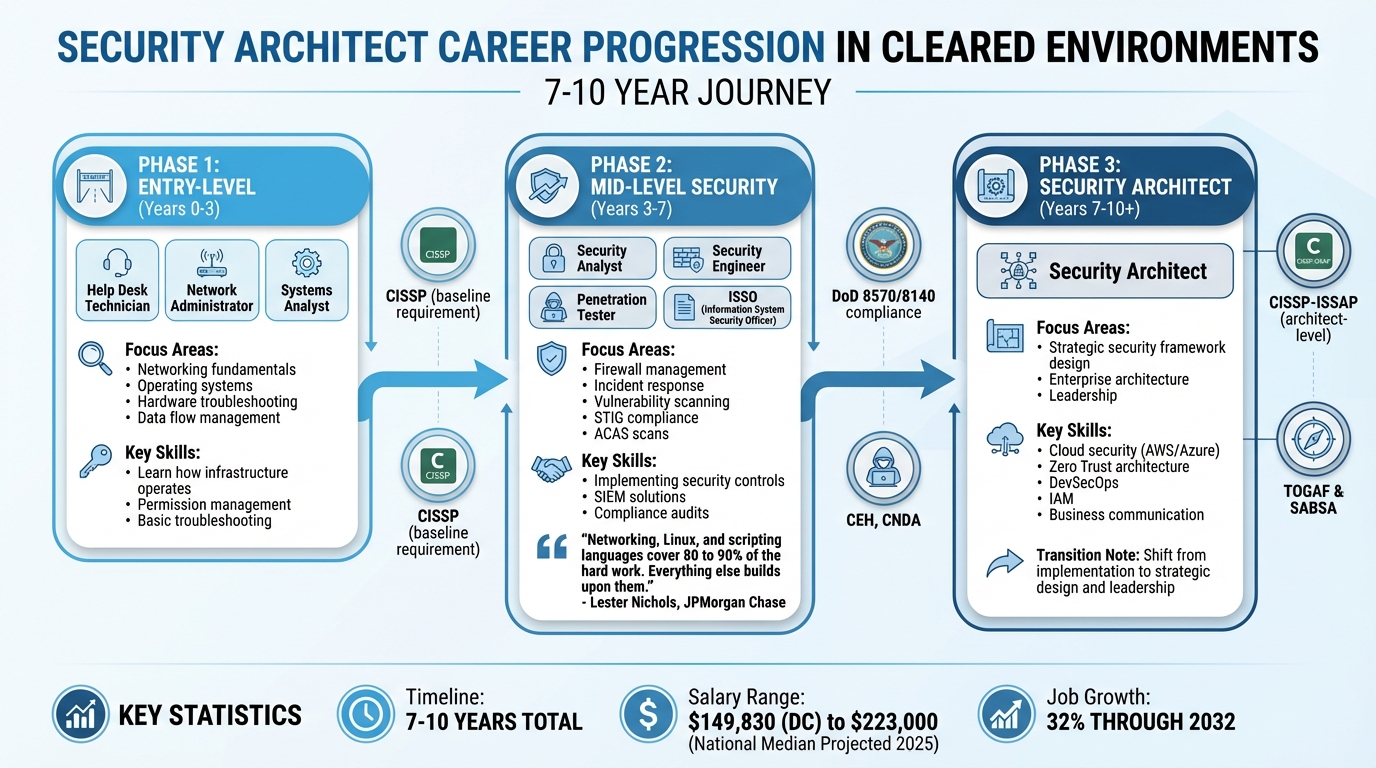
Security Architect Career Path Timeline: From Entry-Level to Leadership
Becoming a Security Architect is no quick leap – it’s a journey that typically spans 7 to 10 years, progressing through various IT and cybersecurity roles [9]. Interestingly, the path doesn’t usually begin in security. Instead, it starts in general IT, where you gain a deep understanding of how infrastructure operates – knowledge that’s critical before you can effectively protect it. Building on foundational education and certifications, each step along the way equips you with the skills needed for this advanced role.
Starting Positions and Mid-Level Roles
The first few years of your career might see you in roles such as Help Desk Technician, Network Administrator, or Systems Analyst. These positions are all about learning the basics – how data flows through networks, managing permissions, and troubleshooting issues. Mastering networking, operating systems, and hardware during this phase lays the groundwork for more specialized security work.
As you gain experience, you’ll transition into mid-level security roles like Security Analyst, Security Engineer, or Penetration Tester. These roles are where you shift from general IT to hands-on security tasks. You’ll work on managing firewalls, responding to incidents, scanning for vulnerabilities, and implementing security controls. If you’re in a cleared environment, you could take on roles like Information System Security Officer (ISSO), working on STIG compliance or conducting ACAS scans. These environments bring unique challenges, particularly in safeguarding systems tied to national security.
The leap from Security Engineer to Security Architect is a big one. While engineers focus on implementing solutions, architects are responsible for designing the broader security strategy. This requires not just technical expertise but also strategic thinking and leadership. Projects like implementing SIEM solutions or conducting compliance audits offer opportunities to showcase your ability to design comprehensive security frameworks.
"Networking, Linux, and scripting languages cover 80 to 90% of the hard work. Everything else builds upon them." – Lester Nichols, Director of Security Architecture, JPMorgan Chase & Co. [9]
Once you’ve established yourself in mid-level roles, the next step is to refine your technical expertise and develop leadership skills.
Building Specialized Skills
As you progress, focus on strengthening key technical areas. Deepen your knowledge of networking, including ports and services, and become proficient in Linux, which underpins many security tools. Learn scripting languages like Python, PowerShell, or Bash, as these are invaluable for automation and problem-solving.
In mid-level roles, it’s also important to broaden your skill set. Dive into areas like cloud security (on platforms like AWS or Azure), Zero Trust architecture, identity and access management, and DevSecOps. If you’re a software developer, focus on secure coding practices and API security to transition into Application Security. The trick is not to specialize too early – explore related fields to build a well-rounded skill set.
Maintaining a home lab is a fantastic way to experiment with new technologies and stay sharp. Dedicate 4–6 weekends a year to refreshing your skills and exploring emerging trends. This not only keeps you current but also shows initiative.
Lastly, work on your communication skills. Being able to translate complex technical concepts into clear, actionable business risks is a critical part of stepping into a leadership role like Security Architect.
Skills You Need to Succeed
To excel as a Security Architect, you’ll need a blend of technical expertise, communication savvy, and leadership abilities. Success in this role involves mastering network security, encryption, cloud platforms, and compliance frameworks, while also being able to communicate effectively, think strategically, and guide teams.
Technical Knowledge and Security Frameworks
A strong technical foundation is non-negotiable. This includes expertise in network security tools like firewalls, VPNs, and IDS/IPS systems, as well as Identity and Access Management (IAM) and Public Key Infrastructure (PKI). Familiarity with encryption standards such as AES, RSA, and TLS/SSL is also essential. In cleared environments, you’ll often work with frameworks like the DoD Risk Management Framework (RMF), Security Technical Implementation Guides (STIGs), and tools like eMASS for managing authorization packages. Additionally, hands-on experience with NIST SP 800-53 is crucial for implementing security and privacy controls in federal systems.
As cloud platforms dominate, expertise in secure environments like AWS GovCloud and Microsoft Azure Government is increasingly important. Understanding cloud-native tools like AWS KMS and Azure Key Vault, as well as mastering at least one major cloud platform, is vital. The principles you learn will often apply across platforms [10]. Beyond cloud, knowledge of Zero Trust Architecture (ZTA) – covering identity, device, network, and data layers – is critical, as is integrating security into DevSecOps pipelines using tools for SAST, DAST, and container security.
Enterprise architecture frameworks, such as SABSA and TOGAF, help align security initiatives with broader business objectives [2]. Tools like MITRE ATT&CK enhance your ability to model threats and understand adversary tactics. Certifications like ISSAP (Information Systems Security Architecture Professional), in addition to CISSP, can further validate your expertise in security architecture [2]. Beyond technical mastery, translating these concepts into actionable business strategies is just as important.
Business and Communication Abilities
Technical skills will get you far, but business and communication abilities are what set advanced professionals apart. Security Architects often act as "security ambassadors", bridging the gap between technical systems and business objectives [2]. This means translating complex threats into terms that executives and non-technical stakeholders can easily grasp [11][3].
"Every day I wear multiple hats for my organization. … This can be tactical, strategic and technical." – Pranshu Bajpai, Security Architect, Motorola [13]
You’ll need to explain the value of security initiatives – like adopting Zero Trust – to decision-makers, including CFOs [3]. Leading cross-functional teams on projects that involve IT, compliance, and operations will sharpen your ability to engage stakeholders effectively [3]. Mentoring junior staff is another way to develop leadership skills while preparing for the strategic demands of the role [12][2]. Clear documentation is equally important; you’ll need to produce reports and proposals that resonate with both technical teams and business leaders [11].
Understanding how your organization creates value – and balancing security needs with usability and cost – is a key part of the job [12]. With 92% of organizations reporting gaps in cybersecurity skills [2], professionals who combine technical depth with business insight stand out in the cleared community.
How Your Security Clearance Helps Your Career
Having an active security clearance can be a game-changer for your career. It opens the door to specialized roles, boosts earning potential, and provides job stability that’s hard to match – even for those with strong technical skills. Knowing how to leverage these benefits can give you an edge in the competitive cybersecurity job market.
Job Opportunities for Cleared Security Architects
An active clearance grants you access to roles that are off-limits to most professionals. Defense contractors and government agencies are especially eager to hire Security Architects with clearances to design secure systems for classified operations. For instance, as government IT modernization efforts ramp up, particularly with the shift to Zero Trust Architecture, there’s a growing need for cleared professionals who can transition outdated systems to secure cloud environments. Similarly, the implementation of CMMC 2.0 by late 2025 has created demand for architects skilled in designing systems that meet Level 3 requirements for Defense Industrial Base contractors. These jobs not only require technical know-how but also the ability to work in classified settings and enforce strict security protocols. The rigorous clearance process limits competition, creating a niche job market with fewer candidates vying for these roles [1].
These positions don’t just offer unique challenges – they also come with higher paychecks.
Pay and Benefits for Cleared Professionals
The exclusivity of cleared roles comes with impressive financial perks. Your clearance level directly impacts your salary, with TS/SCI clearance holders earning significantly more. Add a Full Scope Polygraph (FSP), and the national average salary jumps to $148,314. In high-demand areas like Washington, D.C., TS/SCI FSP holders can earn over $206,143 annually. Principal Security Architects who pair their clearances with certifications like CISSP (to meet DoDD 8140 Level III standards) and cloud expertise typically see salaries ranging from $150,000 to over $206,143. Another advantage? Recruitment is faster for candidates with polygraph clearances – sometimes taking hours instead of weeks – making job stability in this field almost unparalleled [1].
As cybersecurity needs continue to grow, your clearance remains a powerful tool for landing top-tier roles and commanding premium salaries.
Your Next Steps to Becoming a Cleared Security Architect
Stepping into a Security Architect role requires a well-thought-out plan. Start by earning a CISSP certification, which lays the groundwork for broad security knowledge. From there, pursue specialized credentials like ISSAP or SABSA, and round out your expertise with vendor-specific cloud security certifications for platforms like AWS GovCloud or Azure Government environments [2]. This blend of general and specialized knowledge is exactly what cleared organizations are looking for.
While certifications are essential, hands-on experience is just as important. Security Architect roles generally call for 5–10 years of experience in IT and cybersecurity [2]. If you’re currently working as a Security Engineer or Analyst, focus on projects that showcase your ability to think strategically. Examples include designing security frameworks, restructuring networks, or conducting compliance audits [2]. These experiences not only sharpen your expertise but also demonstrate your readiness for a more strategic role. And don’t forget – your active clearance gives you a competitive edge in this field.
The demand for information security professionals is skyrocketing. Jobs in this sector are expected to grow by 32% through 2032, and 92% of organizations report a gap in cybersecurity skills [2]. With your clearance already setting you apart, combining technical skills with an architectural mindset will make you a standout candidate.
Once your certifications and experience align, take advantage of resources like Cleared Cyber Security Jobs to propel your career forward. This platform offers tailored tools such as job alerts, career resources, and job fairs specifically for cleared professionals. Upload your resume, set up alerts for Security Architect roles, and connect with employers who value your unique qualifications. The path from engineer to architect is within reach – now it’s time to make your move.
FAQs
Do I need a TS/SCI to become a Security Architect?
For senior Security Architect roles, especially those dealing with classified or sensitive government systems, a TS/SCI clearance is frequently a must-have. That said, it’s not always a requirement for entry-level roles or positions that handle less critical systems. The specific clearance needed often depends on the organization’s needs and the responsibilities tied to the role.
Which certifications matter most for DoD 8140 architecture roles?
Certifications play a crucial role in DoD 8140 architecture roles. Key certifications include CISSP and IASAE (Levels I-III), which are highly regarded for advanced security expertise. Additionally, widely recognized certifications like CISM, Security+, CCSP, and specialized Microsoft certifications are often essential. The exact certifications required can differ depending on the specific responsibilities of the role.
How do I show “architect-level” experience without the title?
Highlighting your skills, responsibilities, and achievements effectively is key when aiming for a Security Architect role. Focus on showcasing your ability to design secure systems, implement robust controls, and lead security initiatives. Even if you haven’t held the formal title, emphasize your leadership and technical expertise through relevant experiences.
Make sure to include hands-on experience with frameworks like DoD RMF or Zero Trust. Certifications such as CISSP or TOGAF are also worth mentioning, as they demonstrate your qualifications and commitment to the field. Use measurable results from past projects to illustrate your impact – think along the lines of reducing vulnerabilities, improving compliance rates, or successfully deploying secure infrastructure.
Tailor your resume to align with these responsibilities. For example, highlight accomplishments like leading a team in implementing multi-factor authentication, designing network segmentation strategies, or conducting risk assessments that enhanced organizational security. By doing so, you’ll present yourself as a strong candidate, even without the official title of Security Architect.