• Skip to primary navigation
  • Skip to main content
Cleared Cyber Security Jobs | CyberSecJobs.com

Cleared Cyber Security Jobs | CyberSecJobs.com

Cleared Cyber Security Jobs

  • Home
  • Search Cleared Cyber Jobs
  • Job Fairs
  • Career Resources

Career Paths

Cryptanalyst Career Path for Cleared Intelligence Professionals

CyberSecJobs Editorial · March 18, 2026 ·

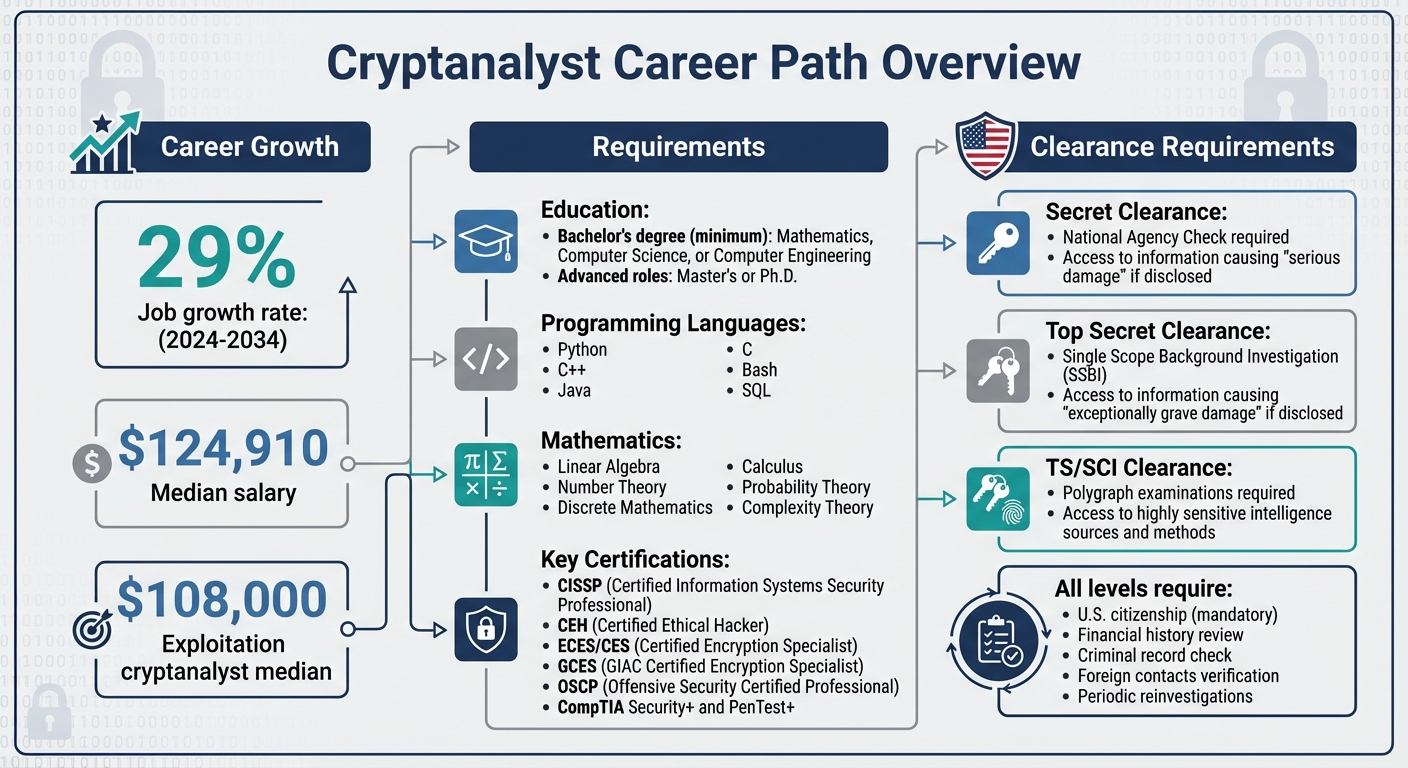
Cryptanalysts are modern codebreakers working in intelligence to analyze and break encryption systems, revealing crucial data for national security. With demand for information security roles projected to grow by 29% from 2024 to 2034 and median salaries reaching $124,910, this career path offers strong opportunities for cleared professionals. Essential qualifications include a degree in mathematics or computer science, programming expertise in Python, C++, and Java, and certifications like CISSP or CEH. Most roles require a Secret or Top Secret clearance, which involves thorough background checks. Platforms like Cybersecjobs.com can help you find these specialized roles. Start by building your skills, earning certifications, and leveraging your clearance to secure a rewarding career in cryptanalysis.
Cryptanalyst Career Requirements: Skills, Education, and Clearance Levels

Cryptanalyst Career Requirements: Skills, Education, and Clearance Levels

What Are The Career Paths In Secure Cryptography? – Next LVL Programming

sbb-itb-bf7aa6b

What Cryptanalysts Do in Intelligence Roles

Cryptanalysts working in intelligence roles focus on decoding and analyzing encrypted communications from foreign governments, terrorist groups, and criminal organizations. Their mission is to uncover hidden information that informs high-stakes decisions for national security. These roles are designed specifically for security-clearance environments, where protecting sensitive information is a top priority.

Daily Cryptanalysis Tasks

On a typical day, cryptanalysts handle encrypted data collected through signals intelligence (SIGINT) operations. Their job involves analyzing these communications to identify weaknesses in encryption algorithms or errors in coding. Beyond cracking codes, they ensure data collection systems are running smoothly and evaluate the security of cryptographic systems to uncover vulnerabilities that could grant access to target networks. To do this, they often develop and test custom tools using programming languages like Python, C++, and Java.

For example, in January 2026, the NSA sought Exploitation Cryptanalysts at Fort Meade, MD. These professionals were tasked with diagnosing and exploiting encrypted material while debugging software to support national security. The role included participation in the Cryptanalysis Development Program (CADP), which required completing five tours of duty over three years. These assignments emphasized collaboration with analysts and engineers to tackle complex technical challenges.

Role Component Primary Tasks
Technical Analysis Identifying weaknesses in algorithms; diagnosing software issues
Operational Support Analyzing encrypted data; ensuring quality in data collection systems
Development Creating and testing cryptanalysis tools; validating hypotheses with code
Collaboration Sharing intelligence reports; working with joint operations teams

Working with Intelligence Teams

Once technical findings are gathered, cryptanalysts collaborate with broader intelligence teams. They partner with intelligence analysts, cybersecurity experts, and operations staff to turn raw data into actionable insights. This involves applying mathematical and programming skills to sift through massive datasets, uncover adversarial networks, and identify potential vulnerabilities in target systems. These efforts directly support SIGINT missions, helping to track targets and exploit access points in critical infrastructure.

In law enforcement, cryptanalysts assist investigators by deciphering encrypted digital evidence and may even testify as expert witnesses in court. Some also bridge the gap between technical cryptanalysis and program management, ensuring that cryptanalytic capabilities align with project timelines and budgets. As Professor Neal Koblitz from the University of Washington explains:

Cryptography is part of the multidisciplinary field of computer security, where people who have studied computer science, engineering, or mathematics collaborate to solve multifaceted problems.

Required Skills and Tools for Cleared Cryptanalysts

Becoming a cleared cryptanalyst isn’t just about cracking codes – it’s a complex mix of mathematical expertise, programming skills, and the ability to adapt to emerging technologies. With advancements like quantum computing and new attack methods, staying ahead in this field requires constant learning and problem-solving.

Mathematics and Programming Skills

Cryptanalysts lean heavily on mathematics to expose vulnerabilities in encryption systems. Key areas include linear algebra, number theory, discrete mathematics, and calculus. Other essential topics include differential equations, matrix algebra, complexity theory, information theory, and probability theory. As QuickStart explains:

Cryptanalysts are expert mathematicians who can design, develop, and evaluate algorithms that can be used to decipher various number theory problems.

Programming skills are just as critical. Languages like Python, C, C++, and Java are used to write algorithms and debug encryption software. Scripting languages such as Bash and query tools like SQL help with automation and data handling. Cryptanalysts also need a deep understanding of computer architecture, data structures, network protocols (like TCP/IP), and operating systems such as Linux and Unix to uncover implementation flaws in cryptographic systems.

Skill Category Essential Technical Skills
Mathematics Linear Algebra, Number Theory, Discrete Math, Calculus, Probability and Complexity Theory
Programming Python, C, C++, Java, Bash, SQL
Technical Domains Computer Architecture, Data Structures, Network Protocols, SIEM (e.g., Splunk)
Cryptanalysis Algorithm Diagnosis, Side-Channel Analysis, Pattern Recognition, Debugging

These skills form the backbone of a cryptanalyst’s toolkit, enabling them to tackle both theoretical and practical challenges.

Cryptanalysis Tools and Software

Cryptanalysts rely on specialized tools to perform their work effectively. For reverse engineering, Ghidra, developed by the NSA, is a go-to tool for analyzing compiled code and pinpointing cryptographic elements. Wireshark is widely used to intercept and analyze network traffic, helping cryptanalysts detect encrypted communication patterns.

To recover passwords or test brute-force attacks, tools like Hashcat and John the Ripper are indispensable. Aircrack-ng focuses specifically on breaking wireless encryption, such as WEP and WPA-PSK. For encoding, decoding, and lightweight cryptanalysis tasks, CyberChef, often dubbed the "Cyber Swiss Army Knife", is a versatile choice.

Other specialized tools include Cryptol, which evaluates how algorithms function within software, and CryptoBench, which performs cryptanalysis on messages encrypted with common algorithms. Volatility, a memory forensics tool, is used to extract encryption keys or plaintext data from RAM. The NSA Codebreaker Challenge offers hands-on experience with many of these tools, making it an excellent resource for those looking to sharpen their skills [3].

Analytical and Problem-Solving Abilities

While technical skills are essential, analytical thinking is what truly sets successful cryptanalysts apart. Pattern recognition enables them to identify hidden structures or coding systems in what might seem like random data. They must also be able to hypothesize about how encrypted data is structured, test these ideas through programming, and draw logical conclusions. As QuickStart puts it:

A cryptanalyst should have strong analytical skills, excellent problem-solving attitude, and creative mindset.

Creative thinking is especially important for tackling unconventional or unexpected problems. Cryptanalysts often have to reverse-engineer the encryption process by examining the encrypted message itself, piecing together the "internals" from external clues. Given the sensitive nature of their work, traits like ethical integrity and trustworthiness are non-negotiable. Intelligence agencies, including the NSA, actively seek out individuals with curiosity and a drive to learn – qualities that help cryptanalysts address national security challenges with precision and resourcefulness.

Education, Certifications, and Clearance Requirements

Entering the field of cryptanalysis within the intelligence community requires a strong educational background, relevant certifications, and proper security clearance. These elements are critical for success in roles that demand access to classified information. Here’s a closer look at these key qualifications.

Degree Requirements for Cryptanalysts

At a minimum, a bachelor’s degree in mathematics, computer science, or computer engineering is necessary for entry-level cryptanalyst positions. These fields equip you with the mathematical and programming expertise needed to break down complex encryption systems. For those aiming for senior or research-focused positions, advanced degrees such as a master’s or Ph.D. are often required. These qualifications pave the way for work in areas like algorithm development, quantum cryptanalysis, and academic research.

Proficiency in programming languages such as C, C++, Python, and Java is essential at every stage of education. This technical skill set is non-negotiable for tackling encryption challenges.

The demand for professionals in information security is on the rise. According to the U.S. Bureau of Labor Statistics, these roles are expected to grow by 28.5% through 2034. Median salaries for exploitation cryptanalysts were reported at $108,000 as of October 2025 [1][2]. A strong academic foundation not only prepares you for the technical aspects of the job but also boosts your competitiveness for roles requiring security clearance.

Certifications for Cleared Cryptanalysts

Certifications are another way to demonstrate your expertise and stand out in the field. Some of the most respected certifications for cryptanalysts include:

  • EC-Council Certified Encryption Specialist (ECES/CES)
  • Certified Information Systems Security Professional (CISSP)
  • Certified Ethical Hacker (CEH)
  • GIAC Certified Encryption Specialist (GCES)
  • GIAC Penetration Tester (GPEN)
  • GIAC Certified Intrusion Analyst (GCIA)
  • CompTIA Security+ and PenTest+
  • Offensive Security Certified Professional (OSCP)

Earning one or more of these certifications, in addition to your degree, can significantly boost your qualifications for intelligence roles that require clearance.

Security Clearance Requirements

Most cryptanalyst positions in intelligence demand a Secret, Top Secret, or Top Secret/Sensitive Compartmented Information (TS/SCI) clearance. These clearances grant access to classified information and are categorized based on the potential damage caused by unauthorized disclosure:

  • Secret Clearance: Requires a National Agency Check and provides access to information that could cause serious damage if compromised.
  • Top Secret Clearance: Involves a Single Scope Background Investigation (SSBI) and applies to information that could cause exceptionally grave damage.
  • TS/SCI Clearance: Includes additional polygraph examinations and grants access to highly sensitive intelligence sources and methods.

Securing any of these clearances involves an extensive background check covering your financial history, criminal record, foreign contacts, and personal conduct. U.S. citizenship is mandatory, and maintaining clearance requires strict adherence to security protocols as well as periodic reinvestigations.

Because many employers look for candidates who already hold active clearances, obtaining one early in your career can give you a significant edge when pursuing roles in the intelligence sector. These clearances are not just a formality – they are a cornerstone of trust and reliability in sensitive operations.

Finding Cleared Cryptanalyst Jobs

The job market for cleared intelligence professionals operates differently than traditional career paths. Holding a clearance gives you access to specialized roles, but knowing where and how to search is key.

Using Cybersecjobs.com for Job Search

Cybersecjobs.com

Cybersecjobs.com is a targeted platform designed for professionals with active clearances. Through the Quick Sign Up feature, you can upload your resume and make it accessible to employers actively seeking cleared candidates. This direct approach is especially effective in the intelligence field, where hiring managers prioritize applicants who already meet clearance requirements.

Take advantage of job alerts by using keywords like "cryptanalysis", "signals exploitation", or "cryptologic technician" to stay updated on relevant openings. You can also filter results by clearance level, location, and employer type. While many intelligence roles require on-site work in SCIFs (Sensitive Compartmented Information Facilities), some cyber intelligence analyst positions now offer remote or hybrid options, giving you more flexibility [5].

Cybersecjobs.com also organizes job fairs, connecting you directly with hiring managers from intelligence agencies and defense contractors. For example, nearly 45% of the 341 cyber intelligence analyst listings on the platform required TS/SCI with Polygraph clearance [5]. These events provide an excellent opportunity to showcase your qualifications and network with employers.

By leveraging these tools, you can secure a role that aligns with your skills and clearance, setting the foundation for future career growth.

Career Advancement Paths

As a cryptanalyst, your career typically progresses through several stages as you gain expertise. Entry-level roles focus on applying established decryption techniques and analyzing encrypted data under supervision. After three to five years, you can move into mid-level roles that demand more complex problem-solving and greater autonomy. For instance, Booz Allen Hamilton recently advertised a Cyber Intelligence Analyst, Mid position requiring four years of experience and a TS/SCI with Polygraph clearance, offering a salary range of $62,000 to $141,000 [5].

Senior cryptanalysts often transition into specialized research roles, tackling challenges like quantum-resistant encryption or developing new cryptanalytic techniques. Others move into leadership positions, managing analyst teams and coordinating projects across multiple agencies. As Booz Allen Hamilton highlights:

The problem facing the intelligence community (IC) is no longer how to get more data, it’s understanding how to turn the data they have into answers.

This shift underscores the growing demand for experienced cryptanalysts who can merge technical expertise with strategic thinking.

Military experience can also open doors. For example, the U.S. Navy’s Cryptologic Technician Interpretive (CTI) rating provides specialized training in foreign language communications and signals intelligence [4]. This blend of linguistic and technical skills complements civilian cryptanalyst credentials, offering an alternative pathway into intelligence roles.

As you build on your technical skills and leverage your clearance, you’ll not only advance in your career but also play a crucial role in shaping intelligence operations at a strategic level.

Conclusion

A career in cryptanalysis for cleared professionals combines technical expertise with strategic planning. To succeed, start with a solid background in mathematics or computer science and develop your programming skills in languages like Python, C++, and Java. Certifications such as the EC-Council Certified Encryption Specialist or CompTIA Security+ can help showcase your abilities.

Security clearance is a powerful asset in this field. With employment for information security professionals expected to grow by 29% through 2034 and median salaries reaching $124,910, the opportunities are plentiful [2]. Platforms like Cybersecjobs.com can help you connect with these opportunities – upload your resume, set up job alerts for cryptanalysis roles, and attend job fairs to engage directly with intelligence agencies and defense contractors. If you’re transitioning from a broader STEM background, programs like the NSA’s Cryptanalysis Development Program (CADP) offer structured training and rotational experiences to help you specialize.

Take action today by expanding your skills, earning relevant certifications, and leveraging your clearance. Explore advanced areas such as quantum cryptanalysis, blockchain security, or signals intelligence to position yourself for the next stage in your career.

FAQs

How do I get a security clearance for cryptanalyst roles?

To work as a cryptanalyst with a security clearance, there are some essential steps to follow. First, you must meet basic eligibility criteria: being a U.S. citizen, demonstrating loyalty to the country, and having a clean record – both criminal and financial. Additionally, a sponsoring employer, like a government agency or contractor, is necessary to start the clearance process.

The process begins with completing the SF-86 form, which collects detailed personal information. Afterward, you’ll go through an in-depth background investigation and an adjudication phase to determine your eligibility. Once granted, maintaining your clearance involves periodic reinvestigations and strict compliance with security protocols.

What should I study first if I’m new to cryptanalysis?

If you’re just stepping into the world of cryptanalysis, it’s important to begin with the fundamentals of cryptography and cryptanalysis. Dive into topics like encryption methods, different types of ciphers, and the techniques used to decode or analyze encrypted messages. A solid understanding of mathematics is crucial here – key areas include linear algebra, number theory, and calculus. Pursuing a bachelor’s degree in computer science or mathematics can help build the core skills you’ll need to excel in this field.

What’s the best way to find cleared cryptanalyst jobs?

The most effective way to discover cryptanalyst positions requiring clearance is by exploring job boards that specifically cater to security-cleared roles. Additionally, networking within the cybersecurity community that focuses on cleared professionals can reveal hidden opportunities. Use your security clearance as a key advantage when applying to positions with intelligence agencies or defense contractors. Make it a habit to frequently browse platforms dedicated to cleared jobs for the latest openings that match your skill set.

Related Blog Posts

  • CySA Plus Certification Career Guide for Cleared SOC Analysts
  • Digital Forensics Examiner Career Path for Cleared Professionals
  • Threat Intelligence Analyst Career Path for Cleared Professionals
  • Cryptographer Career Path for Cleared Professionals

Related Guides

  • Data Security Analyst Career Path for Cleared Professionals
  • Identity and Access Management Specialist Career Path Cleared
  • Cryptographer Career Path for Cleared Professionals
  • TS/SCI Salary Premium: Real 2026 Numbers
  • Security Clearance Interview: What to Expect

Cryptographer Career Path for Cleared Professionals

CyberSecJobs Editorial · March 17, 2026 ·

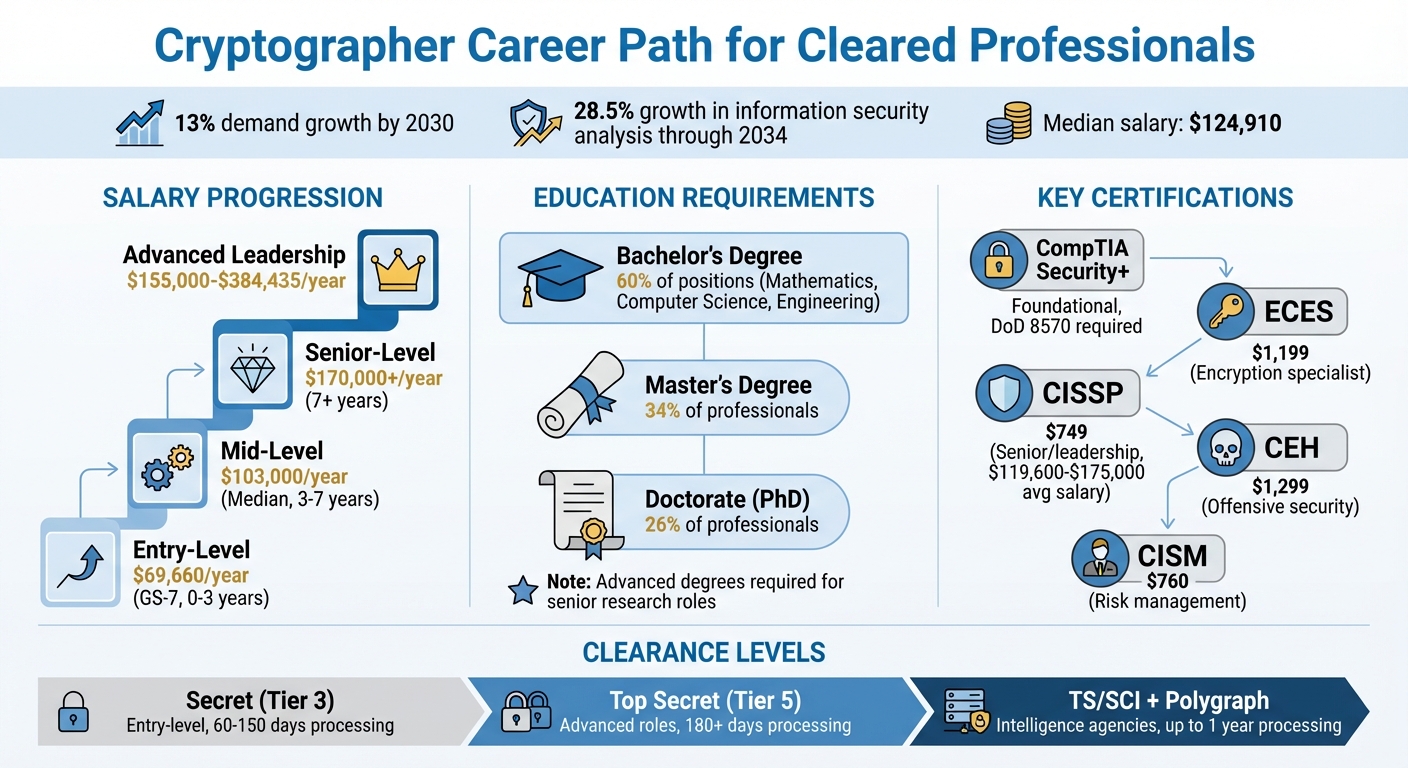
Cryptographers with security clearances are essential for protecting national security data and countering adversaries. They work in agencies like the NSA and DoD, focusing on encryption, cryptanalysis, and secure systems design. Median salary for these roles is $103,000, with demand projected to grow by 13% by 2030. Most professionals hold advanced degrees (34% Master’s, 26% Doctorate) and require U.S. security clearances, which can take up to a year to obtain.

Key Takeaways:

  • Skills Needed: Advanced mathematics, programming (C, C++, Python, Rust), and cryptographic protocols.
  • Education: Bachelor’s in Mathematics, Computer Science, or Engineering; advanced degrees for senior roles.
  • Certifications: ECES, CISSP, CEH, and Security+.
  • Career Progression: Entry-level roles start at $69,660; senior positions can exceed $170,000.
  • Clearance Levels: Secret (Tier 3) for entry-level; Top Secret/SCI (Tier 5) for advanced roles.

Professionals must navigate security clearance processes, continuous vetting, and specialized training to succeed. Opportunities are concentrated in intelligence agencies, federal contractors, and research labs.

Cryptographer Career Path: Salary Progression and Education Requirements

Cryptographer Career Path: Salary Progression and Education Requirements

How to get a Security Clearance With No Experience

What Cleared Cryptographers Do

Cleared cryptographers juggle two key responsibilities: safeguarding classified information and tackling encryption systems used by adversaries. Their work is essential for both securing government communications and gaining critical intelligence.

Protecting Classified Data

One major part of the job is creating encryption systems that shield sensitive information. Cryptographers develop complex algorithms and digital keys, embedding them into both software and hardware to keep data safe during transmission and storage. They also evaluate existing security setups, identifying and fixing vulnerabilities that could be exploited by hackers or foreign entities. This proactive approach ensures that classified data stays out of the wrong hands.

Conducting Cryptanalysis

Cryptanalysts, often the same professionals handling encryption, focus on dismantling the encryption systems of foreign governments or criminal networks. As a National Security Agency spokesperson puts it, "Cryptanalysts at NSA find ways to get around those protections so that the United States has the information it needs for national security" [4]. This process involves spotting mathematical flaws or programming mistakes in encryption methods. It’s a highly creative and analytical task that often requires thinking outside the box. Their findings not only support intelligence efforts but also help strengthen the security of future systems.

Collaborating in Secure Systems Design

Beyond encryption and decryption, cryptographers work with multidisciplinary teams to create secure systems from the ground up. They team up with software developers, IT specialists, and government agencies to build protocols tailored for classified environments. Security Architects play a key role, crafting frameworks and policies that safeguard critical assets. Whether it’s debugging software, designing new cryptanalysis tools, or monitoring data flows, these professionals ensure security measures are deeply integrated into system designs. Collaboration like this not only enhances system security but also provides a pathway for cryptographers to move into strategic leadership roles within their field.

Required Skills and Qualifications

Excelling in cleared cryptography requires a mix of specialized knowledge and practical expertise. With the U.S. Bureau of Labor Statistics forecasting a 31.5% growth in security analyst jobs over the next decade [5], this is an ideal time to develop the skills needed for a career in this field.

Mathematics and Algorithms

Cryptography is deeply rooted in applied mathematics. Key areas like number theory underpin algorithms such as RSA, focusing on concepts like integers, prime numbers, and modular arithmetic. Abstract algebra, especially group theory and finite fields, is critical for mastering Elliptic Curve Cryptography (ECC). Probability and statistics also play a role in assessing system vulnerabilities and the likelihood of key compromise. As The Crypto Recruiters explain:

A flawed implementation of a perfect algorithm is just as insecure as a flawed algorithm. The code is where the theory meets reality, and even a tiny mistake can create a catastrophic vulnerability [5].

Programming Languages

Turning mathematical theory into secure, functional systems requires strong programming skills. Languages like C and C++ are essential for performance-critical applications, low-level hardware security, and building cryptographic libraries. Python is widely used for tasks like rapid prototyping and security analysis, thanks to libraries like PyCryptodome. Meanwhile, Rust is gaining traction in the security field for its memory safety features, and the industry is increasingly embracing memory-safe languages like Rust and Go. Hands-on experience, such as participating in Capture The Flag (CTF) competitions or contributing to open-source projects, can showcase your abilities to potential employers.

Clearance-Specific Knowledge

Working in classified environments demands expertise in security protocols, including end-to-end encryption, Public Key Infrastructure (PKI), and both symmetric and asymmetric cryptography. A deep understanding of computer architecture is also vital for defending against side-channel attacks, where adversaries exploit physical signals like power usage or electromagnetic emissions to access sensitive data. Adopting an adversarial mindset is equally important – anticipating attack strategies helps safeguard national security and meet the rigorous operational demands of classified work.

Education and Certifications

Educational Pathways

To step into a career in cryptography, a bachelor’s degree in Mathematics, Computer Science, or Electrical Engineering is typically required. Mathematics degrees are especially valued because they cover key areas like number theory, abstract algebra, and discrete mathematics – subjects that form the backbone of modern encryption algorithms. On the other hand, Computer Science and Electrical Engineering programs equip students with the programming skills and hardware knowledge essential for implementing cryptographic systems and defending against threats like side-channel attacks.

For those aiming for senior research roles, particularly with organizations like the NSA or NIST, a Master’s or PhD in Cryptography, Theoretical Computer Science, or Applied Mathematics is often necessary. These advanced degrees allow professionals to focus on developing new algorithms, conducting cryptanalysis, or contributing to post-quantum cryptography research. Coursework in Linear Algebra, Number Theory, Probability, and Complexity Theory is crucial for excelling in these roles. Additionally, internships at government agencies such as the NSA, NIST, or national labs can provide valuable experience in classified environments early in one’s career.

Specialized institutions like the National Intelligence University (NIU) and the National Cryptologic School (NCS) offer classified education specifically designed for cleared professionals [9]. The NCS, part of the National Cryptologic University, provides training in cryptology at over 20 university campuses and cryptologic centers [9]. For military personnel and NSA civilians, the Accelerated Degree Program (ADP) offers college credit for NCU coursework and military training through partner institutions [9].

This solid academic groundwork is often complemented by certifications that validate expertise in cryptography and related fields.

Key Certifications for Cleared Cryptographers

Certifications not only validate your skills but are often required for cleared positions under DoD 8570/8140 mandates. One standout option is the EC-Council Certified Encryption Specialist (ECES), which focuses on the practical use of symmetric and asymmetric algorithms, hashing, and PKI. The ECES certification is particularly valuable for those seeking hands-on cryptographic knowledge, with the exam priced at around $1,199 [7].

The CompTIA Security+ certification is a foundational requirement for many cleared roles, offering baseline security knowledge that aligns with DoD 8570 compliance.

For senior or leadership positions, the Certified Information Systems Security Professional (CISSP) is a must. This ANSI-accredited and DoD-approved certification covers cryptography within a broader security framework and is highly regarded for management and architecture roles. The exam costs $749 [1], and CISSP-certified professionals in the U.S. report average salaries between $119,600 and $175,000 [7].

The Certified Ethical Hacker (CEH) certification is geared toward offensive security and penetration testing roles, especially in government sectors. This certification comes with an exam fee of approximately $1,299 [7].

Finally, the Certified Information Security Manager (CISM) takes a risk management approach to cryptography. This certification costs $760, or $575 for ISACA members [1], and is particularly useful for professionals focusing on security governance and risk management.

Security Clearance Requirements

Types of Security Clearances

Cryptographers working with classified information need clearances aligned with the sensitivity of the data they manage. For many entry-level roles in cryptography or network defense, a Secret (Tier 3) clearance is typical. This level covers information that could cause "serious damage" to national security if exposed. Processing times for this clearance generally range from 60 to 150 days [2].

For more advanced positions, such as cryptanalysis or vulnerability research, a Top Secret (Tier 5) clearance is required. This clearance level protects information that, if compromised, could cause "exceptionally grave damage" to national security. Many cryptographers working for intelligence agencies also need access to Sensitive Compartmented Information (SCI). SCI access allows clearance holders to work with specific intelligence sources and methods. When combined with a polygraph examination, processing times for SCI can stretch to 180 days or longer, sometimes exceeding a year [2].

Under the Trusted Workforce 2.0 (TW 2.0) framework, which became operational in 2026, the federal government has adopted a "clear once, trusted everywhere" policy. This approach aims to streamline clearance reciprocity across agencies. Additionally, Continuous Vetting (CV) has replaced the older system of periodic reinvestigations. CV involves ongoing monitoring of criminal records, credit activity, and foreign travel throughout the duration of a clearance [2].

Once the appropriate clearance is identified, the process moves forward with extensive background investigations.

Eligibility and Background Checks

To qualify for a security clearance, applicants must be U.S. citizens and demonstrate unwavering loyalty to the United States. Importantly, individuals cannot apply for a clearance on their own; sponsorship by a federal agency or an authorized cleared contractor is required, typically following a conditional job offer [2] [10]. Applications are submitted through the eApp platform, which has replaced the older e-QIP system. The eApp platform uses logic-based questioning and real-time error detection to streamline the process [2].

The Defense Counterintelligence and Security Agency (DCSA) handles over 95% of federal background investigations [2]. These investigations cover a 10-year span of personal history. For cryptographic positions, adjudicators may also examine your online activity, such as GitHub projects, professional forum contributions, and collaborations with international researchers, to ensure compliance with security standards [2]. Since financial issues are a leading cause of clearance denials, resolving credit problems in advance is critical [2].

"Any falsification on the SF-86, however minor, can be fatal. Be candid." – Kevin James, Cybersecurity Writer [2]

To expedite the process, prepare a detailed 10-year record of your addresses, employment, and education. Be thorough when documenting foreign contacts, including names, nationalities, and the nature of each relationship. If you have any potentially disqualifying factors – like past drug use or financial troubles – disclose them upfront and provide evidence of how you’ve addressed the issues [2].

Understanding these steps is essential for anyone pursuing a career in cleared cryptography.

sbb-itb-bf7aa6b

How to Find Cleared Cryptographer Jobs

Once you’ve met the qualifications and clearance requirements, the next step is landing a role that aligns with your expertise.

Optimizing Your Job Search

Finding the right cryptographer job takes some strategy. Start by building a detailed profile on Cybersecjobs.com and uploading your resume to their database. This allows recruiters from direct-hire employers to find you for sensitive or unlisted positions that aren’t publicly advertised [11].

Make sure your profile and resume highlight your clearance level (e.g., Secret, TS/SCI), technical expertise like Post-Quantum Cryptography (PQC), PKI, RMF, ASIC/FPGA, and DCID 6/4, and certifications such as CompTIA Security+, CISSP, or CEH. Including these keywords can help you rank higher in recruiter searches and align with job filters.

Leverage advanced search tools and set up Boolean alerts to zero in on roles that fit your qualifications. For example, you could use a search string like:
("Cryptography" OR "Cryptanalyst") AND ("TS/SCI" OR "Top Secret") AND ("Remote" OR "Hybrid").

Enable your profile’s searchability so recruiters can find you. If privacy is a concern, consider using an alias until you’ve established contact.

Focus on quality over quantity when applying. Cleared job requirements – like specific clearance levels, polygraph types, and location – are typically non-negotiable. Applying to positions outside your eligibility wastes time. Instead, target major federal contractors known for cryptography work, such as Booz Allen Hamilton, Leidos, Northrop Grumman, MITRE, and ManTech.

Participating in Cleared Job Fairs

While a strong online presence is essential, attending job fairs can give you a competitive edge.

Cleared job fairs provide direct access to hiring managers from top defense contractors and government agencies [11]. These events often feature roles that aren’t publicly advertised due to their sensitivity. Many platforms offer both in-person and virtual hiring events, including those tailored to specific regions. For example, virtual events might connect local professionals with defense and intelligence companies in their area [12].

Prepare by bringing multiple resumes that clearly outline your clearance and skills. Research the participating employers in advance so you can discuss your qualifications confidently. Be ready to talk about your clearance level, polygraph eligibility, and flexibility regarding relocation or working on-site in secure facilities (SCIFs). Keep in mind that most national security cryptography roles require in-person work rather than remote arrangements.

Career Progression for Cleared Cryptographers

A career in cleared cryptography unfolds through a series of well-defined stages. Recognizing these milestones can help you chart a clear path for growth and professional development.

Entry-Level Roles

The journey typically begins with roles like Cryptanalyst, Junior Security Analyst, or Cryptography Engineer I during the first three years. At the NSA, for example, entry-level positions often start at the GS-7 grade level. In these roles, you’ll focus on tasks such as implementing cryptographic protocols, managing encryption keys, and supporting senior team members. According to the Bureau of Labor Statistics, employment in related fields like information security analysis is projected to grow by 28.5% through 2034, making this an opportune time to enter the field [4]. Entry-level salaries start at around $69,660 per year, with the median salary for the profession reaching $124,910 [4].

Early in your career, gaining hands-on experience with cryptographic tools and earning certifications like CISSP or EC-Council Certified Encryption Specialist (CES) can give you a competitive edge. Programs like the NSA’s CADP offer a structured three-year plan that includes rotations across five different offices, technical mentorship, and formal training to accelerate your growth. These foundational years are crucial for building the skills needed to take on more complex responsibilities.

Mid-Level and Senior Roles

As you gain experience, you’ll transition into roles requiring greater independence and strategic thinking. Between three and seven years into your career, you might step into positions like Cryptography Engineer or Security Consultant. These roles involve taking ownership of projects, designing advanced cryptographic solutions, conducting security reviews, and mentoring junior team members. Instead of simply following established protocols, you’ll contribute to creating new ones.

By the seven-year mark and beyond, you’ll be prepared for roles like Senior Cryptographer, Security Architect, or Team Lead. At this stage, your focus shifts from hands-on implementation to strategic planning. You’ll design complex security architectures, establish organizational policies, and guide the technical direction of your team. Compensation for senior roles often approaches $170,000, including bonuses [5]. Specializing in areas like post-quantum cryptography (PQC), blockchain security, or hardware-based cryptographic solutions can further accelerate your career progression.

Advanced Leadership Roles

Advanced roles build on your technical expertise and leadership experience, focusing on shaping the broader security strategy. Positions like Principal Cryptographer, Chief Information Security Officer (CISO), or Distinguished Research Scientist involve high-level decision-making, resource management, and influencing industry practices. In these roles, your responsibilities extend beyond solving cryptographic challenges to setting strategic priorities and ensuring the efficient allocation of resources.

Resources for Career Development

Advancing as a cleared cryptographer means staying committed to learning and building connections in the field. Below are some key resources to help you grow your skills and expand your professional network.

Training Programs and Certifications

The National Cryptologic School (NCS) offers advanced cryptology training tailored for cleared professionals looking to deepen their expertise [9]. For those with a solid foundation, the Advanced Crypto Course (ACC) from the Department of Defense provides further specialized training [8]. Additionally, the National Intelligence University (NIU) offers classified bachelor’s and master’s degree programs, allowing you to earn credentials while working directly with sensitive material [9].

If you’re an NSA civilian employee, you can take advantage of the After-hours college program, which supports job-related courses at accredited universities [9]. For employees with at least a year of experience, the Advanced Studies Program provides the opportunity to attend college for up to four semesters with full salary and tuition covered [9]. The NSA also collaborates with institutions like the Naval Postgraduate School and National Defense University, offering tuition-free degrees in intelligence-related fields [9]. For hands-on experience, the NSA Codebreaker Challenge delivers cryptographic problem-solving exercises paired with study resources [16].

While formal education is vital, connecting with professional networks can further enhance your career.

Professional Organizations

Joining professional organizations can open doors to networking and additional learning. ISC2 (International Information System Security Certification Consortium) provides courses on cutting-edge topics like Quantum Computing, Zero Trust Strategy, and AI Security. Local chapters often host networking events, and members gain access to free Express Courses covering topics like data protection and application security [13].

The National Cryptologic Foundation (NCF) organizes events that bring together industry leaders and government experts. For instance, on March 17, 2026, the NCF hosted a session titled "Convening to Act: Accelerating U.S. Post-Quantum Cryptography Adoption: From Standards to Deployment", focusing on strategies for implementing Quantum-Resistant Cryptography [14]. Meanwhile, the International Institute of Cryptology (i2OC) offers certifications, publishes research, and provides a global network for professionals dedicated to securing digital communications [15].

Cybersecjobs.com Career Resources

Cybersecjobs.com

For cleared professionals navigating the cryptography job market, Cybersecjobs.com offers tailored tools to simplify your search. The platform allows you to use job search filters specific to security clearance levels, helping you quickly find roles requiring Top Secret, TS/SCI, or Polygraph clearances. You can also upload your resume, set up job alerts for cryptographer positions, and access career resources designed for the cleared community.

Additionally, Cybersecjobs.com hosts job fairs, connecting you directly with employers who need cleared cryptographers. This direct connection streamlines the hiring process and eliminates unnecessary steps. For more government-focused tools, the NSA’s Job Exploration Tool (JET) can help match your skills and education to positions within the Intelligence Community [17].

Conclusion

A career as a cleared cryptographer requires a strong foundation in mathematics and programming. Proficiency in languages like Python, C, C++, and Rust is especially important for developing secure systems [3][6]. Jobs in related fields are expected to grow steadily, with average salaries around $121,000. Senior-level roles can bring in $155,000 to $165,000 annually, showcasing the profession’s financial rewards and stability [6][19].

While about 60% of cybersecurity job postings from May 2024 to April 2025 are expected to require a four-year degree, advancing to high-level cryptography roles often calls for a master’s or PhD [6]. Certifications such as CISSP or ECES further validate expertise and can pave the way to leadership positions. In some cases, senior cryptography roles may offer salaries as high as $384,435 [20]. As William Emmanuel Yu points out:

Most of the time, certifications are geared towards using cryptography instead of building and proving them. For the latter, I suggest you get a graduate degree [21].

Beyond certifications, obtaining security clearances is crucial for roles within agencies like the NSA, CIA, and FBI. These clearances not only expand career opportunities but also significantly impact earning potential [18][19]. With the field rapidly evolving to address challenges like post-quantum cryptography and quantum computing, staying ahead through continuous learning and skill development is non-negotiable.

FAQs

How do I get sponsored for a security clearance?

To be sponsored for a security clearance, the first step is landing a job with an employer that requires access to classified information and is authorized to sponsor you. Without sponsorship, it’s impossible to obtain a clearance independently.

Once hired, your employer will handle the necessary paperwork, such as submitting the SF-86 form, and will initiate the background investigation. This thorough process examines your personal, financial, and professional history and can take several months to complete.

Can I become a cryptographer without a master’s or PhD?

Yes, a bachelor’s degree is usually enough to start a career as a cryptographer. That said, many senior or specialized positions in the field tend to favor candidates with advanced degrees like a master’s or PhD.

What can I do now to speed up the clearance process?

To move through the security clearance process more quickly, make sure all your background information is thorough and accurate – even small mistakes can lead to delays. Practice responsible behavior, keep your finances in good order, and steer clear of situations that might cause concern. Staying organized is key: submit any requested documents promptly and keep an eye on updates, such as the Trusted Workforce 2.0 initiative, to help you handle the process more smoothly.

Related Blog Posts

  • CIO-SP3 Cybersecurity Positions vs DISA Encore III – Which Vehicle Drives Your Career?
  • Cisco CCIE Security Career Guide for Cleared Expert Engineers
  • Threat Intelligence Analyst Career Path for Cleared Professionals
  • CISO Career Path for Cleared Chief Information Security Officers

Related Guides

  • Data Security Analyst Career Path for Cleared Professionals
  • Identity and Access Management Specialist Career Path Cleared
  • Cryptanalyst Career Path for Cleared Intelligence Professionals
  • TS/SCI Salary Premium: Real 2026 Numbers
  • Security Clearance Interview: What to Expect

Security Auditor Career Path for Cleared Professionals

CyberSecJobs Editorial · March 17, 2026 ·

Cleared security auditors play a key role in protecting classified government systems. They operate in secure environments like AWS GovCloud and Azure Government, ensuring compliance with federal standards. These roles require U.S. government security clearance, a bachelor’s degree in fields like cybersecurity or computer science, and certifications such as CISA, CISSP, or CISM.

Key highlights:

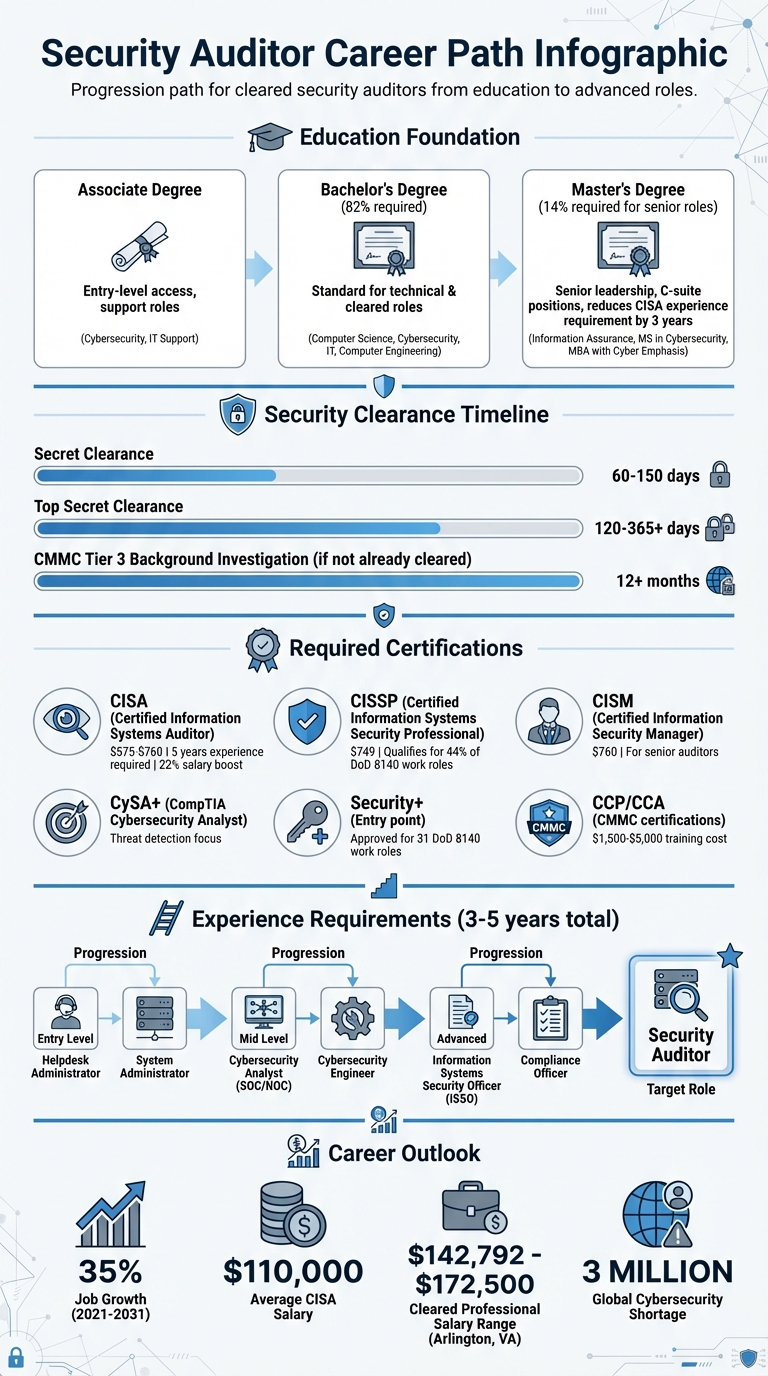
  • Clearance Processing Times: Secret clearance takes 60–150 days; Top Secret can take 120–365+ days.
  • Education: A bachelor’s degree is a baseline requirement; advanced degrees can accelerate career growth.
  • Certifications: CISA is essential for auditing roles; CISSP and CISM are valuable for senior positions.
  • Experience: Entry-level roles like Helpdesk Administrator or Cybersecurity Analyst build the foundation for auditing.
  • Demand: Security analyst jobs are growing by 35% (2021–2031), with salaries ranging from $110,000 to $172,500 for cleared professionals.

Cleared security auditors are in high demand, especially with the rollout of CMMC 2.0 requirements. Combining education, certifications, and experience with an active clearance ensures strong career prospects in this field.

Security Auditor Career Path Requirements and Salary Guide for Cleared Professionals

Security Auditor Career Path Requirements and Salary Guide for Cleared Professionals

Information Security Auditor – Information Security Auditor Salary and Skills You Need

Education and Background Requirements

To land most cleared security auditor positions, you’ll need at least a bachelor’s degree. This four-year degree is also essential for advancing into technical or mid-level roles. Common fields of study include Computer Science, Cybersecurity, Information Technology, Information Assurance, and Computer Engineering [1][2].

Tailor your coursework to meet the needs of cleared employers. Focus on areas like penetration testing, cryptography, database security, incident response, and network defense tools. Additionally, courses in governance and compliance – such as policy development, risk management, and information assurance – are critical for auditing roles [2][4].

"As an auditor, I quickly learned that you don’t have to know everything about one thing; you have to know a little about everything." – Swathi West, Healthcare Compliance Manager at BARR Advisory [1]

Degrees and Coursework

The demand for information security analysts is booming, with job growth projected at 35% from 2021 to 2031, far exceeding the national average for all occupations [1][3]. This makes your choice of degree more crucial than ever. For cleared auditing roles, 82% of employers require at least a bachelor’s degree [7].

If you’re still in school, consider pursuing cleared internships to gain real-world experience. Programs like the National Security Agency (NSA)’s 12-week paid summer internships provide hands-on exposure to active cyber operations, giving you a competitive edge when applying for cleared positions after graduation [1]. Additionally, align your electives with the NICE Workforce Framework standards, as many government-aligned programs use these guidelines to shape their curricula [4].

For those with leadership aspirations, advancing your education can open new doors.

Advanced Degrees and Career Impact

Building on your undergraduate education, pursuing a Master’s degree in Cybersecurity, Information Assurance, or an MBA with a cybersecurity focus can significantly accelerate your career. In fact, 14% of employers now require a master’s degree for senior roles [7]. While only 2% of IT auditors currently hold a master’s degree, it can set you apart in the competitive cybersecurity field [5].

An advanced degree offers tangible advantages. For example, it can substitute for up to three years of the five-year professional experience requirement for the Certified Information Systems Auditor (CISA) credential [1]. This is a game-changer, as CISA holders report a 22% salary boost and a 70% improvement in job performance [1]. If your ultimate goal is to step into a C-suite role like Chief Information Security Officer (CISO), an advanced degree is often a key requirement.

Degree Level Typical Career Impact Relevant Majors
Associate Degree Entry-level access; support roles Cybersecurity, IT Support
Bachelor’s Degree Standard for technical & cleared roles Computer Science, Cybersecurity, IT, Computer Engineering
Master’s Degree Senior leadership; C-suite; reduced experience for CISA Information Assurance, MS in Cybersecurity, MBA (Cyber Emphasis)

Getting Started: Entry-Level and Mid-Level Positions

Common Starting Roles

Breaking into security auditing often starts with hands-on technical experience. These early roles not only help you build essential skills but also position you to use your clearance effectively as you move toward specialized audit positions.

Starting as a Helpdesk Administrator is a great way to master IT troubleshooting and understand common system failures. This knowledge becomes critical when identifying vulnerabilities during audits. Moving into System Administrator roles helps you learn how systems are designed and secured, covering areas like operating systems, network setups, and infrastructure – key elements you’ll later evaluate for compliance. If you’re looking for direct experience in threat detection and monitoring, consider a Cybersecurity Analyst position in a Security Operations Center (SOC) or Network Operations Center (NOC). These roles often involve anomaly monitoring and, in some cases, compliance analysis to ensure systems are ready for audits.

For those with more experience, Cybersecurity Engineer and Information Systems Security Officer (ISSO) positions combine technical expertise with compliance responsibilities. ISSOs, in particular, focus on ensuring systems meet required laws and regulations, making this role a natural stepping stone to auditing. If you’re aiming for roles in the defense industrial base, working as a Compliance Officer or Consultant at a Managed Service Provider (MSP) can provide excellent preparation.

"I strongly believe that consultants need to be more knowledgeable than assessors on the topic of CMMC because not only do they need to know ‘what right looks like’, they also need to know how to implement it" – Amira Armond, Owner and Quality Manager at Kieri Solutions [8]

Why Experience Matters

Hands-on experience is critical for mastering the responsibilities of a security auditor. Beyond technical knowledge, auditors need the ability to independently assess evidence and verify whether systems effectively protect information from unauthorized access or loss. This means understanding the deeper technical reasoning behind every question you ask [1].

"The tricky part of this job is that you need to know the answers, as well [as the questions]" – Swathi West, Healthcare Compliance Manager at BARR Advisory [1]

Swathi West’s career is an excellent example of leveraging experience. She began as an intern at UnitedHealth Group and used her aerospace engineering background to learn compliance frameworks on the job.

Experience is also essential for earning industry-standard certifications. For instance, the CISA certification requires five years of relevant experience [1]. To qualify as a lead auditor for CMMC, candidates must first serve as team members on at least three Level 2 assessments [8]. Becoming a Certified CMMC Assessor (CCA) requires at least three years of cybersecurity experience and one year of assessment or audit experience. Advancing to Lead CCA status demands five years of cybersecurity experience, five years of management experience, and three years of assessment or audit experience [8].

If you hold a security clearance, you already have a major advantage. Many companies are willing to provide on-the-job training for clearable candidates in SOC or NOC roles. Those with an existing government clearance can often complete the suitability background check for auditing positions in under a month, while others may face a wait of over 12 months [8].

Certifications for Cleared Security Auditors

Top Certifications to Pursue

If you’re working in cleared environments, certifications aren’t just a nice-to-have – they’re mandatory. This is outlined in the Department of Defense Directive 8140 (formerly 8570), which applies to roughly 225,000 military, civilian, and contractor roles. Under this directive, you need to meet specific qualification requirements within nine months of starting a position [9][12].

Here are some of the key certifications to consider:

CISA (Certified Information Systems Auditor) is a must for anyone tasked with auditing IT systems or performing compliance reviews. To sit for the exam, you’ll need five years of relevant experience, and the exam itself costs between $575 and $760 [10][12].

"If you’re going to be auditing information systems, conducting security assessments, or ensuring compliance with security requirements, CISA is what you need."
– Mike McNelis, Training Camp [12]

CISSP (Certified Information Systems Security Professional) is another big one. Covering eight security domains, it qualifies professionals for a variety of roles under DoD 8140, accounting for 44% of approved work roles across five workforce categories. The exam fee is $749 [10][12].

CISM (Certified Information Security Manager) is tailored for those managing and governing an organization’s security program. It’s especially useful for senior auditors overseeing risk management. The exam costs $760 [10].

CySA+ (CompTIA Cybersecurity Analyst) focuses on threat detection and data analysis, making it ideal for technical auditors involved in security assessments and testing [10].

For those working in the Defense Industrial Base (DIB), certifications like Certified CMMC Professional (CCP) and Certified CMMC Assessor (CCA) are becoming increasingly relevant. With the Cybersecurity Maturity Model Certification (CMMC) showing up in contracts starting in late 2025, auditors who can guide organizations through Level 2 compliance (covering 110 security controls) are in high demand [12]. Training for these certifications ranges from $1,500 to $5,000 [8], and you’ll need a Tier 3 background investigation if you’re not already cleared – a process that can take over a year [8].

These certifications can lay the groundwork for advancing your career in cleared security auditing.

Selecting the Right Certification

Choosing the right certification is critical for meeting the unique demands of cleared cybersecurity roles. A good starting point is reviewing the DoD 8140/8570.01-M matrix to confirm that your chosen credential aligns with your target work role, whether that’s Auditor, ISSM, or Analyst [9]. Auditors, in particular, fall under the Cyber Security Service Provider (CSSP) category [11].

"One of the things to keep in mind with this chart is that you have a choice at each level to get several certifications. Which certification you go after will depend on where you are going."
– Kevin King, EC-Council [11]

If your focus is strictly on audit standards and control evaluations, CISA should be your top choice [10]. On the other hand, if you’re aiming for a broader role like Director of IT or security management, CISSP or CISM will give you the scope you need [11]. For those pursuing CMMC assessor roles, you’ll need to start with CCP and progress to CCA, often alongside a baseline certification like CISA or CISSP [8].

For newcomers, CompTIA Security+ is an excellent entry point. It’s approved for 31 different work roles under DoD 8140, making it one of the most versatile certifications [12]. If you’re looking to specialize in technical assessments, certifications like CEH (Certified Ethical Hacker) or CompTIA PenTest+ can give you an extra edge [12].

Certifications like CISSP also offer the benefit of cross-agency mobility. To prepare effectively, aim to score in the 90s on practice exams before attempting the real thing [11]. Keep in mind that government agencies rigorously verify certification statuses, so maintaining your credentials through annual Continuing Professional Education (CPE) credits is essential to avoid being removed from a contract [12].

With the right certifications, you can build a strong foundation for a career in cleared security auditing and ensure you meet the demands of this specialized field.

sbb-itb-bf7aa6b

Required Skills for Security Auditors

Technical Abilities

To excel as a security auditor in cleared environments, a solid foundation in programming, network security, penetration testing, cryptography, and software protocols is a must. These skills are crucial for analyzing code through both static (SAST) and dynamic methods.

Proficiency in languages like Java, Python, C/C++, JavaScript, .NET, and PHP is particularly important. These are the tools of the trade for conducting in-depth code reviews and applying SAST techniques to examine code without executing it. Dynamic analysis, on the other hand, helps identify vulnerabilities during runtime, making both approaches indispensable.

Cryptography is another critical area. Security auditors must understand concepts like public and private key encryption, digital signatures, RSA algorithms, and hashing functions to safeguard data during transmission. In cleared work, knowledge of compliance frameworks such as CMMC, NIST 800-171, and ISO 27001 is essential, as these standards guide how sensitive information is protected within defense and government sectors.

Network expertise plays a key role as well. Security auditors need to be familiar with network architecture, firewalls, and operating systems like Windows, Linux, macOS, and UNIX. Advanced testing methods, such as fuzzing and symbolic execution, are also valuable for uncovering vulnerabilities that might go unnoticed using traditional techniques.

"Security code auditors are like the special forces of cybersecurity teams."
– CybersecurityGuide.org

However, technical skills alone aren’t enough. Security auditors must also bring strong communication and analytical abilities to the table.

Interpersonal and Analytical Skills

While technical know-how gets you started, success in this field depends heavily on critical thinking and effective communication. Analytical skills are vital for evaluating audit data and identifying which vulnerabilities pose the most significant risks. Precision is equally important – missing a single misconfiguration in a cleared environment could lead to serious consequences.

Communication skills are just as crucial. Security auditors need to translate complex technical findings into language that non-technical stakeholders, such as senior executives and program managers, can understand. Explaining vulnerabilities in terms of business impact and presenting clear cost–benefit analyses can help decision-makers prioritize remediation efforts.

"Security code auditors are the brain surgeons of computer systems. They analyze, diagnose, and develop treatment plans for repairing any potentially problematic code vulnerabilities."
– CybersecurityGuide.org

For instance, in 2018, an audit of the U.S. Department of Homeland Security’s computer systems uncovered several vulnerabilities. The findings led to immediate actions like software patching and enhanced access controls, significantly reducing the risk of cyber attacks. This example highlights how effectively communicating audit results can prompt decisive action and improve overall security.

How to Advance Your Career

Continuing Education and Training

The cybersecurity world evolves rapidly, and staying ahead of the curve is essential for cleared security auditors. The Cybersecurity Maturity Model Certification (CMMC) is transforming Department of Defense (DoD) assessments by shifting from self-attestation to independent audits. Starting with the CMMC Certified Professional (CCP) lays a strong foundation, while progressing to the CMMC Certified Assessor (CCA) allows you to conduct official Level 2 assessments for defense contractors. ISACA, as the official CMMC Assessor and Instructor Certification Organization (CAICO), serves as a key resource for CMMC-related training.

"CMMC represents a strategic career investment – and a strong entry point for practitioners looking to specialize. It is poised to reshape cybersecurity roles in the defense sector, making certification a strategic move for advancement." – Pam Nigro, Vice President of Security and Security Officer, Medecision [13]

To maintain compliance with DoD 8140 standards, consider attending 3–4 day CISA boot camps. Tailor your training to focus on NIST SP 800-171, which applies to contractors handling Controlled Unclassified Information (CUI), and NIST SP 800-172 for Level 3 Expert assessments. If your work involves CUI in cloud environments, mastering FedRAMP Moderate requirements and FIPS 140-encryption standards is critical.

Once you’ve sharpened your skills, the next step is to expand your professional connections.

Building Your Professional Network

Networking in the cleared community is about more than just making connections – it’s about creating mutual value. Joining organizations like ISACA, Information Systems Security Association (ISSA), and (ISC)² can provide access to industry updates and specialized peer networks.

"Networking isn’t just about what you can gain – it’s about offering value in return. Don’t be that person who only reaches out when they need a favor." – Ashley Jones, Editor, ClearedJobs.Net [14]

Schedule 15–20 minute informational interviews with professionals in your target field to build meaningful relationships. Recruiters who focus on cleared positions are also valuable contacts, as they often know about contract opportunities before they’re officially announced. Keep an eye on major contract wins in your area of expertise, as these often signal hiring surges. When updating your profile on Cleared Cyber Security Jobs, use the STAR formula (Situation, Task, Action, Result) to highlight your accomplishments and make sure to refresh your "last active" date regularly. Recruiters tend to prioritize profiles that appear most recent.

Using Your Security Clearance

Once you’ve built your skills and network, use your security clearance strategically to open doors to exclusive opportunities. An active clearance, combined with advanced certifications and strong connections, sets you apart in the competitive cleared cybersecurity field. With CMMC 2.0 Level 2 aligning with all 110 requirements of NIST SP 800-171 and DFARS 252.204-7012 requiring contractors to report cyber incidents within 72 hours, the demand for cleared auditors continues to rise [13]. Your clearance also provides access to specialized job fairs and direct-hire opportunities with government agencies and defense contractors.

While you can include your clearance on secure job boards and at cleared job fairs, avoid listing it on public-facing platforms like LinkedIn to maintain operational security. Additionally, the phased rollout of CMMC requirements in DoD solicitations through 2025 and 2026 ensures that cleared auditors with the right certifications will remain in demand for years to come.

Conclusion

Building a career as a cleared security auditor requires a mix of education, certifications, practical experience, and an active clearance. About 82% of employers look for candidates with a bachelor’s degree for these roles [7]. Additionally, most positions demand 3–5 years of prior experience in IT or security-related jobs before moving into specialized auditing [6][7].

These qualifications pave the way for a career that offers both financial rewards and professional growth.

The Certified Information Systems Auditor (CISA) certification stands out as the top credential for this field. Professionals with this certification earn an average annual salary of $110,000, with a 22% pay boost after certification [7][1]. Pairing this with an active Secret or Top Secret/SCI clearance significantly increases earning potential, with salaries ranging from $142,792 to $172,500 in high-demand areas like Arlington, VA [15].

The demand for cleared security auditors is growing rapidly. Employment for security analysts is expected to increase by 35% from 2021 to 2031, and there’s currently a global shortage of nearly three million cybersecurity professionals [6][5]. This, coupled with the ever-changing regulatory environment, ensures that auditors with technical expertise, sharp analytical skills, and strong communication abilities remain essential to government agencies and defense contractors.

FAQs

Can I become a security auditor without a current clearance?

Yes, you can build a career as a security auditor even if you don’t currently hold a clearance. That said, having a clearance can open up more opportunities and potentially increase your earning potential. Employers often prioritize candidates with clearances because it allows them to handle sensitive projects, making this qualification a valuable advantage in the industry.

Which certification should I get first: Security+, CISA, or CISSP?

For those beginning their journey in cybersecurity and holding security clearances, Security+ is an excellent starting point. This certification lays the groundwork by covering essential topics like cybersecurity fundamentals, network security, and risk management – perfect for entry-level positions.

As you gain experience, you can explore more advanced certifications. For example, CISA is well-suited for professionals focusing on auditing and compliance, while CISSP is designed for those aiming for senior-level, advanced roles. Starting with Security+ ensures you establish a solid base and can then advance your credentials in line with your career aspirations.

What’s the fastest path from SOC or sysadmin work into auditing?

The quickest path from a SOC or sysadmin role to cybersecurity auditing involves tapping into your technical background and obtaining certifications like CISSP or CISA. Use your experience in areas like security monitoring, incident response, or system administration as a foundation. Then, expand your knowledge to include security frameworks, risk management, and compliance processes. This blend of hands-on expertise and recognized credentials can set you up for success in auditing positions.

Related Blog Posts

  • CISA Certification Career Guide for Cleared IT Auditors
  • Threat Intelligence Analyst Career Path for Cleared Professionals
  • Security Architect Career Path for Cleared Professionals
  • CISO Career Path for Cleared Chief Information Security Officers

Related Guides

  • Risk Analyst Career Path for Cleared Cyber Professionals
  • GRC Analyst Career Path for Cleared Compliance Professionals
  • CISO Career Path for Cleared Chief Information Security Officers
  • TS/SCI Salary Premium: Real 2026 Numbers
  • Security Clearance Interview: What to Expect

Risk Analyst Career Path for Cleared Cyber Professionals

CyberSecJobs Editorial · March 16, 2026 ·

Risk Analyst roles in cybersecurity are vital for protecting classified systems and national security. These professionals analyze risks, evaluate threats, and implement security measures for government agencies and defense contractors. With increasing cyberattacks targeting sensitive networks, the demand for cleared Risk Analysts has grown significantly. Here’s what you need to know:

  • Key Responsibilities: Assess vulnerabilities, monitor classified networks, investigate breaches, and provide recommendations to enhance security.
  • Qualifications: A bachelor’s degree (cybersecurity, IT, or related fields) is often required. Advanced degrees and certifications like CRISC, CISSP, or Security+ can accelerate career growth.
  • Security Clearance: Essential for accessing classified information, with levels like Secret or Top Secret/SCI required. Clearance timelines range from 60 to 240 days.
  • Skills Needed: Technical expertise in risk management, cloud security, and scripting (Python, PowerShell) combined with strong communication skills.
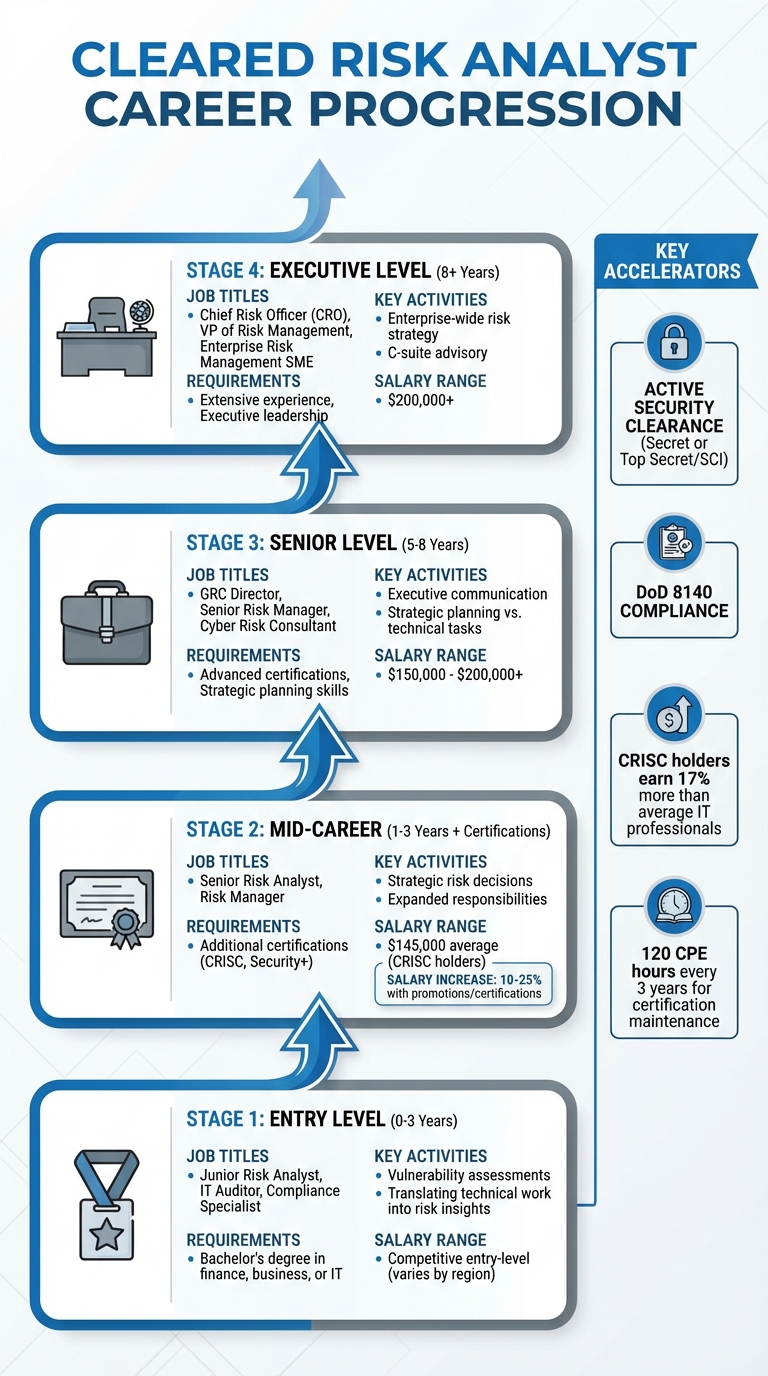
  • Career Progression: Start in entry-level roles like IT Auditor or Junior Analyst, then advance to senior positions such as Risk Manager or GRC Director. Salaries range from $147,000 to $200,000+ for experienced professionals.
  • Certifications: Certifications like CRISC, CISSP, and CGRC validate expertise and meet DoD requirements, boosting earning potential and job prospects.

To succeed, focus on building technical skills, obtaining security clearance, earning certifications, and networking within the cleared community. This career path offers competitive pay, job security, and the opportunity to safeguard critical systems.

Inside My Job as a GRC / Cyber Risk Analyst – The TRUTH

Qualifications and Entry Requirements

Let’s break down what it takes to become a cleared Risk Analyst, from the education you’ll need to the security clearances and experience required to land the role.

Educational Background

Most cleared Risk Analyst roles call for a bachelor’s degree in fields like cybersecurity, computer science, or information systems. These degrees lay the groundwork for understanding system vulnerabilities, digital threats, and architecture [4][6]. But technical fields aren’t the only way in – degrees in finance, business, economics, mathematics, or statistics are also highly regarded, especially for positions that focus on financial or operational risks [2][3].

For those looking to climb the ladder faster, pursuing a master’s degree – such as an MBA or an MS in Cybersecurity or Financial Risk Management – can help you develop a broader understanding of business strategy and complex risk scenarios [2][3]. That said, the hiring landscape is evolving. Many organizations now emphasize skills and certifications over formal degrees, valuing hands-on expertise [4][5].

"Look at where you are now and where you want to go. Then see what’s out there and work those jobs to build the credentials" [4].

Once you’ve got the education or skills, the next step is meeting the strict requirements for security clearance.

Security Clearance and Eligibility

Security clearance is non-negotiable for cleared Risk Analyst roles. U.S. citizenship is a must, and most positions require an active clearance, such as Secret (Tier 3) or Top Secret/SCI (Tier 5), to handle classified data and protect critical national security systems [1]. Under the Trusted Workforce 2.0 framework, investigations are divided into three tiers, with Tier 5 being the most rigorous, requiring a 10-year history of your residences, employment, and education [1].

Before starting the clearance process, it’s wise to gather key documents like your 10-year address history, employment records, and passport details. This helps ensure accuracy and avoids potential issues, like "Personal Conduct" red flags [1]. On top of that, reviewing your credit report and resolving any financial issues is crucial – financial mismanagement is one of the leading reasons for clearance denials [1]. If you have foreign contacts, document their names, nationalities, and the nature of your relationship to streamline the Tier 5 investigation [1].

Keep in mind, clearance is tied to your job. If you leave a position, it becomes inactive after 24 months unless reactivated [1]. Once cleared, you’ll gain access to secure environments like AWS GovCloud, Microsoft Azure Government, and systems managed by Information Systems Security Officers (ISSO) [1].

With clearance in hand, the next step is gaining relevant professional experience.

Entry-Level Experience

Cleared Risk Analyst roles are rarely entry-level. Most professionals start in roles like Junior Risk Analyst, IT Auditor, Cybersecurity Assessor, or Systems Security Analyst before transitioning into more advanced positions [2][4]. According to CompTIA, a solid foundation includes 10 years of general IT experience, with at least five years focused on security, especially for those pursuing certifications like SecurityX [6].

If you can’t find a direct path into a Risk Analyst role, consider adjacent positions in software development, IT auditing, or compliance to build a relevant skill set [6][7].

"Aspiring cyber risk analysts should first target positions that deal with software issues – either in the implementation or development phases. The skills you will learn in these roles will transition nicely to the cybersecurity team" [6].

"The certifications help you have at least credentials that get you into a starter position at an organization" [4].

Start documenting your experience with risk identification, assessment, and response early on. This will make certification applications easier down the line [7]. For example, certifications like CRISC require three years of experience in IT risk management and IS control. However, you can take the exam before meeting the experience requirement and then have up to five years to accumulate and verify the necessary background [7].

Required Skills and Certifications

Cleared Risk Analysts need a mix of technical expertise and strong communication abilities. The Bureau of Labor Statistics predicts a 29% growth in information security analyst jobs between 2024 and 2034, highlighting the demand in the field. On top of that, there’s a global shortfall of about 4.8 million cybersecurity professionals [9].

Technical and Soft Skills

On the technical side, vulnerability analysis and risk management are critical. Analysts often work with frameworks like NIST CSF, ISO 27001, and CIS Controls to assess risks and craft mitigation strategies. In cleared environments, where classified data is common, these skills are even more important. A solid understanding of network and cloud security, including TCP/IP and platforms like AWS, Azure, and Google Cloud Platform, is essential.

Scripting and automation skills in languages like Python, PowerShell, or Bash are also valuable. These tools help automate tasks such as log analysis and security audits. Staying informed about the latest threats is another key responsibility. Knowledge of data security practices, encryption methods, role-based access control, and data classification ensures sensitive information remains secure.

Soft skills are just as crucial. Being able to explain technical issues in plain language helps non-technical stakeholders make informed decisions. According to one expert, "91% of talent professionals agree that soft skills are very important to the future of recruitment and HR" [12]. Critical thinking and attention to detail allow analysts to spot patterns and early warning signs of attacks. Collaboration across teams, from security operations to business leadership, is vital for effective incident response.

"In a world where job roles are changing rapidly, soft skills will be one of the few constants…"

  • Chris Jones, CEO, City & Guilds [12]

Hands-on experience is a must for mastering these skills. Resources like the SANS StormCast podcast and CISA alerts can help you stay ahead of emerging threats. If you’re just starting out, roles in IT support, networking, or systems administration can build a strong foundation for a career in risk analysis.

Once these skills are in place, certifications can serve as proof of your expertise and help you advance.

Top Certifications for Cleared Risk Analysts

Certifications not only validate your skills but can also boost your earning potential. For example, professionals with a CRISC certification earn between $147,000 and $151,000 annually, while CISSP holders average $132,000. Many cleared roles also require certifications to meet DoD 8570/8140 guidelines.

Certification Level Cost Prerequisites Relevance to Cleared Roles
CompTIA Security+ Entry Varies None (Network+ recommended) Foundational; meets DoD 8140/8570 requirements
CRISC (ISACA) Advanced $575 (members) / $760 (non-members) 3 years in IT risk management Bridges technical risk with business objectives
CISSP (ISC2) Advanced Varies 5 years of professional experience Gold standard for security management and architecture in government/defense
CGRC (ISC2) Advanced $599 2 years of experience Critical for NIST RMF and FedRAMP compliance in government contracting
GSEC (GIAC) Intermediate Varies None Validates hands-on technical security tasks
CompTIA SecurityX Advanced Varies 10 years IT experience (5 in security) Formerly CASP+; approved for DoD Directive 8140 for advanced security architects

A strategic approach to certifications can maximize your career growth. Start with Security+ to establish a strong base, then specialize with certifications like CRISC or CGRC for mid-level roles in risk and compliance. For senior positions, CISSP is often the go-to choice. If you’re focusing on audit and control evaluation, consider CISA. As Ken Sahs from Training Camp explains, "CISA proves you can evaluate whether controls are working. CRISC proves you can design the risk framework those controls support" [11].

In addition to certifications, hands-on experience with frameworks like NIST SP 800-30/39/53 and ISO 27001 is invaluable. ISACA allows up to five years after passing the CRISC exam to verify the required three years of experience [7]. Developing expertise in cloud security can also pay off, often adding over $15,000 to your salary [8].

Career Advancement for Cleared Risk Analysts

Risk Analyst Career Progression Path: Entry to Executive Level

Risk Analyst Career Progression Path: Entry to Executive Level

Career Progression Stages

A career as a cleared Risk Analyst unfolds across four main stages. Most professionals begin as Junior Risk Analysts, IT Auditors, or Compliance Specialists, typically with 0–3 years of experience[3][10]. During this phase, earning a bachelor’s degree in finance, business, or IT is key, along with translating technical work – like vulnerability assessments – into risk management insights[3][10]. Even at the entry level, salaries are competitive and vary by region.

With 1–3 years of experience and additional certifications, you can move into mid-career roles such as Senior Risk Analyst or Risk Manager. Certifications not only help secure promotions but also sharpen your ability to make strategic risk decisions. For example, professionals with a CRISC certification earn an average of $145,000 annually, with North American holders earning about 17% more than the average IT professional[7]. On average, promotions or role changes supported by certifications lead to salary increases of 10% to 25%[10].

After 5–8 years in the field, senior-level positions like GRC Director, Senior Risk Manager, or Cyber Risk Consultant become attainable. Success at this stage requires shifting focus from technical tasks to strategic planning and effective communication with executives[10]. For those with over 8 years of experience, salaries often range from $150,000 to well over $200,000[10]. At the executive level, roles such as Chief Risk Officer (CRO), VP of Risk Management, or Enterprise Risk Management SME represent the pinnacle of the career path[3][10].

"If you’re tired of being seen as the ‘department of no’ and want to become a strategic business advisor, CRISC provides that pathway"[7].

Next, let’s explore how your active security clearance can accelerate these career milestones.

How to Leverage Your Security Clearance

An active security clearance is a game-changer for advancing your career as a Risk Analyst. Beyond complementing your qualifications and certifications, it positions you uniquely to influence enterprise cybersecurity strategies and take on broader responsibilities.

To maximize the value of your clearance, ensure you meet DoD 8140 compliance by pursuing certifications such as CompTIA SecurityX (formerly CASP+), which are geared toward advanced security architect and senior engineer roles[6].

Focus on sectors with high demand for risk expertise, such as financial services, healthcare, and defense contracting. These industries often provide the strongest career and financial growth opportunities[10]. Volunteering for cross-functional initiatives – like vendor assessments or policy reviews – can also help you demonstrate your ability to work across different business units, a skill that’s critical for senior roles. Additionally, align your current responsibilities with CRISC’s four domains (Governance, Risk Assessment, Risk Response, and Technology) to build a clear record of your experience[7].

To stay eligible for senior government positions, maintain your clearance and complete 120 Continuing Professional Education (CPE) hours every three years[7]. As organizations increasingly emphasize business-oriented risk perspectives, professionals who can translate technical threats into language that resonates with boards and executives are in high demand[10]. Specializing in areas like Cloud Risk Management, Third-Party Risk, or AI-driven threat modeling can further set you apart and accelerate your career growth[10][6].

sbb-itb-bf7aa6b

Job Search Strategies for Cleared Professionals

Using Cleared Cyber Security Jobs Effectively

Cleared Cyber Security Jobs

Your profile on Cleared Cyber Security Jobs acts as your introduction to hiring managers. Recruiters often glance at your key skills and preferred work locations before diving into your resume, so having a fully completed profile is crucial. Fill out every section – technical skills, geographic preferences, and more – to ensure you show up in the right searches.

Another tip? Keep your profile fresh. Employers tend to prioritize recently updated profiles, so logging in weekly or monthly can update your profile date and improve your visibility in search results.

When searching for Risk Analyst positions, use Boolean search strings to cover multiple job title variations. For instance:
"Risk Analyst" OR "Risk Management Analyst" OR "Program Analyst"
This approach ensures you catch all relevant listings. You should also search by ZIP code and set a mileage radius to find jobs that might mention military base names or alternate city spellings.

Additionally, set up job alerts (sometimes called "Job Agents") to get email notifications as soon as new roles matching your criteria are posted. When creating alerts, include all clearance levels you’re eligible for. The platform’s research tools can also help you identify hiring trends, such as which cleared facilities are actively recruiting and which skills are most sought after [21, 22].

Once your online profile is polished, shift your focus to crafting tailored application materials for cleared roles.

How to Tailor Applications for Cleared Roles

Generic resumes won’t cut it in the cleared job market. Each submission needs to align closely with the job’s specific skills and requirements. Use the STAR method (Situation, Task, Action, Result) to showcase your achievements rather than just listing responsibilities.

For example:
"Assessed 47 enterprise systems using RMF, identifying 132 vulnerabilities and reducing critical findings by 38% within six months."

Including measurable results like percentages or numbers gives hiring managers a clear picture of your impact. If you’re working toward certifications like CRISC or CISSP, mention them along with their expected completion dates to further strengthen your application.

Be mindful of operational security (OPSEC) when crafting your resume. Avoid mentioning classified project names, sensitive budget details, office sizes, or specific colleague names. Keep it concise – one to two pages is ideal, as recruiters often skim resumes quickly before deciding to reach out. If you’re transitioning from the military, highlight your desired relocation area and your availability date near the top of your resume [23, 24].

"Your security-cleared resume is not a biography or a mere list of qualifications. It’s an ad designed to help you land that coveted cleared job interview."

  • Ashley Jones, Editor, ClearedJobs.Net [13]

"Keep subjective self-descriptions out of your summary section. I’m looking at you, Results-Oriented Team Players."

  • Bill Branstetter, 9th Way Insignia [13]

Professional Development for Cleared Risk Analysts

Advanced Certifications and Training

For cleared Risk Analysts, stacking certifications can significantly boost your career prospects. With the Governance, Risk, and Compliance (GRC) market projected to reach $32.8 billion by 2032 – and a 25% shortage of qualified professionals – there’s a clear demand for those who invest in the right credentials [11].

One top choice is the Certified Information Security Manager (CISM). This certification emphasizes security governance, program development, and incident management, making it ideal for leadership roles. CISM-certified professionals typically earn between $140,000 and $142,000 annually [10]. The exam costs $575 for ISACA members and $760 for non-members [11].

Another valuable certification is Certified in Governance, Risk and Compliance (CGRC), which focuses on NIST RMF and FedRAMP compliance – essential for government contracting work. The exam fee is $599 [11]. For hands-on professionals, CompTIA SecurityX (formerly CASP+) offers DoD 8140 approval and covers advanced security architecture and incident response [6].

As artificial intelligence becomes more integrated into organizations, AI governance certifications like ISACA’s AAISM and AAIA are gaining traction. These credentials position you as an expert in managing AI risks and compliance.

"The professionals who get certified in AI governance now, before everyone else catches up, are going to be the ones organizations turn to when new regulations inevitably hit." – Ken Sahs, Training Camp [11]

Maintaining your certifications is equally important. Most require 120 CPE hours every three years, with annual fees of $45 for ISACA members or $85 for non-members [7]. Joining ISACA (approximately $135 annually) can simplify this process, as many CPE activities apply to multiple certifications like CRISC, CISA, and CISM [11].

Practical experience with frameworks such as NIST CSF, ISO 27001, and COBIT can also showcase your expertise [11]. But beyond technical skills, networking plays a crucial role in advancing your career.

Networking in the Cleared Community

Technical knowledge is essential, but building strong professional relationships is just as critical. In the cleared community, in-person networking often carries more weight than online connections.

Events like Security Cleared EXPO are tailored specifically for cleared professionals. These career fairs connect you directly with hiring managers who understand clearance levels and mission requirements. This setup allows you to discuss your TS/SCI clearance, polygraph status, and specialized skills without the usual security concerns [14].

Many defense contractors also host talent communities to engage with potential hires. For example, Booz Allen offers tech talks where you can interact with current employees and learn about upcoming projects. These events provide insight into the organization’s culture and allow you to build relationships before applying for a role [16].

Local ISACA chapters are another excellent networking resource. They host free webinars and in-person events where you can meet professionals in your area. Since many cleared positions are tied to specific facilities or SCIFs, these local connections can reveal opportunities that aren’t publicly posted [7].

Platforms like ClearedConnections can also increase your visibility. This free database allows cleared job seekers to upload their resumes, making them accessible to U.S. government agencies and contractors [15]. While not a direct networking event, it’s a valuable tool for reaching the right audience.

The cleared community prioritizes long-term relationships over quick, transactional networking. Regularly attending events, contributing to discussions, and offering support to peers can open doors to referrals and insider information about upcoming contracts or facility expansions. These connections can give you a competitive edge and help you thrive in the cleared cybersecurity field.

Conclusion

Pursuing a career as a Risk Analyst can give cleared cyber professionals a distinct advantage, opening doors to specialized roles in government agencies and defense contracting.

To excel, you’ll need a mix of technical skills, relevant certifications, continuous learning, and a solid professional network. Engaging with organizations like ISACA and attending industry events can help you stay connected within the cleared community.

Your job search should align with your professional growth. Platforms like Cleared Cyber Security Jobs simplify the process by linking you to employers who value your clearance and expertise. By combining your clearance with advanced certifications and active community involvement, you can shape a career dedicated to protecting critical systems and sensitive data.

FAQs

Do I need an active clearance to get hired?

Yes, having an active security clearance is usually a must for risk analyst roles in cybersecurity. These jobs often deal with sensitive data and tasks tied to national security, making the clearance a critical requirement for employment.

Which certification should I get first for risk roles?

The CRISC certification is an excellent entry point for those pursuing careers in risk management. Tailored specifically for risk management professionals, this certification is particularly helpful for beginners aiming to develop their knowledge and skills in the field.

What’s the fastest way to move from IT into GRC?

To move from IT into GRC (Governance, Risk, and Compliance) quickly, start by building a strong knowledge base and earning certifications that align with the field. Begin with IT and security fundamentals, then dive into essential compliance frameworks like SOC 2 and ISO 27001. Certifications such as CompTIA Security+ or CISA can help establish your credibility. Use your existing IT experience to your advantage and enroll in focused GRC training programs. With consistent effort, you could make this transition in as little as 6 to 12 months.

Related Blog Posts

  • CRISC Certification Career Guide for Cleared Risk Professionals
  • Threat Intelligence Analyst Career Path for Cleared Professionals
  • CISO Career Path for Cleared Chief Information Security Officers
  • GRC Analyst Career Path for Cleared Compliance Professionals

Related Guides

  • Security Auditor Career Path for Cleared Professionals
  • GRC Analyst Career Path for Cleared Compliance Professionals
  • CISO Career Path for Cleared Chief Information Security Officers
  • TS/SCI Salary Premium: Real 2026 Numbers
  • Security Clearance Interview: What to Expect

GRC Analyst Career Path for Cleared Compliance Professionals

CyberSecJobs Editorial · March 16, 2026 ·

The demand for Governance, Risk, and Compliance (GRC) roles is surging, especially for professionals with security clearances. Here’s what you need to know:

  • Job Growth: GRC roles like analysts and virtual CISOs have seen a 1,000% increase in interest over five years, driven by stricter regulations and rising cybercrime costs.
  • Salary Potential: Entry-level cleared GRC analysts earn $60,000–$88,954 annually, while senior roles can exceed $420,000.
  • Core Responsibilities: GRC analysts focus on governance, risk management, and compliance by conducting risk assessments, managing audits, and aligning with frameworks like NIST and ISO 27001.
  • Career Progression: Cleared professionals often advance to mid-level roles within 2–3 years, with salaries ranging from $95,000 to $105,000.
  • Certifications: Key certifications include CISA, CRISC, CGRC, and Security+, which enhance career prospects and earning potential.
  • Military Advantage: Veterans’ experience with SOPs, risk mitigation, and cross-functional communication aligns well with GRC roles.

With cybercrime projected to cost $12.2 trillion annually by 2031, cleared GRC professionals are in high demand. Start by gaining technical skills, earning certifications, and leveraging your security clearance to access lucrative opportunities.

GRC Roles and How to Get Started

Entry-Level GRC Positions for Cleared Candidates

Breaking into GRC roles doesn’t demand extensive specialized experience. Starting as a Junior GRC Analyst, you’ll focus on tasks like monitoring regulatory compliance, assisting with risk assessments, and supporting audits [8]. This role often involves gathering documentation and tracking compliance findings under the guidance of senior analysts. Salaries typically range from $60,000 to $80,000, with some high-demand sectors offering starting pay closer to $88,954 [8].

For those with a bit of IT experience, IT Compliance Analyst roles might be a great fit. These positions ensure that technology systems align with security and regulatory frameworks such as NIST or ISO 27001 [10]. About two years of IT systems administration experience – like managing patches, hosts, and cloud services – can make you a strong candidate [9]. Other entry-level options include Compliance Assistants, who handle documentation, draft compliance guidelines, and track regulatory updates [8], or Risk Associates, who focus on identifying operational and cybersecurity risks and assessing their potential impact [8].

For candidates with active security clearances, roles like Associate GRC Security Analyst provide direct involvement in federal compliance projects. These positions often require implementing NIST RMF steps and supporting ATO packages [9]. Having a Secret or Top Secret clearance is a significant advantage, as it eliminates the long wait for clearance investigations [9]. Cleared professionals can often advance to mid-level roles within 2–3 years, where median salaries range from $95,000 to $105,000 [8].

These positions are particularly well-suited for veterans, whose military experience often aligns seamlessly with the skills required for GRC work.

How Military Experience Applies to GRC Work

Veterans bring a wealth of skills that naturally transition into GRC roles. Familiarity with standard operating procedures (SOPs) translates directly to documenting internal controls and preparing for audits [12]. Many entry-level GRC responsibilities, such as compliance documentation and audit support, align with the operational discipline developed in the military. Additionally, experience in identifying threats and crafting mitigation strategies fits perfectly into the risk assessment duties common in GRC roles [10].

Another key strength military professionals offer is the ability to communicate complex requirements across diverse teams – a skill honed through cross-functional operations. This ability is essential when collaborating with IT, legal, and finance departments in GRC environments [10][8].

To stand out in federal GRC positions, transitioning military personnel should highlight their familiarity with frameworks like the NIST RMF and their experience with the ATO process on resumes [9]. If direct GRC roles aren’t immediately available, consider feeder positions such as IT Support, Network Administrator, or Security Administrator to build relevant technical expertise [11]. Entry-level GRC job descriptions show that 27% prioritize framework knowledge (SOC 2, ISO 27001, NIST), 21.6% require risk management skills, and 19% emphasize documentation and reporting [11] – all areas where veterans tend to excel.

Military experience can be a powerful asset in this field, offering a strong foundation for success in GRC roles.

sbb-itb-bf7aa6b

Required Skills and Tools for GRC Analysts

Technical Skills Every GRC Analyst Needs

To excel in a GRC role, especially in cleared environments, a strong grasp of technical frameworks and analytical skills is essential. At the core is framework expertise – familiarity with NIST (including the Risk Management Framework and 800-53), ISO 27001, SOC 2, and industry-specific regulations like HIPAA or PCI DSS is non-negotiable [1][13][4]. Risk assessment is a daily task, requiring you to identify threats, evaluate their potential impact, and decide which risks need immediate action. Increasingly, this involves assigning monetary values to risks instead of relying on instinct [1][7][3].

Another critical area is control implementation and testing. It’s not enough to document security controls – they must work as intended in real-world scenarios [1][13]. Additionally, you’ll need to master policy development and audit management. This includes drafting security policies that align with both regulations and company goals, as well as managing audits from start to finish – collecting evidence, conducting gap analyses, and ensuring compliance [1][13][6].

While you don’t need to be a coding expert, basic technical know-how is important. You should understand IT infrastructure, networking basics, and cloud platforms like AWS, Azure, or GCP [13][3][2]. Data analysis also plays a big role – working with spreadsheets and visualization tools to interpret risk metrics and compliance data is a regular part of the job [1][7][13]. These technical skills are often supported by specialized tools, which are discussed in the next section.

Common GRC Software and Platforms

GRC analysts rely on a variety of tools to streamline their work. Enterprise GRC platforms like Archer and ServiceNow GRC (IRM) are widely used for managing workflows, risk registers, and control evidence [1][7][3]. These platforms can map controls across multiple frameworks, such as linking NIST 800-53 requirements to ISO 27001 standards [3].

For automation, tools like Vanta, Drata, and CyberArrow simplify evidence collection and enable continuous monitoring, cutting down the manual effort involved in audit preparation [7][13][3]. Vulnerability management tools, including Tenable Nessus and Qualys, are essential for analyzing and prioritizing vulnerability data [3]. Privacy-focused roles might require platforms like OneTrust to handle GDPR and CCPA compliance [3].

To build practical experience, take advantage of free tools and developer instances. For example, the ServiceNow Developer Program offers free Personal Developer Instances, and Nessus Essentials is available at no cost. Open-source platforms like eramba allow you to practice risk mapping and policy management [3]. Using these tools to create mock risk registers or draft sample security policies is a great way to showcase your skills to potential employers.

Interpersonal Skills for GRC Professionals

Technical knowledge alone won’t take you far in GRC – strong interpersonal skills are just as important. These roles often require you to act as a bridge between technical teams and executive leadership, translating complex security issues into actionable insights for decision-makers [1][14][2]. This demands excellent communication skills and the ability to deliver tough messages about security gaps in a professional manner [14].

Stakeholder management is another key skill. GRC analysts frequently need to persuade teams across legal, finance, and IT to prioritize compliance efforts, often without having direct authority over them [1][13][2].

As Larry Trittschuh, CISO and CSO, puts it: "If there was one skill I’d go back and develop in cybersecurity, it would be empathy. When you walk in their [engineers’] shoes and see what’s driving them, it makes a huge difference" [2].

Attention to detail is non-negotiable. Whether you’re reviewing regulatory texts or auditing control evidence, small mistakes can lead to compliance issues [1][7][5]. Staying calm under pressure is equally important, especially during audits, security incidents, or regulatory reviews [6][5].

John Elliott, PCI Security Standards Advisor, highlights the value of intellectual humility: "People who can recognize what they don’t know, admit it, and seek to know the answers – curious, life-long learners – are the kind of people who thrive in cybersecurity" [2].

Certifications and Education for GRC Careers

Best Certifications for GRC Analysts

Earning the right certifications can significantly improve your career prospects and earning potential in GRC (Governance, Risk, and Compliance). One standout credential is CISA (Certified Information Systems Auditor), widely regarded as the benchmark for auditing and control evaluation. With over 170,000 professionals certified globally, it’s a highly respected qualification. The certification requires five years of experience and costs $575 for ISACA members or $760 for non-members [15].

For those focused on enterprise risk management, CRISC (Certified in Risk and Information Systems Control) is a valuable option. This certification equips you to translate technical risks into business terms, with holders earning between $147,000 and $151,000 annually [15].

If you’re working in federal or government roles, CGRC (Certified in Governance, Risk and Compliance) is particularly relevant. Formerly known as CAP, this certification emphasizes NIST RMF and FedRAMP standards, which are critical for government and defense contracting positions. While it’s less recognized in the private sector, it’s highly respected in federal circles. The exam costs $599 through ISC2 [17,19].

For those aiming to move into leadership roles, CISM (Certified Information Security Manager) is a strong choice. It focuses on managing and overseeing security programs rather than deep technical skills [15]. Entry-level professionals, on the other hand, should consider CompTIA Security+, which meets baseline requirements for government GRC roles (DoD 8570/8140) and provides the technical foundation needed to start in the field [14,17].

As Ken Sahs from Training Camp explains: "CISA proves you can evaluate whether controls are working. CRISC proves you can design the risk framework those controls support. Together, they cover both sides of the GRC coin" [15].

Emerging areas in GRC are also worth exploring. CDPSE (Certified Data Privacy Solutions Engineer) is becoming more relevant as data privacy regulations like GDPR and CCPA grow in importance. For those interested in AI-related risks, ISACA’s new certifications – AAISM (AI Security Management) and AAIA (AI Auditing) – address governance challenges in AI deployment [15].

How to Plan Your Certification Path

Your certification journey should align with your career stage. In the first three years, focus on foundational credentials like Security+ or ISC2’s Certified in Cybersecurity (CC), which is currently offered for free under the "One Million Certified in Cybersecurity" initiative [17,19]. If you’re in government roles, prioritize CGRC early to establish expertise in NIST RMF [15].

For professionals with three to seven years of experience, it’s time to specialize. Choose CISA if your focus is on auditing, CRISC for risk management, or CISM for managing security programs [15]. At senior levels (seven or more years), certifications like CISSP (Certified Information Systems Security Professional) add technical depth and are often required for leadership roles [15].

Christine Mills, a Project Manager, notes: "CISSP provides the technical foundation that makes GRC work substantive rather than superficial" [16].

To maximize your certification efforts, consider joining ISACA and applying the 70-20-10 rule: 70% hands-on experience (e.g., drafting policies), 20% networking and mentorship, and 10% formal study. Many CPE activities can count toward multiple ISACA certifications, helping you maintain multiple credentials affordably [17,3].

While certifications prove technical skills, academic degrees can provide a broader perspective and strategic foundation.

Degrees That Support GRC Careers

Degrees in fields like cybersecurity, information systems, business administration, or law can give you the technical and strategic knowledge needed for senior GRC roles [6,12,13,16]. Backgrounds in computer science and accounting are also highly valued [12,13]. However, practical experience combined with certifications like CISA can often offset the absence of a degree [13].

Professionals from non-technical backgrounds can also pivot into GRC roles by leveraging their existing skills. For instance:

  • Legal professionals can transition into AI Governance or Privacy roles.
  • Project managers can position themselves as Audit Readiness Leads.
  • IT support staff can move into Incident Governance positions [3].

As Taimur Ijlal, author of The Cloud Security Guy, puts it: "GRC has quietly become one of the fastest-growing, most stable, and most accessible career paths in cybersecurity" [14].

With nearly 440,000 new cybersecurity jobs added between 2022 and 2023 and a 1,000% increase in search interest for GRC roles over the past five years, this field is expanding rapidly [3,12]. The demand creates opportunities for professionals with a "T-shaped" skill set – broad business knowledge paired with deep expertise in specific areas like cloud or AI risk [3].

The Best Way to Start a GRC Career in 2025 AND Get Hired

How to Advance Your GRC Career

GRC Career Progression Timeline: From Entry-Level to Executive Roles

GRC Career Progression Timeline: From Entry-Level to Executive Roles

GRC Career Progression Timeline

A career in GRC typically unfolds in four stages, each with its own set of skills and responsibilities.

  • Entry-Level Stage (0–3 years): At this stage, you’ll find roles like GRC Analyst, IT Audit Analyst, or Compliance Coordinator. Your focus will be on tasks like gathering data, reviewing controls, and assisting with internal audit walkthroughs. This is where you build your technical foundation and earn certifications like Security+ to kick-start your career.
  • Mid-Level Stage (4–8 years): Here, the emphasis shifts to taking ownership and developing specialized expertise. Roles such as Risk Specialist, GRC Manager, or Privacy Lead involve leading projects, designing compliance processes, and translating technical risks into financial outcomes.

"It’s a shift from tactical execution to strategic ownership, where mid-level professionals step into roles with greater governance and oversight responsibilities." – Rachna Dutta, Infosec Consultant

  • Senior Leadership Level (8+ years): At this point, you’ll step into positions like Director of GRC or Head of Risk. Your responsibilities broaden to include shaping company-wide policies, managing budgets, and aligning GRC initiatives with overarching business goals.
  • Executive Stage (10+ years): Titles such as Chief Information Security Officer (CISO), Chief Risk Officer (CRO), or Chief Compliance Officer (CCO) come into play. These roles demand balancing risk with innovation while reporting directly to the board.

For professionals with active security clearances, career progression can be faster, often reaching mid-level roles within just 2–3 years. As you climb the ladder, honing your strategic leadership skills becomes increasingly important.

What You Need for Senior GRC Positions

Cleared professionals aiming for senior GRC roles need a combination of strategic leadership and technical expertise. Moving beyond the foundational skills, senior positions require a shift in mindset. You’ll need to bridge the gap between technical vulnerabilities and their business implications, such as revenue loss or contractual penalties. Building consensus across departments – legal, finance, and IT – is also crucial.

Quantitative risk assessment becomes a key skill at this level. Frameworks like FAIR can help you assign monetary values to risks, allowing you to integrate risk, compliance, and audit functions effectively.

"The shift here is from ‘managing programs’ to ‘shaping culture.’ And that takes both courage and clarity." – Harry West, GRC Practitioner

Certifications like CISM or CISSP are often required, appearing in over 70% of senior-level job postings. Most senior roles also demand at least eight years of experience [11]. Compensation reflects the responsibility: Senior GRC Analysts earn between $154,000 and $209,000, while Cyber Risk Managers can command salaries from $215,000 to $280,000 [3].

To advance, focus your efforts strategically:

  • Dedicate 70% to hands-on experience, such as drafting policies or managing mock audits.
  • Spend 20% networking and seeking mentorship.
  • Allocate the remaining 10% to earning formal certifications [3].

Develop a portfolio showcasing your leadership in initiatives like ISO 27001 gap assessments or third-party risk management programs. Learn to frame risks in business terms, emphasizing ROI and financial impact, to stand out in senior-level roles.

How to Use Your Security Clearance in GRC

Your active security clearance can fast-track your career in Governance, Risk, and Compliance (GRC) by unlocking higher-paying roles. Just like technical skills and certifications, a security clearance enhances your qualifications for advanced positions. Let’s dive into where cleared professionals can find these opportunities and why the level of your clearance is so important.

Where to Find Cleared GRC Jobs

The job market for cleared professionals operates differently from the typical cybersecurity hiring space. Many roles requiring a security clearance aren’t advertised on general job boards because employers specifically seek candidates with active clearances.

To get started, explore platforms tailored for cleared professionals. Cleared Cyber Security Jobs is a great example, focusing solely on connecting security-cleared candidates with employers in cybersecurity. The site offers features like clearance-specific job search filters, resume uploads, and job alerts that notify you when positions matching your qualifications become available.

Another effective option is attending clearance-specific job fairs. These events often provide direct access to unadvertised roles, as many employers prefer to fill cleared positions through referrals before making them public.

While finding the right job is crucial, the level of your security clearance plays an equally vital role in shaping your career path.

Why Your Clearance Level Matters

The value of your clearance level cannot be overstated in the GRC job market. It determines the roles you qualify for, your earning potential, and how far you can advance in your career.

  • Confidential clearances (valid for up to 15 years) typically open doors to entry-level positions.
  • Secret clearances (valid for up to 10 years) make you eligible for many federal contractor GRC roles.
  • Top Secret clearances (valid for up to 5 years) grant access to the most lucrative and sensitive opportunities in the field.

"Trust, once earned, is the currency of opportunity. Holding security clearance does more than open up doors – it sends the message to prospective employers that you’re the type of individual who can be trusted at your best." – Charm Paz, CHRP, Recruiter & Editor, GCheck [17]

In industries like payments and fintech, GRC professionals with active clearances often see salary boosts of up to 15%, as employers prioritize candidates who can hit the ground running [3]. Clearances, however, require sponsorship by a federal agency or contractor after a job offer. To maintain your clearance, ensure timely reinvestigations and adhere to all guidelines – this protects your career investment.

For even greater career prospects, pair your clearance with certifications such as CISA, CRISC, or ISO 42001 (AI Governance). These credentials can help you secure specialized roles in the ever-evolving GRC landscape [3].

Conclusion

Building a career in cleared GRC (Governance, Risk, and Compliance) requires a mix of practical skills, targeted certifications, and taking full advantage of your security clearance. As outlined earlier, developing expertise in frameworks like NIST and earning certifications such as CISA and CRISC are essential steps toward success. Your technical skills – whether it’s implementing NIST standards, conducting quantitative risk assessments, or working with platforms like ServiceNow GRC or RSA Archer – serve as the backbone of your professional capabilities. Certifications like ISO 42001, CISA, and CRISC can fast-track your advancement into senior-level roles [3].

Your security clearance sets you apart, especially in high-stakes industries like defense, government, and finance. With cybercrime expected to cost the global economy $12.2 trillion annually by 2031, cleared professionals with the right expertise are in high demand. Competitive salaries reflect this, with senior roles earning up to $209,000 and executive positions surpassing $483,000 [3].

Start building your expertise now by creating sample security policies, drafting mock risk registers, or performing gap analyses [14]. The 70-20-10 approach – focusing on hands-on experience, networking, and formal certifications – can help you balance your professional development effectively [3].

The GRC landscape has evolved from simple compliance tasks to a more strategic role, enabling organizations to manage risks proactively and operate with greater resilience. With interest in roles like GRC Analyst skyrocketing by 1,000% over the past five years, now is the time to prepare for a thriving career in this growing field [3]. Take the steps today to become a leader in building secure and resilient organizations for the future.

FAQs

What does a GRC analyst do day to day?

A GRC (Governance, Risk, and Compliance) analyst plays a key role in ensuring an organization adheres to legal, regulatory, and internal standards. Their responsibilities cover a range of tasks, including conducting risk assessments, refining internal controls, and managing compliance documentation like System Security Plans (SSPs). They also assist with audits, such as those related to the Risk Management Framework (RMF).

Collaboration is a big part of the job. GRC analysts work closely with various teams to implement and oversee security controls, monitor compliance efforts, and address any violations that arise. Tools like ServiceNow and Nessus often come into play to streamline these processes.

To excel in this role, a combination of strong technical expertise and clear communication skills is essential. These abilities help ensure that compliance efforts are both effective and well-coordinated across the organization.

Which certification should I earn first for cleared GRC roles?

The best certification to begin with for cleared GRC roles is CompTIA Security+. This certification offers a solid grounding in security principles and is frequently considered a baseline requirement for numerous cleared compliance positions.

How do I leverage my security clearance to get hired faster in GRC?

Highlighting your security clearance can speed up your hiring process in GRC roles. Make it a focal point in your job applications by showcasing your clearance level and the rigorous vetting you’ve undergone. This demonstrates to employers that you’re already pre-qualified, saving them time. To keep this advantage, ensure you follow all necessary guidelines to maintain your clearance. Focus on positions that explicitly require cleared candidates – this can help you skip some early screening steps and get hired faster.

Related Blog Posts

  • GSEC Certification Career Guide for Cleared Security Essentials
  • CRISC Certification Career Guide for Cleared Risk Professionals
  • CGRC Certification Career Guide for Cleared GRC Analysts
  • Threat Intelligence Analyst Career Path for Cleared Professionals

Related Guides

  • Security Auditor Career Path for Cleared Professionals
  • Risk Analyst Career Path for Cleared Cyber Professionals
  • CISO Career Path for Cleared Chief Information Security Officers
  • TS/SCI Salary Premium: Real 2026 Numbers
  • Security Clearance Interview: What to Expect
  • « Go to Previous Page
  • Go to page 1
  • Go to page 2
  • Go to page 3
  • Go to page 4
  • Interim pages omitted …
  • Go to page 10
  • Go to Next Page »
  • Facebook
  • Instagram
  • LinkedIn
  • Twitter
  • YouTube

Cleared Cyber Security Jobs | CyberSecJobs.com

  • Contact
  • About
  • Privacy Policy