

Endpoint Security Engineers with security clearances are in high demand, protecting sensitive government and defense networks. Here’s what you need to know:
- Job Market: Nearly 470,000 cybersecurity jobs were open between May 2023 and April 2024. Salaries range from $68,000 (entry-level) to $165,000 (senior roles).
- Skills: Proficiency in EDR tools (e.g., Crowdstrike, Microsoft Defender), scripting (PowerShell, Python), Windows/Linux administration, and network security is essential.
- Certifications: Start with CompTIA Security+ for entry-level roles. CISSP is highly valued for senior positions, with advanced certifications boosting earnings by $50,000-$60,000 annually.
- Clearances: Roles often require Secret, Top Secret, or TS/SCI clearances, with processing times ranging from 60 to 365+ days.
- Career Growth: Entry-level roles focus on monitoring and basic automation. Mid-level positions demand threat modeling and auditing, while senior roles involve strategic security planning and leadership.
This field offers strong growth opportunities, driven by the increasing need for national cybersecurity expertise.
Required Skills for Endpoint Security Engineers
Technical Skills for Cleared Professionals
Endpoint Security Engineers need a strong foundation in technical skills to excel in their roles. A key requirement is proficiency in Endpoint Detection and Response (EDR) platforms, particularly enterprise-grade tools like Crowdstrike, Microsoft Defender (E5), Trellix (formerly McAfee), Symantec, Tanium, and Tripwire. These tools are essential for detecting and responding to cyber threats within defense networks.
Another critical area is scripting and automation. Knowledge of PowerShell, Bash, and Python is invaluable for creating automated processes and developing custom tools that integrate seamlessly with Security Information and Event Management (SIEM) systems.
Expertise in Windows and Linux administration is necessary for managing hybrid infrastructures in cleared environments. Additionally, a solid understanding of network security concepts – such as firewalls, VPNs, and intrusion detection/prevention systems (IDS/IPS) – is essential to support broader cybersecurity strategies. Familiarity with Identity and Access Management (IAM) technologies, including multi-factor authentication (MFA), single sign-on (SSO), and public key infrastructure (PKI), is also critical for implementing Zero Trust security models.
Security operations skills are another cornerstone of the role. These include log analysis, incident response, threat hunting, and digital forensics, all of which help identify and mitigate breaches before they affect critical systems. It’s worth noting that the U.S. Bureau of Labor Statistics predicts a 32% growth in employment for information security analysts between 2022 and 2032, far outpacing the 3% average for all occupations[3]. This demand partly stems from the fact that only 15% of organizations worldwide in 2023 reported a "mature" level of cyber risk preparedness[3].
| Skill Category | Essential Technical Skills | Common Tools/Frameworks |
|---|---|---|
| Endpoint Protection | EDR, XDR, Antivirus, Host Intrusion Prevention | Crowdstrike, Microsoft Defender, Trellix, Tanium |
| Infrastructure | Windows/Linux Admin, Cloud Security, Virtualization | Azure, AWS, VMware |
| Automation | Scripting, Orchestration, Tool Integration | PowerShell, Bash, Python |
| Network Security | Firewalls, VPNs, IDS/IPS, DNS Filtering | Cisco, Palo Alto, Fortinet |
| Compliance | Risk Management, Auditing, Governance | RMF, FISMA, ITIL, NIST |
These technical skills form the backbone of an Endpoint Security Engineer’s expertise, providing the tools to protect critical systems effectively.
Soft Skills for Career Growth
While technical abilities are crucial, advancing your career in this field also requires strong soft skills. Communication is especially important in cleared environments, where you must explain complex security issues to executives who may not have a technical background. As Greg Belding, an experienced IT professional, puts it, "Senior security engineers should have… highly developed communication skills, especially when it comes to communicating security-related issues to different teams within their organization"[4].
Analytical thinking is another key trait, enabling you to research attack vectors, conduct security assessments, and differentiate between real threats and false positives. Attention to detail is equally important, whether you’re auditing systems for compliance with frameworks like the Risk Management Framework (RMF) or documenting infrastructure changes.
Teamwork plays a significant role as well. In Security Operations Centers (SOCs), Endpoint Security Engineers collaborate with network administrators, systems engineers, and threat intelligence analysts. This collaboration is essential for coordinating incident responses, integrating security tools into existing systems, and ensuring compliance across the organization.
Finally, problem-solving is a daily necessity. Whether addressing breaches, troubleshooting tool issues, or balancing security requirements with operational needs, engineers must think on their feet to maintain the integrity of mission-critical environments.
sbb-itb-bf7aa6b
Certifications and Clearance Levels
Top Certifications for Endpoint Security Engineers
The Department of Defense (DoD) now follows DoD 8140 guidelines, aligning certifications with specific work roles as defined by the NICE Framework. Without a DoD 8140-compliant certification, you cannot legally perform cybersecurity tasks under DoD contracts [7].
For junior to mid-level positions, CompTIA Security+ is often the starting point. It meets IAT Level II and IAM Level I requirements and is approved for 31 work roles under DoD 8140 [8]. Certifications like CompTIA CySA+ and Certified Ethical Hacker (CEH) are ideal for those specializing in active monitoring or incident response, as they align with CSSP Analyst, Auditor, and Incident Responder roles [7].
For senior roles, advanced certifications are key. The CISSP (Certified Information Systems Security Professional) is applicable to 44% of approved work roles across five of the seven workforce areas in DoD 8140 [8]. This certification is essential for positions in engineering, architecture, and management. Another option is SecurityX (formerly CASP+), which satisfies IAT III and IASAE requirements without the five-year experience prerequisite needed for CISSP [7]. Notably, professionals holding advanced certifications like CISSP can earn $50,000 to $60,000 more annually compared to those with baseline certifications like Security+ [8].
New hires are required to obtain the baseline certification within 180 days of starting [6][7]. The entire certification process – including exam fees, study materials, and training – typically costs between $3,000 and $8,000 over several years. Additionally, certifications must be maintained through Continuing Professional Education (CPE) credits, as expired certifications can result in removal from cleared contracts [8].
These certifications form the foundation for meeting the clearance requirements discussed below.
Clearance Level Requirements
Beyond certifications, meeting clearance level requirements is critical for Endpoint Security Engineer roles in the defense sector.
These positions often require Secret (Tier 3), Top Secret (Tier 5), or TS/SCI eligibility [9]. Security clearances are granted through sponsorship by a federal agency or a cleared contractor after receiving a conditional job offer [9]. Since 2026, the e-QIP system has been replaced by eApp, a digital platform for completing the Standard Form 86 (SF-86) [9].
Clearance processing times vary widely. Secret clearances typically take 60 to 150 days, while Top Secret clearances can take 120 to 240 days [9]. For TS/SCI roles requiring a polygraph, processing times may extend to 180–365+ days, as scheduling the polygraph can introduce delays [9]. However, Interim Secret clearances may be granted in 10 to 30 days based on preliminary checks, enabling candidates to start work on certain tasks while awaiting full clearance [9].
The Defense Counterintelligence and Security Agency (DCSA) handles 95% of all federal background checks [9]. Under the Trusted Workforce 2.0 framework, periodic reinvestigations have been replaced by Continuous Vetting, an automated system that monitors criminal, financial, and travel records in real time [9]. Financial issues (Guideline F) are the most common reason for clearance denials or revocations [9], so performing a self-audit to address any financial delinquencies is highly recommended before applying.
Having an active clearance within the past 24 months makes you more attractive to employers by reducing onboarding time and costs. Clearances become inactive if not renewed within two years of leaving a position that required them, unless a new sponsor picks them up [9]. Maintaining the appropriate DoD 8140 certification is often necessary to retain your clearance or privileged system access; failure to comply can lead to suspension or removal from your role [7].
Cybersecurity Engineering Careers: Endpoint, SIEM, Threat Intelligence & Automation
Career Progression for Endpoint Security Engineers
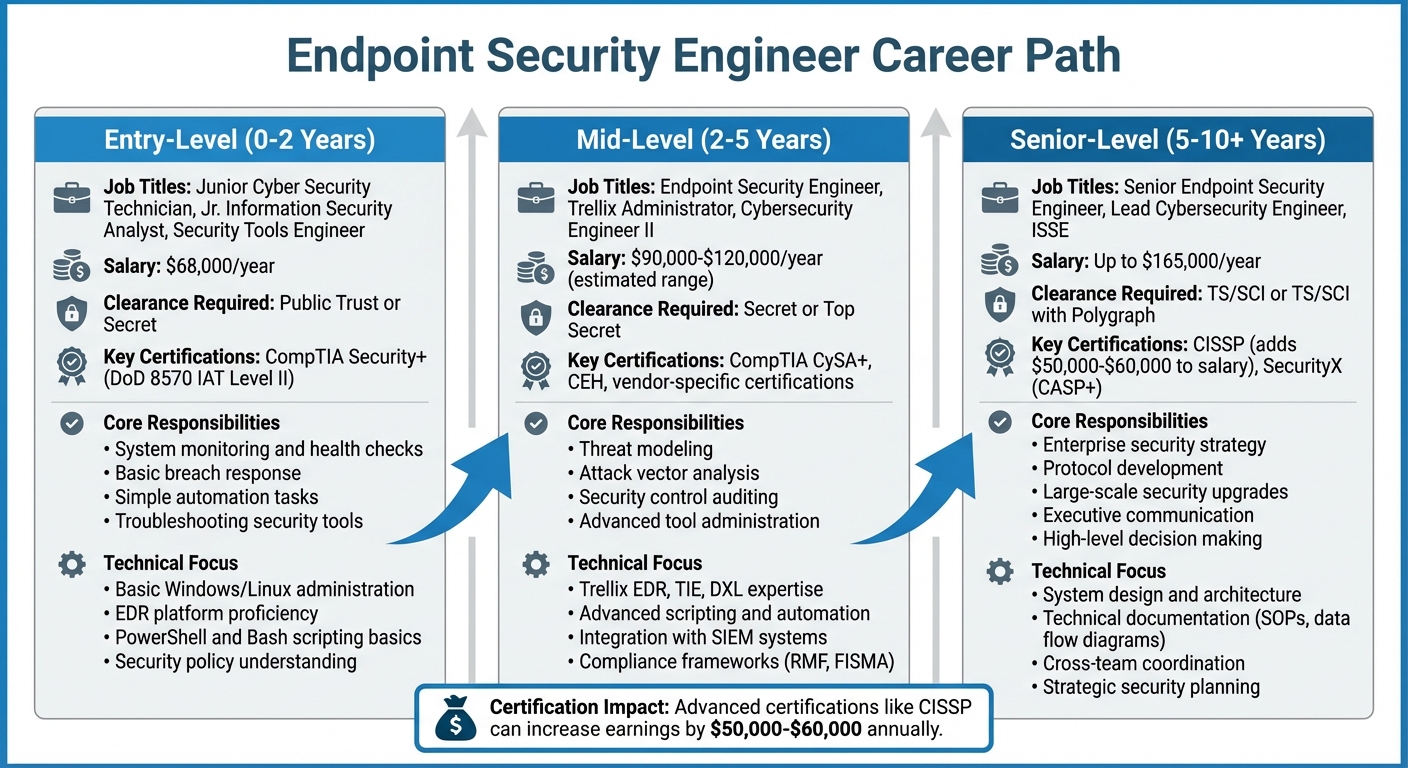
Endpoint Security Engineer Career Progression: Skills, Certifications, and Salary by Level
Building on the skills and certifications mentioned earlier, the career path for cleared Endpoint Security Engineers unfolds through defined stages, each offering greater responsibilities and challenges.
Entry-Level Roles and Requirements
Starting a career in endpoint security as a cleared professional typically involves roles like Junior Cyber Security Technician, Jr. Information Security Analyst, or Security Tools Engineer. These positions are designed for those with zero to two years of experience and focus on fundamental tasks such as identifying security measures, responding to breaches, and automating straightforward processes [4].
To qualify, candidates generally need a DoD 8570 IAT Level II certification (often CompTIA Security+) and basic Windows and Linux administration skills. Entry-level engineers are responsible for monitoring system health, troubleshooting issues, and becoming proficient with deployed endpoint security tools. Salaries in these roles start at approximately $68,000 per year in the United States [1].
These positions require a Public Trust or Secret clearance, making them suitable for those beginning the clearance process. Professionals in these roles focus on developing hands-on experience with endpoint detection and response (EDR) platforms, gaining a solid understanding of security policies, and learning scripting languages like PowerShell and Bash for basic automation tasks [1].
Mid-Level and Senior Positions
Once foundational skills are established, professionals can advance to roles that demand greater technical expertise and a focus on strategic security management.
After gaining two to five years of experience, cleared professionals can move into roles such as Endpoint Security Engineer, Trellix Administrator, or Cybersecurity Engineer II. These mid-level positions involve tasks like threat modeling, analyzing attack vectors, and auditing security controls [4]. Success at this stage requires deeper expertise in platforms like Trellix EDR, Threat Intelligence Exchange (TIE), and Data Exchange Layer (DXL), along with certifications specific to these tools [2].
Senior roles, including Senior Endpoint Security Engineer, Lead Cybersecurity Engineer, and Information Systems Security Engineer (ISSE), typically require five to ten years of experience and TS/SCI clearance for environments with heightened security needs. At this level, the focus shifts from technical execution to managing organizational security strategies. Responsibilities include creating enterprise-wide security plans, overseeing protocol development, and driving large-scale changes like upgrading security solutions across the organization [4]. Senior engineers are also expected to communicate complex security concepts to non-technical stakeholders and make high-level decisions. Salaries for senior-level roles can reach up to $165,000 per year [1].
These positions often require strong technical documentation skills, such as drafting system design diagrams, data flow diagrams, standard operating procedures (SOPs), and test plans [2]. Many high-clearance senior roles, particularly those requiring TS/SCI with Full Scope Polygraph, also demand full-time, on-site work at secure facilities [2].
Finding Jobs on Cleared Cyber Security Jobs

If you’re ready to dive into an endpoint security career, the next step is finding the right role. Cleared Cyber Security Jobs simplifies the process by offering tailored search tools for cleared professionals. It connects you directly with employers in defense and intelligence sectors.
Using Job Search Filters
To narrow your search, use keywords like "Endpoint Security Engineer," "Cyber Security Engineer," or "Endpoint Protection" [1][13]. For example, as of March 19, 2026, searching for "Cyber Security Engineer" yielded 1,825 open positions on the platform [13].
One standout feature is the clearance level filter, which lets you select from options like Secret, Top Secret, TS/SCI, TS/SCI Poly, and Public Trust. This ensures you’re only seeing jobs that match your current clearance level [11][13]. Secret clearance roles are the most abundant, with 2,388 listings, while TS/SCI positions account for 715 openings [11].
You can also refine your search by location. High-demand areas include Virginia (559 jobs), California (535 jobs), and Maryland (533 jobs). If you’re looking for flexibility, the "Remote" filter reveals 2,203 positions [11]. Additionally, you can focus on opportunities with major defense contractors like Northrop Grumman, RTX, Booz Allen Hamilton, or Sierra Nevada Corporation [11]. To streamline your search further, sort job listings by "Relevance" to align with your skills or by "Date" to view the latest openings [13].
Using Career Resources
The platform offers more than just filters – it provides tools to enhance your job search. For example, you can set up job alerts to get notified about new roles that match your clearance level and expertise [12][5][13]. Uploading your resume is another smart move, as it allows recruiters from top defense firms to find you directly [10].
If you’re transitioning from the military, take advantage of specialized Veteran Talent Communities. These communities provide resources and events tailored for cleared veterans, helping them translate military skills into civilian cybersecurity roles [5]. Additionally, career fairs hosted on the platform offer direct access to hiring managers from defense contractors. These resources are particularly beneficial for endpoint security positions, which often require both technical know-how and security clearances [5].
Conclusion
Being an Endpoint Security Engineer with clearance requires a mix of technical know-how, relevant certifications, and the right level of clearance. Proficiency with tools like Microsoft Defender, Tanium, and HBSS, combined with certifications such as CompTIA CySA+, helps you stand out in this competitive field. Your clearance – whether it’s Secret, TS/SCI, or TS/SCI with Polygraph – opens the door to a wide range of roles in government contracting and defense sectors.
The demand for professionals with these qualifications continues to grow, reflecting the critical need for endpoint security expertise in these industries.
Platforms like Cleared Cyber Security Jobs can help you navigate this career path. Use personalized job alerts with keywords like "Endpoint Security", "HBSS", "Tanium", or "Microsoft Defender" to stay updated on new opportunities [12][14]. Uploading your resume also allows recruiters to find you directly.
Your technical skills, certifications, and active clearance are the building blocks for success in endpoint security. Whether you’re starting out or aiming for senior roles, leveraging these qualifications and utilizing specialized career resources can help you uncover opportunities that align with your expertise.
FAQs
Do I need an active clearance to get hired?
Yes, most Endpoint Security Engineer positions require candidates to hold an active security clearance. Employers usually prefer clearances that are either current or have been valid within the past two years. Possessing an active clearance can greatly improve your chances of landing these roles.
Which certification should I get first for DoD roles?
If you’re aiming for roles within the Department of Defense (DoD), DoD 8140 certifications are your starting point. One essential step is completing the Cyber 101 course. This course serves as a baseline to demonstrate your foundational knowledge, making it a highly recommended first move for cleared professionals interested in these positions.
How can I gain endpoint security experience without an EDR admin role?
To build expertise in endpoint security, start by pursuing certifications like CompTIA Security+. These credentials provide a solid understanding of security principles and are widely recognized in the industry. Combine this with hands-on projects, such as setting up and managing endpoint security tools like Microsoft Defender in lab environments. These practical exercises can deepen your technical knowledge.
You can also enhance your skills by exploring online courses, attending workshops, and connecting with cybersecurity professionals through networking events or forums. Additionally, entry-level roles in areas like security analysis or IT support offer valuable, real-world experience. These positions can help you establish a strong foundation in endpoint security, even if you’re not in a dedicated EDR (Endpoint Detection and Response) administrator role.