

Risk Analyst roles in cybersecurity are vital for protecting classified systems and national security. These professionals analyze risks, evaluate threats, and implement security measures for government agencies and defense contractors. With increasing cyberattacks targeting sensitive networks, the demand for cleared Risk Analysts has grown significantly. Here’s what you need to know:
- Key Responsibilities: Assess vulnerabilities, monitor classified networks, investigate breaches, and provide recommendations to enhance security.
- Qualifications: A bachelor’s degree (cybersecurity, IT, or related fields) is often required. Advanced degrees and certifications like CRISC, CISSP, or Security+ can accelerate career growth.
- Security Clearance: Essential for accessing classified information, with levels like Secret or Top Secret/SCI required. Clearance timelines range from 60 to 240 days.
- Skills Needed: Technical expertise in risk management, cloud security, and scripting (Python, PowerShell) combined with strong communication skills.
- Career Progression: Start in entry-level roles like IT Auditor or Junior Analyst, then advance to senior positions such as Risk Manager or GRC Director. Salaries range from $147,000 to $200,000+ for experienced professionals.
- Certifications: Certifications like CRISC, CISSP, and CGRC validate expertise and meet DoD requirements, boosting earning potential and job prospects.
To succeed, focus on building technical skills, obtaining security clearance, earning certifications, and networking within the cleared community. This career path offers competitive pay, job security, and the opportunity to safeguard critical systems.
Inside My Job as a GRC / Cyber Risk Analyst – The TRUTH
Qualifications and Entry Requirements
Let’s break down what it takes to become a cleared Risk Analyst, from the education you’ll need to the security clearances and experience required to land the role.
Educational Background
Most cleared Risk Analyst roles call for a bachelor’s degree in fields like cybersecurity, computer science, or information systems. These degrees lay the groundwork for understanding system vulnerabilities, digital threats, and architecture [4][6]. But technical fields aren’t the only way in – degrees in finance, business, economics, mathematics, or statistics are also highly regarded, especially for positions that focus on financial or operational risks [2][3].
For those looking to climb the ladder faster, pursuing a master’s degree – such as an MBA or an MS in Cybersecurity or Financial Risk Management – can help you develop a broader understanding of business strategy and complex risk scenarios [2][3]. That said, the hiring landscape is evolving. Many organizations now emphasize skills and certifications over formal degrees, valuing hands-on expertise [4][5].
"Look at where you are now and where you want to go. Then see what’s out there and work those jobs to build the credentials" [4].
Once you’ve got the education or skills, the next step is meeting the strict requirements for security clearance.
Security Clearance and Eligibility
Security clearance is non-negotiable for cleared Risk Analyst roles. U.S. citizenship is a must, and most positions require an active clearance, such as Secret (Tier 3) or Top Secret/SCI (Tier 5), to handle classified data and protect critical national security systems [1]. Under the Trusted Workforce 2.0 framework, investigations are divided into three tiers, with Tier 5 being the most rigorous, requiring a 10-year history of your residences, employment, and education [1].
Before starting the clearance process, it’s wise to gather key documents like your 10-year address history, employment records, and passport details. This helps ensure accuracy and avoids potential issues, like "Personal Conduct" red flags [1]. On top of that, reviewing your credit report and resolving any financial issues is crucial – financial mismanagement is one of the leading reasons for clearance denials [1]. If you have foreign contacts, document their names, nationalities, and the nature of your relationship to streamline the Tier 5 investigation [1].
Keep in mind, clearance is tied to your job. If you leave a position, it becomes inactive after 24 months unless reactivated [1]. Once cleared, you’ll gain access to secure environments like AWS GovCloud, Microsoft Azure Government, and systems managed by Information Systems Security Officers (ISSO) [1].
With clearance in hand, the next step is gaining relevant professional experience.
Entry-Level Experience
Cleared Risk Analyst roles are rarely entry-level. Most professionals start in roles like Junior Risk Analyst, IT Auditor, Cybersecurity Assessor, or Systems Security Analyst before transitioning into more advanced positions [2][4]. According to CompTIA, a solid foundation includes 10 years of general IT experience, with at least five years focused on security, especially for those pursuing certifications like SecurityX [6].
If you can’t find a direct path into a Risk Analyst role, consider adjacent positions in software development, IT auditing, or compliance to build a relevant skill set [6][7].
"Aspiring cyber risk analysts should first target positions that deal with software issues – either in the implementation or development phases. The skills you will learn in these roles will transition nicely to the cybersecurity team" [6].
"The certifications help you have at least credentials that get you into a starter position at an organization" [4].
Start documenting your experience with risk identification, assessment, and response early on. This will make certification applications easier down the line [7]. For example, certifications like CRISC require three years of experience in IT risk management and IS control. However, you can take the exam before meeting the experience requirement and then have up to five years to accumulate and verify the necessary background [7].
Required Skills and Certifications
Cleared Risk Analysts need a mix of technical expertise and strong communication abilities. The Bureau of Labor Statistics predicts a 29% growth in information security analyst jobs between 2024 and 2034, highlighting the demand in the field. On top of that, there’s a global shortfall of about 4.8 million cybersecurity professionals [9].
Technical and Soft Skills
On the technical side, vulnerability analysis and risk management are critical. Analysts often work with frameworks like NIST CSF, ISO 27001, and CIS Controls to assess risks and craft mitigation strategies. In cleared environments, where classified data is common, these skills are even more important. A solid understanding of network and cloud security, including TCP/IP and platforms like AWS, Azure, and Google Cloud Platform, is essential.
Scripting and automation skills in languages like Python, PowerShell, or Bash are also valuable. These tools help automate tasks such as log analysis and security audits. Staying informed about the latest threats is another key responsibility. Knowledge of data security practices, encryption methods, role-based access control, and data classification ensures sensitive information remains secure.
Soft skills are just as crucial. Being able to explain technical issues in plain language helps non-technical stakeholders make informed decisions. According to one expert, "91% of talent professionals agree that soft skills are very important to the future of recruitment and HR" [12]. Critical thinking and attention to detail allow analysts to spot patterns and early warning signs of attacks. Collaboration across teams, from security operations to business leadership, is vital for effective incident response.
"In a world where job roles are changing rapidly, soft skills will be one of the few constants…"
- Chris Jones, CEO, City & Guilds [12]
Hands-on experience is a must for mastering these skills. Resources like the SANS StormCast podcast and CISA alerts can help you stay ahead of emerging threats. If you’re just starting out, roles in IT support, networking, or systems administration can build a strong foundation for a career in risk analysis.
Once these skills are in place, certifications can serve as proof of your expertise and help you advance.
Top Certifications for Cleared Risk Analysts
Certifications not only validate your skills but can also boost your earning potential. For example, professionals with a CRISC certification earn between $147,000 and $151,000 annually, while CISSP holders average $132,000. Many cleared roles also require certifications to meet DoD 8570/8140 guidelines.
| Certification | Level | Cost | Prerequisites | Relevance to Cleared Roles |
|---|---|---|---|---|
| CompTIA Security+ | Entry | Varies | None (Network+ recommended) | Foundational; meets DoD 8140/8570 requirements |
| CRISC (ISACA) | Advanced | $575 (members) / $760 (non-members) | 3 years in IT risk management | Bridges technical risk with business objectives |
| CISSP (ISC2) | Advanced | Varies | 5 years of professional experience | Gold standard for security management and architecture in government/defense |
| CGRC (ISC2) | Advanced | $599 | 2 years of experience | Critical for NIST RMF and FedRAMP compliance in government contracting |
| GSEC (GIAC) | Intermediate | Varies | None | Validates hands-on technical security tasks |
| CompTIA SecurityX | Advanced | Varies | 10 years IT experience (5 in security) | Formerly CASP+; approved for DoD Directive 8140 for advanced security architects |
A strategic approach to certifications can maximize your career growth. Start with Security+ to establish a strong base, then specialize with certifications like CRISC or CGRC for mid-level roles in risk and compliance. For senior positions, CISSP is often the go-to choice. If you’re focusing on audit and control evaluation, consider CISA. As Ken Sahs from Training Camp explains, "CISA proves you can evaluate whether controls are working. CRISC proves you can design the risk framework those controls support" [11].
In addition to certifications, hands-on experience with frameworks like NIST SP 800-30/39/53 and ISO 27001 is invaluable. ISACA allows up to five years after passing the CRISC exam to verify the required three years of experience [7]. Developing expertise in cloud security can also pay off, often adding over $15,000 to your salary [8].
Career Advancement for Cleared Risk Analysts
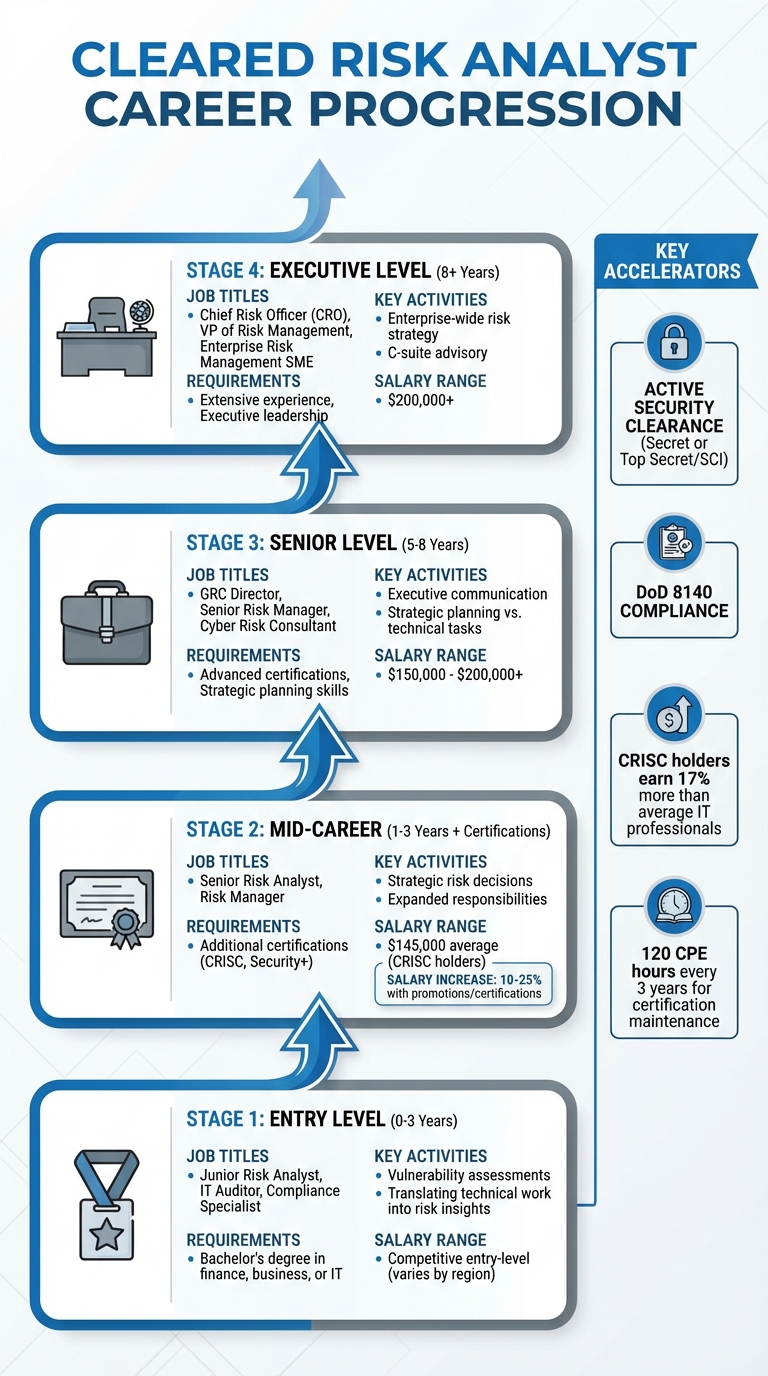
Risk Analyst Career Progression Path: Entry to Executive Level
Career Progression Stages
A career as a cleared Risk Analyst unfolds across four main stages. Most professionals begin as Junior Risk Analysts, IT Auditors, or Compliance Specialists, typically with 0–3 years of experience[3][10]. During this phase, earning a bachelor’s degree in finance, business, or IT is key, along with translating technical work – like vulnerability assessments – into risk management insights[3][10]. Even at the entry level, salaries are competitive and vary by region.
With 1–3 years of experience and additional certifications, you can move into mid-career roles such as Senior Risk Analyst or Risk Manager. Certifications not only help secure promotions but also sharpen your ability to make strategic risk decisions. For example, professionals with a CRISC certification earn an average of $145,000 annually, with North American holders earning about 17% more than the average IT professional[7]. On average, promotions or role changes supported by certifications lead to salary increases of 10% to 25%[10].
After 5–8 years in the field, senior-level positions like GRC Director, Senior Risk Manager, or Cyber Risk Consultant become attainable. Success at this stage requires shifting focus from technical tasks to strategic planning and effective communication with executives[10]. For those with over 8 years of experience, salaries often range from $150,000 to well over $200,000[10]. At the executive level, roles such as Chief Risk Officer (CRO), VP of Risk Management, or Enterprise Risk Management SME represent the pinnacle of the career path[3][10].
"If you’re tired of being seen as the ‘department of no’ and want to become a strategic business advisor, CRISC provides that pathway"[7].
Next, let’s explore how your active security clearance can accelerate these career milestones.
How to Leverage Your Security Clearance
An active security clearance is a game-changer for advancing your career as a Risk Analyst. Beyond complementing your qualifications and certifications, it positions you uniquely to influence enterprise cybersecurity strategies and take on broader responsibilities.
To maximize the value of your clearance, ensure you meet DoD 8140 compliance by pursuing certifications such as CompTIA SecurityX (formerly CASP+), which are geared toward advanced security architect and senior engineer roles[6].
Focus on sectors with high demand for risk expertise, such as financial services, healthcare, and defense contracting. These industries often provide the strongest career and financial growth opportunities[10]. Volunteering for cross-functional initiatives – like vendor assessments or policy reviews – can also help you demonstrate your ability to work across different business units, a skill that’s critical for senior roles. Additionally, align your current responsibilities with CRISC’s four domains (Governance, Risk Assessment, Risk Response, and Technology) to build a clear record of your experience[7].
To stay eligible for senior government positions, maintain your clearance and complete 120 Continuing Professional Education (CPE) hours every three years[7]. As organizations increasingly emphasize business-oriented risk perspectives, professionals who can translate technical threats into language that resonates with boards and executives are in high demand[10]. Specializing in areas like Cloud Risk Management, Third-Party Risk, or AI-driven threat modeling can further set you apart and accelerate your career growth[10][6].
sbb-itb-bf7aa6b
Job Search Strategies for Cleared Professionals
Using Cleared Cyber Security Jobs Effectively

Your profile on Cleared Cyber Security Jobs acts as your introduction to hiring managers. Recruiters often glance at your key skills and preferred work locations before diving into your resume, so having a fully completed profile is crucial. Fill out every section – technical skills, geographic preferences, and more – to ensure you show up in the right searches.
Another tip? Keep your profile fresh. Employers tend to prioritize recently updated profiles, so logging in weekly or monthly can update your profile date and improve your visibility in search results.
When searching for Risk Analyst positions, use Boolean search strings to cover multiple job title variations. For instance:
"Risk Analyst" OR "Risk Management Analyst" OR "Program Analyst"
This approach ensures you catch all relevant listings. You should also search by ZIP code and set a mileage radius to find jobs that might mention military base names or alternate city spellings.
Additionally, set up job alerts (sometimes called "Job Agents") to get email notifications as soon as new roles matching your criteria are posted. When creating alerts, include all clearance levels you’re eligible for. The platform’s research tools can also help you identify hiring trends, such as which cleared facilities are actively recruiting and which skills are most sought after [21, 22].
Once your online profile is polished, shift your focus to crafting tailored application materials for cleared roles.
How to Tailor Applications for Cleared Roles
Generic resumes won’t cut it in the cleared job market. Each submission needs to align closely with the job’s specific skills and requirements. Use the STAR method (Situation, Task, Action, Result) to showcase your achievements rather than just listing responsibilities.
For example:
"Assessed 47 enterprise systems using RMF, identifying 132 vulnerabilities and reducing critical findings by 38% within six months."
Including measurable results like percentages or numbers gives hiring managers a clear picture of your impact. If you’re working toward certifications like CRISC or CISSP, mention them along with their expected completion dates to further strengthen your application.
Be mindful of operational security (OPSEC) when crafting your resume. Avoid mentioning classified project names, sensitive budget details, office sizes, or specific colleague names. Keep it concise – one to two pages is ideal, as recruiters often skim resumes quickly before deciding to reach out. If you’re transitioning from the military, highlight your desired relocation area and your availability date near the top of your resume [23, 24].
"Your security-cleared resume is not a biography or a mere list of qualifications. It’s an ad designed to help you land that coveted cleared job interview."
- Ashley Jones, Editor, ClearedJobs.Net [13]
"Keep subjective self-descriptions out of your summary section. I’m looking at you, Results-Oriented Team Players."
- Bill Branstetter, 9th Way Insignia [13]
Professional Development for Cleared Risk Analysts
Advanced Certifications and Training
For cleared Risk Analysts, stacking certifications can significantly boost your career prospects. With the Governance, Risk, and Compliance (GRC) market projected to reach $32.8 billion by 2032 – and a 25% shortage of qualified professionals – there’s a clear demand for those who invest in the right credentials [11].
One top choice is the Certified Information Security Manager (CISM). This certification emphasizes security governance, program development, and incident management, making it ideal for leadership roles. CISM-certified professionals typically earn between $140,000 and $142,000 annually [10]. The exam costs $575 for ISACA members and $760 for non-members [11].
Another valuable certification is Certified in Governance, Risk and Compliance (CGRC), which focuses on NIST RMF and FedRAMP compliance – essential for government contracting work. The exam fee is $599 [11]. For hands-on professionals, CompTIA SecurityX (formerly CASP+) offers DoD 8140 approval and covers advanced security architecture and incident response [6].
As artificial intelligence becomes more integrated into organizations, AI governance certifications like ISACA’s AAISM and AAIA are gaining traction. These credentials position you as an expert in managing AI risks and compliance.
"The professionals who get certified in AI governance now, before everyone else catches up, are going to be the ones organizations turn to when new regulations inevitably hit." – Ken Sahs, Training Camp [11]
Maintaining your certifications is equally important. Most require 120 CPE hours every three years, with annual fees of $45 for ISACA members or $85 for non-members [7]. Joining ISACA (approximately $135 annually) can simplify this process, as many CPE activities apply to multiple certifications like CRISC, CISA, and CISM [11].
Practical experience with frameworks such as NIST CSF, ISO 27001, and COBIT can also showcase your expertise [11]. But beyond technical skills, networking plays a crucial role in advancing your career.
Networking in the Cleared Community
Technical knowledge is essential, but building strong professional relationships is just as critical. In the cleared community, in-person networking often carries more weight than online connections.
Events like Security Cleared EXPO are tailored specifically for cleared professionals. These career fairs connect you directly with hiring managers who understand clearance levels and mission requirements. This setup allows you to discuss your TS/SCI clearance, polygraph status, and specialized skills without the usual security concerns [14].
Many defense contractors also host talent communities to engage with potential hires. For example, Booz Allen offers tech talks where you can interact with current employees and learn about upcoming projects. These events provide insight into the organization’s culture and allow you to build relationships before applying for a role [16].
Local ISACA chapters are another excellent networking resource. They host free webinars and in-person events where you can meet professionals in your area. Since many cleared positions are tied to specific facilities or SCIFs, these local connections can reveal opportunities that aren’t publicly posted [7].
Platforms like ClearedConnections can also increase your visibility. This free database allows cleared job seekers to upload their resumes, making them accessible to U.S. government agencies and contractors [15]. While not a direct networking event, it’s a valuable tool for reaching the right audience.
The cleared community prioritizes long-term relationships over quick, transactional networking. Regularly attending events, contributing to discussions, and offering support to peers can open doors to referrals and insider information about upcoming contracts or facility expansions. These connections can give you a competitive edge and help you thrive in the cleared cybersecurity field.
Conclusion
Pursuing a career as a Risk Analyst can give cleared cyber professionals a distinct advantage, opening doors to specialized roles in government agencies and defense contracting.
To excel, you’ll need a mix of technical skills, relevant certifications, continuous learning, and a solid professional network. Engaging with organizations like ISACA and attending industry events can help you stay connected within the cleared community.
Your job search should align with your professional growth. Platforms like Cleared Cyber Security Jobs simplify the process by linking you to employers who value your clearance and expertise. By combining your clearance with advanced certifications and active community involvement, you can shape a career dedicated to protecting critical systems and sensitive data.
FAQs
Do I need an active clearance to get hired?
Yes, having an active security clearance is usually a must for risk analyst roles in cybersecurity. These jobs often deal with sensitive data and tasks tied to national security, making the clearance a critical requirement for employment.
Which certification should I get first for risk roles?
The CRISC certification is an excellent entry point for those pursuing careers in risk management. Tailored specifically for risk management professionals, this certification is particularly helpful for beginners aiming to develop their knowledge and skills in the field.
What’s the fastest way to move from IT into GRC?
To move from IT into GRC (Governance, Risk, and Compliance) quickly, start by building a strong knowledge base and earning certifications that align with the field. Begin with IT and security fundamentals, then dive into essential compliance frameworks like SOC 2 and ISO 27001. Certifications such as CompTIA Security+ or CISA can help establish your credibility. Use your existing IT experience to your advantage and enroll in focused GRC training programs. With consistent effort, you could make this transition in as little as 6 to 12 months.