• Skip to primary navigation
  • Skip to main content
Cleared Cyber Security Jobs | CyberSecJobs.com

Cleared Cyber Security Jobs | CyberSecJobs.com

Cleared Cyber Security Jobs

  • Home
  • Search Cleared Cyber Jobs
  • Job Fairs
  • Career Resources

CyberSecJobs Editorial

CDPSE Certification Career Guide for Cleared Data Privacy Engineers

CyberSecJobs Editorial · February 18, 2026 ·

The Certified Data Privacy Solutions Engineer (CDPSE) certification is a top choice for cleared professionals in government and defense who need to integrate privacy into system design. It validates your ability to turn privacy regulations into technical solutions, making you stand out in roles like Privacy Architect or Chief Privacy Officer. With over 16,000 certified professionals and average salaries around $150,000, the CDPSE is a key credential for advancing in privacy-focused careers.

Key Details:

  • Exam Cost: $575 (ISACA members) / $760 (non-members)
  • Structure: 120 questions, 3.5 hours
  • Domains: Privacy Governance (20%), Privacy Engineering (39%), Data Lifecycle Management (23%)
  • Eligibility: 3 years of experience in 2 of 4 domains, verified by a supervisor
  • Annual Maintenance: 20 CPE hours, $45 fee (members)

The certification covers technical areas like encryption, Privacy Enhancing Technologies (PETs), and secure data lifecycle management. It’s especially relevant for cleared professionals managing classified data while meeting federal privacy standards. The demand for privacy experts is growing, with job postings increasing by 75% over four years.

This guide explains how to prepare for the exam, meet eligibility, and use the certification to advance your career in high-security environments.
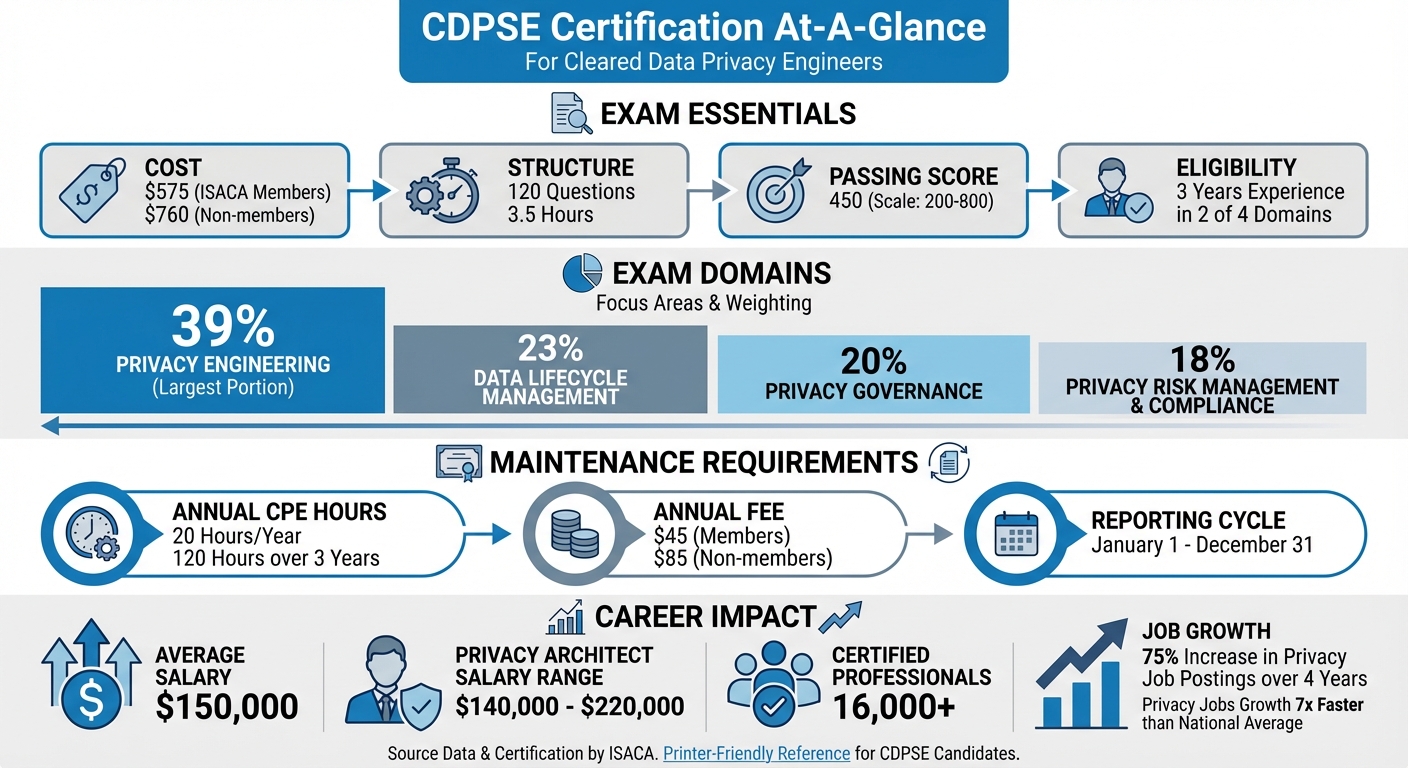
CDPSE Certification Quick Reference Guide: Costs, Domains, and Career Benefits

CDPSE Certification Quick Reference Guide: Costs, Domains, and Career Benefits

What is the CDPSE Certification?
CDPSE

CDPSE Certification Overview

The Certified Data Privacy Solutions Engineer (CDPSE) is a certification built on real-world experience. It confirms your ability to design, build, and implement privacy-focused solutions from the ground up [1][3]. Specifically, it certifies expertise in embedding privacy controls into IT systems, networks, and applications.

For professionals working in defense and intelligence, the CDPSE demonstrates your ability to turn federal privacy mandates into effective technical designs. It shows you can translate complex legal requirements into practical system designs that safeguard sensitive data throughout its lifecycle.

"If I’m hiring somebody that has the CDPSE, that individual has a fairly extensive body of knowledge. It’s not just legal, it’s not just IT, it’s not just governance, it’s not just security. It’s an amalgam of all those various domains and disciplines." – Matt Stamper, CISO and Executive Advisor [7]

The exam consists of 120 questions based on real-world scenarios [2]. Starting June 2, 2025, the certification will follow a four-domain structure, emphasizing technical controls and collaboration. This ensures certified professionals can work seamlessly with developers, engineers, and project managers in high-security environments.

The 3 Core Domains Explained

While the exam includes four domains, three are especially relevant for cleared professionals handling technical responsibilities:

Privacy Governance (20%) focuses on creating a strong framework for managing personal data. This includes understanding transparency, accountability, and federal regulations, as well as managing vendor relationships in secure environments.

Privacy Engineering (39%) dives into the technical side of privacy. It covers the Secure Development Life Cycle (SDLC), identity and access management (IAM), encryption, hashing protocols, and Privacy Enhancing Technologies (PETs) like anonymization and pseudonymization.

Data Lifecycle Management (23%) ensures data is handled securely at every stage – from collection and classification to retention and destruction – while complying with federal guidelines.

Domain Weight Focus Areas
Privacy Governance 20% Privacy laws, policies, vendor management, and incident response [2]
Privacy Engineering 39% Infrastructure, SDLC, encryption, IAM, and Privacy Enhancing Technologies [2]
Data Lifecycle Management 23% Data classification, inventory, retention, and secure destruction [2]

These domains are the foundation for thriving in roles that demand both technical skills and a deep understanding of privacy.

How CDPSE Supports Cleared Career Goals

The CDPSE bridges the gap between legal requirements and technical execution, making it easier to implement Privacy by Design and Default in government systems [1]. Privacy engineering roles are often harder to fill compared to legal or compliance positions [3]. Earning a CDPSE demonstrates your ability to perform Privacy Impact Assessments (PIAs), conduct threat and vulnerability assessments, and collaborate across teams. This means you can take policy requirements and turn them into actionable technical specifications for developers and auditors.

"Modern privacy laws and regulations require organizations to implement privacy by design and by default into IT systems, networks, and applications… We designed the CDPSE certification to promote privacy-enhanced design that works cross-functionally." – Kim Cohen, ISACA Senior Director of Credentialing [7]

With the exam covering AI and Machine Learning privacy topics [2], you’ll also be prepared for emerging challenges. As government agencies increasingly rely on advanced analytics and automation, your ability to integrate privacy controls into these systems will become even more critical.

sbb-itb-bf7aa6b

CDPSE Certification Requirements and Eligibility

What You Need to Get Certified

Earning the CDPSE certification involves meeting three key requirements. First, you must pass a 3.5-hour exam consisting of 120 questions, achieving a minimum score of 450 on a scale of 200–800 [5]. Second, you need at least three years of professional experience in data privacy governance, architecture, or lifecycle management. This experience must span at least two of the four domains and must be within the past 10 years [11]. Finally, you must agree to follow ISACA’s Code of Professional Ethics, which outlines expected professional and personal behaviors [8].

"Members of ISACA and/or holders of the CDPSE designation agree to a Code of Professional Ethics to guide professional and personal conduct." – ISACA [8]

Unlike some other certifications from ISACA, the CDPSE does not allow for substitutions or waivers. A university degree will not shorten the three-year experience requirement, and all work experience must be verified by a supervisor, manager, colleague, or client. Verification from Human Resources departments or family members is not accepted [11].

Eligibility Guidelines for Cleared Engineers

If you’re a cleared engineer, the certification process adapts to accommodate classified work environments. Documentation focuses on general practice areas rather than project-specific details to maintain confidentiality [11]. Cleared professionals also have some flexibility: you can take the exam before completing the three-year experience requirement. Once you pass, you’ll have up to five years to accumulate and verify the necessary work experience [1].

When documenting your experience in classified settings, emphasize broader job responsibilities, such as implementing privacy-enhancing technologies or managing data lifecycle processes. Your verifier should be someone familiar with your technical work who can confirm your responsibilities within the CDPSE domains, without requiring disclosure of classified information [11].

For those who pass the exam before completing the required experience, the five-year window provides ample time to meet the work history criteria in areas like privacy governance or architecture. This setup allows you to focus on preparation and certification while planning your career path to meet the remaining requirements.

Tips to prepare for the 2025 ISACA CDPSE 3rd Edition exam

ISACA

How to Prepare for the CDPSE Exam

Getting ready for the CDPSE exam requires a clear understanding of its structure, a solid study plan, and effective time management. Here’s how to set yourself up for success.

Exam Format and Structure

The CDPSE exam consists of 120 multiple-choice questions, and you’ll have 3.5 hours to complete it. To pass, you’ll need a scaled score of 450 (on a scale from 200 to 800) [2][7][12]. You can take the exam at an authorized PSI testing center or opt for remote proctoring, giving you the flexibility to choose a setting that works best for you [1].

The exam is divided into four domains, each weighted differently. Domain 4 (Privacy Engineering) is the heaviest, making up 39% of the exam. Domain 3 (Data Life Cycle Management) accounts for 23%, followed by Domain 1 (Privacy Governance) at 20%, and Domain 2 (Privacy Risk Management and Compliance) at 18% [2]. After registering, you have 12 months to schedule your exam, and appointments can be booked as early as 48 hours after payment. If needed, you can reschedule for free up to 48 hours before your appointment [1].

With the logistics covered, let’s dive into the tools and strategies that can help you prepare.

Study Materials and Strategies

The ISACA CDPSE Review Manual and the Questions, Answers & Explanations (QAE) Database are your go-to resources for studying [12][9]. According to CDPSE top scorer Chris Fraker:

"ISACA’s CDPSE Questions, Answers & Explanations (QAE) manual closely mirrors the exam, with beneficial explanations." [9]

The QAE Database includes about 300 practice questions, a personalized dashboard to track your progress, and a 12-month subscription. Additionally, ISACA offers an online review course that takes roughly 22 hours to complete and provides 12 CPE credits.

Here’s a breakdown of costs:

  • Exam fees: $575 for ISACA members, $760 for non-members.
  • Review manual: $105 for members, $135 for non-members.
  • ISACA membership: $135 annually, which also provides access to the "Engage" online community for study groups and peer support.

When studying, focus on understanding the core privacy concepts rather than just memorizing answers. Fraker emphasizes:

"Don’t cram, learn. All IT certifications have foundational elements that a certified professional should know and understand." [9]

A well-rounded understanding will not only help you pass the exam but also ensure you’re prepared for real-world applications.

Managing Your Study Schedule

Consistency is key when it comes to preparing for the CDPSE exam. Create a daily study routine, ideally at the same time of day as your scheduled exam, to build focus and reduce stress [9]. Fraker suggests:

"Find the best time of day to study and stay consistent… Find out what works best for you and try and make it a routine." [9]

If you’re working in a classified environment, set up a study space outside secure areas to access online materials and practice exams. Remote proctoring offers additional flexibility, allowing you to take the exam in a controlled environment that fits your needs.

Since Domain 4 (Privacy Engineering) carries the most weight, dedicate extra study time to mastering this section. However, don’t neglect the other domains – use the QAE Database’s tracking features to identify areas where you need improvement [1]. A balanced and consistent approach will help you stay on track and boost your confidence as exam day approaches.

Maintaining Your CDPSE Certification

CPE Requirements Explained

Passing the exam is just the beginning – you’ll need to stay active in maintaining your certification. For professionals working in classified environments, this process comes with unique considerations.

To keep your CDPSE certification, you must complete 20 CPE hours annually and a total of 120 hours over three years. Each CPE hour represents 50 minutes of focused study, excluding breaks and meals [4]. Your reporting cycle starts on January 1 after you earn your certification, and any hours accumulated from your certification date to December 31 count toward your first cycle [4].

There’s also an annual maintenance fee: $45 for ISACA members and $85 for non-members. If you hold more than two certifications, the fee drops to $25 for members and $50 for non-members for each additional certification [10].

"The goal of this continuing professional education (CPE) policy is to ensure that all CDPSEs maintain an adequate level of current knowledge and proficiency in data privacy governance, privacy architecture, and data lifecycle" [4].

Failure to meet the CPE requirements or pay your fees by December 31 will result in your certification being revoked. Reinstating it requires a $50 fee plus any unpaid back fees [10].

Now, let’s explore the types of CPE activities available for cleared professionals to meet these requirements.

CPE Activities for Cleared Professionals

There are plenty of ways to earn CPE hours, and many activities can count toward multiple ISACA certifications. If you’re an ISACA member, you can earn up to 36 free CPE hours annually through webinars and online training [10]. Additionally, completing ISACA Journal quizzes provides one CPE hour per quiz, with up to six hours available each year [13].

For cleared professionals, in-house corporate training and government-sponsored workshops qualify as CPE activities, provided you have a certificate of completion [4]. In environments where formal certificates aren’t issued, you can document your attendance using ISACA’s "Verification of Attendance" form, signed by your manager [14].

If you’re teaching or presenting at conferences, you’ll earn five times the duration of your presentation for the first delivery. For example, a two-hour presentation would net you 10 CPE hours [4]. Enrolling in university courses also counts: 15 CPE hours per semester credit hour or 10 hours per quarter credit hour [4].

Volunteering is another option. Serving on ISACA boards, working groups, or the ISACA Foundation can earn you up to 20 CPE hours annually [10]. Mentoring colleagues or helping others prepare for the CDPSE exam can add up to 10 CPE hours per year [4]. Even passing a related professional exam earns you two CPE hours for every hour of exam duration [4].

Make sure to keep detailed records of all your activities. This includes your name, the sponsoring organization, the activity title, the date, and the total hours awarded. Retain these records for at least 12 months after your three-year cycle ends, as ISACA conducts random audits of certified professionals each year [10]. To avoid last-minute stress, report your CPE hours in the MyISACA portal as you earn them. This ensures you stay on top of requirements and maintain your certification status [4].

Using CDPSE to Advance Your Cleared Career

New Career Opportunities

Earning the CDPSE certification opens doors to senior-level roles that demand expertise in technical privacy, such as Chief Privacy Officer (CPO), Chief Risk Officer (CRO), and Lead Privacy Manager [16][6]. These roles are especially important in government and defense contracting, where meeting privacy compliance standards is directly tied to mission success.

The demand for skilled technical privacy professionals has skyrocketed. Over four years, job postings mentioning "data privacy" or "data protection" rose by 75%. Privacy analyst roles have doubled, and overall, data privacy jobs are projected to grow more than seven times faster than the national average. Globally, there are an estimated 3.5 million unfilled cybersecurity roles, with demand for experts in building and securing enterprise systems expected to increase by 164% in the next five years [15].

For professionals with security clearances, the CDPSE certification is especially valuable in defense and national security, where technical expertise is needed to translate legal requirements into actionable technical frameworks [16]. To seize these opportunities, you need to stand out in the competitive cleared job market.

Standing Out in the Cleared Job Market

The CDPSE certification equips you with a unique mix of skills across IT, security, governance, and legal domains. This multidisciplinary expertise is a significant advantage, particularly in government environments where legal teams often lack the technical know-how to manage data collection, storage, retrieval, and packaging effectively [7].

With 64% of organizations citing insufficient training as a major cause of privacy failures [16] and nearly 60% of data breaches stemming from human error [6], employers are prioritizing candidates who can implement technical controls over those who only understand policy. Your CDPSE certification highlights your ability to work with Privacy Enhancing Technologies (PETs), manage secure development life cycles, and integrate privacy into IT system architectures – skills that directly address these common vulnerabilities.

Platforms like Cleared Cyber Security Jobs can help you find roles requiring privacy expertise, connecting you with employers who value your technical credentials. Roles such as Privacy Solutions Architect, which align with CDPSE expertise, offer salaries ranging from $140,000 to $220,000 [17].

Beyond showcasing your expertise, staying ahead of industry trends is crucial for long-term career growth.

Staying Current with Industry Trends

The privacy field is evolving quickly, and the CDPSE certification ensures you stay on top of these changes. One major shift is the growing emphasis on "privacy by design and by default", which requires professionals who can implement privacy controls rather than just interpret regulations [7].

"Modern privacy laws and regulations require organizations to implement privacy by design and by default into IT systems, networks, and applications. We designed the CDPSE certification to promote privacy-enhanced design that works cross-functionally" [7].

With over 120 countries enforcing privacy laws or regulations [16], organizations need engineers capable of navigating frameworks like GDPR and CCPA while deploying technical solutions across various jurisdictions. The certification’s focus on Privacy Engineering – representing 39% of the exam [2] – prepares you to tackle these challenges with practical skills rather than just theoretical knowledge.

As new technologies like AI and machine learning introduce complex privacy challenges, CDPSE-certified professionals must address issues such as anonymization, pseudonymization, and advanced PETs [2]. Additionally, with the move to cloud-based systems, you’ll need to manage shared responsibility models, secrets management, and container security to prevent data exposure [18].

Data privacy has become a top priority for corporate boards, ranking among their top three concerns due to the financial and reputational risks tied to breaches [15]. This increased focus translates into more resources and career opportunities for technical privacy experts. By maintaining your certification through annual CPE requirements, you’ll ensure your skills remain aligned with emerging technologies and regulations, keeping you competitive in the cleared job market.

Conclusion

The CDPSE certification bridges the gap between legal compliance and technical application, making it a sought-after credential in the cleared community. By combining your technical privacy skills with this certification, you can position yourself as a key player in the cybersecurity field.

To get started, confirm your eligibility and begin preparing for the exam. The official CDPSE Review Manual and the Questions, Answers & Explanations database are excellent resources to help you tackle the 120-question, 3.5-hour exam. Once you pass, submit your application within five years, pay the $50 certification fee, and provide proof of your work experience [7]. Keep your certification active by meeting the annual CPE requirements, ensuring your expertise stays relevant as privacy laws evolve across over 120 countries [16].

The financial benefits of this certification are hard to ignore. CDPSE-certified professionals in data privacy roles earn an average of $150,000 annually, with Privacy Solutions Architect positions offering salaries between $140,000 and $220,000 [7]. This certification is especially valuable in cleared roles, where organizations need experts who can implement privacy controls alongside regulatory compliance. With advancements in technologies like AI and machine learning, the CDPSE credential showcases your ability to navigate complex privacy challenges while adhering to strict federal standards.

Take advantage of platforms like Cleared Cyber Security Jobs to connect with employers looking for technical privacy specialists. Update your LinkedIn profile and business cards with the CDPSE designation to highlight your qualifications [4]. Visit ISACA’s website to begin your certification journey today. With the demand for technical privacy expertise growing, the CDPSE certification is your opportunity to stand out in the cleared cybersecurity landscape.

FAQs

Is CDPSE worth it for cleared engineers vs. privacy lawyers?

The CDPSE certification holds strong value for cleared engineers. It confirms their technical privacy expertise, opens doors to better career prospects, and can even result in higher salaries. Unlike privacy lawyers, who concentrate on legal compliance and policy, the CDPSE focuses on professionals handling privacy in technical and operational environments. This makes it particularly relevant for cleared engineers involved in data privacy and security tasks.

How can I verify CDPSE experience without revealing classified work?

To verify CDPSE experience, you need to provide evidence of professional work across at least two of the exam domains. Use examples from non-classified, technical, or project-related work that clearly showcase your skills and expertise. Make sure your submission aligns with ISACA’s professional ethics guidelines and continuing education requirements. This way, you can validate your experience without sharing any sensitive or classified information.

What’s the best way to study if Privacy Engineering is the biggest domain?

To get ready for the CDPSE exam with an emphasis on Privacy Engineering, begin by thoroughly reviewing all three domains, with extra attention to the Privacy Engineering section. Dive into the detailed content outline to understand the scope of the material. Leverage specialized study guides and take practice exams to build your expertise in critical areas like privacy-by-design and risk modeling. A well-organized study plan combined with practicing real-world scenarios can solidify your knowledge and increase your confidence.
Related Blog Posts

  • CISA Certification Career Guide for Cleared IT Auditors
  • CCSP Certification Career Guide for Cleared Cloud Security
  • CIPP Certification Career Guide for Cleared Privacy Professionals
  • CIPM Certification Career Guide for Cleared Privacy Managers

Related Guides

  • CTIA Certification Career Guide for Cleared Threat Intel Analysts
  • CIPM Certification Career Guide for Cleared Privacy Managers
  • CIPP Certification Career Guide for Cleared Privacy Professionals
  • Cybersecurity Salary Guide 2026
  • TS/SCI Salary Premium: Real 2026 Numbers

CIPM Certification Career Guide for Cleared Privacy Managers

CyberSecJobs Editorial · February 18, 2026 ·

Looking to advance your career in privacy management within high-security roles? The Certified Information Privacy Manager (CIPM) certification equips professionals with the expertise to design, implement, and oversee privacy programs in sensitive environments. Here’s what you need to know:

  • What It Is: A globally recognized certification from IAPP, focusing on managing privacy programs rather than just understanding laws.
  • Who It’s For: Ideal for security-cleared professionals managing sensitive data in government or defense sectors.
  • Exam Details: 90 multiple-choice questions, 2.5 hours, $550 fee, and approximately 30 hours of study time.
  • Key Domains: Privacy program governance, operational life cycle, data protection, incident response, and more.
  • Preparation Tools: Study guides, practice exams, and IAPP training courses are available to help you succeed.
  • Career Impact: Opens doors to roles like Privacy Program Manager and Data Protection Officer, especially in classified settings.

This certification not only validates your skills but also positions you as a leader in privacy management for high-stakes roles. Ready to get started? Gather study materials, plan your schedule, and take the first step toward certification.

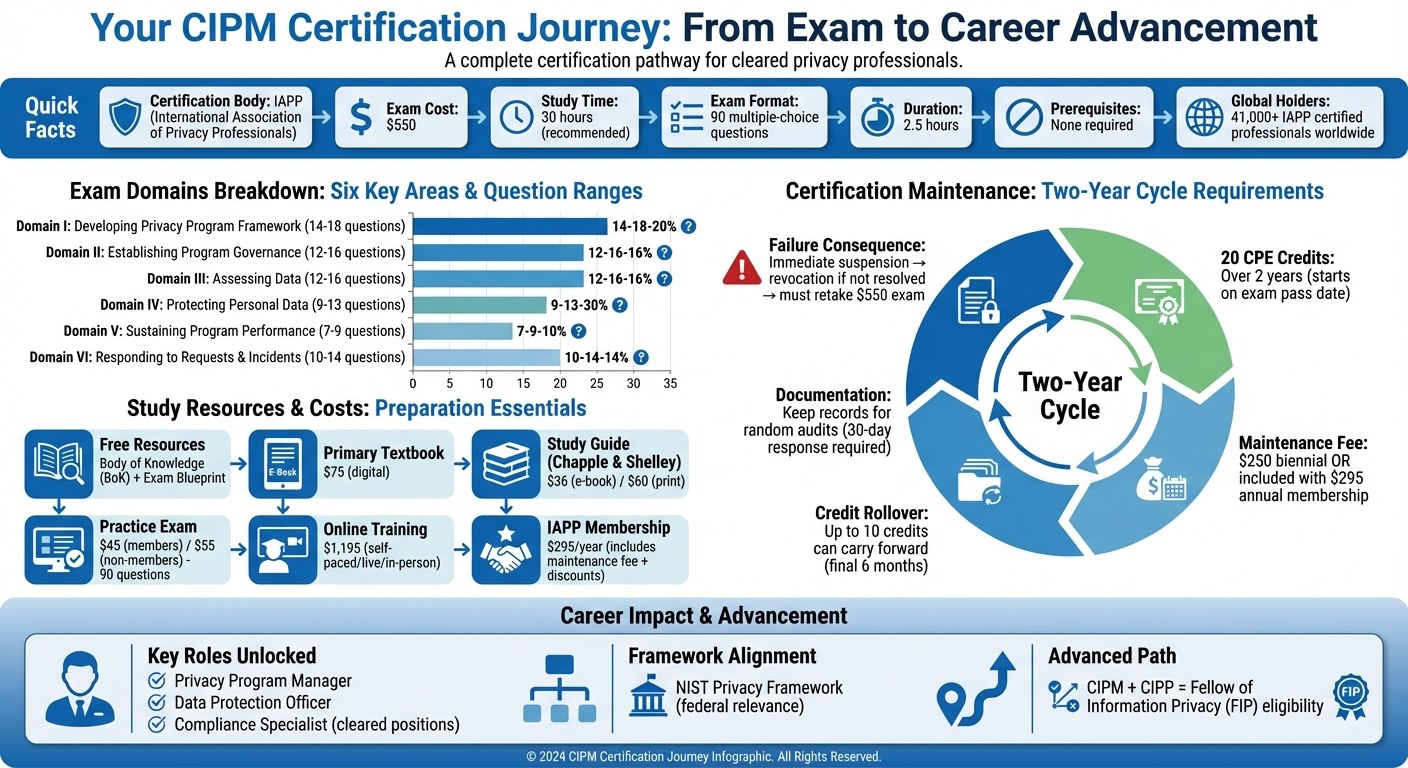
CIPM Certification Path: Requirements, Exam Structure, and Maintenance Timeline

CIPM Certification Path: Requirements, Exam Structure, and Maintenance Timeline

Free Certified Information Privacy Manager Certification Training | How To Clear CIPM in 30 Days?

sbb-itb-bf7aa6b

CIPM Certification Requirements and Exam Details

For cleared professionals looking to expand their qualifications, the CIPM certification offers an accessible and practical pathway. Below, you’ll find key details about the requirements and structure of the exam.

Eligibility and Prerequisites

The CIPM certification has no strict professional experience or educational prerequisites [1]. This means anyone, whether new to privacy or an experienced manager, can take the exam. You don’t need a specific degree or years of documented experience – just a solid understanding of privacy program management.

This open policy is especially useful for cleared professionals. It allows individuals to shift from cybersecurity into privacy-focused roles or enhance their credentials for managing classified data environments.

Exam Format and Knowledge Domains

Now that eligibility is clear, here’s a closer look at the exam’s structure and what it covers.

The test includes a mix of stand-alone questions and case-study scenarios designed to evaluate how well you can apply privacy principles in real-world situations. Correct answers earn one point each, and there’s no penalty for incorrect answers [2].

You can take the exam at over 6,000 Pearson VUE testing centers worldwide or opt for remote proctoring, which lets you take the test from your home or office [2].

The exam focuses on six core domains, each targeting essential skills for managing privacy programs, particularly in sensitive or classified environments. Here’s a breakdown:

Domain Focus Area Question Range
Domain I Developing a Privacy Program Framework 14–18
Domain II Establishing Program Governance 12–16
Domain III Operational Life Cycle: Assessing Data 12–16
Domain IV Operational Life Cycle: Protecting Personal Data 9–13
Domain V Operational Life Cycle: Sustaining Program Performance 7–9
Domain VI Operational Life Cycle: Responding to Requests and Incidents 10–14

Recent updates to the Body of Knowledge have introduced new performance indicators, including aspects of AI governance and global compliance challenges [3]. The exam focuses on practical application, so you’ll need to show how to implement privacy controls effectively rather than just memorizing terms or definitions.

How to Prepare for the CIPM Exam

Study Materials and Resources

To tackle the CIPM exam, you’ll need to lean on well-curated study resources that align with the demands of managing privacy in sensitive environments. The IAPP provides two essential starting points for free: the Body of Knowledge (BoK) and the Exam Blueprint. These documents outline the exam’s core topics and help pinpoint areas where additional study might be required before purchasing supplemental materials.

The primary textbook, Privacy Program Management: Tools for Managing Privacy Within Your Organization, is an indispensable resource, available in digital format for US$75. If you’re looking for a more structured guide, the IAPP CIPM Certified Information Privacy Manager Study Guide by Mike Chapple and Joe Shelley is a great option. It includes chapter reviews, pre-assessments, and access to online tools like flashcards and practice tests. The e-book version costs about US$36, while the print edition is priced at US$60.

For practice, the official CIPM Practice Exam is a must-have. It includes 90 questions (some retired from past exams) and costs US$45 for IAPP members or US$55 for non-members. This practice test is designed to familiarize you with the format and pinpoint areas needing improvement [4]. Taking it under timed conditions is an excellent way to simulate the actual exam environment and improve time management.

If you prefer a guided learning experience, the IAPP offers online training for US$1,195. Options include self-paced, live, or in-person formats. Additionally, becoming an IAPP member for US$295 annually provides perks like discounts on study materials (including the practice exam) and covers the certification maintenance fee.

Once you’ve gathered your materials, create a well-structured study schedule to maximize your preparation time.

Study Timeline and Schedule

The IAPP suggests dedicating at least 30 hours to studying for the CIPM exam [1]. This is a manageable commitment, even for professionals with demanding schedules in security-cleared roles. Whether you’re new to privacy or already hold certifications, this recommended study time lays a strong foundation. Keep in mind that you have up to one year from the date of exam purchase to schedule and take the test [2], offering flexibility to accommodate work obligations.

Kick off your preparation with the free IAPP mini-course, "How to prepare for an IAPP certification." This course can help you craft a personalized study plan [5]. Use the Exam Blueprint to identify domains with a higher concentration of questions, allowing you to focus your efforts where it matters most.

When you’re ready to schedule the exam, you’ll find flexible testing options designed to accommodate the operational needs of security-cleared professionals. The exam format will remain consistent with the structure outlined earlier.

Staying informed on privacy trends can also give you an edge. Subscribing to the IAPP Daily Dashboard is a great way to stay updated on topics like AI governance and global compliance challenges, which may appear on the exam.

A strong study plan not only sets you up for success on the exam but also equips you with the knowledge to excel in your privacy-focused role.

Using CIPM Certification in Cleared Positions

Career Opportunities for CIPM-Certified Professionals

Earning a CIPM certification opens doors to unique roles where privacy management and national security intersect. Government agencies and defense contractors are increasingly tasked with managing sensitive personal data while ensuring compliance with strict privacy regulations. This growing demand creates opportunities for professionals with expertise in both privacy and security clearance. With a CIPM, you’re well-positioned for roles like Privacy Program Manager, Data Protection Officer, or Compliance Specialist within organizations handling classified information.

What sets you apart is your ability to translate regulatory requirements into practical, actionable policies. This skill is especially valuable in cleared positions where privacy expertise must align with security protocols. The certification’s alignment with the NIST Privacy Framework makes it particularly relevant for federal roles, as many government agencies and defense contractors rely on this framework for risk management. By holding a CIPM, you demonstrate proficiency in implementing these standards in daily operations.

When applying for cleared roles, focus on the Privacy Program Governance domain, which emphasizes performance measurement and effectively communicating privacy risks – two areas that are top priorities in defense-related work.

The next section will explore how to put these skills into action in your workplace.

Applying CIPM Skills on the Job

With clear career paths available, your CIPM certification equips you to manage privacy effectively in environments with high-security requirements. In these roles, aligning privacy management with cybersecurity efforts is not just beneficial – it’s essential.

Your CIPM training prepares you to navigate complex data environments. Start by conducting data inventories and flow mapping to track how information moves within your organization. Incorporate Privacy by Design (PbD) principles early in the system development life cycle, ensuring privacy considerations are built into processes from the ground up. Additionally, assess technical, physical, and environmental controls to safeguard sensitive data. By focusing on understanding your data rather than applying broad restrictions, you’ll align with both privacy and cybersecurity best practices – an approach that directly supports the stringent security needs of cleared positions.

Use your training to establish measurable privacy metrics, which are critical for oversight and demonstrating the effectiveness of your privacy program. Conduct evidence-based privacy audits to showcase how your program delivers value, particularly to stakeholders who are more familiar with traditional security measures. Leaders in government and defense sectors rely on this kind of data to evaluate program performance and ensure compliance.

When incidents arise, your CIPM skills will help you differentiate between privacy and security breaches, allowing you to respond appropriately and maintain the integrity of classified environments. Given the strict protocols for breach reporting in these settings, this capability is invaluable. Additionally, develop and implement training programs to ensure all personnel are aware of their privacy responsibilities. By fostering a workplace culture that prioritizes privacy, you’ll complement and enhance existing security practices.

"CIPM certification demonstrates an understanding of implementing privacy regulatory requirements in day-to-day operations." – IAPP [1]

Maintaining Your CIPM Certification

Once you’ve started applying your CIPM skills in the workplace, keeping your certification active is key to maintaining your professional edge.

Annual CPE Requirements

To keep your CIPM certification valid, you’ll need to complete 20 Continuing Professional Education (CPE) credits over a two-year period [1]. This cycle starts the day you pass your exam and pay the maintenance fee, ending on the last day of the same month two years later [9]. The two-year window gives you plenty of time to plan your professional development.

Earning these credits is simple. Activities hosted by the IAPP – like conferences, live webinars, or KnowledgeNet meetings – are credited automatically [9]. For external activities, such as seminars, speaking engagements, or privacy-related courses, you’ll need to report those credits yourself using the online CPE Submission Form [9]. Be sure to submit credits within 90 days of completing an activity. If you earn extra credits in the final six months of your cycle, you can carry up to 10 of those credits into the next term [7][8][9].

If you hold multiple IAPP certifications, such as CIPP or CIPT, you’re in luck – credits often overlap and can be applied to more than one certification [7]. Just remember to keep documentation for any non-IAPP activities, as the IAPP conducts random monthly audits and may ask for proof within 30 days if selected [9].

Recertification Steps

Recertifying your CIPM involves two main tasks: submitting 20 CPE credits and paying the Certification Maintenance Fee (CMF), which is $250 for each two-year cycle [1][9]. If you’re an IAPP member, the $295 annual membership fee covers the CMF and also gives you access to additional resources [1].

Failing to meet either of these requirements results in an immediate suspension of your certification. If your two-year cycle ends while you’re suspended, your CIPM certification will be revoked, and you’ll need to retake the $550 exam to regain it [2]. Additionally, if you’re suspended for not meeting the CPE requirement, you can’t apply credits from the previous cycle to make up for the shortfall. Instead, you’ll need to earn the missing credits during the new term, on top of the standard 20 credits [9].

For those holding multiple IAPP certifications, all your credentials will align with the expiration date of the earliest one. To avoid any interruptions, keep track of your deadlines and ensure both your credits and maintenance fee are submitted on time. Staying on top of these requirements is essential for advancing your career in privacy management.

Conclusion

The CIPM certification demonstrates your ability to integrate privacy requirements into everyday operations, particularly within high-security settings [1]. With over 41,000 professionals worldwide holding IAPP certifications [12], earning this credential places you among a global network of privacy experts skilled at minimizing risks and safeguarding organizations from financial and reputational setbacks [6].

To get started, review the free CIPM Body of Knowledge and Exam Blueprint, which outlines the six key domains of the certification [1]. The exam costs $550 and can be purchased through the IAPP store [2]. The IAPP suggests dedicating at least 30 hours to studying, using the official textbook, Privacy Program Management: Tools for Managing Privacy Within Your Organization [1]. You might also consider the 90-question practice exam, available for $55, to assess your readiness before taking the actual test [1]. Once certified, your focus will shift to maintaining your credentials.

To keep your certification active, you’ll need to earn 20 CPE credits annually and pay a $250 biennial fee. Alternatively, an IAPP membership at $295 per year covers these costs and provides additional perks [1]. For professionals aiming to deepen their expertise, combining the CIPM with a CIPP certification can help meet the requirements for the prestigious Fellow of Information Privacy (FIP) designation [10].

This certification opens doors to higher earning potential, a broader range of career opportunities across both public and private sectors, and the confidence to lead privacy programs effectively [10][11]. Ready to take the next step? Download the Body of Knowledge, gather your study resources, and begin your journey toward becoming a certified privacy leader in high-security environments.

FAQs

Is CIPM worth it for cleared roles?

The CIPM certification holds strong value for professionals in cleared roles. It demonstrates a high level of expertise in managing privacy programs and equips individuals with the skills needed to oversee these programs effectively at every stage of their lifecycle. As a globally recognized standard, this certification underscores leadership in privacy management, making it a powerful tool for career growth in cleared environments.

How hard is the CIPM exam?

The CIPM exam isn’t easy – it’s designed to test your expertise thoroughly. You’ll face 90 multiple-choice questions that must be completed in just 2.5 hours. To succeed, you’ll need a strong grasp of privacy program management and a clear understanding of the Body of Knowledge. Dedicating time to focused study and mastering the key concepts will be crucial to performing well.

Can CIPM CPEs overlap with other IAPP certs?

Yes, you can apply CIPM Continuing Privacy Education (CPE) credits to other IAPP certifications. If the activities align with multiple certifications, the credits can count toward each one. There’s no need to earn separate credits for every individual certification.

Related Blog Posts

  • CISM Certification Career Guide for Cleared Security Managers
  • CISA Certification Career Guide for Cleared IT Auditors
  • CAP Certification Career Guide for Cleared Authorization Pros
  • CIPP Certification Career Guide for Cleared Privacy Professionals

Related Guides

  • CTIA Certification Career Guide for Cleared Threat Intel Analysts
  • CDPSE Certification Career Guide for Cleared Data Privacy Engineers
  • CIPP Certification Career Guide for Cleared Privacy Professionals
  • Cybersecurity Salary Guide 2026
  • TS/SCI Salary Premium: Real 2026 Numbers

CIPP Certification Career Guide for Cleared Privacy Professionals

CyberSecJobs Editorial · February 17, 2026 ·

The CIPP/US certification is a must-have for U.S.-based professionals working in privacy and cybersecurity, especially those with security clearance. It validates expertise in U.S. privacy laws, federal data protection standards, and compliance requirements critical for federal and defense roles. Here’s what you need to know:

  • What It Is: A globally recognized credential from the IAPP, focusing on privacy laws and regulations.
  • Why It Matters: Employers value CIPP/US-certified professionals for their ability to navigate privacy challenges in sensitive environments.
  • Earning Potential: Certified professionals earn $20,000–$30,000 more annually, with starting salaries around $135,000 and median earnings up to $205,000.
  • Preparation: Requires 30+ hours of study, official textbooks, and practice exams. Exam costs $550, with ongoing maintenance fees every two years.
  • Career Growth: Opens doors to roles like Privacy Officer and Data Protection Officer, with opportunities to expand into CIPM or CIPT certifications.

Whether you’re advancing your career or transitioning into privacy-focused roles, the CIPP/US certification is a powerful tool to showcase your expertise and meet federal compliance standards.

The Complete CIPP Certification Guide (2025) – Requirements, Exam Tips & Career Value

sbb-itb-bf7aa6b

Benefits of CIPP Certification for Cleared Professionals

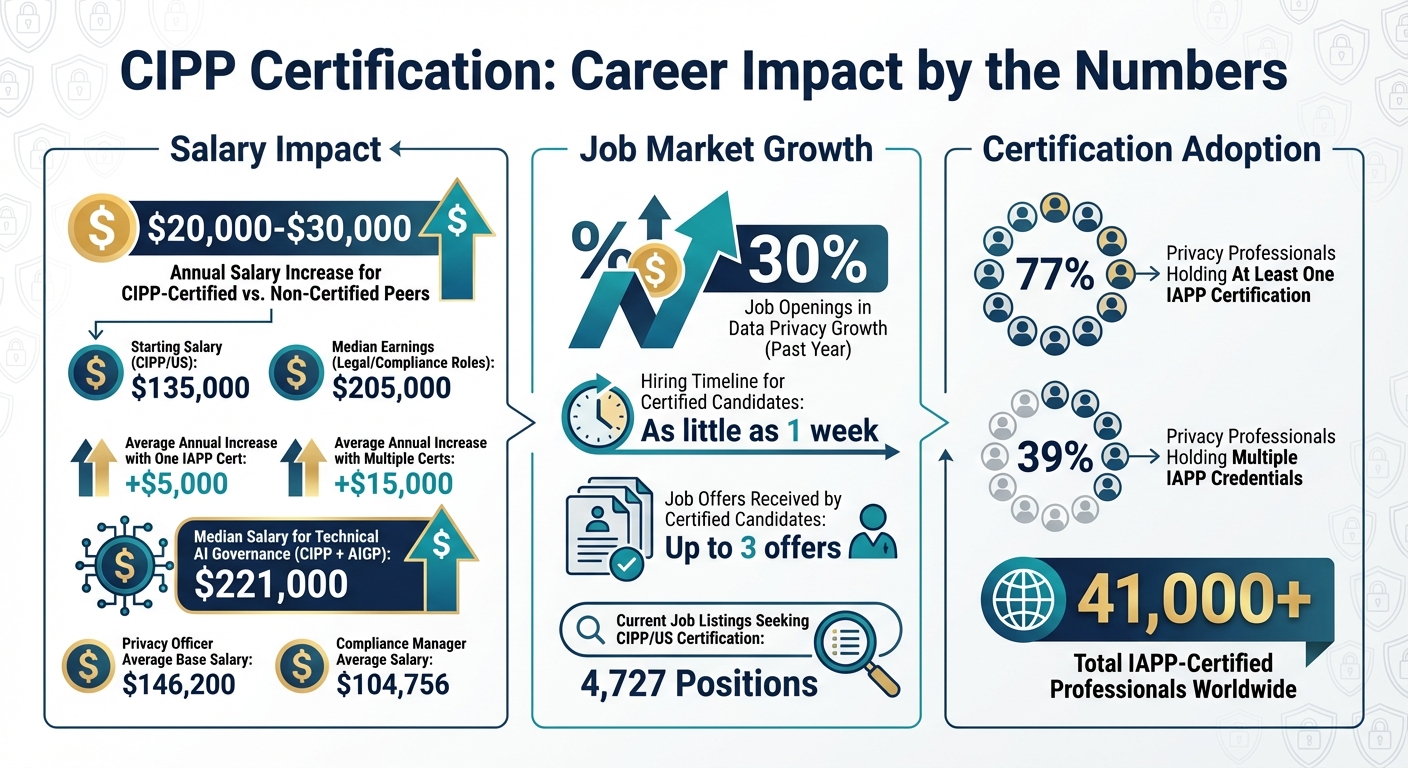
CIPP Certification Salary Benefits and Career Statistics for Privacy Professionals

CIPP Certification Salary Benefits and Career Statistics for Privacy Professionals

For professionals with security clearances, the CIPP/US certification offers more than just a career boost – it solidifies essential privacy expertise critical for working in sensitive federal environments.

Higher Salaries and Career Advancement Opportunities

IAPP-certified professionals enjoy a significant salary edge, earning $20,000–$30,000 more annually. Specifically, those with a CIPP/US certification can expect starting salaries around $135,000, with median earnings reaching $205,000 in legal and compliance roles[4][5][8].

The demand for privacy experts is skyrocketing. Over the past year, job openings in data privacy grew by 30%, drastically reducing hiring timelines to as little as a week. Certified candidates often receive up to three job offers[5]. For cleared professionals, the certification’s emphasis on national security and law enforcement data access provides an additional competitive edge.

Adding more certifications can further accelerate career growth. Around 39% of privacy professionals hold multiple IAPP credentials, which correlates with higher median salaries[4]. For instance, earning the Fellow of Information Privacy (FIP) designation – by combining CIPP with credentials like CIPM or CIPT – can open doors to senior roles like Data Protection Officer[2][5].

These benefits highlight how the CIPP/US certification not only boosts earning potential but also demonstrates expertise in compliance, making it a valuable asset for cleared professionals.

Proving Your Privacy Compliance Expertise

The CIPP/US certification is accredited by ANAB under ISO 17024:2012, which ensures it meets stringent federal and defense standards[2][6].

"Accreditation signifies holders have the skills to work across national and international jurisdictions." – IAPP[6]

This certification validates knowledge of U.S. privacy laws, including the FTC Act, GLBA, HIPAA, and CPRA[7]. A recent job search revealed 4,727 listings specifically seeking candidates with CIPP/US certification[7]. For cleared professionals, this credential signals to employers, clients, and vendors that you possess the expertise needed to navigate complex privacy requirements in both national and international contexts. This is especially vital in cleared environments, where trust and proven skills are non-negotiable. The certification’s focus on national security and law enforcement data requirements makes it even more valuable for professionals in these roles.

In addition to validation, the CIPP/US certification opens doors to a wide range of industry opportunities.

Industry Applications for Cleared Professionals

The CIPP/US certification is highly adaptable, making it relevant across multiple industries. In healthcare, it ensures compliance with HIPAA regulations, which is essential for managing sensitive medical data in government health programs and defense medical facilities[8]. In financial services, its coverage of the GLBA is critical, while professionals in technology and AI governance also benefit significantly.

Some individuals pair the CIPP/US with the AI Governance Professional (AIGP) certification to handle the ethical challenges of deploying AI systems. Those specializing in technical AI governance have reported median salaries as high as $221,000[4]. Moreover, government contractors working in telecommunications, defense systems, and intelligence rely heavily on the privacy law expertise that the CIPP/US provides.

This certification’s versatility allows cleared professionals to seamlessly transition between industries while maintaining its relevance. With 77% of privacy professionals holding at least one IAPP certification, the CIPP/US is widely recognized as a credential that maximizes career opportunities while adhering to security clearance requirements[4]. For cleared professionals, it’s a powerful tool for staying competitive in high-demand, high-value sectors.

How to Get CIPP Certified

Eligibility Requirements and Exam Structure

The CIPP exam is open to everyone – there are no prerequisites required to take it [2]. This inclusive approach makes it accessible to professionals at any point in their careers.

"Eligibility criteria for examination and certification as a Certified Information Privacy Professional… are applied equally to all individuals regardless of age, race, religion, gender, national origin, veteran status or disability." – IAPP Certification Candidate Handbook [2]

The CIPP/US exam includes 90 questions focusing on U.S. federal and state privacy laws, sector-specific regulations like HIPAA and GLBA, and enforcement practices. You’ll have 2.5 hours to complete the test, with a mandatory 15-minute break. Scoring ranges from 100 to 500, and you’ll need at least 300 to pass. Testing is available at over 6,000 Pearson VUE centers worldwide, or you can take it remotely through OnVUE on a personal computer (VPNs are not allowed).

Before scheduling your exam, make sure the name on your MyIAPP profile matches your government-issued ID. If you need accommodations, such as screen readers or interpreters, submit your request at least 30 days before your test date. If you don’t pass on your first attempt, you’ll need to wait at least seven days before retaking the exam.

These guidelines ensure a smooth process and help maintain the rigorous standards needed for high-level privacy and cybersecurity roles.

Study Resources and Training Programs

The IAPP suggests allocating at least 30 hours of focused study for the CIPP exam. To kick off your preparation, take advantage of the free mini-course and downloadable study guide. These tools will help you create a solid study plan before diving into additional resources. Two must-haves for your prep are the Body of Knowledge, which outlines all exam topics, and the Exam Blueprint, which breaks down the number of questions per subject area.

For more in-depth preparation, you can choose from several training options: online courses, live sessions, or in-person classes. Here’s a breakdown of costs:

  • CIPP/US Online Training: $1,195.00
  • Practice Exam: $55.00
  • U.S. Private-Sector Privacy Textbook: $95.00 (print) or $75.00 (digital)

Practice exams are especially helpful for simulating the actual test environment and identifying areas where you need improvement. Additionally, the IAPP Resource Center offers a range of privacy tools, and subscribing to the Daily Dashboard newsletter provides real-world insights into privacy issues that align with exam topics.

Once you feel confident in your preparation, you can move on to the registration process.

Registration Process, Costs, and Employer Sponsorship

When you’re ready, registering for the CIPP exam is straightforward. Purchase the exam for $550.00 through the IAPP store, then schedule it in the "My Purchases" section of your MyIAPP account. Keep in mind that your exam purchase is valid for one year, so it’s a good idea to schedule your test date as early as possible.

After passing the exam, you’ll need to pay a Certification Maintenance Fee (CMF) every two years to keep your credential active. If you’re an IAPP member, this fee is included in your membership benefits. Non-members can pay the CMF at the time of the exam to ensure their certification is activated immediately upon passing.

Many professionals seek employer sponsorship or reimbursement for certification costs. Employers interested in supporting certification efforts can contact IAPP at sales@iapp.org to discuss sponsorship opportunities. The MyIAPP "My Purchases" system is also designed to simplify employer-funded transactions and reimbursement processes.

Using CIPP Certification in Cleared Roles

Practical Applications in Federal Cybersecurity

The CIPP/US certification offers a solid foundation for addressing privacy challenges in federal cybersecurity roles. It provides training on legal requirements for handling personal data in federal settings, along with guidance on navigating state data security laws and federal breach notification protocols during incidents. This certification also prepares you to manage privacy issues in civil litigation, such as e-discovery and cross-border data transfers. Additionally, it helps you understand the intricate landscape of U.S. federal and state privacy laws, as well as sector-specific regulations for industries like healthcare and finance. This unique combination of technical and legal knowledge is essential when creating privacy policies or advising leadership on compliance strategies. It also facilitates a smooth transition into specialized roles focused on privacy. [3]

Applying CIPP Knowledge to Privacy-Focused Positions

The operational expertise gained from CIPP certification directly supports roles such as Privacy Officer, Compliance Manager, and Data Protection Officer in cleared environments. These positions come with competitive salaries – Privacy Officers earn an average base salary of $146,200, while Compliance Managers average $104,756. In these roles, you’ll ensure compliance with federal, state, and local privacy laws, oversee data collection restrictions related to national security, and implement workplace privacy tools throughout the employment lifecycle. You’ll also be responsible for crafting policies that safeguard both employee and customer data, ensuring alignment with sector-specific regulations. These responsibilities highlight the blend of technical skills and legal insight that the certification fosters. [10]

Promoting Privacy Awareness in Cleared Organizations

CIPP-certified professionals play a pivotal role in fostering privacy-conscious practices within their organizations. They bridge the gap between technical security measures and legal compliance, ensuring that security policies align with privacy requirements. Armed with this certification, you’ll be positioned to advocate for "Privacy by Design" principles, integrating privacy considerations into every stage of federal product and service development. By leveraging exam guidelines, you can pinpoint specific privacy domains in need of attention, enabling the creation of tailored training programs and awareness initiatives for your cleared environment. With over 41,000 professionals worldwide holding IAPP certifications, you’ll be part of a growing community dedicated to advancing privacy standards across government and defense sectors. [9]

Maintaining and Expanding Your CIPP Credential

Once you’ve earned your CIPP credential and started applying your knowledge, it’s crucial to keep it active and look for ways to grow your expertise. Doing so ensures you remain competitive in cleared roles and stay up-to-date with evolving privacy standards.

Continuing Education and Recertification Requirements

To maintain your CIPP certification, you’ll need to earn 20 Continuing Privacy Education (CPE) hours every two years and pay a $250 Certification Maintenance Fee (CMF) – though this fee is waived if you’re an IAPP member. While CPE credits from IAPP events are automatically tracked, activities outside the IAPP must be self-reported using the CPE Submission Form within 90 days. Be sure to save documentation in case of an audit.

If you earn more than 20 CPE credits, you can carry over up to 10 extra credits into your next cycle, provided they’re earned in the final six months of your current term. However, some activities have limits: for example, reading materials can only count for 5 CPEs per term, and attending KnowledgeNet meetings is capped at 3 CPEs per term. Missing these requirements leads to suspension, and eventually, revocation of your certification – requiring you to retake the exam to regain your credential [11].

Once your CIPP is secure, you might consider expanding your qualifications with additional certifications.

Additional Certifications: CIPM and CIPT

Building on your CIPP foundation, you can deepen your expertise by pursuing certifications like the CIPM (Certified Information Privacy Manager) or the CIPT (Certified Information Privacy Technologist).

  • The CIPM is ideal for professionals tasked with managing privacy compliance across an organization, focusing on operationalizing privacy programs.
  • The CIPT is designed for IT and engineering professionals, emphasizing how to embed privacy into products and services.

Both certifications align with your existing CIPP credential, and their expiration dates will match your CIPP cycle. In many cases, the same CPE credits can apply to multiple certifications if the material is relevant. Additionally, if you hold a CIPP along with either a CIPM or CIPT, you may qualify for the Fellow of Information Privacy (FIP) designation, provided you meet the required experience criteria [12].

For those interested in cutting-edge fields, the AI Governance Professional (AIGP) credential focuses on responsible AI systems and emerging regulations [1].

Networking and Professional Development Opportunities

Maintaining your CIPP credential is just part of the equation. Advancing your career also depends on professional development and building a strong network.

Networking not only opens doors but also enhances your learning. Local KnowledgeNet meetings are a great way to connect with peers and earn up to 3 CPEs per term [11]. Broader industry engagement opportunities, like IAPP conferences and live web events, also provide automatic CPE tracking.

The IAPP Career Central platform is another valuable resource. It offers a dedicated job board where you can filter opportunities by country and work model – whether remote, hybrid, or in-person – to find roles that align with your expertise.

You can also earn CPE credits through various activities:

  • Mentoring provides 3 CPEs per mentorship.
  • Authoring articles earns 2 CPEs per publication.
  • Speaking at industry events typically grants 3 CPEs per hour of presentation [11].

For professionals in security-cleared roles, platforms like Cleared Cyber Security Jobs offer additional resources tailored to privacy-focused careers in federal and defense sectors. These opportunities can help you stay ahead in your field while contributing to your professional growth.

Conclusion

The CIPP certification positions cleared professionals for advanced roles in privacy and cybersecurity. With more than 4,700 job listings specifically seeking CIPP/US-certified candidates and an average salary of $140,000 for those holding the credential, it’s clear this certification unlocks career opportunities in federal and defense sectors [7][13]. Its emphasis on U.S. federal and state privacy laws – particularly regarding government access to private-sector data – makes it a strong fit for professionals in national security contexts.

The certification’s structure is designed to support swift career growth. Since there are no prerequisites, professionals can quickly transition into privacy-focused roles. The tiered model (CIPP, CIPM, CIPT) also provides a clear pathway for long-term career development [7][14]. Notably, certified professionals earn a financial edge: those with one IAPP certification typically earn about $5,000 more annually than non-certified peers, while holding multiple certifications can increase that figure to $15,000 [7].

The certification’s credibility is further reinforced by its ANSI accreditation under ISO 17024:2012 standards [2]. As Stephen Holland and Christopher Stevens, both retired military intelligence professionals, explained:

"A tiered certification process, starting with CIPP, followed by CIPM… demonstrates a lifelong commitment to the information privacy profession" [14].

For U.S.-based cleared professionals, the CIPP/US specialization addresses key challenges in federal contracting, from HIPAA compliance and financial data protection to state-specific laws like the CCPA. This equips professionals to meet both privacy and security demands head-on.

While the $550 exam fee and ongoing maintenance costs may seem like an investment, they come with tangible returns: higher earning potential, access to specialized roles such as Data Protection Officer, and expanded job opportunities. With privacy-related job openings up 30% and hiring timelines as short as one week [15], there’s no better time to pursue the CIPP certification.

FAQs

Which cleared roles benefit most from CIPP/US?

Cleared roles such as privacy and compliance managers, privacy officers, and data protection professionals are the primary beneficiaries of the CIPP/US certification. It provides a thorough understanding of U.S. privacy laws and regulations, which are essential for excelling in these roles.

How should I study if I have a full-time cleared job?

Studying effectively while working full-time can feel like a juggling act, but it’s absolutely doable with the right approach. Start by using flexible and focused resources like the IAPP’s free CIPP/US Study Guide. This guide covers key topics and includes practice questions to help you prepare efficiently.

Aim to dedicate at least 30 hours to your study plan. Use a mix of tools such as textbooks, online courses, and practice exams to reinforce your understanding. To make the most of your time, leverage self-assessment tools to identify areas where you need improvement.

Consistency is key. Schedule short, regular study sessions that fit around your work commitments. This approach helps you stay on track without feeling overwhelmed, making it easier to balance both your job and your study goals.

What CPEs count toward maintaining my CIPP/US?

To maintain your CIPP/US certification, you can earn Continuing Privacy Education (CPE) credits through various activities. These include participating in web conferences, attending industry conferences, volunteering, joining KnowledgeNet meetings, or completing online training related to privacy. Just make sure these activities are directly tied to privacy topics and are properly documented to meet the certification requirements.

Related Blog Posts

  • CISSP Certification Career Guide for Cleared Cyber Professionals
  • CISA Certification Career Guide for Cleared IT Auditors
  • Security Plus Certification Career Guide for Cleared Entry Level
  • CCSP Certification Career Guide for Cleared Cloud Security

Related Guides

  • CTIA Certification Career Guide for Cleared Threat Intel Analysts
  • CDPSE Certification Career Guide for Cleared Data Privacy Engineers
  • CIPM Certification Career Guide for Cleared Privacy Managers
  • Cybersecurity Salary Guide 2026
  • TS/SCI Salary Premium: Real 2026 Numbers

CAP Certification Career Guide for Cleared Authorization Pros

CyberSecJobs Editorial · February 17, 2026 ·

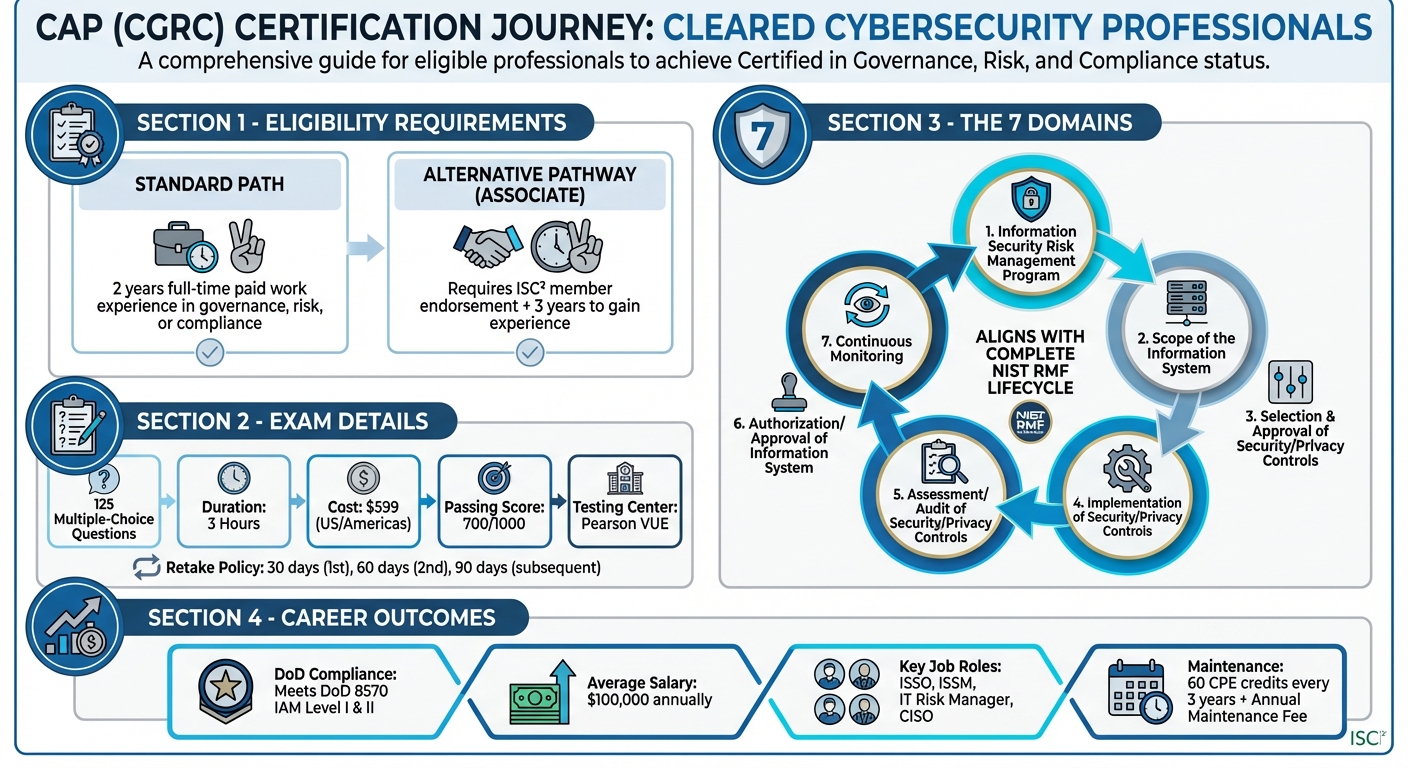
Looking to advance your cybersecurity career in cleared environments? The CAP certification, now called Certified in Governance, Risk and Compliance (CGRC), is a globally recognized credential for professionals managing information system security under the Risk Management Framework (RMF). It’s especially relevant for U.S. government employees, defense contractors, and anyone seeking compliance with DoD 8570 IAM Level I and II roles.

Key Takeaways:

  • Certification Overview: Validates expertise in aligning IT operations with regulatory compliance and risk management.
  • Eligibility: Requires 2 years of work experience in governance, risk, or compliance, or candidates can take the Associate pathway.
  • Exam Details: 125 questions, 3 hours, $599 fee, minimum score of 700/1000 to pass.
  • Career Opportunities: Roles like ISSO, ISSM, and IT Risk Manager, with average salaries of $100,000 annually.
  • Study Resources: Focus on NIST publications (SP 800-37, SP 800-53) and ISC² guides.

The CAP certification is essential for cleared professionals navigating RMF-based roles, ensuring compliance with both current and future DoD standards.

CAP Certification Path: Requirements, Exam Details, and Career Outcomes

CAP Certification Path: Requirements, Exam Details, and Career Outcomes

CAP Certification Exam Overview

Eligibility Requirements

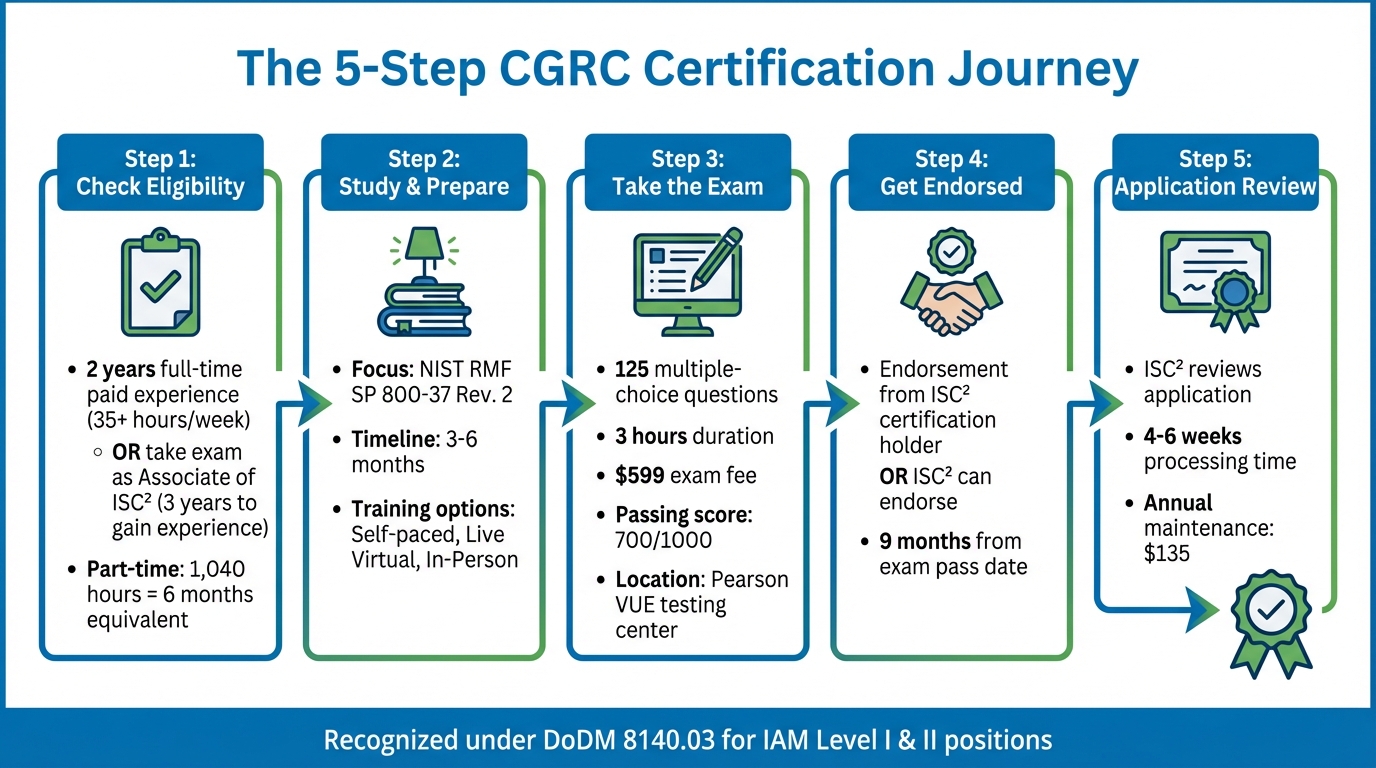
To qualify for the CAP certification exam, candidates must have two years of full-time, paid work experience in at least one of the CAP domains. If you don’t meet this requirement, you can still take the exam through the Associate pathway. This pathway requires an endorsement from an (ISC)² member and allows you three years to gain the necessary work experience while holding the associate title. Work experience must be verifiable and relevant to governance, risk, or compliance. Once eligibility is confirmed, it’s time to focus on the exam format for effective preparation.

Exam Format and Content

The CAP exam, now referred to as the Certified in Governance, Risk and Compliance (CGRC) exam, includes 125 multiple-choice questions to be completed within three hours [5]. It is administered at Pearson VUE testing centers [5].

After completing the exam, you’ll get unofficial results immediately at the testing center. However, official results take six to eight weeks due to psychometric and forensic analysis [5]. If you don’t pass, there are specific waiting periods before retaking the exam: 30 days after the first attempt, 60 days after the second, and 90 days for subsequent attempts [5]. Successfully tackling these requirements is a key milestone for cybersecurity professionals working in cleared environments.

Cost and Registration Process

The CAP exam fee is set at $599 for candidates in the United States and the Americas [5]. Registration is straightforward – sign up for the CGRC exam through Pearson VUE, where you can schedule your test date and location [5].

Once you pass, keep an eye on your email for endorsement instructions. Completing this step is necessary to finalize your certification [5]. To keep your certification active, you’ll need to earn 60 Continuing Professional Education (CPE) credits every three years and pay an Annual Maintenance Fee [2].

sbb-itb-bf7aa6b

The 7 CAP Certification Domains

Domain Overview

The CAP exam is structured around seven domains, each representing a critical phase of the NIST Risk Management Framework (RMF). These domains guide candidates through the full lifecycle of managing and authorizing information systems, from setting up a risk management program to ensuring ongoing monitoring. The CAP/CGRC certification stands out as the only security credential under the DoD 8570 Mandate that aligns with every step of the NIST RMF [3]. Mastering these domains is essential for anyone preparing for the exam and aiming to excel in this field.

What You Need to Know for Each Domain

Each domain highlights key skills and knowledge areas for professionals working in secure and regulated environments.

  • Domain 1: Information Security Risk Management Program
    This domain establishes the groundwork for system authorization. It focuses on governance, organizational risk tolerance, aligning security with mission goals, and compliance with FISMA and OMB Circular A-130.
  • Domain 2: Scope of the Information System
    Here, the emphasis is on system categorization using FIPS 199 and NIST SP 800-60. It involves determining impact levels (low, moderate, or high) based on potential losses in confidentiality, integrity, and availability. Additionally, it defines system boundaries and components that require authorization.
  • Domain 3: Selection and Approval of Security and Privacy Controls
    This domain addresses selecting baseline controls from NIST SP 800-53 and tailoring them to specific environments. It also covers control overlays for DoD systems and documenting decisions in the System Security Plan.
  • Domain 4: Implementation of Security and Privacy Controls
    Focuses on applying chosen controls during the system development lifecycle (SDLC). It includes integrating security engineering principles and documenting the implementation in the System Security Plan.
  • Domain 5: Assessment/Audit of Security and Privacy Controls
    Covers testing methodologies from NIST SP 800-53A. Professionals learn to create assessment plans, perform control testing, and document results in a Security Assessment Report for independent validation.
  • Domain 6: Authorization/Approval of Information System
    This domain involves final risk determination and emphasizes the role of the Authorizing Official. It includes creating a Plan of Action and Milestones (POA&M) to secure an Authority to Operate (ATO).
  • Domain 7: Continuous Monitoring
    Focuses on maintaining continuous security monitoring as outlined in NIST SP 800-137. This includes managing configurations, vulnerabilities, and adapting to evolving threats to ensure ongoing compliance and maintain the ATO.

Study Tips for Each Domain

To prepare effectively, align your study efforts with the core elements of each domain using these strategies:

  • Dive into key NIST Special Publications, particularly SP 800-37 (RMF), SP 800-53 (Security Controls), SP 800-53A (Assessment), and SP 800-137 (Continuous Monitoring). These documents are central to the exam.
  • Approach the material with a managerial perspective. The exam focuses on governance and compliance decision-making rather than just technical details.
  • For professionals with security clearances, connect each domain to DoD-specific policies, such as the 8500 series and CNSS instructions. Relating your real-world experience to these domains can help pinpoint areas where you may need to deepen your understanding.

How to Prepare for the CAP Exam

Recommended Study Materials

The Official (ISC)² Guide to the CAP CBK, Second Edition by Patrick Howard is a key resource for exam preparation. It’s priced at about $52.92 for a new copy, with used versions available for as low as $6.65. While it has a solid 4.4/5-star rating on Amazon from 178 global reviews, keep in mind that it was published in 2012. This means it doesn’t include some of the newer RMF elements, like the "Preparation" step or roles such as SCA-R and SCA-V. Use it as a baseline resource, but supplement it with updated materials.

Another critical document is NIST SP 800-37 Rev 2, which outlines the RMF 2.0 process featured heavily on the exam. Pay close attention to Appendices D, E, F, and G for detailed insights. Before spending on additional materials, download ISC2’s free resources like the "Ultimate Guide to the CAP" and "Advance Your Risk Management Career Strategy" eBook. These can provide a solid starting point. Additionally, the Official ISC2 CAP Flash Cards are free and can help you test your knowledge on the go.

For practice questions, consider purchasing the book Certified Authorization Professional (CAP): Exam Questions and Annotated Answers for around $20.00. ISC2 also offers an Official CBK Training Seminar, which includes 180-day access to course content and a printable Student Guide. To connect with others preparing for the exam, join online communities like the ISC2 Community "CAP Certification Study Group" and the TechExams Community forum.

Creating Your Study Plan

Start by conducting a gap analysis across the seven CAP domains to identify where you’re strong and where you need improvement. Plan your study time based on the weight of each domain – spend more time on areas that account for a larger percentage of the exam. Scheduling your exam 6–10 weeks in advance (with a $599 fee) can help you stay focused and motivated by setting a clear deadline.

Two weeks before the test, take a full-length, three-hour mock exam with 125 questions to simulate the actual experience. This will help you build stamina and refine your pacing. Remember, your overall score determines whether you pass, so you don’t need to excel in every single domain – just aim for a strong total performance. If you don’t pass on your first try, plan for a 30-day review period before retaking the exam. Adjust your study plan accordingly to address any gaps.

Common Mistakes to Avoid

As you prepare, steer clear of these common errors: Focusing too much on technical controls while neglecting administrative, procedural, and legal aspects of the authorization process. The CAP exam evaluates your understanding of the entire risk management process, not just specific tools or programming knowledge. Always prioritize studying primary source material like NIST documentation rather than relying solely on third-party summaries.

Don’t overlook the full RMF lifecycle. While "Categorization" and "Selection" often get the most attention, areas like "Continuous Monitoring" and "Authorization" are equally important. Be sure you understand the responsibilities of key roles, such as the System Authorization Authority, the Assessor, and the System Owner, as these are central to the exam. Keep a managerial perspective that balances technical knowledge with governance and compliance, as this aligns with the holistic approach required for success on the CAP exam.

Career Benefits of CAP Certification

CAP and DoD 8570 Compliance

DoD 8570

The CAP certification, now referred to as CGRC by (ISC)², is a DoD Approved 8570 Baseline Certification that satisfies training requirements under both the DoD 8570 and the updated DoD 8140 standards. This certification is a critical requirement for many cleared professionals working in Information Assurance roles within federal agencies and defense contracting.

What sets CAP apart is its alignment with every phase of the NIST Risk Management Framework (RMF). This makes it indispensable for professionals tasked with managing risk assessment and creating security documentation throughout a system’s lifecycle. With the Department of Defense requiring all components to transition to the DoD Cyber Workforce Framework (DCWF) by fiscal year 2026, CAP certification ensures compliance with both current and legacy standards [7].

For cleared positions, certifications like CAP are often non-negotiable. Defense contracts frequently require baseline certifications, and candidates lacking these credentials can be automatically disqualified, regardless of their experience. This makes CAP not just a certification but a gateway to expanded career opportunities in the cleared community.

Job Roles for CAP-Certified Professionals

CAP-certified individuals often land roles that are both in-demand and well-compensated, with average annual salaries around $100,000 [4]. The certification qualifies professionals for Information Assurance Management (IAM) Level I and II roles, which focus on authorizing and approving RMF-related policies and procedures.

Job Category Specific Job Titles
Management & Oversight Chief Information Security Officer (CISO), GRC Director, Information Assurance Manager, IT Risk Manager
Technical & Engineering Information Systems Security Officer (ISSO), Information Systems Security Manager (ISSM), Cybersecurity Engineer, Authorization Specialist
Compliance & Audit Cybersecurity Auditor, Cybersecurity Compliance Officer, Information Systems Auditor, Third-Party Risk Manager

"IAM personnel are responsible for authorizing or approving RMF policy and procedure documents, so it is important they know and understand the RMF. That is why [CAP] is a valued certification." – Tyra Appleby, Systems Security Engineer [6]

Given the federal government and DoD’s reliance on RMF, CAP-certified professionals are especially sought after in regions like Washington, D.C., and Virginia [4]. During interviews, it’s beneficial to connect your professional experience to the seven domains of the CAP Common Body of Knowledge to highlight your expertise with RMF.

Finding CAP Jobs on Cleared Cyber Security Jobs

Cleared Cyber Security Jobs

Once certified, finding roles that value CAP becomes much easier. Cleared Cyber Security Jobs is a specialized job board designed for security-cleared professionals in the cybersecurity industry. The platform offers tools like targeted job filters, resume uploads, and alerts for positions requiring CAP certification, all tailored to the cleared workforce.

As a job seeker, you can search for roles such as ISSO, ISSM, and IAM-level positions that specifically require CAP certification. The platform connects you directly with employers looking for cleared professionals, bypassing staffing firms. It also offers job fairs, giving you the chance to meet hiring managers face-to-face.

For employers, the platform provides access to a resume database and job posting packages, making it easier to find professionals with CAP credentials. Since all job seekers must have U.S. citizenship and an active security clearance, the talent pool is highly qualified, simplifying the hiring process and increasing your chances of standing out as a candidate.

CGRC Certification Explained: Exam Details, Study Tips & Career Benefits

Conclusion

The CAP certification – now known as CGRC under (ISC)² – continues to be a key credential for professionals in authorization and compliance roles, especially those with security clearances. Its alignment with the NIST Risk Management Framework and its recognition for DoD 8570 IAM Level I and Level II positions make it a critical qualification for federal and defense contracting jobs. Without it, your access to many cleared opportunities could be restricted.

More than just meeting baseline requirements, the CAP certification paves the way for higher-level roles like CISO, IT Risk Manager, and Information Systems Auditor. Professionals holding this credential typically earn around $100,000 annually [4]. Its vendor-neutral nature ensures your skills are applicable across both public and private sectors, providing flexibility in career paths.

The certification also connects you to a global network of over 160,000 cybersecurity professionals through (ISC)² [1], offering opportunities for ongoing learning and professional development. This is particularly valuable in regions with high demand for cybersecurity expertise, such as Washington, D.C., and Virginia.

To maximize the benefits of your certification, showcase it prominently on your resume and highlight how your experience aligns with the seven CAP domains during interviews. This not only emphasizes your understanding of the Risk Management Framework but also demonstrates your ability to apply it practically. Remember to maintain your certification by earning 60 CPE credits every three years and paying the Annual Maintenance Fee [2].

Whether you’re starting out in authorization or aiming for leadership roles, the CAP certification establishes you as a trusted expert in governance, risk, and compliance – qualities that are in high demand among cleared employers.

FAQs

Is CAP the same as CGRC?

The CAP certification has been updated and is now called Certified in Governance, Risk and Compliance (CGRC). Despite the name change, it remains the same credential, with the new title emphasizing its focus on governance, risk, and compliance practices.

Can I take the CAP/CGRC exam without 2 years of experience?

To be eligible for the exam, you must have at least 2 years of paid work experience in one or more of the seven domains outlined in the CAP Common Body of Knowledge (CBK). This requirement is in place to ensure that candidates possess the hands-on experience needed to excel.

What CAP/CGRC study resources should I prioritize first?

To kick off your preparation, dive into the Official (ISC)2® Guide to the CAP® CBK®. This resource provides a detailed breakdown of the core knowledge areas covered in the exam. Pair this with the ISC2 CGRC/CAP exam outline, which gives a clear overview of the exam domains, helping you focus on the right topics.

Once you’ve reviewed these foundational materials, consider leveraging ISC2’s official prep tools and training courses. These resources are designed to deepen your understanding and ensure your study efforts align closely with the exam’s structure and content.

Related Blog Posts

  • CCSP Certification Career Guide for Cleared Cloud Security
  • CCSK Certification Career Guide for Cleared Cloud Knowledge
  • CRISC Certification Career Guide for Cleared Risk Professionals
  • CGRC Certification Career Guide for Cleared GRC Analysts

Related Guides

  • CGRC Certification Career Guide for Cleared GRC Analysts
  • CRISC Certification Career Guide for Cleared Risk Professionals
  • CASP Plus Certification Career Guide for Cleared Security Architects
  • Cybersecurity Salary Guide 2026
  • TS/SCI Salary Premium: Real 2026 Numbers

CGRC Certification Career Guide for Cleared GRC Analysts

CyberSecJobs Editorial · February 16, 2026 ·

The Certified in Governance, Risk, and Compliance (CGRC) certification is a must-have for cleared cybersecurity professionals. It validates expertise in frameworks like NIST RMF SP 800-37, FedRAMP, and ISO 27001 – essential for roles in federal and Department of Defense (DoD) environments. Recognized under DoDM 8140.03 and DoD 8570.01, this certification is highly sought after for IAM Level I and II positions.

Here’s what you need to know:

  • Eligibility: 2 years of relevant full-time experience in GRC domains or take the exam as an "Associate of ISC²" to gain experience later.
  • Exam Details: 125 multiple-choice questions, 3 hours, $599 fee, passing score: 700/1000.
  • Preparation: Focus on NIST RMF SP 800-37 Rev. 2, ISC² official resources, and practice tests. Study timelines range from 3–6 months.
  • Career Impact: Average U.S. salary for CGRC holders is $118,980–$135,430, with high demand in cleared roles like Information Systems Security Officer and Cybersecurity Risk Analyst.

If you’re in a cleared environment, the CGRC certification not only boosts your qualifications but also aligns with DoD requirements, opening doors to higher-paying, specialized roles.

Prerequisites and Eligibility for CGRC Certification

Eligibility Criteria

To earn the CGRC certification, you need 2 years of full-time paid experience in at least one of the seven domains outlined in the CGRC Common Body of Knowledge. Full-time work is defined as a minimum of 35 hours per week in roles related to information systems security, system authorization, or security risk management practices [8][10].

Professionals in cleared environments often meet these requirements through tasks such as conducting Authorization and Accreditation (A&A) activities, preparing authorization packages, or managing continuous monitoring programs. Roles like Information Assurance Manager, Cybersecurity Compliance Officer, or System Security Officer typically align with these criteria [8][9].

If you’ve worked part-time (20–34 hours per week), your experience can also count. For every 1,040 hours worked, you earn the equivalent of six months of full-time experience [8]. Don’t meet the experience requirement yet? You can still take the exam and earn the Associate of ISC2 designation, which gives you three years to gain the required experience [8][2]. The exam fee is $599, and there’s an annual maintenance fee of $135 [2].

This hands-on experience not only prepares you for the certification but also allows you to leverage your existing security clearance for further alignment with CGRC requirements.

How Security Clearance Complements CGRC

Your current security clearance can significantly enhance your CGRC application by demonstrating the skills and experience required for the certification. Cleared environments often operate under the NIST Risk Management Framework (RMF) SP 800-37, which forms the backbone of the CGRC exam [3][10]. If your work involves categorizing systems, selecting controls, or maintaining authorization packages, you’re already gaining the expertise needed for the certification.

The CGRC certification is recognized under DoD Directive 8140.03 and 8570.01 for Information Assurance Management (IAM) Level I and Level II positions [9][2]. This means that your cleared role not only qualifies you for the certification but also aligns with Department of Defense (DoD) requirements. Additionally, cleared workplaces often have a high number of ISC2-certified professionals, such as CISSPs, making it easier to find an endorser once you pass the exam [3].

As Dwayne Natwick, an ISC2 Authorized Trainer, explains: "The CGRC exam is based primarily on the NIST Risk Management Framework (RMF) 800-37… which the United States Federal Government utilizes to maintain compliance and reduce risks" [3].

sbb-itb-bf7aa6b

CGRC Certification Explained: Exam Details, Study Tips & Career Benefits

How to Earn the CGRC Certification

CGRC Certification Process: 5 Steps from Eligibility to Certification

CGRC Certification Process: 5 Steps from Eligibility to Certification

Steps to Certification

Earning the CGRC certification involves a clear, step-by-step process. First, ensure you meet the eligibility criteria: two years of relevant, full-time work experience. If you don’t yet have the required experience, you can still take the exam as an Associate of ISC² and gain up to three years to complete the necessary work experience [8][1].

Once you’ve confirmed your eligibility, your next priority should be studying the NIST Risk Management Framework (RMF) SP 800-37 Rev. 2, which forms the backbone of the exam content.

As Dwayne Natwick, an ISC² Authorized Trainer, explains: "The relationship between steps, tasks, and roles are necessary to pass the exam. The CGRC exam requires an expert level of understanding for the RMF and supporting tasks" [3].

To prepare, you can choose from ISC²’s official training options, which include self-paced courses, live virtual sessions, or in-person classroom training [5][11][13].

When you’re ready, schedule your exam through a Pearson VUE testing center. After passing, you’ll need an endorsement from a current ISC² certification holder who can verify your work experience. If you don’t know anyone with an ISC² credential, ISC² itself can act as your endorser [3]. Keep in mind, you have nine months from the date you pass the exam to complete this endorsement process [3].

The final step is ISC²’s review of your application, which usually takes 4–6 weeks [3]. This structured process is designed to help professionals manage their certification journey alongside their demanding professional responsibilities. With the steps laid out, it’s time to build a study plan that fits your schedule.

Preparation Timeline

For professionals juggling full-time work, a realistic study timeline is 3–6 months. Your familiarity with the NIST RMF will influence how much time you need. The exam covers seven domains, each with a specific weight, so it’s essential to allocate your study time strategically. For example, Domain 4 (Implementation of Security and Privacy Controls) has the highest weight at 17%, while Domain 1 (Governance, Risk Management, and Compliance Program) and Domain 5 (Assessment/Audit of Security and Privacy Controls) each account for 16% [10].

Here’s a suggested approach for a 3–6 month study plan:

  • Start with an overview of Domain 1 and NIST SP 800-37.
  • Move on to Domains 2 and 3, focusing on system scope and control selection.
  • Dedicate significant time to Domain 4, which emphasizes implementation.
  • Study Domain 5’s assessment procedures in detail.
  • Wrap up with Domains 6 and 7, and use the final weeks for practice tests, flashcards, and mapping RMF tasks to roles – a critical skill for passing the exam [3].

Consistency is key. ISC² even offers an Education Guarantee, allowing you to retake their official training course for free if you don’t pass the exam on your first try [11].

Study Resources for CGRC Certification

Official ISC² Resources

ISC² provides a range of official study tools to help you prepare for the 125-question, 3-hour CGRC exam. Start with the CGRC Exam Outline, which breaks down the seven domains, their weights, and the tasks you’ll be tested on. This document is essential for organizing your study plan effectively [10][12].

For training, ISC² offers three main options: Online Self-Paced (using adaptive learning technology to match your pace), Live Virtual (instructor-led online sessions), and In-Person classroom training [5][12]. The self-paced format is especially helpful if you’re juggling exam prep with a demanding cleared position [12][13].

Additional resources include the Official CGRC Flash Cards for quick reviews, Official Practice Tests to simulate the exam environment and improve timing, and the "Ultimate Guide to the CGRC." ISC² also offers specialized courses like the Risk Management Practitioner Certificate, which dives into practical risk analysis and standards relevant to the exam [12][3][14]. If you’re an ISC² Candidate, you can take advantage of discounts – 20% off official online training and up to 50% off textbooks [14]. These tools provide a solid foundation for your study efforts, particularly when tailored to cleared environments.

Cleared-Specific Study Materials

For cleared professionals, additional resources are available to address the unique requirements of their operational environments.

Since the CGRC exam is rooted in the NIST Risk Management Framework (RMF) SP 800-37 Rev. 2, studying NIST’s RMF SP 800-37 is a must. It’s a free resource available directly from NIST, and understanding the relationships between RMF steps, tasks, and roles is key to success [3].

Other essential documents include NIST SP 800-53 (security and privacy controls), FIPS 199/200 (system categorization), FedRAMP, FISMA, and CMMC. These frameworks are integral to the exam and are particularly relevant for professionals working in DoD or federal contracting environments [10][3]. ISC² also provides GRC Skill Builders, such as "Supply Chain Risk Management through Governance, Risk and Compliance", free for ISC² Members [3][14]. Lastly, joining the ISC² Community Study Groups allows you to connect with other candidates and exchange insights tailored to cleared roles [12][3].

Career Benefits of CGRC Certification for Cleared Professionals

The CGRC certification isn’t just a credential – it’s a career accelerator for cleared cybersecurity professionals. With its alignment to U.S. DoDM 8140.03 and DoD 8570.01, this certification opens doors to high-demand roles in government and contractor positions.

Cleared Roles That Benefit from CGRC

Earning the CGRC certification qualifies professionals for critical cleared roles, particularly in Information Assurance Management (IAM) Level I and Level II positions. These roles are pivotal for managing privileged access and ensuring compliance within the Department of Defense (DoD) [7][2]. By January 2026, over 5,000 professionals worldwide will hold this certification, underscoring its growing importance in the cleared cybersecurity field [7].

Here’s a snapshot of the roles where CGRC certification makes a tangible difference:

Role Average Salary (USD) Required Clearance Level CGRC Benefits
Information Systems Security Officer $110,000 – $140,000 Secret/Top Secret Validates RMF and authorization skills
Cybersecurity Risk Analyst $100,000 – $130,000 Secret/Top Secret Enhances risk assessment expertise
GRC Manager / Director $120,000 – $158,000 Secret/Top Secret Confirms leadership in compliance

GRC skills are in high demand, ranking as the second most sought-after skill (35%) for professionals aiming for promotions or new roles [6]. CGRC holders in North America enjoy an average salary of $134,522, while the global average stands at $110,006 [15]. These figures highlight the certification’s value in boosting earning potential and career progression.

Using CGRC for Promotions

The CGRC credential doesn’t just qualify you for specialized roles – it also positions you for leadership opportunities. By covering critical areas like Authorization/Approval and Governance, the certification helps professionals transition from technical roles to managerial positions.

"The CGRC credential recognizes that those who earn it have the knowledge, skills and ability in how to integrate governance, performance management, risk management and regulatory compliance within organizations."

  • ISC² [6]

For those with less than two years of experience, passing the exam to become an Associate of ISC² is a smart move. This designation signals to cleared recruiters that you’re on a fast track to leadership in GRC. It allows you to gain the necessary experience over three years while showcasing your technical expertise [1][2].

As organizations shift from threat-based to risk-based security models, the demand for professionals who can align IT objectives with risk tolerance is growing [4]. Additionally, with new regulations emerging around AI and other technologies, CGRC-certified professionals are well-prepared to tackle these challenges and lead the way [6].

Tips for Applying CGRC in Your Cleared Job Search

Your CGRC certification can be a game-changer when pursuing cleared GRC roles. To stand out in a competitive job market – where 89% of hiring managers prioritize cybersecurity credentials [16] – you’ll need to present your certification strategically.

Optimizing Your Resume

Craft your resume with precision, using terminology that aligns with the seven CGRC domains. Avoid vague phrases like "oversaw compliance initiatives." Instead, incorporate specific keywords such as "System Authorization", "POA&M", "Risk Register," and "Continuous Monitoring." These terms demonstrate your familiarity with the Authorization to Operate process and your ability to assist Authorizing Officials effectively.

Make sure "Certified in Governance, Risk and Compliance (CGRC)" is prominently displayed in your resume header and certifications section. Highlight your compliance with DoD 8570.01 and DoDM 8140.03 to ensure your resume clears automated filters for IAM Level I and Level II roles. If you’re still gaining experience, list your status as "Associate of ISC²" to show you’re actively working toward full certification.

When describing your experience, structure it around CGRC domains. Mention specific frameworks like NIST RMF, FISMA, FedRAMP, CMMC, and ISO/IEC 27001. Use targeted phrases such as "control tailoring", "vulnerability scanning," and "evidence validation," and note your involvement in processes like Change Control Boards. This approach highlights your hands-on expertise in control implementation, assessment preparation, and lifecycle management.

Searching for Cleared Jobs with CGRC

Platforms like Cleared Cyber Security Jobs provide specialized filters for security-cleared professionals seeking GRC roles. Use a variety of keywords when searching, including CGRC, RMF, NIST SP 800-37, System Authorization, A&A, Continuous Monitoring, and CAP (the certification’s former name). This ensures your search captures the full range of relevant opportunities.

Focus on positions that explicitly reference IAM Level I or IAM Level II, especially if you’re targeting Department of Defense contractor roles. These designations align with CGRC approval under DoDM 8140.03, making them a perfect fit for your certification.

Set up job alerts for sought-after titles like Information Assurance Manager, Cybersecurity Auditor, GRC Analyst, or Cybersecurity Risk & Compliance Project Manager. These roles not only leverage your CGRC certification but also position you for long-term growth within the cleared community.

Conclusion

The CGRC certification stands out as a strong career booster in the field of cleared cybersecurity. Recognized under DoDM 8140.03 for IAM Level I and Level II roles, it meets Department of Defense standards and confirms expertise in essential security frameworks. By early 2026, only 5,000 professionals worldwide are expected to hold this credential, placing you among a select group of specialists[5].

The pathway to certification is clear: confirm your eligibility or pursue the Associate of ISC² option, undergo focused training centered on NIST SP 800-37 Rev. 2, and follow the required steps to secure your endorsement. ISC² Authorized Trainer Dwayne Natwick highlights that grasping the connections between RMF steps, tasks, and roles is key to passing the exam[3].

Earning the CGRC certification can lead to roles like GRC Architect, Information Assurance Manager, or Cybersecurity Auditor – positions that come with competitive salaries and reflect the growing importance of managing cybersecurity as a business risk rather than just a technical issue[6].

To make the most of your certification, specialized job platforms can help you find roles tailored to your skills. Sites like Cleared Cyber Security Jobs offer tools like advanced filters and job alerts for security-cleared professionals. Searching with terms such as RMF, System Authorization, A&A, and Continuous Monitoring can help you uncover the full range of opportunities that align with your CGRC expertise.

FAQs

Is CGRC worth it if I already work in RMF?

Earning the CGRC certification is worth considering, even if you’re already working with RMF. It broadens your understanding of governance, risk, and compliance frameworks across various industries. Plus, it can open up new career opportunities. This certification highlights your expertise, helping you stand out in the competitive field of cleared cybersecurity.

How can I use CGRC to qualify for IAM Level I/II roles?

The CGRC certification highlights your skills in governance, risk management, and compliance – essential for IAM Level I/II positions. To be eligible, you’ll need at least two years of full-time experience in areas such as security and privacy governance. Together, this certification and experience demonstrate your capability to handle access controls and implement security frameworks with confidence.

What should I study first for the CGRC exam?

To prepare for the CGRC exam, begin by thoroughly reviewing the official exam outline. This document highlights the key areas you’ll need to master, such as security governance, risk management, and controls implementation. It’s your roadmap to understanding the exam’s structure and the topics you’ll encounter.

Once you’re familiar with the outline, use official study tools like flashcards and practice quizzes to test your knowledge. These tools can help pinpoint the areas where you need more work, allowing you to focus your efforts on the most challenging topics.

By prioritizing the exam outline and leveraging these resources, you’ll create a more targeted and efficient study plan.

Related Blog Posts

  • GSEC Certification Career Guide for Cleared Security Essentials
  • GCWN Certification Career Guide for Cleared Windows Security
  • GRID Certification Career Guide for Cleared Incident Response
  • CRISC Certification Career Guide for Cleared Risk Professionals

Related Guides

  • CAP Certification Career Guide for Cleared Authorization Pros
  • CRISC Certification Career Guide for Cleared Risk Professionals
  • CASP Plus Certification Career Guide for Cleared Security Architects
  • Cybersecurity Salary Guide 2026
  • TS/SCI Salary Premium: Real 2026 Numbers
  • « Go to Previous Page
  • Go to page 1
  • Interim pages omitted …
  • Go to page 43
  • Go to page 44
  • Go to page 45
  • Go to page 46
  • Go to page 47
  • Interim pages omitted …
  • Go to page 68
  • Go to Next Page »
  • Facebook
  • Instagram
  • LinkedIn
  • Twitter
  • YouTube

Cleared Cyber Security Jobs | CyberSecJobs.com

  • Contact
  • About
  • Privacy Policy